Matthew 12:15

Greek (Tischendorf 8th ed.) Matthew 12:15 appears in the Greek New Testament. The text above is from the Tischendorf 8th edition. Each word links to its Strong’s number and a concise gloss. Click any word for its full Thayer’s Greek Lexicon entry.
Download image
Cite this verse

Matthew 12:15 (World English Bible). Public Domain. Lemma interlinear Bible study tool, https://lemma.gebible.app/v/matthew/12/15.

Show BibTeX & RIS
BibTeX
RIS
English Translation
Jesus, perceiving that, withdrew from there. Great multitudes followed him; and he healed them all,
World English Bible · Public Domain
Download a study sheet

One document with this verse’s original text, its word-by-word gloss line, the meaning frame, cross-references with their text, attributed commentary, and full source and license credits — printable, and it pastes into notes with its structure intact.

This verse Autodidact and up

Study sheet (.html) Plain text (.txt)

A passage Seminary Student

Up to 50 verses in one chapter. A passage sheet keeps up to 6 commentary sources and 12 cross-references per verse, in the order this page ranks them, and says so on the sheet whenever that leaves anything out. Ask for a single verse and you get the Autodidact verse sheet above.

Everything on this page stays free to read, with no account — the sheet is a download of what is already on screen, not access to it.

Want to remove ads? Support Godless Engineer
Compare translations 3

The same verse in 3 English versions, stacked beneath the original-language interlinear above. Click any original word for its lexicon entry.

Each is an independent rendering of the whole verse — the interlinear is not word-aligned to these translations.

Highlighted words mark where these versions differ — a whole-verse word diff, not a word-by-word alignment.

  • World English Bible Public Domain
    Jesus, perceiving that, withdrew from there. Great multitudes followed him; and he healed them all,
  • King James Version Public Domain
    But when Jesus knew it, he withdrew himself from thence: and great multitudes followed him, and he healed them all;
  • unfoldingWord Literal Text CC BY-SA 4.0
    But Jesus, having perceived this, withdrew from there. And many followed him, and he healed them all,

unfoldingWord Literal Text — © unfoldingWord, licensed CC BY-SA 4.0. Word-aligned USFM3 via Door43 (git.door43.org/unfoldingWord/en_ult).

Versions to compare (up to 4)

3 of 4 selected

Show all 19 translations

Every available English version of this verse, each an independent rendering of the whole verse.

  • World English Bible Public Domain
    Jesus, perceiving that, withdrew from there. Great multitudes followed him; and he healed them all,
  • Berean Standard Bible Public Domain
    Aware of this, Jesus withdrew from that place. Large crowds followed Him, and He healed them all,
  • Majority Standard Bible Public Domain
    Aware of this, Jesus withdrew from that place. Large crowds followed Him, and He healed them all,
  • King James Version Public Domain
    But when Jesus knew it, he withdrew himself from thence: and great multitudes followed him, and he healed them all;
  • American Standard Version (1901) Public Domain
    And Jesus perceiving `it' withdrew from thence: and many followed him; and he healed them all,
  • Revised Version (1885) Public Domain
    And Jesus perceiving it withdrew from thence: and many followed him; and he healed them all,
  • Geneva Bible (1599) Public Domain
    But whe Iesus knew it, he departed thece, and great multitudes folowed him, and he healed the al,
  • Douay-Rheims (1899) Public Domain
    But Jesus knowing it, retired from thence: and many followed him, and he healed them all.
  • Young's Literal Translation Public Domain
    and Jesus having known, withdrew thence, and there followed him great multitudes, and he healed them all,
  • Literal Standard Version CC BY-SA 4.0
    and Jesus having known, withdrew from there, and there followed Him great multitudes, and He healed them all,
  • Unlocked Literal Bible CC BY-SA 4.0
    As Jesus perceived this, he withdrew from there. Many people followed him, and he healed them all.
  • unfoldingWord Literal Text CC BY-SA 4.0
    But Jesus, having perceived this, withdrew from there. And many followed him, and he healed them all,
  • Darby Bible Public Domain
    But Jesus knowing [it], withdrew thence, and great crowds followed him; and he healed them all:
  • World Messianic Bible Public Domain
    Yeshua, perceiving that, withdrew from there. Great multitudes followed him; and he healed them all,
  • Webster's Bible Public Domain
    But when Jesus knew it, he withdrew himself from thence: and great multitudes followed him, and he healed them all.
  • Free Bible Version CC BY-SA 4.0
    Knowing this, Jesus left, with large crowds following him. He healed all of them,
  • Bible in Basic English Public Domain
    And Jesus, having knowledge of this, went away from there, and a great number went after him; and he made them all well,
  • Text-Critical English NT CC BY 4.0
    Aware of this, Jesus withdrew from there. Large crowds followed him, and he healed them all
  • Tyndale New Testament (1534) Public Domain
    When Iesus knewe that he departed thece and moche people folowed him and he healed the all

Literal Standard Version (2020), Covenant Press — licensed CC BY-SA 4.0. Text via the HelloAO Bible API (eBible.org). Unlocked Literal Bible (unfoldingWord) — licensed CC BY-SA 4.0. Text via the HelloAO Bible API (eBible.org). unfoldingWord Literal Text — © unfoldingWord, licensed CC BY-SA 4.0. Word-aligned USFM3 via Door43 (git.door43.org/unfoldingWord/en_ult). Free Bible Version, Dr. Jonathan Gallagher — licensed CC BY-SA 4.0. Text via the HelloAO Bible API (eBible.org).

Word by word

More ways to search: Search by grammar → Find every occurrence → Compare this word →

Practice this passage: Drill this verse → Learn its vocabulary →

ἀνεχώρησεν
anachōréō
G402
“to return”
Verb, Aorist, Active, Indicative, 3rd person, Singular
Part of Speech
Verb
Tense
Aorist
Voice
Active
Mood
Indicative
Person
3rd person
Number
Singular
Full Thayer's Definition

Origin: from G303 and G5562

TDNT: None

1. to go back, return 2. to withdraw a. so as to leave a room b. of those who through fear seek some other place, or shun sight
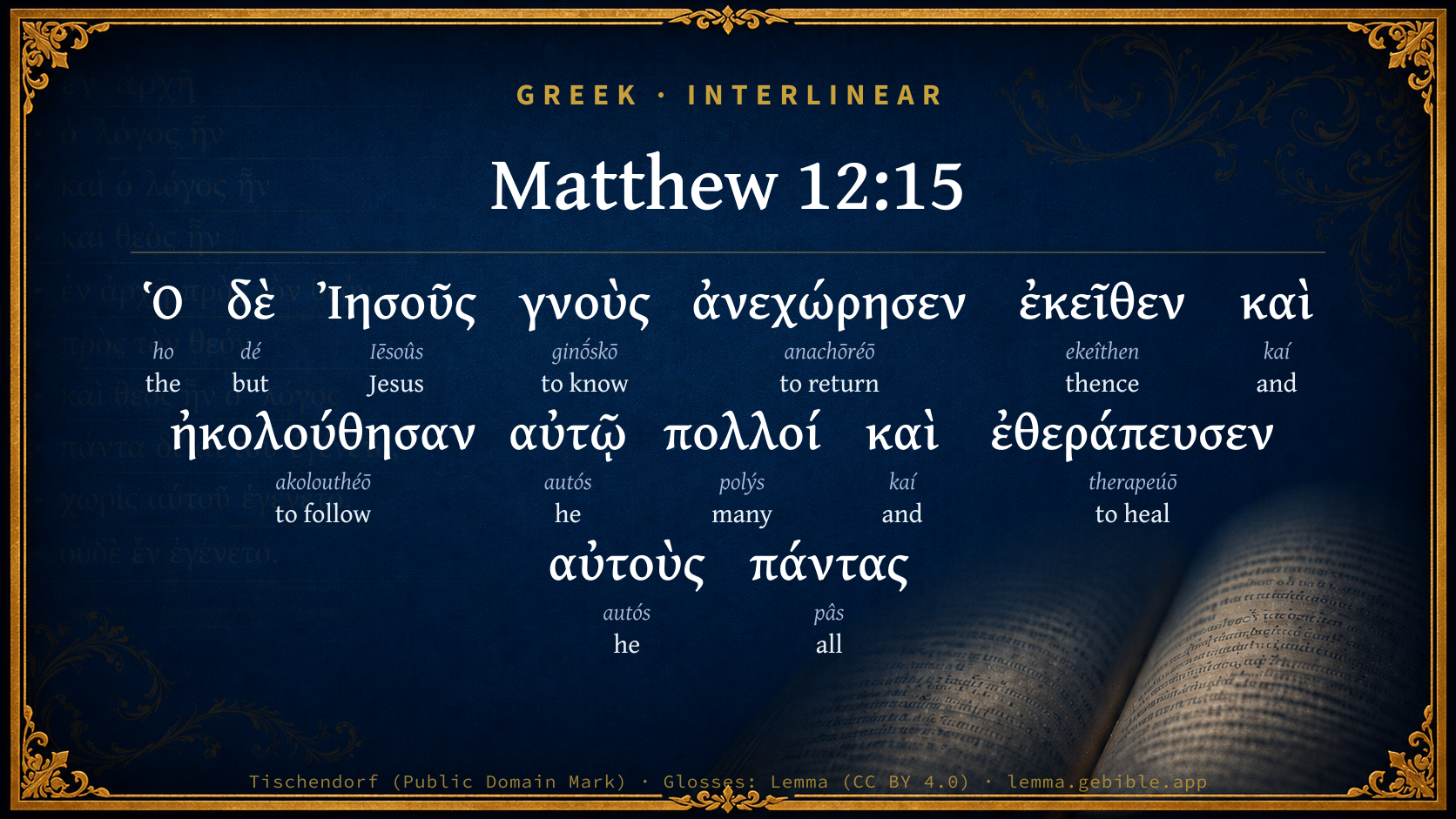
  1. Ὁ ho G3588 “the” Article, Nominative, Singular, Masculine
  2. δὲ dé G1161 “but” Conjunction
  3. Ἰησοῦς Iēsoûs G2424 “Jesus” Noun, Nominative, Singular, Masculine
  4. γνοὺς ginṓskō G1097 “to know” Verb, Aorist, Active, Participle, Nominative, Singular, Masculine
  5. ἐκεῖθεν ekeîthen G1564 “thence” Adverb
  6. καὶ kaí G2532 “and” Conjunction
  7. ἠκολούθησαν akolouthéō G190 “to follow” Verb, Aorist, Active, Indicative, 3rd person, Plural
  8. αὐτῷ autós G846 “he” Personal pronoun, Dative, Singular, Masculine
  9. πολλοί polýs G4183 “many” Adjective, Nominative, Plural, Masculine
  10. καὶ kaí G2532 “and” Conjunction
  11. ἐθεράπευσεν therapeúō G2323 “to heal” Verb, Aorist, Active, Indicative, 3rd person, Singular
  12. αὐτοὺς autós G846 “he” Personal pronoun, Accusative, Plural, Masculine
  13. πάντας pâs G3956 “all” Adjective, Accusative, Plural, Masculine

About this verse

These counts appear in no published source. They are computed here, from the morphology-tagged text and Lemma’s own curated glosses. What Lemma adds →

14
words
12
distinct lemmas
Gospels
section

Notable vocabulary

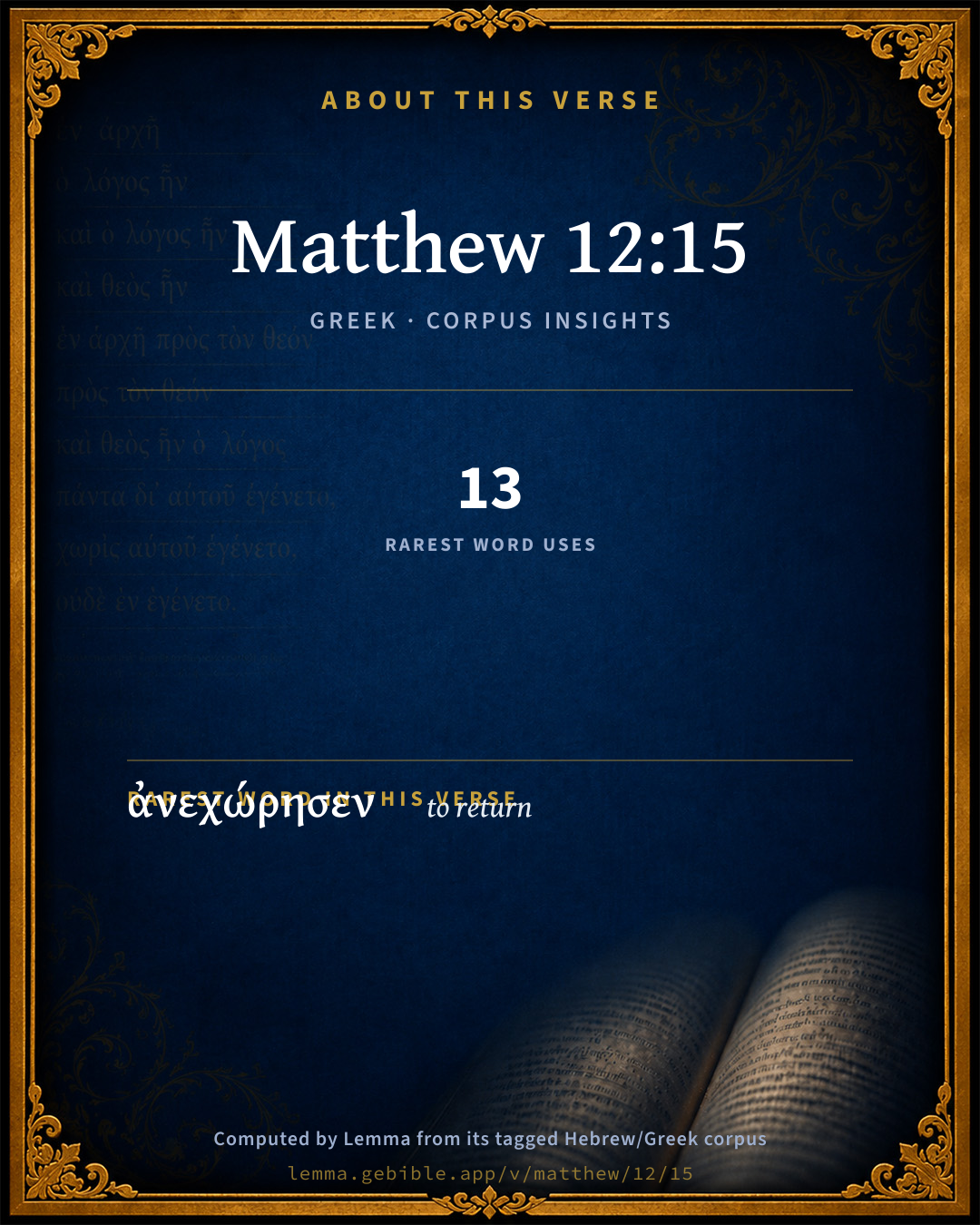
The rarest word here is ἀνεχώρησεν to return G402 — appearing just 13 times in the whole Greek New Testament.

Shared distinctive vocabulary

ἀνεχώρησεν to return G402 occurs in 13 verses of the Greek New Testament. Also found in:

Repetition

Words recur within this verse:

  • καὶ and G2532 ×2
  • αὐτῷ he G846 ×2

Cross-references

13

Topical passages linked to Matthew 12:15 in the Treasury of Scripture Knowledge — connected by theme and wording, ordered by reader-vote popularity; previews shown in the World English Bible.

  • Mark 3:7–12 Jesus withdrew to the sea with his disciples, and a great multitude followed him from Galilee, from Judea,
  • Matthew 10:23 But when they persecute you in this city, flee into the next, for most assuredly I tell you, you will not have gone through the cities of Israel, until the Son of Man has come.
  • Matthew 19:2 Great multitudes followed him, and he healed them there.
  • John 7:1 After these things, Jesus was walking in Galilee, for he wouldn't walk in Judea, because the Jews sought to kill him.
  • John 11:54 Jesus therefore walked no more openly among the Jews, but departed from there into the country near the wilderness, to a city called Ephraim. He stayed there with his disciples.
  • Matthew 4:23–25 Jesus went about in all Galilee, teaching in their synagogues, preaching the Gospel of the Kingdom, and healing every disease and every sickness among the people.
  • Mark 6:56 Wherever he entered, into villages, or into cities, or into the country, they laid the sick in the marketplaces, and begged him that they might touch just the fringe of his garment; and as many as touched him were made well.
  • John 10:40–42 He went away again beyond the Jordan into the place where John was baptizing at first, and there he stayed.
  • Luke 6:12 It happened in these days, that he went out to the mountain to pray, and he continued all night in prayer to God.
  • Luke 6:17–19 He came down with them, and stood on a level place, with a crowd of his disciples, and a great number of the people from all Judea and Jerusalem, and the sea coast of Tyre and Sidon, who came to hear him and to be healed of their diseases;
  • John 9:4 I must work the works of him who sent me, while it is day. The night is coming, when no one can work.
  • Galatians 6:9 Let us not be weary in doing good, for we will reap in due season, if we don't give up.
  • 1 Peter 2:21 For to this you were called, because Christ also suffered for us, leaving you an example, that you should follow his steps,

Cross-references courtesy of OpenBible.info (CC BY 4.0).

Commentary

Notes on Matthew 12:15 from classic Christian and Jewish commentators (each source and its license shown beneath its notes). The classic Christian expositions comment on the surrounding passage and are grouped to its opening verse, so a note may address several verses; the Jewish commentaries on the Tanakh (Rashi and others) are per-verse, so they appear only where the commentator wrote on this verse.

Lemma curates 59 commentaries, every one of them public domain or Creative Commons licensed, each selected and text-cleaned for this edition rather than reprinted as found. About our sources →

Lange's Commentary on the Holy Scriptures

2. Royal administration of Christ among the people in His retirement. Mat_12:15-21

15But when Jesus knew it, he withdrew himself11 from thence: and great multitudes16[many]12 followed him, and he healed them all; And charged them that they should not make him known: 17That it might be fulfilled13 which was spoken by Esaias 18[Isaiah] the prophet, saying, “Behold my servant [son],14 whom I have chosen; my beloved, in whom my soul is well pleased: I will put my Spirit upon him, and he shall shew [announce] judgment to the Gentiles. 19He shall not strive, nor cry; neither shall any man hear his voice in the streets. 20A bruised reed shall he not break, and smoking flax shall he not quench, till he send forth judgment unto victory. 21And in his name15 shall the Gentiles trust” (Isa_42:1-3).

EXEGETICAL AND CRITICAL

General Survey.—The reference of the Evangelist in this section to the more private activity of the Lord, applies to the whole period of His retirement from the persecutions of the Jewish hierarchy. It commenced at the festival of Purim, in 782, and closed with His public appearance on leaving the wilderness of Ephraim, before the Passover of 783. In the interval, He enjoyed only temporary seasons of rest, especially in Peræa. The following took place during this period: (1) The return over the Sea of Galilee to Gaulonitis, on the occasion of His coming to Galilee from the festival of Purim, when he was informed of the execution of John the Baptist ( Matthew 14); (2) a quiet journey through the country during the Easter festival, extending probably as far as Bethany, and return to Galilee (chs. 12 and 13); (3) a journey from Galilee, through the territory of Tyre and Sidon, and the northern highlands, to the eastern and western shores of the Lake of Gennesareth ( Matthew 15); (4) the return from Magdala, and over the lake, to the eastern mountains: (5) a secret journey through Galilee and the country, terminating in His sudden appearance at Jerusalem, at the Feast of Tabernacles, in the year 782 ( Matthew 16; Mat_17:1-21); (6) the last appearance of Jesus at Capernaum, and journey to Peræa through the country lying between Samaria and Galilee; (7) the first stay of Jesus in Peræa, and going up to Jerusalem to the Feast of the Dedication of the Temple; (8) the second stay in Peræa, and going to Bethany to raise Lazarus; (9) the retirement of Jesus to the wilderness of Ephraim, under the ban of the Sanhedrim, till the last Easter festival. The statement of the Evangelist refers more particularly to this period, although it applies, in general, to the whole life of Jesus.

Mat_12:15. He healed them all.—By healing their sick, He restored the people generally. Living connection between the healthy and the diseased.

Mat_12:16. And charged them.—This does not refer to their keeping the place of His residence secret, but to the duty of reserve in publishing His deeds and dignity as the Messiah. He was desirous of arresting for a time an open rupture between His carnal followers and His enemies.

Mat_12:17. In order that (ἵνα) it might be fulfilled, Isa_42:1.—Freely quoted from the original Hebrew. The expression, עֶבֶד יְהוִֹה, servant of Jehovah, in the second portion of the prophecies of Isaiah, must refer to the Messiah. As the idea of a personal Messiah had been clearly expressed in the first portion of these prophecies, the hermeneutical rule here applies, that a biblical doctrine can never pass from a definite to a more indefinite form. The interpretation of the Sept., applying the term to Jacob and Israel, only shows the peculiar Alexandrian tendencies of the translators. Possibly they may have been misled by the expression in Isa_8:14, although even there the terms, Jacob and Israel, should be taken in an ideal rather than a literal sense. The Chaldee Paraphrast and Kimchi apply the passage to the Messiah (comp. Isa_11:1 sqq.). The prophecy reads as follows: “Behold My servant, whom I establish (place firmly); Mine Elect, in whom My soul delighteth: I have put My Spirit upon Him; judgment to the nations (Gentiles) shall He bring. He shall not cry, nor be loud (lift up the voice, strain) and He shall not cause His voice to be heard outside (in the street, outside the camp). A bruised reed shall He not break, and the dimly-burning flax shall He not quench: according to truth (unto truth) shall He manifest (bring forth, complete) judgment. He shall not keep back (being wearied) nor (prematurely) break through (רָצַץ, transitive), till He have planted judgment on the earth: and the isles (the uttermost ends of the earth) shall wait for His law.”—This prophecy, then, is a verbal prediction in the strictest sense.16

Mat_12:18. Judgment.—Decisive final judgment, Joh_3:36.—To the Gentiles.—The multitudes which follow the Lord, in disregard of the condemnation of the Pharisees, were an emblem of the Gentiles. [Alford: “In these words the majesty of His future glory as the Judge is contrasted with the meekness to be spoken of: ‘And yet He shall not bruise.’ ”—P. S.]

Mat_12:20. A bruised reed and smoking flax.—An emblem of the people bowed and broken under the load of traditionalism.17 The poor people (or, in general, the poor in spirit, are not to inherit death, despair, and perdition in judgment, but) are to receive from the Lord, both spiritually and physically, a new life.

Till He send forth judgment unto victory [ἐκβάλῃ εἰς νῖκος τὴν κρίσιν, exire jusserit, cause it to issue in victory, so that no further conflict will remain].—An abbreviation and paraphrase of Isa_42:3 (לֶאֱמֶת, etc.) and 4 (עַר־יָשִׁים, etc.). The judgment is to be transformed into a victory of truth, or into an absolute victory. This was implied in the expressions used by the prophet, but is brought out more distinctly in the text of the Evangelist. The word ἐκβάλῃ (comp. Mat_9:38) indicates great power, overcoming all resistance.

Mat_12:21. In His name.—In the original, לְתוֹרָתוֹ. The Sept. renders it as in Matthew, substituting name for law.18 The name of the Messiah implies the principle, the summary of His doctrine. Meyer: “The Gentiles will trust, on the ground of what His name as the Messiah implies.” This view is supported by the use of the dative, τῷὀνόματι.

DOCTRINAL AND ETHICAL

1. The breach between the Messiah and His people widens. The King is rejected, and His sufferings approach a crisis. This implied, at the same time, a breach between the enemies and the adherents of Jesus in Israel, which in turn typified that which would ensue between unbelieving Israel and the believing Gentiles.

2. On this occasion, the peculiar manner in which Jesus was to administer His kingly office appeared more clearly than ever before. He might now have manifested Himself as Judge, broken the bruised reed and quenched the smoking flax. But instead of that, He retired, and adopted a more private mode of working, in anticipation of His full and final sufferings. Accordingly, the Evangelist most aptly applies the prediction of Isaiah to this period of retirement; because, while characteristic of the activity of Jesus generally, it referred specially to this year of persecution.

3. Christ fled for His enemies, while He retired from them. His was not the flight of fear. He always addressed Himself only to those who were susceptible—i. e., to those who labored and were heavy laden—not to judge, but to save them.—The time for His final sufferings had not yet come; there was still ample room for active work, although of a more private character. On this ground He now retired, and dwelt chiefly with the poor people, among whom also He displayed the greatest number of His miraculous deliverances.

HOMILETICAL AND PRACTICAL

Christ’s retirement from His enemies a solemn sign,—1. not of fear or weakness; but, 2. of power, of wisdom, of compassion, and of judgment.—The Lord can never want a Church.—Jesus; or, perfect patience amid an impatient world.—The patience and meekness of Jesus as predicted by the prophets.—Christ the Elect of God.—Christ the Root of the elect.—Patience, endurance, and perseverance, the evidence of election.—The Elect the servant of God.—God’s beloved Son His perfect Servant. 1. As Servant, the Redeemer of the world; 2. as Son, the ground and object of the world’s redemption.—Christ the true Friend of the people.—Jesus the Saviour of nations.—The patience and meekness of Christ overcoming the world.

Starke:—Quesnel: It is good sometimes to remain concealed with Christ, whether it be from humility or from necessity.—Jesus Christ above all the Servant of God, and alone worthy to serve Him.—Oh, how lovable is meekness in the servants of Christ! He who loves strife and debate cannot be His.—Zeisius: Christ in the form of a servant, Php_2:7-8.—Let our courage never fail, truth must prevail.—Christ the hope, not only of Israel, but of the Gentiles.

Gossner:—It is characteristic of the Lord that He quietly proceeded on His way and accomplished His work without noise and commotion. Many seem to do a great deal and yet accomplish nothing.—If we hold a smoking flax to the fire, it is easily kindled again.

Heubner:—Where there is even a germ of good, there is still hope.—The bruised reed: a soul bowed down under a sense of sin.—Smoking flax: a soul in which a spark of the Divine life is still left.

Footnotes:

[11] Mat_12:15.—[Ἰησ. γνοὺς ἀνεχώςͅησεν: “Jesus knowing” it, i.e. (as Lange inserts in the text in small type), that they sought to destroy His life, “withdrew Himself.”—P. S.]

[12] Mat_12:15.—Lachmann, on the authority of Cod. B. and the Latin Vulgate, omits ὅχλοι. The omission was probably exegetical, to avoid the appearance of exaggeration in what follows. [Cod. Sinait. sustains Lachmann and, like the Vatican Cod., in Mai’s and in Buttmann’s edition, reads simply πολλοί.—P. S.]

[13] Mat_12:17.—[This is the proper transl. of ἵνα (or ὅπως) πληρωθῇ. Not: and thus was fulfilled, as Webster and Wilkinson in loc. explain, which is superficial and ungrammatical. ̔Ἴνα is not to be taken ἐκβατικῶς, but τελικῶς; it signifies not simply the result, but the divine purpose and aim. Comp. Meyer on Mat_1:23, and Lange in the Exeg. note on Mat_12:17—P. S.]

[14] Mat_12:18.—The Lord (as also the Sept. in the passage alluded to, Isa_42:1) uses the word ὁπαῖς μου, not the more usual ὁδοῦλος μου, for the Hebrew עַבדּי, a significant change, which Dr. Lange overlooks, as he translates: mein Knecht. See Exeg. note on Mat_12:17, etc.—P. S.]

[15] Mat_12:21.—[Text. rec.: ἐν τῷ ὀνόματι. But Lachmann, Tischendorf, Alford, Wordsworth, etc., omit ἐν, on the best critical authorities. Meyer: “ἐν is an addition, as also ἐπί in Euseb. and some minuscule MSS.” This is the only case in the N. T. where ἐλπιζειν is constructed with the simple dative, although it is good Greek (comp. Thucyd iii. 97) and signifies the cause and object of hope. Elsewhere, as in the LXX, the verb is constructed with ἐν, εἱς, or ἐπί.—P. S.]

[16][Dr. Wordsworth calls this quotation, Mat_12:17-21, a remarkable specimen of the manner in which the Holy Spirit, speaking by the evangelists, deals with the prophecies of the Old Test. in order to interpret them. “Ινα (or ὅπως) πληρωθῇ τὸ δηθεν, is the form used by the evangelists when this process of divine exposition is performed. It is the title of an evangelical targum or paraphrase. For the Hebrew עַבְדִּי, my servant, the Lord does not say ὁδοῦλος μου, my servant (as the Septuagint usually translates, though not in this passage), but ὁπαῖς μου, which admits of a double sense, servant and son (comp. Act_3:13; Act_3:26; Act_4:27; Act_4:30), and suggests the union of the obedience of the servant and the dearness of the son in the person of Christ. In a similar way Wordsworth explains the other modifications of the words of the prophecy here quoted.—P. S.]

[17][A proverbial expression for. “He will not crush the contrite heart, nor extinguish the slightest spark of repentant feeling in the sinner.” Alford.—P. S.]

[18][The LXX renders: ἐπὶ τῷ ὀνόματι, Matthew, according to the true reading: τῷ ὀνόματι, without preposition. Both followed another Hebrew reading: לִשְמוֹ for לְתוֹרֶתוֹ.—P. S.]

Lange's Commentary on the Holy Scriptures (Critical, Doctrinal, and Homiletical), ed. John Peter Lange, English translation edited by Philip Schaff (1864–1880) — public domain. Text from a community e-Sword module.

Godbey's Commentary on the New Testament

William B. Godbey

CHAPTER 15

THE FIRST AND SECOND COMING OF CHRIST

Mat 12:15-21. “And Jesus, knowing, departed thence [i.e., when He ascertained that the Pharisees and Herodians were counseling to kill Him, He departed from that place where He had healed the withered hand on the Sabbath]; and many multitudes followed Him, and He healed them all.” What a wonderful Physician we have! He never fails to cure the patient, our own faith being the measuring-line of His efficiency, whether for soul or body. When your work is done, and the Lord is ready to take you to heaven, though you will have abundance of faith for your soul to sweep into glory, you will have no faith for your body to be healed. That will be a glorious day, because heaven is so much better than health.

“He charged them that they may not make Him known,” — i.e., the notoriety of His mighty works would excite the multitude to crown Him King, as the Jews all understood that Christ was to be their King, and they were so tired of the Roman yoke, which they had carried thirty years. O how they longed for Messiah to come and break it off their necks!

“In order that the word spoken by Isaiah the prophet may be fulfilled, saying, Behold My Servant, whom I have chosen, My Beloved in whom my soul delighteth; I will place My Spirit upon Him, and He will proclaim judgment to the Gentiles.” This is a beautiful prophetical allusion to the glorious coming of our Lord, when He shall girdle the globe with the splendors and triumphs of His Millennial Theocracy, all the nations of the earth gladly bowing down to His benignant, equitable, and heavenly administration, bringing back the bright days of Eden, which have so long lingered only in the memories of the past, while the nations will “beat their swords into plowshares and their spears into pruning-hooks, and learning war no more.” The sad memories of the long, bloody ages, which have ground down the nations of the earth into the dust of degradation and oppression, and whitened the plains, will be forgotten, amid universal peace, prosperity, philanthropy, and happiness, all nations delighted with the mild and amiable reign of the glorious King of kings and Lord of lords.

“He shall not strive, nor scream, neither shall any one hear His voice in the streets.” Paul says, “It does not behoove the man of God to strive.” Hence, in harmony with Jesus and Paul, while we should earnestly “contend for the faith once delivered to the saints,” we should not do it in a controversial spirit, but love predominating, having no desire for self- aggrandizement, but only the glorification of God in the proclamation and vindication of truth. There is nothing in this passage against street- preaching, which Jesus and His apostles practiced all their lives. While the people of God preach on the streets, and everywhere else, they are characterized by meekness, humility, and love, in contradistinction to the selfish and uproarious manner of worldly people, shouting aloud, advertising their merchandise, and prosecuting their various secular employments. There is a quietness, resignation, and humiliation peculiar to the saints, most decisively contrastive with the rush and precipitation peculiar to the worldly rabble. This verse lucidly describes Jesus in His humiliation, contrastively with the preceding, which describes Him in His glorious dominion.

“The bruised reed, He will not break.” This is a beautiful symbolism of the humble penitent, crying to God with a broken heart and a contrite spirit. “He will not quench the smoking flax.” Here we have a vivid symbolism of the struggling soul, crying to God for the sanctifying baptism of the Holy Ghost and fire. “Until He may send forth judgment unto victory.” Here we have both works of grace in beautiful juxtaposition the former, describing the agonizing penitent under the strong figure of a bruised reed, which Satan is trying to break and destroy forever; and the hatter, under the vivid metaphor of the flax, smoking and trying to burn, and the enemy throwing on it the chilling waters to put it out, thus beautifully typifying the seeker after a clean heart, longing for the sin — consuming fires of the Holy Ghost from heaven to fall. In both of these cases, it is here certified that our Savior will “send forth judgment unto victory” in the case of the poor sinner seeking pardon — i.e., “the bruised reed;” since He has bled and died, and paid all the debt He owes, in the full light of heavenly jurisprudence, He can give an eternal judgment of acquittal, thus justifying Him freely through the atonement. The fact is equally pertinent in the case of the Christian seeking full sanctification by the refining fire going through the heart in sin-consuming flames — i.e., “the smoking flax;” instead of extinguishing with the cold water of dead formality, He fans it into a roaring flame, wrapping the soul in the copious baptism of the Holy Ghost and fire. As the complete expurgation of every sinful taint has been abundantly provided for in the cleansing blood and the refining fire, He can, in the full light of heavenly jurisdiction, administer a verdict in favor of the entire sanctification of all who approach Him by way of complete consecration and doubtless faith.

“And in His name shall the Gentiles hope.” (Isa 42:1.)

He is the “Lion of the tribe of Judah,” whose roaring reverberates round the world, His tread shaking every hand, and His power breaking every chain, and liberating the captive nations whom Satan has bound through the ages.

William B. Godbey, Commentary on the New Testament (1896–1900) — public domain. Text from a community e-Sword module.

Tyndale Open Study Notes

Tyndale Open Resources

12:15-21 This summary of Jesus’ ministry clarifies Jesus’ nature as the Messiah, the Servant of God who will bring salvation to the nations (see Isa 42:1-4).

Tyndale Open Study Notes — © Tyndale Open Resources, licensed CC BY-SA 4.0. Text via the HelloAO Bible API.

Bengel's Gnomon

Johann Albrecht Bengel

Mat 12:15. Ἀνεχῶρησεν, He departed This is especially referred to in Mat 12:19. Our Lord avoided noise.

Bengel's Gnomon of the New Testament — English translation (T&T Clark, Edinburgh, 1860) — public domain. Text from a community e-Sword module.

Meyer's Critical & Exegetical Commentary

Heinrich August Wilhelm Meyer

Mat_12:15 ff. Mat_12:17-21 are peculiar to Matthew.

αὐτοὺς πάντας] all the sick who were among the multitudes. Indefinite expression. On the condensed style of Matthew , 15 f., comp. Mar_3:7 ff.; Luk_6:17 ff.

Mat_12:16. He gave them strict injunctions, in order that, and so on (Mat_16:20, Mat_20:31); for He did not wish, by creating too great a sensation, to provoke His enemies to proceed to extremities before the time. Comp. on Mat_8:4.

Mat_12:17. This ἐπετίμ. αὐτοῖς was designed, in accordance with the divine order in history, to fulfil the prophecy that the Messiah was to act without anything like ostentatious display in His proceedings. On the silent majesty of Jesus, comp. Dorner, Jesu sündlose Vollkommenh. p. 28 ff.

Meyer — Critical and Exegetical Commentary on the New Testament — English translation by Peter Christie, edited by Frederick Crombie (T&T Clark, 1880) — public domain. Text from a community e-Sword module.

Expositor's Greek Testament

ed. W. Robertson Nicoll

Mat 12:15-21 . Jesus retires; prophetic portraiture of His character . Mat 12:15-16 are abridged from Mar 3:7-12 , which contains an account of an extensive healing ministry. The sequel of the Sabbatic encounter is very vague. The one fact outstanding and noteworthy is the withdrawal of Jesus, conscious of having given deep offence, but anxious to avoid tragic consequences for the present. It is to that fact mainly that the evangelist attaches his fair picture of Jesus, in prophetic language. It is happily brought in here, where it gains by the contrast between the real Jesus and Jesus as conceived by the Pharisees, a miscreant deserving to die. It is not necessary to suppose that the historical basis of the picture is to be found exclusively in Mat 12:15-16 , all the more that the statement they contain is but a meagre reproduction of Mar 3:7-12 , omitting some valuable material, e.g. , the demoniac cry: “Thou art the Son of God”. The historic features answering to the prophetic outline in the evangelist’s mind may be taken from the whole story of Christ’s public life as hitherto told, from the baptism onwards. Luke gives his picture of Jesus at the beginning (Mat 4:16-25 ) as a frontispiece, Matthew places his at the end of a considerable section of the story, at a critical turning point in the history, and he means the reader to look back over the whole for verification. Thus for the evangelist Mat 12:18 may point back to the baptism (Mat 3:13-17 ), when the voice from heaven called Jesus God’s beloved Son; Mat 12:19 to the teaching on the hill (Mat 12:5-7 ), when the voice of Jesus was heard not in the street but on the mountain top, remote from the crowd below; Mat 12:20 to the healing ministry among the sick, physically bruised reeds, poor suffering creatures in whom the flame of life burnt low; Mat 12:21 to such significant incidents as that of the centurion of Capernaum (Mat 8:5-13 ). Broad interpretation here seems best. Some features, e.g. , the reference to judgment, Mat 12:20 , second clause, are not to be pressed.

The quotation is a very free reproduction from the Hebrew, with occasional side glances at the Sept [73] It has been suggested that the evangelist drew neither from the Hebrew nor from the Sept [74] , but from a Chaldee Targum in use in his time (Lutteroth). It is certainly curious that he should have omitted Isa 42:4 , “He shall not fail nor be discouraged,” etc., a most important additional feature in the picture = Messiah shall not only not break the bruised reed, but He shall not be Himself a bruised reed, but shall bravely stand for truth and right till they at length triumph. Admirable historic materials to illustrate that prophetic trait are ready to our hand in Christ’s encounters with the Pharisees (Mat 9:1-17 , Mat 12:1-13 ). Either Matthew has followed a Targum, or been misled by the similarity of Isa 42:3-4 , or he means Mat 12:20 to bear a double reference, and read: He shall neither break nor be a bruised reed, nor allow to be quenched either in others or in Himself the feeble flame: a strong, brave, buoyant, ever-victorious hero, helper of the weak, Him self a stranger to weakness. ᾑρέτισα (Mat 12:18 ), an Ionic form in use in Hellenistic Greek, here only in N. T., often in Sept [75] = αἱρέομαι . Hesychius under ᾑρετισάμην gives as equivalents ἠγάπησα , ἐπιθύμησα , ἠθέλησα , ἠράσθην . κραυγά . σει (Mat 12:19 ), late form for κράζω . Phrynichus, p. 337, condemns, as illiterate, use of κραυγασμός instead of κεκραγμός . On the words οὐδὲ κρ . Pricaeus remarks: “Sentio clamorem intelligi qui nota est animi commoti et effervescentis”. He cites examples from Seneca, Plutarch, Xenophon, etc. ἀκούσει is late for ἀκούσεται . Verbs expressing organic acts or states have middle forms in the future ( vide Rutherford, New Phrynichus , pp. 138, 376 412). ἕως , Mat 12:20 , followed by subjunctive, with ἄν , as in classics, in a clause introduced by ἕως referring to a future contingency. τῷ ὀνόματι , Mat 12:21 , dative after ἐλπιοῦσιν ; in Sept [76] , Isa 42:4 , with ἐπί . This construction here only in N. T.

[73] Septuagint.

[74] Septuagint.

[75] Septuagint.

[76] Septuagint.

The Expositor's Greek Testament, edited by W. Robertson Nicoll (1897–1910) — public domain. Text from a community e-Sword module.

Jamieson, Fausset & Brown

Robert Jamieson, A. R. Fausset & David Brown

But when Jesus knew it, he withdrew himself from thence--whither, our Evangelist says not; but Mark (Mar 3:7) says "it was to the sea"--to some distance, no doubt, from the scene of the miracle, the madness, and the plotting just recorded.

and great multitudes followed him, and he healed them all--Mark gives the following interesting details: "A great multitude from Galilee followed Him, and from Judea and from Jerusalem, and from Idumea, and from beyond Jordan; and they about Tyre and Sidon, a great multitude, when they had heard what great things He did, came unto Him. And He spake to His disciples, that a small ship should wait on Him because of the multitude, lest they should throng Him. For He had healed many; insomuch that they pressed upon Him for to touch Him, as many as had plagues. And unclean spirits, when they saw Him, fell down before Him, and cried, saying, Thou art the Son of God. And He straitly charged them that they should not make Him known" (Mar 3:7-12). How glorious this extorted homage to the Son of God! But as this was not the time, so neither were they the fitting preachers, as BENGEL says. (See on Mar 1:25, and compare Jam 2:19). Coming back now to our Evangelist: after saying, "He healed them all," he continues:

Jamieson, Fausset & Brown — Commentary Critical and Explanatory on the Whole Bible (1871) — public domain (CC PDM 1.0). Text via the HelloAO Bible API.

Adam Clarke's Commentary

Verse 15. Jesus - withdrew himself from thence] It is the part of prudence and Christian charity not to provoke, if possible, the blind and the hardened; and to take from them the occasion of sin. A man of God is not afraid of persecution; but, as his aim is only to do good, by proclaiming every where the grace of the Lord Jesus, he departs from any place when he finds the obstacles to the accomplishment of his end are, humanly speaking, invincible, and that he can not do good without being the means of much evil. Yield to the stream when you cannot stem it.

Great multitudes followed him, and he healed them all] The rejection of the Gospel in one place has often been the means of sending it to and establishing it in another. Jesus healed all that followed him, i.e. all who had need of healing, and who desired to be healed; for thus the passage must be understood: - and is he not still the same? No soul shall ever implore his healing power in vain; but let it be remembered, that only those who follow Christ, and apply to him, are healed of their spiritual maladies.

Adam Clarke's Commentary on the Bible (1810–1826) — public domain. Text from a community e-Sword/MySword module.

Ellicott's Commentary for English Readers

(15) He withdrew himself from thence.—The coalition of the two dominant parties led to a temporary retirement from Capernaum as the usual scene of His labours. In this matter He was setting forth in act, as an example, the rule which He had previously given as a precept (Mat_10:23).

He healed them all—i.e., all that had need of healing, and fulfilled its conditions.

A Bible Commentary for English Readers, edited by Charles John Ellicott (1878–1897) — public domain. Text from a community e-Sword module.

The Cambridge Bible for Schools and Colleges

gen. ed. J. J. S. Perowne

15. he withdrew himself from thence] See ch. Mat_10:23. Jesus follows the principle which He laid down for His disciples’ guidance.

The Cambridge Bible for Schools and Colleges (gen. ed. J. J. S. Perowne; Cambridge University Press, 1878–1918) — public domain. Text from a community e-Sword module.

John Gill's Exposition

Behold, my servant whom I have chosen,.... These are the words of God the Father, speaking to the church, concerning Christ, as mediator; who, as such, is God's servant, employed by him, and obedient to him, in the work of man's salvation; and is a righteous, faithful, prudent, and diligent one; whom he, from all eternity, had chosen to this service, and in the fulness of time sent him to do it, and supported and upheld him in it; for it is whom I uphold, in the Hebrew text. My beloved, in whom my soul is well pleased; who always was the object of his love, not only as his own and only begotten Son, but as in his office capacity, as mediator; in regard to which he was his elect, as it is in Isaiah; and, as such, he was always delighted in his person, well pleased with his office, and the discharge of it, and which he declared more than once by a voice from heaven, as at his baptism, and at his transfiguration on the mount: I will put my Spirit upon him; as he did without measure, whereby he was abundantly qualified for his whole work, and particularly for preaching the Gospel, being richly anointed with gifts and graces, above his fellows; of which the descent of the Holy Spirit upon him, as a dove at his baptism, which immediately preceded his public ministry, was a symbol. And he shall show judgment unto the Gentiles; meaning, not the general judgment, at the last day, which is committed to him; nor the laws of Justice and equity; but the Gospel, which is the produce of the God of judgment; best informs the judgment of men about the business of salvation; gives an account of the righteous procedure of God in justifying sinners, by the righteousness of his Son; and teaches men to live soberly, righteously, and godly: this Christ brought forth, and showed, at this time, to the Heathens, the Idumeans, Tyrians, and Sidonians; who flocked unto him; whereby this part of the prophecy had its fulfilment: in the Hebrew it is, "he shall bring forth"; that is, out of his heart and mouth, and is the same as "show" here.

Behold, my servant whom I have chosen,.... These are the words of God the Father, speaking to the church, concerning Christ, as mediator; who, as such, is God's servant, employed by him, and obedient to him, in the work of man's salvation; and is a righteous, faithful, prudent, and diligent one; whom he, from all eternity, had chosen to this service, and in the fulness of time sent him to do it, and supported and upheld him in it; for it is whom I uphold, in the Hebrew text. My beloved, in whom my soul is well pleased; who always was the object of his love, not only as his own and only begotten Son, but as in his office capacity, as mediator; in regard to which he was his elect, as it is in Isaiah; and, as such, he was always delighted in his person, well pleased with his office, and the discharge of it, and which he declared more than once by a voice from heaven, as at his baptism, and at his transfiguration on the mount: I will put my Spirit upon him; as he did without measure, whereby he was abundantly qualified for his whole work, and particularly for preaching the Gospel, being richly anointed with gifts and graces, above his fellows; of which the descent of the Holy Spirit upon him, as a dove at his baptism, which immediately preceded his public ministry, was a symbol. And he shall show judgment unto the Gentiles; meaning, not the general judgment, at the last day, which is committed to him; nor the laws of Justice and equity; but the Gospel, which is the produce of the God of judgment; best informs the judgment of men about the business of salvation; gives an account of the righteous procedure of God in justifying sinners, by the righteousness of his Son; and teaches men to live soberly, righteously, and godly: this Christ brought forth, and showed, at this time, to the Heathens, the Idumeans, Tyrians, and Sidonians; who flocked unto him; whereby this part of the prophecy had its fulfilment: in the Hebrew it is, "he shall bring forth"; that is, out of his heart and mouth, and is the same as "show" here.

Matthew 12:19

mat 12:19

mat 12:19

mat 12:19He shall not strive,.... Or contend in a wrangling way, as the disputers of this world do about words to no profit, and for the sake of victory only, and popular applause, but shall choose rather to withdraw, than to carry on a controversy to a great length, to little purpose; or, as men litigate a point in a court of judicature, where one is plaintiff, and the other defendant. In the Hebrew text it is, "he shall not cry"; he shall not act the part of a plaintiff; he shall not complain, or bring in any charge, or accusation against any, but choose rather to suffer wrong, than to contend: thus signifies such a cry, as is a complaint of injustice, Isa 5:7 and a plaintiff, one that brings an action against another (l): but Christ did not so, he would not accuse to the Father, nor complain against his most implacable enemies, but left that to Moses, in whom they trusted; "nor cry", or, as in the Hebrew text, lift up; that is, his voice, in a clamorous way, using reviling and opprobrious language, or menaces and threatenings; but, on the contrary, he silently put up all abuses, and patiently bore every affront, and behaved peaceably, quietly, committing himself and cause to a righteous God.

Neither shall any man hear his voice in the streets; or, as in the Hebrew text, "nor cause his voice to be heard in the street": the sense is the same, and the meaning is, that he sought not worldly honour, popular applause, and to be seen of men; he did nothing in an ostentatious way, said nothing in his own commendation, was never heard to praise himself, and chose that others should be silent concerning him: for this does not so much regard the lowness of his voice, as if that was not so sonorous as to be heard without doors, when he preached within, as his modest mein and suitable deportment; nor the places where he usually ministered, which was sometimes in the street, as well as in an house, or on a mountain, or by the sea side, or in the temple, and the synagogues. The Ethiopic version here is very wrong, "no man shall hear his voice in the synagogues"; for his voice was often heard there.

(l) Vid. Cocc. Heb. Lex. in rad.

John Gill's Exposition of the Whole Bible (1746–1763) — public domain (CC PDM 1.0). Text via the HelloAO Bible API.

Trapp's Complete Commentary

John Trapp

15 But when Jesus knew it, he withdrew himself from thence: and great multitudes followed him, and he healed them all;

Ver. 15. Great multitudes followed him] Maugre the malice of earth and hell. They lose their labour that seek to quell Christ, and subvert his kingdom: "Yet have I set my king upon mine holy hill of Sion," Psa 2:6; "The kingdom of heaven suffereth violence," Mat 11:12. Or (as Melancthon rendereth that text), Vi erumpit, procedit, enititur: vi scilicet spirituali, ut sol enititur per nubes: ergo irriti hostium conatus. It bursts through all, βιαζεται.

John Trapp, A Commentary or Exposition upon All the Books of the Old and New Testament (1647–1656) — public domain. Text from a community e-Sword module.

Matthew Poole's English Annotations

Here is nothing in these two verses but what we have before met with: the multitudes have followed Christ in all his motions, from his first beginning to preach and to work his miraculous operations.

He healed them all, must be understood of those that were sick. The charge he gives is the same which we have often met with, of which no satisfactory account can be given, further than that, knowing his time was not yet come, and he had much work to do before his death, he useth all prudent means to preserve his life, reserving himself for the further work which his Father left him to do. The publishing of his miracles would have made a great noise, and possibly have more enraged the Pharisees against him; neither did he seek his own glory, but the glory of him that sent him.

Matthew Poole's English Annotations on the Holy Bible (1683–1685) — public domain. Text from a community e-Sword/MySword module.

The Pulpit Commentary

Vers. 15-21. Jesus withdraws, and although many follow him and are healed by him, he charges them not to make him known, thus fulfilling the prophecy of the Ideal Israelite, who is the object of God"s love and delight, and will receive his Spirit and declare the revelation of him to the Gentiles; he will not strive or exalt himself, or use harshness towards the weak; and his meekness shall last until he has succeeded in his purpose of revealing God to men; for he shall succeed, and he shall be the object of the Gentiles" hope.

Vers. 15, 16 are found essentially in Mar_3:7, 12; the remainder of this section, the application of prophecy here only. But when Jesus knew it; and Jesus perceiving it (Revised Version). Whether by his own unaided powers, or by intelligence brought him, is not stated. He withdrew himself (cf. Mat_4:12, he departed, note) from thence. We see from the next clause that this withdrawal was not into any very retired spot, but rather away front the town in which he had been. His motives may have been partly to carry on his work more quietly elsewhere, (fulfilling his own injunction, Mat_10:23) and partly to avoid stirring up the excitement of partisans like those who a little later wished to seize him by force and make him king. (Joh_6:15, where observe "withdrew And great multitudes followed him, and he healed them all. Almost verbally in Mat_19:2.

Vers. 15-21. The patience of Christ.

I HIS RETIREMENT.

1. Its reason. It was not fear; his hour was not yet come. He fled, it has been said, not only from his enemies, but for them. He would not bring upon them the guilt of his death; he would give them time, "yet another year;" he would try what could be done by patience and gentleness and self-denying love. He would not stimulate their malice by remaining m their neighbourhood. When men are heated in disputes and controversies, it is best sometimes to retire. Persistence may stir up wrath all the more, and perhaps increase the sin of those who are arguing on the wrong side, influenced by party spirit, or, it may be, by evil motives.

2. Its occupation. The Lord could not be alone. The Pharisees hated him; but great multitudes followed him still. Some sought his teaching; some sought his mercy. He listened, as he ever did, to the cry of pain and sorrow; he healed all that had need of healing. The opposition of his enemies did not dishearten him; it did not turn him aside from his works of love. Good men are sometimes very much cast down by opposition. They lose heart; they sink into melancholy, as Elijah did; they think that their life has been wasted; they can work no longer. It was not so with the Lord Christ. He retired, but it was to another field of labour. His servants must never give way to despondency; it implies distrustfulness, doubt of their Lord.

3. Its privacy. He charged the multitude that they should not make him known. He was content that his holy deeds of Divine love should remain unknown; he was willing to work on in obscurity. He did not seek the praise of men; he sought only to save souls. So his servants should be willing to work either in private or in public, either in remote corners or before the eyes of men, wherever it may please God to set them. But everywhere alike, in the little village or in the great city, they must seek only his glory; not human praise, earthly reputation.

II THE FULFILMENT OF PROPHECY.

1. The servant of Jehovah. Isaiah had prophesied of the Messiah, and now the same God who had inspired the prophet was bringing to pass the prophecy. The Lord Christ came to fulfil the Law and the prophets; the details of his blessed life were so ordered as to bring about that great end, to fulfil all that had been written of him. The prophecy came from God; the fulfilment also was regulated by his overruling providence. Isaiah, the evangelical prophet, had faithfully portrayed the character of the Christ. tie was to be the Servant of Jehovah. "I came," he said, "not to do my own will, but the will of him that sent me;" "I have finished the work which thou gavest me to do." He was the Servant of whom Isaiah prophesied; he was the Beloved, the Elect of God, for it pleased the Father by him to reconcile all things unto himself. At his baptism the voice from heaven proclaimed that in him the Father was well pleased; then he was anointed with the Holy Spirit, and consecrated for his Divine mission. He would proclaim judgment to the Gentiles, when he would send his apostles into all the world to preach the gospel to every creature. Such was the prophet"s description of the Servant of Jehovah, and such was Jesus the Christ.

2. His quietness. "He shall not strive." It was even now fulfilled; he had withdrawn from strife. He loved not strife. His disciples must learn of him; they must avoid, as far as lieth in them, angry disputes and the heated atmosphere of controversy. "He shall not cry." His preaching was not noisy or violent; it was calm, quiet, dignified. He delighted not in uproar and excitement, but in quiet communion with God. His disciples differ from one another; they present different aspects of the Christian character; "the Holy Spirit divideth to every man severally as he will;" but we may say that a holy calmness is generally one of the characteristic marks of the most advanced followers of Christ.

3. His gentleness.

(1) "A bruised reed shall he not break." There were many bruised reeds then among those who sought his help; there are many such among his disciples now weak, trembling Christians with little strength, bowed down with sorrow, bruised by many a trial, by many temptations, and, it may be, by many weak concessions to the tempter. He wilt not break them; they are fearful, trembling, full of anxious doubts. He is gentle exceedingly; such should his servants be.

(2) "Smoking flax shall he not quench." He will not despise the least spark of spiritual life. The flax may burn dimly, very dimly; but if it burn at all, there is hope. If there is any tenderness of conscience, any sense of sin, any yearning after God, however feeble and intermittent, there is the possibility of conversion, of sanctification, even of saintliness. He will not quench the smoking flax; nay, he will fan it into a bright, clear flame. He will not by harshness or sternness check the faintest aspirations after holiness; he will deepen, strengthen, guide them by the influence of his Holy Spirit. For it was to save our souls that he came down from heaven and gave himself to die; therefore every human soul is precious exceedingly in the sight of the Lord. He will not lightly lose that which he prized so highly; he will cherish the slightest flickering of the flame of life in the weak, dying soul. Then quench not the Spirit; quench it not in thyself by sin or by despondency; quench it not in others by harshness or contempt. Listen to the softest whisper of the blessed Spirit of God. Listen like Samuel; it will fill thy whole being with its pervading influence. But if, like Saul, thou persist in disobedience, the end at last must be like the end of Saul Spirit of the Lord departed from Saul, and an evil spirit from the Lord troubled him.

4. His success at last. This quiet gentleness will result in victory. He will persevere, winning souls, one by one, by the soft holy influence of his constraining love. "He shall not fail, nor be discouraged, till he have set judgment in the earth"; (Isa_42:4) "He shall bring forth judgment unto truth;" he shall at length be recognized as King and Judge. His judicial decision between right and wrong, his rule of holiness, shall at last prevail. It will be the victory of truth and righteousness; and that not only in the Holy Land, among the chosen people. "In his Name shall the Gentiles hope." "The isles shall wait for his law." "They shall wait, and not wait in vain; for he is the Saviour of all men a Light to lighten the Gentiles." He will send forth his holy Law, the Divine Law of love, to draw all men to himself by the attractive power of his cross. Such is the picture which the prophet draws of the Christ a picture in which we see the strength of gentleness, the majesty of love. These are the weapons by which the Saviour overcometh the world. His disciples must learn of him. "In quietness and in confidence shall be your strength." Gentleness and Christian love win more hearts than sternness and severity.

LESSONS.

Study the prophecies of the Old Testament, they give us precious views of the Messiah"s character and teaching.

1. He was the Servant of Jehovah; we are his servants; we should strive to do his will, as he ever did the will of the Father.

2. Imitate his quietness; shun violence and party spirit; cherish a holy quiet in the soul.

3. Be gentle like the Lord, kind to the weak and fearful; great is the strength of gentleness.

The Pulpit Commentary (1880–1919), ed. H.D.M. Spence-Jones & Joseph S. Exell — public domain. Text from a community e-Sword module.

Kretzmann's Popular Commentary

Paul E. Kretzmann

Jesus retires:

v. 15. But when Jesus knew it, He withdrew Himself from thence; and great multitudes followed Him, and He healed them all,

v. 16. and charged them that they should not make Him known,

v. 17. that it might be fulfilled which was spoken by Esaias the prophet, saying,

v. 18. Behold My Servant whom I have chosen, My Beloved in whom My soul is well pleased: I will put My Spirit upon Him, and He shall show judgment to the Gentiles.

v. 19. He shall not strive nor cry, neither shall any man hear His voice in the streets.

v. 20. A bruised reed shall He not break, and smoking flax shall He not quench, till He send forth judgment unto victory.

v. 21. And in His name shall the Gentiles trust.

The hour of Jesus had not yet come in which He would be delivered into the hands of His enemies, so He left the city in which He had had the encounter with the Pharisees. The spell of His personality and of His words was still upon the people, who followed Him in crowds. And His Savior sympathy went out to them in the same miraculous manifestations, in works of healing. But more than ever He disliked and discouraged publicity, since it was bound to do harm to His work at this stage. He therefore begged them with an almost threatening attitude not to reveal Him. He wanted to perform His ministry, for the present, almost in concealment. And herein was the prophecy Isa 42:1-4 fulfilled. The servant of Jehovah is the Messiah, Jesus Christ, who, according to His human nature, had received the Spirit of God at His baptism, who, at the same time, had been acknowledged as the Son of God, whose Gospel-message was to be the light of the Gentiles till the ends of the earth. His spirit would be neither that of contention nor of blatant self-advertising after the manner of preachers that bring their names to the front, but forget the Gospel they were sent to preach. So gentle, sympathetic, and kind would His spiritual ministry be that those that are weak, whose faith was at the point of extinction, could depend upon His help. The bruised reed is carefully bound up until the contusion is healed; the weak Christian receives strength from above. The lamp of faith which is at the point of expiring will receive fresh oil from the Gospel. By this manner of working in and through the Gospel the Messiah will lead His Gospel to victory over all the forces of Satan and man’s pride, and the Gentiles themselves, at present still far from the testimonies of promise, will learn to trust in His name. A short, but comprehensive statement concerning the Messianic work of Christ, the miracles of His prophetic office.

Paul E. Kretzmann, Popular Commentary of the Bible (1921–1924) — public domain. Text from a community e-Sword module.

McGarvey & Pendleton's Commentaries

J. W. McGarvey

J. W. McGarvey's The Fourfold Gospel [XL. Jesus Heals Multitudes].

XL. JESUS HEALS MULTITUDES BESIDE THE SEA OF GALILEE. aMATT. XII. 15-21; bMARK III. 7-12.

a15 And Jesus perceiving it withdrew bwith his disciples afrom thence: bto the sea [This was the first withdrawal of Jesus for the avowed purpose of self-preservation. After this we find Jesus constantly retiring to avoid the plots of his enemies. The Sea of Galilee, with its boats and its shores touching different jurisdictions, formed a convenient and fairly safe retreat]: aand many followed him; band a great multitude from Galilee followed; and from Judæa, 8 and from Jerusalem, and from Idumaea, and beyond the Jordan, and about Tyre and Sidon, a great multitude, hearing what great things he did, came unto him. [Idumæa was the land formerly inhabited by the Edomites. It is a Greek word from "Edom," which was another word for Esau ( Gen_25:30), and means red. This land was originally the narrow strip reaching from the Dead Sea to the Red Sea, lying between the Arabah on the west, and the desert on the east, being about one hundred miles long and fifteen or twenty broad. During the Babylonian captivity, however, the Edomites took possession of the southern portion of Judæa, and Strabo says that they encroached as far as to the city of Hebron. They were conquered by John Hyrcanus, one of the Asmonæan princes about 120 B. C., and were by him made subservient to the law and incorporated with the Jewish people. As before [217] noted, Herod the Great sprang from this people. Tyre and Sidon were Phoenician cities on the Mediterranean seacoast, westward from the Lake of Galilee.] aand he healed them all, 16 and charged them that they should not make him known: 17 that it might be fulfilled which was spoken through Isaiah the prophet [ Isa_42:1-4. Partly taken from the LXX and part an original translation], saying, 18 Behold, my servant whom I have chosen; My beloved, in whom my soul is well pleased: I will put my Spirit upon him, And he shall declare judgment to the Gentiles. [The word translated "servant," means also son, but it is rightly translated "servant" here, for the Father uses another word when he would designate Jesus as specifically his Son ( Mat_3:17, Mat_17:5). Jesus was a servant in form ( Phi_2:7), and in obedience ( Heb_10:9). The word "judgment," as used in the Old Testament, from which it is here translated, means rule, doctrine, truth. It is usually here understood as meaning that Jesus would reveal the gospel or the full truth of the new dispensation to the Gentiles.] 19 He shall not strive, nor cry aloud; Neither shall any one hear his voice in the streets. 20 A bruised reed shall he not break, and smoking flax shall he not quench, Till he send forth judgment unto victory. [These two verses find their fulfillment in the events of this paragraph. Jesus did not strive nor quarrel with the Pharisees, but having victoriously put them to silence, he meekly and quietly withdrew from their presence, and the healing of the multitudes which followed him as aptly fulfilled the prediction about the reed and the flax, for these two words, symbolic of weakness ( Isa_36:6) and patience-trying annoyance ( Pro_10:26), fitly represented the sick and lame and blind--sinners who, by affliction, had been made contrite and poor in spirit, remorseful and repentant, and who were brought to Jesus to be healed. If the hollow cylinder of the reed is bruised, its strength is gone, and it is no longer able to stand erect. Flax was then used where we now use cotton, as wicking for lamps. Imperfection in the fiber of it would cause it to smoke. A violent [218] man, irritated by the fumes of the smoking wick, would put it out, and cast it from him. But the Lord's servant would patiently fan it to flames. The statement that he would not break these bruised reeds, nor quench this smoking flax, was an emphatic declaration, by contrast, that he would heal their bruises and fan their dying energies and resolutions into a flame, until he sent forth judgment unto victory; i. e., until the gospel--the authoritative announcement of the divine purpose or will--shall be sent forth and advanced to its final triumph. Christ shall show patient mercy and forbearance until the gospel shall practically exclude the need of it, by triumphing over Jewish opposition and Gentile impiety so as to bring about universal righteousness.] 21 And in his name shall the Gentiles hope. [This verse sets forth the breadth of Christ's conquest over all nations. It reaches beyond our times into a future which is yet to be. But it was partially fulfilled by the presence of Idumæans and citizens of Tyre and Sidon in the multitudes which Jesus healed--unless we say that only Jews from these quarters are meant, which is not likely.] b9 And he spake to his disciples, that a little boat should wait on him because of the crowd, lest they should throng him: 10 for he had healed many; insomuch that as many as plagues pressed upon him that they might touch him. [Literally, they "fell upon him;" such was their eagerness to be healed by touching him.] 11 And unclean spirits, whensoever they beheld him, fell down before him, and cried, saying, Thou art the Son of God. 12 And he charged them much that they should not make him known. [Because this was not the right time, nor were they the right witnesses to make him known.] [219]

[FFG 217-219]

J. W. McGarvey (with Philip Y. Pendleton), Commentaries on the New Testament (The Fourfold Gospel, 1914; Acts; and the epistles) — public domain. Text from a community e-Sword/MySword module.

The People's New Testament

B. W. Johnson

15. Jesus withdrew from thence. Left Capernaum for the time. He avoided needless danger until his earthly ministry was accomplished, and the bitter opposition of the Pharisees admonished him to temporarily withdraw.

B. W. Johnson's The People's New Testament with Notes (1889–1891) — public domain. Electronic text from the Christian Classics Ethereal Library (CCEL) ThML edition.

unfoldingWord translationNotes

Door43 World Missions Community

General Information:

This account explains how the actions of Jesus fulfilled one of the prophecies of Isaiah.

As Jesus perceived this, he

"Jesus was aware of what the Pharisees were planning, so he"

withdrew from

"departed from" or "left"

not to make him known to others

"not to tell anyone else about him"

not to make him known to others, that it might come true, what

The phrase "that it might come true" can be translated as the beginning of a new sentence. AT: "not to make him known to others. This was to fulfill what"

what had been said through Isaiah the prophet, saying

This can be stated in active form. AT: "what God had said long ago through the prophet Isaiah"

translationWords

Jesus

cure

command

true

Isaiah

prophet

unfoldingWord translationNotes — © Distant Shores Media and the Door43 World Missions Community, licensed CC BY-SA 4.0. Source: git.door43.org/Door43/en_tn.

Cambridge Greek Testament for Schools and Colleges

15. ἀνεχώρησεν ἐκεῖθεν. See ch. Mat 10:23. Jesus follows the principle which He laid down for his disciples’ guidance.

Cambridge Greek Testament for Schools and Colleges (Cambridge University Press, 1896; 21 vols, various authors incl. Carr, Maclear, Plummer, Farrar, Lumby, Moule, M. R. James, Simcox) — public domain. Text from a community e-Sword module.

Alford’s Greek Testament

Henry Alford

15-21.] Peculiar in this form to Matthew. See Mar 3:7-12.Luk 6:17-19Luk 6:17-19.

15.] αὐτοὺς πάντας: see similar expressions, ch. 19:2: Luk 6:19;—i.e. ‘all who wanted healing.’

Henry Alford, The Greek Testament (1849–1861) — public domain. Text from a community e-Sword module.

International Critical Commentary

(M) 15, 16. And Jesus perceived it, and departed thence: and there followed Him many, and He healed them all; and He charged them that they should not make Him known.] The editor summarises Mar 3:7-12, which he might have omitted as not congruous to this chapter of controversy. But Mar 3:7-12 suggested to him a contrast between the Lord’s quiet work of healing and His avoidance of publicity, and the hostile clamour of the Pharisees. He adds the quotation from Isaiah to emphasise the contrast.—ὁ δὲ Ἰησοῦς] as often for Mk.’s καὶ ὁ Ἰησοῦς. γνούς is not in Mk. ἐκεῖθεν added by Mt.; see on 4:21.—ἠκολούθησαν αὐτῷ πολλοί] Mk. has πολὺ πλῆθος—ἠκολούθησεν.—πάντας] Mk. has πολλούς. For a similar change, see on 8:16. Lk. also has πάντας.—ἐπετίμησεν] Mk. has πολλὰ ἐπετίμα. Mk.’s adverbial πολλά (13 times) is generally omitted by Mt. He retains it twice, 13:3, 16:21; and has it once besides, 27:19. For the substitution of the aorist for the imperfect, see Introduction, p. xx.

The editor here adds a fulfilment of prophecy.

International Critical Commentary — older volumes (1896–1929), various authors — public domain. Text from a community e-Sword module.

Lesson kit

Teaching starters — assembled from the data on this page, not authored interpretation. Every prompt links to the verse data it draws on. Edit before teaching.

Matthew, in the Gospels, opens this verse with 14 words (12 distinct Greek lemmas). Its most distinctive word is anachōréō (“to return”). A historical commentator’s framing appears above. Read the whole chapter for the surrounding context.

Discussion questions

  1. What does “to return” (anachōréō) contribute to the verse as a whole?
  2. How does Matthew 2:12, which shares the word «to return», read alongside this verse?
  3. What does the repetition of “and” (2× in this one verse) do in this verse?
  4. These translations render this verse differently. What is at stake in choosing one wording over another?
  5. Compare how Lange's Commentary on the Holy Scriptures and Godbey's Commentary on the New Testament read this verse. Where do they agree or differ?

Things to notice

Reading settings

Reading text

Shown beneath each verse's original-language words.

Old Testament
Old Testament edition

Read the OT as the Masoretic Hebrew (MT) or the Greek Septuagint (LXX).

English shown for the Greek Septuagint (in the Hebrew ↔ Greek comparison).

Comparing translations? Open the Compare panel on any verse page to stack up to four side by side.