
Mark 6:31

Greek (Tischendorf 8th ed.) Mark 6:31 appears in the Greek New Testament. The text above is from the Tischendorf 8th edition. Each word links to its Strong’s number and a concise gloss. Click any word for its full Thayer’s Greek Lexicon entry.
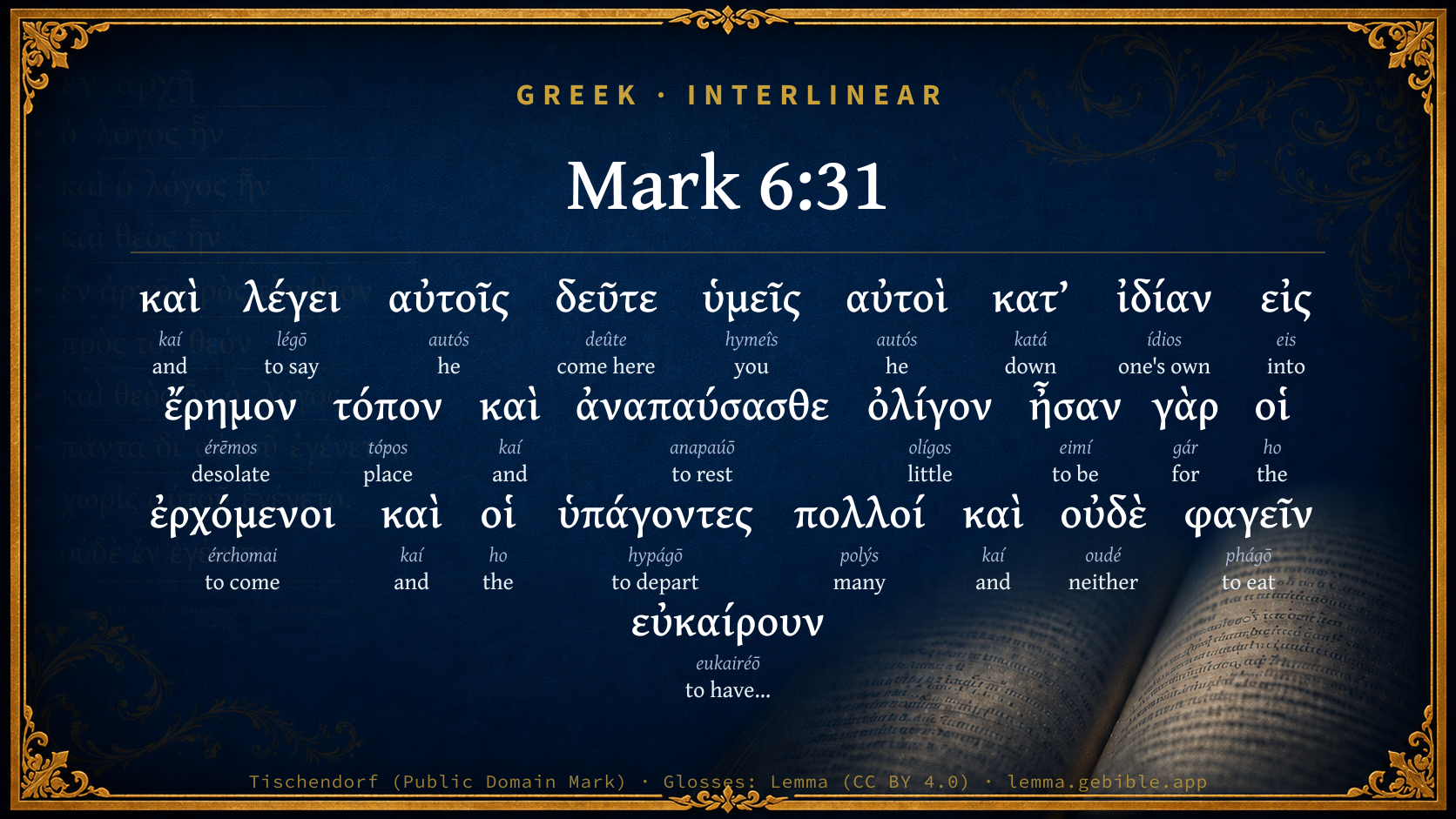
Download image
Cite this verse

Mark 6:31 (World English Bible). Public Domain. Lemma interlinear Bible study tool, https://lemma.gebible.app/v/mark/6/31.

Show BibTeX & RIS
BibTeX
RIS
English Translation
He said to them, "You come apart into a deserted place, and rest awhile." For there were many coming and going, and they had no leisure so much as to eat.
World English Bible · Public Domain
Highlights
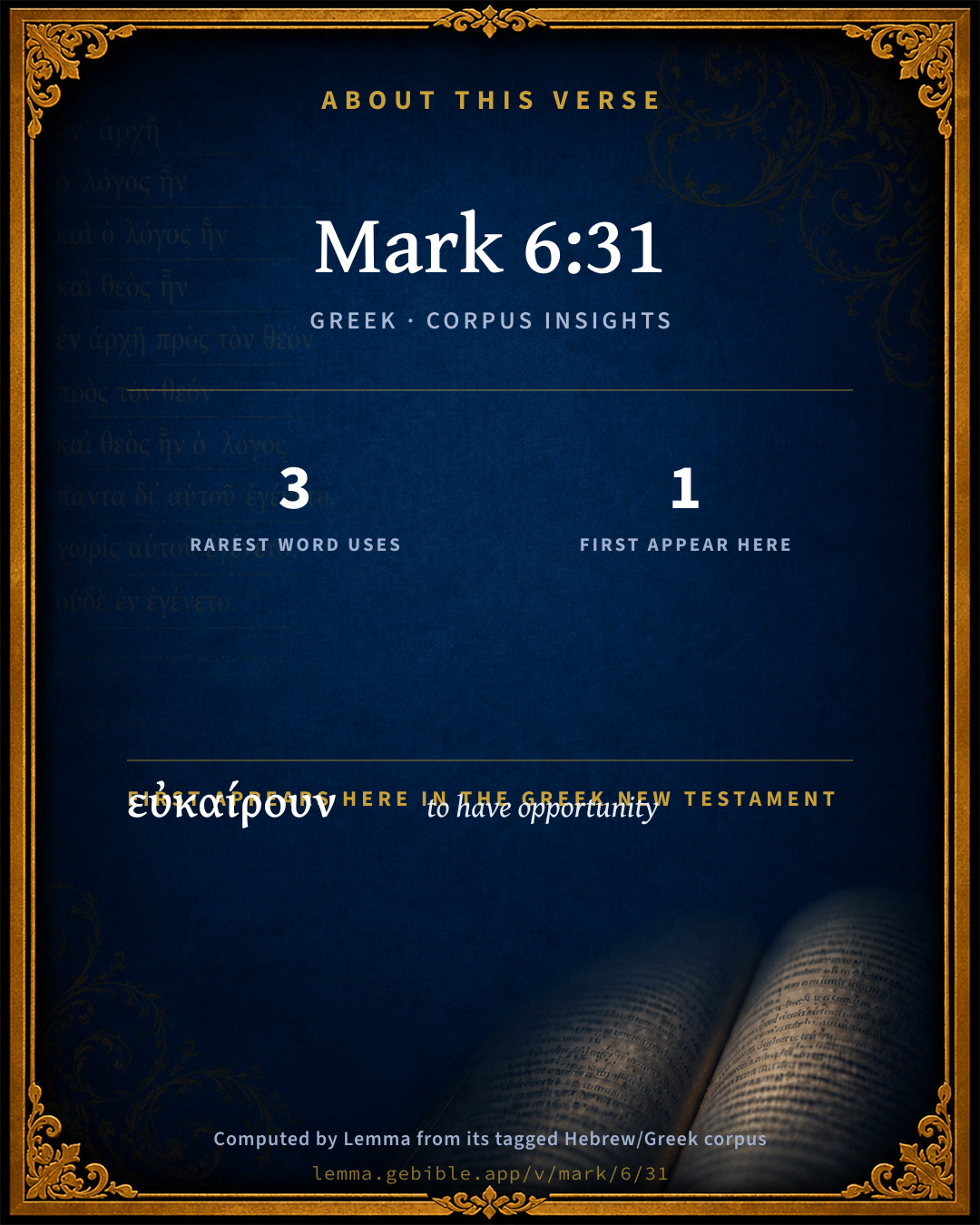
  • 1 first appearance in the Greek New Testament
Full analysis ↓
Download a study sheet

One document with this verse’s original text, its word-by-word gloss line, the meaning frame, cross-references with their text, attributed commentary, and full source and license credits — printable, and it pastes into notes with its structure intact.

This verse Autodidact and up

Study sheet (.html) Plain text (.txt)

A passage Seminary Student

Up to 50 verses in one chapter. A passage sheet keeps up to 6 commentary sources and 12 cross-references per verse, in the order this page ranks them, and says so on the sheet whenever that leaves anything out. Ask for a single verse and you get the Autodidact verse sheet above.

Everything on this page stays free to read, with no account — the sheet is a download of what is already on screen, not access to it.

Want to remove ads? Support Godless Engineer
Compare translations 3

The same verse in 3 English versions, stacked beneath the original-language interlinear above. Click any original word for its lexicon entry.

Each is an independent rendering of the whole verse — the interlinear is not word-aligned to these translations.

Highlighted words mark where these versions differ — a whole-verse word diff, not a word-by-word alignment.

  • World English Bible Public Domain
    He said to them, "You come apart into a deserted place, and rest awhile." For there were many coming and going, and they had no leisure so much as to eat.
  • King James Version Public Domain
    And he said unto them, Come ye yourselves apart into a desert place, and rest a while: for there were many coming and going, and they had no leisure so much as to eat.
  • unfoldingWord Literal Text CC BY-SA 4.0
    And he says to them, “You yourselves, come by yourselves to a desolate place and rest a little while.” For the ones coming and the ones going were many, and they were not even having opportunity to eat.

unfoldingWord Literal Text — © unfoldingWord, licensed CC BY-SA 4.0. Word-aligned USFM3 via Door43 (git.door43.org/unfoldingWord/en_ult).

Versions to compare (up to 4)

3 of 4 selected

Show all 19 translations

Every available English version of this verse, each an independent rendering of the whole verse.

  • World English Bible Public Domain
    He said to them, "You come apart into a deserted place, and rest awhile." For there were many coming and going, and they had no leisure so much as to eat.
  • Berean Standard Bible Public Domain
    And He said to them, “Come with Me privately to a solitary place, and let us rest for a while.” For many people were coming and going, and they did not even have time to eat.
  • Majority Standard Bible Public Domain
    And He said to them, “Come with Me privately to a solitary place, and let us rest for a while.” For many people were coming and going, and they did not even have time to eat.
  • King James Version Public Domain
    And he said unto them, Come ye yourselves apart into a desert place, and rest a while: for there were many coming and going, and they had no leisure so much as to eat.
  • American Standard Version (1901) Public Domain
    And he saith unto them, Come ye yourselves apart into a desert place, and rest a while. For there were many coming and going, and they had no leisure so much as to eat.
  • Revised Version (1885) Public Domain
    And he saith unto them, Come ye yourselves apart into a desert place, and rest a while. For there were many coming and going, and they had no leisure so much as to eat.
  • Geneva Bible (1599) Public Domain
    And he sayd vnto them, Come ye apart into the wildernes, and rest a while: for there were many commers and goers, that they had not leasure to eate.
  • Douay-Rheims (1899) Public Domain
    And he said to them: Come apart into a desert place, and rest a little. For there were many coming and going: and they had not so much as time to eat.
  • Young's Literal Translation Public Domain
    and he said to them, `Come ye yourselves apart to a desert place, and rest a little,' for those coming and those going were many, and not even to eat had they opportunity,
  • Literal Standard Version CC BY-SA 4.0
    and He said to them, “Come yourselves apart to a desolate place, and rest a little,” for those coming and those going were many, and not even to eat had they opportunity,
  • Unlocked Literal Bible CC BY-SA 4.0
    Then he said to them, “Come away by yourselves into a deserted place and rest a while.” For many were coming and going, and they did not even have time to eat.
  • unfoldingWord Literal Text CC BY-SA 4.0
    And he says to them, “You yourselves, come by yourselves to a desolate place and rest a little while.” For the ones coming and the ones going were many, and they were not even having opportunity to eat.
  • Darby Bible Public Domain
    And he said to them, Come ye yourselves apart into a desert place and rest a little. For those coming and those going were many, and they had not leisure even to eat.
  • World Messianic Bible Public Domain
    He said to them, “Come away into a deserted place, and rest awhile.” For there were many coming and going, and they had no leisure so much as to eat.
  • Webster's Bible Public Domain
    And he said to them, Come ye yourselves apart into a desert place, and rest a while: for there were many coming and going, and they had no leisure so much as to eat.
  • Free Bible Version CC BY-SA 4.0
    “Come with me, just yourselves. We'll go to a quiet place, and rest for a while,” Jesus told them, because there was so much coming and going that they didn't even have time to eat.
  • Bible in Basic English Public Domain
    And he said to them, Come away by yourselves to a quiet place, and take a rest for a time. Because there were a great number coming and going, and they had no time even for food.
  • Text-Critical English NT CC BY 4.0
    Then he said to them, “Come away by yourselves to a desolate place and rest for a little while.” For many people were coming and going, and Jesus and his apostles did not even have an opportunity to eat.
  • Tyndale New Testament (1534) Public Domain
    And he sayd vnto them: come ye aparte into the wyldernes and rest awhyle. For there were many comers and goers that they had no leasure so moche as to eate.

Literal Standard Version (2020), Covenant Press — licensed CC BY-SA 4.0. Text via the HelloAO Bible API (eBible.org). Unlocked Literal Bible (unfoldingWord) — licensed CC BY-SA 4.0. Text via the HelloAO Bible API (eBible.org). unfoldingWord Literal Text — © unfoldingWord, licensed CC BY-SA 4.0. Word-aligned USFM3 via Door43 (git.door43.org/unfoldingWord/en_ult). Free Bible Version, Dr. Jonathan Gallagher — licensed CC BY-SA 4.0. Text via the HelloAO Bible API (eBible.org).

Word by word

More ways to search: Search by grammar → Find every occurrence → Compare this word →

Practice this passage: Drill this verse → Learn its vocabulary →

εὐκαίρουν
eukairéō
G2119
“to have opportunity”
Verb, Imperfect, Active, Indicative, 3rd person, Plural
Part of Speech
Verb
Tense
Imperfect
Voice
Active
Mood
Indicative
Person
3rd person
Number
Plural
Full Thayer's Definition

Origin: from G2121

TDNT: None

1. to have opportunity 2. to have leisure 3. to do something 4. to give one's time to a thing
  1. καὶ kaí G2532 “and” Conjunction
  2. λέγει légō G3004 “to say” Verb, Present, Active, Indicative, 3rd person, Singular
  3. αὐτοῖς autós G846 “he” Personal pronoun, Dative, Plural, Masculine
  4. δεῦτε deûte G1205 “come here” Verb, Present, Active, Imperative, 2nd person, Plural
  5. ὑμεῖς hymeîs G5210 “you” Personal pronoun, 2nd person, Nominative, Plural
  6. αὐτοὶ autós G846 “he” Personal pronoun, Nominative, Plural, Masculine
  7. κατ’ katá G2596 “down” Preposition
  8. ἰδίαν ídios G2398 “one's own” Adjective, Accusative, Singular, Feminine
  9. εἰς eis G1519 “into” Preposition
  10. ἔρημον érēmos G2048 “desolate” Adjective, Accusative, Singular, Masculine
  11. τόπον tópos G5117 “place” Noun, Accusative, Singular, Masculine
  12. καὶ kaí G2532 “and” Conjunction
  13. ἀναπαύσασθε anapaúō G373 “to rest” Verb, Aorist, Middle, Imperative, 2nd person, Plural
  14. ὀλίγον olígos G3641 “little” Adverb
  15. ἦσαν eimí G1510 “to be” Verb, Imperfect, Active, Indicative, 3rd person, Plural
  16. γὰρ gár G1063 “for” Conjunction
  17. οἱ ho G3588 “the” Article, Nominative, Plural, Masculine
  18. ἐρχόμενοι érchomai G2064 “to come” Verb, Present, Middle or Passive deponent, Participle, Nominative, Plural, Masculine
  19. καὶ kaí G2532 “and” Conjunction
  20. οἱ ho G3588 “the” Article, Nominative, Plural, Masculine
  21. ὑπάγοντες hypágō G5217 “to depart” Verb, Present, Active, Participle, Nominative, Plural, Masculine
  22. πολλοί polýs G4183 “many” Adjective, Nominative, Plural, Masculine
  23. καὶ kaí G2532 “and” Conjunction
  24. οὐδὲ oudé G3761 “neither” Conjunction, Negative
  25. φαγεῖν phágō G5315 “to eat” Verb, Aorist, Active, Infinitive

About this verse

These counts appear in no published source. They are computed here, from the morphology-tagged text and Lemma’s own curated glosses. What Lemma adds →

26
words
21
distinct lemmas
Gospels
section

Notable vocabulary

The rarest word here is εὐκαίρουν to have opportunity G2119 — appearing just 3 times in the whole Greek New Testament.

First appearance in Scripture

This word makes its first canonical appearance in the Greek New Testament here:

  • εὐκαίρουν to have opportunity G2119

Shared distinctive vocabulary

εὐκαίρουν to have opportunity G2119 occurs in 3 verses of the Greek New Testament. Also found in:
Repetition

Words recur within this verse:

  • καὶ and G2532 ×4
  • αὐτοῖς he G846 ×2
  • οἱ the G3588 ×2

Cross-references

5

Topical passages linked to Mark 6:31 in the Treasury of Scripture Knowledge — connected by theme and wording, ordered by reader-vote popularity; previews shown in the World English Bible.

  • Mark 3:20 The multitude came together again, so that they could not so much as eat bread.
  • John 6:1 After these things, Jesus went away to the other side of the sea of Galilee, which is also called the Sea of Tiberias.
  • Mark 1:45 But he went out, and began to proclaim it much, and to spread about the matter, so that Jesus could no more openly enter into a city, but was outside in desert places: and they came to him from everywhere.
  • Mark 3:7 Jesus withdrew to the sea with his disciples, and a great multitude followed him from Galilee, from Judea,
  • Matthew 14:13 Now when Jesus heard this, he withdrew from there in a boat, to a deserted place apart. When the multitudes heard it, they followed him on foot from the cities.

Cross-references courtesy of OpenBible.info (CC BY 4.0).

Commentary

Notes on Mark 6:31 from classic Christian and Jewish commentators (each source and its license shown beneath its notes). The classic Christian expositions comment on the surrounding passage and are grouped to its opening verse, so a note may address several verses; the Jewish commentaries on the Tanakh (Rashi and others) are per-verse, so they appear only where the commentator wrote on this verse.

Lemma curates 59 commentaries, every one of them public domain or Creative Commons licensed, each selected and text-cleaned for this edition rather than reprinted as found. About our sources →

Tyndale Open Study Notes

Tyndale Open Resources

6:31-33 Let’s go: Jesus and the disciples probably proceeded northward along the western shore of the Sea of Galilee toward Bethsaida (Luke 9:10), in sight of the crowds along the shore. • so many people: The great crowds demonstrate the success of the apostolic mission and the greatness of Jesus, whom the apostles represented.

Tyndale Open Study Notes — © Tyndale Open Resources, licensed CC BY-SA 4.0. Text via the HelloAO Bible API.

Bengel's Gnomon

Johann Albrecht Bengel

Mar 6:31. Ὑμεῖς αὐτοὶ, ye yourselves) also. Often the Saviour betook Himself alone to solitude: now He says, Do ye also seek solitude [a desert place].—ὀλίγον, a little while) Solitude and intercourse with others should be blended together by the godly.—ἦσαν, they were) They did not always come and go together.

Bengel's Gnomon of the New Testament — English translation (T&T Clark, Edinburgh, 1860) — public domain. Text from a community e-Sword module.

Expositor's Greek Testament

ed. W. Robertson Nicoll

Mar 6:31 . ὑμεῖς αὐτοὶ , either: you yourselves, vos ipsi , without the crowd (Meyer, Schanz), or, better: you the same men who have been hard at work and need rest (Weiss in Meyer, Holtz., H. C.). This sympathy of Jesus with the Twelve reflects His own craving for rest which He often unsuccessfully strove to obtain. ἀναπαύσασθε , aorist only a breathing space in a life of toil. οἱ ἐρ . καὶ οἱ ὑπάγ . Many coming and going: a constant stream of people on some errand; no sooner done with one party than another presented itself no leisure. οὐδε φαγεῖν εὐκαίρουν : no leisure ( cf. εὔκαιρος , Mar 6:21 ), even to eat; imperfect, implying that it was not a solitary occurrence. What was the business on hand? Probably a political movement in Christ’s favour with which the Twelve sympathised. vide Joh 6:15 .

The Expositor's Greek Testament, edited by W. Robertson Nicoll (1897–1910) — public domain. Text from a community e-Sword module.

Cambridge Greek Testament for Schools and Colleges

31. λέγει ([1267][1268][1269][1270][1271] 33) rather than εἶπεν ([1272][1273][1274][1275]).

[1267] Codex Sinaiticus. 4th cent. Discovered by Tischendorf in 1859 at the Monastery of St Katharine on Mount Sinai. Now at St Petersburg. The whole Gospel, ending at Mar 16:8. Photographic facsimile, 1911.

[1268] Codex Vaticanus. 4th cent., but perhaps a little later than א. In the Vatican Library almost since its foundation by Pope Nicolas V., and one of its greatest treasures. The whole Gospel, ending at Mar 16:8. Photographic facsimile, 1889.

[1269] Codex Ephraemi. 5th cent. A palimpsest: the original writing has been partially rubbed out, and the works of Ephraem the Syrian have been written over it; but a great deal of the original writing has been recovered; of Mark we have Mar 1:17 to Mar 6:31, Mar 8:5 to Mar 12:29, Mar 13:19 to Mar 16:20. In the National Library at Paris.

[1270] Codex Regius. 8th cent. An important witness. At Paris. Contains Mar 1:1 to Mar 10:15; Mar 10:30 to Mar 15:1; Mar 15:20 to Mar 16:20, but the shorter ending is inserted between Mar 16:8 and Mar 16:9, showing that the scribe preferred it to the longer one.

[1271] Codex Sangallensis. 9th or 10th cent. Contains the Gospels nearly complete, with an interlinear Latin translation. The text of Mark is specially good, agreeing often with CL. At St Gall.

[1272] Codex Alexandrinus. 5th cent. Brought by Cyril Lucar, Patriarch of Constantinople, from Alexandria, and afterwards presented by him to King Charles I. in 1628. In the British Museum. The whole Gospel. Photographic facsimile, 1879.

[1273] Codex Bezae. 6th cent. Has a Latin translation (d) side by side with the Greek text, and the two do not quite always agree. Presented by Beza to the University Library of Cambridge in 1581. Remarkable for its frequent divergences from other texts. Contains Mark, except Mar 16:15-20, which has been added by a later hand. Photographic facsimile, 1899.

[1274] Codex Oxoniensis. 9th cent. Contains Mark, except Mar 3:35 to Mar 6:20.

[1275] Codex Petropolitanus. 9th cent. Gospels almost complete. Mar 16:18-20 is in a later hand.

31. ὑμεῖς αὐτοί. You yourselves, or you by yourselves. The former rendering implies that others are resting, and now the missionaries themselves must rest. But who are these others? Syr-Sin, omits the words.

ὀλίγον. Only a short breathing time is possible. The compound and the aor. ἀναπαύσασθε imply that relaxation and not cessation is meant, refreshment and not final rest. Lightfoot on Phm 1:7. [1351][1352][1353] etc. have ἀναπαύεσθε.

[1351] Codex Sinaiticus. 4th cent. Discovered by Tischendorf in 1859 at the Monastery of St Katharine on Mount Sinai. Now at St Petersburg. The whole Gospel, ending at Mar 16:8. Photographic facsimile, 1911.

[1352] Codex Bezae. 6th cent. Has a Latin translation (d) side by side with the Greek text, and the two do not quite always agree. Presented by Beza to the University Library of Cambridge in 1581. Remarkable for its frequent divergences from other texts. Contains Mark, except Mar 16:15-20, which has been added by a later hand. Photographic facsimile, 1899.

[1353] Codex Regius. 8th cent. An important witness. At Paris. Contains Mar 1:1 to Mar 10:15; Mar 10:30 to Mar 15:1; Mar 15:20 to Mar 16:20, but the shorter ending is inserted between Mar 16:8 and Mar 16:9, showing that the scribe preferred it to the longer one.

ἦσαν γὰρ … πολλοί. For those who were coming and those who were going were many, and between the two there was no leisure even for meals. Mt., as usual, is silent about the pressure of the crowds; see on Mar 3:9; Mar 3:20.

εὐκαίρουν. Here Vulg. has spatium habebant, Act 17:21 vacabant, 1Co 16:12 ei vacuum, fuerit. Not found in LXX.

Cambridge Greek Testament for Schools and Colleges (Cambridge University Press, 1896; 21 vols, various authors incl. Carr, Maclear, Plummer, Farrar, Lumby, Moule, M. R. James, Simcox) — public domain. Text from a community e-Sword module.

Geneva Bible (1599)

Geneva Bible translators

Such as follow Christ shall want nothing, no not in the wilderness, but shall have abundance. And how wicked a thing is it, not to look for this transitory life at his hands,who giveth everylasting life?

Geneva Bible (1599) marginal notes — public domain. Text via Bolls.life.

Adam Clarke's Commentary

Verse 31. Rest a while] Rest is necessary for those who labour; and a zealous preacher of the Gospel will as often stand in need of it as a galley slave.

Adam Clarke's Commentary on the Bible (1810–1826) — public domain. Text from a community e-Sword/MySword module.

Ellicott's Commentary for English Readers

(31-44) And he said unto them.—See Notes on Mat_14:13-21. Peculiar to St. Mark are (1) the tender consideration of the invitation to “rest awhile,” and (2) the description of the throng of people as “coming and going.”

A Bible Commentary for English Readers, edited by Charles John Ellicott (1878–1897) — public domain. Text from a community e-Sword module.

The Cambridge Bible for Schools and Colleges

gen. ed. J. J. S. Perowne

31. there were many coming and going] The Passover was now nigh at hand (Joh_6:4) and the pilgrim companies would be on the move towards the Holy City.

The Cambridge Bible for Schools and Colleges (gen. ed. J. J. S. Perowne; Cambridge University Press, 1878–1918) — public domain. Text from a community e-Sword module.

John Gill's Exposition

And he said unto them,.... After he had heard their account, was satisfied with it, and approved of what they had said and done:

come ye yourselves apart into a desert place, and rest a while: where they might be free from noise and hurry, and take some rest and refreshment, after their wearisome journey, hard labours, and great fatigue in preaching and working miracles; which shows the great compassion, tenderness, and care of Christ, for his disciples:

for there were many coming and going, and they had no leisure so much as to eat; the people were continually going to and fro; as soon as one company was gone, who came with their sick and diseased to be healed, or upon one account or another, another came: so that there was no opportunity of private meditation and prayer, nor of spiritual converse together: nor even so much as to eat a meal's meat for the refreshment of nature.

John Gill's Exposition of the Whole Bible (1746–1763) — public domain (CC PDM 1.0). Text via the HelloAO Bible API.

Trapp's Complete Commentary

John Trapp

31 And he said unto them, Come ye yourselves apart into a desert place, and rest a while: for there were many coming and going, and they had no leisure so much as to eat.

Ver. 31. Rest a while] God would not have the strength of his people to be exhausted in his service, but that respect be had to the health of their bodies, as well as to the welfare of their souls. Therefore the priests of the law took their turns of serving in the order of their course, as Zacharias, Luk 1:8. And the ministers of the gospel are allowed to drink a little wine for their health’s sake, as Timothy. Those that neglect, their bodies must reckon for it. Col 2:23.

John Trapp, A Commentary or Exposition upon All the Books of the Old and New Testament (1647–1656) — public domain. Text from a community e-Sword module.

Albert Barnes' Notes on the Bible

A desert place - A retired place, across the sea from Capernaum, where they would be free from interruption.

There were many coming and going - Coming to be healed and retiring, or coming to hear him preach. It means that they were “thronged,” or that there was a vast multitude attending his preaching.

Albert Barnes' Notes on the Bible (1834–1885) — public domain. Text from a community e-Sword/MySword module.

Matthew Poole's English Annotations

Matthew makes the cause of this motion of our Saviour’s to have been his receiving the report of Herod’s dealing with John the Baptist, as we often find him yielding to the fury of his adversaries. Mark assigns another reason, (as there may be several reasons or motives of and to the same action or motion), viz. that both himself and his apostles might have a little rest. The place which he chose for his recess is called

a desert place, not because it was wholly not inhabited, but very thinly inhabited. Luke saith it was a desert place belonging to the city called Bethsaida, Luk 9:10; probably some large forest, or common pasture, which belonged to that city, and took a denomination from it. It was a place on the other side of the water, for they went to it by ship. But this water was but a lake, though called the sea of Tiberias, for the people, fetching a little further compass about, went thither on foot, and outwent the motion of the ship.

Matthew Poole's English Annotations on the Holy Bible (1683–1685) — public domain. Text from a community e-Sword/MySword module.

The Pulpit Commentary

Our Lord cared for his disciples. They required rest after the labour and excitement of their ministry; and it was impossible to find the needful refreshment and repose where they were so thronged by the multitude.

Christ"s offer of rest.

I THE PECULIAR GIFT OF JESUS TO HIS SERVANTS. "Into a desert place;" only Christ to speak with them, to comfort and to advise.

II A MANIFOLD PROVISION FOR HIS SERVANTS" NEEDS. Calm after excitement; repose after labour; meditation upon Divine marvels and experiences. Security from threatening dangers.

III A PREPARATION FOR FUTURE SERVICE. "Rest a while. M.

The Christian worker"s rest.

I IN A WORLD WHERE THERE IS NO TRUE REST.

II PROCEEDING FROM THE LORD.

1. Divinely commanded.

2. Divinely prepared.

3. Divinely shared.

III TO FIT FOR FURTHER SERVICE. M.

"Coming and going.

I A PICTURE OF THE WORLD"S LIFE.

II INDICATIVE OF THE WORLD"S SPIRITUAL STATE.

III AN OCCASION OF DIFFICULTY TO THE CHURCH. M.

Recreative rest.

The disciples had been teaching the people, and meeting their objections; they had been curing the sick, and had seen effects startling even to themselves. Exultant over the work they had done, they were in some danger of forgetting its spiritual issues, and needed a reminder that it was more important to have one"s name in the book of life than to have power to cast out. devils. Agitated, restless, and weary, they returned to their Lord, and he, understanding their deepest wants, bade them follow him into a quiet retreat, that they might rest a while. Each sabbath day should bring us also to Jesus, that he may lead us into rest.

I RECREATIVE REST IS RECOGNIZED BY GOD AS A NECESSITY FOR MAN. We are so constituted that a constant strain on the same powers will either degrade or destroy them. The absence of physical rest would produce madness or death. But if we had only physical recreation, if there were no provision for the cultivation of the mind and of the affections, if we knew nothing of the quietude of home and the rest of the Lord"s day, we should soon become little better than the beasts which perish. This revelation shows that our "Father knoweth that we have need of these things." The Holy Book is not out of the sphere of our human necessities. It is wet with the tears of the sorrowful, and thumbed by the horny hands of the toiler, and through it the Son of man still cries, "Come unto me, all ye that labour and are heavy laden, and I will give you rest." The second chapter in the Book of Genesis speaks of rest as well as of work. One of the fundamental laws given on Sinai ordained that on six days we should work, but that on the seventh we should do no manner of work. Prophecy points on to a distant future, and declares "there remaineth a rest for the people of God." There is, indeed, no true want which God has not met. If the feeblest of his creatures requires food of a certain kind, it is placed beside it from the first. The butterfly, for example, which we sometimes use as a type of carelessness, deposits her eggs by unerring instinct where the young caterpillars may find their proper food. And the God who giveth to each his food sees that we want rest, and provides for it. When our day"s work is done, and we are tired, weariness provides and fits for repose, and "the sleep of the labouring man is sweet." When we are in danger of becoming hard and worldly amid the cares of business, God places around us at home restful endearments and softening influences. And often on the sabbath day he says with effectual power, "Oh, rest in the Lord, and wait patiently for him.

II RECREATIVE REST SHOULD HAVE A JUST RELATION TO EARNEST WORK, Everything of value has its own standard. Art, for example, is of value in proportion to taste. Rest finds its value in proportion to work. The mere pleasure-seeker loses the very thing he seeks because he seeks it; for pleasure is the complement of effort, toil, and sacrifice. Rest is the shadow thrown by the substance work, and you reach the shadow when you have passed by the substance that throws it. Nothing is more pitiable than the sight of a blase, self-indulgent epicure, who has never done any genuine work, and who saunters through life voting everything to be a weariness. How vivid is the contrast between his enjoyment and that of the schoolboy who comes home after passing his examination; or the man of business who rejoices to get free and renew the joys of his boyhood! The same principle applies to things spiritual. Those who have known no struggle with doubt or temptation, who have made no sacrifice for the Master, know little or nothing of the rapture which comes to others when, as they pray, there comes a burst of sunshine through the darkness. There would be more enjoyment of God"s rest if only there were a more thorough doing of God"s work. The converse of all this is true. legitimate rest prepares for work. If an indulgence or recreation makes duty distasteful, so that we go back to it with surly discontent, then either the pleasure has been of the wrong kind, or it has been indulged in in a wrong spirit. The disciples who went into the desert to rest "a while" were soon at work again, and their retirement with Christ had increased their knowledge and power. Such should be the effect of each sabbath day. Its morrow should find us endued with more courage, patience, and hope, in our daily toil. The rest at Elim was as important for Israel as the march from the Red Sea.

III RECREATIVE REST IS INTENDED TO EXERCISE A WHOLESOME INFLUENCE ON CHARACTER. Many questions are asked concerning various forms of recreation, whether for Christians they are legitimate or not. Incidentally some tests have already been suggested. What is their effect upon the work of life? Do they fit us for doing it better, or do they lead us to turn from it with loathing? And what is their effect on Christian work? Is that more, or is it less hearty, devout, and spiritual, because of our pleasure-taking? But, besides these, there is a more subtle test to be found in the effect of recreation on character. Rightly chosen and enjoyed, it may do much to supply our personal deficiencies. We are seeking to become men in Christ Jesus to have all the possibilities of manhood, so far as they are innocent, developed and strengthened, and not to have a few characteristics abnormally strong. If we are becoming stern in our fight with difficulties, the relaxations of home-life should make us considerate and gentle. It is well that there is a time to laugh, as well as a time to weep; and that God sends us that which will lift us out of the narrow groove in which the uniformity of life would keep us. If recreation is to have the effect on character which is highest and best, it must be enjoyed in conscious fellowship with Christ. The final test about any doubtful recreation would be Would Christ share this? Is it he who has said, "Come ye apart with me, and rest a while"? We rejoice in the belief that he does share in our recreations. He is with us under the whispering trees, and beside the sea as it rolls in upon the shore. He walks with us, as of old, across the corn-fields, and beside the hedgerows, with their marvellous wealth of life and beauty; and as we commune together he bids us think of the minuteness and tenderness of our Father"s care. To many weary disciples he still is saying, "Come ye yourselves apart into a desert place, and rest a while. A.R.

The Pulpit Commentary (1880–1919), ed. H.D.M. Spence-Jones & Joseph S. Exell — public domain. Text from a community e-Sword module.

John Wesley's Explanatory Notes

Matt. xiv, 13; John vi, 1.

John Wesley, Explanatory Notes Upon the Whole Bible (1754–1765) — public domain. Text via the GEBible commentary corpus.

The People's New Testament

B. W. Johnson

31. Come ye apart into a desert place. For notes on the feeding of the five thousand see Matt. 14:14–21. Compare Luke 9:10–17 and John 6:5–14. All the four gospels give this account.

B. W. Johnson's The People's New Testament with Notes (1889–1891) — public domain. Electronic text from the Christian Classics Ethereal Library (CCEL) ThML edition.

Alford’s Greek Testament

Henry Alford

31-34.] One of the most affecting descriptions in the Gospels, and in this form peculiar to Mark. Matt. has a brief compendium of it. Every word and clause is full of the rich recollections of one who saw, and felt the whole. Are we mistaken in tracing the warm heart of him who said, ‘I will go with thee to prison and to death?’

31.] ὑμεῖς αὐτοί—not others; ‘you alone.’

Henry Alford, The Greek Testament (1849–1861) — public domain. Text from a community e-Sword module.

International Critical Commentary

31. ὑμεῖς αὐτοὶ κατʼ ἰδίαν—you yourselves apart. The language is selected to emphasize as much as possible the privacy which Jesus wished to secure for them. εὐκαίρουν—This verb belongs to the later Greek. It means to have opportunity or leisure for anything. As to the occasion of this departure, Mt. gives another account. According to him, Jesus took the disciples away to a solitary place across the lake when he heard the death of John the Baptist. Here, it is to give the disciples rest after their missionary journey, which it was impossible for them to get with the multitudes crowding about them and preventing even their eating.

εὐκαίρουν, instead of ηὐκαίρουν, Tisch. Treg. WH. RV. א ABEFGHLV ΓΔ, etc.

International Critical Commentary — older volumes (1896–1929), various authors — public domain. Text from a community e-Sword module.

Vincent's Word Studies in the New Testament

Marvin R. Vincent

Come apart. See on chapter Mr 3:7.

Marvin R. Vincent, Word Studies in the New Testament (1887–1900) — public domain. Text from a community e-Sword/MySword module.

Lesson kit

Teaching starters — assembled from the data on this page, not authored interpretation. Every prompt links to the verse data it draws on. Edit before teaching.

Mark, in the Gospels, opens this verse with 26 words (21 distinct Greek lemmas). Its most distinctive word is eukairéō (“to have opportunity”). A historical commentator’s framing appears above. Read the whole chapter for the surrounding context.

Discussion questions

  1. The word eukairéō carries the sense “to have opportunity.” How does it shape the verse?
  2. This is the first place “to have opportunity” appears in Scripture (first appears here). What does its debut here establish?
  3. How does Acts 17:21, which shares the word «to have opportunity», read alongside this verse?
  4. What does the repetition of “and” (4× in this one verse) do in this verse?
  5. These translations render this verse differently; the difference is in the English rendering, not the original. What questions does that raise?
  6. Compare how Tyndale Open Study Notes and Bengel's Gnomon read this verse. Where do they agree or differ?

Things to notice

  • 1 word makes its first canonical appearance in Scripture here.
  • These translations choose different wording for 20 words in this verse.
  • “and” occurs 4× in this single verse.
  • 21 distinct Greek lemmas span 26 words in this verse.

Reading settings

Reading text

Shown beneath each verse's original-language words.

Old Testament
Old Testament edition

Read the OT as the Masoretic Hebrew (MT) or the Greek Septuagint (LXX).

English shown for the Greek Septuagint (in the Hebrew ↔ Greek comparison).

Comparing translations? Open the Compare panel on any verse page to stack up to four side by side.