Acts 1:5

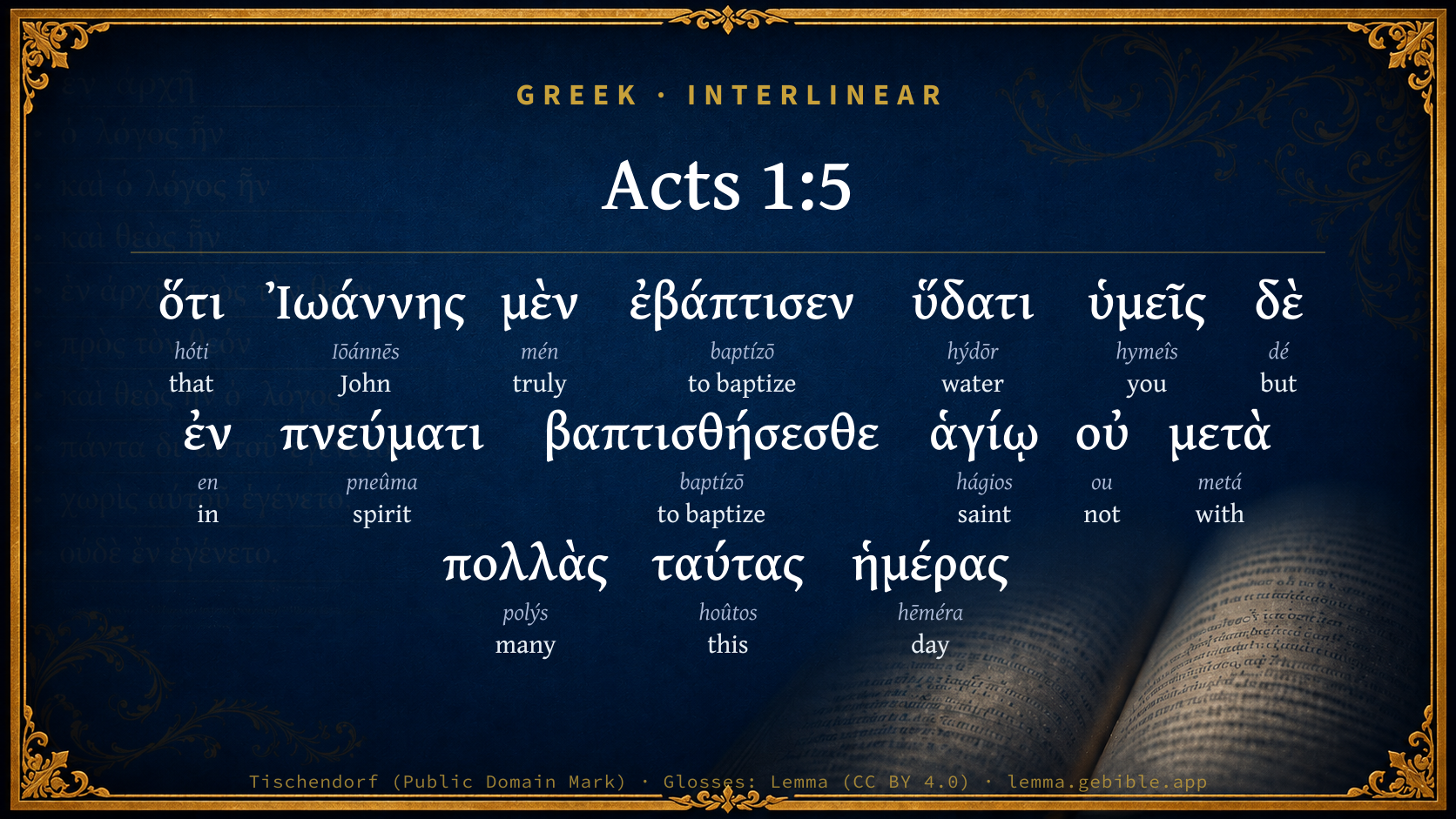
Greek (Tischendorf 8th ed.) Acts 1:5 appears in the Greek New Testament. The text above is from the Tischendorf 8th edition. Each word links to its Strong’s number and a concise gloss. Click any word for its full Thayer’s Greek Lexicon entry.
Download image
Cite this verse

Acts 1:5 (World English Bible). Public Domain. Lemma interlinear Bible study tool, https://lemma.gebible.app/v/acts/1/5.

Show BibTeX & RIS
BibTeX
RIS
English Translation
For John indeed baptized in water, but you will be baptized in the Holy Spirit not many days from now."
World English Bible · Public Domain
Download a study sheet

One document with this verse’s original text, its word-by-word gloss line, the meaning frame, cross-references with their text, attributed commentary, and full source and license credits — printable, and it pastes into notes with its structure intact.

This verse Autodidact and up

Study sheet (.html) Plain text (.txt)

A passage Seminary Student

Up to 50 verses in one chapter. A passage sheet keeps up to 6 commentary sources and 12 cross-references per verse, in the order this page ranks them, and says so on the sheet whenever that leaves anything out. Ask for a single verse and you get the Autodidact verse sheet above.

Everything on this page stays free to read, with no account — the sheet is a download of what is already on screen, not access to it.

Want to remove ads? Support Godless Engineer
Compare translations 3

The same verse in 3 English versions, stacked beneath the original-language interlinear above. Click any original word for its lexicon entry.

Each is an independent rendering of the whole verse — the interlinear is not word-aligned to these translations.

Highlighted words mark where these versions differ — a whole-verse word diff, not a word-by-word alignment.

  • World English Bible Public Domain
    For John indeed baptized in water, but you will be baptized in the Holy Spirit not many days from now."
  • King James Version Public Domain
    For John truly baptized with water; but ye shall be baptized with the Holy Ghost not many days hence.
  • unfoldingWord Literal Text CC BY-SA 4.0
    that John indeed baptized with water, but you will be baptized in the Holy Spirit after these not many days.”

unfoldingWord Literal Text — © unfoldingWord, licensed CC BY-SA 4.0. Word-aligned USFM3 via Door43 (git.door43.org/unfoldingWord/en_ult).

Versions to compare (up to 4)

3 of 4 selected

Show all 19 translations

Every available English version of this verse, each an independent rendering of the whole verse.

  • World English Bible Public Domain
    For John indeed baptized in water, but you will be baptized in the Holy Spirit not many days from now."
  • Berean Standard Bible Public Domain
    For John baptized with water, but in a few days you will be baptized with the Holy Spirit.”
  • Majority Standard Bible Public Domain
    For John baptized with water, but in a few days you will be baptized with the Holy Spirit.”
  • King James Version Public Domain
    For John truly baptized with water; but ye shall be baptized with the Holy Ghost not many days hence.
  • American Standard Version (1901) Public Domain
    For John indeed baptized with water; but ye shall be baptized in the Holy Spirit not many days hence.
  • Revised Version (1885) Public Domain
    For John indeed baptized with water; but ye shall be baptized with the Holy Ghost not many days hence.
  • Geneva Bible (1599) Public Domain
    For Iohn in deede baptized with water, but ye shall be baptized with the holy Ghost within these fewe daies.
  • Douay-Rheims (1899) Public Domain
    For John indeed baptized with water, but you shall be baptized with the Holy Ghost, not many days hence.
  • Young's Literal Translation Public Domain
    because John, indeed, baptized with water, and ye shall be baptized with the Holy Spirit -- after not many days.'
  • Literal Standard Version CC BY-SA 4.0
    because John, indeed, immersed in water, but you will be immersed in the Holy Spirit not many days after these.”
  • Unlocked Literal Bible CC BY-SA 4.0
    that John indeed baptized with water, but you shall be baptized in the Holy Spirit in a few days.”
  • unfoldingWord Literal Text CC BY-SA 4.0
    that John indeed baptized with water, but you will be baptized in the Holy Spirit after these not many days.”
  • Darby Bible Public Domain
    For John indeed baptised with water, but *ye* shall be baptised with the Holy Spirit after now not many days.
  • World Messianic Bible Public Domain
    For Yochanan indeed immersed in water, but you will be immersed in the Holy Spirit not many days from now.”
  • Webster's Bible Public Domain
    For John truly baptized with water; but ye shall be baptized with the Holy Spirit not many days hence.
  • Free Bible Version CC BY-SA 4.0
    It's true that John baptized in water, but in just a few days' time you will be baptized in the Holy Spirit.”
  • Bible in Basic English Public Domain
    For the baptism of John was with water, but you will have baptism with the Holy Spirit, after a little time.
  • Text-Critical English NT CC BY 4.0
    For John baptized with water, but you will be baptized with the Holy Spirit not many days from now.”
  • Tyndale New Testament (1534) Public Domain
    For Iohn baptised with water: but ye shalbe baptised with the holy goost and that with in this feawe dayes.

Literal Standard Version (2020), Covenant Press — licensed CC BY-SA 4.0. Text via the HelloAO Bible API (eBible.org). Unlocked Literal Bible (unfoldingWord) — licensed CC BY-SA 4.0. Text via the HelloAO Bible API (eBible.org). unfoldingWord Literal Text — © unfoldingWord, licensed CC BY-SA 4.0. Word-aligned USFM3 via Door43 (git.door43.org/unfoldingWord/en_ult). Free Bible Version, Dr. Jonathan Gallagher — licensed CC BY-SA 4.0. Text via the HelloAO Bible API (eBible.org).

Word by word

More ways to search: Search by grammar → Find every occurrence → Compare this word →

Practice this passage: Drill this verse → Learn its vocabulary →

ὕδατι
hýdōr
G5204
“water”
Noun, Dative, Singular, Neuter
Part of Speech
Noun
Case
Dative
Number
Singular
Gender
Neuter
Full Thayer's Definition

Origin: genitive case, hudatos hoo'-dat-os, etc., from the base of G5205

TDNT: 13:14,1

1. water a. of water in rivers, in fountains, in pools b. of the water of the deluge c. of water in any of the earth's repositories d. of water as the primary element, out of and through which the world that was before the deluge, arose and was compacted e. of the waves of the sea f. fig. used of many peoples
  1. ὅτι hóti G3754 “that” Conjunction
  2. Ἰωάννης Iōánnēs G2491 “John” Noun, Nominative, Singular, Masculine
  3. μὲν mén G3303 “truly” Particle
  4. ἐβάπτισεν baptízō G907 “to baptize” Verb, Aorist, Active, Indicative, 3rd person, Singular
  5. ὑμεῖς hymeîs G5210 “you” Personal pronoun, 2nd person, Nominative, Plural
  6. δὲ dé G1161 “but” Conjunction
  7. ἐν en G1722 “in” Preposition
  8. πνεύματι pneûma G4151 “spirit” Noun, Dative, Singular, Neuter
  9. βαπτισθήσεσθε baptízō G907 “to baptize” Verb, Future, Passive, Indicative, 2nd person, Plural
  10. ἁγίῳ hágios G40 “saint” Adjective, Dative, Singular, Neuter
  11. οὐ ou G3756 “not” Particle, Negative
  12. μετὰ metá G3326 “with” Preposition
  13. πολλὰς polýs G4183 “many” Adjective, Accusative, Plural, Feminine
  14. ταύτας hoûtos G3778 “this” Demonstrative pronoun, Accusative, Plural, Feminine
  15. ἡμέρας hēméra G2250 “day” Noun, Accusative, Plural, Feminine

About this verse

These counts appear in no published source. They are computed here, from the morphology-tagged text and Lemma’s own curated glosses. What Lemma adds →

16
words
15
distinct lemmas
Acts
section

Repetition

A word recurs within this verse:

  • ἐβάπτισεν to baptize G907 ×2

Cross-references

13

Topical passages linked to Acts 1:5 in the Treasury of Scripture Knowledge — connected by theme and wording, ordered by reader-vote popularity; previews shown in the World English Bible.

  • Matthew 3:11 I indeed baptize you in water for repentance, but he who comes after me is mightier than I, whose shoes I am not worthy to carry. He will baptize you in the Holy Spirit.
  • Acts 11:15–16 As I began to speak, the Holy Spirit fell on them, even as on us at the beginning.
  • Luke 3:16 John answered them all, "I indeed baptize you with water, but he comes who is mightier than I, the latchet of whose sandals I am not worthy to loosen. He will baptize you in the Holy Spirit and fire,
  • 1 Corinthians 12:13 For in one Spirit we were all baptized into one body, whether Jews or Greeks, whether bond or free; and were all given to drink into one Spirit.
  • Titus 3:5 not by works of righteousness, which we did ourselves, but according to his mercy, he saved us, through the washing of regeneration and renewing by the Holy Spirit,
  • Mark 1:8 I baptized you in water, but he will baptize you in the Holy Spirit."
  • Acts 2:1–4 Now when the day of Pentecost had come, they were all with one accord in one place.
  • Acts 10:45 They of the circumcision who believed were amazed, as many as came with Peter, because the gift of the Holy Spirit was also poured out on the Gentiles.
  • Acts 2:16–21 But this is what has been spoken through the prophet Joel:
  • Joel 2:28–32 "It will happen afterward, that I will pour out my Spirit on all flesh; And your sons and your daughters will prophesy. Your old men will dream dreams. Your young men will see visions.
  • John 1:31 I didn't know him, but for this reason I came baptizing in water: that he would be revealed to Israel."
  • Acts 19:4 Paul said, "John indeed baptized with the baptism of repentance, saying to the people that they should believe in the one who would come after him, that is, in Jesus."
  • Joel 3:18 It will happen in that day, That the mountains will drop down sweet wine, The hills will flow with milk, All the brooks of Judah will flow with waters; And a fountain will come forth from the house of Yahweh, And will water the valley of Shittim.

Cross-references courtesy of OpenBible.info (CC BY 4.0).

Commentary

Notes on Acts 1:5 from classic Christian and Jewish commentators (each source and its license shown beneath its notes). The classic Christian expositions comment on the surrounding passage and are grouped to its opening verse, so a note may address several verses; the Jewish commentaries on the Tanakh (Rashi and others) are per-verse, so they appear only where the commentator wrote on this verse.

Lemma curates 59 commentaries, every one of them public domain or Creative Commons licensed, each selected and text-cleaned for this edition rather than reprinted as found. About our sources →

Tyndale Open Study Notes

Tyndale Open Resources

1:5 baptized: See “Baptism” Theme Note.

Tyndale Open Study Notes — © Tyndale Open Resources, licensed CC BY-SA 4.0. Text via the HelloAO Bible API.

Bengel's Gnomon

Johann Albrecht Bengel

Act 1:5. Ὑμεῖς, ye) who are Mine. Mat 3:11, John the Baptist, “I indeed baptize you with water unto repentance—but—He shall baptize you with the Holy Ghost and with tire.” This has a widely extended application: Act 11:16.—βαπτισθήσεσθε, ye shall be baptized) by Me. Matt. l. c.—οὐ μετὰ πολλὰς, not many days hence) The number of days not being defined, kept the faith of the disciples in exercise.

Bengel's Gnomon of the New Testament — English translation (T&T Clark, Edinburgh, 1860) — public domain. Text from a community e-Sword module.

Meyer's Critical & Exegetical Commentary

Heinrich August Wilhelm Meyer

Act_1:5. Reminiscence of the declaration of the Baptist, Luk_3:16; Joh_1:33. For on you the baptism of the Spirit will now soon take place, which John promised instead of his baptism of water.

βαπτισθήσεσθε] τὴν ἐπίχυσιν καὶ τὸν πλοῦτον τῆς χορηγίας σημαίνει., Theophyl.; Mat_3:11; Mar_1:8; Luk_3:16; Act_11:16. Moreover, comp. on Joh_1:33.

οὐ μετὰ πολλ. ταύτ. ἡμέρ.] is not a transposition for οὐ πολὺ μετὰ ταύτ. ἡμέρ., but: not after many of these (now and, up to the setting in of the future event, still current) days. Comp. Winer, p. 152 [E. T. 201]. The position of the negative is to be explained from the idea of contrast (not after many, but after few). See Kühner, II. 628. On ταύτας, inserted between πολλ. and ἡμέρ., comp. Xen. Anab. iv. 2. 6, v. 7. 20, vii. 3. 30; Dem. 90. 11; Alc. 1. 14.

Meyer — Critical and Exegetical Commentary on the New Testament — English translation by Peter Christie, edited by Frederick Crombie (T&T Clark, 1880) — public domain. Text from a community e-Sword module.

Expositor's Greek Testament

ed. W. Robertson Nicoll

Act 1:5 . ἐν πνεύματι : the omission of ἐν before ὕδατι and its insertion before πνεύμ . may be meant to draw a distinction between the baptism with water and the baptism in the Spirit (R.V. margin “in”). But in Mat 3:11 we have the preposition ἐν in both parts of the verse; cf. Joh 1:31 . On ἐν with the instrumental dative see Blass, Grammatik des N. G. , p. 114, and Grotius, in loco; cf. the Hebrew בְּ . οὐ μετὰ πολλὰς ταύτας ἡμέρας : not after many, i.e. , after few. This use of οὐ with an adjective or adverb is characteristic of St. Luke, cf. Luk 15:13 , Act 27:14 , in which places οὐ πολύς = ὀλίγος as here; cf. οὐ μετρίως , Act 20:12 ; οὐ μακράν , Luk 7:6 , Act 17:27 ; οὐκ ἄσημος , Act 21:39 ; οὐχ ὁ τυχών , Act 19:11 ; Act 28:2 , cf. Hawkins, Horæ Syn. , p. 153. No doubt μετʼ οὐ would be more correct, but the negative is found both before and after the preposition, so in Luk 15:13 ; cf. Josephus, Ant. , i., 12, and xiii., 7, 1, for similar changes of allocation in the same words. ταύτας closely connects the days referred to with the current day; cf. also Winer-Schmiedel, p. 221. οὐ μετὰ πολλάς , φησὶν ἵνα μὴ εἰς ἀθυμίαν ἐμπέσωσιν · ὡρισμένως δὲ πότε , οὐκ εἶπεν , ἵνα ἀεὶ ἐκγρηγορῶσιν ἐκδεχόμενοι , Theophylact, in loco.

The Expositor's Greek Testament, edited by W. Robertson Nicoll (1897–1910) — public domain. Text from a community e-Sword module.

Geneva Bible (1599)

Geneva Bible translators

Either of the Father, or of me: so that either the Father or Christ is set here against John, as the holy Ghost is against the water, as things answerable the one to the other.

Geneva Bible (1599) marginal notes — public domain. Text via Bolls.life.

Jamieson, Fausset & Brown

Robert Jamieson, A. R. Fausset & David Brown

ye shall be baptized with the Holy Ghost not many days hence--ten days hence, as appears from Lev 23:15-16; but it was expressed thus indefinitely to exercise their faith.

Jamieson, Fausset & Brown — Commentary Critical and Explanatory on the Whole Bible (1871) — public domain (CC PDM 1.0). Text via the HelloAO Bible API.

Adam Clarke's Commentary

Verse 5. Ye shall be baptized with the Holy Ghost not many days hence.] This must refer to some conversation that is not distinctly related by the evangelists; as these identical words do not occur in any of the preceding histories. The Codex Bezae reads this passage thus: but ye shall be baptized with the Holy Ghost, which ye shall receive not many days hence. John baptized with water, which was a sign of penitence, in reference to the remission of sin; but Christ baptizes with the Holy Ghost, for the destruction of sin, the illumination of the mind, and the consolation of the heart. John's baptism was in reference to the spiritual kingdom; but Christ's baptism established and maintained that kingdom. From this passage we may also learn that baptism does not always mean being plunged or immersed in water; for as this promise most evidently refers to the communication of the Holy Spirit on the following pentecost, and then he sat upon each as a cloven tongue of fire, this certainly has more affinity to sprinkling than to plunging. However, the mode of administering the sign is of very little consequence; and which is the best mode is exceedingly dubious: the stress should be laid on receiving the thing signified-the Holy Ghost, to illuminate, regenerate, refine, and purify the heart. With this, sprinkling or immersion are equally efficient: without this, both are worth nothing.

Adam Clarke's Commentary on the Bible (1810–1826) — public domain. Text from a community e-Sword/MySword module.

John Calvin's Commentaries

5. Because John truly Christ repeateth this unto his apostles out of John’s own words. For some part of them had heard that at John’s mouth, which the Evangelists report, “I truly baptize you with water, but he that cometh after me shall baptize you with the Holy Ghost, and with fire.” Now Christ pronounceth that they shall well perceive that that is true indeed which he said. Furthermore, this serveth greatly to confirm the sentence next going before, for it is an argument drawn from the office of Christ. And that thus: John was sent to baptize with water, he fulfilled his function as it became the servant of God. The Son of God is sent to baptize with the Holy Ghost; it remained, therefore, that he do his duty. Neither can it be otherwise but he must do that which his Father hath commanded him to do, and for which also he came down into the earth. But it seemeth a very absurd thing to restrain that unto the visible sending of the Holy Ghost, which was spoken universally of regeneration. I answer, that Christ did not then only baptize with the Holy Ghost, when as he sent him under the form of fiery tongues; for he had baptized his apostles before this; and he baptizeth all the elect thus daily. But because the sending of the Holy Ghost after so glorious a sort was a token of the hidden grace wherewith he doth daily inspire his elect, he doth fitly apply thereunto the testimony of John. And truly this was as though it had been the common baptism of the Church. For besides that the apostles did not receive the Spirit for themselves only, but for the use of all the faithful, there was also declared the universal favor of Christ towards his Church, while that he poured out thereupon the gifts of his Spirit in great abundance.

Although, therefore, he doth daily baptize the elect of his Father, yet was this no let why he might not show forth this token to be remembered above all others, that the apostles might know that they were only entered by John; and that not in vain, seeing their perfection was hard at hand. And that is frivolous which some gather out of this place most commonly, namely, that the baptism of John and the baptism of Christ were diverse. For here doth not he dispute in this place of baptism, but maketh only a comparison betwixt the person of John and the person of Christ. When as John did say that he did baptize with water only, he did not reason of what sort his baptism was; but what he himself was; lest he should arrogate that unto himself which was proper to Christ. As also, the ministers in these days ought not to speak otherwise of themselves; but they must acknowledge Christ to be the author of all those things which they do prefigure in the outward baptism, and leave nothing to themselves save only the outward administration. For when as these titles are attributed unto baptism, namely, that it is the laver of regeneration, (Titus 3:5,) a washing away of sins, the fellowship of death, and burying with Christ, (Romans 6:4,) and a grafting into the body of Christ, it is not declared what man, being the minister of the outward sign, doth; but rather what Christ doth, who only giveth force and efficacy unto the signs. We must always hold fast this distinction, lest, whilst we deck man too much, we take from Christ.

But here may a question be moved, why he doth rather name John here than any other; first, It is manifest enough that John did profess himself to be the minister of the outward sign, namely, of water, and that Christ was the author of the spiritual baptism; secondly, Because it was meet that John should decrease and Christ increase; and, thirdly, Because the apostles did so much esteem of John, (John 3:30,) it might have been that thereby the glory of Christ might have been obscured. Therefore, Christ, to the end he might reclaim them to himself, telleth them that John did only minister unto them the external baptism; notwithstanding, he confirmeth them also, lest they should doubt of the promise; for they did attribute very much unto John, and therefore were they persuaded that the baptism which they had received by him was not in vain. Now, if that the verity and force thereof must be looked for at Christ’s hands, then ought the apostles to hope that that shall surely be fulfilled which John prefigured.

So must we, in like manner, think that we are not in vain baptized with water by men, because Christ, who commanded the same to be done, will fulfill his office, and baptize us with the Spirit. So faith draweth a consequent from the outward sign unto the inward effect; yet doth it not attribute any more than is meet, either to the sign or to the minister thereof, because in the sign it only looketh unto the promise, which is Christ’s, and doth acknowledge him to be the only author of grace. Let us, therefore, use such a mean that we do in no part diminish Christ’s honor; and yet, nevertheless, let us hope for that fruit by our baptism which is noted in this place. By assigning so short a time our Savior maketh them more joyful to hope well. Whereupon it followeth, that that death was not to be lamented which brought with it presently so precious fruit. And let us note this also, that this word baptism is used improperly in this place, that the contrariety may be full. After the same sort, Paul, in his Epistle unto the Romans, (Romans 3:26,) after he hath set down the law of works, to the end that the contrary may answer on the other side, he useth the law of faith for faith itself.

John Calvin's Commentaries (1540-1563) — public domain. Text from the Calvin Translation Society English edition (1840s-50s) via the Christian Classics Ethereal Library (ccel.org). Calvin's coverage is partial (roughly two-thirds of the Bible); uncommented books and verses are honest gaps, never fabricated. The 19th-century editor's footnotes and remarks are omitted so the notes are faithfully Calvin's own voice.

Ellicott's Commentary for English Readers

(5) John truly baptized with water.—See Note on Mat_3:11. The words threw the disciples back upon their recollection of their first admission to the Kingdom. Some of them, at least, must have remembered also the teaching which had told them of the new birth of water and of the Spirit (Joh_3:3-5). Now they were told that their spirits were to be as fully baptised, i.e., plunged, into the power of the Divine Spirit, as their bodies had then been plunged in the waters of the Jordan. And this was to be “not many days hence.” The time was left undefined, as a discipline to their faith and patience. They were told that it would not be long, lest faith and patience should fail.

A Bible Commentary for English Readers, edited by Charles John Ellicott (1878–1897) — public domain. Text from a community e-Sword module.

The Cambridge Bible for Schools and Colleges

gen. ed. J. J. S. Perowne

5. ye shall be baptized with the Holy Ghost] Thus was now to be fulfilled that of which John the Baptist had spoken (Mat_3:11), “He shall baptize you with the Holy Ghost and with fire.” Such an event, when it came to pass, could not fail to work mightily on the minds of those among Christ’s Apostles who had been disciples of John, as Andrew had been (Joh_1:40), and probably some of the others.

The Cambridge Bible for Schools and Colleges (gen. ed. J. J. S. Perowne; Cambridge University Press, 1878–1918) — public domain. Text from a community e-Sword module.

John Gill's Exposition

For John truly baptized with water,.... Or "in water", as he himself says, Mat 3:11 John's baptism was water baptism, an immersion of persons in water: he was the first administrator of it, and therefore is here mentioned by name; and his, and the baptism of the Spirit, are opposed; for there were others, as the disciples of Christ, that baptized in water as well as John: and these words are not to be understood of the words of the Lord, by the mouth of John, which the disciples heard, for they were not then called when John spoke the words in Mat 3:11 nor indeed are they the same with these; but these are the words of Christ himself, and which the apostles heard from his own mouth, as is clear from Act 11:16 though they are not recorded by any of the evangelists; and these are not the only words which Luke repeats, that the evangelists are silent about; see Act 20:35.

but ye shall be baptized with the Holy Ghost; that is, by himself; for it is Christ's prerogative to baptize with the Spirit, as John foretold of him, and it designs such an extraordinary and plentiful donation of the gifts of the Spirit, as may be expressed by a baptism; in which the apostles, on the day of "Pentecost", were, as it were, to be immersed, and with them covered; as Cyril of Jerusalem (h) observes,

"as he, , "who is plunged in water, and baptized", is encompassed by the water on every side, so are they that are wholly baptized by the Spirit.

Not many days hence; within ten days, for this was on the fortieth day from his death, which was at the passover, these words were said; and on the fiftieth day from thence was the feast of Pentecost, when this had its fulfilment,

(h) Cateches. 17. sect. 8. p. 247.

John Gill's Exposition of the Whole Bible (1746–1763) — public domain (CC PDM 1.0). Text via the HelloAO Bible API.

Trapp's Complete Commentary

John Trapp

5 For John truly baptized with water; but ye shall be baptized with the Holy Ghost not many days hence.

Ver. 5. Shall be baptized] See Mat 3:11.

John Trapp, A Commentary or Exposition upon All the Books of the Old and New Testament (1647–1656) — public domain. Text from a community e-Sword module.

Albert Barnes' Notes on the Bible

For John truly baptized ... - These are the words of Jesus to his apostles, and he evidently has reference to what was said of John’s baptism compared with his own in Mat 3:11; Joh 1:33. In those verses John is represented as baptizing with water, but the Messiah who was to come, as baptizing with the Holy Spirit and with fire. This promise was now about to be fulfilled in a remarkable manner. See Acts 2.

Not many days hence - This was probably spoken not long before his ascension, and of course not many days before the day of Pentecost.

Albert Barnes' Notes on the Bible (1834–1885) — public domain. Text from a community e-Sword/MySword module.

Haydock's Catholic Bible Commentary

Baptized with the Holy Ghost, that is, cleansed, and sanctified by the plentiful graces he shall pour upon you. (Witham)

George Leo Haydock (1774–1849), Haydock's Catholic Family Bible and Commentary, 1859 edition — public domain. Excludes Psalms (Douay-Rheims chapter numbering differs from Protestant) and Deuterocanonical books (Catholic canon only).

Matthew Poole's English Annotations

For John truly baptized with water, Mat 3:11; water being of a purifying nature, plentiful, and easy to come by.

But ye shall be baptized with the Holy Ghost; his gifts and graces, which were (as water on baptized persons) largely bestowed upon them on the day of Pentecost:

1. That the apostles and all others might be assured of the doctrine of the Gospel.

2. That they might be enabled to fulfil their ministry, and obey our Saviour’s commands left with them. Not many days hence; it was but ten days after his ascension; but our Saviour would not prefix a certain day, that they might watch every day.

Matthew Poole's English Annotations on the Holy Bible (1683–1685) — public domain. Text from a community e-Sword/MySword module.

Whedon's Commentary on the Bible

Daniel D. Whedon

5. And finally, together they must stay in order that together they may receive the one Pentecostal unction.

Promise of the Father—See notes on Luk_24:49; Joh_14:16-26, Joh_16:7-11. So called because predicted in the Old Testament as from God. See note on Act_2:16; Joe_3:1-2.

5. Baptized with the Holy Ghost—Under the old dispensation it was the law, the type, the ritual, and the shadow that were prominent, and the Spirit was in the background; under the new, reversely, all these retreat into the background, and the Spirit is predominant. This is the dispensation not of the ritual but of the Spirit. Hence it must be inaugurated by a full and overwhelming manifestation of the Spirit, as the old was inaugurated by the physical splendour of Sinai. And if this dispensation be ever glorious in its realization, if it ever attain a latter-day glory worthy to be the antitype of which the Pentecost was the type, it must be by the power of the Spirit poured forth upon men of the advanced culture of the future.

Baptized— By a curious contradiction Lechler on this verse tells us that this baptism was an immersion, and yet on verse seventh calls it an outpouring. Now, no one would say that a shower, however copiously outpoured, immersed a man. Nor would the most inconsiderate reasoner say that the person was plunged into the Holy Ghost. The element is applied to the person, not the person to the element. Nor does the Greek preposition εν, in, reasonably imply immersion. Thus, the Greek Septuagint renders Eze_16:9, “I washed thee with water, εν υδατι, and anointed thee in oil, εν ελαιω.” The Pentecostal baptism was certainly not by immersion.

Not many days hence—Though the days of delay of fulfilling the promise were to be not many, yet why so many? Why not the immediate charisma? The reasons may be several: 1. Their hearts must be trained by yet further experiences before they are fitted to become recipients of so wonderful an outpouring of the Spirit. Errors (like their question in Act_1:6) must be corrected; trials like the last departure of their Lord must be endured; hours of earnest supplication (Act_1:14) must be passed before their own hearts, minds, and wills are ready to co-operate freely, fully, and energetically with the Divine Spirit. 2. As we shall soon illustrate, the final departure of the Son was a requisite condition before the advent of the Spirit. 3. As it was at the Passover that the crucifixion was to take place, so the founding of the new Church must in the Divine order be placed at the Pentecost. An epochal event must have its epochal day.

Daniel D. Whedon (gen. ed.), Commentary on the Old and New Testaments (1874–1909) — public domain. Text from a community e-Sword module.

The Pulpit Commentary

Indeed for truly, A.V Ye shall be baptized, etc. (Comp. Mat_3:11; Luk_3:16; Joh_1:33) St. Peter refers to this saying of the Lord"s in his address to the Church of Jerusalem, (Act_11:16) and the record of it here may be an indication that St. Luke derived his information of these early events from Peter. A curious question arises as to the baptism of the apostles themselves. When were they baptized, and by whom? Chrysostom says, "They were baptized by John." But it is evident, from Joh_3:22 Joh 4:1, Joh_4:2, that converts were baptized with Christian, as distinct from John"s, baptism in our Lord"s lifetime, and hence it may seem probable, especially considering that St. Paul was baptized, that the apostles may have been baptized by Christ (Bishop Wordsworth. (Joh_4:2) If so, the baptism with the Holy Ghost at Pentecost was the complement of that baptism, not the substitute for it. "In our case," says Chrysostom, "both (the baptism of water and of the Spirit) take place under one act, but then they were divided."

The Pulpit Commentary (1880–1919), ed. H.D.M. Spence-Jones & Joseph S. Exell — public domain. Text from a community e-Sword module.

John Wesley's Explanatory Notes

Ye shall be baptized with the Holy Ghost - And so are all true believers to the end of the world. But the extraordinary gifts of the Holy Ghost also are here promised.

John Wesley, Explanatory Notes Upon the Whole Bible (1754–1765) — public domain. Text via the GEBible commentary corpus.

McGarvey & Pendleton's Commentaries

J. W. McGarvey

See notes on verse 4

J. W. McGarvey (with Philip Y. Pendleton), Commentaries on the New Testament (The Fourfold Gospel, 1914; Acts; and the epistles) — public domain. Text from a community e-Sword/MySword module.

The People's New Testament

B. W. Johnson

5. John truly baptized with water. They had received John's baptism; they were now to be baptized with the Holy Spirit. Not many days. Only ten days after these words were spoken.

B. W. Johnson's The People's New Testament with Notes (1889–1891) — public domain. Electronic text from the Christian Classics Ethereal Library (CCEL) ThML edition.

Cambridge Greek Testament for Schools and Colleges

5. The variation in construction after βαπτίζειν, first the dative ὕδατι without a preposition and then with ἐν, is probably due to the difference of sense between baptism with water and with the Spirit. But βαπτίζειν ἐν ὕδατι is found (Joh 1:31) where there is no contrast between sacramental and spiritual baptism.

Cambridge Greek Testament for Schools and Colleges (Cambridge University Press, 1896; 21 vols, various authors incl. Carr, Maclear, Plummer, Farrar, Lumby, Moule, M. R. James, Simcox) — public domain. Text from a community e-Sword module.

Alford’s Greek Testament

Henry Alford

5.] The Lord cites these words from the mouth of John himself, reff. Matt.;—and thus announces to them that, as John’s mission was accomplished in baptizing with water, so now the great end of His own mission, the Baptism with the Holy Ghost, was on the point of being accomplished. Calvin remarks, that He speaks of the Pentecostal effusion as being the Baptism with the Holy Ghost, because it was a great representation on the whole Church of the subsequent continued work of regeneration on individuals: ‘Quasi totius Ecclesiæ communis baptismus.’ I may add, also because it was the beginning of a new period of spiritual influence, totally unlike any which had preceded. See ch. 2:17.

ὕδατι and ἐν πν. ἁγ. are slightly distinguished. The insertion of the preposition bef. πν. ἁγ. seems to give a dignity which the mere instrumental dative, ὕδατι, wants.

ταύτας serves to bind on the οὐ πολλ. ἡμ. to the day then current; as we say, ‘one of these days.’ See Winer, § 23. 5, who instances ‘ante hos quinque dies’ in Lat, and quotes πρὸ πολλῶν τῶνδε ἡμερῶν, from Heliod. ii. 22. 97.

‘Numerus dierum non definitus exercebat fidem discipulorum,’ Bengel.

Henry Alford, The Greek Testament (1849–1861) — public domain. Text from a community e-Sword module.

Lesson kit

Teaching starters — assembled from the data on this page, not authored interpretation. Every prompt links to the verse data it draws on. Edit before teaching.

Acts, in the Acts, opens this verse with 16 words (15 distinct Greek lemmas). Its most distinctive word is hýdōr (“water”). A historical commentator’s framing appears above. Read the whole chapter for the surrounding context.

Discussion questions

  1. The word hýdōr carries the sense “water.” How does it shape the verse?
  2. How does Matthew 3:11, which shares this passage’s theme, read alongside this verse?
  3. What does the repetition of “to baptize” (2× in this one verse) do in this verse?
  4. These translations render this verse differently. What is at stake in choosing one wording over another?
  5. Compare how Tyndale Open Study Notes and Bengel's Gnomon read this verse. Where do they agree or differ?

Things to notice

  • These translations choose different wording for 10 words in this verse.
  • “to baptize” occurs 2× in this single verse.
  • 15 distinct Greek lemmas span 16 words in this verse.

Reading settings

Reading text

Shown beneath each verse's original-language words.

Old Testament
Old Testament edition

Read the OT as the Masoretic Hebrew (MT) or the Greek Septuagint (LXX).

English shown for the Greek Septuagint (in the Hebrew ↔ Greek comparison).

Comparing translations? Open the Compare panel on any verse page to stack up to four side by side.