
Matthew 8:16

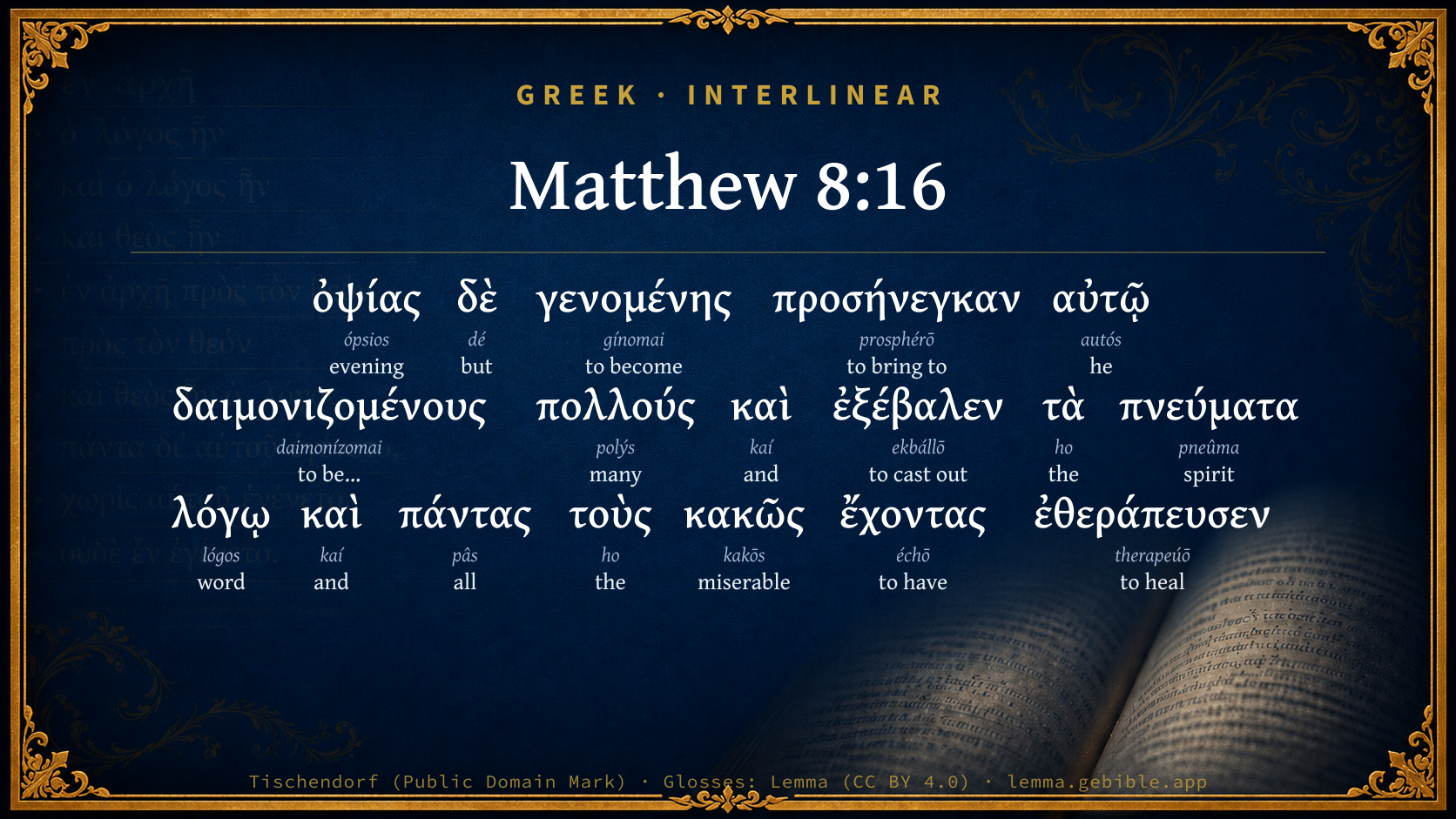
Greek (Tischendorf 8th ed.) Matthew 8:16 appears in the Greek New Testament. The text above is from the Tischendorf 8th edition. Each word links to its Strong’s number and a concise gloss. Click any word for its full Thayer’s Greek Lexicon entry.
Download image
Cite this verse

Matthew 8:16 (World English Bible). Public Domain. Lemma interlinear Bible study tool, https://lemma.gebible.app/v/matthew/8/16.

Show BibTeX & RIS
BibTeX
RIS
English Translation
When evening came, they brought to him many possessed with demons. He cast out the spirits with a word, and healed all who were sick;
World English Bible · Public Domain
Highlights
  • 1 first appearance in the Greek New Testament
Full analysis ↓
Download a study sheet

One document with this verse’s original text, its word-by-word gloss line, the meaning frame, cross-references with their text, attributed commentary, and full source and license credits — printable, and it pastes into notes with its structure intact.

This verse Autodidact and up

Study sheet (.html) Plain text (.txt)

A passage Seminary Student

Up to 50 verses in one chapter. A passage sheet keeps up to 6 commentary sources and 12 cross-references per verse, in the order this page ranks them, and says so on the sheet whenever that leaves anything out. Ask for a single verse and you get the Autodidact verse sheet above.

Everything on this page stays free to read, with no account — the sheet is a download of what is already on screen, not access to it.

Want to remove ads? Support Godless Engineer
Compare translations 3

The same verse in 3 English versions, stacked beneath the original-language interlinear above. Click any original word for its lexicon entry.

Each is an independent rendering of the whole verse — the interlinear is not word-aligned to these translations.

Highlighted words mark where these versions differ — a whole-verse word diff, not a word-by-word alignment.

  • World English Bible Public Domain
    When evening came, they brought to him many possessed with demons. He cast out the spirits with a word, and healed all who were sick;
  • King James Version Public Domain
    When the even was come, they brought unto him many that were possessed with devils: and he cast out the spirits with his word, and healed all that were sick:
  • unfoldingWord Literal Text CC BY-SA 4.0
    Now evening having come, they brought to him many being possessed by demons, and he cast out the spirits with a word and healed all the ones having sickness,

unfoldingWord Literal Text — © unfoldingWord, licensed CC BY-SA 4.0. Word-aligned USFM3 via Door43 (git.door43.org/unfoldingWord/en_ult).

Versions to compare (up to 4)

3 of 4 selected

Show all 19 translations

Every available English version of this verse, each an independent rendering of the whole verse.

  • World English Bible Public Domain
    When evening came, they brought to him many possessed with demons. He cast out the spirits with a word, and healed all who were sick;
  • Berean Standard Bible Public Domain
    When evening came, many who were demon-possessed were brought to Jesus, and He drove out the spirits with a word and healed all the sick.
  • Majority Standard Bible Public Domain
    When evening came, many who were demon-possessed were brought to Jesus, and He drove out the spirits with a word and healed all the sick.
  • King James Version Public Domain
    When the even was come, they brought unto him many that were possessed with devils: and he cast out the spirits with his word, and healed all that were sick:
  • American Standard Version (1901) Public Domain
    And when even was come, they brought unto him many possessed with demons: and he cast out the spirits with a word, and healed all that were sick:
  • Revised Version (1885) Public Domain
    And when even was come, they brought unto him many possessed with devils: and he cast out the spirits with a word, and healed all that were sick:
  • Geneva Bible (1599) Public Domain
    When the Euen was come, they brought vnto him many that were possessed with deuils: and he cast out the spirits with his worde, and healed all that were sicke,
  • Douay-Rheims (1899) Public Domain
    And when evening was come, they brought to him many that were possessed with devils: and he cast out the spirits with his word: and all that were sick he healed:
  • Young's Literal Translation Public Domain
    And evening having come, they brought to him many demoniacs, and he did cast out the spirits with a word, and did heal all who were ill,
  • Literal Standard Version CC BY-SA 4.0
    And evening having come, they brought to Him many demoniacs, and He cast out the spirits with a word, and healed all who were ill,
  • Unlocked Literal Bible CC BY-SA 4.0
    When evening had come, the people brought to Jesus many who were possessed by demons. He drove out the spirits with a word and healed all who were sick.
  • unfoldingWord Literal Text CC BY-SA 4.0
    Now evening having come, they brought to him many being possessed by demons, and he cast out the spirits with a word and healed all the ones having sickness,
  • Darby Bible Public Domain
    And when the evening was come, they brought to him many possessed by demons, and he cast out the spirits with a word, and healed all that were ill;
  • World Messianic Bible Public Domain
    When evening came, they brought to him many possessed with demons. He cast out the spirits with a word, and healed all who were sick,
  • Webster's Bible Public Domain
    When the evening was come, they brought to him many that were possessed with demons: and he cast out the spirits with his word, and healed all that were sick;
  • Free Bible Version CC BY-SA 4.0
    When evening came they brought many who were demon-possessed to Jesus. He made the spirits leave at his command, and he healed all those who were sick.
  • Bible in Basic English Public Domain
    And in the evening, they took to him a number of people who had evil spirits; and he sent the spirits out of them with a word, and made well all who were ill;
  • Text-Critical English NT CC BY 4.0
    When evening came, many who were possessed by demons were brought to him, and he cast out the spirits with a word and healed all who were sick.
  • Tyndale New Testament (1534) Public Domain
    When the euen was come they brought vn to him many that were possessed with devyllis. And he cast out the spirites with a worde and healed all that were sicke

Literal Standard Version (2020), Covenant Press — licensed CC BY-SA 4.0. Text via the HelloAO Bible API (eBible.org). Unlocked Literal Bible (unfoldingWord) — licensed CC BY-SA 4.0. Text via the HelloAO Bible API (eBible.org). unfoldingWord Literal Text — © unfoldingWord, licensed CC BY-SA 4.0. Word-aligned USFM3 via Door43 (git.door43.org/unfoldingWord/en_ult). Free Bible Version, Dr. Jonathan Gallagher — licensed CC BY-SA 4.0. Text via the HelloAO Bible API (eBible.org).

Word by word

More ways to search: Search by grammar → Find every occurrence → Compare this word →

Practice this passage: Drill this verse → Learn its vocabulary →

δαιμονιζομένους
daimonízomai
G1139
“to be demon-possessed”
Verb, Present, Middle or Passive deponent, Participle, Accusative, Plural, Masculine
Part of Speech
Verb
Tense
Present
Voice
Middle or Passive deponent
Mood
Participle
Case
Accusative
Number
Plural
Gender
Masculine
Full Thayer's Definition

Origin: middle voice from G1142

TDNT: 02:19,1

1. to be under the power of a demon.
  1. ὀψίας ópsios G3798 “evening” Adjective, Genitive, Singular, Feminine
  2. δὲ dé G1161 “but” Conjunction
  3. γενομένης gínomai G1096 “to become” Verb, Aorist, Middle deponent, Participle, Genitive, Singular, Feminine
  4. προσήνεγκαν prosphérō G4374 “to bring to” Verb, Aorist, Active, Indicative, 3rd person, Plural
  5. αὐτῷ autós G846 “he” Personal pronoun, Dative, Singular, Masculine
  6. πολλούς polýs G4183 “many” Adjective, Accusative, Plural, Masculine
  7. καὶ kaí G2532 “and” Conjunction
  8. ἐξέβαλεν ekbállō G1544 “to cast out” Verb, Aorist, Active, Indicative, 3rd person, Singular
  9. τὰ ho G3588 “the” Article, Accusative, Plural, Neuter
  10. πνεύματα pneûma G4151 “spirit” Noun, Accusative, Plural, Neuter
  11. λόγῳ lógos G3056 “word” Noun, Dative, Singular, Masculine
  12. καὶ kaí G2532 “and” Conjunction
  13. πάντας pâs G3956 “all” Adjective, Accusative, Plural, Masculine
  14. τοὺς ho G3588 “the” Article, Accusative, Plural, Masculine
  15. κακῶς kakōs G2560 “miserable” Adverb
  16. ἔχοντας échō G2192 “to have” Verb, Present, Active, Participle, Accusative, Plural, Masculine
  17. ἐθεράπευσεν therapeúō G2323 “to heal” Verb, Aorist, Active, Indicative, 3rd person, Singular

About this verse

These counts appear in no published source. They are computed here, from the morphology-tagged text and Lemma’s own curated glosses. What Lemma adds →

18
words
16
distinct lemmas
Gospels
section

Notable vocabulary

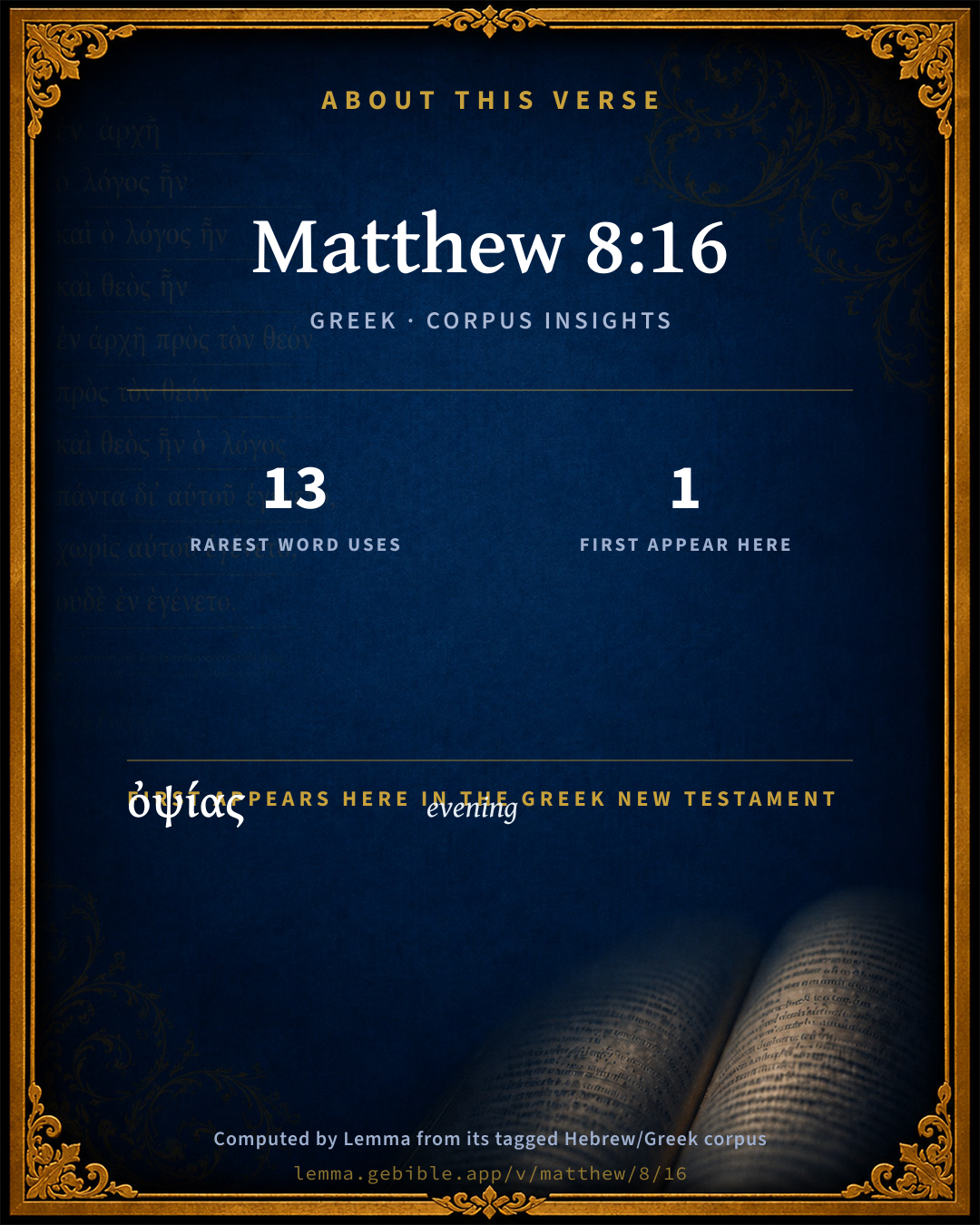
The rarest word here is δαιμονιζομένους to be demon-possessed G1139 — appearing just 13 times in the whole Greek New Testament.

First appearance in Scripture

This word makes its first canonical appearance in the Greek New Testament here:

  • ὀψίας evening G3798

Shared distinctive vocabulary

δαιμονιζομένους to be demon-possessed G1139 occurs in 13 verses of the Greek New Testament. Also found in:
Repetition

Words recur within this verse:

Cross-references

13

Topical passages linked to Matthew 8:16 in the Treasury of Scripture Knowledge — connected by theme and wording, ordered by reader-vote popularity; previews shown in the World English Bible.

  • Exodus 15:26 and he said, "If you will diligently listen to the voice of Yahweh your God, and will do that which is right in his eyes, and will pay attention to his commandments, and keep all his statutes, I will put none of the diseases on you, which I have put on the Egyptians; for I am Yahweh who heals you."
  • Matthew 14:14 Jesus went out, and he saw a great multitude. He had compassion on them, and healed their sick.
  • Luke 4:40 When the sun was setting, all those who had any sick with various diseases brought them to him; and he laid his hands on every one of them, and healed them.
  • Mark 1:32–34 At evening, when the sun had set, they brought to him all who were sick, and those who were possessed by demons.
  • Matthew 12:22 Then one possessed by a demon, blind and mute, was brought to him and he healed him, so that the blind and mute man both spoke and saw.
  • Mark 5:8 For he said to him, "Come out of the man, you unclean spirit!"
  • Acts 5:15 They even carried out the sick into the streets, and laid them on cots and mattresses, so that as Peter came by, at the least his shadow might overshadow some of them.
  • Acts 19:13–16 But some of the itinerant Jews, exorcists, took on themselves to name over those who had the evil spirits the name of the Lord Jesus, saying, "We adjure you by Jesus whom Paul preaches."
  • Matthew 4:23–24 Jesus went about in all Galilee, teaching in their synagogues, preaching the Gospel of the Kingdom, and healing every disease and every sickness among the people.
  • Matthew 9:2 Behold, they brought to him a man who was paralyzed, lying on a bed. Jesus, seeing their faith, said to the paralytic, "Son, cheer up! Your sins are forgiven you."
  • Mark 2:3 Four people came, carrying a paralytic to him.
  • Mark 1:25–27 Jesus rebuked him, saying, "Be quiet, and come out of him!"
  • Mark 9:25 When Jesus saw that a multitude came running together, he rebuked the unclean spirit, saying to him, "You mute and deaf spirit, I command you, come out of him, and never enter him again!"

Cross-references courtesy of OpenBible.info (CC BY 4.0).

Commentary

Notes on Matthew 8:16 from classic Christian and Jewish commentators (each source and its license shown beneath its notes). The classic Christian expositions comment on the surrounding passage and are grouped to its opening verse, so a note may address several verses; the Jewish commentaries on the Tanakh (Rashi and others) are per-verse, so they appear only where the commentator wrote on this verse.

Lemma curates 59 commentaries, every one of them public domain or Creative Commons licensed, each selected and text-cleaned for this edition rather than reprinted as found. About our sources →

Joseph Benson's Commentary

Mat 8:16-17. When even was come, they brought unto him many, &c. — The news of this miracle being spread through the town, those who had sick relations or friends resolved to apply to Jesus for a cure. Only, because it was the sabbath, they did not come immediately to him. They waited till the holy rest was ended, which, according to the Jewish form of the day, was at sunsetting, at which time, according to Mar 1:32, and Luk 4:40, they brought the sick in great numbers to him: and he took pity on them and healed them all, casting out the devils from the demoniacs with his word — His authoritative and powerful word, the same by which he made the world, and all things therein. That it might be fulfilled which was spoken by Esaias — That is, whereby was fulfilled, namely, in a lower sense than that primarily intended by the prophets; saying, Himself took our infirmities, &c. — Isaiah spoke it in a more exalted sense. The evangelist here only alludes to those words as being capable of this lower meaning also. Such instances are frequent in the sacred writings, and are elegances rather than imperfections. He fulfilled these words in the highest sense, by bearing our sins in his own body on the tree: in a lower sense, by sympathizing with us in our sorrows, and healing us of the diseases which were the fruit of sin.

Joseph Benson's Commentary on the Old and New Testaments (1811–1818) — public domain. Text from a community e-Sword module.

Tyndale Open Study Notes

Tyndale Open Resources

8:16-17 Jesus is the authoritative Lord over every disease and demon.

8:16 with a simple command: Jesus’ authority extended beyond touch; his words brought healing and life.

Tyndale Open Study Notes — © Tyndale Open Resources, licensed CC BY-SA 4.0. Text via the HelloAO Bible API.

Bengel's Gnomon

Johann Albrecht Bengel

Mat 8:16. Ὀψίας, evening) of that day on which so much had been said and done. Diseases are wont to be more oppressive at eventide.—τὰ πνεύματα, the spirits) i.e. the devils.—λόγῳ, with a word[374]) by that alone.[375]—πάντας, all) without exception: some men are said to have a healing power in the case only of certain special diseases.

[374] That such is Bengel’s meaning is clear from his German Version, where he renders it “mit einem wort.” E. V. has “By His word.”—(I. B.)

[375] “Solo,” i.e. without using any other means.—(I. B.)

Bengel's Gnomon of the New Testament — English translation (T&T Clark, Edinburgh, 1860) — public domain. Text from a community e-Sword module.

Expositor's Greek Testament

ed. W. Robertson Nicoll

Mat 8:16-17 . Events of that Sabbath evening (Mar 1:32-34 ; Luk 4:40-41 ). A general statement, which, after Mat 4:23 f., might have been dispensed with; but it is in the source (Mark) in the same context, and it gives our evangelist a welcome opportunity of quoting a prophetic text in reference to Christ’s healing work.

Mat 8:16 . Ὀψίας γενομένης : vague indication of time on any day, but especially a Sabbath day. There were two evenings, an early and a late (Exo 30:8 ). Which of them was it; before or after sunset? Mark is more exact. δαιμον . πολλούς : why a crowd just then, and why especially demoniacs brought to be healed? For explanation we must go to Mark. The preaching of Jesus in the synagogue that Sabbath day, and the cure of a demoniac (Mar 1:21-28 ), had created a great sensation, and the result is a crowd gathered at the door of Peter’s house at sunset, when the Sabbath ended, with their sick, especially with demoniacs.

The Expositor's Greek Testament, edited by W. Robertson Nicoll (1897–1910) — public domain. Text from a community e-Sword module.

Geneva Bible (1599)

Geneva Bible translators

Of all sorts.

Geneva Bible (1599) marginal notes — public domain. Text via Bolls.life.

Adam Clarke's Commentary

Verse 16. When the even was come] The Jews kept their sabbath from evening to evening, according to the law, Le 23:32, From evening to evening shall ye celebrate your sabbath. And the rabbins say, The sabbath doth not enter but when the sun is set. Hence it was that the sick were not brought out to our Lord till after sun-set, because then the sabbath was ended.

Many that were possessed with devils] Dr. Lightfoot gives two sound reasons why Judea, in our Lord's time, abounded with demoniacs. First, Because they were then advanced to the very height of impiety. See what Josephus, their own historian, says of them: There was not (said he) a nation under heaven more wicked than they were. See Clarke on Ro 1:1. Secondly, Because they were then strongly addicted to magic, and so, as it were, invited evil spirits to be familiar with them. It seems strange to find men at this distance of time questioning the truth of that which neither scribes nor Pharisees then doubted; nor did they ever object against the pretensions of Christ and his apostles to cast them out. And, if the whole business of demonism had been only a vulgar error, (as wise men now tell us,) what a fine opportunity had the wise men then, to unmask the whole matter, and thus pour contempt on the pretensions of our blessed Lord and his followers, who held it to be one proof of their Divine mission, that demons were subject to them!

And healed all that were sick] Not a soul did the Lord Jesus ever reject, who came to him soliciting his aid. Need any sinner despair who comes to him, conscious of his spiritual malady, to be healed by his merciful hand?

Adam Clarke's Commentary on the Bible (1810–1826) — public domain. Text from a community e-Sword/MySword module.

Ellicott's Commentary for English Readers

(16) When the even was come.—Or, as St. Luke has it, “While the sun was setting.” There were two reasons why the time should be thus specified. (1) It was natural that the sick should be brought in the cool of the evening, rather than in the scorching heat of the afternoon; and (2) it was the Sabbath, and the feeling which made the Pharisees question the lawfulness of a man’s carrying the bed on which he had been lying (Joh_5:10), would probably have deterred the friends of the sick from bringing them as long as it lasted. But with sunset the Sabbath came to a close, and then they would feel themselves free to act. The prominence given to “those that were possessed with devils,” both by St. Matthew and St. Mark, shows that it was the work of the Sabbath morning that had most impressed itself on their minds.

A Bible Commentary for English Readers, edited by Charles John Ellicott (1878–1897) — public domain. Text from a community e-Sword module.

The Cambridge Bible for Schools and Colleges

gen. ed. J. J. S. Perowne

16. with his word] not by a touch, as in the case of leprosy and fever. Christ never laid his hand on demoniacs.

The Cambridge Bible for Schools and Colleges (gen. ed. J. J. S. Perowne; Cambridge University Press, 1878–1918) — public domain. Text from a community e-Sword module.

John Gill's Exposition

That it might be fulfilled which was spoken by Esaias the prophet,.... In Isa 53:4 "He hath borne our griefs and carried our sorrows", here rendered,

himself took our infirmities and bare our sicknesses: very agreeable to the Hebrew text, "he himself", not another; "took up", upon himself voluntarily, freely, as a man lifts up a burden, and takes it on his shoulders; "our infirmities", diseases, sicknesses, whether of body or soul, , "and bare", or carried, as a man does a burden upon his back, "our sicknesses", or diseases, which occasion pain and sorrow. And that these words are spoken of the Messiah, the Jews themselves own; for among the names they give to the Messiah, "a leper" is one; which they prove from this passage (u).

"The Rabbins say, "a leper" of the house of Rabbi is his name; as it is said, "surely he hath borne our griefs, and carried our sorrows, yet we did esteem him stricken, smitten of God and afflicted". Says R. Nachman, if he is of the living, he is as I am, as it is said, Jer 30:21 Says Rab, if of the living, he is as our Rabbi, the holy.''

Upon which last clause the gloss is,

"If the Messiah is of them that are alive, our Rabbi the holy is he, "because he bears infirmities".''

Elsewhere (w) they say,

"There is one temple that is called the temple of the sons of afflictions; and when the Messiah comes into that temple, and reads all the afflictions, all the griefs, and all the chastisements of Israel, which come upon them, then all of them shall come upon him: and if there was any that would lighten them off of Israel, and take them upon himself, there is no son of man that can bear the chastisements of Israel, because of the punishments of the law; as it is said, "surely he hath borne our griefs", &c.''

And in another ancient book (x) of their's, God is represented saying to the Messiah,

, "wilt thou bear chastisements", in order to remove their iniquities? (the iniquities of the children of God,) as it is written, "surely he hath borne our griefs": he replied, "I will bear them with joy".''

Hence it is manifest, that according to the mind of the ancient Jews, this passage belongs to the Messiah, and is rightly applied to him by the evangelist. But the difficulty is, how it had its accomplishment in Christ's healing the bodily diseases of men; since Isaiah speaks not of his actions and miracles, but of his sufferings and death; and not of bearing the diseases of the body, as it should seem, but of the diseases of the mind, of sins, as the Apostle Peter interprets it, Pe1 2:24. To remove which, let it be observed, that though the prophet chiefly designs to point out Christ taking upon him, and bearing the sins of his people, in order to make satisfaction for them, and to save them from them; yet so likewise, as to include his bearing, by way of sympathy, and taking away by his power, the bodily diseases of men, which arise from sin; and which was not only an emblem of his bearing and taking away sin, but a proof of his power and ability to do it: for since he could do the one, it was plain he could do the other.

(u) T. Bab. Sanhedrim, fol. 98. 2. (w) Zohar in Exod. fol. 85. 2. (x) Pesikta in Abkath Rochel, l. 1. par. 2. p. 309. Ed. Huls.

John Gill's Exposition of the Whole Bible (1746–1763) — public domain (CC PDM 1.0). Text via the HelloAO Bible API.

Trapp's Complete Commentary

John Trapp

16 When the even was come, they brought unto him many that were possessed with devils: and he cast out the spirits with his word, and healed all that were sick:

Ver. 16. When the even was come] In the morning he sowed his seed, and in the evening he withheld not his hand, Ecc 11:6. It is good to be doing while it is day. Mr Bradford, martyr, held that hour not well spent wherein he did not some good, either with his tongue, pen, or hand.

John Trapp, A Commentary or Exposition upon All the Books of the Old and New Testament (1647–1656) — public domain. Text from a community e-Sword module.

Albert Barnes' Notes on the Bible

When the even was come ... - The fame of the miracles of Jesus would probably draw together a crowd, and those who had friends that were afflicted would bring them. All that were brought to him he healed. This was proof of two things: first, of his great benevolence; and, secondly, of his divine mission. He might have established the latter by miracles that would do no good. None of his miracles were performed, however, merely to make a display of power, unless the cursing of the barren fig-tree be an exception. Compare Mar 11:11-14. What is here recorded occurred on the evening of the Sabbath, Mar 1:21-32. The Jews kept the Sabbath from evening to evening, Lev 23:32. On the Sabbath they would not even bring their sick to be healed Luk 13:14; but as soon as it was closed, on the evening of the same day, they came in multitudes to be cured.

Possessed with devils - See the notes at Mat 4:24.

With his word - By his command; by a word.

Albert Barnes' Notes on the Bible (1834–1885) — public domain. Text from a community e-Sword/MySword module.

Matthew Poole's English Annotations

Mark hath much the same Mar 1:32-34 and Luk 4:40,41. Luke adds, he laid his hands upon them, and healed them. We before, Mat 4:24, showed who were meant by persons possessed by devils. See Poole on "Mat 4:24". It is only observable that it is said,

he cast out the spirits by his word, by the same power by which he made the world and all things therein, Gen 1:1-31, by his authoritative word. He

healed all that were sick, that is, all that were brought to him. Laying on of his hands, was but an external symbol or rite used in blessing, in miraculous operations, and in ordination of ministers. The great question is, how that which the prophet Isaiah said, Isa 53:4, was fulfilled by these miraculous operations. The words are, Surely he hath borne our griefs, and carried our sorrows; and, Isa 53:5, with his stripes we are healed: and the apostle Peter, referring to that text, saith, Who bare our sins in his own body on the tree, 1Pe 2:24. The words neither seem truly quoted, nor doth the sense appear the same, the evangelist applying what the prophet seems to speak of our sins, to our bodily infirmities, and his bearing them, to his curing them; whereas Peter seemeth to apply it to his bearing our sins, that is, the punishment of our sins, in his stripes, and by his sufferings on the cross. What I observed before is here to be considered, that the evangelists, in their quotations out of the Old Testament, took themselves only concerned to keep to the sense, not exactly to the words (which is a liberty we ordinarily take in quotations). As to the sense, grief and sorrows are terms capable of an interpretation, as to whatsoever comes upon us as the fruit and demerit of our sins, so as the prophet designed to express Christ’s suffering all the punishment due to us for sin, of which nature are all the afflictions of this life, and death itself, as well as the pains of hell. The only question is, how Matthew’s saying, he healed the people’s diseases, answered the prophet’s expression, he bore our griefs and carried our sorrows. This scripture was twice fulfilled in Christ: as to their bodily griefs and sorrows, that is mentioned by Matthew, though he bare them not all in his own body, yet he had compassion on men with reference to them, and showed himself afflicted in their afflictions by his putting forth his Divine power to heal them; and he bore the guilt that was the cause of these and other griefs and sorrows upon the tree, as is said by Peter; and he therefore healed them, that he might demonstrate himself to be the true Messias prophesied of by Isaiah, who was to come, who was to bear our griefs and to carry our sorrows.

Matthew Poole's English Annotations on the Holy Bible (1683–1685) — public domain. Text from a community e-Sword/MySword module.

Whedon's Commentary on the Bible

Daniel D. Whedon

16. Even — Old English for evening. Some say they waited for evening to avoid the heat of the day. But as it was Sabbath, and we read of no other instance of withholding the sick until evening, doubtless they waited until the Jewish Sabbatical hours were over.

Daniel D. Whedon (gen. ed.), Commentary on the Old and New Testaments (1874–1909) — public domain. Text from a community e-Sword module.

The Pulpit Commentary

Vers. 16, 17. The great number of his miracles, and the secret of his performing them.

Parallel passages: Mar_1:32-34 Luk_4:40. When the even was come; Revised Version, and when even-According to the original connexion, preserved, as it seems, in Mark and Luke, this was the evening of the day in which our Lord had healed the man with the withered hand in the synagogue. Probably, therefore, the day had been a sabbath. But with the setting sun (parallel passage in Luke), or rather, according to Talmudic teaching, when three stars were visible after sunset (vide Lightfoot, " Her. Hebr.," in lec. ), the sabbath was over, (Lev_23:32) and people were free to carry out their sick. Should the day not have been a sabbath, we may presume that the evening was chosen as cooler for the sick to be moved, and as more convenient to those who carried them, the day"s work being done. They brought unto him many that were possessed with devils: (Mat_4:24, note) and he cast out the spirits with his (Revised Version, a) word (ver. 8). In contrast to saying over them the long formulas of exorcism used by others. And healed all that were sick. The stress is on all. None were so ill as to be beyond his power, and no kind of disease too great for him to subdue.

Vers. 16, 17. The sympathy of Christ.

He has finished a long day"s work, and has gone into the house for rest. Even there he finds work to do, and he heals Peter"s wife"s mother. Meanwhile a crowd is collecting at the door. They have brought their sick from all quarters, and Jesus cannot let them come in vain. Tired as he is, he goes forth to them and heals them nit. So touching a proof at once of the people"s need and of Christ"s sympathetic help leads the evangelist to see a fulfilment of the ancient prophecy of the" Servant of the Lord." Here the sympathy of Christ is revealed to us.

I SYMPATHY IS THE MOTIVE OF CHRIST"S LIFE-WORK. It was sympathy that led him to take up the great task of saving the world. Sympathy is also apparent in the details of that task. There have been philanthropists whose private conduct seemed hard, who were negligent of the misery at their feet, who took little interest in individual cases of distress, while they manifested the greatest energy in pressing on large measures of humanitarian reform. Christ is not thus partial in his kindness. Moreover, we find no attempt at working miracles for any other purpose than the help of the sufferers. No doubt Christ was aiming at the glory of God throughout; (see Joh_2:11 Joh_11:4) evidently his miracles were visible parables, setting forth in concrete acts the grace of his spiritual work. Yet the motive in his heart was not didactic, but sympathetic. His first idea was not to teach a lesson, but to relieve distress. He was "moved with compassion.

II THE SYMPATHY OF CHRIST EXTENDED TO BODILY TROUBLE. He healed the sick. He cared for men"s bodies as well as their souls. Often he reached their spiritual natures by first of all showing himself their Friend in temporal affairs.

1. Thus he encourages us to pray to him in sickness for our sick friends, and in regard to earthly troubles generally. Christ does not disdain these things.

2. Thus, also, we are urged by the example of Christ to help the suffering in their bodily needs. God gave miracles to the first century; he has given medicine to the nineteenth century. It is our duty to use what means we have for healing the sick. Medical missions are most Christ-like.

III THE SYMPATHY OF CHRIST IS EFFECTIVE. It is more than the tear of pity. Christ feels with the sufferers, and that is much; but he goes further, and relieves them of their sufferings. He cured the sick. He freed the possessed. He reclaimed the lost. His spiritual work now is practical. When we open our hearts to the love of Christ we receive more than compassion; we receive redemption.

IV THE SYMPATHY OF CHRIST IS COSTLY, He takes our infirmities; he bears our diseases. This means more than the removal of those troubles; the strong words cannot be satisfied unless we understand them to teach that the afflictions are a burden to Christ. The sympathy which costs us nothing is shallow and worthless. Christ"s sympathy was deep and real. It was pain to him. Perhaps the healing process was itself painful, as he felt the "virtue" going out of him. However that may have been, his coming into this world, his endurance of sights of misery, and his deep compassion for the distressed, wrung his heart, because he felt that the sufferings of his brethren were his own sufferings. All this was a shadow of his great anguish when he bore more than sickness, when he bore the sins of the world on the cross. W.F.A.

The Pulpit Commentary (1880–1919), ed. H.D.M. Spence-Jones & Joseph S. Exell — public domain. Text from a community e-Sword module.

John Wesley's Explanatory Notes

Mark i, 32; Luke iv, 40.

John Wesley, Explanatory Notes Upon the Whole Bible (1754–1765) — public domain. Text via the GEBible commentary corpus.

Scofield Reference Notes

C. I. Scofield

possessed

(Greek - δαιμονίζομαι - "demonized"). (See Scofield "Mat 7:22").

The Scofield Reference Bible (1917 edition), notes by C. I. Scofield — public domain. Text from a community e-Sword module.

Kretzmann's Popular Commentary

Paul E. Kretzmann

Events of that Sabbath-evening:

v. 16. When the even was come, they brought unto Him many that were possessed with devils; and He cast out the spirits with His word, and healed all that were sick,

v. 17. that it might be fulfilled which was spoken by Esaias the prophet, saying, Himself took our infirmities, and bare our sicknesses.

All Galilee was filled with the report concerning Christ, and a steady stream of sick people with their relatives was usually pouring in from every direction. It was after the close of the Sabbath-day, Lev 23:32; they need hesitate no longer for fear of transgressing the Law. The fame of the Lord’s having cured a demoniac in the morning had spread like wild-fire. The majority of those brought to Him were afflicted with the same terrible disease, that of being possessed of evil spirits. With a word He cast out the demons who, like the entire spirit world, are subject to Him; with tender kindness He healed all the other sicknesses; there was none that could withstand His almighty mercy. The reference of Matthew to the prophecy, Isa 53:4, is very appropriate. The prophet’s reference is to griefs and sorrows, to diseases and pains of the soul, due to sin and its curse. But the evangelist rightly argues: He that bears the greater is master of the smaller. The diseases of man are connected with sin, on the one hand, and with death, on the other. And so our High Priest, touched with the feeling of our infirmities, had sympathy with the results and consequences of sin, knowing its curse, its destructive influence, upon body and soul, Heb 4:15; Heb 5:2. He bare, He took away, our sins and infirmities; they are no longer a curse for the believers.

Paul E. Kretzmann, Popular Commentary of the Bible (1921–1924) — public domain. Text from a community e-Sword module.

Burkitt's Expository Notes on the New Testament

William Burkitt

It was very common about the time of our Saviour’s coming in the flesh, for the devil bodily to possess persons, and very grievously to torment them. This is one of the sad and dismal evils which sin had made us liable an obnoxious to, to be bodily possessed by Satan; whan we give Satan the power of our hearts, it is a just and righteous thing wiah God, to give him the possession of bodies.

But who is the person that dispossesses Satan? Christ Jesus; it is a stronger than the strong man that must cast out Satan: our Jesus in whom we trust, by his powerful word alone can deliver us from Satan’s power, and all the sad effects and consequences thereof.

But observe, with what condolency and sympathizing piety he exercises these acts of mercy and compassion towards poor creatures: he is said to take our infirmities upon himself, and to bare our sicknesses: he bare the guilt, which was the cause of these griefs and sorrows; and he bare the sorrows themselves, by a tender sympathy with us under the burden of them. Christ considers our sufferings as his own: he was afflicted in all our afflictions, and pained with all our pains; in this sense, he took our infirmities and bare our sicknesses.

William Burkitt's Expository Notes on the New Testament (1700–1703) — public domain. Text from a community e-Sword module.

The People's New Testament

B. W. Johnson

16. They brought many. See also Mark 1:32. Possessed with devils. See note on Matt. 4:24. Healed the sick. The sick were diseased in body; the demoniacs were spiritually diseased.

B. W. Johnson's The People's New Testament with Notes (1889–1891) — public domain. Electronic text from the Christian Classics Ethereal Library (CCEL) ThML edition.

unfoldingWord translationNotes

Door43 World Missions Community

Connecting Statement:

Here the scene shifts to later that evening and tells of Jesus healing more people and casting out demons.

General Information:

In verse 17, Matthew quotes the prophet Isaiah to show that Jesus' healing ministry was a fulfillment of prophecy.

When evening had come

Because Jews did not work or travel on the Sabbath, "evening" may imply after the Sabbath. They waited until evening to bring people to Jesus. You do not need to mention the Sabbath unless you need to avoid wrong meaning. (See: Assumed Knowledge and Implicit Information)

many who were possessed by demons

This can be stated in active form. AT: "many people whom demons possessed" or "many people whom demons controlled" (See: Active or Passive)

He drove out the spirits with a word

Here "word" stands for a command. AT: "He commanded the spirits to leave" (See: Metonymy)

was fulfilled that which had been spoken by Isaiah the prophet

This can be stated in active form. AT: "Jesus fulfilled the prophecy that the prophet Isaiah had spoken to the people of Israel" (See: Active or Passive)

took our sickness and bore our diseases

Matthew is quoting the prophet Isaiah. These two phrases mean basically the same thing and emphasize that he healed all of our diseases. AT: "healed those who were sick and made them well" (See: Parallelism)

translationWords

demon-possessed

cast out

spirit

cure

fulfill

Isaiah

prophet

unfoldingWord translationNotes — © Distant Shores Media and the Door43 World Missions Community, licensed CC BY-SA 4.0. Source: git.door43.org/Door43/en_tn.

Cambridge Greek Testament for Schools and Colleges

16. λόγῳ. Not by a touch, as in the case of leprosy and fever. Christ never laid his hand on demoniacs.

Cambridge Greek Testament for Schools and Colleges (Cambridge University Press, 1896; 21 vols, various authors incl. Carr, Maclear, Plummer, Farrar, Lumby, Moule, M. R. James, Simcox) — public domain. Text from a community e-Sword module.

Alford’s Greek Testament

Henry Alford

16.] at sunset, Mark ver. 32: Luke ver. 40. From St. Mark we learn that the whole city was collected at the door; from St. Luke, that the dæmons cried out and said, ‘Thou art Christ the Son of God.’ And from both, that our Lord permitted them not to speak, for they knew Him. They brought the sick in the evening, either because it was cool,—or because the day’s work was over, and men could be found to carry them,—or perhaps because it was the sabbath (see Mar 1:21, Mar 1:29, Mar 1:32), which ended at sunset.

Henry Alford, The Greek Testament (1849–1861) — public domain. Text from a community e-Sword module.

International Critical Commentary

16. And when it was evening, they brought to Him many demoniacs; and He cast out the spirits with a word, and healed all that were in evil plight.] Mk has: “And when it was evening, when the sun set, they were bringing to Him all who were in evil plight, and the demoniacs. And the whole city was gathered at the door. And He healed many who were in evil plight, and cast out many demons; and did not suffer the demons to speak, because they knew Him to be the Christ.”

This passage is very characteristic of Mk.’s style. Notice the tautologous “When it was evening, when the sun set,” the repetition of τοὺς κακῶς ἔχοντας and of τὰ δαιμόνια, and the emphasis upon the multitude who thronged the door. Mt. omits “when the sun set”; cf. Introduction, p. xxiv. He substitutes the aorist προσήνεγκαν for Mk.’s imperfect ἔφερον. See Introduction, p. xx. προσφέρειν occurs fifteen times in Mt., three in Mk. The substitution of the composite for the simple verb carries with it the substitution of αὐτῷ for πρὸς αὐτόν; cf. the same change in 9:2 = Mar 2:3, the dat. for πρός με in 17:17 = Mar 9:19, the dot. for πρὸς αὐτόν in 22:23 = Mar 12:18, and the dat. for πρὸς τὸν ΙΙειλᾶτον in 27:57 = Mar 15:43. He abbreviates the rest in such a way as to omit one occurrence of τοὺς κακῶς ἔχοντας and of τὰ δαιμόνια, and by a slight transposition has “many brought, all healed” for Mk.’s “all brought, many healed.” Cf. Introduction, p. xxxii. λόγῳ is an assimilation to v. 8 It enhances the miraculous character of the healing. Cf. Introduction, p. xxxii.

(O)

International Critical Commentary — older volumes (1896–1929), various authors — public domain. Text from a community e-Sword module.

Lesson kit

Teaching starters — assembled from the data on this page, not authored interpretation. Every prompt links to the verse data it draws on. Edit before teaching.

Matthew, in the Gospels, opens this verse with 18 words (16 distinct Greek lemmas). Its most distinctive word is daimonízomai (“to be demon-possessed”). A historical commentator’s framing appears above. Read the whole chapter for the surrounding context.

Discussion questions

  1. The word daimonízomai carries the sense “to be demon-possessed.” How does it shape the verse?
  2. This is the first place “evening” appears in Scripture (first appears here). What does its debut here establish?
  3. How does Matthew 4:24, which shares the word «to be demon-possessed», read alongside this verse?
  4. What does the repetition of “and” (2× in this one verse) do in this verse?
  5. These translations render this verse differently; the difference is in the English rendering, not the original. What questions does that raise?
  6. Compare how Joseph Benson's Commentary and Tyndale Open Study Notes read this verse. Where do they agree or differ?

Things to notice

  • 1 word makes its first canonical appearance in Scripture here.
  • These translations choose different wording for 14 words in this verse.
  • “and” occurs 2× in this single verse.
  • 16 distinct Greek lemmas span 18 words in this verse.

Reading settings

Reading text

Shown beneath each verse's original-language words.

Old Testament
Old Testament edition

Read the OT as the Masoretic Hebrew (MT) or the Greek Septuagint (LXX).

English shown for the Greek Septuagint (in the Hebrew ↔ Greek comparison).

Comparing translations? Open the Compare panel on any verse page to stack up to four side by side.