Luke 1:16

Greek (Tischendorf 8th ed.) Luke 1:16 appears in the Greek New Testament. The text above is from the Tischendorf 8th edition. Each word links to its Strong’s number and a concise gloss. Click any word for its full Thayer’s Greek Lexicon entry.
Download image
Cite this verse

Luke 1:16 (World English Bible). Public Domain. Lemma interlinear Bible study tool, https://lemma.gebible.app/v/luke/1/16.

Show BibTeX & RIS
BibTeX
RIS
English Translation
He will turn many of the children of Israel to the Lord, their God.
World English Bible · Public Domain
Download a study sheet

One document with this verse’s original text, its word-by-word gloss line, the meaning frame, cross-references with their text, attributed commentary, and full source and license credits — printable, and it pastes into notes with its structure intact.

This verse Autodidact and up

Study sheet (.html) Plain text (.txt)

A passage Seminary Student

Up to 50 verses in one chapter. A passage sheet keeps up to 6 commentary sources and 12 cross-references per verse, in the order this page ranks them, and says so on the sheet whenever that leaves anything out. Ask for a single verse and you get the Autodidact verse sheet above.

Everything on this page stays free to read, with no account — the sheet is a download of what is already on screen, not access to it.

Want to remove ads? Support Godless Engineer
Compare translations 3

The same verse in 3 English versions, stacked beneath the original-language interlinear above. Click any original word for its lexicon entry.

Each is an independent rendering of the whole verse — the interlinear is not word-aligned to these translations.

Highlighted words mark where these versions differ — a whole-verse word diff, not a word-by-word alignment.

  • World English Bible Public Domain
    He will turn many of the children of Israel to the Lord, their God.
  • King James Version Public Domain
    And many of the children of Israel shall he turn to the Lord their God.
  • unfoldingWord Literal Text CC BY-SA 4.0
    And he will turn many of the sons of Israel back to the Lord their God.

unfoldingWord Literal Text — © unfoldingWord, licensed CC BY-SA 4.0. Word-aligned USFM3 via Door43 (git.door43.org/unfoldingWord/en_ult).

Versions to compare (up to 4)

3 of 4 selected

Show all 19 translations

Every available English version of this verse, each an independent rendering of the whole verse.

  • World English Bible Public Domain
    He will turn many of the children of Israel to the Lord, their God.
  • Berean Standard Bible Public Domain
    Many of the sons of Israel he will turn back to the Lord their God.
  • Majority Standard Bible Public Domain
    Many of the sons of Israel he will turn back to the Lord their God.
  • King James Version Public Domain
    And many of the children of Israel shall he turn to the Lord their God.
  • American Standard Version (1901) Public Domain
    And many of the children of Israel shall be turn unto the Lord their God.
  • Revised Version (1885) Public Domain
    And many of the children of Israel shall he turn unto the Lord their God.
  • Geneva Bible (1599) Public Domain
    And many of the children of Israel shall he turne to their Lord God.
  • Douay-Rheims (1899) Public Domain
    And he shall convert many of the children of Israel to the Lord their God.
  • Young's Literal Translation Public Domain
    and many of the sons of Israel he shall turn to the Lord their God,
  • Literal Standard Version CC BY-SA 4.0
    and he will turn many of the sons of Israel to the LORD their God,
  • Unlocked Literal Bible CC BY-SA 4.0
    Many of the people of Israel will be turned to the Lord their God.
  • unfoldingWord Literal Text CC BY-SA 4.0
    And he will turn many of the sons of Israel back to the Lord their God.
  • Darby Bible Public Domain
    And many of the sons of Israel shall he turn to [the] Lord their God.
  • World Messianic Bible Public Domain
    He will turn many of the children of Israel to the Lord their God.
  • Webster's Bible Public Domain
    And many of the children of Israel shall he turn to the Lord their God.
  • Free Bible Version CC BY-SA 4.0
    He will turn many Israelites back to the Lord their God.
  • Bible in Basic English Public Domain
    And through him great numbers of the children of Israel will be turned to the Lord their God.
  • Text-Critical English NT CC BY 4.0
    He will turn many of the sons of Israel to the Lord their God.
  • Tyndale New Testament (1534) Public Domain
    and many of the chyldren of Israel shall he tourne to their Lorde God.

Literal Standard Version (2020), Covenant Press — licensed CC BY-SA 4.0. Text via the HelloAO Bible API (eBible.org). Unlocked Literal Bible (unfoldingWord) — licensed CC BY-SA 4.0. Text via the HelloAO Bible API (eBible.org). unfoldingWord Literal Text — © unfoldingWord, licensed CC BY-SA 4.0. Word-aligned USFM3 via Door43 (git.door43.org/unfoldingWord/en_ult). Free Bible Version, Dr. Jonathan Gallagher — licensed CC BY-SA 4.0. Text via the HelloAO Bible API (eBible.org).

Word by word

More ways to search: Search by grammar → Find every occurrence → Compare this word →

Practice this passage: Drill this verse → Learn its vocabulary →

ἐπιστρέψει
epistréphō
G1994
“to turn”
Verb, Future, Active, Indicative, 3rd person, Singular
Part of Speech
Verb
Tense
Future
Voice
Active
Mood
Indicative
Person
3rd person
Number
Singular
Full Thayer's Definition

Origin: from G1909 and G4762

TDNT: 19:02,1

1. transitively a. to turn to 1. to the worship of the true God b. to cause to return, to bring back 1. to the love and obedience of God 2. to the love for the children 3. to love wisdom and righteousness 2. intransitively a. to turn to one's self b. to turn one's self about, turn back c. to return, turn back, come back
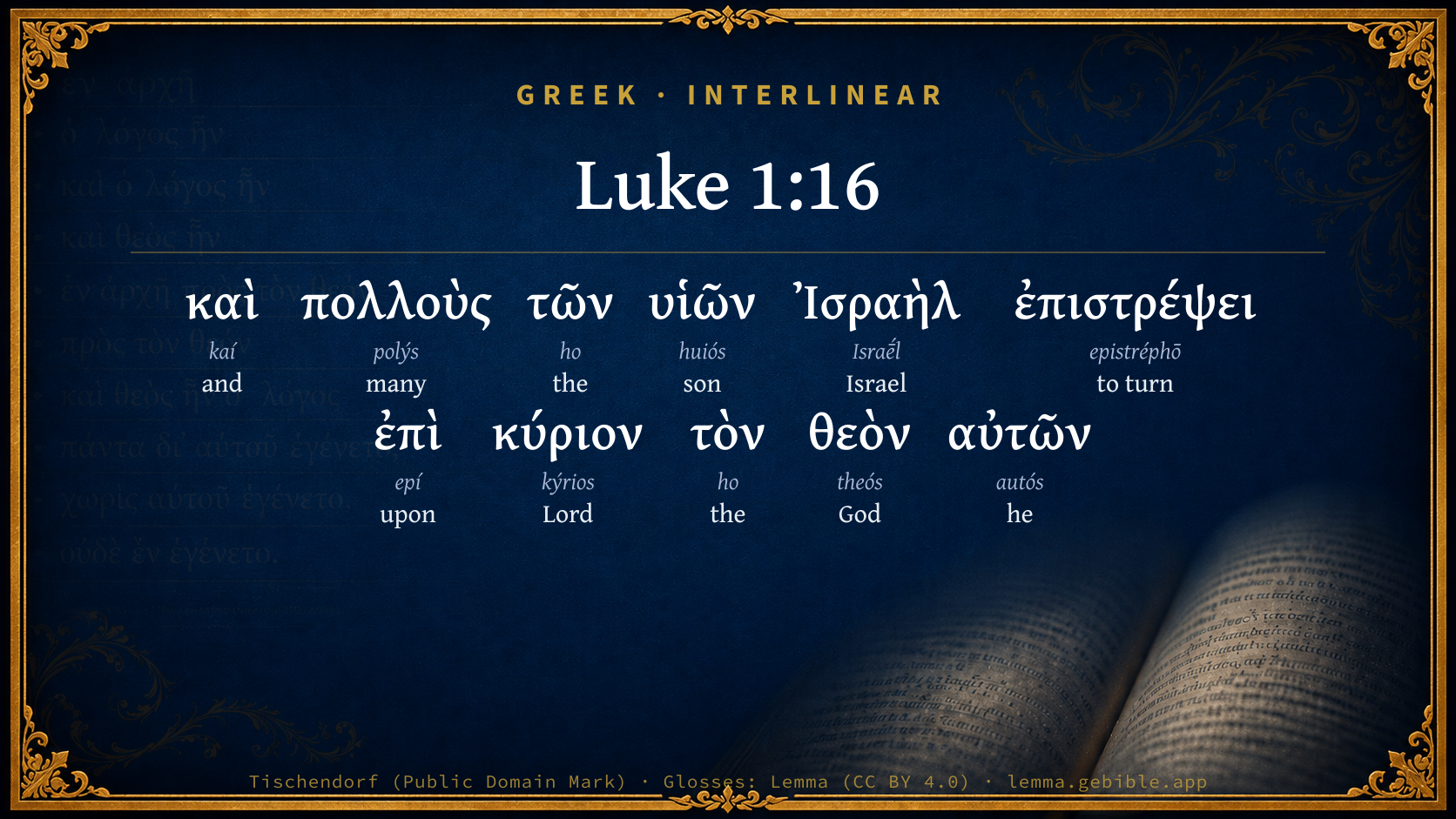
  1. καὶ kaí G2532 “and” Conjunction
  2. πολλοὺς polýs G4183 “many” Adjective, Accusative, Plural, Masculine
  3. τῶν ho G3588 “the” Article, Genitive, Plural, Masculine
  4. υἱῶν huiós G5207 “son” Noun, Genitive, Plural, Masculine
  5. Ἰσραὴλ Israḗl G2474 “Israel” Noun, Proper, indeclinable
  6. ἐπὶ epí G1909 “upon” Preposition
  7. κύριον kýrios G2962 “Lord” Noun, Accusative, Singular, Masculine
  8. τὸν ho G3588 “the” Article, Accusative, Singular, Masculine
  9. θεὸν theós G2316 “God” Noun, Accusative, Singular, Masculine
  10. αὐτῶν autós G846 “he” Personal pronoun, Genitive, Plural, Masculine

About this verse

These counts appear in no published source. They are computed here, from the morphology-tagged text and Lemma’s own curated glosses. What Lemma adds →

11
words
10
distinct lemmas
Gospels
section

Shared distinctive vocabulary

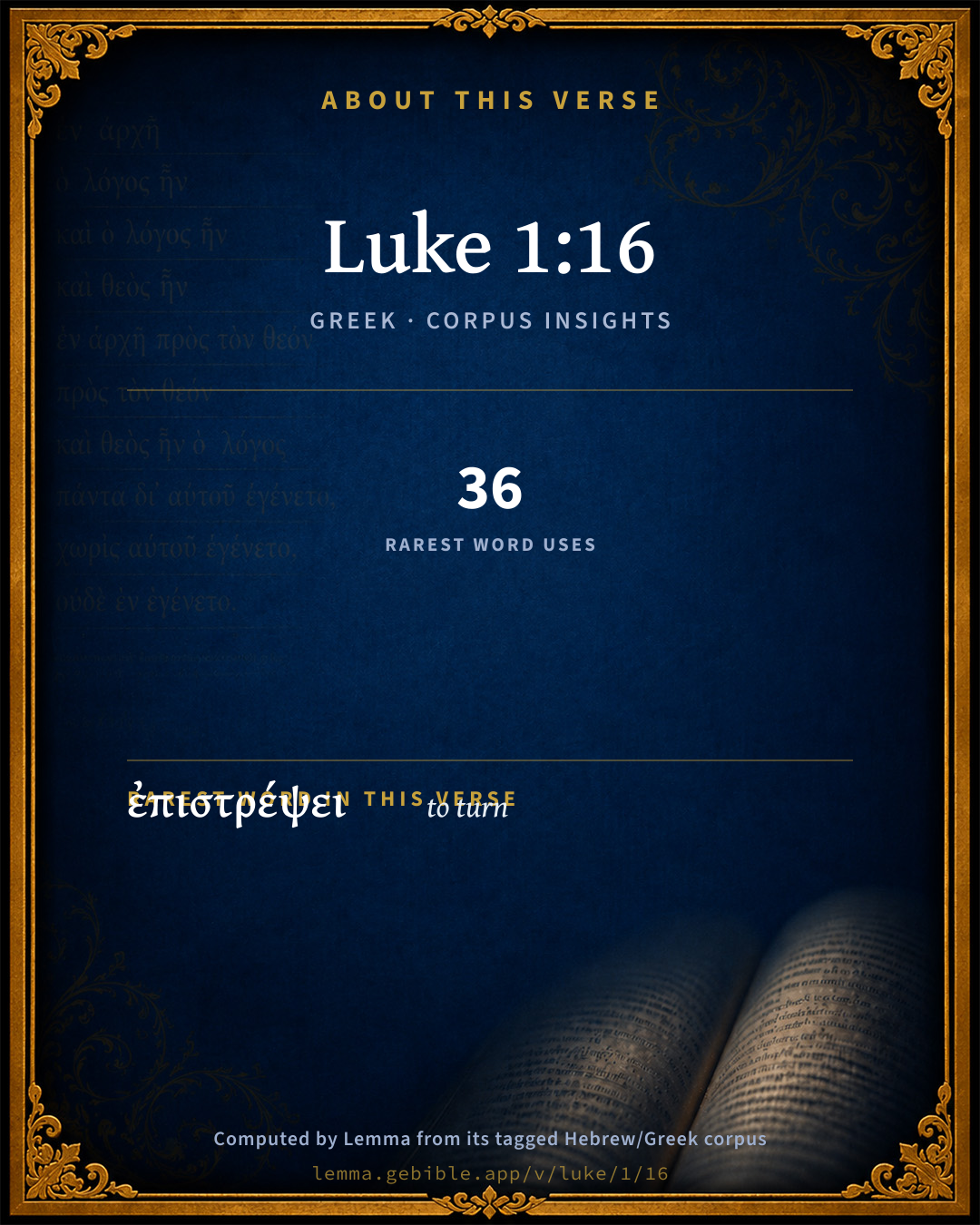
ἐπιστρέψει to turn G1994 occurs in 35 verses of the Greek New Testament. Also found in:

Repetition

A word recurs within this verse:

Cross-references

7

Topical passages linked to Luke 1:16 in the Treasury of Scripture Knowledge — connected by theme and wording, ordered by reader-vote popularity; previews shown in the World English Bible.

  • Matthew 21:32 For John came to you in the way of righteousness, and you didn't believe him, but the tax collectors and the prostitutes believed him. When you saw it, you didn't even repent afterward, that you might believe him.
  • Isaiah 40:3–5 The voice of one who cries, Prepare you in the wilderness the way of Yahweh; make level in the desert a highway for our God.
  • Malachi 3:1 "Behold, I send my messenger, and he will prepare the way before me; and the Lord, whom you seek, will suddenly come to his temple; and the messenger of the covenant, whom you desire, behold, he comes!" says Yahweh of hosts.
  • Matthew 3:1–6 In those days, John the Baptizer came, preaching in the wilderness of Judea, saying,
  • Isaiah 49:6 yes, he says, It is too light a thing that you should be my servant to raise up the tribes of Jacob, and to restore the preserved of Israel: I will also give you for a light to the Gentiles, that you may be my salvation to the end of the earth.
  • Daniel 12:3 Those who are wise shall shine as the brightness of the expanse; and those who turn many to righteousness as the stars forever and ever.
  • Luke 1:76 And you, child, will be called a prophet of the Most High, For you will go before the face of the Lord to make ready his ways,

Cross-references courtesy of OpenBible.info (CC BY 4.0).

Commentary

Notes on Luke 1:16 from classic Christian and Jewish commentators (each source and its license shown beneath its notes). The classic Christian expositions comment on the surrounding passage and are grouped to its opening verse, so a note may address several verses; the Jewish commentaries on the Tanakh (Rashi and others) are per-verse, so they appear only where the commentator wrote on this verse.

Lemma curates 59 commentaries, every one of them public domain or Creative Commons licensed, each selected and text-cleaned for this edition rather than reprinted as found. About our sources →

MacLaren's Expositions of Holy Scripture

Alexander MacLaren

Luke

ELIJAH COME AGAIN

Luk 1:5 - Luk 1:17.

The difference between the style of Luke’s preface {Luk 1:1 - Luk 1:4} and the subsequent chapters relating to the Nativity suggests that these are drawn from some Hebrew source. They are saturated with Old Testament phraseology and constructions, and are evidently translated by Luke. It is impossible to say whence they came, but no one is more likely to have been their original narrator than Mary herself. Elisabeth or Zacharias must have communicated the facts in this chapter, for there is no indication that those contained in this passage, at all events, were known to any but these two.

If we were considering a fictitious story, we should note the artistic skill which prepared for the appearance of the hero by the introduction first of his satellite; but the order of the narrative is due, not to artistic skill, but to the divinely ordered sequence of events. It was fitting that John’s office as Forerunner should begin even before his birth. So the story of his entrance into the world prepares for that of the birth which hallows all births.

I. We have first a beautiful outline picture of the quiet home in the hill country.

The husband and wife were both of priestly descent, and in their modest lives, away among the hills, were lovely types of Old Testament godliness. That they are pronounced ‘blameless’ militates against no doctrine of universal sinfulness. It is not to be taken as dogma at all, but as the expression of God’s merciful estimate of His servants’ characters. These two simple saints lived, as all married believers should do, yoked together in the sweet exercise of godliness, and helping each other to all high and noble things. Hideous corruption of wedlock reigned round them. Such profanations of it as were shown later by Herod and Herodias, Agrippa and Bernice, were but too common; but in that quiet nook these two dwelt ‘as heirs together of the grace of life,’ and their prayers were not hindered.

The most of the priests who appear in the Gospels are heartless formalists, if not worse; yet not only Annas and Caiaphas and their spiritual kindred ministered at the altar, but there were some in whose hearts the ancient fire burned. In times of religious declension, the few who still are true are mostly in obscure corners, and live quiet lives, like springs of fresh water rising in the midst of a salt ocean. John thus sprang from parents in whom the old system had done all that it could do. In his origin, as in himself, he represented the consummate flower of Judaism, and discharged its highest office in pointing to the coming One.

This ‘blameless’ pair had a crook in their lot. Childlessness was then an especial sorrow, and many a prayer had gone up from both that their solitary home might be gladdened by children’s patter and prattle. But their disappointed hope had not made them sour, nor turned their hearts from God. If they prayed about it, they would not murmur at it, and they were not thereby hindered from ‘walking in all God’s commandments and ordinances blameless.’ Let us learn that unfulfilled wishes are not to clog our devotion, nor to silence our prayers, nor to slacken our running the race set before us.

II. We are carried away from the home among the hills to the crowded Temple courts.

The devout priest has come up to the city, leaving his aged wife in solitude, for his turn of service has arrived. Details of the arrangements of the sacerdotal ‘courses’ need not detain us. We need only note that the office of burning incense was regarded as an honour, was determined by lot, and took place at the morning and evening sacrifice. So Zacharias, with his censer in his hand, went to the altar which stood in front of the veil, flanked on the right hand by the table of shewbread, and on the left by the great lamp-stand. The place, his occupation, the murmur of many praying voices without, would all tend to raise his thoughts to God; and the curling incense, as it ascended, would truly symbolise the going up of his heart in aspiration, desire, and trust. Such a man could not do his work heartlessly or formally.

Mark the manner of the angel’s appearance. He was not seen as in the act of coming, but was suddenly made visible standing by the altar, as if he had been stationed there before; and what had happened was not that he came, but that Zacharias’s eyes were opened. So, when Elisha’s servant was terrified at the sight of the besiegers, the prophet prayed that his eyes might be opened, and when they were, he saw what had been there before, ‘the mountain full of horses and chariots of fire.’ Not the Temple courts only, but all places are full of divine messengers, and we should see them if our vision was purged. But such considerations are not to weaken the supernatural element in the appearance of this angel with his message. He was sent, whatever that may mean in regard to beings whose relation to place must be different from ours. He had an utterance of God’s will to impart.

It has often been objected to these chapters that they are full of angelic appearances, which modern thought deems suspicious. But surely if the birth of Jesus was what we hold it to have been, the coming into human life of the Incarnate Son of God, it is not legend that angel wings gleam in their whiteness all through the story, and angel voices adore the Lord of men as well as angels, and angel eyes gaze on His cradle, and learn new lessons there.

III. We have next the angel’s message.

The devoutest heart is conscious of shrinking dread when brought face to face with celestial brightness that has overflowed into our darkness. So ‘Fear not’ is the first word on the messenger’s lips, and one can fancy the accent of sweetness and the calm of heart which followed. It has often been thought that Zacharias had been praying for offspring while he was burning incense; but the narrative does not say so, and besides the fact that he had ceased to hope for children {as is shown by his incredulity}, surely it casts a slur on his religious character to suppose that personal wishes were uppermost at so sacred a moment. Prayers that he had long ago put aside as finally refused, now started to life again. God delays often, but He does not forget. Blessings may come to-day as the result of old prayers which have almost passed from our memory and our hope.

Observe how brief is the announcement of the child’s birth, important as that was to the father’s heart, and how the prophecy lingers on the child’s future work, which is important for the world. His name, character, and work in general are first spoken, and then his specific office as the Forerunner is delineated at the close. The name is significant. ‘John’ means ‘The Lord is gracious.’ It was an omen, a condensed prophecy, the fulfilment of which stretched beyond its bearer to Him as whose precursor alone was John a token of God’s grace.

His character {Luk 1:15} puts first ‘great in the sight of the Lord.’ Then there are some whom God recognises as great, small as we all are before Him. And His estimate of greatness is not the world’s estimate. How Herod or Pilate or Caesar, or philosophers at Athens, or rabbis in Jerusalem would have scoffed if they had been pointed to the gaunt ascetic pouring out words which they would have thought wild, to a crowd of Jews, and been told that that was the greatest man in the world {except One}! The elements of greatness in the estimate of God which is truth, are devotion to His service, burning convictions, intense moral earnestness, superiority to sensuous delights, clear recognition of Jesus, and humble self-abnegation before Him. These are not the elements recognised in the world’s Pantheon. Let us take God’s standard.

John was to be a Nazarite, living not for the senses, but the soul, as all God’s great ones have to be. The form may vary, but the substance of the vow of abstinence remains for all Christians. To put the heel on the animal within, and keep it well chained up, is indispensable, if we are ever to know the buoyant inspiration which comes from a sacreder source than the fumes of the wine-cup. Like John, we must flee the one if we would have the other, and be ‘filled with the Holy Ghost.’

The consequence of his character is seen in his work, as described generally in Luk 1:16. Only such a man can effect such a change, in a time of religious decay, as to turn many to God. It needs a strong arm to check the downward movement and to reverse it. No one who is himself entangled in sense, and but partially filled with God’s Spirit, will wield great influence for good. It takes a Hercules to stop the chariot racing down hill, and God’s Herculeses are all made on one pattern, in so far that they scorn delights, and empty themselves of self and sense that they may be filled with the Spirit.

John’s specific office is described in Luk 1:17, with allusion to the closing prophecy of Malachi. That prophecy had kindled an expectation that Elijah, in person, would precede Messias. John was like a reincarnation of the stern prophet. He came in a similar epoch. His characteristic, like Elijah’s, was ‘power,’ not gentleness. If the earlier prophet had to beard Ahab and Jezebel, the second Elijah had Herod and Herodias. Both haunted the desert, both pealed out thunders of rebuke. Both shook the nation, and stirred conscience. No two figures in Scripture are truer brethren in spirit than Elijah the Tishbite and John the Baptist.

His great work is to go before the Messiah, and to prepare Israel for its King. Observe that the name of the coming One is not mentioned in Luk 1:17. ‘Him’ is enough. Zacharias knew who ‘He’ was. But observe, too, that the same mysterious person is distinctly called ‘The Lord,’ which in this connection, and having regard to the original prophecy in Malachi, can only be the divine name. So, in some fashion not yet made plain, Messiah’s advent was to be the Lord’s coming to His people, and John was the Forerunner, in some sense, of Jehovah Himself.

But the way in which Israel was to be prepared is further specified in the middle clauses of the verse, which are also based on Malachi’s words. The interpretation of ‘to turn the hearts of the fathers to the children’ is very doubtful; but the best explanation seems to be that the phrase means to bring back to the descendants of the ancient fathers of the nation the ancestral faith and obedience. They are to be truly Abraham’s seed, because they do the works and cherish the faith of Abraham. The words imply the same truth which John afterwards launched as a keen-edged dart, ‘Think not to say, We have Abraham to our father.’ Descent after the flesh should lead to kindred in spirit. If it does not, it is nought.

To turn ‘the disobedient to the wisdom of the just’ is practically the same change, only regarded from another point of view. John was sent to effect repentance, that change of mind and heart by which the disobedient to the commands of God should be brought to possess and exercise the moral and religious discernment which dwells only in the spirits of the righteous. Disobedience is folly. True wisdom cannot be divorced from rectitude. Real rectitude cannot live apart from obedience to God.

Such was God’s intention in sending John. How sadly the real effects of his mission contrast with its design! So completely can men thwart God, as Jesus said in reference to John’s mission, ‘The Pharisees and lawyers frustrated the counsel of God against themselves, being not baptized of him.’ Let us take heed lest we bring to nothing, so far as we are concerned, His gracious purpose of redemption in Christ!

Alexander MacLaren, Expositions of Holy Scripture (1904–1910) — public domain. Text from a community e-Sword module.

Bengel's Gnomon

Johann Albrecht Bengel

Luk 1:16-17. Ἐπιστρέψει, καὶ προελεύσεται, he shall turn, and shall go before) The words presently after in Luk 1:17, to turn, ἐπιστρέψαι, refer to the verb ἐπιστρέψει, in Luk 1:16: and ἑτοιμάσαι, to make ready, refers to προελεύσεται.—Κύριον, the Lord) Christ is therefore God. Comp. the following verse, ἐνώπιον αὐτοῦ, before Him—Κυρίῳ, the Lord: and in verse 76 [“the Highest—before the face of the Lord”].

Bengel's Gnomon of the New Testament — English translation (T&T Clark, Edinburgh, 1860) — public domain. Text from a community e-Sword module.

Meyer's Critical & Exegetical Commentary

Heinrich August Wilhelm Meyer

Luk_1:16-17. Working of John as a preacher of repentance, who as a moral reformer of the people (comp. on Mat_17:11) prepares the way for the Messianic consummation of the theocracy.

ἐπιστρέψει] for through sin they have turned themselves away from God.

κύριον τ. Θεὸν αὐτ.] not the Messiah (Euthymius Zigabenus, and many of the older commentators), but God.

καὶ αὐτός] He will turn many to God, and he himself will, etc.

προελεύσεται] not: he will emerge previously (de Wette), but: he will precede (Xen. Cyr. vi. 3, 9), go before Him (Gen_23:3; Gen_23:14; Jdt_2:19; Jdt_15:13).

ἐνώπ. αὐτοῦ] can only, in accordance with the context, be referred to God (Luk_1:16), whose preceding herald he will be. The prophets, namely, look upon and depict the setting in of the Messianic kingdom as the entrance of Jehovah into the midst of His people, so that thereupon God Himself is represented by the Messiah; Isaiah 40.; Mal_3:1; Mal_4:5 f. Comp. Tit_2:13. In the person of the entering Messiah Jehovah Himself enters; but the Messiahs own personal divine nature is not yet expressed in this ancient-prophetic view (in opposition to Gess, Pers. Chr. p. 47). Incorrect, because in opposition to this prophetic idea, is the immediate reference of αὐτοῦ to the Messiah (Heumann, Kuinoel, Valckenaer, Winer), as regards which appeal is made to the emphatic use of הוּא, αὐτός, and ipse (comp. the Pythagorean αὐτὸς ἔφα), whereby a subject not named but well known to every one is designated (Winer, p. 152 [E. T. 182 f.]).

ἐν πνεύματι κ. δυνάμ. Ἠλ.] furnished therewith. Spirit and power (power of working) of Elias (according to Mal_4:5 f.) is, as a matter of course, Gods Spirit (comp. Luk_1:15) and divine power, but in the peculiar character and vital expression which were formerly apparent in the case of Elias, whose antitype John is, not as a miracle-worker (Joh_10:41), but as preacher of repentance and prophetic preparer of the way of the Lord.

ἐπιστρέψαι κ.τ.λ.] according to Malachi, l.c.: in order to turn fathers hearts to children; to be taken literally of the restoration of the paternal love, which in the moral degradation of the people had in many grown cold. Comp. Sir_48:10 and Fritzsche in loc. Kuinoel incorrectly holds that πατέρων means the patriarchs, and that the meaning is (similar to that given by Augustine, de civit. D. xx. 29; Beza, Calovius, and others): efficiet, ut posteri erga Deum eundem habeant animum pium, quem, habebant eorum majores. Comp. also Hengstenberg, Christol. III. p. 674, and Bleek. The absence of any article ought in itself to have warned against this view!

καὶ ἀπειθεῖς ἐν φρον. τ. δικ.] sc. ἐπιστρέψαι. The discourse passes over from the special relation to the general one. ἀπειθεῖς is the opposite of τῶν δικαίων, and therefore is not to be understood of the children (Olshausen), but of the immoral in general, whose characteristic is disobedience, namely towards God.

ἐν φρονήσει] connected immediately in a pregnant way with the verb of direction, in which the thought of the result was predominant. See Kühner, II. p. 316. Sensus eorum, qui justi sunt, in conversione protinus induitur, Bengel. φρόνησις (see Arist. Eth. Nic. vi. 5. 4), practical intelligence. Comp. on Eph_1:8. The practical element follows from ἀπειθεῖς.

ἑτοιμάσαι] to put in readiness, etc. Aim of the ἐπιστρέψαι κ.τ.λ., and so final aim of the προελεύσεται κ.τ.λ.

κυρίῳ] for God, as at Luk_1:16-17.

λαὸν κατεσκευασμ.] a people adjusted, placed in the right moral state (for the setting up of the Messianic kingdom), is related to ἑτοιμάσαι as its result. Parandus populus, ne Dominus populum imparatum inveniens majestate sua obterat, Bengel.

Meyer — Critical and Exegetical Commentary on the New Testament — English translation by Peter Christie, edited by Frederick Crombie (T&T Clark, 1880) — public domain. Text from a community e-Sword module.

Expositor's Greek Testament

ed. W. Robertson Nicoll

Luk 1:16 describes the function of the Baptist. ἐπιστρέψει : repentance, conversion, his great aim and watchword.

The Expositor's Greek Testament, edited by W. Robertson Nicoll (1897–1910) — public domain. Text from a community e-Sword module.

Geneva Bible (1599)

Geneva Bible translators

Shall be a means to bring many to repentance, and turn themselves to the Lord from whom they fell.

Geneva Bible (1599) marginal notes — public domain. Text via Bolls.life.

Jamieson, Fausset & Brown

Robert Jamieson, A. R. Fausset & David Brown

A religious and moral reformer, Elijah-like, he should be (Mal 4:6, where the "turning of the people's heart to the Lord" is borrowed from Kg1 18:37). In both cases their success, though great, was partial--the nation was not gained.

Jamieson, Fausset & Brown — Commentary Critical and Explanatory on the Whole Bible (1871) — public domain (CC PDM 1.0). Text via the HelloAO Bible API.

Adam Clarke's Commentary

Verse 16. Many of the children of Israel shall he turn] See this prediction fulfilled, Lu 3:10-18.

Adam Clarke's Commentary on the Bible (1810–1826) — public domain. Text from a community e-Sword/MySword module.

Ellicott's Commentary for English Readers

(16) Shall he turn to the Lord their God.—The opening words of the message of the New Covenant spring out of the closing words of the last of the prophets (Mal_4:6), and point to the revival of the Elijah ministry, which is more definitely announced in the next verse.

A Bible Commentary for English Readers, edited by Charles John Ellicott (1878–1897) — public domain. Text from a community e-Sword module.

The Cambridge Bible for Schools and Colleges

gen. ed. J. J. S. Perowne

16. many … shall he turn] Eze_3:19; Isa_40:3; Mat_3:3-6. The word for ‘turn’ is sometimes rendered ‘convert’ as in Luk_22:32, ‘when thou art converted.’ These words resume the thread of prophecy which had been broken for three centuries (Mal_4:6).

The Cambridge Bible for Schools and Colleges (gen. ed. J. J. S. Perowne; Cambridge University Press, 1878–1918) — public domain. Text from a community e-Sword module.

John Gill's Exposition

And many of the children of Israel,.... To whom only, or at least chiefly, he was sent, and came preaching, and administering the ordinance of baptism; and great multitudes of them flocked unto him, attended on his ministry, believed in his doctrine, and submitted to his baptism, but not all; for some slighted his preaching, and rejected his baptism: however, some there were, and many too, that were converted under his ministry, confessed their sins, and were baptized by him; which verified this prediction:

shall he turn to the Lord their God; not Jehovah, the Father; for though he was the Lord God of the Jews in general, and of those that were turned by John's ministry in a special manner; yet John cannot be said "to go before him", as he is in the next verse; but the Messiah is here meant, who is the Lord Jehovah, and is often so called in the Old Testament; particularly in a prophecy afterwards respected, Isa 40:3 a name peculiar to God alone: and who also is called God, as he is frequently with additional epithets; as the mighty God, God over all, the great God, the true God, and eternal life; and our, your, and their God, the God of his covenant people, whether Jews or Gentiles; see Isa 25:9. Conversion, which is meant by turning to God, is not man's work, but God's; and is effected by his mighty power, which is only equal to it; but John was to be, and was, an instrument of the conversion of many among the Jews, by preaching the doctrine of repentance towards God, and faith in the Messiah, that was just ready to come: he was the means in the hand of God, of turning many from sin, of bringing them to a true sense of it, and to an hearty and ingenuous confession and acknowledgment of it; and from trusting to, and depending upon, their birth privileges, legal duties, and self-righteousness; and from their gross notions of a temporal Messiah; and of leading them to believe in Christ as a spiritual Saviour, as the Lamb of God, that should take away the sin of the world.

John Gill's Exposition of the Whole Bible (1746–1763) — public domain (CC PDM 1.0). Text via the HelloAO Bible API.

Trapp's Complete Commentary

John Trapp

16 And many of the children of Israel shall he turn to the Lord their God.

Ver. 16. Shall he turn to the Lord] A high honour to have any hand in the conversion of souls. They that wise others shall shine in heaven, Dan 12:3.

John Trapp, A Commentary or Exposition upon All the Books of the Old and New Testament (1647–1656) — public domain. Text from a community e-Sword module.

Albert Barnes' Notes on the Bible

Children of Israel - Jews. Descendants of Israel or Jacob.

Shall he turn - By repentance. He shall call them from their sins, and persuade them to forsake them, and to seek the Lord their God.

Albert Barnes' Notes on the Bible (1834–1885) — public domain. Text from a community e-Sword/MySword module.

The Pulpit Commentary

And many of the children of Israel shall he turn to the Lord their God. The state of the people at this period was indeed unhappy. The dominant Italian power had introduced into Syria and Palestine the vices and profligate life of Italy and Greece. The great Syrian city Antioch, for instance, in vice and sensuality, had gone far beyond her conqueror, and was perhaps at that time the most wicked city in the world. In the court of Herod, patriotism and true nobility were dead. The priests and scribes were for the most part deeply corrupted, and the poor shepherdless common folk only too readily followed the example of the rich and great. The boy who was to be born was to be a great preacher of righteousness; his glorious mission would be to turn many of these poor wanderers to the Lord their God.

The Pulpit Commentary (1880–1919), ed. H.D.M. Spence-Jones & Joseph S. Exell — public domain. Text from a community e-Sword module.

John Wesley's Explanatory Notes

And many of the children of Israel shall he turn - None therefore need be ashamed of "preaching like John the Baptist." To the Lord their God - To Christ.

John Wesley, Explanatory Notes Upon the Whole Bible (1754–1765) — public domain. Text via the GEBible commentary corpus.

unfoldingWord translationNotes

Door43 World Missions Community

Many of the people of Israel will be turned to the Lord their God

Here "be turned" is a metaphor for a person repenting and worshiping the Lord. This can be stated in active form. AT: "He will cause many of the people of Israel to repent and worship the Lord their God" (See: Metaphor and Active or Passive)

will go before the face of the Lord

Before the Lord comes, he will go and announce to the people that the Lord will come to them.

the face of the Lord

Here "the face of" someone can be an idiom that refers to the that person's presence. It is sometimes omitted in translation. AT: "the Lord" (See: Idiom)

in the spirit and power of Elijah

"with the same spirit and power that Elijah had." The word "spirit" either refers to God's Holy Spirit or to Elijah's attitude or way of thinking. Make sure that the word "spirit" does not mean ghost or evil spirit.

turn the hearts of the fathers to the children

"persuade fathers to care about their children again" or "cause fathers to restore their relationships with their children"

turn the hearts

The heart is spoken of as if it is something that can be turned to go in a different direction. This refers to changing someone's attitude toward something. (See: Metaphor)

and the disobedient to the wisdom of the righteous

"to turn the disobedient to the wisdom of the righteous" or "to convince the disobedient that they should be wise and do what righteous people do"

the disobedient

Here this refers to people who do not obey the Lord.

make ready for the Lord a people prepared for him

What the people will be prepared to do can be stated clearly. AT: "make ready for the Lord a people who are prepared to believe his message" (See: Assumed Knowledge and Implicit Information)

translationWords

Israel

turn

lord

spirit

power

Elijah

heart

disobey

wise

unfoldingWord translationNotes — © Distant Shores Media and the Door43 World Missions Community, licensed CC BY-SA 4.0. Source: git.door43.org/Door43/en_tn.

Cambridge Greek Testament for Schools and Colleges

16. πολλοὺς … ἐπιστρέψει. Eze 3:19; Isa 40:3; Mat 3:3-6. The word for ‘turn’ is sometimes rendered ‘convert’ as in Luk 22:32, ‘when thou are converted.’ These words resume the thread of prophecy which had been broken for three centuries (Mal 4:6).

Cambridge Greek Testament for Schools and Colleges (Cambridge University Press, 1896; 21 vols, various authors incl. Carr, Maclear, Plummer, Farrar, Lumby, Moule, M. R. James, Simcox) — public domain. Text from a community e-Sword module.

Alford’s Greek Testament

Henry Alford

16.] The work of John was one of preparation and turning men’s hearts towards God. For full notes on his office, see on Mat_11. It may suffice here to repeat, that it was a concentration of the spirit of the law, whose office it was to convince of sin: and that he eminently represented the law and the prophets in their work of preparing the way for Christ.

Henry Alford, The Greek Testament (1849–1861) — public domain. Text from a community e-Sword module.

International Critical Commentary

16, 17. The two personal characteristics just stated—subjection of the flesh and sovereignty of the spirit—will manifest themselves in two external effects,—a great religious revival and the preparation for the Messianic kingdom. The first of these was the recognized work of every Prophet. Israel, through sin, was constantly being alienated from God; and it was one of the chief functions of a Prophet to convert the people to God again (Jer 3:7, Jer 3:10, Jer 3:14, Jer 3:18:8; Eze 3:19; Dan 9:13).

καὶ αὐτός The personal pronouns are much more used in N.T. than in class. Grk., esp. in the oblique cases. But even in the nom. the pronoun is sometimes inserted, although there is little or no emphasis. Lk. is very fond of beginning sentences with καὶ αὐτός, even where αὐτός can hardly mean “he on his part,” as distinct from others (3:23, 5:14, 17, 6:20, etc.). In προελεύσεται we have another mark of Lk.’s style. Excepting Mar 6:33 and 2Co 9:5, the verb is peculiar to Lk. in N.T. (22:47; Act 12:10, Act 20:5 ?, 13).

ἐνώπιον αὐτοῦ. “Before God,” who comes to His people in the person of the Messiah (Isa 40:1-11; Mal 3:1-5). It is unlikely that αὐτοῦ means the Messiah, who has not yet been mentioned. There is no analogy with αὐτὸς ἔφα, ipse dixit, where the pronoun refers to some one so well known that there is no need to mention him by name. For ἐνώπιον see on ver. 15; and for δύναμις, on 4:14, 36. Elijah is mentioned, not as a worker of miracles, for “John did no sign” (Joh 10:41), but as a preacher of repentance: it was in this that the Baptist had his spirit and power. For Rabbinic traditions respecting Elijah as the Forerunner see Edersh. L. & T. 2. p. 706. Comp. Justin, Try. xlix.

The omission of the articles before πνεύματι and δυνάμει is probably due to the influence of an Aramaic original, in which the gen. which follows would justify the omission. Proper names in -ας pure commonly have gen. in -ου (Mat 1:6, Mat 3:3) ; but here Ἠλεία is the true reading.

ἐπιστρέψαι καρδίας πατέρων ἐπὶ τέκνα. The literal interpretation here makes good sense, and perhaps, on the whole, it is the best. In the moral degradation of the people even parental affection had languished: comp. Ecclus. 48:10. Genuine reform strengthens family ties; whatever weakens them is no true reform. Or the meaning may be that the patriarchs will no longer be ashamed of their offspring: comp. Isa 43:16. In any case, ἀπειθεῖς is not to be referred to τέκνα. It is not the disobedience of children to parents that is meant, but that of the Jews to God.

The Vulg. renders ἀπειθεῖς by incredibiles, for which some MSS. have incredulos: comp. dissociabilis, penetrabilis for adjectives in -bilis with this force. Lat. Vet. varies: ineruditos (f), non consentientes (d), contumaces (e).

ἐν φρονήσει δικαίων. The prep. of rest after a verb of motion expresses the result of the motion (7:17 ; Mat 14:3): “Turn them so as to be in the wisdom of the just.” For φρόνησις see Lft. on Col 1:9 : the word occurs only here and Eph 1:8 in N.T. De Wette, Bleek, and others maintain that φρόνησις here means simply “disposition,” Gesinnung. In what follows it is better to make ἑτοιμάσαι dependent upon ἐπιστρέψαι, not co-ordinate with it. The preparation is the consequence of the conversion, and the final object of the προελεύσεται: ne Dominus populum imparatum majestate sua obterat (Beng.).

International Critical Commentary — older volumes (1896–1929), various authors — public domain. Text from a community e-Sword module.

Lesson kit

Teaching starters — assembled from the data on this page, not authored interpretation. Every prompt links to the verse data it draws on. Edit before teaching.

Luke, in the Gospels, opens this verse with 11 words (10 distinct Greek lemmas). Its most distinctive word is epistréphō (“to turn”). A historical commentator’s framing appears above. Read the whole chapter for the surrounding context.

Discussion questions

  1. The word epistréphō carries the sense “to turn.” How does it shape the verse?
  2. How does Matthew 10:13, which shares the word «to turn», read alongside this verse?
  3. What does the repetition of “the” (2× in this one verse) do in this verse?
  4. These translations render this verse differently; the difference is in the English rendering, not the original. What questions does that raise?
  5. Compare how MacLaren's Expositions of Holy Scripture and Bengel's Gnomon read this verse. Where do they agree or differ?

Things to notice

Reading settings

Reading text

Shown beneath each verse's original-language words.

Old Testament
Old Testament edition

Read the OT as the Masoretic Hebrew (MT) or the Greek Septuagint (LXX).

English shown for the Greek Septuagint (in the Hebrew ↔ Greek comparison).

Comparing translations? Open the Compare panel on any verse page to stack up to four side by side.