
Acts 10:2

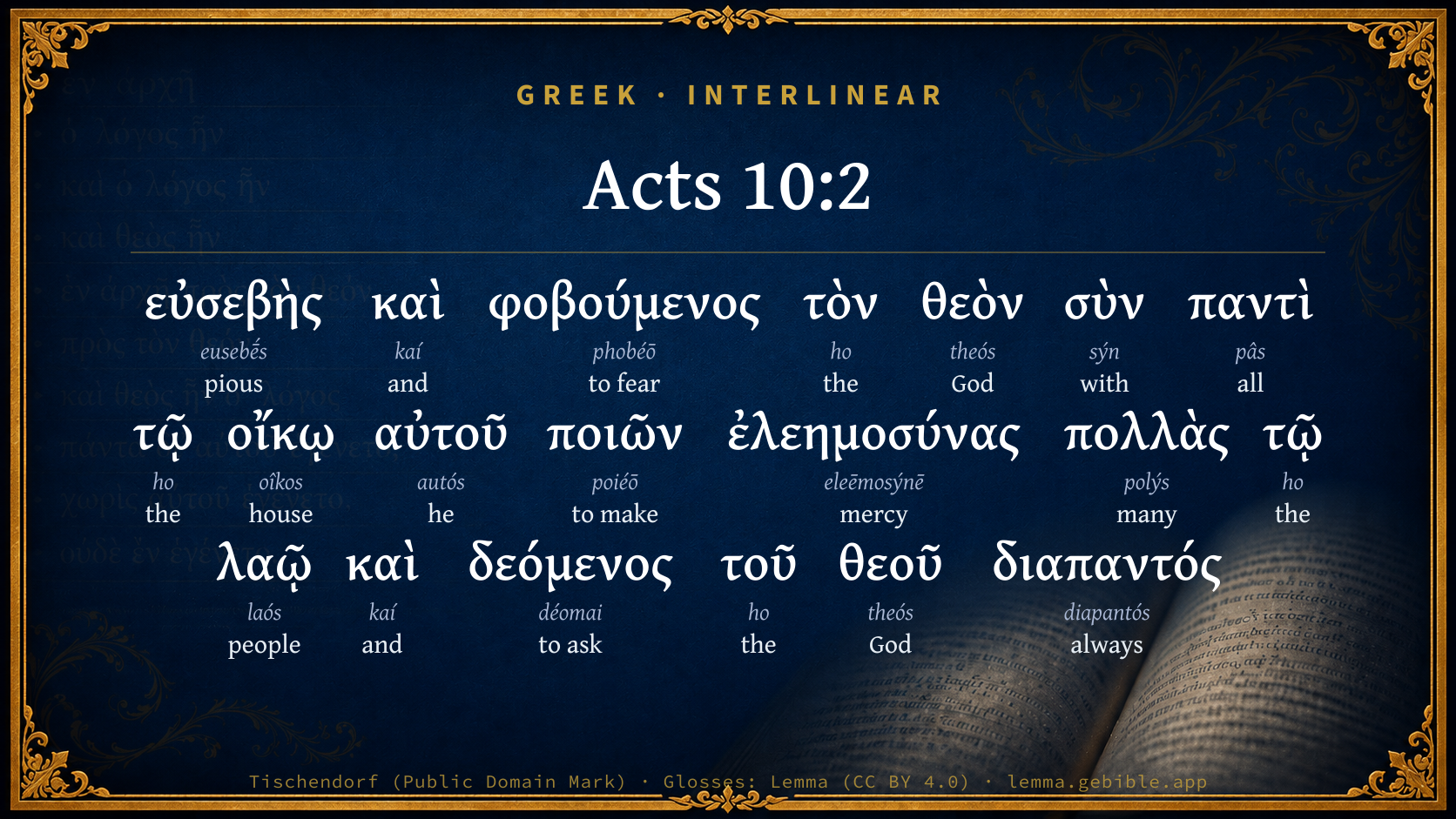
Greek (Tischendorf 8th ed.) Acts 10:2 appears in the Greek New Testament. The text above is from the Tischendorf 8th edition. Each word links to its Strong’s number and a concise gloss. Click any word for its full Thayer’s Greek Lexicon entry.
Download image
Cite this verse

Acts 10:2 (World English Bible). Public Domain. Lemma interlinear Bible study tool, https://lemma.gebible.app/v/acts/10/2.

Show BibTeX & RIS
BibTeX
RIS
English Translation
a devout man, and one who feared God with all his house, who gave gifts for the needy generously to the people, and always prayed to God.
World English Bible · Public Domain
Highlights
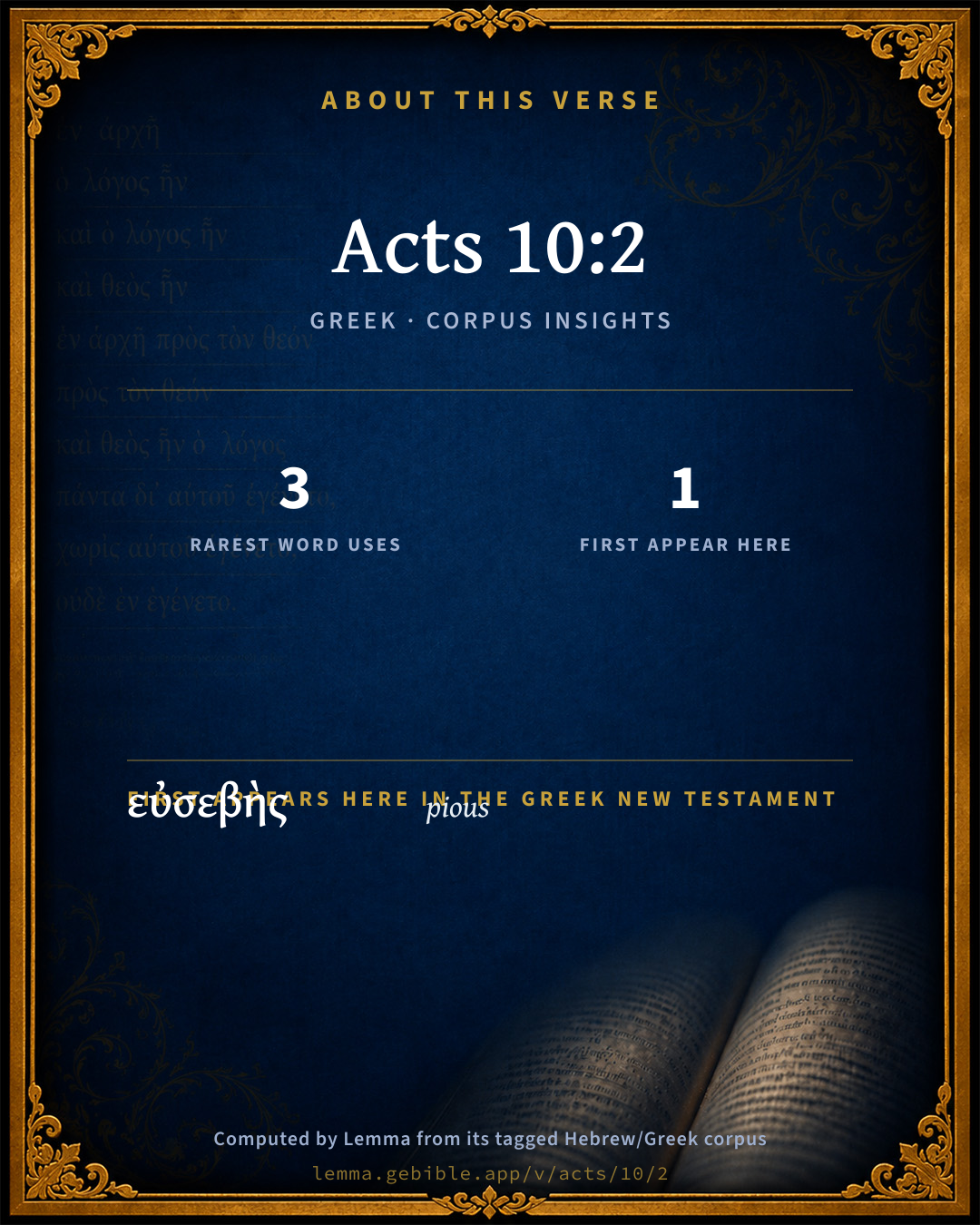
  • 1 first appearance in the Greek New Testament
Full analysis ↓
Download a study sheet

One document with this verse’s original text, its word-by-word gloss line, the meaning frame, cross-references with their text, attributed commentary, and full source and license credits — printable, and it pastes into notes with its structure intact.

This verse Autodidact and up

Study sheet (.html) Plain text (.txt)

A passage Seminary Student

Up to 50 verses in one chapter. A passage sheet keeps up to 6 commentary sources and 12 cross-references per verse, in the order this page ranks them, and says so on the sheet whenever that leaves anything out. Ask for a single verse and you get the Autodidact verse sheet above.

Everything on this page stays free to read, with no account — the sheet is a download of what is already on screen, not access to it.

Want to remove ads? Support Godless Engineer
Compare translations 3

The same verse in 3 English versions, stacked beneath the original-language interlinear above. Click any original word for its lexicon entry.

Each is an independent rendering of the whole verse — the interlinear is not word-aligned to these translations.

Highlighted words mark where these versions differ — a whole-verse word diff, not a word-by-word alignment.

  • World English Bible Public Domain
    a devout man, and one who feared God with all his house, who gave gifts for the needy generously to the people, and always prayed to God.
  • King James Version Public Domain
    A devout man, and one that feared God with all his house, which gave much alms to the people, and prayed to God alway.
  • unfoldingWord Literal Text CC BY-SA 4.0
    devout and fearing God with all his household, making many gifts of alms to the people and praying to God through all.

unfoldingWord Literal Text — © unfoldingWord, licensed CC BY-SA 4.0. Word-aligned USFM3 via Door43 (git.door43.org/unfoldingWord/en_ult).

Versions to compare (up to 4)

3 of 4 selected

Show all 19 translations

Every available English version of this verse, each an independent rendering of the whole verse.

  • World English Bible Public Domain
    a devout man, and one who feared God with all his house, who gave gifts for the needy generously to the people, and always prayed to God.
  • Berean Standard Bible Public Domain
    He and all his household were devout and God-fearing. He gave generously to the people and prayed to God regularly.
  • Majority Standard Bible Public Domain
    He and all his household were devout and God-fearing. He gave generously to the people and prayed to God regularly.
  • King James Version Public Domain
    A devout man, and one that feared God with all his house, which gave much alms to the people, and prayed to God alway.
  • American Standard Version (1901) Public Domain
    a devout man, and one that feared God with all his house, who gave much alms to the people, and prayed to God always.
  • Revised Version (1885) Public Domain
    a devout man, and one that feared God with all his house, who gave much alms to the people, and prayed to God alway.
  • Geneva Bible (1599) Public Domain
    A deuoute man, and one that feared God with all his housholde, which gaue much almes to the people, and prayed God continually.
  • Douay-Rheims (1899) Public Domain
    A religious man, and fearing God with all his house, giving much alms to the people, and always praying to God.
  • Young's Literal Translation Public Domain
    pious, and fearing God with all his house, doing also many kind acts to the people, and beseeching God always,
  • Literal Standard Version CC BY-SA 4.0
    pious, and fearing God with all his house, also doing many kind acts to the people, and always imploring God;
  • Unlocked Literal Bible CC BY-SA 4.0
    He was a devout man, one who worshiped God with all his household; he gave much money to those in need, and he constantly prayed to God.
  • unfoldingWord Literal Text CC BY-SA 4.0
    devout and fearing God with all his household, making many gifts of alms to the people and praying to God through all.
  • Darby Bible Public Domain
    pious, and fearing God with all his house, [both] giving much alms to the people, and supplicating God continually,
  • World Messianic Bible Public Domain
    a devout man, and one who feared God with all his house, who gave gifts for the needy generously to the people, and always prayed to God.
  • Webster's Bible Public Domain
    A devout man, and one that feared God with all his house, who gave much alms to the people, and prayed to God always.
  • Free Bible Version CC BY-SA 4.0
    He was a religious man who, together with everyone in his household, had great reverence for God. He gave generously to the poor, and prayed regularly to God.
  • Bible in Basic English Public Domain
    A serious-minded man, fearing God with all his family; he gave much money to the poor, and made prayer to God at all times.
  • Text-Critical English NT CC BY 4.0
    He was a devout man who feared God along with his entire household; he gave generously to those in need and always prayed to God.
  • Tyndale New Testament (1534) Public Domain
    a devoute man and one that feared God with all his housholde which gave moche almes to the people and prayde God alwaye.

Literal Standard Version (2020), Covenant Press — licensed CC BY-SA 4.0. Text via the HelloAO Bible API (eBible.org). Unlocked Literal Bible (unfoldingWord) — licensed CC BY-SA 4.0. Text via the HelloAO Bible API (eBible.org). unfoldingWord Literal Text — © unfoldingWord, licensed CC BY-SA 4.0. Word-aligned USFM3 via Door43 (git.door43.org/unfoldingWord/en_ult). Free Bible Version, Dr. Jonathan Gallagher — licensed CC BY-SA 4.0. Text via the HelloAO Bible API (eBible.org).

Word by word

More ways to search: Search by grammar → Find every occurrence → Compare this word →

Practice this passage: Drill this verse → Learn its vocabulary →

εὐσεβὴς
eusebḗs
G2152
“pious”
Adjective, Nominative, Singular, Masculine
Part of Speech
Adjective
Case
Nominative
Number
Singular
Gender
Masculine
Full Thayer's Definition

Origin: from G2095 and G4576

TDNT: 09:55,1

1. pious, dutiful
  1. καὶ kaí G2532 “and” Conjunction
  2. φοβούμενος phobéō G5399 “to fear” Verb, Present, Middle or Passive deponent, Participle, Nominative, Singular, Masculine
  3. τὸν ho G3588 “the” Article, Accusative, Singular, Masculine
  4. θεὸν theós G2316 “God” Noun, Accusative, Singular, Masculine
  5. σὺν sýn G4862 “with” Preposition
  6. παντὶ pâs G3956 “all” Adjective, Dative, Singular, Masculine
  7. τῷ ho G3588 “the” Article, Dative, Singular, Masculine
  8. οἴκῳ oîkos G3624 “house” Noun, Dative, Singular, Masculine
  9. αὐτοῦ autós G846 “he” Personal pronoun, Genitive, Singular, Masculine
  10. ποιῶν poiéō G4160 “to make” Verb, Present, Active, Participle, Nominative, Singular, Masculine
  11. ἐλεημοσύνας eleēmosýnē G1654 “mercy” Noun, Accusative, Plural, Feminine
  12. πολλὰς polýs G4183 “many” Adjective, Accusative, Plural, Feminine
  13. τῷ ho G3588 “the” Article, Dative, Singular, Masculine
  14. λαῷ laós G2992 “people” Noun, Dative, Singular, Masculine
  15. καὶ kaí G2532 “and” Conjunction
  16. δεόμενος déomai G1189 “to ask” Verb, Present, Middle or Passive deponent, Participle, Nominative, Singular, Masculine
  17. τοῦ ho G3588 “the” Article, Genitive, Singular, Masculine
  18. θεοῦ theós G2316 “God” Noun, Genitive, Singular, Masculine
  19. διαπαντός diapantós G1275 “always” Adverb

About this verse

These counts appear in no published source. They are computed here, from the morphology-tagged text and Lemma’s own curated glosses. What Lemma adds →

20
words
15
distinct lemmas
Acts
section

Notable vocabulary

The rarest word here is εὐσεβὴς pious G2152 — appearing just 3 times in the whole Greek New Testament.

First appearance in Scripture

This word makes its first canonical appearance in the Greek New Testament here:

  • εὐσεβὴς pious G2152

Shared distinctive vocabulary

εὐσεβὴς pious G2152 occurs in 3 verses of the Greek New Testament. Also found in:
Repetition

Words recur within this verse:

Cross-references

48

Topical passages linked to Acts 10:2 in the Treasury of Scripture Knowledge — connected by theme and wording, ordered by reader-vote popularity; previews shown in the World English Bible.

  • Matthew 7:7–8 "Ask, and it will be given you. Seek, and you will find. Knock, and it will be opened for you.
  • Acts 10:4 He, fastening his eyes on him, and being frightened, said, "What is it, Lord?" He said to him, "Your prayers and your gifts to the needy have gone up for a memorial before God.
  • Acts 10:22 They said, "Cornelius, a centurion, a righteous man and one who fears God, and well spoken of by all the nation of the Jews, was directed by a holy angel to invite you to his house, and to listen to what you say."
  • Acts 10:35 but in every nation he who fears him and works righteousness is acceptable to him.
  • Acts 13:16 Paul stood up, and beckoning with his hand said, "Men of Israel, and you who fear God, listen.
  • Isaiah 58:7–8 Isn't it to deal your bread to the hungry, and that you bring the poor who are cast out to your house? when you see the naked, that you cover him; and that you not hide yourself from your own flesh?
  • Acts 8:2 Devout men buried Stephen, and lamented greatly over him.
  • Acts 10:7 When the angel who spoke to him had departed, Cornelius called two of his household servants and a devout soldier of those who waited on him continually.
  • Daniel 6:16 Then the king commanded, and they brought Daniel, and cast him into the den of lions. [Now] the king spoke and said to Daniel, Your God whom you serve continually, he will deliver you.
  • Luke 2:25 Behold, there was a man in Jerusalem whose name was Simeon. This man was righteous and devout, looking for the consolation of Israel, and the Holy Spirit was on him.
  • Acts 13:26 Brothers, children of the stock of Abraham, and those among you who fear God, the word of this salvation is sent out to you.
  • Acts 18:8 Crispus, the ruler of the synagogue, believed in the Lord with all his house. Many of the Corinthians, when they heard, believed and were baptized.
  • Revelation 15:4 Who wouldn't fear you, Lord, And glorify your name? For you only are holy. For all the nations will come and worship before you. For your righteous acts have been revealed."
  • Genesis 18:19 For I have known him, to the end that he may command his children and his household after him, that they may keep the way of Yahweh, to do righteousness and justice; to the end that Yahweh may bring on Abraham that which he has spoken of him."
  • Joshua 24:15 If it seem evil to you to serve Yahweh, choose you this day whom you will serve; whether the gods which your fathers served that were beyond the River, or the gods of the Amorites, in whose land you dwell: but as for me and my house, we will serve Yahweh.
  • 1 Kings 8:43 hear in heaven, your dwelling-place, and do according to all that the foreigner calls to you for; that all the peoples of the earth may know your name, to fear you, as does your people Israel, and that they may know that this house which I have built is called by my name.
  • 2 Chronicles 6:33 then hear from heaven, even from your dwelling-place, and do according to all that the foreigner calls to you for; that all the peoples of the earth may know your name, and fear you, as does your people Israel, and that they may know that this house which I have built is called by your name.
  • Job 1:1 There was a man in the land of Uz, whose name was Job. That man was blameless and upright, and one who feared God, and turned away from evil.
  • Job 1:5 It was so, when the days of their feasting had run their course, that Job sent and sanctified them, and rose up early in the morning, and offered burnt offerings according to the number of them all. For Job said, "It may be that my sons have sinned, and renounced God in their hearts." Thus did Job continually.
  • Psalms 25:5 Guide me in your truth, and teach me, For you are the God of my salvation, I wait for you all day long.
  • Psalms 25:8–9 Good and upright is Yahweh, Therefore he will instruct sinners in the way.
  • Psalms 41:1 Blessed is he who considers the poor: Yahweh will deliver him in the day of evil.
  • Psalms 55:17 Evening, morning, and at noon, I will cry out in distress. He will hear my voice.
  • Psalms 86:3 Be merciful to me, Lord, For I call to you all day long.
  • Psalms 88:1 Yahweh, the God of my salvation, I have cried day and night before you.
  • Psalms 101:6–8 My eyes will be on the faithful of the land, That they may dwell with me. He who walks in a perfect way, He will serve me.
  • Psalms 102:15 So the nations will fear the name of Yahweh; All the kings of the earth your glory.
  • Psalms 119:2 Blessed are those who keep his statutes, Who seek him with their whole heart.
  • Proverbs 2:3–5 Yes, if you call out for discernment, And lift up your voice for understanding;
  • Ecclesiastes 7:18 It is good that you should take hold of this. Yes, also from that don't withdraw your hand; for he who fears God will come forth from them all.
  • Isaiah 59:19 So shall they fear the name of Yahweh from the west, and his glory from the rising of the sun; for he will come as a rushing stream, which the breath of Yahweh drives.
  • Daniel 6:10 When Daniel knew that the writing was signed, he went into his house (now his windows were open in his chamber toward Jerusalem) and he kneeled on his knees three times a day, and prayed, and gave thanks before his God, as he did before.
  • Daniel 6:20 When he came near to the den to Daniel, he cried with a lamentable voice; the king spoke and said to Daniel, Daniel, servant of the living God, is your God, whom you serve continually, able to deliver you from the lions?
  • Daniel 6:26 I make a decree, that in all the dominion of my kingdom men tremble and fear before the God of Daniel; for he is the living God, and steadfast forever, His kingdom that which shall not be destroyed; and his dominion shall be even to the end.
  • Luke 7:4–5 When they came to Jesus, they begged him earnestly, saying, "He is worthy for you to do this for him,
  • Luke 18:1 He also spoke a parable to them that they must always pray, and not give up,
  • Acts 9:11 The Lord said to him, "Arise, and go to the street which is called Straight, and inquire in the house of Judas for one named Saul, a man of Tarsus. For behold, he is praying,
  • Acts 9:31 So the assemblies throughout all Judea and Galilee and Samaria had peace, and were built up. They were multiplied, walking in the fear of the Lord and in the comfort of the Holy Spirit.
  • Acts 9:36 Now there was at Joppa a certain disciple named Tabitha, which when translated, means Dorcas. This woman was full of good works and acts of mercy which she did.
  • Acts 10:31 and said, 'Cornelius, your prayer is heard, and your gifts to the needy are remembered in the sight of God.
  • Acts 13:50 But the Jews stirred up the devout and prominent women and the chief men of the city, and stirred up a persecution against Paul and Barnabas, and threw them out of their borders.
  • Acts 16:14–15 A certain woman named Lydia, a seller of purple, of the city of Thyatira, one who worshiped God, heard us; whose heart the Lord opened to listen to the things which were spoken by Paul.
  • Acts 22:12 One Ananias, a devout man according to the law, well reported of by all the Jews who lived in Damascus,
  • Romans 15:26–27 For it has been the good pleasure of Macedonia and Achaia to make a certain contribution for the poor among the saints who are at Jerusalem.
  • 2 Corinthians 9:8–15 And God is able to make all grace abound to you, that you, always having all sufficiency in everything, may abound to every good work.
  • Colossians 4:2 Continue steadfastly in prayer, watching therein with thanksgiving;
  • 1 Thessalonians 5:17 Pray without ceasing.
  • James 1:5 But if any of you lacks wisdom, let him ask of God, who gives to all liberally and without reproach; and it will be given to him.

Cross-references courtesy of OpenBible.info (CC BY 4.0).

Where the printed editions differ

1 variant

Places in this verse where the major printed Greek editions disagree on the wording in a way that affects the translation — a comparison of editions, not a manuscript-by-manuscript collation. The editions are the modern critical texts (Nestlé-Aland 28/27, SBL, Westcott-Hort, Tregelles, Tyndale House) and the traditional texts behind the KJV (the Textus Receptus and the Byzantine/Majority text). It is not a claim about which reading is original.

  1. Editions differ
    διὰ

    “through”

    In NA28NA27TynSBLWHTregTR»1Byz Not in TR

Textual data: Translators Amalgamated Greek New Testament (STEPBible TAGNT) · CC BY 4.0.

Commentary

Notes on Acts 10:2 from classic Christian and Jewish commentators (each source and its license shown beneath its notes). The classic Christian expositions comment on the surrounding passage and are grouped to its opening verse, so a note may address several verses; the Jewish commentaries on the Tanakh (Rashi and others) are per-verse, so they appear only where the commentator wrote on this verse.

Lemma curates 59 commentaries, every one of them public domain or Creative Commons licensed, each selected and text-cleaned for this edition rather than reprinted as found. About our sources →

Tyndale Open Study Notes

Tyndale Open Resources

10:2 a devout, God-fearing man: Gentiles who are described as God-fearing were attracted to the high ethical standards of Judaism but were not prepared to accept the rite of circumcision or the full implications of the Jewish law by becoming full converts to Judaism (cp. 13:43). Christianity was an attractive option to Gentiles who worshiped God (18:7; see 13:48; 16:30; 17:4, 12, 17). These people would be wide open to the message of the gospel that announced that “there is peace with God through Jesus Christ” (10:36).

Tyndale Open Study Notes — © Tyndale Open Resources, licensed CC BY-SA 4.0. Text via the HelloAO Bible API.

Bengel's Gnomon

Johann Albrecht Bengel

Act 10:2. Σὺν, with) Implying the close connection of the master and his household, of the commander and his soldiers: Act 10:7.—οἴκῳ, his house) Comp. ch. Act 11:14.—τῷ λαῷ, to the people) Among many of the Jews there was at that time great poverty. GOD repaid the debt of the poor, in their stead. The grace of GOD towards Israel recompenses the favour of Cornelius towards the Israelites.—δεόμενος, praying) Prayer and liberality are commended here; fasting is added, Act 10:30. The beneficent do what GOD wishes: what these same persons in praying wish for, GOD does.

Bengel's Gnomon of the New Testament — English translation (T&T Clark, Edinburgh, 1860) — public domain. Text from a community e-Sword module.

Expositor's Greek Testament

ed. W. Robertson Nicoll

Act 10:2 . ἑκατοντάρχης : form general in N.T., and so in later Greek, although χιλίαρχος is always retained in N.T., and ἑκατόνταρχος is also found, Mat 8:5 ; Mat 8:8 (W.H [237] ), Luk 7:2 , Act 22:25 (W.H [238] ); so πατριάρχης , πολιτάρχης , ἐθνάρχης , see Winer-Schmiedel, p. 82, and note on forms employed in Josephus and LXX; W.H [239] , Appendix, p. 163; Blass, Gram. , pp. 28, 68; and Grimm-Thayer, sub v. , for various authorities. ἐκ σπείρης τῆς Ἰ : the word σπεῖρα here = cohors , although used in the N.T. in a more general way as of the band which arrested Jesus, and so also of Jewish troops in Jdt 14:11 , 2Ma 8:23 ; 2Ma 12:20 ; 2Ma 12:22 . Each legion was subdivided into ten cohorts, but besides the legionary cohorts there were auxiliary cohorts, and Josephus mentions that five of these cohorts were stationed at Cæsarea at the time of the death of Herod Agrippa, composed to a great extent at all events of the inhabitants of Cæsarea and Sebaste, Ant. , xix., 9, 2; xx., 8, 7. There were in the provinces Italic cohorts composed of volunteer Roman citizens born in Italy, and in answer to the strictures of Schürer, who contends that there was no Italic cohort in Cæsarea at this time, Blass, in loco , asks why one of the five cohorts mentioned by Josephus may not have been composed of Roman citizens who had made their home at Cæsarea or Sebaste, a cohort known by the name mentioned. But Ramsay has given great interest to the subject by his account of a recently discovered inscription at Carnuntum the epitaph of a young Roman soldier, a subordinate officer in the second Italic cohort, who died at Carnuntum while engaged on detached service from the Syrian army. He sees reason to infer that there was an Italic cohort stationed in Syria in A.D. 69, and although the new discovery does not prove anything with certainty for the period in Act 10 , say 40 44 A.D., yet it becomes in every way probable that at that date, when Cornelius is described as in Act 10:1 , an Italic cohort recruited from the east was stationed in the province Syria. But even if it could be shown that no Italic cohort was stationed at Cæsarea from A.D. 6 41, or again from 41 44 in the reign of Herod, it by no means follows that a centurion belonging to the cohort may not have been on duty there. He may have been so, even if his cohort was on duty elsewhere, and it would be a bold thing to deny such a possibility when the whole subject of detached service is so obscure; Ramsay, Expositor , September, 1896, also Expositor , December, 1896 (Schürer’s reply), and January, 1897 (Ramsay); Schürer, Jewish People , div. i., vol. ii., p. 53 ff. E.T.; Ramsay, Was Christ born at Bethlehem? pp. 260 269; O. Holtzmann, Neutest. Zeitgeschichte , p. 108; and Wendt, in loco , (1899). εὐσεβὴς καὶ φ . τὸν Θεὸν : the adjective is only used here and in Act 10:7 (Act 22:12 ), and once again in 2Pe 2:9 in the N.T. In the LXX it is found four times in Isaiah, thrice as an equivalent of צַדִּיק , Act 24:16 , Act 26:7 (2), righteous, upright, cf. also Pro 12:12 , once as an equivalent of נָדִיב , liberal, generous, see on Act 8:2 above; frequent in Ecclus. and Macc., see also Trench, N.T. Synonyms , i., p. 196. Taken by itself the word might denote goodness such as might characterise a Gentile, cf. Act 17:23 , and its classical use (like the Latin pietas ); but construed with φ . τὸν Θεόν it certainly seems to indicate that Cornelius was “a God-fearing proselyte” (not to be identified it would seem with “proselytes of the gate,” although the confusion is common (Schürer, Jewish People , div. ii., vol. ii., p. 316 E.T.)). In Acts this class of proselyte is always so described (or σεβόμενοι τὸν Θ .) “they that fear God,” i.e. , the God of the Jews, cf. Act 10:22 ; Act 10:35 , Act 13:16 ; Act 13:26 , etc. All the incidents of the story seem to point to the fact that Cornelius had come into relations with the synagogue, and had learned the name and the fear of the God of Israel, cf. Act 10:2 ; Act 10:22 ; Act 10:25 , without accepting circumcision, see especially Ramsay, Expositor , p. 200 (1896), where he corrects his former remarks in St. Paul , p. 43; Hamburger, Real-Encyclopädie des Judentums , “Fremder,” i., 3, p. 382; Hort, Ecclesia , p. 58; O. Holtzmann, Neutest. Zeitgeschichte , pp. 184, 185; Weizsäcker, Apostolic Age , i., 103 E.T.; McGiffert, Apostolic Age , p. 101, note, and for a further explanation of the distinction between the σεβόμενοι and the “proselytes of the gate” cf. Muirhead Times of Christ (T. & T. Clark), pp. 105, 106. σὺν παντὶ τῷ οἴκῳ αὐτοῦ : the centurions of the N.T. are always favourably represented, cf. Mat 8:5 , Luk 7:9 ; Luk 23:47 , Act 27:3 . οἶκος here includes not only the family but the whole household, cf. Act 7:10 , Act 11:14 , Act 16:31 , Act 18:8 , etc.; Luk 1:27 ; Luk 10:5 ; Luk 19:9 , thus the soldier “who waited on him continually” is also called εὐσεβής . οἶκος ( cf. πᾶς ὁ οἶκ . ὅλος ὁ οἶκ .), favourite word with St. Luke in the sense of “family” (Lekebusch, Friedrich) as compared with the other Evangelists, but often found in St. Paul ( cf. Hebrews), so also LXX, Gen 7:1 ; Gen 47:12 . St. Peter uses the word so in Act 11:14 , and in 1Pe 2:18 we have οἰκέτης . St. Chrysostom well says: “Let us take heed as many of us as neglect those of our own house” ( Hom. , xxii.). Cf. too Calvin, in loco . ποιῶν ἐλεημ . τῷ λαῷ , see note on Act 9:36 ; the word occurs frequently in Ecclus. and Tobit, and its occurrence here and elsewhere in Acts illustrates the Jewish use of the term; but although it is true to say that it does not occur in Acts in any Christian precept, St. Paul applies the word to the collection made from the Christian Churches for his nation at Jerusalem, Act 24:17 , a collection to which he attached so much importance as the true outcome of Christian love and brotherhood, see l.c. How highly almsgiving was estimated amongst the Jews we may see from the passages referred to in Hastings’ B.D. and B.D. 2 ; Uhlhorn’s Christian Charity in the Ancient Church , p. 52 ff. E.T.; but it should be remembered that both in Ecclus. and Tobit there are passages in which both almsgiving and fasting are also closely connected with prayer, Sir 7:10 , Tob 12:8 . τῷ λ ., i.e. , Israel, as always in Luke, see above on Act 4:25 . Both this and his continuous prayer to God, Act 10:30 , characterise him as half a Jew (Weiss). διὰ παντός : Luk 24:53 , and three times in Acts (once in a quotation, Act 2:25 ), but only used once in Matthew and Mark, and not at all by St. John; on St. Luke’s predilection for πᾶς and its compounds see Friedrich, pp. 5, 6. The description of the centurion no doubt reminds us of the description of another centurion in Luk 7:5 (so Weiss), but we are not obliged to conclude that the centurion here is merely pictured after the prototype there; but the likeness may possibly point to the same source for both narratives, as in some respects the language in the two cases is verbally alike, see Feine. δεόμενος : “ preces et liberalitas commendantur hic; accedit jejunium , Act 10:30 ”; so Bengel, and he adds, “Benefici faciunt, quod Deus vult: precantes iidem quod volunt, Deus facit”.

[237] Westcott and Hort’s The New Testament in Greek: Critical Text and Notes.

[238] Westcott and Hort’s The New Testament in Greek: Critical Text and Notes.

[239] Westcott and Hort’s The New Testament in Greek: Critical Text and Notes.

The Expositor's Greek Testament, edited by W. Robertson Nicoll (1897–1910) — public domain. Text from a community e-Sword module.

Geneva Bible (1599)

Geneva Bible translators

So that he worshipped one God, and was no idolater, and neither could be void of faith in Christ, because he was a devout man but as yet he knew not that he was come.

This is a great commendation to this man, that he labored to have all his household and familiar friends and acquaintances to be religious and godly.

Geneva Bible (1599) marginal notes — public domain. Text via Bolls.life.

Jamieson, Fausset & Brown

Robert Jamieson, A. R. Fausset & David Brown

A devout man, &c.--an uncircumcised Gentile proselyte to the Jewish faith, of whom there were a very great number at this time; a distinguished proselyte, who had brought his whole household establishment under the hallowing influence of the Jewish faith and the regular observance of its principal seasons of worship.

gave much alms to the people--that is, the Jewish people, on the same principle as another centurion before him (Luk 7:5); thinking it no "great thing," if they had "sown unto him spiritual things, that they should reap his carnal things" (Co1 9:11).

prayed to God alway--at the stated daily seasons. (See on Act 10:3).

Jamieson, Fausset & Brown — Commentary Critical and Explanatory on the Whole Bible (1871) — public domain (CC PDM 1.0). Text via the HelloAO Bible API.

Adam Clarke's Commentary

Verse 2. A devout man] ευσεβης, from ευ, well, and σεβομαι, I worship. A person who worships the true God, and is no idolater.

One that feared God] φοβουμενος τον θεον, One who was acquainted with the true God, by means of his word and laws; who respected these laws, and would not dare to offend his Maker and his Judge. This is necessarily implied in the fear of God.

With all his house] He took care to instruct his family in the knowledge which he himself had received; and to establish the worship of God in his house.

Gave much alms] His love to God led him to love men; and this love proved its sincerity by acts of beneficence and charity.

Prayed to God alway.] Felt himself a dependent creature; knew he had no good but what he had received; and considered God to be the fountain whence he was to derive all his blessings. He prayed to God alway; was ever in the spirit of prayer, and frequently in the act. What an excellent character is this! And yet the man was a Gentile! He was what a Jew would repute common and unclean: see Ac 10:28. He was, therefore, not circumcised; but, as he worshipped the true God, without any idolatrous mixtures, and was in good report among all the nation of the Jews, he was undoubtedly what was called a proselyte of the gate, though not a proselyte of justice, because he had not entered into the bond of the covenant by circumcision. This was a proper person, being so much of a Jew and so much of a Gentile, to form the connecting link between both people; and God chose him that the salvation of the Jews might with as little observation as possible be transmitted to the Gentiles. The choice of such a person, through whom the door of faith was opened to the heathen world, was a proof of the wisdom and goodness of God. The man who was chosen to this honour was not a profligate Gentile; nor yet a circumcised proselyte. He was a Gentile, amiable and pure in his manners; and, for his piety and charitableness, held in high estimation among all the nation of the Jews. Against such a person they could not, with any grace, be envious, though God should pour out upon him the gift of the Holy Spirit.

Adam Clarke's Commentary on the Bible (1810–1826) — public domain. Text from a community e-Sword/MySword module.

John Calvin's Commentaries

2. He saith that he was a godly man, and one that feared God; secondly, that like a good householder he had a care to instruct his families; he praiseth him afterward for the offices of love, because he was beneficial [beneficent] toward all the people; and, lastly, that he prayed [to] God continually. The sum is this, that Cornelius was a man of singular virtues, wherein the integrity of the godly consisteth, so that his life was framed, in all points, according to the rule which God prescribeth unto us. And because the law is contained in two tables, Luke commendeth, in the former place, Cornelius’ godliness; secondly, he descendeth unto the second part, that he exercised the offices of love toward men. This is very profitable to be marked, because we have a way to live well described in his person.

Wherefore, in ordering the life well, let faith and religion be the foundation, which being taken away, all other virtues are nothing else but smokes. Luke reckoneth up the fear of God and prayer as fruits and testimonies of godliness and of the worship of God, and that for good causes. For religion cannot be separated from the fear of God and the reverence of him, neither can any man be counted godly, save he who acknowledging God to be his Father and Lord, doth addict himself wholly to him. And let us know that voluntary fear is commended in this place when those men submit themselves to God willingly and from their heart, who duly consider themselves what is due to him.

Moreover, because a great part of the world doth, with reigned trifles, corrupt and deprave the worship of God, Luke added, for good causes, that Cornelius prayed continually; whereby he doth signify, that he proved not his godliness only with external ceremonies, but that he worshipped God spiritually, when as he exercised himself in prayer. We must also note the continuance of his prayer; whence we gather, that he did not pray only coldly, after the common custom, but that he was earnestly bent to prayer, as the continual benefits of God do exhort us and prick us forward thereunto, and the force of faith ought there to show itself. Wherefore let every one of us exhort himself to persevere in prayer by the example of Cornelius.

With all his house. We must not lightly pass over this commendation that Cornelius had a church in his house. And, surely, a true worshipper of God will not suffer so much as in him lieth God to be banished from his house. For how unmeet a thing is it for him to maintain his own right stoutly, that his wife, children, servants, and maids may obey him, and not to regard that God is disobeyed. It shall sometimes fall out so that a godly man cannot have even his wife to be of his mind; yet he, which ruleth others, must endeavor by all means to have God obeyed; and there is nothing more meet than that we should consecrate all ours to God as ourselves. Therefore, if a godly man have children which are unlike him, or a wife of evil conditions, or lewd and wicked servants, let him not wink, nor yet suffer his house to be polluted through his slothfulness. The diligence of Cornelius is not so much commended as the blessing of God, whereby it came to pass that he had his house obedient unto him in godliness. And we must not omit the circumstance, that he instructed his family in the fear of God, setting light by the fear of danger, which did hang over his head therefore. For the Jewish religion was in great contempt; and no citizen of Rome might freely receive any strange religion, as they called it. Wherefore, although the sincere profession of the gospel be evil spoken of in the world, yet is it too corrupt frightfulness if that unjust hatred hinder any man from offering his family to God for a sacrifice, by godly instruction.

Giving alms. There is also the figure synecdoche in this member, [clause.] For as it was said, even now, that the worship of God was proved by prayers, so now, when Luke speaketh of love, he maketh choice of one kind; whereby he showeth that Cornelius was a liberal and bountiful man. For our godliness ought so to appear to men, that we declare that we fear God by using bountifulness and justice. The word alms is translated unto those external good works wherewith we help the poor, (Isaiah 58:7,) forasmuch as misericordia, or mercy, is the inward affection of the heart properly. For from this fountain springeth true and well ordered bountifulness, if the troubles and sorrows of our brethren do move us to compassion; if, considering the unity which is amongst us, we foster and cherish them as we would cherish our own flesh, and study to help them as we would help our own members. Hypocrites are, indeed, sometimes liberal, or at least bountiful; but howsoever they waste all, yet no relief which they shall bestow upon the poor shall be worthy to be called by the name of alms. For we must hold that of Paul, He which hath no love is nothing, though he give all his goods to the poor, (1 Corinthians 13:3.) Let us, therefore, learn by this word, that God doth then allow our liberality, if we relieve the poverty of the poor, being moved with compassion, and if, as it were, with open bowels we bestow that which the liberality of God doth give.

Whereas Luke saith that he gave alms to all the people, it signifieth as much as everywhere to the poor; for there were not a few rich men to whom to have given had been an absurd thing. But whereas he bestowed so liberally upon the Jews, he declared how he agreed with them in religion; in which respect Luke saith, shortly after, that he was allowed of all the Jews. And if so be it he was such an excellent mirror of godliness and holiness, even when he had but a small smattering of faith, although he were letted so many ways, ought not we to be ashamed who will be accounted most Christian doctors, and are yet so cold in the exercises of godliness? If a small sparkle of faith prevailed so much in him, what ought the full brightness of knowledge to work in us? But howsoever we boast of Christ with full mouth, yet how far are we, for the most part, from the example of the holy man, so that there appeareth scarce a small shadow of those virtues wherewith he was replete? For how loose are we in prayer? How slow and sluggish to do the duties of mercy? Yea, many are not only letted with filthiness and covetousness from giving liberally so much of their own as they ought, but they are so inflamed with a desire to have, they are become so beastly through cruelty, that they are not afraid to rob the poor of their substance, and to eat their very flesh.

John Calvin's Commentaries (1540-1563) — public domain. Text from the Calvin Translation Society English edition (1840s-50s) via the Christian Classics Ethereal Library (ccel.org). Calvin's coverage is partial (roughly two-thirds of the Bible); uncommented books and verses are honest gaps, never fabricated. The 19th-century editor's footnotes and remarks are omitted so the notes are faithfully Calvin's own voice.

Ellicott's Commentary for English Readers

(2) A devout man, and one that feared God with all his house.—The word for “devout” is not the same as that used in Act_2:5; Act_8:2, and Luk_2:25, and appears to be used by St. Luke, as again in Act_10:7, for the special type of devotion that belonged to Gentile converts to Judaism. The phrase “those that feared God” is employed distinctly for this class in Act_10:22; Act_10:35, and again in Act_13:16; Act_13:26. There is a special significance in the addition “with all his house.” The centurion was not satisfied with having found a higher truth for himself, but sought to impart it to the soldiers and slaves, possibly to those nearer and dearer to him, who came under his influence (Comp. Act_10:7.)

Which gave much alms to the people—i.e., to the Jews of Cæsarea as distinct from the Gentiles. (Comp. Act_26:17; Act_26:23; Act_28:17.)

And prayed to God alway.—As the vision that follows may rightly be regarded as an answer to the prayers thus offered, it is natural to infer that Cornelius was seeking for guidance as to the new faith which Philip had brought to Cæsarea, and of which he could scarcely fail to have heard. Was it really a new revelation from God to man? Could he be admitted to the fellowship of the society which confessed Jesus as the Christ without accepting the yoke of circumcision and the ceremonial law from which, as a “proselyte of the gate,” he had hitherto kept back?

A Bible Commentary for English Readers, edited by Charles John Ellicott (1878–1897) — public domain. Text from a community e-Sword module.

The Cambridge Bible for Schools and Colleges

gen. ed. J. J. S. Perowne

2. a devout man] i.e. he was a worshipper of the true God, but had not joined himself to the Jews in the observance of the Law. The language of St Peter in Act_10:28 shews us that he was not a complete proselyte. Wherever in the N. T. we find mention made of Roman centurions they appear to have been good men, Mat_8:5; Luk_7:2; Luk_23:47.

and one that feared God with all his house] The earnestness of his devotion to God is evidenced by the character of his household. If his family be here meant, he had instructed them in the worship of God, and had provided that those who attended on him should also be of the same character. The soldier, whom he sends to Peter, is called “devout” in Act_10:7.

which gave much alms to the people] i.e. to the Jewish people among whom he was stationed. He was like the centurion (Luk_7:5) of whom the Jews said, “He loveth our nation and hath built us a synagogue.”

and prayed to God alway] thus shewing himself anxious for greater knowledge of God’s way, which from Act_11:14 we learn must have been the purport of the prayer of Cornelius.

The Cambridge Bible for Schools and Colleges (gen. ed. J. J. S. Perowne; Cambridge University Press, 1878–1918) — public domain. Text from a community e-Sword module.

John Gill's Exposition

A devout man,.... A truly religious person, who had forsaken the Roman idolatry and superstition, in which he was brought up:

and one that feared God: the one only living and true God, the God of Israel; he had the fear of God wrought in his heart, which is a part of the covenant of grace, a blessing of it, and the beginning of wisdom; he was truly a gracious man, a converted person, and who from an internal principle worshipped God externally:

with all his house; he brought up his family in a religious way, as every good man should; and which was very remarkable in a Gentile, a soldier, and an officer:

which gave much alms to the people; to the Jews that dwelt at Caesarea, and therefore was of good report among them, and much beloved by them, Act 10:22 he had regard to both tables of the law, both to the worship of God, and the love of the neighbour: and prayed to God always; every day, at the usual times of prayer; prayed privately in his closet, and with his family, as well as attended public service of this kind.

John Gill's Exposition of the Whole Bible (1746–1763) — public domain (CC PDM 1.0). Text via the HelloAO Bible API.

Trapp's Complete Commentary

John Trapp

2 A devout man, and one that feared God with all his house, which gave much alms to the people, and prayed to God alway.

Ver. 2. A devout man, &c.] ευσεβης. Not of the king’s religion, whatever it be, as those Melchites it, Nicephorus. And as Tertullian tells us in his Apology, that the people were bound to worship those gods only that the Senate decreed should be worshipped. Cornelius was a right worshipper.

With all his house] A man is really what he is relatively. David would show his sincerity by being good at home, Psa 101:2.

John Trapp, A Commentary or Exposition upon All the Books of the Old and New Testament (1647–1656) — public domain. Text from a community e-Sword module.

Albert Barnes' Notes on the Bible

A devout man - Pious, or one who maintained the worship of God. See the notes on Luk 2:25. Compare Act 2:5; Act 8:2.

And one that feared God - This is often a designation of piety. See notes on Act 9:31. It has been supposed by many that the expressions here used denote that Cornelius was a Jew, or was instructed in the Jewish religion, and was a proselyte. But this by no means follows. It is probable that there might have been among the Gentiles a few at least who were fearers of God, and who maintained his worship according to the light which they had. So there may be now persons found in pagan lands who in some unknown way have been taught the evils of idolatry and the necessity of a purer religion, and who may be prepared to receive the gospel. The Sandwich Islands were very much in this state when the American missionaries first visited them. They had thrown away their idols, and seemed to be waiting for the message of mercy and the Word of eternal life, as Cornelius was. A few other instances have been found by missionaries in pagan lands of those who have thus been prepared by a train of providential events, or by the teaching of the Spirit, for the gospel of Christ.

With all his house - With all his family. It is evident here that Cornelius instructed his family, and exerted his influence to train them in the fear of God. True piety will always lead a man to seek the salvation of his family.

Much alms - Large and liberal charity. This is always an effect of piety. See Jam 1:27; Psa 41:1.

Prayed to God alway - Constantly; meaning that he was in the regular habit of prayer. Compare Rom 12:12; Luk 18:1; Psa 119:2; Pro 2:2-5. As no particular kind of prayer is mentioned except secret prayer, we are not authorized to affirm that he offered prayer in any other manner. It may be observed, however, that he who prays in secret will usually pray in his family; and as the facially of Cornelius is mentioned as being also under the influence of religion, it is, perhaps, not a forced inference that he observed family worship.

Albert Barnes' Notes on the Bible (1834–1885) — public domain. Text from a community e-Sword/MySword module.

Haydock's Catholic Bible Commentary

A religious man, and one that feared God. He was not a Jew, yet believed in one God. --- Always, that is, frequently praying, and giving alms. In the Rheims Testament we find this note: "Hereby it appeareth, that such works are done before justification, though they suffice not to salvation, yet are acceptable preparatives for the grace of justification, and such as move God to mercy. ... though all such preparative works come also of grace." These Douay divines did not hold with the Quenellists that a true faith, or the habit of faith, must needs be the first grace. (Witham) --- Cornelius religiously observed the law of nature, and the principal points of the Jewish moral law, though he did not profess Judaism. (Calmet) --- He was an admirable example of virtue before his knowledge of Christianity. He feared God, and brought up his family in the same holy fear. He was leader of the first band, and consequently had the eagle, the Roman ensign, carried before him. Four hundred men were under his command. (Tirinus) --- "His former goodness could no longer avail him, unless he were, by the bond of Christian society and peace, incorporated with the Church; he is therefore ordered to send unto Peter, that by him he may learn Christ, by him he may be baptized." (St. Augustine, lib. i. de bap. chap. 8.) --- Alms. Nothing is more efficacious than the alms of a man, whose hands have not been defiled by injustice. It is a clear stream, refreshing in the heat of day, and imparting verdure to every plant that is near it. It is a fountain springing to eternal life. It is a tree, whose branches reach even to heaven, and which produces its eternal fruit in abundance, when death has removed from you all that is temporal. Waste not, then, your treasures in selfish gratifications, the fruit of which is sorrow; but feed the poor, and the hungry. Plant and sow in their hands, and your produce will be great; no soil is more fertile. (St. John Chrysostom, hic. hom. xxii.)

George Leo Haydock (1774–1849), Haydock's Catholic Family Bible and Commentary, 1859 edition — public domain. Excludes Psalms (Douay-Rheims chapter numbering differs from Protestant) and Deuterocanonical books (Catholic canon only).

Matthew Poole's English Annotations

A devout man; this Cornelius was a proselyte of the gate, or such as observed the seven precepts of Noah, and lived without giving any offence to the Jews.

With all his house; it was a very good sign that he feared God, in that he engaged all his house to do the like, at least outwardly, which was as much as he could do: this was spoken by God in Abraham’s commendation, Gen 18:19.

Prayed to God alway; he did not neglect the seasons of prayer, especially the time of offering the morning and evening sacrifice, which by prayer they desired to partake the benefit of by which Christ our sacrifice, and his merits, were figured unto them. Cornelius indeed prayed always, or at all times, taking time in a moral sense, for the seasons and opportunities for such a duty; (as we are commanded to give thanks always, Eph 5:20); but he could not pray always, or at all times, taking time in a natural sense, for then he must have neglected all other duties; however, his endeavour was to keep his heart always in a praying disposition.

Matthew Poole's English Annotations on the Holy Bible (1683–1685) — public domain. Text from a community e-Sword/MySword module.

Whedon's Commentary on the Bible

Daniel D. Whedon

2. Devout… feared God—Men of deep thought and solemn consciousness of sin at this time looked for a true, infinite, holy God, by whose worship the reason would be satisfied and the conscience be assured of divine mercy. Such men often found the true God in Israel, and hence when stationed in the Holy Land (like Cornelius and the centurion of Luk_8:2, and perhaps Act_27:3) they would first be attracted to the synagogue, with perhaps some repugnance to circumcision and the heavy Mosaic ritual, but would find true relief in Christianity, both from the ritual and the condemnation of sin.

With all his house—His own family under the influence of his own devout spirit; his official aids, like the devout soldier of Act_10:7, were selected for their like spirit.

Always—With established and regular home devotion.

Cornelius, had not the Gospel been brought to his knowledge, would have had his piety, under the influence of that Spirit granted to all sincere and earnest souls, completed unto salvation by the atonement of the unknown Redeemer. Millions of holy men have by this same unknown Saviour gone, even from pagan lands, to glory. Where the Gospel is rightly presented such thirsty souls drink it in powerfully; and by such men and the energetic Church combined the Gospel is destined to overflow the world with a deluge, not of destruction, but of universal salvation. It is the existence of such spirits in all lands which constitute the encouragement for our missionary Church and the hope of a dying world. They are the scattered tinder in the pagan mass to catch the Gospel spark and spread it to a flame.

Daniel D. Whedon (gen. ed.), Commentary on the Old and New Testaments (1874–1909) — public domain. Text from a community e-Sword module.

The Pulpit Commentary

Who for which, A.V. A devout man (eujsebhv); and in ver. 7. It is an interesting question as to what was the precise religions status of Cornelius, whether he was a proselyte in any technical sense. But the whole narrative, in which he is spoken of simply as a Gentile and uncircumcised, seems to indicate that, though he had learnt from the Jews to worship the true God, and from the Jewish Scriptures read or heard in the synagogue to practice those virtues which went up for a memorial before God, yet he was in no sense a proselyte. It is pleasant to think that there may have been many such in the different countries where the Jews were dispersed. (comp. Act_13:16, and probably Act_11:20)

HOMILIES BY R. TUCK

Vers. 2, 22. Devout heathen.

To correct the tendency to limit the operations of Divine grace to particular sections, classes, or nations, the Scriptures record instances of true devoutness and sincere piety both before and outside the Abrahamic covenant. The comforting and inspiring truth of the Divine call and election man has too often changed into a doctrine of Divine favoritism, involving the sovereign and groundless choice of some, and the consequent repudiation and hopeless condition of many. We should ever seek to hold the truth which God is pleased to reveal with a jealousy of ourselves, lest we should unduly apply it to the disadvantage of others. Our God has said, "All souls are mine;" he maketh "his sun to rise upon the evil and upon the good." And if he claims the right to judge all mankind, he must have given them all knowledge, opportunities, and measures of grace. While fully realizing that the only book revelation has been made to the Jew and the Christian, and that the great revelation of God to man has been made in the person of the Lord Jesus Christ, and that this revelation is the key to, and the completion of, all others, we need not refuse to admit that God has had gracious access to the minds and hearts of heathen peoples, and has guided, in measures that seemed wise, their gropings and seekings after him. One of the remarkable cases is that of Cornelius the Roman centurion, a man declared to be of pious character, and to have won the Divine acceptance. As illustrating the above statements, mention may be made of Melchizedek, Balsam, Araunah, etc. Accepting the fact that there may be genuine religion among the heathen, we may ask by what signs may we hopefully recognize it, and then turn to the story of Cornelius for aid in making answer.

I The first sign is BELIEF IN GOD, as distinguished from the gods. The conception of one supreme Being is more common among the heathen than we are wont to admit. It is often lost sight of by the prominence that is given to subordinate divinities, and the elaborate worship rendered to them. It is often sadly limited and deteriorated by the notion of a second being, who is regarded as a rival of the supreme Being, and energetically destroying his work. Polytheism and dualism represent the two evil tendencies of man"s religious nature; but we may reasonably hope that not a few of the heathen have, like Cornelius, risen above the prevailing sentiments, and held firmly their faith in one supreme God. And we must, in all charity, assume that there may be a personal trust of heart on the living God, when the intellectual conceptions of him, and of his relations with men, are very imperfect and unworthy. To be acceptable, a man"s religion must include faith in one God; and we must remember that this was the first great fact and truth revealed to men, and, however men may have blotted it over in their souls, they have not blotted it out.

II The second sign is SUCH APPREHENSION OF GOD AS BRINGS FEAR. The Bible use of the word "fear" should be carefully explained. It is the word which most suitably expresses the proper attitude of men towards God. It includes awe, reverence, worship, and obedience, and may be best illustrated by the feelings entertained by a good child towards a good and noble parent. The sense of Divine authority should make us fear to do wrong, and the sense of Divine holiness should make us fear to approach unpreparedly his presence or to take his Name in vain. Fear," as an equivalent for "worship," needs explanation, and, rightly explained, it will be seen that it is the very essence of religion, so far as religion affects man"s feeling. Wrong senses of the term fear may be considered. Fear which crushes hope and keeps us from God must be wrong; as is also fear that makes us unwilling to accept the grace he offers.

III The third sign is SUCH APPREHENSION OF GOD AS LEADS TO PRAYER. Not merely to prayer as a sudden act, forced on by calamity or distress, but to prayer as the daily expression of the cherished spirit of dependence on God a daily leaning on God and waiting for him, which is indicated by the description of Cornelius as a" devout man." Miss Cobbe strikingly says, "Our belief in the personality of God is in a peculiar manner allied to the moral side of religion. In proportion as that moral side is developed in us, so, we may almost say, is the clearness of our conviction that it is indeed a living God who rules the world, and no mere creative intelligence. Now, this moral side comes out only in its full luminousness in prayer. Prayer is in its essence the approach of the finite and fallible moral agent to its infinite moral Lord, to whom it is conscious of erring allegiance, and to whom it comes for forgiveness and strength. In such prayer all the moral life bursts into vivid consciousness. In prayer there comes to us the true revelation of the personality of God." Illustrate by the characteristic feature of the converted Saul of Tarsus, "Behold, he prayeth!

IV The fourth sign we may speak of as the RESULTS OF TRUE RELIGION IN PRACTICAL CHARITIES. These are signs, because they are the natural and necessary fruitage and expression of true piety. Right ideas of God tone our relations with our fellow-men, so that we can be "kind even to the unthankful and the unholy" Cornelius is marked as one who "gave much alms to the people." The more internal features of true piety are, of necessity, beyond our reading; but our Lord taught us that by men"s fruits in conduct we might know them, and that, if there is ever the Divine life in souls, it will force its way out into practical charities and goodness of conduct. When, therefore, we find those we call "heathen" exhibiting Christian virtues, we may reasonably hope that there is a rightheartedness towards God of which these are the expressions. By the story of Cornelius we are taught that God may make more or less open responses to such devout and prayerful souls by visions, revelations, or inward communications, witnessing thus their acceptance, and guiding the open soul to righteousness and truth. It is true for all the world that if any man will do his will, he shall know of the doctrine." While this subject needs to be treated with great prudence, and strongly dogmatic statements should be avoided, we may gain from it some relief from the pressure of our questioning as to the salvability of the heathen, and we may conceive how the heathen state may become a moral preparation for Christianity. It is an important feature of modern missionary enterprise that those who preach Christ"s gospel seek to find points of contact in the heathen mind and religious sentiments, and expect to discover that God has been beforehand with them, preparing men"s hearts to receive the wonderful message of Divine salvation by a Divine sacrifice. R.T.

The Pulpit Commentary (1880–1919), ed. H.D.M. Spence-Jones & Joseph S. Exell — public domain. Text from a community e-Sword module.

John Wesley's Explanatory Notes

Who gave much alms to the people - That is, to the Jews, many of whom were at that time extremely poor.

John Wesley, Explanatory Notes Upon the Whole Bible (1754–1765) — public domain. Text via the GEBible commentary corpus.

McGarvey & Pendleton's Commentaries

J. W. McGarvey

See notes on verse 1

J. W. McGarvey (with Philip Y. Pendleton), Commentaries on the New Testament (The Fourfold Gospel, 1914; Acts; and the epistles) — public domain. Text from a community e-Sword/MySword module.

The People's New Testament

B. W. Johnson

2. A devout man. This is stated of Gentiles in several places in Acts, and always means those who had abandoned heathenism and turned to Jehovah. They had not become Jews, but were trying to worship the One God. The greater part of the first Gentile converts were made up of this class. He was benevolent and a man of prayer.

B. W. Johnson's The People's New Testament with Notes (1889–1891) — public domain. Electronic text from the Christian Classics Ethereal Library (CCEL) ThML edition.

Cambridge Greek Testament for Schools and Colleges

2. εὐσεβής, a devout man, i.e. he was a worshipper of the true God, but had not joined himself to the Jews in the observance of the Law. The language of St Peter in Act 10:28 shews us that he was not a proselyte. It is noteworthy that wherever in the N.T. we find mention made of Roman centurions they appear to have been good men, Mat 8:5; Luk 7:2; Luk 23:47.

σὺν παντὶ τῷ οἴκῳ αὐτοῦ, with all his house. The earnestness of his devotion to God is evidenced by the character of his household. (Cf. Abraham’s character, Gen 18:19.) If his family be here meant, he had instructed them in the worship of God, and had provided that those who attended on him should also be of the same character. The soldier, whom he sends to Peter, is called εὐσεβής likewise. Chrysostom says here ἀκούσωμεν ὅσοι τῶν οἰκείων ἀμελοῦμεν.

τῷ λαῷ, to the people. This must mean the Jewish people among whom he was stationed. So of the centurion mentioned Luk 7:5 it is said by the Jews ‘He loveth our nation and hath built us a synagogue.’

δεόμενος τοῦ θεοῦ διαπαντός, praying to God always. This devotional habit of the centurion is manifested through the whole narrative. See especially Act 10:30.

Cambridge Greek Testament for Schools and Colleges (Cambridge University Press, 1896; 21 vols, various authors incl. Carr, Maclear, Plummer, Farrar, Lumby, Moule, M. R. James, Simcox) — public domain. Text from a community e-Sword module.

Alford’s Greek Testament

Henry Alford

2. εὐς. κ. φοβ. τ. θ.] i.e. he had abandoned polytheism, and was a worshipper of the true God: whether a proselyte of the gate, or not, seems uncertain. That he may have been such, there is nothing in the narrative to preclude: nor does Meyer’s objection apply, that it is not probable that, among the many thousand converts, no Greek proselyte had yet been admitted by baptism into the church. Many such cases may have occurred, and some no doubt had: but the object of this providential interference seems to have been, to give solemn sanction to such reception, by the agency of him who was both the chief of the Apostles, and the strong upholder of pure Judaism. It is hardly possible that μαρτυρούμενος ὑπὸ ὅλου τοῦ ἔθνους τῶν Ἰουδαίων (ver. 22) should have been said of a Gentile not in any way conformed to the Jewish faith and worship. The great point (ch. 11:3) which made the present event so important, was, that Cornelius was ἀνὴρ ἀκροβυστίαν ἔχων. Doubtless also among his company (ver. 24) there must have been many who were not proselytes.

τῷ λαῷ] The Jewish inhabitants, see ch. 26:17, 23; 28:17; Joh 11:50; Joh 18:14 al.

δεόμενος τ. θεοῦ διὰ π.] From Cornelius’s own narrative, ver. 31, as well as from the analogy of God’s dealings, we are certainly justified in inferring, with Neander, that the subject of his prayers was that he might be guided into truth, and if so, hardly without reference to that faith which was now spreading so widely over Judæa. This is not matter of conjecture, but is implied by Peter’s οἴδατε τὸ γενόμ. δῆμα καθʼ ὅλης τῆς Ἰουδαίας. Further than this, we cannot infer with certainty; but, if the particular difficulty present in his mind be sought, we can hardly avoid the conclusion that it was connected with the apparent necessity of embracing Judaism and circumcision in order to become a believer on Christ.

Henry Alford, The Greek Testament (1849–1861) — public domain. Text from a community e-Sword module.

Vincent's Word Studies in the New Testament

Marvin R. Vincent

Devout [ευσεβης] . See on godliness, 2Pe 1:3.

Prayed [δεομενος] . See on prayers, Luk 5:33.

" Unheard by all but angel ears The good Cornelius knelt alone, Nor dream 'd his prayers and tears Would help a world undone.

"The while upon his terrac'd roof The lov'd apostle to his Lord, In silent thought aloof For heavenly vision soared." Keble, Christian Year.

Marvin R. Vincent, Word Studies in the New Testament (1887–1900) — public domain. Text from a community e-Sword/MySword module.

Lesson kit

Teaching starters — assembled from the data on this page, not authored interpretation. Every prompt links to the verse data it draws on. Edit before teaching.

Acts, in the Acts, opens this verse with 20 words (15 distinct Greek lemmas). Its most distinctive word is eusebḗs (“pious”). A historical commentator’s framing appears above. Read the whole chapter for the surrounding context.

Discussion questions

  1. How does “pious” (eusebḗs) shape what this verse is saying?
  2. The word “pious” first appears here in Scripture. What is being introduced at this debut?
  3. Acts 10:7 shares the word «pious» with this verse. How do the two illuminate each other?
  4. “God” occurs 2× in this one verse. What is the effect of the repetition?
  5. The translations on this page render this verse differently — a whole-verse word diff, not a word-by-word alignment. What might account for the different wordings?
  6. Reading how Tyndale Open Study Notes and Bengel's Gnomon read this verse, where do the two commentators agree and where do they part?

Things to notice

  • 1 word makes its first canonical appearance in Scripture here.
  • These translations choose different wording for 21 words in this verse.
  • “God” occurs 2× in this single verse.
  • 15 distinct Greek lemmas span 20 words in this verse.

Reading settings

Reading text

Shown beneath each verse's original-language words.

Old Testament
Old Testament edition

Read the OT as the Masoretic Hebrew (MT) or the Greek Septuagint (LXX).

English shown for the Greek Septuagint (in the Hebrew ↔ Greek comparison).

Comparing translations? Open the Compare panel on any verse page to stack up to four side by side.