
Luke 2:34

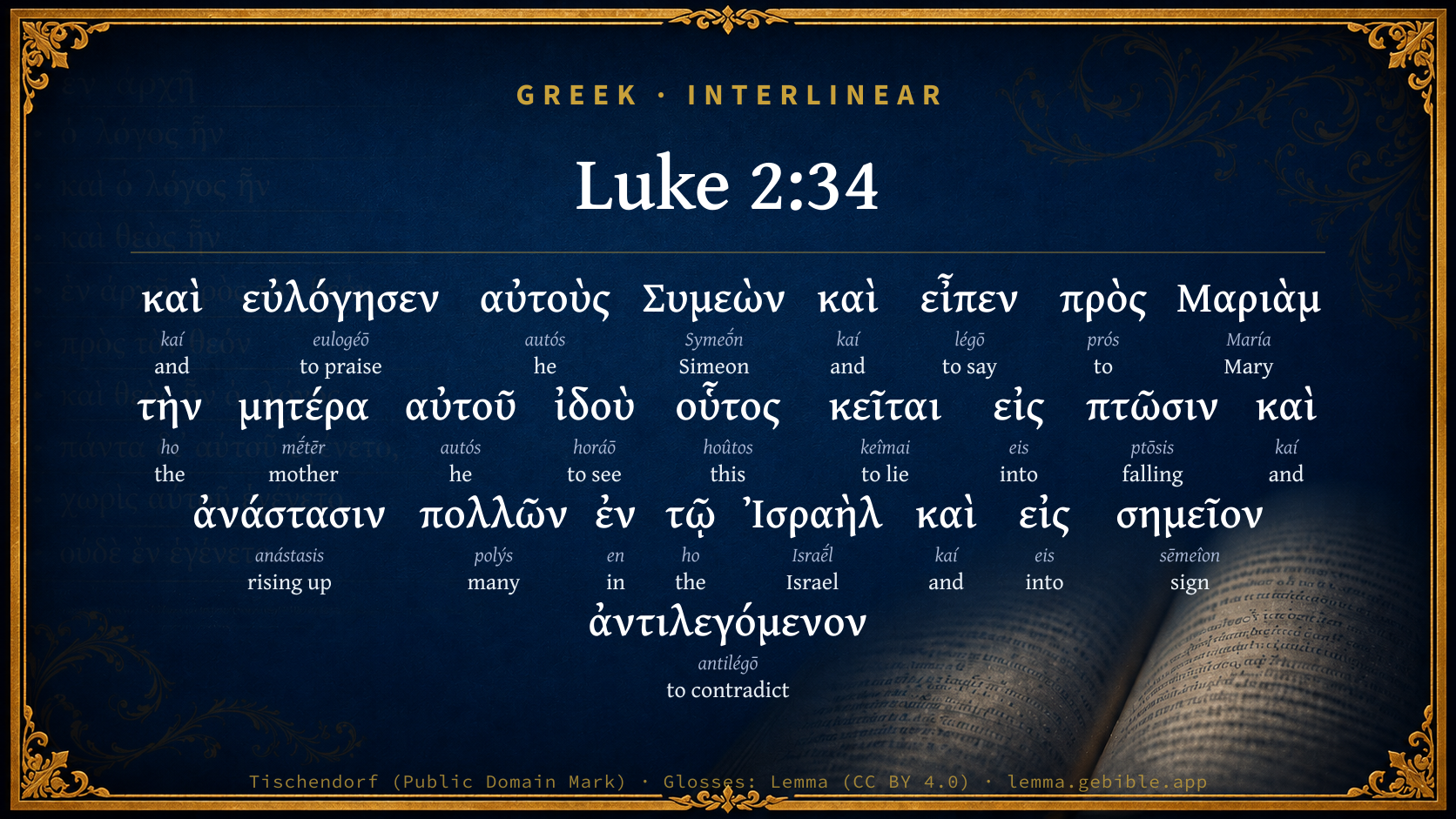
Greek (Tischendorf 8th ed.) Luke 2:34 appears in the Greek New Testament. The text above is from the Tischendorf 8th edition. Each word links to its Strong’s number and a concise gloss. Click any word for its full Thayer’s Greek Lexicon entry.
Download image
Cite this verse

Luke 2:34 (World English Bible). Public Domain. Lemma interlinear Bible study tool, https://lemma.gebible.app/v/luke/2/34.

Show BibTeX & RIS
BibTeX
RIS
English Translation
and Simeon blessed them, and said to Mary, his mother, "Behold, this child is set for the falling and the rising of many in Israel, and for a sign which is spoken against.
World English Bible · Public Domain
Highlights
  • 1 first appearance in the Greek New Testament
Full analysis ↓
Download a study sheet

One document with this verse’s original text, its word-by-word gloss line, the meaning frame, cross-references with their text, attributed commentary, and full source and license credits — printable, and it pastes into notes with its structure intact.

This verse Autodidact and up

Study sheet (.html) Plain text (.txt)

A passage Seminary Student

Up to 50 verses in one chapter. A passage sheet keeps up to 6 commentary sources and 12 cross-references per verse, in the order this page ranks them, and says so on the sheet whenever that leaves anything out. Ask for a single verse and you get the Autodidact verse sheet above.

Everything on this page stays free to read, with no account — the sheet is a download of what is already on screen, not access to it.

Want to remove ads? Support Godless Engineer
Compare translations 3

The same verse in 3 English versions, stacked beneath the original-language interlinear above. Click any original word for its lexicon entry.

Each is an independent rendering of the whole verse — the interlinear is not word-aligned to these translations.

Highlighted words mark where these versions differ — a whole-verse word diff, not a word-by-word alignment.

  • World English Bible Public Domain
    and Simeon blessed them, and said to Mary, his mother, "Behold, this child is set for the falling and the rising of many in Israel, and for a sign which is spoken against.
  • King James Version Public Domain
    And Simeon blessed them, and said unto Mary his mother, Behold, this child is set for the fall and rising again of many in Israel; and for a sign which shall be spoken against;
  • unfoldingWord Literal Text CC BY-SA 4.0
    And Simeon blessed them, and said to Mary, his mother, “Behold, this one is appointed for the downfall and rising up of many in Israel and for a sign that is spoken against—

unfoldingWord Literal Text — © unfoldingWord, licensed CC BY-SA 4.0. Word-aligned USFM3 via Door43 (git.door43.org/unfoldingWord/en_ult).

Versions to compare (up to 4)

3 of 4 selected

Show all 19 translations

Every available English version of this verse, each an independent rendering of the whole verse.

  • World English Bible Public Domain
    and Simeon blessed them, and said to Mary, his mother, "Behold, this child is set for the falling and the rising of many in Israel, and for a sign which is spoken against.
  • Berean Standard Bible Public Domain
    Then Simeon blessed them and said to His mother Mary: “Behold, this Child is appointed to cause the rise and fall of many in Israel, and to be a sign that will be spoken against,
  • Majority Standard Bible Public Domain
    Then Simeon blessed them and said to His mother Mary: “Behold, this Child is appointed to cause the rise and fall of many in Israel, and to be a sign that will be spoken against,
  • King James Version Public Domain
    And Simeon blessed them, and said unto Mary his mother, Behold, this child is set for the fall and rising again of many in Israel; and for a sign which shall be spoken against;
  • American Standard Version (1901) Public Domain
    and Simeon blessed them, and said unto Mary his mother, Behold, this `child' is set for the falling and the rising of many in Israel; and for a sign which is spoken against;
  • Revised Version (1885) Public Domain
    and Simeon blessed them, and said unto Mary his mother, Behold, this child is set for the falling and rising up of many in Israel; and for a sign which is spoken against;
  • Geneva Bible (1599) Public Domain
    And Simeon blessed them, and saide vnto Mary his mother, Beholde, this childe is appointed for the fall and rising againe of many in Israel, and for a signe which shalbe spoken against,
  • Douay-Rheims (1899) Public Domain
    And Simeon blessed them, and said to Mary his mother: Behold this child is set for the fall, and for the resurrection of many in Israel, and for a sign which shall be contradicted;
  • Young's Literal Translation Public Domain
    and Simeon blessed them, and said unto Mary his mother, `Lo, this `one' is set for the falling and rising again of many in Israel, and for a sign spoken against --
  • Literal Standard Version CC BY-SA 4.0
    and Simeon blessed them and said to His mother Mary, “Behold, this [One] is set for the falling and rising again of many in Israel, and for a sign spoken against—
  • Unlocked Literal Bible CC BY-SA 4.0
    Simeon blessed them and said to Mary his mother, “Behold, this child is appointed for the downfall and rising up of many people in Israel and for a sign that is rejected—
  • unfoldingWord Literal Text CC BY-SA 4.0
    And Simeon blessed them, and said to Mary, his mother, “Behold, this one is appointed for the downfall and rising up of many in Israel and for a sign that is spoken against—
  • Darby Bible Public Domain
    And Simeon blessed them, and said to Mary his mother, Lo, this [child] is set for the fall and rising up of many in Israel, and for a sign spoken against;
  • World Messianic Bible Public Domain
    Simeon blessed them, and said to Miriam, his mother, “Behold, this child is appointed for the falling and the rising of many in Israel, and for a sign which is spoken against.
  • Webster's Bible Public Domain
    And Simeon blessed them, and said to Mary his mother, Behold, this child is set for the fall and rising again of many in Israel; and for a sign which shall be spoken against;
  • Free Bible Version CC BY-SA 4.0
    Then Simeon blessed them, and said to Jesus' mother Mary, “This child is destined to cause many in Israel to fall and many to rise. He is a sign from God that many will reject,
  • Bible in Basic English Public Domain
    And Simeon gave them his blessing and said to Mary, his mother, See, this child will be the cause of the downfall and the lifting up of great numbers of people in Israel, and he will be a sign against which hard words will be said;
  • Text-Critical English NT CC BY 4.0
    Then Simeon blessed them and said to Mary, the child's mother, “Behold, this child is appointed to bring about the falling and rising of many in Israel and to be a sign that will be spoken against,
  • Tyndale New Testament (1534) Public Domain
    And Simeon blessed them and sayde vnto Mary his mother: beholde this chyld shalbe the fall and resurreccion of many in Israel and a signe which shalbe spoke agaynste.

Literal Standard Version (2020), Covenant Press — licensed CC BY-SA 4.0. Text via the HelloAO Bible API (eBible.org). Unlocked Literal Bible (unfoldingWord) — licensed CC BY-SA 4.0. Text via the HelloAO Bible API (eBible.org). unfoldingWord Literal Text — © unfoldingWord, licensed CC BY-SA 4.0. Word-aligned USFM3 via Door43 (git.door43.org/unfoldingWord/en_ult). Free Bible Version, Dr. Jonathan Gallagher — licensed CC BY-SA 4.0. Text via the HelloAO Bible API (eBible.org).

Word by word

More ways to search: Search by grammar → Find every occurrence → Compare this word →

Practice this passage: Drill this verse → Learn its vocabulary →

πτῶσιν
ptōsis
G4431
“falling”
Noun, Accusative, Singular, Feminine
Part of Speech
Noun
Case
Accusative
Number
Singular
Gender
Feminine
Full Thayer's Definition

Origin: from the alternate of G4098

TDNT: 08:47,8

1. a falling, downfall
  1. καὶ kaí G2532 “and” Conjunction
  2. εὐλόγησεν eulogéō G2127 “to praise” Verb, Aorist, Active, Indicative, 3rd person, Singular
  3. αὐτοὺς autós G846 “he” Personal pronoun, Accusative, Plural, Masculine
  4. Συμεὼν Symeṓn G4826 “Simeon” Noun, Proper, indeclinable
  5. καὶ kaí G2532 “and” Conjunction
  6. εἶπεν légō G3004 “to say” Verb, Aorist, Active, Indicative, 3rd person, Singular
  7. πρὸς prós G4314 “to” Preposition
  8. Μαριὰμ María G3137 “Mary” Noun, Proper, indeclinable
  9. τὴν ho G3588 “the” Article, Accusative, Singular, Feminine
  10. μητέρα mḗtēr G3384 “mother” Noun, Accusative, Singular, Feminine
  11. αὐτοῦ autós G846 “he” Personal pronoun, Genitive, Singular, Masculine
  12. ἰδοὺ horáō G3708 “to see” Verb, Aorist, Middle, Imperative, 2nd person, Singular
  13. οὗτος hoûtos G3778 “this” Demonstrative pronoun, Nominative, Singular, Masculine
  14. κεῖται keîmai G2749 “to lie” Verb, Present, Middle or Passive deponent, Indicative, 3rd person, Singular
  15. εἰς eis G1519 “into” Preposition
  16. καὶ kaí G2532 “and” Conjunction
  17. ἀνάστασιν anástasis G386 “rising up” Noun, Accusative, Singular, Feminine
  18. πολλῶν polýs G4183 “many” Adjective, Genitive, Plural, Masculine
  19. ἐν en G1722 “in” Preposition
  20. τῷ ho G3588 “the” Article, Dative, Singular, Masculine
  21. Ἰσραὴλ Israḗl G2474 “Israel” Noun, Proper, indeclinable
  22. καὶ kaí G2532 “and” Conjunction
  23. εἰς eis G1519 “into” Preposition
  24. σημεῖον sēmeîon G4592 “sign” Noun, Accusative, Singular, Neuter
  25. ἀντιλεγόμενον antilégō G483 “to contradict” Verb, Present, Passive, Participle, Accusative, Singular, Neuter

About this verse

These counts appear in no published source. They are computed here, from the morphology-tagged text and Lemma’s own curated glosses. What Lemma adds →

26
words
20
distinct lemmas
Gospels
section

Notable vocabulary

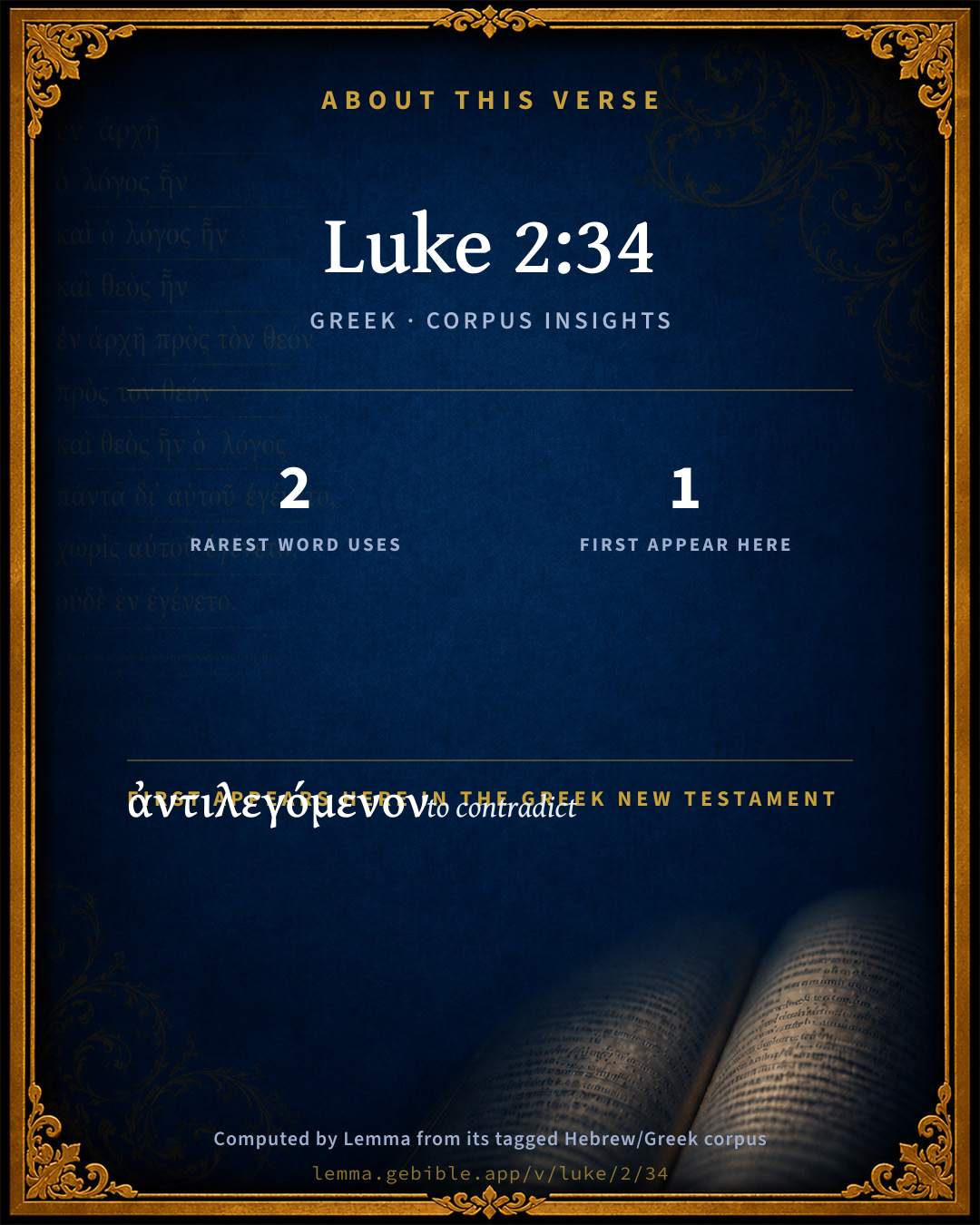
The rarest word here is πτῶσιν falling G4431 — appearing just 2 times in the whole Greek New Testament.

First appearance in Scripture

This word makes its first canonical appearance in the Greek New Testament here:

  • ἀντιλεγόμενον to contradict G483

Shared distinctive vocabulary

πτῶσιν falling G4431 occurs in 2 verses of the Greek New Testament. Also found in:
Repetition

Words recur within this verse:

  • εἰς into G1519 ×2
  • καὶ and G2532 ×4
  • αὐτοὺς he G846 ×2
  • τὴν the G3588 ×2

Cross-references

36

Topical passages linked to Luke 2:34 in the Treasury of Scripture Knowledge — connected by theme and wording, ordered by reader-vote popularity; previews shown in the World English Bible.

  • 1 Corinthians 1:23 but we preach Christ crucified; a stumbling block to Jews, and foolishness to Greeks,
  • 1 Peter 2:7–8 For you therefore who believe is the honor, but for such as are disobedient, "The stone which the builders rejected, Has become the chief cornerstone,"
  • Isaiah 8:14–15 He shall be for a sanctuary; but for a stone of stumbling and for a rock of offense to both the houses of Israel, for a gin and for a snare to the inhabitants of Jerusalem.
  • Matthew 21:44 He who falls on this stone will be broken to pieces, but on whoever it will fall, it will scatter him as dust."
  • Acts 9:1–20 But Saul, still breathing threats and slaughter against the disciples of the Lord, went to the high priest,
  • 2 Corinthians 2:15–16 For we are a sweet aroma of Christ to God, in those who are saved, and in those who perish;
  • Hosea 14:9 Who is wise, that he may understand these things? Who is prudent, that he may know them? For the ways of Yahweh are right, And the righteous walk in them; But the rebellious stumble in them.
  • Leviticus 9:22–23 Aaron lifted up his hands toward the people, and blessed them; and he came down from offering the sin offering, and the burnt offering, and the peace offerings.
  • Psalms 22:6–8 But I am a worm, and no man; A reproach of men, and despised by the people.
  • John 5:18 For this cause therefore the Jews sought all the more to kill him, because he not only broke the Sabbath, but also called God his own Father, making himself equal with God.
  • Acts 3:15–19 and killed the Prince of life, whom God raised from the dead, to which we are witnesses.
  • Acts 4:26 The kings of the earth take a stand, And the rulers take council together, Against the Lord, and against his Christ.'
  • Acts 6:7 The word of God increased and the number of the disciples multiplied in Jerusalem exceedingly. A great company of the priests were obedient to the faith.
  • Acts 13:45 But when the Jews saw the multitudes, they were filled with jealousy, and contradicted the things which were spoken by Paul, and blasphemed.
  • Acts 17:6 When they didn't find them, they dragged Jason and certain brothers before the rulers of the city, crying, "These who have turned the world upside down have come here also,
  • 1 Peter 4:14 If you are insulted for the name of Christ, blessed are you; because the Spirit of glory and of God rests on you. On their part he is blasphemed, but on your part he is glorified.
  • Acts 2:36–41 "Let all the house of Israel therefore know assuredly that God has made him both Lord and Christ, this Jesus whom you crucified."
  • Acts 24:5 For we have found this man to be a plague, an instigator of insurrections among all the Jews throughout the world, and a ringleader of the sect of the Nazarenes.
  • Romans 9:32 Why? Because they didn't seek it by faith, but as it were by works of the law. They stumbled over the stumbling stone;
  • Hebrews 7:7 But without any dispute the less is blessed by the better.
  • Hebrews 12:1–3 Therefore let us also, seeing we are surrounded by so great a cloud of witnesses, lay aside every weight and the sin which so easily entangles us, and let us run with patience the race that is set before us,
  • Genesis 14:19 He blessed him, and said, "Blessed be Abram of God Most High, possessor of heaven and earth:
  • Genesis 47:7 Joseph brought in Jacob, his father, and set him before Pharaoh, and Jacob blessed Pharaoh.
  • Exodus 39:43 Moses saw all the work, and, behold, they had done it as Yahweh had commanded, even so had they done it: and Moses blessed them.
  • Psalms 69:9–12 For the zeal of your house consumes me. The reproaches of those who reproach you have fallen on me.
  • Isaiah 8:18 Behold, I and the children whom Yahweh has given me are for signs and for wonders in Israel from Yahweh of Hosts, who dwells in Mount Zion.
  • Matthew 11:19 The Son of Man came eating and drinking, and they say, 'Behold, a gluttonous man and a drunkard, a friend of tax collectors and sinners!' But wisdom is justified by her children."
  • Matthew 12:46 While he was yet speaking to the multitudes, behold, his mother and his brothers stood outside, seeking to speak to him.
  • Matthew 26:65–67 Then the high priest tore his clothing, saying, "He has spoken blasphemy! Why do we need any more witnesses? Behold, now you have heard his blasphemy.
  • Matthew 27:40–45 and saying, "You who destroy the temple, and build it in three days, save yourself! If you are the Son of God, come down from the cross!"
  • Matthew 27:63 saying, "Sir, we remember what that deceiver said while he was still alive: 'After three days I will rise again.'
  • John 3:20 For everyone who does evil hates the light, and doesn't come to the light, lest his works would be exposed.
  • John 8:48–52 Then the Jews answered him, "Don't we say well that you are a Samaritan, and have a demon?"
  • John 9:24–29 So they called the man who was blind a second time, and said to him, "Give glory to God. We know that this man is a sinner."
  • Acts 28:22 But we desire to hear from you what you think. For, as concerning this sect, it is known to us that everywhere it is spoken against."
  • Hebrews 7:1 For this Melchizedek, king of Salem, priest of God Most High, who met Abraham returning from the slaughter of the kings and blessed him,

Cross-references courtesy of OpenBible.info (CC BY 4.0).

Commentary

Notes on Luke 2:34 from classic Christian and Jewish commentators (each source and its license shown beneath its notes). The classic Christian expositions comment on the surrounding passage and are grouped to its opening verse, so a note may address several verses; the Jewish commentaries on the Tanakh (Rashi and others) are per-verse, so they appear only where the commentator wrote on this verse.

Lemma curates 59 commentaries, every one of them public domain or Creative Commons licensed, each selected and text-cleaned for this edition rather than reprinted as found. About our sources →

The Biblical Illustrator

Joseph S. Exell

Luk_2:34-35

Behold, this Child is set for the fall and rising again of many

Simeons prediction

This prediction has a very gloomy aspect, and speaks with a tone of sad foreboding in strange contrast to the riant tone of the song of thanksgiving which immediately precedes it.

But was it too gloomy for the facts? Was not every jot and tittle of it fulfilled within three and thirty years of its utterance? Is it not still finding a wide and large fulfilment?

1. When the word of Christ comes home to you, whether it come to quicken you to a new life, or to convince you of some truth which you had not recognized before, or had not reduced to practice, do not be amazed and discouraged if you stumble at it, if it awaken doubt and contradiction in your hearts, if you find it hard to believe, and still harder to live by. It is no strange thing which is happening to you, but the common and normal experience of all who believe in Him. The advent of Christ in the heart, His coming in power, must resemble His advent into the world, must create a strife between the good and the evil in your nature, must disclose so much that is evil in you as to make you fear goodness to be beyond your reach. How, but by the conviction of sin, can you be made penitent, and driven to lay hold on the salvation which takes away sin? And the oftener Christ comes, the nearer He draws to you, the more fully He enters into your life--the deeper will be your conviction of sin, of a tainted and imperfectnature; till, at times, you will fear as if a sword had been thrust it.to your very soul. This, indeed, is what He comes to you for; to separate between the evil and the good, to make you conscious of evils you did not suspect, so conscious that you hate and long to be delivered from them.

2. But this is not the only comfort or encouragement which the prediction of Simeon suggests. If he had not foreseen the nearer and immediate results of Christs advent, we might have distrusted him when he spake of its distant and ultimate results. If he had not told us of the conflict and sorrow, the self-exposure and self-contempt to which a faithful reception of Christ subjects us, we could hardly have believed him when he speaks of Christ as the Consolation for all sorrow, and the Light which is to glorify the whole dark world. But when we find all that he said of the nearer results of Christs coming to be true, we can hardly help believing him when he speaks to us of its happy ultimate results. Simeon has approved himself a faithful witness; we have found in our own experience that Christ is a Rock of stumbling and offence, a Signal which calls out all the opposition of an imperfect nature, a Sword which pierces the very soul and divides the evil in us from the good, a Touchstone which reveals our most secret thoughts and bents; let us also believe that He will be our Consolation, our Light, our Glory.

3. We may well believe it. Per augusta ad augusta, through a narrow way to a large place, through much struggle with many difficulties to a glorious end, through conflict to victory, seems the very motto of the Christian life. And this thought also is contained in Simeons prediction, which is so framed as to imply that it was by a Divine intention, and in order to realize a gracious Divine end, that Christ was to bring strife on the earth, to kindle an inward war, to disclose the lurking evils of the human heart. He was set, in order that the thoughts of many hearts should be revealed--set by God for this very purpose. So that when our thoughts are exposed, when we have to endure the inward conflict between evil and good, when the word of Christ pierces and rends our hearts, all is according to a Divine order, a Divine intention; all is intended to prepare and conduct us to that Divine end, the salvation of our souls. It is all meant to prepare us for a time in which our souls shall be so flooded and suffused with the Divine Light that there shall be no more darkness in us, so penetrated with the Divine Glory that sin and sorrow and shame shall for ever flee away. And if this be Gods intention, if this is the end to which He is conducting us, who will not bear the strife and pain and self-contempt of this present imperfect life with patience, nay, with courage and with hope? (S. Cox, D. D.)

Christ the rising and fall of many

This however cannot be all that is meant by Christs being set for the fall of many. They who remain just as they were, and where they were, cannot be said to fall. Falling implies some change: and they who have fallen must be in a worse state than before they fell. Now this is dismally true. They who, having heard of Christ, have not believed in Him, and do not believe in Him--they who do not believe in Him in the scriptural sense of believing, that is, with the heart and soul, as well as with the understanding--they who have not a living faith in Him, and do not show it by living a life of faith--they who, having heard of Christ, do not believe in Him in this sense, are indeed in a worse state than they would have been in, had Christ never come into the world. They are in a worse state, because they are in a more hopeless state.

The last chance of salvation has been tried on them; but in vain. Everything that could be done has been done for them, but in vain. God has poured forth all the riches of His grace and mercy and love on them; but in vain. Their hearts continue as hard as the naked rock, as dry as the sandy desert. Nothing, it has been proved, can soften them; nothing can refresh them; nothing can make them bear fruit. The Comforter has been sent to us. If we refuse His comfort, if we reject His salvation, we must continue uncomforted and unsaved for ever. Yet this is not all. The state of those, who, having heard of Christ, have no living faith in Him, but continue in their sins, is not only worse than if they had never heard of Christ, because it is more hopeless; it is also worse, because it is more sinful. For the sinfulness of any action is to be measured, not by the nature of the action itself, but by the character and condition of the doer. It is in him, not in the action, that the sin lies; and its sinfulness will always vary, in proportion as he knows it to be sinful, and as he has had stronger motives and helps for struggling against it. Moreover we all feel that for a child to behave ill to a kind and loving father is far worse, far more inexcusable, than if its father had been harsh and neglectful. These, then, are the two qualities which deepen the sinfulness of sin. When it is a sin against knowledge, it becomes doubly sinful; and its sinfulness increases in proportion as that knowledge is clear and certain. And when it is also a sin against love, it then becomes tenfold sinful; its sinfulness still growing worse and worse, in proportion to the strength of the motives whereby our love has been appealed to. These are the rules we are wont to make use of in judging one another. It is our own rule too, in our dealings with each other, as well as the rule of the gospel, that to whom much is given, of him much shall be required. They who, with the knowledge of Christ, live like heathens, we have already seen, are far more sinful than the heathens: and thus to them the coming of Christ has been the occasion of falling. They have fallen, because they have not risen; and because, by remaining where they were, they are so much further below what they ought to be. But the coming of Christ has also given us new duties. We have higher motives, a higher mark set before us. We are bound to strive after more heavenly aims. We are bound to seek after a more heavenly purity. So that the gift of the gospel is accompanied with a twofold danger. If we abide in our former ways, it renders those ways more sinful: and it imposes higher duties upon us, the neglect of which covers us with fresh guilt. For in this way also has the coming of Christ been a dismal occasion of falling to many. Many have hated the light, because their deeds were dark, and have either tried to quench the light, or finding their efforts to do so were vain, have wrapt themselves up in still thicker darkness. Thus was it with the Jews. To them the coming of Christ was an occasion of falling. Through Christs coming they were no longer the chosen people of God. They forfeited their rank among nations, and became wanderers on the face of the earth, wanderers still more forlorn than when they wandered under Moses in the wilderness. So, too, was the coming of Christ an occasion of falling even to the heathens. For although, having gods many, and lords many, they had been ready to receive any new idol, that the folly or wickedness of man enthroned in the heavens, yet, when the true God, as revealed in the person of His Only-begotten Son, was made known to them, they too tried to quench His light with blood. And even now there are still found those who openly hate and blaspheme God and His Christ, and thus have fallen into deeper sinfulness through Christs coming. Alas, it is a fearful and ghastly thought, how many millions on millions of souls will have received no benefit by Christs atonement, how many millions on millions of souls may perhaps be among those for whose fall that blessed Child was set. This must surely have been the worst part of the agony by which Christs spirit was rent on that awful night in the garden, the thought of the millions of souls to whom He should only be an occasion of falling. It is a thought the sting of which nothing can take away, except when the soul is rapt in adoration of the perfect holiness, and perfect justice, and perfect love of God. (J. C. Hare.)

Christs mission

Simeon makes this declaration emphatically in reference to Israel; but he makes it prophetically in reference to the Gentile world, and to the multitudes which to the end of time shall come under the sound of the gospel.

I. We propose to ILLUSTRATE THIS REPRESENTATION OF OUR SAVIOURS MISSION. Illustrations may be borrowed from almost every circumstance in His work, and from every perfection in His personal ministration.

1. His very appearance in the first instance illustrated forcibly, and in some cases painfully, the truth of this declaration, that, on His entrance into our world, and on His revealing Himself by the ministry of His word, He should have been for the falling and for the rising again of many in Israel. But when Christ came, and His appearance was so contrary to all their expectations had led them to look for, they were prepared, not to receive Him, but positively to reject and dishonour Him. And so the appearance of Christ in the world is a stumbling-block to the present day. On the other hand, in reference to the appearance of Christ, He is set for the rising again of many in Israel. This was true of His temporal appearance among the people of Israel. While the princes and the rulers of that period passed Him by with scorn, and refused to listen to His Divine instruction, it is beautifully said that the common people heard Him gladly. There was something in the very humility of His circumstances, in the poverty of His life, in the lowliness of His outward walk and conversation, which brought Him near to them, and them near to Him.

2. We receive a second illustration of the truth of this declaration from the mystery of the Redeemers person. This representation of our Saviours character was in His own time, has been in every succeeding age, and is in our time, the occasion of the falling and the rising again of many. There were many in His day who made it a stumbling-stone and a rock of offence. There was nothing in the history of the Jewish people which gave them such sore offence, and excited such bitter hatred to the kind Jesus Christ, as His announcing Himself to be the Son of God, and claiming equality with the Father it was on this very ground that they persecuted Him through life; and it is very remarkable that on this very ground they at last put Him to death on the cross. Now, on the other hand, this very representation of our Saviours person is life from the dead to those who believe in His name.

3. The ministry of Jesus Christ is also another method of illustrating the truth of this declaration: This child is set for the fall and the rising again of many in Israel. Our Lords ministry on earth was remarkable for the effect it had on those to whom it was directed. What was the falling away of the Jews in this instance was the gathering of the Gentiles.

4. This declaration is still further illustrated if we consider the death which Jesus died. Those who disbelieve, and disbelieve Him as a dying Saviour making atonement for sin, disbelieve the only remedy for sin, and fall fearfully from His presence. But on the contrary, where shall we find any representation of the Redeemer like the representation of the Redeemer crucified and dying, and rising again as the means of renewing our spirits, confirming our confidence, and elevating our hope. He died, but it is for the rising again of many.

5. Then, finally, it may be illustrated in the dispensation and economy of the gospel. But while it is for the rising again of many, it is also for the fall of many. The gospel dispensation has brought everything to an extreme; there is the extreme of mercy, and there is the extreme of judgment; God has discovered to us His grace, as we have never seen it; and God is discovering to us also His righteousness and His justice as was never shown before.

Behold, for it is remarkable, this Child is set for the fall and the rising again of many in Israel.

1. It is remarkable if we consider the great intention of Christ in coming into our world. Nothing can be more explicit than the intention of our Saviour and of the gospel in their appearance amongst us.

2. It is the more remarkable, in the second place, because the evil arising to us from the testimony of Christ is to be found in ourselves, and not in the Saviour. If it is said that Christ in His appearance shall be for the fall and rising again, for the condemnation as well as the salvation, of many, it is not so much descriptive of the intention of His coming as of the effect of His coming. But behold--let it be considered remarkable, fix your attention on it, that this arises from their own perversity, their own unbelief, their own sin. We are exhorted thus to behold and improve it because we have a serious concern in it. (A. Reed.)

The exhibition of Christ tries the human heart

This subject naturally divides itself into two branches, which require a distinct consideration.

I. Let us consider, THAT GOD EXHIBITS CHRIST BEFORE THE MINDS OF MEN, IS ORDER TO TRY THEIR HEARTS.

1. The truth of this observation appears from what the prophets foretold concerning the feelings and conduct of men towards the Messiah, when He should make His appearance in the flesh, and perform His mediatorial work among them. David predicted that He would alarm the fears, and awaken the enmity and opposition of the world against Him. Why do the heathen rage, and the people imagine a vain thing? The kings of the earth set themselves, and the rulers take counsel together, against the Lord and against His anointed, saying, Let us break their bands asunder, and cast away their cords from us.

2. It appears from the history of Christ, that He fulfilled the predictions which went before concerning Him, and tried the hearts of all, who either heard Him preach, or saw His miracles, or were any way acquainted with Him. He was a sign universally spoken against. Some heard Him gladly; but others heard Him with disgust and indignation. Some admired His miracles; but others despised and blasphemed them.

3. The exhibition of Christ after His death, through the medium of the gospel, tried the hearts of the whole Jewish nation.

4. Ever since the days of the apostles, the character of Christ, displayed in the gospel, has tried the hearts of the whole Christian world.

5. It appears from the very character of Christ, that He cannot be exhibited to the minds of men without trying their hearts. His character, above all others, is adapted to draw forth the feelings of the human heart. Wherever He is exhibited in all His excellences, offices, and designs, He must necessarily try the hearts of men in some very important respects. And, first, in regard to God. God, therefore, by exhibiting Christ in the gospel, tries the hearts of men in respect to Himself. He certainly made it appear that the Jews were His enemies, by the instrumentality of Christ. In the second place, the exhibition of Christ necessarily discovers the secrets of mens hearts towards themselves, as well as towards God. Christ, in the course of His life, and more especially at His death, laid open the guilt and ill desert of sinners. Besides, thirdly, the exhibition of Christ as a Mediator, discovers mens feelings in regard to the terms of salvation. The next thing proposed is--

II. To show that GOD TRIES THE HEARTS OF MEN THROUGH THE MEDIUM OF CHRIST, IN ORDER TO FIX THEIR FUTURE AND FINAL STATE. Behold, this Child is set for the fall and rising again of many. God intends to make men happy or miserable for ever, according to the feelings of their hearts towards the Son of His love. And there appears to be a propriety in Gods treating men according to their love, or hatred of Christ, because their feelings towards Christ afford a proper criterion of their true characters. If they love Christ, they love Gad; but if they hate Christ, they hate God. If they love Christ, they love the good of the universe; but if they hate Christ, they are enemies to all good. The character of Christ is the most infallible test of all human characters. Improvement:

1. Since it is Gods design in exhibiting Christ before men, to try their hearts and prepare them for their final state, it becomes the ministers of the gospel to make Christ the main subject of their preaching.

2. If God means to try the hearts of men, and prepare them for their final state through the medium of the gospel, then He has an important purpose to answer, by sending it where He knows it will be rejected.

3. If the exhibition of Christ be designed to form men for their future and eternal state, then they are in a very solemn situation while they are hearing the gospel.

4. If the gospel tries the hearts and forms the characters of those who hear it, then sinners may easily and insensibly fit themselves for destruction.

5. We learn from what has been said in this discourse, that all who hear the gospel may know, before they leave the world, what will be their future and final state. (N. Emmons, D. D.)

Christianity the test of character

We shall briefly consider in what respects Christianity proves itself the grand test of mens dispositions.

1. It puts to the proof whether or not men love truth.

2. The gospel is a test of mens hearts as affected with regard to God.

3. In respect to humility, the gospel tries and ascertains the state of the heart.

4. A fourth respect in which tile gospel is a test of your character is whether you are true, or not, to your own interest; whether you have wisdom to choose the right relief for your misery, the proper supply for your wants.

5. Lastly, Christianity is a test of our obedience or disobedience to the will of God. If God is a Master, where is His fear? If God is a Father, where is His honour?

A few words of improvement may appropriately conclude this important subject.

1. Wherever the gospel is propounded, it is a test of character to each individual who hears it: and whoever does not receive it will hereafter stand confessed to God as having loved darkness rather than light, because his deeds were evil.

2. The rejection of Christianity is entirely voluntary: it arises from the spirit of pride, the preference of falsehood, the love of sin: but where shall we look for criminality, if not in an evil mind?

3. The trial of character here is only preparatory to the last trial hereafter. (R. Hall, M. A.)

Christs knowledge of man

That the thoughts of many hearts may be revealed.

I. Yes, THAT IS THE CLAIM WHICH CHRIST HAS UPON US--THAT HE KNOWS US. AS it is said, He knew what was in man; and He does not merely know our faces and our forms, but our true selves. You know nothing of any science or thing until you know its hidden inner secret. How different it is to know about a thing and to know what is within a thing. Superficial knowledge is that of the surface, of the skin; and profound knowledge is that which is organic and descends to the foundation. You know every man has within him an amazing secret realm of thought and emotion; I may go a step further and say, it is unknown to himself, and most men never have more than very occasional glimpses into the within the veil of their own minds; most men are not at home within themselves; they do not dwell there. Even those men who do suppose that they are well acquainted with their own minds, often deceive themselves.

II. MAN HAS A GREAT HIDDEN NATURE, WAITING FOR REVEALMENT AND DEVELOPMENT. But how secret. This it is which makes the relationship of the pastor and the teacher frequently so sacred; it is felt that he can fathom the great deep of the human soul. You may illustrate it from so poor a piece of machinery as a watch; a watchmaker descends into the mystery; he knows it; and if he professes to know and does not, great mischiefs and mistakes result. Or, look at the human body and its diseases. I had a friend who was ill; he had three doctors who attended him; they gave him up; they looked at symptoms and phenomena; they were ignorant of the law; another came, touched the mainspring and restored him to health. Look I and here the image is more pertinent; look at the schoolmaster and educator, the teacher, the boy. I knew a minister in his early childhood; he was a very wild, a strong-willed boy: his parents punished him severely, again and again--they were pious people; at last they tried another method, they took him downstairs, after they had closed the shop at night, and they knelt down on either side of him, and they prayed, they both prayed for him, and they wept. Oh! said he to me, I could not stand that, I tried, and I prayed, and they conquered. He is an eminent minister now. They had touched the mainspring; there is a mainspring in all of us, and we bless the man who reveals it to us; he who can touch it, rules us--be he general, poet, statesman, or preacher.

III. Yes; this is Christs claim upon us; He knows us; HE IS THE TRUE REVEALER OF THE HIDDEN NATURE OF MAN. He therefore taught as one having authority, and not as the Scribes. And hence the word of the prophecy of Simeon, which I have read as a text, is to be taken by the side of His precious word. Christ is a light--a light, says Simeon, to lighten the Gentiles, and to be the glory of Thy people Israel. That was the true light, which lighteth every man that cometh into the world. What do we mean by light, but that which makes manifest the interior chambers of our nature? Yes! to know man is the great indispensable of all teaching. Rare knowledge and wonderful!

IV. Yes, AND KNOWLEDGE OF HUMAN NATURE IS ESSENTIAL TO ALL TEACHING. You see the painter! he will tell you that knowledge of anatomy is essential to success; he needs the knowledge of muscular action, to give life to his picture--a knowledge of internal action to external development. Thus you see in Christ knowledge of humanity. His whole teaching reveals adaptation, fitness to complete imperfect man! Hence, because of Christs transcendental knowledge, Christianity cannot be realized on earth. It is always over and beyond man. But a terrible thing it is to be with one who entirely knows us, and reads us through and through like a book--by observation, like Foster--by intuition, like Shakespeare; but to many it is only moral anatomy or surgery. The greatest knowledge of man is by sympathy. And Christ knew the World of the Human Heart by sympathy. Have you not noticed that scarcely any mind can cross the broad disc of our Lords even temporary association, without revealing, as it passes, its state? It seems as if any mind coming into the neighbourhood of His Divine character is compelled to yield itself up, not only to His perfect knowledge--but, in the memorable events of His life, is illustrated bow that which is done in secret is proclaimed on the house-tops. Amazing would seem the attraction of our Lords character, by which He drew to Him most opposite beings. He held them by their affection to Him. He held them by their hostility to Him. He revealed their love, their hatred, and their fear. Christs character was like that ancient mirror which, if held up before the face, did not reveal the face, but the thought.

V. THE TEACHING OF OUR LORD HAD THE SAME INFLUENCE AS HIS PERSONAL CHARACTER; it revealed the thoughts of the heart. All His parables removed the abstract ideas of the human soul into the region of home life. Thus Christ shows how He knows our inner nature, and speaks to the inner world of motive and imagination.

VI. 1. He knew. Mark, His knowledge was and is absolute. We speak of many, and say, They know human nature by observation or by intuition.

Properly, Christs knowledge is neither the one nor the other; the first says, I know human nature because I look at it; the second says, I know human nature because I look at myself, and find myself related to it. Christ knew it because He made it.

2. Hence His authority over man. Man felt His knowledge.

3. He revealed our thoughts in His sympathy, he knew what was in man; hence His sympathy with men. Yes, His sympathy with man!

VII. Christ not only revealed the thoughts of many hearts by eliciting their peculiar moral character, but HE SPOKE TO THE UNIVERSAL HEART OF MAN IN ALL AGES, BOTH BY HIS NEEDS AND BY HIS WORDS; He transformed the great instincts of men in all ages into absolute revelations. Christianity has revealed and authenticated to men what had been for ages suspected, or hoped, or feared.

VIII. 1. He saw human nature was dark. He came to enlighten it. I am the light of the world.

2. He saw the hardness as well as the darkness of man. He came to soften the worlds heart. He knew what was in man.

3. He consecrated humanity. He revealed the holy destiny of man, for He knew what was in man.

4. That the thoughts of many hearts might be revealed. He came to sublime and to crown human nature, to reveal to man His brightest, boldest thought--Eternal life--Immortality. (E. P. Hood.)

The detector of the heart

It may be profitable for us, then, to inquire:

I. IN WHAT MANNER DOES THE GOSPEL BECOME A DETECTOR OF THE HEART? There are two ways in which this detection and unveiling are most apparent and most important.

1. By its authoritative conveyance of truths and facts, it detects and prostrates the pride of human reasoning.

2. By the requirement of an uncompromising decision of character. Let us now inquire--

II. WHAT ARE THE INSTRUCTIVE AND PRACTICAL INFERENCES WHICH WE SHOULD DEDUCE FROM THESE VIEWS OF THE GOSPEL.

1. That the ministry of the gospel ought to be so conducted as to secure, as much as possible, this important object of discrimination and detection.

2. Every hearer of the gospel should feel constrained to bring home to his own heart the great test of character. 3, How greatly to be loved and prized is that gospel, which can give hope to the sinner even on the detection of his guilt and danger. (H. F. Burder, D. D.)

The first prediction of the Cross

I. 1. This is the first announcement that the way of the Holy Child must be the way of sorrows. The angel had spoken of the throne of David; the shepherds had brought a message of peace; Simeon foretells the Cross. Yet this prophecy is called a blessing! He blessed them! Blessedness is not the same as external prosperity. Blessedness is obedience to the will of the Father.

2. Mary has to learn that she, too, must suffer with her Child. A sword shall pierce through thy own soul. This is her blessing! Is it not true that the coming of the Eternal Word in human flesh has brought a blessing upon human sufferings, which are henceforth linked with His?

3. Simeon foresees that the Christ must suffer because His life would be violently opposed to the principles by which men were guiding their lives. He is among men as the Incarnate Word, reading their inmost thoughts, and revealing to them their true selves. Therefore must He be for the salvation of some and for the condemnation of others; therefore must He be a Sign that is spoken against.

4. Human suffering arises from the breach of the Divine order which was made when man chose his own will rather than Gods. The Divinely-ordered human life is lived by the Word made-flesh. Inasmuch as the Divinely-ordered life is in direct opposition to the self-centred lives of fallen men, it must come into collision with them and must suffer. At the same time, by its very perfection, and by its hold on the true Centre--the Divine Will--it must condemn all that falls short of it or opposes it.

II. 1. Contemplate in the Child here presented to the Father, the One Perfect Human Life, unfolding itself amidst the evil antagonisms of selfish human nature.

2. Learn that it follows that all who will live godly in Christ Jesus must suffer persecution (2Ti_3:12). (Canon Vernon Hutton, M. A.)

Fall and rise

Christ is set for the fall of some and the rising of others.

1. It is not otherwise.

2. It cannot be otherwise.

3. It ought not to be otherwise.

4. It will not be otherwise. (J. J. Van Oosterzee, D. D.)

Struggle and triumph

The sign spoken against.

1. In its continual struggle.

2. In its certain triumph. (J. J. Van Oosterzee, D. D.)

Dual aspect of Christs Advent

Simeon added this probably as an explanation of an expression he had just used in his burst of inspired song. The glory of Israel was a phrase already consecrated in religious language. It commonly meant the Sacred Presence or Shekinah between the cherubim over the ark of the covenant. Israel, as St. Paul in later years pointed out, had indeed many a prerogative among the nations. Israel was Gods adopted family; Israel inherited the covenants--those early understandings between earth and heaven, of which the great patriarchs had been the favoured recipients; to Israel God had revived in its completeness the moral law; Israel offered to God a worship, the nature and details of which had been Divinely ordered; Israel, so rich in the past, was also the people of the future; the promises were its endowment for the coming ages, and in the fathers or patriarchs Israel had not merely a store of precious memories, but a lasting possession. The patriarchs were the property of their descendents to the end of time; but the true glory of Israel was this, that of its stock and blood as concerning the flesh, Christ--whose Incarnation the Sacred Presence over the ark prefigured--Christ came, who is all over all, God blessed for ever. All else that Israel was or had--its sacred books, its typical ritual, its ideal of righteousness in the moral law, its great saints and heroes--all else pointed on and up to this its supreme prerogative But what would it mean in fact, in history? Would all Israelites hasten to recognize their true title as a race to greatness? Would all hearts join in one outburst of thankful praise when the glory of Israel presented Himself to His countrymen? Simeon feels it his duty to check unwarranted expectations which his earlier words might have seemed to raise.

1. Christs coming into the world was not to have a uniform effect upon human souls. It would act on one soul in one way, and on another in another: it would act differently on the same soul at different periods of its history. It is Christs wish to bless every one with whom He comes in contact; but His goodwill is limited by the free action of men, who are left at liberty to accept or reject Him as they choose. The spiritual world is not ruled mechanically. The truth and grace of God only act upon men with good results so far as they are willing that they should so act. That Christs Advent should have great results was inevitable. It acted as a moral shock upon the existing fabric of thought and life, dispelling illusions, and making men think and choose. None could regard Christ with indifference. He stirred the emotions of all.

2. Of the two effects of Christs Advent, Simeon mentions first the fall of many in Israel. Bold paradox--to associate His blessed name, who came to be the health and Saviour of men, with spiritual failure. Yet this was what prophecy had led men to expect. And it is what actually happened. When Christ appeared as a public teacher, He was despised and rejected by the great majority of the Jewish people. Even such as heard Him gladly at first, joined the priests and rulers at last in the cry, Crucify Him. Only a few clung firmly to Him through it all.

3. When our Lord had His own way with souls, it was to raise them to newness of life. To come into contact with Him--sympathetic contact--was to touch a life so intrinsically buoyant and vigorous that it transfused itself forthwith into the attracted soul, and bore it onwards and upwards. The rising again of which Simeon speaks is not the future resurrection of the body, but the present moral and spiritual resurrection of believers souls. (Canon Liddon.)

Use and abuse of Gods gifts

Everything that comes from God is naturally fitted and originally intended for good. But His gifts are often perverted, and become, though not the cause, yet the occasion, of evil.

I. IT IS SO WITH COMMON TEMPORAL BLESSINGS. They are all good things in themselves, but they prove advantages or disadvantages according to our use of them.

1. Riches. When properly received and used to the glory of God and good of men, riches are a great blessing; but when coveted, or rested in as the chief good, or abused in extravagance and profligacy, they become the root of all evil, and drown men in destruction.

2. Greatness. In Gods hand it is to make great, to give power and honour to men; and those great men who conduct themselves in a manner becoming their exalted station, are honourable and happy indeed; but the more pre-eminent in station men are, the more sinful and ruinous is their misconduct.

3. Learning is justly accounted honourable and valuable; and it actually not only promotes a mans worldly distinction, but proves a blessing in the highest sense of the word, when consecrated to God, and possessed in humility and virtue; but there are few greater curses than learning misapplied, usurping the place of the wisdom which is from above, or coexisting with habits of immorality.

4. Health is a blessing, without which all other earthly blessings are of little avail; and when spent in piety and usefulness, it enables men to rise to a high degree of credit and success, and even moral excellence; but when its stability is presumed on to encourage men to proceed in a career of dissipation, and its vigour wasted on crimes, or on trifles, it becomes the occasion of multiplied evils and of deep degradation.

5. Affliction is kindly sent for the benefit of transgressors; and when its voice is listened to, it recalls them from their wanderings; but when it is unimproved, it only hardens men more and more, and sinks them deeper and deeper in misery.

6. Nor is it otherwise with life itself. Skin upon skin, one piece of valuable property after another--nay, all that man hath, will he give for his life. Every man is bound to praise the Almighty Author and Preserver of his life; and the life that now is, when rightly improved, is the means of rising to the happiness of the endless life which is to come; but life spent and closed in natures guilt and depravity, is to all who so spend it and so close it, the forerunner of the second death, so that it would have been better for them never to have lived at all.

II. THE SAME PRINCIPLE APPLIES WITH RESPECT TO CHRISTS COMING INTO THE WORLD. He came to bless all mankind; but His coming may only increase our condemnation. (James Foote, M. A.)

Treatment of Christ and the gospel

1. Remember that the gospel must prove the means either of your rise or of your fall. It is, then, a matter of infinite moment, involving all that is important in your endless character and destiny.

2. Speak not against Christ, but for Him. Beware of speaking lightly of Him, or His ordinances, doctrines, people. On the contrary, espouse His cause, and embrace every opportunity of remembering Him to others.

3. Let all the sufferings and indignities of the Redeemer be matter of grief to you. Your sins made them necessary.

4. Suffer the gospel to have its proper heart-searching effect on you. That the thoughts of many hearts shall be revealed, is a result not to be deprecated, but desired; in order that what is right and pleasant may be cherished, and what is wrong corrected. God sees all now, and one day He will reveal all. It will then be too late to think of amendment. The present is the time for any salutary discovery. (James Foote, M. A.)

Christ--the fall and rise of many

Wherever Christ Jesus comes, with whomsoever He may come in contact, He is never without influence, never inoperative, but in every case a weighty result is produced. There is about the holy Child Jesus a power which is always in operation. He is not set to be an unobserved, inactive, slumbering personage in the midst of Israel but He is set for the falling or for the rise of the many to whom He is known Never does a man hear the gospel, but he either rises or falls under that hearing. Observe, then, the two sides of the truth--Jesus always working upon men with marked effect; and, on the other hand, man treating the Lord Jesus with warmth either of affection or opposition; an action and a reaction being evermore produced. Why is this?

1. Because of the energy which dwells in the Lords Christ, and in the gospel which now represents Him among men. The gospel is all life and energy; like leaven it heaves and ferments with inward energy, it cannot rest till it leavens all around it. It may be compared to salt which must permeate, penetrate, and season that which is subject to its influence. It is no more possible for you to restrain the working of the gospel than to forbid the action of fire. Stand before the fire, it shall warm and comfort you; thrust your hand into it, it shall burn you. It must work, because it is fire. And so with yonder sun. Though clouds may hide it from our sight at this moment, yet for ever does it pour forth, as from a furnace mouth, its heat and light. Nor could it cease to burn and shine, unless it ceased to be a sun. As long as it is a sun, it must permeate surrounding space with its influence and splendour. Do you wonder that the Sun of Righteousness is of yet Diviner energy?

2. Jesus Christ and His gospel are matters of such prime necessity to mankind, that from this cause also there must always be an effect produced by Christ. He is as necessary to our souls as the air is to our bodies. If we receive Him, we live; if we will not receive Him, we must die. It is unavoidable that it should be so. You cannot reject the Saviour, and be a little damaged thereby; there is no alternative but that you utterly perish.

3. The position in which Jesus Christ meets men makes it inevitable that He must have an effect upon them. He stands right in mens way. They must decide about Him one way or the other.

4. He was appointed for this very thing. Set. It was for this very end He came. See the husbandman take the fan. You observe the heap of mingled wheat and chaff lying on the floor. He begins to move the fan to and fro till he has created a breeze of wind. What happens? The chaff flies to the further end of the threshing floor, and there it lies by itself; the wheat, more weighty, remains purified and cleansed, a golden heap of grain. Such is the preaching of the gospel. Such is Christ: he is the separater of those who will perish from those who shall be saved. The fan discerns and discovers, it reveals the worthless and manifests the precious. Thus hath Christ the fan in his hand! Or, take another metaphor, which we find in the prophets, Who may abide the day of His coming? and who shall stand when He appeareth? for He is like a refiners fire, and like fullers soap. You see the refiners fire. Notice how it burns and blazes. Now, it turns to a white heat; you cannot bear to look on it. What has happened? Why, the dross is divided from the silver and the alloy from the gold. The refiners fire separates the precious from the vile. And so the gospel reveals the elect of God, and leaves to hardness of heart the finally impenitent. Where it is preached, the men who accept it are precious ones of God, His elect, His chosen; the men who reject it are the reprobate silver. So shall men call them, for God hath rejected them. Mark too, the fullers soap. The fuller takes his soap, and exercising his craft upon yonder piece of linen marked with many stains and colours, you see how these foul things fly before the soap, and the fair fabric alone remains. Both spots and linen feel the power of the soap. So cloth the gospel take the polluted fabric of humanity and cleanse it: the filth departs and flies before it, and the fair linen remains. Such are the saints of God; when the gospel comes to them they are purified thereby, while the wicked, as foul spots, are driven away in their wickedness. Having thus set forth the great truth of the text, I purpose now to answer briefly one or two questions.

I. WHO ARE THOSE THAT FALL BY CHRIST. In Christs day the question was not difficult to answer. Those that fell by Christ were--

1. The holders of tradition, who gave mens sayings higher authority than Gods commands.

2. The externalists.

3. The self-righteous.

4. The wiseacres.

5. The sceptical. Very much the same sort of people as fell by

Christ then fall by Christ now.

II. TO WHOM WILL THE LORD JESUS BE A RISING AGAIN? He will be a rising again to those who have fallen. Dost thou confess, I have fallen? Dost thou acknowledge, I possess a fallen nature? Dost thou lament thou hast fallen into sin? O my brother, He will be thy rising. He cannot uplift those who are not brought low. Note, again, those that rise in Him are those who are now willing to rise m Him. Jesus is set to raise you up.

III. There are SOME WHO SHALL BOTH FALL AND RISE, AGAIN IN CHRIST; to whom Christ shall give such a fall as they never had before, and such a rise as shall be to their eternal resurrection. But what a fall was there when I learned that if salvation was of works, it could not be of grace, and if it was of grace it could not be of works; the two could not be mixed together. Then I said I would hope in the performance of the duties which the gospel inculcates; I thought I had power to do this; I would repent, and believe, and so win heaven. But what a fall I had, and how each bone seemed broken when He declared to me, without Me, ye can do nothing. Ah, this is how Christ saves souls. He gives them a fall first, and afterwards He makes them rise. You cannot fill the vessel till it is empty. There must be room made for mercy by the pouring out of human merit. You cannot clothe the man who is clothed already, or feed him who has no hunger. But this fall which Jesus gives us is a blessed fall. He never did throw a man down without lifting him up afterwards. I kill and I make alive; I wound and I heal, these are attributes of Jehovah Jesus.

IV. We shall conclude with a few words upon the last part of the text. The text tells us that the Lord Jesus is A SIGN THAT SHALL BE SPOKEN AGAINST.

1. Christ was a sign of Divine love. In Him God reaches the climax of benevolence, and man exhibits the climax of deadly hate. The greatest gift provokes the greatest hostility, and the loftiest sign brings forth the most virulent opposition.

2. Christ was a sign of Divine justice. A bleeding Saviour, the Son of God deserted by His Father, the thunderbolts of vengeance finding a target in the Person of the Well-beloved, herein is justice revealed most fully. I hear not that other signs of vengeance have been spoken against. Men have trembled, but have not railed. Sodom and Gomorrah with bowed head confessed the justice of their doom. Egypt engulphed in the Red Sea saith nothing of it; none of her records contain a single blasphemy against Jehovah for having swept away the nations chivalry. The judgments of God, as a rule, strikes men dumb with awe! But this, which was the greatest display of Divine hatred of sin, where the Son of God was made to descend into the lowest depths as our substitute, this provokes to-day mans uttermost wrath. Know you not how many are continually railing at the Cross? The Crucified is still abhorred. How matchless is the perversity of human nature, that when God displays His justice most, but blends it sweetly with His love, the sign is everywhere spoken against!

3. Christ was the sign of mans communion with God, and of Gods fellowship with man. A ladder reaching from earth to heaven; a connecting bridge between creature and Creator. But alas! man does not want to be near his Maker, and hence he rails at the means provided for communion.

4. Christ is the sign of the elect seed, the representative of the holy, the newborn, the spiritual; and hence, as soon as the carnal mind, that knoweth not God nor loveth Him, perceives Christ and His gospel, it at once stirs up the depth of its malevolence to put down Christ if it be possible. But they shall never put Him down. They may speak against the gospel, but here is our joy, that Christ will raise up His people, and will certainly give the fall to His enemies. The ark of the Lord can never fall before Dagon; but Dagon must fall down before the Lords ark. (C. H. Spurgeon.)

Christ reveals hearts

Eastern fable tells of a magic mirror that remained clear and unsullied when the pure-hearted looked into it, but became troubled and obscure when the glance of the guilty fell upon it. So the owner of that mirror could always tell the character of those who looked into it. Such a test we have in Jesus. We can tell a mans nature by knowing what he thinks of Christ, and thus the thoughts of many hearts are revealed. (Sunday School Times.)

Christ spoken against

There are four reasons why they speak against Him; that is, as the true Christ of God.

I. Ignorance, men not knowing their need of Him; many of the relations he bears therefore appear to the natural man to be superfluous; he does not know his need, and therefore speaks against it in ignorance.

II. The native enmity of the mind. The carnal mind is enmity against God; men will naturally speak against that that they have an antipathy to.

III. Because they are too much taken up with the world, and they do not like to be interrupted. Now we must pursue the world, must enjoy the world; to become one of these religious mopes would be to spoil all our pleasures. Thus they have an idea that there is something very gloomy about religion, and so they speak against it, especially the truth.

IV. The natural man has a vague idea that the threatenings of God are mere words; that whoever the Lord may send to hell, says the natural man, I cant believe He will send me there. (J. Wells.)

This Child

These are the words of Simeon. A beautiful picture--age and childhood meeting together, a gentle shoot and the full ripe corn in the ear, a sapling and a full-grown oak ready for transplantation into that realm where the saints of God flourish with an immortal life and glory.

I. A CHILD. A wonderful thing. A seed containing a world of unknown possibilities. It makes parents glad. It should do so. A gift of God, a pledge and proof of the gracious tenderness which rules the world. But a child should also make parents thoughtful. Children are not mere play-things--ornaments, but undeveloped powers--slumbering volcanoes, which may burst out with desolating eruptions; or shrouded lights, that shall emerge in fuller and brighter radiance from year to year, shedding gladness and blessing all around.

II. BEHOLD THIS CHILD. Have we not sometimes wished that some Simeon could have taken a child of ours in his arms and become prophetic with respect to his destiny? But it is not permitted--graciously so. We know, however, that the future of children is not a thing of chance, nor is it determined only by what the child is in itself. Otherwise the parental relationship would be largely nullified. A child has its own native powers and tendencies, but they are capable of regulation or perversion. The doctrine of Scripture is that the child will be much what the parent makes him.

III. THE HISTORY OF THIS CHILD WAS TO BE ONE OF A CHEQUERED NATURE, AND THE MOTHER WAS TO ENDURE SAD WOE. A sword shall pierce, dec. This not uncommon for mothers. Simeon, however, blessed the parents in spite of the sorrow that would be mingled with the lot of Jesus and their own. Blessedness not the same as continuous happiness or pleasure. A pathway of uninterrupted joy may not be a blessing. Blessed are they that mourn, dec. Christs life was blessed when He was tempted, had not where to lay His head, was alone upon the mountain, was robed in mock royalty, beaten, spit upon, agonized in the garden, died upon the cross. No one could call Him happy, hut He was blessed.

IV. THIS CHILD WAS SET FOR THE FALL AND RISING AGAIN OF MANY IN ISRAEL: The effect different in different persons. Not, however, intended to be different. The purpose of God is good and gracious. All His gifts are intended for benefit--health, prosperity, afflictions. How differently are we affected by the same things! Children in the same house, under the same training, &c.

1. Falling--

(1) In aggravated degradation;

(2) augmented guilt;

(3) humiliation and repentance.

2. Rising again.

(1) Faith.

(2) Forgiveness.

(3) Holiness.

(4) Heaven.

The words of Simeon are for this day, for this nation, for you. This Child which was set forth then is still set forth, until in the counsels of heaven the last day shall break upon the world, and the throne of judgment shall be erected where now stands the throne of grace. This Child is still the turning-point upon which are centred the destinies of the world. This Child is not for a race, but for the world; not for an age, but for all time. This Child you have heard of from your infancy. You have not heard so much of any child as this. This child runs as a golden thread through the history of the world. You may neglect Him, but you cannot escape Him. You may despise Him, but you cannot escape Him. You may hate Him, but you cannot escape Him. It cannot be with you as it is with a heathen who has never heard of His name, and upon whom the glory of His brightness has never risen. (E. Mellor, D. D.)

Christ is set for the ruin of many

I. How TRUE IS THIS PROPHECY. Undoubtedly the Son of Man came not to destroy souls, but to save. In boundless love He has sacrificed Himself for the world, and opened heaven by His cruel death. Nevertheless, he is set to the ruin of many.

1. Many are destitute of holy faith, which is the gate of life and the ground of eternal salvation.

2. Many are destitute of Divine charity, which we must possess in addition to faith, if we would be saved.

II. HOW TERRIBLE IS THIS PROPHECY. Dreadful are the consequences to those for the ruin of whom Christ is set.

1. They forfeit the price of their redemption.

2. They lose the eternal happiness destined for them. (Joseph Schuen.)

What Christ was to be to different people

I. What this Child was to be to His enemies--an object of opposition and an occasion of ruin,

II. What He was to be to His mother--a cause of acute suffering (by sympathy).

III. What He was to be to His people--the Author of their recovery or restoration.

IV. What He was to be to all man kind--a test or touchstone of their moral and spiritual state. (G. Brooks.)

The prophecy of Simeon

While Joseph and the mother were still marvelling at the words spoken by the old man concerning Jesus, he turned to them, and with a solemn blessing first pronounced upon those who were privileged to have so near a place on earth to the Saviour of mankind, spoke these words to His mother only, Behold this Child, &c. He is placed, or laid, as a firmly-planted rock, with a twofold result and purpose--the fall of some, the rising of others. Two passages of the prophetIsaiah, the one from the eighth and the other from the twenty-eighth chapter, seem to be here brought together; as also in the ninth chapter of the Epistle to the Romans, and in the second chapter of the First Epistle of St. Peter. God places this Child in Zion as a precious corner-stone, a sure foundation. Whosoever will may build upon Him the house of his habitation, and rise into a holy temple, safe from the storms of time and the devastations of judgment. He is set for the rising of many. But if men will not thus use Him, as the foundation-stone of a safe and sure dwelling, then (according to the other passage) they will find Him a stone of stumbling and a rock of offence. He will be like an obstructing rock in their path--even to them who stumble at the word, being disobedient. God will not move Christ out of the way because men are perverse enough to stumble over Him. This Child is set, by a hand not of man, to be either for the rising (if they will have it so), or else for the fall (if they will have it so) of many in Israel. A solemn responsibility! We must either rise by Christ or fall--which we will. And for a sign spoken against. A sign, in the Scripture use, denotes something or some one pointing to God, to Gods being, to Gods working. Christ is a sign. He came upon earth to point to God. But this sign, like every other, may be, and commonly is, gainsaid, or spoken against. For one who accepts it, for one who, because of Christ, sees and believes in and lives for God--many cavil, many reject, and many neglect the gospel. This in all times. But most of all when He was Himself amongst men. Then indeed gainsaying ran on into open violence. Such is the warning uttered in the ears of His mother, over the little Infant lying still and helpless in the arms of the aged saint. Yea, he adds, a sword shall pierce through thy own soul also. She who is now rejoicing in the blessedness of being her Lords mother, must learn that no one comes so near Christ without partaking in His sufferings. For us the prophecy of Simeon is recorded. Let us try and judge ourselves by it, that we be not judged of the Lord. To which purpose, in our case, is this child set? To which of two purposes? for our fall, or for our rising?

1. For our fall, if we let the word come to us unheeded, to be snatched away by the tempter; if we receive the word for a moment with joy, but take no heed to its watering by the Spirits grace, to its growth by the sunshine of Gods presence, by the dew of Gods blessing; if we allow the word to become choked in us by cares and riches and pleasures of this life, so that it brings no fruit to perfection; if we continue in sin that grace may abound. This Child is set for the fall of many. And, oh, my friends, perhaps we have scarcely yet said of how many. It is not only the utterly hardened, not only the avowed unbeliever, not only the scoffer, the dishonest, or the impure, who stumble at the great stumbling-stone; it is quite as often the mere neglecter, the mere procrastinator, the merely undecided, the almost Christian, who shows what he is by his treatment of the Saviour and the great salvation. Not to be with Christ is, He says it Himself, to be (in His judgment) against Him.

2. Let us listen, in this day of opportunity and of blessing, to the alternative here set before us. This Child is set for the rising of many. What is this rising? and in whom is it verified? It is a rising out of darkness, out of the low, misty valley of sense and worldliness, into the clear light and pure knowledge of Him whom truly to know is eternal life. It is a rising out of misery and sin. Set for the rising of many, the text says. Who, then, are these? They are those who feel their need of Christ. And which of us has not cause to do so? (Dean Vaughan.)

Man saved or destroyed by the truth

Every man who has heard the word of salvation has some kind of connection with Christ. Christ is offered to each of us, in good faith on Gods part, as a means of salvation, a foundation on which we may build. A man is free to accept or reject that offer. If he reject it, he has not thereby cut himself off from all contact and connection with that rejected Saviour, but he still sustains a relation to Him; and the message that he has refused to believe is exercising an influence upon his character and his destiny. The smallest particle of light falling on the sensitive plate produces a chemical change that can never be undone again, and the light of Christs love once brought to the knowledge and presented for the acceptance of a soul, stamps on it an ineffaceable sign of its having been there. The gospel once heard is always the gospel which has been heard. Nothing can alter that. Once heard, it is henceforward a perpetual element in the whole condition, character, and destiny of the hearer. Christ does something to every one of us. His gospel will tell upon you. It is telling upon you. If you disbelieve it, it is not the same as if you had never heard it. Never is the box of ointment opened without some savour from it abiding in every nostril to which its odour has been wafted. Only the alternative, the awful either, or, is open for each--the savour of life unto life, or of death unto death. (A. Maclaren, D. D.)

The dual aspect of Christs advent

St. Paul experienced, in his own person, the double effect of the advent of Christ into the world set forth in Simeons language--first, the repulsion which made him so bitter a persecutor, and next the attraction which made him so glorious an apostle. And of this double experience Augustine was a second great example. There are many in our modern world who are thinking and speaking and living in opposition to the eternal Christ. It may be, as in the case of Paul, in the case of Augustine, in their earlier days they have, from whatever cause, taken a fright at religion; they have been repelled by some caricature of it, or some inconsistency on the part of its professors, or by taking only one aspect of its doctrines and claims into consideration; or by a sense of their present inability to comply with its demand upon the conscience and upon the heart; but it is a happiness to think that Christ is still there in the firmament of the heavens, in the midst of the Church, among the golden candlesticks, set not merely for the fall, but for the rising again of many a soul in Israel. It is to be hoped that brighter days await those wanderers, many of whom are most assuredly children of the kingdom who have lost their way, but will not lose it for ever. A nearer sight, a constraining sense of the Divine Redeemers claims, will come when men see that He can, and does, give by His Spirit, love, joy, peace, patience, to those who ask Him. When they take into account the works which He did of old, the words which He spake, the impression which He made when He was upon the earth; when they see the society which He founded, the creed which radiates from and centres in His person, and which is more widely accepted now, eighteen centuries after His death, than ever before, they may reconsider their prejudices: they may say less than they mean when they admit that there is something to be said for Christianity after all; they may rise from the tomb into which they had fallen-the tomb of doubt, the tomb of care, the tomb of evil living--into the glorious liberty of the children of God. (Canon Liddon.)

Christ set for our fall an upraising

How is He set for our fall? That seems very strange. It is not Gods purpose that the revelation of good produces fall. We must seek any explanation rather than one which shakes the central pillar of the universe, and turns God into a Master of evil. No, the real explanation lies in ourselves, in what we know and see men do of their own will. Good and evil lie before men, and they choose evil. There is a state of heart which naturally turns away from or hates the life of Christ and the spirit of its work. There is no kinship between Him and it. When His goodness is flashed upon such men, it sends them into violent hatred of it. He is set for their fall. But it is their own deeds that have brought them to that condition--not Gods will. This is the condemnation, that men loved darkness rather than light. Why? Because their deeds were evil. Plainly, then, if we wish to rise into a new life and a higher one when the revelation of goodness is made to us, if we wish Christ to be set for our rising, the first thing to do is to love light; and in order to love it, to make our deeds good. Never mind having, high ideals, until you have got your daily actions and thoughts right. It is a simple promise, but it is eternally true and sure: To him that ordereth his conversation aright will I show the salvation of God. We must be akin to Christ before we tan receive Christ. To such, when He comes home to the heart, when we feel Him rushing on us, He comes in resurrection-power, sot for our rising. And we rise, shaking off our sins, our dark thoughts, the burden of our sorrow, the besetting of self, the curse of indifference, impatience, and sloth into a new life. It is like the unbinding of the earth in spring. Thus is Christ set for our rise and fall. It is a solemn thing to watch a man when that testing comes to him. The hour strikes when he is called on to choose between two ways of acting, and he knows God is in one and the devil in the other. What is this? It is Christ set before him for his rise or fall; Christ come to reveal his inward thoughts, his inward strength or weakness. It is a judgment-hour; and years of evil fall, or of righteous growth rest upon the hour. And still more grave is it when Christ is set before a nation for its fall or rising again. All great ideas are set for the rise and falling of men, for life and for death. Of this law the strongest instance in history is that which accompanied the coming el Christ. His ideas made the world into two camps. Nor has the power of Christs spiritual thoughts ceased to do this kind of work. Through the solitary contest in each mans soul, and his own choice of good or evil; through the contest in every community, in every nation, in the whole world, men and nations rise and fall, and the silent separation ever going on accumulates the materials for the last great judgment when this dispensation of time is over and another shall begin. That day is not what has been pictured in poetry. It will be the magnificent indications of Gods ways to men; the clear, unmistakable revelation of the holiness and justice and truth of God. Men shall see then. The time of doubt and casuistry and shadow will be over; all thoughts shall be revealed, and we shall know ourselves and know God. Once more Christ will be openly set for the rise and fall of men. By the revelation of His holiness alone the good shall be irresistibly attracted; the evil, till they find out their evil, irresistibly repelled. There will be no caprice. In accordance with inevitable law, in accordance with the voice in mens own hearts, will the judgment-sentence of the Son of Man be given. (Stopford A. Brooke.)

By their treatment of Christ Himself men will show what they are

The veil will be stripped off from them--such is the figure--by their own language, and their own conduct towards Christ. By their estimate of His character, by their appreciation or disparagement of His holy life, and mighty works and Divine doctrine--by their acceptance or rejection of Him whose appeal was ever to the conscience of man, as in the sight of a heart-searching God--men will disclose their true disposition; will show whether they love the world, whether they echo its lying voice, whether they desire darkness lest their deeds should be reproved, or whether, on the other hand, they are brave to see, and bold to confess the truth, whether they have an ear to hear the voice of God, and a will to follow Him whithersoever He goeth. But, most of all, as the end draws nigh, and the life of holiness is closing in the death of martyrdom. Then, even more than in earlier days, were the feelings of men tested, the thoughts of hearts revealed, by their dealing with the Suffering and the Crucified. The high priests plot and blaspheme, Pilate vacillates and gives way, the soldiers part among them the garments, the people stand beholding, Judas despairs, Peter repents, Joseph of Arimathaea becomes courageous, Nicodemus comes by day, the centurion confesses, one thief blasphemes, the other prays, men faint and flee women out of weakness are made strong, a sword pierces the heart of the mother, that the thoughts of many hearts may be revealed. Even thus has it been in all time. For all time the words were uttered; it is by their treatment of Jesus, in Himself and in His people, in His word, in His church, in His sacraments, in His Spirit, that men show decisively before God, before one another, before themselves (if they will behold it) what manner of spirit they are of. (Dean Vaughan.)

Before these words were spoken Mary was full of happiness. She had come into the Temple trembling with the deep pleasure of young motherhood, her soul filled full of natural piety, her heart leaping with joy. And when, moved still more by the old religious rite, she heard the hymn of Simeon over her boy, all her joy rose to spring-tide in her. Her face glowed. Joy and triumph filled her soul. Simeon saw this lightning on her face, saw her mien transfigured, and with the wisdom which has outlived weakness but not sympathy, turned and touched her joy with the warning of his prophecy. A sword shall pierce through thine own soul. It was cruel, we think; it was pitiful to dash her young delight with cold. That is our first thought, and it might be a true one, had the sorrow she was to suffer been ordinary sorrow. But it was so dreadful a pain that she needed to prepare herself, needed the warning. Her joy was too great at this moment to be destroyed by the words; it was only chastened by a shade of impending sorrow, so that when the pain came it was not so great a shock. Nor did the shade make the joy really less. Joy was only lodged deeper in the heart, made more intense--a secret, silent possession: nay, the very dread of its loss made her handling of it tenderer, and her love of it greater. By both, by joy and by the shadow of sorrow, she was exalted, raised from the girl to the thoughtful woman who kept things in her heart and pondered them. Soon Simeons prophecy was fulfilled. She saw her Son go forth from the quiet of the village with high hopes, and at His first return to His home the people tried to kill Him. For a time things seemed bright, but as she followed His ministry with the passionate love which motherhood has for a son who claims also by his character deep reverence, she saw Him despised and rejected of men, a man of sorrows and acquainted with grief, hated and driven to death. Day by day tile sword pierced her soul; day by day its sharp edge was whetted by love and fruitless indignation. Can we ira, gin, how that must have worn life away? And then the end, the hour by the cross when she knelt apart, silent to the last, seeing Him die so cruelly--the mothers heart pierced in twain. No wonder she died early. No wonder Christiandom has sung to her, painted and graven her, as the Mother of Sorrows. We, looking at her life and her Sons, know of a truth that out of suffering nobly borne for love of man, good comes to all. Involved in our pain, we know nothing but that we suffer. Yet the history of Marys sorrow is the history of all sorrow. Good flows from it to the whole, and when we see that good we shall rejoice that we have suffered. No sword pierces the human heart, but the blood that streams from it heals the nations. (Stopford A. Brooke.)

On the advantages of affliction

To the prophecies which Simeon addresses to Mary concerning her Divine Son, he adds one relative to herself. The very moment after filling her heart with joy by announcing the future glory of Jesus, he announces also the many sufferings she must endure. Such is the ordinary conduct of Providence, towards the just and elect. He chequers prosperity with reverses, so that they may be induced to transfer still more and more their affections to things above, and to elevate their hearts to those mansions where alone true joy is to be found.

I. THERE IS NO REAL CAUSE WHY BELIEVERS SHOULD FAINT UNDER THE CHASTISEMENTS OF THEIR HEAVENLY FATHER.

1. Gods corrections are tokens of His love, and the means which He often uses for bringing His children into glory. Amo_3:2; Heb_12:5 -

7. Prosperity is not the field where virtue flourishes; the soil is too rich; aluxuriance of baleful weeds chokes the good plants and makes them unfruitful. Adams fall was in paradise. Noahs abundance proved a snare and temptation to him. David, in the midst of happiness, became an adulterer and a murderer. Solomon, in the midst of His opulence, apostatised from his God. Such has been the opinion of some of the wisest men concerning an uninterrupted course of prosperity, that they have even shunned the company, and broken off all connection with those who enjoyed it. It is written of St. Ambrose, that being upon a journey, and coming to an inn, he heard the landlord boast, that through his whole life he had never known what it was to be under trouble or affliction; upon which, that father would not so much as lodge for a night in his house, but foretold a sudden destruction to him and his, which soon after came to pass. Thus the children of God, instead of repining, or sinking under pressure of affliction, ought to thank their heavenly Father for it, and esteem it one of the most precious blessings He bestows on them.

2. The ways of God are frequently dark and obscure; and we may not for a long time perceive the cause of our affliction.

3. It is common for us to place our affections on trifles, whilst we despise things of the greatest value. So long as things go well with us in this world, we look no further. Then God, in order to wean us from these snares, embitters them to us; and in proportion as our love of this earth diminishes, our desire of heaven will increase.

II. ADVICE TO THOSE WHO ARE UNDER THE CHASTENING AND CORRECTING HAND OF GOD.

1. Use every possible means to acquire just notions, worthy and becoming sentiments, of the Omnipotent Creator and supreme Governor of the world. Consider Him as merciful as well as just; of infinite goodness, as well as incomprehensible wisdom and power; as One who hates nothing that He has made, and whose kindness to His children is unlimited.

2. Make as speedy and strict an inquiry as possible into your present condition, and try to find out what are the causes and motives of the Lords thus dealing with you; and at the same time consider what improvements you ought to make of His dispensations. Were you to meet with no trials, where would be your fortitude? If no temptations, where would be your virtue? If no afflictions, where your resignation? If no disappointments in your worldly pleasures, what would become of your attention to heavenly realities? (B. Murphy.)

The Biblical Illustrator, edited by Joseph S. Exell (c. 1880s–1900s) — public domain. Text from a community e-Sword module.

Joseph Benson's Commentary

Luk 2:34-35. And Simeon blessed them — Namely, Joseph and Mary. He pronounced them blessed who had the honour to be related to this child, and were intrusted with the bringing him up. He prayed for them, that God would bless them, and, doubtless, wished others to do the same. Behold, this child is set for the fall and rising again of many in Israel — As he shall, in fact, be the means of bringing aggravated ruin upon some through their rejecting him; as well as of procuring salvation and recovery to others, on their believing on him. In other words, He will be a savour of death to some, to unbelievers: a savour of life to others, to believers. Simeon here alludes to Isa 8:14; and Isa 28:16; which passages Paul has joined in one citation. Behold, I lay in Zion a stumbling-stone, and a rock of offence, and whosoever believeth on him shall not be ashamed. And for a sign which shall be spoken against — A sign from God, yet rejected of men; or a mark to be shot at; the butt of the malice of wicked men. Yea, a sword — Ρομφαια, a javelin, or dart; shall pierce through thy own soul also — The darts that are shot at thy son shall pierce thee to the heart; the calumnies, persecutions, and sufferings which he shall be exposed to, especially in his death, shall prove matter of the greatest affliction to thee, and shall sting thee with the bitterest griefs; that the thoughts of many hearts may be revealed — All these things are ordered by Providence, that the real characters of men may be discovered, and the sincerity of those who are approved may be made manifest; while the hypocrisy and earthly- mindedness of those who intend only their own secular advantage, under the specious pretence of waiting for the Messiah’s kingdom, shall be exposed; for they will soon be offended at the obscure form of his appearance, and at the persecutions which will attend him and his cause.

Joseph Benson's Commentary on the Old and New Testaments (1811–1818) — public domain. Text from a community e-Sword module.

Tyndale Open Study Notes

Tyndale Open Resources

2:34 to cause many in Israel to fall: Many Israelites rejected Jesus as the Messiah (see Isa 8:14-15). • a sign from God: See Luke 11:29-30; cp. Isa 8:18.

Tyndale Open Study Notes — © Tyndale Open Resources, licensed CC BY-SA 4.0. Text via the HelloAO Bible API.

Bengel's Gnomon

Johann Albrecht Bengel

Luk 2:34. Εὐλόγησεν, blessed) ברך, bidding them farewell with a blessing, after he had seen their pious wonder.—αὐτοὺς, them) Joseph and Mary: not Jesus Himself: see Heb 7:7.—εἶπε, he said) His faithful prediction of coming adversities succeeds to their joyful admiration [wonder], and acts as an antidote to the abuse of it.—πρὸς Μαριὰμ, to Mary) rather than to Joseph, of whom the last mention occurs in Luk 2:51; see note there. [He is therefore supposed, with probability, to have died before Jesus reached His thirtieth year.—V. g.]—οὗτος, He [This child]) concerning Whom thou dost wonder that such things are spoken.—κεῖται) He, who is lying [alluding to which κεῖται is used; Engl. Vers. loses this point, “is set”] in my arms; He is set (laid as in a building), as a precious stone, for the fall and rising again. It is to be observed, that these things were not foretold in the prediction of the angel, Luk 2:10-11, ch. Luk 1:30-31, but were added by a holy man. It was the province of the angel only εὐαγγελίζεσθαι, to bring good tidings.—καὶ ἀνάστασιν, and the rising again) And here ought not to be taken as a mere disjunctive: comp. 2Co 2:15; for many of those same persons who fall rise up again also. Rom 11:11-12. He Himself is the resurrection, as He Himself is the sign.—πολλῶν, of many) So Luk 2:35.—σημεῖον ἀντιλεγόμενον, a sign, which is [about to be] spoken against) A striking Oxymoron. Signs in other cases do away with all contradiction: but this sign shall be an object of contradiction, although, considered in itself, it is an evident sign to faith; Isa 55:13, LXX. For in the very fact that He is a light, He is conspicuous and signalized [insignis, in reference to signum, which is its derivation]. It will be a great spectacle. The mutual contradictions of believers and unbelievers, with respect to Jesus, as also the thoughts, Luk 2:35, of unbelievers against Jesus, are chiefly recorded by John, ch. 5 and following chapters. They contradicted Him in words and acts; Heb 12:3. It was not yet the seasonable time, that His passion, cross, and death should be more expressly predicted. When Jesus is being for the first time presented in the temple, adversities are declared as awaiting Him. When He was for the last time in the temple, He Himself spake words not unlike those of Simeon; Mat 23:37.

Bengel's Gnomon of the New Testament — English translation (T&T Clark, Edinburgh, 1860) — public domain. Text from a community e-Sword module.

Meyer's Critical & Exegetical Commentary

Heinrich August Wilhelm Meyer

Luk_2:34. Αὐτούς] the parents, Luk_2:33.

After he has blessed them (has in prayer promised them Gods grace and salvation), he again specially addresses the mother, whose marvellous relation to the new-born infant he has, according to Luke, recognised ἐν πνεύματι.

καῖται] He is placed there, i.e. He has the destination, see on Php_1:16.

εἰς πτῶσιν κ.τ.λ.] designates, in reference to Isa_8:14 (comp. Mat_21:22; Mat_21:44; Act_4:11; Rom_9:33; 1Pe_2:6), the moral judgment (Joh_3:19 ff.), which is to set in by means of the appearance and the ministry of the Messiah. According to divine decree many must take offence at Him and fallnamely, through unbeliefinto obduracy and moral ruin; many others must arise, inasmuch as they raise themselvesnamely, through faith in Himto true spiritual life. The fulfilment of both is abundantly attested in the evangelic history; as, for example, in the case of the Pharisees and scribes the falling, in that of the publicans and sinners the rising, in that of Paul both; comp. Rom_11:11 ff.

καὶ εἰς σημεῖον ἀντιλεγόμ.] What was previously affirmed was His destination for others; now follows the special personal experience, which is destined for Him. His manifestation is to be a sign, a marvellous token (signal) of the divine counsel, which experiences contradiction from the world (see on Rom_10:21). The fulfilment of this prediction attained its culmination in the crucifixion; hence Luk_2:35. Comp. Heb_12:3. But it continues onward even to the last day, 1Co_15:25.

Meyer — Critical and Exegetical Commentary on the New Testament — English translation by Peter Christie, edited by Frederick Crombie (T&T Clark, 1880) — public domain. Text from a community e-Sword module.

Expositor's Greek Testament

ed. W. Robertson Nicoll

Luk 2:34 . εὐλόγησεν : “the less is blessed of the better”. Age, however humble, may bless youth. Jacob blessed Pharaoh. κεῖται , is appointed εἰς πτῶσιν , etc.: generally, this child will influence His time in a decided manner, and to opposite effects, and with painful consequences to Himself; a forecast not necessarily beyond prophetic ken, based on insight into the career of epoch-making men. It is so more or less always. The blessing of being father or mother of such a child is great, but not unmixed with sorrow.

The Expositor's Greek Testament, edited by W. Robertson Nicoll (1897–1910) — public domain. Text from a community e-Sword module.

Geneva Bible (1599)

Geneva Bible translators

That is, a mark, which all men shall strive earnestly to hit.

Is appointed and set of God for a mark.

Fall of the reprobate, which perish through their own default: and for the rising of the elect, unto whom God shall give faith to believe.

Geneva Bible (1599) marginal notes — public domain. Text via Bolls.life.

Jamieson, Fausset & Brown

Robert Jamieson, A. R. Fausset & David Brown

set--appointed.

fall and rising again of many in Israel, and for a sign spoken against--Perhaps the former of these phrases expresses the two stages of temporary "fall of many in Israel" through unbelief, during our Lord's earthly career, and the subsequent "rising again" of the same persons after the effusion of the Spirit at pentecost threw a new light to them on the whole subject; while the latter clause describes the determined enemies of the Lord Jesus. Such opposite views of Christ are taken from age to age.

Jamieson, Fausset & Brown — Commentary Critical and Explanatory on the Whole Bible (1871) — public domain (CC PDM 1.0). Text via the HelloAO Bible API.

Adam Clarke's Commentary

Verse 34. This child is set for the fall] This seems an allusion to Isa 8:14-15: Jehovah, God of hosts, shall be-for a stone of stumbling and rock of offence to both houses of Israel; and many among them shall stumble and fall, c. As Christ did not come as a temporal deliverer, in which character alone the Jews expected him, the consequence should be, they would reject him, and so fall by the Romans. See Ro 11:11-12, and Matthew 24. But in the fulness of time there shall be a rising again of many in Israel. See Ro 11:26.

And for a sign] A mark or butt to shoot at - a metaphor taken from archers. Or perhaps Simeon refers to Isa 11:10-12. There shall be a root of Jesse, which shall stand for an ENSIGN of the people to it shall the Gentiles seek: - intimating that the Jews would reject it, while the Gentiles should flock to it as their ensign of honour, under which they were to enjoy a glorious rest.

That the thoughts (or reasonings) of many hearts may be revealed.] I have transposed this clause to the place to which I believe it belongs. The meaning appears to me to be this: The rejection of the Messiah by the Jewish rulers will sufficiently prove that they sought the honour which comes from the world, and not that honour which comes from God: because they rejected Jesus, merely for the reason that he did not bring them a temporal deliverance. So the very Pharisees, who were loud in their professions of sanctity and devotedness to God, rejected Jesus, and got him crucified, because his kingdom was not of this world. Thus the reasonings of many hearts were revealed.

Adam Clarke's Commentary on the Bible (1810–1826) — public domain. Text from a community e-Sword/MySword module.

Ellicott's Commentary for English Readers

(34) This child is set for the fall and rising again.—The words start from the thought of Isa_8:14-15. The Christ is seen by Simeon as the stone on which some fall and are bruised (Luk_20:18), while others plant their feet upon it and rise to a higher life. Primarily the clause speaks of the contrast between the two classes; but there is nothing to exclude the thought that some may first fall, and then, though sorely “bruised,” may rise again. (Comp. Rom_11:11.)

For a sign which shall be spoken against.—Better, “a sign that is spoken against.” In the choice of the phrase, we have again an echo from Isaiah (Isa_7:14). The child Immanuel was to be Himself a sign, even as Isaiah and his children were (Isa_8:18), but the sign was not to win acceptance. He was to endure the “contradiction” of sinners (Heb_12:3). There is probably a reference also to the words of Jehovah (Isa_65:2) stretching forth his hands to a “gainsaying” people. The whole history of our Lord’s ministry—one might almost say, of His whole after-work in the history of Christendom—is more or less the record of the fulfilment of Simeon’s prediction.

A Bible Commentary for English Readers, edited by Charles John Ellicott (1878–1897) — public domain. Text from a community e-Sword module.

The Cambridge Bible for Schools and Colleges

gen. ed. J. J. S. Perowne

34. is set] Literally, “lies.” The metaphor is taken from a stone which may either become ‘a stone of stumbling’ and ‘a rock of offence’ (Isa_8:14; Rom_9:32-33; 1Co_1:23), or ‘a precious cornerstone’ (1Pe_2:7-8; Act_4:11; 1Co_3:11).

for the fall and rising again of many in Israel] Rather, for the falling and rising. For the fall of many Pharisees, Herodians, Sadducees, Nazarenes, Gadarenes; and for the rising—a savour of life unto life—of all that believed on Him. In some cases—as that of Peter and the dying robber—they who fell afterwards rose.

which shall be spoken against] Rather, which is spoken against. “As concerning this sect we know that everywhere it is spoken against,” Act_28:22. Jesus was called “this deceiver,” “a Samaritan,” “a demoniac,” and in the Talmud he is only alluded to as ‘So and So’ (Peloni), ‘that man’ (Otho haîsh), ‘Absalom,’ ‘the hung’ (Thalooi), ‘the son of Pandera,’ &c. To this day Nuzrâni, ‘Christian,’ is—after ‘Jew’—the most stinging term of reproach throughout Palestine. Among Pagans the Christians were charged with cannibalism, incest, and every conceivable atrocity, and Suetonius, Pliny, Tacitus have no gentler words for Christianity than ‘an execrable, extravagant, or malefic superstition.’ To holy men like Zacharias and Simeon God had revealed that the Glory of the Messiah was to be perfected by suffering (Heb_2:10). They, at least, did not expect an earthly conqueror—

“Armed in flame, all glorious from afar,

Of hosts the captain, and the Lord of War.”

The Cambridge Bible for Schools and Colleges (gen. ed. J. J. S. Perowne; Cambridge University Press, 1878–1918) — public domain. Text from a community e-Sword module.

John Gill's Exposition

Yea, a sword shall pierce through thy own soul also,.... Meaning either the sword, "or spear of scandal", as the Arabic version renders it; so the calumny, and reproach of the tongues of men, is compared to a sharp sword, Psa 57:4 and such the virgin might meet with on account of her conception in art unmarried state, which might greatly wound her soul; or else the sorrows she met with on account of her son: as he was a man of sorrows, so was she a woman of sorrows, from his cradle to his cross; and his sorrows, like so many darts, or javelins, rebounded from him to her, and pierced her soul through; as when Herod sought his life, Mat 2:13 when she had lost him for a whole day, Luk 2:48 and when he was frequently exposed to danger among the spiteful and malicious Jews; but never more than when she stood at his cross, and saw him, in his agonies, extended on the tree, bleeding, gasping, and dying, Joh 19:25. Some think this refers to martyrdom, which she was to suffer by the sword, of which the Scripture is silent, Epiphanius, an ancient writer, seems to hint at it (n),

That the thoughts of many hearts may be revealed; that is, all this offence was to be taken at Christ, and he to be spoken against; and all these afflictions, reproaches, and persecutions, he and his were to endure for this end; that the secret thoughts of men might be discovered, and they be known to be what they were, whether hypocrites, or good men, foes or friends of Christ: so on the one hand, what were the Scribes and Pharisees, who talked of a Messiah, and pretended to righteousness and holiness, and yet when the Messiah came, rejected him, and so all such who followed Christ with worldly views, and expected a temporal kingdom, but left him when they found it otherwise, and Judas, one of his disciples; and, on the other hand, who were sincere and hearty? as the rest of his disciples, Joseph of Arimathea, and others, who abode by him, notwithstanding the cross; and the same use have all persecutions, errors, and heresies, the opposition and contradiction of men in every shape now, and the same end is answered; wicked men, and hypocrites, are known to be what they are; and good men are made manifest; and what each think of Christ and his Gospel, is discovered hereby; see Co1 11:19.

(n) Contr. Haeres. 72.

John Gill's Exposition of the Whole Bible (1746–1763) — public domain (CC PDM 1.0). Text via the HelloAO Bible API.

Trapp's Complete Commentary

John Trapp

34 And Simeon blessed them, and said unto Mary his mother, Behold, this child is set for the fall and rising again of many in Israel; and for a sign which shall be spoken against;

Ver. 34. For the fall, &c.] Being reorum scopulus, piorum rupes.

And for a sign, &c.] For a butt mark, against whom his enemies shall shoot the shafts of their gainsayings; like as at the sack of Constantinople, the image of the crucifix was taken down by the Turks, and a Turk’s cap put upon the head thereof, and so set up, and shot at with their arrows, calling it the God of the Christians.

John Trapp, A Commentary or Exposition upon All the Books of the Old and New Testament (1647–1656) — public domain. Text from a community e-Sword module.

Albert Barnes' Notes on the Bible

Simeon blessed them - Joseph and Mary. On them he sought the blessing of God.

Is set - Is appointed or constituted for that, or such will be the effect of his coming.

The fall - The word “fall” here denotes “misery, suffering, disappointment,” or “ruin.” There is a plain reference to the passage where it is said that he should be “a stone of stumbling and a rock of offence,” Isa 8:14-15. Many expected a temporal prince, and in this they were disappointed. They loved darkness rather than light, and rejected him, and fell unto destruction. Many that were proud were brought low by his preaching. They fell from the vain and giddy height of their own self-righteousness, and were humbled before God, and then, through him, rose again to a better righteousness and to better hopes. The nation also rejected him and put him to death, and, as a judgment, “fell” into the hands of the Romans. Thousands were led into captivity, and thousands perished. The nation rushed into ruin, the temple was destroyed, and the people were scattered into all the nations. See Rom 9:32-33; 1Pe 2:8; 1Co 1:23-24.

And rising again - The word “again” is not expressed in the Greek. It seems to be supposed, in our translation, that the “same persons would fall and rise again; but this is not the meaning of the passage. It denotes that many would be ruined by his coming, and that many “others” would be made happy or be saved. Many of the poor and humble, that were willing to receive him, would obtain pardon of sin and peace - would “rise” from their sins and sorrows here, and finally ascend to eternal life.

And for a sign ... - The word “sign” here denotes a conspicuous or distinguished object, and the Lord Jesus was such an object of contempt and rejection by all the people. He was despised, and his religion has been the common “mark” or “sign” for all the wicked, the profligate, and the profane, to curse, and ridicule, and oppose. Compare Isa 8:18, and Act 28:22. Never was a prophecy more exactly fulfilled than this. Thousands have rejected the gospel and fallen into ruin; thousands are still falling of those who are ashamed of Jesus; thousands blaspheme him, deny him, speak all manner of evil against him, and would crucify him again if he were in their hands; but thousands also “by” him are renewed, justified, and raised up to life and peace.

Albert Barnes' Notes on the Bible (1834–1885) — public domain. Text from a community e-Sword/MySword module.

Haydock's Catholic Bible Commentary

Is set for the ruin. Christ came for the redemption and salvation of all men: but Simeon prophesies what would happen in consequence of the wilful blindness and obstinacy of many. (Witham) --- Not that God sent his Son for the fall of any man; but that many, by their own perverseness, in wilfully refusing to receive and obey him, would take occasion of falling. (Challoner) --- And for a sign which shall be contradicted, to signify that Christ, and his doctrine, should be as it were a mark, or butt, against whom the Jews should discharge the arrows and darts of their malice. (Witham) --- Hence St. Paul, (2 Corinthians ii. 16.) We are to one the odour of death unto death, but to the other the odour of life unto life.

George Leo Haydock (1774–1849), Haydock's Catholic Family Bible and Commentary, 1859 edition — public domain. Excludes Psalms (Douay-Rheims chapter numbering differs from Protestant) and Deuterocanonical books (Catholic canon only).

Matthew Poole's English Annotations

Simeon blessed them: some may question how it was that Simeon blessed Christ, whereas the apostle tells us, The less is blessed of the better, Heb 7:7. But we must distinguish between:

1. A prophetical blessing, as Jacob blessed his sons, which was nothing but a prediction how God would bless them.

2. An authoritative blessing, as the priests blessed the people in the name of the Lord, Num 6:1-27; which is nothing but a pronouncing them blessed by authority from God, whom God hath blessed.

3. A charitable or precatory blessing; praying God to bless them.

Thus inferiors may bless superiors, as well as superiors may bless inferiors. The first or last, or both those, is to be understood here, not the second.

And said unto Mary his mother; not to Joseph, who he knew was not his natural, but legal and reputed, father.

Behold, this child is set for the fall and rising again of many in Israel. That by the fall and rising again is here meant the salvation and damnation of many is doubted by no valuable interpreters. The apostle so applies Isa 8:14,15, where he is said to be for a stone of stumbling and for a rock of offence to both the houses of Israel, for a gin and for a snare to the inhabitants of Jerusalem. And many among them shall stumble, and fall, and be broken, and be snared, and be taken. So doth Peter, 1Pe 2:8. Neither is it more than Christ telleth us, Joh 9:39, For judgment I am come into this world, that they which see not might see; and that they which see might be made blind. Accordingly the apostle saith, 2Co 2:16, that they were to some the savour of death unto death, to others the savour of life unto life. The reason is, because they that believe in him shall be saved, they that believe not shall be damned, Mar 16:16; Joh 3:18,36. This is now granted on all hands, that Christ will be the occasion of many people’s damnation, even all that reject and oppose him, and believe not in him; and the cause of many people’s salvation, even all that shall be saved: for there is no other name given under heaven, by which any can be saved, Act 4:12; see Mat 21:44; 1Pe 2:4,5. And it is observable, that the salvation of souls by Christ is expressed by the term rising; so as all are, fallen, Eph 2:1, and have need of the application of a greater power to them for their salvation, than an under propping of the innate power of their wills. But the great question is about χειται, is set, whether it signifieth only an event, or some counsel and ordination of God. Let us compare it with other texts where the same word is used, Phi 1:17; 1Th 3:3. How such great issues of providence should happen without the foreknowledge of God, or how God should have any such foreknowledge without a previous act of his will determining the thing, let any one consider; in the mean time it is freely granted, that the intervening of men’s unbelief, and malice, and opposition to Christ and his gospel, is the proximate meritorious cause of the fall of any soul by occasion of him.

It follows, and for a sign which shall be spoken against; such a mark as Job speaks of, Job 16:12; or such a sign as Isaiah speaks of, Isa 8:18. Simeon here prophesieth, that Christ, and his ministers and people, should be ridiculed, and all the arrows of ungodly men should be shot against him; which proved true in that age as to Christ and his apostles, and in succeeding ages as to all that derive from him, and will so hold to the end of the world.

Yea, a sword shall pierce through thy own soul also; as the irons entered into the soul of Joseph, Psa 105:18. He tells the virgin her soul should be wounded with the reproaches and indignities which should be offered to this blessed babe, as it proved afterwards, when she heard him reviled, and saw him crucified.

That the thoughts of many hearts may be revealed. The gospel times, especially times of persecution, will discover whom God hath chosen, and whom he hath not, by discovering the thoughts of their hearts; it will then be seen who will receive and who will reject the Messias, who is on his side and who will be against him. The term that doth denote the consequent, not the effect. The preaching of the gospel is the Lord’s fan, by which he purgeth his floor. Persecution is the Lord’s sieve, by which he winnoweth churches, and separateth the dirt, and darnel, and tares from the wheat. Gospel times and times of persecution are both of them times which make great discovery of men’s spirits.

Matthew Poole's English Annotations on the Holy Bible (1683–1685) — public domain. Text from a community e-Sword/MySword module.

Whedon's Commentary on the Bible

Daniel D. Whedon

34. Unto Mary—Simeon blesses both, but he addresses Mary. He recognizes that she and not the husband is the parent.

Is set for the fall and rising again—Is set should rather be rendered is laid or lies. It is a metaphor drawn from a stone over which some are seen stumbling and falling, others seen rising. So this child is the test by which men shall stand or fall. The phrase rising again is better translated uprising. It does not mean that those who rise are those who have fallen. Christ is the test, by faith in whom men shall rise or fall by unbelief. The Jewish nation fell; the apostles, the primitive Church, the believing Gentiles rose.

A sign—A sign which indicated God’s will to men, yet a mark at which calumny should aim its shafts.

Daniel D. Whedon (gen. ed.), Commentary on the Old and New Testaments (1874–1909) — public domain. Text from a community e-Sword module.

The Pulpit Commentary

And Simeon blessed them, and said unto Mary his mother, Behold, this Child. It is noticeable that, while Simeon blesses Mary and Joseph, he refrains from blessing the Child, of whom, however, he pointedly speaks. It was not for one like Simeon to speak words of blessing over "the Son of the Highest." The words which follow are expressly stated to have been addressed only to Mary. Simeon knew that she was related but not Joseph to the Babe in his arms; he saw, too, that her heart, not Joseph"s, would be pierced with the sword of many sorrows for that Child"s sake. Behold, this Child is set for the fall and rising again of many in Israel; and for a sign which shall be spoken against. For nearly three centuries, of course with varying intensity, the name of Jesus of Nazareth and his followers was a name of shame, hateful and despised. Not only among the Roman idolaters was "the Name" spoken against with intense bitterness (see the expressions used by men like Tacitus, Suetonius, and Pliny), but also among his own nation, the Jews, was Jesus known as "the Deceiver," "that Man," "the Hung." These were common expressions used in the great rabbinical schools which flourished in the early days of Christianity.

Vers. 34, 35. The touchstone of truth.

We do not suppose that Simeon saw the future course of the Savior and of his gospel in clear outline; but, taught of God, he foresaw that that little Child he had been holding in his arms would be One who would prove a most powerful factor in his country"s history; and he saw that relationship to him would be a source of the greatest blessing, or of weightiest trouble, or of most serious condemnation. Thus guided by this venerable saint, we will regard the gospel of Christ as

I A TOUCHSTONE. Our Lord himself was a touchstone by which the men of his day were tried. He came not to judge the world, but to save the world, as he said; (Joh_12:4-7) and yet it was also true that "for judgment he came into the world," as he also said. (Joh_9:39) His mission was not to try, but to redeem; yet it was a necessary incidental consequence of his coming that the character of the men who came in contact with him would be severely tested. When the Truth itself appeared and moved amongst men, then it became clear that those who were ignorantly supposed to be blind were the souls that were seeing God ("that they who see not might see"), and equally clear that those who claimed to know everything had eyes that were fastened against the light ("that they who see might be made blind"). As Jesus lived and wrought and spoke, the hearts of men were revealed those who were children of wisdom heard his voice, (Joh_18:37) while those who loved darkness rather than light turned away from the revealing Truth. And today the gospel is the touchstone of human character. They who are earnest seekers after God, after wisdom, after righteousness, gladly sit at the feet of the great Teacher to learn of him; but they who live for pleasure, for gain, for the honor that cometh from man only, for this passing world, pass him by, indifferent or hostile. They who are prepared to come as little children to learn of the heavenly Father, receive his Word and enter his kingdom; (Luk_18:16) while they who consider themselves able to solve the great problems of life and destiny keep their minds closed against the truth.

II A SWORD OF SORROW. It was not only Mary"s heart that was pierced by reason of her affection for Jesus Christ. Loyalty to him proved to that generation, and has proved in every age since then, a sword that has wounded and slain. At many times and in many places it has meant violent persecution stripes, imprisonment, death. In every land and in every age it has exposed men to hostility, to reproach, to temporal loss, to social disadvantage, to a lower station, to a struggling life, to a wounded spirit. (Luk_9:23Jo Luk_17:14 2Ti_3:12) Our Lord invites us to regard this inevitable accompaniment of spiritual integrity as an honor and a blessing rather than a stigma and a curse. (Mat_5:10-12)

III A STUMBLING-STONE. That "Child was set for the fall... of many." The truth which Jesus spoke, the great work of salvation he wrought out, has proved to many, not only in Israel, but in every land where it has been made known, a rock of offense. (see Luk_20:18 1Co_1:23)

IV A STEPPING-STONE. Not only for the fall, but for the "rising again," was that Infant "set." By planting their feet on that safe, strong rock, the humiliated and even the degraded rise to honor and esteem, the humble to hopefulness, the weak to strength, the blemished to beauty, the useless to helpfulness, the children of earth to spheres of blessedness and joy in the heavenly world. C.

The Pulpit Commentary (1880–1919), ed. H.D.M. Spence-Jones & Joseph S. Exell — public domain. Text from a community e-Sword module.

John Wesley's Explanatory Notes

Simeon blessed them - Joseph and Mary. This child is set for the fall and rising again of many - That is, he will be a savour of death to some, to unbelievers: a savour of life to others, to believers: and for a sign which shall be spoken against - A sign from God, yet rejected of men: but the time for declaring this at large was not yet come: that the thoughts of many hearts may be revealed - The event will be, that by means of that contradiction, the inmost thoughts of many, whether good or bad, will be made manifest.

John Wesley, Explanatory Notes Upon the Whole Bible (1754–1765) — public domain. Text via the GEBible commentary corpus.

Burkitt's Expository Notes on the New Testament

William Burkitt

Two things are here observed, Simeon’s blessing, and Simeon’s prediction; he blessed them: that is, the parents and the child Jesus: not authoritatively, but prophetically, declaring how God would bless them.

His prediction is twofold,

1. Concerning Christ.

2. Concerning his mother.

Concerning Christ, Simeon declares, that he should be for the rise of many in Israel:namely, all such as should embrace and obey his doctrine, and imitate and follow his example: and for the fall of others; that is, shall bring punishment and ruin upon all obdurate and impenitent sinners: and a sign to be spoken against: that is, he shall be as a mark for obstinate sinners to set themselves against.

Christ himself, when here in the world, was a stone of stumbling and a rock of offence, to the men of the world, enduring the contradiction of sinners against himself, both the virulence of their tongues, and the violence of their hands.

Doubtless God’s first design in sending his Son into the world was, that through him the world might be saved, Joh 3:16 But to such persons, whose minds had no relish for spiritual things, he became accidentally a stone of stumbling, and a rock of offence.

Secondly, concerning the mother of Christ, Simeon declares that the sight of her son’s bitter sufferings would, like a sword, pierce her heart; for though he might be born, yet should he not die, without the pains of his mother; as if the throes suffered by other women at the birth were reserved for her to endure at the death of her son. The sufferings of the holy Jesus on the cross, were as a sword or dagger at the heart of the Holy Virgin, and she suffered with him both as a tender mother, and as a sympathizing member of his body: yea, suffered martyrdom after him, saith Epiphanius.

William Burkitt's Expository Notes on the New Testament (1700–1703) — public domain. Text from a community e-Sword module.

The People's New Testament

B. W. Johnson

34. Set for the falling and rising of many. Christ brought downfall to the hopes of those who expected a temporal prince and a political millennium, and ruin to those whose desire for the kingdom of God was ambition for place and power in it, as the Pharisees. He brought rising to those who were willing that God should overthrow their plans and ambitions, and who accepted from him the grander gift of a universal kingdom, prepared for all people. The rejection of him brought ruin to the Jews; the acceptance of him brought life eternal.

B. W. Johnson's The People's New Testament with Notes (1889–1891) — public domain. Electronic text from the Christian Classics Ethereal Library (CCEL) ThML edition.

Cambridge Greek Testament for Schools and Colleges

34. κεῖται. Compare Php 1:17. Literally, “lies.” The metaphor is taken from a stone which may either become ‘a stone of stumbling’ and ‘a rock of offence’ (Isa 8:14; Rom 9:32-33; 1Co 1:23), or ‘a precious corner-stone’ (1Pe 2:7-8; Act 4:11; 1Co 3:11).

εἰς πτῶσιν καὶ ἀνάστασιν. ‘For the falling and rising.’ For the fall of many Pharisees, Herodians, Sadducees, Nazarenes, Gadarenes; and for the rising of all that believed on Him. In some cases—as that of Peter and the dying robber—they who fell afterwards rose. In all these cases the presence of Christ involved a moral judgment. It became ‘a savour of life unto life, or of death unto death.’ πτῶσις only occurs again in Mat 7:27.

ἀντιλεγόμενον. ‘Which is spoken against.’ “As concerning this sect we know that everywhere it is spoken against,” Act 28:22. Jesus was called “this deceiver,” “a Samaritan,” “a demoniac,” and in the Talmud He is only alluded to as ‘So and So’ (Peloni), ‘that man’ (Otho haîsh), ‘Absalom,’ ‘the hung’ (Thalooi), ‘the son of Pandera,’ &c. To this day Nuzrâni, ‘Christian,’ is—after ‘Jew’—the most stinging term of reproach throughout Palestine. Among Pagans the Christians were charged with cannibalism, incest, and every conceivable atrocity, and Suetonius, Pliny, Tacitus have no gentler words for Christianity than ‘an execrable, extravagant, or malefic superstition.’ To holy men like Zacharias and Simeon God had revealed that the Glory of the Messiah was to be perfected by suffering (Heb 2:10). They, at least, did not expect an earthly conqueror—

“Armed in flame, all glorious from afar,

Of hosts the captain, and the Lord of War.”

Cambridge Greek Testament for Schools and Colleges (Cambridge University Press, 1896; 21 vols, various authors incl. Carr, Maclear, Plummer, Farrar, Lumby, Moule, M. R. James, Simcox) — public domain. Text from a community e-Sword module.

Alford’s Greek Testament

Henry Alford

34.] κεῖται εἰς, is appointed for—see reff.: not (Meyer) ‘lies here, in my arms.’

πτῶσιν, as a stone of stumbling and rock of offence (Isa 8:14: Rom 9:33), at which they should fall through unbelief.

ἀνάστ., rising up—in the sense of ch. 1:52—by faith and holiness; or, the πτῶσις and ἀνάστ. may refer to the same persons; as it is said by our Lord, ‘He that humbleth himself shall be exalted.’ I prefer this last interpretation, as cohering best with the next verse: see note on it.

Henry Alford, The Greek Testament (1849–1861) — public domain. Text from a community e-Sword module.

International Critical Commentary

34. κεῖται. “Is appointed,” Php 1:16; 1Th 3:3; Jos 4:6; not “is lying” here in thine arms.

εἰς πτῶσιν. In accordance with Isa 8:14, where the same double destiny is expressed. The coming of the Messiah necessarily involves a crisis, a separation, or judgment (κρίσις). Some welcome the Light; others “love the darkness rather than the Light, because their works are evil” (Joh 3:19), and are by their own conduct condemned. Judas despairs, Peter repents; one robber blasphemes, the other confesses (2Co 2:16). Hence the πτῶσις of many is an inevitable result of the manifestation of the Christ. Yet the purpose is not πτῶσις, but ἀνάστασις and σωτηρία (Rom 11:11, Rom 11:12). Elsewhere in N.T. ἀνάστασις means the resurrection of the dead; in bibl. Grk. it is never transitive. Some understand the metaphor as that of a stone lying (κεῖται), against which some stumble and fall (Mat 21:44; Act 4:11; Rom 9:33; 1Pe 2:6), while others use it as a means to rise. But the latter half of the figure is less appropriate.

σημεῖον. A manifest token, a phenomenon impossible to ignore, by means of which something else is known. A person may be a σημεῖον, as Christ is said to be here, and Jonah in 11:30.—ἀντιλεγόμενον. “Which is spoken against.” This is the πτῶσις, that men recognize, and yet reject and oppose, the σημεῖον; an opposition which reached a climax in the crucifxion (Heb 12:3). For the passive comp. Act 28:22.

International Critical Commentary — older volumes (1896–1929), various authors — public domain. Text from a community e-Sword module.

Vincent's Word Studies in the New Testament

Marvin R. Vincent

Them. The parents; the child being separately and specially designated.

Is set [κειται] . The verb means primarily to be laid, and so to lie : hence to be set forth or promulgated, as the law is said to be laid down, and so, appointed or destined, as here.

The fall and rising again (ptwsin kai ajnastasin). For the fall, because he will be a stumbling block to many (Isa 8:14; Mt 21:42, 44; Act 4:11; Rom 9:33; 1Co 1:23). For the rising, because many will be raised up through him to life and glory (Rom 6:4, 9; Eph 2:6). The A. V. predicates the falling and the rising of the same persons : the fall and rising again of many. The Rev., the falling and rising up of many, is ambiguous. The American Revisers give it correctly : the falling and the rising.

Which shall be spoken against [αντιλεγομενον] . The participle is the present; and the expression does not voice a prophecy, but describes an inherent characteristic of the sign : a sign of which it is the character to experience contradiction from the world. In the beginning, as a babe, Jesus experienced this at the hands of Herod; so all through his earthly ministry and on the cross; and so it will be to the end, until he shall have put all enemies under his feet. Compare Heb 12:3. Wyc., a token to whom it shall be gainsaid.

Marvin R. Vincent, Word Studies in the New Testament (1887–1900) — public domain. Text from a community e-Sword/MySword module.

Lesson kit

Teaching starters — assembled from the data on this page, not authored interpretation. Every prompt links to the verse data it draws on. Edit before teaching.

Luke, in the Gospels, opens this verse with 26 words (20 distinct Greek lemmas). Its most distinctive word is ptōsis (“falling”). A historical commentator’s framing appears above. Read the whole chapter for the surrounding context.

Discussion questions

  1. How does “falling” (ptōsis) shape what this verse is saying?
  2. The word “to contradict” first appears here in Scripture. What is being introduced at this debut?
  3. Matthew 7:27 shares the word «falling» with this verse. How do the two illuminate each other?
  4. “into” occurs 2× in this one verse. What is the effect of the repetition?
  5. These translations render this verse differently. What is at stake in choosing one wording over another?
  6. Reading how The Biblical Illustrator and Joseph Benson's Commentary read this verse, where do the two commentators agree and where do they part?

Things to notice

  • 1 word makes its first canonical appearance in Scripture here.
  • These translations choose different wording for 11 words in this verse.
  • “into” occurs 2× in this single verse.
  • 20 distinct Greek lemmas span 26 words in this verse.

Reading settings

Reading text

Shown beneath each verse's original-language words.

Old Testament
Old Testament edition

Read the OT as the Masoretic Hebrew (MT) or the Greek Septuagint (LXX).

English shown for the Greek Septuagint (in the Hebrew ↔ Greek comparison).

Comparing translations? Open the Compare panel on any verse page to stack up to four side by side.