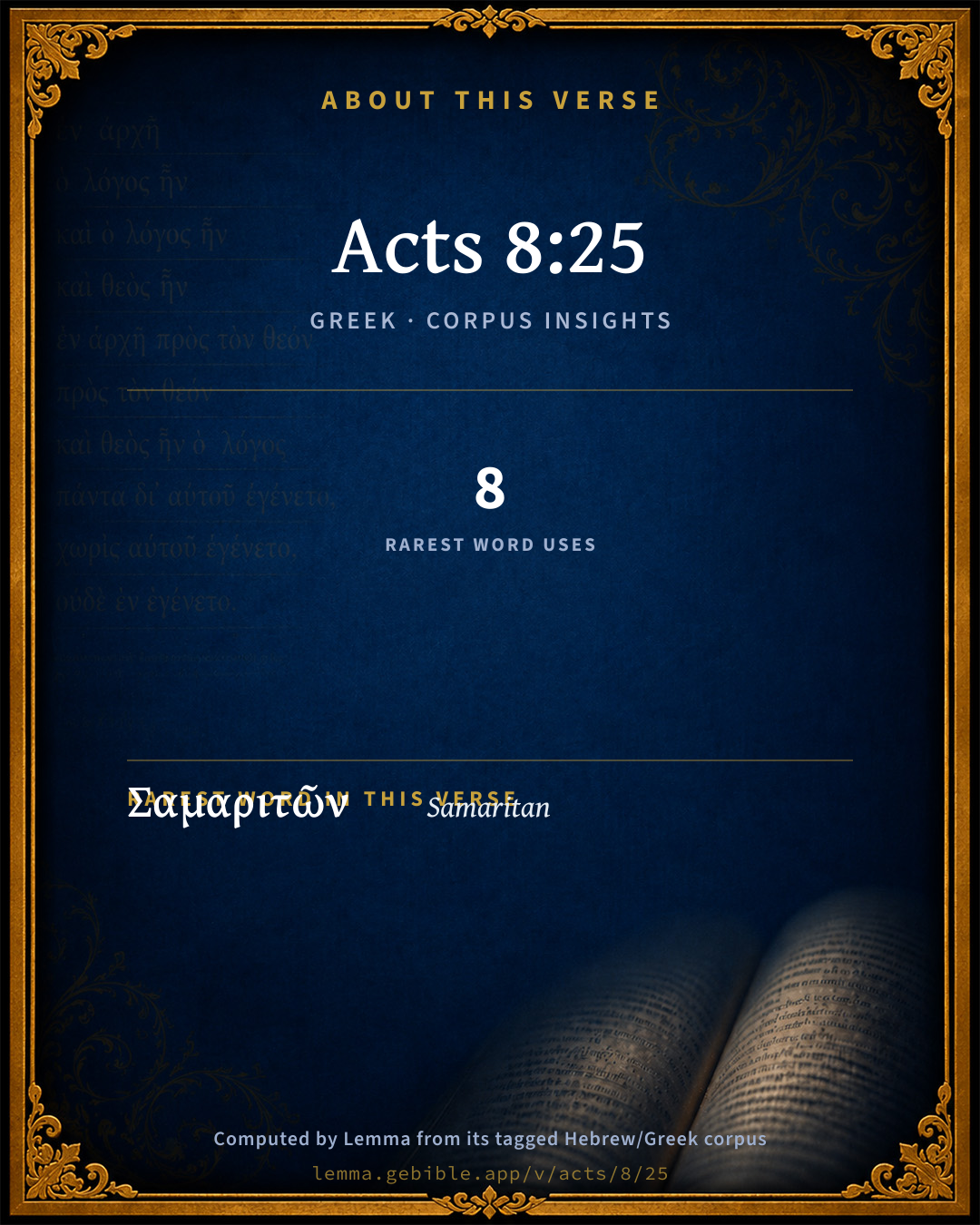
Acts 8:25

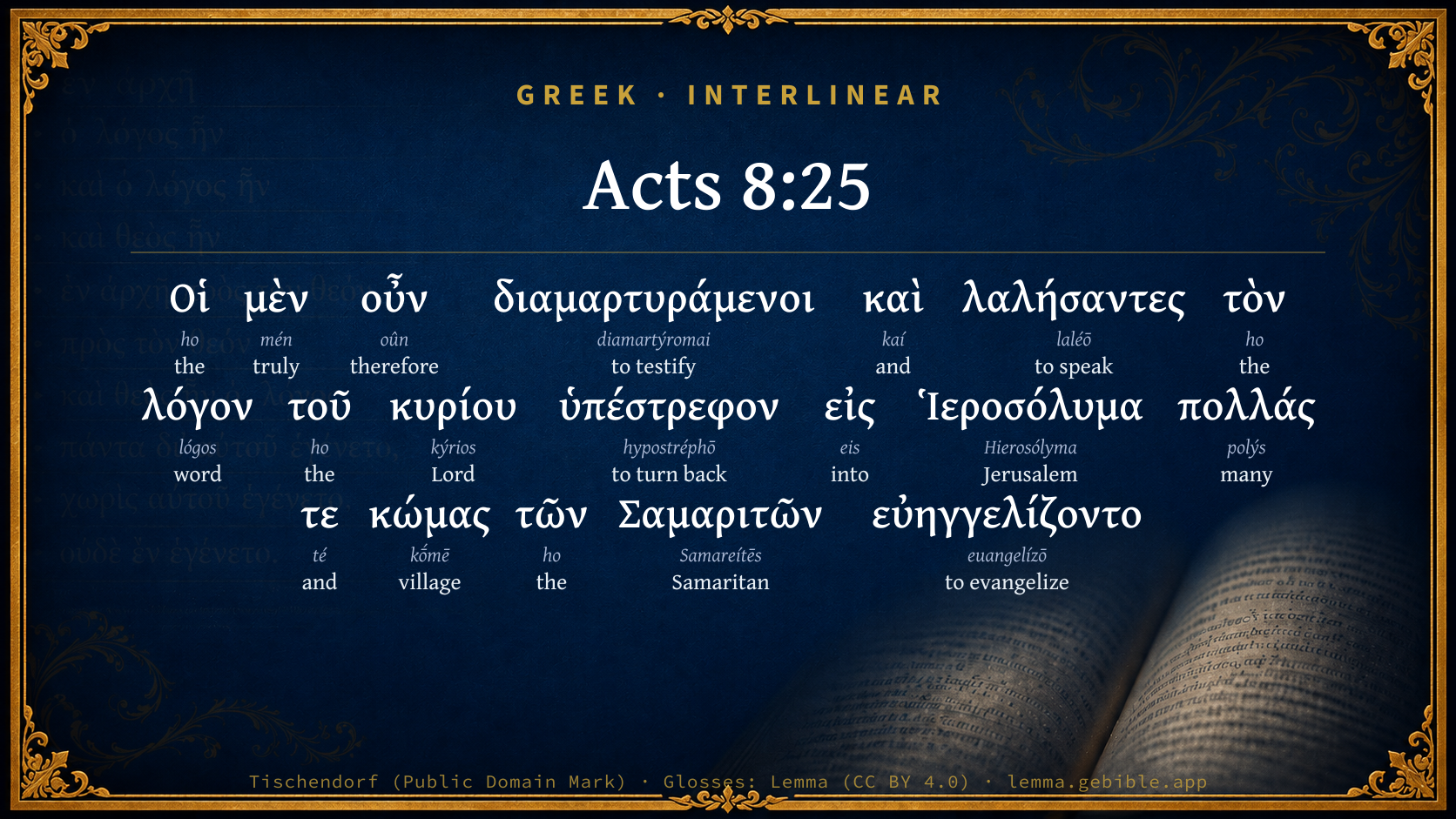
Greek (Tischendorf 8th ed.) Acts 8:25 appears in the Greek New Testament. The text above is from the Tischendorf 8th edition. Each word links to its Strong’s number and a concise gloss. Click any word for its full Thayer’s Greek Lexicon entry.
Download image
Cite this verse

Acts 8:25 (World English Bible). Public Domain. Lemma interlinear Bible study tool, https://lemma.gebible.app/v/acts/8/25.

Show BibTeX & RIS
BibTeX
RIS
English Translation
They therefore, when they had testified and spoken the word of the Lord, returned to Jerusalem, and preached the Gospel to many villages of the Samaritans.
World English Bible · Public Domain
Download a study sheet

One document with this verse’s original text, its word-by-word gloss line, the meaning frame, cross-references with their text, attributed commentary, and full source and license credits — printable, and it pastes into notes with its structure intact.

This verse Autodidact and up

Study sheet (.html) Plain text (.txt)

A passage Seminary Student

Up to 50 verses in one chapter. A passage sheet keeps up to 6 commentary sources and 12 cross-references per verse, in the order this page ranks them, and says so on the sheet whenever that leaves anything out. Ask for a single verse and you get the Autodidact verse sheet above.

Everything on this page stays free to read, with no account — the sheet is a download of what is already on screen, not access to it.

Want to remove ads? Support Godless Engineer
Compare translations 3

The same verse in 3 English versions, stacked beneath the original-language interlinear above. Click any original word for its lexicon entry.

Each is an independent rendering of the whole verse — the interlinear is not word-aligned to these translations.

Highlighted words mark where these versions differ — a whole-verse word diff, not a word-by-word alignment.

  • World English Bible Public Domain
    They therefore, when they had testified and spoken the word of the Lord, returned to Jerusalem, and preached the Gospel to many villages of the Samaritans.
  • King James Version Public Domain
    And they, when they had testified and preached the word of the Lord, returned to Jerusalem, and preached the gospel in many villages of the Samaritans.
  • unfoldingWord Literal Text CC BY-SA 4.0
    Then the ones having testified and having spoken the word of the Lord were returning to Jerusalem and proclaiming the gospel to many villages of the Samaritans.

unfoldingWord Literal Text — © unfoldingWord, licensed CC BY-SA 4.0. Word-aligned USFM3 via Door43 (git.door43.org/unfoldingWord/en_ult).

Versions to compare (up to 4)

3 of 4 selected

Show all 19 translations

Every available English version of this verse, each an independent rendering of the whole verse.

  • World English Bible Public Domain
    They therefore, when they had testified and spoken the word of the Lord, returned to Jerusalem, and preached the Gospel to many villages of the Samaritans.
  • Berean Standard Bible Public Domain
    And after Peter and John had testified and spoken the word of the Lord, they returned to Jerusalem, preaching the gospel in many of the Samaritan villages.
  • Majority Standard Bible Public Domain
    And after Peter and John had testified and spoken the word of the Lord, they returned to Jerusalem, preaching the gospel in many of the Samaritan villages.
  • King James Version Public Domain
    And they, when they had testified and preached the word of the Lord, returned to Jerusalem, and preached the gospel in many villages of the Samaritans.
  • American Standard Version (1901) Public Domain
    They therefore, when they had testified and spoken the word of the Lord, returned to Jerusalem, and preached the gospel to many villages of the Samaritans.
  • Revised Version (1885) Public Domain
    They therefore, when they had testified and spoken the word of the Lord, returned to Jerusalem, and preached the gospel to many villages of the Samaritans.
  • Geneva Bible (1599) Public Domain
    So they, when they had testified and preached the worde of the Lord, returned to Hierusalem, and preached the Gospel in many townes of the Samaritans.
  • Douay-Rheims (1899) Public Domain
    And they indeed having testified and preached the word of the Lord, returned to Jerusalem, and preached the gospel to many countries of the Samaritans.
  • Young's Literal Translation Public Domain
    They indeed, therefore, having testified fully, and spoken the word of the Lord, did turn back to Jerusalem; in many villages also of the Samaritans they did proclaim good news.
  • Literal Standard Version CC BY-SA 4.0
    They indeed, therefore, having testified fully, and spoken the word of the LORD, turned back to Jerusalem; they also proclaimed good news in many villages of the Samaritans.
  • Unlocked Literal Bible CC BY-SA 4.0
    When they had testified and spoken the word of the Lord, Peter and John returned to Jerusalem, proclaiming the gospel to many villages of the Samaritans.
  • unfoldingWord Literal Text CC BY-SA 4.0
    Then the ones having testified and having spoken the word of the Lord were returning to Jerusalem and proclaiming the gospel to many villages of the Samaritans.
  • Darby Bible Public Domain
    They therefore, having testified and spoken the word of the Lord, returned to Jerusalem, and announced the glad tidings to many villages of the Samaritans.
  • World Messianic Bible Public Domain
    They therefore, when they had testified and spoken the word of the Lord, returned to Jerusalem, and preached the Good News to many villages of the Samaritans.
  • Webster's Bible Public Domain
    And they, when they had testified and preached the word of the Lord, returned to Jerusalem, and preached the gospel in many villages of the Samaritans.
  • Free Bible Version CC BY-SA 4.0
    After they had given their testimony and shared the word of the Lord, they returned to Jerusalem, sharing the good news in many Samaritan villages along the way.
  • Bible in Basic English Public Domain
    So they, having given their witness and made clear the word of the Lord, went back to Jerusalem, giving the good news on their way in a number of the small towns of Samaria.
  • Text-Critical English NT CC BY 4.0
    After Peter and John had testified and spoken the word of the Lord, they returned to Jerusalem, preaching the good news in many villages of the Samaritans as they went.
  • Tyndale New Testament (1534) Public Domain
    And they when they had testified and preached the worde of the lorde returned toward Ierusalem and preached the gospell in many cities of the Samaritas.

Literal Standard Version (2020), Covenant Press — licensed CC BY-SA 4.0. Text via the HelloAO Bible API (eBible.org). Unlocked Literal Bible (unfoldingWord) — licensed CC BY-SA 4.0. Text via the HelloAO Bible API (eBible.org). unfoldingWord Literal Text — © unfoldingWord, licensed CC BY-SA 4.0. Word-aligned USFM3 via Door43 (git.door43.org/unfoldingWord/en_ult). Free Bible Version, Dr. Jonathan Gallagher — licensed CC BY-SA 4.0. Text via the HelloAO Bible API (eBible.org).

Word by word

More ways to search: Search by grammar → Find every occurrence → Compare this word →

Practice this passage: Drill this verse → Learn its vocabulary →

Σαμαριτῶν
Samareítēs
G4541
“Samaritan”
Noun, Genitive, Plural, Masculine
Part of Speech
Noun
Case
Genitive
Number
Plural
Gender
Masculine
Full Thayer's Definition

Origin: from G4540

TDNT: 08:29,0

1. a Samaritan, a. an inhabitant of the city of Samaria b. an inhabitant of the region of Samaria
  1. Οἱ ho G3588 “the” Article, Nominative, Plural, Masculine
  2. μὲν mén G3303 “truly” Particle
  3. οὖν oûn G3767 “therefore” Conjunction
  4. διαμαρτυράμενοι diamartýromai G1263 “to testify” Verb, Aorist, Middle deponent, Participle, Nominative, Plural, Masculine
  5. καὶ kaí G2532 “and” Conjunction
  6. λαλήσαντες laléō G2980 “to speak” Verb, Aorist, Active, Participle, Nominative, Plural, Masculine
  7. τὸν ho G3588 “the” Article, Accusative, Singular, Masculine
  8. λόγον lógos G3056 “word” Noun, Accusative, Singular, Masculine
  9. τοῦ ho G3588 “the” Article, Genitive, Singular, Masculine
  10. κυρίου kýrios G2962 “Lord” Noun, Genitive, Singular, Masculine
  11. ὑπέστρεφον hypostréphō G5290 “to turn back” Verb, Imperfect, Active, Indicative, 3rd person, Plural
  12. εἰς eis G1519 “into” Preposition
  13. Ἱεροσόλυμα Hierosólyma G2414 “Jerusalem” Noun, Accusative, Singular, Feminine
  14. πολλάς polýs G4183 “many” Adjective, Accusative, Plural, Feminine
  15. τε té G5037 “and” Particle
  16. κώμας kṓmē G2968 “village” Noun, Accusative, Plural, Feminine
  17. τῶν ho G3588 “the” Article, Genitive, Plural, Masculine
  18. εὐηγγελίζοντο euangelízō G2097 “to evangelize” Verb, Imperfect, Middle, Indicative, 3rd person, Plural

About this verse

These counts appear in no published source. They are computed here, from the morphology-tagged text and Lemma’s own curated glosses. What Lemma adds →

19
words
16
distinct lemmas
Acts
section

Notable vocabulary

The rarest word here is Σαμαριτῶν Samaritan G4541 — appearing just 8 times in the whole Greek New Testament.

Shared distinctive vocabulary

Σαμαριτῶν Samaritan G4541 occurs in 8 verses of the Greek New Testament. Also found in:

Repetition

A word recurs within this verse:

Cross-references

11

Topical passages linked to Acts 8:25 in the Treasury of Scripture Knowledge — connected by theme and wording, ordered by reader-vote popularity; previews shown in the World English Bible.

  • Acts 20:21 testifying both to Jews and to Greeks repentance toward God, and faith toward our Lord Jesus.
  • Luke 9:52–56 and sent messengers before his face. They went, and entered into a village of the Samaritans, so as to prepare for him.
  • John 15:27 You will also testify, because you have been with me from the beginning.
  • Acts 1:8 But you will receive power when the Holy Spirit has come upon you. You will be witnesses to me in Jerusalem, in all Judea and Samaria, and to the uttermost parts of the earth."
  • Acts 8:40 But Philip was found at Azotus. Passing through, he preached the Gospel to all the cities, until he came to Caesarea.
  • Acts 18:5 But when Silas and Timothy came down from Macedonia, Paul was compelled by the Spirit, testifying to the Jews that Jesus was the Christ.
  • Acts 26:22–23 Having therefore obtained the help that is from God, I stand to this day testifying both to small and great, saying nothing but what the prophets and Moses said would happen,
  • Acts 28:23 When they had appointed him a day, many people came to him at his lodging. He explained to them, testifying about the Kingdom of God, and persuading them concerning Jesus, both from the law of Moses and from the prophets, from morning until evening.
  • Acts 28:28 "Be it known therefore to you, that the salvation of God is sent to the Gentiles. They will also listen."
  • Acts 28:31 preaching the Kingdom of God, and teaching the things concerning the Lord Jesus Christ with all boldness, without hinderance.
  • 1 Peter 5:12 Through Silvanus, our faithful brother, as I consider him, I have written to you briefly, exhorting, and testifying that this is the true grace of God in which you stand.

Cross-references courtesy of OpenBible.info (CC BY 4.0).

Commentary

Notes on Acts 8:25 from classic Christian and Jewish commentators (each source and its license shown beneath its notes). The classic Christian expositions comment on the surrounding passage and are grouped to its opening verse, so a note may address several verses; the Jewish commentaries on the Tanakh (Rashi and others) are per-verse, so they appear only where the commentator wrote on this verse.

Lemma curates 59 commentaries, every one of them public domain or Creative Commons licensed, each selected and text-cleaned for this edition rather than reprinted as found. About our sources →

Joseph Benson's Commentary

Act 8:25. And when they had testified, and preached the word of the Lord — Had borne a solemn testimony by word and deed to the truth of the gospel, and confirmed what Philip had preached; they returned to Jerusalem — To the other ten apostles, having executed their commission, and performed the errand on which they were sent; and preached the gospel — As they went along; in many villages of the Samaritans — Which lay in their way, doubtless confirming their doctrine by miracles, though none are here recorded.

Joseph Benson's Commentary on the Old and New Testaments (1811–1818) — public domain. Text from a community e-Sword module.

Bengel's Gnomon

Johann Albrecht Bengel

Act 8:25. Διαμαρτυράμενοι, having testified) having fulfilled their testimony, which was circulated abroad among all.—εἰς Ἰερουσαλὴμ, towards Jerusalem) for what they did on the way to it is subjoined. As yet it was the province of the apostles for the most part to remain at Jerusalem.—πολλὰς, in many) Divine operations easily succeed: human counsels, only with anxiety.

Bengel's Gnomon of the New Testament — English translation (T&T Clark, Edinburgh, 1860) — public domain. Text from a community e-Sword module.

Meyer's Critical & Exegetical Commentary

Heinrich August Wilhelm Meyer

Act_8:25-26. Τὸν λόγ. τ. κυρ.] The word which they spoke was not their word, but Christs, who caused the gospel to be announced by them as His ministers and interpreters. Comp. Act_13:48 f., Act_15:35 f, Act_19:10; Act_19:20. But the auctor principalis is God (Act_10:36), hence the gospel is still more frequently called ὁ λόγος τοῦ Θεοῦ (Act_4:29; Act_4:31, Act_6:2, and frequently).

πολλάς τε κώμας … εὐηγγελ.] namely, on their way back to Jerusalem.

εὐαγγελίζεσθαι, with the accusative of the person (Luk_3:18; Act_14:21; Act_16:10), is rare, and belongs to the later Greek. See Lobeck, ad Phryn. p. 267 f.

ἄγγελος δὲ κυρίου] is neither to be rationalized with Eichhorn to the effect, that what is meant is the sudden and involuntary rise of an internal impulse not to be set aside; nor with Olshausen to the effect, that what is designated is not a being appearing individually, but a spiritual power, by which a spiritual communication was made to Philip (the language is, in fact, not figurative, as in Joh_1:51, but purely historical). On the contrary, Luke narrates an actual angelic appearance, that spoke literally to Philip. This appearance must, in respect of its form, be left undefined, as a vision in a dream (Eckermann, Heinrichs, Kuinoel) is not indicated in the text, not even by ἀνάστηθι, which rather (raise thyself) belongs to the pictorial representation; comp. on Act_5:17. Philip received this angelic intimation in Samaria (in opposition to Zeller, who makes him to have returned with the apostles to Jerusalem), while the two apostles were on their way back to Jerusalem.

Γάζα, עַזָּה, i.e. the strong (Gen_10:19; Jos_15:45; Jdg_3:3; Jdg_16:1; 1Ma_11:16), a strongly fortified Philistine city, situated on the Mediterranean, on the southern border of Canaan. See Stark, Gaza u. d. philistäische Küste, Jena 1852; Ritter, Erdk. XVI. l, p. 45 ff.; Arnold in Herzogs Encykl. IV. p. 671 ff. It was conquered (Plut. Alex. 25; Curt. iv. 6) and destroyed (Strabo, xvi. 2. 30, p. 759) by Alexander the Great,a fate which, after many vicissitudes, befell it afresh under the Jewish King Alexander Jannaeus, in B.C. 96 (Joseph. Antt. xiii. 13. 3, Bell. i. 4. 2). Rebuilt as New Gaza farther to the south by the Proconsul Gabinius, B.C. 58, the city was incorporated with the province of Syria. Its renewed, though not total destruction by the Jews occurred not long before the siege of Jerusalem (Joseph. Bell. Jud. ii. 18. 1). It is now the open town Ghuzzeh.

αὕτη ἐστὶν ἔρημος] applies to the way (von Raumer, Robinson, Winer, Buttmann, Ewald, Baumgarten, Lange, and older commentators, as Castalio, Beza, Bengel, and others). As several roads led from Jerusalem to Gaza (and still lead, see Robinson, II. p. 748), the angel specifies the road, which he means, more exactly by the statement: this way is desolate, i.e. it is a desert way, leading through solitary and little cultivated districts. Comp. 2Sa_2:24, LXX. Such a road still exists; see Robinson, l.c. The object of this more precise specification can according to the text only be this, that Philip should take no other road than that on which he would not miss, but would really encounter, the Ethiopian. The angel wished to direct him right surely. Other designs are imported without any ground in the text, as, e.g., that he wished to raise him above all fear of the Jews (Chrysostom, Oecumenius), or to describe the locality as suitable for undisturbed evangelical operations (Baumgarten), and for deeper conversation (Ewald, Jahrb. V. p. 227), or even to indicate that the road must now be spiritually prepared and constructed (Lange). ἕρημος stands without the article, because it is conceived altogether qualitatively. If αὕτη is to be referred to Gaza (so Stark, l.c. p. 510 ff., following Erasmus, Calvin, Grotius, and others), and the words likewise to be ascribed to the angel, we should have to take ἕρημος as destroyed, and to understand these words of the angel as an indication that he meant not the rebuilt New Gaza, but the old Gaza lying in ruins. But this would be opposed, not indeed to historical correctness (see Stark), but yet to the connection, for the event afterwards related happened on the way, and this way was to be specified. Others consider the words as a gloss of Luke (de Wette, Wieseler, and others, following older interpreters). But if αὕτη is to be referred to the way, it is difficult to see what Luke means by that remark. If it is to indicate that the way is not, or no longer, passable, this has no perceptible reference to the event which is related. But if, as Wieseler, p. 401, thinks, it is meant to point to the fact that the Ethiopian on this solitary way could read without being disturbed, and aloud, no reader could possibly guess this, and at any rate Luke would not have made the remark till Act_8:28. If, on the other hand, we refer αὕτη in this supposed remark of Luke to the city, we can only assume, with Hug and Lekebusch, p. 419 f., that Luke has meant its destruction, which took place in the Jewish war (Joseph. Bell. ii. 18. 1). But even thus the notice would have no definite object in relation to the narrative, which is concerned not with the city, but with the way as the scene of the event. Hug and Lekebusch indeed suppose that the recent occurrence of the destruction induced Luke to notice it here on the mention of Gaza; but it is against this view in its turn, that Luke did not write till a considerable time after the destruction of Jerusalem (see Introduction, sec. 3). Reland, Wolf, Krebs, inappropriately interpret ἔρημος as unfortified, which the context must have suggested (as in the passages in Sturz, Lex. Xen. II. p. 359), and which would yield a very meaningless remark. Wassenberg, Heinrichs, and Kuinoel take refuge in the hypothesis of an interpolated gloss.

Meyer — Critical and Exegetical Commentary on the New Testament — English translation by Peter Christie, edited by Frederick Crombie (T&T Clark, 1880) — public domain. Text from a community e-Sword module.

Expositor's Greek Testament

ed. W. Robertson Nicoll

Act 8:25 . οἱ μὲν οὖν : the μὲν οὖν and δέ in Act 8:26 may connect the return of the party to Jerusalem and the following instructions to Philip for his journey, and so enable us to gather for a certainty that Philip returned to Jerusalem with the Apostles, and received there his further directions from the Lord; see Rendall’s Appendix on μὲν οὖν , Acts , p. 164, but cf. on the other hand, Belser, Beiträge , pp. 51, 52. On the frequent and characteristic use of μὲν οὖν in Luke, see above on Act 1:6 , etc. ὑπέστρεψαν : if we read the imperfect, we have the two verbs in the verse in the same tense, and the sense would be that the Apostles did not return at once to Jerusalem, but started on their return (imperfect), and preached to the Samaritan villages on the way (as Belser also allows) the τε closely unites the two verbs (Weiss). The verb is characteristic of St. Luke: in his Gospel twenty-one or twenty-two times; in Acts, eleven or twelve times; in the other Evangelists, only once, Mar 15:40 , and this doubtful; only three times in rest of N.T. (Lekebusch, Friedrich).

The Expositor's Greek Testament, edited by W. Robertson Nicoll (1897–1910) — public domain. Text from a community e-Sword module.

Jamieson, Fausset & Brown

Robert Jamieson, A. R. Fausset & David Brown

and they--Peter and John.

when they had . . . preached--in the city where Philip's labors had been so richly blessed.

returned . . . and preached . . . in many villages of the Samaritans--embracing the opportunity of their journey back to Jerusalem to fulfil their Lord's commission to the whole region of Samaria (Act 1:8).

Jamieson, Fausset & Brown — Commentary Critical and Explanatory on the Whole Bible (1871) — public domain (CC PDM 1.0). Text via the HelloAO Bible API.

Adam Clarke's Commentary

Verse 25. And they, when they had - preached - returned to Jerusalem] That is, Peter and John returned, after they had borne testimony to and confirmed the work which Philip had wrought.

Adam Clarke's Commentary on the Bible (1810–1826) — public domain. Text from a community e-Sword/MySword module.

John Calvin's Commentaries

25. And they testified. In these words Luke teacheth that Peter and John came not only that they might enrich the Samaritans with the gifts of the Spirit, but also that they might establish them in the faith which they had already received, by approving Philip’s doctrine. For thus much doth the word testify import; as if he should say, that it came to pass by their testimony, that the word of God had full and perfect authority, and that the truth was of force, as being well testified and authentic. Notwithstanding Luke teaeheth therewithal that they were faithful witnesses of God, when he addeth that they uttered the word of God. This was, therefore, the sum of the apostles’ doctrine, faithfully to utter those things which they had learned of the Lord, and not their own inventions, or the inventions of any man else. He saith, that they did this not only in the city, but also in villages. Therefore we see that they were so inflamed to further the glory of Christ, that whithersoever they came they had him in their mouth. So that the seed of life began to be sown throughout the whole region, after that it was preached in the city.

John Calvin's Commentaries (1540-1563) — public domain. Text from the Calvin Translation Society English edition (1840s-50s) via the Christian Classics Ethereal Library (ccel.org). Calvin's coverage is partial (roughly two-thirds of the Bible); uncommented books and verses are honest gaps, never fabricated. The 19th-century editor's footnotes and remarks are omitted so the notes are faithfully Calvin's own voice.

Ellicott's Commentary for English Readers

(25) And they, when they had testified . . .—The statement involves a stay of some duration, long enough to found and organise a community of disciples. And this was followed, not by an immediate return to Jerusalem, but, as the Greek tense shows, by one with many halts, at each of which the glad tidings of “the word of the Lord” were proclaimed, and a Church founded. Did the Apostles enter on this journey into the village on which one of them had sought to call down fire from heaven (Luk_9:54)? Now, at least, he had learnt to know what manner of Spirit claimed him as his own.

The curtain falls at the close of this drama on the Christians of Samaria, and we know but little of their after history. The one glimpse of them which we get is, however, of very special interest. When Paul and Barnabas after their first missionary journey went up to Jerusalem, they passed “through Phenico and Samaria” (Act_15:3). St. Paul also had conquered the antagonism that divided the Jew, and, above all, the Pharisee, from the Samaritan. The Samaritans heard with joy of that conversion of the Gentiles which showed that old barriers and walls of partition were broken down. Many, we may believe, would elect to take their stand on the ground of the freedom of the gospel rather than on any claim to Jewish descent or the observance of the Jewish Law. Others, however, we know, adhered to that Law with a rigorous tenacity, and left their creed and ritual, their Gerizim worship and their sacred Books, as an inheritance to be handed down from century to century, even to the present day. The whole nation suffered severely in the wars with Rome under Vespasian, and Sychem was taken and destroyed, a new city being built by the emperor on the ruins—a Roman city with Temples dedicated to Roman gods—to which, as perpetuating the name of his house and lineage, he gave the name of Flavia Neapolis (= New Town), which survives in the modern Nablous. In the early history of the Church there attaches to that city the interest of having been the birthplace of the martyr Justin, and of the heretic Dositheus. In one of the Simon legends, as stated above, the latter appears as the instructor of the sorcerer, but this is probably a distortion of his real history.

A Bible Commentary for English Readers, edited by Charles John Ellicott (1878–1897) — public domain. Text from a community e-Sword module.

The Cambridge Bible for Schools and Colleges

gen. ed. J. J. S. Perowne

25. And they [They therefore], when they had testified and preached [spoken] the word of the Lord, returned to [towards] Jerusalem, and preached the gospel in [to] many villages of the Samaritans] Peter and John had not been sent forth to make an extended missionary journey, but only to confirm the work of the Evangelists who had first preached and baptized in Samaria, by laying their hands upon the converts. This done they returned to their place in Jerusalem, but by the way preached in such villages of Samaria as lay in their road.

The Cambridge Bible for Schools and Colleges (gen. ed. J. J. S. Perowne; Cambridge University Press, 1878–1918) — public domain. Text from a community e-Sword module.

John Gill's Exposition

And the angel of the Lord spake unto Philip,.... To inquire who this angel was, whether Michael or Gabriel, or the tutelar angel of Ethiopia, or of the eunuch, or of Philip, is too curious; it was one of the ministering spirits sent forth by Christ, to serve a gracious purpose of his, and for the good of one of the heirs of salvation:

saying, arise; at once, make haste and speed, and quick dispatch; the phrase denotes readiness, alacrity, and expedition:

and go toward the south; the southern point from the city of Samaria, where Philip now was; or to the south of Jerusalem: the parts of Gaza, Lydda, Jamnia, Joppa, &c. were called the "south": hence often mention is made of such a Rabbi and such a Rabbi, that he was "of the south" (k); so R. Joshua, who was of Lydda, is said to be of the south (l). The Ethiopic version renders it at "noon time", and so the Arabic of De Dieu; as if it respected not the place whither he was to go, but the time when he was to go; and that it might be about the middle of the day, the following narrative seems to confirm:

unto the way which goes down from Jerusalem unto Gaza, which is desert: this place is sometimes called Azzah, and sometimes Gaza, which is owing to the different pronunciation of the first letter of it; it was first inhabited by the Avim, or Hivites, who being destroyed by the Caphtorim, they dwelt in their stead, Deu 2:23. It fell to the lot of the tribe of Judah, but could not be held by it, because of the giants which remained in it; and was, as Jerom says (m), a famous city of Palestine in his day; and was formerly the border of the Canaanites towards Egypt; and the way to Egypt lay through it, in which the eunuch was travelling: the way from Jerusalem to this place lay through Bethlehem, as the above ancient writer observes, on Jer 31:15 where he says

"some of the Jews interpret this place thus; that Jerusalem being taken by Vespasian, through this way (Bethlehem and Ephratah, of which he is speaking) to Gaza and Alexandria, a vast number of captives were led to Rome.''

And as the same writer elsewhere says (n), Bethlehem was six miles from Aella (or Jerusalem) to the south, in the way which leads to Hebron; and it is commonly believed that the way to Gaza was through Hebron, and is the way in which they go to it now; and to a hill near this place Samson, carried the gates of Gaza, Jdg 16:1 And this also was to the south of Jerusalem, and two and twenty miles from it (o): and it is also said by the same author (p), that there is a village called Bethzur, and in his time Bethhoron, in the way from Jerusalem to Hebron, about twenty miles from the former, at which there was a fountain, where it was reported the eunuch was baptized by Philip. There was it seems another way from Jerusalem to Gaza, through Diospolis, or Eleutheropolis, and so to Ascalon, and from thence to Gaza (q): and this was the road the eunuch went, if their conjecture is right, that he was baptized in the river Eleutherus; but which way he went is not certain, nor where he was baptized. The situation of Gaza was, according to Arrianus (r), as follows:

"Gaza is distant from the sea at least twenty furlongs (two miles and a half), and the access unto it is sandy and deep, and the sea near the city is all muddy. Gaza was a great city, and was built on high ground, and encompassed with a strong wall: it was the last of those cities inhabited, as you go from Phoenicia into Egypt, "at the beginning of the desert".''

Which last words seem to furnish out a reason why it is here called Gaza, "which is desert"; because it was situated where the desert began: though this clause is differently understood; some apply it to Gaza; as if the sense was "Gaza the desert", to distinguish old Gaza which was destroyed by Alexander the great, and as Strabo says (s), "remained desert", from new Gaza, built at some distance from it: Jerom has (t) this distinction of old and new Gaza; there is scarce any appearance, he says, of the foundations of the ancient city; and that which is now seen is built in another place; and an unknown Greek writer makes express mention of new Gaza, which is the city itself; and speaks of another Gaza at some distance, which he calls Gaza, , "the desert" (u): but the haven, which was seven furlongs distant from Gaza, was not called new Gaza till Julian's time: it was first called Majuma, and afterwards Constantia, by Constantine; either from his son Constantius, or his sister Constantia, it having embraced the Christian religion (w): wherefore, as Beza observes, no regard could be had to this distinction in the times of Luke; and though it was besieged by Alexander and taken, yet it did not become a desolate place; it had its walls, gates, and fortifications afterwards; and was after this taken by Ptolomy, and then by Alexander Janneeus; it was repaired by Gabinius, and given to Herod by Augustus (x): so that it could not be said to be desert, in the times of Philip and the eunuch, with respect to its inhabitants and fortifications: it seems rather therefore to be so called, for the above reason, because situated at the beginning of the desert; and the whole space between the parts of Egypt next the Nile, and Palestina, is called "the desert", both by Arrianus (y) and Josephus (z): others apply this epithet to the way, and read it as do the Syriac, Arabic, and Ethiopic versions, "to the way of the desert which goes from Jerusalem"; meaning the wilderness, which lay in the way from Jerusalem to Gaza. This place was distant from Jerusalem about seventy five miles; for from Jerusalem to Ascalon was, as Josephus (a) says, five hundred and twenty furlongs, which make sixty five miles; and from Ascalon to Gaza were ten miles, as our countryman Mr. Sandes Says (b); though according to the Itinerary of Antoninus (c), the distance was sixteen miles. The Talmudists make mention of this place, they represent it as a very pleasant place to dwell in; they say (d), Gaza is , "a beautiful habitation"; they speak of three famous markets, and one of them was the market of Gaza (e); and very near to this city there was a beast market (f); and to which may be added, though it may not serve to strengthen the reason of its name being called Gaza the desert, there was a place on the border of the city, which was named , "the desert of the leper" (g): there were also brooks about the parts of Gaza and Azotus (h); in one of which, if the eunuch was near Gaza, to which he was going, he might be baptized; since it is uncertain whereabout Philip met him, and where the place of water was, in which the ordinance of baptism was administered to him. This city is now called Gazera, or Gazara, and is inhabited by Greeks, Turks, and Arabians.

(k) T. Hieros. Succa, fol. 53. 4. (l) Ib. Challa, fol. 57. 2. (m) De locis Hebraicis, fol. 91. K. (n) Ib. fol. 89. E. (o) Ib. fol. 87. E. (p) Fol. 89. G. (q) Vid. Reland. Palestina Illustrata, l. 2. p. 407. & l. 3. p. 646, 659. (r) De Expeditione Alexandri, l. 2. (s) Geograph. l. 16. (t) De locis Hebraicis, fol. 91. K. (u) Apud Reland. ib. l. 2. p. 509. (w) Euseb. de Vita Constantin. l. 4. c. 38. Sozomen. Hist. l. 5. c. 3. (x) Joseph. Antiqu. l. 13. c. 13. sect. 3. & 14. 5. &. 15. 7. (y) Ut supra. (De Expeditione Alexandri, l. 2.) (z) De Bello Jud. l. 7. c. 5. sect. 3. (a) Ib. l. 3. c. 2. sect. 1. (b) Travels, p. 151. (c) Apud Reland. ib. l. 2. p. 419. (d) T. Hieros. Sheviith, fol. 37. 3. (e) Ib. Avoda Zara, fol. 39. 4. (f) T. Bab. Avoda Zara, fol. 11. 2. (g) T. Bab. Sanhedrin, fol. 71. 1. (h) Aristeas de 70 Interpret. p. 41.

John Gill's Exposition of the Whole Bible (1746–1763) — public domain (CC PDM 1.0). Text via the HelloAO Bible API.

Trapp's Complete Commentary

John Trapp

25 And they, when they had testified and preached the word of the Lord, returned to Jerusalem, and preached the gospel in many villages of the Samaritans.

Ver. 25. When they had testified] That is, with great gravity and liberty declared. (διαμαρτυρομενοι.)

In many villages of the Samaritans] Accounting with Luther, that vilissimus pagus est palatium eburneum in quo est pastor et credentes aliqui; the meanest village may become an ivory palace, by having in it a faithful pastor and some few believers.

John Trapp, A Commentary or Exposition upon All the Books of the Old and New Testament (1647–1656) — public domain. Text from a community e-Sword module.

Albert Barnes' Notes on the Bible

In many villages ... - They went at first directly to the “city” of Samaria. On their return to Jerusalem they travelled more at leisure, and preached in the villages also - a good example for the ministers of the gospel, and for all Christians, when traveling from place to place. The reason why they returned to Jerusalem, and made that their permanent abode, might have been, that it was important to bear witness to the resurrection of Christ in the very city where he had been crucified, and where his resurrection had occurred. If the doctrine was established “there,” it would be more easy to establish it elsewhere.

Albert Barnes' Notes on the Bible (1834–1885) — public domain. Text from a community e-Sword/MySword module.

Matthew Poole's English Annotations

Not only in the chief city, but in the smallest villages, these great apostles spend their pains; for so it was promised unto them that they should receive power to do, Act 1:8.

Matthew Poole's English Annotations on the Holy Bible (1683–1685) — public domain. Text from a community e-Sword/MySword module.

The Pulpit Commentary

They therefore for and they, A.V.; spoken for preached, A.V.; to many for in many, A.V.

Vers. 25-40. The Word written preparing the way for the Word preached.

The conversion of the Ethiopian eunuch is a great text on missionary work. It illustrates with singular force and clearness the double need of the Bible and the preacher to bring men to the knowledge of Christ crucified. Without the evangelist to teach him, this seeker after truth might long have groped in vain after the meaning of the prophet; and if his mind had not been exercised by musings on the prophet, the evangelist would neither have had the opportunity to teach nor would his teaching have had such success. It was the concurrence of the two that brought this illustrious convert within the gates of the city of God. Hence the conclusion that the written Word and the preached Word are concurrent factors in the conversion of men to God; that both are necessary, and that neither of them can safely be dispensed with. The written Word, being "given by inspiration of God," is, as far as it goes, perfect and infallible, and yet it is not of itself sufficient. The preached Word, albeit far inferior, as being liable to error, imperfect and fallible, is yet necessary as the complement of the testimony of Scripture. The written Word stands immovable, the touchstone of truth, the standard of doctrine, the referee in doubt, the pattern and model, the crucible of error, the court of final appeal in all controversies of faith. The preached Word varied, modified, by circumstances of time and place, drawing its coloring, its clothing, its fashion, from its immediate surroundings, presents the eternal truth in the garb most suited to the wants and capacities of those with whom it deals. But in doing this it is liable to err. Then the sole appeal is to the written Word of God. All teaching not in accordance with it, however venerable for age and for the authority by which it is supported, must be mercilessly cut off. Blessed is that Church whose doctors explain but never darken the revelations of Holy Scripture. Blessed are the people whose teachers guide them into the meaning of Holy Scripture, but never turn them from it. Happy is that disciple whose mind, being deeply imbued with the truths of the Word of God, is aided by a faithful evangelist to adjust those truths in their true proportion and relation to each other, and to fill up their interstices with harmonious and homogeneous materials. As regards missionary work, the lesson is, sow the Bible broadcast to prepare the way for the foot of the missionary. Let the version of the Holy Scriptures given to each nation in his own tongue be to the modern world what the version of the LXX was to the old; so that the evangelist may find the ground already ploughed, and ready to receive the seed of eternal life, when he preaches the salvation which is by Jesus Christ.

Vers. 25-40. The second flight of the gospel.

Samaria evangelized both by Philip and the apostles, and both in the city and country districts a preparation of the Church for yet greater expansion. Necessity that such a flight as from Samaria to the desert on the way to Ethiopia should be supernaturally commanded. The step-by-step process of opening the Jewish mind to the idea of a world-message. The eunuch was a proselyte of the gate, so would be regarded as holding an intermediate position. Contrast this childhood of the Church with our advanced knowledge of the Divine purposes. Moreover, at that time no New Testament. The work to be done must await the instruments. The gospel cannot be preached fully till the apostles have fulfilled their testimony. R.

The Pulpit Commentary (1880–1919), ed. H.D.M. Spence-Jones & Joseph S. Exell — public domain. Text from a community e-Sword module.

Godbey's Commentary on the New Testament

William B. Godbey

25. After the arrival of the apostles, Philip accompanied them; meanwhile they prosecuted extensive tours in Samaria, everywhere preaching the gospel, seeing multitudes of those heathen converted, and unhesitatingly preaching to them the second work of grace, i. e., entire sanctification in the reception of the personal Holy Ghost.

William B. Godbey, Commentary on the New Testament (1896–1900) — public domain. Text from a community e-Sword module.

McGarvey & Pendleton's Commentaries

J. W. McGarvey

25. In connection with the prime object of their visit to Samaria, Peter and John also furthered the efforts of Philip in preaching and teaching. This we learn from an incidental remark in connection with the statement of their departure for Jerusalem. (25) " Now they, having testified and spoken the word of the Lord, returned into Jerusalem and preached the gospel in many villages of the Samaritans. " This labor in the Samaritan villages was performed on their journey toward Jerusalem, which may have been somewhat circuitous, according to the situation of the villages which they desired to visit. Thus these primitive preachers of the gospel made all the stations of their journeys through the country successive points for disseminating the truth.

J. W. McGarvey (with Philip Y. Pendleton), Commentaries on the New Testament (The Fourfold Gospel, 1914; Acts; and the epistles) — public domain. Text from a community e-Sword/MySword module.

The People's New Testament

B. W. Johnson

25. When they had testified. Peter and John did not return until they preached in many Samaritan villages.

B. W. Johnson's The People's New Testament with Notes (1889–1891) — public domain. Electronic text from the Christian Classics Ethereal Library (CCEL) ThML edition.

unfoldingWord translationNotes

Door43 World Missions Community

Connecting Statement:

This is concludes the part of the story about Simon and the Samaritans.

testified

Peter and John told what they personally knew about Jesus to the Samaritans.

spoken the word of the Lord

"Word" here is a metonym for "message." Peter and John explained the message about Jesus to the Samaritans. (See: Metonymy)

to many villages of the Samaritans

Here "villages" refers to the people in them. AT: "to the people in many Samaritan villages" (See: Synecdoche)

translationWords

Peter

John (the apostle)

testimony

word of God

Jerusalem

preach

good news

Samaria

unfoldingWord translationNotes — © Distant Shores Media and the Door43 World Missions Community, licensed CC BY-SA 4.0. Source: git.door43.org/Door43/en_tn.

Cambridge Greek Testament for Schools and Colleges

25. οἱ μὲν οὖν … λαλήσαντες … εἰς Ἱεροσόλυμα … εὐηγγελίζοντο, they therefore, when they had testified and spoken the word of the Lord, returned towards Jerusalem, and preached the Gospel to many villages of the Samaritans. Peter and John had not been sent forth to make an extended missionary journey, but only to confirm the work of the Evangelists who had first preached and baptized in Samaria, by laying their hands upon the converts. This done they returned to their place in Jerusalem, but by the way preached in such villages of Samaria as lay in their road.

On this return Chrysostom remarks διατὶ πάλιν ἀπίασιν ἐκεῖ ἔνθα ἡ τυραννὶς ἦν, ἔνθα ἡ ἀρχὴ τῶν κακῶν, ἔνθα οἱ μάλιστα φωνῶντες; καθάπερ έν τοῖς πολέμοις οἱ στρατηγοὶ ποιοῦσι καὶ τὸ πονοῦν τοῦ πολέμου μέρος καταλαμβάνουσι τὸ αὐτὸ καὶ οὗτολι ἐργάζονται.

Cambridge Greek Testament for Schools and Colleges (Cambridge University Press, 1896; 21 vols, various authors incl. Carr, Maclear, Plummer, Farrar, Lumby, Moule, M. R. James, Simcox) — public domain. Text from a community e-Sword module.

Alford’s Greek Testament

Henry Alford

25-40.] Conversion of the Æthiopian eunuch by Philip’s teaching.

25.] μὲν οὖν indicates (see note on ver. 4) that the paragraph should begin here, not at ver. 26 as commonly.

κώμας τ. Σαμ.] It is interesting to recall Luk 9:52, where on their entering into a κώμην Σαμ, the same John wishes to call down fire from heaven, καὶ ἀναλῶσαι αὐτούς. On constr. (εὐαγγ. w. accus.), see reff.

The gradual sowing of the seed further and further from Jerusalem is advancing: not only is this eunuch to carry it to a far distant land, but Philip is sent to a desert road, away from town or village, to seek him. The imperfects (altered in the rec., see var. readd., into aorists) are significant. They were on their way back to Jerusalem, and were evangelizing the Samaritan villages, when the angel spake (aor.) to Philip.

Henry Alford, The Greek Testament (1849–1861) — public domain. Text from a community e-Sword module.

Lesson kit

Teaching starters — assembled from the data on this page, not authored interpretation. Every prompt links to the verse data it draws on. Edit before teaching.

Acts, in the Acts, opens this verse with 19 words (16 distinct Greek lemmas). Its most distinctive word is Samareítēs (“Samaritan”). A historical commentator’s framing appears above. Read the whole chapter for the surrounding context.

Discussion questions

  1. What does “Samaritan” (Samareítēs) contribute to the verse as a whole?
  2. Matthew 10:5 shares the word «Samaritan» with this verse. How do the two illuminate each other?
  3. “the” occurs 4× in this one verse. What is the effect of the repetition?
  4. These translations render this verse differently; the difference is in the English rendering, not the original. What questions does that raise?
  5. Reading how Joseph Benson's Commentary and Bengel's Gnomon read this verse, where do the two commentators agree and where do they part?

Things to notice

Reading settings

Reading text

Shown beneath each verse's original-language words.

Old Testament
Old Testament edition

Read the OT as the Masoretic Hebrew (MT) or the Greek Septuagint (LXX).

English shown for the Greek Septuagint (in the Hebrew ↔ Greek comparison).

Comparing translations? Open the Compare panel on any verse page to stack up to four side by side.