Mark 6:13

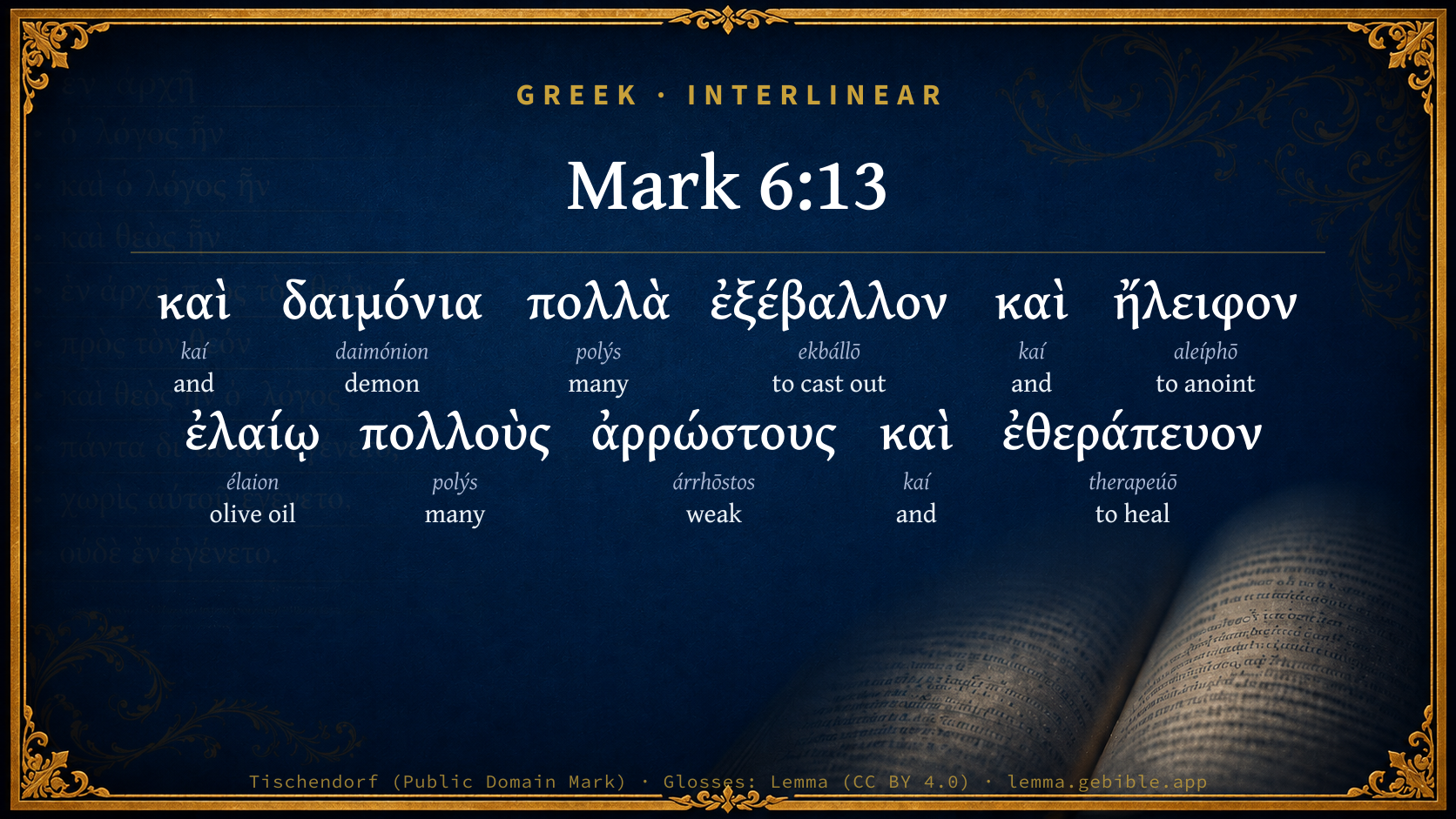
Greek (Tischendorf 8th ed.) Mark 6:13 appears in the Greek New Testament. The text above is from the Tischendorf 8th edition. Each word links to its Strong’s number and a concise gloss. Click any word for its full Thayer’s Greek Lexicon entry.
Download image
Cite this verse

Mark 6:13 (World English Bible). Public Domain. Lemma interlinear Bible study tool, https://lemma.gebible.app/v/mark/6/13.

Show BibTeX & RIS
BibTeX
RIS
English Translation
They cast out many demons, and anointed many with oil who were sick, and healed them.
World English Bible · Public Domain
Download a study sheet

One document with this verse’s original text, its word-by-word gloss line, the meaning frame, cross-references with their text, attributed commentary, and full source and license credits — printable, and it pastes into notes with its structure intact.

This verse Autodidact and up

Study sheet (.html) Plain text (.txt)

A passage Seminary Student

Up to 50 verses in one chapter. A passage sheet keeps up to 6 commentary sources and 12 cross-references per verse, in the order this page ranks them, and says so on the sheet whenever that leaves anything out. Ask for a single verse and you get the Autodidact verse sheet above.

Everything on this page stays free to read, with no account — the sheet is a download of what is already on screen, not access to it.

Want to remove ads? Support Godless Engineer
Compare translations 3

The same verse in 3 English versions, stacked beneath the original-language interlinear above. Click any original word for its lexicon entry.

Each is an independent rendering of the whole verse — the interlinear is not word-aligned to these translations.

Highlighted words mark where these versions differ — a whole-verse word diff, not a word-by-word alignment.

  • World English Bible Public Domain
    They cast out many demons, and anointed many with oil who were sick, and healed them.
  • King James Version Public Domain
    And they cast out many devils, and anointed with oil many that were sick, and healed them.
  • unfoldingWord Literal Text CC BY-SA 4.0
    And they were casting out many demons and anointing many sick with oil and healing them.

unfoldingWord Literal Text — © unfoldingWord, licensed CC BY-SA 4.0. Word-aligned USFM3 via Door43 (git.door43.org/unfoldingWord/en_ult).

Versions to compare (up to 4)

3 of 4 selected

Show all 19 translations

Every available English version of this verse, each an independent rendering of the whole verse.

  • World English Bible Public Domain
    They cast out many demons, and anointed many with oil who were sick, and healed them.
  • Berean Standard Bible Public Domain
    They also drove out many demons and healed many of the sick, anointing them with oil.
  • Majority Standard Bible Public Domain
    They also drove out many demons and healed many of the sick, anointing them with oil.
  • King James Version Public Domain
    And they cast out many devils, and anointed with oil many that were sick, and healed them.
  • American Standard Version (1901) Public Domain
    And they cast out many demons, and anointed with oil many that were sick, and healed them.
  • Revised Version (1885) Public Domain
    And they cast out many devils, and anointed with oil many that were sick, and healed them.
  • Geneva Bible (1599) Public Domain
    And they cast out many deuils: and they anointed many that were sicke, with oyle, and healed them.
  • Douay-Rheims (1899) Public Domain
    And they cast out many devils, and anointed with oil many that were sick, and healed them.
  • Young's Literal Translation Public Domain
    and many demons they were casting out, and they were anointing with oil many infirm, and they were healing `them'.
  • Literal Standard Version CC BY-SA 4.0
    and they were casting out many demons, and they were anointing many sick with oil, and they were healing [them].
  • Unlocked Literal Bible CC BY-SA 4.0
    They cast out many demons, and anointed many sick people with oil and healed them.
  • unfoldingWord Literal Text CC BY-SA 4.0
    And they were casting out many demons and anointing many sick with oil and healing them.
  • Darby Bible Public Domain
    and they cast out many demons, and anointed with oil many infirm, and healed them.
  • World Messianic Bible Public Domain
    They cast out many demons, and anointed many with oil who were sick and healed them.
  • Webster's Bible Public Domain
    And they cast out many demons, and anointed with oil many that were sick, and healed them.
  • Free Bible Version CC BY-SA 4.0
    They drove out many demons, and healed many who were sick by anointing them with oil.
  • Bible in Basic English Public Domain
    And they sent out a number of evil spirits, and put oil on a great number who were ill, and made them well.
  • Text-Critical English NT CC BY 4.0
    They also cast out many demons and anointed with oil many who were sick and healed them.
  • Tyndale New Testament (1534) Public Domain
    and they caste out many devylles. And they annoynted many that were sicke with oyle and healed them.

Literal Standard Version (2020), Covenant Press — licensed CC BY-SA 4.0. Text via the HelloAO Bible API (eBible.org). Unlocked Literal Bible (unfoldingWord) — licensed CC BY-SA 4.0. Text via the HelloAO Bible API (eBible.org). unfoldingWord Literal Text — © unfoldingWord, licensed CC BY-SA 4.0. Word-aligned USFM3 via Door43 (git.door43.org/unfoldingWord/en_ult). Free Bible Version, Dr. Jonathan Gallagher — licensed CC BY-SA 4.0. Text via the HelloAO Bible API (eBible.org).

Word by word

More ways to search: Search by grammar → Find every occurrence → Compare this word →

Practice this passage: Drill this verse → Learn its vocabulary →

About this verse

These counts appear in no published source. They are computed here, from the morphology-tagged text and Lemma’s own curated glosses. What Lemma adds →

11
words
8
distinct lemmas
Gospels
section

Notable vocabulary

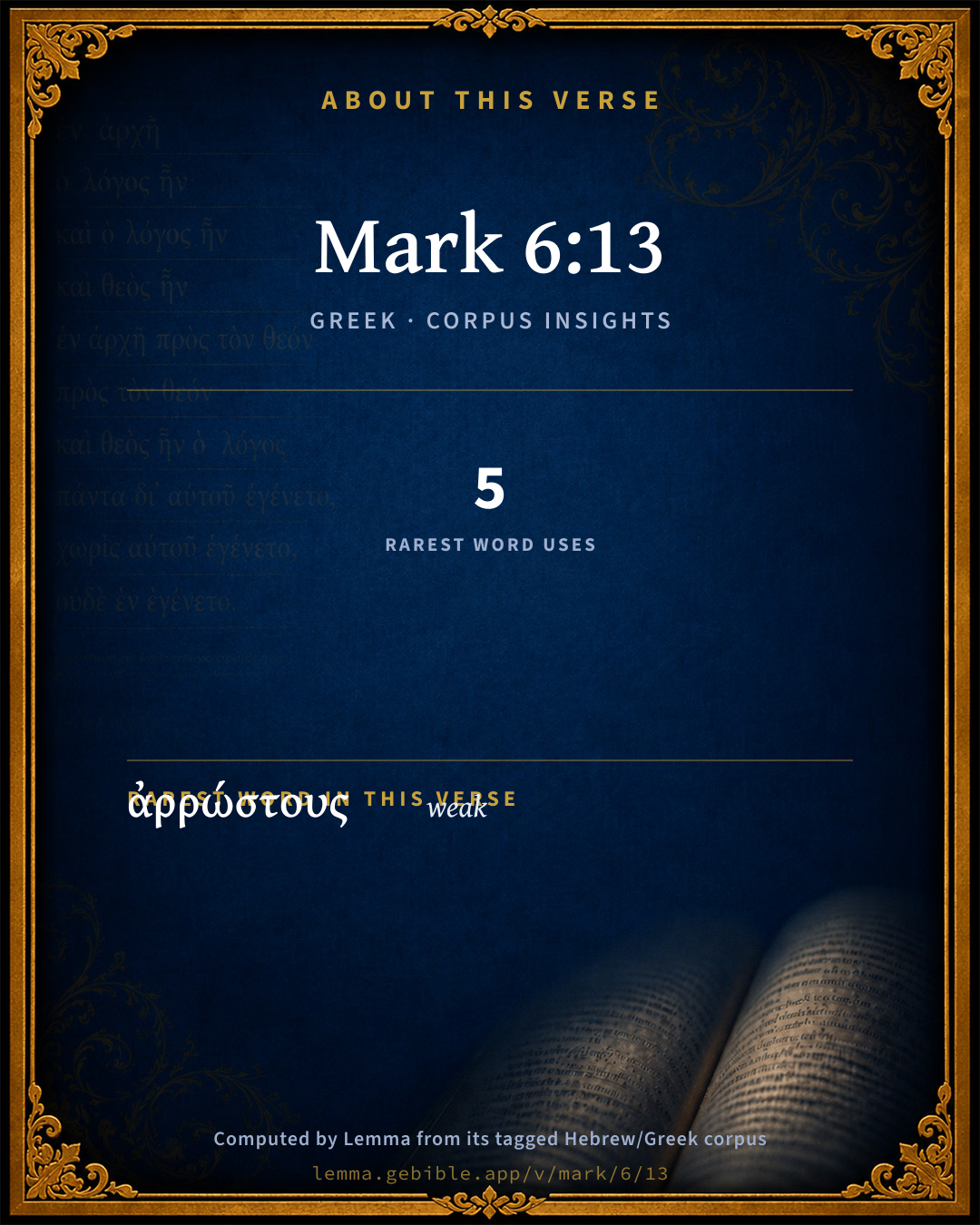
The rarest word here is ἀρρώστους weak G732 — appearing just 5 times in the whole Greek New Testament.

Shared distinctive vocabulary

ἀρρώστους weak G732 occurs in 5 verses of the Greek New Testament. Also found in:

Repetition

Words recur within this verse:

  • πολλὰ many G4183 ×2
  • καὶ and G2532 ×3

Cross-references

3

Topical passages linked to Mark 6:13 in the Treasury of Scripture Knowledge — connected by theme and wording, ordered by reader-vote popularity; previews shown in the World English Bible.

  • James 5:14–15 Is any among you sick? Let him call for the elders of the assembly, and let them pray over him, anointing him with oil in the name of the Lord,
  • Mark 6:7 He called to himself the twelve, and began to send them out two by two; and he gave them authority over the unclean spirits.
  • Luke 10:17 The seventy returned with joy, saying, "Lord, even the demons are subject to us in your name!"

Cross-references courtesy of OpenBible.info (CC BY 4.0).

Commentary

Notes on Mark 6:13 from classic Christian and Jewish commentators (each source and its license shown beneath its notes). The classic Christian expositions comment on the surrounding passage and are grouped to its opening verse, so a note may address several verses; the Jewish commentaries on the Tanakh (Rashi and others) are per-verse, so they appear only where the commentator wrote on this verse.

Lemma curates 59 commentaries, every one of them public domain or Creative Commons licensed, each selected and text-cleaned for this edition rather than reprinted as found. About our sources →

Bengel's Gnomon

Johann Albrecht Bengel

Mar 6:13.[46] Ἐξέβαλλον, they began casting out) The demons, without doubt, bore their expulsion by the disciples with more vexation than that by the Lord Himself.—ἤλειφον ἐλαίῳ, anointed with oil) This anointing differed widely from that anointing which is called extreme unction. They did not carry oil about with themselves, as Mar 6:8 proves; but found and used it at the houses of the sick. The miracle was on that account the more unequivocal.

[46] Mar 6:10. ἐκεῖθεν, from thence) out of the city.

Bengel's Gnomon of the New Testament — English translation (T&T Clark, Edinburgh, 1860) — public domain. Text from a community e-Sword module.

Geneva Bible (1599)

Geneva Bible translators

That oil was a token and a sign of this marvelous virtue: and seeing that the gift of healing is ceased a good while since, the ceremony which is yet retained of some is to no purpose.

Geneva Bible (1599) marginal notes — public domain. Text via Bolls.life.

Adam Clarke's Commentary

Verse 13. Anointed with oil many that were sick] This is only spoken of here, and in Jas 5:14. This ceremony was in great use among the Jews; and in certain cases it might be profitable. But in the cases mentioned here, which were merely miraculous, it could avail no more of itself than the imposition of hands. It was used symbolically, as an emblem of that ease, comfort, and joy, which they prayed God to impart to the sick. For various examples of its use among the Jews, see Lightfoot and Wetstein on this place.

Adam Clarke's Commentary on the Bible (1810–1826) — public domain. Text from a community e-Sword/MySword module.

Ellicott's Commentary for English Readers

(13) Anointed with oil.—St. Mark is the only Evangelist who mentions this as the common practice of the disciples, but we learn from Jas_5:14 that it was afterwards in use, at least, in the churches of Jerusalem and other Jewish communities. It was partly analogous to our Lord’s treatment of the blind and deaf (Mar_7:33; Mar_8:23; Joh_9:6), i.e., it was an outward sign showing the wish to heal, and therefore a help to faith; but as the use of oil was more distinctly that of an agent recognised as remedial in the popular therapeutics of the time, it had also the character of uniting (and devout minds have since so regarded it) the use of natural outward means of healing with prayer for the divine blessing. It need scarcely be said that it had not the slightest affinity with the mediæval so-called sacrament of extreme unction, which, though it may still retain, in theory, a partial secondary connection with the cure of the diseases of the body, is practically never administered till all hope of cure is abandoned. The development of the latter aspect of the usage was obviously the after-growth of a later time, when the miraculous gift of healing was withdrawn, and when it became necessary to devise a theory for the retention of the practice.

A Bible Commentary for English Readers, edited by Charles John Ellicott (1878–1897) — public domain. Text from a community e-Sword module.

The Cambridge Bible for Schools and Colleges

gen. ed. J. J. S. Perowne

13. anointed with oil] St Mark alone mentions this anointing as the method, whereby the healing of the sick was effected. Though not expressly ordered, it was doubtless implied in the injunction to “heal the sick” (Mat_10:8). The prophet Isaiah (Mar_1:6) alludes to the use of oil for medicinal purposes, and we find this form of cure prescribed thirty years later than this Gospel, by St James in his general Epistle (Mar_5:14). It was much used by the Jews for curative purposes, and thus supplied at once a fitting symbol and an efficient means in these miraculous cures wrought by the Apostles. For the use of the symbolical media by our Lord Himself comp. Mar_8:23; Joh_9:6.

The Cambridge Bible for Schools and Colleges (gen. ed. J. J. S. Perowne; Cambridge University Press, 1878–1918) — public domain. Text from a community e-Sword module.

John Gill's Exposition

And they cast out many devils,.... Which they had power given them to do; and this they did, in confirmation of their mission and doctrine, and for the benefit of miserable creatures, who were possessed by them; and to show their power over the devils, and as a prelude of what they were to be the instruments of, in casting Satan out of the souls of men, both Jews and Gentiles; and especially, in the ejection of him out of the Gentile world:

and anointed with oil many that were sick, and healed them. This they were doubtless directed to by Christ, as an outward sign of healing; but not as a medicine; otherwise there would have been no miracle in the cure: though it is certain, the Jews used anointing with oil medicinally in many cases, as the means of healing; but they did not always succeed, as the apostles did: on the day of atonement (w),

"it was not lawful to "anoint" part of the body, as the whole body; but if a man was sick, or had ulcers on his head, he might anoint according to his usual way, and no notice was taken of it.''

Again (x),

"a man may not anoint with wine, or vinegar, but he may anoint with oil: he that has a pain in his head, or has ulcers upon him, , "he may anoint with oil", but he may not anoint with wine and vinegar: wine of the second tithe, which they mix, is forbidden to anoint with; oil of the second tithe, which they mix, is lawful to anoint with.''

And it is elsewhere said (y), that

"R. Meir allowed of the mixing of oil and wine, , "to anoint the sick" on a sabbath; but when he was sick, and we sought to do so to him, he would not suffer us.''

But that oil was used by the apostles as a medicine for the healing of diseases, cannot well be thought; since oil, though it may be useful in some cases, it is not an universal medicine, which is proper to all; nor were the apostles instructed by Christ in the art of physic, but were possessed by him with extraordinary gifts, to cure the disorders of the body, for the confirmation of the Gospel, which they preached; and it is easy to observe, that healing the sick by anointing with oil, is joined with the extraordinary power of casting out devils; and it was the same power by which they performed the one, as the other; see Luk 9:1. Hence it appears, that this passage gives no countenance to the use of such a practice in our days; since these were apostles only, who used it, who were extraordinary persons, and whose office in the church was an extraordinary one, and is now ceased; and healing in this way, was by an extraordinary power bestowed upon them, which has ceased; and therefore the rite, or ceremony of anointing with oil, for such a purpose, should be of course discontinued; however, it cannot be supported by this instance, whatever countenance it may seem to have from Jam 5:14, for it must be owned, there is some difference in the passages: the persons that anointed here were apostles, there the elders of the church; the persons anointed there, were good people, the members of the church, but here any sort of persons, and chiefly, if not altogether unbelievers; the healing of them is ascribed to the prayer of faith in James, but here to the extraordinary power of the apostles, by anointing with oil; though it may be, the healing was equally miraculous in the one, as the other: but be this as it will, nothing can be concluded from hence, in favour of the sacrament of extreme unction, used by the Papists; who administer that to persons, just at the point of death, and that for the remission of their sins, and the saving of their souls; whereas oil was used by the apostles to sick persons, and for the recovery of their bodily health. But since these were extraordinary cures which they performed this way, why did they make use of oil at all, seeing the virtue of healing did not come from that, and they could as well have healed sicknesses without it, as with it? To which it may be replied, that they did not always make use of it; sometimes only words were expressed, sometimes only hands were laid on the sick, and sometimes the sick persons were healed by handkerchiefs and aprons taken from them; which show, that the "healing" virtue was not in the means, nor was it tied to any: moreover, this was only used as an outward sign of healing, and might have some spiritual significancy in it; it might show, that they were sent forth by Christ the anointed one, who is anointed with the oil of gladness above his fellows; it might be symbolical of the grace of the Spirit, which is often compared to oil, which they themselves were possessed of in a large measure, and which is communicated through the ministration of the Gospel; and it might be significative of the Gospel itself, which brings light and joy, health and comfort along with it, to the souls of men, which they were the happy messengers of.

(w) T. Bab. Yoma, fol. 77. 2. Maimon. Hikh. Shebitat Ashur, c. 3. sect. 9. (x) T. Hieros. Maaser Sheni, fol. 53. 2. (y) Ib. Betacot, fol. 3. 1. & Sabbat, fol. 14. 3.

John Gill's Exposition of the Whole Bible (1746–1763) — public domain (CC PDM 1.0). Text via the HelloAO Bible API.

Trapp's Complete Commentary

John Trapp

13 And they cast out many devils, and anointed with oil many that were sick, and healed them.

Ver. 13. And anointed with oil many, &c.] By the misunderstanding of this text, and that Jas 5:14, Pro pastoribus habuit Ecclesia unguentarios, et pigmentarios; qui hoc praetextu miseras oviculas non tantum ungerent, sed etiam emungerent. {a} This oil in the text was used, not as a medicine, but as a sign and symbol of that power of miraculous healing.

{a} Bezae Confess.

John Trapp, A Commentary or Exposition upon All the Books of the Old and New Testament (1647–1656) — public domain. Text from a community e-Sword module.

Albert Barnes' Notes on the Bible

Cast out many devils - See the notes at Mat 4:24.

And anointed with oil ... - Anointing with oil was in common use among the Jews in cases of sickness. It was supposed to have a mild, soothing, and alleviating effect on the body. In Jam 5:14, the elders of the church, in connection with prayer, were directed also to anoint the sick with “oil.” See the notes at that passage. It was also used in wounds. See the notes at Isa 1:6. The good Samaritan poured oil and wine into the wounds of the waylaid Jew, Luk 10:34. Josephus says that, in the last sickness of Herod, his physicians commanded him to be anointed with oil. It need not be supposed, however, that the apostles used oil for mere “medical” purposes. It was used, probably, like the imposition of hands, or like our Saviour’s anointing the eyes of the blind with clay; also as a sign, in expectation of imparting that aid and comfort from God which was sought, and which was “represented” by the soothing and gentle effect of oil.

Albert Barnes' Notes on the Bible (1834–1885) — public domain. Text from a community e-Sword/MySword module.

Haydock's Catholic Bible Commentary

It was usual for the Jews to prescribe oil as a proper thing to anoint the sick; but its virtue in the present instance, when used by the apostles, was not natural but supernatural, and was derived from him who sent them; because this unction always produced a certain and constant cure in those who were anointed. This miraculous gift of healing the sick with oil, which Christ conferred on his apostles, was a prelude or gradual preparation to the dignity to which he raised this unction, when he established it a perpetual rite in his holy Church. (Rutter) --- With oil, &c. This anointing the sick, was at least a figure of the sacrament, which Christ was pleased to institute for the spiritual relief of persons in danger of death: and which is fully expressed by St. James, in his Catholic Epistle. Chap vi. The Council of Trent says this sacrament was instituted in St. Mark, and published in the Epistle of St. James. (Council of Trent, session xiv. canon 1.) (Witham)

George Leo Haydock (1774–1849), Haydock's Catholic Family Bible and Commentary, 1859 edition — public domain. Excludes Psalms (Douay-Rheims chapter numbering differs from Protestant) and Deuterocanonical books (Catholic canon only).

Whedon's Commentary on the Bible

Daniel D. Whedon

13. Anointed with oil many that were sick — See note on Mat_6:17. Oil bore the same symbolic relation to the restoration of health of body and soul in these miracles that water did to spiritual purification of body and soul in baptism. Hence, in Jas_5:14, the elders in their miraculous cures were to anoint the sick with prayer. The Jews had the custom of anointing the sick with incantations.

Daniel D. Whedon (gen. ed.), Commentary on the Old and New Testaments (1874–1909) — public domain. Text from a community e-Sword module.

The Pulpit Commentary

And anointed with oil many that were sick, and healed them. It is hardly possible to separate this from the reference to the use of oil for the sick, in Jam_5:14. Unction was employed extensively in ancient times for medicinal purposes. It is recorded of Herod the Great by Josephus ("Antiq.," 17:6, 5) that in one of his sicknesses he was "immersed in a bath full of oil," from which he is said to have derived much benefit. The apostles used it, no doubt not only on account of its supposed remedial virtues, but also as an outward and visible sign that the healing was effected by their instrumentality in the name of Christ, and perhaps also because the oil itself was significant of God"s mercy, of spiritual comfort and joy" the oil of gladness." Neither this passage nor that in St. James can properly be adduced to support the ceremony of "extreme unction;" for in both these cases the result was that the sick were restored to health. The so-called sacrament of" extreme unction "is administered immediately before death, when the sick person is in articulo morris.

The Pulpit Commentary (1880–1919), ed. H.D.M. Spence-Jones & Joseph S. Exell — public domain. Text from a community e-Sword module.

John Wesley's Explanatory Notes

They anointed with oil many that were sick - Which St. James gives as a general direction, James v, 14, 15, adding those peremptory words, And the Lord shall heal him - He shall be restored to health: not by the natural efficacy of the oil, but by the supernatural blessing of God. And it seems this was the great standing means of healing, desperate diseases in the Christian Church, long before extreme unction was used or heard of, which bears scarce any resemblance to it; the former being used only as a means of health; the latter only when life is despaired of.

John Wesley, Explanatory Notes Upon the Whole Bible (1754–1765) — public domain. Text via the GEBible commentary corpus.

The People's New Testament

B. W. Johnson

13. Anointed with oil. Matthew says nothing of this. Oil was a symbol of the Divine grace; to anoint with it, of the Holy Spirit. Its use implied that God was the healer.

B. W. Johnson's The People's New Testament with Notes (1889–1891) — public domain. Electronic text from the Christian Classics Ethereal Library (CCEL) ThML edition.

Cambridge Greek Testament for Schools and Colleges

13. ἐλαίῳ. Oil was believed to have healing properties (Luk 10:34; Jas 5:14), and this would aid faith on both sides. See on Joh 9:6 and Knowling on Jas 5:14. This anointing for healing purposes is very different from that which is administered when healing is believed to be impossible and death imminent. It is mentioned nowhere else in the Gospels and seems not to have been employed by Christ. Mk says nothing about cleansing lepers or raising the dead (Mat 10:8). Mt. may possibly have had some other source.

Cambridge Greek Testament for Schools and Colleges (Cambridge University Press, 1896; 21 vols, various authors incl. Carr, Maclear, Plummer, Farrar, Lumby, Moule, M. R. James, Simcox) — public domain. Text from a community e-Sword module.

Alford’s Greek Testament

Henry Alford

13. ἤλειφον ἐλαίῳ] This oil was not used medicinally, but as a vehicle of healing power committed to them;—a symbol of a deeper thing than the oil itself could accomplish. That such anointing has nothing in common with the extreme unction of Romanists, see proved in note on Jas 5:14.

See for instances of such symbolic use of external applications, 2Ki 5:14: Mar 8:23: Joh 9:6, &c.

Henry Alford, The Greek Testament (1849–1861) — public domain. Text from a community e-Sword module.

International Critical Commentary

13. ἤλειφον ἐλαίῳ—they anointed with oil. This is the only place in the N.T., except Jas 5:14, in which anointing and healing are mentioned together. Anointing was a frequent specific, however, in ordinary medical treatment, and this would suggest its use in the symbolism of supernatural healing. ἀρῥώστους—this word occurs only four times in the N.T., and two of these, the only ones in Mk., are this and v. 5 In this account of what the disciples did, we have the purpose of their mission, which is only implied in v. 7.

HEROD’S CONJECTURE

International Critical Commentary — older volumes (1896–1929), various authors — public domain. Text from a community e-Sword module.

Lesson kit

Teaching starters — assembled from the data on this page, not authored interpretation. Every prompt links to the verse data it draws on. Edit before teaching.

Mark, in the Gospels, opens this verse with 11 words (8 distinct Greek lemmas). Its most distinctive word is árrhōstos (“weak”). A historical commentator’s framing appears above. Read the whole chapter for the surrounding context.

Discussion questions

  1. The word árrhōstos carries the sense “weak.” How does it shape the verse?
  2. How does Matthew 14:14, which shares the word «weak», read alongside this verse?
  3. What does the repetition of “many” (2× in this one verse) do in this verse?
  4. These translations render this verse differently; the difference is in the English rendering, not the original. What questions does that raise?
  5. Compare how Bengel's Gnomon and Geneva Bible (1599) read this verse. Where do they agree or differ?

Things to notice

  • These translations choose different wording for 9 words in this verse.
  • “many” occurs 2× in this single verse.
  • 8 distinct Greek lemmas span 11 words in this verse.

Reading settings

Reading text

Shown beneath each verse's original-language words.

Old Testament
Old Testament edition

Read the OT as the Masoretic Hebrew (MT) or the Greek Septuagint (LXX).

English shown for the Greek Septuagint (in the Hebrew ↔ Greek comparison).

Comparing translations? Open the Compare panel on any verse page to stack up to four side by side.