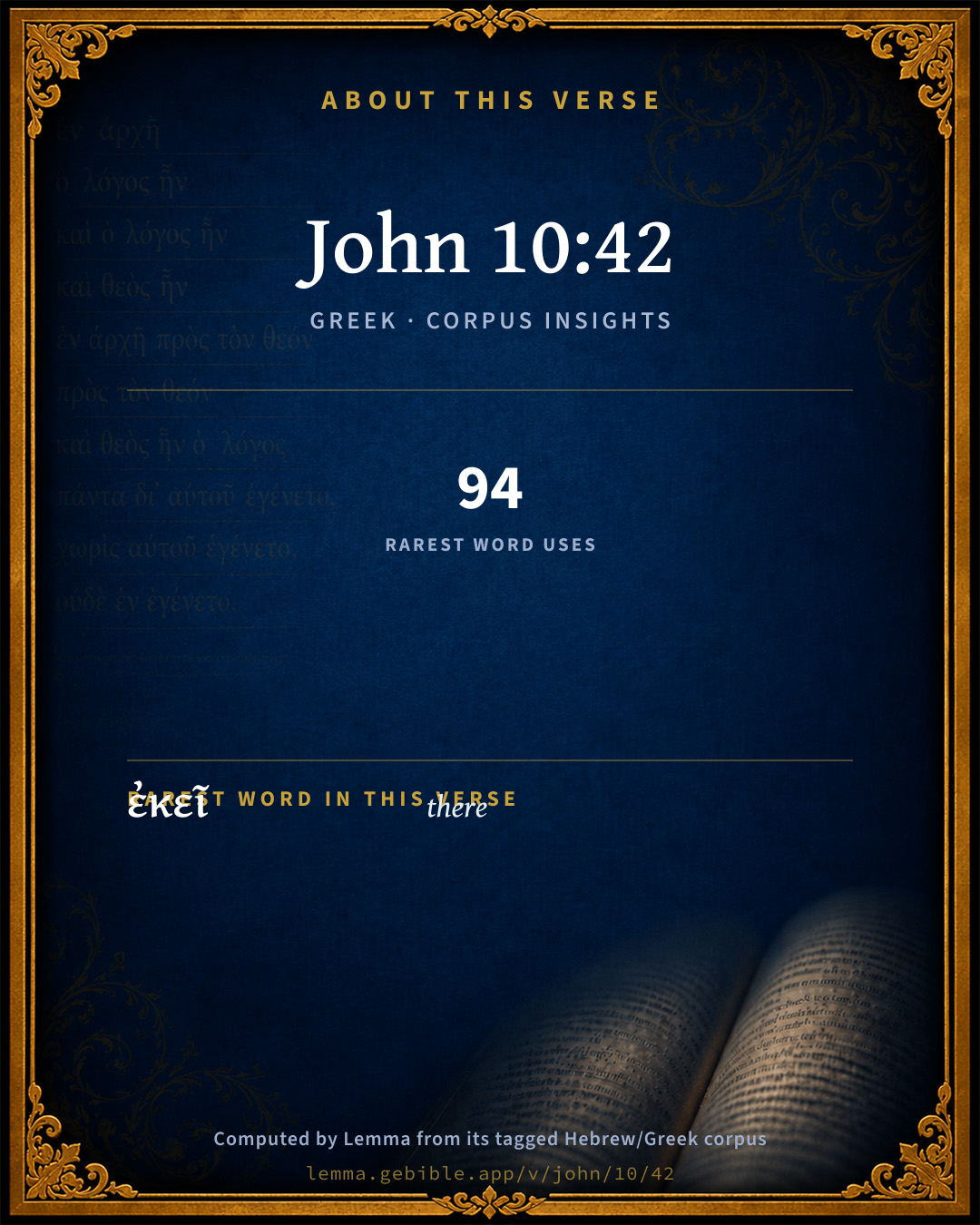
John 10:42

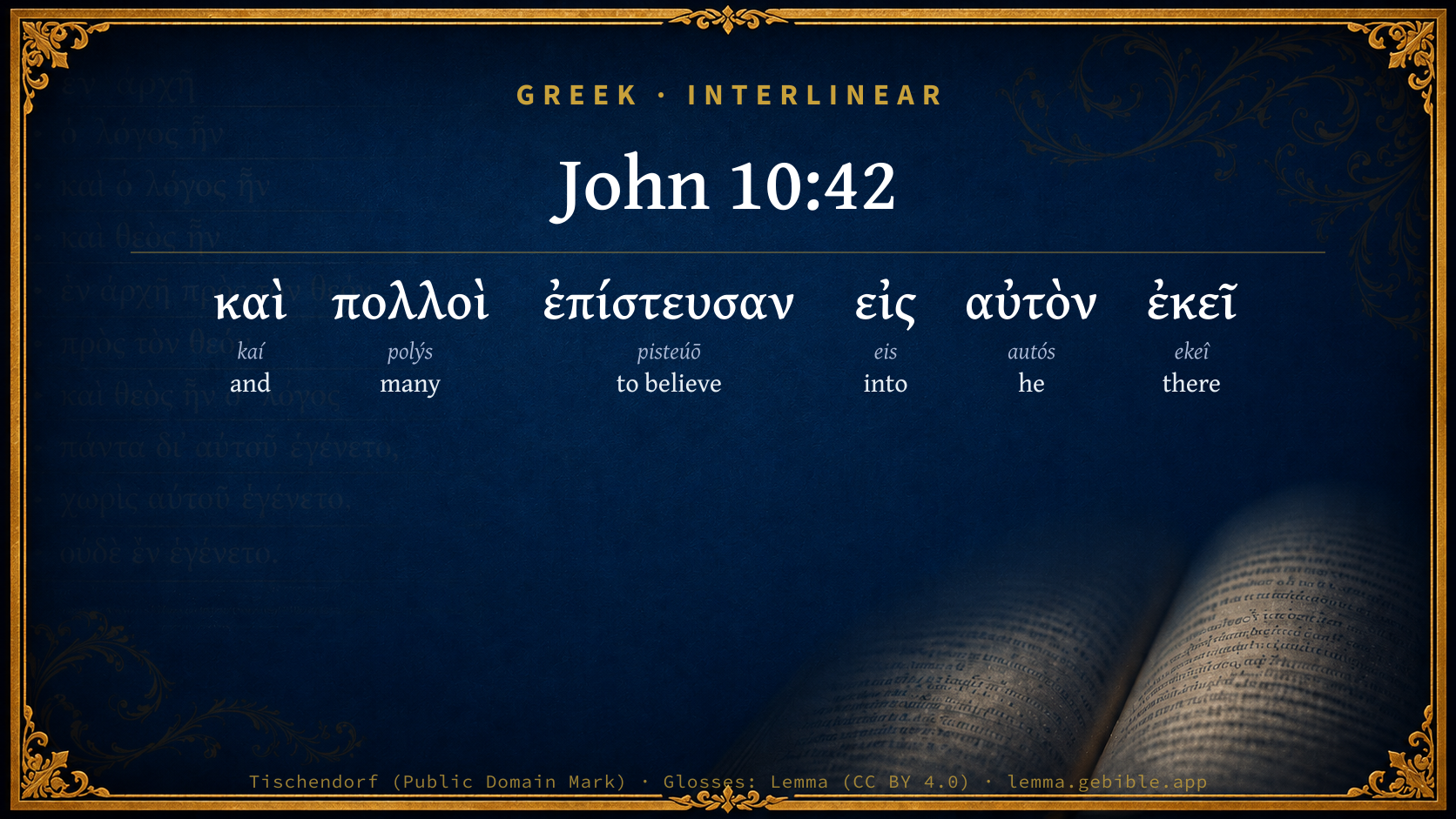
Greek (Tischendorf 8th ed.) John 10:42 appears in the Greek New Testament. The text above is from the Tischendorf 8th edition. Each word links to its Strong’s number and a concise gloss. Click any word for its full Thayer’s Greek Lexicon entry.
Download image
Cite this verse

John 10:42 (World English Bible). Public Domain. Lemma interlinear Bible study tool, https://lemma.gebible.app/v/john/10/42.

Show BibTeX & RIS
BibTeX
RIS
English Translation
Many believed in him there.
World English Bible · Public Domain
Download a study sheet

One document with this verse’s original text, its word-by-word gloss line, the meaning frame, cross-references with their text, attributed commentary, and full source and license credits — printable, and it pastes into notes with its structure intact.

This verse Autodidact and up

Study sheet (.html) Plain text (.txt)

A passage Seminary Student

Up to 50 verses in one chapter. A passage sheet keeps up to 6 commentary sources and 12 cross-references per verse, in the order this page ranks them, and says so on the sheet whenever that leaves anything out. Ask for a single verse and you get the Autodidact verse sheet above.

Everything on this page stays free to read, with no account — the sheet is a download of what is already on screen, not access to it.

Want to remove ads? Support Godless Engineer
Compare translations 3

The same verse in 3 English versions, stacked beneath the original-language interlinear above. Click any original word for its lexicon entry.

Each is an independent rendering of the whole verse — the interlinear is not word-aligned to these translations.

Highlighted words mark where these versions differ — a whole-verse word diff, not a word-by-word alignment.

  • World English Bible Public Domain
    Many believed in him there.
  • King James Version Public Domain
    And many believed on him there.
  • unfoldingWord Literal Text CC BY-SA 4.0
    And many believed in him there.

unfoldingWord Literal Text — © unfoldingWord, licensed CC BY-SA 4.0. Word-aligned USFM3 via Door43 (git.door43.org/unfoldingWord/en_ult).

Versions to compare (up to 4)

3 of 4 selected

Show all 19 translations

Every available English version of this verse, each an independent rendering of the whole verse.

  • World English Bible Public Domain
    Many believed in him there.
  • Berean Standard Bible Public Domain
    And many in that place believed in Jesus.
  • Majority Standard Bible Public Domain
    And many in that place believed in Jesus.
  • King James Version Public Domain
    And many believed on him there.
  • American Standard Version (1901) Public Domain
    And many believed on him there.
  • Revised Version (1885) Public Domain
    And many believed on him there.
  • Geneva Bible (1599) Public Domain
    And many beleeued in him there.
  • Douay-Rheims (1899) Public Domain
    But all things whatsoever John said of this man, were true. And many believed in him.
  • Young's Literal Translation Public Domain
    and many did believe in him there.
  • Literal Standard Version CC BY-SA 4.0
    and many believed in Him there.
  • Unlocked Literal Bible CC BY-SA 4.0
    Many people believed in him there.
  • unfoldingWord Literal Text CC BY-SA 4.0
    And many believed in him there.
  • Darby Bible Public Domain
    And many believed on him there.
  • World Messianic Bible Public Domain
    Many believed in him there.
  • Webster's Bible Public Domain
    And many believed on him there.
  • Free Bible Version CC BY-SA 4.0
    Many who were there put their trust in Jesus.
  • Bible in Basic English Public Domain
    And a number came to have faith in him there.
  • Text-Critical English NT CC BY 4.0
    And many of the people there believed in Jesus.
  • Tyndale New Testament (1534) Public Domain
    And many beleved on him theare.

Literal Standard Version (2020), Covenant Press — licensed CC BY-SA 4.0. Text via the HelloAO Bible API (eBible.org). Unlocked Literal Bible (unfoldingWord) — licensed CC BY-SA 4.0. Text via the HelloAO Bible API (eBible.org). unfoldingWord Literal Text — © unfoldingWord, licensed CC BY-SA 4.0. Word-aligned USFM3 via Door43 (git.door43.org/unfoldingWord/en_ult). Free Bible Version, Dr. Jonathan Gallagher — licensed CC BY-SA 4.0. Text via the HelloAO Bible API (eBible.org).

Cross-references

7

Topical passages linked to John 10:42 in the Treasury of Scripture Knowledge — connected by theme and wording, ordered by reader-vote popularity; previews shown in the World English Bible.

  • John 4:41 Many more believed because of his word.
  • John 2:23 Now when he was in Jerusalem at the Passover, during the feast, many believed in his name, observing his signs which he did.
  • John 4:39 From that city many of the Samaritans believed in him because of the word of the woman, who testified, "He told me everything that I did."
  • John 7:31 But of the multitude, many believed in him. They said, "When the Christ comes, he won't do more signs than those which this man has done, will he?"
  • John 8:30 As he spoke these things, many believed in him.
  • John 11:45 Therefore many of the Jews, who came to Mary and saw what Jesus did, believed in him.
  • John 12:42 Nevertheless even of the rulers many believed in him, but because of the Pharisees they didn't confess it, so that they wouldn't be put out of the synagogue,

Cross-references courtesy of OpenBible.info (CC BY 4.0).

Commentary

Notes on John 10:42 from classic Christian and Jewish commentators (each source and its license shown beneath its notes). The classic Christian expositions comment on the surrounding passage and are grouped to its opening verse, so a note may address several verses; the Jewish commentaries on the Tanakh (Rashi and others) are per-verse, so they appear only where the commentator wrote on this verse.

Lemma curates 59 commentaries, every one of them public domain or Creative Commons licensed, each selected and text-cleaned for this edition rather than reprinted as found. About our sources →

Tyndale Open Study Notes

Tyndale Open Resources

10:42 This is a note of irony. While Jesus found little faith among the religious leaders in the holy city of Jerusalem, in the desert he found many who . . . believed.

Tyndale Open Study Notes — © Tyndale Open Resources, licensed CC BY-SA 4.0. Text via the HelloAO Bible API.

Adam Clarke's Commentary

Verse 42. Many believed on him there.] The people believed on him:

1. because of the testimony of John the Baptist whom they knew to be a good and a wise man, and a prophet of the Lord; and they knew he could neither deceive nor be deceived in this mater; and,

2. they believed because of the miracles which they saw Jesus work. These fully proved that all that John had said of him was true. The scribes and Pharisees with all their science could not draw a conclusion so just. Truth and common sense are often on the side of the common people, whom the insolently wise, the unsanctifiedly learned, and the tyrannically powerful sometimes disingenuously brand with the epithets of mob and swinish multitude.

1. THIS and the preceding chapter contain two remarkable discomfitures of the Jewish doctors. In the former they were confounded by the testimony of a plain uneducated man, simply appealing to the various circumstances of a matter of fact, at which they cavilled, and which they endeavoured to decry. In this chapter the wise are taken in their own craftiness: the Pharisees are confounded by that wisdom which is from above, speaking of and manifesting the deep things of God. Sometimes God himself stops the mouths of gainsayers; at other times he makes the simplest of his followers too mighty for the most learned among the doctors. Ancient and modern martyrologies of the people of God abound with proofs of both these facts. And the persecutions of the Protestants by the Papists in the reign of Queen Mary afford a very large proportion of proofs. In these the mighty power of God, and the prevalence of truth, were gloriously apparent. Both the word of God and the Protestant cause were nobly illustrated by those transactions. May that abomination that maketh desolate never more sit in the holy place!

2. It must be remarked, by every serious reader, that our Lord did frequently speak of himself to the Jews, as being not only sent of God as their Messiah, but as being one with him. And it is as evident that in this sense the priests and Pharisees understood him; and it was because they would not credit this that they accused him of blasphemy. Now, if our Lord was not the person they understood him to state himself to be, he had the fairest opportunity, from their strong remonstrances, to correct their misapprehension of his words, if they really had mistaken his meaning-but this he never attempts. He rather strengthens his assertions in his consequent discourses with them; which, had not his positions been true, he could not have done, even as an honest man. He not only asserted himself to be equal with God, but wished them to believe it to be true; and he amply confirmed this heavenly doctrine by the miracles he wrought.

Adam Clarke's Commentary on the Bible (1810–1826) — public domain. Text from a community e-Sword/MySword module.

Ellicott's Commentary for English Readers

(42) And many believed on him there.—The word “there” is, in the best texts, in a position of emphasis. “And there many believed on Him.” It marks the contrast between the rejection in Jerusalem and the reception at Bethania.

A Bible Commentary for English Readers, edited by Charles John Ellicott (1878–1897) — public domain. Text from a community e-Sword module.

The Cambridge Bible for Schools and Colleges

gen. ed. J. J. S. Perowne

42. many believed on him there] ‘There’ is emphatic. ‘There,’

The Cambridge Bible for Schools and Colleges (gen. ed. J. J. S. Perowne; Cambridge University Press, 1878–1918) — public domain. Text from a community e-Sword module.

Trapp's Complete Commentary

John Trapp

42 And many believed on him there.

Ver. 42. And many believed on him there] Place is no prejudice to the powerful operation of the word, when by the Spirit it is made prolific and generative.

John Trapp, A Commentary or Exposition upon All the Books of the Old and New Testament (1647–1656) — public domain. Text from a community e-Sword module.

Matthew Poole's English Annotations

Some believed on him as such whom John Baptist had spoken him to be; others possibly believed on him in the sense mentioned Joh 2:23; not to the saving of their souls, but as one sent of God, a great Prophet, no ordinary man. The rage of men shall not hinder the progress of the gospel.

Matthew Poole's English Annotations on the Holy Bible (1683–1685) — public domain. Text from a community e-Sword/MySword module.

International Critical Commentary

42. πολλοὶ ἐπίστευσαν εἰς αὐτόν, a favourite phrase of Jn. See on 4:39.

For the constr. πιστεύειν εἴς τινα, see on 1:12.

ἐκεῖ comes before εἰς αὐτόν in the rec. text; but אABDLWΘ place it at the end of the sentence, as at v. 40. perhaps for emphasis. It often comes last in Jn., e.g. 2:1, 11:8, 15, 31, 12:2.

He says “my Father” here and vv. 25, 29, 37. His relation to God was unique; see on 2:16.

Moulton-Milligan Vocabulary of the Greek Testament, illustrated from the papyri, by J. H. Moulton and G.Milligan (1914-). This is being completed by Dr. Milligan; it is indispensable.

אԠSinaiticus (δ 2). Leningrad. iv.

A Alexandrinus (δ 4). British Museum. v. Cc. 6:50-8:52 are missing.

B Vaticanus (δ 1). Rome. Cent. iv.

D Bezæ (δ 5). Cambridge. v-vi. Græco-Latin. Cc. 18:14-20:13 are missing in the Greek text, and the gap has been filled by a ninth-century scribe (Dsupp).

L Regius (ε 56). Paris. viii. Cc. 15:2-20 21:15-25 are missing.

W Freer (ε 014). Washington. iv-vi. Discovered in Egypt in 1906. The Gospels are in the order Mt., Jn., Lk., Mk. Collation in The Washington MS. of the Four Gospels, by H. A. Sanders (1912).

Γ̠(ε 70) Oxford and Leningrad. ix-x. Contains Son 1:1-13 8:3-15:24 19:6 to end.

Δ̠Sangallensis (ε 76). St. Gall. ix-x. Græco-Latin.

Θ̠Koridethi (ε 050). Tiflis. vii-ix. Discovered at Koridethi, in Russian territory, and edited by Beermann & Gregory (Leipzig, 1913). The text is akin to that of fam. 13, fam. 1, and the cursives 28, 565, 700 See Lake and Blake in Harvard Theol. Review (July 1923) and Streeter, The Four Gospels. Cf. also J.T.S. Oct. 1915, April and July 1925.

1 C. T. Wilson, Peasant Life in the Holy Land, p. 165. The author’s observations illustrative of the relation of the shepherd to his sheep are very apposite in connexion with c. 10.

1 For a critical analysis of the parable of the Shepherd and the Sheep, see Holtzmann, Life of Jesus, Eng. Tr., p. 37 f.

2 So Valentinus applied them (Hippol. Ref. vi. 35). Jülicher thinks (Introd., p. 401) that the words have a Gnostic ring.

1 For an account of the nineteenth-century Persian reformer who called himself Bāb, or “the Gate,” see ERE ii. 299, s.v. “Bāb.”

1 καλός “denotes that kind of goodness which is at once seen to be good” (Hort, on 1Pe 2:12).

1 Cf. Abbott, Diat. 2125, 2126.

1 Clem. Alex. (Strom. vi. 14, p. 794 P) comments on the “other sheep, deemed worthy of another fold and mansion, according to their faith.”

1 Except Cod. Sangallensis (sæc. ix.), which has ouile vel pastorale for ποίμνη.

אSinaiticus (δ 2). Leningrad. iv.

B Vaticanus (δ 1). Rome. Cent. iv.

L Regius (ε 56). Paris. viii. Cc. 15:2-20 21:15-25 are missing.

W Freer (ε 014). Washington. iv-vi. Discovered in Egypt in 1906. The Gospels are in the order Mt., Jn., Lk., Mk. Collation in The Washington MS. of the Four Gospels, by H. A. Sanders (1912).

Θ̠Koridethi (ε 050). Tiflis. vii-ix. Discovered at Koridethi, in Russian territory, and edited by Beermann & Gregory (Leipzig, 1913). The text is akin to that of fam. 13, fam. 1, and the cursives 28, 565, 700 See Lake and Blake in Harvard Theol. Review (July 1923) and Streeter, The Four Gospels. Cf. also J.T.S. Oct. 1915, April and July 1925.

A Alexandrinus (δ 4). British Museum. v. Cc. 6:50-8:52 are missing.

D Bezæ (δ 5). Cambridge. v-vi. Græco-Latin. Cc. 18:14-20:13 are missing in the Greek text, and the gap has been filled by a ninth-century scribe (Dsupp).

Γ̠(ε 70) Oxford and Leningrad. ix-x. Contains Son 1:1-13 8:3-15:24 19:6 to end.

Δ̠Sangallensis (ε 76). St. Gall. ix-x. Græco-Latin.

1 See A. Pallis, Notes on St. Mark and St. Matthew (1903), p. v.

1 Aramaic Origin, etc., p. 102. Torrey agrees with this (Harvard Theol. Review, Oct. 1923, p. 328).

אԠSinaiticus (δ 2). Leningrad. iv.

B Vaticanus (δ 1). Rome. Cent. iv.

D Bezæ (δ 5). Cambridge. v-vi. Græco-Latin. Cc. 18:14-20:13 are missing in the Greek text, and the gap has been filled by a ninth-century scribe (Dsupp).

Θ̠Koridethi (ε 050). Tiflis. vii-ix. Discovered at Koridethi, in Russian territory, and edited by Beermann & Gregory (Leipzig, 1913). The text is akin to that of fam. 13, fam. 1, and the cursives 28, 565, 700 See Lake and Blake in Harvard Theol. Review (July 1923) and Streeter, The Four Gospels. Cf. also J.T.S. Oct. 1915, April and July 1925.

A Alexandrinus (δ 4). British Museum. v. Cc. 6:50-8:52 are missing.

L Regius (ε 56). Paris. viii. Cc. 15:2-20 21:15-25 are missing.

W Freer (ε 014). Washington. iv-vi. Discovered in Egypt in 1906. The Gospels are in the order Mt., Jn., Lk., Mk. Collation in The Washington MS. of the Four Gospels, by H. A. Sanders (1912).

Γ̠(ε 70) Oxford and Leningrad. ix-x. Contains Son 1:1-13 8:3-15:24 19:6 to end.

Δ̠Sangallensis (ε 76). St. Gall. ix-x. Græco-Latin.

International Critical Commentary — older volumes (1896–1929), various authors — public domain. Text from a community e-Sword module.

Lesson kit

Teaching starters — assembled from the data on this page, not authored interpretation. Every prompt links to the verse data it draws on. Edit before teaching.

John, in the Gospels, opens this verse with 6 words (6 distinct Greek lemmas). Its most distinctive word is ekeî (“there”). A historical commentator’s framing appears above. Read the whole chapter for the surrounding context.

Discussion questions

  1. What does “there” (ekeî) contribute to the verse as a whole?
  2. John 4:41 shares this passage’s theme. How do the two illuminate each other?
  3. Reading how Tyndale Open Study Notes and Adam Clarke's Commentary read this verse, where do the two commentators agree and where do they part?

Reading settings

Reading text

Shown beneath each verse's original-language words.

Old Testament
Old Testament edition

Read the OT as the Masoretic Hebrew (MT) or the Greek Septuagint (LXX).

English shown for the Greek Septuagint (in the Hebrew ↔ Greek comparison).

Comparing translations? Open the Compare panel on any verse page to stack up to four side by side.