Acts 17:12

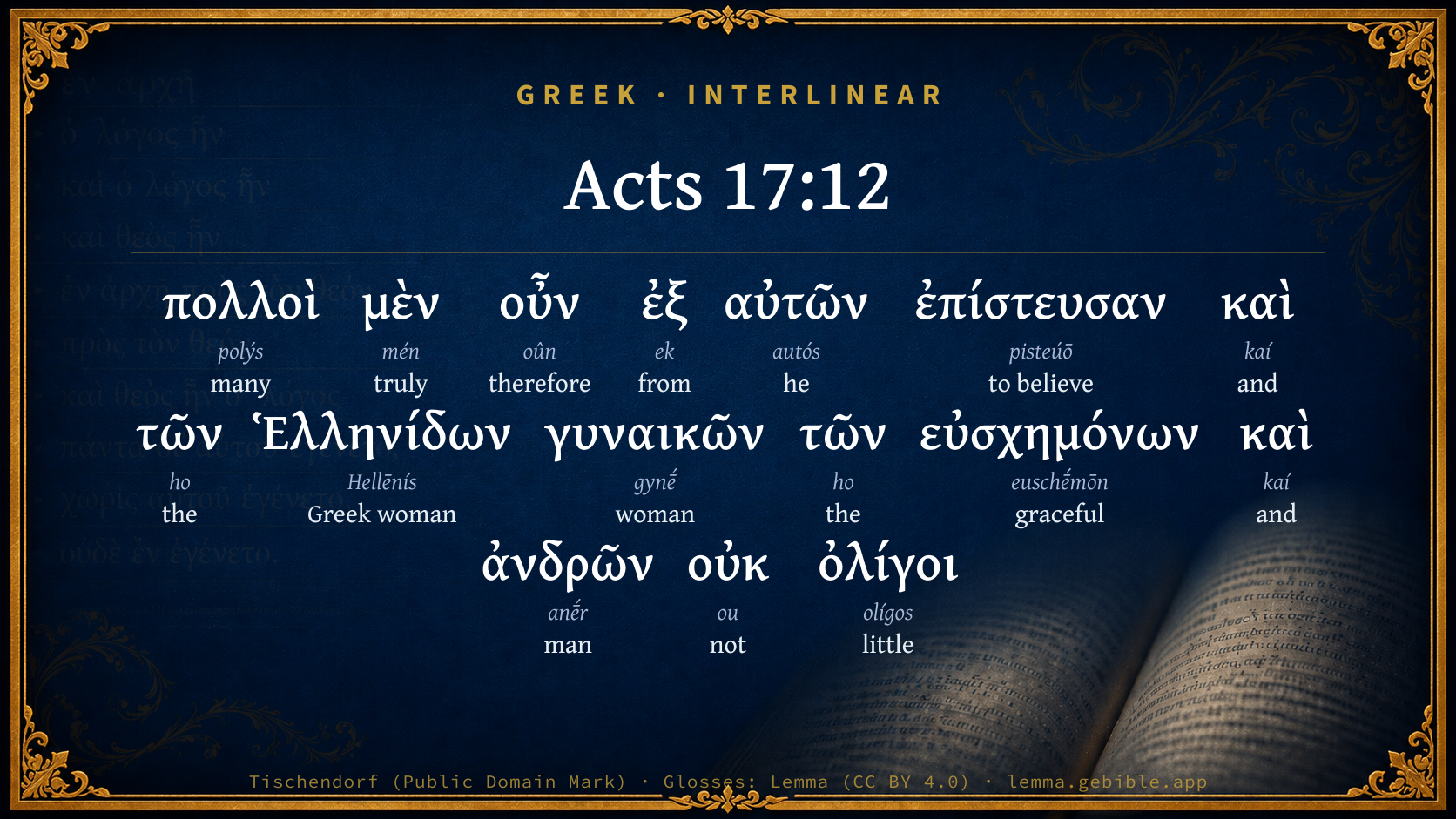
Greek (Tischendorf 8th ed.) Acts 17:12 appears in the Greek New Testament. The text above is from the Tischendorf 8th edition. Each word links to its Strong’s number and a concise gloss. Click any word for its full Thayer’s Greek Lexicon entry.
Download image
Cite this verse

Acts 17:12 (World English Bible). Public Domain. Lemma interlinear Bible study tool, https://lemma.gebible.app/v/acts/17/12.

Show BibTeX & RIS
BibTeX
RIS
English Translation
Many of them therefore believed; also of the prominent Greek women, and not a few men.
World English Bible · Public Domain
Download a study sheet

One document with this verse’s original text, its word-by-word gloss line, the meaning frame, cross-references with their text, attributed commentary, and full source and license credits — printable, and it pastes into notes with its structure intact.

This verse Autodidact and up

Study sheet (.html) Plain text (.txt)

A passage Seminary Student

Up to 50 verses in one chapter. A passage sheet keeps up to 6 commentary sources and 12 cross-references per verse, in the order this page ranks them, and says so on the sheet whenever that leaves anything out. Ask for a single verse and you get the Autodidact verse sheet above.

Everything on this page stays free to read, with no account — the sheet is a download of what is already on screen, not access to it.

Want to remove ads? Support Godless Engineer
Compare translations 3

The same verse in 3 English versions, stacked beneath the original-language interlinear above. Click any original word for its lexicon entry.

Each is an independent rendering of the whole verse — the interlinear is not word-aligned to these translations.

Highlighted words mark where these versions differ — a whole-verse word diff, not a word-by-word alignment.

  • World English Bible Public Domain
    Many of them therefore believed; also of the prominent Greek women, and not a few men.
  • King James Version Public Domain
    Therefore many of them believed; also of honourable women which were Greeks, and of men, not a few.
  • unfoldingWord Literal Text CC BY-SA 4.0
    Then indeed many of them believed, even influential Greek women and not a few men.

unfoldingWord Literal Text — © unfoldingWord, licensed CC BY-SA 4.0. Word-aligned USFM3 via Door43 (git.door43.org/unfoldingWord/en_ult).

Versions to compare (up to 4)

3 of 4 selected

Show all 19 translations

Every available English version of this verse, each an independent rendering of the whole verse.

  • World English Bible Public Domain
    Many of them therefore believed; also of the prominent Greek women, and not a few men.
  • Berean Standard Bible Public Domain
    As a result, many of them believed, along with quite a few prominent Greek women and men.
  • Majority Standard Bible Public Domain
    As a result, many of them believed, along with quite a few prominent Greek women and men.
  • King James Version Public Domain
    Therefore many of them believed; also of honourable women which were Greeks, and of men, not a few.
  • American Standard Version (1901) Public Domain
    Many of them therefore believed; also of the Greek women of honorable estate, and of men, not a few.
  • Revised Version (1885) Public Domain
    Many of them therefore believed; also of the Greek women of honourable estate, and of men, not a few.
  • Geneva Bible (1599) Public Domain
    Therefore many of them beleeued, and of honest women, which were Grecians, and men not a fewe.
  • Douay-Rheims (1899) Public Domain
    And many indeed of them believed, and of honourable women that were Gentiles, and of men not a few.
  • Young's Literal Translation Public Domain
    many, indeed, therefore, of them did believe, and of the honourable Greek women and men not a few.
  • Literal Standard Version CC BY-SA 4.0
    therefore, many of them, indeed, believed, and not a few of the honorable Greek women and men.
  • Unlocked Literal Bible CC BY-SA 4.0
    Therefore many of them believed, including some influential Greek women and many men.
  • unfoldingWord Literal Text CC BY-SA 4.0
    Then indeed many of them believed, even influential Greek women and not a few men.
  • Darby Bible Public Domain
    Therefore many from among them believed, and of Grecian women of the upper classes and men not a few.
  • World Messianic Bible Public Domain
    Many of them therefore believed; also of the prominent Greek women, and not a few men.
  • Webster's Bible Public Domain
    Therefore many of them believed; also of honorable women who were Greeks, and of men not a few.
  • Free Bible Version CC BY-SA 4.0
    As a result many of them became believers, along with some highly-placed Greek women and men.
  • Bible in Basic English Public Domain
    And a number of them had faith, and no small number of the Greek women of high position and of the men.
  • Text-Critical English NT CC BY 4.0
    As a result, many of them believed, as did quite a few of the Greek women of high standing and the men.
  • Tyndale New Testament (1534) Public Domain
    And many of the beleved: also of worshipfull weme which were Grekes and of men not afeawe.

Literal Standard Version (2020), Covenant Press — licensed CC BY-SA 4.0. Text via the HelloAO Bible API (eBible.org). Unlocked Literal Bible (unfoldingWord) — licensed CC BY-SA 4.0. Text via the HelloAO Bible API (eBible.org). unfoldingWord Literal Text — © unfoldingWord, licensed CC BY-SA 4.0. Word-aligned USFM3 via Door43 (git.door43.org/unfoldingWord/en_ult). Free Bible Version, Dr. Jonathan Gallagher — licensed CC BY-SA 4.0. Text via the HelloAO Bible API (eBible.org).

Word by word

More ways to search: Search by grammar → Find every occurrence → Compare this word →

Practice this passage: Drill this verse → Learn its vocabulary →

Ἑλληνίδων
Hellēnís
G1674
“Greek woman”
Noun, Genitive, Plural, Feminine
Part of Speech
Noun
Case
Genitive
Number
Plural
Gender
Feminine
Full Thayer's Definition

Origin: feminine of G1672

TDNT: 10:24,2

1. a Greek women 2. a Gentile women, not a Jewess
  1. πολλοὶ polýs G4183 “many” Adjective, Nominative, Plural, Masculine
  2. μὲν mén G3303 “truly” Particle
  3. οὖν oûn G3767 “therefore” Conjunction
  4. ἐξ ek G1537 “from” Preposition
  5. αὐτῶν autós G846 “he” Personal pronoun, Genitive, Plural, Masculine
  6. ἐπίστευσαν pisteúō G4100 “to believe” Verb, Aorist, Active, Indicative, 3rd person, Plural
  7. καὶ kaí G2532 “and” Conjunction
  8. τῶν ho G3588 “the” Article, Genitive, Plural, Feminine
  9. γυναικῶν gynḗ G1135 “woman” Noun, Genitive, Plural, Feminine
  10. τῶν ho G3588 “the” Article, Genitive, Plural, Masculine
  11. εὐσχημόνων euschḗmōn G2158 “graceful” Adjective, Genitive, Plural, Masculine
  12. καὶ kaí G2532 “and” Conjunction
  13. ἀνδρῶν anḗr G435 “man” Noun, Genitive, Plural, Masculine
  14. οὐκ ou G3756 “not” Particle, Negative
  15. ὀλίγοι olígos G3641 “little” Adjective, Nominative, Plural, Masculine

About this verse

These counts appear in no published source. They are computed here, from the morphology-tagged text and Lemma’s own curated glosses. What Lemma adds →

16
words
14
distinct lemmas
Acts
section

Notable vocabulary

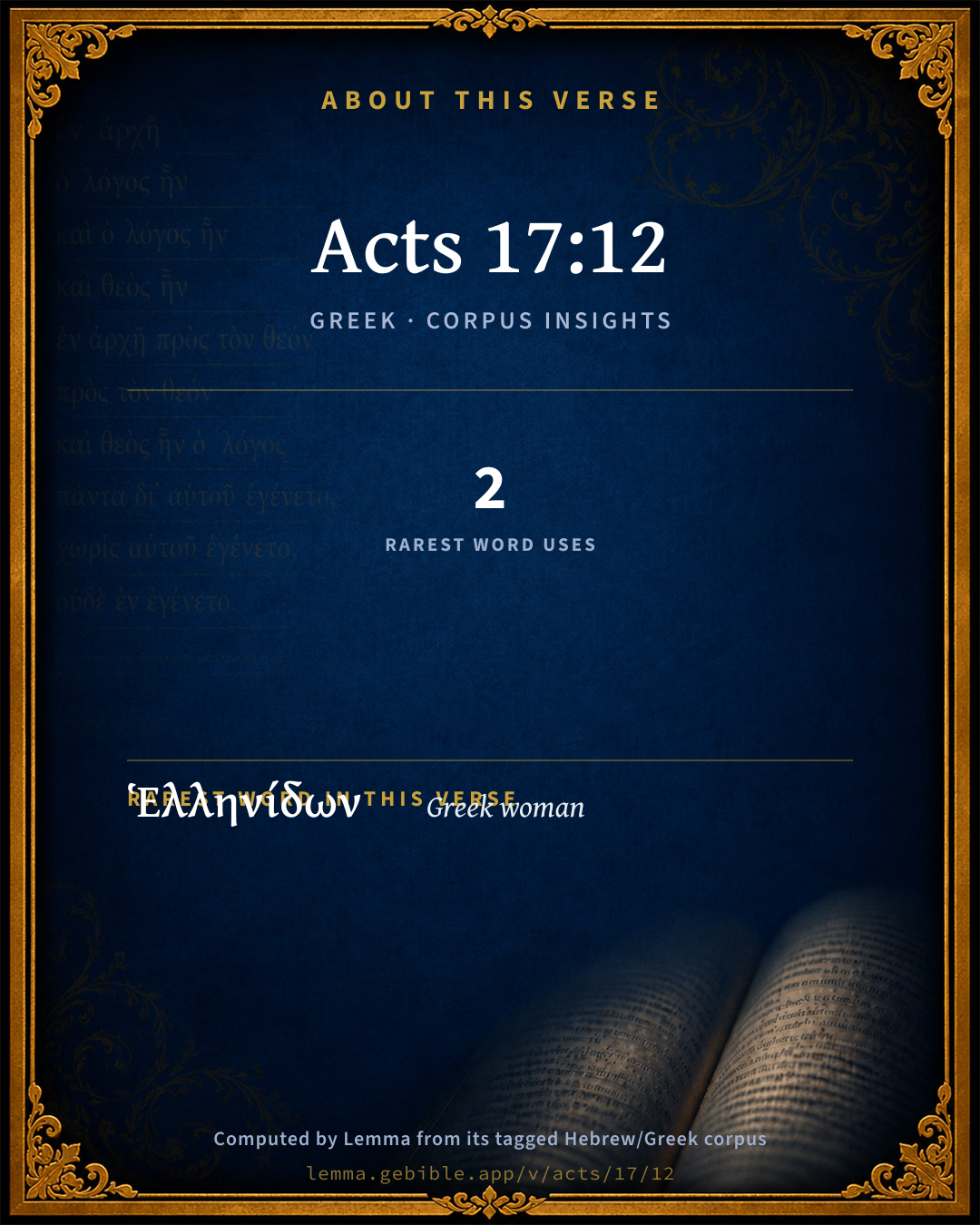
The rarest word here is Ἑλληνίδων Greek woman G1674 — appearing just 2 times in the whole Greek New Testament.

Shared distinctive vocabulary

Ἑλληνίδων Greek woman G1674 occurs in 2 verses of the Greek New Testament. Also found in:

Repetition

Words recur within this verse:

Cross-references

11

Topical passages linked to Acts 17:12 in the Treasury of Scripture Knowledge — connected by theme and wording, ordered by reader-vote popularity; previews shown in the World English Bible.

  • Ephesians 5:14 Therefore he says, "Awake, you who sleep, and arise from the dead, and Christ will shine on you."
  • Acts 13:50 But the Jews stirred up the devout and prominent women and the chief men of the city, and stirred up a persecution against Paul and Barnabas, and threw them out of their borders.
  • Acts 14:1 It happened in Iconium that they entered together into the synagogue of the Jews, and so spoke that a great multitude both of Jews and of Greeks believed.
  • Acts 17:2–4 Paul, as was his custom, went in to them, and for three Sabbath days reasoned with them from the Scriptures,
  • 1 Corinthians 1:26 For you see your calling, brothers, that not many are wise according to the flesh, not many mighty, and not many noble;
  • Psalms 25:8–9 Good and upright is Yahweh, Therefore he will instruct sinners in the way.
  • John 1:45–49 Philip found Nathanael, and said to him, "We have found him, of whom Moses in the law, and the prophets, wrote: Jesus of Nazareth, the son of Joseph."
  • John 7:17 If anyone desires to do his will, he will know about the teaching, whether it is from God, or if I am speaking from myself.
  • Acts 13:46 Paul and Barnabas spoke out boldly, and said, "It was necessary that God's word should be spoken to you first. Since indeed you thrust it from you, and judge yourselves unworthy of eternal life, behold, we turn to the Gentiles.
  • James 1:10 and the rich, in that he is made humble, because like the flower in the grass, he will pass away.
  • James 1:21 Therefore, putting away all filthiness and overflowing of wickedness, receive with humility the implanted word, which is able to save your souls.

Cross-references courtesy of OpenBible.info (CC BY 4.0).

Commentary

Notes on Acts 17:12 from classic Christian and Jewish commentators (each source and its license shown beneath its notes). The classic Christian expositions comment on the surrounding passage and are grouped to its opening verse, so a note may address several verses; the Jewish commentaries on the Tanakh (Rashi and others) are per-verse, so they appear only where the commentator wrote on this verse.

Lemma curates 59 commentaries, every one of them public domain or Creative Commons licensed, each selected and text-cleaned for this edition rather than reprinted as found. About our sources →

The Biblical Illustrator

Joseph S. Exell

Act_17:12

Therefore many of them believed.

The gospel and the classes

1. They believed--a little word, but a great thing--the step by which they passed from condemnation to peace; from the house on the sand before it fell, to the rock. The moment before they were without Christ and hope; the moment after they were in Christ, and heirs of eternal life. How could interests so vast turn on a point so small? All decisive turnings are made on points. The poles are mathematical points, yet how huge the mass that spins round them!

2. Many believed. A swelling of spiritual life sometimes comes over a city or country, as the tidal wave over the ocean--lifted and led in both cases by a power in the heavens. The symptoms which portended this revival were a bent of mind towards the Word, and a daily searching of it. When we see the same symptoms we may expect the same enlargement.

3. Note the classes who were won to the Lord.

I. Greeks. There is no respect of persons with God: neither Jew nor Greek. Yet the conversion of a Greek may give an apostle greater reason for joy, inasmuch as while of no more value intrinsically than a Jew, a Greek could open a door into a wider field. Those successes were sweetest which were promises of more.

II. Men and women. God made both in marvellous wisdom for each other; together they have gone from Him; it is a glad sight when they return in company. How sad when the sexes are divided by that partition which divides the Church from the world! As there is neither Jew nor Greek, so there is neither male nor female in the kingdom of Christ. Sometimes the husband or brother believes, while wife or sister smothers the spiritual life by the cares of this world. Sometimes the women of the family are devoted to Christ, while the men are too philosophic or self-indulgent. Husbands and wives, etc., be heirs together of the grace of life.

III. People of high standing. Are the upper ten, then, more precious? No. But there are times and circumstances in which their conversion is more noteworthy.

1. If for nothing else, the early disciples valued it as men value certain gems, on account of its rarity. The common people heard the Master gladly, but the rulers held aloof. On that account Jesus looked fondly on the rich young man who came to Him.

2. Their influence is greater.

3. Great temptations bind them.

IV. Not a few. There is a strange appetite in the Christians heart; it continually cries, Give an appetite inherited from Christ. When many came He invited the rest as eagerly. (W. Arnot, D. D.)

Also of honourable women.--

Women and the Church

Women are first named, implying that they were first to believe. This is still no common occurrence.

I. Women receive the gospel more readily than do men. Lydias case is repeated in all quarters of Christendom. The sisters of Bethany, the women who ministered unto Christ, prophesy the faith of their sex.

II. Upon the basis of this fact it is not flattery to say that women are more noble than men. There are qualities belonging to their sex fitting women above men to appreciate the gospel. Though first in the fall, also first in relations, qualifications, and promise to bring deliverance.

III. Women have special reasons for becoming Christians. Their aptness to receive it is evidence of their need of it--

1. To satisfy their finer, quicker sense of right, truth, beauty.

2. To fulfil their mission in life not by power, but by influence. Their want of Christian character is a want of qualification for their life work.

IV. Womans obligation to Christianity. Outside of the religion of revelation they were burdened and enslaved. Their elevation they owe to Christianity. (S. Mease, D. D.)

And of men not a few.--

Men and the Church

Of the men in Berea, not a few received the gospel. The same is true wherever the gospel has been carried. The inference, however, is that the number of men was not equal to the number of women. This inference is confirmed by observation of modern churches. This unfortunate phenomenon is deserving of discussion.

I. Mens need of the gospel is as absolute as that of women.

1. Depravity is as deep and real, effecting an equal estrangement from God, and producing the same evil fruits--disobedience, perversion of life, unrest, apprehension of evil, and death, both in body and soul.

2. Their manly courage, strength, and capacity leave them helpless as women; for spiritual ends Gods help alone will avail.

3. They must find the same one remedy--the blood of Christ.

4. To men the gospel is as much and all that it is to women--the power of God unto salvation to them that believe.

II. The allegiance and service of men are as unconditionally required as those of women.

1. The gospel is the one instrumentality for the worlds redemption. Against it are arrayed all the forces of sin and Satan. Will men, strong and courageous, refuse to enlist, while women contend with readier will and in greater numbers?

2. The work of the gospel is great above every other, securing human happiness here and hereafter. Wherever men are, there is a call to labour. Sin, crime, poverty, and suffering are devouring multitudes by reason of gospel work undone, whilst men are idling in the market place. Will men, with stronger endowments and better advantages, look on, leaving the burden to weaker but better women?

III. The evil resulting from mens greater reluctance than women to accept and promote the gospel. Were the men as ready to believe as are women, the latter in still greater numbers would be at the feet of Jesus--our daughters, wives, and mothers. An increasing host of both sexes would flock to the standard of the Cross. Men out of the Church are hindrances to women who would enter, and often difficulties to such as have entered. The men are in the front ranks of the worlds battle: why should they not be in the front as to numbers and activity in the battle for truth, salvation, and God? (S. Mease, D. D.)

The Biblical Illustrator, edited by Joseph S. Exell (c. 1880s–1900s) — public domain. Text from a community e-Sword module.

Bengel's Gnomon

Johann Albrecht Bengel

Act 17:12. Ἐξ αὐτῶν, of them) the Jews.—γυναικῶν, women) who were followed by the men.

Bengel's Gnomon of the New Testament — English translation (T&T Clark, Edinburgh, 1860) — public domain. Text from a community e-Sword module.

Expositor's Greek Testament

ed. W. Robertson Nicoll

Act 17:12 . See critical note and Ramsay, Church in the Roman Empire, u. s. As at Thessalonica, so here the Apostles’ work extended beyond the limits of the synagogue. Ἑλληνίδων : the term relates to the men as well as to the women the Jewish men had already been included in the first word πολλοί , see Alford, Weiss, Wendt, Zöckler. εὐσχημόνων , see above on Act 13:50 . Blass refers the term to ἀνδρῶν also, and points out that Sopater of Berœa alone in Acts is named πατρόθεν according to Greek custom, cf. Act 20:4 (R.V., W.H [308] , Weiss, Wendt). See also Orr, Neglected Factors in the Early Progress of Christianity , p. 107.

[308] Westcott and Hort’s The New Testament in Greek: Critical Text and Notes.

The Expositor's Greek Testament, edited by W. Robertson Nicoll (1897–1910) — public domain. Text from a community e-Sword module.

Jamieson, Fausset & Brown

Robert Jamieson, A. R. Fausset & David Brown

Therefore many of them believed--convinced that Jesus of Nazareth whom Paul preached was indeed the great Promise and Burden of the Old Testament. From this it is undeniable, (1) that the people, no less than the ministers of the Church, are entitled and bound to search the Scriptures; (2) that they are entitled and bound to judge, on their own responsibility, whether the teaching they receive from the ministers of the Church is according to the word of God; (3) that no faith but such as results from personal conviction ought to be demanded, or is of any avail.

of honourable women which were Greeks, and of men--which were Greeks.

not a few--"The upper classes in these European-Greek and Romanized towns were probably better educated than those of Asia Minor" [WEBSTER and WILKINSON].

Jamieson, Fausset & Brown — Commentary Critical and Explanatory on the Whole Bible (1871) — public domain (CC PDM 1.0). Text via the HelloAO Bible API.

Adam Clarke's Commentary

Verse 12. Therefore many of them believed] From the manner in which they heard, received, and examined the word preached to them, it was not likely they could be deceived. And, as it was the truth that was proclaimed to them, it is no wonder that they apprehended, believed, and embraced it.

Of honourable women which were Greeks] Probably mere heathens are meant; and these were some of the chief families in the place. Thus we find that the preaching of Paul at Berea was made the instrument of converting both Jews and Gentiles.

Adam Clarke's Commentary on the Bible (1810–1826) — public domain. Text from a community e-Sword/MySword module.

John Calvin's Commentaries

12. And many believed. This is not referred unto the sentence next going before, as if those of whom he spake began to believe, making choice of some of them: for that were an absurd thing. But Luke’s meaning is, because many were added by their example, the Church was increased in that city. And hitherto hath Luke declared the first beginning of the church of Thessalonica, lest any man should think that Paul’s labors did perish through his sudden and violent departure; for unless I be much deceived, he showeth for this purpose what fruit his preaching brought forth in the other city, before he came to the exile of Berea.

John Calvin's Commentaries (1540-1563) — public domain. Text from the Calvin Translation Society English edition (1840s-50s) via the Christian Classics Ethereal Library (ccel.org). Calvin's coverage is partial (roughly two-thirds of the Bible); uncommented books and verses are honest gaps, never fabricated. The 19th-century editor's footnotes and remarks are omitted so the notes are faithfully Calvin's own voice.

Ellicott's Commentary for English Readers

(12) Therefore many of them believed.—The narrator dwells with satisfaction on the fact that at Berœa there were many Jewish as well as Gentile converts. Among the latter there were, as at Thessalonica, women of the upper class.

A Bible Commentary for English Readers, edited by Charles John Ellicott (1878–1897) — public domain. Text from a community e-Sword module.

The Cambridge Bible for Schools and Colleges

gen. ed. J. J. S. Perowne

12. also of honourable women] The same word is found Act_13:50, of the women of Antioch in Pisidia, and signifies that they were of honourable estate, distinguished for their position, influence and wealth.

which were Greeks] The adjective refers specially to the women, but it probably is intended to define the men too. The Jewish converts had been mentioned as examiners of the Scriptures. The men and women mentioned afterwards were probably all Gentiles.

The Cambridge Bible for Schools and Colleges (gen. ed. J. J. S. Perowne; Cambridge University Press, 1878–1918) — public domain. Text from a community e-Sword module.

John Gill's Exposition

Therefore many of them believed,.... What the apostle preached, and in Jesus of Nazareth, as the true Messiah, and professed their faith in him, upon finding, through reading and searching the Scriptures, that the characters of the Messiah agreed in him, and that what the apostle delivered were entirely consonant to those writings:

also of honourable women which were Greeks, and of men not a few; besides the Jews, there were Gentiles also, both men and women; who were proselytes to the Jewish religion, and who were persons of figure and credit, especially the women, who were also converted and believed in Christ. These converts were the beginning of a Gospel church state in this place, which continued many ages after. Timon, one of the first seven deacons of the church at Jerusalem, is said to be bishop of Berea; though, according to others, Onesimus, the servant of Philemon, was the first bishop of this church: even in the fifth century mention is made of Lucas, bishop of Berea, who was present in the synods of Chalcedon and Ephesus; yea, in the ninth century, there were Christians dwelling in this place (p).

(p) Magdeburg. Hist. Eccles. cent. 5. c. 10. p. 666. cent. 9. c. 2. p. 4.

John Gill's Exposition of the Whole Bible (1746–1763) — public domain (CC PDM 1.0). Text via the HelloAO Bible API.

Trapp's Complete Commentary

John Trapp

12 Therefore many of them believed; also of honourable women which were Greeks, and of men, not a few.

Ver. 12. Therefore many of them believed] There are certain abilities and actions we have, and may perform without special grace; in the employment whereof we are to expect the effectual work of the Spirit. See it in these noble Bereans; they brought their bodies to the assembly, took the heads of Paul’s sermons very truly, repeated and examined the notes they had taken, and yet were unconverted, as appears by this verse. Now if any, of us do hide the like talent, we are not to expect the Spirit of sanctification. As our liberty in external acts (as to come to church to hear, &c.) is still some, so must our endeavours be answerable.

John Trapp, A Commentary or Exposition upon All the Books of the Old and New Testament (1647–1656) — public domain. Text from a community e-Sword module.

Albert Barnes' Notes on the Bible

Therefore many of them believed - As the result of their examination. This result will commonly follow when people search the Scriptures. Much is gained when people can be induced to examine the Bible. We may commonly take it for granted that such an examination will result in their conviction of the truth. The most prominent and usual cause of infidelity is found in the fact that people will not investigate the Scriptures. Many infidels have confessed that they had never carefully read the New Testament. Thomas Paine confessed that he wrote the first part of the Age of Reason without having a Bible at hand, and without its being possible to procure one where he then was (in Paris). “I had,” says he, “neither Bible nor Testament to refer to, though I was writing against both; nor could I procure an” (Age of Reason, p. 65, ed. 1831; also p. 33). None, it may safely be affirmed, have ever read the Scriptures with candor, and with the true spirit of prayer, who have not been convinced of the truth of Christianity, and been brought to submit their souls to its influence and its consolations. The great thing which Christians desire their fellow-men to do is candidly to search the Bible, and when this is done they confidently expect that they will be truly converted to God.

Of honourable women - See the notes on Act 13:50.

Albert Barnes' Notes on the Bible (1834–1885) — public domain. Text from a community e-Sword/MySword module.

Matthew Poole's English Annotations

God blessing his own gifts, and giving still unto them that had, and made use of them. And would we also lay aside all filthiness, and superfluity of naughtiness, and receive with meekness the ingrafted word, which is able to save our souls, Jam 1:21, we should find the hand of the Lord not to be shortened, but his word as powerful, as piercing, as converting as ever.

Matthew Poole's English Annotations on the Holy Bible (1683–1685) — public domain. Text from a community e-Sword/MySword module.

Whedon's Commentary on the Bible

Daniel D. Whedon

12. Therefore—In consequence of a candid heart and an examining energy many believed. A large Church was arising in a small place. Berea was beautifully promising to be a fair Christian city.

Daniel D. Whedon (gen. ed.), Commentary on the Old and New Testaments (1874–1909) — public domain. Text from a community e-Sword module.

The Pulpit Commentary

Many...therefore for therefore many, A.V.; the Greek women of honor able estate for honorable women which were Greeks, A.V. Honorable; eujschmonwn, as lewv Act_13:50, where it is coupled with toutouv thv po (see ver. 4; comp. Mar_15:43) Meyer thinks that it is meant that the men were Greeks too; but this is uncertain. The only Beraean convert whose name we know is Sopater, (Act_20:4) or Sosipater, who is probably the same. (Rom_16:21) If so, he was apparently a Jew, whose Hebrew name may have been Abishua.

Preparation for the truth.

many of them believed." Contrast between the ignoble prejudice and the noble openness of mind. Responsibility for our faith. Knowledge and practice bound up together.

I THE TRUE PREPARATION FOR DIVINE BLESSINGS.

1. A state of mind. At liberty to think. Open to teaching. Desire for instruction. The two kinds of skepticism (skepsis), inquiry for truth, inquiry for reasons against faith.

2. A course of action and habit. Reading of the Scriptures daily, with a set purpose, devoutly, in connection with the preached Word, with an intention to follow their guidance.

II THE TRUE FAITH SETTLED ON ITS BROAD FOUNDATION.

1. As distinguished from mere individual self-assertion and ignoble pride.

2. As accepting the standard of revealed truth.

3. As apostolic, seeing that those things were so," i.e. as Paul represented them. The Pauline faith was the only faith which linked together the Old Testament and the New.

III RESULTS FOLLOWING THE USE OF MEANS. A lesson to both preachers and hearers. R.

The Pulpit Commentary (1880–1919), ed. H.D.M. Spence-Jones & Joseph S. Exell — public domain. Text from a community e-Sword module.

John Wesley's Explanatory Notes

Many of the - Of the Jews. And of the Grecian women - Who were followed by their husbands.

John Wesley, Explanatory Notes Upon the Whole Bible (1754–1765) — public domain. Text via the GEBible commentary corpus.

Scofield Reference Notes

C. I. Scofield

Therefore Illustrates Joh 5:46. Believing the O.T. they believed the Gospel.

honourable Greek women of honourable estate.

The Scofield Reference Bible (1917 edition), notes by C. I. Scofield — public domain. Text from a community e-Sword module.

McGarvey & Pendleton's Commentaries

J. W. McGarvey

12. If the claims of Jesus are false, an honest and thorough investigation of them is the best way to prove them so. If they are true, such an investigation will be certain to convince us and to bless us. With the Bereans, the logical result of a daily investigation is stated thus: (12) " Therefore, many of them, and not a few of the honorable men and women who were Greeks, believed. " It was not here, as in Thessalonica, that " some of them" and "a great multitude of Greeks" believed; but it was " many of them," and "not a few of the Greeks." That they believed, is distinctly attributed to the fact that they "searched the Scriptures;" showing again, that faith is produced by the word of God.

J. W. McGarvey (with Philip Y. Pendleton), Commentaries on the New Testament (The Fourfold Gospel, 1914; Acts; and the epistles) — public domain. Text from a community e-Sword/MySword module.

Cambridge Greek Testament for Schools and Colleges

12. τῶν Ἑλληνίδων γυναικῶν τῶν εὐσχημόνων, of honourable women which were Greeks. See above on Act 13:50.

The adjective Ἑλληνίς agrees in gender with γυναικῶν because it stands before that word in the sentence, but it probably is intended to define ἀνδρῶν too. The Jewish population has been previously described as ready to search the Scriptures. The men as well as the women who are mentioned afterwards were most likely all Gentiles.

Cambridge Greek Testament for Schools and Colleges (Cambridge University Press, 1896; 21 vols, various authors incl. Carr, Maclear, Plummer, Farrar, Lumby, Moule, M. R. James, Simcox) — public domain. Text from a community e-Sword module.

Alford’s Greek Testament

Henry Alford

12.] The designation conveyed in Ἑλληνίδων is to be supplied before ἀνδρῶν also. So εἰς πᾶσαν πόλιν κ. τόπον, Luk 10:1. See Winer, edn. 6, § 59. 5.

Henry Alford, The Greek Testament (1849–1861) — public domain. Text from a community e-Sword module.

Vincent's Word Studies in the New Testament

Marvin R. Vincent

Honorable women. See on verse 4, and Mr 14:43.

Marvin R. Vincent, Word Studies in the New Testament (1887–1900) — public domain. Text from a community e-Sword/MySword module.

Lesson kit

Teaching starters — assembled from the data on this page, not authored interpretation. Every prompt links to the verse data it draws on. Edit before teaching.

Acts, in the Acts, opens this verse with 16 words (14 distinct Greek lemmas). Its most distinctive word is Hellēnís (“Greek woman”). A historical commentator’s framing appears above. Read the whole chapter for the surrounding context.

Discussion questions

  1. What does “Greek woman” (Hellēnís) contribute to the verse as a whole?
  2. Mark 7:26 shares the word «Greek woman» with this verse. How do the two illuminate each other?
  3. “and” occurs 2× in this one verse. What is the effect of the repetition?
  4. The translations on this page render this verse differently — a whole-verse word diff, not a word-by-word alignment. What might account for the different wordings?
  5. Reading how The Biblical Illustrator and Bengel's Gnomon read this verse, where do the two commentators agree and where do they part?

Things to notice

Reading settings

Reading text

Shown beneath each verse's original-language words.

Old Testament
Old Testament edition

Read the OT as the Masoretic Hebrew (MT) or the Greek Septuagint (LXX).

English shown for the Greek Septuagint (in the Hebrew ↔ Greek comparison).

Comparing translations? Open the Compare panel on any verse page to stack up to four side by side.