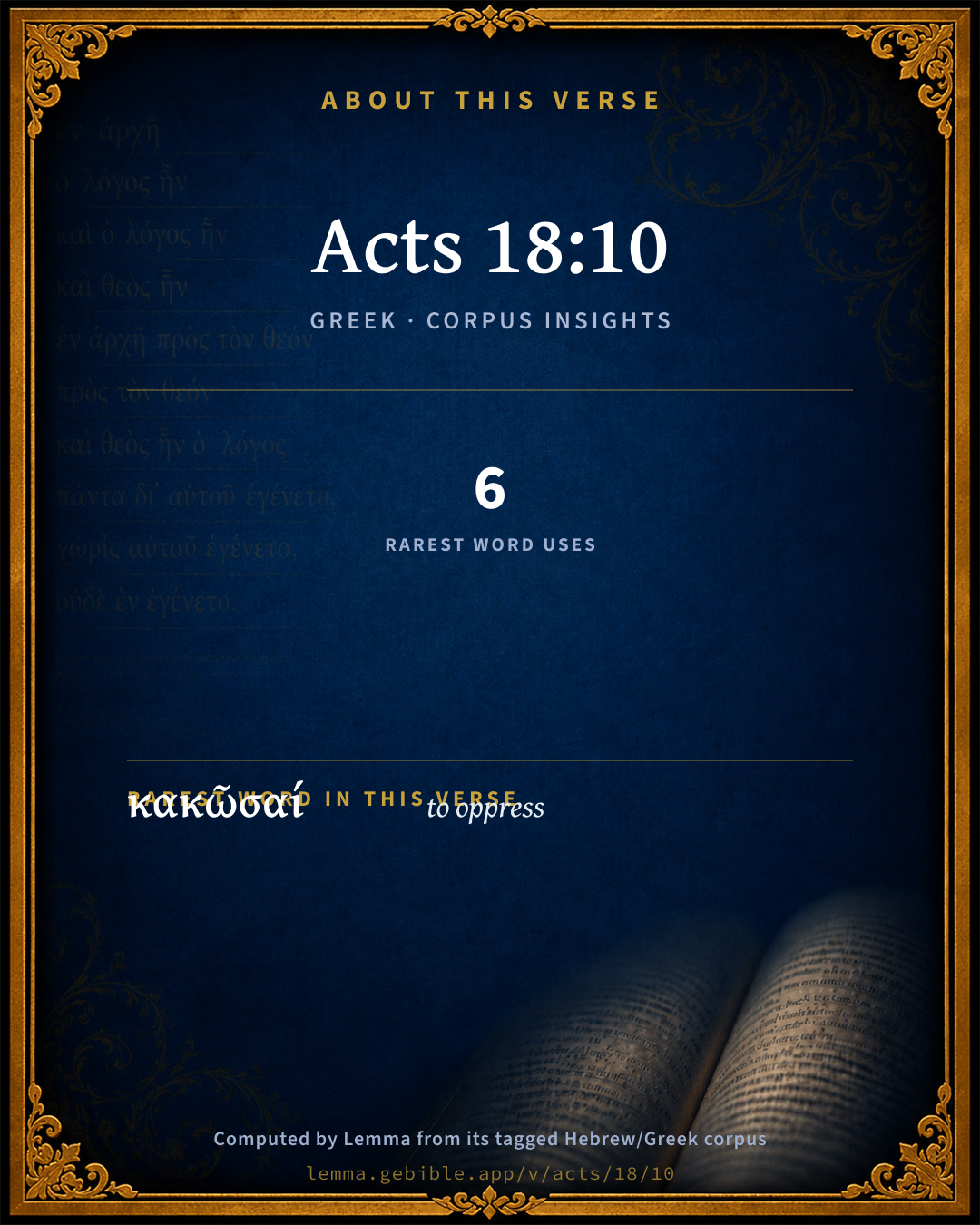
Acts 18:10

Greek (Tischendorf 8th ed.) Acts 18:10 appears in the Greek New Testament. The text above is from the Tischendorf 8th edition. Each word links to its Strong’s number and a concise gloss. Click any word for its full Thayer’s Greek Lexicon entry.
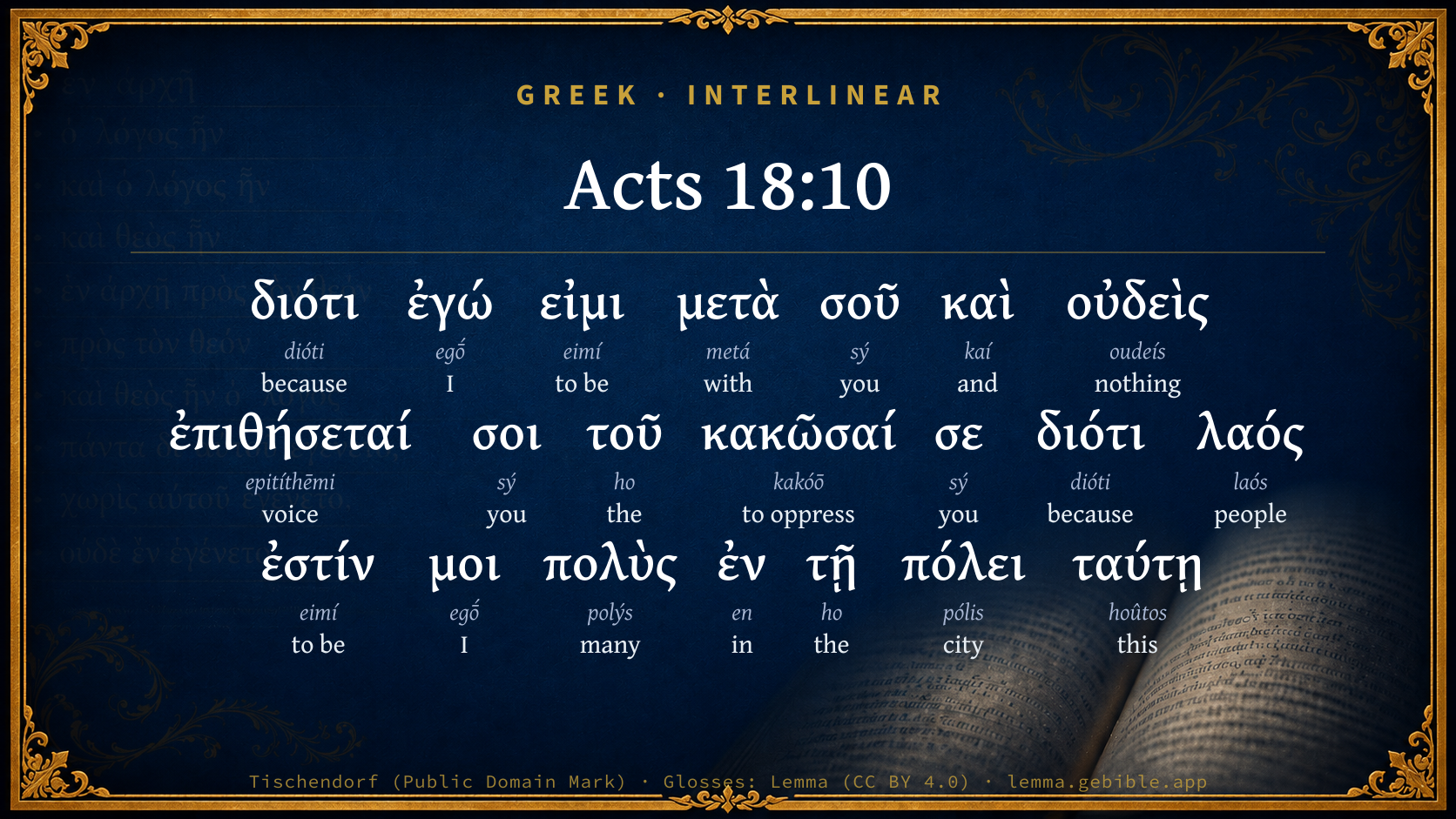
Download image
Cite this verse

Acts 18:10 (World English Bible). Public Domain. Lemma interlinear Bible study tool, https://lemma.gebible.app/v/acts/18/10.

Show BibTeX & RIS
BibTeX
RIS
English Translation
for I am with you, and no one will attack you to harm you, for I have many people in this city."
World English Bible · Public Domain
Download a study sheet

One document with this verse’s original text, its word-by-word gloss line, the meaning frame, cross-references with their text, attributed commentary, and full source and license credits — printable, and it pastes into notes with its structure intact.

This verse Autodidact and up

Study sheet (.html) Plain text (.txt)

A passage Seminary Student

Up to 50 verses in one chapter. A passage sheet keeps up to 6 commentary sources and 12 cross-references per verse, in the order this page ranks them, and says so on the sheet whenever that leaves anything out. Ask for a single verse and you get the Autodidact verse sheet above.

Everything on this page stays free to read, with no account — the sheet is a download of what is already on screen, not access to it.

Want to remove ads? Support Godless Engineer
Compare translations 3

The same verse in 3 English versions, stacked beneath the original-language interlinear above. Click any original word for its lexicon entry.

Each is an independent rendering of the whole verse — the interlinear is not word-aligned to these translations.

Highlighted words mark where these versions differ — a whole-verse word diff, not a word-by-word alignment.

  • World English Bible Public Domain
    for I am with you, and no one will attack you to harm you, for I have many people in this city."
  • King James Version Public Domain
    For I am with thee, and no man shall set on thee to hurt thee: for I have much people in this city.
  • unfoldingWord Literal Text CC BY-SA 4.0
    For I am with you, and no one will set upon you to harm you, for much people is to me in this city.”

unfoldingWord Literal Text — © unfoldingWord, licensed CC BY-SA 4.0. Word-aligned USFM3 via Door43 (git.door43.org/unfoldingWord/en_ult).

Versions to compare (up to 4)

3 of 4 selected

Show all 19 translations

Every available English version of this verse, each an independent rendering of the whole verse.

  • World English Bible Public Domain
    for I am with you, and no one will attack you to harm you, for I have many people in this city."
  • Berean Standard Bible Public Domain
    For I am with you and no one will lay a hand on you, because I have many people in this city.”
  • Majority Standard Bible Public Domain
    For I am with you and no one will lay a hand on you, because I have many people in this city.”
  • King James Version Public Domain
    For I am with thee, and no man shall set on thee to hurt thee: for I have much people in this city.
  • American Standard Version (1901) Public Domain
    for I am with thee, and no man shall set on thee to harm thee: for I have much people in this city.
  • Revised Version (1885) Public Domain
    for I am with thee, and no man shall set on thee to harm thee: for I have much people in this city.
  • Geneva Bible (1599) Public Domain
    For I am with thee, and no man shall lay handes on thee to hurt thee: for I haue much people in this citie.
  • Douay-Rheims (1899) Public Domain
    Because I am with thee: and no man shall set upon thee, to hurt thee; for I have much people in this city.
  • Young's Literal Translation Public Domain
    because I am with thee, and no one shall set on thee to do thee evil; because I have much people in this city;'
  • Literal Standard Version CC BY-SA 4.0
    because I am with you, and no one will set on you to do evil [to] you, because I have many people in this city”;
  • Unlocked Literal Bible CC BY-SA 4.0
    For I am with you, and no one will try to harm you, for I have many people in this city.”
  • unfoldingWord Literal Text CC BY-SA 4.0
    For I am with you, and no one will set upon you to harm you, for much people is to me in this city.”
  • Darby Bible Public Domain
    because *I* am with thee, and no one shall set upon thee to injure thee; because I have much people in this city.
  • World Messianic Bible Public Domain
    for I am with you, and no one will attack you to harm you, for I have many people in this city.”
  • Webster's Bible Public Domain
    For I am with thee, and no man shall lay hands on thee, to hurt thee: for I have many people in this city.
  • Free Bible Version CC BY-SA 4.0
    because I am with you, and no one will attack you, for many people in this city are mine.”
  • Bible in Basic English Public Domain
    For I am with you, and no one will make an attack on you to do you damage: for I have a number of people in this town.
  • Text-Critical English NT CC BY 4.0
    For I am with yoʋ, and no one will attack yoʋ to do yoʋ harm, for I have many people in this city.”
  • Tyndale New Testament (1534) Public Domain
    for I am with the and no man shall invade the that shall hurte the. For I have moche people in this cite.

Literal Standard Version (2020), Covenant Press — licensed CC BY-SA 4.0. Text via the HelloAO Bible API (eBible.org). Unlocked Literal Bible (unfoldingWord) — licensed CC BY-SA 4.0. Text via the HelloAO Bible API (eBible.org). unfoldingWord Literal Text — © unfoldingWord, licensed CC BY-SA 4.0. Word-aligned USFM3 via Door43 (git.door43.org/unfoldingWord/en_ult). Free Bible Version, Dr. Jonathan Gallagher — licensed CC BY-SA 4.0. Text via the HelloAO Bible API (eBible.org).

Word by word

More ways to search: Search by grammar → Find every occurrence → Compare this word →

Practice this passage: Drill this verse → Learn its vocabulary →

κακῶσαί
kakóō
G2559
“to oppress”
Verb, Aorist, Active, Infinitive
Part of Speech
Verb
Tense
Aorist
Voice
Active
Mood
Infinitive
Full Thayer's Definition

Origin: from G2556

TDNT: 11:04,4

1. to oppress, afflict, harm, maltreat 2. to embitter, render evil affected
  1. διότι dióti G1360 “because” Conjunction
  2. ἐγώ egṓ G1473 “I” Personal pronoun, 1st person, Nominative, Singular
  3. εἰμι eimí G1510 “to be” Verb, Present, Active, Indicative, 1st person, Singular
  4. μετὰ metá G3326 “with” Preposition
  5. σοῦ sý G4771 “you” Personal pronoun, 2nd person, Genitive, Singular
  6. καὶ kaí G2532 “and” Conjunction
  7. οὐδεὶς oudeís G3762 “nothing” Adjective, Nominative, Singular, Masculine, Negative
  8. ἐπιθήσεταί epitíthēmi G2007 “voice” Verb, Future, Middle, Indicative, 3rd person, Singular
  9. σοι sý G4771 “you” Personal pronoun, 2nd person, Dative, Singular
  10. τοῦ ho G3588 “the” Article, Genitive, Singular, Neuter
  11. σε sý G4771 “you” Personal pronoun, 2nd person, Accusative, Singular
  12. διότι dióti G1360 “because” Conjunction
  13. λαός laós G2992 “people” Noun, Nominative, Singular, Masculine
  14. ἐστίν eimí G1510 “to be” Verb, Present, Active, Indicative, 3rd person, Singular
  15. μοι egṓ G1473 “I” Personal pronoun, 1st person, Dative, Singular
  16. πολὺς polýs G4183 “many” Adjective, Nominative, Singular, Masculine
  17. ἐν en G1722 “in” Preposition
  18. τῇ ho G3588 “the” Article, Dative, Singular, Feminine
  19. πόλει pólis G4172 “city” Noun, Dative, Singular, Feminine
  20. ταύτῃ hoûtos G3778 “this” Demonstrative pronoun, Dative, Singular, Feminine

About this verse

These counts appear in no published source. They are computed here, from the morphology-tagged text and Lemma’s own curated glosses. What Lemma adds →

21
words
15
distinct lemmas
Acts
section

Notable vocabulary

The rarest word here is κακῶσαί to oppress G2559 — appearing just 6 times in the whole Greek New Testament.

Shared distinctive vocabulary

κακῶσαί to oppress G2559 occurs in 6 verses of the Greek New Testament. Also found in:

Repetition

Words recur within this verse:

Cross-references

24

Topical passages linked to Acts 18:10 in the Treasury of Scripture Knowledge — connected by theme and wording, ordered by reader-vote popularity; previews shown in the World English Bible.

  • 2 Corinthians 12:9 He has said to me, "My grace is sufficient for you, for my power is made perfect in weakness." Most gladly therefore I will rather glory in my weaknesses, that the power of Christ may rest on me.
  • Exodus 4:12 Now therefore go, and I will be with your mouth, and teach you what you shall speak."
  • Isaiah 41:10 Don't you be afraid, for I am with you; don't be dismayed, for I am your God; I will strengthen you; yes, I will help you; yes, I will uphold you with the right hand of my righteousness.
  • Matthew 28:20 teaching them to observe all things that I commanded you. Behold, I am with you always, even to the end of the age." Amen.
  • Romans 8:31 What then shall we say about these things? If God is for us, who can be against us?
  • John 10:16 I have other sheep, which are not of this fold. I must bring them also, and they will hear my voice. They will become one flock with one shepherd.
  • 2 Timothy 4:22 The Lord Jesus Christ be with your spirit. Grace be with you. Amen.
  • Isaiah 54:17 No weapon that is formed against you shall prosper; and every tongue that shall rise against you in judgment you shall condemn. This is the heritage of the servants of Yahweh, and their righteousness which is of me, says Yahweh.
  • Jeremiah 15:20–21 I will make you to this people a fortified brazen wall; and they shall fight against you, but they shall not prevail against you; for I am with you to save you and to deliver you, says Yahweh.
  • Joshua 1:9 Haven't I commanded you? Be strong and of good courage; don't be afraid, neither be dismayed: for Yahweh your God is with you wherever you go.
  • Isaiah 43:2 When you pass through the waters, I will be with you; and through the rivers, they shall not overflow you: when you walk through the fire, you shall not be burned, neither shall the flame kindle on you.
  • Matthew 10:30 but the very hairs of your head are all numbered.
  • John 11:52 and not for the nation only, but that he might also gather together into one the children of God who are scattered abroad.
  • Romans 10:20–21 Isaiah is very bold, and says, "I was found by those who didn't seek me. I was revealed to those who didn't ask for me."
  • Jeremiah 1:18–19 For, behold, I have made you this day a fortified city, and an iron pillar, and brazen walls, against the whole land, against the kings of Judah, against the princes of it, against the priests of it, and against the people of the land.
  • Luke 21:18 And not a hair of your head will perish.
  • Acts 15:18 All his works are known to God from eternity.'
  • 2 Timothy 4:17 But the Lord stood by me, and strengthened me, that through me the message might be fully proclaimed, and that all the Gentiles might hear; and I was delivered out of the mouth of the lion.
  • Joshua 1:5 There shall not any man be able to stand before you all the days of your life. As I was with Moses, so I will be with you; I will not fail you, nor forsake you.
  • Isaiah 8:10 Take counsel together, and it shall be brought to nothing; speak the word, and it shall not stand: for God is with us.
  • Matthew 1:23 "Behold, the virgin shall be with child, And shall bring forth a son. They shall call his name Immanuel;" Which is, being interpreted, "God with us."
  • Judges 2:18 When Yahweh raised them up judges, then Yahweh was with the judge, and saved them out of the hand of their enemies all the days of the judge: for it repented Yahweh because of their groaning by reason of those who oppressed them and vexed them.
  • Acts 15:14 Simeon has reported how God first visited the Gentiles, to take out of them a people for his name.
  • 1 Corinthians 6:9–11 Or don't you know that the unrighteous will not inherit the Kingdom of God? Don't be deceived. Neither the sexually immoral, nor idolaters, nor adulterers, nor male prostitutes, nor homosexuals,

Cross-references courtesy of OpenBible.info (CC BY 4.0).

Commentary

Notes on Acts 18:10 from classic Christian and Jewish commentators (each source and its license shown beneath its notes). The classic Christian expositions comment on the surrounding passage and are grouped to its opening verse, so a note may address several verses; the Jewish commentaries on the Tanakh (Rashi and others) are per-verse, so they appear only where the commentator wrote on this verse.

Lemma curates 59 commentaries, every one of them public domain or Creative Commons licensed, each selected and text-cleaned for this edition rather than reprinted as found. About our sources →

Bengel's Gnomon

Johann Albrecht Bengel

Act 18:10. Ἐγὼ, I) The foundation of confidence.—οὐδεὶς, no man) This is fulfilled in Act 18:14-15.—ἐπιθήσεται) will set on, will direct himself against. Neuter, as frequently in the LXX.—[λαὸς—πολὺς, people—much) Since so few at Athens had received the faith, the comfort now administered was of the greatest advantage to him; and accordingly he subsequently exhibited extraordinary patience in bearing with the Corinthians, with the hope that their nation might be won over to the faith, of whom he might otherwise have become easily wearied: 2Co 10:6, “Having in a readiness to revenge all disobedience, when your obedience is fulfilled.”—V. g.]

Bengel's Gnomon of the New Testament — English translation (T&T Clark, Edinburgh, 1860) — public domain. Text from a community e-Sword module.

Expositor's Greek Testament

ed. W. Robertson Nicoll

Act 18:10 . διότι ἐγώ : fundamentum fiduciæ , Bengel. ἐπιθ .: only here in this sense, but so in LXX, aggrediri, cf. Gen 43:18 , Exo 21:14 , 2Ch 23:13 , Jdg 16:7 . τοῦ κακῶσαι : infinitive with τοῦ , probably to express conceived or intended result, Burton, p. 157 and also p. 148, i.e. , an event indicated by the context not to have actually taken place. λαός : “qui mei sunt et mei fient”: Bengel even in Corinth, proverbial for its vice, Christ has His “chosen people,” and in Cenchreae, where all the vices of a seafaring population found a home, “Christianity wrought its miracle,” so Renan, Saint Paul , p. 219, cf. the Apostle’s own description, 1Co 6:9-11 : “in Corinth the Gospel had been put to a supreme test, and nowhere had it triumphed more gloriously”. No wonder that in facing this stronghold of the powers of darkness St. Paul needed an assurance similar to that which cheered the heart of an Elijah, 1Ki 19:18 . But whilst the new faith thus gained adherents chiefly from the lowest social grade, cf. also 1Co 1:26 , which indicates that there were some in the higher social ranks and some versed in the learning of the schools who welcomed the Gospel; to a Crispus, a Gaius, a Stephanas, we may add Erastus, the public treasurer of the city, Rom 16:23 , an office which in a place like Corinth carried with it considerable influence and position (as even Renan admits, although he regards him as the only adherent won from the upper classes), and the readiness with which the Corinthian Church responded to St. Paul’s appeal for the poor saints indicates that many of its members had some means at their disposal ( cf. the striking account of Paul’s work at Corinth by McGiffert, p. 267, and Orr, Some Neglected Factors in Early Christianity , p. 108).

The Expositor's Greek Testament, edited by W. Robertson Nicoll (1897–1910) — public domain. Text from a community e-Sword module.

Jamieson, Fausset & Brown

Robert Jamieson, A. R. Fausset & David Brown

I have much people in this city--"whom in virtue of their election to eternal life He already designates as His" (compare Act 13:48) [BAUMGARTEN].

Jamieson, Fausset & Brown — Commentary Critical and Explanatory on the Whole Bible (1871) — public domain (CC PDM 1.0). Text via the HelloAO Bible API.

Adam Clarke's Commentary

Verse 10. No man shall set on thee] Και ουδεις επιθησεται σοι, No man shall be permitted to lay violent hands upon thee. It is very likely that the Jews had conspired his death; and his preservation was an act of the especial interposition of Divine Providence.

I have much people in this city.] Εν τῃ πολει ταυτῃ, In this very city: there are many here who have not resisted my Spirit, and consequently are now under its teachings, and are ready to embrace my Gospel as soon as thou shalt declare it unto them.

Adam Clarke's Commentary on the Bible (1810–1826) — public domain. Text from a community e-Sword/MySword module.

John Calvin's Commentaries

10. Because I am. This is the former reason why Paul, having subdued fear, must manfully and stoutly do his duty, because he hath God on his side. Whereto answereth the rejoicing of David,

“If I shall walk in the midst of the shadow of death, I shall fear none ill: because thou art with me,” (Psalm 23:4.)

Again,

“If tents be pitched about me,” etc., (Psalm 27:3.)

The question is, whether he did not perceive that God was present with him elsewhere, as he had had experience of his help in divers places. For the promise is general,

“I am with you until the end of the world,” (Matthew 28:20.)

Neither is it lawful for us to mistrust so often as we obey his calling, but that he will be present with us. But it is an usual thing with the Lord to apply that unto certain kinds when the matter so requireth, which he hath promised to do in all affairs; and we know that when we come to the push, then are we most desirous of help. Moreover, these two members are joined together, “I am with thee, and no man shall hurt thee.” For it falleth out sometimes that God doth help us, and yet doth he, to look to, suffer us to be oppressed, as he forsook not Paul even in the midst of death; and here he promiseth the peculiar defense of his hand, whereby he shall be preserved from the violence of his enemies.

But the question is, whether Paul needed any such confirmation, who ought to have been willing to enter [undergo] all manner [of] dangers. For what if he had been to suffer death, should he therefore have fainted through fear? I answer, that if at any time God pronounce that his servants shall be safe for a time, that doth no whit hinder, but that they may prepare themselves to suffer death valiantly; but as we distinguish between profitable and necessary, so we must note that there be some promises, which, if the faithful want, they must needs faint and sink down; and that other some are added when it is expedient so to be, which, though they be taken away, (because the grace of God doth nevertheless remain firm and sure,) the faith of the godly doth not fail. After this sort, Paul is commanded not to fear, because his enemies shall not touch him; and if so be he should have been oppressed even then with their violence, yet would he not have been afraid, but God would have his boldness and courage to increase even by this, because he should be without danger. If at any time the Lord bear with us so far forth, we are not to despise such a comfort of our infirmity. In the mean season, let this be sufficient for us to tread under foot all corrupt fear of the flesh, that so long as we fight under his banner we cannot be forsaken of him. And when it is said, “No man shall gainstand thee to do thee hurt,” the Lord doth not mean that he shall be free from violence and tumult whom the Jews did afterward deadly invade; but his meaning is, that their attempts shall be frustrate, because the Lord had determined to deliver him out of their hands. Therefore, we must fight stoutly that we may win the field.

Because I have much people. The second reason why he should take a good heart is, because the Lord will raise up a great and populous church there, though it be to be doubted whether this member depend upon that which goeth next before; for the text will run fitly thus, Because the Lord determined by the hand of Paul to gather together a great church, he would not suffer the enemies to interrupt the course of his labors, as if he should have said, I will help thee, that thou mayest not fail my people whose minister I have appointed thee to be. I do willingly embrace this exposition, that divers reasons are not inferred which are to be read apart, but that they be so distinguished that they agree together. Furthermore, the Lord calleth those his people, who, though they might then for good causes be counted strangers, yet because they were written in the book of life, and were forthwith to be admitted into his family, they have this title given them not improperly. For we know that many sheep wander without the flock for a time, as the sheep have many wolves among them. Therefore whom the Lord determined shortly after to gather to himself, those doth he take for his people in respect of their future faith. But let us remember, that those are engrafted into the body of Christ who appertain unto the same by the eternal adoption of God; as it is written,

“Thine they were and thou gavest them me” (John 17:6.)

John Calvin's Commentaries (1540-1563) — public domain. Text from the Calvin Translation Society English edition (1840s-50s) via the Christian Classics Ethereal Library (ccel.org). Calvin's coverage is partial (roughly two-thirds of the Bible); uncommented books and verses are honest gaps, never fabricated. The 19th-century editor's footnotes and remarks are omitted so the notes are faithfully Calvin's own voice.

Ellicott's Commentary for English Readers

(10) For I am with thee.—The command was followed by a promise which met the special trial of the time. Men might be against him, but Christ was with him. The general promise given to the Church at large, “Lo! I am with you always” (Mat_28:20), received a personal application, “I am with thee;” and though called to a life of suffering, there was for the time an assurance that the wrath of men should be restrained, and that his work should not be hindered.

I have much people in this city.—The words remind us once more of those which Elijah had heard at a moment of like weakness, “Yet have I left me seven thousand men in Israel” (1Ki_19:18). Even in the sinful streets of Corinth, among those plunged deepest into its sin (1Co_5:10-11), there were souls yearning for deliverance, in whom conscience was not dead, and was waiting only for the call to repentance.

A Bible Commentary for English Readers, edited by Charles John Ellicott (1878–1897) — public domain. Text from a community e-Sword module.

The Cambridge Bible for Schools and Colleges

gen. ed. J. J. S. Perowne

10. for I am with thee] The pronoun is expressed emphatically in the Greek, and no man shall set on thee to hurt [harm] thee. There will be assailants. Christ does not promise him freedom from attack. But the enemy shall not be able to do him violence. And this appearance of Christ would give the Apostle the confidence of the prophet of old (2Ki_6:16), “They that be with us are more than they that be with them.”

for I have much people in this city] How important and extensive was the Christian community at Corinth we may gather from the Epistles which St Paul wrote afterwards to the Church there. And as the city was one of the great centres of commercial activity at this period, we can see how important it was (humanly speaking) for the Church to make good its footing there from the first. The Lord mercifully by this vision gave his servant assurance that his words should be largely blessed, and rising up thus comforted, he was ready for any task.

The Cambridge Bible for Schools and Colleges (gen. ed. J. J. S. Perowne; Cambridge University Press, 1878–1918) — public domain. Text from a community e-Sword module.

John Gill's Exposition

For I am with thee,.... According to his promise, Mat 28:20 not only to assist in the ministry of the word, to give light into it, and liberty to preach it, and success in it, but to keep and preserve him from being hurt by men:

and no man shall set on thee; attack thee, or lay hands on thee:

to hurt thee; to do any injury to thy person, to thy body, in any part of it: wicked men cannot strike a blow, or do the least damage to a servant of Christ without his permission; he can tie their hands, and restrain their rage.

For I have much people in this city; this wicked and luxurious city; there were many here who were yet in their sins, in a state of unregeneracy, whom God had chosen to be his people, and had taken into his covenant as such; were given to Christ as his peculiar people, and whom he had redeemed with his precious blood: they were his people both by gift and purchase, before they were called by grace; and because of this his interest in them, he will have his Gospel continued for the gathering them in to himself; for Christ will lose none of his, all shall come unto him: from all which it appears, that Christ has a people who are related to him, and he has an interest in, before they are effectually called by grace; for this refers not to the many Corinthians who had heard and believed, and were baptized, but to some that had not, and were yet to be called; not the Jews in this city, Christ's own nation, nor all the inhabitants of it who were in some sense Christ's people, being made and supported in their beings by him, are intended; but a special people among the Gentiles, the same with the other sheep Christ speaks of, Joh 10:16 not yet of his fold; a people beloved of God, chosen in Christ, given to him, and with whom a covenant was made in him, for whom Christ undertook, in whose name he acted, and for whom he received blessings and promises, as well as took the care and charge of their persons; for the sake of these he assumed human nature, and suffered and died; towards these his heart always is; his eye is upon them, and he knows them, and where they are; and therefore he will look them up and find them out, and they shall be brought to believe in him, and shall not perish, but have everlasting life: and it may be further observed, that Christ has "many" such, though they are but comparatively few, yet in themselves they are a great number; yea, he has sometimes many of these in the worst of places, and among the vilest of men; and for the sake of these, in order to select and separate them from the rest, is the Gospel preached and continued. The ministers of it are sent here and there, where such persons are, and there they are continued till they are gathered in; yea, on this account both the Gospel and its preachers are continued in the world; and even the world itself, for the sake of these, till they are brought in, and then it will be destroyed; and it may be also remarked, that for the encouragement of Gospel ministers, Christ promises his presence and protection, and which was fulfilled in the Apostle Paul at Corinth; who though he stayed there a year and six months, none were suffered to do him any injury; and when an insurrection was made within that time, yet the apostle escaped, and quietly departed elsewhere.

John Gill's Exposition of the Whole Bible (1746–1763) — public domain (CC PDM 1.0). Text via the HelloAO Bible API.

Trapp's Complete Commentary

John Trapp

10 For I am with thee, and no man shall set on thee to hurt thee: for I have much people in this city.

Ver. 10. For I am with thee] As to behold thy behaviour ( Cave, spectat Deus), so to support, defend, and deliver thee. If a child be in the dark, yet, having his father by the hand, he fears nothing. David feared not the "vale of the shadow of death," that is, death in its most horrid and hideous representations, and all because God was with him, Psa 23:4.

John Trapp, A Commentary or Exposition upon All the Books of the Old and New Testament (1647–1656) — public domain. Text from a community e-Sword module.

Albert Barnes' Notes on the Bible

For I am with thee - I will attend, bless, and protect you. See the notes on Mat 28:20.

No man shall set on thee - No one who shall rise up against thee will be able to hurt thee. His life was in God’s hands, and he would preserve him in order that his people might be collected into the church.

For I have - Greek: there is to me; that is, I possess, or there belongs to me.

Much people - Many who should be regarded as his true friends, and who should be saved.

In this city - In that very city that was so voluptuous, so rich, so effeminate, and where there had been already so decided opposition shown to the gospel. This passage evidently means that God had a design or purpose to save many of that people, for it was given to Paul as an encouragement to him to labor there, evidently meaning that God would grant him success in his work. It cannot mean that the Lord meant to say that the great mass of the people, or that the moral and virtuous part, if there were any such, was then regarded as his people; but that he intended to convert many of those guilty and profligate Corinthians to himself, and to gather a people for his own service there. We may learn from this:

(1) That God has a purpose in regard to the salvation of sinners.

(2) That that purpose is so fixed in the mind of God that he can say that those in relation to whom it is formed are his.

(3) This is the ground of encouragement to the ministers of the gospel. Had God no purpose to save sinners, they could have no hope in their work.

(4) This plan may have reference to the most frivolous, the most guilty, and the most abandoned, and ministers should not be deterred by the amount or the degree of wickedness from attempting to save them.

(5) There may be more hope of success among a dissolute and profligate population, than among proud, cold, and skeptical philosophers. Paul had little success in philosophic Athens; he had great success in dissolute Corinth. There is often more hope of converting a man openly dissolute and abandoned, than one who prides himself on his philosophy, and is confident in his own wisdom.

Albert Barnes' Notes on the Bible (1834–1885) — public domain. Text from a community e-Sword/MySword module.

Matthew Poole's English Annotations

Christ, in this vision, useth two arguments to persuade Paul to continue preaching the gospel at Corinth:

1. Because he would be with him, to supply, support, and deliver him; as it is promised to Jeremiah, Jer 1:19, and to all the faithful ministers of Christ, Mat 28:20. This promise was fulfilled to Paul, and to other of God’s servants; whatsoever troubles they met with, even when they were killed, they were not hurt, Rom 8:36-39.

2. The other reason why Paul was commanded to tarry was, because there were many that God would have called by his ministry; and thus those who were not his people God calleth his people, as Hos 1:10; 2:23.

Matthew Poole's English Annotations on the Holy Bible (1683–1685) — public domain. Text from a community e-Sword/MySword module.

Whedon's Commentary on the Bible

Daniel D. Whedon

10. I have much people—Not, as Dr. Hackett has it, “Many who are appointed to become such,” for nothing is said of any such appointment. They were not appointed to become Christians any more than all the Corinthians. In all was the same power of acceptance, and of all the same appointment to accept. Yet divine prescience foresaw who would exercise the power to accept, and styles that class, more or less, by anticipation, the Lord’s people.

Daniel D. Whedon (gen. ed.), Commentary on the Old and New Testaments (1874–1909) — public domain. Text from a community e-Sword module.

The Pulpit Commentary

Harm for hurt, A.V. I have much people, etc. We may infer from this intimation from him who "knoweth them that are his," which led to St. Paul staying on at Corinth upwards of a year and six months (ver. 11), that the shortness of his stay at Athens was because the Lord had not much people there. For the encouraging promise of protection in the midst of danger given to St. Paul by Christ in this vision, comp. Jer_1:17-19.

The Pulpit Commentary (1880–1919), ed. H.D.M. Spence-Jones & Joseph S. Exell — public domain. Text from a community e-Sword module.

John Wesley's Explanatory Notes

I am with thee: therefore fear not all the learning, politeness, grandeur, or power of the inhabitants of this city. Speak and hold not thy peace - For thy labour shall not be in vain. For I have much people in this city - So he prophetically calls them that afterward believed.

John Wesley, Explanatory Notes Upon the Whole Bible (1754–1765) — public domain. Text via the GEBible commentary corpus.

McGarvey & Pendleton's Commentaries

J. W. McGarvey

See notes on verse 9

J. W. McGarvey (with Philip Y. Pendleton), Commentaries on the New Testament (The Fourfold Gospel, 1914; Acts; and the epistles) — public domain. Text from a community e-Sword/MySword module.

Cambridge Greek Testament for Schools and Colleges

10. διότι ἐγώ εἰμι μετὰ σοῦ, for I am with thee. The pronoun is emphatically expressed.

τοῦ κακῶσαί σε, to harm thee. There will be assailants. Christ does not promise him freedom from attack. But the enemy shall not be able to do him violence. And this appearance of Christ would give the Apostle the confidence of the prophet of old (2Ki 6:16), ‘They that be with us are more than they that be with them.’

With this genitival infinitive of design, cf. Luk 24:29, εἰσῆλθεν τοῦ μεῖναι σὺν αὐτοῖς, also Gen 24:21, καὶ παρεσιώπα τοῦ γνῶναι εἰ εὐώδωκε κύριος τὴν ὁδὸν αὐτοῦ ἢ οὔ.

διότι λαὸς … ἐν τῇ πόλει ταύτῃ, for I have much people in this city. How important and extensive the Christian community at Corinth became we may gather from the Epistles which St Paul wrote afterwards to the Church there. And as the city was one of the great centres of commercial activity at this period, we can see how important it was (humanly speaking) for the Church to make good its footing there from the first. The Lord mercifully by this vision gave His servant assurance that his words should be largely blessed, and rising up thus comforted, he was ready for any task.

Cambridge Greek Testament for Schools and Colleges (Cambridge University Press, 1896; 21 vols, various authors incl. Carr, Maclear, Plummer, Farrar, Lumby, Moule, M. R. James, Simcox) — public domain. Text from a community e-Sword module.

Alford’s Greek Testament

Henry Alford

10. ἐπιθ. σοι] See ref. and examples of this usage in Wetst.:—shall set on thee, as E. V.

λαός ἐστί μοι πολύς] See Joh 10:16. As our Lord forewarned Paul in Jerusalem that they would not receive his testimony concerning Him, so here He encourages him, by a promise of much success in Corinth. The word λαός, the express title beforetime of the Jews, is still used now, notwithstanding their secession.

Henry Alford, The Greek Testament (1849–1861) — public domain. Text from a community e-Sword module.

Lesson kit

Teaching starters — assembled from the data on this page, not authored interpretation. Every prompt links to the verse data it draws on. Edit before teaching.

Acts, in the Acts, opens this verse with 21 words (15 distinct Greek lemmas). Its most distinctive word is kakóō (“to oppress”). A historical commentator’s framing appears above. Read the whole chapter for the surrounding context.

Discussion questions

  1. The word kakóō carries the sense “to oppress.” How does it shape the verse?
  2. How does Acts 7:6, which shares the word «to oppress», read alongside this verse?
  3. What does the repetition of “because” (2× in this one verse) do in this verse?
  4. These translations render this verse differently; the difference is in the English rendering, not the original. What questions does that raise?
  5. Compare how Bengel's Gnomon and Expositor's Greek Testament read this verse. Where do they agree or differ?

Things to notice

Reading settings

Reading text

Shown beneath each verse's original-language words.

Old Testament
Old Testament edition

Read the OT as the Masoretic Hebrew (MT) or the Greek Septuagint (LXX).

English shown for the Greek Septuagint (in the Hebrew ↔ Greek comparison).

Comparing translations? Open the Compare panel on any verse page to stack up to four side by side.