
Mark 12:27

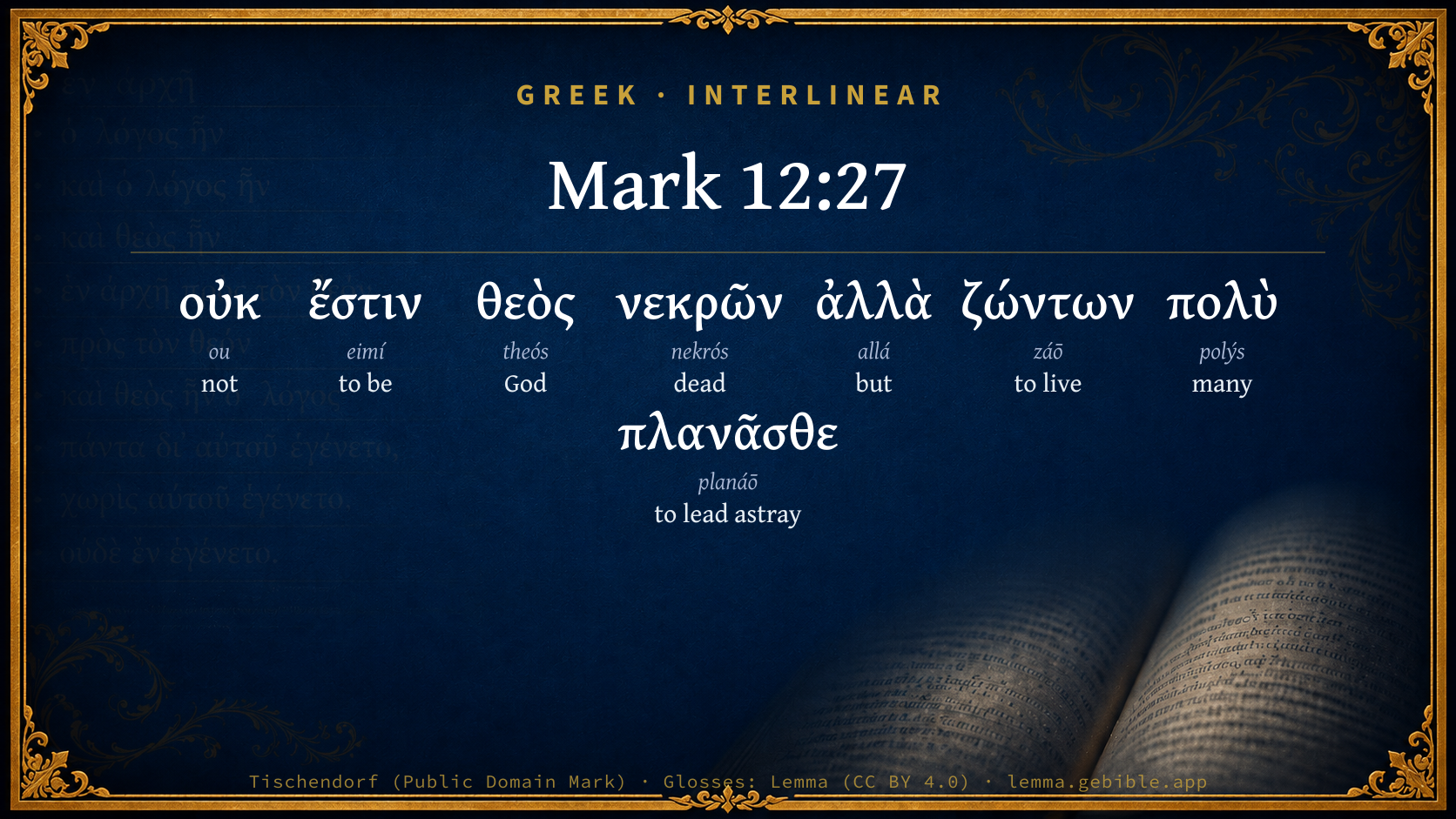
Greek (Tischendorf 8th ed.) Mark 12:27 appears in the Greek New Testament. The text above is from the Tischendorf 8th edition. Each word links to its Strong’s number and a concise gloss. Click any word for its full Thayer’s Greek Lexicon entry.
Download image
Cite this verse

Mark 12:27 (World English Bible). Public Domain. Lemma interlinear Bible study tool, https://lemma.gebible.app/v/mark/12/27.

Show BibTeX & RIS
BibTeX
RIS
English Translation
He is not the God of the dead, but of the living. You are therefore badly mistaken."
World English Bible · Public Domain
Download a study sheet

One document with this verse’s original text, its word-by-word gloss line, the meaning frame, cross-references with their text, attributed commentary, and full source and license credits — printable, and it pastes into notes with its structure intact.

This verse Autodidact and up

Study sheet (.html) Plain text (.txt)

A passage Seminary Student

Up to 50 verses in one chapter. A passage sheet keeps up to 6 commentary sources and 12 cross-references per verse, in the order this page ranks them, and says so on the sheet whenever that leaves anything out. Ask for a single verse and you get the Autodidact verse sheet above.

Everything on this page stays free to read, with no account — the sheet is a download of what is already on screen, not access to it.

Want to remove ads? Support Godless Engineer
Compare translations 3

The same verse in 3 English versions, stacked beneath the original-language interlinear above. Click any original word for its lexicon entry.

Each is an independent rendering of the whole verse — the interlinear is not word-aligned to these translations.

Highlighted words mark where these versions differ — a whole-verse word diff, not a word-by-word alignment.

  • World English Bible Public Domain
    He is not the God of the dead, but of the living. You are therefore badly mistaken."
  • King James Version Public Domain
    He is not the God of the dead, but the God of the living: ye therefore do greatly err.
  • unfoldingWord Literal Text CC BY-SA 4.0
    He is not a God of the dead, but of the living. You are being much deceived.”

unfoldingWord Literal Text — © unfoldingWord, licensed CC BY-SA 4.0. Word-aligned USFM3 via Door43 (git.door43.org/unfoldingWord/en_ult).

Versions to compare (up to 4)

3 of 4 selected

Show all 19 translations

Every available English version of this verse, each an independent rendering of the whole verse.

  • World English Bible Public Domain
    He is not the God of the dead, but of the living. You are therefore badly mistaken."
  • Berean Standard Bible Public Domain
    He is not the God of the dead, but of the living. You are badly mistaken!”
  • Majority Standard Bible Public Domain
    He is not the God of the dead, but the God of the living. Therefore you are badly mistaken!”
  • King James Version Public Domain
    He is not the God of the dead, but the God of the living: ye therefore do greatly err.
  • American Standard Version (1901) Public Domain
    He is not the God of the dead, but of the living: ye do greatly err.
  • Revised Version (1885) Public Domain
    He is not the God of the dead, but of the living: ye do greatly err.
  • Geneva Bible (1599) Public Domain
    God is not ye God of the dead, but the God of the liuing. Ye are therefore greatly deceiued.
  • Douay-Rheims (1899) Public Domain
    He is not the God of the dead, but of the living. You therefore do greatly err.
  • Young's Literal Translation Public Domain
    he is not the God of dead men, but a God of living men; ye then go greatly astray.'
  • Literal Standard Version CC BY-SA 4.0
    He is not the God of dead men, but a God of living men; you then go greatly astray.”
  • Unlocked Literal Bible CC BY-SA 4.0
    He is not the God of the dead, but of the living. You are quite mistaken.”
  • unfoldingWord Literal Text CC BY-SA 4.0
    He is not a God of the dead, but of the living. You are being much deceived.”
  • Darby Bible Public Domain
    He is not the God of [the] dead, but of [the] living. *Ye* therefore greatly err.
  • World Messianic Bible Public Domain
    He is not the God of the dead, but of the living. You are therefore badly mistaken.”
  • Webster's Bible Public Domain
    He is not the God of the dead, but the God of the living: ye therefore do greatly err.
  • Free Bible Version CC BY-SA 4.0
    He's not the God of the dead, but of the living. You are completely mistaken!”
  • Bible in Basic English Public Domain
    He is not the God of the dead, but of the living: you are greatly in error.
  • Text-Critical English NT CC BY 4.0
    He is not the God of the dead, but the God of the living. You have therefore made a serious error.”
  • Tyndale New Testament (1534) Public Domain
    He is not the God of the deed but the God of the livynge. Ye are therfore greatly deceaved.

Literal Standard Version (2020), Covenant Press — licensed CC BY-SA 4.0. Text via the HelloAO Bible API (eBible.org). Unlocked Literal Bible (unfoldingWord) — licensed CC BY-SA 4.0. Text via the HelloAO Bible API (eBible.org). unfoldingWord Literal Text — © unfoldingWord, licensed CC BY-SA 4.0. Word-aligned USFM3 via Door43 (git.door43.org/unfoldingWord/en_ult). Free Bible Version, Dr. Jonathan Gallagher — licensed CC BY-SA 4.0. Text via the HelloAO Bible API (eBible.org).

Word by word

More ways to search: Search by grammar → Find every occurrence → Compare this word →

Practice this passage: Drill this verse → Learn its vocabulary →

πλανᾶσθε
planáō
G4105
“to lead astray”
Verb, Present, Passive, Indicative, 2nd person, Plural
Part of Speech
Verb
Tense
Present
Voice
Passive
Mood
Indicative
Person
2nd person
Number
Plural
Full Thayer's Definition

Origin: from G4106

TDNT: 09:48,9

1. to cause to stray, to lead astray, lead aside from the right way a. to go astray, wander, roam about 2. metaph. a. to lead away from the truth, to lead into error, to deceive b. to be led into error c. to be led aside from the path of virtue, to go astray, sin d. to sever or fall away from the truth 1. of heretics e. to be led away into error and sin
  1. οὐκ ou G3756 “not” Particle, Negative
  2. ἔστιν eimí G1510 “to be” Verb, Present, Active, Indicative, 3rd person, Singular
  3. θεὸς theós G2316 “God” Noun, Nominative, Singular, Masculine
  4. νεκρῶν nekrós G3498 “dead” Adjective, Genitive, Plural, Masculine
  5. ἀλλὰ allá G235 “but” Conjunction
  6. ζώντων záō G2198 “to live” Verb, Present, Active, Participle, Genitive, Plural, Masculine
  7. πολὺ polýs G4183 “many” Adjective, Accusative, Singular, Neuter

About this verse

These counts appear in no published source. They are computed here, from the morphology-tagged text and Lemma’s own curated glosses. What Lemma adds →

8
words
8
distinct lemmas
Gospels
section

Shared distinctive vocabulary

πλανᾶσθε to lead astray G4105 occurs in 37 verses of the Greek New Testament. Also found in:
Cross-references

5

Topical passages linked to Mark 12:27 in the Treasury of Scripture Knowledge — connected by theme and wording, ordered by reader-vote popularity; previews shown in the World English Bible.

  • Romans 14:9 For to this end Christ died, rose, and lived again, that he might be Lord of both the dead and the living.
  • Mark 12:24 Jesus answered them, "Isn't this because you are mistaken, not knowing the Scriptures, nor the power of God?
  • Romans 4:17 As it is written, "I have made you a father of many nations." This is in the presence of him whom he believed: God, who gives life to the dead, and calls the things that are not, as though they were.
  • Hebrews 3:10 Therefore I was displeased with that generation, And said, 'They always err in their heart, But they didn't know my ways;'
  • Hebrews 11:13–16 These all died in faith, not having received the promises, but having seen them and embraced them from afar, and having confessed that they were strangers and pilgrims on the earth.

Cross-references courtesy of OpenBible.info (CC BY 4.0).

Where the printed editions differ

1 variant

Places in this verse where the major printed Greek editions disagree on the wording in a way that affects the translation — a comparison of editions, not a manuscript-by-manuscript collation. The editions are the modern critical texts (Nestlé-Aland 28/27, SBL, Westcott-Hort, Tregelles, Tyndale House) and the traditional texts behind the KJV (the Textus Receptus and the Byzantine/Majority text). It is not a claim about which reading is original.

  1. Extra text
    ὑμεῖς οὖν

    “you yourselves therefore”

    In TregTRByz Not in NA28NA27TynSBLWH

    ὑμεῖς οὖν (humeis oun) 'you yourselves therefore' is only in traditional manuscripts (Treg+TR+Byz)

Textual data: Translators Amalgamated Greek New Testament (STEPBible TAGNT) · CC BY 4.0.

Commentary

Notes on Mark 12:27 from classic Christian and Jewish commentators (each source and its license shown beneath its notes). The classic Christian expositions comment on the surrounding passage and are grouped to its opening verse, so a note may address several verses; the Jewish commentaries on the Tanakh (Rashi and others) are per-verse, so they appear only where the commentator wrote on this verse.

Lemma curates 59 commentaries, every one of them public domain or Creative Commons licensed, each selected and text-cleaned for this edition rather than reprinted as found. About our sources →

The Biblical Illustrator

Joseph S. Exell

Mar_12:18; Mar_12:27

In the resurrection.

More in Scripture than as first appears

These words of Christ show us how much more there is in Scripture than at first sight appears. God spoke to Moses in the bush, and called Himself the God of Abraham; and Christ tells us, that in this simple announcement was contained the promise, that Abraham should rise again from the dead. In truth, if we may say it with reverence, the All-wise All-knowing God cannot speak, without meaning many things at once. He sees the end from the beginning; He understands the numberless connections and relations of all things one with another. Every word of His is full of instruction looking many ways; and, though it is not often given to us to know these various senses, and we are not at liberty to attempt lightly to imagine them, yet, as far as they are told us, and as far as we may reasonably infer them, we must thankfully accept them. (J. H. Newman.)

Christs proof of immortality

Christ raises the question: Could God call Himself Abrahams God if He had permitted his hopes to be disappointed, and his whole life to be dissipated by the touch of death? Whatever we love we seek to keep alive, and, if God loved Abraham, would He let him die? If the Sadducee was right, Abraham was at the time a handful of desert dust in which certainly God could take no peculiar interest. The fact that man can engage the interest of God, speak to Him, enter into covenant with Him; be beloved, embraced, protected by God, is the proof of immortality. Because God lives, he will live also whom God loves. There are many arguments that go to prove immortality, but this is chief, that God loves man, delights in him, and would be Himself bereaved, and spend a desolate eternity, if death robbed Him of the spirits that trust Him. (R. Glover)

.

The error of the Sadducees

1. Knowledge of the Scriptures may be very superficial.

2. Christ shows us how to conduct controversy.

3. Jesus enlarges our thoughts of what life is.

4. We are not to measure the unseen by the seen.

5. We cannot ignore one truth without danger of losing our hold on others.

6. The future life differs from the present

(1) In its constitution;

(2) in its blessedness.

7. A higher existence hereafter suggests the folly of expecting perfection here.

8. Our friends, who sleep in Jesus are not dead. (F. Wagstaff.)

Materialism and the Resurrection

I. The argument. It may be presented in three aspects.

1. After the three patriarchs were dead, and had been in the grave for centuries, God spoke of Himself as their God. If the words assume their then conscious existence as spirits, then it followed

(1) that the negative portion of the system of the Sadducees was destroyed. There are spiritual existences.

2. Supposing they do not exist in a state of consciousness, still God considers Himself as sustaining relations to them; He is their God. This, again, disposes of materialistic Sadduceeism. For God cannot sustain that relationship to what has been annihilated-to what has ceased to be-to nothing.

3. The emphasis may be put on the term God. I am the God, etc. What is it to be God to a being who has a religious nature, is capable of worship and happiness through Divine relations? How had He shown them He was their God? He called, led, educated, tried them, and taught them to rest implicitly on His word. He promised them a wonderful possession. What seemed to be conveyed by the words was never actually enjoyed. Yet they lived in faith, and died in the exercise of this faith-that in bestowing this possession He would prove Himself to be their God. If the Sadducees were right, there was an end of them and of the Divine faithfulness. It was a commencement without a conclusion, a porch without a temple, a beginning of promise without the termination.

II. Now, this subject will cast light upon two others.

1. The manner in which Christ threw light upon the future condition of man. He did not bring life and immortality to light as a new thing. There were indications of it in the ancient Church. He brought out in distinctness, and clearness, and fulness what was involved in mist and fog. Speaking with Divine authority,

(1) He took the affirmative side-always took it: resisted the objectors, threw against them arguments from the power of God, and the Scriptures of God.

(2) He raised men from the dead.

(3) He threw light upon the resurrection-the life of men in glory-long after their bodies had passed away.

(4) Then He illustrated and embodied in His own Person everything He taught. He died, was buried, was raised, was changed, was glorified.

(5) But greatest of all, by His redemptive work He shows how all could be done according to, and in harmony with, the principles of the Divine government, and the perfection of Gods nature.

2. Light is cast upon the state of the pious and holy dead. They live.

Martyred saints committed their spirits to the Lord Jesus.

1. If men choose to live without God here, they will find hereafter that there is a sense in which the actual relation between Him and them has not been destroyed.

2. The dignity and glory of a religious life. They are to be glorious immortals who love God, cherish religious faith, cultivate acquaintance with the infinite, and walk in holy obedience. The character of faithful worshippers is to be perpetuated and become eternal.

3. It is of infinite importance that all possess this Divine faith, and live the real life based upon the truth of God and the Gospel of Christ. (Thomas Binney.)

Immortality and love

I never saw a man that did not believe in the immortality of love when following the body of a loved one to the grave. I have seen men under other circumstances that did not believe in it; but I never saw a man that, when he stood looking upon the form of one that he really loved stretched out for burial, did not revolt from saying, It has all come to that: the hours of sweet companionship; the wondrous interlacings of tropical souls, the joys, the hopes, the trusts, the unutterable yearnings-there they all lie. No man can stand and look in a coffin upon the body of a fellow creature, and remember the flaming intelligence, the blossoming love, the whole range of Divine faculties which so lately animated that cold clay, and say, These have all collapsed and gone. No person can witness the last sad ceremonials which are performed over the remains of a human being-the sealing down of the unopenable lid, the following of the rumbling procession to the place of burial, the letting of the dust down into dust, the falling of the earth upon the hollow coffin, with those sounds that are worse than thunder, and the placing of the green sod over the grave-no person, unless he be a beast, can witness these things, and then turn away and say, I have buried my wife; I have buried my child; I have buried my sister, my brother, my love. (H. W. Beecher.)

A type of the Resurrection

One bright summer day I stood beside a large water butt, watching the insect life which skimmed its surface and the lower forms of life which revelled and rejoiced in its depths. Whilst thus engaged, I saw a little creature, in the shape of a worm, come up with zig-zag course apparently from the bottom of the butt to its surface. There was a little agitation-the shell broke, and a bright and beautiful insect flew away towards heaven. To my apprehension that was the most beautiful type of the resurrection ever beheld, and thus has our gracious God filled all nature with appropriate and instructive emblems of the glorious doctrine of the resurrection. (S. Cocks.)

The Resurrection

In Dr. Browns work on the resurrection, their is a beautiful parable from Halley. The story is of a servant, who, receiving a silver cup from his master, suffers it to fall into a vessel of aquafortis, and, seeing it disappear, contends in argument with a fellow servant that its recovery is impossible, until the master comes on the scene, and infuses salt water, which precipitates the silver from the solution; and then, by melting and hammering the metal, he restores it to its original shape. With this incident a sceptic-one of whose great stumbling blocks was the resurrection-was so struck, that he ultimately renounced his opposition to the gospel, and became a partaker of the Christian hope of immortality. (S. S. Teacher.)

Heaven will reveal itself

John Bunyan was once asked a question about heaven which he could not answer, because the matter was not revealed in the Scriptures; and he thereupon advised the inquirer to live a holy life and go and see. (Christian Age.)

Progressive knowledge of the Bible

It is curious to compare old and new maps, and to mark the progress of discovery. The black space of ocean is followed by a faint outline of a few miles of coast, marking the termination of an intrepid voyage. Then further portions of the same coast are laid down at intervals as supposed islands. Then by and by these portions are connected, and the outline of a great continent begins to be developed. The undiscovered passes into the region of the known and familiar. Thus it is with the Bible. What progress is being made in the discovery of its meaning! How much better acquainted is the Church of Christ now with its spirit, its allusions, its inner and outer history, than the same church during a former period! What a far more true and just idea of the mind of Christ, as manifested in and by the Apostolic Church, have we now than the Church of the fourth and fifth centuries possessed! Distance has increased the magnitude, the extent, the totality, the grandeur in the heaven-kissing mountain range. Individually I find in daily study of the Bible a daily discovery. What was formerly unknown becomes known, and what seemed a solitary coast becomes a part of a great whole, and what seemed wild and strange and lonely becomes to me green pasture and refreshing water-the abode of my fireside affections. And surely I shall read the Bible as an alphabet in heaven. It was my first school book here, and I hope it will be my first there. What I shall I never know the Spirit which moves the wheels, whose rims are so high that they are dreadful? The only true theory of development is the development of the spiritual eye for the reception of that light which ever shineth. (Norman Macleod, D. D.)

Our knowledge of the future state imperfect

Whatever correct ideas we have about the heavenly state, are of course derived from the revelation God has made. And yet from the very nature of the subject our ideas must necessarily be vague, and perhaps even incorrect. The information may be, and doubtless is, the very best God could give us; but the unsatisfactoriness of it clearly remains, just because the subject is so far beyond our present attainments and conceptions. It is like talking of the higher mathematics to a child who has only begun to comprehend the simplest relations of numbers, and to whom the multiplication table is an Ultima Thule. (Christian World Pulpit.)

Like the angels

The children of God, in the resurrection, our Saviour says, shall be equal to the angels; or, perhaps, more properly, they shall be like the angels in attributes, station, and employments. Like the angels, they will possess endless youth, activity, power, knowledge, and holiness; enjoy the same immortal happiness, dignity, and Divine favour; be lovely, beautiful, and glorious in the sight of God, and shine forth as the sun in the kingdom of their Father. Like the angels, shall they be sons, and kings, and priests to God, and live and reign with Him forever and ever. (Pres. Dwight.)

Individual relation to God

In our mysterious being we have a double existence; we are part of a body, and God deals with men collectively as communities: yet also we are as much single spirits as if we were alone in the world, each running separately and apart its individual course. To teach men from the first the awful, the difficult truth, that they have each of them a soul-this was the meaning of that discipline of Abraham and the Patriarchs; and the whole history has shown how necessary it was. The visible world is all about us, early and late, wrapping us around, occupying eye and thought and desire; we seem to belong to it, and to it alone; it seems as if we must take our chance with it. And, on the other hand, we know how easily men come to think that being one of a body-even though it were the seed of Abraham, or the Church of Christ-made it less necessary to remember their personal singleness, their personal responsibility. To belong to a good set, to a religions family, seems to give us a security for ourselves; insensibly, perhaps, we take to ourselves credit for the goodness of our friends, we look at ourselves as if we must be what they are. The soul has indeed to think and to work with others and for others, and for great aims and purposes, out of and beyond itself. For others, and with others, the best parts of its earthly work is done. But first, the soul has to know that sublime truth about itself: that it stands before the Everlasting by itself, and for what it is. Abraham learned it, like Moses, like Elijah, like Isaiah, like St. Paul: in Job and the Psalter we see the early fruits of that discipline. The soul knew itself alone with God; no words could tell the incommunicable secret of the presence of God; and in that secret was wrapped up the seed of its conviction of its mysterious immortality-God is not the God of the dead, but of the living. This is the first lesson of the masters of the spiritual life. This is the first opening of the eyes to the reality of religion, when it comes upon us in our heart of hearts, in the deep certainties of conscience, that in spite of all that fills the eye and is not ourselves, there is ourself and there is God; and we begin by degrees, as it has been said, to perceive that there are but two beings in the whole universe-two only supreme and luminously self- evident beings-our own soul, and the God who made it. (Dean Church.)

As the angels.-

Employment in heaven

What shall we do in heaven? Well, our employments will accord with our state and disposition. Some one of you may perhaps be an artist. Now to paint a fine picture to hang upon somebodys wall on earth is accounted a great thing. Pooh! In heaven, your canvas shall be a soul, and your picture a loving spirit which under your guidance shall become a being of grace and beauty for evermore. On earth, an artist generally paints to make himself a name and earn both money and glory, but in heaven the object and aim of an artist shall be, Oh, that I might train this soul to be like Christ! Oh, that my work might glorify God! Someone else here may, I think, be an architect in heaven, not with bricks, stone, mortar, ladders, and rubbish. No; you build houses here; there you shall build human souls into angels. If life in heaven is to be as the angels, we have the joy of knowing that useful and congenial occupation will be our lot. (W. Birch.)

Congenial occupation in heaven

A lad, who served as a milk vendor, stood one day in Antwerp cathedral before the glorious picture by Rubens of the bringing down of Christ from the cross. The boy drank in all the beauty of the painting as if it were a thing of life; and it seemed as if the hunger in his soul were satisfied while he gazed upon the marvellous glory of that scene. At length, he turned away with a sigh in his heart, but a light in his eye, saying, I, also, have in me the soul of a painter! But he was only a poor boy, who went with a dog and a little cart carrying milk cans from the country to the people of Antwerp. In his soul he said, I in soul am an artist! But he had to go back to his dog and cart and milk cans, and that sort of humdrum work continued to be his daily employment, until having lost his living through a false accusation, and he and his dog being refused bread, they wandered up and down in the cold of the winter until one day they found themselves weary and starving at the door of the cathedral. The poor boy, with the soul of an artist, followed by his dog, more faithful to him than men and women, walked up the grand aisle of the cathedral, and stood before the glorious picture of Christ. Being weary, he lay down, when the poor dog crouched close to his starving master to warm him, and the boy kissed the head of the faithful beast and fixed his eyes on the sacred canvas. In the morning, the people found a boy and dog both dead, and clasped together. He had the soul of a painter, but he was poor and cold and hungry, yet he died feeling the love of his dog and beholding the picture whose glory had inspired his soul. And the people wept, and mourned over the poor boy whose circumstances had prevented the realization of his hearts desire. In the other world there will be no obstruction to lawful desires, and the possibilities of the human heart shall be granted. Every one of us shall have our opportunity of congenial employment. That which is within the soul and forms our real nature shall come out and have an opportunity of being employed in the service of God and mankind. A man with a musical soul one day went into a shop where he saw a beautiful violin for sale, and with all the money he had, he bought it. He came exultingly out of the shop the possessor of the glorious instrument. Then somebody said to him, My friend, where is the bow? He had the fiddle, but he had no bow. In a corresponding way, many of you have the violin in your nature, the capacity for harmony, but circumstances are against you; you cannot realize your earnest resolves because there is something wanting, You were meant to be a poet, and yet are, perhaps, a brick setter; or you were made to be an artist, and may be only a chimney sweep; or you may have the instincts of an engineer, and yet are probably chained to a desk in some dingy office, or may be a shoemaker sitting at a stall all day mending boots. These are some of the disciplinary contradictions of this life, where round people are continually found in square holes, and square people in round holes. But in the better land all these odds shall be made even, and an opportunity given to everyone to bring out that which God has put within us, and we shall be and do that which harmonizes with our angelic nature and inclination. (W. Birch.)

Leisure in heaven

Most earnest men are too busy in this world to find time to really live and know themselves. They are too much engrossed in the maddening maze of things to watch and pray and practise self-examination. They are like a steamer which is of excellent build and power of speed, and which is so profitable to its owners that they send it about from port to port and never put it into harbour to survey and restore it; and at length when stress of weather comes, the beautiful, powerful steamer gives way and sinks. Thousands of business men are like that steamer; they perish for want of overhauling and renovation. They are too busy to think of God, and death, and judgment. They are too busy to do a good deed in any way except putting their hand into their pocket to give something to a charitable institution, or throwing a copper to some unfortunate beggar. In the other world these over busy men will bare time to think of God and of themselves. The life of the other world will without doubt be progressive. Progress or development is the law of creation. There is progress on earth, and there will be progress in heaven. Your life is to be as a pure river which cannot be defiled or overshadowed by evil. We shall have to learn to forgive, learn to be pure, learn to be loving, learn to be kind. Have you learned these things on earth? Not fully; but you are trying to learn them; if so, you shall be as the angels and finish your education in heaven. There has been only One who went perfect into heaven. That perfect being was Jesus, and He has promised that His Spirit shall be with everyone who desires to follow Him. (W. Birch.)

The Biblical Illustrator, edited by Joseph S. Exell (c. 1880s–1900s) — public domain. Text from a community e-Sword module.

Bengel's Gnomon

Johann Albrecht Bengel

Mar 12:27. Οὐκ ἔστιν ὁ Θεὸς νεκρῶν, ἀλλὰ ζώντων) This is a reading midway between the extremes.[2] Starting from it, some have repeated Θεὸς before νεκρῶν, others after ἀλλὰ.—[ὑμεῖς οὖν, ye therefore) viz. ye Sadducees, the doctrine of the resurrection is the primary one.—V. g.]—πολὺ greatly) An antithesis to this follows at Mar 12:34, not far [from the kingdom of God].

[2] The margin of Ed. 2 supports this reading, as also the Germ. Vers., although the larger Ed. does not approve of it.—E. B.

BDLΔ omit the ὁ before Θεος. A supports it, as does the Rec. Text. Orig. in different passages gives it differently. ABCDabc Vulg. Orig. 3, 829; 4, 69; 341 omit the θεὸς, inserted in Rec. Text before ζὼντων without any adequate authority.—ED. and TRANSL.

Bengel's Gnomon of the New Testament — English translation (T&T Clark, Edinburgh, 1860) — public domain. Text from a community e-Sword module.

Expositor's Greek Testament

ed. W. Robertson Nicoll

Mar 12:27 . πολὺ πλανᾶσθε , much ye err. This new and final assertion of ignorance is very impressive; severe, but kindly; much weakened by adding ὑμεῖς οὖν .

The Expositor's Greek Testament, edited by W. Robertson Nicoll (1897–1910) — public domain. Text from a community e-Sword module.

Adam Clarke's Commentary

Verse 27. But the God of the living] θεος, God, is left out by ABCDKL, and in more than forty others, Syriac, one Arabic, one Persic, Coptic, Armenian, Gothic, Saxon, Vulgate, Itala, and Origen. Griesbach has omitted it.

Adam Clarke's Commentary on the Bible (1810–1826) — public domain. Text from a community e-Sword/MySword module.

The Cambridge Bible for Schools and Colleges

gen. ed. J. J. S. Perowne

27. He is not the God of the dead] Our Lord thus taught them that the words implied far more than that God was the God, in Whom Abraham and the patriarchs trusted and worshipped.

but the God of the living] Jehovah could not have called Himself the God of persons who do not exist, and over whom death had completely triumphed. The patriarchs, therefore, though their bodies were dead, must themselves have been still living in the separate state, and awaiting the resurrection.

The Cambridge Bible for Schools and Colleges (gen. ed. J. J. S. Perowne; Cambridge University Press, 1878–1918) — public domain. Text from a community e-Sword module.

John Gill's Exposition

Jesus answered him, the first of all the commandments is,.... Christ replied at once, without taking any time to consider of it, that the chief and principal of all the commands of the law, and what is of the greatest importance is,

hear, O Israel, the Lord our God is one Lord. The Vulgate Latin, and Arabic versions read, "one God"; but the Syriac, and Ethiopic render it, "one Lord"; and that rightly, agreeably to the Greek text, and to Deu 6:4, from whence this is taken. This passage of Scripture, to the end of the ninth verse, is the first of the sections which were put into their phylacteries; See Gill on Mat 23:5; and was repeated twice every day, morning and evening; which is by the Jews called from the first word , "the reading of the Shema": concerning the exact time of the reciting of this, morning and evening, and of the posture in which they do it, reclining in the evening, and standing in the morning, and of the prayers before and after it, various rules are given in their Misna (p), or oral law; it is a precept of great esteem and veneration with them, and attended to with much solemnity. The account Maimonides (q) gives of it is this:

"twice every day they read Keriath Shema; (i.e. "hear, O Israel", &c.) in the evening and in morning, as it is said, Deu 6:7. "When thou liest down, and when thou risest up"; in the hour it is the custom of men to lie down, and this is night; and in the hour it is the custom of men to stand, and this is day: and what does he read? three sections; and they are these, "hear", &c. Deu 6:4, and it shall come to pass, "if ye shall hearken", &c. Deu 11:13, "and Moses said", &c. Exo 13:3, and they read the section, "hear, O Israel", first, because there is in it the unity of God, and the love of him and his doctrine; for it is, , "the great root", or "foundation", on which all hangs or depends.''

And it is observable, that the last letter of the word "hear", and the last of the word "one", are both written in very large characters in the Hebrew Bible, to denote the greatness of the command, and to cause attention to it. The Jews seek for mysteries in these letters, and think the unusual size of them, points at some very great things: they observe, that the first of these letters is numerically "seventy", and directs to the seventy names of the law, and the seventy ways in which it may be interpreted, and the seventy nations of the world, from whom the Israelites are distinguished, by their belief of the one God (r); and that the latter stands for the number "four", and shows that the Lord is the one God, in heaven and in earth, in all the world, and in the four parts of it; and that both these letters put together, make a word, which signifies "a witness"; showing that this passage is a glorious testimony of the unity of God, and that the Israelites are witnesses of it, by believing and professing it; and that should they depart from the faith of it, God would be a witness against them: and now, though there is no solid foundation for such interpretations, yet this shows what an opinion they had of the greatness of this command; to which, may be added, they ask (s),

"why does, "hear, O Israel", &c. go before that passage in Deu 11:13. "And it shall come to pass, if ye shall hearken diligently unto my commandments", &c. but because a man must take upon him, first the yoke of the kingdom of heaven, and after that he must take upon him the yoke of the commandments.''

The sense is, that he must first make a confession of his faith in God, which is contained in Deu 6:4 and then he must obey his commands; so that they plainly considered this, as the first and greatest of all. These words are frequent in the mouths of the modern Jews, in proof of the unity of God, and against a plurality in the Deity; but the ancient ones, not only consider them as a good and sufficient proof, that there is but one God, but as expressive of a Trinity in the Godhead: with a view to this text they observe (t), that

"Jehovah, "our God, Jehovah"; these are, , "three degrees" (or persons) with respect to this sublime mystery, "in the beginning, God", or "Elohim, created", &c.''

And again (u),

"there is an unity which is called Jehovah the first, our God, Jehovah; behold! they are all one, and therefore called one: lo! these three names are as one; and although we call them one, and they are one; but by the revelation of the Holy Ghost it is made known, and they are by the sight of the eye to be known, that "these three are one", (see Jo1 5:7,) and this is the mystery of the voice that is heard; the voice is one; and there are three things, fire, and wind, and water, and they are all one, in the mystery of the voice, and they are not but one: so here, Jehovah, our God, Jehovah, these, , "three modes, forms", or "things", are one.''

Once more they (w) say,

"there are two, and one is joined to them, and they are three; and when they are three, they are one: these are the two names of hear, O Israel, which are Jehovah, Jehovah, and Elohenu, or our God, is joined unto them; and it is the seal of the ring of truth.''

To which I shall subjoin one passage more, where R. Eliezer is asking his father R. Simeon ben Jochai, why Jehovah is sometimes called Elohim, he replies (x), among other things;

"come see, there are "three degrees", (or persons,) and every degree is by itself; although they are all one, and bound together in one, and one is not separated from another.''

To believe this, is the first and chief commandment in the law, and is the principal article of the Christian faith; namely, to believe that there is one God, and that there are three persons, Father, Son, and Spirit, in the Godhead.

(p) Berncot, c. 1. sect. 1, 2, 3, 4. (q) Hilch. Keriat Shema, c. 1. sect. 1, 2. (r) Baal Hatturim, in Deut. vi. 4. (s) Misn. Berncot, c. 2. sect. 2. (t) Zohar in Gen. fol. 1. 3. (u) Zohar in Exod. fol. 18. 3, 4. (w) Ib. in Num. fol. 67. 3. (x) Zohar in Lev. fol. 27. 2.

John Gill's Exposition of the Whole Bible (1746–1763) — public domain (CC PDM 1.0). Text via the HelloAO Bible API.

Trapp's Complete Commentary

John Trapp

27 He is not the God of the dead, but the God of the living: ye therefore do greatly err.

Ver. 27. {See Trapp on "Mat 22:32"}

John Trapp, A Commentary or Exposition upon All the Books of the Old and New Testament (1647–1656) — public domain. Text from a community e-Sword module.

The Pulpit Commentary

Ye therefore do greatly err. The Greek is, omitting the oun , simply umeiv polu planasye , Ye greatly err. The omission is more consistent with St. Mark"s usual style. The Sadducees entirely misunderstood the meaning of their own Scriptures.

The Pulpit Commentary (1880–1919), ed. H.D.M. Spence-Jones & Joseph S. Exell — public domain. Text from a community e-Sword module.

John Wesley's Explanatory Notes

He is not the God of the dead, but the God of the living - That is, (if the argument be proposed at length, ) since the character of his being the God of any persons, plainly intimates a relation to them, not as dead, but as living; and since he cannot be said to be at present their God at all, if they are utterly dead; nor to be the God of human persons, such as Abraham, Isaac, and Jacob, consisting of souls and bodies, if their bodies were to abide in everlasting death; there must needs be a future state of blessedness, and a resurrection of the body to share with the soul in it.

John Wesley, Explanatory Notes Upon the Whole Bible (1754–1765) — public domain. Text via the GEBible commentary corpus.

Cambridge Greek Testament for Schools and Colleges

27. [2764][2765][2766][2767][2768][2769][2770] omit θεός. [2771][2772][2773][2774][2775] omit ὑμεῖς οὖν.

[2764] Codex Sinaiticus. 4th cent. Discovered by Tischendorf in 1859 at the Monastery of St Katharine on Mount Sinai. Now at St Petersburg. The whole Gospel, ending at Mar 16:8. Photographic facsimile, 1911.

[2765] Codex Alexandrinus. 5th cent. Brought by Cyril Lucar, Patriarch of Constantinople, from Alexandria, and afterwards presented by him to King Charles I. in 1628. In the British Museum. The whole Gospel. Photographic facsimile, 1879.

[2766] Codex Vaticanus. 4th cent., but perhaps a little later than א. In the Vatican Library almost since its foundation by Pope Nicolas V., and one of its greatest treasures. The whole Gospel, ending at Mar 16:8. Photographic facsimile, 1889.

[2767] Codex Ephraemi. 5th cent. A palimpsest: the original writing has been partially rubbed out, and the works of Ephraem the Syrian have been written over it; but a great deal of the original writing has been recovered; of Mark we have Mar 1:17 to Mar 6:31, Mar 8:5 to Mar 12:29, Mar 13:19 to Mar 16:20. In the National Library at Paris.

[2768] Codex Bezae. 6th cent. Has a Latin translation (d) side by side with the Greek text, and the two do not quite always agree. Presented by Beza to the University Library of Cambridge in 1581. Remarkable for its frequent divergences from other texts. Contains Mark, except Mar 16:15-20, which has been added by a later hand. Photographic facsimile, 1899.

[2769] Codex Regius. 8th cent. An important witness. At Paris. Contains Mar 1:1 to Mar 10:15; Mar 10:30 to Mar 15:1; Mar 15:20 to Mar 16:20, but the shorter ending is inserted between Mar 16:8 and Mar 16:9, showing that the scribe preferred it to the longer one.

[2770] Codex Sangallensis. 9th or 10th cent. Contains the Gospels nearly complete, with an interlinear Latin translation. The text of Mark is specially good, agreeing often with CL. At St Gall.

[2771] Codex Sinaiticus. 4th cent. Discovered by Tischendorf in 1859 at the Monastery of St Katharine on Mount Sinai. Now at St Petersburg. The whole Gospel, ending at Mar 16:8. Photographic facsimile, 1911.

[2772] Codex Vaticanus. 4th cent., but perhaps a little later than א. In the Vatican Library almost since its foundation by Pope Nicolas V., and one of its greatest treasures. The whole Gospel, ending at Mar 16:8. Photographic facsimile, 1889.

[2773] Codex Ephraemi. 5th cent. A palimpsest: the original writing has been partially rubbed out, and the works of Ephraem the Syrian have been written over it; but a great deal of the original writing has been recovered; of Mark we have Mar 1:17 to Mar 6:31, Mar 8:5 to Mar 12:29, Mar 13:19 to Mar 16:20. In the National Library at Paris.

[2774] Codex Regius. 8th cent. An important witness. At Paris. Contains Mar 1:1 to Mar 10:15; Mar 10:30 to Mar 15:1; Mar 15:20 to Mar 16:20, but the shorter ending is inserted between Mar 16:8 and Mar 16:9, showing that the scribe preferred it to the longer one.

[2775] Codex Sangallensis. 9th or 10th cent. Contains the Gospels nearly complete, with an interlinear Latin translation. The text of Mark is specially good, agreeing often with CL. At St Gall.

27. πολὺ πλανᾶσθε. See crit. note. Mk alone has this. The terse abruptness is characteristic of his preservation of the original manner of utterance; ye go greatly astray. Cf. Mar 1:27, Mar 4:40, Mar 9:23, Mar 10:14; Mar 10:18. Religion, the bond between God and man, is indeed a poor ting, if man’s existence ends with death. Ceux qui ont vécu pour Dieu ne peuvent jamais être morts pour lui (Loisy).

Cambridge Greek Testament for Schools and Colleges (Cambridge University Press, 1896; 21 vols, various authors incl. Carr, Maclear, Plummer, Farrar, Lumby, Moule, M. R. James, Simcox) — public domain. Text from a community e-Sword module.

International Critical Commentary

27. Οὐκ ἔστιν Θεὸς νεκρῶν ἀλλὰ ζώντων—Without the art., Θεὸς becomes the pred., not the subj., and νεκρῶν is also anarthrous, so that it reads, He is not a God of dead men, but of living.

As this is commonly explained, it is made to hinge on the use of the present, instead of the past. The statement is, he is their God, not he was; and hence, they are still living. But this is a non sequitur, since it is a common expression in regard to both dead and living, and would be taken in the same sense, or used in the same sense, by either Pharisees or Sadducees. But it follows from the nature of God that, when he calls himself the God of any people, certain things are implied in the statement about these people, e.g. that they are righteous, not sinners; blessed, not wretched; and here living, not dead. That is, immortality may be inferred from the nature of God himself in the case of those whom he calls his. But Jesus applies it to the resurrection of the dead generally, and not simply of the righteous dead. What the Sadducees denied was the possibility of the resurrection on materialistic grounds; at the basis of their denial of the resurrection was the other denial of spiritual being.1 But Jesus proves the possibility of the resurrection by examples.2 Notice that Jesus does not reveal the fact of the resurrection, but argues it from acknowledged premises. Given, he says, the fact of God, and the resurrection follows. He recognizes the rational ground of immortality. And what is of more importance, he recognizes the validity of our intuition about God. We can say that certain things may be assumed about him on first principles.

Omit ὁ before Θεὸς, Treg. WH. RV. BDKLM marg. ΔΠ. Omit Θεὸς before ζώντων, Tisch. Treg. WH. RV. א ABCDFKLM marg. UX ΔΠ Latt. Egyptt. Pesh.

πολὺ πλανᾶσθε—you make a great mistake. This concise statement at the close makes an abrupt, but for that reason, forcible ending of the conversation.

Omit ὑμεῖς οὖν, you therefore, Tisch. Treg. WH. RV. א BCL Δ one ms. Lat. Vet. Memph.

A SCRIBE QUESTIONS JESUS CONCERNING THE FIRST COMMANDMENT

International Critical Commentary — older volumes (1896–1929), various authors — public domain. Text from a community e-Sword module.

Vincent's Word Studies in the New Testament

Marvin R. Vincent

Ye do greatly err. An emphatic close, peculiar to Mark.

Marvin R. Vincent, Word Studies in the New Testament (1887–1900) — public domain. Text from a community e-Sword/MySword module.

Lesson kit

Teaching starters — assembled from the data on this page, not authored interpretation. Every prompt links to the verse data it draws on. Edit before teaching.

Mark, in the Gospels, opens this verse with 8 words (8 distinct Greek lemmas). Its most distinctive word is planáō (“to lead astray”). A historical commentator’s framing appears above. Read the whole chapter for the surrounding context.

Discussion questions

  1. How does “to lead astray” (planáō) shape what this verse is saying?
  2. How does Matthew 18:12, which shares the word «to lead astray», read alongside this verse?
  3. The translations on this page render this verse differently — a whole-verse word diff, not a word-by-word alignment. What might account for the different wordings?
  4. Compare how The Biblical Illustrator and Bengel's Gnomon read this verse. Where do they agree or differ?

Things to notice

Reading settings

Reading text

Shown beneath each verse's original-language words.

Old Testament
Old Testament edition

Read the OT as the Masoretic Hebrew (MT) or the Greek Septuagint (LXX).

English shown for the Greek Septuagint (in the Hebrew ↔ Greek comparison).

Comparing translations? Open the Compare panel on any verse page to stack up to four side by side.