Mark 13:26

Greek (Tischendorf 8th ed.) Mark 13:26 appears in the Greek New Testament. The text above is from the Tischendorf 8th edition. Each word links to its Strong’s number and a concise gloss. Click any word for its full Thayer’s Greek Lexicon entry.
Download image
Cite this verse

Mark 13:26 (World English Bible). Public Domain. Lemma interlinear Bible study tool, https://lemma.gebible.app/v/mark/13/26.

Show BibTeX & RIS
BibTeX
RIS
English Translation
Then they will see the Son of Man coming in clouds with great power and glory.
World English Bible · Public Domain
Download a study sheet

One document with this verse’s original text, its word-by-word gloss line, the meaning frame, cross-references with their text, attributed commentary, and full source and license credits — printable, and it pastes into notes with its structure intact.

This verse Autodidact and up

Study sheet (.html) Plain text (.txt)

A passage Seminary Student

Up to 50 verses in one chapter. A passage sheet keeps up to 6 commentary sources and 12 cross-references per verse, in the order this page ranks them, and says so on the sheet whenever that leaves anything out. Ask for a single verse and you get the Autodidact verse sheet above.

Everything on this page stays free to read, with no account — the sheet is a download of what is already on screen, not access to it.

Want to remove ads? Support Godless Engineer
Compare translations 3

The same verse in 3 English versions, stacked beneath the original-language interlinear above. Click any original word for its lexicon entry.

Each is an independent rendering of the whole verse — the interlinear is not word-aligned to these translations.

Highlighted words mark where these versions differ — a whole-verse word diff, not a word-by-word alignment.

  • World English Bible Public Domain
    Then they will see the Son of Man coming in clouds with great power and glory.
  • King James Version Public Domain
    And then shall they see the Son of man coming in the clouds with great power and glory.
  • unfoldingWord Literal Text CC BY-SA 4.0
    And then they will see the Son of Man coming in clouds with much power and glory.

unfoldingWord Literal Text — © unfoldingWord, licensed CC BY-SA 4.0. Word-aligned USFM3 via Door43 (git.door43.org/unfoldingWord/en_ult).

Versions to compare (up to 4)

3 of 4 selected

Show all 19 translations

Every available English version of this verse, each an independent rendering of the whole verse.

  • World English Bible Public Domain
    Then they will see the Son of Man coming in clouds with great power and glory.
  • Berean Standard Bible Public Domain
    At that time they will see the Son of Man coming in the clouds with great power and glory.
  • Majority Standard Bible Public Domain
    At that time they will see the Son of Man coming in the clouds with great power and glory.
  • King James Version Public Domain
    And then shall they see the Son of man coming in the clouds with great power and glory.
  • American Standard Version (1901) Public Domain
    And then shall they see the Son of man coming in clouds with great power and glory.
  • Revised Version (1885) Public Domain
    And then shall they see the Son of man coming in clouds with great power and glory.
  • Geneva Bible (1599) Public Domain
    And then shall they see the Sonne of man comming in ye cloudes, with great power and glory.
  • Douay-Rheims (1899) Public Domain
    And then shall they see the Son of man coming in the clouds, with great power and glory.
  • Young's Literal Translation Public Domain
    `And then they shall see the Son of Man coming in clouds with much power and glory,
  • Literal Standard Version CC BY-SA 4.0
    And then they will see the Son of Man coming in clouds with much power and glory,
  • Unlocked Literal Bible CC BY-SA 4.0
    Then they will see the Son of Man coming in the clouds with great power and glory.
  • unfoldingWord Literal Text CC BY-SA 4.0
    And then they will see the Son of Man coming in clouds with much power and glory.
  • Darby Bible Public Domain
    and then shall they see the Son of man coming in clouds with great power and glory;
  • World Messianic Bible Public Domain
    Then they will see the Son of Man coming in clouds with great power and glory.
  • Webster's Bible Public Domain
    And then they shall see the Son of man coming in the clouds with great power and glory.
  • Free Bible Version CC BY-SA 4.0
    Then they will see the Son of man as he comes on the clouds, possessing great power and glory.
  • Bible in Basic English Public Domain
    And then they will see the Son of man coming in clouds with great power and glory.
  • Text-Critical English NT CC BY 4.0
    Then people will see the Son of Man coming in the clouds with great power and glory.
  • Tyndale New Testament (1534) Public Domain
    And then shall they se the sonne of man comynge in the cloudes with greate power and glory.

Literal Standard Version (2020), Covenant Press — licensed CC BY-SA 4.0. Text via the HelloAO Bible API (eBible.org). Unlocked Literal Bible (unfoldingWord) — licensed CC BY-SA 4.0. Text via the HelloAO Bible API (eBible.org). unfoldingWord Literal Text — © unfoldingWord, licensed CC BY-SA 4.0. Word-aligned USFM3 via Door43 (git.door43.org/unfoldingWord/en_ult). Free Bible Version, Dr. Jonathan Gallagher — licensed CC BY-SA 4.0. Text via the HelloAO Bible API (eBible.org).

Word by word

More ways to search: Search by grammar → Find every occurrence → Compare this word →

Practice this passage: Drill this verse → Learn its vocabulary →

νεφέλαις
nephélē
G3507
“cloud”
Noun, Dative, Plural, Feminine
Part of Speech
Noun
Case
Dative
Number
Plural
Gender
Feminine
Full Thayer's Definition

Origin: from G3509

TDNT: 19:02,6

1. a cloud a. used of the cloud which led the Israelites in the wilderness
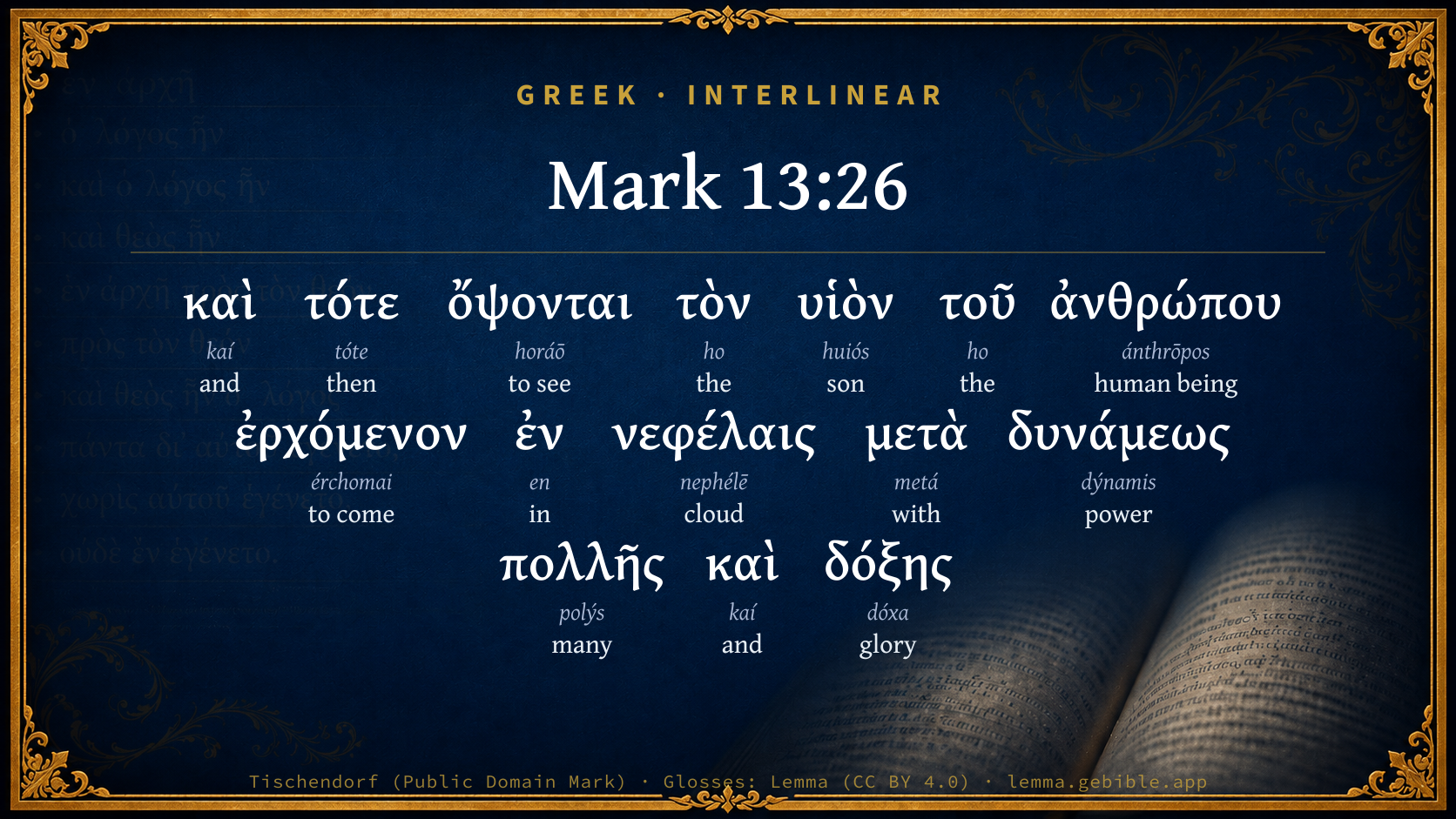
  1. καὶ kaí G2532 “and” Conjunction
  2. τότε tóte G5119 “then” Adverb
  3. ὄψονται horáō G3708 “to see” Verb, Future, Middle deponent, Indicative, 3rd person, Plural
  4. τὸν ho G3588 “the” Article, Accusative, Singular, Masculine
  5. υἱὸν huiós G5207 “son” Noun, Accusative, Singular, Masculine
  6. τοῦ ho G3588 “the” Article, Genitive, Singular, Masculine
  7. ἀνθρώπου ánthrōpos G444 “human being” Noun, Genitive, Singular, Masculine
  8. ἐρχόμενον érchomai G2064 “to come” Verb, Present, Middle or Passive deponent, Participle, Accusative, Singular, Masculine
  9. ἐν en G1722 “in” Preposition
  10. μετὰ metá G3326 “with” Preposition
  11. δυνάμεως dýnamis G1411 “power” Noun, Genitive, Singular, Feminine
  12. πολλῆς polýs G4183 “many” Adjective, Genitive, Singular, Feminine
  13. καὶ kaí G2532 “and” Conjunction
  14. δόξης dóxa G1391 “glory” Noun, Genitive, Singular, Feminine

About this verse

These counts appear in no published source. They are computed here, from the morphology-tagged text and Lemma’s own curated glosses. What Lemma adds →

15
words
13
distinct lemmas
Gospels
section

Notable vocabulary

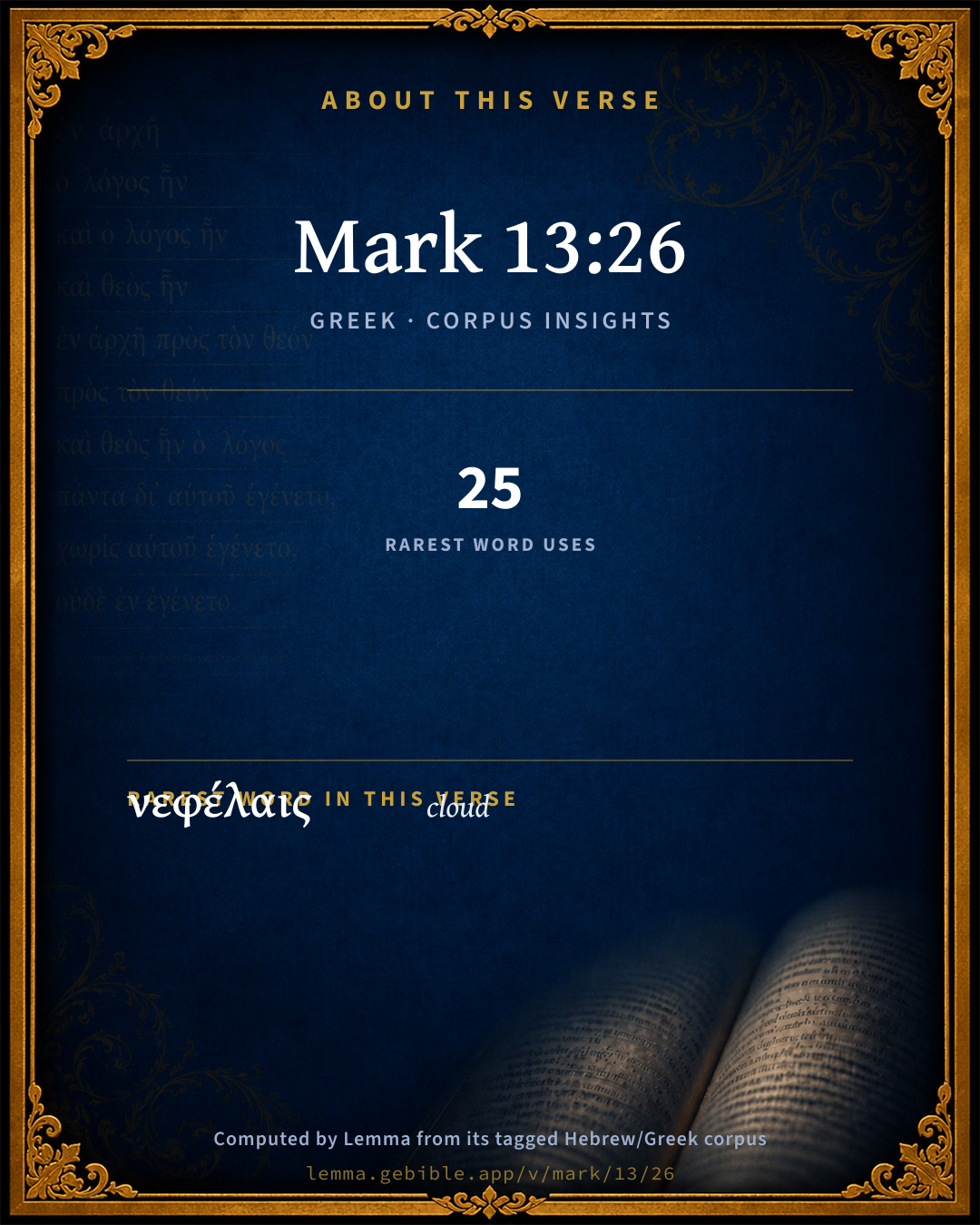
The rarest word here is νεφέλαις cloud G3507 — appearing just 25 times in the whole Greek New Testament.

Shared distinctive vocabulary

νεφέλαις cloud G3507 occurs in 21 verses of the Greek New Testament. Also found in:

Repetition

Words recur within this verse:

Cross-references

11

Topical passages linked to Mark 13:26 in the Treasury of Scripture Knowledge — connected by theme and wording, ordered by reader-vote popularity; previews shown in the World English Bible.

  • Revelation 1:7 Behold, he is coming with the clouds, and every eye will see him, including those who pierced him. All the tribes of the earth will mourn over him. Even so, Amen.
  • Matthew 16:27 For the Son of Man will come in the glory of his Father with his angels, and then he will render to everyone according to his deeds.
  • Matthew 24:30 and then the sign of the Son of Man will appear in the sky. Then all the tribes of the earth will mourn, and they will see the Son of Man coming on the clouds of the sky with power and great glory.
  • Mark 14:62 Jesus said, "I AM. You will see the Son of Man sitting at the right hand of Power, and coming with the clouds of the sky."
  • Matthew 25:31 "But when the Son of Man comes in his glory, and all the holy angels with him, then he will sit on the throne of his glory.
  • Daniel 7:9–14 I saw until thrones were placed, and one who was ancient of days sat: his clothing was white as snow, and the hair of his head like pure wool; his throne was fiery flames, [and] the wheels of it burning fire.
  • Mark 8:38 For whoever will be ashamed of me and of my words in this adulterous and sinful generation, the Son of Man also will be ashamed of him, when he comes in the glory of his Father with the holy angels."
  • Acts 1:11 who also said, "You men of Galilee, why do you stand looking into the sky? This Jesus, who was received up from you into the sky will come back in the same way as you saw him going into the sky."
  • 1 Thessalonians 4:16 For the Lord himself will descend from heaven with a shout, with the voice of the archangel, and with God's trumpet. The dead in Christ will rise first,
  • 2 Thessalonians 1:7–10 and to give relief to you that are afflicted with us, when the Lord Jesus is revealed from heaven with his mighty angels in flaming fire,
  • Matthew 16:17 Jesus answered him, "Blessed are you, Simon Bar Jonah, for flesh and blood has not revealed this to you, but my Father who is in heaven.

Cross-references courtesy of OpenBible.info (CC BY 4.0).

Commentary

Notes on Mark 13:26 from classic Christian and Jewish commentators (each source and its license shown beneath its notes). The classic Christian expositions comment on the surrounding passage and are grouped to its opening verse, so a note may address several verses; the Jewish commentaries on the Tanakh (Rashi and others) are per-verse, so they appear only where the commentator wrote on this verse.

Lemma curates 59 commentaries, every one of them public domain or Creative Commons licensed, each selected and text-cleaned for this edition rather than reprinted as found. About our sources →

The Biblical Illustrator

Joseph S. Exell

Mar_13:26

The Son of Man coming in the clouds.

Christs second advent

It has been as much a hope as a fear in all religions of men that there would be a verdict which would on the one hand bring forth mens righteousness as the light, and on the other change their pride in sin to shame. For a new start the great thing to be longed for is that all men and things might find their proper level; the evil, its rebuke and penalty; the good, its crown and its reward. Therefore there will be a judgment, and Christ will be the Judge. Through Him the worlds were made; through Him salvation wrought; and through Him judgment will be executed. We think too little of that day whose glory pales the sun, and of the fact that many things, now seeming great, will then seem trifling and contemptible, and much obscure faithfulness will be lifted into light and glory. The uses we should make of this truth are various.

1. It should quicken our sense of responsibility. The thought that God ignores our deeds permits good to languish and evil to thrive. The belief that God will bring all into judgment, stimulates good, represses evil.

2. It should give us a more vivid sense of Gods providential presence. On this world He walked; on it He again will stand. He is the living God, and is guiding the course of all events by His loving hand.

3. It should comfort us. Mans judgment of us is harsh; our judgment of ourselves unwise. But what could we ask for more than to be judged by Christ? (R. Glover.)

The second coming of Christ

Brethren! the earnest belief in and the longing for the coming of Jesus Christ has been too much surrendered to one school of interpreters in unfulfilled prophecy, who have no greater claim to possess it than the rest of us. It belongs, or ought to belong, to us all. And I bring it to you, dear friends, as a sharp test-what do you feel about that coming? Can you say, More than they that wait for the morning, my soul waiteth for Thee? Does your heart leap when you think that Christ, who is ever present, is drawing near to us? All the signs of the times, intellectual and social, the rottenness of much of our life, the abounding luxury, the hideous vice that flaunts unblamed and unabashed before us all; the unsettlement of opinion in which it is unbelief that seems to be removing the mountains that all men thought stood fast and firm forever; all these things cry out to Him whose ear is not deaf-even if our voice does not join in the cry-and beseech Him to come. And I believe that a Day of the Lord, dreadful and radiant with the brightness of destructive power, which is also constructive and merciful love, is hanging over much of the world, and not a little of the Church, at this moment. (A. Maclaren, D. D.)

Sight of Christ as Judge

Mr. G-was mayor of the town of Maidenhead not many years after the late Rev. J. Cooke settled in it. One Sabbath evening he attended the meeting house, and heard Mr. Cooke preach. The text was, Behold, He cometh with clouds, and every eye shall see Him (Rev_1:7). His attention was powerfully arrested: an arrow of conviction entered his heart; he became speedily a changed man, and regularly attended the means of grace. He had been a jovial companion, a good singer, and a most gay and cheerful member of the corporation. The change was soon perceived. His brethren, at one of their social parties, rallied him upon Methodism. But he stood firm by his principles, and said, Gentlemen, if you will listen patiently, I will tell you why I go to meeting, and do not attend your card table. I went one Sunday evening to hear Mr. Cooke. He took for his text, Behold, He cometh with clouds, and every eye shall see Him. Your eye shall see Him! In short, he gave them so faithful and powerful an epitome of the sermon, and applied it so closely to them individually, marking the words, every eye shall see Him, with such emphasis, and pointing to them, said, Your eye, and your eye, that they were satisfied with his reasons for going, and never again durst speak to him on the subject. (Biblical Museum.)

Science points to the end of the world

Is it not probable, it may be asked, that the time will come when the globe itself will come to an end? And if it be so, can science detect the provision that is possibly made for this consummation of all things? We have seen that the atmosphere has for long been undergoing a change; that at a very early period it was charged with carbonic acid, the carbon of which now forms part of animal and vegetable structures. We saw, also, that at first it contained no ammonia; but since vegetation and decomposition began, the nitrogen that existed in the nitrates of the earth, and some of the nitrogen of the atmosphere, have been gradually entering into new combinations, and forming ammonia; and the quantity of ammonia, a substance at first non-existent, has gradually increased, and as it is volatile, the atmosphere now always contains some of it. The quantity has now become so great in it that it can always be detected by chemical analysis. There is an evident tendency of it to increase in the atmosphere. Now supposing, it to go on increasing up to a certain point, it forms with air a mixture that, upon the application of fire, is violently explosive. An atmosphere charged with ammonia is liable to explode whenever a flash of lightning passes through it. And such an explosion would doubtless destroy, perhaps without leaving traces of, the present order of things. (Dr. Kemp.)

The Biblical Illustrator, edited by Joseph S. Exell (c. 1880s–1900s) — public domain. Text from a community e-Sword module.

Bengel's Gnomon

Johann Albrecht Bengel

Mar 13:26. Μετὰ δυνάμεως πολλῆς καὶ δόξης, with great power and glory) The adjective in the middle, applying to both nouns. Mark frequently employs a Zeugma of this kind, so as to put some word in the middle, which is intended to be connected with the preceding, and also with the subsequent word or words, See ch. Mar 3:26, Mar 4:21, Mar 5:40; Mar 5:42, Mar 6:13, Mar 7:2; Mar 7:21, Mar 10:7.

Bengel's Gnomon of the New Testament — English translation (T&T Clark, Edinburgh, 1860) — public domain. Text from a community e-Sword module.

Expositor's Greek Testament

ed. W. Robertson Nicoll

Mar 13:26 . τὸν ὑιὸν τ . ἀ .: the Son of Man, not the sign of, etc., as in Mt.: Christ His own sign, vide on Mt.

The Expositor's Greek Testament, edited by W. Robertson Nicoll (1897–1910) — public domain. Text from a community e-Sword module.

Ellicott's Commentary for English Readers

(26) Then shall they see the Son of man.—Note the simpler form, which at once replaces and explains St. Matthew’s “the sign of the Son of Man.”

A Bible Commentary for English Readers, edited by Charles John Ellicott (1878–1897) — public domain. Text from a community e-Sword module.

The Cambridge Bible for Schools and Colleges

gen. ed. J. J. S. Perowne

26. shall they see the Son of man] Even when speaking of the “glorious majesty” of His Second Advent, He calls Himself by the name which links Him to the Humanity He came to save. For the title see note on ch. Mar_2:10, and compare Joh_5:22; Joh_5:27, “the Father judgeth no man, but hath committed all judgment unto the Son, and hath given him authority to execute judgment also, because he is the Son of man.”

in the clouds] And so the Angels distinctly stated to the Apostles at the Ascension (Act_1:11); and Daniel foresaw Him coming with the clouds of heaven (Dan_7:13-14).

The Cambridge Bible for Schools and Colleges (gen. ed. J. J. S. Perowne; Cambridge University Press, 1878–1918) — public domain. Text from a community e-Sword module.

John Gill's Exposition

Now learn a parable of the fig tree,.... Our Lord was now upon the Mount of Olives, in one part of which fig trees grew in great plenty, and one, or more, might be near, and in view; and it was the time of year, the passover being at hand, for its putting forth:

when her branch is yet tender; and soft and opening, through the sap now in motion:

and putteth forth leaves; from the branches:

ye know, that summer is near; from such an appearance on the fig tree; See Gill on Mat 24:32.

John Gill's Exposition of the Whole Bible (1746–1763) — public domain (CC PDM 1.0). Text via the HelloAO Bible API.

Trapp's Complete Commentary

John Trapp

26 And then shall they see the Son of man coming in the clouds with great power and glory.

Ver. 26. {See Trapp on "Mat 24:30"}

John Trapp, A Commentary or Exposition upon All the Books of the Old and New Testament (1647–1656) — public domain. Text from a community e-Sword module.

The Pulpit Commentary

And then shall they see the Son of man coming in clouds with great power and glory. St. Matthew (Mat_24:30) introduces here the words, "And then shall appear the sign of the Son of man in heaven." Many of the Fathers, as St. Chrysostom, Jerome, Bede, and others, think that this sign will be the cross. Josephus (5:3) says that shortly before the destruction of Jerusalem, a portent like a sword, glittering as a star, appeared in the heavens. But surely the sign of the Son of man at the end of the world will be the Son of man himself coming in clouds. The clouds, covering the troubled heaven and now illuminated by the brightness of his coming, will constitute "the sublime drapery of his presence" (Dr. Morison).

The Pulpit Commentary (1880–1919), ed. H.D.M. Spence-Jones & Joseph S. Exell — public domain. Text from a community e-Sword module.

Scofield Reference Notes

C. I. Scofield

Son of man

Christ (Second Advent). Luk 12:35-40; Deu 30:3; Act 1:9-11 (See Scofield "Mat 8:20")

The Scofield Reference Bible (1917 edition), notes by C. I. Scofield — public domain. Text from a community e-Sword module.

Cambridge Greek Testament for Schools and Colleges

26. καὶ τότε. “Then, and not till then.” Mt. has “on the clouds” (ἐπί); with that exception, all three have the same wording.

ὄψονται. Not, “ye shall see.” This is another intimation that those whom He is addressing will not live to see the Second Advent. Cf. 1Th 4:16; 2Th 1:7; 2Th 2:8; Rev 1:8; Rev 19:11-16; Zec 12:10. Mt. has “Then shall appear the sign of the Son of Man.”

τὸν υἱὸν τοῦ ἀνθρώπου. The ref. to Dan 7:13 is clear, as also in Mar 14:62; see Driver, ad loc. pp. 102–109; Westcott on Joh 1:14, pp. 71–74. Early in the Ministry Christ seems to have begun to use the title “Son of Man” of Himself (see on Mar 2:10), and to have made the application to Himself gradually more clear (see on Mar 8:31). But here for the first time He is said to have definitely connected it with the famous prophecy in Daniel.

ἐν νεφέλαις. Mt. has “on the clouds of heaven” (bis), Lk. “in a cloud,” Dan. “with the clouds of heaven,” Rev. “with the clouds.” We must not insist on a literal interpretation of these words; the clouds may be part of the symbolism. It is God who moves the clouds (Isa 19:1; Psa 104:3); and they accompany “the destined Possessor of universal dominion” (Dalman, Words, pp. 242–9).

Cambridge Greek Testament for Schools and Colleges (Cambridge University Press, 1896; 21 vols, various authors incl. Carr, Maclear, Plummer, Farrar, Lumby, Moule, M. R. James, Simcox) — public domain. Text from a community e-Sword module.

International Critical Commentary

26. καὶ τότε ὄψονται τὸν υἱὸν τ. ἀνθρώπου ἐρχόμενον ἐν νεφελαῖς—And then they will see the Son of Man coming in clouds. This language is not to be taken literally, any more than that about the heavenly bodies. That is, usage makes it unnecessary, and in this case, the immediate connection with the destruction of Jerusalem makes it impossible. In Psa 97:1-5, the reign of God on earth has the same accompaniment of clouds, darkness, and fire. In Isa 19:1, Yahweh is represented as coming on a swift cloud to Egypt. In Zec 9:14, when God stirs the sons of Zion against the sons of Greece, he, himself, is seen above the combatants, sending forth his arrows like lightning, blowing the trumpet, and coming in the whirlwinds of the south. And in Psa 18:5-16, is the locus classicus, where all the powers of nature are made to contribute to the pomp of Yahweh’s coming to the rescue of his servant. But the passage from which this language is taken is Dan 7:13, in which one like a Son of Man comes with the clouds of heaven, and the Ancient of Days gives him an everlasting and universal kingdom. The writer has seen a vision of four beasts, which are four kingdoms, and then he has a vision not of a beast, but of a Son of Man, to whom is given not a perishable kingdom like that of the beasts, but an everlasting kingdom. And when he explains this kingdom like the others, it appears to be the kingdom of the saints of the Most High. But the point is, that in this vision, the clouds are not to be taken literally; they make a part of the picture, intended to represent that this kingdom to be set up on the earth is after all not an earthly kingdom, but one coming down out of heaven, a theocracy. If any one had suggested to the writer, that it was to have a literal fulfilment, he would have said that that was not in his mind. Jesus then, in adopting this language, meant that this prophecy out of the O.T. was to be fulfilled in himself at the time of the destruction of Jerusalem. Then the kingdom of God is to be set up in the world, that unworldly and everlasting kingdom of which the sign is not a beast, but one like a Son of Man coming in the clouds. But here, we face the question, what there was in this catastrophe of the Jewish nation which can be described as a coming of the Son of Man in the clouds with power and great glory. All the marks of time in the chapter point to that one time and confine us to that; and, as we have seen, the language, which seems to point to a world-catastrophe and the consummation of all things, does not take us beyond that, since it is used elsewhere of events, such as the destruction of Babylon and the judgment of Edom, which have the same general character as this destruction of Jerusalem. But what is there about this event that can be called a coming of the Son of Man with power and great glory? The answer to this is to be found in the fact that Christ is said in the N.T., to have assumed the seat of power at the right hand of God, and especially that the government of the world has been committed to him. The same language that has been used in the O.T., therefore, to represent a Divine intervention in the affairs of the world, especially in great national crises, is now applied to the Messianic King, who rules, not on an earthly but a heavenly throne. And neither in the one case nor the other is a visible coming implied. But Mt., in the account of the trial of Jesus before the Sanhedrim, uses a word which is decisive of the way in which the coming of the Son of Man is to be taken. Jesus says, Mat 26:64, ἀπʼ ἄρτι ὄψεσθε τ. υἱὸν τ. ἀνθρώπου καθήμενον ἐκ δεξιῶν τ. δυνάμεως, κ. ἐρχόμενον ἐπὶ τ. νεφελῶν—Henceforth, from this time on, you will see the Son of Man seated on the right hand of the Power, and coming on the clouds of heaven. This settles two things: first, that the coming is not a single event, any more than the sitting on the right hand of Power; and second, that it was a thing which was to begin with the very time of our Lord’s departure from the world. Moreover, the two things, the sitting at the right hand of Power, and the coming, are connected in such a way as to mean that he is to assume power in heaven and exercise it here in the world. The period beginning with the departure of Jesus from the world was to be marked by this assumption of heavenly power by the Christ, and by repeated interferences in crises of the world’s history, of which this destruction of Jerusalem was the first. With it, there was to be a consummation of that age, συντέλεια τοῦ αἰῶνος, a winding up of the Jewish period, and with it the removal of the great obstacle at that time to the setting up of the kingdom of God in the world.

International Critical Commentary — older volumes (1896–1929), various authors — public domain. Text from a community e-Sword module.

Lesson kit

Teaching starters — assembled from the data on this page, not authored interpretation. Every prompt links to the verse data it draws on. Edit before teaching.

Mark, in the Gospels, opens this verse with 15 words (13 distinct Greek lemmas). Its most distinctive word is nephélē (“cloud”). A historical commentator’s framing appears above. Read the whole chapter for the surrounding context.

Discussion questions

  1. How does “cloud” (nephélē) shape what this verse is saying?
  2. How does Matthew 17:5, which shares the word «cloud», read alongside this verse?
  3. What does the repetition of “and” (2× in this one verse) do in this verse?
  4. These translations render this verse differently. What is at stake in choosing one wording over another?
  5. Compare how The Biblical Illustrator and Bengel's Gnomon read this verse. Where do they agree or differ?

Things to notice

Reading settings

Reading text

Shown beneath each verse's original-language words.

Old Testament
Old Testament edition

Read the OT as the Masoretic Hebrew (MT) or the Greek Septuagint (LXX).

English shown for the Greek Septuagint (in the Hebrew ↔ Greek comparison).

Comparing translations? Open the Compare panel on any verse page to stack up to four side by side.