

Acts 1:3
Greek (Tischendorf 8th ed.) Acts 1:3 appears in the Greek New Testament. The text above is from the Tischendorf 8th edition. Each word links to its Strong’s number and a concise gloss. Click any word for its full Thayer’s Greek Lexicon entry.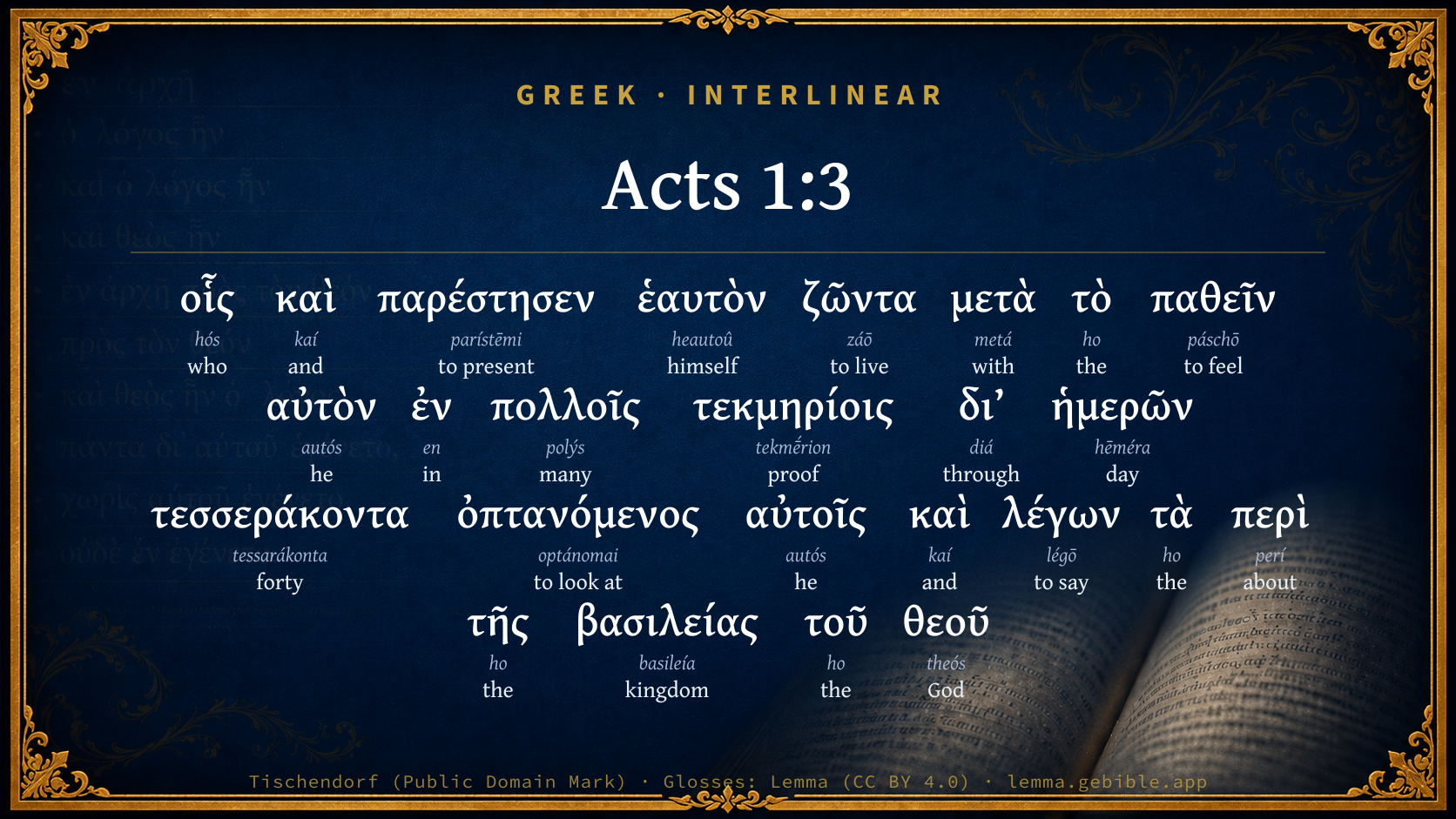
To these he also showed himself alive after he suffered, by many proofs, appearing to them over a period of forty days, and speaking about God's Kingdom.
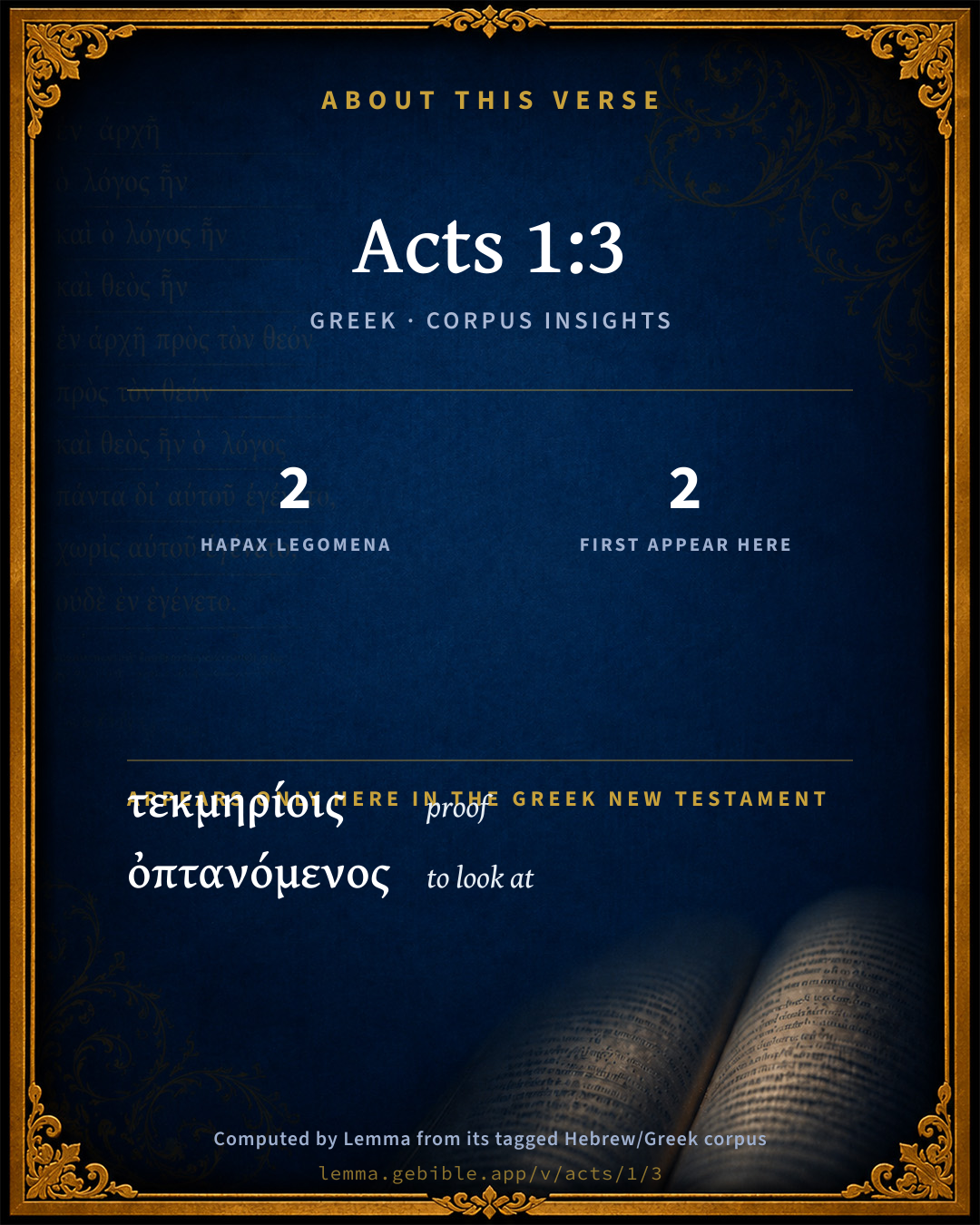
- 2 hapax legomena — only here in the Greek New Testament
- 2 first appearances in the Greek New Testament
Download a study sheet
One document with this verse’s original text, its word-by-word gloss line, the meaning frame, cross-references with their text, attributed commentary, and full source and license credits — printable, and it pastes into notes with its structure intact.
This verse Autodidact and up
A passage Seminary Student
Up to 50 verses in one chapter. A passage sheet keeps up to 6 commentary sources and 12 cross-references per verse, in the order this page ranks them, and says so on the sheet whenever that leaves anything out. Ask for a single verse and you get the Autodidact verse sheet above.
Everything on this page stays free to read, with no account — the sheet is a download of what is already on screen, not access to it.
Compare translations 3
The same verse in 3 English versions, stacked beneath the original-language interlinear above. Click any original word for its lexicon entry.
Each is an independent rendering of the whole verse — the interlinear is not word-aligned to these translations.
Highlighted words mark where these versions differ — a whole-verse word diff, not a word-by-word alignment.
-
World English Bible Public Domain
To these he also showed himself alive after he suffered, by many proofs, appearing to them over a period of forty days, and speaking about God's Kingdom.
-
King James Version Public Domain
To whom also he shewed himself alive after his passion by many infallible proofs, being seen of them forty days, and speaking of the things pertaining to the kingdom of God:
-
unfoldingWord Literal Text CC BY-SA 4.0
to whom also, after he had suffered, he presented himself living with many proofs, appearing to them for 40 days and speaking things concerning the kingdom of God.
unfoldingWord Literal Text — © unfoldingWord, licensed CC BY-SA 4.0. Word-aligned USFM3 via Door43 (git.door43.org/unfoldingWord/en_ult).
Show all 19 translations
Every available English version of this verse, each an independent rendering of the whole verse.
-
World English Bible Public Domain
To these he also showed himself alive after he suffered, by many proofs, appearing to them over a period of forty days, and speaking about God's Kingdom.
-
Berean Standard Bible Public Domain
After His suffering, He presented Himself to them with many convincing proofs that He was alive. He appeared to them over a span of forty days and spoke about the kingdom of God.
-
Majority Standard Bible Public Domain
After His suffering, He presented Himself to them with many convincing proofs that He was alive. He appeared to them over a span of forty days and spoke about the kingdom of God.
-
King James Version Public Domain
To whom also he shewed himself alive after his passion by many infallible proofs, being seen of them forty days, and speaking of the things pertaining to the kingdom of God:
-
American Standard Version (1901) Public Domain
To whom he also showed himself alive after his passion by many proofs, appearing unto them by the space of forty days, and speaking the things concerning the kingdom of God:
-
Revised Version (1885) Public Domain
To whom he also shewed himself alive after his passion by many proofs, appearing unto them by the space of forty days, and speaking the things concerning the kingdom of God:
-
Geneva Bible (1599) Public Domain
To whome also he presented himselfe aliue after that he had suffered, by many infallible tokens, being seene of them by the space of fourtie daies, and speaking of those thinges which appertaine to the kingdome of God.
-
Douay-Rheims (1899) Public Domain
To whom also he shewed himself alive after his passion, by many proofs, for forty days appearing to them, and speaking of the kingdom of God.
-
Young's Literal Translation Public Domain
to whom also he did present himself alive after his suffering, in many certain proofs, through forty days being seen by them, and speaking the things concerning the reign of God.
-
Literal Standard Version CC BY-SA 4.0
to whom He also presented Himself alive after His suffering, in many certain proofs, being seen by them through forty days, and speaking the things concerning the Kingdom of God.
-
Unlocked Literal Bible CC BY-SA 4.0
After his suffering, he presented himself alive to them with many convincing proofs. For forty days he appeared to them, and he spoke about the kingdom of God.
-
unfoldingWord Literal Text CC BY-SA 4.0
to whom also, after he had suffered, he presented himself living with many proofs, appearing to them for 40 days and speaking things concerning the kingdom of God.
-
Darby Bible Public Domain
to whom also he presented himself living, after he had suffered, with many proofs; being seen by them during forty days, and speaking of the things which concern the kingdom of God;
-
World Messianic Bible Public Domain
To these he also showed himself alive after he suffered, by many proofs, appearing to them over a period of forty days and speaking about God’s Kingdom.
-
Webster's Bible Public Domain
To whom also he showed himself alive after his passion, by many infallible proofs, being seen by them forty days, and speaking of the things pertaining to the kingdom of God:
-
Free Bible Version CC BY-SA 4.0
Over the course of forty days after the death he suffered, he showed himself to them, proving that he was alive with convincing evidence. He appeared to them, and told them about the kingdom of God.
-
Bible in Basic English Public Domain
And to whom he gave clear and certain signs that he was living, after his death; for he was seen by them for forty days, and gave them teaching about the kingdom of God:
-
Text-Critical English NT CC BY 4.0
He presented himself alive to them, after his suffering, by many convincing proofs, appearing to them over the course of forty days and speaking about the kingdom of God.
-
Tyndale New Testament (1534) Public Domain
to whom also he shewed him selfe alyve after his passion by many tokens apperynge vnto them fourty dayes and speakynge of the kyngdome of god
Literal Standard Version (2020), Covenant Press — licensed CC BY-SA 4.0. Text via the HelloAO Bible API (eBible.org). Unlocked Literal Bible (unfoldingWord) — licensed CC BY-SA 4.0. Text via the HelloAO Bible API (eBible.org). unfoldingWord Literal Text — © unfoldingWord, licensed CC BY-SA 4.0. Word-aligned USFM3 via Door43 (git.door43.org/unfoldingWord/en_ult). Free Bible Version, Dr. Jonathan Gallagher — licensed CC BY-SA 4.0. Text via the HelloAO Bible API (eBible.org).
Word by word
More ways to search: Search by grammar → Find every occurrence → Compare this word →
Practice this passage: Drill this verse → Learn its vocabulary →
- Appears 1× in the Greek New Testament
- First appears here
- Part of Speech
- Noun
- Case
- Dative
- Number
- Plural
- Gender
- Neuter
Full Thayer's Definition
- οἷς hós G3739 “who” Relative pronoun, Dative, Plural, Masculine
- καὶ kaí G2532 “and” Conjunction
- παρέστησεν parístēmi G3936 “to present” Verb, Aorist, Active, Indicative, 3rd person, Singular
- ἑαυτὸν heautoû G1438 “himself” Reflexive pronoun, 3rd person, Accusative, Singular, Masculine
- ζῶντα záō G2198 “to live” Verb, Present, Active, Participle, Accusative, Singular, Masculine
- μετὰ metá G3326 “with” Preposition
- τὸ ho G3588 “the” Article, Accusative, Singular, Neuter
- παθεῖν páschō G3958 “to feel” Verb, Aorist, Active, Infinitive
- αὐτὸν autós G846 “he” Personal pronoun, Accusative, Singular, Masculine
- ἐν en G1722 “in” Preposition
- πολλοῖς polýs G4183 “many” Adjective, Dative, Plural, Neuter
- τεκμηρίοις tekmḗrion G5039 “proof” Noun, Dative, Plural, Neuter
- δι’ diá G1223 “through” Preposition
- ἡμερῶν hēméra G2250 “day” Noun, Genitive, Plural, Feminine
- τεσσεράκοντα tessarákonta G5062 “forty” Adjective, Numeral (indeclinable)
- ὀπτανόμενος optánomai G3700 “to look at” Verb, Present, Middle or Passive deponent, Participle, Nominative, Singular, Masculine
- αὐτοῖς autós G846 “he” Personal pronoun, Dative, Plural, Masculine
- καὶ kaí G2532 “and” Conjunction
- λέγων légō G3004 “to say” Verb, Present, Active, Participle, Nominative, Singular, Masculine
- τὰ ho G3588 “the” Article, Accusative, Plural, Neuter
- περὶ perí G4012 “about” Preposition
- τῆς ho G3588 “the” Article, Genitive, Singular, Feminine
- βασιλείας basileía G932 “kingdom” Noun, Genitive, Singular, Feminine
- τοῦ ho G3588 “the” Article, Genitive, Singular, Masculine
- θεοῦ theós G2316 “God” Noun, Genitive, Singular, Masculine
About this verse
These counts appear in no published source. They are computed here, from the morphology-tagged text and Lemma’s own curated glosses. What Lemma adds →
- 25
- words
- 20
- distinct lemmas
- Acts
- section
Notable vocabulary
2 hapax legomena — words that appear only here in the entire Greek New Testament:
First appearance in Scripture
These words make their first canonical appearance in the Greek New Testament here:
Shared distinctive vocabulary
τεσσεράκοντα forty G5062 occurs in 21 verses of the Greek New Testament. Also found in:
Cross-references
23Topical passages linked to Acts 1:3 in the Treasury of Scripture Knowledge — connected by theme and wording, ordered by reader-vote popularity; previews shown in the World English Bible.
- 1 Corinthians 15:5–7 and that he appeared to Cephas, then to the twelve.
- Acts 13:31 and he was seen for many days by those who came up with him from Galilee to Jerusalem, who are his witnesses to the people.
- John 20:26 After eight days again his disciples were inside, and Thomas was with them. Jesus came, the doors being locked, and stood in the midst, and said, "Peace be to you."
- 1 John 1:1 That which was from the beginning, that which we have heard, that which we have seen with our eyes, that which we saw, and our hands touched, concerning the Word of life
- John 21:1 After these things, Jesus revealed himself again to the disciples at the sea of Tiberias. He revealed himself this way.
- John 21:14 This is now the third time that Jesus was revealed to his disciples, after he had risen from the dead.
- Matthew 28:9 As they went to tell his disciples, behold, Jesus met them, saying, "Rejoice!" They came and took hold of his feet, and worshiped him.
- Matthew 21:43 "Therefore I tell you, the Kingdom of God will be taken away from you, and will be given to a nation bringing forth its fruits.
- Luke 17:20–21 Being asked by the Pharisees when the Kingdom of God would come, he answered them, "The Kingdom of God doesn't come with observation;
- Acts 28:31 preaching the Kingdom of God, and teaching the things concerning the Lord Jesus Christ with all boldness, without hinderance.
- John 20:1–21 Now on the first day of the week, Mary Magdalene went early, while it was still dark, to the tomb, and saw the stone taken away from the tomb.
- Romans 14:17 for the Kingdom of God is not eating and drinking, but righteousness, peace, and joy in the Holy Spirit.
- Colossians 1:13 who delivered us out of the power of darkness, and translated us into the Kingdom of the Son of his love;
- 1 Thessalonians 2:12 to the end that you should walk worthily of God, who calls you into his own Kingdom and glory.
- Deuteronomy 9:9 When I was gone up onto the mountain to receive the tables of stone, even the tables of the covenant which Yahweh made with you, then I stayed on the mountain forty days and forty nights; I did neither eat bread nor drink water.
- Deuteronomy 9:18 I fell down before Yahweh, as at the first, forty days and forty nights; I did neither eat bread nor drink water; because of all your sin which you sinned, in doing that which was evil in the sight of Yahweh, to provoke him to anger.
- 1 Kings 19:8 He arose, and ate and drink, and went in the strength of that food forty days and forty nights to Horeb the Mount of God.
- Matthew 3:2 "Repent, for the Kingdom of Heaven is at hand!"
- Matthew 4:2 When he had fasted forty days and forty nights, he was hungry afterward.
- Matthew 28:16–17 But the eleven disciples went into Galilee, to the mountain where Jesus had sent them.
- Mark 16:10–14 She went and told those who had been with him, as they mourned and wept.
- Luke 24:1–53 But on the first day of the week, at early dawn, they and some others came to the tomb, bringing the spices which they had prepared.
- Daniel 2:44–45 In the days of those kings shall the God of heaven set up a kingdom which shall never be destroyed, nor shall the sovereignty of it be left to another people; but it shall break in pieces and consume all these kingdoms, and it shall stand forever.
Cross-references courtesy of OpenBible.info (CC BY 4.0).
Lesson kit
Teaching starters — assembled from the data on this page, not authored interpretation. Every prompt links to the verse data it draws on. Edit before teaching.
Acts, in the Acts, opens this verse with 25 words (20 distinct Greek lemmas). Its most distinctive word is tekmḗrion (“proof”). A historical commentator’s framing appears above. Read the whole chapter for the surrounding context.
Discussion questions
- What does “proof” (tekmḗrion) contribute to the verse as a whole?
- 2 words here appear nowhere else in the Greek New Testament. Why might the author reach for such rare wording?
- 2 words make their first appearance in Scripture here. What does this debut establish?
- How does Matthew 4:2, which shares the word «forty», read alongside this verse?
- What does the repetition of “the” (4× in this one verse) do in this verse?
- These translations render this verse differently; the difference is in the English rendering, not the original. What questions does that raise?
- Compare how The Biblical Illustrator and MacLaren's Expositions of Holy Scripture read this verse. Where do they agree or differ?
Things to notice
- 2 words in this verse appear nowhere else in the Greek New Testament.
- 2 words make their first canonical appearance in Scripture here.
- These translations choose different wording for 23 words in this verse.
- “the” occurs 4× in this single verse.
- 20 distinct Greek lemmas span 25 words in this verse.
Commentary
Notes on Acts 1:3 from classic Christian and Jewish commentators (each source and its license shown beneath its notes). The classic Christian expositions comment on the surrounding passage and are grouped to its opening verse, so a note may address several verses; the Jewish commentaries on the Tanakh (Rashi and others) are per-verse, so they appear only where the commentator wrote on this verse.
Lemma curates 59 commentaries, every one of them public domain or Creative Commons licensed, each selected and text-cleaned for this edition rather than reprinted as found. About our sources →
The Biblical Illustrator
Joseph S. Exell
The Biblical Illustrator, edited by Joseph S. Exell (c. 1880s–1900s) — public domain. Text from a community e-Sword module.
MacLaren's Expositions of Holy Scripture
Alexander MacLaren
Alexander MacLaren, Expositions of Holy Scripture (1904–1910) — public domain. Text from a community e-Sword module.
Tyndale Open Study Notes
Tyndale Open Resources
Tyndale Open Study Notes — © Tyndale Open Resources, licensed CC BY-SA 4.0. Text via the HelloAO Bible API.
Bengel's Gnomon
Johann Albrecht Bengel
Bengel's Gnomon of the New Testament — English translation (T&T Clark, Edinburgh, 1860) — public domain. Text from a community e-Sword module.
Meyer's Critical & Exegetical Commentary
Heinrich August Wilhelm Meyer
Meyer — Critical and Exegetical Commentary on the New Testament — English translation by Peter Christie, edited by Frederick Crombie (T&T Clark, 1880) — public domain. Text from a community e-Sword module.
Expositor's Greek Testament
ed. W. Robertson Nicoll
The Expositor's Greek Testament, edited by W. Robertson Nicoll (1897–1910) — public domain. Text from a community e-Sword module.
Geneva Bible (1599)
Geneva Bible translators
Geneva Bible (1599) marginal notes — public domain. Text via Bolls.life.
Jamieson, Fausset & Brown
Robert Jamieson, A. R. Fausset & David Brown
Jamieson, Fausset & Brown — Commentary Critical and Explanatory on the Whole Bible (1871) — public domain (CC PDM 1.0). Text via the HelloAO Bible API.
Adam Clarke's Commentary
Adam Clarke's Commentary on the Bible (1810–1826) — public domain. Text from a community e-Sword/MySword module.
John Calvin's Commentaries
John Calvin's Commentaries (1540-1563) — public domain. Text from the Calvin Translation Society English edition (1840s-50s) via the Christian Classics Ethereal Library (ccel.org). Calvin's coverage is partial (roughly two-thirds of the Bible); uncommented books and verses are honest gaps, never fabricated. The 19th-century editor's footnotes and remarks are omitted so the notes are faithfully Calvin's own voice.
Ellicott's Commentary for English Readers
A Bible Commentary for English Readers, edited by Charles John Ellicott (1878–1897) — public domain. Text from a community e-Sword module.
The Cambridge Bible for Schools and Colleges
gen. ed. J. J. S. Perowne
The Cambridge Bible for Schools and Colleges (gen. ed. J. J. S. Perowne; Cambridge University Press, 1878–1918) — public domain. Text from a community e-Sword module.
John Gill's Exposition
John Gill's Exposition of the Whole Bible (1746–1763) — public domain (CC PDM 1.0). Text via the HelloAO Bible API.
Trapp's Complete Commentary
John Trapp
John Trapp, A Commentary or Exposition upon All the Books of the Old and New Testament (1647–1656) — public domain. Text from a community e-Sword module.
Albert Barnes' Notes on the Bible
Albert Barnes' Notes on the Bible (1834–1885) — public domain. Text from a community e-Sword/MySword module.
Haydock's Catholic Bible Commentary
George Leo Haydock (1774–1849), Haydock's Catholic Family Bible and Commentary, 1859 edition — public domain. Excludes Psalms (Douay-Rheims chapter numbering differs from Protestant) and Deuterocanonical books (Catholic canon only).
Matthew Poole's English Annotations
Matthew Poole's English Annotations on the Holy Bible (1683–1685) — public domain. Text from a community e-Sword/MySword module.
Whedon's Commentary on the Bible
Daniel D. Whedon
Daniel D. Whedon (gen. ed.), Commentary on the Old and New Testaments (1874–1909) — public domain. Text from a community e-Sword module.
The Pulpit Commentary
The Pulpit Commentary (1880–1919), ed. H.D.M. Spence-Jones & Joseph S. Exell — public domain. Text from a community e-Sword module.
John Wesley's Explanatory Notes
John Wesley, Explanatory Notes Upon the Whole Bible (1754–1765) — public domain. Text via the GEBible commentary corpus.
Burkitt's Expository Notes on the New Testament
William Burkitt
William Burkitt's Expository Notes on the New Testament (1700–1703) — public domain. Text from a community e-Sword module.
Godbey's Commentary on the New Testament
William B. Godbey
William B. Godbey, Commentary on the New Testament (1896–1900) — public domain. Text from a community e-Sword module.
McGarvey & Pendleton's Commentaries
J. W. McGarvey
J. W. McGarvey (with Philip Y. Pendleton), Commentaries on the New Testament (The Fourfold Gospel, 1914; Acts; and the epistles) — public domain. Text from a community e-Sword/MySword module.
The People's New Testament
B. W. Johnson
B. W. Johnson's The People's New Testament with Notes (1889–1891) — public domain. Electronic text from the Christian Classics Ethereal Library (CCEL) ThML edition.
Cambridge Greek Testament for Schools and Colleges
Cambridge Greek Testament for Schools and Colleges (Cambridge University Press, 1896; 21 vols, various authors incl. Carr, Maclear, Plummer, Farrar, Lumby, Moule, M. R. James, Simcox) — public domain. Text from a community e-Sword module.
Alford’s Greek Testament
Henry Alford
Henry Alford, The Greek Testament (1849–1861) — public domain. Text from a community e-Sword module.
Vincent's Word Studies in the New Testament
Marvin R. Vincent
Marvin R. Vincent, Word Studies in the New Testament (1887–1900) — public domain. Text from a community e-Sword/MySword module.