
Mark 6:20

Greek (Tischendorf 8th ed.) Mark 6:20 appears in the Greek New Testament. The text above is from the Tischendorf 8th edition. Each word links to its Strong’s number and a concise gloss. Click any word for its full Thayer’s Greek Lexicon entry.
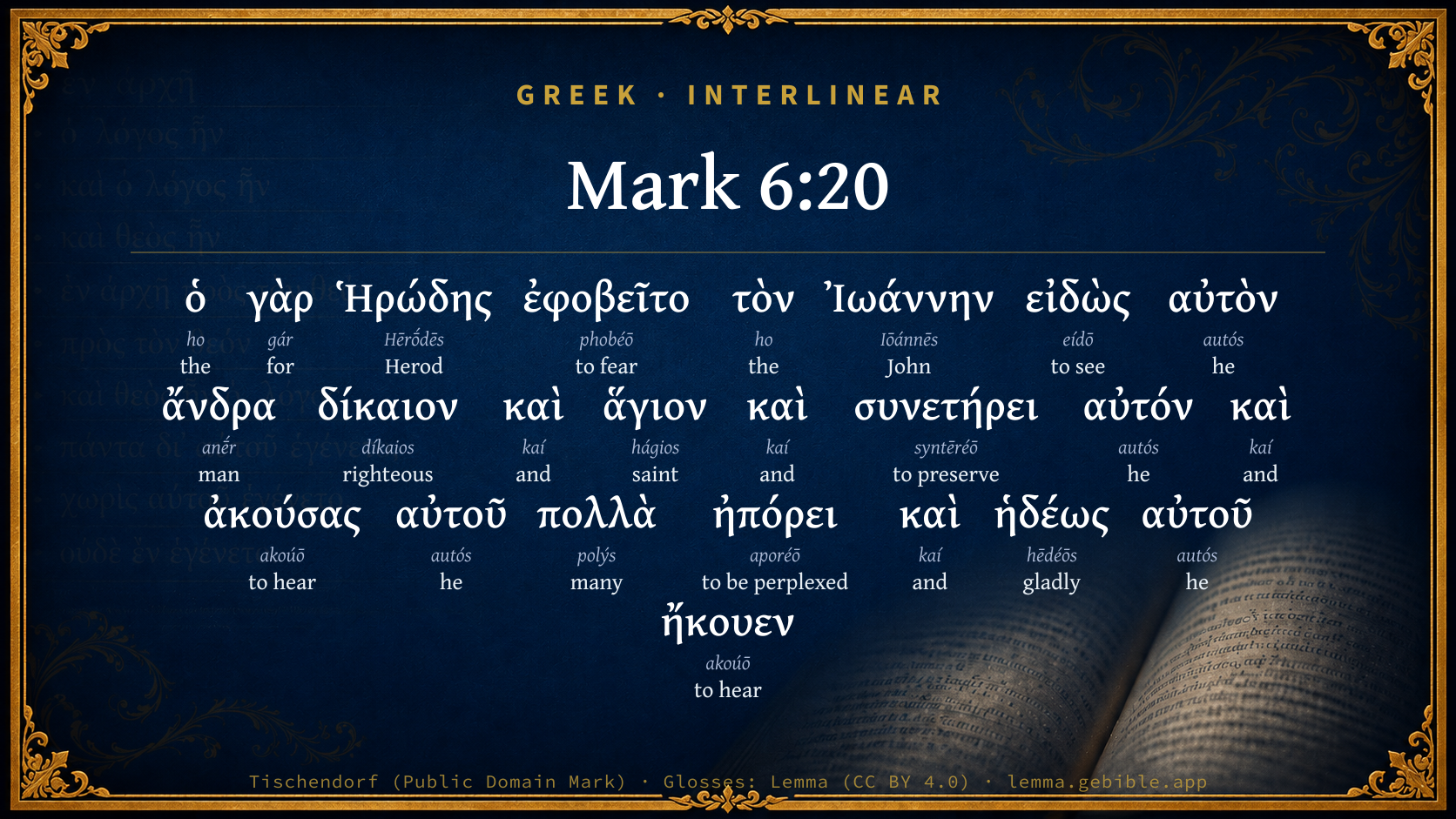
Download image
Cite this verse

Mark 6:20 (World English Bible). Public Domain. Lemma interlinear Bible study tool, https://lemma.gebible.app/v/mark/6/20.

Show BibTeX & RIS
BibTeX
RIS
English Translation
for Herod feared John, knowing that he was a righteous and holy man, and kept him safe. When he heard him, he did many things, and he heard him gladly.
World English Bible · Public Domain
Highlights
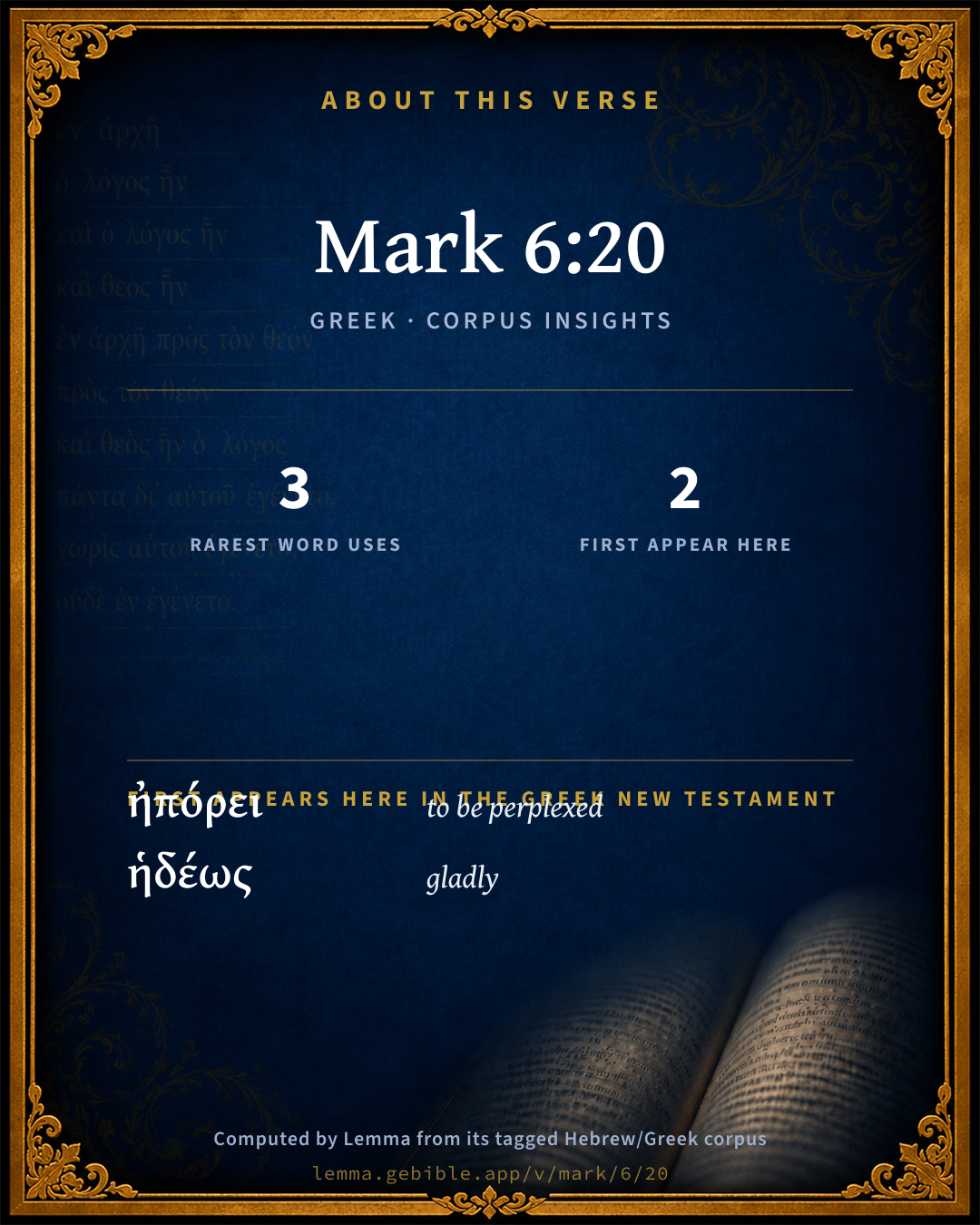
  • 2 first appearances in the Greek New Testament
Full analysis ↓
Download a study sheet

One document with this verse’s original text, its word-by-word gloss line, the meaning frame, cross-references with their text, attributed commentary, and full source and license credits — printable, and it pastes into notes with its structure intact.

This verse Autodidact and up

Study sheet (.html) Plain text (.txt)

A passage Seminary Student

Up to 50 verses in one chapter. A passage sheet keeps up to 6 commentary sources and 12 cross-references per verse, in the order this page ranks them, and says so on the sheet whenever that leaves anything out. Ask for a single verse and you get the Autodidact verse sheet above.

Everything on this page stays free to read, with no account — the sheet is a download of what is already on screen, not access to it.

Want to remove ads? Support Godless Engineer
Compare translations 3

The same verse in 3 English versions, stacked beneath the original-language interlinear above. Click any original word for its lexicon entry.

Each is an independent rendering of the whole verse — the interlinear is not word-aligned to these translations.

Highlighted words mark where these versions differ — a whole-verse word diff, not a word-by-word alignment.

  • World English Bible Public Domain
    for Herod feared John, knowing that he was a righteous and holy man, and kept him safe. When he heard him, he did many things, and he heard him gladly.
  • King James Version Public Domain
    For Herod feared John, knowing that he was a just man and an holy, and observed him; and when he heard him, he did many things, and heard him gladly.
  • unfoldingWord Literal Text CC BY-SA 4.0
    for Herod was fearing John, knowing him a righteous and holy man, and he was keeping him safe, and having heard him, he was much perplexed, and he was listening to him gladly.

unfoldingWord Literal Text — © unfoldingWord, licensed CC BY-SA 4.0. Word-aligned USFM3 via Door43 (git.door43.org/unfoldingWord/en_ult).

Versions to compare (up to 4)

3 of 4 selected

Show all 19 translations

Every available English version of this verse, each an independent rendering of the whole verse.

  • World English Bible Public Domain
    for Herod feared John, knowing that he was a righteous and holy man, and kept him safe. When he heard him, he did many things, and he heard him gladly.
  • Berean Standard Bible Public Domain
    because Herod feared John and protected him, knowing that he was a righteous and holy man. When he heard John’s words, he was greatly perplexed; yet he listened to him gladly.
  • Majority Standard Bible Public Domain
    because Herod feared John and protected him, knowing that he was a righteous and holy man. When he heard John’s words, he did much of what he said; and he listened to him gladly.
  • King James Version Public Domain
    For Herod feared John, knowing that he was a just man and an holy, and observed him; and when he heard him, he did many things, and heard him gladly.
  • American Standard Version (1901) Public Domain
    for Herod feared John, knowing that he was a righteous and holy man, and kept him safe. And when he heard him, he was much perplexed; and he heard him gladly.
  • Revised Version (1885) Public Domain
    for Herod feared John, knowing that he was a righteous man and a holy, and kept him safe. And when he heard him, he was much perplexed; and he heard him gladly.
  • Geneva Bible (1599) Public Domain
    For Herod feared Iohn, knowing that hee was a iust man, and an holy, and reuerenced him, and when he heard him, he did many things, and heard him gladly.
  • Douay-Rheims (1899) Public Domain
    For Herod feared John, knowing him to be a just and holy man: and kept him, and when he heard him, did many things: and he heard him willingly.
  • Young's Literal Translation Public Domain
    for Herod was fearing John, knowing him a man righteous and holy, and was keeping watch over him, and having heard him, was doing many things, and hearing him gladly.
  • Literal Standard Version CC BY-SA 4.0
    for Herod was fearing John, knowing him [to be] a righteous and holy man, and was keeping watch over him, and having heard him, was doing many things, and hearing him gladly.
  • Unlocked Literal Bible CC BY-SA 4.0
    for Herod feared John; he knew that he was a righteous and holy man, and he kept him safe. Listening to him made him greatly upset, yet he heard him gladly.
  • unfoldingWord Literal Text CC BY-SA 4.0
    for Herod was fearing John, knowing him a righteous and holy man, and he was keeping him safe, and having heard him, he was much perplexed, and he was listening to him gladly.
  • Darby Bible Public Domain
    for Herod feared John knowing that he was a just and holy man, and kept him safe; and having heard him, did many things, and heard him gladly.
  • World Messianic Bible Public Domain
    for Herod feared Yochanan, knowing that he was a righteous and holy man, and kept him safe. When he heard him, he did many things, and he heard him gladly.
  • Webster's Bible Public Domain
    For Herod feared John, knowing that he was a just and holy man, and observed him: and when he heard him, he did many things, and heard him gladly.
  • Free Bible Version CC BY-SA 4.0
    because Herod knew John was a holy man who did what was right. Herod protected John and though what John said was very disturbing to him, he was still happy to hear what he had to say.
  • Bible in Basic English Public Domain
    For Herod was in fear of John, being conscious that he was an upright and holy man, and kept him safe. And hearing him, he was much troubled; and he gave ear to him gladly.
  • Text-Critical English NT CC BY 4.0
    For Herod feared John, knowing that he was a righteous and holy man, and he protected him. When Herod listened to John, he would listen to him gladly and do many things.
  • Tyndale New Testament (1534) Public Domain
    For Herode feared Iohn knowynge that he was a iuste man and an holy: and gave him reverence: and when he hearde him he dyd many thinges and hearde him gladly.

Literal Standard Version (2020), Covenant Press — licensed CC BY-SA 4.0. Text via the HelloAO Bible API (eBible.org). Unlocked Literal Bible (unfoldingWord) — licensed CC BY-SA 4.0. Text via the HelloAO Bible API (eBible.org). unfoldingWord Literal Text — © unfoldingWord, licensed CC BY-SA 4.0. Word-aligned USFM3 via Door43 (git.door43.org/unfoldingWord/en_ult). Free Bible Version, Dr. Jonathan Gallagher — licensed CC BY-SA 4.0. Text via the HelloAO Bible API (eBible.org).

Word by word

More ways to search: Search by grammar → Find every occurrence → Compare this word →

Practice this passage: Drill this verse → Learn its vocabulary →

συνετήρει
syntēréō
G4933
“to preserve”
Verb, Imperfect, Active, Indicative, 3rd person, Singular
Part of Speech
Verb
Tense
Imperfect
Voice
Active
Mood
Indicative
Person
3rd person
Number
Singular
Full Thayer's Definition

Origin: from G4862 and G5083

TDNT: 10:31,1

1. to preserve (a thing from perishing or being lost) 2. to keep within one's self, keep in mind (a thing, lest it be forgotten)
  1. ὁ ho G3588 “the” Article, Nominative, Singular, Masculine
  2. γὰρ gár G1063 “for” Conjunction
  3. Ἡρώδης Hērṓdēs G2264 “Herod” Noun, Nominative, Singular, Masculine
  4. ἐφοβεῖτο phobéō G5399 “to fear” Verb, Imperfect, Middle or Passive deponent, Indicative, 3rd person, Singular
  5. τὸν ho G3588 “the” Article, Accusative, Singular, Masculine
  6. Ἰωάννην Iōánnēs G2491 “John” Noun, Accusative, Singular, Masculine
  7. εἰδὼς eídō G1492 “to see” Verb, Perfect, Active, Participle, Nominative, Singular, Masculine
  8. αὐτὸν autós G846 “he” Personal pronoun, Accusative, Singular, Masculine
  9. ἄνδρα anḗr G435 “man” Noun, Accusative, Singular, Masculine
  10. δίκαιον díkaios G1342 “righteous” Adjective, Accusative, Singular, Masculine
  11. καὶ kaí G2532 “and” Conjunction
  12. ἅγιον hágios G40 “saint” Adjective, Accusative, Singular, Masculine
  13. καὶ kaí G2532 “and” Conjunction
  14. αὐτόν autós G846 “he” Personal pronoun, Accusative, Singular, Masculine
  15. καὶ kaí G2532 “and” Conjunction
  16. ἀκούσας akoúō G191 “to hear” Verb, Aorist, Active, Participle, Nominative, Singular, Masculine
  17. αὐτοῦ autós G846 “he” Personal pronoun, Genitive, Singular, Masculine
  18. πολλὰ polýs G4183 “many” Adjective, Accusative, Plural, Neuter
  19. ἠπόρει aporéō G639 “to be perplexed” Verb, Imperfect, Active, Indicative, 3rd person, Singular
  20. καὶ kaí G2532 “and” Conjunction
  21. ἡδέως hēdéōs G2234 “gladly” Adverb
  22. αὐτοῦ autós G846 “he” Personal pronoun, Genitive, Singular, Masculine
  23. ἤκουεν akoúō G191 “to hear” Verb, Imperfect, Active, Indicative, 3rd person, Singular

About this verse

These counts appear in no published source. They are computed here, from the morphology-tagged text and Lemma’s own curated glosses. What Lemma adds →

24
words
16
distinct lemmas
Gospels
section

Notable vocabulary

The rarest word here is συνετήρει to preserve G4933 — appearing just 3 times in the whole Greek New Testament.

First appearance in Scripture

These words make their first canonical appearance in the Greek New Testament here:

  • ἠπόρει to be perplexed G639
  • ἡδέως gladly G2234

Shared distinctive vocabulary

συνετήρει to preserve G4933 occurs in 3 verses of the Greek New Testament. Also found in:
Repetition

Words recur within this verse:

  • ἀκούσας to hear G191 ×2
  • αὐτὸν he G846 ×4
  • καὶ and G2532 ×4
  • ὁ the G3588 ×2

Cross-references

19

Topical passages linked to Mark 6:20 in the Treasury of Scripture Knowledge — connected by theme and wording, ordered by reader-vote popularity; previews shown in the World English Bible.

  • Matthew 21:26 But if we say, 'From men,' we fear the multitude, for all hold John as a prophet."
  • Matthew 14:5 When he would have put him to death, he feared the multitude, because they counted him as a prophet.
  • 2 Chronicles 24:15–22 But Jehoiada grew old and was full of days, and he died; one hundred thirty years old was he when he died.
  • John 5:35 He was the burning and shining lamp, and you were willing to rejoice for a while in his light.
  • Exodus 11:3 Yahweh gave the people favor in the sight of the Egyptians. Moreover the man Moses was very great in the land of Egypt, in the sight of Pharaoh's servants, and in the sight of the people.
  • 1 Kings 21:20 Ahab said to Elijah, Have you found me, my enemy? He answered, I have found you, because you have sold yourself to do that which is evil in the sight of Yahweh.
  • 2 Kings 3:12–13 Jehoshaphat said, The word of Yahweh is with him. So the king of Israel and Jehoshaphat and the king of Edom went down to him.
  • 2 Kings 6:21 The king of Israel said to Elisha, when he saw them, My father, shall I strike them? shall I strike them?
  • 2 Kings 13:14 Now Elisha was fallen sick of his sickness of which he died: and Joash the king of Israel came down to him, and wept over him, and said, My father, my father, the chariots of Israel and the horsemen of it!
  • 2 Chronicles 24:2 Joash did that which was right in the eyes of Yahweh all the days of Jehoiada the priest.
  • 2 Chronicles 26:5 He set himself to seek God in the days of Zechariah, who had understanding in the vision of God: and as long as he sought Yahweh, God made him to prosper.
  • Psalms 106:12–13 Then they believed his words. They sang his praise.
  • Ezekiel 2:5–7 They, whether they will hear, or whether they will forbear, (for they are a rebellious house), yet shall know that there has been a prophet among them.
  • Ezekiel 33:32 Behold, you are to them as a very lovely song of one who has a pleasant voice, and can play well on an instrument; for they hear your words, but they don't do them.
  • Daniel 4:18 This dream I, king Nebuchadnezzar, have seen; and you, Belteshazzar, declare the interpretation, because all the wise men of my kingdom are not able to make known to me the interpretation; but you are able; for the spirit of the holy gods is in you.
  • Daniel 4:27 Therefore, O king, let my counsel be acceptable to you, and break off your sins by righteousness, and your iniquities by showing mercy to the poor; if there may be a lengthening of your tranquillity.
  • Daniel 5:17 Then Daniel answered before the king, Let your gifts be to yourself, and give your rewards to another; nevertheless I will read the writing to the king, and make known to him the interpretation.
  • Mark 4:16 These in like manner are those who are sown on the rocky places, who, when they have heard the word, immediately receive it with joy.
  • Mark 11:18 The chief priests and the scribes heard it, and sought how they might destroy him. For they feared him, because all the multitude was astonished at his teaching.

Cross-references courtesy of OpenBible.info (CC BY 4.0).

Where the printed editions differ

1 variant

Places in this verse where the major printed Greek editions disagree on the wording in a way that affects the translation — a comparison of editions, not a manuscript-by-manuscript collation. The editions are the modern critical texts (Nestlé-Aland 28/27, SBL, Westcott-Hort, Tregelles, Tyndale House) and the traditional texts behind the KJV (the Textus Receptus and the Byzantine/Majority text). It is not a claim about which reading is original.

  1. Different wording
    ἠπόρει,

    “he was perplexed”

    In NA28NA27TynSBLWH Not in TregTRByz

    ἐποίει (epoiei) 'he was doing' occurs in traditional manuscripts (Treg+TR+Byz) instead of ἠπόρει, (ēporei) 'he was perplexed' in older manuscripts (NA28+NA27+Tyn+SBL+WH)

Textual data: Translators Amalgamated Greek New Testament (STEPBible TAGNT) · CC BY 4.0.

Commentary

Notes on Mark 6:20 from classic Christian and Jewish commentators (each source and its license shown beneath its notes). The classic Christian expositions comment on the surrounding passage and are grouped to its opening verse, so a note may address several verses; the Jewish commentaries on the Tanakh (Rashi and others) are per-verse, so they appear only where the commentator wrote on this verse.

Lemma curates 59 commentaries, every one of them public domain or Creative Commons licensed, each selected and text-cleaned for this edition rather than reprinted as found. About our sources →

The Biblical Illustrator

Joseph S. Exell

Mar_6:20

For Herod feared John.

Better to fear God than His minister

Herod feared John, and did many things; had he feared God, he would have laboured to do everything. (Gurnall.)

Fear versus Love

The chains of love are stronger than the chains of fear. Herods love of Herodias was too hard for his fear of John. (Gurnall.)

What moves wicked men thus to affect and reverence Gods faithful ministers

1. The consideration of the excellent gifts which they discern in them, especially natural gifts. These draw them into admiration, and so cause them to esteem and reverence them.

2. Some worldly good or benefit which they reap by the acquaintance or society of such faithful ministers of God.

3. The holy lives of Gods faithful ministers. (G. Petter.)

Character of Herod

I. How mysterious and complex is the character of man! In the same individual what a variety of qualities, apparently the most opposite, are sometimes combined. How important it is that we should know ourselves and the sins which so easily mislead and overcome us; looking meanwhile for guidance to Him who searcheth the reins and trieth the hearts of men.

II. How strong is the impression which real excellence of character makes, even on the minds of wicked men. With all his abandonment of principle and looseness of practice, Herod could not help admiring and respecting John.

III. Yet a man may go far in his admiration of goodness, while he remains practically unaffected by it. The precise extent of Johns moral influence over Herod we do not know; but it is plain that he did follow his guidance in some respects, and, so far, for good; but, in spite of all, there was no real, decided, permanent change in his heart and character. He had mistaken the semblance of religion for its reality-the husk for the kernel. Consequently, when temptation came, it made him tenfold more the child of Satan than before.

IV. Learn from this the danger of yielding to favourite sins. Until met by the home thrust, It is not lawful for thee to have her, all went on smoothly and pleasantly between Herod and John; but the exposure of his darling vice turned his friendship into enmity.

V. The danger of trifling with serious impressions and acting contrary to conscience. Herods association with John ought to have brought him to a humbling sense of sin and a decided change of heart. But he trampled on his convictions; and fatal was the result. Let us be warned by his example. Every funeral that passes, solemn and slow, along the streets; every visit of disease and death to your family circle; every season of holy communion with God; every prick of conscience; these are all so many instruments which God puts in operation for your well-being. Attend to these faithful monitors; cherish them; and they will be productive of lasting benefit to your soul. (R. Burns, D. D.)

Bad men with better moments

This wicked and despotic man, though he appointed for himself no bounds of morality, had moral sensibility lying within him. In the midst of vice and crime he had a conscience. More than that: this man whose very name has come down as a synonym of all that is corrupt and oppressive, had, in the midst of vices and crimes, a kind of yearning for goodness. He had heard John; he had heard him gladly; he wanted to hear him again; and, after the momentary flash of passion and anger was over, he wanted to save him. He was sorry that he was to be executed. There was something in this despotic king which yearned towards justice and goodness. And woe be to every wicked man who, in his wickedness, never finds a single spark of virtue to illuminate his life. I have reason to believe that the men who follow vice have hours in which they look out from themselves longingly, and wish they were better; and that men who are given over to the power of their passions have hours and days in which no outward condemnation is comparable to that which they themselves pass on themselves. Men, because they are wicked, are not necessarily dead. Because they violate rectitude, they do not necessarily destroy their conscience utterly. It sleeps or is drugged; but it has its revenge. Nay, more; it is this dormant or latent sensibility to that which is in contrariety to their whole course of life, that lays the foundation for hope of the recovery or reformation of men. There are hours when many a man, if he had power to regenerate himself, would speedily do it. Oh! that we only knew those hours. Oh! that some friend could approach every such man at these periods when the doors of his prison are thrown open for a time, and lead him by the hand. How many men might be rescued from the abyss which finally overwhelms and destroys them, how many men might be brought up from their degradation and peril, if only we were wise to seize the hours in which they are impressible. The acute and watchful physician knows that a disease runs to a crisis, and that there are points of time when, if the patient is carefully nursed and tended, curative tendencies will set in, and his health may be restored. Now, men are in the same condition spiritually; and if there were rely some oversight of them, they might be saved; but, alas! they themselves cannot perpetuate these hours; they will not; and we stand outside, and know nothing of them. So in every street, and in every community, there are men who are secretly burning out the very vital substance of their life; who are walking in ways, the beginnings of which are pleasant, but the ends of which are death; who are going down through the community, moaning as they go, sighing for something better, and at times holding up hands of prayer and saying, God, help me! Nevertheless, there are men who, with all these experiences, are utterly destroyed. Here was this man Herod-as bad a man as could well be pictured, in many respects; and yet there were in him elements that could have reformed and restored him. (H. W. Beecher.)

Herods partial repentance

It is curious and instructive to observe that Herod is set before us here in the good points of his character-at least, in the best points that he had. It is in the Holy Gospels that one of the vilest wretches in human history is set before us in a somewhat amiable and interesting aspect. He feels a sincere respect for religion. He is not so far gone but that he knows honesty and faith and self-devotion when he sees them in another man. And he does not respect these the less, but a great deal the more, when the just and holy man does not spare his own sins, but denounces them to his face. Not only this, but he takes the preacher under his protection; and declares, doubtless with much hard swearing, when one and another of the courtiers propose to stop the prophets insolence by taking his life, that no man shall hurt a hair of his head. And I have no doubt that he took enormous pride in it, too, as many a swearing, drinking, cheating reprobate nowadays will pride himself on hiring a pew in a most puritan church, where righteousness and temperance and judgment are faithfully preached to him, and will insist, with profuse expletives, that no man shall say a word against his minister. The case is common enough. But we should do Herod injustice if we should suppose this to be all. Herod listened to the preacher of righteousness and repentance with a genuine personal and practical interest. He applies Johns teaching to his own case-to his own sins and his own duties-so far as anything was left to his ingenuity in the matter of application, for Johns teaching was sufficiently direct and pointed in itself. Herod did lay the word of the Lord to heart with reference to his own amendment, and did obviously begin to make such a difference in his course of life as to give Herodias reason to fear that he would not make an end of reforming until he had reformed her and her devils imp of a daughter out of the palace altogether. He did many things in consequence of Johns preaching-many just and upright things such as were strange enough to hear of in the vice-regal court of Palestine; beneficent and public-spirited things, making his reign, for the time, a less unmitigated curse to that afflicted country; merciful things, using his princely wealth and power for the relic of the distressed. What a thing to give thanks for was even this partial repentance of Herod, for the good it did, for the pain and outrage that it saved! Let no one think that the preaching of Gods kingdom is a total waste, even when no man yields to it his unreserved submission. The whole work of Christs gospel in any community is not to be summed up in the net number of converts or communicants. How many a soul is saved from being just such an abandoned wretch as Herod was; how many a decent home from being such a sty of uncleanness as Herods palace was; how many a State from being defiled with blood and turbulent with wrong, just through some mens standing in awe before the holiness of Christ, and hearing Him gladly, and being willing to do many things! (Leonard W. Bacon.)

Insufficiency of Herods right-doing

In all his doing of right things, Herod does nothing right; for in all that he does he is Herod. The things that he does in obedience to Johns preaching are right in the abstract, considered independently of the man that does them. But as a matter of fact, these actions in the abstract never get done in actual life. We can think about them, and reason about them; but we never really see or know of an action that is not done by somebody. The action is the man acting. Strictly speaking, it is not actions that are right or wrong; it is men. And when the question is,-Did the man do right? we have to look at the man as well as the deed. And the honest conscience has no doubt on this point: No man is right in his doing, so long as he is cherishing a fixed, conscious purpose to do wrong, or not to do altogether right. This is a rule that does not work both ways. The hidden thought of the heart is like the morsel hidden in the garment (Hag_2:10-14); it can pollute a good act, it cannot sanctify an evil act. Here is Herod resolutely protecting the sternest of Gods prophets, eagerly listening to him, heeding him, obeying him in many things, but standing out obstinately in his incestuous and adulterous love against that word of the Lord, It is not lawful for thee to have her. How does the case stand with him, just now? It was right, wasnt it? for Herod to do many things at the preaching of John. He was a pretty good man for the time being, wasnt he? Wasnt it quite like heroism-moral heroism-backed up by political caution, when he stubbornly refused to permit the killing of John, and said to Herodias, No! I will not! I will agree to lock him up in prison, but not one step further will I go! Was he not rather the pattern of what we should call a good member of society-a man with a sincere respect for religion, and a great interest in the church, and a strong attachment to his favourite minister;-a man who is willing to subscribe handsomely, and do many things, and deny himself many things, but of course, not everything? Now I do not find that the gospel has any dealings with this kind of goodness. It does not appear that Jesus Christ has any advice or encouragement for those who would like to be rid of a part of their sins. He is not a specialist in spiritual maladies; He is a Great Physician. It is not worth your while to go to Him with a request for partial and local treatment-to hold up before Him your infected, swollen limb, and say, There! give me something for that! Dont touch the rest of me. I am all right. I only want that arm cured. He will not treat the case on any such terms. Your case is constitutional, not local. If you would have the help of Jesus Christ; you must surrender the case to Him; and prepare for thorough treatment, perhaps for sharp surgery. (Leonard W. Bacon.)

Character a power

Your success is very much connected with your personal character. Herod heard John gladly, and did many things, because he knew the preacher to be a just and holy man. Words uttered from the heart find their way to the heart by a holy sympathy. Character is power. (R Cecil.)

Inconstancy

A ship that is not of the right make can not sail trim, and a clock whose spring is faulty will not always go true; so a person of unsound principles cannot be constant and even in his practices. The religion of those that are inwardly rotten, is like a fire in some cold climates, which almost fries a man before, when at the same time he is freezing behind; they are zealous in some things, as holy duties, which are cheap; and cold in other things, especially when they cross their profit or credit; as Mount Hecla is covered with snow on one side, when it burns and casts out cinders on the other: but the holiness of them that are sound at heart is like the natural heat,-though it resorts most to the vitals of sacred performances, yet, as need is, it warms and has an influence upon all the outward parts of civil transactions. It may be said of true sanctity, as of the sun, There is nothing hid from the heat thereof. When all the parts of the body have their due nourishment distributed to them, it is a sign of a healthy temper. As the saint is described sometimes by a clean heart, so also sometimes by clean hands, because he has both; the holiness of his heart is seen at his fingers ends. (G. Swinnock.)

A false respect for religion

A man may be acknowledged to be just and holy, and for that very reason he may be dreaded. You like to see lions and tigers in the Zoological Gardens, but you would not like to see them in your own room; you would very much prefer to see them behind bars and within cages; and so very many have respect for religion, but religious people they cannot bear. (C. H. Spurgeon.)

Wanting to go to heaven, but liking the way to hell

Herod was a foxy man. We sometimes meet with these foxy people. They want to go to heaven, but they like the road to hell. They will sing a hymn to Jesus, but a good roaring song they like also. They will give a guinea to the church, but how many guineas are spent on their own lust. Thus they try to dodge between God and Satan. (C. H. Spurgeon.)

John and Herod

I. The hopeful points in Herods character. He respected justice and holiness. He admired the man in whom he saw justice and righteousness. He listened to John. He obeyed the word to which he listened. He continued to hear the preacher gladly. His conscience was greatly affected.

II. The flaws in the case of Herod. Though he feared John he never looked to Johns Master. He had no respect for goodness in his own heart. He never loved the Word of God as Gods Word. He was under the sway of sin. His was a religion of fear, not of love.

III. What because of Herod. He slew the preacher whom he respected. This Herod Antipas was the man who afterwards mocked the Saviour. He soon lost all the power he possessed. His name is infamous forever. (C. H. Spurgeon.)

Limed by lust

He was like a bird taken with lime twigs: he wanted to fly; but, sad to say, he was willingly held, limed by his lust. (C. H. Spurgeon.)

Preaching! Mans privilege and Gods power

I. The blessedness of hearing the Word. The preaching of the gospel is represented by the sowing of seed-casting the net into the sea-it is the bread of heaven-it is the light of the world.

II. The responsibilities of the hearer of the Word.

III. The needful accompaniments of hearing the Word. (C. H. Spurgeon.)

Transient religious impressions

When you take hold of a piece of india rubber, you may make any impression that you like all over it, but after all it resumes its old shape. There are hosts of hearers of that kind: very impressible, but they quickly return to their old tastes and habits. (C. H. Spurgeon.)

Why Herod feared John

Herod was a king; John was a subject. Herod was in a palace; John was in a prison. Herod wore a crown; John most probably did not even own a turban, Herod wore the purple; John wore camlet, as we should call it. John was the son of an obscure Jewish country priest and his wife: the child of their old age. There is no hint that John had any wealth, or name, or fame, or education, or influence, when he began his life as a man. He comes on the scene as a rough, angular man, with not many words and not many friends. Herod began to reign just about when John began to live, so that there was no preponderant age in the priests son over the kings son: that was all on the other side. Indeed, by all mere surface facts, principles, and analogies, John ought to have feared Herod; he ought to have bated his breath and bent his head before him. Now, I propose to discuss at this time the roots of this power and weakness, to see what made Herod so weak and John so strong, and to ask this question, What can we, who are set as John was, in the advance guard of reformers, do to make a deep, clear mark? And I note for you that John had three great roots of power: First, he was a powerful man by creation-a with a clear head, a steady nerve, and a nature set in a deadly antagonism to sin and meanness of every sort and degree. He was the Jewish John Knox or John Brown.

When he saw a thing was true,

He went to work and put it through.

He could die, but he could not back down, Every time I meet a man who is a man, and not a stick, I ask myself one question: Why are you the man you are? Whence does your power hint itself to me? Whence does it come. And while the ultimate answer has never come out of Phrenology or Physiognomy, or any of the sciences that profess to tell you what a man is by how he looks, yet the indicative answer has always lain in that direction. In the head, and face, and form of a man there is certainly something that impresses you in some such way as the weight, colour, and inscription of a coin reveal to you, with a fair certainty, whether it be gold, or silver, or-brass and it is possible, too, that the line in which a man has descended, the country in which he is born, the climate, the scenery, the history, the poetry, and the society about him, have a great deal to do with the man. The father, in Queen Elizabeths time as I have known in old English families, may be twenty-two carat gold; and the children in Queen Victorias time may be no better than lead. That mysterious antagonism that sows tares among the wheat, sows baseness in the blood; and if there be not forever a careful and most painful dividing and burning, the tares will in time come to nearly all there is on the soil. But still forever the great mint of Providence beats on, silently, certainly, continually, sending its own new golden coins to circulate through our human life, and on each of them stamping the infallible image and superscription that tells us this is gold. Nay, the same great Providence makes not only gold coins, but silver and iron too; and if they are true to their ring, they are all Divine; as in all great houses there be divers vessels, some to more honour and some to less honour, but not one to dishonour if it be true to its purpose; for while the golden vase that holds the wine at the feast of a king is a vessel of honour, so is the iron pot that holds the meat in the furnace; the Parian vase that you fill with flowers is a vessel of honour, and so is the tin dipper with which you fill it at the well. For me, it is a wonderful thing to study merely the pictures of great men. There is a power in the very shadow that makes you feel they were born to be kings and priests unto God. But if you know a great man personally, you find a power in him which the picture can never give you. I suppose this good Jewish country parson, the father of John, flora the little we can glean about him, was just a gentle, timid, pious, retiring man, whose mind had never risen above the routine of his humble post in the temple. But lo! God, in the full time, drops just one golden ingot down into that family treasury, pure, ponderous, solid gold. Yet I need not tall you that there is a theory of human nature that busies itself forever in trying to prove that our human nature in itself is abominably and naturally despicable. Now, this primitive intrinsic nature, I say, was the first element that made John mightier in the prison than Herod was in the palace. The one was a king by creation; the other was only a king by descent. And then, secondly, there comes into the difference another element. Herod made the purple vile by his sin; John made the camels hair radiant by his holiness. And in that personal truth, this rightwiseness, this wholeness, he gained every Divine force in the universe over to his side, and left to Herod only the infernal forces. It was a question of power, reaching back ultimately, as all such questions do, to God and the devil. So the fetter was turned to a sceptre, and the sceptre to a fetter, and the soul of the Sybarite quailed, and went down before the soul of the saint. Then the good man, the true, the upright, downright man of power, goes right on to the mark. Let me tell you a story given me by the late venerable James Mott, of Philadelphia, whose uncle, fifty years ago, discovered the island in the Pacific inhabited by Adams and his companions, as you have read in the story of The Mutiny of the Bounty. I was talking with him one day about it, and he said that, after staying at the island for some time, his uncle turned his vessel homeward and steered directly for Boston,-sailing as he did from your own good city,-eight thousand miles distant. Month after month the brave craft ploughed through storm and shine, keeping her head ever homewards. But as she came near home, she got into a thick fog, and seemed to be sailing by guess. The captain had never sighted land from the time they started; but one night he said to the crew, Now, boys, lay her to! I reckon Boston harbour must be just over there somewhere; but we must wait for the fog to clear up before we try to run in. And so, sure enough, when the morning sun rose it lifted the fog, and right over against them were the spires and homes of the great city of Boston! So can men go right onward over this great sea of life. The chart and compass are with them; and the power is with them to observe the meridian sun and the eternal stars. Storms will drive them, currents will drift them, dangers will beset them; they wilt long for more solid certainties; but by noon and by night they will drive right on, correcting deflections, resisting adverse influences, and then, at the last, when they are near home, they will know it. The darkness may be all about them, but the soul shines in its confidence; and the true mariner will say to his soul, I will wait for the mist to rise with the new morning; I know home is just over there. Then in the morning he is satisfied; he wakes to see the golden light on temple and home. So God brings him to the desired haven. New John was one of those right-on men. Had there been a crevice in Johns armour, Herod would have found it out and laughed at him; but in the presence of that pure life, that deep, conscious antagonism to sin, that masterful power, won as a soldier wins a hard battle, this man on the throne was abased before that man in the prison. Then the third root of power in this great man, by which he mastered a king,-by which he became a king,-lay in the fact that he was a true, clear, unflinching, outspoken preacher of holiness. Some preachers reflect the great verities of religion, as bad boys reflect the sun from bits of broken glass. They stand just on one side, and flash a blaze of fierce light across the eyes of their victim, and leave him more bewildered and irritated than he was before. Such a one is your fitful, changing doctrinaire, whose ideas of right and wrong, or sin and holiness, of God and the devil, today, are not at all as they were last Sunday: who holds not that blessed thing, an ever-changing, because an ever-growing and ripening faith, but a mere sand hill of bewilderment, liable to be blown anywhere by the next great storm. Then there is another sort of preacher, who is like the red light at the head of a railway night train. He is made for warning; he comes to tell of danger. That is the work of his life. When he is not doing that, he has nothing to do. I hear friends at times question whether this man has a Divine mission. Surely, if there be danger to the soul,-and that question is not yet decided in the negative,-then he has to the inner life a mission as Divine as that of the red lamp to the outer life. And I know myself of men who have turned sharp out of the track before his fierce glare, who, but for him, had been run down, and into a disgraceful grave. But the true preacher of holiness, the real forerunner of Christ, is the man who holds up in himself the Divine truth, as a true mirror holds the light, so that whoever comes to him, will see his own character just as it is. Such a man was this who mastered a king. His soul was never distorted by the traditions of the elders, or the habits of good society, as it is called. On the broad clear surface of his soul, as on a pure still lake, you saw things as if in a great deep. He had no broken lights, for he held fast to his own primitive nature, and to his own direct inspiration. (R. Collyer.)

The Biblical Illustrator, edited by Joseph S. Exell (c. 1880s–1900s) — public domain. Text from a community e-Sword module.

Bengel's Gnomon

Johann Albrecht Bengel

Mar 6:20. Ἐφοβεῖτο, feared) Holiness makes a man an object of reverential awe. John did not fear Herod.—εἰδὼς, knowing) This affords an argument for the truth of religion: the fear of the bad, and their reverence towards piety. [He did not, however, recognise him as a prophet. The estimate formed by men of the world does not reach to the main turning point of the truth. Judas himself, when now overwhelmed by the mists of despair, did not call Jesus the Christ, but the innocent blood.—V. g.]—συνετήρει, was guarding him [but Eng. Vers. observed him]) against Herodias.—πολλὰ—ἤκουε, many things—heard) And yet Herod was not a pious man.

Bengel's Gnomon of the New Testament — English translation (T&T Clark, Edinburgh, 1860) — public domain. Text from a community e-Sword module.

Expositor's Greek Testament

ed. W. Robertson Nicoll

Mar 6:20 gives the reason. ἐφοβεῖτο , feared, a mixture of reverence and superstitious dread towards the prophet and man of God. συνετήρει , not merely observed him (A. V [47] ) this, too neutral and colourless kept him safe (R. V [48] ) from her fixed malice often manifested but not likely to have its way with him in ordinary circumstances. ἀκούσας πολλὰ implies frequent meetings between the Baptist and the king, either at Machaerus or at Tiberias. ἠπόρει , the true reading, not only on critical grounds (attested by [49] [50] [51] ), but also on psychological, corresponding exactly to the character of the man a δίψυχος ἀνὴρ drawn two ways, by respect for goodness on the one hand, by evil passions on the other. He was at a loss what to do in the matter of his wife’s well-known purpose, shiftless ( ἀπορεῖν , to be without resources); half sympathised with her wish, yet could not be brought to the point. ἡδέως α . ἤκουεν , ever heard him with pleasure; every new hearing exorcising the vindictive demon, even the slightest sympathy with it, for a time.

[47] Authorised Version.

[48] Revised Version.

[49] Codex Sinaiticus (sæc. iv.), now at St. Petersburg, published in facsimile type by its discoverer, Tischendorf, in 1862.

[50] Codex Vaticanus (sæc. iv.), published in photographic facsimile in 1889 under the care of the Abbate Cozza-Luzi.

[51] Codex Regius--eighth century, represents an ancient text, and is often in agreement with א and B.

The Expositor's Greek Testament, edited by W. Robertson Nicoll (1897–1910) — public domain. Text from a community e-Sword module.

Geneva Bible (1599)

Geneva Bible translators

The tyrant was very well content to hear sentence pronounced against him, but the seed fell upon stony places.

Geneva Bible (1599) marginal notes — public domain. Text via Bolls.life.

Ellicott's Commentary for English Readers

(20) For Herod feared John.—The full description of Herod’s feelings towards the Baptist is peculiar to St. Mark.

A just man and an holy.—The two words indicate—the first, righteousness as seen in relation to man; the second, the same element of character in relation to God.

Observed him.—The word has been differently interpreted, but Luk_2:19, where it is translated “kept,” seems decisive as to its meaning that Herod had a certain reverence for his prisoner. In English, however, to “keep” a man is ambiguous, and the “observed” of our version seems on the whole preferable to any other.

He did many things.—The better MSS. give, “he was much perplexed.”

A Bible Commentary for English Readers, edited by Charles John Ellicott (1878–1897) — public domain. Text from a community e-Sword module.

The Cambridge Bible for Schools and Colleges

gen. ed. J. J. S. Perowne

20. observed him] Rather, as in the margin, kept him, i. e. kept him safe from her machinations. The original word occurs in Mat_9:17, and Luk_5:38, “they put new wine into new bottles, and both are preserved.”

when he heard him] The Greek here is still more emphatic; “and when he heard him, he used to do many things, and used to listen to him gladly.” Not once or twice but many times Herod sent for his lonely prisoner, even as Felix sent for St Paul (Act_24:26), and listened to him as he reasoned with him of righteousness, temperance, and judgment to come, and not only listened, but listened gladly; nay more, he “did many things;” many things, but not “the thing.” He would not put away his unlawful wife.

The Cambridge Bible for Schools and Colleges (gen. ed. J. J. S. Perowne; Cambridge University Press, 1878–1918) — public domain. Text from a community e-Sword module.

John Gill's Exposition

For Herod feared John,.... Had him in great respect; he had a great veneration for him; which was the reason that Herodias could not as yet accomplish her design against him, and vent her rage upon him. Though some understand this not of his reverence, but of his dread of him: he knew as follows, that he was a man exemplary for justice and holiness, which gained him great esteem among the people; wherefore, though Herod, as well as Herodias, could very willingly have put him to death, yet, as Matthew says, "he feared the multitude", Mat 14:5, who, in general, had an high opinion of John as a prophet, and a holy good man: he feared therefore to take away his life, lest they should rise and rebel against him; nor would he suffer Herodias to do it, for the same reason.

Knowing that he was a just man, and an holy; by what he had heard of him, by his own conversation with him, and the observation he had made upon his tenets and conduct. He was a "just", or "righteous" man, in a civil, legal, and evangelical sense: he did that which was just, between man and man; he did to others, as he would be done by himself; he was outwardly righteous before men, he lived soberly and righteously; nor was he chargeable with any notorious breach of the law; his conversation was strictly moral: and he was just or righteous before God, through the righteousness of Christ imputed to him; in whom he believed, and to whom he looked as the Lamb of God, that taketh away the sin of the world: but it was in the former sense, that he was known by Herod to be a just man; who only could pass such a judgment upon him, by his outward conduct and manner of life: and so as he had true principles of internal holiness wrought in him by the Spirit of God, with which he was filled from his mother's womb; he was externally holy in his walk and conversation, which was visible to others, and was taken notice of by this wicked prince: the former of these characters may regard his justice, uprightness, and integrity among men; the latter, his piety and devotion unto God: and the whole agrees with the account the Jewish historian (z) gives of him, that he was

"an excellent good man, who stirred up the Jews to the study of virtue, and especially piety and justice.''

These were epithets, which used to be given to men, famous for religion and piety; so we read of Simeon, "the just" (a), and of R. Simeon, "the Holy One" (b):

and observed him: or "kept him" in custody, in prison, as the Vulgate Latin, Syriac, and Ethiopic render it; and did not put him to death, but preserved him from the designs of Herodias against him. Or he observed and took notice of what he had heard him say in his ministry; he laid it up, and kept it in his mind, and memory; the remembrance of which kept him in awe, and he durst not, and could not for the present, give heed to the solicitations of Herodias, or suffer her to take away his life: and he also observed his exemplary life and conversation, which was so just and upright, that his conscience would not admit him to give him up to her will and pleasure.

And when he heard him, he did many things, and heard him gladly: when he heard John explain the law and the prophets, open the writings of the Old Testament, preach the doctrine of repentance towards God, and faith in the Messiah to come; set forth the evil, danger, and punishment of sin, and exhorted to a holy life and conversation; taught the doctrine of baptism for the remission of sin by Christ, and spoke of the glories and happiness of a future state, and of the nature of the Gospel dispensation, just now ushering in; Herod, like one of the stony ground hearers, received the word with joy, was pleased with it, and in some things outwardly reformed: but the word did not take root in his heart, and therefore what external effects it produced, came to nothing; nor was he able to withstand the lusts and corruptions of his heart. The sense seems to be, that while he was hearing John, his natural affections were moved, and he had a kind of pleasure in the things he delivered; just as the Jews for a season rejoiced in his light, Joh 5:35, his natural conscience dictating to him, that the things which were spoken, were right, and just, and good; and they were delivered in such a solemn and striking manner, as commanded attention and awe; and were things of such a nature and importance, that from a principle of self-love, he could not but wish himself an interest in: and so far they had such an influence upon him, as to engage him to do many things in an external way, which had the appearance of good, at least of moral good: so that it is manifest from hence, that persons may have a natural affection for the ministry of the word, and seem delighted with it for a while; yea, may do a great many good actions, which seem to be such; and yet the word come in word only, and not in power: there may be all this, and yet true grace may not be wrought, and the word not be the engrafted word, which is able to save. In one of Beza's copies, and so in one of Stephens's, and in the Coptic version, instead of "he did many things", it is read, "he hesitated much": he was perplexed and distressed, he did not know what to do with himself; his conscience was uneasy, some things were pleasing to him, and others greatly afflicted him; his mind was distracted, he could not tell what to think, say, or do: however, it had such an effect upon him, that he had some respect for John; a veneration of him; at least, some fear and dread of him, which kept him from taking away his life, or suffering any others to do it.

(z) Joseph. Antiqu. l. 18. c. 7. (a) Pirke Abot, c. 1. sect. 9. (b) T. Bab. Succah, fol. 52. 2.

John Gill's Exposition of the Whole Bible (1746–1763) — public domain (CC PDM 1.0). Text via the HelloAO Bible API.

Trapp's Complete Commentary

John Trapp

20 For Herod feared John, knowing that he was a just man and an holy, and observed him; and when he heard him, he did many things, and heard him gladly.

Ver. 20. For Herod feared John] Holiness is majestic. "Holy and reverend is God’s name," Psa 111:9; therefore reverend, because holy. He honoureth his saints in the consciences of their greatest enemies.

He did many things] Or, as some copies have it, πολλα ηπορει, multum haesitabat, " He doubted in many things;" he was often set at a stand, and knew not how to ward off the dry blows of the word, nor which way to look, it came so close to him.

John Trapp, A Commentary or Exposition upon All the Books of the Old and New Testament (1647–1656) — public domain. Text from a community e-Sword module.

Haydock's Catholic Bible Commentary

Herod,[2] &c. The sense both of the Latin and Greek text seems to be, that Herod entertained and shewed a particular respect and value for John the Baptist: yet some expound it, that he had a watchful eye over him, and sought only for an occasion to take him off. (Witham)

===============================

[BIBLIOGRAPHY]

Custodiebat eum, Greek: suneterei auton. The Protestant translation, observed him.

George Leo Haydock (1774–1849), Haydock's Catholic Family Bible and Commentary, 1859 edition — public domain. Excludes Psalms (Douay-Rheims chapter numbering differs from Protestant) and Deuterocanonical books (Catholic canon only).

The Pulpit Commentary

The words in the Authorized Version are, When he heard him, he did many things (polla epoiei), and heard him gladly. But according to the best authorities the reading should be (polla hporei), he was much perplexed. In St. Luke, as stated above, we have (dihporei), "he was much perplexed." Nor is there any inconsistency in the next clause in St. Mark, if we accept this reading. Herod was not utterly depraved. There was to him a charm, not only in the character, but in the discourses of John the Baptist. But he was an inconsistent man, and was continually the victim of a conflict between the good and the evil within him, in which evil, alas! triumphed. Herodias, on the other hand, had always wished to get rid of John, as the stern and uncompromising reprover of her adultery and incest; and so at length she persuaded Herod to give way. "For," says Bede, "she feared lest Herod should at length repent, and yield to the exhortations of John, and dissolve this unreal marriage, and restore Herodias to her lawful husband."

The Pulpit Commentary (1880–1919), ed. H.D.M. Spence-Jones & Joseph S. Exell — public domain. Text from a community e-Sword module.

John Wesley's Explanatory Notes

And preserved him - Against all the malice and contrivances of Herodias. And when he heard him - Probably sending for him, at times, during his imprisonment, which continued a year and a half. He heard him gladly - Delusive joy! While Herodias lay in his bosom.

John Wesley, Explanatory Notes Upon the Whole Bible (1754–1765) — public domain. Text via the GEBible commentary corpus.

Scofield Reference Notes

C. I. Scofield

and observed

kept him safely, and, hearing him, did many things, hearing him gladly.

The Scofield Reference Bible (1917 edition), notes by C. I. Scofield — public domain. Text from a community e-Sword module.

The People's New Testament

B. W. Johnson

20. Herod feared John. Was in awe of him as a holy man, and feared the indignation of the people if he slew him.

B. W. Johnson's The People's New Testament with Notes (1889–1891) — public domain. Electronic text from the Christian Classics Ethereal Library (CCEL) ThML edition.

Cambridge Greek Testament for Schools and Colleges

20. ἠπόρει ([1198][1199][1200] Memph.) rather than ἐποίει ([1201][1202][1203][1204][1205], Latt. Syrr.).

[1198] Codex Sinaiticus. 4th cent. Discovered by Tischendorf in 1859 at the Monastery of St Katharine on Mount Sinai. Now at St Petersburg. The whole Gospel, ending at Mar 16:8. Photographic facsimile, 1911.

[1199] Codex Vaticanus. 4th cent., but perhaps a little later than א. In the Vatican Library almost since its foundation by Pope Nicolas V., and one of its greatest treasures. The whole Gospel, ending at Mar 16:8. Photographic facsimile, 1889.

[1200] Codex Regius. 8th cent. An important witness. At Paris. Contains Mar 1:1 to Mar 10:15; Mar 10:30 to Mar 15:1; Mar 15:20 to Mar 16:20, but the shorter ending is inserted between Mar 16:8 and Mar 16:9, showing that the scribe preferred it to the longer one.

[1201] Codex Alexandrinus. 5th cent. Brought by Cyril Lucar, Patriarch of Constantinople, from Alexandria, and afterwards presented by him to King Charles I. in 1628. In the British Museum. The whole Gospel. Photographic facsimile, 1879.

[1202] Codex Ephraemi. 5th cent. A palimpsest: the original writing has been partially rubbed out, and the works of Ephraem the Syrian have been written over it; but a great deal of the original writing has been recovered; of Mark we have Mar 1:17 to Mar 6:31, Mar 8:5 to Mar 12:29, Mar 13:19 to Mar 16:20. In the National Library at Paris.

[1203] Codex Bezae. 6th cent. Has a Latin translation (d) side by side with the Greek text, and the two do not quite always agree. Presented by Beza to the University Library of Cambridge in 1581. Remarkable for its frequent divergences from other texts. Contains Mark, except Mar 16:15-20, which has been added by a later hand. Photographic facsimile, 1899.

[1204] Codex Sangallensis. 9th or 10th cent. Contains the Gospels nearly complete, with an interlinear Latin translation. The text of Mark is specially good, agreeing often with CL. At St Gall.

[1205] Codex Petropolitanus. 9th cent. Gospels almost complete. Mar 16:18-20 is in a later hand.

20. Ἡρῴδης ἐφοβεῖτο τ. Ἰωάννην. Argumentum verae religionis timor malorum (Beng.). Cf. Felix and Paul (Act 24:25). Herod instinctively felt (εἰδώς) the sanctity of John. Δίκαιος, freq. in Mt. and Lk., is used elsewhere by Mk only Mar 2:17, and he nowhere else uses ἅγιος of a man. Act 3:14 we have τ. ἅγιον καὶ δίκαιον.

συνετήρει αὐτόν. Kept him safe (R.V.), custodiebat eum (Vulg.), rather than “observed him” (A.V.), which is tautological with what follows; it explains οὐκ ἐδύνατο. Herodias could never compass John’s death, because Antipas had him safely guarded (Tob 3:15; 2Ma 12:42). This is against the theory that the oath of Antipas was “pre-arranged.” The imperfects in this verse seem to form a climax.

πολλὰ ἠπόρει. See crit. note. The familiar “he did many things,” multa faciebat (Vulg.), is vague. Lagrange says that, taken with what follows, ἐποίει is absolument banal. If it means that he did many things at John’s bidding, the brevity is surprising. Hence Syr-Sin. has “and many things he heard from him he did.” The objection that “was much perplexed” would require πολλὰ ἠπορεῖτο does not hold in Bibl. Grk. Luk 9:7 we have διηπόρει, Wis 11:5; Wis 11:17 we have ἀποροῦντες εὐεργετήθησαν and οὐ γὰρ ἠπόρει ἡ παντοδύναμὸς σου χείρ. The objection would not hold even in class. Grk. τὸ δʼ ἀπορεῖν ἀνδρὸς κακοῦ (Eur. Herc. Fur. 106); ἀποροῦντες οὖν ταῦτα οἱ, Αργεῖοι (Thuc. Mar 6:40); cf. Hdt. iii. 4, iv. 179, vi. 34. What is true is that ἀπορεῖσθαι is more freq. than ἀπορεῖν. Was much perplexed between his respect for John and his passion for Herodias, between conscience and inclination, makes excellent sense. But Nestle (Text. Crit. of Grk T., p. 274) is a little inclined to follow Field and Burkitt in preferring ἐποίει.

ἡδέως αὐτοῦ ἤκουεν. Antipas could appreciate the loftiness and vigour of John’s mind, so different from those with whom he daily lived; he used to hear him gladly.

Cambridge Greek Testament for Schools and Colleges (Cambridge University Press, 1896; 21 vols, various authors incl. Carr, Maclear, Plummer, Farrar, Lumby, Moule, M. R. James, Simcox) — public domain. Text from a community e-Sword module.

Alford’s Greek Testament

Henry Alford

20. συνετ.] preserved him; not, ‘esteemed him highly:’—kept him in safety that he should not be killed by Herodias. The reading ἠπόρει is remarkable, and perhaps has some connexion with the διηπόρει of Luk 9:7. The imperfects imply time, and habit. Whether Herod heard him only at such times as he happened to be at Machærus, or took him also to his residence at Tiberias, is, as Meyer remarks, uncertain.

Henry Alford, The Greek Testament (1849–1861) — public domain. Text from a community e-Sword module.

International Critical Commentary

20. The statement of Mk. is that John’s righteousness made Herod afraid, and what John said both perplexed and delighted him, so that he preserved him. ἐφοβεῖτο—feared. The kind of fear that Herod had of John is shown by the superstitious idea that he had of John’s resurrection. The prophet’s righteousness and holiness made him seem, even to Herod’s worldly sense, a man of God, and his fear therefore was of the God back of the righteous man. καὶ συνετήρει αὐτόν—and guarded him, viz. from the hostile intentions of Herodias. RV. kept him safe.2 πολλὰ ἠπόρει—was much perplexed. The perplexity arose from the conflict between his fear of John and his entanglement with Herodias. καὶ ἡδέως—The peculiarity of the Hebraistic use of καί to tie together variously related statements is here curiously exemplified.3 The gladness with which Herod heard John is the tribute which the moral sense, even in bad men, pays to the truth, and to boldness and freshness in the utterance of it.

πολλὰ ἠπόρει, was much perplexed, instead of πολλὰ ἐποίει, did many things, Tisch. Treg. marg. WH. RV. א BL Memph.

International Critical Commentary — older volumes (1896–1929), various authors — public domain. Text from a community e-Sword module.

Vincent's Word Studies in the New Testament

Marvin R. Vincent

Observed him [συνετηρει] . A mistranslation. Rev., kept him safe. Peculiar to Mark. Compare Mt 9:17, are preserved; Luk 2:19, kept; sun, closely; threin, to preserve or keep, as the result of guarding. See on Joh 17:12, and reserved, 1Pe 1:4.

Did many things [πολλα εποιει] . The proper reading, however, is hjporei; from aj, not, and porov, a passage. Hence, strictly, to be in circumstances where one cannot find a way out. So Rev., rightly, he was much perplexed. The other reading is meaningless.

Marvin R. Vincent, Word Studies in the New Testament (1887–1900) — public domain. Text from a community e-Sword/MySword module.

Lesson kit

Teaching starters — assembled from the data on this page, not authored interpretation. Every prompt links to the verse data it draws on. Edit before teaching.

Mark, in the Gospels, opens this verse with 24 words (16 distinct Greek lemmas). Its most distinctive word is syntēréō (“to preserve”). A historical commentator’s framing appears above. Read the whole chapter for the surrounding context.

Discussion questions

  1. What does “to preserve” (syntēréō) contribute to the verse as a whole?
  2. 2 words make their first appearance in Scripture here. What does this debut establish?
  3. How does Matthew 9:17, which shares the word «to preserve», read alongside this verse?
  4. What does the repetition of “to hear” (2× in this one verse) do in this verse?
  5. These translations render this verse differently; the difference is in the English rendering, not the original. What questions does that raise?
  6. Compare how The Biblical Illustrator and Bengel's Gnomon read this verse. Where do they agree or differ?

Things to notice

  • 2 words make their first canonical appearance in Scripture here.
  • These translations choose different wording for 16 words in this verse.
  • “to hear” occurs 2× in this single verse.
  • 16 distinct Greek lemmas span 24 words in this verse.

Reading settings

Reading text

Shown beneath each verse's original-language words.

Old Testament
Old Testament edition

Read the OT as the Masoretic Hebrew (MT) or the Greek Septuagint (LXX).

English shown for the Greek Septuagint (in the Hebrew ↔ Greek comparison).

Comparing translations? Open the Compare panel on any verse page to stack up to four side by side.