
Matthew 9:10

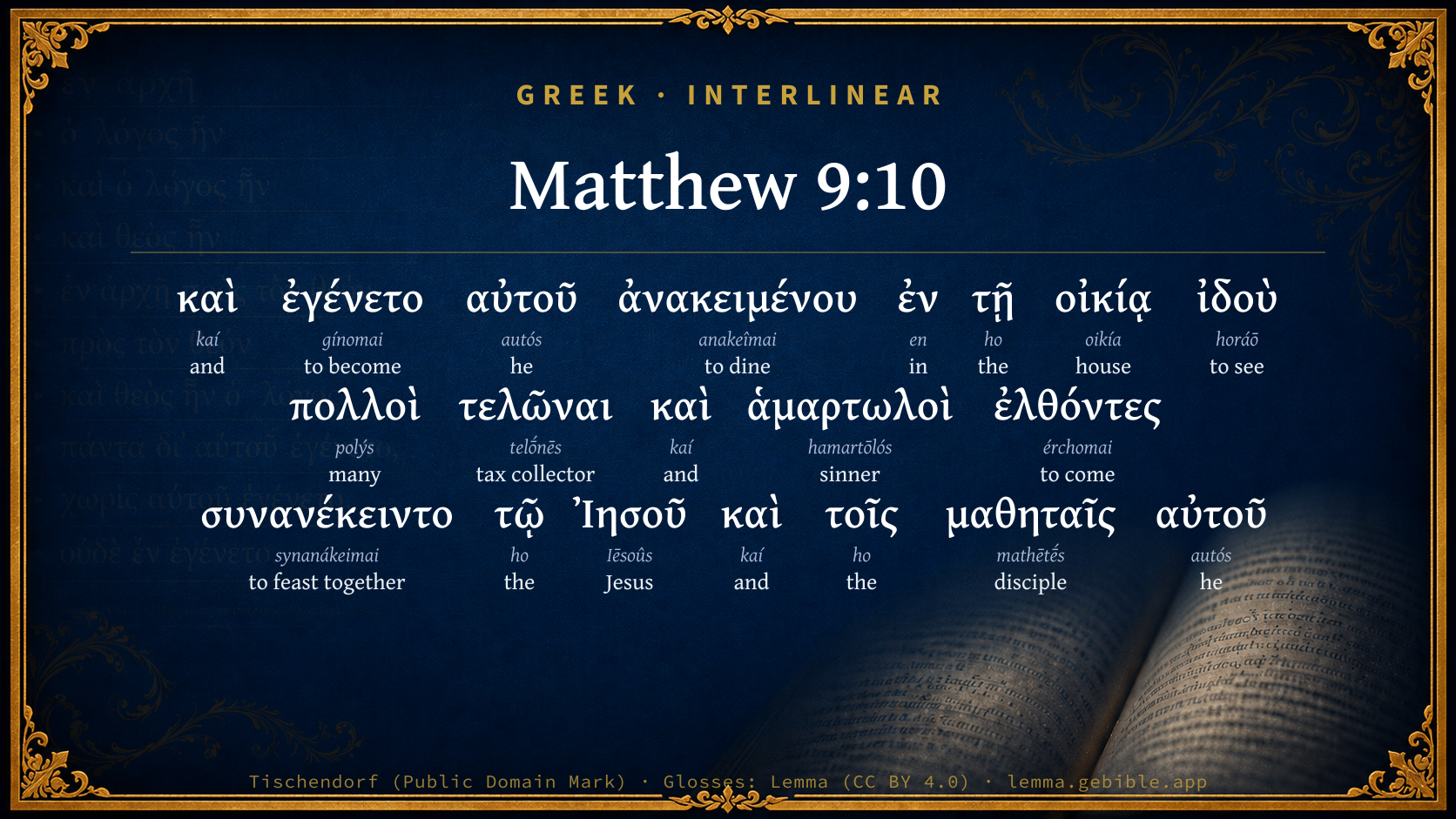
Greek (Tischendorf 8th ed.) Matthew 9:10 appears in the Greek New Testament. The text above is from the Tischendorf 8th edition. Each word links to its Strong’s number and a concise gloss. Click any word for its full Thayer’s Greek Lexicon entry.
Download image
Cite this verse

Matthew 9:10 (World English Bible). Public Domain. Lemma interlinear Bible study tool, https://lemma.gebible.app/v/matthew/9/10.

Show BibTeX & RIS
BibTeX
RIS
English Translation
It happened as he sat in the house, behold, many tax collectors and sinners came and sat down with Jesus and his disciples.
World English Bible · Public Domain
Highlights
  • 3 first appearances in the Greek New Testament
Full analysis ↓
Download a study sheet

One document with this verse’s original text, its word-by-word gloss line, the meaning frame, cross-references with their text, attributed commentary, and full source and license credits — printable, and it pastes into notes with its structure intact.

This verse Autodidact and up

Study sheet (.html) Plain text (.txt)

A passage Seminary Student

Up to 50 verses in one chapter. A passage sheet keeps up to 6 commentary sources and 12 cross-references per verse, in the order this page ranks them, and says so on the sheet whenever that leaves anything out. Ask for a single verse and you get the Autodidact verse sheet above.

Everything on this page stays free to read, with no account — the sheet is a download of what is already on screen, not access to it.

Want to remove ads? Support Godless Engineer
Compare translations 3

The same verse in 3 English versions, stacked beneath the original-language interlinear above. Click any original word for its lexicon entry.

Each is an independent rendering of the whole verse — the interlinear is not word-aligned to these translations.

Highlighted words mark where these versions differ — a whole-verse word diff, not a word-by-word alignment.

  • World English Bible Public Domain
    It happened as he sat in the house, behold, many tax collectors and sinners came and sat down with Jesus and his disciples.
  • King James Version Public Domain
    And it came to pass, as Jesus sat at meat in the house, behold, many publicans and sinners came and sat down with him and his disciples.
  • unfoldingWord Literal Text CC BY-SA 4.0
    And it happened that he was reclining to eat in the house, and behold, many tax collectors and sinners, having come, were dining with Jesus and his disciples.

unfoldingWord Literal Text — © unfoldingWord, licensed CC BY-SA 4.0. Word-aligned USFM3 via Door43 (git.door43.org/unfoldingWord/en_ult).

Versions to compare (up to 4)

3 of 4 selected

Show all 19 translations

Every available English version of this verse, each an independent rendering of the whole verse.

  • World English Bible Public Domain
    It happened as he sat in the house, behold, many tax collectors and sinners came and sat down with Jesus and his disciples.
  • Berean Standard Bible Public Domain
    Later, as Jesus was dining at Matthew’s house, many tax collectors and sinners came and ate with Him and His disciples.
  • Majority Standard Bible Public Domain
    Later, as Jesus was dining at Matthew’s house, many tax collectors and sinners came and ate with Him and His disciples.
  • King James Version Public Domain
    And it came to pass, as Jesus sat at meat in the house, behold, many publicans and sinners came and sat down with him and his disciples.
  • American Standard Version (1901) Public Domain
    And it came to pass, as he sat at meat in the house, behold, many publicans and sinners came and sat down with Jesus and his disciples.
  • Revised Version (1885) Public Domain
    And it came to pass, as he sat at meat in the house, behold, many publicans and sinners came and sat down with Jesus and his disciples.
  • Geneva Bible (1599) Public Domain
    And it came to passe, as Iesus sate at meate in his house, beholde, many Publicanes and sinners, that came thither, sate downe at the table with Iesus and his disciples.
  • Douay-Rheims (1899) Public Domain
    And it came to pass as he was sitting at meat in the house, behold many publicans and sinners came, and sat down with Jesus and his disciples.
  • Young's Literal Translation Public Domain
    And it came to pass, he reclining (at meat) in the house, that lo, many tax-gatherers and sinners having come, were lying (at meat) with Jesus and his disciples,
  • Literal Standard Version CC BY-SA 4.0
    And it came to pass, He reclining in the house, that behold, many tax collectors and sinners having come, were dining with Jesus and His disciples,
  • Unlocked Literal Bible CC BY-SA 4.0
    As Jesus sat down to eat in the house, behold, many tax collectors and sinful people came and dined with Jesus and his disciples.
  • unfoldingWord Literal Text CC BY-SA 4.0
    And it happened that he was reclining to eat in the house, and behold, many tax collectors and sinners, having come, were dining with Jesus and his disciples.
  • Darby Bible Public Domain
    And it came to pass, as he lay at table in the house, that behold, many tax-gatherers and sinners came and lay at table with Jesus and his disciples.
  • World Messianic Bible Public Domain
    As he sat in the house, behold, many tax collectors and sinners came and sat down with Yeshua and his disciples.
  • Webster's Bible Public Domain
    And it came to pass, as Jesus sat at table in the house, behold, many publicans and sinners came and sat down with him and his disciples.
  • Free Bible Version CC BY-SA 4.0
    While Jesus was eating at Matthew's home, many tax collectors and sinners came and sat down at the table with Jesus and his disciples.
  • Bible in Basic English Public Domain
    And it came about, when he was in the house taking food, that a number of tax-farmers and sinners came and took their places with Jesus and his disciples.
  • Text-Critical English NT CC BY 4.0
    Later, as Jesus reclined at the table in Matthew's house, behold, many tax collectors and sinners came and reclined with him and his disciples.
  • Tyndale New Testament (1534) Public Domain
    And it came to passe as he sat at meate in the housse: beholde many publicans and synners came and sate downe also with Iesus and hys disciples.

Literal Standard Version (2020), Covenant Press — licensed CC BY-SA 4.0. Text via the HelloAO Bible API (eBible.org). Unlocked Literal Bible (unfoldingWord) — licensed CC BY-SA 4.0. Text via the HelloAO Bible API (eBible.org). unfoldingWord Literal Text — © unfoldingWord, licensed CC BY-SA 4.0. Word-aligned USFM3 via Door43 (git.door43.org/unfoldingWord/en_ult). Free Bible Version, Dr. Jonathan Gallagher — licensed CC BY-SA 4.0. Text via the HelloAO Bible API (eBible.org).

Word by word

More ways to search: Search by grammar → Find every occurrence → Compare this word →

Practice this passage: Drill this verse → Learn its vocabulary →

συνανέκειντο
synanákeimai
G4873
“to feast together”
Verb, Imperfect, Middle or Passive deponent, Indicative, 3rd person, Plural
Part of Speech
Verb
Tense
Imperfect
Voice
Middle or Passive deponent
Mood
Indicative
Person
3rd person
Number
Plural
Full Thayer's Definition

Origin: from G4862 and G345

TDNT: 13:54,4

1. to recline together, feast together a. of guests
  1. καὶ kaí G2532 “and” Conjunction
  2. ἐγένετο gínomai G1096 “to become” Verb, Aorist, Middle deponent, Indicative, 3rd person, Singular
  3. αὐτοῦ autós G846 “he” Personal pronoun, Genitive, Singular, Masculine
  4. ἀνακειμένου anakeîmai G345 “to dine” Verb, Present, Middle or Passive deponent, Participle, Genitive, Singular, Masculine
  5. ἐν en G1722 “in” Preposition
  6. τῇ ho G3588 “the” Article, Dative, Singular, Feminine
  7. οἰκίᾳ oikía G3614 “house” Noun, Dative, Singular, Feminine
  8. ἰδοὺ horáō G3708 “to see” Verb, Aorist, Middle, Imperative, 2nd person, Singular
  9. πολλοὶ polýs G4183 “many” Adjective, Nominative, Plural, Masculine
  10. τελῶναι telṓnēs G5057 “tax collector” Noun, Nominative, Plural, Masculine
  11. καὶ kaí G2532 “and” Conjunction
  12. ἁμαρτωλοὶ hamartōlós G268 “sinner” Adjective, Nominative, Plural, Masculine
  13. ἐλθόντες érchomai G2064 “to come” Verb, Aorist, Active, Participle, Nominative, Plural, Masculine
  14. τῷ ho G3588 “the” Article, Dative, Singular, Masculine
  15. Ἰησοῦ Iēsoûs G2424 “Jesus” Noun, Dative, Singular, Masculine
  16. καὶ kaí G2532 “and” Conjunction
  17. τοῖς ho G3588 “the” Article, Dative, Plural, Masculine
  18. μαθηταῖς mathētḗs G3101 “disciple” Noun, Dative, Plural, Masculine
  19. αὐτοῦ autós G846 “he” Personal pronoun, Genitive, Singular, Masculine

About this verse

These counts appear in no published source. They are computed here, from the morphology-tagged text and Lemma’s own curated glosses. What Lemma adds →

20
words
15
distinct lemmas
Gospels
section

Notable vocabulary

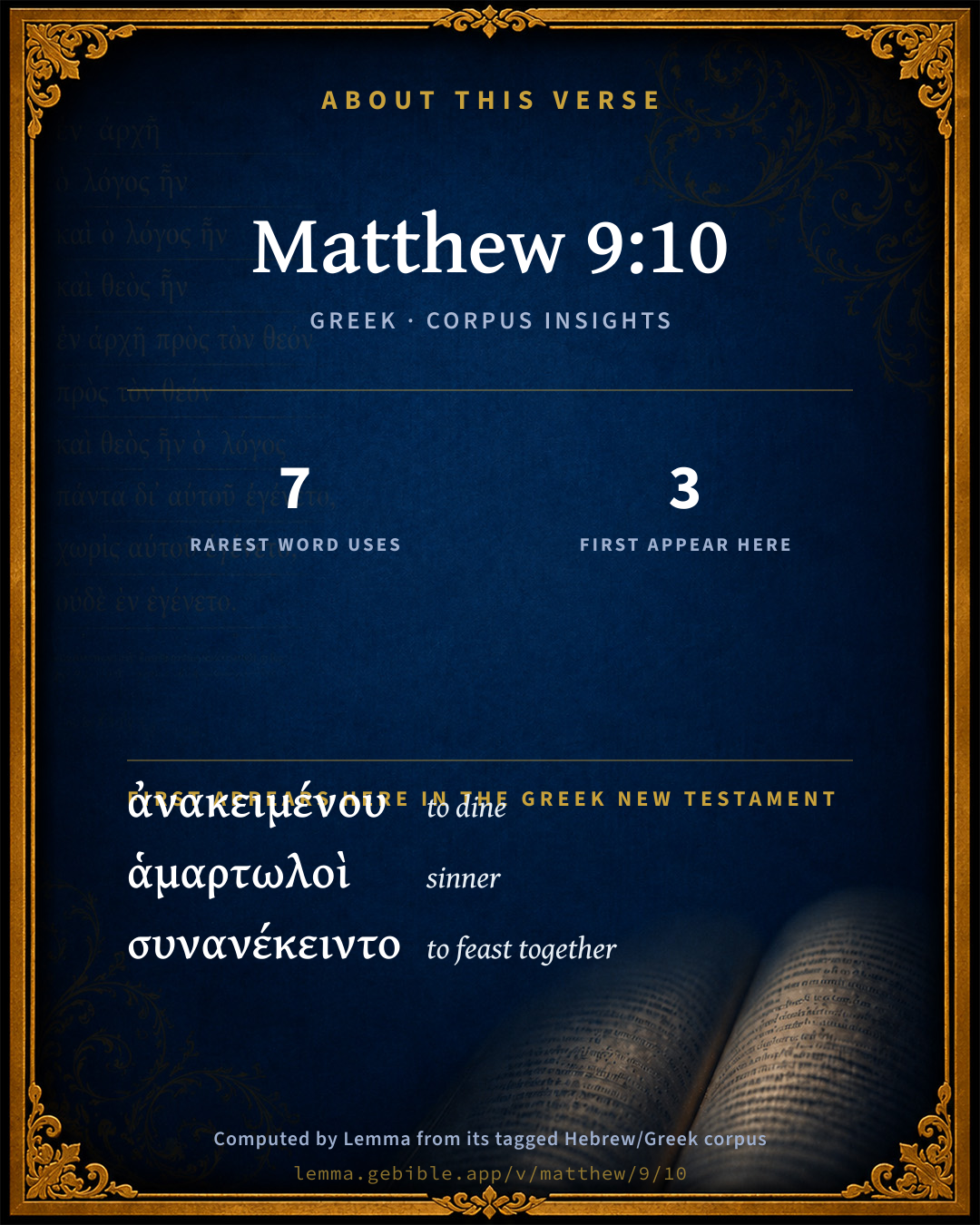
The rarest word here is συνανέκειντο to feast together G4873 — appearing just 7 times in the whole Greek New Testament.

First appearance in Scripture

These words make their first canonical appearance in the Greek New Testament here:

  • ἀνακειμένου to dine G345
  • ἁμαρτωλοὶ sinner G268
  • συνανέκειντο to feast together G4873

Shared distinctive vocabulary

συνανέκειντο to feast together G4873 occurs in 7 verses of the Greek New Testament. Also found in:
Repetition

Words recur within this verse:

Cross-references

5

Topical passages linked to Matthew 9:10 in the Treasury of Scripture Knowledge — connected by theme and wording, ordered by reader-vote popularity; previews shown in the World English Bible.

  • Mark 2:15–17 It happened, that he was reclining at the table in his house, and many tax collectors and sinners sat down with Jesus and his disciples, for there were many, and they followed him.
  • Luke 5:29–32 Levi made a great feast for him in his house. There was a great crowd of tax collectors and others who were reclining with them.
  • 1 Timothy 1:13–16 although I was before a blasphemer, a persecutor, and insolent. However, I obtained mercy, because I did it ignorantly in unbelief.
  • Matthew 5:46–47 For if you love those who love you, what reward do you have? Don't even the tax collectors do the same?
  • John 9:31 We know that God doesn't listen to sinners, but if anyone is a worshipper of God, and does his will, he listens to him.

Cross-references courtesy of OpenBible.info (CC BY 4.0).

Commentary

Notes on Matthew 9:10 from classic Christian and Jewish commentators (each source and its license shown beneath its notes). The classic Christian expositions comment on the surrounding passage and are grouped to its opening verse, so a note may address several verses; the Jewish commentaries on the Tanakh (Rashi and others) are per-verse, so they appear only where the commentator wrote on this verse.

Lemma curates 59 commentaries, every one of them public domain or Creative Commons licensed, each selected and text-cleaned for this edition rather than reprinted as found. About our sources →

The Biblical Illustrator

Joseph S. Exell

Mat_9:10

As Jesus sat at meat in the house.

I. Levis calling.

II. Levis feast.

1. It probably did not immediately follow the call, but was a fit token of the joy of its acceptance.

2. St. Matthew the blessed means of bringing together the Saviour and the lost whom He came to redeem. (A. M. Stuart.)

The Biblical Illustrator, edited by Joseph S. Exell (c. 1880s–1900s) — public domain. Text from a community e-Sword module.

Joseph Benson's Commentary

Mat 9:10-13. As Jesus sat at meat in the house — Namely, of Matthew, (see Mar 2:15,) who, being desirous at once to show his respects to Christ, and to give his former companions and acquaintance an opportunity of enjoying his instructive conversation, made a great entertainment for him, Luk 5:29. And many publicans and sinners came and sat down with him — Being invited by Matthew. The publicans, or collectors of taxes which the Jews paid the Romans, were infamous for their illegal exactions. With these were now present several other open, notorious sinners. When the Pharisees saw it — When they observed that Jesus ate and openly conversed with these men, being offended, they said, Why eateth your Master, &c. — Thus they commonly ask our Lord, Why do thy disciples do this? and his disciples, Why doth your Master? The Pharisees pretended to greater strictness than Christ in keeping at a distance from sinners, but they were far from being strict in reforming themselves, or in zeal for love and doing good to their fellow-creatures. When Jesus heard that — The Pharisees, it seems, though they had not directed their discourse to Jesus, yet had spoken so loud as to let all the guests hear their censure. Hence it was necessary that Christ should show them the unreasonableness of it, and therefore he said, They that be whole need not a physician, but they that are sick — Implying that, since the Pharisees thought themselves righteous persons, they had no need of his company and instructions, whereas the publicans, whom they called sinners, being sick, had the best right to it: and that as nobody ever blamed a physician for going into the company of the patients whose case he had undertaken; so, they could not blame him for conversing with sinners, since he did it not as their companion but as their physician, and therefore with a view to reclaim them. But go ye and learn what that meaneth — Ye that take upon you to teach others; I will have mercy, and not sacrifice — That is, I will have mercy rather than sacrifice: I love acts of mercy better than sacrifice itself. See this explained at large in the note on Hos 6:6; as if he had said, In bringing sinners to repentance, which is the highest exercise of benevolence, I do what is more acceptable to God than offering sacrifices, however many or costly, or observing the most important ceremonial institutions, so unreasonably magnified by the men of your sect, who observe them on many occasions at the expense of charity.

Joseph Benson's Commentary on the Old and New Testaments (1811–1818) — public domain. Text from a community e-Sword module.

Whedon's Commentary on the Bible

Daniel D. Whedon

§ 52. — CONVERSATION AT MATTHEW’S FEAST, Mat_9:10-17.

This fact occurred probably some six months after the call mentioned in the last verse.

10. At meat in the house — Luke informs us that it was in Matthew’s or Levi’s house. Publicans and sinners — Men of unpopular reputation, and men guilty of wicked conduct. Matthew called to this feast not only his old associates the publicans, but many whom he would gladly bring under the reforming power of our Lord’s discourse. He thus showed to his acquaintances and friends that he gloried in his Christian profession and Christian hopes.

Daniel D. Whedon (gen. ed.), Commentary on the Old and New Testaments (1874–1909) — public domain. Text from a community e-Sword module.

Tyndale Open Study Notes

Tyndale Open Resources

9:10 The Jewish people despised Jewish tax collectors (5:46-47; 18:15-20), who cooperated with Roman oppressors and were considered betrayers of the Israelite nation. Many also considered them unclean because of their frequent contact with Gentiles and because of the idolatrous images on Roman coins. Tax-collection was a private enterprise. In each district, Rome granted the right to collect taxes to the highest bidder (cp. Luke 19:1-10). Anything collected above the bid was profit for the collectors, who, driven by greed, often used extortion.

Tyndale Open Study Notes — © Tyndale Open Resources, licensed CC BY-SA 4.0. Text via the HelloAO Bible API.

Bengel's Gnomon

Johann Albrecht Bengel

Mat 9:10. Ἐν τῇ οἰκίᾳ, in the house) Cf. Mat 9:28; or, if you take it of Matthew’s house, Mar 2:15; Luk 5:29. Matthew appears in this feast to have bid adieu to his former companions,[404] nor does he call the house any longer his own.—τελῶναι καὶ ἁμαρτωλοὶ, publicans and sinners) who had sinned grievously against the sixth and seventh [seventh and eighth] commandments.—συνανέκειτο, sat down together with) Kind and condescending was the intercourse of Jesus.[405]

[404] He seems also hereby to have afforded them an opportunity of going to the Lord, such as would hardly have been given to so great a number of such characters at any other time. Shortly after, Matthew came to know the glory of Jesus by His acts, and especially by the raising of Jairus’ daughter, ch. Mat 9:19; and he was sent forth, at no long interval afterwards, with the rest of His apostles: on which occasion he has called himself Matthew the publican, ch. Mat 10:3; and, from the deepest sense of gratitude (as is natural), has recalled to remembrance with what marvellous speed grace transferred him from his state as a publican (ch. Mat 18:17) to an Apostolic embassy which was distinguished by miracles.—Harm. p. 282.

[405] For whose sake the banquet was given, to which, without any command on His part, publicans and sinners came. Therefore the objection of the Pharisees, even looking at it in a mere external point of view, was void of all justice.—V. g.

Bengel's Gnomon of the New Testament — English translation (T&T Clark, Edinburgh, 1860) — public domain. Text from a community e-Sword module.

Meyer's Critical & Exegetical Commentary

Heinrich August Wilhelm Meyer

Mat_9:10. Ἐγένετο … καί] see note on Luk_5:12.

ἀνακειμένου] In classical Greek, to recline at table is represented by κατακεῖσθαι, as frequently also in the N. T. (Mar_2:15; Mar_14:3), though in Polybius, Athenaeus, and later writers ἀνακεῖσθαι, too, is by no means rare. Phrynichus, ed. Lobeck, p. 217. On the custom itself (with the left arm resting on a cushion), comp. note on Joh_13:23.

ἐν τῇ οἰκίᾳ] With the exception of Fritzsche, Bleek, Holtzmann, Keim, Hilgenfeld (yet comp. already the still merely doubtful remark of Bengel), critics have gratuitously assumed the house to have been that of Matthew, which accords, no doubt, with Luk_5:29 (not Mar_2:15), but neither with the simple ἐν τῇ οἰκίᾳ (see Mat_9:23; Mat_13:1; Mat_13:36; Mat_17:25) nor with the connection. Seeing, then, that the publican who rose from his seat at the custom-house and followed Jesus cannot, of course, have gone to his own residence, nothing else can have been meant but the house of Jesus (in which He lived). There lies the variation as compared with Luke, and like many another, it cannot be disposed of. But de Wettes objection, reproduced by Lichtenstein, Lange, and Hilgenfeld, that it is scarcely probable that Jesus would give feasts, has no force whatever, since Matthew does not say a single word about a feast; but surely one may suppose that, when the disciples were present in his residence at Capernaum, Jesus may have eaten, i.e. have reclined at table with them. The publicans and sinners who came thither were at the same time hospitably received.

καὶ ἁμαρτωλοί] and in general men of an immoral stamp, with whom were also classed the publicans as being servants of the Roman government, and often guilty of fraudulent conduct (Luk_3:13); comp. Luk_19:7. Observe that Jesus Himself by no means denies the πονηρὸν εἶναι in regard to those associated with Him at table, Mat_9:12 f. They were truly diseased ones, who were now, however, yielding themselves up to the hands of the physician.

Meyer — Critical and Exegetical Commentary on the New Testament — English translation by Peter Christie, edited by Frederick Crombie (T&T Clark, 1880) — public domain. Text from a community e-Sword module.

Expositor's Greek Testament

ed. W. Robertson Nicoll

Mat 9:10 . καὶ ἐγένετο , etc. The narrative of this incident in all three Synoptists is condensed, and the situation not clear. What house is meant ( ἐν τῇ οἰκ .), and why so many ( πολλοὶ )? “There were many,” Mark remarks, emphatically (Mat 2:15 ), and the ἰδοὺ here implies that something important took place. Luke infers (for we need not suppose independent information) that it is a feast ( δοχὴν ), and, doubtless, he is right. But given by whom? Levi, according to Luke. It may have been so, but not necessarily as the prime mover; possibly, nay, probably, as the agent of his new Master. Our thoughts have been too much biassed by the assumption that the call of Matthew in this section is the main thing, and the feast an accompanying incident, a farewell feast of Matthew’s in which Jesus passively partook. The truth, probably, is that the call was a preliminary to the feast, the first step in the working out of a plan. Jesus aims at a mission among the reprobated classes, and His first step is the call of Matthew to discipleship, and His second the gathering together, through him, of a large number of these classes to a social entertainment; the place of meeting being, possibly, not a private house, whether Christ’s or Matthew’s, but a public hall. If Matthew’s house or Simon’s (in which Jesus probably had His home, vide Mark) was large enough to have a quadrangular court, the gathering might be there, where, according to Faber, Archäologie der Hebräer , p. 408, meetings of various sorts were held. In any case it was a great affair scores, possibly hundreds, present, too large for a room in a house, a conventicle meeting, so to speak; a meeting with such people in the Synagogue not being possible. For further remarks vide on Mark. τελῶναι καὶ ἁμαρτωλοὶ : publicans naturally, if Matthew was the host, but why ἁμαρ .? He was a respectable man; are the ἁμαρ . simply the τελῶναι as viewed from the outside, so named in anticipation of the Pharisaic description of the party? If Jesus was the inviter, they might be a distinct class, and worse, very real sinners, for His aim was a mission among the social Pariahs.

The Expositor's Greek Testament, edited by W. Robertson Nicoll (1897–1910) — public domain. Text from a community e-Sword module.

Geneva Bible (1599)

Geneva Bible translators

The customers fellows which were placed by the Romans, after that Judea was brought into the form of a province, to gather the customs, and therefore of the rest of the Jews, they were called sinners, that is to say very vile men.

Geneva Bible (1599) marginal notes — public domain. Text via Bolls.life.

Jamieson, Fausset & Brown

Robert Jamieson, A. R. Fausset & David Brown

And it came to pass, as Jesus sat at meat in the house--The modesty of our Evangelist signally appears here. Luke says (Luk 5:29) that "Levi made Him a great feast," or "reception," while Matthew merely says, "He sat at meat"; and Mark and Luke say that it was in Levi's "own house," while Matthew merely says, "He sat at meat in the house." Whether this feast was made now, or not till afterwards, is a point of some importance in the order of events, and not agreed among harmonists. The probability is that it did not take place till a considerable time afterwards. For Matthew, who ought surely to know what took place while his Lord was speaking at his own table, tells us that the visit of Jairus, the ruler of the synagogue, occurred at that moment (Mat 9:18). But we know from Mark and Luke that this visit of Jairus did not take place till after our Lord's return, at a later period from the country of the Gadarenes. (See Mar 5:21, &c., and Luk 8:40, &c.). We conclude, therefore, that the feast was not made in the novelty of his discipleship, but after Matthew had had time to be somewhat established in the faith; when returning to Capernaum, his compassion for old friends, of his own calling and character, led him to gather them together that they might have an opportunity of hearing the gracious words which proceeded out of His Master's mouth, if haply they might experience a like change.

behold, many publicans and sinners--Luke says, "a great company" (Luk 5:29) --came and sat down with him and his disciples. In all such cases the word rendered "sat" is "reclined," in allusion to the ancient mode of lying on couches at meals.

Jamieson, Fausset & Brown — Commentary Critical and Explanatory on the Whole Bible (1871) — public domain (CC PDM 1.0). Text via the HelloAO Bible API.

Adam Clarke's Commentary

Verse 10. Sat at meat in the house] Viz. of Matthew, who it appears, from Lu 5:29, made a great feast on the occasion, thus testifying his gratitude for the honour done him; and that his friends and acquaintances might profit by the teaching of his new master, he invites them to the entertainment that was honoured by the presence of Christ. His companions, it appears, were not of the most creditable kind. They were tax-gatherers (See Clarke on Mt 5:46) and sinners, αμαρτωλοι, a word which I believe in general signifies heathens, throughout the Gospels, and in several other parts of the New Testament. See, among others, Mt 11:19; Mt 26:45; Mr 2:15-17; Mr 14:41; Lu 5:30-32; Lu 6:32-34; Lu 7:34; Lu 7:37; Lu 7:39; Lu 15:1-2; Lu 15:7; Lu 15:10; Lu 19:7; Lu 24:7; Joh 9:16; Joh 9:24; Joh 9:25; Joh 9:31; Ro 5:8; Ga 2:15; Heb 7:26; 1Pe 4:18; in most, if not all of which places, it evidently refers to the character or state of a Gentile, or Heathen. See also the notes on these passages.

Adam Clarke's Commentary on the Bible (1810–1826) — public domain. Text from a community e-Sword/MySword module.

Ellicott's Commentary for English Readers

(10) As Jesus sat at meat in the house.—The Greek runs, as he sat at meat. The insertion of the name Jesus in this part of the sentence injures the sense. What seems to have been meant is, that while Matthew sat (i.e., reclined after Roman fashion), many publicans and sinners came and reclined with Jesus and His disciples. On the assumption of St. Matthew’s authorship of the Gospel, there is a noticeable humility in his omission of the fact that he had made “a great feast” (Luk_5:29). It was apparently a farewell feast to old friends and neighbours before he entered on his new calling. They were naturally mostly of his own class, or on a yet lower level. The publican was the pariah of Palestine, and no decent person would associate with him. The term “sinners” may have included Gentiles, but does not necessarily designate them. So far as the context goes, as in Mat_9:13, the term is used in its simple and natural sense.

A Bible Commentary for English Readers, edited by Charles John Ellicott (1878–1897) — public domain. Text from a community e-Sword module.

The Cambridge Bible for Schools and Colleges

gen. ed. J. J. S. Perowne

10–13. A Meal in the Evangelist’s House. Mar_2:15-17; Luk_5:29-32

10. in the house] St Luke says “and Levi made him a great feast,” which makes it clear that the meal was in Levi’s house.

The Cambridge Bible for Schools and Colleges (gen. ed. J. J. S. Perowne; Cambridge University Press, 1878–1918) — public domain. Text from a community e-Sword module.

John Gill's Exposition

And when the Pharisees saw it,.... The feast Matthew made, the guests that were invited, and particularly that Christ sat down to meat with such vile and wicked company; they and the Scribes, as Mark and Luke add, who generally were together, of the same complexion, equally enemies to Christ, and watchful observers of his conduct, and pretending to a more strict and religious way of life, were offended at all this;

and said to his disciples, which they chose to do, rather than to Christ himself; partly, because they were afraid to engage in a dispute with him, who had just given them a full proof of his omniscience, that he knew the very thoughts and reasonings of their minds, and had so confounded them already, both by his arguments and miracles; and partly, because they might think themselves a match for the disciples, and might hope to stumble and ensnare them, and prevail upon them to quit their profession, and leave following him, whom they would suggest could not be a good man, that was guilty of so evil an action; which, with them, was very unlawful and abhorrent, as that for which they accuse and reprove him,

why eateth your master with publicans and sinners? The "publicans", or gatherers of the Roman tax, toll, or tribute of any sort, whether Jews or Gentiles, were persons of a very infamous character; and, as here, so often, in Jewish writings, are ranked with "sinners", and those of the worst sort: so false swearing was allowed to be made , "to murderers, and to robbers, and to publicans" (o); and so "publicans and thieves" are joined together by Maimonides (p), and a publican is said by him to be as a thief. And indeed this was not only the sense of the Jews, but also of other people, according to those words of Zeno the poet, (q), "all publicans are all of them robbers": though this was not originally their character; for formerly the best of the Roman gentry were employed in this office, till by malpractices it became scandalous, when the meaner sort of people, yea, even vassals, were put into it (r). Now, with such sort of men as these the Pharisees held it unlawful to have any sort of conversation; they expelled such their society, would not dwell with them in the same house, nor eat or drink with them; concerning which, their rules and methods are these;

"a companion, or friend, who becomes the king's collector, or a "publican", or the like, they drive him from society with them: if he abstains from his evil works, then he is as any other man (s).''

Again,

"when the king's collectors enter into a house to dwell, all that are in the house are defiled (t).''

Moreover, it is (u) said, that

"the former saints ate their common food with purity, i.e. with their hands washed, and took care of all defilements every day; and these were called Pharisees; and this sect was exceedingly holy, and was the way of piety; for such a man was separated, and he abstained from the rest of the people, and he did not touch them, , "nor did he eat and drink with them".''

It was a general rule with them, that a clean person ought not to eat with an unclean, as they judged the common people to be; nay, that a Pharisee, who was unclean himself, might not eat with another person that was so, and which they boast of, as a great degree of holiness.

"Come and see, (say they (w),) to what a pitch purity has arrived in Israel; for they not only teach, that a pure person may not eat with one that is defiled, but that one that has a "gonorrhoea" may not eat with another that has one, lest he should be used to transgress this way; and a Pharisee that has a "gonorrhoea" may not eat with a common person that has one, lest he should be used to do so.''

Hence they looked upon Christ and his disciples as such, and would insinuate that they were evil men, who had no regard to purity of life and conversation.

(o) Mis. Nedarim, c. 3. sect. 4. (p) Hilch. Gezela, c. 5. sect. 9. 11. (q) Apud Fabricii Graec. Biblioth. l. 2. c. 22. p. 755. (r) Alex. ab Alex. Genial. Dier. l. 2. c. 29. (s) Maimon. Mishcab & Moshab, c. 10. sect. 8. (t) lb. c. 12. sect. 12. (u) lb. Hilchoth Tumaot Okelim. c. 16. sect. 12. (w) T. Bab. Sabbat, fol. 13. 1.

John Gill's Exposition of the Whole Bible (1746–1763) — public domain (CC PDM 1.0). Text via the HelloAO Bible API.

Trapp's Complete Commentary

John Trapp

10 And it came to pass, as Jesus sat at meat in the house, behold, many publicans and sinners came and sat down with him and his disciples.

Ver. 10. As Jesus sat at meat in the house] Matthew feasted Christ, for joy of his conversion. Yea, he made a feast, a feast like a king, a very sumptuous feast, as St Luke’s word importeth, {a} he kept open house, a table for all comers. As princes at their coronation straw the streets with coin, make the conduits run wine, release prisoners, &c.; so here. "Kill the fatted calf, and let us be merry," said he at his son’s return, Luk 15:23. When a sinner repents there are grand festivals and feasts in heaven: instruments of music are put into the angels’ hands, and songs into their mouths. How well paid was Zaccheus, when salvation was come home to his house! When God was once reconciled to the people in the wilderness, after their sin in setting up the golden calf, to testify their great joy and thankfulness, they brought stuff more than enough to the building of the tabernacle. The centurion, when he once became a proselyte, built the Jewish synagogues that had been thrown down by Antiochus, Luk 7:5. And Tyre converted finds another manner of merchandise than formerly, namely, to feed and clothe God’s saints with durable clothing, Isa 23:18.

{a} Luk 5:29, Δοχην. acceptionem, splendidum epulum, ut annotat Erasm. ex Athenaeo.

John Trapp, A Commentary or Exposition upon All the Books of the Old and New Testament (1647–1656) — public domain. Text from a community e-Sword module.

Albert Barnes' Notes on the Bible

And it came to pass, as Jesus sat at meat in the house - This was at a feast given to him by “Levi” or “Matthew,” Luk 5:29. This is another circumstance favorable to Matthew, but omitted by him, and recorded by Luke; showing also that the apostles were averse to praising themselves. To receive Christ hospitably and kindly was a commendable act, and it strongly evinces Matthew’s freedom from ostentation that he has not himself mentioned the fact. It thus illustrates the command of the Saviour, as recorded by himself, Mat 6:1-4.

At meat - At the table; at supper.

Many publicans and sinners came - Probably the old friends of Matthew who had been invited by him. The character of a “publican,” or tax-gatherer, among the Jews was commonly not very respectable (see notes at Mat 5:47; Mat 18:17), and there is no improbability in supposing that Matthew, before his conversion, had sustained the general character of such people, and that his associations and friendships had been among those who were not remarkable for their morality.

Albert Barnes' Notes on the Bible (1834–1885) — public domain. Text from a community e-Sword/MySword module.

Matthew Poole's English Annotations

Luke saith that Levi made him a great feast in his own house: and there was a great company of publicans and of others that sat down with them, Luk 5:29. Mark saith, there were many, and they followed him, Mar 2:15. Matthew, touched with the sense of the free and infinite love of Christ to him, maketh Christ a feast: this speaketh him a man of some estate: he invites many to dine with him, some of them publicans, some noted sinners. He designs good undoubtedly to such as had been his former companions, that they might also see the Lord, and be brought to follow him. Grace teacheth a man to study the conversion of others, and never dwelleth in a narrow soul, nor studieth its concealment from others.

Matthew Poole's English Annotations on the Holy Bible (1683–1685) — public domain. Text from a community e-Sword/MySword module.

The Pulpit Commentary

Vers. 10-13. The feast with publicans and sinners, and Christ"s apology. Parallel passages: Mar_2:15-17 Luk_5:29-32. All three evangelists give the essential features of the section, but Mark and Luke show more clearly that the feast was in the house of the new disciple, and Matthew alone gives the reference to Hosea.

And it came to pass, as Jesus (he, Revised Version) sat at meat; " Gr. reclined: and so always" (Revised Version margin); cf. Mat_26:20. In the house; Luke, "And Levi made him a great feast in his house." Whether or not this was the same as the telwnion , we have no means of knowing, but presumably it was not. Behold, many publicans (Mat_5:46, note) and sinners. The second term seems to include all who openly impugned or neglected the Law. It is, therefore, sometimes used with special reference to Gentiles. (Mat_26:45; cf. Gal_2:15) Came and sat down with him (Revised Version, Jesus, emphatic) and his disciples.

Vers. 10-13. Jesus the Friend of sinners.

The incident here recorded follows on the call of Matthew the publican. Our Lord had just appointed a member of an order usually regarded as hopelessly reprobate to be one of his apostles. It was natural that the publican"s old associates should recognize this breaking down of old barriers, and flock to the feast which Matthew provided to welcome and honour his new Friend.

I THE FACT. Jesus did eat and drink with men of questionable occupation, and even with those of notoriously bad character. He did not simply show himself kindly disposed towards such people. He associated with them. Many benevolent persons would wish them well, and-some would support homes and refuges for the most miserable and degraded among them. But the Church of Christ has been slow in following her Master"s example in showing real brotherhood for people under a social ban. The conduct of Jesus was new to the world, and it has been but rarely followed. Here is the wonder of his brotherly nature. He will take the lowest to the priceless privilege of his friendship.

II THE COMPLAINT. This conduct of our Lord was regarded as scandalous by the religious people of his day, as similar conduct on the part of any good man who was daring enough to attempt it would be regarded by the religious people of our own times. It was not really suspected that he enjoyed the bad atmosphere of low society, but he was charged with courting that society in order to win popularity. Ungenerous people cannot conceive of generous motives. To them the grandest act of self-sacrifice must have some sinister aim.

III THE EXPLANATION. Jesus associated with persons of bad character in the hope of raising them. He compared himself to a physician who does not pay his visits to healthy people. The doctor on his rounds goes to some strange houses. If he were but a casual caller, his choice of associates might raise a scandal. But his work determines his action. Though he has to handle and study what is very repulsive, science and humane ends elevate his treatment of it, and keep this pure. Christ goes first where he is most needed. Not desert, not pleasure, but need, draws him. When he comes it is to heal. His purpose sanctifies his association with persons of loose character. His one aim is to do them good.

IV THE JUSTIFICATION. The religious people who accused our Lord had formed a totally false conception of the service which was acceptable to God. Jesus answered them out of their own Bible. There they might have read that what God required was not ceremonial offerings, but kindness to our fellow-men and not sacrifice." Thus he turns the tables. These very religious people, his accusers, are not pleasing God. They are very particular about formal observances, but they neglect the weightier matters of the Law. Christ is truly doing God"s will by showing mercy. God is love, and Divine love is never so gratified as by the exercise of human charity. Therefore it is quite in accordance with his Father"s will that Christ shall call the sinners. His mission is to them. Those people who think themselves righteous cannot have any blessing from Christ. The self-righteous hypocrite is really further from the kingdom of heaven than the publican and the sinner. W.F.A.

Vers. 10-13. (see also Mar_2:15-22 Luk_5:29-39) The model readiness of mercy.

Learn that

I THE MOST UNUSUAL PLACES AND THE MOST UNUSUAL TIMES ARE, ACCORDING TO THE EXAMPLE OF CHRIST, TO BE UTILIZED FOR THE SEEKING AND CONVERTING OF THE MOST UNUSUAL CHARACTERS, AND THOSE WHO MAY BE APPARENTLY OF THE MOST HOPELESS KIND.

II THAT BY THE EXAMPLE OF CHRIST NO LIMIT MUST BE SET TO THE CONDESCENSION WHENEVER EVEN IT MAY MOST REALLY MERIT THAT DESCRIPTION OF THE MAN WHO WOULD EMULATE THE CHARACTER AND THE WORK AND THE METHODS OF THAT MODEL PHYSICIAN OF SOULS.

III THAT AS THE SUPREME NEED OF THE SOUL IS MERCY, SO ALSO THE SOVEREIGN QUALIFICATION OF HIM WHO WOULD RE ITS PHYSICIAN IS READINESS TO MERCY TO FEEL IT AND TO SHOW IT.

Contrast the "having mercy" and the requiring of sacrifice. B.

The Pulpit Commentary (1880–1919), ed. H.D.M. Spence-Jones & Joseph S. Exell — public domain. Text from a community e-Sword module.

John Wesley's Explanatory Notes

As Jesus sat at table in the house - Of Matthew, who having invited many of his old companions, made him a feast, Mark ii, 15; and that a great one, though he does not himself mention it. The publicans, or collectors of the taxes which the Jews paid the Romans, were infamous for their illegal exactions: Sinners - Open, notorious, sinners.

John Wesley, Explanatory Notes Upon the Whole Bible (1754–1765) — public domain. Text via the GEBible commentary corpus.

Kretzmann's Popular Commentary

Paul E. Kretzmann

The publican feast:

v. 10. And it came to pass, as Jesus sat at meat in the house, behold, many publicans and sinners came and sat down with Him and His disciples.

Matthew, either upon his own initiative or at the suggestion of Jesus, caused a feast to be prepared, Mar 2:15; Luk 5:29. But here is a significant fact: publicans and sinners were the guests beside Jesus and His disciples. They were reclining, after the Oriental fashion, on special sofas, resting on pillows; scores, possibly hundreds, were present, all of the lowly, the social outcasts of the city, those whom the Pharisees had excommunicated from the synagogues. The latter took offense:

v. 11. And when the Pharisees saw it, they said unto His disciples, Why eateth your Master with publicans and sinners?

They regarded the whole festival as a scandalous affair, but lacked the courage to address Christ directly on this matter, hoping incidentally thus to alienate the disciples from the Master. Jesus, the Friend of the sinners, is a rock of offense to all self-righteous, proud hearts. They find His behavior savoring of the gutter, and criticize severely such as follow His directions in seeking sinners.

Paul E. Kretzmann, Popular Commentary of the Bible (1921–1924) — public domain. Text from a community e-Sword module.

Burkitt's Expository Notes on the New Testament

William Burkitt

Observe here, Christ invites Matthew to a discipleship, Matthew invites Christ to a feast; the servant invites his master, a sinner invited his Saviour. We do not find, wherever Christ was invited to any table, that he refused to go; if a Pharisee, if a publican invited, he constantly went; not for the pleasure of eating, but for the opportunity of conversing and doing good; Christ feasts us when we feast him.

From Matthew’s example, learn, That new converts are full of affection towards Christ, and very expressive of their love unto him. Such as before conversion disesteemed him, do afterwards kindly and respectfully entertain him; Matthew touched with a sense of Christ’s rich love, makes him a royal feast.

Observe farther, How at this feast many publicans and sinners were present, of Matthew’s acquaintance no doubt, and probably invited by him, that they might also see Christ, and be partakes of the same grace with him.

Whence we learn, That grace teaches a man to desire and seek the conversion of others; and such as are truly brought home to Christ, themselves, will study and endeavour to bring in all their acquaintance to Christ also.

William Burkitt's Expository Notes on the New Testament (1700–1703) — public domain. Text from a community e-Sword module.

McGarvey & Pendleton's Commentaries

J. W. McGarvey

J. W. McGarvey's The Fourfold Gospel [LVII. Matthew's Feast].

LVII. MATTHEW'S FEAST. DISCOURSE ON FASTING. (Capernaum.) aMATT. IX. 10-17; bMARK II. 15-22; cLUKE V. 29-39.

c29 And Levi [another name for the apostle Matthew] made him a great feast in his house: b15 And it came to pass, that he was sitting aas he sat at meat in the bhis ahouse, cand there was a great multitude of publicans [Matthew had invited his old friends] and of others band abehold, many publicans and sinners came and sat down with Jesus and his disciples. bfor there were many, cthat were sitting at meat with them. band they followed him. c30 And the Pharisees and their scribes bthe scribes of the Pharisees, [that is, the scribes which were of their party or sect] when they saw that he was eating with the sinners and publicans, c murmured against his disciples, saying, athey said unto his disciples, cWhy do ye eat and drink with the publicans and sinners? aWhy eateth your Teacher with the publicans and sinners? bHow is it that he eateth and drinketh with publicans and sinners? [From their standpoint, the question was natural enough. No strict Jew could eat with a Gentile ( Act_11:3, Gal_2:12), and Matthew's guests were classed with the heathen.] a12 But b17 And awhen he bJesus heard it, he canswering said bsaith unto them, They that are whole cin health have no need of a physician, but they that are sick. a13 But go ye and learn what this meaneth, I desire mercy, and not sacrifice [For an explanation of this passage, see Mat_22:4, Luk_14:8, Joh_2:8, Joh_2:9). Mourning and fasting would therefore ill befit such an occasion.] c35 But the days will come; and when the bridegroom shall [350] be taken from them, band then will they fast in that day. cthose days. [Jesus here foretells the removal of his visible presence from his disciples by his ascension. His words predict but do not command a fast. He prescribed no stated fasts, and the apostolic church kept none. History shows that prescribed fasts become formal and tend to Phariseeism.] 36 And he spake also a parable unto them: No man rendeth a piece from a new garment and putteth it upon an old garment, else he will rend the new, and also the piece from the new will not agree with the old. a16 And no man putteth bseweth a piece of undressed cloth on aupon an old garment; for belse that which should fill it up taketh from it, afrom the garment, bthe new from the old, and a worse rent is made. [Jesus justifies the conduct of his disciples by an appeal to the principles of the new dispensation, by which they were governed. The disciples of John looked upon Jesus as a reformer of Judaism, but he corrects their false impressions. To tear the new dispensation to pieces to renovate or embellish the old would be to injure the new and to destroy the old. By the process of fulling or dressing, new cloth was cleansed and shrunk so as to become more compact. The new cloth, therefore, had in it, so to speak, a life-element, and in its movement while shrinking it would tear the weaker fiber of the old cloth to which it was sewed, and thus enlarge the rent. The new dispensation could have rites and forms of its own, but could not conform to the rites of the Pharisees. If the conduct of his disciples had made a rent in the rabbinical traditions with regard to fasting, Jesus could not so modify the conduct of his disciples as to patch the rent without injuring the moral sense of his disciples, and without making Phariseeism a more meaningless hypocrisy than ever.] 22 And no man putteth { a17 Neither do men put new wine into old wine-skins: celse the the new wine will burst the skins, aand the wine citself will be ais spilled, band the wine perisheth, and the skins: aburst, cand the skins will perish. abut they put new wine cnew [351] wine must be put} binto fresh wine-skins. aand both are preserved. [This parable is also an illustration of the principles set forth above. Wine was then stored in casks of skin--usually hides of goats. Wine-skins, newly made, were elastic, and would expand to accommodate the fermentation of the new wine within. But the old wine-skins were stiff and of little strength, and would burst if fermenting liquid were confined within them.] c39 And no man having drunk old wine desireth new; for he saith, The old is good. [The thought here is that as wine should be put in skins suited for it, and as, at an entertainment, the different kinds of wine should be served in appropriate succession; so, fasting should be observed on suitable occasions--not, for instance, at a wedding.]

[FFG 349-352]

J. W. McGarvey (with Philip Y. Pendleton), Commentaries on the New Testament (The Fourfold Gospel, 1914; Acts; and the epistles) — public domain. Text from a community e-Sword/MySword module.

The People's New Testament

B. W. Johnson

10. As he sat at meat. At a meal. In the house. The house of Matthew. Matthew made a feast (Mark 2:15; Luke 5:29). Many publicans and sinners came. Matthew's old associates. Luke says they were invited. Publicans. Collectors of the Roman tax, usually Jews, but hated because they collected a hateful tax, often, too, grasping and unscrupulous. Sinners. Persons excommunicated from the synagogue. An orthodox Jew would not eat with them. When the term sinner is applied to a woman, it usually means an outcast.

B. W. Johnson's The People's New Testament with Notes (1889–1891) — public domain. Electronic text from the Christian Classics Ethereal Library (CCEL) ThML edition.

unfoldingWord translationNotes

Door43 World Missions Community

General Information:

These events occur at the house of Matthew the tax collector.

the house

This is probably Matthew's house, but it could also be Jesus' house. Specify only if needed to avoid confusion.

behold

This marks the beginning of another event in the larger story. It may involve different people than the previous events. Your language may have a way of doing this.

When the Pharisees saw it

"When the Pharisees saw that Jesus was eating with the tax collectors and sinful people"

Why does your teacher eat with tax collectors and sinful people?

The Pharisees use this question to criticize what Jesus is doing. (See: Rhetorical Question)

translationWords

tax

sin

disciple

Pharisee

teacher

unfoldingWord translationNotes — © Distant Shores Media and the Door43 World Missions Community, licensed CC BY-SA 4.0. Source: git.door43.org/Door43/en_tn.

Cambridge Greek Testament for Schools and Colleges

10–13. A MEAL IN THE EVANGELIST’S HOUSE

Mar 2:15-17; Luk 5:29-32.

10. καὶ ἐγένετο. See note, ch. Mat 11:1.

ἀνακεῖσθαι, late in this sense for the classical κατακεῖσθαι, ‘to recline at table.’

ἐν τῇ οἰκίᾳ. St Luke says ‘and Levi made him a great feast,’ which makes it clear that the meal was in Levi’s house.

πολλοὶ τελῶναι. The fact that the tax-gatherers were numerous enough to form a large class of society points significantly to the oppression of the country. ἁμαρτωλοί, men of impure lives, or esteemed impure by the Pharisees.

Cambridge Greek Testament for Schools and Colleges (Cambridge University Press, 1896; 21 vols, various authors incl. Carr, Maclear, Plummer, Farrar, Lumby, Moule, M. R. James, Simcox) — public domain. Text from a community e-Sword module.

Alford’s Greek Testament

Henry Alford

10.] We are told in Luk 5:29, that Levi made him a great feast in his house; and, similarly, Mark has ἐν τῇ οἰκ. αὐτοῦ. The narrative in our text is so closely identical with that in Mark, that it is impossible to suppose, with Greswell, that a different feast is intended. The arguments by which he supports his view are by no means weighty. From the words τῇ οἰκίᾳ, he infers that the house was not that of Matthew, but that in which our Lord usually dwelt, which he supposes to be intended in several other places. But surely the article might be used without any such significance, or designating any particular house,—as would be very likely if Matthew himself is here the narrator. (A similar mistake has been made in supposing τὸ πλοῖον, as in ver. 1, and elsewhere, to mean some one particular ship; whereas it is generic: see note there.) Again, Greswell presses to verbal accuracy the terms used in the accounts (e.g. συνανέκειντο and ἐλθόντες συνανέκειντο), and attempts to shew them to be inconsistent with one another. But surely the time is past for such dealing with the historic text of the Gospels; and, besides, he has overlooked a great inconsistency in his own explanation, viz., that of making in the second instance, according to him, Scribes and Pharisees present at the feast given by a Publican, and exclaiming against that which they themselves were doing. It was not at, but after the feast that the discourse in vv. 11-17 took place. And his whole inference, that δοχὴ μεγάλη must be the great meal in the day, and consequently in the evening, hangs on too slender a thread to need refutation. The real difficulty, insuperable to a Harmonist, is the connexion here of the raising of Jaeirus’s daughter with this feast: on which see below, ver. 18.

καὶ ἐγέν … καὶ ἰδ.] a Hebraism, see reff.; it occurs, but with the omission of ἰδού, in Mark’s account. The not very usual word, συνανέκειντο, is also common to the two. St. Mark, with his usual precision, adds ἦσαν γὰρ πολλοὶ καὶ ἠκολούθησαν αὐτῷ: a clause answering to ἐλθόντες in our text. See last note.

Henry Alford, The Greek Testament (1849–1861) — public domain. Text from a community e-Sword module.

International Critical Commentary

(M) 10. And it came to pass, as He was sitting in the house, that, behold, many toll-gatherers and outcasts came and sat with Jesus and His disciples.] Mk. has: “And it cometh to pass that he sat in his house, and many toll-gatherers and outcasts sat,” etc. Mt. avoids as usual the historic present γίνεται. In Mk. the αὐτόν is ambiguous. It might refer to Jesus, but more probably signifies Levi. However, the connection, “he arose, and followed Him. And it cometh to pass that he sat in his house,” is a harsh one. Mt. seems to have understood the house to be that of Jesus, and attempts to make this clear by altering the construction into the Septuagintal Hebraic: “And it came to pass as He ( = Jesus) was sitting in the house (= at home) and (= that),” etc. For καὶ ἐγένετο—καί, cf. Blass, p. 262. It seems improbable that Mt., who in 4:13 has spoken of Christ as settling at Capharnaum, and in 9:1 has referred to it as “His own city,” can mean by the simple ἐν τῇ οἰκίᾳ any other than Christ’s own house. By ἁμαρτωλοί are no doubt meant people who were regarded with suspicion by the orthodox Jews because their lives were immoral, or because, like the toll-gatherers, they practised a trade which was looked upon with disfavour. At the end Mk. has “for they were many, and they followed Him.” Mt. omits this as tautologous.

10-13. Mt. and Lk. agree against Mk. in the following:

οἱ Φαρισαῖοι, Mat_11, Lk 30.

διὰ τί, Mar_11, Lk 30; ὄτι, Mar_16.

εἶπεν, Mat_12, Lk 31; λέγει, Mk 17.

International Critical Commentary — older volumes (1896–1929), various authors — public domain. Text from a community e-Sword module.

Lesson kit

Teaching starters — assembled from the data on this page, not authored interpretation. Every prompt links to the verse data it draws on. Edit before teaching.

Matthew, in the Gospels, opens this verse with 20 words (15 distinct Greek lemmas). Its most distinctive word is synanákeimai (“to feast together”). A historical commentator’s framing appears above. Read the whole chapter for the surrounding context.

Discussion questions

  1. The word synanákeimai carries the sense “to feast together.” How does it shape the verse?
  2. 3 words here appear for the first time in Scripture. What is being introduced at this debut?
  3. Matthew 14:9 shares the word «to feast together» with this verse. How do the two illuminate each other?
  4. “and” occurs 3× in this one verse. What is the effect of the repetition?
  5. These translations render this verse differently; the difference is in the English rendering, not the original. What questions does that raise?
  6. Reading how The Biblical Illustrator and Joseph Benson's Commentary read this verse, where do the two commentators agree and where do they part?

Things to notice

  • 3 words make their first canonical appearance in Scripture here.
  • These translations choose different wording for 15 words in this verse.
  • “and” occurs 3× in this single verse.
  • 15 distinct Greek lemmas span 20 words in this verse.

Reading settings

Reading text

Shown beneath each verse's original-language words.

Old Testament
Old Testament edition

Read the OT as the Masoretic Hebrew (MT) or the Greek Septuagint (LXX).

English shown for the Greek Septuagint (in the Hebrew ↔ Greek comparison).

Comparing translations? Open the Compare panel on any verse page to stack up to four side by side.