
John 11:19

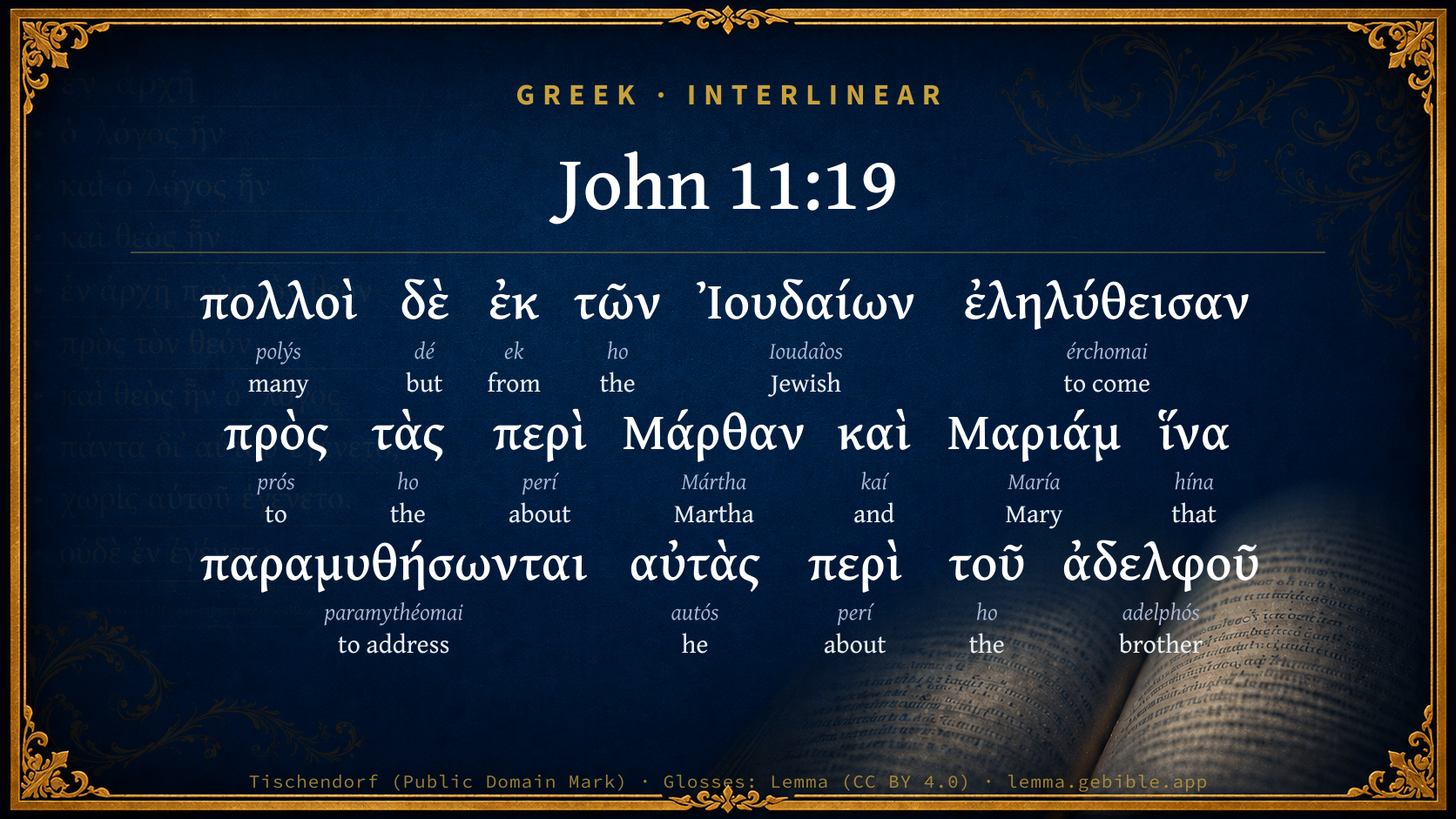
Greek (Tischendorf 8th ed.) John 11:19 appears in the Greek New Testament. The text above is from the Tischendorf 8th edition. Each word links to its Strong’s number and a concise gloss. Click any word for its full Thayer’s Greek Lexicon entry.
Download image
Cite this verse

John 11:19 (World English Bible). Public Domain. Lemma interlinear Bible study tool, https://lemma.gebible.app/v/john/11/19.

Show BibTeX & RIS
BibTeX
RIS
English Translation
Many of the Jews had joined the women around Martha and Mary, to console them concerning their brother.
World English Bible · Public Domain
Highlights
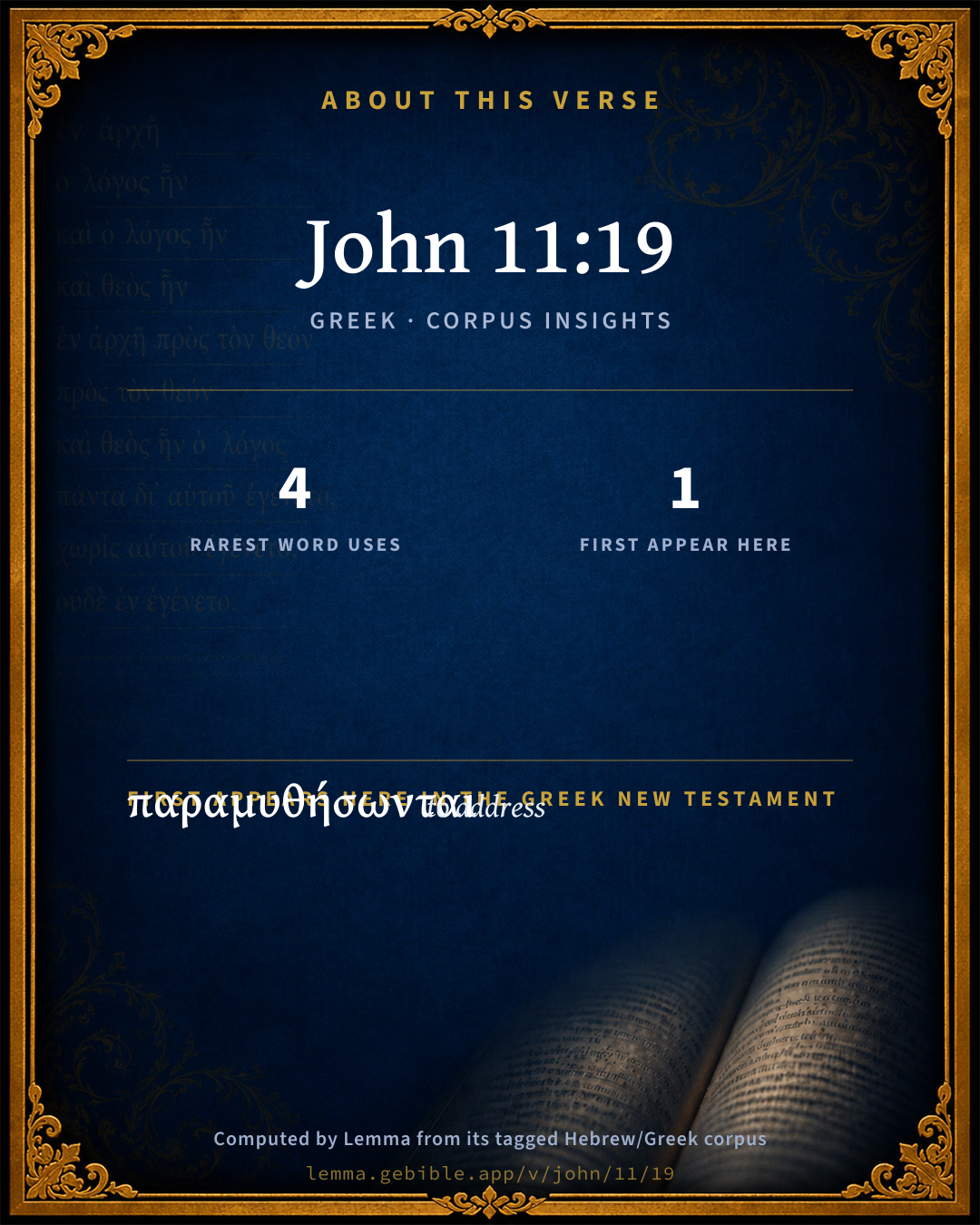
  • 1 first appearance in the Greek New Testament
Full analysis ↓
Download a study sheet

One document with this verse’s original text, its word-by-word gloss line, the meaning frame, cross-references with their text, attributed commentary, and full source and license credits — printable, and it pastes into notes with its structure intact.

This verse Autodidact and up

Study sheet (.html) Plain text (.txt)

A passage Seminary Student

Up to 50 verses in one chapter. A passage sheet keeps up to 6 commentary sources and 12 cross-references per verse, in the order this page ranks them, and says so on the sheet whenever that leaves anything out. Ask for a single verse and you get the Autodidact verse sheet above.

Everything on this page stays free to read, with no account — the sheet is a download of what is already on screen, not access to it.

Want to remove ads? Support Godless Engineer
Compare translations 3

The same verse in 3 English versions, stacked beneath the original-language interlinear above. Click any original word for its lexicon entry.

Each is an independent rendering of the whole verse — the interlinear is not word-aligned to these translations.

Highlighted words mark where these versions differ — a whole-verse word diff, not a word-by-word alignment.

  • World English Bible Public Domain
    Many of the Jews had joined the women around Martha and Mary, to console them concerning their brother.
  • King James Version Public Domain
    And many of the Jews came to Martha and Mary, to comfort them concerning their brother.
  • unfoldingWord Literal Text CC BY-SA 4.0
    And many of the Jews had come to Martha and Mary so that they might comfort them about their brother.

unfoldingWord Literal Text — © unfoldingWord, licensed CC BY-SA 4.0. Word-aligned USFM3 via Door43 (git.door43.org/unfoldingWord/en_ult).

Versions to compare (up to 4)

3 of 4 selected

Show all 19 translations

Every available English version of this verse, each an independent rendering of the whole verse.

  • World English Bible Public Domain
    Many of the Jews had joined the women around Martha and Mary, to console them concerning their brother.
  • Berean Standard Bible Public Domain
    and many of the Jews had come to Martha and Mary to console them in the loss of their brother.
  • Majority Standard Bible Public Domain
    and many of the Jews had come to the women around Martha and Mary to console them in the loss of their brother.
  • King James Version Public Domain
    And many of the Jews came to Martha and Mary, to comfort them concerning their brother.
  • American Standard Version (1901) Public Domain
    and many of the Jews had come to Martha and Mary, to console them concerning their brother.
  • Revised Version (1885) Public Domain
    and many of the Jews had come to Martha and Mary, to console them concerning their brother.
  • Geneva Bible (1599) Public Domain
    And many of ye Iewes were come to Martha and Marie to comfort them for their brother.
  • Douay-Rheims (1899) Public Domain
    And many of the Jews were come to Martha and Mary, to comfort them concerning their brother.
  • Young's Literal Translation Public Domain
    and many of the Jews had come unto Martha and Mary, that they might comfort them concerning their brother;
  • Literal Standard Version CC BY-SA 4.0
    and many of the Jews had come to Martha and Mary, that they might comfort them concerning their brother;
  • Unlocked Literal Bible CC BY-SA 4.0
    Many of the Jews had come to Martha and Mary, to comfort them about their brother.
  • unfoldingWord Literal Text CC BY-SA 4.0
    And many of the Jews had come to Martha and Mary so that they might comfort them about their brother.
  • Darby Bible Public Domain
    and many of the Jews came to Martha and Mary, that they might console them concerning their brother.
  • World Messianic Bible Public Domain
    Many of the Judeans had joined the women around Martha and Miriam, to console them concerning their brother.
  • Webster's Bible Public Domain
    And many of the Jews came to Martha and Mary, to comfort them concerning their brother.
  • Free Bible Version CC BY-SA 4.0
    and many Jews had come to console Mary and Martha at the loss of their brother.
  • Bible in Basic English Public Domain
    And a number of Jews had come to Martha and Mary to give them comfort about their brother.
  • Text-Critical English NT CC BY 4.0
    and many of the Jews had joined the women who were with Martha and Mary, to console them about their brother.
  • Tyndale New Testament (1534) Public Domain
    and many of the Iewes were come to Martha and Mary to comforte them over their brother.

Literal Standard Version (2020), Covenant Press — licensed CC BY-SA 4.0. Text via the HelloAO Bible API (eBible.org). Unlocked Literal Bible (unfoldingWord) — licensed CC BY-SA 4.0. Text via the HelloAO Bible API (eBible.org). unfoldingWord Literal Text — © unfoldingWord, licensed CC BY-SA 4.0. Word-aligned USFM3 via Door43 (git.door43.org/unfoldingWord/en_ult). Free Bible Version, Dr. Jonathan Gallagher — licensed CC BY-SA 4.0. Text via the HelloAO Bible API (eBible.org).

Word by word

More ways to search: Search by grammar → Find every occurrence → Compare this word →

Practice this passage: Drill this verse → Learn its vocabulary →

παραμυθήσωνται
paramythéomai
G3888
“to address”
Verb, Aorist, Middle deponent, Subjunctive, 3rd person, Plural
Part of Speech
Verb
Tense
Aorist
Voice
Middle deponent
Mood
Subjunctive
Person
3rd person
Number
Plural
Full Thayer's Definition

Origin: from G3844 and the middle voice of a derivative of G3454

TDNT: 18:36,8

1. to speak to, address one, whether by way of admonition and incentive, or to calm and console a. to encourage, console
  1. πολλοὶ polýs G4183 “many” Adjective, Nominative, Plural, Masculine
  2. δὲ dé G1161 “but” Conjunction
  3. ἐκ ek G1537 “from” Preposition
  4. τῶν ho G3588 “the” Article, Genitive, Plural, Masculine
  5. Ἰουδαίων Ioudaîos G2453 “Jewish” Adjective, Genitive, Plural, Masculine
  6. ἐληλύθεισαν érchomai G2064 “to come” Verb, Pluperfect, Active, Indicative, 3rd person, Plural
  7. πρὸς prós G4314 “to” Preposition
  8. τὰς ho G3588 “the” Article, Accusative, Plural, Feminine
  9. περὶ perí G4012 “about” Preposition
  10. Μάρθαν Mártha G3136 “Martha” Noun, Accusative, Singular, Feminine
  11. καὶ kaí G2532 “and” Conjunction
  12. Μαριάμ María G3137 “Mary” Noun, Proper, indeclinable
  13. ἵνα hína G2443 “that” Conjunction
  14. αὐτὰς autós G846 “he” Personal pronoun, Accusative, Plural, Feminine
  15. περὶ perí G4012 “about” Preposition
  16. τοῦ ho G3588 “the” Article, Genitive, Singular, Masculine
  17. ἀδελφοῦ adelphós G80 “brother” Noun, Genitive, Singular, Masculine

About this verse

These counts appear in no published source. They are computed here, from the morphology-tagged text and Lemma’s own curated glosses. What Lemma adds →

18
words
15
distinct lemmas
Gospels
section

Notable vocabulary

The rarest word here is παραμυθήσωνται to address G3888 — appearing just 4 times in the whole Greek New Testament.

First appearance in Scripture

This word makes its first canonical appearance in the Greek New Testament here:

  • παραμυθήσωνται to address G3888

Shared distinctive vocabulary

παραμυθήσωνται to address G3888 occurs in 4 verses of the Greek New Testament. Also found in:
Repetition

Words recur within this verse:

Cross-references

18

Topical passages linked to John 11:19 in the Treasury of Scripture Knowledge — connected by theme and wording, ordered by reader-vote popularity; previews shown in the World English Bible.

  • Job 2:11 Now when Job's three friends heard of all this evil that had come on him, they each came from his own place: Eliphaz the Temanite, Bildad the Shuhite, and Zophar the Naamathite, and they made an appointment together to come to sympathize with him and to comfort him.
  • John 11:31 Then the Jews who were with her in the house, and were consoling her, when they saw Mary, that she rose up quickly and went out, followed her, saying, "She is going to the tomb to weep there."
  • 1 Thessalonians 5:11 Therefore exhort one another, and build each other up, even as you also do.
  • 2 Corinthians 1:4 who comforts us in all our affliction, that we may be able to comfort those who are in any affliction, through the comfort with which we ourselves are comforted by God.
  • Job 42:11 Then came there to him all his brothers, and all his sisters, and all those who had been of his acquaintance before, and ate bread with him in his house. They comforted him, and consoled him concerning all the evil that Yahweh had brought on him. Everyone also gave him a piece of money, and everyone a ring of gold.
  • Romans 12:15 Rejoice with those who rejoice. Weep with those who weep.
  • 1 Thessalonians 4:18 Therefore comfort one another with these words.
  • Genesis 37:35 All his sons and all his daughters rose up to comfort him; but he refused to be comforted. He said, "For I will go down to Sheol to my son mourning." His father wept for him.
  • 2 Samuel 10:2 David said, I will show kindness to Hanun the son of Nahash, as his father shown kindness to me. So David sent by his servants to comfort him concerning his father. David's servants came into the land of the children of Ammon.
  • Jeremiah 16:5–7 For thus says Yahweh, Don't enter into the house of mourning, neither go to lament, neither bemoan them; for I have taken away my peace from this people, says Yahweh, even loving kindness and tender mercies.
  • Lamentations 1:2 She weeps sore in the night, and her tears are on her cheeks; Among all her lovers she has none to comfort her: All her friends have dealt treacherously with her; they are become her enemies.
  • Lamentations 1:9 Her filthiness was in her skirts; she didn't remember her latter end; Therefore is she come down wonderfully; she has no comforter: See, Yahweh, my affliction; for the enemy has magnified himself.
  • Lamentations 1:16 For these things I weep; my eye, my eye runs down with water; Because the comforter who should refresh my soul is far from me: My children are desolate, because the enemy has prevailed.
  • Lamentations 1:21 They have heard that I sigh; there is none to comfort me; All my enemies have heard of my trouble; they are glad that you have done it: You will bring the day that you have proclaimed, and they shall be like me.
  • Lamentations 2:13 What shall I testify to you? what shall I liken to you, daughter of Jerusalem? What shall I compare to you, that I may comfort you, virgin daughter of Zion? For your breach is great like the sea: who can heal you?
  • 1 Chronicles 7:21–22 and Zabad his son, and Shuthelah his son, and Ezer, and Elead, whom the men of Gath who were born in the land killed, because they came down to take away their cattle.
  • Ecclesiastes 7:2 It is better to go to the house of mourning than to go to the house of feasting: for that is the end of all men, and the living should take this to heart.
  • Isaiah 51:19 These two things have happened to you. Who will bemoan you? Desolation and destruction, and the famine and the sword; how shall I comfort you?

Cross-references courtesy of OpenBible.info (CC BY 4.0).

Commentary

Notes on John 11:19 from classic Christian and Jewish commentators (each source and its license shown beneath its notes). The classic Christian expositions comment on the surrounding passage and are grouped to its opening verse, so a note may address several verses; the Jewish commentaries on the Tanakh (Rashi and others) are per-verse, so they appear only where the commentator wrote on this verse.

Lemma curates 59 commentaries, every one of them public domain or Creative Commons licensed, each selected and text-cleaned for this edition rather than reprinted as found. About our sources →

Tyndale Open Study Notes

Tyndale Open Resources

11:19 Life in New Testament times was lived publicly. Lazarus’s large extended family, as well as the villagers, had arrived for a seven-day mourning period. To console the sisters in their loss, there was great wailing and crying (see 11:33 and corresponding study note).

Tyndale Open Study Notes — © Tyndale Open Resources, licensed CC BY-SA 4.0. Text via the HelloAO Bible API.

Bengel's Gnomon

Johann Albrecht Bengel

Joh 11:19. [295] ΠΟΛΛΟΊ) many, on account of being in their neighbourhood.—τὰς περί) An idiomatic phrase. Act 13:13 [ΟἹ ΠΕΡῚ ΠΑῦΛΟΝ, Paul and his company], Act 28:7[296]—ἵνα παραμυθήσωνται, that they might be comforted) some days after the burial. In the present day we say, to condole with.

[295] Joh 11:17. τέσσαρας ἡμέρας, four days) Therefore Lazarus was buried on the very day of his death. Comp. ver. 39, “Lord, by this time he stinketh; for he hath been dead four days.”. V. g.

[296] ἐν τοῖς περὶ τὸν τόπον, in the same quarters. So here translate, Martha, Mary and her friends. A and Rec. Text read τὰς περὶ M. But BCLXabc Vulg. read πρὸς τὴν M. D reads πρὸς M., omitting τήν.—E. and T.

Bengel's Gnomon of the New Testament — English translation (T&T Clark, Edinburgh, 1860) — public domain. Text from a community e-Sword module.

Meyer's Critical & Exegetical Commentary

Heinrich August Wilhelm Meyer

Joh_11:19. ʼΕκ τῶν Ἰουδαίων] is generally taken as equivalent to Ἱεροσολυμιτῶν, but altogether without ground. Wherever John uses the term the Jews, unless it be in the purely national sense (as in Joh_2:6, Joh_2:13, Joh_3:1, Joh_4:9, and frequently), to distinguish them as a nation from other nations, he constantly means the Jewish opposition to Jesus. See on Joh_1:19. So also here (compare Brückner, Gumlich, Godet). On them, however, the miracle produced the noteworthy deep impression which will be recorded in Joh_11:45-46. The Lazarus family, which, without doubt, was a highly respected one, mustand might it not have been so, notwithstanding its friendship with Jesus?have had many acquaintances, perhaps also relatives, among these Jews.

πρὸς τὰς περὶ Μ. κ. Μ.] is not quite identical in force with πρὸς τὴν Μ. κ. Μ. (so Lachmann after B. C. L. X. א.), but describes the two sisters with their surroundings (Bernhardy, p. 263; Kühner, ad Xen. Mem. ii. 4. 2; comp. Act_13:13). The words might also denote the sisters alone, according to later Greek usage (see Valckenaer, Schol. ad Act_13:13; Lehrs, Quaest. Ep. p. 28 ff.); this usage, however, is quite foreign to the New Testament, besides that, in the present connection, the expression employed has its special propriety, they being men who had come. It implies, moreover, that the household was one of a higher class.

ἵνα παραμ. αὐτ.] The expression of sympathy and consolation, which was connected with definite formalities, lasted usually seven days (1Sa_31:13; 1Ch_10:12; Jdt_16:23). See Lightfoot, p. 1070 ff.

Meyer — Critical and Exegetical Commentary on the New Testament — English translation by Peter Christie, edited by Frederick Crombie (T&T Clark, 1880) — public domain. Text from a community e-Sword module.

Geneva Bible (1599)

Geneva Bible translators

God who is the maker of nature, doth not condemn natural affections, but showeth that they ought to be examined by the rule of faith.

Geneva Bible (1599) marginal notes — public domain. Text via Bolls.life.

Jamieson, Fausset & Brown

Robert Jamieson, A. R. Fausset & David Brown

many of the Jews came to Martha and Mary to comfort them--Thus were provided, in a most natural way, so many witnesses of the glorious miracle that was to follow, as to put the fact beyond possible question.

Jamieson, Fausset & Brown — Commentary Critical and Explanatory on the Whole Bible (1871) — public domain (CC PDM 1.0). Text via the HelloAO Bible API.

Adam Clarke's Commentary

Verse 19. Many of the Jews came] Bethany being so nigh to Jerusalem, many of the relatives and friends of the family came, according to the Jewish custom, to mourn with the afflicted sisters. Mourning, among the Jews, lasted about thirty days: the three first days were termed days of weeping: then followed seven of lamentation. During the three days, the mourner did no servile work; and, if any one saluted him, he did not return the salutation. During the seven days, he did no servile work, except in private-lay with his bed on the floor - did not put on his sandals-did not wash nor anoint himself - had his head covered-and neither read in the law, the Mishnah, nor the Talmud. All the thirty days he continued unshaven, wore no white or new clothes, and did not sew up the rents which he had made in his garments. See Lightfoot, and See Clarke on Joh 11:31.

Adam Clarke's Commentary on the Bible (1810–1826) — public domain. Text from a community e-Sword/MySword module.

John Calvin's Commentaries

19. To comfort them concerning their brother. This was, no doubt, the object which they had in view, but God had another object to accomplish, as we have stated. It is evident from what is here mentioned, that the house of Lazarus and his sisters was greatly respected and honored. Again, as it is natural that the death of friends should occasion grief and mourning to men, this duty, which the Evangelist mentions, ought not to be blamed, unless on this ground, that sinful excess, which prevails in this and in other departments of life, corrupts what is not in itself sinful.

John Calvin's Commentaries (1540-1563) — public domain. Text from the Calvin Translation Society English edition (1840s-50s) via the Christian Classics Ethereal Library (ccel.org). Calvin's coverage is partial (roughly two-thirds of the Bible); uncommented books and verses are honest gaps, never fabricated. The 19th-century editor's footnotes and remarks are omitted so the notes are faithfully Calvin's own voice.

Ellicott's Commentary for English Readers

(19) And many of the Jews came to Martha and Mary.—Better, and many of the Jews had come . . .—They had come before our Lord’s arrival. The word “Jews” is to be understood in St. John’s general sense (comp. Note on Joh_1:19) of those opposed to our Lord, who had lately sought to stone Him (Joh_10:31), and afterwards to take Him by force (Joh_10:39). The family at Bethany was one of position and substance (comp. Notes on Mat_26:6-13; Mar_14:3-9), and they would naturally have had many friends among the higher rank of the Jews. Another reading, which has considerable authority, is “had come to the women with Martha and Mary,” or “to Martha and Mary and their friends.”

To comfort them concerning their brother.—The days of mourning were usually thirty, which were divided into (1) three days of weeping; (2) seven days of lamentation; (3) twenty days of sorrow. This fourth day after the death was the first of the seven days of lamentation. Lightfoot has collected, in a long note on this text, quotations from the Rabbis illustrating the mourning customs, and giving examples of the words used.

A Bible Commentary for English Readers, edited by Charles John Ellicott (1878–1897) — public domain. Text from a community e-Sword module.

The Cambridge Bible for Schools and Colleges

gen. ed. J. J. S. Perowne

19. many of the Jews came to Martha and Mary] Better, many from among the Jews had come, &c. The received text with some good authorities has ‘had come to Martha and Mary and their friends,’ but this is not the best-attested reading. ‘The Jews’ here, as usual, means Christ’s opponents; they would come mostly, if not entirely, from Jerusalem.

to comfort them] It was part of the Jewish ceremonial of mourning that many (ten at least) should come and condole. Gen_27:35; comp. 2Sa_12:17; Job_2:11. It is said that the usual period of mourning was thirty days; three of weeping, seven of lamentation, twenty of sorrow. But the instances in Scripture vary: Jacob, seventy days with an additional seven (Gen_50:3; Gen_50:10); Aaron and Moses, thirty days (Num_20:29; Deu_34:8); Saul and Judith, seven days (1Sa_28:13; Jdg_16:24; comp. Sir_22:12; 2Es_5:20). Josephus tells us that Archelaus mourned for his father seven days, and the Jews for himself, thirty days (B. J. ii. i. 1; iii. ix. 5). The Mishna prescribes seven days for near relations.

The Cambridge Bible for Schools and Colleges (gen. ed. J. J. S. Perowne; Cambridge University Press, 1878–1918) — public domain. Text from a community e-Sword module.

John Gill's Exposition

And many of the Jews came to Martha and Mary,.... Or "to those that were about Martha and Mary"; in order to have access to them, they came to them, and to the rest of the family; though the phrase may design them only, as the Vulgate Latin, and all the Oriental versions read: these Jews, as appears from the context, Joh 11:18, came from Jerusalem, and might be some of the principal inhabitants; and it may be concluded, that these persons, Lazarus, Martha, and Mary, were people of note and figure; and indeed all the accounts of them here, and elsewhere, show the same; see Luk 10:38. The end of their coming to them was

to comfort them concerning their brother; by reason of his death, as was usual with the Jews to do, after the dead was buried; for they did not allow of it before: hence that saying (g) of R. Simeon ben Eleazar,

"do not comfort him (thy friend) in the time his dead lies before him.''

The first office of this kind was done when they returned from the grave; for it is said (h), when they return

"from the grave they make rows round about the mourner, "to comfort him", and they make him to sit, and they stand, and there never were less than ten in a row.''

It was an ancient custom for the mourners to stand in their place in a row, and all the people passed by, and every man as he came to the mourner comforted him, and passed on (i). But besides these consolations, there were others administered at their own houses, which were usually done the first week, for it is said (k),

"the mourner the first week does not go out of the door of his house; the second he goes out, but does not sit, or continue in his place; the third he continues in his place, but does not speak; the fourth, lo, he is as every other man. R. Judah says, there is no need to say, the first week he does not go out of the door of his house, for behold, all come to his house, "to comfort him".''

And is was on the third day more particularly on which these consolatory visits were paid (l):

"on the first day he (the mourner) did not wear his phylacteries; on the second, he put them on; on the third day, others come to comfort him.''

This rule the Jews here seem to have observed, since Lazarus had been dead four days; and they were come from Jerusalem hither to comfort his sisters on account of his death. The whole of this ceremony is thus related by Maimonides (m),

"how do they comfort mourners? after they have buried the dead, the mourners gather together, and stand on the side of the grave; and all that accompany the dead stand round about them, one row within another: and there is no row less than ten; and the mourners are not of the number; the mourners stand on the left hand of the comforters; and all the comforters go to the mourners, one by one, and say to them, , "may ye be comforted from heaven": after that the mourner goes to his house, and every day of the seven days of mourning, men come to comfort him; whether new faces come, or do not, the mourner sits down at the head, (or in the chief place,) and no comforters may sit but upon the floor, as it is said, Job 2:13, "and they sat with him on the ground": nor may they say any thing until the mourner has opened his mouth first, as it is said, Job 2:13, "and none spake a word unto him": and it is written afterwards, Job 3:1, "so opened Job his mouth", &c. and Eliphaz answered, Job 4:1, and when he nods with his head, the comforters may not sit with him any longer, that they may not trouble him more than is necessary. If a man dies, and there are no mourners to be comforted, ten worthy men go and sit in his place all the seven days of mourning; and the rest of the people gather to them; and if there are not ten fixed every day, ten of the rest of the people gather together, and sit in his place:''

for this business of comforting mourners was reckoned an act of great piety and mercy (n); and these Jews here might come, not so much out of respect to the dead, or to his sisters, as because it was thought to be a meritorious act.

(g) Pirke Abot, c. 4. sect. 18. (h) Gloss in Cetubot, fol. 8. 2. & in Beracot, fol. 16. 2. (i) Gloss in T. Bab. Sanhedrin, fol. 19. 1. (k) T. Bab. Moed Katon, fol. 23. 1. (l) Massech. Semachot, c. 6. fol. 14. 3. (m) Hilch. Ebel, c. 13. sect. 1, 2, 3, 4. (n) Maimon. in Misn. Peah, c. 1. sect. 1.

John Gill's Exposition of the Whole Bible (1746–1763) — public domain (CC PDM 1.0). Text via the HelloAO Bible API.

Trapp's Complete Commentary

John Trapp

19 And many of the Jews came to Martha and Mary, to comfort them concerning their brother.

Ver. 19. To comfort them] A pious office, and yet never thought of by the superstitious Papists, amidst all those vain fopperies they prescribe to be done about the dead. Only, what the ancients used for the comfort of the living is perverted by them to the pretended service and help of the dead.

John Trapp, A Commentary or Exposition upon All the Books of the Old and New Testament (1647–1656) — public domain. Text from a community e-Sword module.

Albert Barnes' Notes on the Bible

Many of the Jews - Probably their distant relatives or their friends.

To comfort - These visits of consolation were commonly extended to seven clays (Grotius; Lightfoot).

Albert Barnes' Notes on the Bible (1834–1885) — public domain. Text from a community e-Sword/MySword module.

Matthew Poole's English Annotations

Not to pray with them for the soul of their brother departed. That departed souls are in a capacity to be advantaged by the prayers of their friends, or any such thing, are corruptions of latter times; but they had a civil usage of mourning for their friends, the time for which was anciently thirty days. They mourned for Jacob forty days, Gen 50:3; for Aaron thirty days, Num 20:29; so for Moses, Deu 34:8. It is probable the days were fewer for persons of an inferior quality, but they had some days for all; during which days their neighbours and friends came to visit them, and relieve them in their sorrow, with such arguments as they had.

Matthew Poole's English Annotations on the Holy Bible (1683–1685) — public domain. Text from a community e-Sword/MySword module.

Whedon's Commentary on the Bible

Daniel D. Whedon

19. Jews came to comfort—The nearness to Jerusalem is mentioned to explain why so many Jews were present. Great is oriental mourning. Weeping and howling for three days, visits of condolence for seven, and thirty days before the last offices are complete. The number here present suggests that the family of Bethany was honourable. Thereby the miracle was plentifully witnessed and published. Few of these comforters sympathized with the Christian hopes of these sisters. But the true Comforter was on his way. Jesus visits his “faithful among the faithless.”

Daniel D. Whedon (gen. ed.), Commentary on the Old and New Testaments (1874–1909) — public domain. Text from a community e-Sword module.

The People's New Testament

B. W. Johnson

19. Many of the Jews came to Martha and Mary. Jews from Jerusalem, of which Bethany was a suburb. As “Jews” in John's usage means the ruling classes, the fact that they came shows that the family of Lazarus was influential. These came to “comfort;” that is, to sit with and talk to the mourners. The mourning was kept up thirty days.

B. W. Johnson's The People's New Testament with Notes (1889–1891) — public domain. Electronic text from the Christian Classics Ethereal Library (CCEL) ThML edition.

Cambridge Greek Testament for Schools and Colleges

19. πολλοὶ δέ for καὶ πολλοί (A), and τὴν for τὰς περί (Acts 3); both on overwhelming evidence.

19. ἐκ τῶν Ἰ. From among the Jews. ‘The Jews,’ as usual, are the hostile party: among the numerous acquaintances of the sisters were many of the opponents of Jesus. This visit was yet another opportunity for them to believe.

ἐλ. πρὸς τὴν Μ. κ. Μ. Had come to M. and M. Some good authorities support T. R. in reading πρὸς τὰς περὶ Μ. κ. Μ., ‘to M. and M. and their friends.’ Comp. οἱ περὶ τὸν Παῦλον, Paul and his companions, Act 13:13.

παραμυθήσωνται. ‘The empty chaff’ of conventional consolation which so moved the spirit of Jesus (Joh 11:33). It formed a barrier between Him and the sorrow which He alone could console. Jewish ceremonial required that many (ten at least) should come and condole. Gen 27:35; comp. 2Sa 12:17; Job 2:11. It is said that the usual period of mourning was thirty days; three of weeping, seven of lamentation, twenty of sorrow. But the instances in Scripture vary: Jacob, seventy days with an additional seven (Gen 50:3; Gen 50:10); Aaron and Moses, thirty days (Num 20:29; Deu 34:8); Saul and Judith, seven days (1Sa 28:13; Jdg 16:24; comp. Sir 22:12; 2Es 5:20). Josephus tells us that Archelaus mourned for his father seven days, and the Jews for himself, thirty days (B. J. II. i. 1; III. ix. 5). The Mishna prescribes seven days for near relations.

Cambridge Greek Testament for Schools and Colleges (Cambridge University Press, 1896; 21 vols, various authors incl. Carr, Maclear, Plummer, Farrar, Lumby, Moule, M. R. James, Simcox) — public domain. Text from a community e-Sword module.

Alford’s Greek Testament

Henry Alford

19.] Lightfoot (Hor. Hebr. in loc.) gives an account of the ceremonies practised during the thirty days of mourning.

The . reading, τὰς περὶ Μ. κ. Μ., would mean Martha and Mary and their friends—the women mourning with them. The expression is foreign to N.T. diction elsewhere, and might be used here for decorum, seeing that they were men who came: or as indicating that the house was one of large hospitality and acquaintance.

Henry Alford, The Greek Testament (1849–1861) — public domain. Text from a community e-Sword module.

International Critical Commentary

19. πολλοὶ δέ. So אBCDLWΘ, as against the rec. καὶ πολλοί (AΓΔ)

ἐκ τῶν Ἰουδαίων, i.e. of the citizens of Jerusalem. οἱ Ἰουδαῖοι often represents in Jn. the Jews who were hostile to Jesus (see on 1:19, 5:10); but here that suggestion is not present.

Jerusalem being so near (v. 18), it was natural that many friends from the city should come to condole with Martha and Mary on the death of their brother. Lightfoot gives (Hor. Hebr., in loc.) curious details about the ceremonial which was customary at these mournful gatherings. The first three days after death were kept with severity, the next four days with less strictness, the period of observance lasting for thirty days altogether. Cf. for the “seven days of mourning for the dead” (Ecclus. 22:12). 1Sa 31:13, Job 2:13, Judith 16:24; and for the visits of neighbours to console, 2 Ezr 10:2.

παραμυθεῖσθαι, “to comfort,” is found in the Greek Bible only here, v. 31, 1Th 2:11, 1Th 5:14, and 2 Macc. 15:9.

πρὸς τὴν Μάρθαν καὶ Μαριάμ is the best-attested reading (אBC*L), but the article should be prefixed to both or to neither of the names. D has πρὸς Μάρθαν καὶ Μαριάμ. Syr. sin. seems, on the other hand, to presuppose the article in both places, and reads “went forth to Bethany that they might comfort Martha and Mary,” omitting “concerning their brother.” See on v. 24 for Jn.’s consistent use of ἡ Μάρθα, ἡ Μαριάμ.

The rec. text, with AC3ΓΔΘ, has ἐληλύθεισαν πρὸς τὰς περὶ Μάρθαν καὶ Μαριάμ, which ought to mean “came to the women of the household of Martha and Mary”; but it can hardly be genuine. Perhaps τὰς περί came in from [αὐ]τὰς περί in the next line. After ἀδελφοῦ ACΓΔ add αὐτῶν, but om. אBDLWΘ

International Critical Commentary — older volumes (1896–1929), various authors — public domain. Text from a community e-Sword module.

Vincent's Word Studies in the New Testament

Marvin R. Vincent

Many of the Jews came. Rev., rightly, had come. The tense is the pluperfect. Lazarus ' friendship with Jesus had not caused him to be regarded as an apostate, at whose burial every indignity would have been shown. People were even to array themselves in white, festive garments in demonstration of joy. Here, on the contrary, every token of sympathy and respect seems to have been shown.

To Martha and Mary [προς τας περι μαρθαν και μαριαν] .

Literally, to those about Martha and Mary; a Greek idiom for Martha and Mary and their companions, or attendants. Compare oiJ peri Paulon, Paul and his companions (Act 13:13). Somewhat analogous is our familiar idiom when we speak of going to visit a household : I am going to Smith's or Brown's, by which we include the head of the household with its members. Westcott and Hort and Tregelles, however, read prov thn Marqan k. M., to Martha and Mary. So also the Revisers' text.

Marvin R. Vincent, Word Studies in the New Testament (1887–1900) — public domain. Text from a community e-Sword/MySword module.

Lesson kit

Teaching starters — assembled from the data on this page, not authored interpretation. Every prompt links to the verse data it draws on. Edit before teaching.

John, in the Gospels, opens this verse with 18 words (15 distinct Greek lemmas). Its most distinctive word is paramythéomai (“to address”). A historical commentator’s framing appears above. Read the whole chapter for the surrounding context.

Discussion questions

  1. What does “to address” (paramythéomai) contribute to the verse as a whole?
  2. This is the first place “to address” appears in Scripture (first appears here). What does its debut here establish?
  3. How does John 11:31, which shares the word «to address», read alongside this verse?
  4. What does the repetition of “about” (2× in this one verse) do in this verse?
  5. The translations on this page render this verse differently — a whole-verse word diff, not a word-by-word alignment. What might account for the different wordings?
  6. Compare how Tyndale Open Study Notes and Bengel's Gnomon read this verse. Where do they agree or differ?

Things to notice

  • 1 word makes its first canonical appearance in Scripture here.
  • These translations choose different wording for 11 words in this verse.
  • “about” occurs 2× in this single verse.
  • 15 distinct Greek lemmas span 18 words in this verse.

Reading settings

Reading text

Shown beneath each verse's original-language words.

Old Testament
Old Testament edition

Read the OT as the Masoretic Hebrew (MT) or the Greek Septuagint (LXX).

English shown for the Greek Septuagint (in the Hebrew ↔ Greek comparison).

Comparing translations? Open the Compare panel on any verse page to stack up to four side by side.