

Luke 12:48
Greek (Tischendorf 8th ed.) Luke 12:48 appears in the Greek New Testament. The text above is from the Tischendorf 8th edition. Each word links to its Strong’s number and a concise gloss. Click any word for its full Thayer’s Greek Lexicon entry.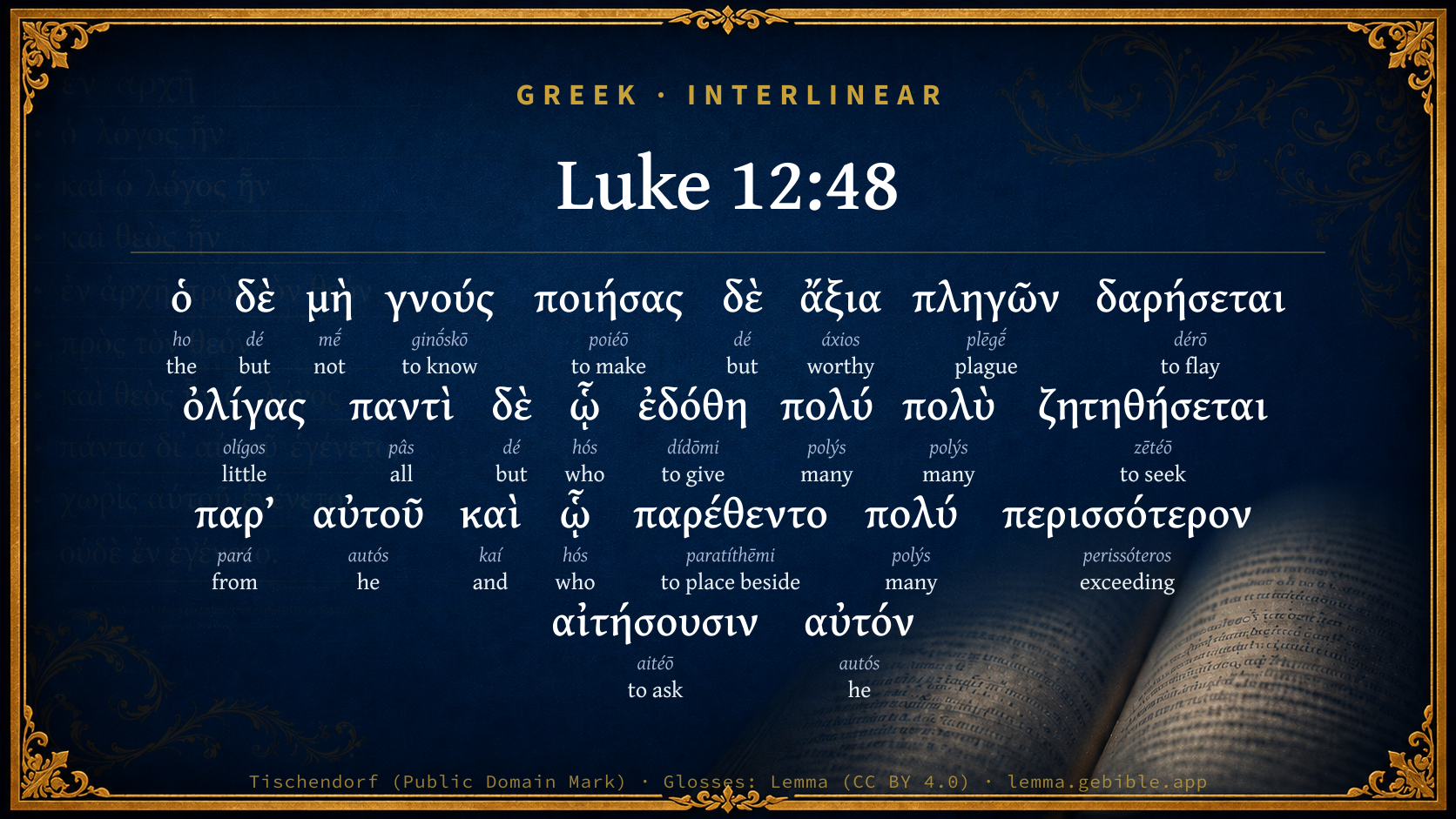
but he who didn't know, and did things worthy of stripes, will be beaten with few stripes. To whoever much is given, of him will much be required; and to whom much was entrusted, of him more will be asked.
Download a study sheet
One document with this verse’s original text, its word-by-word gloss line, the meaning frame, cross-references with their text, attributed commentary, and full source and license credits — printable, and it pastes into notes with its structure intact.
This verse Autodidact and up
A passage Seminary Student
Up to 50 verses in one chapter. A passage sheet keeps up to 6 commentary sources and 12 cross-references per verse, in the order this page ranks them, and says so on the sheet whenever that leaves anything out. Ask for a single verse and you get the Autodidact verse sheet above.
Everything on this page stays free to read, with no account — the sheet is a download of what is already on screen, not access to it.
Compare translations 3
The same verse in 3 English versions, stacked beneath the original-language interlinear above. Click any original word for its lexicon entry.
Each is an independent rendering of the whole verse — the interlinear is not word-aligned to these translations.
Highlighted words mark where these versions differ — a whole-verse word diff, not a word-by-word alignment.
-
World English Bible Public Domain
but he who didn't know, and did things worthy of stripes, will be beaten with few stripes. To whoever much is given, of him will much be required; and to whom much was entrusted, of him more will be asked.
-
King James Version Public Domain
But he that knew not, and did commit things worthy of stripes, shall be beaten with few stripes. For unto whomsoever much is given, of him shall be much required: and to whom men have committed much, of him they will ask the more.
-
unfoldingWord Literal Text CC BY-SA 4.0
But the one not having known and having done things worthy of blows will be beaten little. But everyone to whom much has been given, much will be required from him, and to whom much has been provided, even more will be asked of him.
unfoldingWord Literal Text — © unfoldingWord, licensed CC BY-SA 4.0. Word-aligned USFM3 via Door43 (git.door43.org/unfoldingWord/en_ult).
Show all 19 translations
Every available English version of this verse, each an independent rendering of the whole verse.
-
World English Bible Public Domain
but he who didn't know, and did things worthy of stripes, will be beaten with few stripes. To whoever much is given, of him will much be required; and to whom much was entrusted, of him more will be asked.
-
Berean Standard Bible Public Domain
But the one who unknowingly does things worthy of punishment will be beaten with few blows. From everyone who has been given much, much will be required; and from him who has been entrusted with much, even more will be demanded.
-
Majority Standard Bible Public Domain
But the one who unknowingly does things worthy of punishment will be beaten with few blows. From everyone who has been given much, much will be required; and from him who has been entrusted with much, even more will be demanded.
-
King James Version Public Domain
But he that knew not, and did commit things worthy of stripes, shall be beaten with few stripes. For unto whomsoever much is given, of him shall be much required: and to whom men have committed much, of him they will ask the more.
-
American Standard Version (1901) Public Domain
but he that knew not, and did things worthy of stripes, shall be beaten with few `stripes'. And to whomsoever much is given, of him shall much be required: and to whom they commit much, of him will they ask the more.
-
Revised Version (1885) Public Domain
but he that knew not, and did things worthy of stripes, shall be beaten with few stripes. And to whomsoever much is given, of him shall much be required: and to whom they commit much, of him will they ask the more.
-
Geneva Bible (1599) Public Domain
But he that knewe it not, and yet did commit things worthy of stripes, shall be beaten with fewe stripes: for vnto whomsoeuer much is giuen, of him shalbe much required, and to whom men much commit, the more of him will they aske.
-
Douay-Rheims (1899) Public Domain
But he that knew not, and did things worthy of stripes, shall be beaten with few stripes. And unto whomsoever much is given, of him much shall be required: and to whom they have committed much, of him they will demand the more.
-
Young's Literal Translation Public Domain
and he who, not having known, and having done things worthy of stripes, shall be beaten with few; and to every one to whom much was given, much shall be required from him; and to whom they did commit much, more abundantly they will ask of him.
-
Literal Standard Version CC BY-SA 4.0
and he who, not having known, and having done things worthy of stripes, will be beaten with few; and to everyone to whom much was given, much will be required from him; and to whom they committed much, more abundantly they will ask of him.
-
Unlocked Literal Bible CC BY-SA 4.0
But the one who did not know and did what deserved a beating, he will be beaten with a few blows. But everyone who has been given much, from them much will be required, and the one who has been entrusted with much, even more will be asked.
-
unfoldingWord Literal Text CC BY-SA 4.0
But the one not having known and having done things worthy of blows will be beaten little. But everyone to whom much has been given, much will be required from him, and to whom much has been provided, even more will be asked of him.
-
Darby Bible Public Domain
but he who knew [it] not, and did things worthy of stripes, shall be beaten with few. And to every one to whom much has been given, much shall be required from him; and to whom [men] have committed much, they will ask from him the more.
-
World Messianic Bible Public Domain
but he who didn’t know, and did things worthy of stripes, will be beaten with few stripes. To whomever much is given, of him will much be required; and to whom much was entrusted, of him more will be asked.
-
Webster's Bible Public Domain
But he that knew not, and committed things worthy of stripes, shall be beaten with few stripes. For to whomsoever much is given, of him shall much be required: and to whom men have committed much, from him they will ask the more.
-
Free Bible Version CC BY-SA 4.0
but the servant who didn't know and did things deserving punishment will be beaten only lightly. From those who are given much, much will be required, and from those who are entrusted with more, more will be demanded.
-
Bible in Basic English Public Domain
But he who, without knowledge, did things for which punishment is given, will get only a small number of blows. The man to whom much is given, will have to give much; if much is given into his care, of him more will be requested.
-
Text-Critical English NT CC BY 4.0
But the one who did not know his master's will, yet did what deserved a beating, will be beaten with few lashes. From everyone to whom much has been given, much will be required; and from him to whom much has been entrusted, even more will be demanded.
-
Tyndale New Testament (1534) Public Domain
But he that knewe not and yet dyd committe thinges worthy of strypes shalbe beaten with feawe strypes. For vnto whom moche is geven of him shalbe moche requyred. And to whom men moche commyt the moare of him will they axe.
Literal Standard Version (2020), Covenant Press — licensed CC BY-SA 4.0. Text via the HelloAO Bible API (eBible.org). Unlocked Literal Bible (unfoldingWord) — licensed CC BY-SA 4.0. Text via the HelloAO Bible API (eBible.org). unfoldingWord Literal Text — © unfoldingWord, licensed CC BY-SA 4.0. Word-aligned USFM3 via Door43 (git.door43.org/unfoldingWord/en_ult). Free Bible Version, Dr. Jonathan Gallagher — licensed CC BY-SA 4.0. Text via the HelloAO Bible API (eBible.org).
Word by word
More ways to search: Search by grammar → Find every occurrence → Compare this word →
Practice this passage: Drill this verse → Learn its vocabulary →
- Appears 9× in the Greek New Testament
- First appears at Matthew 11:9
- Part of Speech
- Adjective
- Case
- Accusative
- Number
- Singular
- Gender
- Neuter
- Degree
- Comparative
Full Thayer's Definition
- ὁ ho G3588 “the” Article, Nominative, Singular, Masculine
- δὲ dé G1161 “but” Conjunction
- μὴ mḗ G3361 “not” Particle, Negative
- γνούς ginṓskō G1097 “to know” Verb, Aorist, Active, Participle, Nominative, Singular, Masculine
- ποιήσας poiéō G4160 “to make” Verb, Aorist, Active, Participle, Nominative, Singular, Masculine
- δὲ dé G1161 “but” Conjunction
- ἄξια áxios G514 “worthy” Adjective, Accusative, Plural, Neuter
- πληγῶν plēgḗ G4127 “plague” Noun, Genitive, Plural, Feminine
- δαρήσεται dérō G1194 “to flay” Verb, Future, Passive, Indicative, 3rd person, Singular
- ὀλίγας olígos G3641 “little” Adjective, Accusative, Plural, Feminine
- παντὶ pâs G3956 “all” Adjective, Dative, Singular, Masculine
- δὲ dé G1161 “but” Conjunction
- ᾧ hós G3739 “who” Relative pronoun, Dative, Singular, Masculine
- ἐδόθη dídōmi G1325 “to give” Verb, Aorist, Passive, Indicative, 3rd person, Singular
- πολύ polýs G4183 “many” Adjective, Nominative, Singular, Neuter
- πολὺ polýs G4183 “many” Adjective, Nominative, Singular, Neuter
- ζητηθήσεται zētéō G2212 “to seek” Verb, Future, Passive, Indicative, 3rd person, Singular
- παρ’ pará G3844 “from” Preposition
- αὐτοῦ autós G846 “he” Personal pronoun, Genitive, Singular, Masculine
- καὶ kaí G2532 “and” Conjunction
- ᾧ hós G3739 “who” Relative pronoun, Dative, Singular, Masculine
- παρέθεντο paratíthēmi G3908 “to place beside” Verb, Aorist, Middle, Indicative, 3rd person, Plural
- πολύ polýs G4183 “many” Adjective, Accusative, Singular, Neuter
- περισσότερον perissóteros G4055 “exceeding” Adjective, Accusative, Singular, Neuter, Comparative
- αἰτήσουσιν aitéō G154 “to ask” Verb, Future, Active, Indicative, 3rd person, Plural
- αὐτόν autós G846 “he” Personal pronoun, Accusative, Singular, Masculine
About this verse
These counts appear in no published source. They are computed here, from the morphology-tagged text and Lemma’s own curated glosses. What Lemma adds →
- 26
- words
- 20
- distinct lemmas
- Gospels
- section
Cross-references
16Topical passages linked to Luke 12:48 in the Treasury of Scripture Knowledge — connected by theme and wording, ordered by reader-vote popularity; previews shown in the World English Bible.
- James 3:1 Let not many of you be teachers, my brothers, knowing that we will receive heavier judgment.
- Leviticus 5:17 "If anyone sins, and does any of the things which Yahweh has commanded not to be done; though he didn't know it, yet he is guilty, and shall bear his iniquity.
- Luke 16:10–12 He who is faithful in a very little is faithful also in much. He who is dishonest in a very little is also dishonest in much.
- Matthew 25:14–29 "For it is like a man, going into another country, who called his own servants, and entrusted his goods to them.
- Matthew 13:12 For whoever has, to him will be given, and he will have abundance, but whoever doesn't have, from him will be taken away even that which he has.
- John 15:22 If I had not come and spoken to them, they would not have had sin; but now they have no excuse for their sin.
- 1 Timothy 1:13 although I was before a blasphemer, a persecutor, and insolent. However, I obtained mercy, because I did it ignorantly in unbelief.
- Romans 2:12–16 For as many as have sinned without law will also perish without the law. As many as have sinned under the law will be judged by the law.
- Acts 17:30 The times of ignorance therefore God overlooked. But now he commands that all people everywhere should repent,
- 1 Timothy 1:11 according to the Gospel of the glory of the blessed God, which was committed to my trust.
- Luke 16:2 He called him, and said to him, 'What is this that I hear about you? Give an accounting of your management, for you can no longer be manager.'
- 1 Timothy 6:20 Timothy, guard that which is committed to you, turning away from the empty chatter and oppositions of the knowledge which is falsely so called;
- Numbers 15:29–30 You shall have one law for him who does anything unwittingly, for him who is home-born among the children of Israel, and for the stranger who lives as a foreigner among them.
- Genesis 39:8–23 But he refused, and said to his master's wife, "Behold, my master doesn't know what is with me in the house, and he has put all that he has into my hand.
- Titus 1:3 but in his own time revealed his word in the message with which I was entrusted according to the commandment of God our Savior;
- 1 Corinthians 9:17–18 For if I do this of my own will, I have a reward. But if not of my own will, I have a stewardship entrusted to me.
Cross-references courtesy of OpenBible.info (CC BY 4.0).
Lesson kit
Teaching starters — assembled from the data on this page, not authored interpretation. Every prompt links to the verse data it draws on. Edit before teaching.
Luke, in the Gospels, opens this verse with 26 words (20 distinct Greek lemmas). Its most distinctive word is perissóteros (“exceeding”). A historical commentator’s framing appears above. Read the whole chapter for the surrounding context.
Discussion questions
- How does “exceeding” (perissóteros) shape what this verse is saying?
- Matthew 11:9 shares the word «exceeding» with this verse. How do the two illuminate each other?
- “many” occurs 3× in this one verse. What is the effect of the repetition?
- These translations render this verse differently. What is at stake in choosing one wording over another?
- Reading how The Biblical Illustrator and Bengel's Gnomon read this verse, where do the two commentators agree and where do they part?
Things to notice
- These translations choose different wording for 28 words in this verse.
- “many” occurs 3× in this single verse.
- 20 distinct Greek lemmas span 26 words in this verse.
Commentary
Notes on Luke 12:48 from classic Christian and Jewish commentators (each source and its license shown beneath its notes). The classic Christian expositions comment on the surrounding passage and are grouped to its opening verse, so a note may address several verses; the Jewish commentaries on the Tanakh (Rashi and others) are per-verse, so they appear only where the commentator wrote on this verse.
Lemma curates 59 commentaries, every one of them public domain or Creative Commons licensed, each selected and text-cleaned for this edition rather than reprinted as found. About our sources →
The Biblical Illustrator
Joseph S. Exell
The Biblical Illustrator, edited by Joseph S. Exell (c. 1880s–1900s) — public domain. Text from a community e-Sword module.
Bengel's Gnomon
Johann Albrecht Bengel
Bengel's Gnomon of the New Testament — English translation (T&T Clark, Edinburgh, 1860) — public domain. Text from a community e-Sword module.
Expositor's Greek Testament
ed. W. Robertson Nicoll
The Expositor's Greek Testament, edited by W. Robertson Nicoll (1897–1910) — public domain. Text from a community e-Sword module.
Geneva Bible (1599)
Geneva Bible translators
Geneva Bible (1599) marginal notes — public domain. Text via Bolls.life.
Jamieson, Fausset & Brown
Robert Jamieson, A. R. Fausset & David Brown
Jamieson, Fausset & Brown — Commentary Critical and Explanatory on the Whole Bible (1871) — public domain (CC PDM 1.0). Text via the HelloAO Bible API.
Adam Clarke's Commentary
Adam Clarke's Commentary on the Bible (1810–1826) — public domain. Text from a community e-Sword/MySword module.
Ellicott's Commentary for English Readers
A Bible Commentary for English Readers, edited by Charles John Ellicott (1878–1897) — public domain. Text from a community e-Sword module.
The Cambridge Bible for Schools and Colleges
gen. ed. J. J. S. Perowne
The Cambridge Bible for Schools and Colleges (gen. ed. J. J. S. Perowne; Cambridge University Press, 1878–1918) — public domain. Text from a community e-Sword module.
John Gill's Exposition
John Gill's Exposition of the Whole Bible (1746–1763) — public domain (CC PDM 1.0). Text via the HelloAO Bible API.
Trapp's Complete Commentary
John Trapp
John Trapp, A Commentary or Exposition upon All the Books of the Old and New Testament (1647–1656) — public domain. Text from a community e-Sword module.
Albert Barnes' Notes on the Bible
Albert Barnes' Notes on the Bible (1834–1885) — public domain. Text from a community e-Sword/MySword module.
Haydock's Catholic Bible Commentary
George Leo Haydock (1774–1849), Haydock's Catholic Family Bible and Commentary, 1859 edition — public domain. Excludes Psalms (Douay-Rheims chapter numbering differs from Protestant) and Deuterocanonical books (Catholic canon only).
Whedon's Commentary on the Bible
Daniel D. Whedon
Daniel D. Whedon (gen. ed.), Commentary on the Old and New Testaments (1874–1909) — public domain. Text from a community e-Sword module.
Cambridge Greek Testament for Schools and Colleges
Cambridge Greek Testament for Schools and Colleges (Cambridge University Press, 1896; 21 vols, various authors incl. Carr, Maclear, Plummer, Farrar, Lumby, Moule, M. R. James, Simcox) — public domain. Text from a community e-Sword module.
Alford’s Greek Testament
Henry Alford
Henry Alford, The Greek Testament (1849–1861) — public domain. Text from a community e-Sword module.
International Critical Commentary
International Critical Commentary — older volumes (1896–1929), various authors — public domain. Text from a community e-Sword module.
Vincent's Word Studies in the New Testament
Marvin R. Vincent
Marvin R. Vincent, Word Studies in the New Testament (1887–1900) — public domain. Text from a community e-Sword/MySword module.