
Matthew 15:30

Greek (Tischendorf 8th ed.) Matthew 15:30 appears in the Greek New Testament. The text above is from the Tischendorf 8th edition. Each word links to its Strong’s number and a concise gloss. Click any word for its full Thayer’s Greek Lexicon entry.
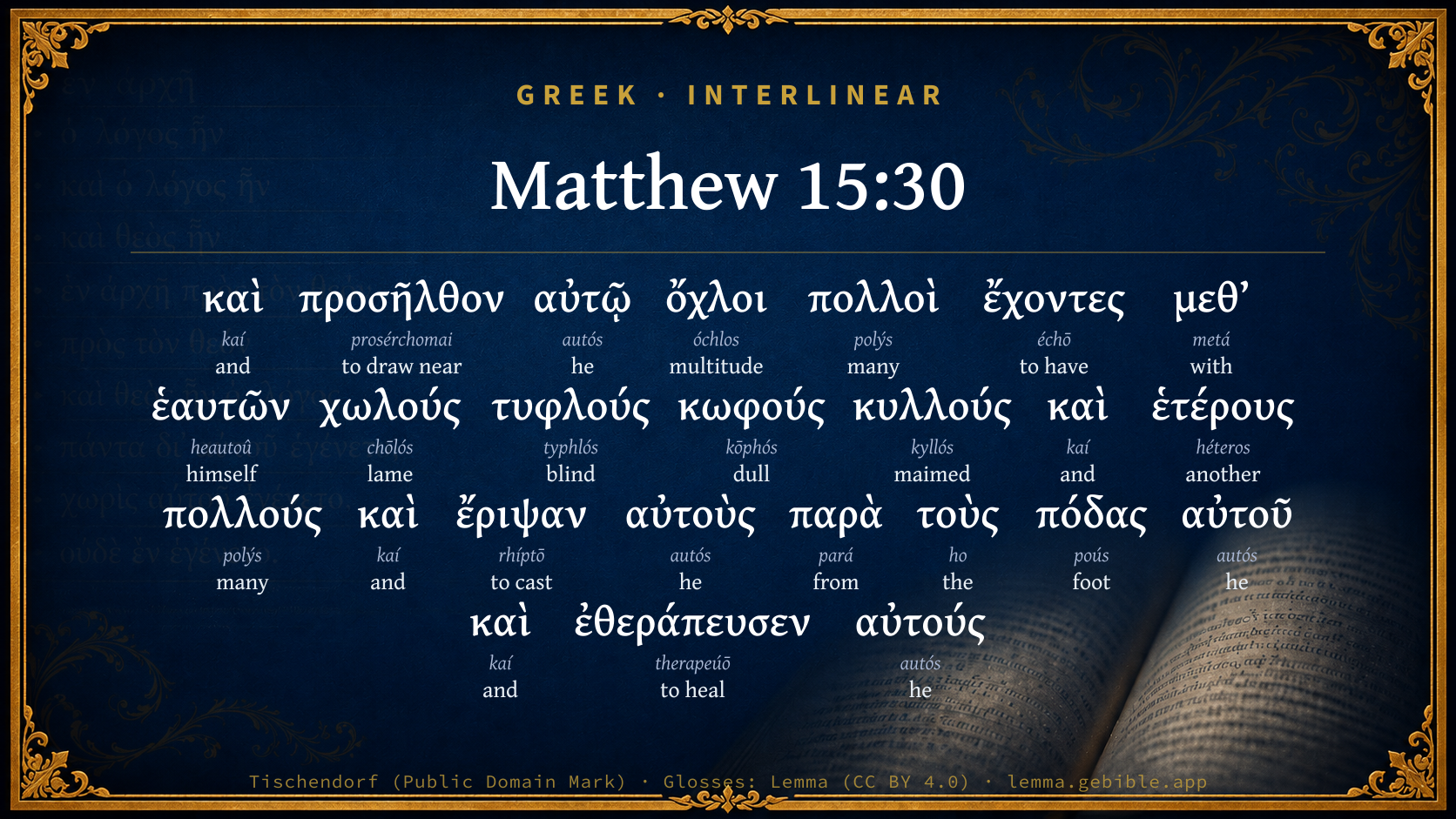
Download image
Cite this verse

Matthew 15:30 (World English Bible). Public Domain. Lemma interlinear Bible study tool, https://lemma.gebible.app/v/matthew/15/30.

Show BibTeX & RIS
BibTeX
RIS
English Translation
Great multitudes came to him, having with them the lame, blind, mute, maimed, and many others, and they put them down at his feet. He healed them,
World English Bible · Public Domain
Highlights
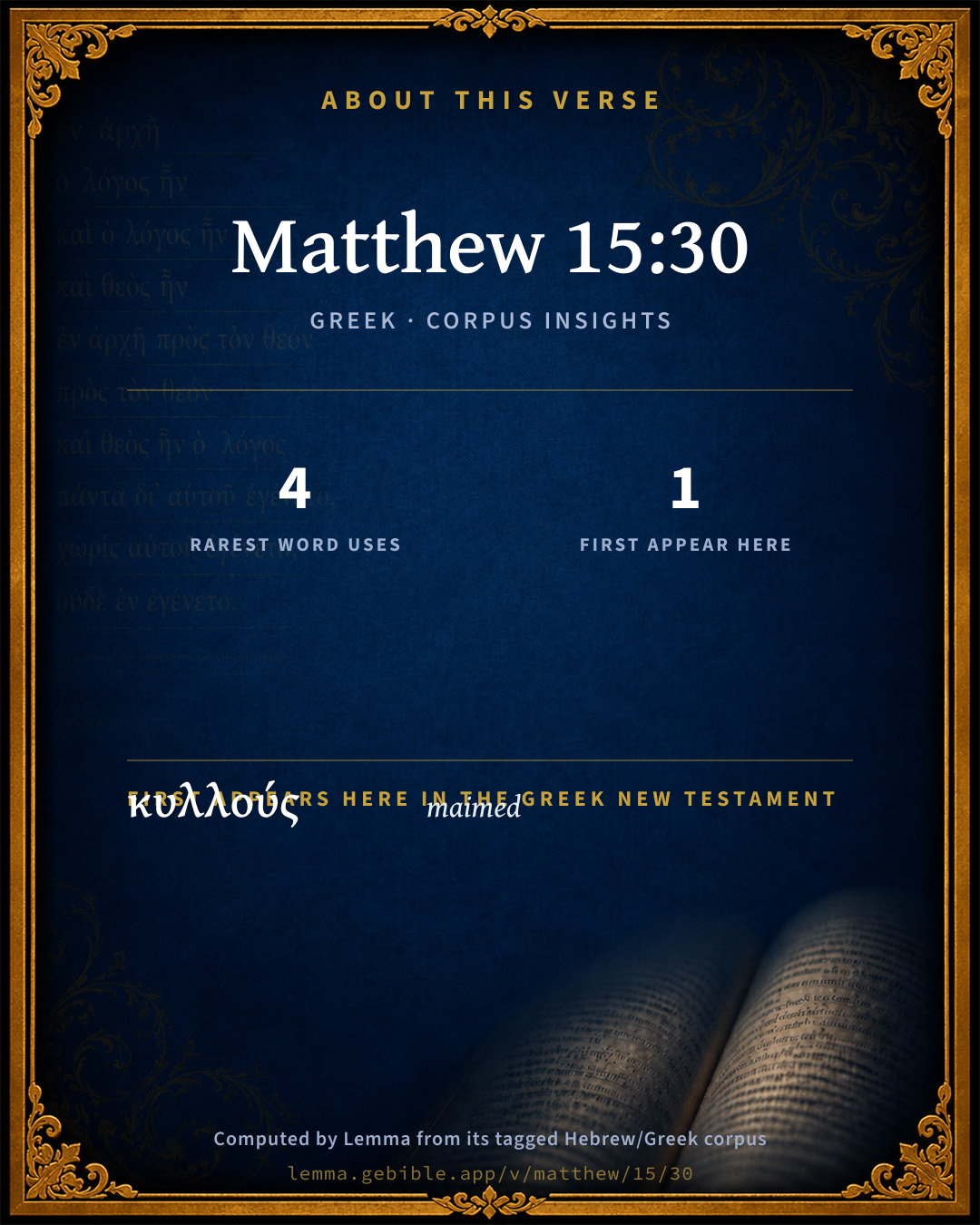
  • 1 first appearance in the Greek New Testament
Full analysis ↓
Download a study sheet

One document with this verse’s original text, its word-by-word gloss line, the meaning frame, cross-references with their text, attributed commentary, and full source and license credits — printable, and it pastes into notes with its structure intact.

This verse Autodidact and up

Study sheet (.html) Plain text (.txt)

A passage Seminary Student

Up to 50 verses in one chapter. A passage sheet keeps up to 6 commentary sources and 12 cross-references per verse, in the order this page ranks them, and says so on the sheet whenever that leaves anything out. Ask for a single verse and you get the Autodidact verse sheet above.

Everything on this page stays free to read, with no account — the sheet is a download of what is already on screen, not access to it.

Want to remove ads? Support Godless Engineer
Compare translations 3

The same verse in 3 English versions, stacked beneath the original-language interlinear above. Click any original word for its lexicon entry.

Each is an independent rendering of the whole verse — the interlinear is not word-aligned to these translations.

Highlighted words mark where these versions differ — a whole-verse word diff, not a word-by-word alignment.

  • World English Bible Public Domain
    Great multitudes came to him, having with them the lame, blind, mute, maimed, and many others, and they put them down at his feet. He healed them,
  • King James Version Public Domain
    And great multitudes came unto him, having with them those that were lame, blind, dumb, maimed, and many others, and cast them down at Jesus' feet; and he healed them:
  • unfoldingWord Literal Text CC BY-SA 4.0
    And large crowds approached him, having with them the lame, the blind, the crippled, the mute, and many others. And they laid them at his feet, and he healed them,

unfoldingWord Literal Text — © unfoldingWord, licensed CC BY-SA 4.0. Word-aligned USFM3 via Door43 (git.door43.org/unfoldingWord/en_ult).

Versions to compare (up to 4)

3 of 4 selected

Show all 19 translations

Every available English version of this verse, each an independent rendering of the whole verse.

  • World English Bible Public Domain
    Great multitudes came to him, having with them the lame, blind, mute, maimed, and many others, and they put them down at his feet. He healed them,
  • Berean Standard Bible Public Domain
    Large crowds came to Him, bringing the lame, the blind, the crippled, the mute, and many others, and laid them at His feet, and He healed them.
  • Majority Standard Bible Public Domain
    Large crowds came to Him, bringing the lame, the blind, the mute, the crippled, and many others, and laid them at Jesus' feet, and He healed them.
  • King James Version Public Domain
    And great multitudes came unto him, having with them those that were lame, blind, dumb, maimed, and many others, and cast them down at Jesus' feet; and he healed them:
  • American Standard Version (1901) Public Domain
    And there came unto him great multitudes, having with them the lame, blind, dumb, maimed, and many others, and they cast them down at this feet; and he healed them:
  • Revised Version (1885) Public Domain
    And there came unto him great multitudes, having with them the lame, blind, dumb, maimed, and many others, and they cast them down at his feet; and he healed them:
  • Geneva Bible (1599) Public Domain
    And great multitudes came vnto him, hauing with them, halt, blinde, dumme, maymed, and many other, and cast them downe at Iesus feete, and he healed them.
  • Douay-Rheims (1899) Public Domain
    And there came to him great multitudes, having with them the dumb, the blind, the lame, the maimed, and many others: and they cast them down at his feet, and he healed them:
  • Young's Literal Translation Public Domain
    and there came to him great multitudes, having with them lame, blind, dumb, maimed, and many others, and they did cast them at the feet of Jesus, and he healed them,
  • Literal Standard Version CC BY-SA 4.0
    and there came to Him great multitudes, having with them lame, blind, mute, maimed, and many others, and they cast them at the feet of Jesus, and He healed them,
  • Unlocked Literal Bible CC BY-SA 4.0
    Large crowds came to him. They brought with them lame, blind, mute, and crippled people, and many others who were sick. They presented them at Jesus' feet, and he healed them.
  • unfoldingWord Literal Text CC BY-SA 4.0
    And large crowds approached him, having with them the lame, the blind, the crippled, the mute, and many others. And they laid them at his feet, and he healed them,
  • Darby Bible Public Domain
    and great crowds came to him, having with them lame, blind, dumb, crippled, and many others, and they cast them at his feet, and he healed them:
  • World Messianic Bible Public Domain
    Great multitudes came to him, having with them the lame, blind, mute, maimed, and many others, and they put them down at his feet. He healed them,
  • Webster's Bible Public Domain
    And great multitudes came to him, having with them those that were lame, blind, dumb, maimed, and many others, and cast them down at Jesus' feet; and he healed them:
  • Free Bible Version CC BY-SA 4.0
    Huge crowds came to him, bringing those who were lame, blind, crippled, dumb, and many others who were sick. They laid them on the ground at his feet, and he healed them.
  • Bible in Basic English Public Domain
    And there came to him great numbers of people having with them those who were broken in body, or blind, or without voice, or wounded, or ill in any way, and a number of others; they put them down at his feet and he made them well:
  • Text-Critical English NT CC BY 4.0
    Large crowds came to him, having with them the lame, blind, mute, crippled, and many others. They put them at the feet of Jesus, and he healed them.
  • Tyndale New Testament (1534) Public Domain
    And moche people came vnto him havinge with the halt blynde domme maymed and other many: and cast them doune at Iesus fete. And he healed them

Literal Standard Version (2020), Covenant Press — licensed CC BY-SA 4.0. Text via the HelloAO Bible API (eBible.org). Unlocked Literal Bible (unfoldingWord) — licensed CC BY-SA 4.0. Text via the HelloAO Bible API (eBible.org). unfoldingWord Literal Text — © unfoldingWord, licensed CC BY-SA 4.0. Word-aligned USFM3 via Door43 (git.door43.org/unfoldingWord/en_ult). Free Bible Version, Dr. Jonathan Gallagher — licensed CC BY-SA 4.0. Text via the HelloAO Bible API (eBible.org).

Word by word

More ways to search: Search by grammar → Find every occurrence → Compare this word →

Practice this passage: Drill this verse → Learn its vocabulary →

κυλλούς
kyllós
G2948
“maimed”
Adjective, Accusative, Plural, Masculine
Part of Speech
Adjective
Case
Accusative
Number
Plural
Gender
Masculine
Full Thayer's Definition

Origin: from the same as G2947

TDNT: None

1. crooked a. of the members of the body b. injured, disabled 2. maimed, mutilated
  1. καὶ kaí G2532 “and” Conjunction
  2. προσῆλθον prosérchomai G4334 “to draw near” Verb, Aorist, Active, Indicative, 3rd person, Plural
  3. αὐτῷ autós G846 “he” Personal pronoun, Dative, Singular, Masculine
  4. ὄχλοι óchlos G3793 “multitude” Noun, Nominative, Plural, Masculine
  5. πολλοὶ polýs G4183 “many” Adjective, Nominative, Plural, Masculine
  6. ἔχοντες échō G2192 “to have” Verb, Present, Active, Participle, Nominative, Plural, Masculine
  7. μεθ’ metá G3326 “with” Preposition
  8. ἑαυτῶν heautoû G1438 “himself” Reflexive pronoun, 3rd person, Genitive, Plural, Masculine
  9. χωλούς chōlós G5560 “lame” Adjective, Accusative, Plural, Masculine
  10. τυφλούς typhlós G5185 “blind” Adjective, Accusative, Plural, Masculine
  11. κωφούς kōphós G2974 “dull” Adjective, Accusative, Plural, Masculine
  12. καὶ kaí G2532 “and” Conjunction
  13. ἑτέρους héteros G2087 “another” Adjective, Accusative, Plural, Masculine
  14. πολλούς polýs G4183 “many” Adjective, Accusative, Plural, Masculine
  15. καὶ kaí G2532 “and” Conjunction
  16. ἔριψαν rhíptō G4496 “to cast” Verb, Aorist, Active, Indicative, 3rd person, Plural
  17. αὐτοὺς autós G846 “he” Personal pronoun, Accusative, Plural, Masculine
  18. παρὰ pará G3844 “from” Preposition
  19. τοὺς ho G3588 “the” Article, Accusative, Plural, Masculine
  20. πόδας poús G4228 “foot” Noun, Accusative, Plural, Masculine
  21. αὐτοῦ autós G846 “he” Personal pronoun, Genitive, Singular, Masculine
  22. καὶ kaí G2532 “and” Conjunction
  23. ἐθεράπευσεν therapeúō G2323 “to heal” Verb, Aorist, Active, Indicative, 3rd person, Singular
  24. αὐτούς autós G846 “he” Personal pronoun, Accusative, Plural, Masculine

About this verse

These counts appear in no published source. They are computed here, from the morphology-tagged text and Lemma’s own curated glosses. What Lemma adds →

25
words
18
distinct lemmas
Gospels
section

Notable vocabulary

The rarest word here is κυλλούς maimed G2948 — appearing just 4 times in the whole Greek New Testament.

First appearance in Scripture

This word makes its first canonical appearance in the Greek New Testament here:

  • κυλλούς maimed G2948

Shared distinctive vocabulary

κυλλούς maimed G2948 occurs in 4 verses of the Greek New Testament. Also found in:
Repetition

Words recur within this verse:

  • πολλοὶ many G4183 ×2
  • καὶ and G2532 ×4
  • αὐτῷ he G846 ×4

Cross-references

12

Topical passages linked to Matthew 15:30 in the Treasury of Scripture Knowledge — connected by theme and wording, ordered by reader-vote popularity; previews shown in the World English Bible.

  • Luke 6:17–19 He came down with them, and stood on a level place, with a crowd of his disciples, and a great number of the people from all Judea and Jerusalem, and the sea coast of Tyre and Sidon, who came to hear him and to be healed of their diseases;
  • Acts 5:15–16 They even carried out the sick into the streets, and laid them on cots and mattresses, so that as Peter came by, at the least his shadow might overshadow some of them.
  • Matthew 14:35–36 When the men of that place recognized him, they sent into all that surrounding region, and brought to him all who were sick,
  • Isaiah 35:5–6 Then the eyes of the blind shall be opened, and the ears of the deaf shall be unstopped.
  • Acts 19:11–12 God worked special miracles by the hands of Paul,
  • Psalms 103:3 Who forgives all your sins; Who heals all your diseases;
  • Matthew 11:4–5 Jesus answered them, "Go and tell John the things which you hear and see:
  • Mark 1:32–34 At evening, when the sun had set, they brought to him all who were sick, and those who were possessed by demons.
  • Luke 7:21–22 In that hour he cured many of diseases and plagues and evil spirits; and to many who were blind he gave sight.
  • Matthew 4:23–24 Jesus went about in all Galilee, teaching in their synagogues, preaching the Gospel of the Kingdom, and healing every disease and every sickness among the people.
  • Mark 6:54–56 When they had come out of the boat, immediately the people recognized him,
  • Acts 2:22 "Men of Israel, hear these words! Jesus of Nazareth, a man approved by God to you by mighty works and wonders and signs which God did by him in the midst of you, even as you yourselves know,

Cross-references courtesy of OpenBible.info (CC BY 4.0).

Commentary

Notes on Matthew 15:30 from classic Christian and Jewish commentators (each source and its license shown beneath its notes). The classic Christian expositions comment on the surrounding passage and are grouped to its opening verse, so a note may address several verses; the Jewish commentaries on the Tanakh (Rashi and others) are per-verse, so they appear only where the commentator wrote on this verse.

Lemma curates 59 commentaries, every one of them public domain or Creative Commons licensed, each selected and text-cleaned for this edition rather than reprinted as found. About our sources →

Bengel's Gnomon

Johann Albrecht Bengel

Mat 15:30. Ἑτέρους, others) sc. who were sick.—ἔῤῥιψαν, cast) since they pressed upon each other.[701]

[701] Mat 15:31. τὸν Θεὸν Ἰσραὴλ, the God of Israel) See Mat 15:24.—V. g.

Bengel's Gnomon of the New Testament — English translation (T&T Clark, Edinburgh, 1860) — public domain. Text from a community e-Sword module.

Expositor's Greek Testament

ed. W. Robertson Nicoll

Mat 15:30 . χωλούς , etc.: the people wanted healing, not teaching, and so brought their sick and suffering to Jesus. ἔρριψαν : they threw them at His feet either in care-free confidence, or in haste, because of the greatness of the number. Among those brought were certain classed as κυλλούς , which is usually interpreted “bent,” as with rheumatism. But in Mat 18:8 it seems to mean “mutilated”. Euthy. takes κυλλοὶ = οἱ ἄχειρες , and Grotius argues for this sense, and infers that among Christ’s works of healing were restorations of lost limbs, though we do not read of such anywhere else. On this view ὑγιεῖς , Mat 15:31 , will mean ἀρτίους , integros .

The Expositor's Greek Testament, edited by W. Robertson Nicoll (1897–1910) — public domain. Text from a community e-Sword module.

Geneva Bible (1599)

Geneva Bible translators

Whose members were weakened with the palsy, or by nature, for afterward it is said, he healed them. Now Christ was wont to heal in this wise, that such members as were weak, he restored to health, and yet he could easily if he had would, have given them hands and feet and other members which wanted them.

Geneva Bible (1599) marginal notes — public domain. Text via Bolls.life.

Adam Clarke's Commentary

Verse 30. Those that were - maimed] κυλλους. Wetstein has fully proved that those who had lost a hand, foot, c., were termed κυλλοι by the Greeks. Kypke has shown, from Hippocrates, that the word was also used to signify those who had distorted or dislocated legs, knees, hands, c. Mr. Wakefield is fully of opinion that it means here those who had lost a limb, and brings an incontestable proof from Mt 18:8 Mr 9:43. "If thy hand cause thee to offend, CUT IT OFF it is better for thee to enter into life (κυλλος) WITHOUT A LIMB, than, having thy TWO hands, to go away into hell." What an astonishing manifestation of omnific and creative energy must the reproduction of a hand, foot, c., be at the word or touch of Jesus! As this was a mere act of creative power, like that of multiplying the bread, those who allow that the above is the meaning of the word will hardly attempt to doubt the proper Divinity of Christ. Creation, in any sense of the word, i.e. causing something to exist that had no existence before, can belong only to God, because it is an effect of an unlimited power to say that such power could be delegated to a person is to say that the person to whom it is delegated becomes, for the time being, the omnipotent God; and that God, who has thus clothed a creature with his omnipotence, ceases to be omnipotent himself; for there cannot be two omnipotents, nor can the Supreme Being delegate his omnipotence to another, and have it at the same time. I confess, then, that this is to me an unanswerable argument for the Divinity of our blessed Lord. Others may doubt; I can't help believing.

Adam Clarke's Commentary on the Bible (1810–1826) — public domain. Text from a community e-Sword/MySword module.

Ellicott's Commentary for English Readers

(30) Blind, dumb.—St. Mark (Mar_7:31-37) relates one memorable instance of a work of healing in this connection. Here we get a great aggregate of miracles, unrecorded in detail, working on the minds of the multitude, and leading them to repeated utterances of praise in the form of a doxology—they “glorified the God of Israel.”

A Bible Commentary for English Readers, edited by Charles John Ellicott (1878–1897) — public domain. Text from a community e-Sword module.

John Gill's Exposition

And great multitudes came unto him,.... From the adjacent places; having heard of his being where he was; and who had either attended on him before, or, however, the fame of him, and his miracles, had reached their ears: these flocked to him, having with them, in their hands, or arms, or upon their backs, or shoulders, leading some, and carrying others, in some form or another,

those that were lame; either in their legs, or arms:

blind; in one eye, or both, and that either from their birth, or since:

dumb: the word signifies both deaf and dumb: these often meet in the same person: and if a man is born deaf, he is always dumb:

maimed: having lost a limb, an arm, or a leg, or so enfeebled by some disease or another, as the palsy, that their limbs were useless to them. The Persic version reads it "leprous":

and many others; who were afflicted with various other diseases, too many to be mentioned particularly:

and cast them down at Jesus' feet; to ease themselves of their burdens, and with a view to move his compassion, believing he was able to cure them: nor do they say a word to him, or desire him to relieve these miserable objects; thinking it was enough to present them to him, and not doubting at all, but he would show favour to them:

and he healed them; immediately, either by a word speaking, or by touching them, or by putting his hands on them, or without any such outward sign, through a divine power proceeding from him, which, at once, removed all their disorders and complaints.

John Gill's Exposition of the Whole Bible (1746–1763) — public domain (CC PDM 1.0). Text via the HelloAO Bible API.

Trapp's Complete Commentary

John Trapp

30 And great multitudes came unto him, having with them those that were lame, blind, dumb, maimed, and many others, and cast them down at Jesus’ feet; and he healed them:

Ver. 30. Having with them those that were lame, blind, &c.] All these infirmities are fruits of sin (which hath made the world an oecumenical hospital) and accidents of life; for that which befalleth any man, may befall every man. {a} The privative favours that God shows us here (saith Gerson) are more than the positive: meaning by privative, God’s preserving us from manifold mischiefs and miseries by his manutension. {b} They that are received in heaven are out of the gun shot; for there is no more sickness, nor sorrow, nor crying, nor pain, for the former things are passed, Rev 21:4. All corruptions, temptations, affliction, which stand, some above us, some about us (as the insulting Philistines about blind Samson), shall end with the same blow, fall with the same clap with ourselves. At Stratford-le-Bow were two martyrs burned at one stake (in the days of Queen Mary), Hugh Laverock, an old lame man, and John A. Price, a blind man. At their death, Hugh, after he was chained, casting away his crutch, and comforting the other, he said to him, Be of good comfort, my brother, for my Lord of London is our good physician: he will heal us shortly, thee of thy blindness, and me of my lameness. And so patiently they suffered.

{a} Cuivis potest contingere quod cuiquam contigit. Mimus.

{b} Multo plures sunt gratiae privativae quam positivae. Gerson.

John Trapp, A Commentary or Exposition upon All the Books of the Old and New Testament (1647–1656) — public domain. Text from a community e-Sword module.

Haydock's Catholic Bible Commentary

And he healed them. The Chanaanæan was long in obtaining her request, and only prevailed by her importunity; whereas the Jews were cured on declaring their infirmities. Thus were they left without excuse, seeing how much greater was the faith of this poor Gentile woman, than that of the descendants of Abraham. (St. John Chrysostom, hom. liii.)

George Leo Haydock (1774–1849), Haydock's Catholic Family Bible and Commentary, 1859 edition — public domain. Excludes Psalms (Douay-Rheims chapter numbering differs from Protestant) and Deuterocanonical books (Catholic canon only).

Whedon's Commentary on the Bible

Daniel D. Whedon

30. Great multitudes — This was a region which he had before visited, and the people are all alive to avail themselves, even from great distances, of his power of healing. Maimed — Whose limbs were deformed from misfortunes at birth. Cast them down — Expressive of the humility of their submission.

Daniel D. Whedon (gen. ed.), Commentary on the Old and New Testaments (1874–1909) — public domain. Text from a community e-Sword module.

The Pulpit Commentary

The incidents in this and the following verse are mentioned only by St. Matthew. Great multitudes. The fame of Jesus attracted the Jews settled in this semi-Gentile district, and cut short the privacy which he had lately been enjoying in his apostles" company. The people seized the opportunity of listening to his teaching and profiting by his superhuman power. Having with them. The catalogue of sufferers that follows represents accurately the sight that meets one in Oriental towns and villages, where the absence of medical appliances and the general want of surgical treatment render slight maladies or injuries chronic and inveterate, and fill the streets with persons in all stages of disease. Maimed; kullouv : debiles (Vulgate). In Mat_18:8 the word means "deprived of a member;" but it has been doubted whether our Lord ever exerted his creative power to replace an absent limb. In the case of Malchus the ear probably was not wholly severed from the skull, but was still attached thereto by a fragment of flesh or skin, and no fresh creation was needed. We may well understand the word to signify "deformed," or deprived of the use of hand or foot. The Arabic Version renders it "dried up," or "withered." Cast them down. The expression implies the precipitancy With which their friends offered the sufferers to Christ"s notice, appealing to his mercy and relying on his power not with careless abandonment, but with an earnest rivalry to be first attended to.

The Pulpit Commentary (1880–1919), ed. H.D.M. Spence-Jones & Joseph S. Exell — public domain. Text from a community e-Sword module.

Kretzmann's Popular Commentary

Paul E. Kretzmann

Healing the multitudes:

v. 30. And great multitudes came unto Him, having with them those that were lame, blind, dumb, maimed, and many others, and cast them down at Jesus’ feet; and He healed them,

v. 31. insomuch that the multitude wondered, when they saw the dumb to speak, the maimed to be whole, the lame to walk, and the blind to see; and they glorified the God of Israel. No evidence of a hunger of the soul, no desire for spiritual enlightenment, only for healing the body.

But Christ surely did not let this opportunity go by; He spoke to them of the one thing needful. But the multitudes came in endless procession, bearing their helpless relatives and friends, the lame, blind, dumb, maimed, or mutilated, whose members were dislocated or had been cut off, and a host of others. It was a repetition of previous occasions. They indicated their complete confidence in His power of healing by casting the sick people down at His feet. They had done their share, they knew He would do His. And His healing power went out once more upon those people of the border, half heathen, half Jewish, to their delighted wonder. All of the sick and crippled were restored to complete health, to the correct use of their members. And the multitudes gladly gave glory to the God of Israel, who had sent them this great Healer.

Paul E. Kretzmann, Popular Commentary of the Bible (1921–1924) — public domain. Text from a community e-Sword module.

McGarvey & Pendleton's Commentaries

J. W. McGarvey

J. W. McGarvey's The Fourfold Gospel [LXIX. Deaf Stammerer Healed].

LXIX. THE DEAF STAMMERER HEALED AND FOUR THOUSAND FED. aMATT. XV. 30-39; bMARK VII. 32-VIII. 9.

b32 And they bring unto him one that was deaf, and had an impediment in his speech [The man had evidently learned to speak before he lost his hearing. Some think that defective hearing had caused the impediment in his speech, but Mar_7:35 suggests that he was tongue-tied]; and they beseech him to put his hand upon him. 33 And he took him aside from the multitude privately, and put his fingers into his ears, and he spat, and touched his tongue [He separated him from the crowd to avoid publicity (see Gen_1:31]; he maketh even the deaf to hear, and the dumb to speak. [These were the people who had asked Jesus to depart from their coast on account of the loss of their swine. A complete change in their feelings had taken place since that day.] a30 And there came unto him great multitudes, having with them the lame, blind, dumb, maimed, and many others, and they cast them down at his feet; and he healed them [We have here an instance of the common difference between the narratives of Matthew and Mark. Where Matthew is wont to mention the healing of multitudes, Mark picks out one of the most remarkable cases and describes it minutely. The hasty action of those who brought in the sick and returned to bring in others is indicated by the way in which they cast down their burdens at Jesus' feet]: 31; insomuch that the multitude wondered, when they saw the dumb speaking, the maimed whole, the lame walking, and the blind seeing: and they glorified the God of Israel [The people whom Jesus healed were Jews, but daily intercourse with the heathen of Decapolis had tended to cool their religious ardor. The works of Jesus revived this ardor and caused them to praise the God whose prophet they esteemed Jesus to be.] a32 And b1 In those days [i. e., while Christ was in Decapolis], when there was again a great multitude, and they had nothing to eat, aJesus called his disciples unto him, and said, bsaith, unto [404] them, 2 I have compassion on the multitude, because they continue with me now three days, and have nothing to eat: aAnd I would not send them away fasting, lest haply they faint on the way. b3 and if I send them away fasting to their home, they will faint on the way: for some of them are come from far. [When the five thousand had been caught in similar circumstances, the apostles had come with suggestions to Jesus, but now, being taught by experience, they keep silence and let Jesus manage as he will. The multitude had not been three days without food, but it had been with Jesus three days and was now without food.] 4 And his { athe disciples say unto banswered him, Whence shall one be able to fill these men with bread here in a desert place? aWhence should we have so many loaves in a desert place as to fill so great a multitude? [It seems strange that the apostles should ask such a question after having assisted in feeding the five thousand. But the failure to expect a miracle, despite previous experience, was a common occurrence in the history of Israel and of the twelve ( Num_11:21-23, Psa_78:19, Psa_78:20). In this case the failure of the apostles to expect miraculous relief suggests that they had probably often been hungry and had long since ceased to look for supernatural relief in such cases. Their disbelief here is so similar to their disbelief in the first instance that it, with a few other minor details, has led rationalistic commentators to confound the miracle with the feeding of the five thousand. But the words of Jesus forbid this-- Mat_16:9, Mat_16:10, Mar_8:19, Mar_8:20.] 34 And Jesus said unto them, b5 And he asked them, How many loaves have ye? And they said, Seven. aand a few small fishes. 35 And he commanded bcommandeth the multitude to sit down on the ground [they were on the bleak mountain, and not in the grassy plain of Butaiha]: and he took the seven loaves aand the fishes; and he gave thanks, band having given thanks, he brake, and gave to his athe disciples, and the disciples to the multitude. [405] { bto set before them; and they set them before the multitude. 7 And they had a few small fishes: and having blessed them, he commanded to set these also before them. a37 And they all ate, and were filled: and they took up that which remained over of the broken pieces, seven baskets full. 38 And they that did eat were babout afour thousand men, besides women and children. 39 And he sent away the multitudes.

[FFG 403-406]

J. W. McGarvey (with Philip Y. Pendleton), Commentaries on the New Testament (The Fourfold Gospel, 1914; Acts; and the epistles) — public domain. Text from a community e-Sword/MySword module.

The People's New Testament

B. W. Johnson

30. There came to him great multitudes. Where he had retired for rest and solitude to a mountain (verse 29).

B. W. Johnson's The People's New Testament with Notes (1889–1891) — public domain. Electronic text from the Christian Classics Ethereal Library (CCEL) ThML edition.

Alford’s Greek Testament

Henry Alford

30.] κυλλοί are persons maimed in the hands; see Jerome in var. readd. (But it is also used of the feet, τί δεῦρο πόδα σὺ κυλλὸν ἀνὰ κύκλον κυκλεῖς; Aristoph. Av. 1379.) The meaning need not be, that a wanting member was supplied to these persons; but that a debility, such as that arising from paralysis or wound, was healed.

ἔῤῥιψαν, not in neglect, but from haste and rivalry.

Henry Alford, The Greek Testament (1849–1861) — public domain. Text from a community e-Sword module.

International Critical Commentary

30-31. And there came to Him many multitudes, having with them lame, blind, dumb, maimed, and many others, and they cast them by His feet, and He healed them: so that the multitudes marvelled, as they saw the dumb speaking, the maimed whole, the lame walking, and the blind seeing: and they glorified the God of Israel.]—προσῆλθον] see on 4:3.—παρὰ τοὺς πόδας αὐτοῦ] D S1 have ὑπό. τοὺς ὄχλους θαυμάσαι] so B E al S1 S2. א C D U Δ curss have τὸν ὄχλον. It is very improbable that Mt. in this non-Marcan passage would have the singular. See Introduction, p. lxxxvi.

(M)

International Critical Commentary — older volumes (1896–1929), various authors — public domain. Text from a community e-Sword module.

Vincent's Word Studies in the New Testament

Marvin R. Vincent

Cast them down [ερριψαν] . Very graphic. Lit., flung them down; not carelessly, but in haste, because so many were coming on the same errand.

Marvin R. Vincent, Word Studies in the New Testament (1887–1900) — public domain. Text from a community e-Sword/MySword module.

Lesson kit

Teaching starters — assembled from the data on this page, not authored interpretation. Every prompt links to the verse data it draws on. Edit before teaching.

Matthew, in the Gospels, opens this verse with 25 words (18 distinct Greek lemmas). Its most distinctive word is kyllós (“maimed”). A historical commentator’s framing appears above. Read the whole chapter for the surrounding context.

Discussion questions

  1. What does “maimed” (kyllós) contribute to the verse as a whole?
  2. This is the first place “maimed” appears in Scripture (first appears here). What does its debut here establish?
  3. How does Matthew 15:31, which shares the word «maimed», read alongside this verse?
  4. What does the repetition of “many” (2× in this one verse) do in this verse?
  5. These translations render this verse differently; the difference is in the English rendering, not the original. What questions does that raise?
  6. Compare how Bengel's Gnomon and Expositor's Greek Testament read this verse. Where do they agree or differ?

Things to notice

  • 1 word makes its first canonical appearance in Scripture here.
  • These translations choose different wording for 15 words in this verse.
  • “many” occurs 2× in this single verse.
  • 18 distinct Greek lemmas span 25 words in this verse.

Reading settings

Reading text

Shown beneath each verse's original-language words.

Old Testament
Old Testament edition

Read the OT as the Masoretic Hebrew (MT) or the Greek Septuagint (LXX).

English shown for the Greek Septuagint (in the Hebrew ↔ Greek comparison).

Comparing translations? Open the Compare panel on any verse page to stack up to four side by side.