

Mark 5:23
Greek (Tischendorf 8th ed.) Mark 5:23 appears in the Greek New Testament. The text above is from the Tischendorf 8th edition. Each word links to its Strong’s number and a concise gloss. Click any word for its full Thayer’s Greek Lexicon entry.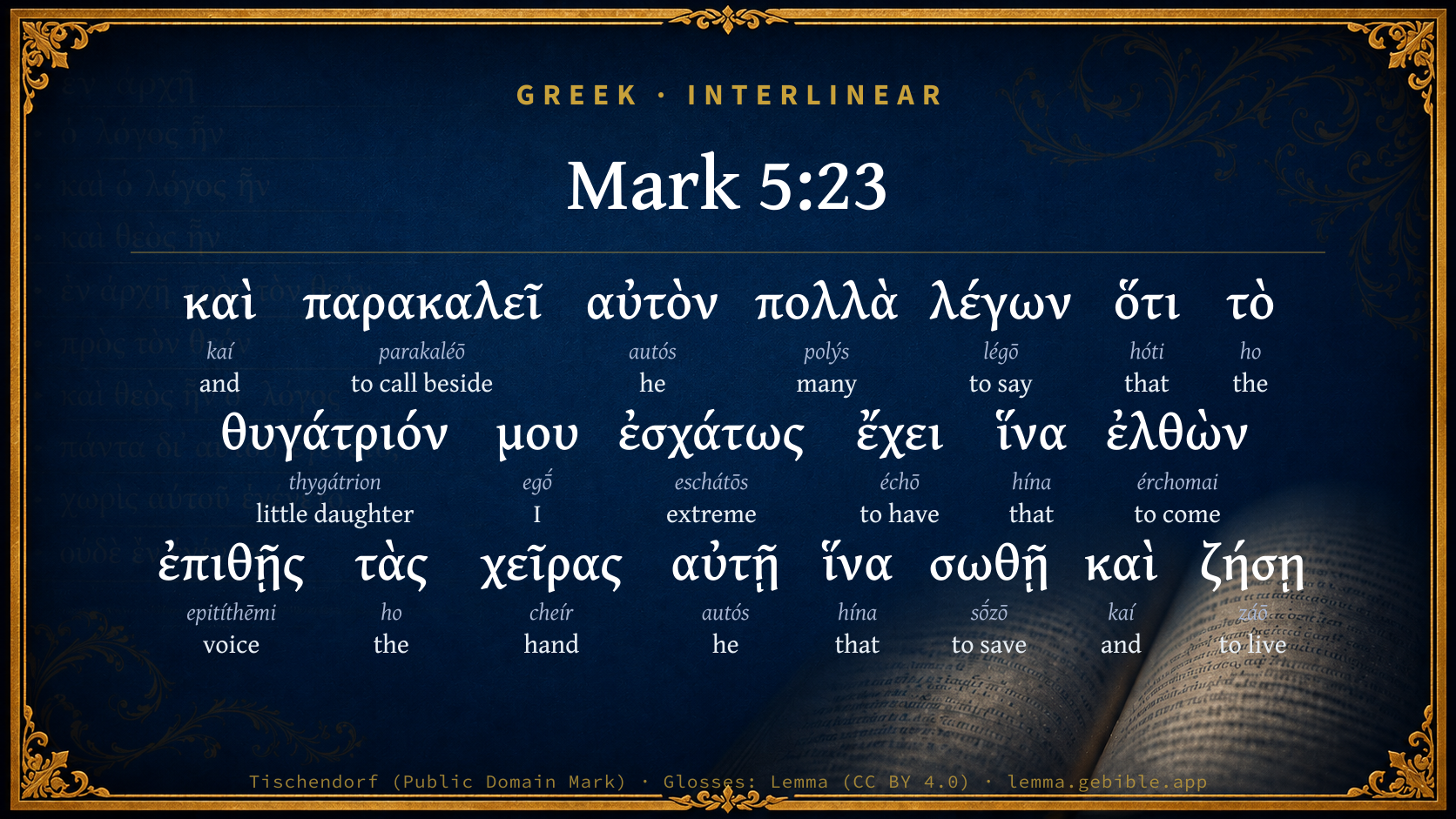
and begged him much, saying, "My little daughter is at the point of death. Please come and lay your hands on her, that she may be made healthy, and live."
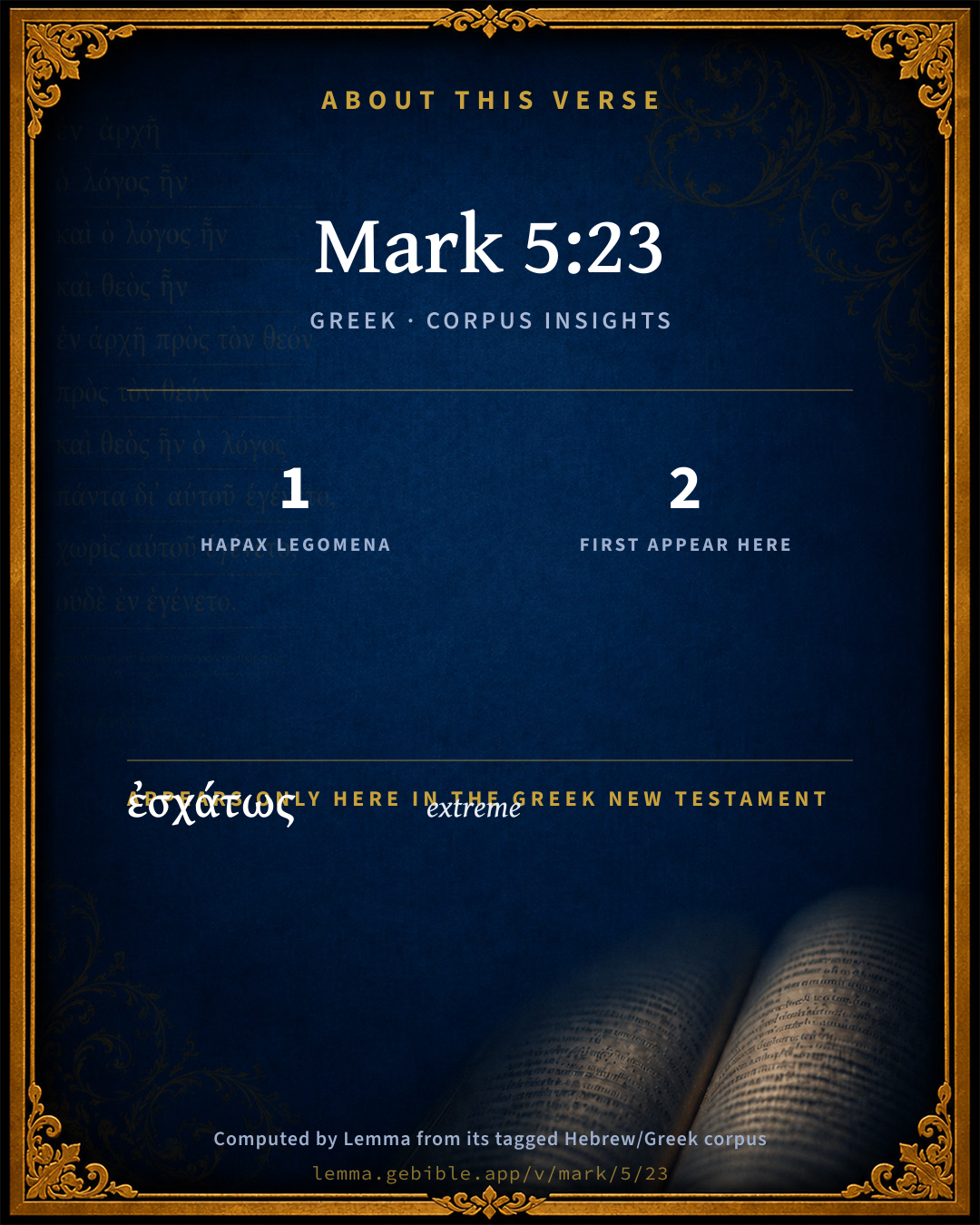
- 1 hapax legomenon — only here in the Greek New Testament
- 2 first appearances in the Greek New Testament
Download a study sheet
One document with this verse’s original text, its word-by-word gloss line, the meaning frame, cross-references with their text, attributed commentary, and full source and license credits — printable, and it pastes into notes with its structure intact.
This verse Autodidact and up
A passage Seminary Student
Up to 50 verses in one chapter. A passage sheet keeps up to 6 commentary sources and 12 cross-references per verse, in the order this page ranks them, and says so on the sheet whenever that leaves anything out. Ask for a single verse and you get the Autodidact verse sheet above.
Everything on this page stays free to read, with no account — the sheet is a download of what is already on screen, not access to it.
Compare translations 3
The same verse in 3 English versions, stacked beneath the original-language interlinear above. Click any original word for its lexicon entry.
Each is an independent rendering of the whole verse — the interlinear is not word-aligned to these translations.
Highlighted words mark where these versions differ — a whole-verse word diff, not a word-by-word alignment.
-
World English Bible Public Domain
and begged him much, saying, "My little daughter is at the point of death. Please come and lay your hands on her, that she may be made healthy, and live."
-
King James Version Public Domain
And besought him greatly, saying, My little daughter lieth at the point of death: I pray thee, come and lay thy hands on her, that she may be healed; and she shall live.
-
unfoldingWord Literal Text CC BY-SA 4.0
And he begs him much, saying, “My little daughter is having end; so that, coming, you might lay your hands on her in order that she might be saved, and she might live.”
unfoldingWord Literal Text — © unfoldingWord, licensed CC BY-SA 4.0. Word-aligned USFM3 via Door43 (git.door43.org/unfoldingWord/en_ult).
Show all 19 translations
Every available English version of this verse, each an independent rendering of the whole verse.
-
World English Bible Public Domain
and begged him much, saying, "My little daughter is at the point of death. Please come and lay your hands on her, that she may be made healthy, and live."
-
Berean Standard Bible Public Domain
and pleaded with Him urgently, “My little daughter is near death. Please come and place Your hands on her, so that she will be healed and live.”
-
Majority Standard Bible Public Domain
and pleaded with Him urgently, “My little daughter is near death. Please come and place Your hands on her so that she will be healed, and she will live.”
-
King James Version Public Domain
And besought him greatly, saying, My little daughter lieth at the point of death: I pray thee, come and lay thy hands on her, that she may be healed; and she shall live.
-
American Standard Version (1901) Public Domain
and beseecheth him much, saying, My little daughter is at the point of death: `I pray thee', that thou come and lay thy hands on her, that she may be made whole, and live.
-
Revised Version (1885) Public Domain
and beseecheth him much, saying, My little daughter is at the point of death: I pray thee, that thou come and lay thy hands on her, that she may be made whole, and live.
-
Geneva Bible (1599) Public Domain
And besought him instantly, saying, My litle daughter lyeth at point of death: I pray thee that thou wouldest come and lay thine hands on her, that she may be healed, and liue.
-
Douay-Rheims (1899) Public Domain
And he besought him much, saying: My daughter is at the point of death, come, lay thy hand upon her, that she may be safe, and may live.
-
Young's Literal Translation Public Domain
and he was calling upon him much, saying -- `My little daughter is at the last extremity -- that having come, thou mayest lay on her `thy' hands, so that she may be saved, and she shall live;'
-
Literal Standard Version CC BY-SA 4.0
and he was calling on Him much, saying, “My little daughter is at the last extremity—that having come, You may lay on her [Your] hands, so that she may be saved, and she will live”;
-
Unlocked Literal Bible CC BY-SA 4.0
He begged again and again, saying, “My little daughter is near death. I beg you, come and lay your hands on her that she may be made well and live.”
-
unfoldingWord Literal Text CC BY-SA 4.0
And he begs him much, saying, “My little daughter is having end; so that, coming, you might lay your hands on her in order that she might be saved, and she might live.”
-
Darby Bible Public Domain
and he besought him much, saying, My little daughter is at extremity; [I pray] that thou shouldest come and lay thy hands upon her so that she may be healed, and may live.
-
World Messianic Bible Public Domain
and begged him much, saying, “My little daughter is at the point of death. Please come and lay your hands on her, that she may be made healthy, and live.”
-
Webster's Bible Public Domain
And besought him greatly, saying, My little daughter lieth at the point of death: I pray thee, come and lay thy hands on her, that she may be healed; and she will live.
-
Free Bible Version CC BY-SA 4.0
and pleaded with him, saying, “My little daughter is about to die. Please come and place your hands on her so she may be healed and live.”
-
Bible in Basic English Public Domain
And made strong prayers to him, saying, My little daughter is near to death: it is my prayer that you will come and put your hands on her, so that she may be made well, and have life.
-
Text-Critical English NT CC BY 4.0
and begged him earnestly, “My little daughter is at the point of death. Please come and lay yoʋr hands on her so that she may be healed. Then she will live.”
-
Tyndale New Testament (1534) Public Domain
and besought hym greatly sayinge: my doughter lyith at poynt of deeth I wolde thou woldest come and laye thy honde on her that she myght be safe and live.
Literal Standard Version (2020), Covenant Press — licensed CC BY-SA 4.0. Text via the HelloAO Bible API (eBible.org). Unlocked Literal Bible (unfoldingWord) — licensed CC BY-SA 4.0. Text via the HelloAO Bible API (eBible.org). unfoldingWord Literal Text — © unfoldingWord, licensed CC BY-SA 4.0. Word-aligned USFM3 via Door43 (git.door43.org/unfoldingWord/en_ult). Free Bible Version, Dr. Jonathan Gallagher — licensed CC BY-SA 4.0. Text via the HelloAO Bible API (eBible.org).
Word by word
More ways to search: Search by grammar → Find every occurrence → Compare this word →
Practice this passage: Drill this verse → Learn its vocabulary →
- Appears 1× in the Greek New Testament
- First appears here
- Part of Speech
- Adverb
- Degree
- Superlative
Full Thayer's Definition
- καὶ kaí G2532 “and” Conjunction
- παρακαλεῖ parakaléō G3870 “to call beside” Verb, Present, Active, Indicative, 3rd person, Singular
- αὐτὸν autós G846 “he” Personal pronoun, Accusative, Singular, Masculine
- πολλὰ polýs G4183 “many” Adjective, Accusative, Plural, Neuter
- λέγων légō G3004 “to say” Verb, Present, Active, Participle, Nominative, Singular, Masculine
- ὅτι hóti G3754 “that” Conjunction
- τὸ ho G3588 “the” Article, Nominative, Singular, Neuter
- θυγάτριόν thygátrion G2365 “little daughter” Noun, Nominative, Singular, Neuter
- μου egṓ G1473 “I” Personal pronoun, 1st person, Genitive, Singular
- ἐσχάτως eschátōs G2079 “extreme” Adverb, Superlative
- ἔχει échō G2192 “to have” Verb, Present, Active, Indicative, 3rd person, Singular
- ἵνα hína G2443 “that” Conjunction
- ἐλθὼν érchomai G2064 “to come” Verb, Aorist, Active, Participle, Nominative, Singular, Masculine
- ἐπιθῇς epitíthēmi G2007 “voice” Verb, Aorist, Active, Subjunctive, 2nd person, Singular
- τὰς ho G3588 “the” Article, Accusative, Plural, Feminine
- χεῖρας cheír G5495 “hand” Noun, Accusative, Plural, Feminine
- αὐτῇ autós G846 “he” Personal pronoun, Dative, Singular, Feminine
- ἵνα hína G2443 “that” Conjunction
- σωθῇ sṓzō G4982 “to save” Verb, Aorist, Passive, Subjunctive, 3rd person, Singular
- καὶ kaí G2532 “and” Conjunction
- ζήσῃ záō G2198 “to live” Verb, Aorist, Active, Subjunctive, 3rd person, Singular
About this verse
These counts appear in no published source. They are computed here, from the morphology-tagged text and Lemma’s own curated glosses. What Lemma adds →
- 21
- words
- 17
- distinct lemmas
- Gospels
- section
Notable vocabulary
1 hapax legomenon — a word that appears only here in the entire Greek New Testament:
- ἐσχάτως extreme G2079
First appearance in Scripture
These words make their first canonical appearance in the Greek New Testament here:
Shared distinctive vocabulary
θυγάτριόν little daughter G2365 occurs in 2 verses of the Greek New Testament. Also found in:
Cross-references
23Topical passages linked to Mark 5:23 in the Treasury of Scripture Knowledge — connected by theme and wording, ordered by reader-vote popularity; previews shown in the World English Bible.
- Luke 13:13 He laid his hands on her, and immediately she stood up straight, and glorified God.
- Mark 16:18 they will take up serpents; and if they drink any deadly thing, it will in no way hurt them; they will lay hands on the sick, and they will recover."
- Luke 4:40 When the sun was setting, all those who had any sick with various diseases brought them to him; and he laid his hands on every one of them, and healed them.
- Acts 28:8 It happened that the father of Publius lay sick of fever and dysentery. Paul entered in to him, prayed, and laying his hands on him, healed him.
- 2 Samuel 12:15–16 Nathan departed to his house. Yahweh struck the child that Uriah's wife bore to David, and it was very sick.
- 2 Kings 5:11 But Naaman was angry, and went away, and said, Behold, I thought, He will surely come out to me, and stand, and call on the name of Yahweh his God, and wave his hand over the place, and recover the leper.
- Psalms 50:15 Call on me in the day of trouble. I will deliver you, and you will honor me."
- Psalms 107:19 Then they cry to Yahweh in their trouble, He saves them out of their distresses.
- Mark 7:32 They brought to him one who was deaf and had an impediment in his speech. They begged him to lay his hand on him.
- Mark 8:23 He took hold of the blind man by the hand, and brought him out of the village. When he had spit on his eyes, and laid his hands on him, he asked him if he saw anything.
- Mark 9:21–22 He asked his father, "How long has it been since this has come to him?" He said, "From childhood.
- Luke 4:38 He rose up from the synagogue, and entered into Simon's house. Simon's mother-in-law was afflicted with a great fever, and they begged him for her.
- James 5:14–15 Is any among you sick? Let him call for the elders of the assembly, and let them pray over him, anointing him with oil in the name of the Lord,
- Matthew 8:3 Jesus stretched out his hand, and touched him, saying, "I want to. Be made clean." Immediately his leprosy was cleansed.
- Mark 6:5–6 He could do no mighty work there, except that he laid his hands on a few sick people, and healed them.
- Mark 6:13 They cast out many demons, and anointed many with oil who were sick, and healed them.
- Mark 7:25–27 For a woman, whose little daughter had an unclean spirit, having heard of him, came and fell down at his feet.
- Luke 7:2–3 A certain centurion's servant, who was dear to him, was sick and at the point of death.
- Luke 7:12 Now when he drew near to the gate of the city, behold, one who was dead was carried out, the only son of his mother, and she was a widow. Many people of the city were with her.
- John 4:46–47 Jesus came therefore again to Cana of Galilee, where he made the water into wine. There was a certain nobleman whose son was sick at Capernaum.
- John 11:3 The sisters therefore sent to him, saying, "Lord, behold, he for whom you have great affection is sick."
- Acts 6:6 whom they set before the apostles. When they had prayed, they laid their hands on them.
- Acts 9:17 Ananias departed, and entered into the house. Laying his hands on him, he said, "Brother Saul, the Lord, who appeared to you on the road by which you came, has sent me, that you may receive your sight, and be filled with the Holy Spirit."
Cross-references courtesy of OpenBible.info (CC BY 4.0).
Lesson kit
Teaching starters — assembled from the data on this page, not authored interpretation. Every prompt links to the verse data it draws on. Edit before teaching.
Mark, in the Gospels, opens this verse with 21 words (17 distinct Greek lemmas). Its most distinctive word is eschátōs (“extreme”). A historical commentator’s framing appears above. Read the whole chapter for the surrounding context.
Discussion questions
- The word eschátōs carries the sense “extreme.” How does it shape the verse?
- 1 word here appears nowhere else in the Greek New Testament. Why might the author reach for such rare wording?
- 2 words make their first appearance in Scripture here. What does this debut establish?
- How does Mark 7:25, which shares the word «little daughter», read alongside this verse?
- What does the repetition of “and” (2× in this one verse) do in this verse?
- These translations render this verse differently; the difference is in the English rendering, not the original. What questions does that raise?
- Compare how The Biblical Illustrator and Godbey's Commentary on the New Testament read this verse. Where do they agree or differ?
Things to notice
- 1 word in this verse appears nowhere else in the Greek New Testament.
- 2 words make their first canonical appearance in Scripture here.
- These translations choose different wording for 24 words in this verse.
- “and” occurs 2× in this single verse.
- 17 distinct Greek lemmas span 21 words in this verse.
Commentary
Notes on Mark 5:23 from classic Christian and Jewish commentators (each source and its license shown beneath its notes). The classic Christian expositions comment on the surrounding passage and are grouped to its opening verse, so a note may address several verses; the Jewish commentaries on the Tanakh (Rashi and others) are per-verse, so they appear only where the commentator wrote on this verse.
Lemma curates 59 commentaries, every one of them public domain or Creative Commons licensed, each selected and text-cleaned for this edition rather than reprinted as found. About our sources →
The Biblical Illustrator
Joseph S. Exell
The Biblical Illustrator, edited by Joseph S. Exell (c. 1880s–1900s) — public domain. Text from a community e-Sword module.
Godbey's Commentary on the New Testament
William B. Godbey
William B. Godbey, Commentary on the New Testament (1896–1900) — public domain. Text from a community e-Sword module.
Tyndale Open Study Notes
Tyndale Open Resources
Tyndale Open Study Notes — © Tyndale Open Resources, licensed CC BY-SA 4.0. Text via the HelloAO Bible API.
Bengel's Gnomon
Johann Albrecht Bengel
Bengel's Gnomon of the New Testament — English translation (T&T Clark, Edinburgh, 1860) — public domain. Text from a community e-Sword module.
Expositor's Greek Testament
ed. W. Robertson Nicoll
The Expositor's Greek Testament, edited by W. Robertson Nicoll (1897–1910) — public domain. Text from a community e-Sword module.
Adam Clarke's Commentary
Adam Clarke's Commentary on the Bible (1810–1826) — public domain. Text from a community e-Sword/MySword module.
Ellicott's Commentary for English Readers
A Bible Commentary for English Readers, edited by Charles John Ellicott (1878–1897) — public domain. Text from a community e-Sword module.
The Cambridge Bible for Schools and Colleges
gen. ed. J. J. S. Perowne
The Cambridge Bible for Schools and Colleges (gen. ed. J. J. S. Perowne; Cambridge University Press, 1878–1918) — public domain. Text from a community e-Sword module.
John Gill's Exposition
John Gill's Exposition of the Whole Bible (1746–1763) — public domain (CC PDM 1.0). Text via the HelloAO Bible API.
Trapp's Complete Commentary
John Trapp
John Trapp, A Commentary or Exposition upon All the Books of the Old and New Testament (1647–1656) — public domain. Text from a community e-Sword module.
Haydock's Catholic Bible Commentary
George Leo Haydock (1774–1849), Haydock's Catholic Family Bible and Commentary, 1859 edition — public domain. Excludes Psalms (Douay-Rheims chapter numbering differs from Protestant) and Deuterocanonical books (Catholic canon only).
Whedon's Commentary on the Bible
Daniel D. Whedon
Daniel D. Whedon (gen. ed.), Commentary on the Old and New Testaments (1874–1909) — public domain. Text from a community e-Sword module.
McGarvey & Pendleton's Commentaries
J. W. McGarvey
J. W. McGarvey (with Philip Y. Pendleton), Commentaries on the New Testament (The Fourfold Gospel, 1914; Acts; and the epistles) — public domain. Text from a community e-Sword/MySword module.
The People's New Testament
B. W. Johnson
B. W. Johnson's The People's New Testament with Notes (1889–1891) — public domain. Electronic text from the Christian Classics Ethereal Library (CCEL) ThML edition.
Cambridge Greek Testament for Schools and Colleges
Cambridge Greek Testament for Schools and Colleges (Cambridge University Press, 1896; 21 vols, various authors incl. Carr, Maclear, Plummer, Farrar, Lumby, Moule, M. R. James, Simcox) — public domain. Text from a community e-Sword module.
Alford’s Greek Testament
Henry Alford
Henry Alford, The Greek Testament (1849–1861) — public domain. Text from a community e-Sword module.
International Critical Commentary
International Critical Commentary — older volumes (1896–1929), various authors — public domain. Text from a community e-Sword module.
Vincent's Word Studies in the New Testament
Marvin R. Vincent
Marvin R. Vincent, Word Studies in the New Testament (1887–1900) — public domain. Text from a community e-Sword/MySword module.