
John 19:20

Greek (Tischendorf 8th ed.) John 19:20 appears in the Greek New Testament. The text above is from the Tischendorf 8th edition. Each word links to its Strong’s number and a concise gloss. Click any word for its full Thayer’s Greek Lexicon entry.
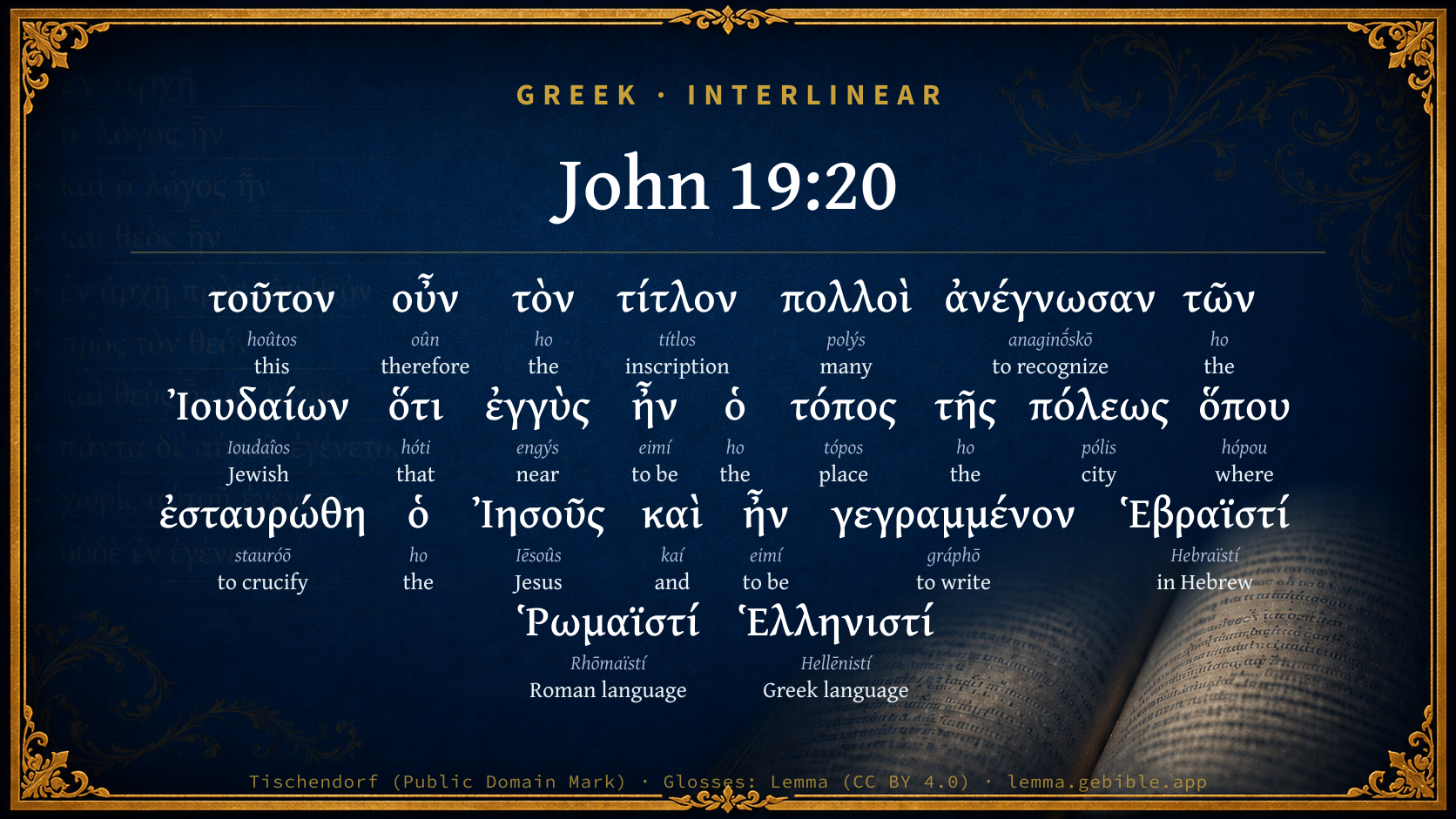
Download image
Cite this verse

John 19:20 (World English Bible). Public Domain. Lemma interlinear Bible study tool, https://lemma.gebible.app/v/john/19/20.

Show BibTeX & RIS
BibTeX
RIS
English Translation
Therefore many of the Jews read this title, for the place where Jesus was crucified was near the city; and it was written in Hebrew, in Latin, and in Greek.
World English Bible · Public Domain
Highlights
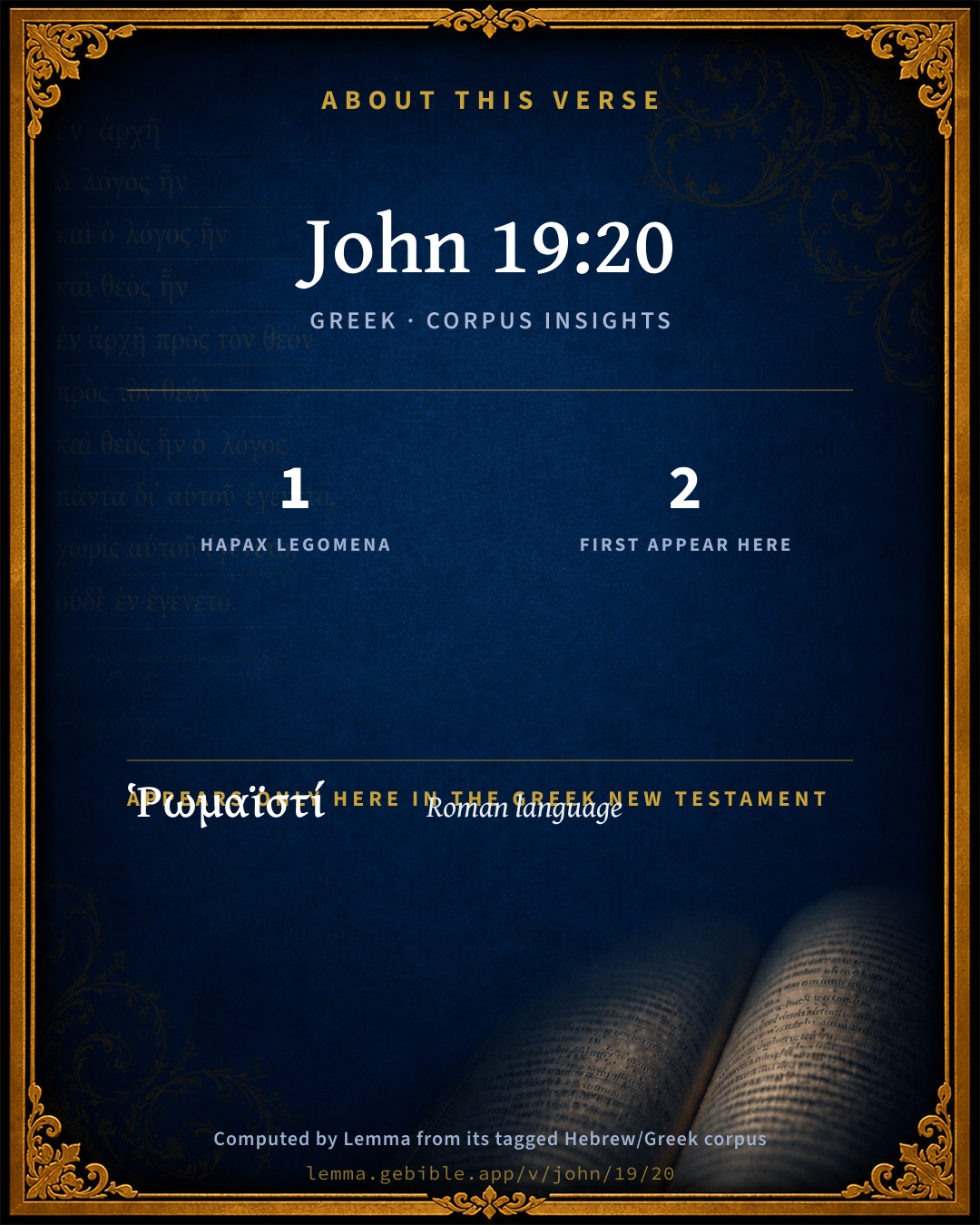
  • 1 hapax legomenon — only here in the Greek New Testament
  • 2 first appearances in the Greek New Testament
Full analysis ↓
Download a study sheet

One document with this verse’s original text, its word-by-word gloss line, the meaning frame, cross-references with their text, attributed commentary, and full source and license credits — printable, and it pastes into notes with its structure intact.

This verse Autodidact and up

Study sheet (.html) Plain text (.txt)

A passage Seminary Student

Up to 50 verses in one chapter. A passage sheet keeps up to 6 commentary sources and 12 cross-references per verse, in the order this page ranks them, and says so on the sheet whenever that leaves anything out. Ask for a single verse and you get the Autodidact verse sheet above.

Everything on this page stays free to read, with no account — the sheet is a download of what is already on screen, not access to it.

Want to remove ads? Support Godless Engineer
Compare translations 3

The same verse in 3 English versions, stacked beneath the original-language interlinear above. Click any original word for its lexicon entry.

Each is an independent rendering of the whole verse — the interlinear is not word-aligned to these translations.

Highlighted words mark where these versions differ — a whole-verse word diff, not a word-by-word alignment.

  • World English Bible Public Domain
    Therefore many of the Jews read this title, for the place where Jesus was crucified was near the city; and it was written in Hebrew, in Latin, and in Greek.
  • King James Version Public Domain
    This title then read many of the Jews: for the place where Jesus was crucified was nigh to the city: and it was written in Hebrew, and Greek, and Latin.
  • unfoldingWord Literal Text CC BY-SA 4.0
    Therefore, many of the Jews read this title, because the place where Jesus was crucified was near the city. And it was written in Hebrew, in Latin, and in Greek.

unfoldingWord Literal Text — © unfoldingWord, licensed CC BY-SA 4.0. Word-aligned USFM3 via Door43 (git.door43.org/unfoldingWord/en_ult).

Versions to compare (up to 4)

3 of 4 selected

Show all 19 translations

Every available English version of this verse, each an independent rendering of the whole verse.

  • World English Bible Public Domain
    Therefore many of the Jews read this title, for the place where Jesus was crucified was near the city; and it was written in Hebrew, in Latin, and in Greek.
  • Berean Standard Bible Public Domain
    Many of the Jews read this sign, because the place where Jesus was crucified was near the city, and it was written in Hebrew, Latin, and Greek.
  • Majority Standard Bible Public Domain
    Many of the Jews read this sign, because the place where Jesus was crucified was near the city, and it was written in Hebrew, Greek, and Latin.
  • King James Version Public Domain
    This title then read many of the Jews: for the place where Jesus was crucified was nigh to the city: and it was written in Hebrew, and Greek, and Latin.
  • American Standard Version (1901) Public Domain
    This title therefore read many of the Jews, for the place where Jesus was crucified was nigh to the city; and it was written in Hebrew, `and' in Latin, `and' in Greek.
  • Revised Version (1885) Public Domain
    This title therefore read many of the Jews: for the place where Jesus was crucified was nigh to the city: and it was written in Hebrew, and in Latin, and in Greek.
  • Geneva Bible (1599) Public Domain
    This title then read many of the Iewes: for the place where Iesus was crucified, was neere to the citie: and it was written in Hebrewe, Greeke and Latine.
  • Douay-Rheims (1899) Public Domain
    This title therefore many of the Jews did read: because the place where Jesus was crucified was nigh to the city: and it was written in Hebrew, in Greek, and in Latin.
  • Young's Literal Translation Public Domain
    this title, therefore, read many of the Jews, because the place was nigh to the city where Jesus was crucified, and it was having been written in Hebrew, in Greek, in Roman.
  • Literal Standard Version CC BY-SA 4.0
    therefore many of the Jews read this title, because the place was near to the city where Jesus was crucified, and it was having been written in Hebrew, in Greek, in Latin.
  • Unlocked Literal Bible CC BY-SA 4.0
    Many of the Jews read this sign because the place where Jesus was crucified was near the city. The sign was written in Hebrew, in Latin, and in Greek.
  • unfoldingWord Literal Text CC BY-SA 4.0
    Therefore, many of the Jews read this title, because the place where Jesus was crucified was near the city. And it was written in Hebrew, in Latin, and in Greek.
  • Darby Bible Public Domain
    This title therefore many of the Jews read, for the place of the city where Jesus was crucified was near; and it was written in Hebrew, Greek, Latin.
  • World Messianic Bible Public Domain
    Therefore many of the Judeans read this title, for the place where Yeshua was crucified was near the city; and it was written in Hebrew, in Latin, and in Greek.
  • Webster's Bible Public Domain
    Many of the Jews then read this title: for the place where Jesus was crucified was nigh to the city: and it was written in Hebrew, Greek, and Latin.
  • Free Bible Version CC BY-SA 4.0
    Many people read the notice because the place where Jesus was crucified was near the city, and it was written in Hebrew, Latin, and Greek.
  • Bible in Basic English Public Domain
    The writing was seen by a number of the Jews, for the place where Jesus was put to death on the cross was near the town; and the writing was in Hebrew and Latin and Greek.
  • Text-Critical English NT CC BY 4.0
    Many of the Jews read this notice, because the place where Jesus was crucified was near the city, and it was written in Hebrew, Greek, and Latin.
  • Tyndale New Testament (1534) Public Domain
    For the place where Iesus was crucified was nye to the cite. And it was written in Hebrue Greke and Latyn.

Literal Standard Version (2020), Covenant Press — licensed CC BY-SA 4.0. Text via the HelloAO Bible API (eBible.org). Unlocked Literal Bible (unfoldingWord) — licensed CC BY-SA 4.0. Text via the HelloAO Bible API (eBible.org). unfoldingWord Literal Text — © unfoldingWord, licensed CC BY-SA 4.0. Word-aligned USFM3 via Door43 (git.door43.org/unfoldingWord/en_ult). Free Bible Version, Dr. Jonathan Gallagher — licensed CC BY-SA 4.0. Text via the HelloAO Bible API (eBible.org).

Word by word

More ways to search: Search by grammar → Find every occurrence → Compare this word →

Practice this passage: Drill this verse → Learn its vocabulary →

Ῥωμαϊστί
Rhōmaïstí
G4515
“Roman language”
Adverb
Part of Speech
Adverb
Full Thayer's Definition

Origin: from a presumed derivative of G4516

TDNT: None

Latin = "of Rome's strength" 1. the language spoken by the Romans
  1. τοῦτον hoûtos G3778 “this” Demonstrative pronoun, Accusative, Singular, Masculine
  2. οὖν oûn G3767 “therefore” Conjunction
  3. τὸν ho G3588 “the” Article, Accusative, Singular, Masculine
  4. τίτλον títlos G5102 “inscription” Noun, Accusative, Singular, Masculine
  5. πολλοὶ polýs G4183 “many” Adjective, Nominative, Plural, Masculine
  6. ἀνέγνωσαν anaginṓskō G314 “to recognize” Verb, Aorist, Active, Indicative, 3rd person, Plural
  7. τῶν ho G3588 “the” Article, Genitive, Plural, Masculine
  8. Ἰουδαίων Ioudaîos G2453 “Jewish” Adjective, Genitive, Plural, Masculine
  9. ὅτι hóti G3754 “that” Conjunction
  10. ἐγγὺς engýs G1451 “near” Adverb
  11. ἦν eimí G1510 “to be” Verb, Imperfect, Active, Indicative, 3rd person, Singular
  12. ὁ ho G3588 “the” Article, Nominative, Singular, Masculine
  13. τόπος tópos G5117 “place” Noun, Nominative, Singular, Masculine
  14. τῆς ho G3588 “the” Article, Genitive, Singular, Feminine
  15. πόλεως pólis G4172 “city” Noun, Genitive, Singular, Feminine
  16. ὅπου hópou G3699 “where” Adverb
  17. ἐσταυρώθη stauróō G4717 “to crucify” Verb, Aorist, Passive, Indicative, 3rd person, Singular
  18. ὁ ho G3588 “the” Article, Nominative, Singular, Masculine
  19. Ἰησοῦς Iēsoûs G2424 “Jesus” Noun, Nominative, Singular, Masculine
  20. καὶ kaí G2532 “and” Conjunction
  21. ἦν eimí G1510 “to be” Verb, Imperfect, Active, Indicative, 3rd person, Singular
  22. γεγραμμένον gráphō G1125 “to write” Verb, Perfect, Passive, Participle, Nominative, Singular, Neuter
  23. Ἑβραϊστί Hebraïstí G1447 “in Hebrew” Adverb
  24. Ἑλληνιστί Hellēnistí G1676 “Greek language” Adverb

About this verse

These counts appear in no published source. They are computed here, from the morphology-tagged text and Lemma’s own curated glosses. What Lemma adds →

25
words
20
distinct lemmas
Gospels
section

Notable vocabulary

1 hapax legomenon — a word that appears only here in the entire Greek New Testament:

  • Ῥωμαϊστί Roman language G4515

First appearance in Scripture

These words make their first canonical appearance in the Greek New Testament here:

  • Ῥωμαϊστί Roman language G4515
  • Ἑλληνιστί Greek language G1676

Shared distinctive vocabulary

τίτλον inscription G5102 occurs in 2 verses of the Greek New Testament. Also found in:
Repetition

Words recur within this verse:

Cross-references

9

Topical passages linked to John 19:20 in the Treasury of Scripture Knowledge — connected by theme and wording, ordered by reader-vote popularity; previews shown in the World English Bible.

  • John 5:2 Now in Jerusalem by the sheep gate, there is a pool, which is called in Hebrew, "Bethesda," having five porches.
  • John 19:13 When Pilate therefore heard these words, he brought Jesus out, and sat down on the judgment seat at a place called "The Pavement," but in Hebrew, "Gabbatha."
  • Acts 21:37 As Paul was about to be brought into the barracks, he asked the commanding officer, "May I speak to you?" He said, "Do you know Greek?
  • Acts 21:40 When he had given him permission, Paul, standing on the stairs, beckoned with his hand to the people. When there was a great silence, he spoke to them in the Hebrew language, saying,
  • Acts 22:2 When they heard that he spoke to them in the Hebrew language, they were even more quiet. He said,
  • Acts 26:14 When we had all fallen to the earth, I heard a voice saying to me in the Hebrew language, 'Saul, Saul, why are you persecuting me? It is hard for you to kick against the goads.'
  • Revelation 16:16 He gathered them together into the place which is called in Hebrew, Megiddo.
  • Hebrews 13:12 Therefore Jesus also, that he might sanctify the people through his own blood, suffered outside of the gate.
  • Revelation 9:11 They have over them as king the angel of the abyss. His name in Hebrew is "Abaddon," but in Greek, he has the name "Apollyon."

Cross-references courtesy of OpenBible.info (CC BY 4.0).

Commentary

Notes on John 19:20 from classic Christian and Jewish commentators (each source and its license shown beneath its notes). The classic Christian expositions comment on the surrounding passage and are grouped to its opening verse, so a note may address several verses; the Jewish commentaries on the Tanakh (Rashi and others) are per-verse, so they appear only where the commentator wrote on this verse.

Lemma curates 59 commentaries, every one of them public domain or Creative Commons licensed, each selected and text-cleaned for this edition rather than reprinted as found. About our sources →

Ellicott's Commentary for English Readers

(20) This and the following verses are peculiar to St. John, and furnish another instance of his exact knowledge of what took place at Jerusalem.

Many of the Jews.—That is, of the hierarchical party, as generally in this Gospel. (Comp. Note on Joh_1:19.) It has been sometimes understood here of the people generally, because the inscription was written in the three languages; but the last clause of the verse furnishes the reason for the action of the chief priests in the next verse. It would be better to punctuate the verses thus: “This title therefore read many of the Jews, because the place where Jesus was crucified was nigh to the city. And it was written in Hebrew, and Greek, and Latin. Therefore said the chief priests . . .”

Nigh to the city.—Comp. Note on Mat_27:33.

Hebrew, and Greek, and Latin.—“Hebrew,” i.e., the current Syro-Chaldaic, was the language of the people generally. The precise form which occurs here is used in the New Testament only by St. John (Joh_5:2; Joh_19:13; Joh_19:17; Joh_19:20; Joh_20:16; Rev_9:11; Rev_16:16). “Greek” was the most widely-known language of the time. “Latin” was the official language of the Roman Empire.

A Bible Commentary for English Readers, edited by Charles John Ellicott (1878–1897) — public domain. Text from a community e-Sword module.

Bengel's Gnomon

Johann Albrecht Bengel

Joh 19:20. Πολλοὶ, many) for a testimony to them. [It is not recorded when the inscription was put up, just as in the case of the cross itself, we are not told when it was raised up.—V. g.]—ὅτι, because) For not many comparatively would have gone far to see it.—τῆς) Construe this with ἐγγύς.—ὅπου) Refer this to τόπος.

Bengel's Gnomon of the New Testament — English translation (T&T Clark, Edinburgh, 1860) — public domain. Text from a community e-Sword module.

Expositor's Greek Testament

ed. W. Robertson Nicoll

Joh 19:20 . This title was read by “many of the Jews,” because the place of crucifixion was close to the city, and lay in the road of any coming in from the north; also it was written in three languages so that every one could read it, whether Jew or Gentile.

The Expositor's Greek Testament, edited by W. Robertson Nicoll (1897–1910) — public domain. Text from a community e-Sword module.

Adam Clarke's Commentary

Verse 20. Hebrew, - Greek, - Latin.] See Clarke on Lu 23:38.

On Mt 27:37, I have given this title in Hebrew, Greek, and Latin, as mentioned by this evangelist. The reader, however, will not be displeased to find the same title repeated here in a character which was written in the fourth century, and is probably nearly resembling that used in the earliest ages of Christianity. The Greek and Latin character, which is inserted here, is an exact fac-simile of that in the Codex Bezae, cut and cast at the expense of the University of Cambridge, for Dr. Kipling's edition of that most venerable MS. which contains the Greek text of the four evangelists and Acts; and the Latin text of the same, as it existed before the time of St. Jerome. Having examined the MS. myself, I can say that these types are a very faithful representation of the original.

In Hebrew, εβραιστι.

יסוע נצריא מלכא דיהודיא

In Greek, ελληνιστι.

ΙΗΣΟΥΣ Ο ΝΑΖΩΡΕΟΣ Ο ΒΑΣΙΛΕΥΣ ΤΩΝ ΙΟΥΔΑΙΩΝ

In Latin, ρωμαιστι.

IEHSUS NAZARENUS REX IUDAEORUM

Adam Clarke's Commentary on the Bible (1810–1826) — public domain. Text from a community e-Sword/MySword module.

The Cambridge Bible for Schools and Colleges

gen. ed. J. J. S. Perowne

20. nigh to the city] Pictures are often misleading in placing the city a mile or two in the background of the Crucifixion. S. John’s exact topographical knowledge comes out again here.

in Hebrew, and Greek, and Latin] The better texts give, In Hebrew and in Latin and in Greek. The national and the official languages would naturally be placed before Greek,—and for different reasons either Hebrew or Latin might be placed first. In Luk_23:38 the order is Greek, Latin, Hebrew; but the clause is of very doubtful authority. In any case the three representative languages of the world at that time, the languages of religion, of empire, and of intellect, were employed. Thus did they ‘tell it out among the heathen that the Lord is king,’ or (according to a remarkable reading of the LXX. in Psa_96:10) ‘that the Lord feigned from the tree.’ (See on Joh_20:16.)

The Cambridge Bible for Schools and Colleges (gen. ed. J. J. S. Perowne; Cambridge University Press, 1878–1918) — public domain. Text from a community e-Sword module.

John Gill's Exposition

This title then read many of the Jews,.... Who were in great numbers, at the place of execution, rejoicing at his crucifixion, and insulting him as he hung on the cross:

for the place where Jesus was crucified, was nigh unto the city; Golgotha, the place of Christ's crucifixion, was not more than two furlongs, or a quarter of a mile from the city of Jerusalem: so that multitudes were continually going from thence to see this sight; the city also being then very full of people, by reason of the feast of the passover; to which may be added, that the cross stood by the wayside, where persons were continually passing to and fro, as appears from Mat 27:39 and where it was usual to erect crosses to make public examples or malefactors, and to deter others from committing the like crimes: so Alexander, the emperor, ordered an eunuch to be crucified by the wayside, in which his servants used commonly to go to his suburb (s) or country house: Cicero says (t) the Mamertines, according to their own usage and custom, crucified behind the city, in the Pompeian way; and Quinctilian observes (u), as often as we crucify criminals, the most noted ways are chosen, where most may behold, and most may be moved with fear: and now Christ being crucified by a public road side, the inscription on the cross was doubtless read by more than otherwise it would:

and it was written in Hebrew, and Greek, and Latin; that it might be read by all, Jews, Greeks, and Romans; and to show that he is the Saviour of some of all nations; and that he is King over all. These words were written in Hebrew letters in the Syriac dialect, which was used by the Jews, and is called the Hebrew language, Joh 19:13 and in which it is most likely Pilate should write these words, or order them to be written; and which, according to the Syriac version we now have, were thus put, ; in Greek the words stood as in the original text, thus, : and in the Latin tongue, as may be supposed, after this manner, "Jesus Nazarenus Rex Judaeorum". These three languages may be very well thought to be understood by Pilate; at least so much of them as to qualify him to write such an inscription as this. The Latin tongue was his mother tongue, which he must be supposed well to understand; and the Greek tongue was very much used by the Romans, since their conquest of the Grecian monarchy; and the emperors' edicts were generally published in Greek, which it was therefore necessary for Pilate to understand; and as he was a governor of Judea, and had been so for some time, he must have acquired some knowledge of the Hebrew language; and these being the principal languages in the world, he chose to write this title in them, that persons coming from all quarters might be able to read it, and understand it in some one of them.

(s) Lipsius de Crucc, l. 3. c. 13. p. 158. (t) Orat. 10. in Veriem. l. 5. p. 604. (u) Declamat. 275.

John Gill's Exposition of the Whole Bible (1746–1763) — public domain (CC PDM 1.0). Text via the HelloAO Bible API.

Trapp's Complete Commentary

John Trapp

20 This title then read many of the Jews: for the place where Jesus was crucified was nigh to the city: and it was written in Hebrew, and Greek, and Latin.

Ver. 20. In Hebrew, Greek, and Latin] In Hebrew, for the Jews who gloried in the law; in Greek, for the Grecians who gloried in wisdom; in Latin, for the Romans who most gloried in dominion and power. As if Pilate should have said, This is the King of all religion, having reference to the Hebrews; of all wisdom, to the Greeks; of all power, to the Romans. The Holy Ghost would also hereby commend unto us the dignity and study of these three languages, to be retained for ever in the Church of Christ.

John Trapp, A Commentary or Exposition upon All the Books of the Old and New Testament (1647–1656) — public domain. Text from a community e-Sword module.

Haydock's Catholic Bible Commentary

As there were probably many Gentiles at Jerusalem at this time, on account of the festival day, this inscription was written in three different languages, that all might be able to read it. (St. John Chrysostom, hom. lxxxiv. in Joan.) --- It was written in Hebrew, on account of the Jews, who glorified in the law of God; in Greek, on account of the wise men of all nations; and in Latin, because of the Romans, who at that time commanded almost every nation of the earth. (St. Augustine, tract. 118. in Joan.)

George Leo Haydock (1774–1849), Haydock's Catholic Family Bible and Commentary, 1859 edition — public domain. Excludes Psalms (Douay-Rheims chapter numbering differs from Protestant) and Deuterocanonical books (Catholic canon only).

Matthew Poole's English Annotations

The place where Jesus was crucified was nigh to the city; as all their places of execution were, within two furlongs, or thereabouts.

It was written in Hebrew, and Greek, and Latin; it was written in all three languages, that not the Jews only, but all such strangers as were come up to the feast, might understand it.

Matthew Poole's English Annotations on the Holy Bible (1683–1685) — public domain. Text from a community e-Sword/MySword module.

Whedon's Commentary on the Bible

Daniel D. Whedon

20. Read many of the Jews—The nearness to the city, mentioned in the next words, and the variety of languages in which it was written, gave a wide notoriety to the inscription. Jerusalem and Judea are told that their king hangs upon the cross. They had threatened to make his unpunished claim of kingship a charge against Pilate before Cesar; Pilate retorts by making that kingship an insult upon them before the world. He can now report to Cesar that he has hung a king for them.

Daniel D. Whedon (gen. ed.), Commentary on the Old and New Testaments (1874–1909) — public domain. Text from a community e-Sword module.

The Pulpit Commentary

This title therefore many of the Jews read: for the place where Jesus was crucified was nigh unto the city; and it was written in Hebrew, in Roman (Latin), and in Greek. The word Ebraisti occurs four times in this Gospel and twice in the Revelation, and nowhere else in the New Testament. Codex B reads Rwmaisti first. The Latin form of the trilingual inscription may very naturally have been placed at the top. The reference to this peculiarity of the inscription as also given by Luke, in T.R., is there omitted by Tischendorf (8th edit.), Tregelles, Westcott and Herr, and R.T., M"Clellan, and others; it looks as if the reading had been borrowed from John, or rather from the spurious "Acts of Pilate," with which it verbally agrees. The proclamation of Christ"s royalty to the three great divisions of the civilized world is a providential fact of supreme interest. Thousands of Jews would carry the news of the mysterious "title" to far-off places, and ponder it in their homes. This was part of the preparation made by Divine providence for announcing to the whole world the kingdom of Jesus Christ. Since the cross from the very first thus became a throne, and the Crucifixion an installation into the kingdom, we learn thence the meaning of the Christian principle, "If we suffer with him, we shall also reign with him."

The Pulpit Commentary (1880–1919), ed. H.D.M. Spence-Jones & Joseph S. Exell — public domain. Text from a community e-Sword module.

John Wesley's Explanatory Notes

It was written in Latin - For the majesty of the Roman empire; in Hebrew - Because it was the language of the nation; and in Greek - For the information of the Hellenists, who spoke that language, and came in great numbers to the feast.

John Wesley, Explanatory Notes Upon the Whole Bible (1754–1765) — public domain. Text via the GEBible commentary corpus.

MacLaren's Expositions of Holy Scripture

Alexander MacLaren

John

AN EYE-WITNESS’S ACCOUNT OF THE CRUCIFIXION

Joh 19:17 - Joh 19:30.

In great and small matters John’s account adds much to the narrative of the crucifixion. He alone tells of the attempt to have the title on the Cross altered, of the tender entrusting of the Virgin to his care, and of the two ‘words’ ‘I thirst’ and ‘It is finished.’ He gives details which had been burned into his memory, such as Christ’s position ‘in the midst’ of the two robbers, and the jar of ‘vinegar’ standing by the crosses. He says little about the act of fixing Jesus to the Cross, but enlarges what the other Evangelists tell as to the soldiers ‘casting lots.’ He had heard what they said to one another. He alone distinctly tells that when He went forth, Jesus was bearing the Cross which afterwards Simon of Cyrene had to carry, probably because our Lord’s strength failed.

Who appointed the two robbers to be crucified at the same time? Not the rulers, who had no such power but probably Pilate, as one more shaft of sarcasm which was all the sharper both because it seemed to put Jesus in the same class as they, and because they were of the same class as the man of the Jews’ choice, Barabbas, and possibly were two of his gang. Jesus was ‘in the midst,’ where He always is, completely identified with the transgressors, but central to all things and all men. As He was in the midst on the Cross, with a penitent on one hand and a rejecter on the other, He is still in the midst of humanity, and His judgment-seat will be as central as His Cross was.

All the Evangelists give the title written over the Cross, but John alone tells that it was Pilate’s malicious invention. He thought that he was having a final fling at the priests, and little knew how truly his title, which was meant as a bitter jest, was a fact. He had it put into the three tongues in use-’Hebrew,’ the national tongue; ‘Greek,’ the common medium of intercourse between varying nationalities; and ‘Latin’ the official language. He did not know that he was proclaiming the universal dominion of Jesus, and prophesying that wisdom as represented by Greece, law and imperial power as represented by Rome, and all previous revelation as represented by Israel, would yet bow before the Crucified, and recognise that His Cross was His throne.

The ‘high-priests’ winced, and would fain have had the title altered. Their wish once more denied Jesus, and added to their condemnation, but it did not move Pilate. It would have been well for him if he had been as firm in carrying out his convictions of justice as in abiding by his bitter jest. He was obstinate in the wrong place, partly because he was angry with the rulers, and partly to recover his self-respect, which had been damaged by his vacillation. But his stiff-necked speech had a more tragic meaning than he knew, for ‘what he had written’ on his own life-page on that day could never be erased, and will confront him. We are all writing an imperishable record, and we shall have to read it out hereafter, and acknowledge our handwriting.

John next sets in strong contrast the two groups round the Cross-the stolid soldiers and the sad friends. The four legionaries went through their work as a very ordinary piece of military duty. They were well accustomed to crucify rebel Jews, and saw no difference between these three and former prisoners. They watched the pangs without a touch of pity, and only wished that death might come soon, and let them get back to their barracks. How blind men may be to what they are gazing at! If knowledge measures guilt, how slight the culpability of the soldiers! They were scarcely more guilty than the mallet and nails which they used. The Sufferer’s clothes were their perquisite, and their division was conducted on cool business principles, and with utter disregard of the solemn nearness of death. Could callous indifference go further than to cast lots for the robe at the very foot of the Cross?

But the thing that most concerns us here is that Jesus submitted to that extremity of shame and humiliation, and hung there naked for all these hours, gazed on, while the light lasted, by a mocking crowd. He had set the perfect Pattern of lowly self-abnegation when, amid the disciples in the upper room, He had ‘laid aside His garments,’ but now He humbles Himself yet more, being clothed only ‘with shame.’ Therefore should we clothe Him with hearts’ love. Therefore God has clothed Him with the robes of imperial majesty.

Another point emphasised by John is the fulfilment of prophecy in this act. The seamless robe, probably woven by loving hands, perhaps by some of the weeping women who stood there, was too valuable to divide, and it would be a moment’s pastime to cast lots for it. John saw, in the expedient naturally suggested to four rough men, who all wanted the robe but did not want to quarrel over it, a fulfilment of the cry of the ancient sufferer, who had lamented that his enemies made so sure of his death that they divided his garments and cast lots for his vesture. But he was ‘wiser than he knew,’ and, while his words were to his own apprehension but a vivid metaphor expressing his desperate condition, ‘the Spirit which was in’ him ‘did signify’ by them ‘the sufferings of Christ.’ Theories of prophecy or sacrifice which deny the correctness of John’s interpretation have the New Testament against them, and assume to know more about the workings of inspiration than is either modest or scientific.

What a contrast the other group presents! John’s enumeration of the women may be read so as to mention four or three, according as ‘His mother’s sister, Mary the wife of Cleophas,’ is taken to mean one woman or two. The latter is the more probable supposition, and it is also probable that the unnamed sister of our Lord’s mother was no other than Salome, John’s own mother. If so, entrusting Mary to John’s care would be the more natural. Tender care, joined with consciousness that henceforth the relation of son and mother was to be supplanted, not merely by Death’s separating fingers, but by faith’s uniting bond, breathed through the word, so loving yet so removing, ‘Woman, behold thy son!’ Dying trust in the humble friend, which would go far to make the friend worthy of it, breathed in the charge, to which no form of address corresponding to ‘Woman’ is prefixed. Jesus had nothing else to give as a parting gift, but He gave these two to each other, and enriched both. He showed His own loving heart, and implied His faithful discharge of all filial duties hitherto. And He taught us the lesson, which many of us have proved to be true, that losses are best made up when we hear Him pointing us by them to new offices of help to others, and that, if we will let Him, He will point us too to what will fill empty places in our hearts and homes.

The second of the words on the Cross which we owe to John is that pathetic expression, ‘I thirst.’ Most significant is the insight into our Lord’s consciousness which John, here as elsewhere, ventures to give. Not till He knew ‘that all things were accomplished’ did He give heed to the pangs of thirst, which made so terrible a part of the torture of crucifixion. The strong will kept back the bodily cravings so long as any unfulfilled duty remained. Now Jesus had nothing to do but to die, and before He died He let flesh have one little alleviation. He had refused the stupefying draught which would have lessened suffering by dulling consciousness, but He asked for the draught which would momentarily slake the agony of parched lips and burning throat.

The words of Joh 19:28 are not to be taken as meaning that Jesus said ‘I thirst’ with the mere intention of fulfilling the Scripture. His utterance was the plaint of a real need, not a performance to fill a part. But it is John who sees in that wholly natural cry the fulfilment of the psalm {Psa 69:21}. All Christ’s bodily sufferings may be said to be summed up in this one word, the only one in which they found utterance. The same lips that said, ‘If any man thirst, let him come unto Me, and drink,’ said this. Infinitely pathetic in itself, that cry becomes almost awful in its appeal to us when we remember who uttered it, and why He bore these pangs. The very ‘Fountain of living water’ knew the pang of thirst that every one that thirsteth might come to the waters, and might drink, not water only, but ‘wine and milk, without money or price.’

John’s last contribution to our knowledge of our Lord’s words on the Cross is that triumphant ‘It is finished,’ wherein there spoke, not only the common dying consciousness of life being ended, but the certitude, which He alone of all who have died, or will die, had the right to feel and utter, that every task was completed, that all God’s will was accomplished, all Messiah’s work done, all prophecy fulfilled, redemption secured, God and man reconciled. He looked back over all His life and saw no failure, no falling below the demands of the occasion, nothing that could have been bettered, nothing that should not have been there. He looked upwards, and even at that moment He heard in His soul the voice of the Father saying, ‘This is My beloved Son, in whom I am well pleased!’

Christ’s work is finished. It needs no supplement. It can never be repeated or imitated while the world lasts, and will not lose its power through the ages. Let us trust to it as complete for all our needs, and not seek to strengthen ‘the sure foundation’ which it has laid by any shifting, uncertain additions of our own. But we may remember, too, that while Christ’s work is, in one aspect, finished, when He bowed His head, and by His own will ‘gave up the ghost,’ in another aspect His work is not finished, nor will be, until the whole benefits of His incarnation and death are diffused through, and appropriated by, the world. He is working to-day, and long ages have yet to pass, in all probability, before the voice of Him that sitteth on the throne shall say ‘It is done!’

Alexander MacLaren, Expositions of Holy Scripture (1904–1910) — public domain. Text from a community e-Sword module.

Cambridge Greek Testament for Schools and Colleges

20. Ῥωμαϊστί before Ἑλληνιστί with אBLX against AIa.

20. ἐγγύς. S. John’s exact topographical knowledge appears again here. Pictures of the Crucifixion mislead in placing the city a mile or two off in the background. Τῆς πόλεως with ἐγγύς (Joh 11:18), not after ὁ τόπος: ‘the place of the city was near’ is scarcely sense.

Ἑβρ., Ῥωμ., Ἑλλ. This is the order in the better authorities. The national and official languages would naturally be placed before Greek,—and for different reasons either Hebrew or Latin might be placed first. In Luk 23:38 the order is Greek, Latin, Hebrew; but the clause is of very doubtful authority. In any case the three representative languages of the world at that time, the languages of religion, of empire, and of intellect, were employed. Thus did they ‘tell it out among the heathen that the Lord is king,’ or (according to a remarkable reading of the LXX. in Psa 96:10) ‘that the Lord reigned from the tree.’

Cambridge Greek Testament for Schools and Colleges (Cambridge University Press, 1896; 21 vols, various authors incl. Carr, Maclear, Plummer, Farrar, Lumby, Moule, M. R. James, Simcox) — public domain. Text from a community e-Sword module.

Alford’s Greek Testament

Henry Alford

20-22.] The same spirit of mockery of the Jews shewed itself in the title, as before, ver. 14. They had prevailed on Pilate by urging this point, that Jesus had set Himself up for a king; and Pilate is willing to remind them of it by these taunts. Hence their complaint and his answer.

The Latin was the official language, the Greek that usually spoken,—the Hebrew (i.e. Aramaic) that of the common people.

ὃ γέγ. γέγ.] The first perfect denotes the past action; the second that it was complete and unalterable.

Henry Alford, The Greek Testament (1849–1861) — public domain. Text from a community e-Sword module.

International Critical Commentary

20. το͂τον ὀ͂ν τὸν τίτλον κτλ. “This title, then (οὖν being a favourite conjunction with Jn.; see on 1:22), many of the Jews read,” as they would have opportunity of doing, the place being near the city, and as they would be able to do, because it was written in Aramaic as well as in Latin (the official language) and Greek (a detail peculiar to Jn.). That “many of the Jews” read the title placed in mockery above the cross, “the King of the Jews,” is not explicitly stated by any other evangelist, and Jn. makes no comment on it. But the irony of the statement is plain enough, and it is probably intentional. See on 1:45.

ἐγγὺς ἦν κτλ. We may translate this either by “the place where Jesus was crucified was near to the city,” or “the place of the city where Jesus was crucified was near”; but the former rendering is to be preferred. He suffered, not within the city walls, but “without the gate” (Heb 13:12); cf. Mat 27:32, Num 15:35, Act 7:58. The traditional site of Golgotha may not be the true one, but it has better claims to recognition than any other.1 Although within the present walls of Jerusalem, it may have been outside the walls as they existed in the first century,

International Critical Commentary — older volumes (1896–1929), various authors — public domain. Text from a community e-Sword module.

Vincent's Word Studies in the New Testament

Marvin R. Vincent

Hebrew, Greek, Latin. Some editors vary the order. Rev., Latin, Greek. Such inscriptions in different languages were not uncommon. Julius Capitolinus, a biographer (A. D. 320), in his life of the third Gordian, says that the soldiers erected his tomb on the Persian borders, and added an epitaph (titulum) in Latin, Persian, Hebrew, and Egyptian characters, in order that it might be read by all. Hebrew was the rational dialect, Latin the official, and Greek the common dialect. As the national Hebrew, King of the Jews was translated into Latin and Greek, so the inscription was prophetic that Christ should pass into civil administration and common speech : that the Hebrew Messiah should become equally the deliverer of Greek and Roman : that as Christ was the real center of the religious civilization of Judaism, so He should become the real center of the world 's intellectual movement as represented by Greece, and of its legal and material civilization as represented by Rome. The three civilizations which had prepared the way for Christ thus concentrated at His cross. The cross is the real center of the world 's history.

21 The chief priests of the Jews. A unique expression, possibly by way of contrast with the King of the Jews.

Marvin R. Vincent, Word Studies in the New Testament (1887–1900) — public domain. Text from a community e-Sword/MySword module.

Lesson kit

Teaching starters — assembled from the data on this page, not authored interpretation. Every prompt links to the verse data it draws on. Edit before teaching.

John, in the Gospels, opens this verse with 25 words (20 distinct Greek lemmas). Its most distinctive word is Rhōmaïstí (“Roman language”). A historical commentator’s framing appears above. Read the whole chapter for the surrounding context.

Discussion questions

  1. What does “Roman language” (Rhōmaïstí) contribute to the verse as a whole?
  2. 1 word here appears nowhere else in the Greek New Testament. Why might the author reach for such rare wording?
  3. 2 words make their first appearance in Scripture here. What does this debut establish?
  4. How does John 19:19, which shares the word «inscription», read alongside this verse?
  5. What does the repetition of “to be” (2× in this one verse) do in this verse?
  6. The translations on this page render this verse differently — a whole-verse word diff, not a word-by-word alignment. What might account for the different wordings?
  7. Compare how Ellicott's Commentary for English Readers and Bengel's Gnomon read this verse. Where do they agree or differ?

Things to notice

  • 1 word in this verse appears nowhere else in the Greek New Testament.
  • 2 words make their first canonical appearance in Scripture here.
  • These translations choose different wording for 4 words in this verse.
  • “to be” occurs 2× in this single verse.
  • 20 distinct Greek lemmas span 25 words in this verse.

Reading settings

Reading text

Shown beneath each verse's original-language words.

Old Testament
Old Testament edition

Read the OT as the Masoretic Hebrew (MT) or the Greek Septuagint (LXX).

English shown for the Greek Septuagint (in the Hebrew ↔ Greek comparison).

Comparing translations? Open the Compare panel on any verse page to stack up to four side by side.