John 14:30

Greek (Tischendorf 8th ed.) John 14:30 appears in the Greek New Testament. The text above is from the Tischendorf 8th edition. Each word links to its Strong’s number and a concise gloss. Click any word for its full Thayer’s Greek Lexicon entry.
Download image
Cite this verse

John 14:30 (World English Bible). Public Domain. Lemma interlinear Bible study tool, https://lemma.gebible.app/v/john/14/30.

Show BibTeX & RIS
BibTeX
RIS
English Translation
I will no more speak much with you, for the prince of the world comes, and he has nothing in me.
World English Bible · Public Domain
Download a study sheet

One document with this verse’s original text, its word-by-word gloss line, the meaning frame, cross-references with their text, attributed commentary, and full source and license credits — printable, and it pastes into notes with its structure intact.

This verse Autodidact and up

Study sheet (.html) Plain text (.txt)

A passage Seminary Student

Up to 50 verses in one chapter. A passage sheet keeps up to 6 commentary sources and 12 cross-references per verse, in the order this page ranks them, and says so on the sheet whenever that leaves anything out. Ask for a single verse and you get the Autodidact verse sheet above.

Everything on this page stays free to read, with no account — the sheet is a download of what is already on screen, not access to it.

Want to remove ads? Support Godless Engineer
Compare translations 3

The same verse in 3 English versions, stacked beneath the original-language interlinear above. Click any original word for its lexicon entry.

Each is an independent rendering of the whole verse — the interlinear is not word-aligned to these translations.

Highlighted words mark where these versions differ — a whole-verse word diff, not a word-by-word alignment.

  • World English Bible Public Domain
    I will no more speak much with you, for the prince of the world comes, and he has nothing in me.
  • King James Version Public Domain
    Hereafter I will not talk much with you: for the prince of this world cometh, and hath nothing in me.
  • unfoldingWord Literal Text CC BY-SA 4.0
    I will no longer speak many things with you, for the ruler of the world is coming. And he has nothing in me,

unfoldingWord Literal Text — © unfoldingWord, licensed CC BY-SA 4.0. Word-aligned USFM3 via Door43 (git.door43.org/unfoldingWord/en_ult).

Versions to compare (up to 4)

3 of 4 selected

Show all 19 translations

Every available English version of this verse, each an independent rendering of the whole verse.

  • World English Bible Public Domain
    I will no more speak much with you, for the prince of the world comes, and he has nothing in me.
  • Berean Standard Bible Public Domain
    I will not speak with you much longer, for the prince of this world is coming, and he has no claim on Me.
  • Majority Standard Bible Public Domain
    I will not speak with you much longer, for the prince of this world is coming, and he has no claim on Me.
  • King James Version Public Domain
    Hereafter I will not talk much with you: for the prince of this world cometh, and hath nothing in me.
  • American Standard Version (1901) Public Domain
    I will no more speak much with you, for the prince of the world cometh: and he hath nothing in me;
  • Revised Version (1885) Public Domain
    I will no more speak much with you, for the prince of the world cometh: and he hath nothing in me;
  • Geneva Bible (1599) Public Domain
    Hereafter will I not speake many things vnto you: for the prince of this world commeth, and hath nought in me.
  • Douay-Rheims (1899) Public Domain
    I will not now speak many things with you. For the prince of this world cometh, and in me he hath not any thing.
  • Young's Literal Translation Public Domain
    I will no more talk much with you, for the ruler of this world doth come, and in me he hath nothing;
  • Literal Standard Version CC BY-SA 4.0
    I will no longer talk much with you, for the ruler of this world comes, and he has nothing in Me;
  • Unlocked Literal Bible CC BY-SA 4.0
    I will no longer speak much with you, for the ruler of this world is coming. He has no power over me,
  • unfoldingWord Literal Text CC BY-SA 4.0
    I will no longer speak many things with you, for the ruler of the world is coming. And he has nothing in me,
  • Darby Bible Public Domain
    I will no longer speak much with you, for the ruler of the world comes, and in me he has nothing;
  • World Messianic Bible Public Domain
    I will no more speak much with you, for the prince of the world comes, and he has nothing in me.
  • Webster's Bible Public Domain
    Hereafter I will not talk much with you: for the prince of this world cometh, and hath nothing in me.
  • Free Bible Version CC BY-SA 4.0
    I can't talk to you much longer, for the prince of this world is coming. He has no power to control me,
  • Bible in Basic English Public Domain
    After this I will not say much to you, because the ruler of this world comes: and he has no power over me;
  • Text-Critical English NT CC BY 4.0
    I will not talk with you much longer, for the ruler of the world is coming, but he has no power over me.
  • Tyndale New Testament (1534) Public Domain
    Here after will I not talke many mordes vnto you. For the rular of this worlde commeth and hath nought in me.

Literal Standard Version (2020), Covenant Press — licensed CC BY-SA 4.0. Text via the HelloAO Bible API (eBible.org). Unlocked Literal Bible (unfoldingWord) — licensed CC BY-SA 4.0. Text via the HelloAO Bible API (eBible.org). unfoldingWord Literal Text — © unfoldingWord, licensed CC BY-SA 4.0. Word-aligned USFM3 via Door43 (git.door43.org/unfoldingWord/en_ult). Free Bible Version, Dr. Jonathan Gallagher — licensed CC BY-SA 4.0. Text via the HelloAO Bible API (eBible.org).

Word by word

More ways to search: Search by grammar → Find every occurrence → Compare this word →

Practice this passage: Drill this verse → Learn its vocabulary →

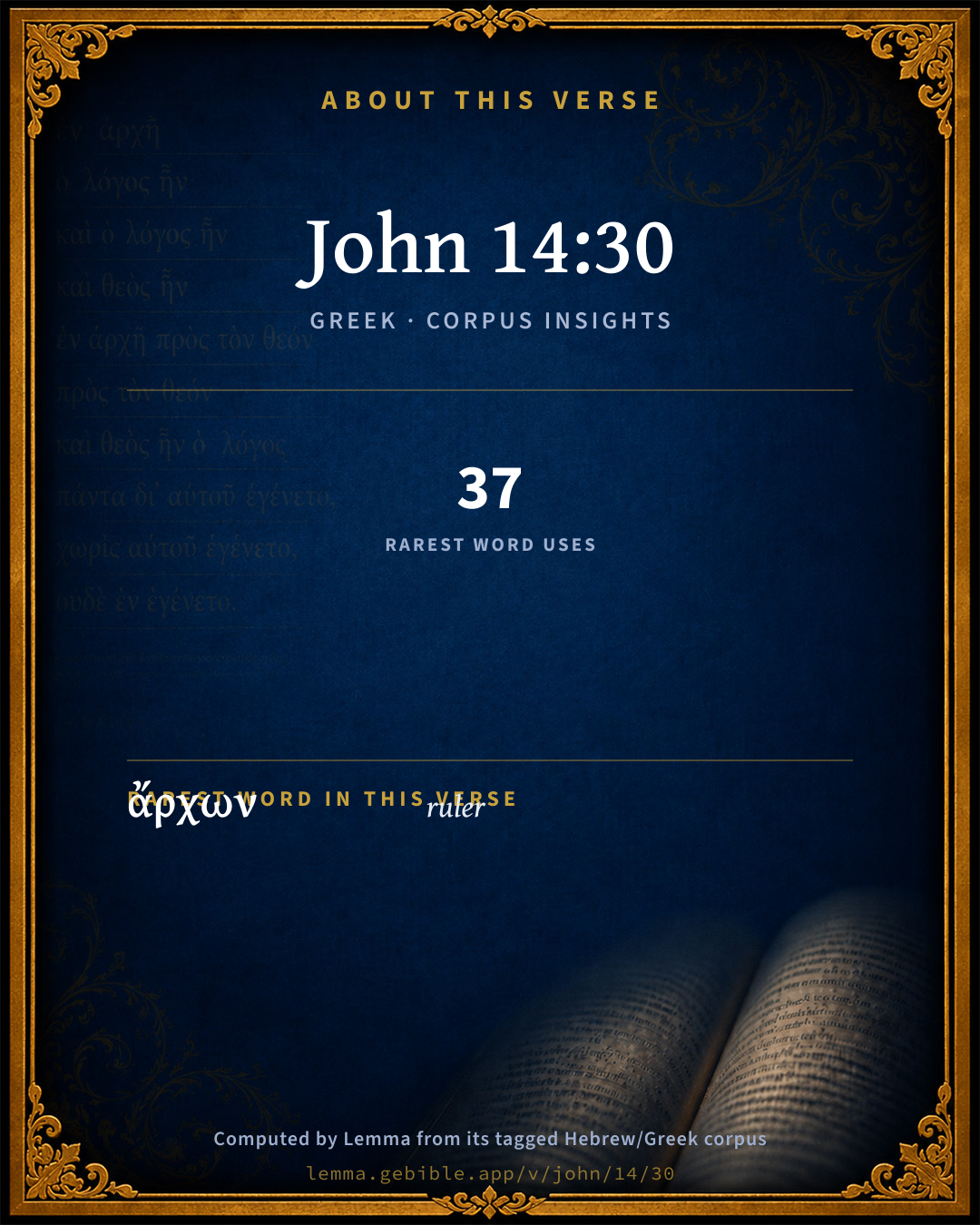
ἄρχων
árchōn
G758
“ruler”
Noun, Nominative, Singular, Masculine
Part of Speech
Noun
Case
Nominative
Number
Singular
Gender
Masculine
Full Thayer's Definition

Origin: present participle of G757

TDNT: 09:08,8

1. a ruler, commander, chief, leader
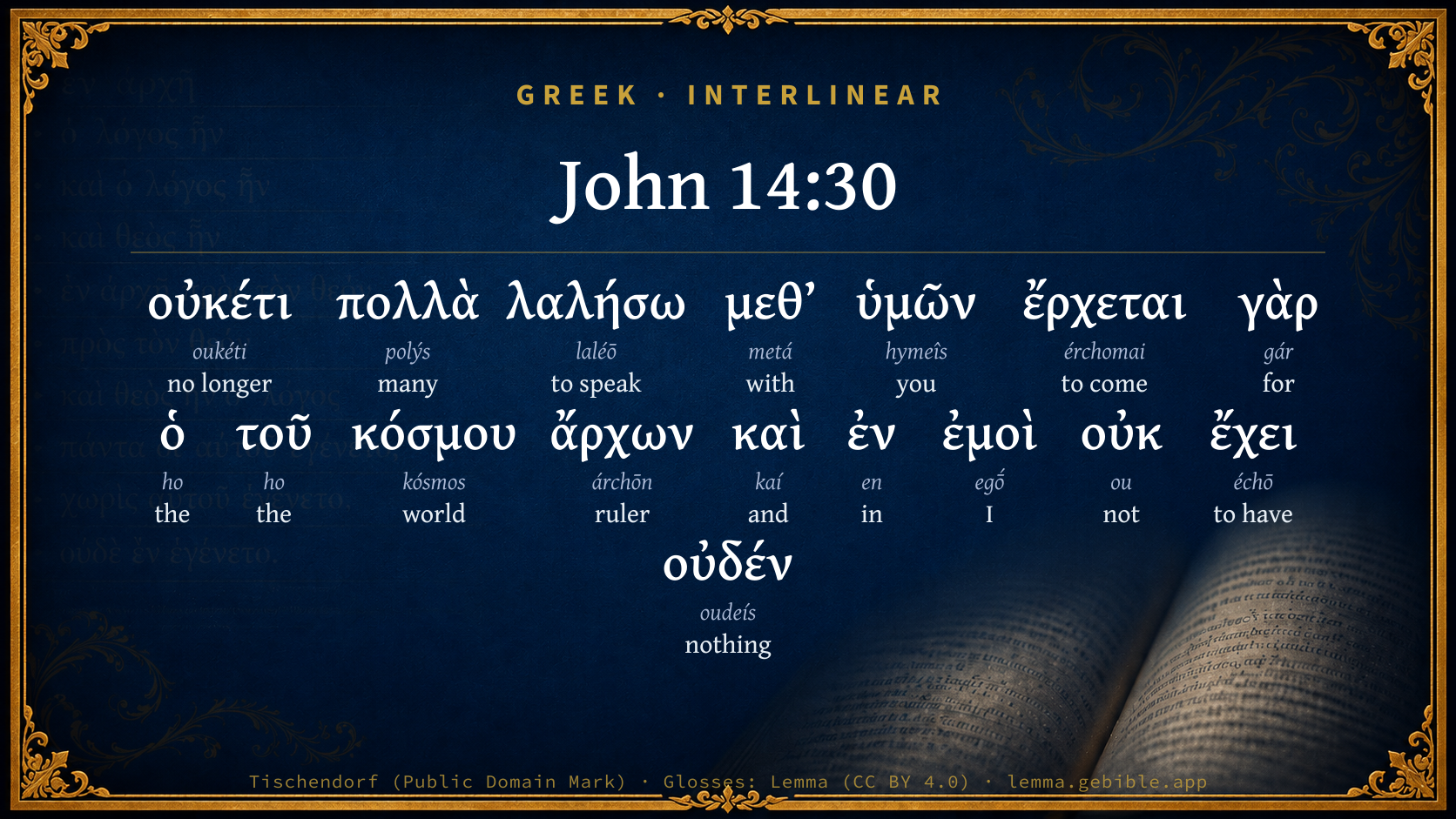
  1. οὐκέτι oukéti G3765 “no longer” Adverb, Negative
  2. πολλὰ polýs G4183 “many” Adjective, Accusative, Plural, Neuter
  3. λαλήσω laléō G2980 “to speak” Verb, Future, Active, Indicative, 1st person, Singular
  4. μεθ’ metá G3326 “with” Preposition
  5. ὑμῶν hymeîs G5210 “you” Personal pronoun, 2nd person, Genitive, Plural
  6. ἔρχεται érchomai G2064 “to come” Verb, Present, Middle or Passive deponent, Indicative, 3rd person, Singular
  7. γὰρ gár G1063 “for” Conjunction
  8. ὁ ho G3588 “the” Article, Nominative, Singular, Masculine
  9. τοῦ ho G3588 “the” Article, Genitive, Singular, Masculine
  10. κόσμου kósmos G2889 “world” Noun, Genitive, Singular, Masculine
  11. καὶ kaí G2532 “and” Conjunction
  12. ἐν en G1722 “in” Preposition
  13. ἐμοὶ egṓ G1473 “I” Personal pronoun, 1st person, Dative, Singular
  14. οὐκ ou G3756 “not” Particle, Negative
  15. ἔχει échō G2192 “to have” Verb, Present, Active, Indicative, 3rd person, Singular
  16. οὐδέν oudeís G3762 “nothing” Adjective, Accusative, Singular, Neuter, Negative

About this verse

These counts appear in no published source. They are computed here, from the morphology-tagged text and Lemma’s own curated glosses. What Lemma adds →

17
words
16
distinct lemmas
Gospels
section

Shared distinctive vocabulary

ἄρχων ruler G758 occurs in 36 verses of the Greek New Testament. Also found in:

Repetition

A word recurs within this verse:

Cross-references

21

Topical passages linked to John 14:30 in the Treasury of Scripture Knowledge — connected by theme and wording, ordered by reader-vote popularity; previews shown in the World English Bible.

  • 1 John 5:19 We know that we are of God, and the whole world lies in the power of the evil one.
  • 1 John 4:4 You are of God, little children, and have overcome them; because greater is he who is in you than he who is in the world.
  • John 12:31 Now is the judgment of this world. Now the prince of this world will be cast out.
  • Ephesians 6:12 For our wrestling is not against flesh and blood, but against the principalities, against the powers, against the world's rulers of the darkness of this age, and against the spiritual hosts of wickedness in the heavenly places.
  • Revelation 12:9 The great dragon was thrown down, the old serpent, he who is called the devil and Satan, the deceiver of the whole world. He was thrown down to the earth, and his angels were thrown down with him.
  • Ephesians 2:2 in which you once walked according to the course of this world, according to the prince of the powers of the air, the spirit who now works in the children of disobedience;
  • 2 Corinthians 4:4 in whom the god of this world has blinded the minds of the unbelieving, that the light of the Gospel of the glory of Christ, who is the image of God, should not dawn on them.
  • 1 Peter 2:22 who did not sin, "neither was deceit found in his mouth."
  • Hebrews 4:15 For we don't have a high priest who can't be touched with the feeling of our infirmities, but one who has been in all points tempted like we are, yet without sin.
  • 1 John 3:5–8 You know that he was revealed to take away our sins, and in him is no sin.
  • Luke 22:53 When I was with you in the temple daily, you didn't stretch out your hands against me. But this is your hour, and the power of darkness."
  • John 16:11–12 about judgment, because the prince of this world has been judged.
  • Revelation 20:2–3 He seized the dragon, the old serpent, which is the devil and Satan, who deceives the whole inhabited earth, and bound him for a thousand years,
  • Colossians 1:13 who delivered us out of the power of darkness, and translated us into the Kingdom of the Son of his love;
  • Hebrews 7:26 For such a high priest was fitting for us: holy, guiltless, undefiled, separated from sinners, and made higher than the heavens;
  • Revelation 20:7–8 And after the thousand years, Satan will be released from his prison,
  • 2 Corinthians 5:21 For him who knew no sin he made to be sin on our behalf; so that in him we might become the righteousness of God.
  • Luke 1:35 The angel answered her, "The Holy Spirit will come on you, and the power of the Most High will overshadow you. Therefore also the holy one who is born from you will be called the Son of God.
  • Luke 24:44–49 He said to them, "This is what I told you, while I was still with you, that all things which are written in the law of Moses, the prophets, and the psalms, concerning me must be fulfilled."
  • Acts 1:3 To these he also showed himself alive after he suffered, by many proofs, appearing to them over a period of forty days, and speaking about God's Kingdom.
  • 1 Peter 1:19 but with precious blood, as of a lamb without spot, the blood of Christ;

Cross-references courtesy of OpenBible.info (CC BY 4.0).

Commentary

Notes on John 14:30 from classic Christian and Jewish commentators (each source and its license shown beneath its notes). The classic Christian expositions comment on the surrounding passage and are grouped to its opening verse, so a note may address several verses; the Jewish commentaries on the Tanakh (Rashi and others) are per-verse, so they appear only where the commentator wrote on this verse.

Lemma curates 59 commentaries, every one of them public domain or Creative Commons licensed, each selected and text-cleaned for this edition rather than reprinted as found. About our sources →

The Biblical Illustrator

Joseph S. Exell

Joh_14:30

Henceforth I will not talk much with you

Christ as a conversationalist

I.

CHRISTS GREATEST WORK WAS DONE BY CONVERSATION.

1. In the four Gospels there are but five discourses properly so called--that in the synagogue at Nazareth, that upon the Mount, that on the Bread of Life in the synagogue at Capernaum, that on the seashore, when He practically traced the future of His kingdom, and that at Jerusalem respecting His second coming. All the rest is conversation, sometimes drifting into monologue. It is significant that the two greatest teachers--Christ and Socrates--taught chiefly in this way.

2. Here is an open door for you all! You cannot write books or preach; but there is no better way into a human heart than by conversation. I write my article and send it to the newspaper. I know not who looks upon it. I stand here and talk, and look into your faces. Some of them answer me back. This is better work than that of the pen. But the best of all is conversation when you open your soul to me, and I open mine to you. In this lies the largest part of our influence. What might we not do with it!

II. Notice, as a characteristic of every good conversationalist, and preeminently of Christ, His QUICK AND CATHOLIC SYMPATHIES.

1. We open this Gospel and find Him talking on the same plane with a Jewish rabbi. We turn the page and behold Him condescending to the level of the depraved Samaritan. Further on we see Him in conversation with His enemies; and, lastly, here with His disciples--in every case alike in sympathy, in touch--what we call tact. What is tact? The touch of one soul with another. I can talk music a little with the musician, for I am fond of music; less of art with the artist, for I know less; about theology with the theologian if he is not too far removed from me theologically; but if I cannot talk with the car conductor, the day labourer, it is because my sympathies are narrow.

2. Christs sympathies were as quick as they were catholic. His soul was receptive as well as distributive. The musician plays on the keys of the organ. They are inert, and answer to his touch. But when the speaker plays on a human soul, he must be keys as well as fingers--he must respond as well as move. There is no flash of thought, question of perplexity, or sorrow anywhere that Christ does not instantly meet.

III. Because He had this quick and catholic sympathy HE DREW MEN OUT. He made them express themselves; oftentimes against their will--evoked their doubts, sins, difficulties. Witness His treatment of Philip, Thomas, and Jude in this conversation. This is rare power: worth more than eloquence or poetry. He knew what was in man; and more than once He saw them doubting among themselves, and phrased His answer to their doubting.

IV. HE HAD THE GIFT OF TURNING EVERYTHING TO ACCOUNT. He asks for a drink of water, and this suggests the water of life; He fed a multitude with bread, and then talked naturally about the bread of life. A friend of mine, on entering a train, asked the brakeman, When shall we get to Albany? I do not know, surlily replied the man, there is nothing certain on a train. Nothing but death, said my friend. Well, that is so. Yes, and therefore we ought to be ready for it. That is a fact, said the brakeman. If my friend had gone out of his way to preach he would not have got an answer.

V. CONVERSATION WITH CHRIST WAS ALWAYS THE INSTRUMENT OF DIVINE MINISTRY. Christ never declined an invitation; but wherever He went, He carried His message of love and goodness, and turned the least incidents into moral lessons, He was always master of the conversation. He was not carried by its drift, wherever it might go, but, like a skilful pilot with his hand on the helm, guided it in what direction He would have it go. (Lyman Abbott, D. D.)

We must prize our opportunities

Make we the best of our Christian friends while we have them: as we would do of a borrowed book or tool that we knew not how soon may be sent for by the right owner. (J. Trapp.)

Interruption

Christ thus closed the conversation to intimate to His disciples

I. THE VALUE OF WHAT HE HAD SPOON IN THE PAST.

1. As their rule of life. If ye love Me, keep My commandments.

2. As teaching them to draw instruction from every source.

3. As being the means of life.

II. THE NEED OF CONCENTRATION IN AN APPROACHING CONFLICT. a time of peace was followed by a time of trial. Christ was ready for it, and concentrated every faculty for a final struggle with the devil, who was worsted by Him in the wilderness, and left Him then for a season.

II. THAT THE CONSCIOUSNESS OF FREEDOM FROM THE CONDEMNATION OF SIN GIVES THE GREATEST POWER TO WITHSTAND THE ASSAULTS OF SATAN. There was no ledge in Christ on which the devil could stand, nothing at which he could clutch. Our weaknesses Satan knows too well. He has something in us. But we may rejoice in freedom from condemnation. Doubt as to this is what Satan loves to take hold of; and it is frequently a sincere Christians weakest point

IV. THAT HE HAS RESOLVED TO MAINTAIN PURITY. Shall have. Christ had no doubt about the issue: nor need there be any in those whom Christ upholds. Resist the devil and he will flee from you. Against the Church the gates of hell shall not prevail.

V. THAT THE DISCIPLES MIGHT LEARN MORE FROM SEEING THAN HEARING. It is not what a man says, but what he does, that influences others. Christ has said: Whosoever taketh not up his cross, etc. Did He shrink from taking it up Himself? Christ ceases to talk, and allows His life to speak.

VI. CHRISTS SORROW THAT HIS INTERCOURSE WITH HIS DISCIPLES HAD TO BE INTERRUPTED. All are subject to all sorts of interruptions here. We must be prepared for breaks in life, gaps in the family, vacant chairs. Still we may, with Christ, take up the joyful life. Death possesses nothing permanent in us. (Homiletic Magazine.)

The prince of this world cometh and hath nothing in Me

The coming struggle

I. THE ENEMY--the prince of this world.

1. Of large dominions (Mat_4:8).

2. Of many subjects (Eph_2:2).

3. Of great power (Eph_2:2; Eph_6:12).

4. Of subtle craft (Gen_3:1; Rev_12:9).

5. Of evil mind (1Jn_2:13; 1Jn_3:8; 1Jn_8:44; Rev_12:10).

II. THE ONSET. The prince of this world cometh.

1. Its proximity. Judas was at hand, and in him Satan was drawing near.

2. Its violence. Quite an army had the devil put in force against the Saviour.

3. Its aim. It was directed against heavens purpose of redemption. It was meant by destroying Christ to confound the counsel of salvation.

4. Its skill. The campaign had on Satans side been planned with ingenuity. Judas, an apostle, had been persuaded to become a traitor. The ecclesiastical authorities had been turned against Gods Son. The Roman power had been secured to lend assistance in affecting His arrest. All signs augured well for the success of his infernal scheme.

III. THE DEFEAT. The prince of this world hath nothing in Me.

1. The seeming victory. Outwardly, Satan was to triumph. Yet it was not to be because of any power which Satan possessed; but to be of Christs free will (Joh_10:18).

2. The actual overthrow (Heb_2:14; Col_2:15).

Learn

1. That Christ is wiser than Satan.

2. That as He conquered so shall His people. (T. Whitelaw, D. D.)

The Biblical Illustrator, edited by Joseph S. Exell (c. 1880s–1900s) — public domain. Text from a community e-Sword module.

MacLaren's Expositions of Holy Scripture

Alexander MacLaren

John

CHRIST FORESEEING HIS PASSION

Joh 14:30 - Joh 14:31.

The summons to departure which closes these verses shows that we have now reached the end of that sacred hour in the upper room. In obedience to the summons, we have to fancy the little group leaving its safe shelter, as sailors might put out from behind a breakwater into a stormy sea. They pass from its seclusion and peace into the joyous stir of the crowded streets, filled with feast-keeping multitudes, on whom the full paschal moon looked down, pure and calming. Somewhere between the upper chamber and the crossing of the brook Kedron, the divine words of the following chapters were spoken, but this discourse, closely connected as it is with them, reaches its fitting close in these penetrating, solemn words of outlook into the near future, so calm, so weighty, so resolute, so almost triumphant, with which Christ seeks finally to impart to His timorous friends some of His own peace and assurance of victory.

They lead us into a region seldom opened to our view, and never to be looked upon but with reverent awe. For they tell us what Christ thought about His sufferings, and how He felt as He went down to that cold, black river, in which He was to be baptized. ‘Put off thy shoes from off thy feet, for the place where thou standest is holy ground.’ So, reverently listening to the words, sacred because of the Speaker, the theme, and the circumstances, we note in them these things: His calm anticipation of the assailant, His unveiling of the secret and motive of His apparent defeat, and His resolute advance to the conflict. Let us look at these three points.

I. First, we have here our Lord’s calm anticipation of the assailant.

‘Hereafter I will not talk much with you: for the Prince of this world cometh, and hath nothing in Me.’ One of the other Gospels tells us, in finishing its account of our Lord’s temptation in the wilderness, that when Satan had ended all these temptations ‘he departed from Him for a season.’ And now we have the second and the intenser form of that assault. The first was addressed to desires, and sought to stimulate ambition and ostentation and the animal appetites, and so, through the cravings of human nature, to shake the Master’s fixed faith. The second used sharper and more fatal weapons, and appealed, not to desire of enjoyment, or ease, or good, but to the natural human shrinking from pain and suffering and shame and death. He that was impervious on the side of natural necessities and more subtle spiritual desires might yet be reached through terror. And so the second form of the assault, instead of tempting the traveller by the sunshine to cast aside his cloak, tempted him by storm and tempest to fling it aside; and the one, as the other, was doomed to failure.

Note how the Master, with that clear eye which saw to the depths as well as the heights, and before which men and things were but, as it were, transparent media through which unseen spiritual powers wrought, just as He discerns the Father’s will as supreme and sovereign, sees here-beneath Judas’s treachery, and Pharisees’ and priests’ envy, and the people’s stolid indifference, and the Roman soldiers’ impartial scorn-the workings of a personal source and centre of all. The ‘Prince of this world,’ who rules men and things when they are severed from God, ‘cometh.’ Christ’s sensitive nature apprehends the approach of the evil thing, as some organisations can tell when a thunderstorm is about to burst. His divine Omniscience, working as it did, even within the limits of humanity, knows not only when the storm is about to burst upon Him, but knows who it is that has raised the tempest. And so He says, ‘The Prince of this world cometh.’

But note, as yet more important, that tremendous and unique consciousness of absolute invulnerability against the assaults. ‘He hath nothing in Me.’ He is ‘the Prince of the world,’ but His dominion stops outside My breast. He has no rule or authority there. His writs do not run, nor is His dominion recognised, within that sacred realm.

Was there ever a man who could say that? Are there any of us, the purest and the noblest, who, standing single-handed in front of the antagonistic power of evil, and believing it to be consolidated and consecrated in a person, dare to profess that there is not a thing in us on which he can lay his black claw and say-’That is mine?’ Is there nothing inflammable within us which the ‘fiery darts of the wicked’ can kindle? Are there any of us who bar our doors so tightly as that we can say that none of his seductions will find their way therein, and that nothing there will respond to them? Christ sets Himself here against the whole embattled and embodied power of evil, and puts Himself in contrast to the universal human experience, when He calmly declares ‘He hath nothing in Me.’ It is an assertion of His absolute freedom from sinfulness, and it involves, as I take it, the other assertion-that as He is free from sin, so He is not subject to that consequence of sin, which is death, as we know it. Another part of Scripture speaks to us in strange language, which yet has in it a deep truth, of ‘him that had the power of death, that is, the devil.’ Men fall under the rightful dominion of the king of evil when they sin, and part of the proof of his dominion is the fact of physical death, with its present accompaniments. Thus, in His calm anticipation, Jesus stands waiting for the enemy’s charge, knowing that all its forces will be broken against the serried ranks of His immaculate purity, and that He will come from the dreadful close unwounded all, and triumphant for evermore.

But do not let us suppose that because Christ, in His anticipation of suffering and death, knew Himself invulnerable, with not even a spot on His heel into which the arrow could go, therefore the conflict was an unreal or shadowy one. It was a true fight, and it was a real struggle that He was anticipating, thus calmly in these solemn words, as knowing Himself the Victor ere He entered on the dreadful field.

II. So note, secondly, in these words, our Lord’s unveiling of the motive and aim of His apparent defeat.

‘But that the world might know that I love the Father, and, as the Father gave Me commandment, even so I do.’ There may be some uncertainty about the exact grammatical relation of these clauses to one another, with which I need not trouble you, because it does not affect their substantial meaning. However we solve the mere grammatical questions, the fundamental significance of the whole remains unaffected, and it is this: that Christ’s sufferings and death were, in one aspect, for the purpose that the world might know His love to the Father, and, in another aspect, were obedience to the Father’s commandment. And if we consider these two aspects, I think we shall get some thoughts worth considering as to the way in which the Master Himself looks upon these sufferings and that death.

The first point I note in this division of my discourse is that Christ would have us regard His sufferings and His death as His own act. Note that remarkable phrase, ‘thus I do.’ A strange word to be used in such a connection, but full of profound meaning. We speak, and rightly, of the solemn events of these coming days as the passion of our Lord, but they were His action quite as much as His passion. He was no mere passive sufferer. In them all He acted, or, as He says here, we may look upon them all, not as things inflicted upon Him from without by any power, however it might seem to have the absolute control of His fate, but as things which He did Himself.

There is one Man who died, not of physical necessity, but because of free choice. There is one Man who chose to be born, and who chose to die; who, in His choosing to be born, chose humiliation, and who, in choosing to die, chose yet deeper humiliation. This sacrifice was a voluntary sacrifice, or, to speak more accurately, He was both Priest and Sacrifice, when ‘through the Eternal Spirit He offered Himself without spot unto God.’ The living Christ is the Lord of Life, and lives because He will; the dying Christ is the Lord of Death, and dies because He chose. He would have us learn that all His bitter sufferings, inflicted from without as they were, and traceable to a deeper source than merely human antagonism, were also self-inflicted and self-chosen, and further traceable to the Father’s will in harmony with His own. ‘Thus I do,’ and thus He did when He died.

Then, further, our Lord would have us regard these sufferings and that death as being His crowning act of obedience to His Father’s will. That is in accordance with the whole tone of His self-consciousness, especially as set before us in this precious Gospel of John, which traces up everything to the submission of the divine Son to the divine Father, a submission which is no mere external act, but results from, and is the expression of, the absolute unity of will and the perfect oneness of mutual love. And so, because He loved the Father, therefore He came to do the Father’s will, and the crowning act of His obedience was this, that He was ‘obedient unto death, even the death of the Cross.’ It was a voluntary sacrifice, but that voluntariness was not self-will. It was a sacrifice in obedience to the Father’s will, but that obedience was not reluctant. Christ was the embodiment of the divine purpose, formed before the ages and realised in time, when He bowed His head and yielded up the ghost. The highest proof of His filial obedience was the Cross. And to it He points us, if we would know what it is to love and obey the Father.

Now it is to be noticed that this motive of our Lord’s death is not the usual one given in Scripture. And I can suppose the question being put, ‘Why did not Jesus Christ say, in that supreme moment, that He went to the Cross because of His love to us rather than because of His love to the Father?’ But I think the answer is not far to seek. There are several satisfactory ones which may be given. One is that this making prominent of His love to God rather than to us, as the motive for His death, is in accordance with that comparative reticence on the part of Jesus as to the atoning aspect of His death, which I have had frequent occasion to point out, and which does not carry in it the implication that that doctrine was a new thing in the Christian preaching after Pentecost. Another reason may be drawn from the whole strain and tone of this chapter, which, as I have already said, traces up everything to the loving relations of obedience between the Father and Son. And yet another reason may be given in that the very statement of Christ’s love to God, and loving obedience to the Father’s commandment as the motive of His death, includes in it necessarily the other thing-love to us. For what was the Father’s commandment which Christ with all His heart accepted, and with His glad will obeyed unto death? It was that the Son should come as the Ransom for the world. The Son of man was sent, ‘not to be ministered unto, but to minister, and to give His life a Ransom for many.’ Or, as He Himself said, in one of His earliest discourses, ‘God so loved the world that He gave His only begotten Son, that whosoever believeth in Him should not perish.’ And for what He gave that Son is clearly stated in the context itself of that passage-’As Moses lifted up the serpent in the wilderness, even so must the Son of Man be lifted up.’

To speak of Christ’s acceptance of the Father’s commandment, then, is but another way of saying that Christ, in all the fullness of His self-surrender, entered into and took as His own the great, eternal divine purpose, that the world should be redeemed by His death upon the Cross. The heavenward side of His love to man is His love to the Father, God.

Now there is another aspect still in which our Lord would here have us regard His sufferings and death, and that is that they are of worldwide significance.

Think for a moment of the obscurity of the speaker, a Jewish peasant in an upper room, with a handful of poor men around Him, all of them ready to forsake Him, within a few hours of His ignominious death; and yet He says, ‘I am about to die, that the echo of it may reverberate through the whole world.’ He puts Himself forth as of worldwide significance, and His death as adapted to move mankind, and as one day to be known all over the world. There is nothing in history to approach to the gigantic arrogance of Jesus Christ, and it is only explicable on the ground of His divinity.

‘This I do that the world may know.’ And what did it matter to the world? Why should it be of any importance that the world should know? For one plain reason, because true knowledge of the true nature and motive of that death breaks the dominion of the Prince of this world, and sets men free from his tyranny. Emancipation, hope, victory, purity, the passing from the tyranny of the darkness into the blessed kingdom of the light-all depend on the world’s knowing that Christ’s death was His own voluntary act of submission to the infinite love and will of the Father, which will and love He made His own, and therefore died, the sacrifice for the world’s sin.

The enemy was approaching. He was to be hoist with his own petard. ‘He digged a pit; he digged it deep,’ and into the pit which he had digged he himself fell. ‘Oh, death! I will be thy plague’ by entering into thy realm. ‘Oh, grave! I will be thy destruction’ by dwelling for a moment within thy dark portals and rending them irreparably as I pass from them. The Prince of this world was defeated when he seemed to triumph, and Christ’s mighty words came true: ‘Now shall the Prince of this world be cast out.’ He would have the world know-with the knowledge which is of the heart as well as the head, which is life as well as understanding, which is possession and appropriation-the mystery, the meaning, the motive of His death, because the world thereby ceases to be a world, and becomes the kingdom of Jesus Christ.

III. Lastly, notice here the resolute advance to the conflict.

‘Arise, let us go hence’-a word of swift alacrity. Evidently He rose to His feet whilst they lay round the table. He bids them rise with Him and follow Him on the path.

But there is more in the words than the mere close of a conversation, and a summons to change of place. They indicate a kind of divine impatience to be in the fight, and to have it over. The same emotion is plainly revealed in the whole of the latter days of our Lord’s life. You remember how His disciples followed amazed, as He strode up the road from Jericho, hastening to His Cross. You remember His deliberate purpose to draw upon Himself public notice during that dangerous and explosive week before the Passover, as shown in the publicity of His entry into Jerusalem, His sharp rebukes of the rulers in the Temple, and in every other incident of those days. You remember His words to the betrayer: ‘That thou doest, do quickly.’ These latter hours of the Lord were strongly marked by the emotion to which He gave utterance in His earlier words: ‘I have a baptism to be baptized with, and how am I straitened till it be accomplished!’ Perhaps that feeling indicated His human shrinking; for we all know how we sometimes are glad to precipitate an unwelcome thing, and how the more we dread it, the more we are anxious to get it over. But there is far more than that in it. There is the resolved determination to carry out the Father’s purpose for the world’s salvation, which was His own purpose, and was none the less His though He knew all the suffering which it involved.

Let us adore the steadfast will, which never faltered, though the natural human weakness was there too, and which, as impelled by some strong spring, kept persistently pressing towards the Cross that on it He might die, the world’s Redeemer.

And do not let us forget that He summoned His lovers and disciples to follow Him on the road. ‘Let us go hence.’ It is ours to take up our cross daily and follow the Master, to do with persistent resolve our duty, whether it be welcome or unwelcome, and to see to it that we plant no faltering and reluctant foot in our Master’s footsteps. For us, too, if we have learned to flee to the Cross for our redemption and salvation, the resolve of our Redeemer and the very passion of the Saviour itself become the pattern and law of our lives. We, too, have to cast ourselves into the fight, and to take up our cross, ‘that the world may know that we love the Father, and as the Father hath given us commandment.’ And if we so live, then our death, too, in some humble measure, may be like His-the crowning act of obedience to the Father’s will; in which we are neither passively nor resistingly dragged under by a force that we cannot effectually resist, but in which we go down willingly into the dark valley where death ‘makes our sacrifice complete.’

Alexander MacLaren, Expositions of Holy Scripture (1904–1910) — public domain. Text from a community e-Sword module.

Tyndale Open Study Notes

Tyndale Open Resources

14:30 The events unfolding in Jerusalem that led to the cross were not controlled by the ruler of this world, meaning Satan. The cross was not an accident, and Jesus was not a helpless victim. Rather, Jesus was obedient to God’s plan.

Tyndale Open Study Notes — © Tyndale Open Resources, licensed CC BY-SA 4.0. Text via the HelloAO Bible API.

Bengel's Gnomon

Johann Albrecht Bengel

Joh 14:30. Οὐκ ἔτι, no longer henceforth) For which reason ye ought the more diligently to hold fast these things which I speak.—ἔρχεται, cometh) is already now coming: having been “cast out,” ch. Joh 12:31, he rushes upon Me. So afterwards he assailed the women spoken of in Rev 12:9; Rev 12:13.—γὰρ, for) The enemy, as being already in the act of making his assault, either on account of the shortness of the time did not suffer Him to speak more, or he ought not to hear the Lord’s words; or, had more been said to the disciples, he might have snatched it from them.—κόσμου, of the world) Even then the prince of the world agitated (influenced) the world, when the world, in compliance with its prince, crucified Christ.—καὶ, and) and cannot prevent Me from going from the world straightway to the Father.—ἐν ἐμοὶ, in Me) although Jesus was now approaching death, of which the devil in other respects had the power.—οὐδὲν, nothing) no share of claim (right) or power over Me. The righteousness of Christ was perfect: a becoming protestation. Here Jesus gets rid of (removes out of the way) the prince of the world; in the second and closing part of this discourse, He gets rid of the world; ch. Joh 16:33, “In the world ye shall have tribulation; but be of good cheer, I have overcome the world.”

Bengel's Gnomon of the New Testament — English translation (T&T Clark, Edinburgh, 1860) — public domain. Text from a community e-Sword module.

Meyer's Critical & Exegetical Commentary

Heinrich August Wilhelm Meyer

Joh_14:30. Οὐκέτι πολλὰ, κ.τ.λ.] Quasi dicat: temporis angustiae abripiunt verba, Grotius.

For the prince of the world (see on Joh_12:31) is coming (is already drawing near). Jesus sees the devil himself in the organs and executors of his design (Joh_13:2; Joh_13:27, Joh_6:70; Luk_4:13).

τοῦ κόσμου] is here emphatically placed first in antithesis to ἐν ἐμοί.

καὶ ἐν ἐμοὶ οὐκ ἔχει οὐδέν] and in me (antithesis of the κόσμος, Joh_17:16) he possesses nothing, namely, as pertaining to his dominion, which more minute definition flows from the conception of the ἄρχων; hence neither ποιεῖν (Kuinoel), nor μέρος (Nonnus), nor of which he could accuse me before God (Ewald), is to be supplied; nor again is the simple sense of the words to be transformed into he has no claim on me (Tholuck, Hofmann, and several others); comp. Luther: cause and right. In any case, Christ expresses the full moral freedom with which He subjects Himself to death (Joh_10:18). The sinlessness, which Cyril., Augustine (in me non habet quicquam, nullum omnino scilicet peccatum), Euth. Zigabenus, Cornelius a Lapide, and many others, including Olshausen, here find expressed, certainly lies at the foundation as a necessary causal presupposition, since only provided that Jesus were sinless, could the devil have in Him nothing that was his, but is not directly expressed. That He has already overcome the world (Joh_16:33) is not the reason (Lücke), but the consequence of His freedom from the prince of the world.

The καί is not: but (Ebrard, Godet); for the antithesis first follows with ἀλλά. Therefore: he comes, and is powerless over me (wherefore I needed not to surrender myself to him), but, nevertheless, that, etc, Joh_14:31.

Meyer — Critical and Exegetical Commentary on the New Testament — English translation by Peter Christie, edited by Frederick Crombie (T&T Clark, 1880) — public domain. Text from a community e-Sword module.

Expositor's Greek Testament

ed. W. Robertson Nicoll

Joh 14:30 . οὐκ ἔτι … ὑμῶν . “I will no longer speak much with you”; “temporis angustiae abripiunt verba,” Grotius. ἔρχεται … οὐδέν . “The ruler of this world” is Satan, see Joh 12:31 . He “comes” in the treachery of Judas (Joh 13:27 ) and all that followed. But this coming was without avail, because ἐν ἐμοὶ οὐκ ἔχει οὐδέν , “in me he hath nothing,” nothing he can call his own, nothing he can claim as his, and which he can use for his purposes. He is ruler of the world, but in Christ has no possessions or rule. A notable assertion of sinlessness.

The Expositor's Greek Testament, edited by W. Robertson Nicoll (1897–1910) — public domain. Text from a community e-Sword module.

Geneva Bible (1599)

Geneva Bible translators

Christ goeth to death not unwillingly, but willingly, not as yielding to the devil, but obeying his Father’s decree.

As who would say, Satan will by and by set upon me with all the might he can, but he hath no power over me, neither shall he find any such thing in me as he thinketh he shall.

Geneva Bible (1599) marginal notes — public domain. Text via Bolls.life.

Jamieson, Fausset & Brown

Robert Jamieson, A. R. Fausset & David Brown

Hereafter I will not talk much with you--"I have a little more to say, but My work hastens apace, and the approach of the adversary will cut it short."

for the prince of this world--(See on Joh 12:31).

cometh--with hostile intent, for a last grand attack, having failed in His first formidable assault (Luk 4:1-13) from which he "departed [only] for a season" (Joh 14:13).

and hath nothing in me--nothing of His own--nothing to fasten on. Glorious saying! The truth of it is, that which makes the Person and Work of Christ the life of the world (Heb 9:14; Jo1 3:5; Co2 5:21).

Jamieson, Fausset & Brown — Commentary Critical and Explanatory on the Whole Bible (1871) — public domain (CC PDM 1.0). Text via the HelloAO Bible API.

Adam Clarke's Commentary

Verse 30. The prince of this world] τουτου, of this, is omitted by ABDEGHKLMS, Mt. BH, one hundred others; both the Syriac, later Persic, all the Arabic, and several of the primitive fathers. I rather think the omission of the pronoun makes the sense more general; for, had he said THIS world, the words might have been restrained to the Jewish state, or to the Roman government. But who is the person called here the prince of the world?

1. Mr. Wakefield thinks that Christ speaks here of himself, as he does in Joh 12:31, (see the note there,) and translates this verse and the following thus: For the ruler of this world is coming; and I have nothing now to do, but to convince the world that I love the Father, and do as he commanded me. On which he observes that our Lord speaks of what he shall be, when he comes again, and not of what he then was: compare Joh 14:18; Joh 16:16; Joh 17:2; Mt 28:18; Php 2:9. And how often does he speak of himself, as the Son of man, in the third person! See his vindication of this translation in the third vol. of his New Testament.

2. Others think that our Lord refers to the Roman government, the ruler of the world, who, by its deputy, Pilate, was going to judge him, but who should find nothing (ευρησει ουδεν, which is the reading found in some excellent MSS. and versions, and is followed by almost all the primitive fathers,) as a just cause of death in him-nothing in the whole of his conduct which was in the least reprehensible; and this indeed Pilate witnessed in the most solemn manner. See Joh 18:38; Joh 19:4; Joh 19:12; see also Lu 23:4, c., and Mt 27:24.

3. But the most general opinion is that Satan is meant, who is called the prince of the power of the air, Eph 2:2 and who is supposed to be the same that is called the god of this world, 2Co 4:4; and who at his last and most desperate trial, the agony in the garden, should be convinced that there was nothing of his nature in Christ, nothing that would coincide with his solicitations, and that he should find himself completely foiled in all his attacks, and plainly foresee the impending ruin of his kingdom. It is very difficult to ascertain the real meaning here: of the different opinions proposed above, the reader must take that which he deems the most likely.

Adam Clarke's Commentary on the Bible (1810–1826) — public domain. Text from a community e-Sword/MySword module.

John Calvin's Commentaries

30. Henceforth I will not talk much with you. By this word he intended to fix the attention of the disciples on himself, and to impress his doctrine more deeply on their minds; for abundance generally takes away the appetite, and we desire more eagerly what we have not in our possession, and delight more in the enjoyment of that which is speedily to be taken from us. In order, therefore, to make them more desirous of hearing his doctrines, he threatens that he will very soon go away. Although Christ does not cease to teach us during the whole course of our life, yet this statement may be applied to our use; for, since the course of our life is short, we ought to embrace the present opportunity.

For the prince of this world cometh He might have said, in direct language, that he would soon die, and that the hour of his death was at hand; but he makes use of a circumlocution, to fortify their minds beforehand, lest, terrified by a kind of death so hideous and detestable, they should faint; for to believe in him crucified, what is it but to seek life in hell? First, he says that his power will be given to Satan; and next he adds, That he will go away, not because he is compelled to do so, but in order to obey the Father.

The devil is called the prince of this world, not because he has a kingdom separated from God, (as the Manicheans imagined,) but because, by God’s permission, he exercises his tyranny over the world. Whenever, therefore, we hear this designation applied to the devil, let us be ashamed of our miserable condition; for, whatever may be the pride of men, they are the slaves of the devil, till they are regenerated by the Spirit of Christ; for under the term world is here included the whole human race. There is but one Deliverer who frees and rescues us from this dreadful slavery. Now, since this punishment was inflicted on account of the sin of the first man, and since it daily grows worse on account of new sins, let us learn to hate both ourselves and our sins. While we are held captives under the dominion of Satan, still this slavery does not free us from blame, for it is voluntary. It ought also to be observed, that what is done by wicked men is here ascribed to the devil; for, since they are impelled by Satan, all that they do is justly reckoned his work.

And hath nothing in me. It is in consequence of the sin of Adam that Satan holds the dominion of death, and, therefore, he could not touch Christ, who is pure from all the pollution of sin, if he had not voluntarily subjected himself. And yet I think that these words have a wider meaning than that in which they are usually explained; for the ordinary interpretation is, “Satan hath found nothing in Christ, for there is nothing in him that deserves death, because he is pure from every stain of sin.” But, in my opinion, Christ asserts here not only his own purity, but likewise his Divine power, which was not subject to death; for it was proper to assure the disciples that he did not yield through weakness, lest they should think less highly of his power. But in this general statement the former is also included, that, in enduring death, he was not compelled by Satan. Hence we infer, that he was substituted in our room, when he submitted to death.

John Calvin's Commentaries (1540-1563) — public domain. Text from the Calvin Translation Society English edition (1840s-50s) via the Christian Classics Ethereal Library (ccel.org). Calvin's coverage is partial (roughly two-thirds of the Bible); uncommented books and verses are honest gaps, never fabricated. The 19th-century editor's footnotes and remarks are omitted so the notes are faithfully Calvin's own voice.

Ellicott's Commentary for English Readers

(30) Hereafter I will not talk much with you.—Better, I will no more, or, I will not continue to talk much with you. The discourse is broken by the thought that the hour of the conflict is at hand, and that He must go forth to meet it.

For the prince of this world cometh.—Better, is coming. The approach is thought of as then taking place. For the phrase, “prince of this world,” comp. Note on Joh_12:31. The prince of evil is here regarded as working in and by Judas, who is carrying out his plans and doing his work. (Comp. Notes on Joh_6:70; Joh_13:2; Joh_13:27.)

And hath nothing in me.—The words are to be taken in their full and absolute meaning, and they assert that the prince of this world possesses nothing in the person of Christ. In Him he has never for a moment ruled. For this appeal to perfect sinlessness, comp. Note on Joh_8:29. It follows from this that His surrender of Himself is entirely voluntary. (Comp. Note on Joh_10:18.)

A Bible Commentary for English Readers, edited by Charles John Ellicott (1878–1897) — public domain. Text from a community e-Sword module.

The Cambridge Bible for Schools and Colleges

gen. ed. J. J. S. Perowne

30. Hereafter I will not talk much] Literally, No longer shall I speak many things: comp. Joh_15:15.

the prince of this world cometh] Better, the ruler of the world is coming. The powers of darkness are at work in Judas and his employers. See on Joh_12:31.

and hath nothing in me] Quite literal: there is nothing in Jesus over which Satan has control. ‘Let no one think that My yielding to his attack implies that he has power over Me. The yielding is voluntary in loving obedience to the Father.’ This declaration, in me he hath nothing, could only be true if Jesus were sinless. On the import of this confident appeal to His own sinlessness see notes on Joh_8:29; Joh_8:46 and Joh_15:10.

The Cambridge Bible for Schools and Colleges (gen. ed. J. J. S. Perowne; Cambridge University Press, 1878–1918) — public domain. Text from a community e-Sword module.

John Gill's Exposition

Hereafter I will not talk much with you,.... Meaning before his death; for after his resurrection he talked much with them, about the things pertaining to the kingdom of God; being seen of them and conversing with them, for the space of forty days; not much, he says, chiefly what is delivered in the two next chapters: the design of this was, to observe to them that his time of departure was near at hand, and to quicken their attention to what he did say to them; since they could not expect to hear him long, or much more from him; he would be otherwise engaged;

for the prince of this world cometh: by "the prince of this world", is meant the devil; why he is so called; see Gill on Joh 12:31; the reason why Christ chooses to use this circumlocution, rather than to say Satan or the devil cometh, is partly to point out what a powerful adversary he had, and was about to engage with, and partly to observe to his disciples, what they must expect from the world, even hatred and persecution; since Satan was the prince of it, and had such powerful influence over the minds of the men of it. When it is said that he cometh, it is to be understood of his coming to Christ, though it is not expressed, and that with an intent agreeably to his character, as a thief, to kill and to destroy; and not of his coming merely by Judas, into whom he had already entered, and had put it into his heart to betray him; and by the armed soldiers, who would accompany him to apprehend him; and by the chief priests, rulers, and people of the Jews, who with united voices would cry, Crucify him, Crucify him; nor only invisibly by his angels, his principalities and powers, he was now employing in different ways, to bring about his purposes; but of his coming himself personally, and visibly: as he visibly appeared to Christ in the wilderness, tempting him, where he left him for a season; so this season or opportunity being come, he takes it, and visibly appears to him in the garden, where a sharp agony and combat was between them; what success he had in this conflict, is next mentioned;

and hath nothing in me; or as some copies read it, "shall find nothing in me"; or as others, "hath nothing to find in me"; Christ had no sin in him, which can be said of none but him. The Jews say (e), that Samuel, by whom they mean the devil, when he wrestled with Jacob, , "could not find any iniquity in him", he had committed; but this is only true of Jacob's antitype: for though his emissaries sought diligently for it, they could find none in him; though he had sin upon him, he had none in him; the sins of his people were imputed to him, but he had no sin inherent in him; hence, though he the Messiah was "cut off", according to Dan 9:26, "but not for himself"; which by the Septuagint is rendered , "but there is no judgment" or "condemnation in him", i.e. no cause of condemnation; which agrees with what is here said: though the accuser of men sought to have something against him, to accuse him of, he could find none; some pretences indeed were made, and charges brought, but could not be made good, insomuch that the judge himself said, "I find in him no fault at all", Joh 18:38, so that the devil had no power over him, no rightful power, nor any but what he had by permission, nor indeed did he prevail over him; for though according to the first prophecy of the Messiah, Satan bruised the heel of Christ; yet Christ bruised his head, destroyed him and his works, spoiled him, and his principalities and powers; whence it appears that the death of Christ was not owing to any sin of his own, for he had none, nor could any be found in him; nor to the superior power of the devil over him; he submitted to death, not through the power of Satan over him, and complied with all the circumstances leading to it, not out of fear of him, but in love to his Father, and obedience to his command; as is clear from the following verse.

(e) Tzeror Hammor, fol. 44. 2.

John Gill's Exposition of the Whole Bible (1746–1763) — public domain (CC PDM 1.0). Text via the HelloAO Bible API.

Trapp's Complete Commentary

John Trapp

30 Hereafter I will not talk much with you: for the prince of this world cometh, and hath nothing in me.

Ver. 30. Hereafter I will not, &c.] Make we the best of our Christian friends while we have them; as we would do of a borrowed book or tool, that we know not how soon they may be sent for by the right owner.

The prince of this world cometh] In his limbs and instruments, those breathing devils that put Christ to death. Persecutors are set to work by Satan; "the devil shall cast some of you into prison," Rev 2:10. Why? Is he become a justice of peace, to send men to prison? Yes, by his agents. But why would Christ be so used by him and his? Hear the next words.

John Trapp, A Commentary or Exposition upon All the Books of the Old and New Testament (1647–1656) — public domain. Text from a community e-Sword module.

Albert Barnes' Notes on the Bible

Will not talk much - The time of my death draws near. It occurred the next day.

The prince of this world - See the notes at Joh 12:31.

Cometh - Satan is represented as approaching him to try him in his sufferings, and it is commonly supposed that no small part of the pain endured in the garden of Gethsemane was from some dreadful conflict with the great enemy of man. See Luk 22:53; “This is your hour and the power of darkness.” Compare Luk 4:13.

Hath nothing in me - There is in me no principle or feeling that accords with his, and nothing, therefore, by which he can prevail. Temptation has only power because there are some principles in us which accord with the designs of the tempter, and which may be excited by presenting corresponding objects until our virtue be overcome. Where there is no such propensity, temptation has no power. As the principles of Jesus were wholly on the side of virtue, the meaning here may be that, though he had the natural appetites of man, his virtue was so supreme that Satan “had nothing in him” which could constitute any danger that he would be led into sin, and that there was no fear of the result of the conflict before him.

Albert Barnes' Notes on the Bible (1834–1885) — public domain. Text from a community e-Sword/MySword module.

Matthew Poole's English Annotations

I shall not have much time hereafter to reveal my mind to you, my suffering is very near; the devil, who is

the prince of this world, See Poole on "Joh 12:31", See Poole on "Joh 16:11" and See Poole on "Eph 6:12" he cometh by the evil angels, or rather by vile and wicked men, as his instruments, Judas and the soldiers. He doth not say wherefore he came, but it is easily understood. And he hath nothing in me that he can justly fault, and take advantage against me, for he findeth no guilt in me to give him any advantage against me; I shall die as an innocent person, and be cut off, but not for myself, (as it was prophesied of the Messiah, Dan 9:26), but (as it is there, Joh 14:24), to finish transgression, and to make reconciliation for iniquity, and to bring in everlasting righteousness.

Matthew Poole's English Annotations on the Holy Bible (1683–1685) — public domain. Text from a community e-Sword/MySword module.

Whedon's Commentary on the Bible

Daniel D. Whedon

30. Will not talk much—The period of silence is approaching. The betrayer, the officer, and the crucifier, under the prince of this world, will soon absorb him. Fright will disperse them; and, except his precious utterances in his resurrection body, they will soon be left forever to the recollections of their own hearts, and the ministration of the Spirit.

The prince of this world—Satan, with all the powers of evil.

Cometh—To inflict sufferings and cut short all discourse.

Hath nothing in me—Hath no basis in my mind or will by which he can bring me to sin, or rightfully bring destruction upon me. This means, not that Jesus was without ability to will wrongly, but that he maintains a free will not to exercise that ability. He so, by will, shuts Satan off, that the tempter finds nothing upon which he can grapple.

Daniel D. Whedon (gen. ed.), Commentary on the Old and New Testaments (1874–1909) — public domain. Text from a community e-Sword module.

The Pulpit Commentary

I will no longer talk much with you. This seems strange when there follow John 15-17; but it gives a hint of the abundance of instruction, of lalia , of logoi , which John at least had heard, of which he has only given the specimens of a few short days of intercourse. For the prince of the world; (see Joh_12:31) the lord and master, by base usurpation, of the world of men. This term is continually found in rabbinical writings for the great central power of evil in the world. The activity of evil was then at work. Satan entered into Judas; the spirit of evil was rampant in all the machination of the leaders of the people. The eagles of this impure host were gathering. The last conflict impended. The prince of the world, who shall be cast out, judged and conquered, cometh, and hath nothing in me. The conflict between the second Adam and the devil culminates. Christ looks through the whole army of his opponents, and feels that he has to wrestle with the ruler of the darkness of the world, but at the same time is sublimely conscious that there is nothing in him on which the evil can fasten. Christ certainly claims a sinlessness of inner nature which no other saint has arrogated to himself. Accusations of the world were numerous enough, but those who brought them were ignorant. Now he has to do with one who knows him, but not so well as he knows himself. The double negation, ouk ecei ouden , must be noticed nothing." Thus he virtually repeats his own utterance, "I am not of this world." This great word presupposes again the uniqueness of Christ"s Personality and consciousness. With every other man the higher the conception of the Divine Law and claim, so. much the deeper becomes the sense of departure from it. In Christ"s case his lofty knowledge of the Father only makes him know, and even compels him to confess, his reconciliation, his obedience, and his inward sinlessness.

The Pulpit Commentary (1880–1919), ed. H.D.M. Spence-Jones & Joseph S. Exell — public domain. Text from a community e-Sword module.

John Wesley's Explanatory Notes

The prince of this world is coming - To make his grand assault. But he hath nothing in me - No right, no claim, or power. There is no guilt in me, to give him power over me; no corruption to take part with his temptation.

John Wesley, Explanatory Notes Upon the Whole Bible (1754–1765) — public domain. Text via the GEBible commentary corpus.

The People's New Testament

B. W. Johnson

30. The prince of this world cometh. The worldly powers of which Satan is prince.

B. W. Johnson's The People's New Testament with Notes (1889–1891) — public domain. Electronic text from the Christian Classics Ethereal Library (CCEL) ThML edition.

unfoldingWord translationNotes

Door43 World Missions Community

ruler of this world

Here "ruler" refers to Satan. See how you translated this in John 12:31. AT: "Satan who rules this world"

ruler ... is coming

Here Jesus implies that Satan is coming to attack him. AT: "Satan is coming to attack me" (See: Assumed Knowledge and Implicit Information)

in order that the world will know

Here the "world" is a metonym for the people who do not belong to God. AT: "in order that the ones who do not belong to God may know" (See: Metonymy)

the Father

This is an important title for God. (See: Translating Son and Father)

translationWords

rule

world

power

God the Father

command

unfoldingWord translationNotes — © Distant Shores Media and the Door43 World Missions Community, licensed CC BY-SA 4.0. Source: git.door43.org/Door43/en_tn.

Cambridge Greek Testament for Schools and Colleges

30. Omit τούτου after κόσμου (insertion from Joh 12:31, Joh 16:11).

30. οὐκέτι. No longer will I speak much with you (comp. Joh 15:15), for the ruler of the world is coming (see on Joh 12:31). The powers of darkness are at work in Judas and his employers; and yet there is nothing in Jesus over which Satan has control. His yielding to the attack is voluntary, in loving obedience to the Father. For the import of this confident appeal to His own sinlessnes, in Me he hath nothing, see on Joh 14:9, Joh 8:29; Joh 8:46, Joh 15:10.

Cambridge Greek Testament for Schools and Colleges (Cambridge University Press, 1896; 21 vols, various authors incl. Carr, Maclear, Plummer, Farrar, Lumby, Moule, M. R. James, Simcox) — public domain. Text from a community e-Sword module.

Alford’s Greek Testament

Henry Alford

30.] οὐκ ἔτι πολλὰ λαλ.:—then, as Stier remarks, He had some words more to say, and was not about to break off at ver. 31, as some have supposed: cf. Grotius: “q. d., temporis angustiæ abripiunt verba.”

ὁ τ. κόσ. ἄρχων] i.e. Satan:—not, Satan in Judas, but Satan himself, with whom the Lord was in conflict during His passion: see Luk 4:13 (and note), and 22:53.

ἐν ἐμοὶ οὐκ ἔχ οὐδ.] “Nullum scilicet omnino peccatum.” Aug. ibid. 2. This is the only true interpretation: has nothing in Me—no point of appliance whereon to fasten his attack. But Meyer well observes, that this is rather the fact to be assumed as the ground of what is here said, than the thing itself which is said. De Wette, Lücke, Tholuck, and many others render it, “has no power over me,”—οὐδὲν αἴτιον θανάτου, Euthym.

Henry Alford, The Greek Testament (1849–1861) — public domain. Text from a community e-Sword module.

International Critical Commentary

30. οὐκέτι πολλὰ λαλήσω μεθʼ ὑμῶν. If cc. 15 and 16 follow c. 14, this is difficult to understand, for then sixty verses of exhortation must be supposed to have been added before the discourse came to an end. But, in our arrangement of the text, the discourse has come to its conclusion. See Introd., p. xx.

ἔρχεται γὰρ ὁ τοῦ κόσμου ἄρχων. The rec. inserts τούτου after κόσμου, as at 12:31, 16:11, but אABDLX omit. For the phrase “the prince of this world,” see on 12:31. It means Satan, not merely Satan in the form of Judas (cf. 13:27), but Satan himself, to meet whose last assault (cf. Luk 4:13, Luk 22:53) Jesus now prepared.

καὶ ἐν ἐμοὶ οὐκ ἔχει οὐδέν “and has nothing in me,” i.e. has no point in my personality on which he can fasten. Twice in the last hours, Jesus said that He Himself was not “of this world” (cf. 17:11, 18:36); and thus “the prince of this world” had no power over Him. This was to claim in serene confidence that He was sinless (cf. Heb 4:15). But, although thus superior to the forces of evil, He must go to meet them in the agony of conflict, for this was the predestined purpose of God.

International Critical Commentary — older volumes (1896–1929), various authors — public domain. Text from a community e-Sword module.

Vincent's Word Studies in the New Testament

Marvin R. Vincent

Hereafter I will not talk [ουκ επι λαλησω] . Rev., more correctly, I will no more speak.

The prince of this world. The best texts read, "of the world."

Hath nothing in me. No right nor power over Christ which sin in Him could give. The Greek order is, in me he hath nothing.

Marvin R. Vincent, Word Studies in the New Testament (1887–1900) — public domain. Text from a community e-Sword/MySword module.

Godet's Commentaries

Frédéric Louis Godet

Vv. 30, 31. “I will no more speak much with you; for the prince of this world is coming, and he has nothing in me. 31. But that the world may know that I love my Father and that I act according as the Father has commanded me, arise, let us go hence.”

Jesus feels the approach of His invisible enemy. There is here not merely the presentiment of the near arrival of Judas, but also of the conflict which He will have to undergo with Satan in Gethsemane.

Two quite different explanations of these verses may be given, the result of which, however, is fundamentally the same. Either the and, καί, before ἐν ἐμοί, is understood in a concessive sense: “He comes, and [in truth] he has nothing in me which can be a reason for his power over me;” then Jesus adds: “but (ἀλλά) in order that the world may know the love which I have for my Father, I yield myself to him freely. Arise!” Or this καί, and, may be taken in the adversative sense, as so frequently in John: “He is coming; but he has no hold upon me; nevertheless (ἀλλά), in order that the world may know,... arise and let us go hence, and that I may be delivered to this enemy!” This second meaning seems to me to present a clearer thought; καί is frequently adversative in John, and we have explained the reason of it; comp. e.g. Joh 6:36 and Joh 15:24.—“No more speak much” does not exclude the few discoursings which are still to follow.— The prince of this world, see Joh 12:31.— Nothing in me: nothing which appertains to his domain and which gives him a right and power over me, the object of his hatred. These words imply in Him who utters them the consciousness of the most perfect innocence. The in order that has often been made dependent on ποιῶ, I do; “In order that the world may know...my love for my Father,...I am going to do according to what He has commanded me.” But the καί, beforeκαθώς, does not allow this construction. Or the ἵνα has been made to depend on a verb understood:

“This happens thus in order that the world may know that I love my Father, and that I do what he has commanded me;” so Tischendorf; and this would be better. But how much more lively is a third construction, which makes the in order that depend on the two following imperatives: “In order that the world may know,...arise, let us go hence!” This way of speaking is absolutely the same with that triumphant apostrophe of Jesus, which is preserved by the three Synoptics (Mat 9:6 and parallels): “That you may know ...arise and walk!”

To arise in order to go to Gethsemane was indeed to yield Himself voluntarily to the perfidy of Judas, who was to seek Him in that place well known by him, and to the power of Satan, who was preparing there for Jesus a last decisive conflict, the complement of that in the desert. Jesus knew well that they would not come to seize Him in the midst of the city, in the room where He was at this moment.

The imperatives: arise, let us go, may not have been immediately followed by a result; this is what Meyer, Luthardt, Weiss, Keil and Reuss think, who suppose that Jesus still remained in the room until after the sacerdotal prayer. They rest upon the He went out in Joh 18:1, and on the solemn prayer of ch. 17, which cannot have been made outside. We shall see that these reasons are not decisive. On the other hand, we do not understand why John should have mentioned so expressly the order to depart, if it had not been followed by a result; or at least why did he not, in this case, indicate the delay by a word of explanation, as in Joh 11:6? Gess says rightly: “Since Jesus, by the order of Joh 14:31, gave the signal for departing, we must represent to ourselves the following discourses, chs. 15, 16, as uttered on the way to Gethsemane.”

Frédéric Louis Godet — Commentaries on Luke, John, Romans, and 1 Corinthians — English translation (T&T Clark, Edinburgh, 1870s–1890s) — public domain. Text from a community e-Sword module.

Lesson kit

Teaching starters — assembled from the data on this page, not authored interpretation. Every prompt links to the verse data it draws on. Edit before teaching.

John, in the Gospels, opens this verse with 17 words (16 distinct Greek lemmas). Its most distinctive word is árchōn (“ruler”). A historical commentator’s framing appears above. Read the whole chapter for the surrounding context.

Discussion questions

  1. How does “ruler” (árchōn) shape what this verse is saying?
  2. How does Matthew 9:18, which shares the word «ruler», read alongside this verse?
  3. What does the repetition of “the” (2× in this one verse) do in this verse?
  4. These translations render this verse differently; the difference is in the English rendering, not the original. What questions does that raise?
  5. Compare how The Biblical Illustrator and MacLaren's Expositions of Holy Scripture read this verse. Where do they agree or differ?

Things to notice

Reading settings

Reading text

Shown beneath each verse's original-language words.

Old Testament
Old Testament edition

Read the OT as the Masoretic Hebrew (MT) or the Greek Septuagint (LXX).

English shown for the Greek Septuagint (in the Hebrew ↔ Greek comparison).

Comparing translations? Open the Compare panel on any verse page to stack up to four side by side.