Mark 8:31

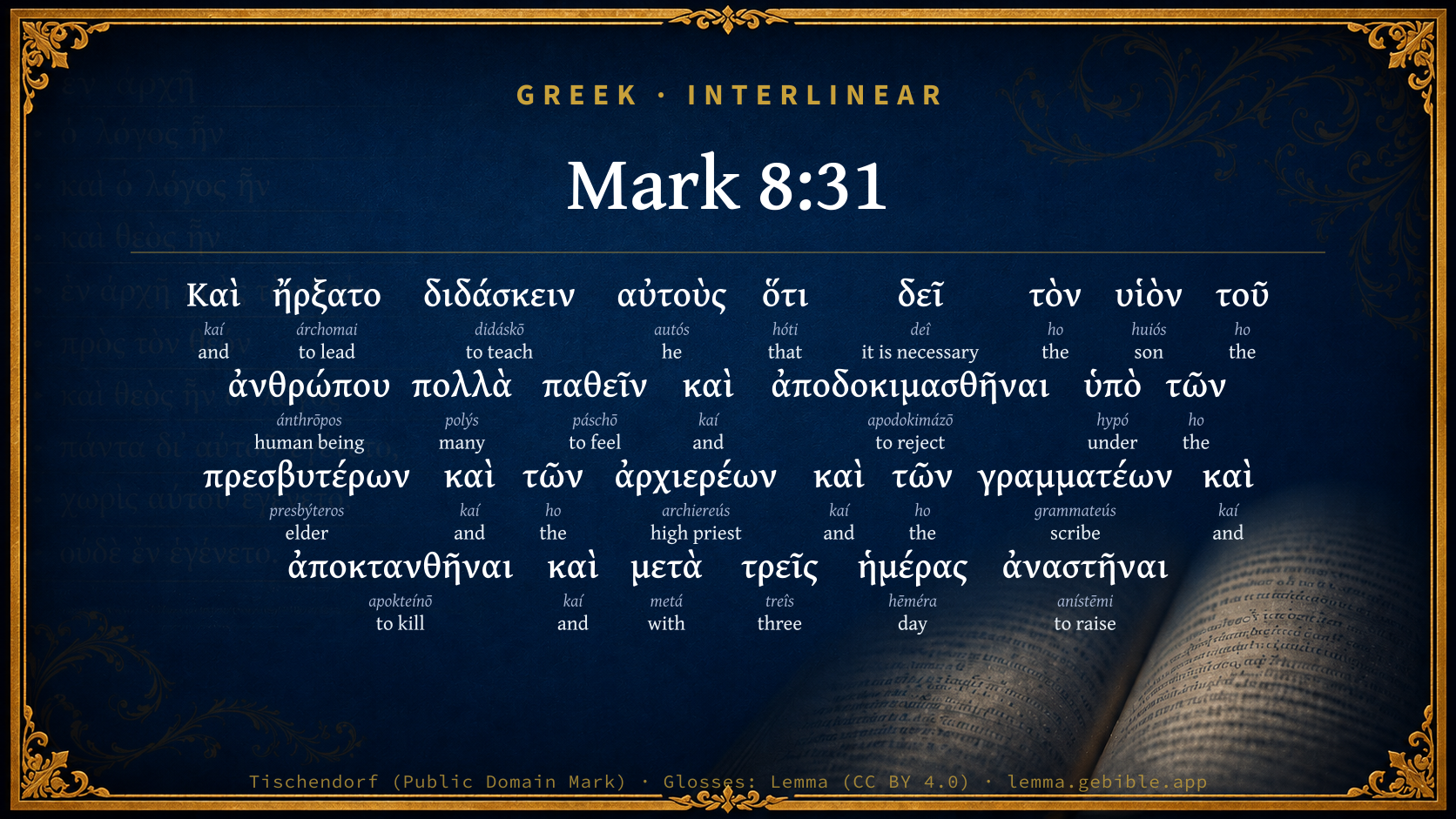
Greek (Tischendorf 8th ed.) Mark 8:31 appears in the Greek New Testament. The text above is from the Tischendorf 8th edition. Each word links to its Strong’s number and a concise gloss. Click any word for its full Thayer’s Greek Lexicon entry.
Download image
Cite this verse

Mark 8:31 (World English Bible). Public Domain. Lemma interlinear Bible study tool, https://lemma.gebible.app/v/mark/8/31.

Show BibTeX & RIS
BibTeX
RIS
English Translation
He began to teach them that the Son of Man must suffer many things, and be rejected by the elders, the chief priests, and the scribes, and be killed, and after three days rise again.
World English Bible · Public Domain
Download a study sheet

One document with this verse’s original text, its word-by-word gloss line, the meaning frame, cross-references with their text, attributed commentary, and full source and license credits — printable, and it pastes into notes with its structure intact.

This verse Autodidact and up

Study sheet (.html) Plain text (.txt)

A passage Seminary Student

Up to 50 verses in one chapter. A passage sheet keeps up to 6 commentary sources and 12 cross-references per verse, in the order this page ranks them, and says so on the sheet whenever that leaves anything out. Ask for a single verse and you get the Autodidact verse sheet above.

Everything on this page stays free to read, with no account — the sheet is a download of what is already on screen, not access to it.

Want to remove ads? Support Godless Engineer
Compare translations 3

The same verse in 3 English versions, stacked beneath the original-language interlinear above. Click any original word for its lexicon entry.

Each is an independent rendering of the whole verse — the interlinear is not word-aligned to these translations.

Highlighted words mark where these versions differ — a whole-verse word diff, not a word-by-word alignment.

  • World English Bible Public Domain
    He began to teach them that the Son of Man must suffer many things, and be rejected by the elders, the chief priests, and the scribes, and be killed, and after three days rise again.
  • King James Version Public Domain
    And he began to teach them, that the Son of man must suffer many things, and be rejected of the elders, and of the chief priests, and scribes, and be killed, and after three days rise again.
  • unfoldingWord Literal Text CC BY-SA 4.0
    And he began to teach them that it is necessary for the Son of Man to suffer many things and to be rejected by the elders and the chief priests and the scribes and to be killed and to rise up after three days.

unfoldingWord Literal Text — © unfoldingWord, licensed CC BY-SA 4.0. Word-aligned USFM3 via Door43 (git.door43.org/unfoldingWord/en_ult).

Versions to compare (up to 4)

3 of 4 selected

Show all 19 translations

Every available English version of this verse, each an independent rendering of the whole verse.

  • World English Bible Public Domain
    He began to teach them that the Son of Man must suffer many things, and be rejected by the elders, the chief priests, and the scribes, and be killed, and after three days rise again.
  • Berean Standard Bible Public Domain
    Then He began to teach them that the Son of Man must suffer many things and be rejected by the elders, chief priests, and scribes, and that He must be killed and after three days rise again.
  • Majority Standard Bible Public Domain
    Then He began to teach them that the Son of Man must suffer many things and be rejected by the elders, chief priests, and scribes, and that He must be killed and after three days rise again.
  • King James Version Public Domain
    And he began to teach them, that the Son of man must suffer many things, and be rejected of the elders, and of the chief priests, and scribes, and be killed, and after three days rise again.
  • American Standard Version (1901) Public Domain
    And he began to teach them, that the Son of man must suffer many things, and be rejected by the elders, and the chief priests, and the scribes, and be killed, and after three days rise again.
  • Revised Version (1885) Public Domain
    And he began to teach them, that the Son of man must suffer many things, and be rejected by the elders, and the chief priests, and the scribes, and be killed, and after three days rise again.
  • Geneva Bible (1599) Public Domain
    Then hee began to teache them that the Sonne of man must suffer many things, and should be reproued of the Elders, and of the hie Priestes, and of the Scribes, and be slaine, and within three dayes rise againe.
  • Douay-Rheims (1899) Public Domain
    And he began to teach them, that the Son of man must suffer many things, and be rejected by the ancients and by the high priests, and the scribes, and be killed: and after three days rise again.
  • Young's Literal Translation Public Domain
    and began to teach them, that it behoveth the Son of Man to suffer many things, and to be rejected by the elders, and chief priests, and scribes, and to be killed, and after three days to rise again;
  • Literal Standard Version CC BY-SA 4.0
    and began to teach them that it is necessary for the Son of Man to suffer many things, and to be rejected by the elders, and chief priests, and scribes, and to be killed, and to rise again after three days;
  • Unlocked Literal Bible CC BY-SA 4.0
    He began to teach them that the Son of Man must suffer many things, and would be rejected by the elders and the chief priests and the scribes, and would be killed, and after three days rise up.
  • unfoldingWord Literal Text CC BY-SA 4.0
    And he began to teach them that it is necessary for the Son of Man to suffer many things and to be rejected by the elders and the chief priests and the scribes and to be killed and to rise up after three days.
  • Darby Bible Public Domain
    And he began to teach them that the Son of man must suffer many things, and be rejected of the elders and of the chief priests and of the scribes, and be killed, and after three days rise [again].
  • World Messianic Bible Public Domain
    He began to teach them that the Son of Man must suffer many things, and be rejected by the elders, the chief priests, and the scribes, and be killed, and after three days rise again.
  • Webster's Bible Public Domain
    And he began to teach them, that the Son of man must suffer many things, and be rejected by the elders, and the chief priests, and scribes, and be killed, and after three days rise again.
  • Free Bible Version CC BY-SA 4.0
    Then Jesus began to explain to them that the Son of man would suffer many things and be rejected by the elders, chief priests, and religious teachers. He would be killed, but three days later would rise again.
  • Bible in Basic English Public Domain
    And teaching them, he said that the Son of man would have to undergo much, and be hated by those in authority, and the chief priests, and the scribes, and be put to death, and after three days come back from the dead.
  • Text-Critical English NT CC BY 4.0
    Then he began to teach them that the Son of Man must suffer many things and be rejected by the elders, the chief priests, and the scribes, and that he must be killed and after three days rise again.
  • Tyndale New Testament (1534) Public Domain
    And he beganne to teache them how that the sonne of man must suffre many thinges and shuld be reproved of the elders and of the hye prestes and scribes and be kylled and after thre dayes aryse agayne.

Literal Standard Version (2020), Covenant Press — licensed CC BY-SA 4.0. Text via the HelloAO Bible API (eBible.org). Unlocked Literal Bible (unfoldingWord) — licensed CC BY-SA 4.0. Text via the HelloAO Bible API (eBible.org). unfoldingWord Literal Text — © unfoldingWord, licensed CC BY-SA 4.0. Word-aligned USFM3 via Door43 (git.door43.org/unfoldingWord/en_ult). Free Bible Version, Dr. Jonathan Gallagher — licensed CC BY-SA 4.0. Text via the HelloAO Bible API (eBible.org).

Word by word

More ways to search: Search by grammar → Find every occurrence → Compare this word →

Practice this passage: Drill this verse → Learn its vocabulary →

ἀποδοκιμασθῆναι
apodokimázō
G593
“to reject”
Verb, Aorist, Passive, Infinitive
Part of Speech
Verb
Tense
Aorist
Voice
Passive
Mood
Infinitive
Full Thayer's Definition

Origin: from G575 and G1381

TDNT: 06:15,2

1. to disapprove, reject, repudiate
  1. Καὶ kaí G2532 “and” Conjunction
  2. ἤρξατο árchomai G756 “to lead” Verb, Aorist, Middle deponent, Indicative, 3rd person, Singular
  3. διδάσκειν didáskō G1321 “to teach” Verb, Present, Active, Infinitive
  4. αὐτοὺς autós G846 “he” Personal pronoun, Accusative, Plural, Masculine
  5. ὅτι hóti G3754 “that” Conjunction
  6. δεῖ deî G1163 “it is necessary” Verb, Present, Active, Indicative, 3rd person, Singular
  7. τὸν ho G3588 “the” Article, Accusative, Singular, Masculine
  8. υἱὸν huiós G5207 “son” Noun, Accusative, Singular, Masculine
  9. τοῦ ho G3588 “the” Article, Genitive, Singular, Masculine
  10. ἀνθρώπου ánthrōpos G444 “human being” Noun, Genitive, Singular, Masculine
  11. πολλὰ polýs G4183 “many” Adjective, Accusative, Plural, Neuter
  12. παθεῖν páschō G3958 “to feel” Verb, Aorist, Active, Infinitive
  13. καὶ kaí G2532 “and” Conjunction
  14. ὑπὸ hypó G5259 “under” Preposition
  15. τῶν ho G3588 “the” Article, Genitive, Plural, Masculine
  16. πρεσβυτέρων presbýteros G4245 “elder” Adjective, Genitive, Plural, Masculine, Comparative
  17. καὶ kaí G2532 “and” Conjunction
  18. τῶν ho G3588 “the” Article, Genitive, Plural, Masculine
  19. ἀρχιερέων archiereús G749 “high priest” Noun, Genitive, Plural, Masculine
  20. καὶ kaí G2532 “and” Conjunction
  21. τῶν ho G3588 “the” Article, Genitive, Plural, Masculine
  22. γραμματέων grammateús G1122 “scribe” Noun, Genitive, Plural, Masculine
  23. καὶ kaí G2532 “and” Conjunction
  24. ἀποκτανθῆναι apokteínō G615 “to kill” Verb, Aorist, Passive, Infinitive
  25. καὶ kaí G2532 “and” Conjunction
  26. μετὰ metá G3326 “with” Preposition
  27. τρεῖς treîs G5140 “three” Adjective, Accusative, Plural, Feminine
  28. ἡμέρας hēméra G2250 “day” Noun, Accusative, Plural, Feminine
  29. ἀναστῆναι anístēmi G450 “to raise” Verb, Aorist, Active, Infinitive

About this verse

These counts appear in no published source. They are computed here, from the morphology-tagged text and Lemma’s own curated glosses. What Lemma adds →

30
words
21
distinct lemmas
Gospels
section

Notable vocabulary

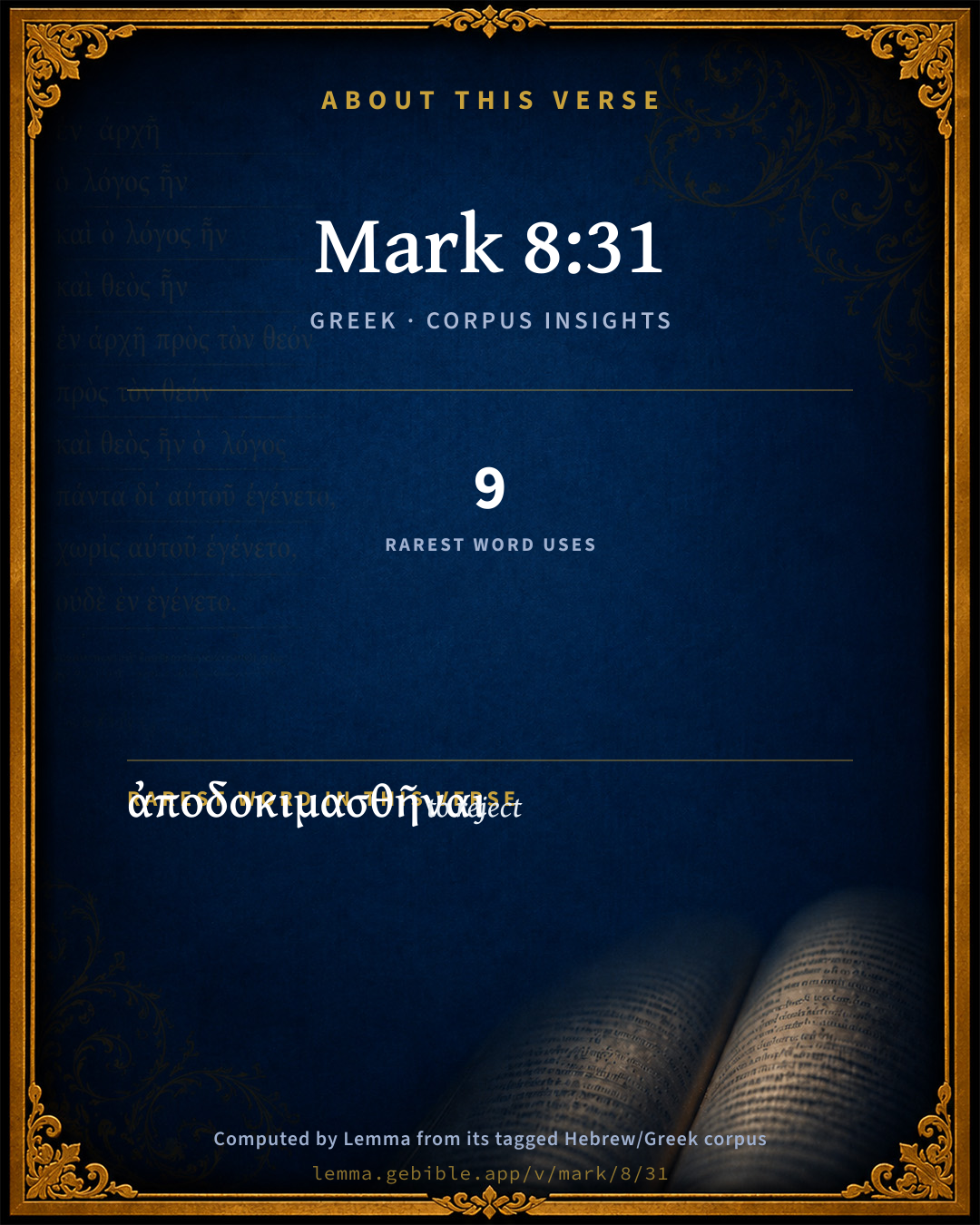
The rarest word here is ἀποδοκιμασθῆναι to reject G593 — appearing just 9 times in the whole Greek New Testament.

Shared distinctive vocabulary

ἀποδοκιμασθῆναι to reject G593 occurs in 9 verses of the Greek New Testament. Also found in:

Repetition

Words recur within this verse:

Cross-references

26

Topical passages linked to Mark 8:31 in the Treasury of Scripture Knowledge — connected by theme and wording, ordered by reader-vote popularity; previews shown in the World English Bible.

  • Mark 10:33–34 "Behold, we are going up to Jerusalem. The Son of Man will be delivered to the chief priests and the scribes. They will condemn him to death, and will deliver him to the Gentiles.
  • John 2:19 Jesus answered them, "Destroy this temple, and in three days I will raise it up."
  • Luke 24:26 Didn't the Christ have to suffer these things and to enter into his glory?"
  • 1 Samuel 10:19 but you have this day rejected your God, who himself saves you out of all your calamities and your distresses; and you have said to him, [No], but set a king over us. Now therefore present yourselves before Yahweh by your tribes, and by your thousands.
  • Hosea 6:2 After two days will he revive us. On the third day he will raise us up, And we will live before him.
  • Matthew 16:21–28 From that time, Jesus began to show his disciples that he must go to Jerusalem and suffer many things from the elders, chief priests, and scribes, and be killed, and the third day be raised up.
  • Mark 9:31–32 For he was teaching his disciples, and said to them, "The Son of Man is being handed over to the hands of men, and they will kill him; and when he is killed, on the third day he will rise again."
  • Luke 17:25 But first, he must suffer many things and be rejected by this generation.
  • Acts 7:35 "This Moses, whom they refused, saying, 'Who made you a ruler and a judge?'--God has sent him as both a ruler and a deliverer by the hand of the angel who appeared to him in the bush.
  • Matthew 21:42 Jesus said to them, "Did you never read in the Scriptures, 'The stone which the builders rejected, The same was made the head of the corner. This was from the Lord. It is marvelous in our eyes?'
  • Mark 12:10 Haven't you even read this Scripture: 'The stone which the builders rejected, The same was made the head of the corner.
  • Acts 7:51–52 "You stiff-necked and uncircumcised in heart and ears, you always resist the Holy Spirit! As your fathers did, so you do.
  • 1 Samuel 8:7 Yahweh said to Samuel, Listen to the voice of the people in all that they tell you; for they have not rejected you, but they have rejected me, that I should not be king over them.
  • Psalms 118:22 The stone which the builders rejected has become the head of the corner.
  • Isaiah 53:3 He was despised, and rejected by men; a man of suffering, and acquainted with disease: and as one from whom men hide their face he was despised; and we didn't respect him.
  • Matthew 12:40 For as Jonah was three days and three nights in the belly of the whale, so will the Son of Man be three days and three nights in the heart of the earth.
  • Matthew 17:22–23 While they were staying in Galilee, Jesus said to them, "The Son of Man is about to be delivered up into the hands of men,
  • Acts 3:13–15 The God of Abraham, Isaac, and Jacob, the God of our fathers, has glorified his Servant Jesus, whom you delivered up, and denied in the presence of Pilate, when he had determined to release him.
  • 1 Corinthians 15:4 that he was buried, that he was raised on the third day according to the Scriptures,
  • Jonah 1:17 Yahweh prepared a great fish to swallow up Jonah, and Jonah was in the belly of the fish three days and three nights.
  • Matthew 20:17–19 As Jesus was going up to Jerusalem, he took the twelve disciples aside, and on the way he said to them,
  • Luke 9:22–27 saying, "The Son of Man must suffer many things, and be rejected by the elders, chief priests, and scribes, and be killed, and the third day be raised up."
  • Luke 18:31–34 He took the twelve aside, and said to them, "Behold, we are going up to Jerusalem, and all the things that are written through the prophets concerning the Son of Man will be completed.
  • Luke 24:6–7 He isn't here, but is risen. Remember what he told you when he was still in Galilee,
  • Luke 24:44 He said to them, "This is what I told you, while I was still with you, that all things which are written in the law of Moses, the prophets, and the psalms, concerning me must be fulfilled."
  • John 12:48 He who rejects me, and doesn't receive my sayings, has one who judges him. The word that I spoke, the same will judge him in the last day.

Cross-references courtesy of OpenBible.info (CC BY 4.0).

Commentary

Notes on Mark 8:31 from classic Christian and Jewish commentators (each source and its license shown beneath its notes). The classic Christian expositions comment on the surrounding passage and are grouped to its opening verse, so a note may address several verses; the Jewish commentaries on the Tanakh (Rashi and others) are per-verse, so they appear only where the commentator wrote on this verse.

Lemma curates 59 commentaries, every one of them public domain or Creative Commons licensed, each selected and text-cleaned for this edition rather than reprinted as found. About our sources →

The Biblical Illustrator

Joseph S. Exell

Mar_8:31; Mar_8:33

That the Son of Man must suffer many things.

The rebuke of love

Let us not overlook this loving rebuke; for

(1) it cures Peters presumption;

(2) sets him to learn a new lesson on the heavenliness of sacrifice;

(3) prevents the greatness of his faith being spoiled by the earthliness of his hopes.

Faithful are the wounds of a friend: but the wounds which the Saviour inflicts are kindest of all. From Peters weakness let us learn how hard it is to see all truth at once. From Christs rebuke let us learn that the heavenly thing is not to seek for glory, but for usefulness, even if we can reach it only through a cross. (R. Glover.)

Peter rebuked Christ and Christ rebuked Peter-an altercation of more than mere words

It is charged with practical truths.

1. Mans shortsightedness.

2. Mans sentiment exaggerated.

3. Mans audacity to think he can help or save Christ.

On Christs side:

1. He rebukes the oldest.

2. He rebukes the wisest-it was Peter who said, Thou art the Christ.

3. He shows that men are only worthy of Him in proportion as they enter into His spirit. (Dr. Parker.)

Christs intimation of His sufferings

I. What there is to mark the time which our blessed Saviour thus selected, for giving prominence to a new and unwelcome subject of discourse. In the third year of His public ministry. Up to this time our Lord left the great truth of His Godhead to work its way rote the minds of His apostles. Now they had arrived at the conviction that He was none other than the ever-living God. What inducement led to, and what instruction may be gathered from, the recorded fact, that when Jesus had drawn from His disciples the acknowledgment of His Divinity, then, and not before, He began to teach them that the Son of Man must suffer many things, and be rejected of the elders, and of the chief priests, and scribes, and be killed, and after three days rise again. Now the apostles could have had none but the most indistinct apprehensions of the office and mission of our Lord, so long as they were ignorant of the death which He had undertaken to die. This made it appear remarkable, that our Lord should so long have withheld the express mention of His sufferings, As much as to say, It will be of no avail to speak to them of My death till they are convinced of My Deity. So long as they only know Me as the Son of Man, they will not be prepared to hear of the cross; when they shall also know Me as the Son of the living God, then will be the time to tell of ignominy and death. Oh, how strange, you may exclaim, that the moment of discovering a Divine person in the form of a man should be the right moment for the being informed that this person should be crucified! To discover a Divine person is to discover what death cannot touch; and yet Christ waited till this discovery in regard of Himself, that He might then expressly mention His approaching dissolution. But do you not observe, my brethren, what a testimony our Lord hereby gives to the fact, that the truth of His Godhead alone explains-alone gives meaning or worth to-His having died on the cross? He will say nothing of His death whilst only believed to be man; He speaks continually of His death, when once acknowledged as God. Are we not taught by this, that they only who believe Christ Divine, can put the right construction on the mystery of His death, or so survey it as to draw from it what it was intended to teach? Then we perceive, that He must have died as a sacrifice; then we understand that He must have died as an atonement to be the propitiation for our sins, to reconcile the world unto God. He could not have died for such ends had He been only man; but being also God, such ends could be answered and effected by His death, though nothing less, so far as we can tell, could have sufficed. Therefore, again and again, we say, Christs Divinity is the explanation of Christs death. We seem quite justified in gathering from the text, that hence forward our Lord made very frequent mention of His cross. If you examine, you will find so many as nine instances spoken of by the evangelists; though it was a topic which He had not before introduced. And what is very observable is, that it seems to have been upon occasions when the disciples were likely to have been puffed up and exalted, that ever after our Lord took special pains to impress upon them that He must be rejected and killed. Ah! my brethren, ought we not to learn from this keeping the cross out of sight till faith had grown strong and high privilege been imparted, that it is the advanced Christian who has need of persecution; and that grace, in place of exempting us from, is to fit us for trial? The disciples must have well known that if suffering were to be their Masters lot, it would also be theirs. If, then and thence, Jesus spake of afflictions which should befall Himself, He must have been understood as likewise speaking of afflictions which would befall His apostles; and He abstained, you see, from dwelling on the tribulation which would be the path to His kingdom, till He found His followers strong in belief of His actual Divinity. And then take one more lesson from the peculiarity of the occasions on which, as we bays shown you, Christ made a special point of introducing the mention of His sufferings; occasions on which the disciples were in danger of being puffed up and exalted. Learn to expect, and be thankful for, something bitter in the cup, when faith has won the victory, and you have tasted, in no common measure, the powers of the invisible world. You may say, however, that it militates against much that we have advanced, that in point of fact, Christs mentioning His sufferings at the time when He did, produced not on the disciples the effect which our statement supposes. We have but too good proof, that though our Lord deferred so long as He did speaking of His sufferings, the apostles were still unprepared for the saying, and could neither understand it nor receive it. Even St. Peter, who had just made the noble confession which proved him ready and willing to hear tidings from Christ, no sooner hears of his Saviour being rejected and killed, than he begins presumptuously to rebuke Him; saying, Be it far from Thee, Lord; this shall not be unto Thee. Yet let it not be thought that Christ chose an unseasonable time, or tried an unsuitable means. The medicine may be what we want; but we, alas! may reject it, as not being what we like. The ease may be precisely such, that from that time forth, it is wholesome that we be admonished of appointed tribulation. We may only the more prove how the admonition is needed, by treating it with dislike, and trying to disbelieve it. When we find that there was such repugnance in St. Peter and his brethren to the cross, though Christ had waited so patiently for the fittest time to introduce it, we ought to learn the difficulty of taking part with the suffering Saviour, and submitting ourselves meekly, and thankfully, to the scorn and the trial of sharing His afflictions. And this lesson from mans aversion to, and how much more the bearing of, the cross, should bring home to us with great force, our need of being continually disciplined by the Spirit of God. And yet it is not to pure and unmingled sorrow, that Christ would consign the more faithful in His Church. As St. Paul writes to the Corinthians, as the sufferings of Christ abound in us, so our consolation also aboundeth by Christ. How beautiful is it in our text, that if Jesus then began to tell His disciples how He should die, He then began also to tell them how He should rise again from the dead. It is our unbelief, or our impatience, which makes us overlook the one statement in our eagerness to get rid of the other. If God lead you into the wilderness, it is, as He saith by the prophet Hosea, that there He may speak comfortably to you, giving you vineyards from thence, and the valley of Achor for a door of hope. (H. Melvill, B. D.)

The Biblical Illustrator, edited by Joseph S. Exell (c. 1880s–1900s) — public domain. Text from a community e-Sword module.

Joseph Benson's Commentary

Mar 8:31-33. And he began to teach them that the Son of man must suffer — The disciples being now convinced that Jesus was the Messiah, the Son of God, and having made confession of him as such, they were prepared to receive this further and equally important discovery, which they could not have borne before, without being so offended as to forsake him; and which, perhaps, they could hardly have borne now, had they thoroughly understood, and fully believed, Christ’s words; for they certainly still expected that he would assume external pomp and power, and restore the kingdom of Israel, an expectation which they held fast, even till the day of his ascension into heaven. And he spake that saying openly — Παρρησια, plainly, namely to the apostles. Our Lord frequently after this repeated the prediction of his sufferings; for instance, Mat 17:22; Mat 20:18; Mat 26:2; Luk 22:15. But it is remarkable that on none of those occasions was the prophecy delivered to any but the twelve, and a few select women, one instance excepted, namely, Luk 17:25, when it was expressed in terms somewhat obscure. The multitude of the disciples were never let into the secret, because it might have made them desert Christ, as they had not, like the apostles, raised expectations of particular preferments in his kingdom, to bias their understandings, and hinder them from perceiving the meaning of the prediction. It is true, he foretold his resurrection from the dead more publicly; for oftener than once he appealed to it as the principal proof of his mission, even in the presence of the priests, as is evident from their mentioning it to Pilate, Mat 27:63. It seems the priests had often been our Lord’s hearers. See the notes on Mat 16:21-23.

Joseph Benson's Commentary on the Old and New Testaments (1811–1818) — public domain. Text from a community e-Sword module.

Whedon's Commentary on the Bible

Daniel D. Whedon

§ 74. — PREDICTIONS OF HIS OWN SUFFERING, vv. AND ULTIMATE COMING TO JUDGE THE WORLD, Mar_8:31-38.

(See notes on Mat_16:21-28.)

Daniel D. Whedon (gen. ed.), Commentary on the Old and New Testaments (1874–1909) — public domain. Text from a community e-Sword module.

Godbey's Commentary on the New Testament

William B. Godbey

HIS DEATH & RESURRECTION

Mat 16:21-23; Mar 8:31-33; Luk 9:22. Matthew: “From that time Jesus began to show to His disciples that it behooved Him to depart to Jerusalem, and to suffer many things from The elders, the chief priests, and scribes, and to be put to death, and to rise the third day. And Peter, taking Him to him, began to rebuke Him, saying, Be it far from Thee, Lord; this shall not be to Thee. And turning, He said to Peter, Get behind Me, adversary; thou art My stumblingblock, because thou dost not have in mind the things of God, but the things of men.” Our Lord is still up at Caesarea-Philippi, with His disciples, teaching and revealing the deeper things of His kingdom, not only to their edification, but their astonishment. It was the misfortune of the Jews so to mix up the prophecies appertaining to the first and second coming of Christ, that they ran into much bewilderment for the want of the necessary discrimination and division of God’s Word; while Isaiah and others had vividly revealed His humiliation, as a “Man of sorrows and acquainted with grief;” as a “Root out of dry ground, without form or comeliness, and none desiring Him;” “Led as a lamb to the slaughter, as a sheep dumb before His shearers, opened not His mouth;” “In His humiliation, His judgment was taken away” — i.e., He had no fair trial, but was mobbed, contrary to both Jewish and Roman law. These gloomy prophecies, descriptive of His humiliation in His first advent, were by no means enjoyable themes with the Jews, who leaned the more to those grand and glorious cognomens portraying Him as “the Prince of peace,” “the government on His shoulders;” and Dan 7:14, not only describing Him as a triumphant and glorious King, but certifying positively that “to His kingdom there shall be no end, but He shall reign King of kings and Lord of lords forever.” Now, for the first time, He comes out and positively reveals to His disciples His coming arrest, condemnation, crucifixion, and resurrection. Peter, robust, stout, and naturally brave as a lion, immediately conceiving the view that His enemies are going to combine against Him, take Him, and kill Him, leaps to the conclusion, That is a game at which two can play. We will fight in His defense till we die, and the thousands and myriads who have been blessed with bodily healing, demoniacal ejectruents, and the multitudes endeared to Him on account of their friends thus wonderfully saved, soul and body, will rally and help us and will make it hot for them. Consequently, both Peter takes Him by the arm, or His vesture, and pulls Him up to Him; looking Him in the face, says, “They can’t do that; we will be on hand, rally Your multitude of friends, and protect You to the last moment.” “Satan,” in the E.V., is too strong, the word not appearing here as a proper name, when it is applied to the devil, but simply in its original meaning, “adversary” or “opposer,” as Peter was innocently antagonizing the Divine economy relative to His death and resurrection, which he did not understand; and Jesus said, “Thou art My stumbling-block;” i.e., “You are throwing yourself in the way of the very work I came to do” — i.e., to suffer, die, and redeem the world from sin, death, and hell. “Thou dost not have in mind the things of God, but the things of men;” i.e., “You are not thinking on the Divine side of this great transaction, you have not yet received light and entered into it understandingly, but you are considering My Messiahship from a human standpoint.”

William B. Godbey, Commentary on the New Testament (1896–1900) — public domain. Text from a community e-Sword module.

Tyndale Open Study Notes

Tyndale Open Resources

8:31-38 Then Jesus began to teach the disciples that he would suffer and be killed in Jerusalem and three days later . . . rise from the dead. Jesus now explicitly predicted what he had revealed in veiled form (2:19-20). In response, Peter objected, so Jesus taught him and the other disciples the nature of his mission and what it really means to follow him.

8:31 It was a divine necessity that Jesus must suffer (see also 9:11; 13:7, 10). The immediate cause for Jesus’ suffering was the elders, the leading priests, and the teachers of religious law (see 10:33; 11:18, 27; 14:1, 43, 53), but the ultimate cause was the will of God. • Jesus’ death would not be the end, for three days later he would rise from the dead. • Three days later is a synonym for on the third day (Matt 16:21; Luke 9:22) and after three days and three nights (Matt 12:40).

Tyndale Open Study Notes — © Tyndale Open Resources, licensed CC BY-SA 4.0. Text via the HelloAO Bible API.

Bengel's Gnomon

Johann Albrecht Bengel

Mar 8:31. Τὸν Υἱὸν τοῦ ἀνθρώπου, the Son of Man) He calls Himself by an humble title: after the resurrection, He says, Christ ought to have suffered; Luk 24:26.—ἀποδοκιμασθῆναι, to be rejected) For they [the elders, etc.] denied that which Peter, Mar 8:29, had confessed; ch. Mar 14:63-64.

Bengel's Gnomon of the New Testament — English translation (T&T Clark, Edinburgh, 1860) — public domain. Text from a community e-Sword module.

Expositor's Greek Testament

ed. W. Robertson Nicoll

Mar 8:31-33 . First announcement of the Passion .

Mar 8:31 . καὶ : Mt. has the more emphatic ἀπὸ τότε , indicating that then began an entirely new way of speaking as to the coming fate of Jesus. διδάσκειν , to teach , more appropriate is Mt.’s word, δεικνύειν , to show . It was a solemn intimation rather than instruction that was given. δεῖ , it must be; in all three evangelists. It points to the inevitableness of the event, not to the rationale of it. On that subject Jesus gave in the first place no instruction. πολλὰ παθεῖν : where not indicated, as in Mt. ἀποδοκιμασθῆναι : an expressive word taken from Psa 118:22 , fitly indicating the precise share of the religious authorities in the coming tragedy. Their part was solemnly to disapprove of the claimant to Messiahship. All else was the natural sequel of their act of rejection. τῶν πρ ., τῶν ἀρ ., τῶν γρ .: the article before each of the three classes named, saddling each with its separate responsibility.

The Expositor's Greek Testament, edited by W. Robertson Nicoll (1897–1910) — public domain. Text from a community e-Sword module.

Geneva Bible (1599)

Geneva Bible translators

Christ suffered all that he suffered for us, not unwillingly neither unawares, but foreknowing it, and willingly.

Geneva Bible (1599) marginal notes — public domain. Text via Bolls.life.

Ellicott's Commentary for English Readers

(31-33) And he began to teach them.—See Notes on Mat_16:21-23. The points peculiar to St. Mark are, (1) that our Lord “spake that saying openly”—the absence of any reticence in this announcement of apparent failure was what startled the disciples; and (2) the graphic touch that as He rebuked Peter, He turned and looked, not on that Apostle only, but on the whole company of the disciples.

A Bible Commentary for English Readers, edited by Charles John Ellicott (1878–1897) — public domain. Text from a community e-Sword module.

The Cambridge Bible for Schools and Colleges

gen. ed. J. J. S. Perowne

31. And he began to teach them] The question and the answer it called forth were alike preparatory to strange and mournful tidings, which He now began to reveal distinctly to the Apostles respecting Himself, for clear and full before His eyes was the whole history of His coming sufferings, the agents through whom they would be brought about, the form they would take, the place where He would undergo them, and their issue, a mysterious resurrection after three days.

The Cambridge Bible for Schools and Colleges (gen. ed. J. J. S. Perowne; Cambridge University Press, 1878–1918) — public domain. Text from a community e-Sword module.

John Gill's Exposition

And he began to teach them,.... For as yet he had said nothing to them about his sufferings and death, at least in express terms; but now they being firmly established in the faith of him, as the Messiah, he thought it proper to inform them,

that the son of man must suffer many things; meaning himself, as that he should be betrayed, apprehended, and bound, should be smitten, spit upon, buffeted, and scourged; and which things must be done, and he suffer them, because it was so determined by God, and foretold in the Scriptures:

and be rejected of the elders, and of the chief priests and Scribes; which composed the grand sanhedrim of the nation, and are the builders that were prophesied of by whom he should be rejected, Psa 118:22,

and be killed; in a violent manner; his life be taken away by force, without law, or justice:

and after three days rise again: not after three days were ended, and on the fourth day, but after the third day was come; that is, "on the third day", as the Syriac, Arabic, Persic, and Ethiopic versions read; and even the Pharisees themselves thus understood Christ, Mat 27:63, so the phrase, "after eight days", is used for the eighth day, being come, or that same day a week later; see Luk 9:28 compared with Mat 17:1.

John Gill's Exposition of the Whole Bible (1746–1763) — public domain (CC PDM 1.0). Text via the HelloAO Bible API.

Trapp's Complete Commentary

John Trapp

31 And he began to teach them, that the Son of man must suffer many things, and be rejected of the elders, and of the chief priests, and scribes, and be killed, and after three days rise again.

Ver. 31. And after three days] That is, within three days, or on the third day.

John Trapp, A Commentary or Exposition upon All the Books of the Old and New Testament (1647–1656) — public domain. Text from a community e-Sword module.

Haydock's Catholic Bible Commentary

After our Redeemer had heard the confession of his first apostle, who spoke in the name of all, as the head, he opens out to them the grand mystery of his passion.

George Leo Haydock (1774–1849), Haydock's Catholic Family Bible and Commentary, 1859 edition — public domain. Excludes Psalms (Douay-Rheims chapter numbering differs from Protestant) and Deuterocanonical books (Catholic canon only).

Matthew Poole's English Annotations

Our Lord is elsewhere said to have taught his disciples, according as they were able to bear, or to hear, what he spake unto them. He did not at the first teach them that he must suffer death: the doctrine of the cross of Christ was like new wine not fit to be put into old bottles; yet necessary to be taught them, lest when they saw it soon after they should have been offended, as indeed they were to some degree, notwithstanding the premonition they had of it. With the doctrine of his suffering, he joins also the doctrine of his resurrection the third day: so saith Matthew. Mark saith, after three days, meta, which seemeth to be a difference between the two evangelists, and also a difficulty, when it is certain that our Saviour did not lie three entire days in the grave. But either Mark reckons the time from his first being betrayed and apprehended, so it was after three days; and Matthew speaketh only of the time which he lay in the grave, that was but part of three days; or else it was the fault of our translators to translate μετα, after, because indeed it often so signifies, whereas it sometimes signifies in, which had better fitted this text, to make it agree with Matthew. This is Grotius’s and Beza’s observation, (see his notes on the text), and is abundantly justified by Mat 27:64, where his adversaries desired of Pilate that the sepulchre might be made fast ἕως τῆς τρίτης ἡμέρας until the third day, because he had said while he was alive, μετὰ τρεῖς ἡμέρας ἀναστῆναι, After three days I will arise, which if they had understood of after the third day fully spent, they would not have petitioned that the sepulchre should have been made fast only until the third day, but it is plain they understood it the third day he would rise. So after three days here is, after the third day is come, not after the third day is past, which neither agrees with Matthew nor yet with the truth. If any desire further to make out this notion, he may read the learned Beza’s larger notes on this verse.

Matthew Poole's English Annotations on the Holy Bible (1683–1685) — public domain. Text from a community e-Sword/MySword module.

The Pulpit Commentary

And he began to teach them, that the Son of man must suffer many things, etc. In St. Matthew"s narrative he says, (Mat_16:21) "From that time began Jesus to show unto his disciples," etc. from the time, that is, of this great confession; from the time when he had openly acknowledged to his disciples the truth of his essential Divinity; from that time he began to instruct them as to his passion and his death. There are two great principles of faith, namely,

(1) the Divinity and the humanity of Christ, and

(2) his cross and passion, whereby he has redeemed the world.

And it was necessary that the disciples should be thus instructed in his amazing dignity as the Son of God, lest, when they saw him put to death, they might doubt as to his Godhead. And after three days rise again. St. Matthew and St. Luke say, "on the third day the day of his death counting for one, and the day of his resurrection for another, with one clear day intervening.

Vers. 31-33. The Christ foretelling his own career.

I HOW UNIQUE AND MARVELLOUS THE PREDICTION! It is a clear, consistent, even symmetrical scheme; as exquisitely balanced and progressively developed as any tragedy of Aeschylus or Euripides. A person who could ideally mark out such a future for himself could not have been mere man. The gospel challenges investigation because of the originality and Divine moral elevation of its conception. And by such statements as this it proves how closely the Old and New Testaments are interwoven, and sympathetically and ideally correspondent.

II IT DEMONSTRATED THAT HIS SUFFERING AND DEATH MUST HAVE BEEN IN THE HIGHEST SENSE VOLUNTARY. He was still at a point where the future was in great degree within his own power. That he clearly knew what lay before him in the event of his continuing steadfast proved that his will was absolutely, divinely free. There were several alternatives within easy reach: these, comprehensively, he put from him in spurning Peter"s interference. It is no fate that is blindly shaping out the destiny of a powerless victim; the necessity is a moral and spiritual one, consequent upon motives and aim deliberately preferred.

III ONLY THE HIGHEST MORAL END COULD JUSTIFY SUCH CONDUCT. To suppose that earthly aims or selfish objects could have determined such a career is a palpable absurdity. Christ is, therefore, through all time, the type of noble self-sacrifice. But it is only spiritual motives and principles that can so inspire. And conscience justifies the sacrifice upon such grounds alone. Whilst we may be incapable of it ourselves, we feel, nevertheless, that it is not madness, but the fulfillment of the great end of our being, and its highest blessedness. If it be but fairly and fully regarded, it furnishes its own justification, and constitutes a judgment bar before which all so-called religious acts and schemes must stand or fall.

IV BY MAKING THIS ANNOUNCEMENT CHRIST:

1. Tested the loyalty of his disciples.

2. Vindicated and revealed his own pure, unalterable spiritual resolution.

3. Furnished them with a support for faith and enthusiastic sympathy. M.

Ver. 31-ch. Mat_16:22) "Mercy on thee, Lord (ilewv soi Kurie): this shall never be unto thee.

Vers. 32, 33. Covert temptation.

This scene has, of course, certain features connected with it which cannot be imitated by ordinary persons, or by mere men. Christ exercised a Divine insight and authority. But there are certain principles illustrated. We see

I HOW IT PRESENTS ITSELF.

1. Under the guise of friendship. The love may be real in the individuals who are the instruments of temptation, but their knowledge is not sufficient, or their moral character not so, high as it should be. Many of the most terrible moral trials of life owe their power to this circumstance.

2. With great assumption of reasonableness. In Peter there was a domineering, "superior" tone. He spoke as one who knew the world, and the impracticableness of his Master"s ideas. But even where this is absent there may be a latent contempt for religious aims, and an unconscious appeal to the utilitarian standards of conduct. With many persons the test of reasonableness in moral action is the immediate advantage of those immediately concerned, or the most directly pleasant course of procedure, or the attainment of some recognized worldly object.

II HOW IT IS TO BE DETECTED.

1. By the aid of the Divine Spirit. There are necessarily many occasions for moral decision in which it would be impossible to assign reasons for the steps taken, because these are not clearly discerned; yet there may be moral certainty. It is the Spirit of God that is to guide us in such cases.

2. By comparing spiritual things with spiritual, e.g. :

(1) In moral questions we should distrust proposals which too readily fall in with our own desire for ease, or a pleasant life, or worldly advantage. It is not usual for great duties so to approve themselves.

(2) Suggestions are to be rejected which stand in the way of personal consecration, or interfere with moral duties and Divine impulses.

III How IT IS TO BE OVERCOME.

1. By distinguishing between the agent or instrument and the inspirer. It was a painful thing for Christ to do, but he did not shrink from denouncing the spirit to which the suggestion was due, and the evil one who had used Peter as his tool. This detection, whether it be declared or not, is a great part of the victory.

2. With promptitude and decision. Christ turned his back upon the tempter. There must be no dallying or temporizing. Upon every moment that follows discovery of evil an eternity hangs.

3. By casting ones self upon the Spirit of God. In prayer: "Deliver us from the evil one." In abiding union and voluntary submission: "Not my will, but thine, be done." "Minding" the things of God, and having the whole attention and affection absorbed by them. M.

The Pulpit Commentary (1880–1919), ed. H.D.M. Spence-Jones & Joseph S. Exell — public domain. Text from a community e-Sword module.

John Wesley's Explanatory Notes

Matt. xvi, 21; Luke ix, 22.

John Wesley, Explanatory Notes Upon the Whole Bible (1754–1765) — public domain. Text via the GEBible commentary corpus.

Scofield Reference Notes

C. I. Scofield

Son of man

(See Scofield "Mat 8:20") Also, Mat 16:21-28; Mar 9:31; Luk 9:22-27; Luk 24:6

The Scofield Reference Bible (1917 edition), notes by C. I. Scofield — public domain. Text from a community e-Sword module.

Kretzmann's Popular Commentary

Paul E. Kretzmann

The first announcement of the Passion:

v. 31. And He began to teach them that the Son of Man must suffer many things, and be rejected of the elders, and of the chief priests, and scribes, and be killed, and after three days rise again.

v. 32. And He spake that saying openly. And Peter took Him, and began to rebuke Him.

v. 33. But when He had turned about and looked on His disciples, He rebuked Peter, saying, Get thee behind Me, Satan; for thou savorest not the things that be of God, but the things that be of men.

Having accepted their confession and thus substantiated the same regarding His person and office, Jesus now took the opportunity to instruct them more fully in the knowledge of salvation. It was a new form of teaching which the Lord introduced at this point, no longer in parables, figures, and dark allusions and intimations, but with perfect freedom and openness. He, the Son of Man, must suffer much. That was the duty which He had taken upon Himself, the obligation which He had shouldered. This suffering is then analyzed. He would be rejected by the elders and by the high priests and by the scribes. It would finally narrow down to this: if the religious authorities would approve of Jesus as the Messiah and accept His teaching, the people would follow. But now it was a foregone conclusion that they would most emphatically disapprove of Him and His ministry. And so the result would follow very naturally: suffering, death, but also resurrection, a fact which the Jewish leaders did not take into account. All these predictions Jesus made with absolute frankness, keeping silence with regard to nothing. The word used here by the evangelist is one which is also fittingly applied to the work of the Christian ministry, 2Co 3:12. The sum and substance of Gospel-preaching is included in the statement of Christ and in the confession of the disciples. The telling of this wondrous story must be signalized and characterized by the same unwavering, un-hesitating boldness with which Jesus here spoke; it is the only way in which the message of salvation will be effective.

It was here that Peter, in his impulsive way, presumed upon a step for which he had absolutely no right. He drew Jesus aside a few steps and began to rebuke Him. The fact that He had just acknowledged Himself to be the Messiah, and that He now spoke of suffering and dying did not seem to Peter to agree. He had an altogether different idea concerning the work of a Messiah. But Jesus could brook no interference where His divine labor of love was concerned. He turned around to all the disciples, in order to draw their attention to His words and acts, since there was a lesson for them all here. He then turned to Peter and reprimanded him most severely: Away, behind Me, Satan! Peter here proved the adversary of Christ; it was Satan himself that was attempting to hinder the work of redemption through Peter. His suggestion and opinion had nothing of God’s will in it, but only that of man, weak, sinful man, that cannot understand God’s ways and works. All the disciples felt the reproof, though it was directed to Peter only. And the warning stands today for all those that would weaken the fact of Christ’s suffering and death in the interest of sinful mankind. In the suffering and death of Christ divine and human ways and methods part company. The cross of Christ is a foolishness and an offense to human ideas, but in reality divine wisdom and divine power.

Paul E. Kretzmann, Popular Commentary of the Bible (1921–1924) — public domain. Text from a community e-Sword module.

McGarvey & Pendleton's Commentaries

J. W. McGarvey

J. W. McGarvey's The Fourfold Gospel [LXX. C. Passion Foretold].

LXX. THIRD WITHDRAWAL FROM HEROD'S TERRITORY. Subdivision C. PASSION FORETOLD. PETER REBUKED. aMATT. XVI. 21-28; bMARK VIII. 31-38; IX. 1; cLUKE IX. 22-27.

a21 From that time [i. e., from the time of Peter's confession, and about three-quarters of a year before the crucifixion] began Jesus to show unto his disciples, b31 And to teach them, that the Son of man must suffer many things [Since the apostles, by the mouth of Peter, had just confessed Jesus as Christ, it was necessary that their crude Messianic conceptions should be corrected and that the true Christhood--the Christhood of the atonement and the resurrection--should be revealed to them. In discourse and parable Jesus had explained the principles and the nature of the kingdom, and now, from this time forth, he taught the [414] apostles about himself, the priestly King], athat he must go up to Jerusalem, band be rejected by aand suffer many things of the elders, and bthe chief priests, and the scribes [The Jewish Sanhedrin was generally designated by thus naming the three constituent parts. See Joh_2:19-22, Joh_3:14, Mat_12:38-40), but these had not been understood by either friend or foe. Now that he thus spoke plainly, we may see by Peter's conduct that they comprehended and were deeply moved by the dark and more sorrowful portion of his revelation, and failed to grasp the accompanying promise of a resurrection.] a22 And Peter took him, and began to rebuke him, saying, Be it far from thee, Lord: this shall never be unto thee. [Evidently Peter regarded Jesus as overcome by a fit of despondency, and felt that such talk would utterly dishearten the disciples if it were persisted in. His love, therefore, prompted him to lead Jesus to one side and deal plainly with him. In so doing, Peter overstepped the laws of discipleship and assumed that he knew better than the Master what course to pursue. In his feelings he was the forerunner of those modern wiseacres who confess themselves constrained to reject the doctrine of a suffering Messiah.] b33 But he turning about, and seeing his disciples. aturned, brebuked Peter, and saith, asaid unto Peter, Get thee behind me, Satan: thou art a stumbling-block unto me: for thou mindest not the things of God, but the things that be of men. [Jesus withdrew from Peter and turned back to his disciples. By the confession of the truth Simon had just won his promised name of Peter, which allied him to Christ, the [415] foundation. But when he now turned aside to speak the language of the tempter, Peter receives the name Satan, as if he were the very devil himself. Peter presented the same temptation with which the devil once called forth a similar rebuke from Christ ( Mat_4:10). He was unconsciously trying to dissuade Jesus from the death on which the salvation of the world depended, and this was working into Satan's hand. Peter did not mind or think about the Messiah's kingdom as divinely conceived and revealed in the Scriptures.] b34 And he called unto him the multitude with his disciples, a24 Then said Jesus unto his disciples, c23 And he said unto all [despite the efforts of Jesus to seek privacy, the people were still near enough at hand to be called and addressed], If any man would come after me, let him deny himself, and take up his cross daily [comp. Rom_8:36, 1Co_15:31] and follow me [For comment, see Luk_12:9, 2Ti_1:8, 2Ti_1:12, 2Ti_2:12] in this adulterous and sinful generation [see pp. 305, 306], the Son of man also shall be ashamed of him cwhen he cometh in his own glory, and the glory of the bhis cFather, and of bwith the holy angels. [Peter had just been ashamed of the words in which Christ pictured himself as undergoing his humiliation. Jesus warns him and all others of the dangers of such shame.] a27 For the Son of man shall come in the glory of his Father, with his angels; and then he shall render unto every man according to his deed. [The Father's glory, the angels, and the rendering of universal judgment form a threefold indication that Jesus here speaks of his final coming to judge the world.] b1 And he said unto them, Verily I say unto you, c27 But I tell you of a truth, aThere are some of them that stand here, who shall in no wise taste of death, till they see the Son of man coming in his kingdom. ctill they see the kingdom of God. bcome with power. [The mention of his final coming suggested one nearer at hand which was to be accomplished during the life of most of those present, since none but Jesus himself and Judas were to die previous to that time. The kingdom was to come and likewise the King. The former coming was literal, the latter spiritual. Those who refer this expression to the transfiguration certainly err, for no visible kingdom was established at that time. The expression refers to the kingdom which was organized and set in motion on the Pentecost which followed the resurrection of Jesus. It was set up with power, because three thousand souls were converted the first day, and many other gospel triumphs speedily followed.] [417]

[FFG 414-417]

J. W. McGarvey (with Philip Y. Pendleton), Commentaries on the New Testament (The Fourfold Gospel, 1914; Acts; and the epistles) — public domain. Text from a community e-Sword/MySword module.

The People's New Testament

B. W. Johnson

31–38. He began to teach them, etc. For the first announcement of the suffering of our Lord, the rebuke of Peter, and the lesson concerning the cross, and saving the soul, see notes on Matt. 16:21–28. Compare Luke 9:22–27. Verse 38 is peculiar to Mark in this connection, though given in Matt. 10:32, 33, on which see notes.

B. W. Johnson's The People's New Testament with Notes (1889–1891) — public domain. Electronic text from the Christian Classics Ethereal Library (CCEL) ThML edition.

unfoldingWord translationNotes

Door43 World Missions Community

Son of Man

This is an important title for Jesus. (See: Translating Son and Father)

would be rejected by the elders ... and after three days rise up

This can be stated in active form. AT: "that the elders and the chief priests and the scribes would reject him, and that men would kill him, and that after three days he would rise up" (See: Active or Passive)

He said this clearly

"He said this in a way that was easy to understand"

began to rebuke him

Peter rebuked Jesus for saying the things he said would happen to the Son of Man. This can be made explicit. AT: "began to rebuke him for saying these things" (See: Assumed Knowledge and Implicit Information)

translationWords

Son of Man

elder

chief priests

scribe

raise

Peter

rebuke

unfoldingWord translationNotes — © Distant Shores Media and the Door43 World Missions Community, licensed CC BY-SA 4.0. Source: git.door43.org/Door43/en_tn.

Cambridge Greek Testament for Schools and Colleges

31–33. THE PASSION FORETOLD; PETER REBUKED

Mat 16:21-23. Luk 9:22

31. ὑπό ([1753][1754][1755][1756][1757][1758]) rather than ἀπό ([1759][1760]2[1761][1762][1763][1764]). μετὰ τρεῖς ἡμέρας ([1765][1766][1767][1768][1769] etc.) rather than τῇ τρίτῃ ἡμέρᾳ (dg Arm. Aeth.). Cf. Mar 9:31, Mar 10:34.

[1753] Codex Sinaiticus. 4th cent. Discovered by Tischendorf in 1859 at the Monastery of St Katharine on Mount Sinai. Now at St Petersburg. The whole Gospel, ending at Mar 16:8. Photographic facsimile, 1911.

[1754] Codex Vaticanus. 4th cent., but perhaps a little later than א. In the Vatican Library almost since its foundation by Pope Nicolas V., and one of its greatest treasures. The whole Gospel, ending at Mar 16:8. Photographic facsimile, 1889.

[1755] Codex Ephraemi. 5th cent. A palimpsest: the original writing has been partially rubbed out, and the works of Ephraem the Syrian have been written over it; but a great deal of the original writing has been recovered; of Mark we have Mar 1:17 to Mar 6:31, Mar 8:5 to Mar 12:29, Mar 13:19 to Mar 16:20. In the National Library at Paris.

[1756] Codex Bezae. 6th cent. Has a Latin translation (d) side by side with the Greek text, and the two do not quite always agree. Presented by Beza to the University Library of Cambridge in 1581. Remarkable for its frequent divergences from other texts. Contains Mark, except Mar 16:15-20, which has been added by a later hand. Photographic facsimile, 1899.

[1757] Codex Regius. 8th cent. An important witness. At Paris. Contains Mar 1:1 to Mar 10:15; Mar 10:30 to Mar 15:1; Mar 15:20 to Mar 16:20, but the shorter ending is inserted between Mar 16:8 and Mar 16:9, showing that the scribe preferred it to the longer one.

[1758] Codex Petropolitanus. 9th cent. Gospels almost complete. Mar 16:18-20 is in a later hand.

[1759] Codex Alexandrinus. 5th cent. Brought by Cyril Lucar, Patriarch of Constantinople, from Alexandria, and afterwards presented by him to King Charles I. in 1628. In the British Museum. The whole Gospel. Photographic facsimile, 1879.

[1760] Codex Ephraemi. 5th cent. A palimpsest: the original writing has been partially rubbed out, and the works of Ephraem the Syrian have been written over it; but a great deal of the original writing has been recovered; of Mark we have Mar 1:17 to Mar 6:31, Mar 8:5 to Mar 12:29, Mar 13:19 to Mar 16:20. In the National Library at Paris.

[1761] Codex Purpureus. 6th cent. Full text in Texts and Studies v. No. 4, 1899. Contains Mar 5:20 to Mar 7:4; Mar 7:20 to Mar 8:32; Mar 9:1 to Mar 10:43; Mar 11:7 to Mar 12:19; Mar 14:25 to Mar 15:23; Mar 15:33-42. See below on Ψ.

[1762] Codex Monacensis. 10th cent. Contains Mar 6:47 to Mar 16:20. Many verses in 14, 15, 16 are defective.

[1763] Codex Oxoniensis. 9th cent. Contains Mark, except Mar 3:35 to Mar 6:20.

[1764] Codex Petropolitanus. 9th cent. Gospels almost complete. Mar 16:18-20 is in a later hand.

[1765] Codex Sinaiticus. 4th cent. Discovered by Tischendorf in 1859 at the Monastery of St Katharine on Mount Sinai. Now at St Petersburg. The whole Gospel, ending at Mar 16:8. Photographic facsimile, 1911.

[1766] Codex Alexandrinus. 5th cent. Brought by Cyril Lucar, Patriarch of Constantinople, from Alexandria, and afterwards presented by him to King Charles I. in 1628. In the British Museum. The whole Gospel. Photographic facsimile, 1879.

[1767] Codex Vaticanus. 4th cent., but perhaps a little later than א. In the Vatican Library almost since its foundation by Pope Nicolas V., and one of its greatest treasures. The whole Gospel, ending at Mar 16:8. Photographic facsimile, 1889.

[1768] Codex Ephraemi. 5th cent. A palimpsest: the original writing has been partially rubbed out, and the works of Ephraem the Syrian have been written over it; but a great deal of the original writing has been recovered; of Mark we have Mar 1:17 to Mar 6:31, Mar 8:5 to Mar 12:29, Mar 13:19 to Mar 16:20. In the National Library at Paris.

[1769] Codex Bezae. 6th cent. Has a Latin translation (d) side by side with the Greek text, and the two do not quite always agree. Presented by Beza to the University Library of Cambridge in 1581. Remarkable for its frequent divergences from other texts. Contains Mark, except Mar 16:15-20, which has been added by a later hand. Photographic facsimile, 1899.

31. ἤρξατο διδάσκειν. It was indeed a new beginning. Slowly, fitfully, and still very defectively, the Twelve had been brought by Him to see that He was the promised Messiah; and now He began to teach them that the King and Conqueror whom they had been expecting must suffer shame and death. All three connect this prediction with the confession of Peter, and here was another reason for silence. Peter’s ὁ Χριστός was true, but what he and the others understood by ὁ Χριστός was not true. In proclaiming Jesus as the Messiah they would have taught much that was erroneous.

Δεῖ. Must, because of the Divine decree. This δεῖ comes to the surface all through the life of Christ from His childhood onwards (Luk 2:49), and is especially evident during the later stages (Luk 4:43; Luk 9:22; Luk 13:33; Luk 17:25; Luk 19:5; Luk 22:37; Luk 24:7; Luk 24:26; Luk 24:44). The word is thus used of Christ all through the N.T., but this is the only instance in Mk. The necessity is not of man’s making, but of God’s; the cause is not man’s hostility to Christ, but God’s love to man. Man’s hostility is God’s instrument.

τὸν υἱὸν τοῦ ἀνθρώπου. See on Mar 2:10; Mar 2:28. In Mk the title is used eight times in passages which predict the Passion or the Resurrection. It is not so used in “Q.”

πολλὰ παθεῖν, multa pati. The expression is frequent (Mar 5:26; Mat 27:19), esp. of the Passion (Mar 9:12; Mat 16:21; Luk 9:22; Luk 17:25). Not in Jn, who neither in Gospel nor Epistles uses πάσχω. What follows forms a climax; Passion, Rejection, Death—the second causing the third. If the hierarchy had not absolutely rejected Him, Pilate would have let Him go.

ἀποδοκιμασθῆναι. Be rejected after investigation. Δοκιμασία was the scrutiny which an official elected at Athens had to undergo to see whether he was qualified to take office. The Sanhedrin held a δοκιμασία with regard to Jesus, and decided that He was not qualified to be the Messiah (Mar 12:10; 1Pe 2:4; 1Pe 2:7). The expression is probably taken from Psa 118:22. But the idea of rejection after investigation is not in the Hebrew word used there and eleven times in Jeremiah, where it is generally, but not always, rendered by ἀποδοκιμάζω. Other renderings are ἀπωθέομαι and ἐξουδενόω, and its meaning is not so much rejecting after scrutiny as rejecting with contempt. Hort on 1Pe 2:4.

ὑπὸ τῶν πρεσβυτέρων κ.τ.λ. The Sanhedrin is mentioned in all its fulness, each of its three constituent parts having the article, which should be repeated in English; cf. Mar 11:27, Mar 14:43; Mar 14:53. It is as if each of the three classes had given a separate vote for rejection. In Mat 16:21 and Luk 9:22 the three are under one article, as forming one body. The ἀρχιερεῖς are usually placed first, as including the high-priest and (at this time) the ex-high-priests; but cf. Luk 9:22; Luk 20:19; Mat 16:21. Very rarely are the ἀρχιερεῖς omitted (Mat 26:57; Act 6:12).

μετὰ τρεῖς ἡμέρας. So also Mar 9:31 and Mar 10:34. The expression may be colloquial, a current phrase for a short time, like our “after two or three days.” Mt. and Lk. change it to the more accurate τῇ τρίτῃ ᾑμέρᾳ, which Syr-Sin. and some other authorities read here. In Hos 6:2, “after two days” = “on the third day.”

Cambridge Greek Testament for Schools and Colleges (Cambridge University Press, 1896; 21 vols, various authors incl. Carr, Maclear, Plummer, Farrar, Lumby, Moule, M. R. James, Simcox) — public domain. Text from a community e-Sword module.

Alford’s Greek Testament

Henry Alford

31-9:1.] Announcement of His approaching death and resurrection. Rebuke of Peter. Mat 16:21-28. Luk 9:22-27. Luke omits the rebuke of Peter. Mark adds, ver. 32, παῤῥησίᾳ τ. λ. ἐλάλει: and, in the rebuke of Peter, that the Lord said the words ἰδὼν τοὺς μαθητὰς αὐτοῦ. In vv. 34, 35, the agreement is close, except that Luke adds καθʼ ἡμέραν, . τὸν στ. αὐτοῦ, and Mark καὶ τοῦ εὐαγγ. aft. ἐμοῦ, ver. 35 (it is perhaps worthy of remark that St. Mark writes ἀκολουθεῖν in ver. 34: possibly from the information of him, to whom it was said, τί πρός σε; σύ μοι ἀκολούθει, Joh 21:22); and informs us, in ver. 34, that our Lord said these words, having called the multitude with his disciples. This Meyer calls a contradiction to Matt. and Luke,—and thinks it arose from a misunderstanding of Luke’s πάντας. Far rather should I say that our account represents every detail to the life, and that the πρὸς πάντας contains traces of it. What wonder that a crowd should here, as every where else, have collected about Him and the disciples?

Henry Alford, The Greek Testament (1849–1861) — public domain. Text from a community e-Sword module.

International Critical Commentary

31-33. After drawing out from his disciples the confession of his Messianic claim, Jesus proceeds to tell them how that claim will be treated by the authorities. In general, it will bring him much suffering, and finally his rejection and violent death at the hands of the Sanhedrim, from which, however, he will be raised after three days. Peter, who evidently regards this as a confession of defeat, and as vacating the claim just made, takes Jesus aside, and begins to rebuke him. But Jesus, recognizing in this the very spirit of the Temptation, meets rebuke with rebuke, telling Peter that he is acting the part of the Tempter, and that he reflects the mind of men, not of God.

31. ἤρξατο διδάσκειν—he began to teach. This is a true beginning, being the first teaching of this kind.1 δεῖ—it is necessary. The necessity arises, first, from the hostility of men; secondly, from the spiritual nature of his work, which made it impossible for him to oppose force to force; and thirdly, from the providential purpose of God, who made the death of Jesus the central thing in redemption. But in order to take its place in the Divine order, his death must come in the human, natural order. That is to say, his death is the natural result of the antagonism of his holy nature to the world; it is the martyr’s death. But it has also a Divine purpose in it, and it is necessary to the accomplishment of that purpose. The Divine purpose can use, however, only the death that results from the human necessity, the martyr’s death. Jesus must be put to death by man. τὸν υἱὸν τοῦ ἀνθρώπου1 πολλὰ παθεῖν—that the Son of Man suffer many things. This is the general statement, under which the rejection and death are specifications. ὑπὸ τῶν πρεσβυτέρων καὶ τῶν ἀρχιερέων κ. τῶν γραμματέων—by the elders and the chief priests and the Scribes.

ὑπὸ, by, instead of ἀπὸ,2 Tisch. Treg. WH. RV. א BCDGKL Π. Insert τῶν, the, before ἀρχιερέων Tisch. Treg. WH. RV. א BCDEHMSUVX, and before γραμματέων Tisch. Treg. WH. RV. א BCDEFHLSMUV Γ.

Elders was the general term for the members of the Sanhedrim, and when used as it is here, with the names of classes comprised in that body, it denotes, of course, the other members outside of these classes. The chief priests were members of the high-priestly class, i.e. either the high priest himself, those who had held the office, or members of the privileged families from which the high priests were taken. The three classes together constituted the Sanhedrim, or supreme council of the Jews, by which Jesus predicts that he is to be rejected and put to death.3 καὶ μετὰ τρεῖς ἡμέρας ἀναστῆναι—and after three days rise again. This is one of the psychological problems with which we are confronted in a history generally answering with considerable exactness to such tests. For when we come to the account of the resurrection, this prophecy plays no part. The event, when it takes place, does not recall the prophecy, and is met with a persistent unbelief which does not seem in any way consonant with the existence of such a prophecy. It would seem as if Jesus must have used language here, which the disciples did not understand, until after the resurrection itself, to refer to that event. That Jesus predicted the crucifixion and resurrection, there does not seem to be any reasonable doubt. But we find variations in the details, which suggest that these were supplied by the writers, post eventum, and that the prediction itself was general in its character. Moreover, we find in the eschatological discourse, that Jesus’ language needs a key, and we seem forced to the supposition that the utter failure of the disciples to understand the present prophecy must have been due to a like enigmatical use of language. παρῥησίᾳ—without any reserve, using entire frankness of speech. Now that the time had come for Jesus to speak about this, he spoke out frankly.

International Critical Commentary — older volumes (1896–1929), various authors — public domain. Text from a community e-Sword module.

Lesson kit

Teaching starters — assembled from the data on this page, not authored interpretation. Every prompt links to the verse data it draws on. Edit before teaching.

Mark, in the Gospels, opens this verse with 30 words (21 distinct Greek lemmas). Its most distinctive word is apodokimázō (“to reject”). A historical commentator’s framing appears above. Read the whole chapter for the surrounding context.

Discussion questions

  1. What does “to reject” (apodokimázō) contribute to the verse as a whole?
  2. How does Matthew 21:42, which shares the word «to reject», read alongside this verse?
  3. What does the repetition of “and” (6× in this one verse) do in this verse?
  4. These translations render this verse differently; the difference is in the English rendering, not the original. What questions does that raise?
  5. Compare how The Biblical Illustrator and Joseph Benson's Commentary read this verse. Where do they agree or differ?

Things to notice

Reading settings

Reading text

Shown beneath each verse's original-language words.

Old Testament
Old Testament edition

Read the OT as the Masoretic Hebrew (MT) or the Greek Septuagint (LXX).

English shown for the Greek Septuagint (in the Hebrew ↔ Greek comparison).

Comparing translations? Open the Compare panel on any verse page to stack up to four side by side.