

Mark 14:24
Greek (Tischendorf 8th ed.) Mark 14:24 appears in the Greek New Testament. The text above is from the Tischendorf 8th edition. Each word links to its Strong’s number and a concise gloss. Click any word for its full Thayer’s Greek Lexicon entry.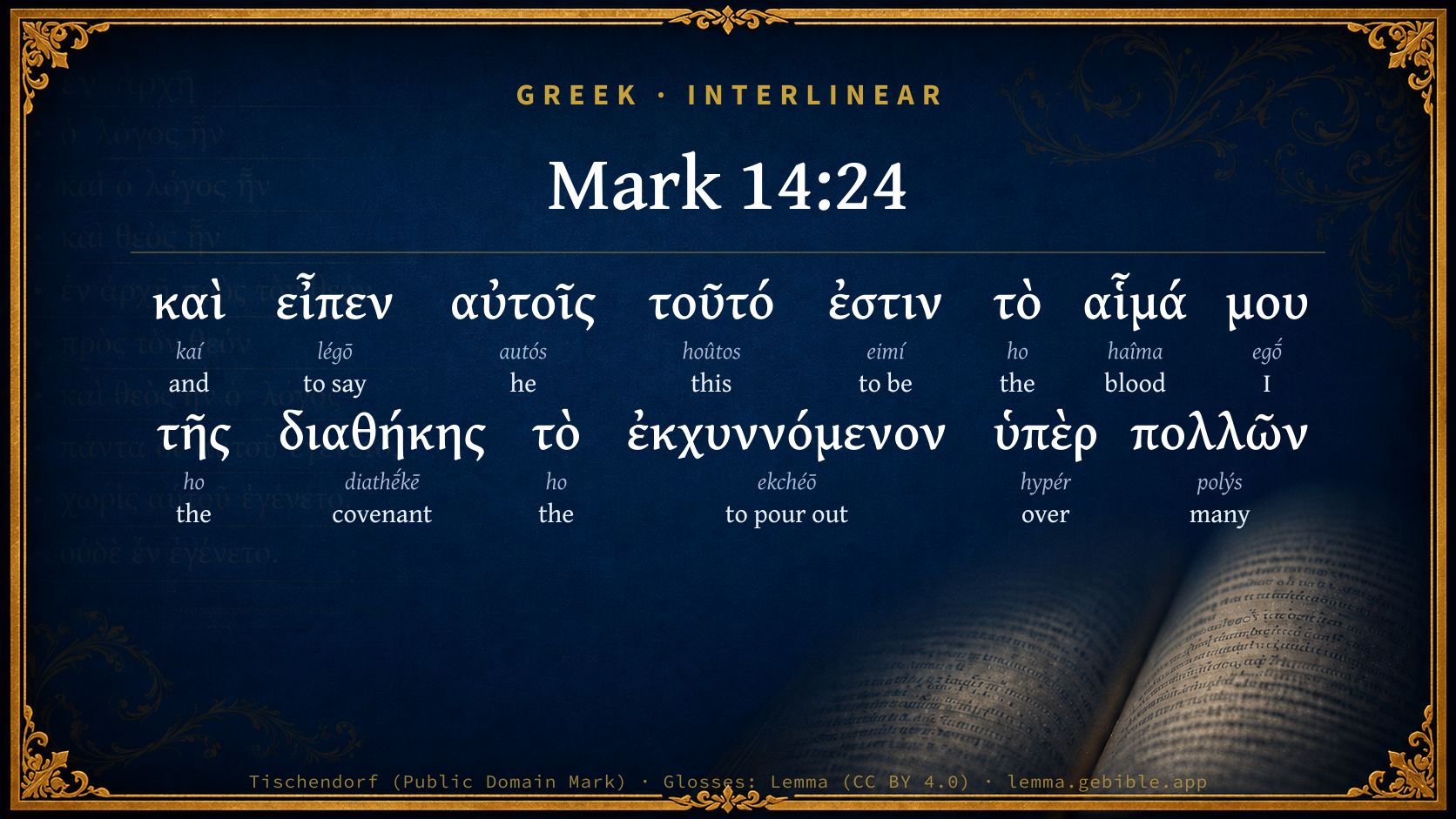
He said to them, "This is my blood of the new covenant, which is poured out for many.
Download a study sheet
One document with this verse’s original text, its word-by-word gloss line, the meaning frame, cross-references with their text, attributed commentary, and full source and license credits — printable, and it pastes into notes with its structure intact.
This verse Autodidact and up
A passage Seminary Student
Up to 50 verses in one chapter. A passage sheet keeps up to 6 commentary sources and 12 cross-references per verse, in the order this page ranks them, and says so on the sheet whenever that leaves anything out. Ask for a single verse and you get the Autodidact verse sheet above.
Everything on this page stays free to read, with no account — the sheet is a download of what is already on screen, not access to it.
Compare translations 3
The same verse in 3 English versions, stacked beneath the original-language interlinear above. Click any original word for its lexicon entry.
Each is an independent rendering of the whole verse — the interlinear is not word-aligned to these translations.
Highlighted words mark where these versions differ — a whole-verse word diff, not a word-by-word alignment.
-
World English Bible Public Domain
He said to them, "This is my blood of the new covenant, which is poured out for many.
-
King James Version Public Domain
And he said unto them, This is my blood of the new testament, which is shed for many.
-
unfoldingWord Literal Text CC BY-SA 4.0
And he said to them, “This is my blood of the covenant, which is being poured out for many.
unfoldingWord Literal Text — © unfoldingWord, licensed CC BY-SA 4.0. Word-aligned USFM3 via Door43 (git.door43.org/unfoldingWord/en_ult).
Show all 19 translations
Every available English version of this verse, each an independent rendering of the whole verse.
-
World English Bible Public Domain
He said to them, "This is my blood of the new covenant, which is poured out for many.
-
Berean Standard Bible Public Domain
He said to them, “This is My blood of the covenant, which is poured out for many.
-
Majority Standard Bible Public Domain
He said to them, “This is My blood of the new covenant, which is poured out for many.
-
King James Version Public Domain
And he said unto them, This is my blood of the new testament, which is shed for many.
-
American Standard Version (1901) Public Domain
And he said unto them, This is my blood of the covenant, which is poured out for many.
-
Revised Version (1885) Public Domain
And he said unto them, This is my blood of the covenant, which is shed for many.
-
Geneva Bible (1599) Public Domain
And he saide vnto them, This is my blood of that newe Testament, which is shed for many.
-
Douay-Rheims (1899) Public Domain
And he said to them: This is my blood of the new testament, which shall be shed for many.
-
Young's Literal Translation Public Domain
and he said to them, `This is my blood of the new covenant, which for many is being poured out;
-
Literal Standard Version CC BY-SA 4.0
and He said to them, “This is My blood of the New Covenant, which is being poured out for many;
-
Unlocked Literal Bible CC BY-SA 4.0
He said to them, “This is my blood of the covenant, the blood that is poured out for many.
-
unfoldingWord Literal Text CC BY-SA 4.0
And he said to them, “This is my blood of the covenant, which is being poured out for many.
-
Darby Bible Public Domain
And he said to them, This is my blood, that of the [new] covenant, that shed for many.
-
World Messianic Bible Public Domain
He said to them, “This is my blood of the new covenant, which is poured out for many.
-
Webster's Bible Public Domain
And he said to them, This is my blood of the new testament, which is shed for many.
-
Free Bible Version CC BY-SA 4.0
“This is my blood,” he told them, “the agreement that's being poured out for many.
-
Bible in Basic English Public Domain
And he said to them, This is my blood of the testament, which is given for men.
-
Text-Critical English NT CC BY 4.0
He said to them, “This is my blood of the new covenant, which is poured out for many.
-
Tyndale New Testament (1534) Public Domain
And he sayde vnto them: This is my bloude of the new testament which is sheed for many.
Literal Standard Version (2020), Covenant Press — licensed CC BY-SA 4.0. Text via the HelloAO Bible API (eBible.org). Unlocked Literal Bible (unfoldingWord) — licensed CC BY-SA 4.0. Text via the HelloAO Bible API (eBible.org). unfoldingWord Literal Text — © unfoldingWord, licensed CC BY-SA 4.0. Word-aligned USFM3 via Door43 (git.door43.org/unfoldingWord/en_ult). Free Bible Version, Dr. Jonathan Gallagher — licensed CC BY-SA 4.0. Text via the HelloAO Bible API (eBible.org).
Word by word
More ways to search: Search by grammar → Find every occurrence → Compare this word →
Practice this passage: Drill this verse → Learn its vocabulary →
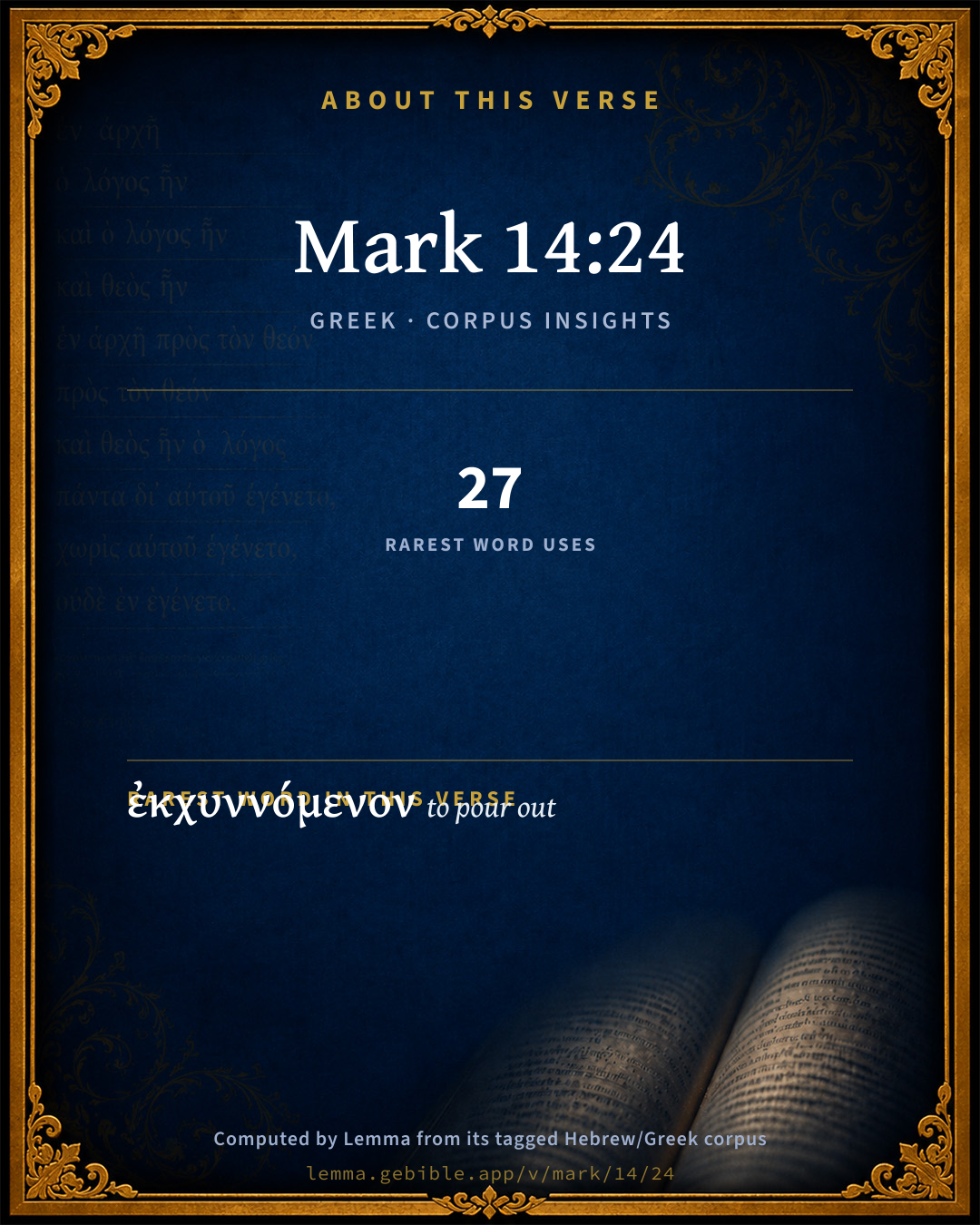
- Appears 27× in the Greek New Testament
- First appears at Matthew 9:17
- Part of Speech
- Verb
- Tense
- Present
- Voice
- Passive
- Mood
- Participle
- Case
- Nominative
- Number
- Singular
- Gender
- Neuter
Full Thayer's Definition
- καὶ kaí G2532 “and” Conjunction
- εἶπεν légō G3004 “to say” Verb, Aorist, Active, Indicative, 3rd person, Singular
- αὐτοῖς autós G846 “he” Personal pronoun, Dative, Plural, Masculine
- τοῦτό hoûtos G3778 “this” Demonstrative pronoun, Nominative, Singular, Neuter
- ἐστιν eimí G1510 “to be” Verb, Present, Active, Indicative, 3rd person, Singular
- τὸ ho G3588 “the” Article, Nominative, Singular, Neuter
- αἷμά haîma G129 “blood” Noun, Nominative, Singular, Neuter
- μου egṓ G1473 “I” Personal pronoun, 1st person, Genitive, Singular
- τῆς ho G3588 “the” Article, Genitive, Singular, Feminine
- διαθήκης diathḗkē G1242 “covenant” Noun, Genitive, Singular, Feminine
- τὸ ho G3588 “the” Article, Nominative, Singular, Neuter
- ἐκχυννόμενον ekchéō G1632 “to pour out” Verb, Present, Passive, Participle, Nominative, Singular, Neuter
- ὑπὲρ hypér G5228 “over” Preposition
- πολλῶν polýs G4183 “many” Adjective, Genitive, Plural, Masculine
About this verse
These counts appear in no published source. They are computed here, from the morphology-tagged text and Lemma’s own curated glosses. What Lemma adds →
- 14
- words
- 12
- distinct lemmas
- Gospels
- section
Cross-references
10Topical passages linked to Mark 14:24 in the Treasury of Scripture Knowledge — connected by theme and wording, ordered by reader-vote popularity; previews shown in the World English Bible.
- Exodus 24:8 Moses took the blood, and sprinkled it on the people, and said, "Look, this is the blood of the covenant, which Yahweh has made with you concerning all these words."
- Zechariah 9:11 As for you also, Because of the blood of your covenant, I have set free your prisoners from the pit in which is no water.
- Revelation 7:9–17 After these things I looked, and behold, a great multitude, which no man could number, out of every nation and of all tribes, peoples, and languages, standing before the throne and before the Lamb, dressed in white robes, with palm branches in their hands.
- Hebrews 9:15–23 For this reason he is the mediator of a new covenant, since a death has occurred for the redemption of the transgressions that were under the first covenant, that those who have been called may receive the promise of the eternal inheritance.
- Mark 10:45 For the Son of Man also came not to be served, but to serve, and to give his life as a ransom for many."
- John 6:53 Jesus therefore said to them, "Most assuredly I tell you, unless you eat the flesh of the Son of Man and drink his blood, you don't have life in yourselves.
- 1 Corinthians 10:16 The cup of blessing which we bless, isn't it a communion of the blood of Christ? The bread which we break, isn't it a communion of the body of Christ?
- 1 Corinthians 11:25 In the same way he also took the cup, after supper, saying, "This cup is the new covenant in my blood. Do this, as often as you drink, in memory of me."
- Hebrews 13:20–21 Now may the God of peace, who brought again from the dead the great shepherd of the sheep with the blood of an eternal covenant, our Lord Jesus,
- Revelation 5:8–10 Now when he had taken the book, the four living creatures and the twenty-four elders fell down before the Lamb, each one having a harp, and golden bowls full of incense, which are the prayers of the saints.
Cross-references courtesy of OpenBible.info (CC BY 4.0).
Where the printed editions differ
1 variantPlaces in this verse where the major printed Greek editions disagree on the wording in a way that affects the translation — a comparison of editions, not a manuscript-by-manuscript collation. The editions are the modern critical texts (Nestlé-Aland 28/27, SBL, Westcott-Hort, Tregelles, Tyndale House) and the traditional texts behind the KJV (the Textus Receptus and the Byzantine/Majority text). It is not a claim about which reading is original.
-
Extra text
καινῆς
“of a new”
In TRByz Not in NA28NA27TynSBLWHTregκαινῆς (kainēs) 'of a new' is only in traditional manuscripts (TR+Byz)
Textual data: Translators Amalgamated Greek New Testament (STEPBible TAGNT) · CC BY 4.0.
Lesson kit
Teaching starters — assembled from the data on this page, not authored interpretation. Every prompt links to the verse data it draws on. Edit before teaching.
Mark, in the Gospels, opens this verse with 14 words (12 distinct Greek lemmas). Its most distinctive word is ekchéō (“to pour out”). A historical commentator’s framing appears above. Read the whole chapter for the surrounding context.
Discussion questions
- What does “to pour out” (ekchéō) contribute to the verse as a whole?
- Matthew 9:17 shares the word «to pour out» with this verse. How do the two illuminate each other?
- “the” occurs 3× in this one verse. What is the effect of the repetition?
- These translations render this verse differently; the difference is in the English rendering, not the original. What questions does that raise?
- Reading how Tyndale Open Study Notes and Expositor's Greek Testament read this verse, where do the two commentators agree and where do they part?
Things to notice
- These translations choose different wording for 7 words in this verse.
- “the” occurs 3× in this single verse.
- 12 distinct Greek lemmas span 14 words in this verse.
Commentary
Notes on Mark 14:24 from classic Christian and Jewish commentators (each source and its license shown beneath its notes). The classic Christian expositions comment on the surrounding passage and are grouped to its opening verse, so a note may address several verses; the Jewish commentaries on the Tanakh (Rashi and others) are per-verse, so they appear only where the commentator wrote on this verse.
Lemma curates 59 commentaries, every one of them public domain or Creative Commons licensed, each selected and text-cleaned for this edition rather than reprinted as found. About our sources →
Tyndale Open Study Notes
Tyndale Open Resources
Tyndale Open Study Notes — © Tyndale Open Resources, licensed CC BY-SA 4.0. Text via the HelloAO Bible API.
Expositor's Greek Testament
ed. W. Robertson Nicoll
The Expositor's Greek Testament, edited by W. Robertson Nicoll (1897–1910) — public domain. Text from a community e-Sword module.
Ellicott's Commentary for English Readers
A Bible Commentary for English Readers, edited by Charles John Ellicott (1878–1897) — public domain. Text from a community e-Sword module.
The Cambridge Bible for Schools and Colleges
gen. ed. J. J. S. Perowne
The Cambridge Bible for Schools and Colleges (gen. ed. J. J. S. Perowne; Cambridge University Press, 1878–1918) — public domain. Text from a community e-Sword module.
John Gill's Exposition
John Gill's Exposition of the Whole Bible (1746–1763) — public domain (CC PDM 1.0). Text via the HelloAO Bible API.
Trapp's Complete Commentary
John Trapp
John Trapp, A Commentary or Exposition upon All the Books of the Old and New Testament (1647–1656) — public domain. Text from a community e-Sword module.
Haydock's Catholic Bible Commentary
George Leo Haydock (1774–1849), Haydock's Catholic Family Bible and Commentary, 1859 edition — public domain. Excludes Psalms (Douay-Rheims chapter numbering differs from Protestant) and Deuterocanonical books (Catholic canon only).
The Pulpit Commentary
The Pulpit Commentary (1880–1919), ed. H.D.M. Spence-Jones & Joseph S. Exell — public domain. Text from a community e-Sword module.
John Wesley's Explanatory Notes
John Wesley, Explanatory Notes Upon the Whole Bible (1754–1765) — public domain. Text via the GEBible commentary corpus.
Cambridge Greek Testament for Schools and Colleges
Cambridge Greek Testament for Schools and Colleges (Cambridge University Press, 1896; 21 vols, various authors incl. Carr, Maclear, Plummer, Farrar, Lumby, Moule, M. R. James, Simcox) — public domain. Text from a community e-Sword module.
International Critical Commentary
International Critical Commentary — older volumes (1896–1929), various authors — public domain. Text from a community e-Sword module.
Vincent's Word Studies in the New Testament
Marvin R. Vincent
Marvin R. Vincent, Word Studies in the New Testament (1887–1900) — public domain. Text from a community e-Sword/MySword module.