
Matthew 4:25

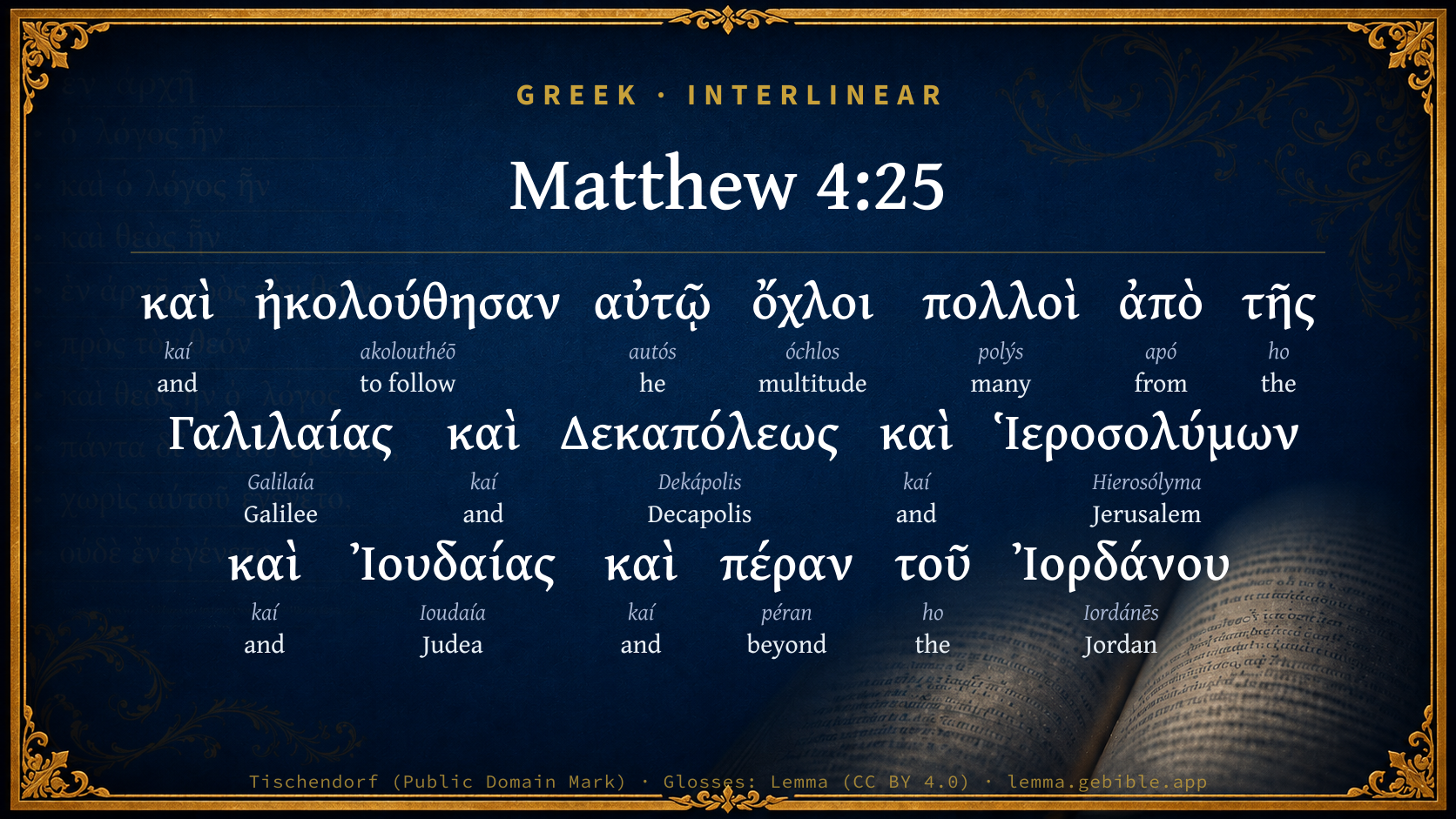
Greek (Tischendorf 8th ed.) Matthew 4:25 appears in the Greek New Testament. The text above is from the Tischendorf 8th edition. Each word links to its Strong’s number and a concise gloss. Click any word for its full Thayer’s Greek Lexicon entry.
Download image
Cite this verse

Matthew 4:25 (World English Bible). Public Domain. Lemma interlinear Bible study tool, https://lemma.gebible.app/v/matthew/4/25.

Show BibTeX & RIS
BibTeX
RIS
English Translation
Great multitudes from Galilee, Decapolis, Jerusalem, Judea and from beyond the Jordan followed him.
World English Bible · Public Domain
Highlights
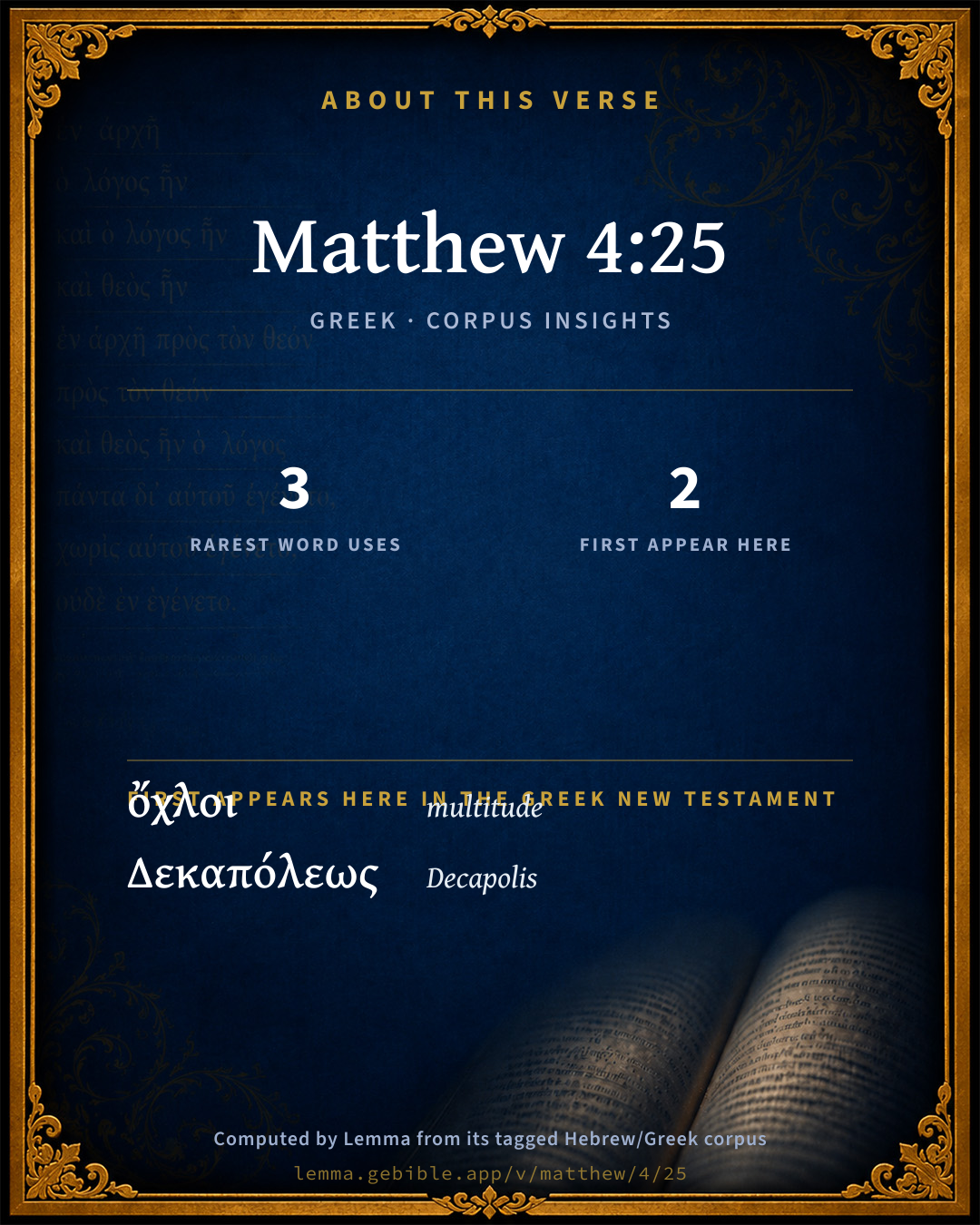
  • 2 first appearances in the Greek New Testament
Full analysis ↓
Download a study sheet

One document with this verse’s original text, its word-by-word gloss line, the meaning frame, cross-references with their text, attributed commentary, and full source and license credits — printable, and it pastes into notes with its structure intact.

This verse Autodidact and up

Study sheet (.html) Plain text (.txt)

A passage Seminary Student

Up to 50 verses in one chapter. A passage sheet keeps up to 6 commentary sources and 12 cross-references per verse, in the order this page ranks them, and says so on the sheet whenever that leaves anything out. Ask for a single verse and you get the Autodidact verse sheet above.

Everything on this page stays free to read, with no account — the sheet is a download of what is already on screen, not access to it.

Want to remove ads? Support Godless Engineer
Compare translations 3

The same verse in 3 English versions, stacked beneath the original-language interlinear above. Click any original word for its lexicon entry.

Each is an independent rendering of the whole verse — the interlinear is not word-aligned to these translations.

Highlighted words mark where these versions differ — a whole-verse word diff, not a word-by-word alignment.

  • World English Bible Public Domain
    Great multitudes from Galilee, Decapolis, Jerusalem, Judea and from beyond the Jordan followed him.
  • King James Version Public Domain
    And there followed him great multitudes of people from Galilee, and from Decapolis, and from Jerusalem, and from Judaea, and from beyond Jordan.
  • unfoldingWord Literal Text CC BY-SA 4.0
    And large crowds followed him from Galilee and Decapolis and Jerusalem and Judea and beyond the Jordan.

unfoldingWord Literal Text — © unfoldingWord, licensed CC BY-SA 4.0. Word-aligned USFM3 via Door43 (git.door43.org/unfoldingWord/en_ult).

Versions to compare (up to 4)

3 of 4 selected

Show all 19 translations

Every available English version of this verse, each an independent rendering of the whole verse.

  • World English Bible Public Domain
    Great multitudes from Galilee, Decapolis, Jerusalem, Judea and from beyond the Jordan followed him.
  • Berean Standard Bible Public Domain
    The large crowds that followed Him came from Galilee, the Decapolis, Jerusalem, Judea, and beyond the Jordan.
  • Majority Standard Bible Public Domain
    Large crowds followed Him, having come from Galilee, the Decapolis, Jerusalem, Judea, and beyond the Jordan.
  • King James Version Public Domain
    And there followed him great multitudes of people from Galilee, and from Decapolis, and from Jerusalem, and from Judaea, and from beyond Jordan.
  • American Standard Version (1901) Public Domain
    And there followed him great multitudes from Galilee and Decapolis and Jerusalem and Judaea and `from' beyond the Jordan.
  • Revised Version (1885) Public Domain
    And there followed him great multitudes from Galilee and Decapolis and Jerusalem and Judaea and from beyond Jordan.
  • Geneva Bible (1599) Public Domain
    And there folowed him great multitudes out of Galile, and Decapolis, and Hierusalem, and Iudea, and from beyond Iordan.
  • Douay-Rheims (1899) Public Domain
    And much people followed him from Galilee, and from Decapolis, and from Jerusalem, and from Judea, and from beyond the Jordan.
  • Young's Literal Translation Public Domain
    And there followed him many multitudes from Galilee, and Decapolis, and Jerusalem, and Judea, and beyond the Jordan.
  • Literal Standard Version CC BY-SA 4.0
    And there followed Him many multitudes from Galilee, and Decapolis, and Jerusalem, and Judea, and beyond the Jordan.
  • Unlocked Literal Bible CC BY-SA 4.0
    Large crowds followed him from Galilee, the Decapolis, Jerusalem, and Judea, and from beyond the Jordan.
  • unfoldingWord Literal Text CC BY-SA 4.0
    And large crowds followed him from Galilee and Decapolis and Jerusalem and Judea and beyond the Jordan.
  • Darby Bible Public Domain
    And great crowds followed him from Galilee, and Decapolis, and Jerusalem, and Judaea, and beyond the Jordan.
  • World Messianic Bible Public Domain
    Great multitudes from Galilee, Decapolis, Jerusalem, Judea, and from beyond the Jordan followed him.
  • Webster's Bible Public Domain
    And there followed him great multitudes of people from Galilee, and from Decapolis, and from Jerusalem, and from Judea, and from beyond Jordan.
  • Free Bible Version CC BY-SA 4.0
    Large crowds followed him from Galilee, Decapolis, Jerusalem, Judea, and the region beyond Jordan.
  • Bible in Basic English Public Domain
    And there went after him great numbers from Galilee and Decapolis and Jerusalem and Judaea and from the other side of Jordan.
  • Text-Critical English NT CC BY 4.0
    And large crowds followed him from Galilee, the Decapolis, Jerusalem, Judea, and from beyond the Jordan.
  • Tyndale New Testament (1534) Public Domain
    And ther folowed hym a greate nombre of people from Galile and from the ten cyties and from Ierusalem and from Iury and from the regions that lye beyonde Iordan.

Literal Standard Version (2020), Covenant Press — licensed CC BY-SA 4.0. Text via the HelloAO Bible API (eBible.org). Unlocked Literal Bible (unfoldingWord) — licensed CC BY-SA 4.0. Text via the HelloAO Bible API (eBible.org). unfoldingWord Literal Text — © unfoldingWord, licensed CC BY-SA 4.0. Word-aligned USFM3 via Door43 (git.door43.org/unfoldingWord/en_ult). Free Bible Version, Dr. Jonathan Gallagher — licensed CC BY-SA 4.0. Text via the HelloAO Bible API (eBible.org).

Word by word

More ways to search: Search by grammar → Find every occurrence → Compare this word →

Practice this passage: Drill this verse → Learn its vocabulary →

Δεκαπόλεως
Dekápolis
G1179
“Decapolis”
Noun, Genitive, Singular, Feminine
Part of Speech
Noun
Case
Genitive
Number
Singular
Gender
Feminine
Full Thayer's Definition

Origin: from G1176 and G4172

TDNT: None

Decapolis = "ten cities" 1. a track of land so called from the ten cities that were in it a. according to Pliny, these cities were: Damascus, Opoton, Philadelphia, Raphana, Scythopolis, Gadara, Hippondion, Pella, Galasa, and Canatha (Gill)
  1. καὶ kaí G2532 “and” Conjunction
  2. ἠκολούθησαν akolouthéō G190 “to follow” Verb, Aorist, Active, Indicative, 3rd person, Plural
  3. αὐτῷ autós G846 “he” Personal pronoun, Dative, Singular, Masculine
  4. ὄχλοι óchlos G3793 “multitude” Noun, Nominative, Plural, Masculine
  5. πολλοὶ polýs G4183 “many” Adjective, Nominative, Plural, Masculine
  6. ἀπὸ apó G575 “from” Preposition
  7. τῆς ho G3588 “the” Article, Genitive, Singular, Feminine
  8. Γαλιλαίας Galilaía G1056 “Galilee” Noun, Genitive, Singular, Feminine
  9. καὶ kaí G2532 “and” Conjunction
  10. καὶ kaí G2532 “and” Conjunction
  11. Ἱεροσολύμων Hierosólyma G2414 “Jerusalem” Noun, Genitive, Plural, Neuter
  12. καὶ kaí G2532 “and” Conjunction
  13. Ἰουδαίας Ioudaía G2449 “Judea” Noun, Genitive, Singular, Feminine
  14. καὶ kaí G2532 “and” Conjunction
  15. πέραν péran G4008 “beyond” Adverb
  16. τοῦ ho G3588 “the” Article, Genitive, Singular, Masculine
  17. Ἰορδάνου Iordánēs G2446 “Jordan” Noun, Genitive, Singular, Masculine

About this verse

These counts appear in no published source. They are computed here, from the morphology-tagged text and Lemma’s own curated glosses. What Lemma adds →

18
words
13
distinct lemmas
Gospels
section

Notable vocabulary

The rarest word here is Δεκαπόλεως Decapolis G1179 — appearing just 3 times in the whole Greek New Testament.

First appearance in Scripture

These words make their first canonical appearance in the Greek New Testament here:

  • ὄχλοι multitude G3793
  • Δεκαπόλεως Decapolis G1179

Shared distinctive vocabulary

Δεκαπόλεως Decapolis G1179 occurs in 3 verses of the Greek New Testament. Also found in:
Repetition

Words recur within this verse:

Cross-references

10

Topical passages linked to Matthew 4:25 in the Treasury of Scripture Knowledge — connected by theme and wording, ordered by reader-vote popularity; previews shown in the World English Bible.

  • Luke 6:17 He came down with them, and stood on a level place, with a crowd of his disciples, and a great number of the people from all Judea and Jerusalem, and the sea coast of Tyre and Sidon, who came to hear him and to be healed of their diseases;
  • Mark 5:20 He went his way, and began to proclaim in Decapolis how Jesus had done great things for him, and everyone marveled.
  • Mark 3:7–8 Jesus withdrew to the sea with his disciples, and a great multitude followed him from Galilee, from Judea,
  • Mark 7:31 Again he departed from the borders of Tyre and Sidon, and came to the sea of Galilee, through the midst of the region of Decapolis.
  • Matthew 5:1 Seeing the multitudes, he went up onto the mountain. When he had sat down, his disciples came to him.
  • Matthew 8:1 When he came down from the mountain, great multitudes followed him.
  • Matthew 12:15 Jesus, perceiving that, withdrew from there. Great multitudes followed him; and he healed them all,
  • Matthew 19:2 Great multitudes followed him, and he healed them there.
  • Mark 6:2 When the Sabbath had come, he began to teach in the synagogue, and many hearing him were astonished, saying, "Where did this man get these things?" and, "What is the wisdom that is given to this man, that such mighty works come about by his hands?
  • Luke 6:19 All the multitude sought to touch him, for power came out from him and healed them all.

Cross-references courtesy of OpenBible.info (CC BY 4.0).

Commentary

Notes on Matthew 4:25 from classic Christian and Jewish commentators (each source and its license shown beneath its notes). The classic Christian expositions comment on the surrounding passage and are grouped to its opening verse, so a note may address several verses; the Jewish commentaries on the Tanakh (Rashi and others) are per-verse, so they appear only where the commentator wrote on this verse.

Lemma curates 59 commentaries, every one of them public domain or Creative Commons licensed, each selected and text-cleaned for this edition rather than reprinted as found. About our sources →

Joseph Benson's Commentary

Mat 4:25. And there followed him great multitudes — Affected with the sight, or fame of his miracles, which was now very great, from Galilee — Its many and populous towns and villages. See note on Mat 4:15. From Decapolis — A tract of land on the east side of the sea of Galilee, which had its name from δεκα, ten, and πολις, a city, because it contained only ten cities, which were situated near each other, and formed into a distinct district, the metropolis of which was Damascus.

Joseph Benson's Commentary on the Old and New Testaments (1811–1818) — public domain. Text from a community e-Sword module.

Bengel's Gnomon

Johann Albrecht Bengel

Mat 4:25. Ὄχλοι, multitudes) The plural is used on account of the various places from which they came.—Δεκαπόκεως, from Decapolis)[165] situated on both sides of the Jordan. Samaria is not mentioned in this enumeration.—πέραν, beyond) i.e., ἀπὸ τῆς πέραν—from the country beyond.

[165] The region called Decapolis comprehended the ten cities of Scythopolis: Hippos, Gadara, Dios, Pella, Philadelphia, Gerasa, Canatha, Capitolias, and Abila.—W. Hughes.—(I. B.)

Bengel's Gnomon of the New Testament — English translation (T&T Clark, Edinburgh, 1860) — public domain. Text from a community e-Sword module.

Meyer's Critical & Exegetical Commentary

Heinrich August Wilhelm Meyer

Mat_4:25. Δεκαπόλεως] a strip of land with ten cities (Josephus, Vit. 9), chiefly inhabited by the heathen, on the other side of the Jordan, in the north-east of Palestine. As to the towns themselves, which were reckoned as included in it, and to which Scythopolis, Gadara, Hippo, and Pella certainly belonged, there was, so early as the time of Pliny (H. N. v. 16), no unanimity of opinion, Lightfoot, Hor. p. 563 ff.; Vaihinger in Herzog, III.; Holtzmann in Schenkels Bibellex.

πέραν τοῦ Ἰορδάνου] as in Mat_5:15, Mat_19:1, Mar_3:8, a geographical name: Peraea (Josephus, Bell. ix. 3. 3; Plin. v. 15), the land east of the Jordan, from Mount Hermon down to the river Arnon.

Meyer — Critical and Exegetical Commentary on the New Testament — English translation by Peter Christie, edited by Frederick Crombie (T&T Clark, 1880) — public domain. Text from a community e-Sword module.

Jamieson, Fausset & Brown

Robert Jamieson, A. R. Fausset & David Brown

And there followed him great multitudes of people from Galilee, and from Decapolis--a region lying to the east of the Jordan, so called as containing ten cities, founded and chiefly inhabited by Greek settlers.

and from Jerusalem, and from beyond Jordan--meaning from Perea. Thus not only was all Palestine upheaved, but all the adjacent regions. But the more immediate object for which this is here mentioned is, to give the reader some idea both of the vast concourse and of the varied complexion of eager attendants upon the great Preacher, to whom the astonishing discourse of the next three chapters was addressed. On the importance which our Lord Himself attached to this first preaching circuit, and the preparation which He made for it, see on Mar 1:35-39.

SERMON ON THE MOUNT.

That this is the same Discourse as that in Luke 6:17-49--only reported more fully by Matthew, and less fully, as well as with considerable variation, by Luke--is the opinion of many very able critics (of the Greek commentators; of CALVIN, GROTIUS, MALDONATUS--Who stands almost alone among Romish commentators; and of most moderns, as THOLUCK, MEYER, DE WETTE, TISCHENDORF, STIER, WIESELER, ROBINSON). The prevailing opinion of these critics is that Luke's is the original form of the discourse, to which Matthew has added a number of sayings, uttered on other occasions, in order to give at one view the great outlines of our Lord's ethical teaching. But that they are two distinct discourses--the one delivered about the close of His first missionary tour, and the other after a second such tour and the solemn choice of the Twelve--is the judgment of others who have given much attention to such matters (of most Romish commentators, including ERASMUS; and among the moderns, of LANGE, GRESWELL, BIRKS, WEBSTER and WILKINSON. The question is left undecided by ALFORD). AUGUSTINE'S opinion--that they were both delivered on one occasion, Matthew's on the mountain, and to the disciples; Luke's in the plain, and to the promiscuous multitude--is so clumsy and artificial as hardly to deserve notice. To us the weight of argument appears to lie with those who think them two separate discourses. It seems hard to conceive that Matthew should have put this discourse before his own calling, if it was not uttered till long after, and was spoken in his own hearing as one of the newly chosen Twelve. Add to this, that Matthew introduces his discourse amidst very definite markings of time, which fix it to our Lord's first preaching tour; while that of Luke, which is expressly said to have been delivered immediately after the choice of the Twelve, could not have been spoken till long after the time noted by Matthew. It is hard, too, to see how either discourse can well be regarded as the expansion or contraction of the other. And as it is beyond dispute that our Lord repeated some of His weightier sayings in different forms, and with varied applications, it ought not to surprise us that, after the lapse of perhaps a year--when, having spent a whole night on the hill in prayer to God, and set the Twelve apart, He found Himself surrounded by crowds of people, few of whom probably had heard the Sermon on the Mount, and fewer still remembered much of it--He should go over its principal points again, with just as much sameness as to show their enduring gravity, but at the same time with that difference which shows His exhaustless fertility as the great Prophet of the Church.

Next: Matthew Chapter 5

Jamieson, Fausset & Brown — Commentary Critical and Explanatory on the Whole Bible (1871) — public domain (CC PDM 1.0). Text via the HelloAO Bible API.

Adam Clarke's Commentary

Verse 25. This verse is immediately connected with the fifth chapter, and should not be separated from it.

Great multitudes] This, even according to the Jews, was one proof of the days of the Messiah: for they acknowledged that in his time there should be a great famine of the word of God; and thus they understood Amos, Am 8:11. Behold, the days come - that I will send a famine in the land, not a famine of bread - but of hearing the words of the Lord. And as the Messiah was to dispense this word, the bread of life, hence they believed that vast multitudes from all parts should be gathered together to him. See Schoettgenius on this place.

Decapolis] A small country, situated between Syria and Galilee of the nations. It was called Decapolis, δεκαπολις, from δεκα, ten, and πολις, a city, because it contained only ten cities; the metropolis, and most ancient of which, was Damascus.

From beyond Jordan.] Or, from the side of Jordan. Probably this was the country which was occupied anciently by the two tribes of Reuben and Gad, and the half tribe of Manasseh; for the country of Decapolis lay on both sides of the river Jordan. See Nu 32:5; Nu 32:33.

THE account of our Lord's temptation, as given by the evangelist, is acknowledged on all hands to be extremely difficult. Two modes of interpretation have been generally resorted to, in order to make the whole plain and intelligible: viz. the literal and allegorical. In all cases, where it can possibly apply, I prefer the first: the latter should never be used, unless obviously indicated in the text itself; or so imperiously necessary that no other mode of interpretation can possibly apply. In the preceding observations, I have taken up the subject in a literal point of view; and it is hoped that most of the difficulties in the relation have been removed, or obviated, by this plan. An ingenious correspondent has favoured me with some observations on the subject, which have much more than the merit of novelty to recommend them. I shall give an abstract of some of the most striking; and leave the whole to the reader's farther consideration.

The thoughts in this communication proceed on this ground: "These temptations were addressed to Christ as a public person, and respected his conduct in the execution of his ministry; and are reported to his Church as a forcible and practical instruction, concerning the proper method of promoting the kingdom of God upon earth. They are warnings against those Satanic illusions, by which the servants of Christ are liable to be hindered in their great work, and even stopped in the prosecution of it.

1. "As our Lord had, at his baptism, been declared to be the SON of God, i.e. the promised Messiah, this was probably well known to Satan, who did not mean to insinuate any thing to the contrary, when he endeavoured to engage him to put forth an act of that power which he possessed as the Messiah. The mysterious union of the Divine with the human nature, in our Lord's state of humiliation, Satan might think possible to be broken; and therefore endeavoured, in the first temptation, Command these stones to be made bread, to induce our Lord to put forth a separate, independent act of power; which our Lord repelled, by showing his intimate union with the Divine will, which he was come to fulfil - Man shall not live by bread alone, but by every word that proceedeth out of the mouth of God. Thus showing, as he did on another occasion, that it was his meat and drink to do the will of his Father.

"2. The ground of the temptation was then changed; and the fulfilment of the Divine will, in the completion of a prophetic promise, was made the ostensible object of the next attack. Cast thyself down - for it is WRITTEN, He will give his angels charge concerning thee, and in their hands shall they bear thee up, c. This our Lord repelled with - Thou shalt not tempt the Lord thy God-as Satan had designed to induce him to seek this public miraculous confirmation of God's peculiar care over him, as the promised Messiah, of his being which, according to the hypothesis above, Satan had no doubt. Moses, being appointed to a great and important work, needed miraculous signs to strengthen his faith but the sacred humanity of our blessed Lord needed them not; nor did his wisdom judge that such a sign from heaven was essential to the instruction of the people.

"3. The last temptation was the most subtle and the most powerful - All these will I give unto thee, if thou wilt fall down and worship me. To inherit all nations, had been repeatedly declared to be the birthright of the Messiah. His right to universal empire could not be controverted; nor could Satan presume to make the investiture. What, then, was his purpose? Satan had hitherto opposed, and that with considerable success, the kingdom of God upon earth; and what he appears to propose here, were terms of peace, and an honourable retreat. The worship which he exacted was an act of homage, in return for his cession of that ascendancy which, through the sin of man, he had obtained in the world. Having long established his rule among men, it was not at first to be expected that he would resign it without a combat: but the purpose of this last temptation appears to be an offer to decline any farther contest; and, yet more, if his terms were accepted, apparently to engage his influence to promote the kingdom of the Messiah. And as the condition of this proposed alliance, he required, not Divine worship, but such an act of homage as implied amity and obligation; and if this construction be allowed, he may be supposed to have enforced the necessity of the measure, by every suggestion of the consequences of a refusal. The sufferings which would inevitably result from a provoked opposition, which would render the victory, though certain to Christ himself, dearly bought; added to which, the conflict he was prepared to carry on through succeeding ages, in which all his subtlety and powers should be employed to hinder the progress of Christ's cause in the earth, and that with a considerable degree of anticipated success. Here the devil seems to propose to make over to Christ the power and influence he possessed in this world, on condition that he would enter into terms of peace with him; and the inducement offered was, that thereby our Lord should escape those sufferings, both in his own person, and in that of his adherents, which a provoked contest would ensure. And we may suppose that a similar temptation lies hid in the desires excited even in some of the servants of Christ, who may feel themselves often induced to employ worldly influence and power for the promotion of his kingdom, even though, in so doing, an apparent communion of Christ and Belial is the result: for it will be found that neither worldly riches, nor power, can be employed in the service of Christ, till, like the spoils taken in war, De 31:21-23, they have passed through the fire and water, as, without a Divine purification, they are not fit to be employed in the service of God and his Church.

"Hence we may conclude, that the first temptation had for its professed object, 1st, our Lord's personal relief and comfort, through the inducement of performing a separate and independent act of power. - The second temptation professed to have in view his public acknowledgment by the people, as the MESSIAH: for, should they see him work such a miracle as throwing himself down from the pinnacle of the temple without receiving any hurt, they would be led instantly to acknowledge his Divine mission; and the evil of this temptation may be explained, as seeking to secure the success of his mission by other means than those which, as the Messiah, he had received from the Father. Compare Joh 14:31. The third temptation was a subtle attempt to induce Christ to acknowledge Satan as an ally, in the establishment of his kingdom." E. M. B.

The above is the substance of the ingenious theory of my correspondent, which may be considered as a third mode of interpretation, partaking equally of the allegoric and literal. I still, however, think, that the nearer we keep to the letter in all such difficult cases, the more tenable is our ground, especially where the subject itself does not obviously require the allegorical mode of interpretation. Among many things worthy of remark in the preceding theory the following deserves most attention: That Satan is ever ready to tempt the governors and ministers of the Christian Church to suppose that worldly means, human policy, secular interest and influence, are all essentially necessary for the support and extension of that kingdom which is not of this world! Such persons can never long preserve hallowed hands: they bring the world into the Church; endeavour to sanctify the bad means they use, by the good end they aim at; and often, in the prosecution of their object, by means which are not of God's devising, are driven into straits and difficulties, and to extricate themselves, tell lies for God's sake. This human policy is from beneath - God will neither sanction nor bless it. It has been the bane of true religion in all ages of the world; and, in every country where the cause of Christianity has been established, such schemers and plotters in the Church of God are as dangerous to its interests as a plague is to the health of society. The governors and ministers of the Christian Church should keep themselves pure, and ever do God's work in his own way. If the slothful servant should be cast out of the vineyard, he that corrupts the good seed of the Divine field, or sows tares among the wheat, should be considered as an enemy to righteousness, and be expelled from the sacred pale as one who closes in with the temptation - "All these things (the kingdoms of the world, and the glory of them) will I give unto THEE, if thou wilt fall down and worship ME." However necessary the Church may be to the state, and the state to the Church, as some people argue, yet the latter is never in so much danger as when the former smiles upon it.

Adam Clarke's Commentary on the Bible (1810–1826) — public domain. Text from a community e-Sword/MySword module.

Ellicott's Commentary for English Readers

(25) Decapolis.—The district so named was formed by the Romans on their first conquest of Syria, B.C. 65, and, speaking roughly, included a tract of country east and south-east of the Sea of Galilee. The ten cities from which the region took its name are given by Pliny (v. 18)—though with the reservation that the list was given differently by others—as Scythopolis, Hippos, Gadara, Pella, Philadelphia, Gerasa, Dion, Canatha, Damascus, and Raphana. Of these Gadara (Mat_8:28; Mar_5:1; Luk_8:26), and in some MSS. of the first named passage, Gerasa, are the only two that occur in the Gospels. Damascus is prominent in the Acts, but the statement of Josephus (B. J. iii. 9, § 7), that Scythopolis was the largest of the ten towns, makes it almost certain that he did not include Damascus in the list.

A Bible Commentary for English Readers, edited by Charles John Ellicott (1878–1897) — public domain. Text from a community e-Sword module.

The Cambridge Bible for Schools and Colleges

gen. ed. J. J. S. Perowne

25. Decapolis] Lit. a group of ten cities. The cities included in this group are variously named by different authors, they lay to the E. and S. of the Sea of Galilee; by some Damascus is mentioned as belonging to the group.

The Cambridge Bible for Schools and Colleges (gen. ed. J. J. S. Perowne; Cambridge University Press, 1878–1918) — public domain. Text from a community e-Sword module.

Trapp's Complete Commentary

John Trapp

25 And there followed him great multitudes of people from Galilee, and from Decapolis, and from Jerusalem, and from Judaea, and from beyond Jordan.

Ver. 25. And there followed him great multitudes] A good housekeeper shall not (likely) want company. "O thou that hearest prayer" (and so solicitest suitors), "to thee shall all flesh come," Psa 65:2. Christ’s miracles drew multitudes after him then; and should still affect us with admiration and strong affection for the gospel, as the author to the Hebrews showeth, Heb 2:3-4.

John Trapp, A Commentary or Exposition upon All the Books of the Old and New Testament (1647–1656) — public domain. Text from a community e-Sword module.

Albert Barnes' Notes on the Bible

From Decapolis - Decapolis was the name of a region of country in the bounds of the half-tribe of Manasseh, mainly on the east of Jordan. It was so called because it included 10 cities - the meaning of the word Decapolis in Greek. Geographers generally agree that Scythopolis was the chief of these cities, and was the only one of them west of the Jordan; that Hippo (Hippos), Gadara, Dion (or Dios), Pelea (or Pella), Gerasa (or Gergesa), Philadelphia, and Raphana (or Raphanae), were seven of the remaining nine, and the other two were either Kanatha and Capitolias, or Damascus and Otopos. These cities were inhabited chiefly by foreigners (Greeks) in the days of our Saviour, and not by Jews. Hence, the keeping of swine by the Gergesenes Mat 8:30-33, which was forbidden by the Jewish law.

Albert Barnes' Notes on the Bible (1834–1885) — public domain. Text from a community e-Sword/MySword module.

Matthew Poole's English Annotations

They followed for the loaves, for the benefit of the bodily cures, or out of curiosity, though some (probably) followed him out of love, and to learn of him.

Decapolis hath its name from ten cities comprehended in it. Here was a mixture both of Jews and Gentiles following Christ, who came to be a Saviour of them both, and to pull down the partition wall between both, to make them both one gospel church, Eph 2:14.

Matthew Poole's English Annotations on the Holy Bible (1683–1685) — public domain. Text from a community e-Sword/MySword module.

Whedon's Commentary on the Bible

Daniel D. Whedon

25. Followed him great multitudes — How true to the life this picture is, the following passage will show. “The news that a foreign hakeem or doctor was passing through the country,” says Mosier, “very soon was spread abroad, and at every halt our camp was thronged with the sick, not only of the village near to which we were encamped, but of all the surrounding villages. Many came several days’ journey to consult our doctor, and were brought to him in spite of every difficulty and inconvenience. Some came on asses, bolstered up on cushions, and supported by their relations; others on camels, whose rough pace must have been torture to any one in sickness. It may be conceived what a misfortune sickness must be in a country where there is no medical relief, nor even a wheel conveyance to seek relief when it is at hand.” Our Lord, as a miraculous healer, as well as teacher, doubtless attracted, in a similar way, still greater crowds.

From Decapolis — Decapolis signifies the Ten Cities. These ten cities, including their rural territories, lay mostly on the east side of the Jordan, near Lake Gennesaret. Their names are differently given, and their numbers really appear to have varied at different times, amounting at one time to fourteen. They are commonly reckoned to be,

1. Damascus,

2. Philadelphia,

3. Raphana,

4. Scythopolis,

5. Gadara,

6. Hippos,

7. Dion,

8. Pella,

9. Galas,

10. Canatha.

But one of these, namely, Scythopolis, was situated in Galilee.

From beyond Jordan — From the Greek word περαν, peran, signifying beyond, the country beyond Jordan was called Perea. This name in its largest sense was applied to the whole strip of territory lying east of the Jordan, and bounded on the east by mountains, which divided it from Arabia Deserta. In its narrower sense, it designated the territory east of the Jordan, toward the south. According to Josephus, its northern limit was at Pella, its southern at Macheron, its east at Philadelphia, its west the Jordan.

This paragraph of the evangelist, beginning at Mat_4:12, gives a general view of our Lord’s ministry during its period in Galilee. It properly succeeds the account of the temptation by which our Lord was proved and perfected for the work. It also well prepares the way for the great summary of his moral doctrines contained in the Sermon on the Mount, which he now sets before us.

It is well remarked by Mr. Stanley, that the scene of the main events of the first three Gospels was in Galilee, while that of the fourth was mainly in Jerusalem. These three, then, he calls the Galilean Gospels.

Daniel D. Whedon (gen. ed.), Commentary on the Old and New Testaments (1874–1909) — public domain. Text from a community e-Sword module.

The Pulpit Commentary

The mention of the multitudes here serves as a transition to the sermon on the mount. The description of the constituent pairs of the multitudes is very similar to that found in Mar_3:7, 8, and is probably derived from the same source, Mark preserving in most respects the fuller form. Great multitudes; ocloi polloi ; (not "many multitudes," but as plural of oclov poluv , Mat_20:29) almost (Luk_5:15) peculiar to this Gospel. (Mat_8:1, where see note Mat_8:18, Received Text; Mat_12:15, Received Text; Mat_13:2 Mat_15:30 Mat_19:2) Decapolis. A kind of confederacy, originally of ten towns, the organization being apparently the work of Pompey. All were east of Jordan except Bethshan (Scythopolis). The names, as given in Pliny, are Damascus, Philadelphia, Raphana, Scythopolis, Gadara, Hippus, Dium, Pella, Galasa (read Gerasa), Kanatha. Schurer adds, Abila (not Abila of Lysanias) and Kanata (distinct from Kanatha). These towns, like the great maritime cities, e.g. Joppa, and Caesarea Stratonis, were independent political communities, which at least, after the time of Pompey were never internally blended into an organic unity with the Jewish region, but were at most externally united with it under the same ruler" (Schurer, II 1. p. 121). The population in them was chiefly heathen. Across Jordan; equivalent to Peraea, as in ver. 15 and Mat_19:1, i.e. from Mount Hermon to the river Arnon (Weiss-Meyer); but according to Josephus, ("Bell. Jud:," 3:3:3) between the rivers Jabbok and Amen (Alford). "The country east of Jordan was known as Peraea (the country beyond) in the wider sense, but Peraea proper was the small district extending from the river Amen (Mojib) to the Zerka, and now called Belka" (Socin"s "Baedeker," p. 54). To the places mentioned here as those whence people came, Mark adds Idumaea; Mark and Luke add Tyre and Sidon.

The Pulpit Commentary (1880–1919), ed. H.D.M. Spence-Jones & Joseph S. Exell — public domain. Text from a community e-Sword module.

John Wesley's Explanatory Notes

Decapolis - A tract of land on the east side of the sea of Galilee, in which were ten cities near each other.

John Wesley, Explanatory Notes Upon the Whole Bible (1754–1765) — public domain. Text via the GEBible commentary corpus.

Kretzmann's Popular Commentary

Paul E. Kretzmann

With His fame grew the number of His followers:

v. 25. And there followed Him great multitudes of people from Galilee, and from Decapolis, and from Jerusalem, and from Judea, and from beyond Jordan.

The extraordinary impression which this Prophet of Nazareth created was not confined to Galilee. People came from Decapolis, the southern part of Gaulanitis, southeast of Lake Gennesaret, whose population was predominantly Grecian. They thought nothing of the long journey from the extreme South, from haughty Judea, from exclusive Jerusalem, from far-distant Perea, beyond the Jordan from Judea. All wanted to see and hear the man whose miracles were astounding the nation.

Summary.Jesus, having successfully withstood the temptation of the devil after His forty-day fast, entered upon His Galilean ministry of teaching, preaching, and healing, Peter, Andrew, James, and John being His first disciples.

Paul E. Kretzmann, Popular Commentary of the Bible (1921–1924) — public domain. Text from a community e-Sword module.

Burkitt's Expository Notes on the New Testament

William Burkitt

Observe here, How affecting our Saviour’s ministry was at first: multitudes throng after him; they come from all parts to attend upon his ministry, when he first began to preach among them. His ministers find it thus also; at their first coming amongst a people, their labours are most acceptable, and they do most good: our people’s affections are then warmest, and our own zeal perhaps is then greatest. Happy is that minister that improves all opportunities and advantages for the good of souls: "for he that winneth souls is wise."

William Burkitt's Expository Notes on the New Testament (1700–1703) — public domain. Text from a community e-Sword module.

The People's New Testament

B. W. Johnson

25. Great multitudes from Galilee. The fame of his teaching and miracles caused great multitudes to gather from all Palestine. Decapolis. A district containing ten cities east of the Jordan and the Sea of Galilee. Notice, in the ministry of Jesus, (1) He was active; (2) He went where people were; (3) He went where the busiest people were—fisherman, those at work, Simon and Andrew—those preparing to work, James and John; (4) He went where worshiping people were; (5) He went where needy people were.

B. W. Johnson's The People's New Testament with Notes (1889–1891) — public domain. Electronic text from the Christian Classics Ethereal Library (CCEL) ThML edition.

Cambridge Greek Testament for Schools and Colleges

25. Δεκάπολις, a group of ten cities. The cities included in this group are variously named by different authors, they lay to the E. and S. of the Sea of Galilee; by some Damascus is mentioned as belonging to the group. See map.

For the form of the word cp. Herod. I. 144, κατάπερ οἱ ἐκ τῆς Πενταπόλιος νῦν χώρης Δωριέες, πρότερον δὲ Ἑξαπόλιος τῆς αὐτῆς ταύτης καλεομένης.

Cambridge Greek Testament for Schools and Colleges (Cambridge University Press, 1896; 21 vols, various authors incl. Carr, Maclear, Plummer, Farrar, Lumby, Moule, M. R. James, Simcox) — public domain. Text from a community e-Sword module.

Alford’s Greek Testament

Henry Alford

25. Δεκαπόλεως] A district principally east of the Jordan, so called from ten cities, some of the names of which are uncertain. Pliny (Nat. Hist. v. 18) says, “Jungitur ei lateri Syriæ Decapolitana regio, a numero oppidorum, in quo non omnes eadem observant. Plurimi tamen Damascum.… Philadelplhiam, Raphanam, omnia in Arabiam recedentia; Scythopolin … Gadara … Hippon, Dion, Pellam.… Galasam, Canatham.” Josephus appears not to include Damascus in Decapolis, for he calls Scythopolis μεγίστη τῆς Δεκαπόλεως (B. J. iii. 9. 7): and Cellarius thinks Cæsarea Philippi and Gergesa should be substituted for Damascus and Raphana. See Mar 7:31.

πέραν τ. Ἰορδ.] Peræa. The country east of the Jordan, between the rivers Jabbok and Arnon. See Jos. B. J. iii. 3. 3.

Henry Alford, The Greek Testament (1849–1861) — public domain. Text from a community e-Sword module.

International Critical Commentary

25. ὄχλοι πολλοί] the plural is characteristic of Mt. He has the plural ὄχλοι about 30 times, the singular 16 times. Mk. has the singular about 37 times, the plural once.1. In Lk. the numbers are more equally balanced.

Δεκαπόλεως] occurs twice in Mk. For its history, see Schürer, II. i, 94; DB., art. “Decapolis.”

Ἰεροσολύμων] is here treated as a neuter plural. In 2:3 it is fem. sing. The aspirated form is apparently due to association with ἱερός. Cf. West. and Hort, Introduction2, p. 313; Blass, p. 31. Mk. and Mt. (except in 23:37) always have this form. Cf. Blass, p. 31.—πέραν τοῦ Ἰορδάνου] is the עֵבֶר חַיַרְדֵּן the Mishna, and the Peræa of Josephus. For its extent, see Schürer, 11. i. 3, 4; DB., art. “Peræa.”

The reason why the editor now gives his illustration of Christ’s teaching before that of His work is probably to be found in the next verse of Mk., viz. 1:22, which describes the effect of Christ’s preaching. He therefore here inserts the Sermon on the mountain, 5-7:27, and closes it with this verse from Mar 1:22 = Mat 7:27, Mat 7:28.

M the Second Gospel.

X passages in which Mt. and Lk. agree closely, borrowed from an unknown source or sources.

Dalm. Dalman.

LXX. The Septuagint Version.

1 The editor (or his source) either had προσκυνήσεις (rather than φοβηθήσῃ = Heb. חירא) in his copy of the LXX., or has substituted it for φοβηθήση to emphasize the antithesis with προσκυνήσης of v. 5. Cf. Introduction, p. xxxi.

S Syriac version: Sinaitic MS.

al i.e. with other uncial MSS.

S Syriac version: Curetonian.

O quotations from the Old Testament borrowed from a collection of Messianic prophecies. See pp.61 f.

Deissm. Deissmann.

Ditt. Dittenberger Sylloge.

Hor. Syn. Horœ Synopticœ (Hawkins).

Ox. Pap. Oxyrhynchus Papyri.

E editorial passages.

1 10:l, but D S1 latt have the singular also here

DB. Dictionary of the Bible (Hastings).

2 On the Sermon on the Mount, see especially the article of Votaw in DB., Extra Volume, pp. 1ff.

International Critical Commentary — older volumes (1896–1929), various authors — public domain. Text from a community e-Sword module.

Lesson kit

Teaching starters — assembled from the data on this page, not authored interpretation. Every prompt links to the verse data it draws on. Edit before teaching.

Matthew, in the Gospels, opens this verse with 18 words (13 distinct Greek lemmas). Its most distinctive word is Dekápolis (“Decapolis”). A historical commentator’s framing appears above. Read the whole chapter for the surrounding context.

Discussion questions

  1. The word Dekápolis carries the sense “Decapolis.” How does it shape the verse?
  2. 2 words make their first appearance in Scripture here. What does this debut establish?
  3. How does Mark 5:20, which shares the word «Decapolis», read alongside this verse?
  4. What does the repetition of “and” (5× in this one verse) do in this verse?
  5. These translations render this verse differently; the difference is in the English rendering, not the original. What questions does that raise?
  6. Compare how Joseph Benson's Commentary and Bengel's Gnomon read this verse. Where do they agree or differ?

Things to notice

  • 2 words make their first canonical appearance in Scripture here.
  • These translations choose different wording for 8 words in this verse.
  • “and” occurs 5× in this single verse.
  • 13 distinct Greek lemmas span 18 words in this verse.

Reading settings

Reading text

Shown beneath each verse's original-language words.

Old Testament
Old Testament edition

Read the OT as the Masoretic Hebrew (MT) or the Greek Septuagint (LXX).

English shown for the Greek Septuagint (in the Hebrew ↔ Greek comparison).

Comparing translations? Open the Compare panel on any verse page to stack up to four side by side.