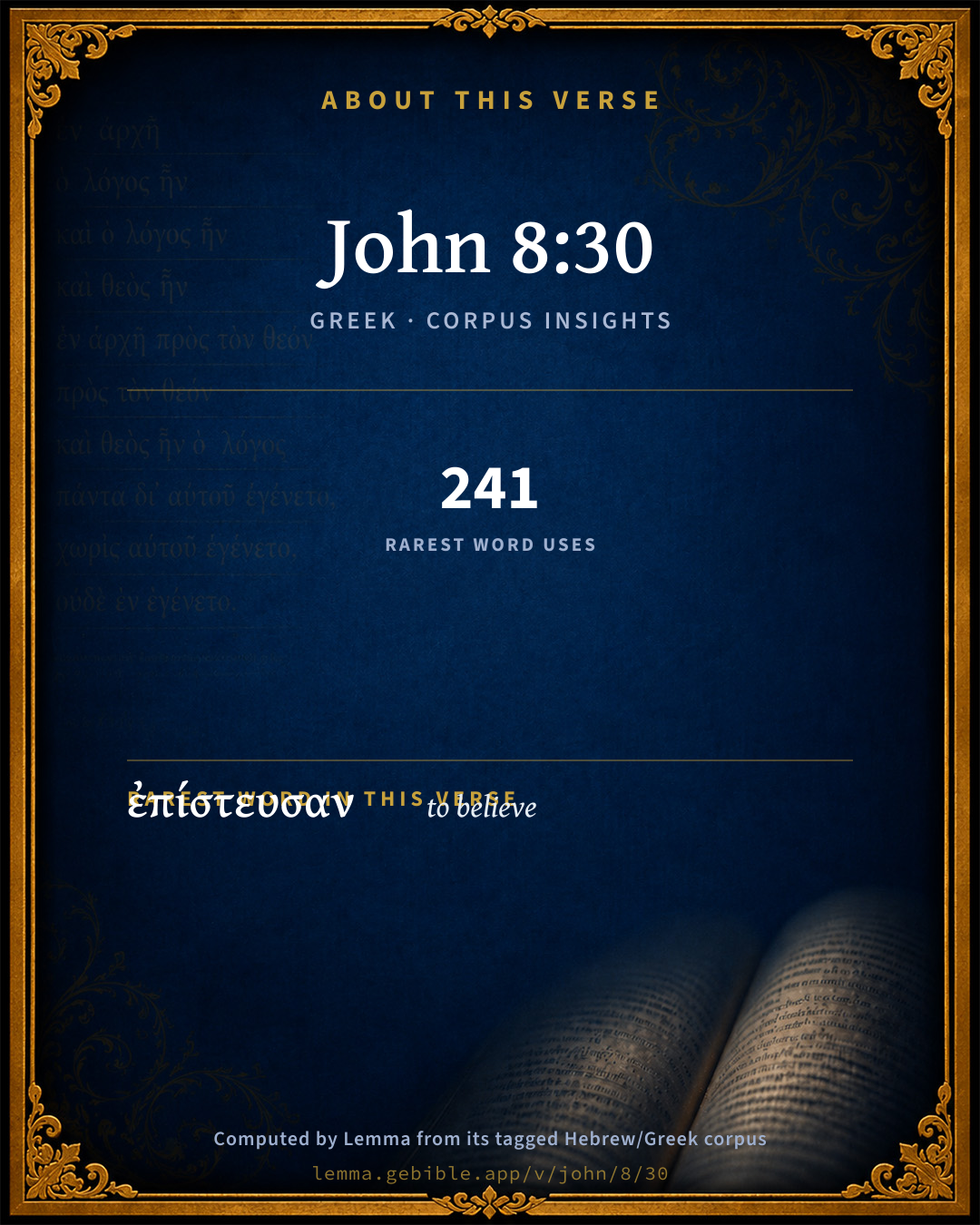
John 8:30

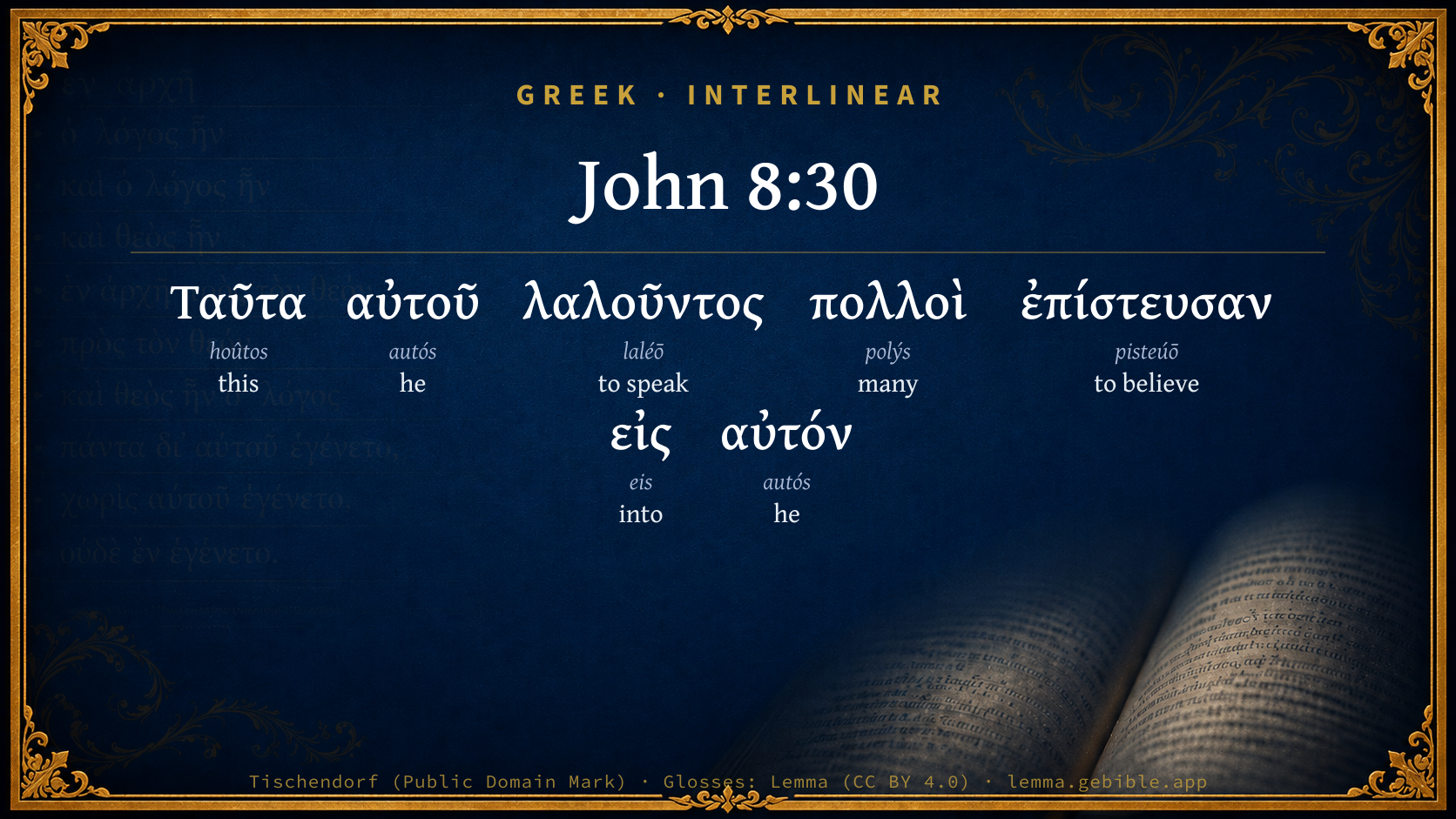
Greek (Tischendorf 8th ed.) John 8:30 appears in the Greek New Testament. The text above is from the Tischendorf 8th edition. Each word links to its Strong’s number and a concise gloss. Click any word for its full Thayer’s Greek Lexicon entry.
Download image
Cite this verse

John 8:30 (World English Bible). Public Domain. Lemma interlinear Bible study tool, https://lemma.gebible.app/v/john/8/30.

Show BibTeX & RIS
BibTeX
RIS
English Translation
As he spoke these things, many believed in him.
World English Bible · Public Domain
Download a study sheet

One document with this verse’s original text, its word-by-word gloss line, the meaning frame, cross-references with their text, attributed commentary, and full source and license credits — printable, and it pastes into notes with its structure intact.

This verse Autodidact and up

Study sheet (.html) Plain text (.txt)

A passage Seminary Student

Up to 50 verses in one chapter. A passage sheet keeps up to 6 commentary sources and 12 cross-references per verse, in the order this page ranks them, and says so on the sheet whenever that leaves anything out. Ask for a single verse and you get the Autodidact verse sheet above.

Everything on this page stays free to read, with no account — the sheet is a download of what is already on screen, not access to it.

Want to remove ads? Support Godless Engineer
Compare translations 3

The same verse in 3 English versions, stacked beneath the original-language interlinear above. Click any original word for its lexicon entry.

Each is an independent rendering of the whole verse — the interlinear is not word-aligned to these translations.

Highlighted words mark where these versions differ — a whole-verse word diff, not a word-by-word alignment.

  • World English Bible Public Domain
    As he spoke these things, many believed in him.
  • King James Version Public Domain
    As he spake these words, many believed on him.
  • unfoldingWord Literal Text CC BY-SA 4.0
    he is speaking these things, many believed in him.

unfoldingWord Literal Text — © unfoldingWord, licensed CC BY-SA 4.0. Word-aligned USFM3 via Door43 (git.door43.org/unfoldingWord/en_ult).

Versions to compare (up to 4)

3 of 4 selected

Show all 19 translations

Every available English version of this verse, each an independent rendering of the whole verse.

  • World English Bible Public Domain
    As he spoke these things, many believed in him.
  • Berean Standard Bible Public Domain
    As Jesus spoke these things, many believed in Him.
  • Majority Standard Bible Public Domain
    As Jesus spoke these things, many believed in Him.
  • King James Version Public Domain
    As he spake these words, many believed on him.
  • American Standard Version (1901) Public Domain
    As he spake these things, many believed on him.
  • Revised Version (1885) Public Domain
    As he spake these things, many believed on him.
  • Geneva Bible (1599) Public Domain
    As hee spake these thinges, many beleeued in him.
  • Douay-Rheims (1899) Public Domain
    When he spoke these things, many believed in him.
  • Young's Literal Translation Public Domain
    As he is speaking these things, many believed in him;
  • Literal Standard Version CC BY-SA 4.0
    As He is speaking these things, many believed in Him;
  • Unlocked Literal Bible CC BY-SA 4.0
    As Jesus was saying these things, many believed in him.
  • unfoldingWord Literal Text CC BY-SA 4.0
    he is speaking these things, many believed in him.
  • Darby Bible Public Domain
    As he spoke these things many believed on him.
  • World Messianic Bible Public Domain
    As he spoke these things, many believed in him.
  • Webster's Bible Public Domain
    As he spoke these words, many believed on him.
  • Free Bible Version CC BY-SA 4.0
    Many who heard Jesus say these things put their trust in him.
  • Bible in Basic English Public Domain
    When he said this a number came to have faith in him.
  • Text-Critical English NT CC BY 4.0
    As he was saying these things, many believed in him.
  • Tyndale New Testament (1534) Public Domain
    Then sayde Iesus to those Iewes which beleved on him. If ye continue in my wordes then are ye my very disciples

Literal Standard Version (2020), Covenant Press — licensed CC BY-SA 4.0. Text via the HelloAO Bible API (eBible.org). Unlocked Literal Bible (unfoldingWord) — licensed CC BY-SA 4.0. Text via the HelloAO Bible API (eBible.org). unfoldingWord Literal Text — © unfoldingWord, licensed CC BY-SA 4.0. Word-aligned USFM3 via Door43 (git.door43.org/unfoldingWord/en_ult). Free Bible Version, Dr. Jonathan Gallagher — licensed CC BY-SA 4.0. Text via the HelloAO Bible API (eBible.org).

Word by word

More ways to search: Search by grammar → Find every occurrence → Compare this word →

Practice this passage: Drill this verse → Learn its vocabulary →

ἐπίστευσαν
pisteúō
G4100
“to believe”
Verb, Aorist, Active, Indicative, 3rd person, Plural
Part of Speech
Verb
Tense
Aorist
Voice
Active
Mood
Indicative
Person
3rd person
Number
Plural
Full Thayer's Definition

Origin: from G4102

TDNT: 08:54,8

1. to think to be true, to be persuaded of, to credit, place confidence in a. of the thing believed 1. to credit, have confidence b. in a moral or religious reference 1. used in the NT of the conviction and trust to which a man is impelled by a certain inner and higher prerogative and law of soul 2. to trust in Jesus or God as able to aid either in obtaining or in doing something: saving faith 1bc) mere acknowledgment of some fact or event: intellectual faith 2. to entrust a thing to one, i.e. his fidelity a. to be intrusted with a thing
  1. Ταῦτα hoûtos G3778 “this” Demonstrative pronoun, Accusative, Plural, Neuter
  2. αὐτοῦ autós G846 “he” Personal pronoun, Genitive, Singular, Masculine
  3. λαλοῦντος laléō G2980 “to speak” Verb, Present, Active, Participle, Genitive, Singular, Masculine
  4. πολλοὶ polýs G4183 “many” Adjective, Nominative, Plural, Masculine
  5. εἰς eis G1519 “into” Preposition
  6. αὐτόν autós G846 “he” Personal pronoun, Accusative, Singular, Masculine

About this verse

These counts appear in no published source. They are computed here, from the morphology-tagged text and Lemma’s own curated glosses. What Lemma adds →

7
words
6
distinct lemmas
Gospels
section

Repetition

A word recurs within this verse:

  • αὐτοῦ he G846 ×2

Cross-references

5

Topical passages linked to John 8:30 in the Treasury of Scripture Knowledge — connected by theme and wording, ordered by reader-vote popularity; previews shown in the World English Bible.

  • John 7:31 But of the multitude, many believed in him. They said, "When the Christ comes, he won't do more signs than those which this man has done, will he?"
  • John 2:23 Now when he was in Jerusalem at the Passover, during the feast, many believed in his name, observing his signs which he did.
  • John 6:14 When therefore the people saw the sign which Jesus did, they said, "This is truly the prophet who comes into the world."
  • John 10:42 Many believed in him there.
  • John 11:45 Therefore many of the Jews, who came to Mary and saw what Jesus did, believed in him.

Cross-references courtesy of OpenBible.info (CC BY 4.0).

Commentary

Notes on John 8:30 from classic Christian and Jewish commentators (each source and its license shown beneath its notes). The classic Christian expositions comment on the surrounding passage and are grouped to its opening verse, so a note may address several verses; the Jewish commentaries on the Tanakh (Rashi and others) are per-verse, so they appear only where the commentator wrote on this verse.

Lemma curates 59 commentaries, every one of them public domain or Creative Commons licensed, each selected and text-cleaned for this edition rather than reprinted as found. About our sources →

Joseph Benson's Commentary

Joh 8:30-32. As he spake these words, many believed on him — Believed that he was the Messiah, and were strongly inclined to follow him as such. Some have supposed that the ambiguity of the expression, in Joh 8:28, (When you have lifted up the Son of man,) induced those here spoken of to believe him to be the Messiah; supposing that it intimated an exaltation to some temporal authority and power. “Hearing him speak,” says Dr. Macknight, “of a temporal kingdom, as they supposed, they began now to think that he entertained some sentiments worthy of the Messiah; and on that account acknowledged him as such.” But surely it is much more reasonable to suppose, from the evangelist’s affirming that they believed on him, without giving any intimation that their faith was in any respect erroneous, and especially from what Jesus says to them in the next verse, that they really had felt their hearts impressed with what they heard from him in the preceding discourse, and were induced to believe on him with a true and saving faith, by the dignity and force attending his words on this occasion. Then Jesus — Knowing the weakness of human nature, the deceitfulness of the human heart, and the difficulties which they would meet with, if they attempted to act according to their present inclinations and purposes; said to those which believed on him — And were now ready to profess their faith; If ye continue in my word — Continue to attend on my instructions, and believe and obey them; then are ye my disciples indeed — And I will finally own you as such; and ye shall know the truth — The whole truth comprehended in my gospel, as far as is necessary or conducive to your salvation, or to your holiness, usefulness, or comfort; and the truth shall make you free — Shall put you in possession of that state of glorious liberty which it is the privilege of my disciples to enjoy. Our Lord meant, that the instructions of his word, accompanied with the illumination of his Spirit, would remove their prejudices, correct their errors, enlarge their views, and by giving them the full assurance of understanding in the doctrine of the gospel, would scatter their doubts, bring satisfaction, peace, and serenity to their minds; and also that it would free them from the slavery of sin and Satan, the love of the world, and the lusts of the flesh, and all the consequences thereof; and even from the yoke of the ceremonial law, under which they at present groaned, from the spirit of bondage, and the tormenting fear of death.

Joseph Benson's Commentary on the Old and New Testaments (1811–1818) — public domain. Text from a community e-Sword module.

MacLaren's Expositions of Holy Scripture

Alexander MacLaren

John

THREE ASPECTS OF FAITH

Joh 8:30 - Joh 8:31.

The Revised Version accurately represents the original by varying the expression in these two clauses, retaining ‘believed on Him’ in the former, and substituting the simple ‘believed Him’ in the latter. The variation in two contiguous clauses can scarcely be accidental in so careful a writer as the Apostle John. And the reason and meaning of it are obvious enough on the face of the narrative. His purpose is to distinguish between more and less perfect acceptance of Jesus Christ. The more perfect is the former, ‘they believed on Him’; the less perfect is the latter, the simple acceptance of His word on His claim of Messiahship, which is stigmatised as shallow, and proved to be transient by the context.

They were ‘Jews’ which believed, and they continued to be so whilst they were believing. Now, the word ‘Jew’ in this Gospel always connotes antagonism to Jesus Christ; and as for these persons, how slight and unreliable their adhesion to the Lord is, comes out in the course of the next few verses; and by the end of the chapter they are taking up stones to stone Him. So John would show us that there is a kind of acceptance which may be real, and may be the basis of something much better hereafter, but which, if it does not grow, rots and disappears; and he would draw a broad line of distinction between that and the other mental act, far deeper, more wholesome, more lasting and vital, which he designates as ‘believing on Him.’ I take these words, then, for consideration, not so much to deal with other thoughts suggested by them, as because they afford me a starting-point for the consideration of the various phases of the act of believing, its blessings and its nature, and its relation to its objects, which are expressed in the New Testament by the various grammatical connections and constructions of this word.

Now, the facts with which I wish to deal may be very briefly stated. There are three ways in which the New Testament represents the act of believing, and its relation to its Object, Christ. These three are, first, the simple one which appears in the text as ‘believed Him.’ Then there is a second, which appears in two forms, slightly different, but which, for our purpose, may be treated as substantially the same-’believing on Him.’ And then there is a third, which, literally and accurately translated is, ‘believing unto’ or ‘into Him.’ That phrase is John’s favourite one, and rather unfortunately, though perhaps necessarily, it has been generally rendered by our translators by the less forcible ‘believing in,’ which gives the idea of repose in, but does not give the idea of motion towards. These three, then, I think, do set forth, if we will ponder them, very large lessons as to the essence of this act of believing, as to the Object upon which it fastens, and as to the blessings which flow from it, which it will be worth our while to consider now. I may cast the whole into the shape of three exhortations: believe Him, believe on Him, believe unto Him.

I. First, then, believe Christ.

We accept a man’s words when we trust the man. Even if belief, or faith, is represented in the New Testament, as it very rarely is, as having for its object the words of revelation, behind that acceptance of the words lies confidence in the person speaking. And the beginning of all true Christian faith has in it, not merely the intellectual acceptance of certain propositions as true, but a confidence in the veracity of Him by whom they are made known to us-even Jesus Christ our Lord.

I do not need to insist upon that at any length here-it would take me away from my present purpose; but what I do wish to emphasise is, that from the very starting-point, the smallest germ of the most rudimentary and imperfect faith which knits a soul to Jesus Christ has Him for its Object, and is thus distinguished from the mere acceptance of truths which, on other grounds than the authority of the speaker, may legitimately commend themselves to a man.

Then believe Him. Now, that breaks up into two thoughts, which are all that I intend to deduce from it now, although many more might be suggested. The one is this, that the least and the lowest that Jesus Christ asks from us is the entire and unhesitating acceptance of His utterances as final, conclusive, and absolutely true. Whatever more Jesus Christ may be, He is, by His life and words, the Communicator of divine and certain truth. He is a Teacher, though He is a great deal more. And whatever more Christian faith may be-and it is a great deal more-it requires, at least, the frank and full recognition of the authority of every word that comes from His lips. A Christianity without a creed is a dream. Bones without flesh are very dry, no doubt; but what about flesh without bones? An inert, shapeless mass. You will never have a vigorous and true Christian life if it is to be moulded according to the fantastic dream of these latter days, which tells us that we may take Jesus as the Guide of our conduct and need not mind about what He says to us. ‘Believe Me’ is His requirement. The words of His mouth, and the revelations which He has made in the sweetness of His life, and in all the graciousness of His dealings, are the very unveiling to man of absolute and final and certain truth.

But then, on the other hand, let us remember that, while all this is most clear and distinct in the teaching of Scripture, it carries us but a very short way. We find, in the instance from which we take our starting-point in this sermon, the broad distinction drawn, and practically illustrated in the conduct of the persons concerned, between the simple acceptance of what Christ says, and a true faith that clings to Him for evermore. And the same kind of disparagement of the lower process of merely accepting His word is found more than once in connection with the same phrases. We find, for instance, the two which are connected in our texts used in a previous conversation between our Lord and His antagonists. When He says to them, ‘This is the work of God, that ye believe on Him whom He hath sent,’ they reply, dragging down His claim to a lower level, ‘What sign showest Thou, that we may see, and believe Thee?’ He demanded belief on Himself; they answer, ‘We are ready to believe you, on condition that we see something that may make the rendering of our belief a logical necessity for us.’

Let us lay to heart the rudimentary and incomplete character of a faith which simply accepts the teaching of Jesus Christ, and does no more. The notion that orthodoxy is Christianity, that a man who does not contradict the teaching of the New Testament is thereby a Christian, is a very old and very perilous and very widespread one. There are many of us who have no better claim to be called Christians than this, that we never denied anything that Jesus Christ said, though we are not sufficiently interested in it, I was going to say, even to deny it. This rudimentary faith, which contents itself with the acceptance of the truth revealed, hardens into mere formalism, or liquefies into mere careless indifference as to the very truth that it professes to believe. There is nothing more impotent than creeds which lie dormant in our brains, and have no influence upon our lives. I wonder how many readers of this sermon, who fancy themselves good Christians, do with their creed as the Japanese used to do with their Emperor-keep him in a palace behind bamboo screens, and never let him do anything, whilst all the reality of power was possessed by another man, who did not profess to be a king at all. Do you think you are Christians because you would sign thirty-nine or three hundred and ninety articles of Christianity, if they were offered to you, while there is not one of them that influences either your thinking or your conduct? Do not let us have these ‘sluggish kings,’ with a mayor of the place to do the real government, but set on the throne of your hearts the principles of your religion, and see to it that all your convictions be translated into practice, and all your practice be informed by your convictions.

This belief in a set of dogmas, on the authority of Jesus Christ, about which dogmas we do not care a rush, and which make no difference upon our lives, is the faith about which James has so many hard things to say; and he ventures upon a parallel that I should not like to venture on unless I were made bold by his example: ‘Thou believest, O vain man! thou doest well: the devils also believe, and’-better than you, in that their belief does something for them, they ‘believe-and tremble!’ But what shall we say about a man who professes himself a disciple, and neither trembles, nor thrills, nor hopes, nor dreads, nor desires, nor does any single thing because of his creed? Believe Jesus, but do not stop there.

II. Believe on Christ.

Now, as I have remarked already, and as many of you know, there is a slightly different, twofold form of this phrase in Scripture. I need not trouble you with the minute distinction between the one and the other. Both forms coincide in the important point on which I wish to touch. That representation of believing on Christ carries us away at once from the mere act of acceptance of His word on His authority to the far more manifestly voluntary, moral, and personal act of reliance upon Him. The metaphor is expanded in various ways in Scripture, and instead of offering any thoughts of my own about it, I would simply ask attention to three of the forms in which it is set forth in the Old and in the New Testaments.

The first of them, and the one which we may regard as governing the others, is that found in the words of Isaiah, ‘Behold, I lay in Zion a stone, a sure Foundation’; and, as the Apostle Peter comments, ‘He that believeth on Him shall not be confounded.’ There the thoughts presented are the superposition of the building upon its Foundation, the rest of the soul, and the rearing of the life on the basis of Jesus Christ.

How much that metaphor says to us about Him as the Foundation, in all the aspects in which we can apply that term! He is the Basis of our hope, the Guarantee of our security, the Foundation-stone of our beliefs, the very Ground on which our whole life reposes, the Source of our tranquillity, the Pledge of our peace. All that I think, feel, desire, wish, and do, ought to be rested upon that dear Lord, and builded on Him by simple faith. By patient persistence of effort rearing up the fabric of my life firmly upon Him, and grafting every stone of it-if I might so use the metaphor-into the bedding-stone, which is Christ, I shall be strong, peaceful, and pure.

The storm comes, the waters rise, the winds howl, the hail and the rain ‘sweep away the refuge of lies,’ and the dwellers in these frail and foundationless houses are hurrying in wild confusion from one peak to another, before the steadily rising tide. But he that builds on that Foundation ‘shall not make haste,’ as Isaiah has it; shall not need to hurry to shift his quarters before the flood overtake him; shall look out serene upon all the hurtling fury of the wild storm, and the rise of the sullen waters. So, reliance on Christ, and the honest making of Him the Basis, not of our hopes only, but of our thinkings and of our doings, and of our whole being, is the secret of security, and the pledge of peace.

Then there is another form of the same phrase, ‘believing on,’ in which is suggested not so much the figure of building upon a foundation, as of some feeble man resting upon a strong stay, or clinging to an outstretched and mighty arm. The same metaphor is implied in the word ‘reliance.’ We lean upon Christ when, forsaking all other props, and realising His sufficiency and sweetness, we rest the whole weight of our weariness and all the impotence of our weakness upon His strong and unwearied arm, and so are saved. All other stays are like that one to which the prophet compares the King of Egypt-the papyrus reed in the Nile stream, on which, if a man leans, it will break into splinters which will go into his flesh, and make a poisoned wound. But if we lean on Christ, we lean on a brazen wall and an iron pillar, and anything is possible sooner than that that stay shall give.

There is still another form of the metaphor, in which neither building upon a foundation, nor leaning upon a support which is thought of as below what rests upon it, are suggested, but rather the hanging upon something firm and secure which is above what hangs from it. The same picture is suggested by our word ‘dependence.’ ‘As a nail fastened in a sure place,’ said one of the prophets, ‘on Him shall hang all the glory of His Father’s house.’

‘Hangs my helpless soul on Thee.’

The rope lowered over the cliffs supports the adventurous bird-nester in safety above the murmuring sea. They who clasp Christ’s hand outstretched from above, may swing over the deepest, most vacuous abyss, and fear no fall.

So, brother, build on Christ, rely on Him, depend on Him, and it shall not be in vain. But if you will not build on the sure Foundation, do not wonder if the rotten one gives way. If you will not lean on the strong Stay, complain not when the weak one crumbles to dust beneath your weight. And if you choose to swing over the profound depth at the end of a piece of pack-thread, instead of holding on by an adamantine chain wrapped round God’s throne, you must be prepared for its breaking and your being smashed to pieces below.

III. The last exhortation that comes out of this comparative study of these phrases is-Believe into Christ.

That is a very pregnant and remarkable expression, and it can scarcely, as you see, be rendered into our language without a certain harshness; but still it is worth while to face the harshness for the sake of getting the double signification that is involved in it. For when we speak of believing unto or into Him, we suggest two things, both of which, apparently, were in the minds of the writers of the New Testament. One is motion towards, and the other is repose in, that dear Lord.

So, then, true Christian faith is the flight of the soul towards Christ. Therein is one of the special blessednesses of the Christian life, that it has for its object and aim absolutely infinite and unattainable completeness and glory, so that unwearied freshness, inexhaustible buoyancy, endless progress, are the dower of every spirit that truly trusts in Christ. All other aims and objects are limited, transient, and will be left behind. Every other landmark will sink beneath the horizon, where so many of our landmarks have sunk already, and where they will all disappear when the last moment comes. But we may have, and if we are Christian people we shall have, bright before us, sufficiently certain of being reached to make our efforts hopeful and confident, sufficiently certain of never being reached to make our efforts blessed with endless aspirations, the great light and love of that dear Lord, to yearn after whom is better than to possess all besides, and following hard after whom, even in the very motion there is rest, and in the search there is finding. Religion is the flight of the soul, the aspiration of the whole man after the unattainable Attainable-’that I may know Him, and be found in Him.’

Oh, how such thoughts ought to shame us who call ourselves Christians! Growth, progress, getting nearer to Christ, yearning ever with a great desire after Him!-do not the words seem irony when applied to most of us? Think of the average type of sluggish contentment with present attainments that marks Christian people-tortoises in their crawling rather than eagles in their flight. And let us take our portion of shame, and remember that the faith which believes Him, and that which believes on Him, both need to be crowned and perfected by that which believes towards Him, of which the motto is, ‘Forgetting the things that are behind, I reach forward to the things that are before.’

But there is another side to this last phase of faith. That true believing towards or unto Christ is the rest of the soul in Him. By faith that deep and most real union of the believing soul with Jesus Christ is effected which may be fitly described as our entrance into and abode in Him. The believer is as if incorporated into Him in whom he believes. Indeed, the Apostle ventures to use a more startling expression than incorporation when he says that ‘he that is joined to the Lord is one Spirit.’ If by faith we press towards, by faith we shall be in, Christ. Faith is at once motion and rest, search and finding, desire and fruition. The felicity of this last form of the phrase is its expression of both these ideas, which are united in fact as in word. A rare construction of the verb to believe, with the simple preposition in, coincides with this part of the meaning of believing unto or into, and need not be separately considered.

With this understanding of its meaning, we see how natural is John’s preference for this construction. For surely, if he has anything to tell us, it is that the true Christian life is a life enclosed, as it were, in Jesus Christ. Nor need I remind you how Paul, though he starts from a different point of view, yet coincides with John in this teaching. For, to him, to be ‘in Christ’ is the sum of all blessedness, righteousness, peace, and power. As in an atmosphere, we may dwell in Him. He may be the strong Habitation to which we may continually resort. One of the Old Testament words for trusting means taking refuge, and such a thought is naturally suggested by this New Testament form of expression. ‘I flee unto Thee to hide me.’ In that Fortress we dwell secure.

To be in Jesus, wedded to Him by the conjunction of will and desire, wedded to Him in the oneness of a believing spirit and in the obedience of a life, to be thus in Christ is the crown and climax of faith, and the condition of all perfection. To be in Christ is life; to be out of Him is death. In Him we have redemption; in Him we have wisdom, truth, peace, righteousness, hope, confidence. To be in Him is to be in heaven. We enter by faith. Faith is not the acceptance merely of His Word, but is the reliance of the soul on Him, the flight of the soul towards Him, the dwelling of the soul in Him. ‘Come, My people, into thy chambers, and shut thy doors about thee . . . until the indignation be overpast.’

Alexander MacLaren, Expositions of Holy Scripture (1904–1910) — public domain. Text from a community e-Sword module.

Godbey's Commentary on the New Testament

William B. Godbey

DEGREES OF FAITH

Joh 8:30-32. “He speaking these words, many believed on Him. Then Jesus said to the Jews who had believed on Him, If you may abide in My Word you are truly My disciples; you shall know the truth, and the truth shall make you free.” We see from the context that these Jews, addressed in these verses, had but a vague, shadowy faith in Him, believing that He was an extraordinary messenger sent of God, a prophet, and might perhaps, in the end, prove to be the Christ who is to redeem Israel. O how the Churches of the present day abound in this superficial, carnal belief in Christ, which staggers at the promises, failing in their appropriation!

William B. Godbey, Commentary on the New Testament (1896–1900) — public domain. Text from a community e-Sword module.

Tyndale Open Study Notes

Tyndale Open Resources

8:30 Once again, the festival audience was divided. Earlier, the debate concluded with plans to arrest Jesus (8:20). Now many . . . believed in him, convinced that he was telling the truth. However, once Jesus’ full identity was disclosed their faith was sorely challenged (8:31-59).

Tyndale Open Study Notes — © Tyndale Open Resources, licensed CC BY-SA 4.0. Text via the HelloAO Bible API.

Meyer's Critical & Exegetical Commentary

Heinrich August Wilhelm Meyer

Joh_8:30-32. The opening of a new section in the discourse, but not first on the following day (Godet), which must then have been indicated as in Joh_8:12; Joh_8:21.

Notice the separation of the persons in question. The πολλοί are many among His hearers in general; among these πολλοί there were also Jewish hierarchs, and because He knew how fleeting and impure was their momentary faith,[21] Jesus addresses to them the words in Joh_8:31-32, which at once had the effect of converting them into opponents; hence there is no inconsistency in His treatment of His hearers.

πεπιστ. αὐτῷ] previously ἘΠΊΣΤ. ΕἸς ΑὐΤΌΝ. The latter was the consequence of their having believed Him, i.e. His words.

ἐὰν ὑμεῖς, etc.] if you on your part, etc.; for they were mixed up with the unbelieving crowd, and by means of ὑμεῖς are selected from it as the persons to whom the admonition and promise are addressed. They are to abide in the word of Jesus, that is, as in the permanent element of their inner and outer life. For another form of the conception, see Joh_8:38; Joh_15:7; Joh_12:47. Comp. 2Jn_1:9.

ἀληθεῶς] really, not merely in appearance, after being momentarily carried away.

γνώσεσθε τ. ἀλήθ.] for divine truth is the content of the λόγος of Christ, Christ Himself is its possessor and vehicle; and the knowledge of it, therefore, first commences when a man believes, inasmuch as the knowledge is the inwardly experienced, living, and moral intelligence of faith (Joh_17:17; 1Jn_1:3 ff.).

ἐλευθερ.] from the slavery, i.e. from the determining power, of sin. See Joh_8:34; Rom_6:18 ff. Ea libertas est, quae pectus purum et firmum gestitat (Ennius, fr. 340). Divine truth is conceived as the causa medians of that regeneration and sanctification which makes him morally free who is justified by faith. Comp. Rom_8:2; Jam_1:20; Jam_2:12.

[21] Mere susceptibility to salvation is not termed Faith by John, as Messner (Lehre der Ap. p. 349) assumes in reference to this passage. Also not in Joh_6:69, or 1Jn_4:16.

Meyer — Critical and Exegetical Commentary on the New Testament — English translation by Peter Christie, edited by Frederick Crombie (T&T Clark, 1880) — public domain. Text from a community e-Sword module.

Expositor's Greek Testament

ed. W. Robertson Nicoll

Joh 8:30 . ταῦτα … αὐτόν . “As He spake these things many believed on Him,” not only believed what He said, but accepted Him as the Messenger of God. The statement closes one paragraph and prepares for the next, in which it is shown what this faith amounted to (Holtzmann).

The Expositor's Greek Testament, edited by W. Robertson Nicoll (1897–1910) — public domain. Text from a community e-Sword module.

Godet's Commentaries

Frédéric Louis Godet

4. “I and you”: 8:30-59.

Jesus, in His second discourse (Joh 8:12-20) attributed to Himself two modes of teaching: testimony, by which He reveals His origin, His mission, His work, and judgment, by which He unveils the moral state of His hearers. In this sense He had also said, Joh 8:26 : “I have yet many things to say and to judge concerning you.” These more severe judgments which Jesus bore in His mind respecting the moral state of His people, we find expressed in the first section of the following discourse; it is judgment reaching its culminating point (Joh 8:30-50): you are not free; you are not children of Abraham; you are not children of God, but of the devil. Such are the severe judgments which are gradually introduced in the conversation between Jesus and even the least ill- disposed of His hearers. The second part is that of testimony. Jesus rises to His greatest height: He is the destroyer of death; He is before Abraham (Joh 8:51-59).

ADDITIONAL NOTES BY THE AMERICAN EDITOR.

Vv. 30-50.

1. Whether the words of Jesus contained in these verses were spoken on the same day as those which precede (Meyer) or on the following day (Godet)—Weiss says correctly that this point cannot be determined—there is apparently a close connection between the two passages. Many believed in consequence of what He had just said. Of these some were of the leading Jewish party, the ᾿Ιουδαῖοι, but these latter were believers only in a sense corresponding with that indicated in Joh 2:23 ff. Jesus, therefore, takes up the thought of the preceding verses, and tells them that, in order to their being His disciples in the real sense of the word and their having a real knowledge of the truth, they must abide in His word—i.e., they must believe that He is the one sent from above, and must inwardly live in the sphere of those teachings which, having heard from God, He speaks to the world.

2. The peculiar additional idea, beyond the preceding, which characterizes these verses, is that of freedom. This idea becomes the starting-point of the conversation and discourse which follow. Whether it was designedly introduced as a test of the reality of their faith, or was incidental to the development of His thought respecting the truth which He revealed, cannot be determined. Possibly it was intended to connect His thought with the idea of freedom from the Roman dominion, which so greatly occupied the minds of the Jews at the time; but all that can be confidently affirmed is, that the Jews here referred to understood it at first in the political sense.

3. The connection of the verses points strongly towards the Jews who believed Him as the subject of the verb answered in Joh 8:33. If this is the correct understanding of the writer’s meaning, it must be inferred that their belief was of the most superficial character, and this case shows that the author uses the verb πιστεύειν even of the lowest degree of belief in Jesus. The different stages of development indicated by this word, in this Gospel, are very noticeable, and, when carefully observed, they throw light upon the author’s plan.

4. The explanation of the words We have never been in bondage to any one, which is given by Godet, is favored by Weiss, and is perhaps the best one which can be given.

5. In Joh 8:37 Jesus addresses these persons as if they were seeking to kill Him. There is a difficulty in supposing that the believing Jews were now desiring to kill Him, but the Jewish party to which they belonged were undoubtedly forming their plans with this end in view. It is possible that He classes them with their party, not because He saw a feeling of this kind in their hearts at the moment, but because this was the feeling of those with whom they had acted, and He saw that they would return to a union with them when their superficial and temporary faith failed.

6. The contrast between the readiness to receive and abide in the truth and the state of mind in which the Jews are is continued throughout this entire passage. They would not believe that He was the one sent from above to speak the words of God (Joh 8:24). They would not abide in the word which, as such a Divine messenger, He spoke (Joh 8:31). They were even seeking to kill Him because He thus spoke the truth (Joh 8:40). They showed thus that they were slaves of sin and children of the devil, and, as they were resolved to continue as they now were, they would die in their sins (Joh 8:21). There is, thus, a manifest unity in the discourse, and the allusions to bondage and fatherhood are only for the purpose of more clearly and emphatically bringing out the ideas suggested in Joh 8:21 ff. This unity favors, but does not absolutely prove, that Joh 8:30-50 are to be placed on the same day with Joh 8:21-29.

7. There is evidently a turn of thought in Joh 8:41 ff., both on the part of the Jews and of Jesus—from their relation to Abraham to their relation to God. The transition is through the words ἡμεῖς ἐκ πορνείας οὐ γεγεννήμεθα . These words, it will be observed, are contrasted with ἕνα πατέρα ἔχομεν τὸν θεόν, and are also evidently connected with the denial on Jesus’ part that Abraham was their father. The true understanding of the passage therefore must, as it would seem, be found in connection with this twofold reference. As He denies their sonship to Abraham, they think that He may refer to sonship in another than the natural sense. But they did not conceive of their sonship in this other sense, except through their descent from Abraham. Hence they say, We are not other than real and legitimate children of Abraham, and therefore we are in the true and most direct sense children of God.

8. The words ἐκ τοῦ θεοῦ ἐξῆλθον indicate pre-existence, and, like the other expressions which Jesus uses of Himself in this discourse, as coming from and revealing the Father, they carry us back in thought to Joh 1:18. These expressions move forward, as we may say, towards Joh 8:58, where the pre-existence is most distinctly declared.

9. The tendency of opinion among the most recent commentators is very strongly towards referring the phrase “He was a murderer from the beginning” to the introduction of death into the world through sin (Rom 5:12). The argument for this view is derived from ἀπ᾿ ἀρχῆς; from the fact that the discourse in general has reference to the truth and the moral sphere and relationships; from the fact that the ψευστής of Joh 8:44 points most naturally to Satan’s deception of our first parents; and from the somewhat similar passage, 1Jn 3:18. The reference to the murder of Abel by Cain (de Wette, Lucke, and others) is favored by 1Jn 3:12; by the fact that this reference of the words makes what is said of Satan exactly correspond with what is charged upon the Jews—opposition to the truth and the desire of actual murder; and by the fact that the murder of Abel was the first one in history.

10. The last clause of Joh 8:44 is most simply explained by making αὐτοῦ refer to ψεῦδος . Westcott proposes, as a more probable translation, “Whenever a man speaketh a lie, he speaketh of his own, for his father also is a liar”—“that is, a man by lying reveals his parentage, and acts conformably with it.” This, however, involves an altogether improbable, not to say violent, change of subject from that of the immediately preceding sentence.—11. In closing this part of His discourse, Jesus appeals again to His own truthfulness and freedom from sin and self-seeking, as proving His claim that He is from God (Joh 8:45-49).

Vv. 30-32. “As Jesus spoke thus, many believed on him. 31. Jesus therefore said to those Jews who had become believers on him: If you abide in my word, you shall be really my disciples, 32 and you shall know the truth, and the truth shall make you free.”

The term “believed” designates here undoubtedly the disposition, openly expressed, to acknowledge Jesus as the Messiah. In this quite considerable number of believers, there were perhaps some members of the Sanhedrim; Joh 12:42 : “Many of the rulers believed on him.” They perceived indeed that, in the words which Jesus had just uttered, there was something else than a vain boast. But Jesus is no more dazzled by this apparent success than he had been by the confession of Nicodemus (Joh 3:1-2), and by the enthusiasm of the Galilean multitude (Joh 6:14-15). Instead of treating these new believers as converts, He puts them immediately to the test by addressing to them a promise which, notwithstanding its greatness, presents a profoundly humiliating side. It is thus that Jesus often acts. At once, the one whose faith is only superficial stumbles at the holiness of the new word and falls; the one whose conscience has been laid hold of perseveres and penetrates farther into the essence of things. The particle therefore in Joh 8:31, sums up in a word the connection of ideas which we have just developed.

This new scene can scarcely have taken place on the same day with the preceding. Joh 8:31 is explained in the most natural way by holding that those of the stranger pilgrims who had believed had departed on the day after the feast, and that, at this moment, Jesus was surrounded only by believing hearers who had until then belonged to the Jewish party. We are surprised, at the first glance, to meet in this gospel a connection of words such as Jews who had become believers. But this contradictio in adjecto is intentional on the part of the author; it is even the key of the following passage. These believers, at the foundation, belonged to the party of the adversaries; they were indeed still really Jews; they continued to share in the Messianic aspirations of the nation; only they were disposed to recognize in Jesus the man who had the mission to satisfy these aspirations. Theirs was nearly the condition of mind of the Galilean multitude, at the beginning of chap. 6. Undoubtedly, these Jewish believers were not all of the πολλοί, many, of the preceding verse, but only a group among them, as Weiss and Westcott think. In the view of the latter, the difference between the two limiting words, αὐτῷ, him, and εἱς αὐτόν, on him, Joh 8:30, is explained even by this fact. But the meaning seems to me rather: They believed on him (as the Messiah) because they for a moment put confidence in His word (him).

The nature of the promise made in Joh 8:31-32, is admirably fitted to the end which Jesus proposes to Himself. He knows that emancipation from the Roman yoke is the great work which is expected of the Messiah; He therefore spiritualizes this hope, and presents it under this more elevated form to the heart of the believers. The pronoun ὑμεῖς, you, has as its aim to contrast these new disciples with the unbelieving multitude. According to Weiss, this word serves rather to place them in opposition to the true believers among the πολλοί; but this distinction was not sufficiently marked. We might also see here a contrast with the early disciples. The first sense is the most natural. The expression to abide in contains the idea of persevering docility. There will be for this rising faith obstacles to be overcome. The Word will find in their hearts inveterate prejudices; a relapse into unbelief is therefore for them, though believers, a serious danger. By this figure: to abide in, the revelation contained in the word of Jesus is compared to a fertile soil in which true faith must be rooted ever more deeply in order to thrive and bear fruit.

Frédéric Louis Godet — Commentaries on Luke, John, Romans, and 1 Corinthians — English translation (T&T Clark, Edinburgh, 1870s–1890s) — public domain. Text from a community e-Sword module.

Jamieson, Fausset & Brown

Robert Jamieson, A. R. Fausset & David Brown

As he spake these words, many believed on him--Instead of wondering at this, the wonder would be if words of such unearthly, surpassing grandeur could be uttered without captivating some that heard them. And just as "all that sat in the council" to try Stephen "saw his face"--though expecting nothing but death--"as it had been the face of an angel" (Act 6:15), so may we suppose that, full of the sweet supporting sense of His Father's presence, amidst the rage and scorn of the rulers, a divine benignity beamed from His countenance, irradiated the words that fell from Him, and won over the candid "many" of His audience.

Jamieson, Fausset & Brown — Commentary Critical and Explanatory on the Whole Bible (1871) — public domain (CC PDM 1.0). Text via the HelloAO Bible API.

Adam Clarke's Commentary

Verse 30. As he spake these words, many believed on him.] The same sun that hardens the clay softens the wax. This discourse, which proved the savour of death unto death to the obstinate Pharisees, became the savour of life unto life to many of the simple-hearted people.

Adam Clarke's Commentary on the Bible (1810–1826) — public domain. Text from a community e-Sword/MySword module.

John Calvin's Commentaries

30. While he spoke these things. Though the Jews, at that time, almost resembled a dry and barren soil, yet God did not permit the seed of his word to be entirely lost. Thus, contrary to all hopes, and amidst so many obstructions, some fruit appears. But the Evangelist inaccurately gives the name of faith to that which was only a sort of preparation for faith For he affirms nothing higher concerning them than that they were disposed to receive the doctrine of Christ, to which also the preceding warning refers.

John Calvin's Commentaries (1540-1563) — public domain. Text from the Calvin Translation Society English edition (1840s-50s) via the Christian Classics Ethereal Library (ccel.org). Calvin's coverage is partial (roughly two-thirds of the Bible); uncommented books and verses are honest gaps, never fabricated. The 19th-century editor's footnotes and remarks are omitted so the notes are faithfully Calvin's own voice.

Ellicott's Commentary for English Readers

(30) Many believed on him.—Wonder has often been expressed at the want of apprehension spoken of in Joh_8:27. There is surely no less room for wonder in the faith spoken of here. Those who believe are of the rulers (“those Jews,” Joh_8:31). The words which they now heard (Joh_8:28-29) contain nothing of what we commonly call proof. They are an appeal to the future which should prove them true, and to His own consciousness of perfect obedience to the Father’s will, and of unbroken realisation of the Father’s presence. They are indeed, in part, words which men have since dwelt upon to prove that He who uttered them did not claim to be divine. It was not so with those who heard Him. They are watching for a technical assertion of His divinity, and do not hear it; but they are convinced by the power of His words that He is divine. (Comp. Note on Joh_7:31.) These scribes and Pharisees feel, as their officers felt before, that “Never man spake like this Man.” Where was priest or Rabbi who could appeal to the spotless purity of a life? There is the irresistible power of truth in the appeal which carries conviction to the heart. We have already found in the case of Nicodemus an example, probably not a solitary one, of a faith among the rulers which dared not confess itself. (See also Joh_12:42.)

A Bible Commentary for English Readers, edited by Charles John Ellicott (1878–1897) — public domain. Text from a community e-Sword module.

The Cambridge Bible for Schools and Colleges

gen. ed. J. J. S. Perowne

30. many believed on him] Nothing exasperated His opponents so much as His success; and therefore in leading us on to the final catastrophe, the Evangelist carefully notes the instances in which He won, though often only for a time, adherents and believers. See on Joh_6:15. Among these ‘many’ were some of the hierarchy (Joh_8:51). Their faith, poor as it proves, is better than that of the many in Joh_2:23; belief that results from teaching is higher than that which results from miracles. Jesus recognises both its worth and its weakness, and applies a test, which might have raised it to something higher, but under which it breaks down.

The Cambridge Bible for Schools and Colleges (gen. ed. J. J. S. Perowne; Cambridge University Press, 1878–1918) — public domain. Text from a community e-Sword module.

John Gill's Exposition

They answered him,.... Not the believing Jews, whom he peculiarly addressed, but the unbelieving Jews, who were present, and heard these things:

we be Abraham's seed; this the Jews always valued themselves upon, and reckoned themselves, on this account, upon a level with the nobles and the princes of the earth.

"Says R. Akiba (c), even the poor of Israel are to be considered as if they were , "noblemen", that are fallen from their substance, because they are the children of Abraham, Isaac, and Jacob;''

and were never in bondage to any man; which is a very great falsehood, for it was declared to Abraham himself, that his seed should serve in a land not theirs, and be afflicted four hundred years, as they were; and as the preface to the law which the Jews gloried in shows, which says, that the Lord their God brought them out of Egypt, out of the house of bondage; and they were frequently overcome by their neighbours, the Moabites, Ammonites, and Philistines, and reduced to servitude under them, until delivered by one judge, or another: and not to take notice of their seventy years' captivity in Babylon, they were at this very time under the Roman yoke, and paid tribute to Caesar; and yet such was the pride of their hearts, they would not be thought to be in bondage; and therefore, with an haughty air, add,

how sayest thou, ye shall be made free? when they thought themselves, and would fain have been thought by others, to have been free already, and so to stand in no need of being made free.

(c) Misn. Bava Kama, c. 8. sect. 6. & T. Bab. Bava Kama, fol. 86. 1. & 91. 1.

John Gill's Exposition of the Whole Bible (1746–1763) — public domain (CC PDM 1.0). Text via the HelloAO Bible API.

Trapp's Complete Commentary

John Trapp

30 As he spake these words, many believed on him.

Ver. 30. Many believed on him] {See Trapp on "Joh 7:31"}

Abideth not in the house] Is not heir of the promises; though it be ordinary with such praesumendo sperare, et sperando perire (as one saith), to presume and perish.

John Trapp, A Commentary or Exposition upon All the Books of the Old and New Testament (1647–1656) — public domain. Text from a community e-Sword module.

Albert Barnes' Notes on the Bible

Many believed on him - Such was the convincing nature and force of the truths which he presented, that they believed he was the Messiah and received his doctrine. While there were many that became more obstinate and hardened under his preaching, there were many, also, who by the same truth were made penitent and believing. “The same sun that hardens the clay, softens the wax” (Clarke).

Albert Barnes' Notes on the Bible (1834–1885) — public domain. Text from a community e-Sword/MySword module.

Matthew Poole's English Annotations

Believing on him is not here to be understood strictly of saving faith; but rather, of some preparations toward it: they began to believe that he was the true Messias, and to have more honourable thoughts than they had of him: that this was all, will appear from what we find in the following verses; and believing often signifieth no more in the New Testament than a light assent given to some propositions of the gospel relating to Christ.

Matthew Poole's English Annotations on the Holy Bible (1683–1685) — public domain. Text from a community e-Sword/MySword module.

Whedon's Commentary on the Bible

Daniel D. Whedon

30. Many believed—Induced by the new hope that he was soon to be lifted up to a kingly throne.

Daniel D. Whedon (gen. ed.), Commentary on the Old and New Testaments (1874–1909) — public domain. Text from a community e-Sword module.

The Pulpit Commentary

As he spake these words, many believed on him. This is another interjected comment or connecting link supplied by the evangelist, revealing intimate knowledge of the state of feeling and changeful emotions of the people. Another hint of the eyewitness and ear witness of this memorable scene; and, supposing that we read here a correct transcript of words that proceeded from his lips, we can do no ether than cry with Thomas, "My Lord, and my God!" The remark is intercalated, as though St. John wished to emphasize the accuracy with which he had reported, on this occasion, the very words of his Lord, conveying their ambiguous phrase, and asserting in fresh form what had convinced St. John, on subsequent reflection, that he was what he said. The phrase, pisteuein eiv , to believe in or on, a person, is to close with him, to accept all the collateral consequences of such trust, to be content to wait for fuller explanation, to east self upon the object of faith, and allow the object of such trust to bear all the responsibility of the act. It is the form most frequently adopted by St. John; (Joh_2:11 Joh_3:16, Joh_3:18, 36 4:39, and many other places; cf. Joh_14:1, 12 17:20) only once in the synoptic narrative. (Mat_18:6 with Mar_9:42) The form pisteuein epi occurs occasionally with the accusative; (1Jn_3:23, and frequently in the Acts) and pisteuein epi with the dative, also! pisteuein en , are used, implying even a closer and more intimate communion still with the Object of faith. (see Joh_16:30) With these forms must be compared the more common one with the simple dative, pisteuein tini , which occurs in vers. 31, 45, and Joh_14:11, etc., which implies acceptance of the saying, promise, or fact there propounded, and falls short of the moral surrender involved in the fuller form. John here asserts that many of his hearers, those who had hitherto refrained from full acceptance of Jesus as the Son of God, yielded to his claims there and then. This faith on the part of "some" is almost more wonderful than the unbelief of others. The difficulties in their way were appalling in comparison with the perplexities which beset our minds. The Lord appealed to his own inner consciousness, to his supernatural aid in speech, to the spotless, sinless character of his hidden life. It was remarkable that any strangers or enemies should have surrendered themselves to them. The event shows that the surrender could not stand the test.

Vers. 30-32. The bondage of the Jews, and the source of true liberty.

The effect of the previous discourse was remarkable.

I THE INTELLECTUAL ACCEPTANCE OF JESUS BY THE JEWS. "As he spake these words, many believed on him." They accepted his statements, and believed him to be the Messiah. They were not, however, true believers, because Jesus afterwards represents them as seeking to kill him (ver. 37).

II THE COUNSEL OF OUR LORD TO THE NEW CONVERTS. "If ye continue in my Word, then are ye my disciples indeed; and ye shall know the truth, and the truth shall make you free.

1. The necessity of steadfastness in the truth.

(1) It is implied that obstacles would have to be overcome. Satan is ever at hand to pluck the good seed of the Word out of the heart. The strength of Jewish prejudice would mass itself against the truth.

(2) Steadfastness is a condition of discipleship. The words of Christ imply the first rude beginnings of faith. It implies that Christ"s Word has come with power, and has a place in their hearts.

2. The blessed privilege of steadfast disciples. "And ye shall know the truth, and the truth shall make you free.

(1) The truth being the element in which the Christian lives, there is in his abiding in it a guarantee for fuller knowledge. "In thy light shall we see light." While others should be ever learning and never able to come to the knowledge of the truth, the Christian receives a larger knowledge is led into all truth, and sees more of the beauty and glory of Christ.

(2) The truth gives true freedom.

(a) This was more than freedom from Roman rule, which was expected to fall with the advent of the Messiah.

(b) As evil has its stronghold in darkness, the light of truth destroys it, and thus the Christian is freed from ignorance and error, and the indisposition to all good.

The Pulpit Commentary (1880–1919), ed. H.D.M. Spence-Jones & Joseph S. Exell — public domain. Text from a community e-Sword module.

Burkitt's Expository Notes on the New Testament

William Burkitt

Observe here, 1. The blessed fruit and success of our Saviour’s foregiong discourse concerning his person anad office. As he spake these words, many believed on him: not at their own natural power and ability, but by Christ’s omnipotent and efficacious grace: he that spake to the ear, caused his word to reach the heart; Christ himself that planted and watered, gave also the increase.

Observe, 2. The love and care of Christ mentioned to these new converts; he watereth immediately these plants with wholesome advice and counsel. If ye continue in my word, then are ye my disciples indeed.

Where note, It must be Christ’s word, the true doctrine of the gospel; and this abided and continued in, which will evince our discipleship.

Observe, 3. A special privilege which shall follow upon abiding in the doctrine of Christ; they shall increase in the knowledge of it, and be made free by it. Ye shall know the truth, and the truth shall make you free.

Where note, 1. That man is naturally in bondage and captivity, by blindness of mind, by hardness of heart, by rebellion of will.

2. That the means appointed by God for setting him at liberty from this captivity and bondage, is the word of Christ, and the doctrine of the gospel. The truth shall make you free.

William Burkitt's Expository Notes on the New Testament (1700–1703) — public domain. Text from a community e-Sword module.

The People's New Testament

B. W. Johnson

30. Many believed. That he was a divine teacher.

B. W. Johnson's The People's New Testament with Notes (1889–1891) — public domain. Electronic text from the Christian Classics Ethereal Library (CCEL) ThML edition.

Cambridge Greek Testament for Schools and Colleges

30. ἐπίστευσαν εἰς αὐτόν. Not merely αὐτῷ; See on Joh 1:12. Nothing exasperated His enemies so much as His success; and therefore in leading us on to the final catastrophe, the Evangelist carefully notes the instances in which He won, though often only for a time, adherents and believers. see on Joh 6:15.

Cambridge Greek Testament for Schools and Colleges (Cambridge University Press, 1896; 21 vols, various authors incl. Carr, Maclear, Plummer, Farrar, Lumby, Moule, M. R. James, Simcox) — public domain. Text from a community e-Sword module.

Alford’s Greek Testament

Henry Alford

30.] They believed on Him with a higher degree of faith than those in ch. 2:23, inasmuch as faith wrought by hearing is higher than that by miracles; but still wanted confirming.

Henry Alford, The Greek Testament (1849–1861) — public domain. Text from a community e-Sword module.

International Critical Commentary

30. ταῦτα αὐτοῦ λαλοῦντος, “As He was saying these things.” The gen. absolute is infrequent in Jn., partly because of his fondness for parataxis; he never uses it in his report of the words of Jesus.

πολλοι ἐπίστευσαν εἰς αὐτόν. For this favourite phrase of Jn., see on 4:39, where (as here) belief in Christ is due to what He said rather than to the “signs” which He wrought. Those who “believed in Him ” were fewer in number than those who “believed Him”—a larger body who are addressed in the next verse, and of whom some, as the sequel shows, soon began to cavil at His teaching.

Jesus Tells the Jews Who are Inclined to Believe Him, that Truth Would Emancipate Them from the Slavery of Sin (vv. 31-34)

International Critical Commentary — older volumes (1896–1929), various authors — public domain. Text from a community e-Sword module.

Vincent's Word Studies in the New Testament

Marvin R. Vincent

Believed on [επιστευκοτας αυτω] . See on 1 12, and compare believed Him, ver. 31.

Marvin R. Vincent, Word Studies in the New Testament (1887–1900) — public domain. Text from a community e-Sword/MySword module.

Lesson kit

Teaching starters — assembled from the data on this page, not authored interpretation. Every prompt links to the verse data it draws on. Edit before teaching.

John, in the Gospels, opens this verse with 7 words (6 distinct Greek lemmas). Its most distinctive word is pisteúō (“to believe”). A historical commentator’s framing appears above. Read the whole chapter for the surrounding context.

Discussion questions

  1. The word pisteúō carries the sense “to believe.” How does it shape the verse?
  2. John 7:31 shares this passage’s theme. How do the two illuminate each other?
  3. “he” occurs 2× in this one verse. What is the effect of the repetition?
  4. The translations on this page render this verse differently — a whole-verse word diff, not a word-by-word alignment. What might account for the different wordings?
  5. Reading how Joseph Benson's Commentary and MacLaren's Expositions of Holy Scripture read this verse, where do the two commentators agree and where do they part?

Things to notice

  • These translations choose different wording for 5 words in this verse.
  • “he” occurs 2× in this single verse.
  • 6 distinct Greek lemmas span 7 words in this verse.

Reading settings

Reading text

Shown beneath each verse's original-language words.

Old Testament
Old Testament edition

Read the OT as the Masoretic Hebrew (MT) or the Greek Septuagint (LXX).

English shown for the Greek Septuagint (in the Hebrew ↔ Greek comparison).

Comparing translations? Open the Compare panel on any verse page to stack up to four side by side.