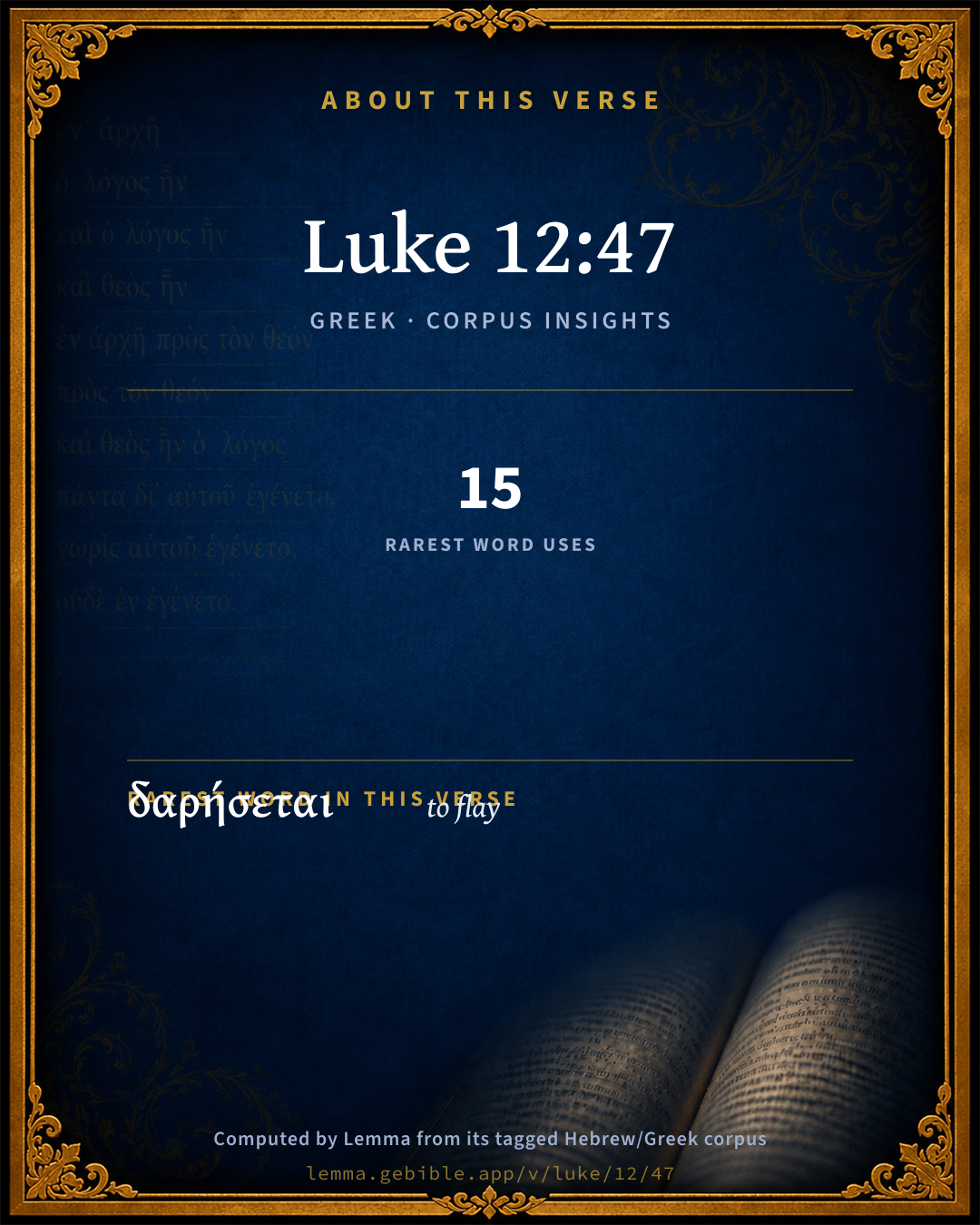
Luke 12:47

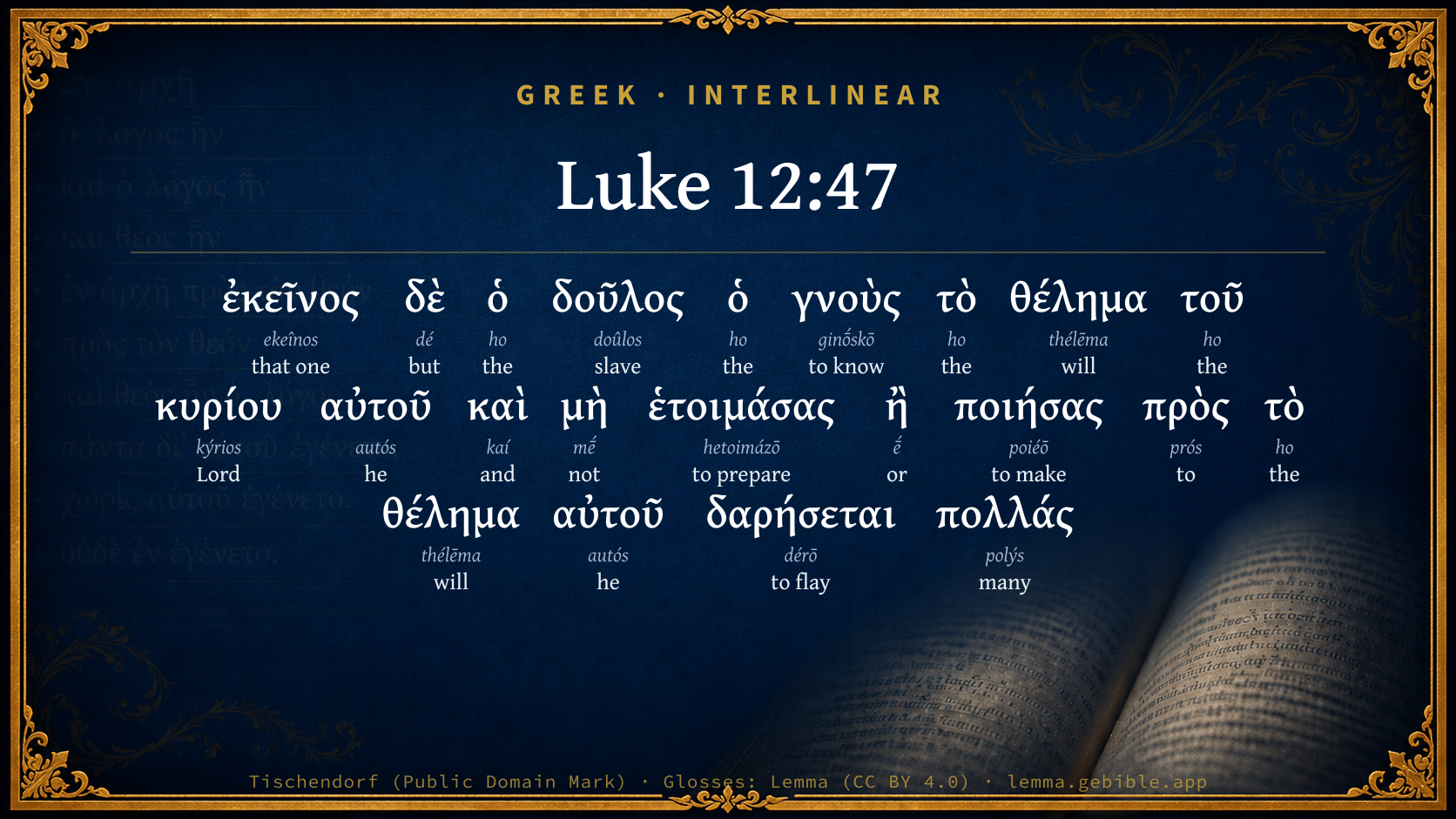
Greek (Tischendorf 8th ed.) Luke 12:47 appears in the Greek New Testament. The text above is from the Tischendorf 8th edition. Each word links to its Strong’s number and a concise gloss. Click any word for its full Thayer’s Greek Lexicon entry.
Download image
Cite this verse

Luke 12:47 (World English Bible). Public Domain. Lemma interlinear Bible study tool, https://lemma.gebible.app/v/luke/12/47.

Show BibTeX & RIS
BibTeX
RIS
English Translation
That servant, who knew his lord's will, and didn't prepare, nor do what he wanted, will be beaten with many stripes,
World English Bible · Public Domain
Download a study sheet

One document with this verse’s original text, its word-by-word gloss line, the meaning frame, cross-references with their text, attributed commentary, and full source and license credits — printable, and it pastes into notes with its structure intact.

This verse Autodidact and up

Study sheet (.html) Plain text (.txt)

A passage Seminary Student

Up to 50 verses in one chapter. A passage sheet keeps up to 6 commentary sources and 12 cross-references per verse, in the order this page ranks them, and says so on the sheet whenever that leaves anything out. Ask for a single verse and you get the Autodidact verse sheet above.

Everything on this page stays free to read, with no account — the sheet is a download of what is already on screen, not access to it.

Want to remove ads? Support Godless Engineer
Compare translations 3

The same verse in 3 English versions, stacked beneath the original-language interlinear above. Click any original word for its lexicon entry.

Each is an independent rendering of the whole verse — the interlinear is not word-aligned to these translations.

Highlighted words mark where these versions differ — a whole-verse word diff, not a word-by-word alignment.

  • World English Bible Public Domain
    That servant, who knew his lord's will, and didn't prepare, nor do what he wanted, will be beaten with many stripes,
  • King James Version Public Domain
    And that servant, which knew his lord's will, and prepared not himself, neither did according to his will, shall be beaten with many stripes.
  • unfoldingWord Literal Text CC BY-SA 4.0
    Now that slave, the one having known the will of his master and not having gotten ready or having done according to his will, will be beaten much.

unfoldingWord Literal Text — © unfoldingWord, licensed CC BY-SA 4.0. Word-aligned USFM3 via Door43 (git.door43.org/unfoldingWord/en_ult).

Versions to compare (up to 4)

3 of 4 selected

Show all 19 translations

Every available English version of this verse, each an independent rendering of the whole verse.

  • World English Bible Public Domain
    That servant, who knew his lord's will, and didn't prepare, nor do what he wanted, will be beaten with many stripes,
  • Berean Standard Bible Public Domain
    That servant who knows his master’s will but does not get ready or follow his instructions will be beaten with many blows.
  • Majority Standard Bible Public Domain
    That servant who knows his master’s will but does not get ready or follow his instructions will be beaten with many blows.
  • King James Version Public Domain
    And that servant, which knew his lord's will, and prepared not himself, neither did according to his will, shall be beaten with many stripes.
  • American Standard Version (1901) Public Domain
    And that servant, who knew his lord's will, and made not ready, nor did according to his will, shall be beaten with many `stripes';
  • Revised Version (1885) Public Domain
    And that servant, which knew his lord’s will, and made not ready, nor did according to his will, shall be beaten with many stripes;
  • Geneva Bible (1599) Public Domain
    And that seruant that knewe his masters will, and prepared not himselfe, neither did according to his will, shalbe beaten with many stripes.
  • Douay-Rheims (1899) Public Domain
    And that servant who knew the will of his lord, and prepared not himself, and did not according to his will, shall be beaten with many stripes.
  • Young's Literal Translation Public Domain
    `And that servant, who having known his lord's will, and not having prepared, nor having gone according to his will, shall be beaten with many stripes,
  • Literal Standard Version CC BY-SA 4.0
    And that servant, who having known his lord’s will, and having not prepared, nor having gone according to his will, will be beaten with many stripes,
  • Unlocked Literal Bible CC BY-SA 4.0
    That servant, having known his lord's will, and not having prepared or done according to his will, will be beaten with many blows.
  • unfoldingWord Literal Text CC BY-SA 4.0
    Now that slave, the one having known the will of his master and not having gotten ready or having done according to his will, will be beaten much.
  • Darby Bible Public Domain
    But that bondman who knew his own lord's will, and had not prepared [himself] nor done his will, shall be beaten with many [stripes];
  • World Messianic Bible Public Domain
    That servant who knew his lord’s will, and didn’t prepare nor do what he wanted, will be beaten with many stripes,
  • Webster's Bible Public Domain
    And that servant who knew his lord's will, and prepared not himself, neither did according to his will, shall be beaten with many stripes.
  • Free Bible Version CC BY-SA 4.0
    That servant who knew what his master wanted and yet didn't get ready or follow his instructions, will be beaten severely;
  • Bible in Basic English Public Domain
    And the servant who had knowledge of his lord's desires and was not ready for him and did not do as he was ordered, will be given a great number of blows;
  • Text-Critical English NT CC BY 4.0
    That servant who knew his master's will, but did not prepare himself or act according to his will, will be beaten with many lashes.
  • Tyndale New Testament (1534) Public Domain
    The servaut that knewe his masters will and prepared not him selfe nether dyd accordinge to his will shalbe bete with many strypes.

Literal Standard Version (2020), Covenant Press — licensed CC BY-SA 4.0. Text via the HelloAO Bible API (eBible.org). Unlocked Literal Bible (unfoldingWord) — licensed CC BY-SA 4.0. Text via the HelloAO Bible API (eBible.org). unfoldingWord Literal Text — © unfoldingWord, licensed CC BY-SA 4.0. Word-aligned USFM3 via Door43 (git.door43.org/unfoldingWord/en_ult). Free Bible Version, Dr. Jonathan Gallagher — licensed CC BY-SA 4.0. Text via the HelloAO Bible API (eBible.org).

Word by word

More ways to search: Search by grammar → Find every occurrence → Compare this word →

Practice this passage: Drill this verse → Learn its vocabulary →

δαρήσεται
dérō
G1194
“to flay”
Verb, Future, Passive, Indicative, 3rd person, Singular
Part of Speech
Verb
Tense
Future
Voice
Passive
Mood
Indicative
Person
3rd person
Number
Singular
Full Thayer's Definition

Origin: a root word

TDNT: None

1. to flay, skin 2. to beat, thrash, smite
  1. ἐκεῖνος ekeînos G1565 “that one” Demonstrative pronoun, Nominative, Singular, Masculine
  2. δὲ dé G1161 “but” Conjunction
  3. ὁ ho G3588 “the” Article, Nominative, Singular, Masculine
  4. δοῦλος doûlos G1401 “slave” Noun, Nominative, Singular, Masculine
  5. ὁ ho G3588 “the” Article, Nominative, Singular, Masculine
  6. γνοὺς ginṓskō G1097 “to know” Verb, Aorist, Active, Participle, Nominative, Singular, Masculine
  7. τὸ ho G3588 “the” Article, Accusative, Singular, Neuter
  8. θέλημα thélēma G2307 “will” Noun, Accusative, Singular, Neuter
  9. τοῦ ho G3588 “the” Article, Genitive, Singular, Masculine
  10. κυρίου kýrios G2962 “Lord” Noun, Genitive, Singular, Masculine
  11. αὐτοῦ autós G846 “he” Personal pronoun, Genitive, Singular, Masculine
  12. καὶ kaí G2532 “and” Conjunction
  13. μὴ mḗ G3361 “not” Particle, Negative
  14. ἑτοιμάσας hetoimázō G2090 “to prepare” Verb, Aorist, Active, Participle, Nominative, Singular, Masculine
  15. ἢ ḗ G2228 “or” Particle
  16. ποιήσας poiéō G4160 “to make” Verb, Aorist, Active, Participle, Nominative, Singular, Masculine
  17. πρὸς prós G4314 “to” Preposition
  18. τὸ ho G3588 “the” Article, Accusative, Singular, Neuter
  19. θέλημα thélēma G2307 “will” Noun, Accusative, Singular, Neuter
  20. αὐτοῦ autós G846 “he” Personal pronoun, Genitive, Singular, Masculine
  21. πολλάς polýs G4183 “many” Adjective, Accusative, Plural, Feminine

About this verse

These counts appear in no published source. They are computed here, from the morphology-tagged text and Lemma’s own curated glosses. What Lemma adds →

22
words
16
distinct lemmas
Gospels
section

Notable vocabulary

The rarest word here is δαρήσεται to flay G1194 — appearing just 15 times in the whole Greek New Testament.

Shared distinctive vocabulary

δαρήσεται to flay G1194 occurs in 15 verses of the Greek New Testament. Also found in:

Repetition

Words recur within this verse:

  • θέλημα will G2307 ×2
  • ὁ the G3588 ×5
  • αὐτοῦ he G846 ×2

Cross-references

11

Topical passages linked to Luke 12:47 in the Treasury of Scripture Knowledge — connected by theme and wording, ordered by reader-vote popularity; previews shown in the World English Bible.

  • James 4:17 To him therefore who knows to do good, and doesn't do it, to him it is sin.
  • John 9:41 Jesus said to them, "If you were blind, you would have no sin; but now you say, 'We see.' Therefore your sin remains.
  • John 12:48 He who rejects me, and doesn't receive my sayings, has one who judges him. The word that I spoke, the same will judge him in the last day.
  • John 15:22–24 If I had not come and spoken to them, they would not have had sin; but now they have no excuse for their sin.
  • Deuteronomy 25:2–3 and it shall be, if the wicked man be worthy to be beaten, that the judge shall cause him to lie down, and to be beaten before his face, according to his wickedness, by number.
  • Acts 17:30 The times of ignorance therefore God overlooked. But now he commands that all people everywhere should repent,
  • Numbers 15:30–31 But the soul who does anything with a high hand, whether he is home-born or a foreigner, the same blasphemes Yahweh; and that soul shall be cut off from among his people.
  • 2 Corinthians 2:15–16 For we are a sweet aroma of Christ to God, in those who are saved, and in those who perish;
  • John 19:11 Jesus answered, "You would have no power at all against me, unless it were given to you from above. Therefore he who delivered me to you has greater sin."
  • Matthew 11:22–24 But I tell you, it will be more tolerable for Tyre and Sidon on the day of judgment than for you.
  • Luke 10:12–15 I tell you, it will be more tolerable in that day for Sodom than for that city.

Cross-references courtesy of OpenBible.info (CC BY 4.0).

Commentary

Notes on Luke 12:47 from classic Christian and Jewish commentators (each source and its license shown beneath its notes). The classic Christian expositions comment on the surrounding passage and are grouped to its opening verse, so a note may address several verses; the Jewish commentaries on the Tanakh (Rashi and others) are per-verse, so they appear only where the commentator wrote on this verse.

Lemma curates 59 commentaries, every one of them public domain or Creative Commons licensed, each selected and text-cleaned for this edition rather than reprinted as found. About our sources →

Ellicott's Commentary for English Readers

(47) And that servant, which knew his lord’s will.—The verses that follow (Luk_12:47-50) are peculiar to St. Luke, and every word is full of profoundest interest. First there comes a warning to the disciples who knew their Lord’s will, who had been told to watch for His coming, to prepare themselves and others for it. That “will” included the use of all gifts and opportunities, as in the parables of the Pounds and the Talents, with faithfulness and activity in using them. On those who, with their eyes open, were sinning against light and knowledge (our Lord’s words had, we can scarcely doubt, a latent reference to Judas) there should come, in this world or in the world to come, a penalty proportionably severe.

A Bible Commentary for English Readers, edited by Charles John Ellicott (1878–1897) — public domain. Text from a community e-Sword module.

The Biblical Illustrator

Joseph S. Exell

Luk_12:47

Beaten with many stripes

Many stripes

Our Lord in the context urges His disciples to diligence, watchfulness, and fidelity.

This is important, for we are stewards, servants, and are responsible to Him who will one day say unto us, Give an account of thy stewardship.

I. THE CHARACTER SUSTAINED--That servant. In many passages of Scripture true believers are called the servants of God. Called so by God--by Christ--by believers themselves (see Joh_12:26). Paul a servant of God; James, a servant of God, etc.

1. The servants Master. This is Christ. He is the Head of the Church--the Divine Sovereign--Lord of all. He issues His commandments--appoints His ordinances--gives His rewards (Joh_13:13; Mat_23:28).

2. The servants origin. Once servants of sin, of Satan--the world--pleasure--self. Now enlightened to perceive the superiority of Christ--translated from the kingdom of darkness (Rom_6:16-22).

3. The servants character.

(1) Must be faithful, give up all for his master.

(2) Patient. His work will require self-denial.

(3) Enduring, day after day he must toil on in an evil and difficult world.

(4) Anxious to please, out of love and affection, not from fear or dread.

II. THE SERVICE REQUIRED--The will of the Master. What is the will of our Master?

1. Faith and repentance. These duties are desired in order that they may accomplish the servants salvation (Joh_3:16; Mar_16:15-16).

2. The advancement of His Kingdom. This is to be brought about by the servants labour. It is an unspeakable honour to be so employed.

3. Internal sanctification. Humility for failings. The acquisition of holiness. Piety of life. Sanctification of spirit.

4. Zeal in duty. Love is not to wax cold--the voices of prayer and praise are not to be silent--the hands are not to hang down--the voice is not to be silent.

III. THE CONSEQUENCES ATTENDANT. On doing this duty depends reward or punishment. If it is faithfully performed, the servant shall have the approval of his Master; if neglected, His blame.

1. This is natural. It is the way of the world. A bad servant is soon discharged. A dishonest one is disgraced.

2. It is also just Wages would not be given unless they were earned. Slaves were obliged to obey.

3. It is for the good of the just. If careless, ignorant, evil men were admitted to heaven, it would be a place of misery.

IV. THE PUNISHMENT PROPORTIONATE. An ignorant servant may be awkward without intentionally transgressing. But for those who know what is right, and deliberately sin, there will be many stripes. It is those who transgress against light and privilege and mercy, who will have to bear the full brunt of the law. Therefore--

1. How great was the guilt of the Jews. They had Gods oracles. Special revelation. Continuance of guidance.

2. How much greater our guilt if we offend. We have not only the light of the Jews, but the full blaze of Christs revelation, and light, and work. All things made plain. All prophecies fulfilled. All directions given. If we neglect our duty, how many will be the stripes we shall receive! (The Preachers Analyst.)

Practice in religion necessary in proportion to our knowledge

I. THAT IGNORANCE IS A GREAT EXCUSE OF MENS FAULTS, AND WILL LESSEN THEIR PUNISHMENT; but he that knew not, but did commit things worthy of stripes, shall be beaten with few stripes.

1. There is an ignorance which doth wholly excuse and clear from all manner of guilt, and that is an absolute and invincible ignorance, when a person is wholly ignorant of the thing, which, if he knew, he should be bound to do, but neither can nor could have helped it, that he is ignorant of it; that is, he either had not the capacity, or wanted the means and opportunity, of knowing it. In this case a person is in no fault, if he did not do what he never knew, nor could know to be his duty. For God measures the faults of men by their wills, and if there be no defect there, there can be no guilt; for no man is guilty, but he that is conscious to himself that he would not do what he knew he ought to do, or would do what he knew he ought not to do.

2. There is likewise another sort of ignorance, which either does not at all, or very little, extenuate the faults of men; when men are not only ignorant, but choose to be so that is, when they wilfully neglect those means and opportunities of knowledge which are afforded to them; such as Job speaks of--Who say unto God, depart from us, for we desire not the knowledge of Thy ways (Job_21:14). But out Saviour here speaks of such an ignorance as does in a good degree extenuate the fault, and yet not wholly excuse it; for he says of them, that they knew not their Lords will; add yet that this ignorance did not wholly excuse them from blame, nor exempt them from punishment, but they should be beaten with few stripes.

3. There is an ignorance which is ,n some degree faulty, and yet does in a great measure excuse the faults which proceed from it; and this is when men are not absolutely ignorant of their duty, but only in comparison of others, who have a far more clear and distinct knowledge of it; and though they do not grossly and wilfully neglect the means of further knowledge, yet, perhaps, they do not make the best use they might of the opportunities they have of knowing their duty better; and therefore, in comparison of others, who have far better means and advantages of knowing their Lords will, they may be said not to know it, though they are not simply ignorant of it, but only have a more obscure and uncertain knowledge of it. Now this ignorance does in a great measure excuse such persons, and extenuate their crimes, in comparison of those who had a clearer and more perfect knowledge of their Master s will; and yet it does not free them from all guilt, because they did not live up to that degree of knowledge which they had; and perhaps if they had used more care and industry, they might have known their Lords will better.

II. THAT THE GREATER ADVANTAGES AND OPPORTUNITIES ANY MAN HATH OF KNOWING THE WILL OF GOD, AND HIS DUTY, THE GREATER WILL BE HIS CONDEMNATION IF HE DO NOT DO IT. The servant which knew his Lords will, and prepared not himself, neither did according to it, shall be beaten with many stripes. Which knew his Lords will, and prepared not himself; the preparation of our mind to do the will of God, whenever there is occasion and opportunity for it, is accepted with Him; a will rightly disposed to obey God, though it be not brought into act for want of opportunity, does not lose its reward: but when, notwithstanding we know not our Lords will, there are neither of these, neither the act nor the preparation and resolution of doing it, what punishment may we not expect? For, after all the aggravations of sin, there is none that doth more intrinsically heighten the malignity of it, than when it is committed against the clear knowledge of our duty, and that upon these three accounts:

1. Because the knowledge of Gods will is so great an advantage to the doing of it.

2. Because it is a great obligation upon us to the doing of it.

3. Because the neglect of our duty in this case cannot be without a great deal of wilfulness and contempt. (Archbishop Tillotson.)

The enlightened, yet disobedient servant, beaten with many stripes

I. THE LORD JEHOVAH IS OUR JUST AND LAWFUL MASTER, AND LEGITIMATELY CLAIMS OUR SUPREME AFFECTION FOR HIS EXCELLENCIES, AND OUR ENTIRE OBEDIENCE TO HIS LAWS. He makes His claims, and He has a right to them.

1. Has He not a right to our supreme affection, and our entire devotedness to His will, as our Creator?

2. The claim will increase when we consider that He is not merely our Father in giving us existence, so that we derive our being from Him, but that we receive our wellbeing from Him.

3. His claims are still higher, and we may say, resistless, on the ground of redemption.

II. THE LORD JEHOVAH HAS AFFORDED YOU AND ME, AS HIS SERVANTS, THE CLEAREST KNOWLEDGE OF HIMSELF, AND OF HIS RIGHT OVER US, AND OF HIS WILL TOWARDS US, AND OF HIS EXPECTATIONS FROM US.

1. By a letter--a book.

2. By His servants--the persons who bear the letter.

3. By the unction of His Holy Spirit imparted to us.

III. IT IS EVIDENT, FROM THE CHOICE AND CONDUCT OF MANY, THAT, THOUGH THEY MUST AND DO KNOW THEIR MASTERS WILL, YET THEY DO NOT PREPARE THEMSELVES NOR DO ACCORDING TO IT.

IV. THE SIN OF SUCH MEN, THEREFORE, IS STAMPED WITH PECULIAR MALIGNITY, AND, WITHOUT PARDON, WILL BE FOLLOWED BY THE SEVEREST PUNISHMENT. You that know your Masters will, and do it not--remember, your sin is stamped with peculiar malignity. The malignity of a crime always bears proportion to the known dignity of the character insulted. To insult a constable, in the exercise of his official capacity, is a crime; to insult a magistrate on the bench is a greater; to insult a monarch on his throne is rebellion. Therefore, the gradation of crime always rises in proportion to the known dignity of the character offended. Then what must be--what must be the black aggravation of your crime, who know your Masters will, and know who that Master is, and yet do not prepare yourselves nor do according to it? You sin against God the Father in His laws--and you know Him to be so; you trample under foot the blood of the Son of God--and you know Him to be so; you do despite unto the Spirit of Grace--and you know who it is that you are doing despite unto. Remember, also, there is an aggravation in the case. It is not one sin committed once; it is the same sin committed again and again, under growing aggravations. Human laws say--for the first offence the penalty shall be light, for the second it shall be doubled, for the third it shall be trebled, and so on, so that punishment always bears proportion to the multitude of the offences. Very well; then, pray what sort of a sinner must you be? You know your Masters will, and do it not; and that is not in one instance--one sin once committed, or one duty once omitted, or one blessing once neglected--it is the same sin committed again, and again, and again, a thousand times repeated with increasing aggravations. Judge, then, wicked and slothful servant, of such a Master! what must be the malignity of your sin. And then, again, it is not one sin committed a thousand times even, but a multitude of sins committed again and again with those magnifying aggravations. (W. Dawson.)

Gods penal law

I. ALL MEN EXIST IN A STATE OF OBLIGATION TO GOD. They are His servants; He, their Master.

II. THE RESPONSIBILITIES OF MEN, CONNECTED WITH THEIR STATE OF OBLIGATION, VARY IN PROPORTION TO THEIR OPPORTUNITIES OF KNOWLEDGE AND OF IMPROVEMENT.

1. There exist in the world very different degrees of opportunity for knowledge and improvement.

2. We are placed in circumstances which afford to us the highest degrees of opportunity for knowledge and for improvement.

3. Possessing as we do such opportunities, we are under a special call to eminent devotedness to the service of God.

III. THE PUNISHMENT OF MEN FOR THE VIOLATION OF THEIR RESPONSIBILITIES, IS REGULATED ACCORDING TO THE VALUE OF THE OPPORTUNITIES WHICH THEY HAVE POSSESSED, AND HAVE ABUSED. There are two remarks under this part of the subject to which your attention will be called.

1. You will observe, first, that punishment is to be inflicted upon all by whom their original obligations have been forgotten and violated. The desert of punishment is presented under the phrase of committing things worthy of stripes. A certain period is stated to be appointed by the master, or lord of the household, for the purpose of returning, in order to inflict punishment, or grant rewards, according to the characters of those by whom he has been professedly served.

2. But, what we principally intend to insist on, on this part of the subject, is, that the punishment to be inflicted on those whose opportunities have been many, will be far more grievous than the punishment to be inflicted on those whose opportunities have been few. Many stripes, or larger and heavier inflictions, are to be the portion of him who knew his lords will and did it not; but few stripes, or minor inflictions, are to be the portion of him who knew not his lords will, and did it not. In this infliction of stripes there seems an allusion to the law, which you observe to be contained in Deu_25:1-3. The deduction of the Saviour, in connection with this law, appears to be this: that those whose opportunities have been few shall receive a certain amount of punishment, limited in some mode analogous to that which is contained in the announcement of the law; but that those whose opportunities have been many, and who yet have abused and slighted them, are to be subjected to a punishment to which no limit and no measure are to be assigned: they are to endure the keenest inflictions which the wrath of an Almighty and Infinite Being can pour upon them. (J. Parsons.)

The penalty of disregarded duty

I had an aged friend who knew Robert Pollock, the celebrated Scotch poet, and he told me that Pollock lost his life through too vivid views of the great future. It seemed as if he walked amid the realities of the eternal world. It was too great for his physical strength, and he died in early life. Robert Pollock one day caught a glimpse of the destiny of those who miss heaven. I can recollect here and there a sentence: And as I listened I heard these beings curse Almighty God, and curse the Lamb, and curse the earth, the resurrection morn, and seek, and ever vainly seek for utter death. And to the everlasting anguish still the thunders from above, responding, spoke these words which, forlornly echoing through the caverns of perdition, fall on every ear: Ye knew your duty, but ye did it not. Then back again recoiled a deeper groan--a deeper groan! O what a groan was that! (Dr. Talmage.)

Result of sinning against the light

A few weeks ago, a poor woman came to my surgery, and said, A young woman is lodging in the same house with me, who is wretchedly poor, in great suffering, and, I fear, near her end. I accompanied the woman home. She led me to the bedside of the dying girl, and left us together. It was a dreadful scene. A girl of three or four and twenty lay on a wretched pallet, with scarcely any covering. A single chair and a broken table was all the furniture the room contained. Near the bed was hanging, on a few pegs, the girls finery. Yes, alas l finery. Dresses of gaudy material, and showily made up, were flaunting their gay colours in this chamber of death, looking in that girls eyes as she lay dying, as witnesses of her sin and folly, and reminding her that, as soon as she was dead, these things, which had cost her so dear, mould become the property of the landlady, as payment of the debt she had not money to discharge. I leaned over the bedside, and took her hand in mine. I told her that Jesus had sent me to her with an offer of peace and pardon. No, she said, hoarsely--no, I was brought up in a Sunday-school; I knew the right, but I did it not. There is no pardon for me now. I knelt down, I prayed for her--prayed, as she had not confidence to pray for herself--her sinful self. I besought Him that she might repent and find peace. But, even as I talked with her, she died, uttering the fearful cry, Too late! too late! (Dr. Raynor.)

Disregarding the light

It is said that off the coast of New Zealand a sea-captain steered his vessel directly toward the light, and, thinking himself safe, fell asleep. His vessel dashed upon the rocks at the very foot of the lighthouse. The beacon-light shining out upon the deep for protection and guidance furnished no help to the slumbering mariner. Indeed, his culpability was greater because of the abuse of the friendly gift.

Degrees of punishment

The legend of St. Macarius of Alexandria runs thus: One day as Macarius wandered among those ancient Egyptian tombs, wherein he had made himself a dwelling-place, he found the skull of a mummy, and turning it over with his crutch, he inquired to whom it belonged; and it replied, To a pagan. And Macarius, looking into the empty eyes, said, Where, then, is thy soul? And the head replied, In hell. Macarius asked, Itchy deep? And the head replied, The depth is greater than the distance from heaven to earth. Then Macarius asked, Are there any deeper than thou art? The skull replied, Yes: the Jews are deeper still. And Macarius asked, Are there any deeper than the Jews? To which the head replied, Yes, in sooth! for the Christians whom Jesus Christ hath redeemed, and who show in their actions that they despise His doctrine, are deeper still.

The Biblical Illustrator, edited by Joseph S. Exell (c. 1880s–1900s) — public domain. Text from a community e-Sword module.

Joseph Benson's Commentary

Luk 12:47-48. And that servant which knew his lord’s will, &c. — Lest the consideration of the strictness of the account, and the greatness of the punishment, described in the parable, might terrify men of honest dispositions, who are liable to err merely through weakness, Jesus showed them, that as offences differ greatly in their circumstances and aggravations, so shall they differ in their punishments also. To understand this part of our Lord’s discourse, we must suppose that the steward here spoken of had received full instruction from his lord, either before his departure, or afterward by letters, how he was to employ himself and the servants under his care. Wherefore, if he neglected his duty, he was more to blame than the inferior servants, who had no knowledge of their lord’s will but from the steward, who might conceal it from them, if he had a mind to serve any by-end of his own. In this respect, how fitly does the parable describe the aggravations of the sin of the ministers and teachers of religion, who have such singular advantages for knowing Christ’s will. In this light, it shows the justice of the more severe punishments here denounced as to be inflicted on them for such wilful neglects and miscarriages, as they are found to be guilty of in the discharge of their office. The expressions, and prepared not himself, neither did according to his lord’s will, deserve particular attention; for here the sense rises above that of the foregoing verse. It is as if our Lord had said, Think not that I merely intend to forbid such gross immoralities as drunkenness, riot, oppression, &c.; but be assured that sins of omission, where there have been fair opportunities of learning your duty, will expose you to the divine correction: shall be beaten with many stripes — Shall have the sorest punishment inflicted on him. Scourging was a usual punishment for negligent servants. But he that knew not, &c. — The opposition between this and the preceding verse is, between a servant who receives an express message from his master, which he contradicts, and another who, though he received no such express message, yet falls into such instances of misbehaviour as he cannot but know to be inconsistent with his duty and office in general; by which he exposes himself justly to some punishment, though, other things being equal, he is less criminal than the former. And did commit things worthy of stripes — Here our Lord’s words strongly intimate, that ignorance will not entirely excuse any who have neglected God’s service, since they might, in general, have known at least the main branches of their duty, as every servant may know, in the main, what kind of conduct his master will approve; though some may be much more fully instructed than others as to his particular pleasure. It may be further observed, that as rational creatures, it is as much our duty to cultivate our reason, and to inquire into, and know our duty, as it is to act agreeably to the knowledge we have. Unto whomsoever much is given, &c. — In the divine administration, the rule of judgment shall be observed which men themselves think just, and put in practice in their commerce one with another. The more advantages any one enjoys, the greater improvement will be expected of him, and the more severely will he be punished if he come short.

Joseph Benson's Commentary on the Old and New Testaments (1811–1818) — public domain. Text from a community e-Sword module.

Tyndale Open Study Notes

Tyndale Open Resources

12:47-48 who knows . . . who does not know: Sins of ignorance receive less punishment than intentional sins (Num 15:22-26; Ps 19:13; cp. Luke 23:34). • When someone has been given much: Believers will be held responsible for the knowledge and resources they have been given (see Jas 3:1). A sin in ignorance is still a sin.

Tyndale Open Study Notes — © Tyndale Open Resources, licensed CC BY-SA 4.0. Text via the HelloAO Bible API.

Bengel's Gnomon

Johann Albrecht Bengel

Luk 12:47. Τὸ θέλημα, will) whereby vigilance is required.—μὴ ἑτοιμάσας, [having got ready]) Neuter, as in ch. Luk 9:52. [There follows ποιήσας in respect of the servant himself: for ἑτοιμάσας has respect to others, whom the servant ought to have got ready.[124]—V. g.]—ΠΟΛΛᾺς, many) viz. πληγὰς, stripes. The same ellipsis occurs, 2Co 11:24.

[124] Engl. Vers. understands ἑαυτὸν to ἑτοιμάσας, “prepared not himself:” it thus loses the point of distinction between ἑτοιμάσας and ποιήσας.—ED. and TRANSL.

Bengel's Gnomon of the New Testament — English translation (T&T Clark, Edinburgh, 1860) — public domain. Text from a community e-Sword module.

Meyer's Critical & Exegetical Commentary

Heinrich August Wilhelm Meyer

Luk_12:47-48. This passage, which is peculiar to Luke, gives explanatory information of a general kind, yet related to Mat_25:14 ff., to account for the severity of the punishment, Luk_12:46. This will ensue, in accordance with the general rule of retribution coming into operation at the return of the Lord: that that slave, etc. Ἐκεῖνος, though placed first for emphasis, does not refer to the single concrete person indicated at Luk_12:45, but is a general term indicating the class to which the οἰκονόμος also belongs; and δέ carries on the meaning with an explanatory force (Hermann, ad Viger. p. 845; Kühner, ad Xen. Mem. ii. 1. 1).

ἑαυτοῦ] of his own Lord, makes the responsibility to be felt the more strongly.

ἑτοιμάσας] ἑαυτόν is not to be supplied (Luther, Kuinoel, and many others), but: and has not made ready, has made no preparation. Comp. Luk_9:52. It belongs also to πρὸς τὸ θέλ. αὐτοῦ.

δαρήσεται πολλάς] πληγὰς δηλονότι (see Schaefer, ad Bos. Ell. p. 387; Valckenaer, Schol. p. 214; Winer, p. 520 [E. T. 737]), τουτέστι κολασθήσονται χαλεπῶς, διότι εἰδότες κατεφρόνησαν, Euthymius Zigabenus. On the accusative, comp. μαστιγοῦσθαι πληγάς, Plat. Legg. viii. p. 845 B, and see Buttmann, Neut. Gr. p. 164 [E. T. 189].

Luk_12:48. ὁ δὲ μὴ γνούς] but the slave, who shall not have learnt to know it. Such a one cannot be left without punishment, not because he has not obeyed the Lords will (for that has remained unknown to him), but because he has done that which deserves punishment; even for such a one there is that which deserves punishment, because, in general, he had the immediate moral consciousness of his relation to his Lord as a subjective standard (comp. Rom_2:12 ff.), even although he did not possess the objective law of the Lords will positively made known to him, on which account also a lighter punishment ensues. Theophylact and Euthymius Zigabenus are wrong in thinking here of such as could have learnt to know the Lords will, but from laziness and frivolity have not learnt to know it. An arbitrary limitation; and can such an ignorance diminish the responsibility? Rom_1:28 ff. We can the less regard the responsibility as diminished when we remember that by ὁ δὲ μὴ γνούς is described the case of a slave of Christ, who has remained ignorant of his Lords will.

παντὶ δὲ κ.τ.λ.] but of every one, in order, moreover, still to add this general law as explanatory information on the subject of that so severe punishment, Luk_12:46, etc.

ἐδόθη πολύ] in official duties, as to the οἰκονόμος.

πολὺ ζητήσεται] in official efficiency. The collocation of πολὺ, πολύ, and then πολὺ, περισσότερον, has a special emphasis.

The second member ᾧ παρέθεντο (the categoric plural, as at Luk_12:20 : in reality κύριος is the subject) κ.τ.λ. is a parallel similar in meaning to the first, but with the climax: περισσότερον, which is not to be taken as: plus quam aliis, quibus non tam multa concredita sunt (Kuinoel, Bleek, following Beza, Grotius, and others, which would be insipid, and a mere matter of course), but: in the case of him to whom much has been entrusted (with whom a large sum has been deposited), still more than this entrusted πολύ will be required of him. In this statement is implied the presupposition that the capital sum must have been increased by interest of exchange or by profit of commerce. Comp. Mat_25:15 ff. The deposit was not to lie idle. On παρατίθεσθαι, comp. Herod. vi. 86; Xen. R. Ath. ii. 16; Polybius, iii. 17. 10, xxxiii. 12. 3; Tob_1:14; 1Ma_9:35. The construction in both members is a well-known form of attraction, Kühner, II. p. 512; Buttmann, Neut. Gr. p. 247 [E. T. 288].

Meyer — Critical and Exegetical Commentary on the New Testament — English translation by Peter Christie, edited by Frederick Crombie (T&T Clark, 1880) — public domain. Text from a community e-Sword module.

Expositor's Greek Testament

ed. W. Robertson Nicoll

Luk 12:47-48 . Degrees of guilt and punishment , in Lk. only, and serving as an apology for the severity of the punishment as described in Luk 12:46 . That punishment presupposes anger. The statement now made is to the effect: penalty inflicted not as passion dictates but as principle demands. ὁ δοῦλος ὁ γνοὺς , etc.: describes the case of a servant who knows the master’s will but does not do it ( μηδὲ ποιήσας ), nay, does not even intend or try to do it ( μὴ ἑτοιμάσας ), deliberately, audaciously negligent. δαρήσεται πολλάς ( πληγάς ): many stripes justly his portion.

The Expositor's Greek Testament, edited by W. Robertson Nicoll (1897–1910) — public domain. Text from a community e-Sword module.

Godet's Commentaries

Frédéric Louis Godet

Vers. 47 and 48. The Principle.—“And that servant which knew his lord’s will, and prepared nothing, neither did according to his will, shall be beaten with many stripes. 48. But he that knew not, and did commit things worthy of stripes, shall be beaten with few stripes. For unto whomsoever much is given, of him shall be much required; and to whom men have committed much, of him they will ask the more.”

Along with the superiority of position described above, the apostles had received a superior degree of knowledge; it is to this new advantage that Luk 12:47 a refers. It is connected with the preceding; for the higher the servant is placed by his master, the fuller are the instructions he receives from him. The same manner of judging will be extended to this other kind of superiority. Ostervald, understanding ἑαυτόν with μὴ ἑτοιμάσας, translates, “who prepared not himself.” This ellipsis is inadmissible. The meaning is, who prepared not [what was necessary to receive his master according to his wishes]. It is the antithesis of Luk 12:35-37.

The servant whom the master has not initiated so specially into his intentions is nevertheless responsible to a certain extent. For he also has a certain knowledge of his will; comp. the application of this same principle, Rom 2:12.

Ver. 48b. The general maxim on which the whole of the preceding rests. The two parallel propositions are not wholly synonymous. The passive ἐδόθη, was given, simply denotes an assigned position; the middle form, παρέθεντο, men have committed, indicates that the trust was taken by the master as his own interest; the figure is that of a sum deposited. Consequently the first term is properly applied to the apostolic commission, and to the authority with which it is accompanied; the second, to the higher light granted to the apostles.

What is claimed of each is not fruits which do not depend on the labourer, but devotedness to work. Meyer thinks that the more signifies “more than had been committed to him.” It is more natural to understand: more than will be exacted from others who have received less.

On the subject of the verbs παρέθεντο and αἰτήσουσιν, see Luk 12:20.

Mark has preserved (Mar 13:37), at the close of the parable of the porter, which he alone has, but which refers to the same duty of watchfulness as the two preceding parables in Luke, this final exhortation: “What I say unto you, I- say unto all, Watch.” This word corresponds in a striking manner to the meaning of Jesus’ answer to Peter in Luke: “All should watch, for all shall share in the Master’s personal requital (Luk 12:37); but very specially (περισσότερον, Luk 12:48) ye, my apostles, who have to expect either a greater recompense or a severer punishment.” On this supposition, Luke relates the question of Peter and the indirect answer of Jesus; Mark, a word of Jesus which belonged to His direct answer. How is the relation between the two to be explained? Holtzmann thinks that Luke of himself imagined the question of Peter, founding on this last word of Jesus in Mark. He cannot help confessing, further, that this interpolation has been very skilfully managed by Luke. Such procedure, in reality, would be as ingenious as arbitrary; it is inadmissible. The account of Luke, besides, finds a confirmation in the text of Matthew, in which the interrogative form of the answer of Jesus is preserved exactly as we find it in Luke, and that though Matthew has omitted Peter’s question, which alone explains this form. Weizsäcker supposes inversely that the question of Peter in Luke was borrowed by the latter from the interrogative form of the saying of Jesus in Mat 24:45: “Who is then the faithful servant...?” But Mark’s account stands to defend that of Luke against this new accusation. For, as we have seen, the last words of the discourse in Mark had no meaning except in reference to Peter’s question reported by Luke. Luke’s form cannot be derived from Mark without protest from Matthew, nor from Matthew without Mark in his turn protesting. We have evidently, as it were, the pieces of a wheelwork taken down; each evangelist has faithfully preserved to us those of them which an incomplete tradition had transmitted to him. Applied to a written document, this dividing would form a real mutilation; as the result of a circulating tradition, it admits of easy explanation.

Frédéric Louis Godet — Commentaries on Luke, John, Romans, and 1 Corinthians — English translation (T&T Clark, Edinburgh, 1870s–1890s) — public domain. Text from a community e-Sword module.

Adam Clarke's Commentary

Verse 47. Shall be beaten with many stripes.] Criminals among the Jews could not be beaten with more than forty stripes; and as this was the sum of the severity to which a whipping could extend, it may be all that our Lord here means. But, in some cases, a man was adjudged to receive fourscore stripes! How could this be, when the law had decreed only forty? Answer: By doubling the crime. He received forty for each crime; if he were guilty of two offences, he might receive fourscore. See Lightfoot.

Adam Clarke's Commentary on the Bible (1810–1826) — public domain. Text from a community e-Sword/MySword module.

The Cambridge Bible for Schools and Colleges

gen. ed. J. J. S. Perowne

47. shall be beaten with many stripes] Exceptional privileges if rejected involve exceptional guilt and punishment, Luk_10:13; Jas_4:17; 2Pe_2:21.

The Cambridge Bible for Schools and Colleges (gen. ed. J. J. S. Perowne; Cambridge University Press, 1878–1918) — public domain. Text from a community e-Sword module.

John Gill's Exposition

But he that knew not,.... His Lord's will; either not having the means of knowing it, as the Heathens; or through neglect of them, not attending to them, and making use of them, which is the case of many, where the Gospel revelation is:

and did commit things worthy of stripes; or punishment; as the Gentiles, by sinning against the law, and light of nature; and those who might have the advantage of a divine revelation, but neglect it: the Septuagint in Deu 25:2 have the same phrase as here, , "worthy of stripes":

shall be beaten with few stripes; their punishment shall be less, and it shall be more tolerable for them in the day of judgment, than for knowing professors. The Jews did not always inflict forty stripes, or forty save one, upon delinquents; but according to their crimes, and as they were able to bear them, more or fewer: so it is said (w),

"when they judge a sinner, how many (stripes) he can bear, they do not reckon, but by stripes that are fit to be trebled: if they judge he is able to bear "twenty", they do not order that he be beaten with twenty one, that so they may be trebled, but that he be beaten with "eighteen": if they condemn him to receive forty, and after he is begun to be beaten, they observe him to be weak, and they say he cannot bear any more than these "nine", or "twelve", with which he has been beaten, lo, he is free; if they condemn him to receive "twelve", and after that he is beaten, they see that he is strong and able to bear more, lo, he is free, and he is not to be beaten any more, upon that estimation: if they condemn him today that he is to be beaten with "twelve" (stripes), and they do not beat him till tomorrow, and lo, tomorrow he is able to bear eighteen, they do not beat him but with twelve.''

And elsewhere the rule is (x),

"he that commits a sin, in which there are two negative (commands broken) if they pronounce but one sentence, he is beaten and is free; but if not (i.e. if more than one) he is beaten, and when he is healed, he is beaten again.''

For unto whomsoever much is given, of him shall, much be required: the more knowledge a man has, the more practice is expected from him; and the greater his gifts are, the more useful he ought to be, and diligent in the improvement of them:

and to whom men have committed much, or to whom much is committed, of him they will ask the more; not more than what was committed to him, but more than from him, who has less committed to him; in proportion to what a man is entrusted with, the greater increase and improvement it is expected he should make.

(w) Maimon. Hilchot Sanhedrin, c. 17. sect. 2, 3. (x) Misn. Maccot, c. 3. sect. 11.

John Gill's Exposition of the Whole Bible (1746–1763) — public domain (CC PDM 1.0). Text via the HelloAO Bible API.

Trapp's Complete Commentary

John Trapp

47 And that servant, which knew his lord’s will, and prepared not himself, neither did according to his will, shall be beaten with many stripes.

Ver. 47. Which knew his Lord’s will] None are so filled with God’s wrath as knowing men. Sapientes sapienter descendunt in infernum, The wise wisely go down into hell, saith Bernard. The devil is too hard for them.

John Trapp, A Commentary or Exposition upon All the Books of the Old and New Testament (1647–1656) — public domain. Text from a community e-Sword module.

Albert Barnes' Notes on the Bible

Which knew his lord’s will - Who knew what his master wished him to do. He that knows what God commands and requires.

Many stripes - Shall be severely and justly punished. They who have many privileges, who are often warned, who have the gospel, and do not repent and believe, shall be far more severely punished than others. They who are early taught in Sunday schools, or by pious parents, or in other ways, and who grow up in sin and impenitence, will have much more to answer for than those who have no such privileges.

Albert Barnes' Notes on the Bible (1834–1885) — public domain. Text from a community e-Sword/MySword module.

Whedon's Commentary on the Bible

Daniel D. Whedon

47. Knew his Lord’s will—Either actually, from received information, or, virtually, because the revelation was within reach and with due warning.

His Lord’s will—Namely, that the servant should keep his girded loins and trimmed lamp in readiness for the coming of his Lord; The sin here is rather negligence than the riot of Luk_12:46. The terms of punishment are therefore much milder.

Prepared not himself—For his Lord’s return in judgment.

Beaten with many stripes—In the blended proportion of his knowledge and his amount of sin.

Daniel D. Whedon (gen. ed.), Commentary on the Old and New Testaments (1874–1909) — public domain. Text from a community e-Sword module.

The Pulpit Commentary

Vers. 47, 48. And that servant, which knew his lord"s will, and prepared not himself, neither did according to his will, shall be beaten with many stripes. But he that knew not, and did commit things worthy of stripes, shall be beaten with few stripes. For unto whomsoever much is given, of him shall be much required. These verses are easy to understand. They explain the broad principles upon which the foregoing statements, in parable and in direct teaching, are based. Rewards and punishments will be allotted in the coming world with strict justice. To some, great knowledge of the Divine will is given and splendid opportunities of work are afforded; to such, if only they are faithful and true, will indeed a high place in the city of God be allotted; but alas for them in the life to come if they fail, if they miss the splendid chance of being true toilers with and for God! Their portion will be the many stripes. To others a knowledge of the Divine will, scanty compared with these just spoken of, is given, and opportunities of doing high and noble work are here comparatively few; if these use the little knowledge and seize the few opportunities, they will, while occupying a lower grade in the hierarchy of heaven, still enjoy the perfect bliss of friendship with God. The punishment for failure here is designated by the few stripes. In this solemn passage it is notable that degrees or grades in punishment as well as degrees or grades in glory are distinctly spoken of.

The Pulpit Commentary (1880–1919), ed. H.D.M. Spence-Jones & Joseph S. Exell — public domain. Text from a community e-Sword module.

John Wesley's Explanatory Notes

And that servant who knew his Lord's will shall be beaten with many stripes - And his having much knowledge will increase, not lessen, his punishment.

John Wesley, Explanatory Notes Upon the Whole Bible (1754–1765) — public domain. Text via the GEBible commentary corpus.

Kretzmann's Popular Commentary

Paul E. Kretzmann

Christ’s summary:

v. 47. And that servant which knew his lord’s will, and prepared not himself, neither did according to his will, shall be beaten with many stripes.

v. 48. But he that knew not, and did commit things worthy of stripes, shall be beaten with few stripes. For unto whomsoever much is given, of him shall be much required; and to whom men have committed much, of him they will ask the more.

The Lord here states the principle according to which punishments are given in the kingdom of God, and especially on the Day of Judgment, not according to an absolute decree, but according to the measure of fault. There is the servant that was fully informed as to the will of his Lord, but deliberately chose to ignore this will and to do as he pleased. His punishment will be heavy, and it will consist of many stripes. On the other hand, a servant may have been in ignorance of the master’s will, but still committed something which deserved punishment; he will receive only few stripes. This is not to be understood as though a servant could plead ignorance when he had deliberately ignored a command. Ignorance is no excuse where knowledge might have been obtained. The rule is that the demand of the master is in proportion to the gifts dispensed, whether these be temporal or spiritual. In every case the person concerned is only a steward having charge of the gifts. A rich man cannot dispose of his property as he chooses; a person with unusual powers of intellect has no right to put them to uses pleasing his own ambition or selfishness; one to whom God has given an extraordinary measure of spiritual knowledge cannot choose to ignore this talent. The day of reckoning is coming; and the reckoning will be severe, but just. In the entire matter of sanctification, therefore, a Christian will be alert at all times.

Paul E. Kretzmann, Popular Commentary of the Bible (1921–1924) — public domain. Text from a community e-Sword module.

The People's New Testament

B. W. Johnson

47, 48. That servant, which knew his lord's will. This is the wilfully disobedient servant. The man who sins in the face of knowledge is such a servant. His neglect of known duty shall aggravate his punishment.

He that knew not. The man who sinned in ignorance shall have lighter punishment. Certainly degrees of punishment for degrees of guilt are taught. All will not be punished alike.

B. W. Johnson's The People's New Testament with Notes (1889–1891) — public domain. Electronic text from the Christian Classics Ethereal Library (CCEL) ThML edition.

unfoldingWord translationNotes

Door43 World Missions Community

Connecting Statement:

Jesus finishes telling the parable.

That servant, having known his lord's will, and not having prepared or done according to his will, will be beaten with many blows

This can be translated in active form. AT: "But as for the servant who knows his lord's will does not prepare or do according to it, the master will beat him with many blows" (See: Active or Passive)

his lord's will ... according to his will

"what his master wanted him to do ... it"

many blows ... few blows

Both servants are punished, but these phrases show the servant who intentionally disobeyed his master was punished more severely than the other servant.

But everyone who has been given much, from them much will be required

This can be stated in active form. AT: "They will require more of anyone who has received much" or "The master will require more of everyone he has given much to" (See: Active or Passive)

the one ... much, even more will be asked

This can be stated in active form. AT: "the master will ask even more of the one ... much" or "the master will require even more of the one ... much" (See: Active or Passive)

the one who has been entrusted with much

This can be stated in active form. AT: "the one to whom the master has given much property to take care of" or "the one to whom the master has given much responsibility" (See: Active or Passive)

translationWords

servant

lord

worthy

unfoldingWord translationNotes — © Distant Shores Media and the Door43 World Missions Community, licensed CC BY-SA 4.0. Source: git.door43.org/Door43/en_tn.

Cambridge Greek Testament for Schools and Colleges

47. μὴ ἑτοιμάσας. The μὴ is used because it gives the supposed reason for the slave’s punishment. Exceptional privileges if rejected involve exceptional guilt and punishment, Luk 10:13; Jas 4:17; 2Pe 2:21.

δαρήσεται πολλάς. Sub. πληγάς. Similarly we find in Plato, μαστιγοῦσθαι πληγάς. Comp. 2Co 11:24, πεντήκοντα παρὰ μίαν ἔλαβον. This cognate accusative is common in classic Greek.

Cambridge Greek Testament for Schools and Colleges (Cambridge University Press, 1896; 21 vols, various authors incl. Carr, Maclear, Plummer, Farrar, Lumby, Moule, M. R. James, Simcox) — public domain. Text from a community e-Sword module.

International Critical Commentary

47. ἐκεῖνος δὲ ὁ δοῦλος. “But that servant,” Ille autem servus. Both AV. and RV. have “and.” The δέ marks the contrast between this transgressor and the οἰκονόμος, for μὴ ἑτοιμάσας ἢ ποιήσας πρὸς τὸ θέλημα αὐτοῦ is a less serious offence than the outrages which are described in vv. 45, 46, and one which all servants may commit.

δαρήσεται πολλάς. Understand πληγάς and comp. παίειν ὁλίγας (Xen. Anab. v. 8. 12). In N.T. δέρω is never “I flay,” but always “I beat.” Comp. the vulgar “hide, giving a hiding to.” In LXX δέρω does not occur, except as v.l. in Lev 1:6; 2Ch 29:34, 2Ch 29:35:11; but in all three places the meaning is “flay,” and the true reading possibly ἐκδέρω. Comp. Mic 2:8, Mic 3:3. The doctrine of degrees of punishment hereafter is taught here still more plainly than in 10:12, 14. See Aug. De Civ. Dei, xxi. 16.

There are two classes not mentioned here: ὁ γνοὺς καὶ ποιήσας and (so far as that is possible) ὁ μὴ γνοὺς καὶ ποιήσας: see on Rom 2:14.

International Critical Commentary — older volumes (1896–1929), various authors — public domain. Text from a community e-Sword module.

Lesson kit

Teaching starters — assembled from the data on this page, not authored interpretation. Every prompt links to the verse data it draws on. Edit before teaching.

Luke, in the Gospels, opens this verse with 22 words (16 distinct Greek lemmas). Its most distinctive word is dérō (“to flay”). A historical commentator’s framing appears above. Read the whole chapter for the surrounding context.

Discussion questions

  1. What does “to flay” (dérō) contribute to the verse as a whole?
  2. How does Matthew 21:35, which shares the word «to flay», read alongside this verse?
  3. What does the repetition of “will” (2× in this one verse) do in this verse?
  4. These translations render this verse differently; the difference is in the English rendering, not the original. What questions does that raise?
  5. Compare how Ellicott's Commentary for English Readers and The Biblical Illustrator read this verse. Where do they agree or differ?

Things to notice

Reading settings

Reading text

Shown beneath each verse's original-language words.

Old Testament
Old Testament edition

Read the OT as the Masoretic Hebrew (MT) or the Greek Septuagint (LXX).

English shown for the Greek Septuagint (in the Hebrew ↔ Greek comparison).

Comparing translations? Open the Compare panel on any verse page to stack up to four side by side.