1 Kings 2:35

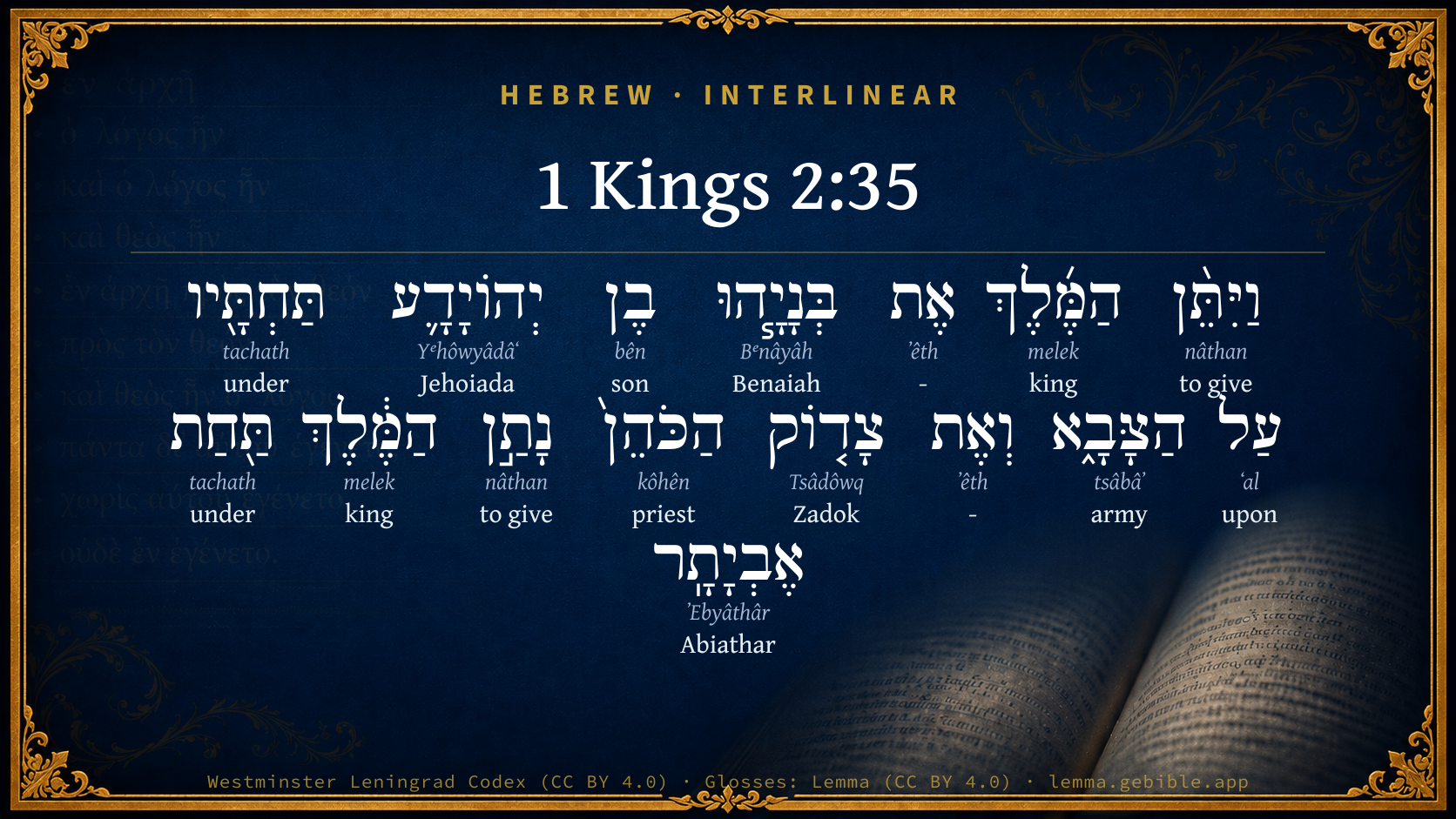
Hebrew (Westminster Leningrad Codex) 1 Kings 2:35 appears in the Hebrew Old Testament. The text above is from the Westminster Leningrad Codex. Each word links to its Strong’s number, a concise gloss, and parsing drawn from the Open Scriptures Hebrew Bible morphology. Click any word for its full Brown-Driver-Briggs (BDB) entry.
Download image
Cite this verse

1 Kings 2:35 (World English Bible). Public Domain. Lemma interlinear Bible study tool, https://lemma.gebible.app/v/1-kings/2/35.

Show BibTeX & RIS
BibTeX
RIS
English Translation
The king put Benaiah the son of Jehoiada in his room over the host; and Zadok the priest did the king put in the room of Abiathar.
World English Bible · Public Domain
Download a study sheet

One document with this verse’s original text, its word-by-word gloss line, the meaning frame, cross-references with their text, attributed commentary, and full source and license credits — printable, and it pastes into notes with its structure intact.

This verse Autodidact and up

Study sheet (.html) Plain text (.txt)

A passage Seminary Student

Up to 50 verses in one chapter. A passage sheet keeps up to 6 commentary sources and 12 cross-references per verse, in the order this page ranks them, and says so on the sheet whenever that leaves anything out. Ask for a single verse and you get the Autodidact verse sheet above.

Everything on this page stays free to read, with no account — the sheet is a download of what is already on screen, not access to it.

Want to remove ads? Support Godless Engineer
Compare translations 3

The same verse in 3 English versions, stacked beneath the original-language interlinear above. Click any original word for its lexicon entry.

Each is an independent rendering of the whole verse — the interlinear is not word-aligned to these translations.

Highlighted words mark where these versions differ — a whole-verse word diff, not a word-by-word alignment.

  • World English Bible Public Domain
    The king put Benaiah the son of Jehoiada in his room over the host; and Zadok the priest did the king put in the room of Abiathar.
  • King James Version Public Domain
    And the king put Benaiah the son of Jehoiada in his room over the host: and Zadok the priest did the king put in the room of Abiathar.
  • unfoldingWord Literal Text CC BY-SA 4.0
    And the king put Benaiah, the son of Jehoiada, in place of him over the army, and the king put Zadok the priest in place of Abiathar.

unfoldingWord Literal Text — © unfoldingWord, licensed CC BY-SA 4.0. Word-aligned USFM3 via Door43 (git.door43.org/unfoldingWord/en_ult).

Versions to compare (up to 4)

3 of 4 selected

Show all 18 translations

Every available English version of this verse, each an independent rendering of the whole verse.

  • World English Bible Public Domain
    The king put Benaiah the son of Jehoiada in his room over the host; and Zadok the priest did the king put in the room of Abiathar.
  • Berean Standard Bible Public Domain
    And the king appointed Benaiah son of Jehoiada in Joab’s place over the army, and he appointed Zadok the priest in Abiathar’s place.
  • Majority Standard Bible Public Domain
    And the king appointed Benaiah son of Jehoiada in Joab’s place over the army, and he appointed Zadok the priest in Abiathar’s place.
  • King James Version Public Domain
    And the king put Benaiah the son of Jehoiada in his room over the host: and Zadok the priest did the king put in the room of Abiathar.
  • American Standard Version (1901) Public Domain
    And the king put Benaiah the son of Jehoiada in his room over the host; and Zadok the priest did the king put in the room of Abiathar.
  • Revised Version (1885) Public Domain
    And the king put Benaiah the son of Jehoiada in his room over the host: and Zadok the priest did the king put in the room of Abiathar.
  • Geneva Bible (1599) Public Domain
    And the King put Benaiah the sonne of Iehoiada in his roume ouer the hoste: and the King set Zadok the Priest in the roume of Abiathar.
  • Douay-Rheims (1899) Public Domain
    And the king appointed Banaias the son of Joiada in his room over the army, and Sadoc the priest he put in the place of Abiathar.
  • Young's Literal Translation Public Domain
    and the king putteth Benaiah son of Jehoiada in his stead over the host, and Zadok the priest hath the king put in the stead of Abiathar.
  • Literal Standard Version CC BY-SA 4.0
    and the king puts Benaiah son of Jehoiada over the host in his stead, and the king has put Zadok the priest in the stead of Abiathar.
  • Unlocked Literal Bible CC BY-SA 4.0
    The king put Benaiah son of Jehoiada over the army in his place, and he put Zadok the priest in Abiathar's place.
  • unfoldingWord Literal Text CC BY-SA 4.0
    And the king put Benaiah, the son of Jehoiada, in place of him over the army, and the king put Zadok the priest in place of Abiathar.
  • Darby Bible Public Domain
    And the king put Benaiah the son of Jehoiada in his stead over the host; and Zadok the priest the king put in the stead of Abiathar.
  • World Messianic Bible Public Domain
    The king put Benaiah the son of Jehoiada in his place over the army; and the king put Zadok the priest in the place of Abiathar.
  • Webster's Bible Public Domain
    And the king put Benaiah the son of Jehoiada in his room over the army: and Zadok the priest the king put in the room of Abiathar.
  • Free Bible Version CC BY-SA 4.0
    The king appointed Benaiah, son of Jehoiada, to take over Joab's role as army commander, and replaced Abiathar with Zadok the priest.
  • Bible in Basic English Public Domain
    And the king put Benaiah, the son of Jehoiada, in his place over the army; and Zadok the priest he put in the place of Abiathar.
  • JPS Tanakh (1917) Public Domain
    And the king put Benaiah the son of Jehoiada in his room over the host; and Zadok the priest did the king put in the room of Abiathar.

Literal Standard Version (2020), Covenant Press — licensed CC BY-SA 4.0. Text via the HelloAO Bible API (eBible.org). Unlocked Literal Bible (unfoldingWord) — licensed CC BY-SA 4.0. Text via the HelloAO Bible API (eBible.org). unfoldingWord Literal Text — © unfoldingWord, licensed CC BY-SA 4.0. Word-aligned USFM3 via Door43 (git.door43.org/unfoldingWord/en_ult). Free Bible Version, Dr. Jonathan Gallagher — licensed CC BY-SA 4.0. Text via the HelloAO Bible API (eBible.org).

Word by word

More ways to search: Search by grammar → Find every occurrence → Compare this word →

Practice this passage: Drill this verse → Learn its vocabulary →

אֶבְיָתָֽר
ʼEbyâthâr
H54
“Abiathar”
Noun, Proper
Part of Speech
Noun
Type
Proper
Full BDB Definition

Origin: contracted from H1 and H3498

TWOT: None

Abiathar = "my father is great" - priest, son of Ahitub (Ahimelech), faithful to David, but later rebelled with Adonijah
  1. וַיִּתֵּ֨ן nâthan H5414 “and · to give” Conjunction + Verb, Qal, Sequential Imperfect, 3rd Person, Masculine, Singular
  2. הַמֶּ֜לֶךְ melek H4428 “the · king” Particle, Definite Article + Noun, Common, Masculine, Singular, Absolute
  3. אֶת ʼêth H853 “-” Particle, Direct Object
  4. בְּנָיָ֧הוּ Bᵉnâyâh H1141 “Benaiah” Noun, Proper
  5. בֶן bên H1121 “son of” Noun, Common, Masculine, Singular, Construct
  6. יְהוֹיָדָ֛ע Yᵉhôwyâdâʻ H3077 “Jehoiada” Noun, Proper
  7. תַּחְתָּ֖יו tachath H8478 “under · him” Preposition + Suffix, Personal, 3rd Person, Masculine, Singular
  8. עַל ʻal H5921 “upon” Preposition
  9. הַצָּבָ֑א tsâbâʼ H6635 “the · army” Particle, Definite Article + Noun, Common, Both, Singular, Absolute
  10. וְאֶת ʼêth H853 “and · -” Conjunction + Particle, Direct Object
  11. צָד֤וֹק Tsâdôwq H6659 “Zadok” Noun, Proper
  12. הַכֹּהֵן֙ kôhên H3548 “the · priest” Particle, Definite Article + Noun, Common, Masculine, Singular, Absolute
  13. נָתַ֣ן nâthan H5414 “to give” Verb, Qal, Perfect, 3rd Person, Masculine, Singular
  14. הַמֶּ֔לֶךְ melek H4428 “the · king” Particle, Definite Article + Noun, Common, Masculine, Singular, Absolute
  15. תַּ֖חַת tachath H8478 “under” Preposition

About this verse

These counts appear in no published source. They are computed here, from the morphology-tagged text and Lemma’s own curated glosses. What Lemma adds →

16
words
12
distinct lemmas
Historical
section

Shared distinctive vocabulary

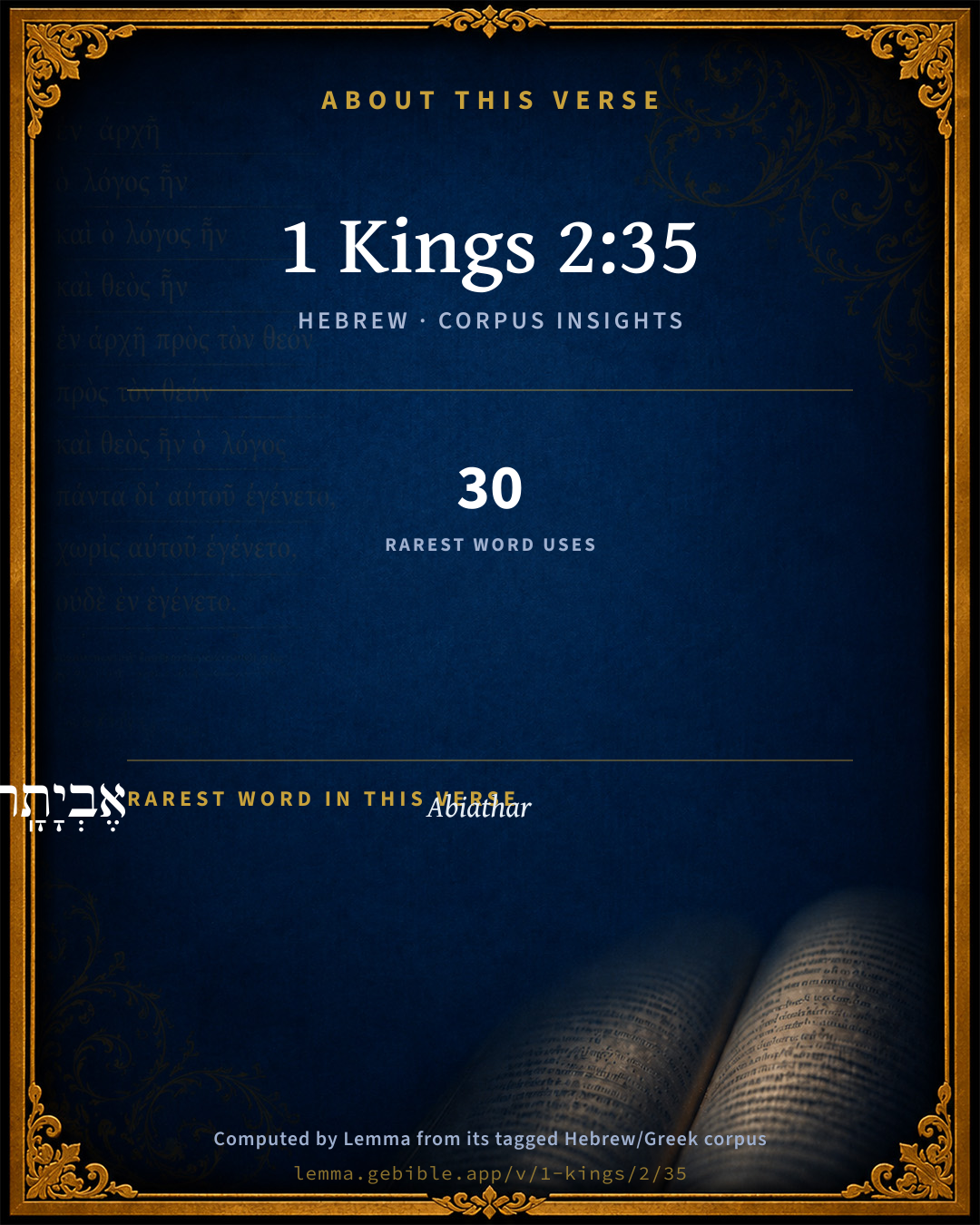
אֶבְיָתָֽר Abiathar H54 occurs in 28 verses of the Hebrew Bible. Also found in:

Grammatical profile

  • 2 verbs
  • 9 nouns
  • 3 prepositions
  • 2 particles

Verb forms

  • וַיִּתֵּ֨ן Qal · Sequential Imperfect
  • נָתַ֣ן Qal · Perfect

Repetition

Words recur within this verse — often emphatic in Hebrew:

  • וַיִּתֵּ֨ן to give H5414 ×2
  • הַמֶּ֜לֶךְ king H4428 ×2
  • תַּחְתָּ֖יו under H8478 ×2

Hebrew & Septuagint length

In English translation the verse runs 27 words from the Hebrew and 73 from the Septuagint (LXX English) — the Septuagint runs noticeably longer here. See the side-by-side →

A rough comparison of the two English renderings, which tokenize alike — not a word-level alignment.

Word counts can differ between the Hebrew and the Greek without any difference in meaning — e.g. the Hebrew direct-object marker אֵת has no separate Greek word, and Greek often adds the article ὁ.

Cross-references

11

Topical passages linked to 1 Kings 2:35 in the Treasury of Scripture Knowledge — connected by theme and wording, ordered by reader-vote popularity; previews shown in the World English Bible.

  • 1 Kings 2:27 So Solomon thrust out Abiathar from being priest to Yahweh, that he might fulfill the word of Yahweh, which he spoke concerning the house of Eli in Shiloh.
  • 1 Kings 4:4 and Benaiah the son of Jehoiada was over the host; and Zadok and Abiathar were priests;
  • 1 Chronicles 24:3 David with Zadok of the sons of Eleazar, and Ahimelech of the sons of Ithamar, divided them according to their ordering in their service.
  • 1 Chronicles 29:22 and ate and drink before Yahweh on that day with great gladness. They made Solomon the son of David king the second time, and anointed him to Yahweh to be prince, and Zadok to be priest.
  • Numbers 25:11–13 Phinehas, the son of Eleazar, the son of Aaron the priest, has turned my wrath away from the children of Israel, in that he was jealous with my jealousy among them, so that I didn't consume the children of Israel in my jealousy.
  • 1 Samuel 2:35 I will raise me up a faithful priest, that shall do according to that which is in my heart and in my mind: and I will build him a sure house; and he shall walk before my anointed forever.
  • 1 Chronicles 6:4–15 Eleazar became the father of Phinehas, Phinehas became the father of Abishua,
  • 1 Chronicles 6:50–53 These are the sons of Aaron: Eleazar his son, Phinehas his son, Abishua his son,
  • Job 34:24 He breaks in pieces mighty men in ways past finding out, And sets others in their place.
  • Psalms 109:8 Let his days be few. Let another take his office.
  • Acts 1:20 For it is written in the book of Psalms, 'Let his habitation be made desolate, Let no one dwell therein,' and, 'Let another take his office.'

Cross-references courtesy of OpenBible.info (CC BY 4.0).

Hebrew and Greek witnesses Masoretic Hebrew ↔ Greek Septuagint

The same verse in the two great witnesses to the Old Testament, shown verse-for-verse.

Here the Septuagint runs noticeably longer than the Hebrew — LXX2012 (modern English Septuagint) 73 words vs World English Bible 27. A rough length comparison of the two English translations, not a word-level alignment — read both below.

These are two independent witnesses, not word-aligned to each other, and the Septuagint is shown in lemma (dictionary) form.

Hebrew 1 Kings 2:35 Masoretic · Westminster Leningrad Codex

וַיִּתֵּ֨ן הַמֶּ֜לֶךְ אֶת בְּנָיָ֧הוּ בֶן יְהוֹיָדָ֛ע תַּחְתָּ֖יו עַל הַצָּבָ֑א וְאֶת צָד֤וֹק הַכֹּהֵן֙ נָתַ֣ן הַמֶּ֔לֶךְ תַּ֖חַת אֶבְיָתָֽר

The king put Benaiah the son of Jehoiada in his room over the host; and Zadok the priest did the king put in the room of Abiathar.

World English Bible · Public Domain

Greek LXX 1 Kings 2:35 Septuagint · lemma form

καί δίδωμι ὁ βασιλεύς ὁ βαναιας υἱός ιωδαε ἀντί αὐτός ἐπί ὁ στρατηγία καί ὁ βασιλεία καταὀρθόω ἐν ἰερουσαλήμ καί ὁ σαδωκ ὁ ἱερεύς δίδωμι ὁ βασιλεύς εἰς ἱερεύς πρῶτος ἀντί αβιαθαρ καί δίδωμι κύριος φρόνησις ὁ σαλωμών καί σοφία πολύς σφόδρα καί πλάτος καρδία ὡς ὁ ἄμμος ὁ παρά ὁ θάλασσα καί πληθύνω ὁ φρόνησις σαλωμών σφόδρα ὑπέρ ὁ φρόνησις πᾶς ἀρχαῖος υἱός καί ὑπέρ πᾶς φρόνιμος αἴγυπτος καί λαμβάνω ὁ θυγάτηρ φαραώ καί εἰςἄγω αὐτός εἰς ὁ πόλις δαυίδ ἕως συντελέω αὐτός ὁ οἶκος αὐτός καί ὁ οἶκος κύριος ἐν πρῶτος καί ὁ τεῖχος ἰερουσαλήμ κυκλόθεν ἐν ἑπτά ἔτος ποιέω καί συντελέω καί εἰμί ὁ σαλωμών ἑβδομήκοντα χιλιάς αἴρω ἄρσις καί ὀγδοήκοντα χιλιάς λατομέω ἐν ὁ ὄρος καί ποιέω σαλωμών ὁ θάλασσα καί ὁ ὑποστήριγμα καί ὁ λουτήρ ὁ μέγας καί ὁ στῦλος καί ὁ κρήνη ὁ αὐλή καί ὁ θάλασσα ὁ χαλκοῦς καί οἰκοδομέω ὁ ἄκρος καί ὁ ἐπάλξις αὐτός καί διακόπτω ὁ πόλις δαυίδ οὕτως θυγάτηρ φαραώ ἀναβαίνω ἐκ ὁ πόλις δαυίδ εἰς ὁ οἶκος αὐτός ὅς οἰκοδομέω αὐτός τότε οἰκοδομέω ὁ ἄκρος καί σαλωμών ἀναφέρω τρεῖς ἐν ὁ ἐνιαυτός ὁλοκαύτωσις καί εἰρηνικός ἐπί ὁ θυσιαστήριον ὅς οἰκοδομέω ὁ κύριος καί θυμιάζω ἐνώπιον κύριος καί συντελέω ὁ οἶκος καί οὗτος ὁ ἄρχων ὁ καταἵστημι ἐπί ὁ ἔργον ὁ σαλωμών τρεῖς χιλιάς καί ἑξακόσιοι ἐπιστάτης ὁ λαός ὁ ποιέω ὁ ἔργον καί οἰκοδομέω ὁ ασσουρ καί ὁ μαγδω καί ὁ γαζερ καί ὁ βαιθωρων ὁ ἐπάνω καί ὁ βααλαθ πλήν μετά ὁ οἰκοδομέω αὐτός ὁ οἶκος ὁ κύριος καί ὁ τεῖχος ἰερουσαλήμ κύκλος μετά οὗτος οἰκοδομέω ὁ πόλις οὗτος καί ἐν ὁ ἔτι δαυίδ ζάω ἐντέλλομαι ὁ σαλωμών λέγω ἰδού μετά σύ σεμεϊ υἱός γηρα υἱός σπέρμα ὁ ιεμινι ἐκ χεβρων οὗτος καταἀράομαι ἐγώ κατάρα ὀδυνηρός ἐν ὅς ἡμέρα πορεύομαι εἰς παρεμβολή καί αὐτός καταβαίνω εἰς ἀπαντή ἐγώ ἐπί ὁ ἰορδάνης καί ὄμνυμι αὐτός κατά ὁ κύριος λέγω εἰ θανατόω ἐν ῥομφαία καί νῦν μή ἀθῳόω αὐτός ὅτι ἀνήρ φρόνιμος σύ καί γιγνώσκω ὅς ποιέω αὐτός καί καταἄγω ὁ πολιά αὐτός ἐν αἷμα εἰς ᾅδης

And the king appointed Banaeas son of Jodae in his place over the host; and the kingdom was established in Jerusalem; and as for Sadoc the priest, the king appointed him to be high priest in the room of Abiathar. And Solomon son of David reigned over Israel and Juda in Jerusalem: and the Lord gave understanding to Solomon, and very much wisdom, and largeness of heart, as the sand by the sea-shore.

LXX2012 (modern English Septuagint) · Public Domain

On this verse, The Cambridge Bible for Schools and Colleges discusses the Septuagint’s reading. Read the note in Commentary ↓

Hebrew: Westminster Leningrad Codex (CC BY 4.0). Greek: Septuagint (public domain); English from LXX2012 (modern English Septuagint) (Public Domain). How the Septuagint differs from the Hebrew →

Targum (Aramaic paraphrase)

1

The Targum is the ancient Jewish Aramaic paraphrase of the Hebrew Scriptures — an interpretive translation, not the Hebrew text itself. Onkelos (literal) and Pseudo-Jonathan (expansive) render the Torah, and Jonathan the Prophets. Coverage is partial: where no permissively-licensed English translation exists for a verse, only the Aramaic is shown. This is verse-level text, not a word-by-word alignment to the Hebrew.

  1. Targum Jonathan Prophets (Joshua–Malachi)
    וּמַנֵי מַלְכָּא יַת בְּנָיָהוּ בַר יְהוֹיָדָע חִלוּפוֹהִי עַל חֵילָא וְיַת צָדוֹק כַּהֲנָא מַנֵי מַלְכָּא חֲלַף אֶבְיָתָר:

    (no public-domain English translation for this verse)

    Targum Jonathan — Aramaic: “Mikraot Gedolot” (public domain). English: “Sefaria Community Translation” (CC0 1.0 (public-domain dedication)); “London "Chaldee Paraphrase," 1871” (public domain). Text via Sefaria.

Commentary

Notes on 1 Kings 2:35 from classic Christian and Jewish commentators (each source and its license shown beneath its notes). The classic Christian expositions comment on the surrounding passage and are grouped to its opening verse, so a note may address several verses; the Jewish commentaries on the Tanakh (Rashi and others) are per-verse, so they appear only where the commentator wrote on this verse.

Lemma curates 59 commentaries, every one of them public domain or Creative Commons licensed, each selected and text-cleaned for this edition rather than reprinted as found. About our sources →

Matthew Henry's Commentary

Here is, I. The preferment of Benaiah and Zadok, two faithful friends to Solomon and his government, Kg1 2:35. Joab being put to death, Benaiah was advanced to be general of the forces in his room, and, Abiathar being deposed, Zadok was made high priest in his room, and therein was fulfilled the word of God, when he threatened to cut off the house of Eli (Sa1 2:35), I will raise me up a faithful priest, and will build him a sure house. Though sacred offices may be disgraced, they shall not be destroyed, by the mal-administration of those that are entrusted with them, nor shall God's work ever stand still for want of hands to carry it on. No wonder that he who was a king so immediately of God's making was empowered to make whom he though fit high priest; and he exercised this power with equity, for the ancient right was in Zadok, he being of the family of Eleazar, whereas Eli and his house were of Ithamar.

II. The course that was taken with Shimei. He is sent for, by a messenger, from his house at Bahurim, expecting perhaps no better than Adonijah's doom, being conscious of his enmity to the house of David; but Solomon knows how to make a difference of crimes and criminals. David had promised Shimei his life for his time. Solomon is not bound by that promise, yet he will not go directly contrary to it. 1. He confines him to Jerusalem, and forbids him, upon any pretence whatsoever, to go out of the city any further than the brook Kidron, Kg1 2:36, Kg1 2:37. He would suffer him to continue at his country seat lest he should make mischief among his neighbours, but took him to Jerusalem, where he kept him prisoner at large. This might make Shimei's confinement easy to himself, for Jerusalem was beautiful for situation, the joy of the whole earth, the royal city, the holy city (he had no reason to complain of being shut up in such a paradise); it would also make it the more safe for Solomon, for there he would have him under his eye and be able to watch his motions; and he plainly tells him that if he ever go out of the rules he shall certainly die for it. This was a fair trial of his obedience, and such a test of his loyalty as he had no reason to complain of. He has his life upon easy terms: he shall live if he will but be content to live at Jerusalem. 2. Shimei submits to the confinement, and thankfully takes his life upon those terms. He enters into recognizance (Kg1 2:38), under the penalty of death, not to stir out of Jerusalem, and owns that the saying is good. Even those that perish cannot but own the conditions of pardon and life unexceptionable, so that their blood, like Shimei's, must rest upon their own heads. Shimei promised, with an oath, to keep within his bounds, Kg1 2:42. 3. Shimei forfeits his recognizance, which was the thing Solomon expected; and God was righteous in suffering him to do it, that he might now suffer for his old sins. Two of his servants (it seems, though he was a prisoner, he lived like himself, well attended) ran from him to the land of the Philistines, Kg1 2:39. Thither he pursued them, and thence brought them back to Jerusalem, Kg1 2:40. For the keeping of it private he saddled his ass himself, probably went in the night, and came home he thought undiscovered. "Seeking his servants," says bishop Hall, "he lost himself; those earthly things either are, or should be, our servants. How commonly do we see men run out of the bounds set by God's law, to hunt after them, till their souls incur a fearful judgment!" 4. Solomon takes the forfeiture. Information is given him that Shimei has transgressed, Kg1 2:41. The king sends for him, and, (1.) charges him with the present crime (Kg1 2:42, Kg1 2:43), that he had put a great contempt upon the authority and wrath both of God and the king, that he had broken the oath of the Lord and disobeyed the commandment of his prince, and by this it appeared what manner of spirit he was of, that he would not be held by the bonds of gratitude or conscience. Had he represented to Solomon the urgency of the occasion, and begged leave to go, perhaps Solomon might have given him leave; but to presume either upon his ignorance or his connivance was to affront him in the highest degree. (2.) He condemns him for his former crime, cursing David, and throwing stones at him in the day of his affliction: The wickedness which thy heart is privy to, Kg1 2:44. There was no need to examine witnesses for the proof of the fact, his own conscience was instead of a thousand witnesses. That wickedness which men's own hearts alone are privy to is enough, if duly considered, to fill them with confusion, in expectation of its return upon their own heads; for if the heart be privy to it, God is greater than the heart and knoweth all things. Others knew of Shimei's cursing David, but Shimei himself knew of the wicked principles of hatred and malice against David which he displayed in cursing him and that his submission was but feigned and forced. (3.) He blessed himself and his government (Kg1 2:45.): King Solomon shall be blessed, notwithstanding Shimei's impotent curses, which perhaps, in fury and despair, he now vented freely: Let them curse, but bless thou. And the throne of David shall be established, by taking away those that would undermine it. It is a comfort, in reference to the enmity of the church's enemies, that, how much soever they rage, it is a vain thing they imagine. Christ's throne is established, and they cannot shake it. (4.) He gives orders for the execution of Shimei immediately, Kg1 2:46. All judgment is committed to the Lord Jesus, and, though he be King of peace, he will be found a King of righteousness; and this will shortly be his word of command concerning all his enemies, that would not have him to reign over them: Bring them forth, and slay them before me; the reproaches of those that blasphemed him will fall on themselves, to their eternal condemnation.

Matthew Henry's Commentary on the Whole Bible (1708–1710) — public domain (CC PDM 1.0). Text via the HelloAO Bible API.

Trapp's Complete Commentary

John Trapp

1Ki 2:35 And the king put Benaiah the son of Jehoiada in his room over the host: and Zadok the priest did the king put in the room of Abiathar.

Ver. 35. And Zadok the priest did the king put, &c.] Abiathar, the fourth from Eli, was of the race of Ithamar, the younger brother. Zadok was the right heir of Eleazar and Phinehas, {Num 25:13 1Ch 6:3, &c.} and was therefore rightly restored by Solomon. Of his commendation, see 1Sa 2:35.

John Trapp, A Commentary or Exposition upon All the Books of the Old and New Testament (1647–1656) — public domain. Text from a community e-Sword module.

Whedon's Commentary on the Bible

Daniel D. Whedon

35. Zadok the priest… in the room of Abiathar — Thus was fulfilled another part of the prophecy to Eli. See 1Sa_2:35, and note. “The ark and tabernacle had never been united since the capture of the ark by the Philistines in the days of Eli. Hence a double exercise of priestly functions in two different places ensued. Even at this time there was one altar of burnt offering at Gibeon, and another before the ark on Mount Zion. See note on 2Sa_6:17. But now, under Solomon, the prince of peace, the type of Christ, this confusion was about to cease, and unity of worship was to be established by the erection of the temple.” — Wordsworth.

Daniel D. Whedon (gen. ed.), Commentary on the Old and New Testaments (1874–1909) — public domain. Text from a community e-Sword module.

Geneva Bible (1599)

Geneva Bible translators

And so took the office of the high Priest from the house of Eli, and restored it to the house of Phinehas.

Geneva Bible (1599) marginal notes — public domain. Text via Bolls.life.

Ellicott's Commentary for English Readers

(35) And the king put.—Benaiah succeeds to Joab’s command over the host: but it is notable that in the Hebrew text of 1Ki_4:2-6, there is no mention of any successor to his command over the body-guard.

A Bible Commentary for English Readers, edited by Charles John Ellicott (1878–1897) — public domain. Text from a community e-Sword module.

The Cambridge Bible for Schools and Colleges

gen. ed. J. J. S. Perowne

35. put in the room of Abiathar] The LXX. amplifies and says that Zadok was now appointed εἰς ἱερέα πρῶτον, to be the first priest. Hitherto he seems to have had his post at Gibeon. There was not a great interval between the deposition of Abiathar and the building of the Temple, after which event the worship at Gibeon would cease. In the interval some deputy would fill Zadok’s place there.

In the LXX. there is found a long additional passage here, concerning Solomon’s wisdom, his marriage with Pharaoh’s daughter, his offerings and sacrifices, and his buildings. Then follows almost in the words of the earlier part of this chapter (1Ki_2:8-9) David’s charge concerning Shimei. The whole insertion seems confused and purposeless.

The Cambridge Bible for Schools and Colleges (gen. ed. J. J. S. Perowne; Cambridge University Press, 1878–1918) — public domain. Text from a community e-Sword module.

John Gill's Exposition

And the king sent and called for Shimei,.... Who had cursed his father; he lived at Bahurim, in the tribe of Benjamin, and from thence he sent for him to him, Sa2 16:5;

and said unto him, build thee an house in Jerusalem and dwell there,

and go not from thence any where; the orders were to remove from Bahurim to Jerusalem, where he was to provide himself a dwelling house, and there continue, and never go out of the city, at least not further on any side of it than it was to the brook Kidron, which was not more than half a mile from the city. This Solomon ordered, to prevent this man going about in the country sowing and stirring up sedition; and that he might be under his eye and notice, that should he commit any evil, and give him an opportunity of punishing him, he might do it as his father had directed him; and he might judge from the temper of the man, and indeed from the nature of men in general, that what they are forbidden they are the most prone unto, that he would transgress in this case, and give him an occasion against him.

John Gill's Exposition of the Whole Bible (1746–1763) — public domain (CC PDM 1.0). Text via the HelloAO Bible API.

Albert Barnes' Notes on the Bible

The high priesthood had been for some time in a certain sense divided between Zadok and Abiathar. (See the 1Ki 1:8 note). Henceforth, Zadok became sole high priest.

Albert Barnes' Notes on the Bible (1834–1885) — public domain. Text from a community e-Sword/MySword module.

Haydock's Catholic Bible Commentary

Abiathar. See ver. 26. Secular princes sometimes nominate, but they must obey, the pastor. (Worthington)

George Leo Haydock (1774–1849), Haydock's Catholic Family Bible and Commentary, 1859 edition — public domain. Excludes Psalms (Douay-Rheims chapter numbering differs from Protestant) and Deuterocanonical books (Catholic canon only).

Matthew Poole's English Annotations

He now put him in the execution of that office to which he may seem to have been anointed before, 1Ch 29:22; but of that, See Poole "1Ch 29:27".

Matthew Poole's English Annotations on the Holy Bible (1683–1685) — public domain. Text from a community e-Sword/MySword module.

The Pulpit Commentary

And the king put Benaiah the son of Jehoiada in his room over the host: and Zadok the priest did the king put in the room of Abiathar. It is hardly likely that Joab would be retained in command of the army after the conspiracy of chap. 1., nor is this implied in this verse, the meaning of which is that Benaiah took the place of Josh, and that Zadok henceforward was sole high priest.

The Pulpit Commentary (1880–1919), ed. H.D.M. Spence-Jones & Joseph S. Exell — public domain. Text from a community e-Sword module.

Lesson kit

Teaching starters — assembled from the data on this page, not authored interpretation. Every prompt links to the verse data it draws on. Edit before teaching.

1 Kings, in the Historical, opens this verse with 16 words (12 distinct Hebrew lemmas). Its most distinctive word is ʼEbyâthâr (“Abiathar”). The Greek Septuagint runs longer here. A historical commentator’s framing appears above. Read the whole chapter for the surrounding context.

Discussion questions

  1. What does “Abiathar” (ʼEbyâthâr) contribute to the verse as a whole?
  2. How does 1 Samuel 22:20, which shares the word «Abiathar», read alongside this verse?
  3. What does the repetition of “to give” (2× in this one verse) do in this verse?
  4. The Septuagint runs longer here than the Hebrew. What might account for the difference?
  5. These translations render this verse differently. What is at stake in choosing one wording over another?
  6. «וַיִּתֵּ֨ן» is a Qal Sequential Imperfect verb. How does that grammatical form shape the action described?
  7. Compare how Matthew Henry's Commentary and Trapp's Complete Commentary read this verse. Where do they agree or differ?

Things to notice

Reading settings

Reading text

Shown beneath each verse's original-language words.

Old Testament
Old Testament edition

Read the OT as the Masoretic Hebrew (MT) or the Greek Septuagint (LXX).

English shown for the Greek Septuagint (in the Hebrew ↔ Greek comparison).

Comparing translations? Open the Compare panel on any verse page to stack up to four side by side.