Luke 10:41

Greek (Tischendorf 8th ed.) Luke 10:41 appears in the Greek New Testament. The text above is from the Tischendorf 8th edition. Each word links to its Strong’s number and a concise gloss. Click any word for its full Thayer’s Greek Lexicon entry.
Download image
Cite this verse

Luke 10:41 (World English Bible). Public Domain. Lemma interlinear Bible study tool, https://lemma.gebible.app/v/luke/10/41.

Show BibTeX & RIS
BibTeX
RIS
English Translation
Jesus answered her, "Martha, Martha, you are anxious and troubled about many things,
World English Bible · Public Domain
Download a study sheet

One document with this verse’s original text, its word-by-word gloss line, the meaning frame, cross-references with their text, attributed commentary, and full source and license credits — printable, and it pastes into notes with its structure intact.

This verse Autodidact and up

Study sheet (.html) Plain text (.txt)

A passage Seminary Student

Up to 50 verses in one chapter. A passage sheet keeps up to 6 commentary sources and 12 cross-references per verse, in the order this page ranks them, and says so on the sheet whenever that leaves anything out. Ask for a single verse and you get the Autodidact verse sheet above.

Everything on this page stays free to read, with no account — the sheet is a download of what is already on screen, not access to it.

Want to remove ads? Support Godless Engineer
Compare translations 3

The same verse in 3 English versions, stacked beneath the original-language interlinear above. Click any original word for its lexicon entry.

Each is an independent rendering of the whole verse — the interlinear is not word-aligned to these translations.

Highlighted words mark where these versions differ — a whole-verse word diff, not a word-by-word alignment.

  • World English Bible Public Domain
    Jesus answered her, "Martha, Martha, you are anxious and troubled about many things,
  • King James Version Public Domain
    And Jesus answered and said unto her, Martha, Martha, thou art careful and troubled about many things:
  • unfoldingWord Literal Text CC BY-SA 4.0
    But answering, the Lord said to her, “Martha, Martha, you are anxious and troubled about many things,

unfoldingWord Literal Text — © unfoldingWord, licensed CC BY-SA 4.0. Word-aligned USFM3 via Door43 (git.door43.org/unfoldingWord/en_ult).

Versions to compare (up to 4)

3 of 4 selected

Show all 19 translations

Every available English version of this verse, each an independent rendering of the whole verse.

  • World English Bible Public Domain
    Jesus answered her, "Martha, Martha, you are anxious and troubled about many things,
  • Berean Standard Bible Public Domain
    “Martha, Martha,” the Lord replied, “you are worried and upset about many things.
  • Majority Standard Bible Public Domain
    “Martha, Martha,” Jesus replied, “you are worried and troubled about many things.
  • King James Version Public Domain
    And Jesus answered and said unto her, Martha, Martha, thou art careful and troubled about many things:
  • American Standard Version (1901) Public Domain
    But the Lord answered and said unto her, Martha, Martha, thou art anxious and troubled about many things:
  • Revised Version (1885) Public Domain
    But the Lord answered and said unto her, Martha, Martha, thou art anxious and troubled about many things:
  • Geneva Bible (1599) Public Domain
    And Iesus answered, and said vnto her, Martha, Martha, thou carest, and art troubled about many things:
  • Douay-Rheims (1899) Public Domain
    And the Lord answering, said to her: Martha, Martha, thou art careful, and art troubled about many things:
  • Young's Literal Translation Public Domain
    And Jesus answering said to her, `Martha, Martha, thou art anxious and disquieted about many things,
  • Literal Standard Version CC BY-SA 4.0
    And Jesus answering said to her, “Martha, Martha, you are anxious and disquieted about many things,
  • Unlocked Literal Bible CC BY-SA 4.0
    But the Lord answered and said to her, “Martha, Martha, you are anxious about many things,
  • unfoldingWord Literal Text CC BY-SA 4.0
    But answering, the Lord said to her, “Martha, Martha, you are anxious and troubled about many things,
  • Darby Bible Public Domain
    But Jesus answering said to her, Martha, Martha, thou art careful and troubled about many things;
  • World Messianic Bible Public Domain
    Yeshua answered her, “Martha, Martha, you are anxious and troubled about many things,
  • Webster's Bible Public Domain
    And Jesus answered, and said to her, Martha, Martha, thou art anxious, and troubled about many things:
  • Free Bible Version CC BY-SA 4.0
    “Martha, Martha,” the Lord replied, “you're worried and upset about all this.
  • Bible in Basic English Public Domain
    But the Lord, answering, said to her, Martha, Martha, you are full of care and troubled about such a number of things:
  • Text-Critical English NT CC BY 4.0
    But Jesus answered her, “Martha, Martha, yoʋ are anxious and troubled about many things,
  • Tyndale New Testament (1534) Public Domain
    And Iesus answered and sayde vnto her: Martha Martha thou carest and arte troubled about many thinges:

Literal Standard Version (2020), Covenant Press — licensed CC BY-SA 4.0. Text via the HelloAO Bible API (eBible.org). Unlocked Literal Bible (unfoldingWord) — licensed CC BY-SA 4.0. Text via the HelloAO Bible API (eBible.org). unfoldingWord Literal Text — © unfoldingWord, licensed CC BY-SA 4.0. Word-aligned USFM3 via Door43 (git.door43.org/unfoldingWord/en_ult). Free Bible Version, Dr. Jonathan Gallagher — licensed CC BY-SA 4.0. Text via the HelloAO Bible API (eBible.org).

Word by word

More ways to search: Search by grammar → Find every occurrence → Compare this word →

Practice this passage: Drill this verse → Learn its vocabulary →

θορυβάζῃ
thorybéō
G2350
“to disturb”
Verb, Present, Passive, Indicative, 2nd person, Singular
Part of Speech
Verb
Tense
Present
Voice
Passive
Mood
Indicative
Person
2nd person
Number
Singular
Full Thayer's Definition

Origin: from G2351

TDNT: None

1. to make a noise or uproar, be turbulent 2. to disturb, throw into confusion a. to be troubled in mind b. to wail tumultuously
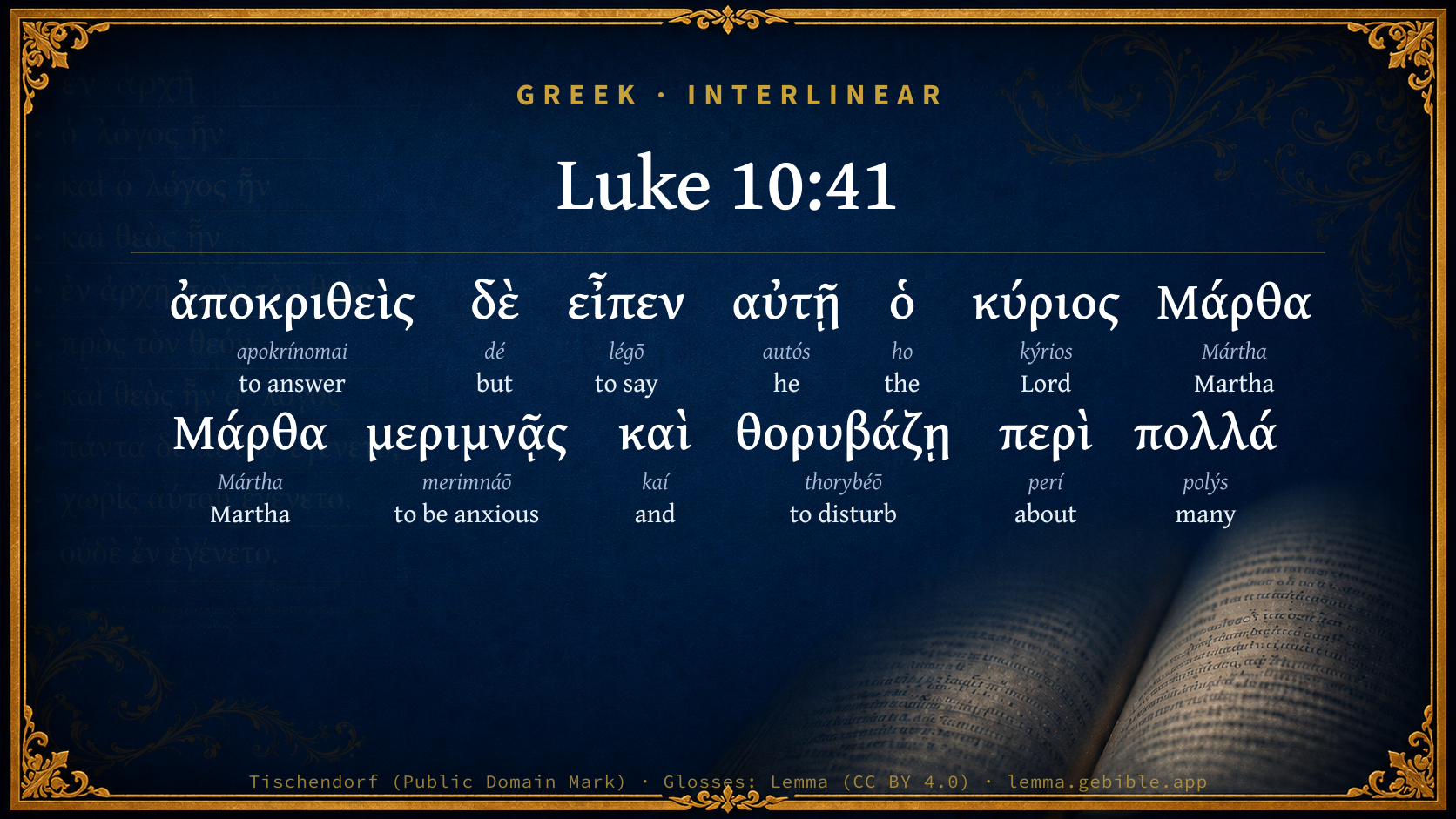
  1. ἀποκριθεὶς apokrínomai G611 “to answer” Verb, Aorist, Passive deponent, Participle, Nominative, Singular, Masculine
  2. δὲ dé G1161 “but” Conjunction
  3. εἶπεν légō G3004 “to say” Verb, Aorist, Active, Indicative, 3rd person, Singular
  4. αὐτῇ autós G846 “he” Personal pronoun, Dative, Singular, Feminine
  5. ὁ ho G3588 “the” Article, Nominative, Singular, Masculine
  6. κύριος kýrios G2962 “Lord” Noun, Nominative, Singular, Masculine
  7. Μάρθα Mártha G3136 “Martha” Noun, Vocative, Singular, Feminine
  8. Μάρθα Mártha G3136 “Martha” Noun, Vocative, Singular, Feminine
  9. μεριμνᾷς merimnáō G3309 “to be anxious” Verb, Present, Active, Indicative, 2nd person, Singular
  10. καὶ kaí G2532 “and” Conjunction
  11. περὶ perí G4012 “about” Preposition
  12. πολλά polýs G4183 “many” Adjective, Accusative, Plural, Neuter

About this verse

These counts appear in no published source. They are computed here, from the morphology-tagged text and Lemma’s own curated glosses. What Lemma adds →

13
words
12
distinct lemmas
Gospels
section

Notable vocabulary

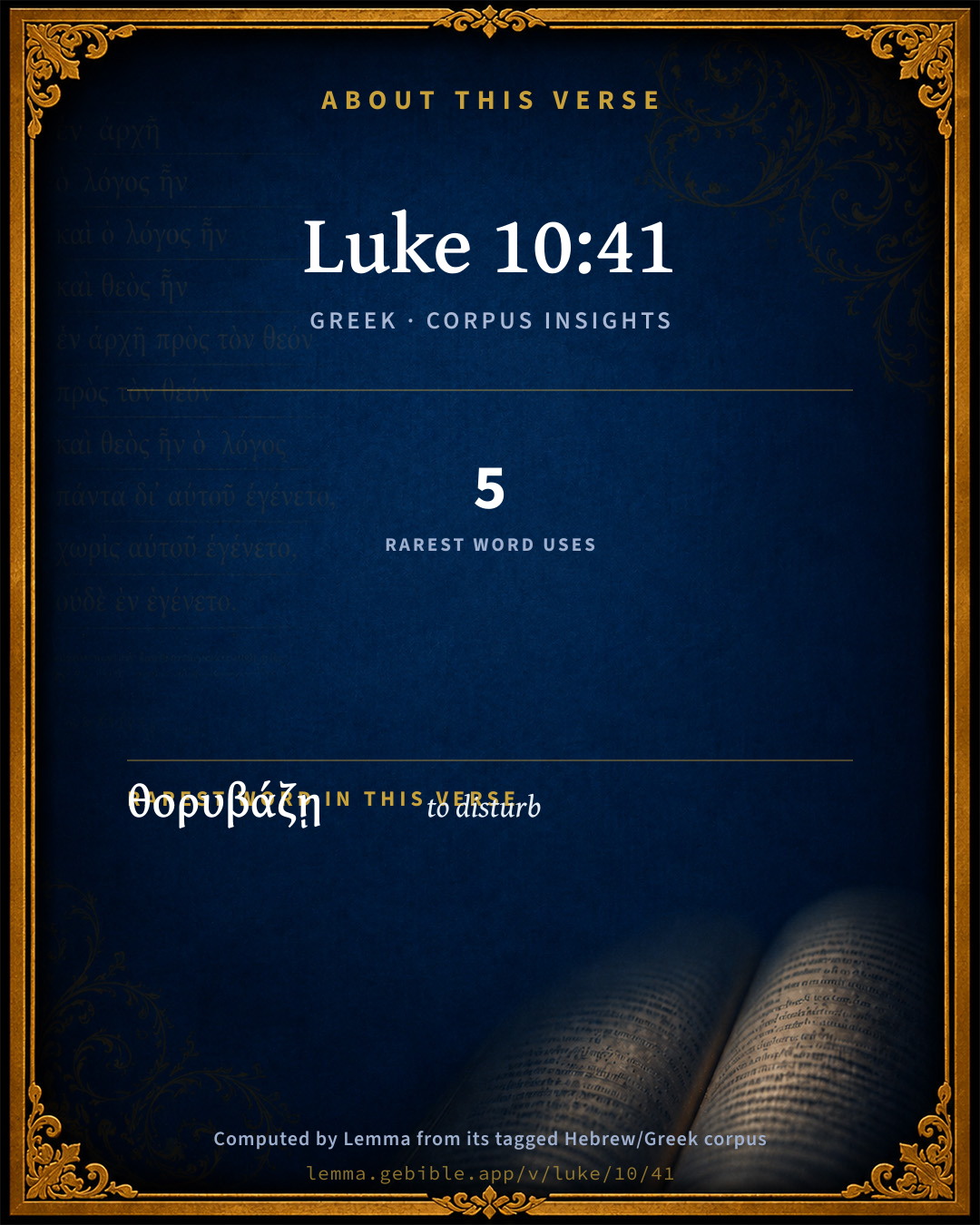
The rarest word here is θορυβάζῃ to disturb G2350 — appearing just 5 times in the whole Greek New Testament.

Shared distinctive vocabulary

θορυβάζῃ to disturb G2350 occurs in 5 verses of the Greek New Testament. Also found in:

Repetition

A word recurs within this verse:

  • Μάρθα Martha G3136 ×2

Cross-references

8

Topical passages linked to Luke 10:41 in the Treasury of Scripture Knowledge — connected by theme and wording, ordered by reader-vote popularity; previews shown in the World English Bible.

  • Philippians 4:6 In nothing be anxious, but in everything, by prayer and petition with thanksgiving, let your requests be made known to God.
  • Mark 4:19 and the cares of this age, and the deceitfulness of riches, and the lusts of other things entering in choke the word, and it becomes unfruitful.
  • Luke 21:34 "So be careful, or your hearts will be loaded down with carousing, drunkenness, and cares of this life, and that day will come on you suddenly.
  • Matthew 6:25–34 Therefore, I tell you, don't be anxious for your life: what you will eat, or what you will drink; nor yet for your body, what you will wear. Isn't life more than food, and the body more than clothing?
  • Luke 8:14 That which fell among the thorns, these are those who have heard, and as they go on their way they are choked with cares, riches, and pleasures of life, and bring no fruit to maturity.
  • Luke 12:22 He said to his disciples, "Therefore I tell you, don't be anxious for your life, what you will eat, nor yet for your body, what you will wear.
  • 1 Corinthians 7:32–35 But I desire to have you to be free from cares. He who is unmarried is concerned for the things of the Lord, how he may please the Lord;
  • Ecclesiastes 6:11 For there are many words that create vanity. What does that profit man?

Cross-references courtesy of OpenBible.info (CC BY 4.0).

Where the printed editions differ

1 variant

Places in this verse where the major printed Greek editions disagree on the wording in a way that affects the translation — a comparison of editions, not a manuscript-by-manuscript collation. The editions are the modern critical texts (Nestlé-Aland 28/27, SBL, Westcott-Hort, Tregelles, Tyndale House) and the traditional texts behind the KJV (the Textus Receptus and the Byzantine/Majority text). It is not a claim about which reading is original.

  1. Different wording
    κύριος·

    “Lord;”

    In NA28NA27TynSBLWH Not in TregTRByz

    Ἰησοῦς (Iēsous) 'Jesus' occurs in traditional manuscripts (Treg+TR+Byz) instead of κύριος· (kurios) 'Lord;' in older manuscripts (NA28+NA27+Tyn+SBL+WH)

Textual data: Translators Amalgamated Greek New Testament (STEPBible TAGNT) · CC BY 4.0.

Commentary

Notes on Luke 10:41 from classic Christian and Jewish commentators (each source and its license shown beneath its notes). The classic Christian expositions comment on the surrounding passage and are grouped to its opening verse, so a note may address several verses; the Jewish commentaries on the Tanakh (Rashi and others) are per-verse, so they appear only where the commentator wrote on this verse.

Lemma curates 59 commentaries, every one of them public domain or Creative Commons licensed, each selected and text-cleaned for this edition rather than reprinted as found. About our sources →

Bengel's Gnomon

Johann Albrecht Bengel

Luk 10:41. Μάρθα, Μάρθα, Martha, Martha) An Epizeuxis [the forcible repetition of the same word in the same sentence] calculated deeply to impress Martha’s mind.—μεριμνᾷς, thou art careful) inwardly. The antithesis is, οὐ μέλει σοι, hast Thou no care?—τυρβάζῃ, thou art troubled) externally. Its synonym is, περιεσπᾶτο, was distracted or cumbered. See Eustathius.

Bengel's Gnomon of the New Testament — English translation (T&T Clark, Edinburgh, 1860) — public domain. Text from a community e-Sword module.

Meyer's Critical & Exegetical Commentary

Heinrich August Wilhelm Meyer

Luk_10:41-42. Περὶ πολλά] Thou art anxious, and weariest thyself (art in the confusion of business) about many things, see Luk_10:40. On τυρβάζεσθαι περί τι, comp. Aristoph. Ran. 1007.

ἑνὸς δέ ἐστι χρεία] A contrast with πολλά: but of one thing there is need; one thing is necessary, that is to say, as an object of care and trouble. By these words Jesus, in accordance with the context, can mean nothing else than that from which Martha had withdrawn, while Mary was bestowing pains upon itthe undivided devotion to His word for the sake of salvation, although in tenderness He abstains from mentioning it by name, but leaves the reference of the expression, in itself only general, to be first discovered from the words which follow. In respect of the neuter ἑνός nothing is to be supplemented any more than there is in respect of πολλά. Following Gregory, Bede, Theophylact, Zeger, Michaelis, and others (comp. Erasmus in the Annotations), Paulus understands: one dish, we need not many kinds, and τὴν ἀγαθὴν μερίδα is then taken as meaning the really good portion,[139] which figuratively represents the participation in communion with Jesus. The former, especially after the impressive Μάρθα, Μάρθα, would have been just as trivial and out of harmony with the serious manner of Jesus as the latter would have been discourteous to the well-intentioned hostess. Nachtigall also mistakes (in Henkes Magaz. VI. p. 355), and Stolz agrees with him in interpreting: one person is enough (in the kitchen), in opposition to which the contrast of πολλά is decisive, seeing that according to it ἑνός must be neuter.

τὴν ἀγαθὴν μερίδα] the good part. That, namely, about which care and pains are taken, consists, according to the various kinds of these objects, of several parts. Mary has selected for herself among these, for her care and pains, the good part; and this is, in accordance with the subject, nothing else than precisely that ἕν which is necessarythat portion of the objects of solicitude and labour which is the good one, the good portion, which only one can be. More vaguely Grotius, Elsner, Kypke, Kuinoel, and others put it: the good occupation; and de Wette, generalizing this: the good destination of life. Comp. also Euthymius Zigabenus: δύο μερίδες πολιτείας ἐπαινεταὶ, ἡ μὲν πρακτική, ἡ δὲ θεωρητική.

τὴν ἀγαθήν] neither means optimam (Kuinoel and others), nor does it imply that the care of Martha, in which assuredly love also was expressed, was mala (Fritzsche, Conject. I. p. 19); but it designates the portion as the good one κατʼ ἐξοχήν.

ἥτις οὐκ ἀφαιρ. ἀπʼ αὐτ.] refers certainly, first of all, to Marthas appeal, Luk_10:40. Hence it means: which shall not be taken away from her; she shall keep it, Mar_4:25, whereby, however, Jesus at the same time, in thoughtful reference to further issues, points, in His characteristically significant manner, to the everlasting possession of this μερίς. By ἥτις, which is not equivalent to ἥ, what follows is described as belonging to the essence of the ἀγαθὴ μερίς: quippe quae. Transit amor multitudinis et remanet caritas unitatis, Augustine.

Those who have found in Marys devotion the representation of the Pauline πίστις, and in the nature of Martha that of zeal for the law, so that the evangelist is made to describe the party relations of his own day (Baur, Zeller, Schwegler, Hilgenfeld), have, by a coup quite as unjustifiable as it was clumsy, transferred this relic of the home life of Jesus into the foreign region of allegory, where it would only inaptly idealize the party relations of the later period.

[139] Comp. the form of speech, πρὸς μερίδας δειπνεῖν, to dine in portions, and sea examples in Wetstein.

Meyer — Critical and Exegetical Commentary on the New Testament — English translation by Peter Christie, edited by Frederick Crombie (T&T Clark, 1880) — public domain. Text from a community e-Sword module.

Expositor's Greek Testament

ed. W. Robertson Nicoll

Luk 10:41 . θορυβάζῃ (from θόρυβος , an uproar; τυρβάζῃ T. R., from τύρβη , similar in meaning, neither form again in N. T.), thou art bustled, gently spoken and with a touch of pity. περὶ πολλά : a great day in that house. Every effort made to entertain Jesus worthily of Him and to the credit of the house.

The Expositor's Greek Testament, edited by W. Robertson Nicoll (1897–1910) — public domain. Text from a community e-Sword module.

Jamieson, Fausset & Brown

Robert Jamieson, A. R. Fausset & David Brown

Martha, Martha--emphatically redoubling upon the name.

careful and cumbered--the one word expressing the inward worrying anxiety that her preparations should be worthy of her Lord; the other, the outward bustle of those preparations.

many things--"much service" (Luk 10:40); too elaborate preparation, which so engrossed her attention that she missed her Lord's teaching.

Jamieson, Fausset & Brown — Commentary Critical and Explanatory on the Whole Bible (1871) — public domain (CC PDM 1.0). Text via the HelloAO Bible API.

Adam Clarke's Commentary

Verse 41. Thou art careful and troubled] Thou art distracted, μεριμνας, thy mind is divided, (See Clarke on Mt 13:22,) in consequence of which, τυρβαζη, thou art disturbed, thy spirit is thrown into a tumult.

About many things.] Getting a variety of things ready for this entertainment, much more than are necessary on such an occasion.

Adam Clarke's Commentary on the Bible (1810–1826) — public domain. Text from a community e-Sword/MySword module.

Ellicott's Commentary for English Readers

(41) And Jesus answered.—The better MSS. give, “And the Lord answered.” (See Note on Luk_7:13.)

Martha, Martha.—We note a special tenderness of reproof in the two-fold utterance of the name, of which this and the like iteration of “Simon, Simon,” in Luk_22:31, are the only examples in our Lord’s recorded utterances during His earthly ministry. (Comp. “Saul, Saul,” in Act_9:4.)

Thou art careful.—The verb is the same as the “take thought” of Mat_6:25, and throws light upon the meaning of that phrase.

A Bible Commentary for English Readers, edited by Charles John Ellicott (1878–1897) — public domain. Text from a community e-Sword module.

The Cambridge Bible for Schools and Colleges

gen. ed. J. J. S. Perowne

41. Martha, Martha] The repeated name adds additional tenderness to the rebuke, as in Luk_22:31; Act_9:4.

thou art careful and troubled about many things] “I would have you without carefulness,” 1Co_7:32; Mat_6:25. The words literally mean, ‘Thou art anxious and bustling.’ Her inward solicitude was shewing itself in outward hastiness.

but one thing is needful] The context should sufficiently have excluded the very bald, commonplace, and unspiritual meaning which has been attached to this verse,—that only one dish was requisite. Clearly the lesson conveyed is the same as in Mat_6:33; Mat_16:26, even if our Lord’s first reference was the lower one. The various readings ‘but there is need of few things,’ or ‘of few things or of one’ (א, B, various versions, &c.) seem to have risen from the notion that even for the simplest meal more than one dish would be required. This, however, is not the case in the simple meals of the East.

that good part] Rather, portion (as of a banquet, Gen_43:34, LXX.; Joh_6:27) or inheritance, Psa_73:26. ἥτις = quippe quae. The nature of the portion is such that, &c.

which shall not be taken away from her] To speak of such theological questions as ‘indefectible grace’ here, is to use the narrative otherwise than was intended. The general meaning is that of Php_1:6; 1Pe_1:5. It has been usual with Roman Catholic and other writers to see in Martha the type of the active, and in Mary of the contemplative disposition, and to exalt one above the other. This is not the point of the narrative, for both may and ought to be combined as in St Paul and in St John. The gentle reproof to Martha is aimed not at her hospitable activity, but at the ‘fret and fuss,’ the absence of repose and calm, by which it was accompanied; and above all, at the tendency to reprobate and interfere with excellence of a different kind.

The Cambridge Bible for Schools and Colleges (gen. ed. J. J. S. Perowne; Cambridge University Press, 1878–1918) — public domain. Text from a community e-Sword module.

John Gill's Exposition

But one thing is needful,.... Meaning not that one dish of meat was sufficient, and there was no need of any more, in opposition to Martha's carefulness in preparing many; for this is too low a sense of the words; which yet some ancient writers have given into: but rather the hearing of the word, the Gospel of Christ, which Mary was engaged in; and which, ordinarily speaking, is necessary to the knowledge of Christ, and salvation by him, and to faith in him, Rom 10:14 not that this is the only needful thing; nor does Christ say there is but one thing needful, but that there is one thing needful; for there are other things that are also needful, and useful, as meditation and prayer, and attendance on, and submission to the ordinances of baptism, and the Lord's supper, and all the duties of religion: but Christ's meaning seems plainly to be, that Mary hearing the word from his mouth, and at his feet, was one necessary thing, in opposition to Martha's many unnecessary ones, about which she was cumbered:

and Mary hath chosen that good part; or "the good part", or "portion"; Christ, the sum and substance of the word she heard, and eternal life and salvation by him. God himself is said to be the portion of his people, and a good one he is, and a portion that lasts for ever; and so is Christ; see Psa 73:26 where the Septuagint use the same word as here. The heavenly inheritance also, eternal glory and happiness, is the saints' portion; it is called in Col 1:12 the part, or portion of the inheritance with the saints in light. The word answers to the Hebrew word, as in that saying of the Misnic doctors (f),

"all Israel have, "a part", or "portion" in the world to come.''

All the Oriental versions add, "for herself", and this choice she made, not from the natural power of her own freewill, but as directed, influenced, and assisted by the Spirit and grace of God, and in consequence of God's eternal choice of her unto salvation by Jesus Christ: and the part she chose is, that

which shall not be taken away from her; by men or devils: faith which comes by hearing of the word, and so every other grace of the Spirit is what can never be lost; nor an interest in God, as a covenant God, or in Christ as a Saviour, nor a right and title to, nor meetness for eternal life, nor that itself, can be taken away, or the believer ever be deprived thereof.

(f) Misn. Sanhedrin, c. 11. sect. 1.

Next: Luke Chapter 11

John Gill's Exposition of the Whole Bible (1746–1763) — public domain (CC PDM 1.0). Text via the HelloAO Bible API.

Trapp's Complete Commentary

John Trapp

41 And Jesus answered and said unto her, Martha, Martha, thou art careful and troubled about many things:

Ver. 41. Thou art careful] Christ prefers attention before attendance. To hearken is better than the fat of rams, 1Sa 15:22.

John Trapp, A Commentary or Exposition upon All the Books of the Old and New Testament (1647–1656) — public domain. Text from a community e-Sword module.

Albert Barnes' Notes on the Bible

Thou art careful - Thou art anxious.

Troubled - Disturbed, distracted, very solicitous.

Many things - The many objects which excite your attention in the family. This was probably designed as a slight reproof, or a tender hint that she was improperly anxious about those things, and that she should, with Mary, rather choose to hear the discourses of heavenly wisdom.

Albert Barnes' Notes on the Bible (1834–1885) — public domain. Text from a community e-Sword/MySword module.

Matthew Poole's English Annotations

Our Saviour plainly blames Martha for her too great solicitude and trouble to provide a dinner, or supper, for him, who had meat to eat which she was not aware of, it being his meat and drink to do the will of his Father, and to preach the gospel. Interpreters much trouble themselves in determining what that

one thing is, which our Saviour here saith is needful. Some think our Saviour meaneth no more than, one dish is enough; but this certainly is too low a sense. Others would have this one thing to be a life of meditation and contemplation, and that this was that

good part Mary had chosen. If Mary had thus spent her whole life they might have said something for this. But certainly Mary’s choosing to take advantage of Christ’s company, rather to spend an hour or two in hearing of him, than in preparing a supper for him, will prove no such thing. I should interpret it generally, concerning the care of the soul with reference to eternity. That is certainly the one thing necessary, that was the better part, which Mary had chosen, as to which Christ would not discourage her, nor any way blunt the edge of those holy desires he had kindled in her, an effect of which study and care was her sitting at the feet of Christ to hear his word.

Matthew Poole's English Annotations on the Holy Bible (1683–1685) — public domain. Text from a community e-Sword/MySword module.

Whedon's Commentary on the Bible

Daniel D. Whedon

41. Martha, Martha—There is a solemn reproof in this repetition. It implies a doubt and a danger.

Careful and troubled—To be the best housekeeper in town adorns the Christian piety of a lady, if it in no way encroaches upon and destroys it. But it is sad when the ambition of a secular duty crowds out important spiritual thoughts and engagements; allowing no time for the cultivation of those germs of spiritual life which are the commencement here of a heavenly life hereafter. We venture to believe that Mary, who limited one duty by another, and gave each its just proportion, could, in her calmness and clearness, accomplish more even of secular duty than her older sister with all her fluster.

Daniel D. Whedon (gen. ed.), Commentary on the Old and New Testaments (1874–1909) — public domain. Text from a community e-Sword module.

The Pulpit Commentary

And Jesus answered and said unto her, Martha, Martha. There are several notable instances of this repetition of the name by the Master in the New Testament story, and in each case apparently in pitying love. So "Simon, Simon," in Luk_22:31, and "Saul, Saul," in Act_9:4.

The Pulpit Commentary (1880–1919), ed. H.D.M. Spence-Jones & Joseph S. Exell — public domain. Text from a community e-Sword module.

John Wesley's Explanatory Notes

Martha, Martha - There is a peculiar spirit and tenderness in the repetition of the word: thou art careful, inwardly, and hurried, outwardly.

John Wesley, Explanatory Notes Upon the Whole Bible (1754–1765) — public domain. Text via the GEBible commentary corpus.

Burkitt's Expository Notes on the New Testament

William Burkitt

As if Christ had said, "Martha, Martha, I well know that thou doest all this in love to me, and it is no more that what is thy duty in its proper season; but thou has now an opportunity to hear my word, which thou can not have every day, and it would have pleased me better, to whom it is meat and drink to feed souls, if I had seen thee sitting with thy dear sister at my feet, and yielding an attentive regard to my holy doctrine, than to find thee performing a necessary civility to my person. Thou hast not made a bad choice, but Mary has made a better; she has laid all aside to attend upon my ministry, and the fruit of it will continue with her to all eternity": It is that good part which shall never be taken away from her.

Note here, 1. The unexpectedness of our Saviour’s answer to Martha, how contrary it was to her expectation: she thought that her sister should have been sent away with a check, and herself with thanks, but she is quite mistaken: for all her good cheer that she had provided for Christ, he spares not to tell her of her fault: Martha, Martha, thou art troubled about many things.

Learn hence, that no obligations to any particular persons should so enthrall us, but that our tongue should be at liberty to reprove the faults of our best friends, wherever we find them. Martha, though a pious and good woman, though a friendly and kind woman, though a woman greatly beloved by Christ, yet is she reproved by Christ.

Note, 2. The reproof given to Martha: Thou art troubled about many things: where Christ condemns not her hospitality, but her solicitude and superfluity, her distraction and perplexity.

Oh how prone are we to exceed in things lawful and necessary, and to go beyond our bounds in them: when we are satisfied in the matter, we are prone to exceed in the measure. Martha’s entertainment of Christ was a noble service, but she was too anxious and solicitious about it; she was cumbered, she was careful, she was troubled.

Note, 3. Our Saviour’s admonition: But one thing is needful: that is, there is one thing which ought first and principally to be regarded by us, and is of the greatest concernment to us; namely, the business of religion, and the care of our soul’s salvation.

Learn hence, that the care of religion, and our soul’s salvation, is the one thing necessary, and that which every man is concerned in the first place, and above all other things to regard and mind.

Note, 4. Our Saviour’s justification of Mary’s choice: Mary hath chosen that good part. Christ did not tell Martha she had chosen a bad part, but her sister had chosen the better. Martha’s entertainment of Christ was good, but Mary’s attendance upon Christ’s ministry was better, and more pleasing unto Christ. Christ was better pleased to see Mary in the chapel, than Martha in the kitchen; though he does not condemn the one, yet he extols the other; Mary had chosen the good part.

Learn hence, that religion and the sevice of God must be the matter of our election and choice; we must choose the good part, and it being once chosen by us, it shall never be taken away from us: One thing is needful: and Mary hath chosen that good part, which shall never be taken away from her.

William Burkitt's Expository Notes on the New Testament (1700–1703) — public domain. Text from a community e-Sword module.

The People's New Testament

B. W. Johnson

41, 42. Thou art anxious and troubled. Agitated over temporal matters while there are others more important.

One thing is needful. Jesus cared nothing for bodily indulgence. The important thing was the bread of life. That, Mary had chosen. Heed the lesson that he who receives most of his word and spirit, is most pleasing in his sight.

B. W. Johnson's The People's New Testament with Notes (1889–1891) — public domain. Electronic text from the Christian Classics Ethereal Library (CCEL) ThML edition.

Cambridge Greek Testament for Schools and Colleges

41. θορυβάζῃ. אBCDL. The word is commoner than τυρβάζῃ, but neither occurs again in N. T. θορυβοῦμαι occurs in Mat 9:23. Mar 5:39. Act 20:10.

ἑνὸς δέ ἐστιν χρεία. AC, La[220] Ti[221] The reading of אBL, Copt. Aeth. Arm. &c. is ὀλίγων δέ ἐστιν χρεία ἢ ἑνός.

[220] La. Lachmann.

[221] Ti. Tischendorf.

41. Μάρθα Μάρθα. The repeated name adds traditional tenderness to the rebuke, as in Luk 22:31; Act 9:4.

μεριμνᾷς καὶ θορυβάζῃ περὶ πολλά. “I would have you without carefulness,” 1Co 7:32; Mat 6:25. The words literally mean, ‘Thou art anxious and bustling.’ Her inward solicitude was shewing itself in outward hastiness.

Cambridge Greek Testament for Schools and Colleges (Cambridge University Press, 1896; 21 vols, various authors incl. Carr, Maclear, Plummer, Farrar, Lumby, Moule, M. R. James, Simcox) — public domain. Text from a community e-Sword module.

International Critical Commentary

41. Μάρθα, Μάρθα, μεριμνᾷς. The repetition of the name conveys an expression of affection and concern: 22:31; Act 9:4; Mat 7:21. Comp. Mar 14:36; Rom 8:15; Gal 4:6, and see on 8:24.1 The verb is a strong one, “thou art anxious,” and implies division and distraction of mind (μερίζω), which believers ought to avoid: Mat 6:25, Mat 6:28, Mat 6:31, Mat 6:34; Luk 12:11, Luk 12:22, Luk 12:26; Phil. 4:26. Comp. μέριμνα, 8:14, 21:34, and especially 1Pe 5:7, where human anxiety (μέριμνα) is set against Divine Providence (μέλει).

καὶ θορυβάζῃ. “And art in a tumult, bustle.” The readings, vary much, and certainty is not obtainable, respecting the central portion of Christ’s rebuke. The form θορυβάζομαι seems to occur nowhere else: τυρβάζω is fairly common: περὶ ταύτας τυρβάζεσθαι (Aristoph. Pax. 1007). An unusual word would be likely to be changed into a familiar one. In any case μεριμνᾷς refers to the mental distraction, and the second verb to the external agitation. Martha complains of having no one to help her; but it was by her own choice that she had so much to do.

The difference between θορυβάζῃ (א B C D L) and τυρβάζῃ (A R) is unimportant: the question is as to the words which ought to stand between Μάρθα and Μαριάμ. As regards the first part the decision is not difficult. Nearly all Greek MSS. have μεριμνᾷς καὶ θορυβάζῃ (or τυρβάζῃ) περὶ πόλλα after Μάρθα, and have γάρ or δέ after Μαριάμ or Μαρία. But on the evidence of certain Latin authorities (a b e ff2 i Amb.) the Revisers and WH. give a place in the margin to θορυβάζῃ only after Μάρθα, with neither γάρ nor δέ after Μαριάμ: and these same authorities with D omit all that lies between θορυβάζῃ and Μαριάμ. This curt abrupt reading may be rejected. It is less easy to determine the second part. We may reject ὀλίγων δέ ἐστιν χρεία χρεία, which has very little support. Both this reading and ἐνὸς δέ ἐστιν χρεία (A C1 P Γ Δ Π) are Probably corruptions of ὀλίγων δέ ἐστιν χρεία ἤ ἐνός (א B C2 L). The last might be a conflate reading from the other two, if the evidence did not show that it is older than ὀλίγων δέ ἐστιν χρεία: it is found in Boh. and Aeth. and also in Origen. See Sanday, App. ad N.T. p. 119. Syr-Sin. has “Martha, Martha, Mary hath chosen for herself the good part, which,” etc.

ὀλίγων δέ ἐστιν χρεία ἢ ἑνός. The ὀλίγων is opposed to περὶ πολλά, and ἑνός has a double meaning, partly opposed to περὶ πολλά, partly anticipatory of the ἀγαθὴ μερίς. There was no need of an elaborate meal; a few things, or one, would suffice.1 Indeed only one portion was necessary ;—that which Mary had chosen. Both χρεία and μερίς are used of food; τὰ πρὸς τὴν χρείαν being necessaries as distinct from τὰ πρὸς τὴν τρυφήν. For μερίς as a “portion” of food comp. Gen 43:34; Deu 18:8; 1Sa 1:4, 1Sa 1:9:23; Neh 8:12, Neh 8:12:47; Ecc 11:2. For μερίς in the higher sense comp. Κύριος ἡ μερὶς τῆς κληρονομίας μου (Psa 15:5). See also Psa 73:26, 119:57, 142:5; Lam 3:24; Ps. Son 5:6, 14:3.

Neither ὀλίγων nor ὲνός can be masc., because the opposition is to πολλά And if the meaning were “Few people are wanted for serving, or only one,” we should require μιᾶς as only women are mentioned.

International Critical Commentary — older volumes (1896–1929), various authors — public domain. Text from a community e-Sword module.

Vincent's Word Studies in the New Testament

Marvin R. Vincent

Thou art anxious [μεριμνας] . See on Mt 6:25.

Troubled [θορυβαζη] . From qorubov, tumult. Anxious denotes the inward uneasiness : troubled, the outward confusion and bustle. ===Luk11

CHAPTER XI

2 - 4. Compare Mt 6:9 - 13.

Marvin R. Vincent, Word Studies in the New Testament (1887–1900) — public domain. Text from a community e-Sword/MySword module.

Godet's Commentaries

Frédéric Louis Godet

Vers. 41, 42. The Answer.

Jesus replies to the reproach of Martha by charging her with exaggeration in the activity which she is putting forth. If she has so much trouble, it is because she wishes it. Μεριμνᾷν, to be careful, refers to moral preoccupation; τυρβάζεσθαι, to be troubled, to external agitation. The repetition of Martha’s name in the answer of Jesus is intended to bring her back gently, but firmly, from her dissipation of mind. The expression in which Jesus justifies His rebuke is at once serious and playful. According to the received reading, One thing only is needful, the thought might be: “A single dish is sufficient.” But as it was certainly not a lesson on simplicity of food that Jesus wished to give here, we must in that case admit a double reference, like that which is so often found in the words of Jesus (Joh 4:31-34): “A single kind of nourishment is sufficient for the body, as one only is necessary for the soul.” This is probably the meaning of the Alex. reading: “There needs but little (for the body), or even but one thing (for the soul).” There is subtilty in this reading; too much perhaps. It has against it 15 Mjj., the Peschito, and a large number of the copies of the Itala. It is simpler to hold that, by the expression one thing, Jesus meant to designate spiritual nourishment, the divine word, but not without an allusion to the simplicity in physical life which naturally results from the preponderance given to a higher interest. The expression ἀγαθὴ μερίς, that good part, alludes to the portion of honour at a feast. The pronoun ἥτις, which as such, brings out the relation between the excellence of this portion, and the impossibility of its being lost to him who has chosen it, and who perseveres in his choice. In this defence of Mary’s conduct there is included an invitation to Martha to imitate her at once.

The two sisters have often been regarded as representing two equally legitimate aspects of the Christian life, inward devotion and practical activity. But Martha does not in the least represent external activity, such as Jesus approves. Her very distraction proves that the motive of her work is not pure, and that her self-importance as hostess has a larger share in it than it ought. On the other hand, Mary as little represents a morbid quietism, requiring to be implemented by the work of an active life. Mary served as long as it appeared to her needful to do so. Thereafter she understood also that, when we have the singular privilege of welcoming a Jesus under our roof, it is infinitely more important to seek to receive than to give. Besides, some months later (Joh 12:3 et seq.), Mary clearly showed that when action or giving was required, she was second to none.

The Tübingen school has discovered depths in this narrative unknown till it appeared. In the person of Martha, Luke seeks to stigmatize Judaizing Christianity, that of legal works; in the person of Mary he has exalted the Christianity of Paul, that of justification without works and by faith alone. What extraordinary prejudice must prevail in a mind which can to such a degree mistake the exquisite simplicity of this story!

Supposing that it really had such an origin, would not this dogmatic importation have infallibly discoloured both the matter and form of the narrative? A time will come when those judgments of modern criticism will appear like the wanderings of a diseased imagination.

Frédéric Louis Godet — Commentaries on Luke, John, Romans, and 1 Corinthians — English translation (T&T Clark, Edinburgh, 1870s–1890s) — public domain. Text from a community e-Sword module.

Lesson kit

Teaching starters — assembled from the data on this page, not authored interpretation. Every prompt links to the verse data it draws on. Edit before teaching.

Luke, in the Gospels, opens this verse with 13 words (12 distinct Greek lemmas). Its most distinctive word is thorybéō (“to disturb”). A historical commentator’s framing appears above. Read the whole chapter for the surrounding context.

Discussion questions

  1. The word thorybéō carries the sense “to disturb.” How does it shape the verse?
  2. How does Matthew 9:23, which shares the word «to disturb», read alongside this verse?
  3. What does the repetition of “Martha” (2× in this one verse) do in this verse?
  4. The translations on this page render this verse differently — a whole-verse word diff, not a word-by-word alignment. What might account for the different wordings?
  5. Compare how Bengel's Gnomon and Meyer's Critical & Exegetical Commentary read this verse. Where do they agree or differ?

Things to notice

  • These translations choose different wording for 8 words in this verse.
  • “Martha” occurs 2× in this single verse.
  • 12 distinct Greek lemmas span 13 words in this verse.

Reading settings

Reading text

Shown beneath each verse's original-language words.

Old Testament
Old Testament edition

Read the OT as the Masoretic Hebrew (MT) or the Greek Septuagint (LXX).

English shown for the Greek Septuagint (in the Hebrew ↔ Greek comparison).

Comparing translations? Open the Compare panel on any verse page to stack up to four side by side.