John 4:39

Greek (Tischendorf 8th ed.) John 4:39 appears in the Greek New Testament. The text above is from the Tischendorf 8th edition. Each word links to its Strong’s number and a concise gloss. Click any word for its full Thayer’s Greek Lexicon entry.
Download image
Cite this verse

John 4:39 (World English Bible). Public Domain. Lemma interlinear Bible study tool, https://lemma.gebible.app/v/john/4/39.

Show BibTeX & RIS
BibTeX
RIS
English Translation
From that city many of the Samaritans believed in him because of the word of the woman, who testified, "He told me everything that I did."
World English Bible · Public Domain
Download a study sheet

One document with this verse’s original text, its word-by-word gloss line, the meaning frame, cross-references with their text, attributed commentary, and full source and license credits — printable, and it pastes into notes with its structure intact.

This verse Autodidact and up

Study sheet (.html) Plain text (.txt)

A passage Seminary Student

Up to 50 verses in one chapter. A passage sheet keeps up to 6 commentary sources and 12 cross-references per verse, in the order this page ranks them, and says so on the sheet whenever that leaves anything out. Ask for a single verse and you get the Autodidact verse sheet above.

Everything on this page stays free to read, with no account — the sheet is a download of what is already on screen, not access to it.

Want to remove ads? Support Godless Engineer
Compare translations 3

The same verse in 3 English versions, stacked beneath the original-language interlinear above. Click any original word for its lexicon entry.

Each is an independent rendering of the whole verse — the interlinear is not word-aligned to these translations.

Highlighted words mark where these versions differ — a whole-verse word diff, not a word-by-word alignment.

  • World English Bible Public Domain
    From that city many of the Samaritans believed in him because of the word of the woman, who testified, "He told me everything that I did."
  • King James Version Public Domain
    And many of the Samaritans of that city believed on him for the saying of the woman, which testified, He told me all that ever I did.
  • unfoldingWord Literal Text CC BY-SA 4.0
    Now many of the Samaritans from that city believed in him because of the report of the woman, testifying, “He told me all things that I have done.”

unfoldingWord Literal Text — © unfoldingWord, licensed CC BY-SA 4.0. Word-aligned USFM3 via Door43 (git.door43.org/unfoldingWord/en_ult).

Versions to compare (up to 4)

3 of 4 selected

Show all 19 translations

Every available English version of this verse, each an independent rendering of the whole verse.

  • World English Bible Public Domain
    From that city many of the Samaritans believed in him because of the word of the woman, who testified, "He told me everything that I did."
  • Berean Standard Bible Public Domain
    Many of the Samaritans from that town believed in Jesus because of the woman’s testimony, “He told me everything I ever did.”
  • Majority Standard Bible Public Domain
    Many of the Samaritans from that town believed in Jesus because of the woman’s testimony, “He told me everything I ever did.”
  • King James Version Public Domain
    And many of the Samaritans of that city believed on him for the saying of the woman, which testified, He told me all that ever I did.
  • American Standard Version (1901) Public Domain
    And from that city many of the Samaritans believed on him because of the word of the woman, who testified, He told me all things that `ever' I did.
  • Revised Version (1885) Public Domain
    And from that city many of the Samaritans believed on him because of the word of the woman, who testified, He told me all things that ever I did.
  • Geneva Bible (1599) Public Domain
    Nowe many of the Samaritans of that citie beleeued in him, for the saying of the woman which testified, He hath tolde me all things that euer I did.
  • Douay-Rheims (1899) Public Domain
    Now of that city many of the Samaritans believed in him, for the word of the woman giving testimony: He told me all things whatsoever I have done.
  • Young's Literal Translation Public Domain
    And from that city many believed in him, of the Samaritans, because of the word of the woman testifying, -- `He told me all things -- as many as I did.'
  • Literal Standard Version CC BY-SA 4.0
    And many from that city believed in Him, of the Samaritans, because of the word of the woman testifying, “He told me all things—as many as I did.”
  • Unlocked Literal Bible CC BY-SA 4.0
    Many of the Samaritans in that city believed in him because of the report of the woman who was testifying, “He told me everything that I have done.”
  • unfoldingWord Literal Text CC BY-SA 4.0
    Now many of the Samaritans from that city believed in him because of the report of the woman, testifying, “He told me all things that I have done.”
  • Darby Bible Public Domain
    But many of the Samaritans of that city believed on him because of the word of the woman who bore witness, He told me all things that I had ever done.
  • World Messianic Bible Public Domain
    From that city many of the Samaritans believed in him because of the word of the woman, who testified, “He told me everything that I have done.”
  • Webster's Bible Public Domain
    And many of the Samaritans of that city believed on him for the saying of the woman, who testified, He told me all that ever I did.
  • Free Bible Version CC BY-SA 4.0
    Many Samaritans from that town trusted in him because of what the woman said: “He told me everything I ever did.”
  • Bible in Basic English Public Domain
    Now a number of the people of that town had faith in him because of the woman's witness: He has been talking to me of everything I ever did.
  • Text-Critical English NT CC BY 4.0
    Many of the Samaritans from that town believed in Jesus because of the woman's testimony: “He told me everything I have ever done.”
  • Tyndale New Testament (1534) Public Domain
    Many of the Samaritas of that cyte beleved on him for the sayinge of the woman which testified: he tolde me all thinges that ever I dyd.

Literal Standard Version (2020), Covenant Press — licensed CC BY-SA 4.0. Text via the HelloAO Bible API (eBible.org). Unlocked Literal Bible (unfoldingWord) — licensed CC BY-SA 4.0. Text via the HelloAO Bible API (eBible.org). unfoldingWord Literal Text — © unfoldingWord, licensed CC BY-SA 4.0. Word-aligned USFM3 via Door43 (git.door43.org/unfoldingWord/en_ult). Free Bible Version, Dr. Jonathan Gallagher — licensed CC BY-SA 4.0. Text via the HelloAO Bible API (eBible.org).

Word by word

More ways to search: Search by grammar → Find every occurrence → Compare this word →

Practice this passage: Drill this verse → Learn its vocabulary →

Σαμαριτῶν
Samareítēs
G4541
“Samaritan”
Noun, Genitive, Plural, Masculine
Part of Speech
Noun
Case
Genitive
Number
Plural
Gender
Masculine
Full Thayer's Definition

Origin: from G4540

TDNT: 08:29,0

1. a Samaritan, a. an inhabitant of the city of Samaria b. an inhabitant of the region of Samaria
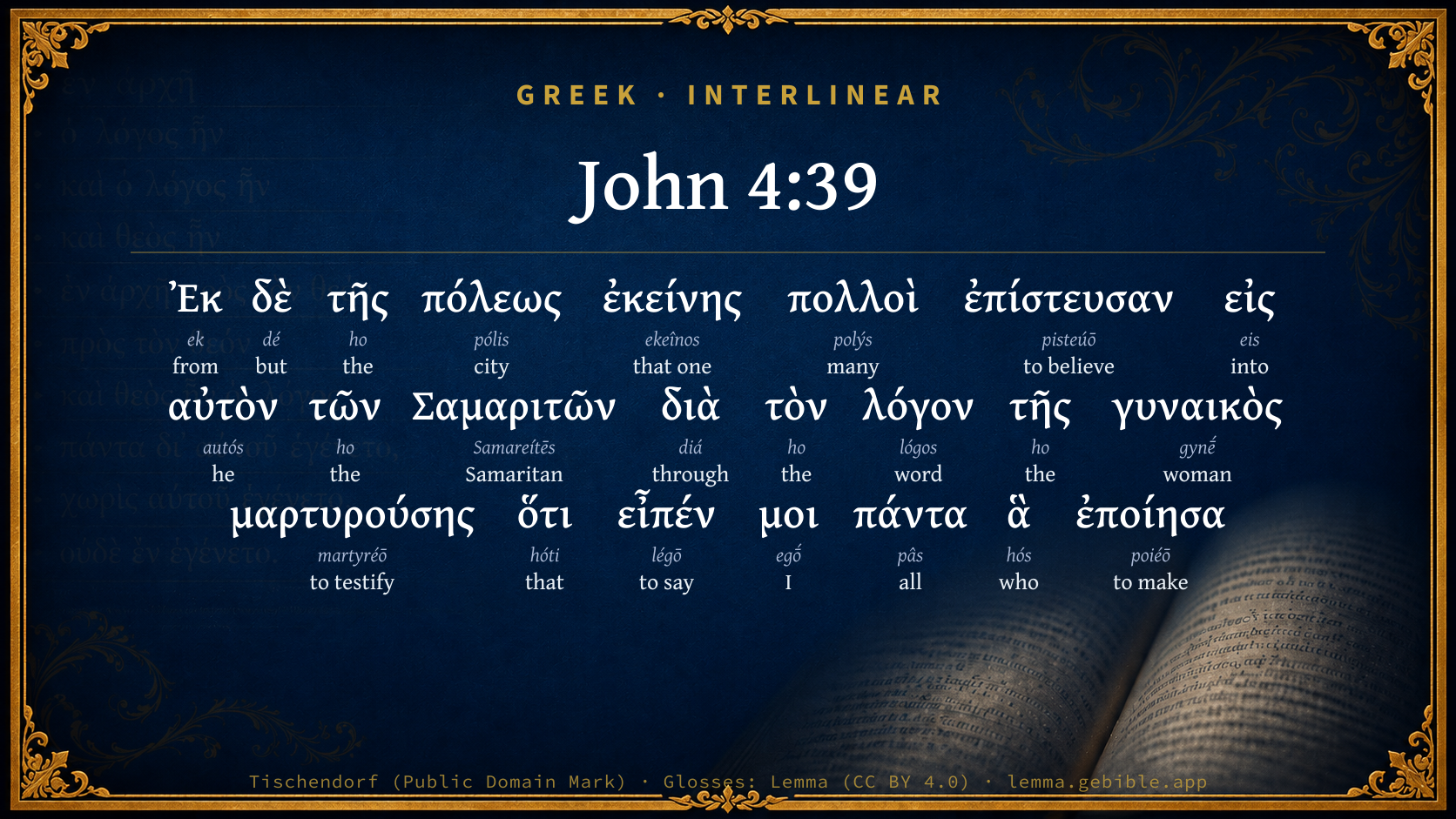
  1. Ἐκ ek G1537 “from” Preposition
  2. δὲ dé G1161 “but” Conjunction
  3. τῆς ho G3588 “the” Article, Genitive, Singular, Feminine
  4. πόλεως pólis G4172 “city” Noun, Genitive, Singular, Feminine
  5. ἐκείνης ekeînos G1565 “that one” Demonstrative pronoun, Genitive, Singular, Feminine
  6. πολλοὶ polýs G4183 “many” Adjective, Nominative, Plural, Masculine
  7. ἐπίστευσαν pisteúō G4100 “to believe” Verb, Aorist, Active, Indicative, 3rd person, Plural
  8. εἰς eis G1519 “into” Preposition
  9. αὐτὸν autós G846 “he” Personal pronoun, Accusative, Singular, Masculine
  10. τῶν ho G3588 “the” Article, Genitive, Plural, Masculine
  11. διὰ diá G1223 “through” Preposition
  12. τὸν ho G3588 “the” Article, Accusative, Singular, Masculine
  13. λόγον lógos G3056 “word” Noun, Accusative, Singular, Masculine
  14. τῆς ho G3588 “the” Article, Genitive, Singular, Feminine
  15. γυναικὸς gynḗ G1135 “woman” Noun, Genitive, Singular, Feminine
  16. μαρτυρούσης martyréō G3140 “to testify” Verb, Present, Active, Participle, Genitive, Singular, Feminine
  17. ὅτι hóti G3754 “that” Conjunction
  18. εἶπέν légō G3004 “to say” Verb, Aorist, Active, Indicative, 3rd person, Singular
  19. μοι egṓ G1473 “I” Personal pronoun, 1st person, Dative, Singular
  20. πάντα pâs G3956 “all” Adjective, Accusative, Plural, Neuter
  21. ἃ hós G3739 “who” Relative pronoun, Accusative, Plural, Neuter
  22. ἐποίησα poiéō G4160 “to make” Verb, Aorist, Active, Indicative, 1st person, Singular

About this verse

These counts appear in no published source. They are computed here, from the morphology-tagged text and Lemma’s own curated glosses. What Lemma adds →

23
words
20
distinct lemmas
Gospels
section

Notable vocabulary

The rarest word here is Σαμαριτῶν Samaritan G4541 — appearing just 8 times in the whole Greek New Testament.

Shared distinctive vocabulary

Σαμαριτῶν Samaritan G4541 occurs in 8 verses of the Greek New Testament. Also found in:

Repetition

A word recurs within this verse:

Cross-references

5

Topical passages linked to John 4:39 in the Treasury of Scripture Knowledge — connected by theme and wording, ordered by reader-vote popularity; previews shown in the World English Bible.

  • John 4:29 "Come, see a man who told me everything that I did. Can this be the Christ?"
  • John 4:5 So he came to a city of Samaria, called Sychar, near the parcel of ground that Jacob gave to his son, Joseph.
  • John 10:41–42 Many came to him. They said, "John indeed did no sign, but everything that John said about this man is true."
  • John 11:45 Therefore many of the Jews, who came to Mary and saw what Jesus did, believed in him.
  • John 4:42 They said to the woman, "Now we believe, not because of your speaking; for we have heard for ourselves, and know that this is indeed the Christ, the Savior of the world."

Cross-references courtesy of OpenBible.info (CC BY 4.0).

Commentary

Notes on John 4:39 from classic Christian and Jewish commentators (each source and its license shown beneath its notes). The classic Christian expositions comment on the surrounding passage and are grouped to its opening verse, so a note may address several verses; the Jewish commentaries on the Tanakh (Rashi and others) are per-verse, so they appear only where the commentator wrote on this verse.

Lemma curates 59 commentaries, every one of them public domain or Creative Commons licensed, each selected and text-cleaned for this edition rather than reprinted as found. About our sources →

Joseph Benson's Commentary

Joh 4:39-40. Many of the Samaritans believed on him — That is, believed him to be a divinely-commissioned teacher, and even the true Messiah, as appears from Joh 4:42; for the saying of the woman, who testified, He told me all that ever I did — A declaration which both struck and convinced them: so is God sometimes pleased to use very weak and unlikely instruments for the beginning and carrying on of a good work. And our Lord, by instructing one poor woman, here spread instruction through a whole town. Let not ministers, then, be either careless or discouraged in their preaching, because their hearers are few and mean; for by doing good to them, good may be conveyed to more, and to persons of greater influence. If believers teach every man his neighbour, and every man his brother, a great number may learn, and these again may teach others. Philip preached the gospel to a single person in his chariot upon the road, and he not only received it himself, but carried it into his country, and propagated it there. We see here also the good effect of speaking experimentally of Christ, and of the things of God. This woman could say little of them, but what she did say, she spake from the heart, and feelingly. Those are most likely to do good to others, who can tell what God has done for their own souls. When the Samaritans were come to him — Being greatly taken with the manner of his deportment, and the tenor of his discourse; they besought him to tarry with them — For some time at least, as being desirous of a further acquaintance with him, and of receiving further benefit from his instructions. For the meanness of his appearance, when they saw him, and the manifest poverty of his outward condition, did not lessen their esteem of him, and expectations from him. Observe, reader, we may entertain good hopes of those who have got over the vulgar prejudices that men have against true worth in a low estate. Blessed are they that are not offended in Christ at the first sight. The evangelist seems to lay an emphasis on their being Samaritans. See also Luk 10:33; Luk 17:16. The Samaritans had not that reputation for religion that the Jews had; yet the Jews, who saw Christ’s miracles, drove him from them, while the Samaritans, who saw not his miracles, nor had shared in his favours, invited him to them! The proof of the gospel’s success is not always according to probability, nor what is experienced according to what is expected. And he — Ever ready to lay hold on every opportunity of doing good, went with them to their city; and abode there two days — Which was a proper medium between entirely neglecting them, and giving them so much of his time and company as would have broken in upon the design of his journey into Galilee, or might have given umbrage to the Jews.

Joseph Benson's Commentary on the Old and New Testaments (1811–1818) — public domain. Text from a community e-Sword module.

Tyndale Open Study Notes

Tyndale Open Resources

4:39-40 Many Samaritans: The religiously sophisticated “chosen people” in Jerusalem did not respond to Jesus with faith (ch 3). By contrast, many Samaritans believed in Jesus because of the testimony of this outcast woman.

Tyndale Open Study Notes — © Tyndale Open Resources, licensed CC BY-SA 4.0. Text via the HelloAO Bible API.

Bengel's Gnomon

Johann Albrecht Bengel

Joh 4:39. Ἐπίστευσαν, believed) Wonderful openness to conviction! They had not yet seen Jesus; comp. Joh 4:40, “So when the Samaritans were come to Him.” Her testimony must have been given by the woman with great efficacy and power [among those souls, which were athirst, and had never before experienced such things.—V. g.]

Bengel's Gnomon of the New Testament — English translation (T&T Clark, Edinburgh, 1860) — public domain. Text from a community e-Sword module.

Meyer's Critical & Exegetical Commentary

Heinrich August Wilhelm Meyer

Joh_4:39 ff. Resumption of the historical narrative of Joh_4:30, which here receives its elucidation, to which then the continuation of the history attaches itself, Joh_4:40-42. As to the position of the words πολλοὶ ἐπ. εἰς αὐτ. τῶν Σαμ., see Buttmann, N. T. Gr. p. 332 [E. T. p. 388].

ὅτι εἶπέ μοι πάντα, κ.τ.λ.] Indication of conscience ratifying Joh_4:18.

διὰ τὸν λόγον αὐτοῦ] on account of His own word (teaching). No mention is made of miracles, but we must not infer from this that there was no need of miracles among the Samaritans; see, on the other hand, Act_8:6 ff. Jesus found that in this case His word sufficed, and therefore upon principle (see Joh_4:48) He forbore to work miracles, and His mighty word was all the mightier among the unprejudiced people.

διὰ τὴν σὴν λαλιὰν] on account of thy discourse. This is the meaning of λαλιά invariably in classical Greek. The term is purposely chosen, as from the standing-point of the speaker; whereas John, as an impartial narrator, with equal appropriateness, writes τὸν λόγον in Joh_4:39. As to λαλιά in Joh_8:43, where Jesus thus designates His own discourse, see in loc. Observe, besides, the emphatic σήν as contrasted with the λόγος of Jesus which they themselves (αὐτοί) have now heard.

ἀκηκόαμεν] the following ὅτι refers to both verbs. They have heard that Jesus was the Messiah, for this became evident to them from His words.

ὁ σωτὴρ τοῦ κόσμου] not due to the individuality of John (1Jn_4:14), and put into the mouths of the people, as Lücke and Tholuck are inclined to suppose, but a confession quite conceivable as the result of the two days ministry of Jesus; universalism, moreover, being more akin to the Messianic faith of the Samaritans (see Gesenius, de Samar. theol. p. 41 ff.) than to that of the Jews, with their definite and energetic feeling of nationality.

Note.

The prohibition in Mat_10:5 militates neither against this narrative of John 4 in general, nor in particular against the promise of Joh_4:35 ff. It had merely a temporary force, and was abrogated again by Mat_28:19-20, and Act_1:8; and, moreover, it presented no insuperable barrier to restrict Jesus in His work (for He did not wholly exclude even Gentiles from His teaching). Act_8:5 ff. is no proof whatever that this history in John is of mythical origin; it is, on the contrary, the fulfilment of the promise given here. Its several features are so original, and so pyschologically true, and the words of Jesus (see especially Joh_4:21-24) come so directly from the living depths of His soul, that the exceptions taken against certain particulars (as, for instance, against the misunderstandings on the part of the woman; against the words concerning the food, Joh_4:32; against the command of Jesus, Go, call thy husband; against the womans question concerning the place of worship; against the faith of the Samaritans, which is said to contradict Luk_9:53) are of no real weight, and are explicable only by the very authenticity of the narrative, not by the supposition of an intentional poetizing. This is in answer to Strauss, B. Bauer, and partly Weisse; also to Scholten, who considers that the authors object was to describe in a non-historical picture the spirit which actuated Jesus even towards the Samaritans. As a full guarantee for that part of the narrative, which the disciples, being absent, could not have witnessed, we may, considering the vivid impress of genuineness which marks it, fairly assume that Jesus Himself communicated it to the evangelist, and there is no need for the unfounded supposition that (Joh_4:8) John was left behind with Jesus (Hengstenberg, Godet). When, finally, Baur (p. 145 ff.; comp. also Hilgenfeld) resolves our history into a typus,the Samaritan woman being a figure of heathendom, susceptible, readily opening itself to faith, and presenting a wide harvest field, a contrast to Nicodemus, the type of unsusceptible Judaism,with all this arbitrariness on the part of the inventor, it is passing strange, if this were his object, that he did not bring Jesus into contact with a real heathen woman, for this would have been quite as easy to invent; and that he should keep the words of the woman so free from the least tinge of anything of a heathen nature (Joh_4:20 ff.), and have put into her mouth so clear an expression of Messianic hope (Joh_4:25; Joh_4:42),this bungling is quite out of character on the part of such an inventor.

Meyer — Critical and Exegetical Commentary on the New Testament — English translation by Peter Christie, edited by Frederick Crombie (T&T Clark, 1880) — public domain. Text from a community e-Sword module.

Expositor's Greek Testament

ed. W. Robertson Nicoll

Joh 4:39-42 briefly sum up the results of the Lord’s visit.

Joh 4:39 . Out of Sychar many of the Samaritans believed on Him. This faith was the result of the woman’s testimony, διὰ τὸν λόγον τῆς γυναικὸς μαρτυροῦσης̇ ; her testimony being, εἶπέ μοι πάντα ὅσα ἐποίησα .

The Expositor's Greek Testament, edited by W. Robertson Nicoll (1897–1910) — public domain. Text from a community e-Sword module.

Godet's Commentaries

Frédéric Louis Godet

Vv. 39-42. “Now many of the Samaritans of that city believed on him because of the word of the woman who testified: He told me all things that I have done. 40. When, therefore, the Samaritans came unto him, they besought him to abide with them; and he abode there two days. 41. And many more believed on him because of his word. 42. And they said to the woman: No longer because of thy saying do we believe; for we have heard him ourselves, and we know that this is indeed the Saviour of the world.”

Here now is the harvest-feast announced in Joh 4:36 : The sower rejoices with the reapers. This time passed at Sychar leaves an ineffaceable impression on the hearts of the apostles, and the sweetness of this recollection betrays itself in the repetition of the words two days, in the fortieth and forty-third verses. Δέ, now, resumes the course of the narrative after the digression in Joh 4:31-38. What a difference between the Samaritans and the Jews! Here a miracle of knowledge, without eclat, is enough to dispose the hearts of the people to come to Jesus, while in Judea eight months of toil have not procured for him one hour of such refreshment.

The thirty-ninth verse has shown us the first degree of faith: The coming to Jesus, as the result of testimony. The fortieth and forty-first verses present the higher degree of faith, its development through personal contact with Jesus.

ADDITIONAL NOTES BY THE AMERICAN EDITOR.

XXII.

1. The repetition of the statement of Joh 4:29 in Joh 4:39 is confirmatory of the view given in the preceding note of the character and source of the impression produced on the woman’s mind. The “many” alluded to in Joh 4:41 believed because of His word. We have, accordingly, in this whole section from Joh 3:1 to Joh 4:42, cases of persons who had their faith awakened by personal communication with Jesus and by listening to what He said.

2. The expression referring to the matter of belief which is peculiar to this case of the many, is that they said they knew this man to bethe Saviour of the world. The testimony of Jesus, as thus indicated, was to the end of the universality of His work. Weiss, in his edition of Meyer’s Commentary, holds that this expression is put into the mouth of these Samaritans by the evangelist, opposing thus the view of Meyer who agrees with Godet.

But the natural pointing of the words of Jesus with respect to worship is towards the possibility of true worship in the case of any man, and independently of place, and this question of worship was the one which these people were most likely to have discussed with Jesus as the great question pertaining to their nation and the Jews. If in their communications with Him they become convinced of His wonderful character, and had even a glimpse of this independency of place belonging to the true worship, their thought must have gone out beyond national limitations to a universal worshiping of God. That they had a clear and full comprehension of this, as the writer had at the time of his writing, is not probable.

Such a supposition is not required by their use of the words. But that they should have expressed the thought, which they must have derived as intimated above, by these words, is not to be regarded as unnatural. Jesus taught His disciples by the suggestion of great thoughts. They had but a feeble grasp of them at the first. At a later time, they entered into deeper knowledge. But the story, as told from the standpoint of the later period, must be interpreted, oftentimes, not from the time of the recording of it, but from that of the events.

An illustrative example may be found in Joh 16:30. How true to the life are the words of the disciples which are there recorded: “Now we know that thou knowest all things, and needest not that any one should ask thee.” And yet, how evident it is that in relation to what His meaning was their minds had, at the most, only a glimmering of the light. Indeed, the very words of Jesus which follow seem to intimate this: “Do ye now believe? Behold the hour cometh, yea, is come, that ye shall be scattered every man to his own and shall leave me alone.” The word which He spoke to Peter at the end with reference to His departure to the unseen world, might, in a certain sense, be applied to His life with His disciples in the region of the truth: “Thou canst not follow me now, but thou shalt follow me afterwards.” So, in this case of the Samaritan believers, the words which were used were the expression of the first outgoing of their thought beyond the boundaries of their own nation and beyond the Jews. But the appreciation of what salvation for the world was— this could only be gained many years afterwards. The story tells what they said, and they may well have said these words. The meaning of the words to their minds must be judged of, not by what we know, but by what they knew.

Frédéric Louis Godet — Commentaries on Luke, John, Romans, and 1 Corinthians — English translation (T&T Clark, Edinburgh, 1870s–1890s) — public domain. Text from a community e-Sword module.

Geneva Bible (1599)

Geneva Bible translators

The Samaritans do most joyfully embrace that which the Jews most stubbornly rejected.

Geneva Bible (1599) marginal notes — public domain. Text via Bolls.life.

Jamieson, Fausset & Brown

Robert Jamieson, A. R. Fausset & David Brown

many . . . believed, &c.--The truth of Joh 4:35 begins to appear. These Samaritans were the foundation of the Church afterwards built up there. No miracle appears to have been wrought there (but unparalleled supernatural knowledge displayed): "we have heard Him ourselves" (Joh 4:42) sufficed to raise their faith to a point never attained by the Jews, and hardly as yet by the disciples--that He was "the Saviour of the world" [ALFORD]. "This incident is further remarkable as a rare instance of the Lord's ministry producing an awakening on a large scale" [OLSHAUSEN].

Jamieson, Fausset & Brown — Commentary Critical and Explanatory on the Whole Bible (1871) — public domain (CC PDM 1.0). Text via the HelloAO Bible API.

Adam Clarke's Commentary

Verse 39. Many of the Samaritans - believed on him for the saying of the woman] This woman was the first apostle of Christ in Samaria! She went and told her fellow citizens that the Messiah was come; and gave for proof, that he had told her the most secret things she had ever done: see on Joh 4:29. This word, which is twice repeated, in Joh 4:29 and here, strongly intimates that a more particular conversation had taken place, between our Lord and the Samaritan woman, than what is here related.

Adam Clarke's Commentary on the Bible (1810–1826) — public domain. Text from a community e-Sword/MySword module.

John Calvin's Commentaries

39. And many Samaritans out of that city believed. The Evangelist here relates what was the success of the woman’s announcement to her citizens, from which it is evident that the expectation and desire of the promised Messiah had no small vigor among them. Now, the word believe is here used inaccurately, and means that they were induced by the woman’s statement to acknowledge Christ to be a Prophet. It is, in some respects, a commencement of faith, when minds are prepared to receive the doctrine. Such an entrance to faith receives here the honorable appellation of faith, in order to inform us how highly God esteems reverence for his word, when he confers so great honor on the docility of those who have not yet been taught. Now, their faith manifests itself in this respect, that they are seized with a desire to profit, and, for that reason, desire that Christ should remain with them

John Calvin's Commentaries (1540-1563) — public domain. Text from the Calvin Translation Society English edition (1840s-50s) via the Christian Classics Ethereal Library (ccel.org). Calvin's coverage is partial (roughly two-thirds of the Bible); uncommented books and verses are honest gaps, never fabricated. The 19th-century editor's footnotes and remarks are omitted so the notes are faithfully Calvin's own voice.

Ellicott's Commentary for English Readers

(39) Many of the Samaritans of that city believed.—The willingness to receive the truth on the part of the Samaritans, is contrasted with the rejection of it on the part of the Jews. They refused the witness of a great prophet; these accept the witness of a woman. Their minds were prepared by the general expectation of the Messiah; and this woman witnesses that Jesus had revealed to her the whole past of her life. There is here a sign they do not question.

A Bible Commentary for English Readers, edited by Charles John Ellicott (1878–1897) — public domain. Text from a community e-Sword module.

The Cambridge Bible for Schools and Colleges

gen. ed. J. J. S. Perowne

39. many of the Samaritans] Strong proof of the truth of Joh_4:35. These Samaritans outstrip the Jews, and even the Apostles, in their readiness to believe. The Jews rejected the testimony of their own Scriptures, of the Baptist, of Christ’s miracles and teaching. The Samaritans accept the testimony of the woman, who had suddenly become an Apostle to her countrymen.

The Cambridge Bible for Schools and Colleges (gen. ed. J. J. S. Perowne; Cambridge University Press, 1878–1918) — public domain. Text from a community e-Sword module.

John Gill's Exposition

And many of the Samaritans of that city,.... Of Sychar, which was a city of Samaria;

believed on him; that he was the true Messiah he had told the woman he was; and she put it to them whether he was or not: before they saw him, or had any conversation with him themselves, they believed in him; see Joh 20:29;

for the saying of the woman which testified, he told me all that ever I did: the account she gave was so plain, and honest, and disinterested, that they could not but give credit to it; and since the person was an utter stranger to her, and yet had laid before her the whole series of her past life and conversation, they concluded he could be no other than the Messiah, who should tell all things; and being of quick understanding or smell, was able to disclose the secrets of men.

John Gill's Exposition of the Whole Bible (1746–1763) — public domain (CC PDM 1.0). Text via the HelloAO Bible API.

Trapp's Complete Commentary

John Trapp

39 And many of the Samaritans of that city believed on him for the saying of the woman, which testified, He told me all that ever I did.

Ver. 39. For the saying of the woman] An unlikely means to effect so great a matter. But what is that to the Almighty? So Junius professeth, that the very first thing that turned him from atheism was conference with a countryman of his, not far from Florence. The next was, the majesty of the Scriptures, which he observed in Joh 1:1-15. So for our forefathers in times of Popery, Mr Fox observeth, that by the reading of Chaucer’s books some were brought to the knowledge of the truth. And in that rarity of books and want of teachers, this one thing I greatly marvel at (saith he), to note in the registers, and consider how the word of God did multiply so exceedingly as it did among them. For I find that one neighbour resorting to and conferring with another, again, with a few words of their first or second talk, did win and turn their minds to that wherein they desire to persuade them touching the truth of God’s word and sacraments.

John Trapp, A Commentary or Exposition upon All the Books of the Old and New Testament (1647–1656) — public domain. Text from a community e-Sword module.

Albert Barnes' Notes on the Bible

And many of the Samaritans of that city believed on him, ... - There is seldom an instance of so remarkable success as this. From a single conversation, in circumstances, in a place, and with an individual little likely to be attended with such results, many sinners were converted; many believed on the testimony of the woman; many more came to hear, and believed because they heard him themselves. We should never despair of doing good in the most unpromising circumstances, and we should seize upon every opportunity to converse with sinners on the great subject of their souls’ salvation.

Albert Barnes' Notes on the Bible (1834–1885) — public domain. Text from a community e-Sword/MySword module.

Matthew Poole's English Annotations

That city was Sichem, or Sychar, but it was within the province of Samaria, from whence it is that they had the name of Samaritans as well as Sichemites.

Many of them, upon the testimony of the woman; That he had told her such secret passages of her life, as he could not have told her if he had not been able, if he had pleased, as well to have told her all things,

believed on him; that is, they owned him as a prophet, and agreed to what the woman said in that particular, and were by it excited to come to see and further discourse with Christ. This justifieth what our Saviour said, that there was then a people prepared for the Lord, the fields were white unto the harvest; that they were thus far wrought upon by the discourse of a woman, and she one not of the highest reputation, and only telling them that he had told her all things she had done. Small means have great effects when God’s time of working is come.

Matthew Poole's English Annotations on the Holy Bible (1683–1685) — public domain. Text from a community e-Sword/MySword module.

Whedon's Commentary on the Bible

Daniel D. Whedon

39. For the saying of the woman—She was a type of the missionary Church; so holding forth the facts and carrying the spirit of the Church that men’s hearts receive it with faith.

Daniel D. Whedon (gen. ed.), Commentary on the Old and New Testaments (1874–1909) — public domain. Text from a community e-Sword module.

The Pulpit Commentary

Vers. 39-42. (4) The harvest of the Lords sowing, and the Saviour of the world.

This harvest is described in vers. 39-42. As this sublime discourse was proceeding, the impression produced by the word of the woman was becoming deeper. The breath of God was moving them mightily. They were prepared by a thousand untraceable influences for faith in the great Deliverer and Teacher. Many of the Samaritans from that city, in the first instance, had been summarily convinced of the presence among them of the long looked-for Prophet, and believed on him by reason of the word (or, discourse) of the woman, who testified, He told me all things that I ever () did. Not merely is this one saying referred to, but the whole report of the words of Jesus of which that saying was the crowning or most startling expression. They are the first specimens of men who believe by the testimony of those who know. "Blessed are they who have not seen, but yet believe.

Vers. 39-42. Jesus and the Samaritans.

The woman was the instrument of bringing her townspeople to the Saviour.

I THE FIRST DEGREE OF SAMARITAN FAITH WAS DEPENDENT ON TESTIMONY. "Now many of the Samaritans of that city believed on him because of the saying of the woman, who testified, He told me all that ever I did.

1. Faith is essentially the belief of testimony. It thus depends upon evidence. "Faith is the substance of things hoped for, the evidence of things not seen". (Heb_11:1)

2. The Samaritans were entitled to the higher blessing. "Blessed are they that have not seen, and yet have believed." We must receive the facts of the gospel history upon testimony, or we cannot receive them at all.

3. Faith rests firmly upon testimony that is thoroughly verified by experience. This Samaritan woman"s experience ended all doubt.

II THE FAITH OF THE SAMARITANS SOUGHT A CLOSER CONTACT WITH JESUS. "They besought him that he would tarry with them.

1. Though faith rests on knowledge, it longs for fuller knowledge.

2. Though Jesus was a Jew, they sought immediate fellowship with him.

3. Their conduct is very different from that of the Jews, who asked no suck interview during his eight months" stay in their midst.

4. Jesus complied with their request, though he knew that it might involve him in the imputation of being a Samaritan. (Joh_8:48)

III THE FAITH OF THE SAMARITANS WAS STRENGTHENED, AND MORE DISCIPLES WERE MADE, BY THE TWO DAYS" SOJOURN AT SYCHAR. "And many more believed because of his own word.

1. They did not ask for signs, like the Jews (ver. 48), neither were miracles wrought for their benefit.

2. His word was effectual to confirm their faith: it came to them, not in word only, but in power; for it was the power of God unto salvation. "For we have heard him ourselves.

(1) This is the language of personal experience.

(2) Their personal experience was final and satisfactory. "And know that this is indeed the Christ, the Saviour of the world.

(a) Mark the absence of all narrow particularism. They knew from their Scriptures that in "Abraham and his seed all nations of the earth shall be blessed." Jesus might have brought this ancient promise under their notice.

(b) They recognize Jesus no longer as a mere prophet, but as Redeemer. "Salvation may be of the Jews," but the Samaritans are the first to accept it in the mass.

(c) The faith of the Samaritans is the condemnation of the Jews" unbelief.

The Pulpit Commentary (1880–1919), ed. H.D.M. Spence-Jones & Joseph S. Exell — public domain. Text from a community e-Sword module.

Kretzmann's Popular Commentary

Paul E. Kretzmann

Faith as personal conviction:

v. 39. And many of the Samaritans of that city believed on Him for the saying of the woman, which testified, He told me all that ever I did.

v. 40. So when the Samaritans were come unto Him, they besought Him that He would tarry with them; and He abode there two days.

v. 41. And many more believed because of His own word;

v. 42. and said unto the woman, Now we believe, not because of thy saying; for we have heard Him ourselves, and know that this is indeed the Christ, the Savior of the world.

The woman did her missionary work well. She spoke with such earnestness and conviction that she persuaded many of the people of the city. Their faith was the result of the woman’s testimony, even before they saw and heard Jesus Himself. If we only, individually and collectively, see to it that the Gospel is proclaimed throughout the world, we may rest assured in advance that the blessing of God will attend our efforts, and that there will always be some that will come to faith and acknowledge Jesus as their Redeemer. And the testimony of the woman caused also the petition of the Samaritans that the Lord should stay with them. For two days they were privileged to have the Savior in their midst. He taught these souls that were hungry for salvation; He gave them the information which they needed concerning His person and work. And the harvest was rich and plentiful. A great many more were gained through the preaching of Jesus, who frankly told the woman that they no longer believed on account of her narrative. They themselves had heard the words of eternal grace, they had the firm knowledge and conviction that this man was not a mere teacher or prophet, but that He was truly the Christ, the Savior of the world. That is the simple, but unshakable certainty of Christian faith. That is the right faith, that we do not only believe to be true what we hear in regard to the wonderful spiritual experiences of others, but that we have the personal conviction regarding Jesus that He is our Savior.

Paul E. Kretzmann, Popular Commentary of the Bible (1921–1924) — public domain. Text from a community e-Sword module.

Burkitt's Expository Notes on the New Testament

William Burkitt

Here an account is given of the conversion of more of the Samaritans from the city of Sichar. Some believed on him, upon the full report which the woman had made, That, He had told her all that ever she did; but others were brought to believe by his own word.

Now from the woman’s being an instrument to bring her acquaintance to Christ by her own experience of what she had heard from him:

Learn, 1. That very weak instruments, when they employ themselves for Christ, desiring to extol his praise, and set forth his glory, are sometimes richly blessed with great success. Many of the Samaritans believed for the saying of this poor woman.

Learn, 2. That when a person can say but little of Christ, yet if it be spoken from experience and sensible feeling, it will be more successful and persuasive, than much more that which is spoken from notional knowledge. Such was this woman’s testimony concerning Christ, Come, see a man that told me all things that ever I did; is not this the Christ? She spake what she found, yea, what she felt within herself, and speaking her own experience, many believed on him for her saying.

But farther, These Samaritans believed Christ to be a prophet upon the testimony of this woman: but they believed him afterwards to be the Messias, or the Saviour of the world, upon the credit and authority of his own word, ver, 41. And many more believed because of his own word.

Thence learn, That although instruments speaking may be a mean to draw persons to give some assent to truth, yet it is Christ himself that must work a full persuasion, and his own word is the surest foundation for faith to build and depend upon: Now we believe, not because of thy saying, for we have heard him ourselves.

William Burkitt's Expository Notes on the New Testament (1700–1703) — public domain. Text from a community e-Sword module.

unfoldingWord translationNotes

Door43 World Missions Community

believed in him

To "believe in" someone means to "trust in" that person. Here this also means that they believed he was the Son of God.

He told me everything that I have done

This is an exaggeration. The woman was impressed by how much Jesus knew about her. AT: "He told me many things about my life" (See: Hyperbole and Generalization)

translationWords

Samaria

believe

report

testimony

unfoldingWord translationNotes — © Distant Shores Media and the Door43 World Missions Community, licensed CC BY-SA 4.0. Source: git.door43.org/Door43/en_tn.

Cambridge Greek Testament for Schools and Colleges

39. πολλοὶ ἐπ. εἰς αὐ. Strong proof of the truth of Joh 4:35. These Samaritans outstrip the Jews, and even the Apostles, in their readiness to believe. The Jews rejected the testimony of their own Scriptures, of the Baptist, of Christ’s miracles and teaching. The Samaritans accept the testimony of the woman, who had suddenly become an Apostle to her countrymen. The miraculous knowledge displayed by Jesus for a second time (Joh 1:49) produces immediate and complete conviction, and in this case the conviction spreads to others.

Cambridge Greek Testament for Schools and Colleges (Cambridge University Press, 1896; 21 vols, various authors incl. Carr, Maclear, Plummer, Farrar, Lumby, Moule, M. R. James, Simcox) — public domain. Text from a community e-Sword module.

Alford’s Greek Testament

Henry Alford

39-42.] The truth of the saying of ver. 35 begins to be manifested. These Samaritans were the foundation of the church afterwards built up there. It does not seem that any miracle was wrought there: αὐτοὶ ἀκηκόαμεν was enough to raise their faith to a point never attained by the Jews, and hardly as yet by the disciples,—that He was the Saviour of the world. Their view seems to have been less clouded by prejudice and narrow-mindedness than that of the Jews; and though the conversion of this people lay not in the plan of the official life of our Lord, or working of His Apostles during it (see Mat 10:5),—yet we have abundant proof from this history, of His gracious purposes towards them. A trace of this occurrence may be found ch. 8:48, where see note. Compare throughout Act 8:1-25. (In ver. 42 λαλιά is perhaps not to be distinguished from λόγος before: see ch. 8:43. But it is hardly possible not to see in the word something of allusion to the woman’s eager and diffuse report to them.)

Henry Alford, The Greek Testament (1849–1861) — public domain. Text from a community e-Sword module.

International Critical Commentary

39. The Samaritan villagers who, on another occasion, rejected Jesus and His disciples had not heard Him teach; their objection to His presence was not personal, but rested on the fact that, as a Jew, He was going to Jerusalem to keep a feast (Luk 9:52). The people of Sychar, on the other hand, were won by His words (v. 42).

πολλοί ἐπίστευσαν εἰς αὐτόν. The phrase is a favourite with Jn., occurring six times (cf. 7:31, 8:30, 10:42, 11:45, 12:42). The aorist seems to indicate a definite, but not necessarily lasting, movement of faith evoked by special words or deeds of Jesus. For the constr. πιστεύειν εἴς τινα, see on 1:12.

The first believers at Samaria were won, not by visible miracles or signs (cf. 2:23, 7:31, 10:42, 11:45, 12:42), but by the woman’s report of what Jesus had said to her. Many more believed because of His sayings which they themselves had heard (v. 42; cf. 8:30). But v. 39 illustrates the normal way in which men are drawn to Christ in the first instance; cf. His prayer for those who were to be led to Him through the apostles’ teaching: ἐρωτῶ … περί τῶν πιστευόντων διὰ τοῦ λόγου αὐτῶν εἰς ἐμέ (17:20).

For ὅσα of the rec. text the better reading (א BC*L) is ἅ, as at v. 29.

International Critical Commentary — older volumes (1896–1929), various authors — public domain. Text from a community e-Sword module.

Vincent's Word Studies in the New Testament

Marvin R. Vincent

The saying [τον λογον] . Rev., better, the word. It does not refer merely to the woman 's statement, He told me, etc., but to her whole testimony [μαρτυρουσης] concerning Christ.

Marvin R. Vincent, Word Studies in the New Testament (1887–1900) — public domain. Text from a community e-Sword/MySword module.

Lesson kit

Teaching starters — assembled from the data on this page, not authored interpretation. Every prompt links to the verse data it draws on. Edit before teaching.

John, in the Gospels, opens this verse with 23 words (20 distinct Greek lemmas). Its most distinctive word is Samareítēs (“Samaritan”). A historical commentator’s framing appears above. Read the whole chapter for the surrounding context.

Discussion questions

  1. The word Samareítēs carries the sense “Samaritan.” How does it shape the verse?
  2. How does Matthew 10:5, which shares the word «Samaritan», read alongside this verse?
  3. What does the repetition of “the” (4× in this one verse) do in this verse?
  4. These translations render this verse differently. What is at stake in choosing one wording over another?
  5. Compare how Joseph Benson's Commentary and Tyndale Open Study Notes read this verse. Where do they agree or differ?

Things to notice

Reading settings

Reading text

Shown beneath each verse's original-language words.

Old Testament
Old Testament edition

Read the OT as the Masoretic Hebrew (MT) or the Greek Septuagint (LXX).

English shown for the Greek Septuagint (in the Hebrew ↔ Greek comparison).

Comparing translations? Open the Compare panel on any verse page to stack up to four side by side.