
Luke 15:13

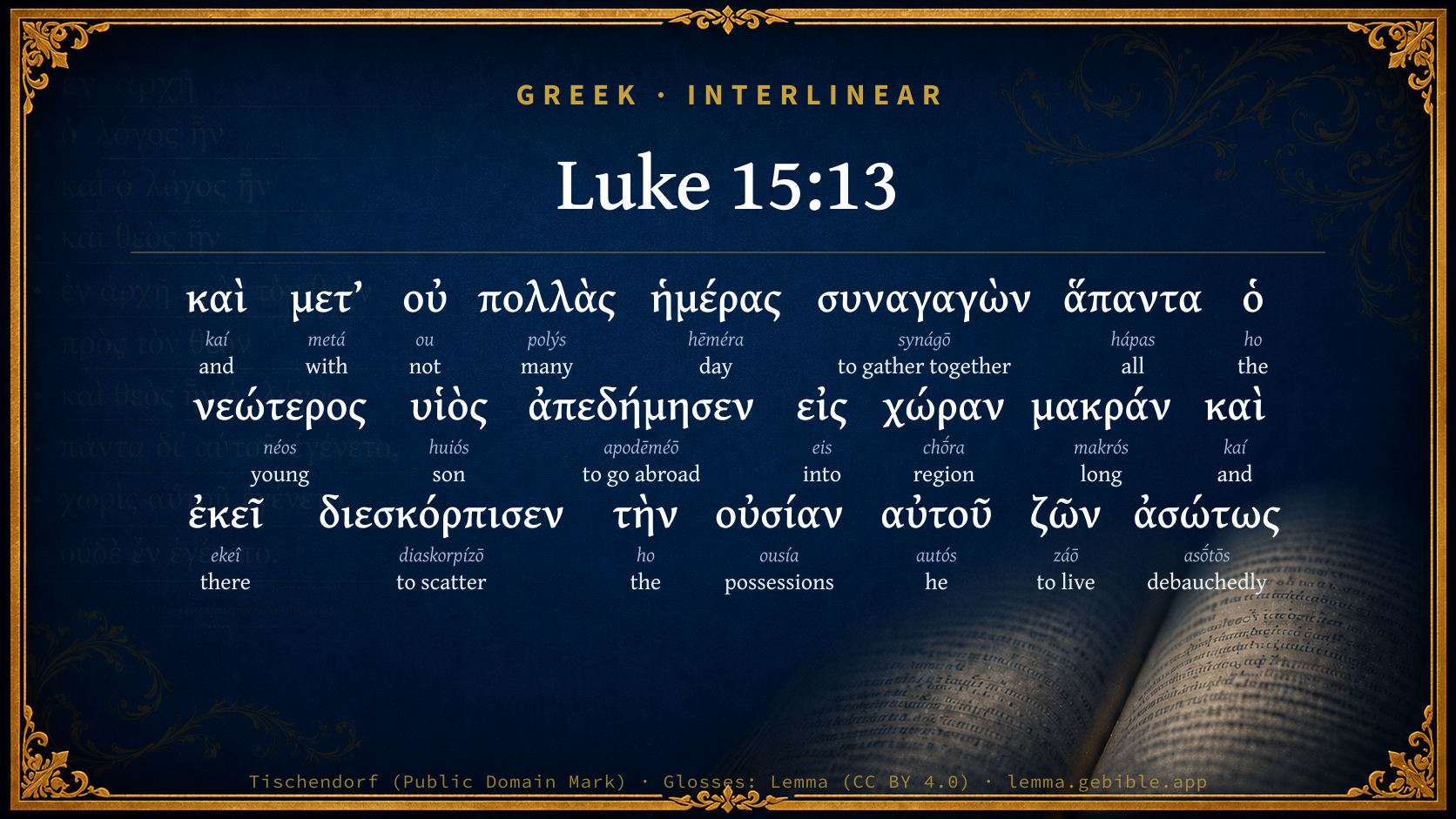
Greek (Tischendorf 8th ed.) Luke 15:13 appears in the Greek New Testament. The text above is from the Tischendorf 8th edition. Each word links to its Strong’s number and a concise gloss. Click any word for its full Thayer’s Greek Lexicon entry.
Download image
Cite this verse

Luke 15:13 (World English Bible). Public Domain. Lemma interlinear Bible study tool, https://lemma.gebible.app/v/luke/15/13.

Show BibTeX & RIS
BibTeX
RIS
English Translation
Not many days after, the younger son gathered all of this together and traveled into a far country. There he wasted his property with riotous living.
World English Bible · Public Domain
Highlights
  • 1 hapax legomenon — only here in the Greek New Testament
  • 1 first appearance in the Greek New Testament
Full analysis ↓
Download a study sheet

One document with this verse’s original text, its word-by-word gloss line, the meaning frame, cross-references with their text, attributed commentary, and full source and license credits — printable, and it pastes into notes with its structure intact.

This verse Autodidact and up

Study sheet (.html) Plain text (.txt)

A passage Seminary Student

Up to 50 verses in one chapter. A passage sheet keeps up to 6 commentary sources and 12 cross-references per verse, in the order this page ranks them, and says so on the sheet whenever that leaves anything out. Ask for a single verse and you get the Autodidact verse sheet above.

Everything on this page stays free to read, with no account — the sheet is a download of what is already on screen, not access to it.

Want to remove ads? Support Godless Engineer
Compare translations 3

The same verse in 3 English versions, stacked beneath the original-language interlinear above. Click any original word for its lexicon entry.

Each is an independent rendering of the whole verse — the interlinear is not word-aligned to these translations.

Highlighted words mark where these versions differ — a whole-verse word diff, not a word-by-word alignment.

  • World English Bible Public Domain
    Not many days after, the younger son gathered all of this together and traveled into a far country. There he wasted his property with riotous living.
  • King James Version Public Domain
    And not many days after the younger son gathered all together, and took his journey into a far country, and there wasted his substance with riotous living.
  • unfoldingWord Literal Text CC BY-SA 4.0
    And after not many days, having gathered everything together, the younger son went to a distant country, and there he wasted his wealth, living recklessly.

unfoldingWord Literal Text — © unfoldingWord, licensed CC BY-SA 4.0. Word-aligned USFM3 via Door43 (git.door43.org/unfoldingWord/en_ult).

Versions to compare (up to 4)

3 of 4 selected

Show all 19 translations

Every available English version of this verse, each an independent rendering of the whole verse.

  • World English Bible Public Domain
    Not many days after, the younger son gathered all of this together and traveled into a far country. There he wasted his property with riotous living.
  • Berean Standard Bible Public Domain
    After a few days, the younger son got everything together and journeyed to a distant country, where he squandered his wealth in wild living.
  • Majority Standard Bible Public Domain
    After a few days, the younger son got everything together and journeyed to a distant country, where he squandered his wealth in wild living.
  • King James Version Public Domain
    And not many days after the younger son gathered all together, and took his journey into a far country, and there wasted his substance with riotous living.
  • American Standard Version (1901) Public Domain
    And not many days after, the younger son gathered all together and took his journey into a far country; and there he wasted his substance with riotous living.
  • Revised Version (1885) Public Domain
    And not many days after the younger son gathered all together, and took his journey into a far country; and there he wasted his substance with riotous living.
  • Geneva Bible (1599) Public Domain
    So not many daies after, when the yonger sonne had gathered all together, hee tooke his iourney into a farre countrey, and there hee wasted his goods with riotous liuing.
  • Douay-Rheims (1899) Public Domain
    And not many days after, the younger son, gathering all together, went abroad into a far country: and there wasted his substance, living riotously.
  • Young's Literal Translation Public Domain
    `And not many days after, having gathered all together, the younger son went abroad to a far country, and there he scattered his substance, living riotously;
  • Literal Standard Version CC BY-SA 4.0
    And not many days after, having gathered all together, the younger son went abroad to a far country, and there he scattered his substance, living riotously;
  • Unlocked Literal Bible CC BY-SA 4.0
    Not many days later, the younger son gathered together all he owned and went to a country far away, and there he wasted all his wealth by living recklessly.
  • unfoldingWord Literal Text CC BY-SA 4.0
    And after not many days, having gathered everything together, the younger son went to a distant country, and there he wasted his wealth, living recklessly.
  • Darby Bible Public Domain
    And after not many days the younger son gathering all together went away into a country a long way off, and there dissipated his property, living in debauchery.
  • World Messianic Bible Public Domain
    Not many days after, the younger son gathered all of this together and traveled into a far country. There he wasted his property with riotous living.
  • Webster's Bible Public Domain
    And not many days after, the younger son gathered all together, and took his journey into a far country, and there wasted his substance with riotous living.
  • Free Bible Version CC BY-SA 4.0
    A few days later the younger son packed up what he had and left for a distant country. Here he wasted all his money living a reckless life.
  • Bible in Basic English Public Domain
    And not long after, the younger son got together everything which was his and took a journey into a far-away country, and there all his money went in foolish living.
  • Text-Critical English NT CC BY 4.0
    A few days later, the younger son gathered together all that he had and went on a journey to a distant country, and there he squandered his property by living recklessly.
  • Tyndale New Testament (1534) Public Domain
    And not longe after the yonger sonne gaddered all that he had to gedder and toke his iorney into a farre countre and theare he wasted his goodes with royetous lyvinge.

Literal Standard Version (2020), Covenant Press — licensed CC BY-SA 4.0. Text via the HelloAO Bible API (eBible.org). Unlocked Literal Bible (unfoldingWord) — licensed CC BY-SA 4.0. Text via the HelloAO Bible API (eBible.org). unfoldingWord Literal Text — © unfoldingWord, licensed CC BY-SA 4.0. Word-aligned USFM3 via Door43 (git.door43.org/unfoldingWord/en_ult). Free Bible Version, Dr. Jonathan Gallagher — licensed CC BY-SA 4.0. Text via the HelloAO Bible API (eBible.org).

Word by word

More ways to search: Search by grammar → Find every occurrence → Compare this word →

Practice this passage: Drill this verse → Learn its vocabulary →

ἀσώτως
asṓtōs
G811
“debauchedly”
Adverb
Part of Speech
Adverb
Full Thayer's Definition

Origin: from the same as G810

TDNT: 09:26,9

1. dissolutely, profligately
  1. καὶ kaí G2532 “and” Conjunction
  2. μετ’ metá G3326 “with” Preposition
  3. οὐ ou G3756 “not” Particle, Negative
  4. πολλὰς polýs G4183 “many” Adjective, Accusative, Plural, Feminine
  5. ἡμέρας hēméra G2250 “day” Noun, Accusative, Plural, Feminine
  6. συναγαγὼν synágō G4863 “to gather together” Verb, Aorist, Active, Participle, Nominative, Singular, Masculine
  7. ἅπαντα hápas G537 “all” Adjective, Accusative, Plural, Neuter
  8. ὁ ho G3588 “the” Article, Nominative, Singular, Masculine
  9. νεώτερος néos G3501 “young” Adjective, Nominative, Singular, Masculine, Comparative
  10. υἱὸς huiós G5207 “son” Noun, Nominative, Singular, Masculine
  11. ἀπεδήμησεν apodēméō G589 “to go abroad” Verb, Aorist, Active, Indicative, 3rd person, Singular
  12. εἰς eis G1519 “into” Preposition
  13. χώραν chṓra G5561 “region” Noun, Accusative, Singular, Feminine
  14. μακράν makrós G3117 “long” Adjective, Accusative, Singular, Feminine
  15. καὶ kaí G2532 “and” Conjunction
  16. ἐκεῖ ekeî G1563 “there” Adverb
  17. διεσκόρπισεν diaskorpízō G1287 “to scatter” Verb, Aorist, Active, Indicative, 3rd person, Singular
  18. τὴν ho G3588 “the” Article, Accusative, Singular, Feminine
  19. οὐσίαν ousía G3776 “possessions” Noun, Accusative, Singular, Feminine
  20. αὐτοῦ autós G846 “he” Personal pronoun, Genitive, Singular, Masculine
  21. ζῶν záō G2198 “to live” Verb, Present, Active, Participle, Nominative, Singular, Masculine

About this verse

These counts appear in no published source. They are computed here, from the morphology-tagged text and Lemma’s own curated glosses. What Lemma adds →

22
words
20
distinct lemmas
Gospels
section

Notable vocabulary

1 hapax legomenon — a word that appears only here in the entire Greek New Testament:

  • ἀσώτως debauchedly G811

First appearance in Scripture

This word makes its first canonical appearance in the Greek New Testament here:

  • ἀσώτως debauchedly G811

Shared distinctive vocabulary

οὐσίαν possessions G3776 occurs in 2 verses of the Greek New Testament. Also found in:
Repetition

Words recur within this verse:

Cross-references

33

Topical passages linked to Luke 15:13 in the Treasury of Scripture Knowledge — connected by theme and wording, ordered by reader-vote popularity; previews shown in the World English Bible.

  • Proverbs 21:17 He who loves pleasure shall be a poor man: He who loves wine and oil shall not be rich.
  • Proverbs 29:3 Whoever loves wisdom brings joy to his father; But a companion of prostitutes squanders his wealth.
  • Jeremiah 2:5 thus says Yahweh, What unrighteousness have your fathers found in me, that they have gone far from me, and have walked after vanity, and are become vain?
  • Proverbs 23:19–22 Listen, my son, and be wise, And keep your heart on the right path!
  • Proverbs 28:7 Whoever keeps the law is a wise son; But he who is a companion of gluttons shames his father.
  • Ecclesiastes 11:9–10 Rejoice, young man, in your youth, And let your heart cheer you in the days of your youth, And walk in the ways of your heart, And in the sight of your eyes; But know that for all these things God will bring you into judgment.
  • Luke 15:30 But when this, your son, came, who has devoured your living with prostitutes, you killed the fattened calf for him.'
  • Luke 16:1 He also said to his disciples, "There was a certain rich man who had a manager. An accusation was made to him that this man was wasting his possessions.
  • Luke 16:19 "Now there was a certain rich man, and he was clothed in purple and fine linen, living in luxury every day.
  • Job 21:13–15 They spend their days in prosperity. In an instant they go down to Sheol.
  • Proverbs 6:26 For a prostitute reduces you to a piece of bread. The adulteress hunts for your precious life.
  • Romans 13:13–14 Let us walk properly, as in the day; not in reveling and drunkenness, not in sexual promiscuity and lustful acts, and not in strife and jealousy.
  • 2 Chronicles 33:1–10 Manasseh was twelve years old when he began to reign; and he reigned fifty-five years in Jerusalem.
  • Psalms 10:4–6 The wicked, in the pride of his face, Has no room in his thoughts for God.
  • Psalms 73:27 For, behold, those who are far from you shall perish. You have destroyed all those who are unfaithful to you.
  • Proverbs 5:8–14 Remove your way far from her. Don't come near the door of her house,
  • Proverbs 18:9 One who is slack in his work Is brother to him who is a master of destruction.
  • Proverbs 21:20 There is precious treasure and oil in the dwelling of the wise; But a foolish man swallows it up.
  • Isaiah 1:4 Ah sinful nation, A people loaded with iniquity, A seed of evil-doers, Children who deal corruptly! They have forsaken Yahweh. They have despised the Holy One of Israel. They are estranged and backward.
  • Isaiah 22:13 and behold, joy and gladness, killing oxen and killing sheep, eating flesh and drinking wine: let us eat and drink, for tomorrow we shall die.
  • Isaiah 30:11 get out of the way, turn aside out of the path, cause the Holy One of Israel to cease from before us."
  • Isaiah 56:12 Come you, [say they], I will get wine, and we will fill ourselves with strong drink; and tomorrow shall be as this day, [a day] great beyond measure.
  • Jeremiah 2:13 For my people have committed two evils: they have forsaken me, the spring of living waters, and hewed them out cisterns, broken cisterns, that can hold no water.
  • Jeremiah 2:17–19 Haven't you procured this to yourself, in that you have forsaken Yahweh your God, when he led you by the way?
  • Jeremiah 2:31 Generation, see the word of Yahweh. Have I been a wilderness to Israel? or a land of thick darkness? why say my people, We are broken loose; we will come no more to you?
  • Amos 6:3–7 Those who put far away the evil day, And cause the seat of violence to come near;
  • 1 Peter 4:3–4 For we have spent enough of our past time doing the desire of the Gentiles, and having walked in lewdness, lusts, drunken binges, orgies, carousings, and abominable idolatries.
  • Job 22:17–18 Who said to God, 'Depart from us;' And, 'What can the Almighty do for us?'
  • Proverbs 27:8 As a bird that wanders from her nest, So is a man who wanders from his home.
  • Micah 6:3 My people, what have I done to you? How have I burdened you? Answer me!
  • Ephesians 2:13 But now in Christ Jesus you who once were far off are made near in the blood of Christ.
  • Ephesians 2:17 He came and preached peace to you who were far off and to those who were near.
  • 2 Peter 2:13 receiving the wages of unrighteousness; people who count it pleasure to revel in the day-time, spots and blemishes, reveling in their deceit while they feast with you;

Cross-references courtesy of OpenBible.info (CC BY 4.0).

Commentary

Notes on Luke 15:13 from classic Christian and Jewish commentators (each source and its license shown beneath its notes). The classic Christian expositions comment on the surrounding passage and are grouped to its opening verse, so a note may address several verses; the Jewish commentaries on the Tanakh (Rashi and others) are per-verse, so they appear only where the commentator wrote on this verse.

Lemma curates 59 commentaries, every one of them public domain or Creative Commons licensed, each selected and text-cleaned for this edition rather than reprinted as found. About our sources →

Joseph Benson's Commentary

Luk 15:13-16. And not many days after, the younger son gathered all together — Having gotten possession of his fortune, he lost no time, but, gathering together all he had, took his journey into a far country — That he might be wholly from under the eye of his parent, who was a person of great piety, and be freed from the restraints of religion, he went into a distant land, among the heathen, (Luk 15:15,) where was neither the knowledge nor worship of God, choosing such companions as were most agreeable to his vicious inclinations, and, connected with these, he wallowed in unbounded riot and debauchery. Thus sinners, through a spirit of infidelity, independence of God, pride, self-conceit, and the love of pleasure, soon go far from God, far from his favour and image; far from the fear and love of him, and all design and desire of pleasing him: and in this state of alienation and distance from him, employ to his dishonour the time and talents he had intrusted them with, to be used for his glory, ζωντες ασωτως, living intemperately, imprudently, foolishly, as the word implies, not considering that God will call them to an account for their abuse of his gifts. And when he had spent all — When this wretched course of intemperance, riot, and folly had clouded his understanding, weakened his memory, vitiated his affections, brought infirmity and disease upon his body, and he had squandered away the whole property he had received of his father, it so happened, through the righteous judgment of God upon him, that there arose a mighty famine in that land — Where he sojourned; and he began to be in want — Of the very necessaries of life. Observe, reader, in that country which is far from God; in that state of heart and life, in which men are alienated from the knowledge and love of him, and shut out from all intercourse with him, they will ere long find a mighty famine arising, and will be in extreme want of every thing calculated to make them happy. And went and joined himself to a citizen of that country — Finding no shelter or relief among those who had been his associates in vice, and had shared in the spoils of his substance; and yet being unable to brook the mortification of returning home in such circumstances; to keep himself from starving in the famine, he went still farther into the country, that was far from his father’s house, and submitted to accept the most disgraceful employment that a Jew could be engaged in; he hired himself to a person, who, thinking such a worthless creature unfit for any better post, sent him into his fields to feed swine, an employment to which, however mean and disagreeable, this unhappy youth, who had once lived in so much plenty and splendour, was forced to submit. Thus sinners, by wandering far from God, into the ways of vice and misery, join themselves to Satan and his servants, the genuine citizens of that country which is far from God, where they are employed in ministering to the lusts and pleasures of others, that is, in feeding the devil’s swine. And he would fain have filled his belly with the husks, &c. — The wages he earned by this ignominious service were not sufficient, in a time of such great scarcity, to purchase him as much food of any kind as would satisfy the cravings of his appetite. Being half starved, therefore, he often looked on the swine with envy as they were feeding, and wished that he could have filled his belly with the husks which they devoured; a circumstance this, which beautifully and forcibly shows the extremity of his misery. And no man gave unto him — There was none that took so much pity upon him as to give him one morsel of food; so sparing did the famine make them, and so much did every one despise this foolish and scandalous prodigal. Thus sinners would fain satisfy themselves with carnal pleasures and worldly comforts, the husks which the swine eat, but the endeavour is vain and fruitless, for the enjoyment of no creature can give true happiness to the intelligent and immortal mind of man, formed and designed to find it in God only.

Joseph Benson's Commentary on the Old and New Testaments (1811–1818) — public domain. Text from a community e-Sword module.

Tyndale Open Study Notes

Tyndale Open Resources

15:13 he wasted all his money in wild living: Jews considered the loss of family property to Gentiles in a distant land to be particularly disgraceful and grounds for excommunication (see also Deut 21:18-21).

Tyndale Open Study Notes — © Tyndale Open Resources, licensed CC BY-SA 4.0. Text via the HelloAO Bible API.

Bengel's Gnomon

Johann Albrecht Bengel

Luk 15:13. Ἀσώτως) A word employed with great propriety. Ἄσωτος, ὁ δἰ αὐτὸν ἀπολλύμενος, i.e. one destroyed by himself, his own worst enemy; Aristot. b. iv. Eth. ch. 1, where ἀσωτία is excess of liberality conjoined with intemperance. [In this state, he was dead to his Fatherland, Luk 15:24.—V. g.]

Bengel's Gnomon of the New Testament — English translation (T&T Clark, Edinburgh, 1860) — public domain. Text from a community e-Sword module.

Expositor's Greek Testament

ed. W. Robertson Nicoll

Luk 15:13 . μετʼ οὐ πολλὰς ἡμέρας : to be joined to ἀπεδήμησεν : he went away as soon as possible, when he had had time to realise his property, in haste to escape into wild liberty or licence. μακράν : the farther away the better. ἀσώτως ( α pr. and σώζω , here only in N.T.), insalvably; the process of reckless waste, free rein given to every passion, must go on till nothing is left. This is what undisciplined freedom comes to.

The Expositor's Greek Testament, edited by W. Robertson Nicoll (1897–1910) — public domain. Text from a community e-Sword module.

Jamieson, Fausset & Brown

Robert Jamieson, A. R. Fausset & David Brown

not many days--intoxicated with his new--found resources, and eager for the luxury of using them at Will.

a far country--beyond all danger of interference from home.

wasted, &c.--So long as it lasted, the inward monitor (Isa 55:2) would be silenced (Isa 9:10; Isa 57:10; Amo 4:6-10).

riotous living-- (Luk 15:30), "with harlots." Ah! but this reaches farther than the sensualist; for "in the deep symbolical language of Scripture fornication is the standing image of idolatry; they are in fact ever spoken of as one and the same sin, considered now in its fleshly, now in its spiritual aspect" (Jer 3:1-15; Eze. 16:1-17:24) [TRENCH].

Jamieson, Fausset & Brown — Commentary Critical and Explanatory on the Whole Bible (1871) — public domain (CC PDM 1.0). Text via the HelloAO Bible API.

Adam Clarke's Commentary

Verse 13. Not many days after] He probably hastened his departure for fear of the fine which he must have paid, and the reproach to which he must have been subjected, had the matter come before the civil magistrate. See above.

Riotous living.] ζων ασωτως, in a course of life that led him to spend all: from α not, and σωω I save. And this we are informed, Lu 15:30, was among harlots; the readiest way in the world to exhaust the body, debase the mind, ruin the soul, and destroy the substance.

Adam Clarke's Commentary on the Bible (1810–1826) — public domain. Text from a community e-Sword/MySword module.

Ellicott's Commentary for English Readers

(13) Took his journey into a far country.—Such instances of emigration were, we may believe, familiar things in most towns of Galilee and Judæa. The young man left his home, and started, bent on pleasure or on gain, for Alexandria, or Rome, or Corinth, and rumour came home of riotous living, and a fortune wasted upon harlots, sabbaths broken, synagogues unvisited, perhaps even of participation in idol feasts. In the interpretation that lies below the surface, the “far country” is the state of the human spirit, of the Gentile world, in their wanderings far off from God. The “riotous living” is the reckless waste of noble gifts and highest energies on unbridled sensuality of life, or sensuous, i.e., idolatrous, forms of worship. The fearful history traced in Rom_1:19-32, is but too faithful a picture of the wanderings of the younger son.

Riotous.—The exact meaning of the word is prodigal, thriftless.

A Bible Commentary for English Readers, edited by Charles John Ellicott (1878–1897) — public domain. Text from a community e-Sword module.

The Cambridge Bible for Schools and Colleges

gen. ed. J. J. S. Perowne

13. not many days after] This shadows forth the rapidity (1) of national, and (2) of individual degeneracy. “In some children, says

Sir Thomas Elyot in The Governour, “nature is more prone to vice than to vertue, and in the tender wittes be sparkes of voluptuositie, whiche norished by any occasion or objecte, encrease oftentymes into so terrible a fire, that therwithall vertue and reason is consumed.” The first sign of going wrong is a yearning for spurious liberty.

took his journey into a far country] The Gentiles soon became ‘afar off’ from God (Act_2:39; Eph_2:17), “aliens from the commonwealth of Israel, and strangers from the covenants of promise, having no hope, and without God in the world.”—So too the individual soul, in its temptations and its guiltiness, ever tries in vain to escape from God (Psa_139:7-10) into the ‘far country’ of sin, which involves forgetfulness of Him. Jer. Ep. 146. Thus the younger son becomes “Lord of himself, that heritage of woe.”

with riotous living] Literally, “living ruinously”—asotos. The adverb occurs here only, and is derived from a ‘not,’ and σώζω ‘I save.’ The substantive occurs in 1Pe_4:4; Eph_5:18. Aristotle defines asotia as a mixture of intemperance and prodigality. For the historical fact indicated, see Rom_1:19-32. Th t individual fact needs, alas! no illustration. One phrase—two words—is enough. Our loving Saviour does not dwell upon, or darken the details, of our sinfulness.

The Cambridge Bible for Schools and Colleges (gen. ed. J. J. S. Perowne; Cambridge University Press, 1878–1918) — public domain. Text from a community e-Sword module.

John Gill's Exposition

And not many days after the younger son gathered all together,.... That his father had divided to him, all his goods and substance: as soon as a man has any internal substance, any considerable degree of natural knowledge, he immediately sets out from God, and employs it against him, in reasoning against him, against his being, his works, his providence, his purposes, his revelation, and will; as soon as a man has the exercise of his reason, as soon as he can think and speak, nay, as soon as he is born, he goes astray from God, speaking lies; and as soon as a wicked man has of this world, what his carnal heart desires, he is for living independent of God, and his providence; he is for gathering together all for himself, in order to spend it on his lusts, and at a distance from his father, the father of his mercies, of whom he is not mindful; and to whom he says, depart from me, having no regard to his worship and service, to his honour and glory, to his cause and interest:

and took his journey into a far country; which sets forth the state of alienation a sinner is in, while unconverted; he is afar off from God, from God the Father; from the presence of God, and communion with him: from the knowledge of God, and desire after it; from love to him, or fear of him; and from the life of God, or a living soberly, righteously, and godly; and from Christ, from the knowledge of him, from faith in him, love to him, fellowship with him, and subjection to his ordinances; and from the Spirit of God, and every thing that is spiritual; and from all that is good, from the law of God, and from the righteousness of it, and from righteous men:

and there wasted his substance in riotous living; his internal substance, his knowledge and understanding, even in natural things, and became brutish, and even like the beasts that perish; and his worldly substance in rioting and drunkenness, in chambering and wantonness, with harlots, as in Luk 15:30 whereby he was brought to a piece of bread, and to the want of it,

John Gill's Exposition of the Whole Bible (1746–1763) — public domain (CC PDM 1.0). Text via the HelloAO Bible API.

Trapp's Complete Commentary

John Trapp

13 And not many days after the younger son gathered all together, and took his journey into a far country, and there wasted his substance with riotous living.

Ver. 13. Gathered all together] Convasatis veluti omnibus.

With riotous living] Ασωτως {a} Not caring to save any part, sibi nihil reservaus, imo seipsum non servans, being such as safety itself could not save; whence the Latins call such a man perditum, an undone person. Such were those of whom Seneca saith, that singulis auribus bina aut terna dependent patrimonia, hanged two or three good lordships at their ears. And such are those among us that turn lands into laces, great rents into great ruffs, &c. The expenses of Apicus’ kitchen amounted to more than two millions of gold. {b} He having eaten up his estate, and finding by his account that he had no more than 200,000 crowns remaining, thought himself poor, and that this sufficed not to maintain his luxury; whereupon he drank down a glass of poison.

{a} ασωτος quasi ασωστος, unsavable.

{b} H. S. millies in culinam coniecisset. {Seneca, Moral Essays, l. 12. c. 10. (8-10) 2:453}

John Trapp, A Commentary or Exposition upon All the Books of the Old and New Testament (1647–1656) — public domain. Text from a community e-Sword module.

Albert Barnes' Notes on the Bible

Gathered all together - Collected his property. If he had received flocks or grain, he sold them and converted them into money. As soon as this arrangement had been made he left his father’s house.

Took his journey - Went, or traveled.

Into a far country - A country far off from his father’s house. He went probably to trade or to seek his fortune, and in his wanderings came at last to this dissipated place, where his property was soon expended.

Wasted his substance - Spent his property.

In riotous living - Literally, “Living without saving anything.” He lived extravagantly, and in the most dissolute company. See Luk 15:30. By his wandering away we may understand that sinners wander far away from God; that they fall into dissolute and wicked company; and that their wandering so far off is the reason why they fall into such company, and are so soon and so easily destroyed.

Albert Barnes' Notes on the Bible (1834–1885) — public domain. Text from a community e-Sword/MySword module.

Whedon's Commentary on the Bible

Daniel D. Whedon

13. Not many days after—This son has set up for himself, just as man desires to be independent of God. And being so, his next purpose is a due distance, where the will of God shall never seem to reach him, and if possible beyond the reach of his eye.

Gathered all together—His means were now all in a movable form, not in real estate; and he was fully prepared for a profligate squander.

Riotous living—The word here rendered riotous is used both in Latin and Greek, and expresses the utmost abandonment of character, and is in fact the original of the English word “sot.”

Daniel D. Whedon (gen. ed.), Commentary on the Old and New Testaments (1874–1909) — public domain. Text from a community e-Sword module.

John Wesley's Explanatory Notes

He took a journey into a far country - Far from God: God was not in all his thoughts: And squandered away his substance - All the grace he had received.

John Wesley, Explanatory Notes Upon the Whole Bible (1754–1765) — public domain. Text via the GEBible commentary corpus.

unfoldingWord translationNotes

Door43 World Missions Community

gathered together all he owned

"packed his things" or "put his things in his bag"

living recklessly

"living without thinking about the consequences of his actions" or "living wildly"

Now

This word is used here to mark a break in the main story line. Here Jesus explains how the younger son went from having plenty to being in need.

a severe famine spread through that country

"a drought occurred there and the entire country did not have enough food"

to be in need

"to lack what he needed" or "to not have enough"

translationWords

famine

unfoldingWord translationNotes — © Distant Shores Media and the Door43 World Missions Community, licensed CC BY-SA 4.0. Source: git.door43.org/Door43/en_tn.

Cambridge Greek Testament for Schools and Colleges

13. μετ’ οὐ πολλὰς ἡμέρας. This shadows forth the rapidity (1) of national, and (2) of individual degeneracy. “In some children,” says Sir Thomas Elyot in The Governour, “nature is more prone to vice than to vertue, and in the tender wìttes be sparkes of voluptuositie, whiche norished by any occasion or objecte, encrease often tymes into so terrible a fire, that therwithall vertue and reason is consumed.” The first sign of going wrong is yearning for spurious liberty.

ἀπεδήμησεν εἰς χώραν μακράν. Discedentes a se non prohibet, redeuntes complectitur, Maldonatus. The Gentiles soon became “afar off” from God (Act 2:39; Eph 2:17), “aliens from the commonwealth of Israel, and strangers from the covenants of promise, having no hope, and without God in the world.” So too the individual soul, in its temptations and its guiltiness, ever tries in vain to escape from God (Psa 139:7-10) into the ‘far country’ of sin, which involves forgetfulness of Him. Jer. Ep. 146. Thus the younger son becomes “Lord of himself, that heritage of woe.”

ζῶν ἀσώτως. Literally, ‘living ruinously’—perdite. The adverb occurs here only, and is derived from α, ‘not,’ and σώζω, ‘I save.’ The substantive occurs in 1Pe 4:4; Eph 5:18. Aristotle defines ἀσωτία as a mixture of intemperance and prodigality. For the historical fact indicated, see Rom 1:19-32. The individual fact needs, alas! no illustration. One phrase—two words—is enough. Our loving Saviour does not dwell upon or darken the details of our sinfulness.

Cambridge Greek Testament for Schools and Colleges (Cambridge University Press, 1896; 21 vols, various authors incl. Carr, Maclear, Plummer, Farrar, Lumby, Moule, M. R. James, Simcox) — public domain. Text from a community e-Sword module.

Alford’s Greek Testament

Henry Alford

13.] μακράν—probably not adverbial (Stier), but agreeing with χώραν, see reff., and Æsch. Prom. 814: Xen. Cyr. v. 4. 47: compare however ἔθνη μακράν, Act 22:21.

The images of both the preceding parables are united here:—in ἀπεδήμησεν we have the straying sheep; in his state when he got into the far country, the lost piece of money. But in this case the search is to be carried on within him—we are now on higher ground than in those two parables.

‘Regio longinqua est oblivio Dei,’ Augustine. (Trench, in loc.)

ἀσώτως] The old English word retchlessly expresses perhaps best the meaning, which is not ‘unsparingly’ (in which sense of ‘saving money’ I doubt σώζω ever being used), but incorrigibly, past hope of reclaim:—ἄσωτος, ὁ διʼ αὑτὸν ἀπολλύμενος, Aristot. Eth. iv. 1.

Henry Alford, The Greek Testament (1849–1861) — public domain. Text from a community e-Sword module.

International Critical Commentary

13. μετʼ οὐ πολλὰς ἡμέρας. He allows no delay between the granting of his request and the realization of his freedom. On the fondness of Lk. for such expressions as οὐ πολλοί, οὐ μακράν, and the like, see on 7:6.

συναγαγών πάντα. He leaves nothing behind that can minister to his desires; nothing to guarantee his return. The stronger form ἅπαντα is well attested (א A etc.).

εἰς χώραν μακράν. There is no reason for making μακράν an adv. (ver. 20) rather than an adj. either here or 19:12: μακρός in the sense of “distant, remote” is quite classical.

ἐκεῖ. Away from his father’s care and restraint, and from the observation of those who knew him.

διεσκόρπισεν τὴν οὐσίαν. The opposite of συναγάγων πάντα. It had cost him nothing to collect it together, and he squanders it as easily as he acquired it.

ζῶν ἀσώτως. The expression occurs Jos. Ant. xii. 4, 8; but ἀσώτως is not found again either in N.T. or LXX. The ἄσωτος is “one who does not save, a spendthrift, a prodigal”: Pro 7:11; comp. Arist. Eth. Nic. ii. 8, 2, iv. 1, 5. For ἀσωτία see Eph 5:18; Tit 1:6; 1Pe 4:4; Pro 28:7; Pro_2 Mac. 6:4. Sometimes ἄσωτος is taken in a passive sense, “one who cannot be saved, abandoned”; perditus rather than prodigus, as if for ἄσωστος (Clem. Alex. Pæd. ii. 1, p. 168, ii. p. 184, ed. Potter). But the active signification is appropriate here. Trench, Syn. xvi.; Suicer and Suidas ς. ἄσωτος. Syr-Sin. adds “with harlots.”

International Critical Commentary — older volumes (1896–1929), various authors — public domain. Text from a community e-Sword module.

Vincent's Word Studies in the New Testament

Marvin R. Vincent

All. Everything was taken out of the father 's hands.

Took his journey [απεδημησεν] . Answering to our phrase went abroad.

Wasted [διεσκορπισεν] . The word used of winnowing grain. See on Mt 25:24.

With riotous living [ζων ασωτως] . Lit., living unsavingly. Only here in New Testament. The kindred noun, ajswtia, is rendered by the Rev., in all the three passages where it occurs, riot (Eph 5:18; Tit 1:6; 1Pe 4:4). See note on the last passage.

Marvin R. Vincent, Word Studies in the New Testament (1887–1900) — public domain. Text from a community e-Sword/MySword module.

Lesson kit

Teaching starters — assembled from the data on this page, not authored interpretation. Every prompt links to the verse data it draws on. Edit before teaching.

Luke, in the Gospels, opens this verse with 22 words (20 distinct Greek lemmas). Its most distinctive word is asṓtōs (“debauchedly”). A historical commentator’s framing appears above. Read the whole chapter for the surrounding context.

Discussion questions

  1. The word asṓtōs carries the sense “debauchedly.” How does it shape the verse?
  2. 1 word here appears nowhere else in the Greek New Testament. Why might the author reach for such rare wording?
  3. This is the first place “debauchedly” appears in Scripture (first appears here). What does its debut here establish?
  4. How does Luke 15:12, which shares the word «possessions», read alongside this verse?
  5. What does the repetition of “and” (2× in this one verse) do in this verse?
  6. These translations render this verse differently. What is at stake in choosing one wording over another?
  7. Compare how Joseph Benson's Commentary and Tyndale Open Study Notes read this verse. Where do they agree or differ?

Things to notice

  • 1 word in this verse appears nowhere else in the Greek New Testament.
  • 1 word makes its first canonical appearance in Scripture here.
  • These translations choose different wording for 15 words in this verse.
  • “and” occurs 2× in this single verse.
  • 20 distinct Greek lemmas span 22 words in this verse.

Reading settings

Reading text

Shown beneath each verse's original-language words.

Old Testament
Old Testament edition

Read the OT as the Masoretic Hebrew (MT) or the Greek Septuagint (LXX).

English shown for the Greek Septuagint (in the Hebrew ↔ Greek comparison).

Comparing translations? Open the Compare panel on any verse page to stack up to four side by side.