Mark 2:15

Greek (Tischendorf 8th ed.) Mark 2:15 appears in the Greek New Testament. The text above is from the Tischendorf 8th edition. Each word links to its Strong’s number and a concise gloss. Click any word for its full Thayer’s Greek Lexicon entry.
Download image
Cite this verse

Mark 2:15 (World English Bible). Public Domain. Lemma interlinear Bible study tool, https://lemma.gebible.app/v/mark/2/15.

Show BibTeX & RIS
BibTeX
RIS
English Translation
It happened, that he was reclining at the table in his house, and many tax collectors and sinners sat down with Jesus and his disciples, for there were many, and they followed him.
World English Bible · Public Domain
Download a study sheet

One document with this verse’s original text, its word-by-word gloss line, the meaning frame, cross-references with their text, attributed commentary, and full source and license credits — printable, and it pastes into notes with its structure intact.

This verse Autodidact and up

Study sheet (.html) Plain text (.txt)

A passage Seminary Student

Up to 50 verses in one chapter. A passage sheet keeps up to 6 commentary sources and 12 cross-references per verse, in the order this page ranks them, and says so on the sheet whenever that leaves anything out. Ask for a single verse and you get the Autodidact verse sheet above.

Everything on this page stays free to read, with no account — the sheet is a download of what is already on screen, not access to it.

Want to remove ads? Support Godless Engineer
Compare translations 3

The same verse in 3 English versions, stacked beneath the original-language interlinear above. Click any original word for its lexicon entry.

Each is an independent rendering of the whole verse — the interlinear is not word-aligned to these translations.

Highlighted words mark where these versions differ — a whole-verse word diff, not a word-by-word alignment.

  • World English Bible Public Domain
    It happened, that he was reclining at the table in his house, and many tax collectors and sinners sat down with Jesus and his disciples, for there were many, and they followed him.
  • King James Version Public Domain
    And it came to pass, that, as Jesus sat at meat in his house, many publicans and sinners sat also together with Jesus and his disciples: for there were many, and they followed him.
  • unfoldingWord Literal Text CC BY-SA 4.0
    And it happens he reclined to eat in his house, and many tax collectors and sinners were dining with Jesus and his disciples, for they were many, and they were following him.

unfoldingWord Literal Text — © unfoldingWord, licensed CC BY-SA 4.0. Word-aligned USFM3 via Door43 (git.door43.org/unfoldingWord/en_ult).

Versions to compare (up to 4)

3 of 4 selected

Show all 19 translations

Every available English version of this verse, each an independent rendering of the whole verse.

  • World English Bible Public Domain
    It happened, that he was reclining at the table in his house, and many tax collectors and sinners sat down with Jesus and his disciples, for there were many, and they followed him.
  • Berean Standard Bible Public Domain
    While Jesus was dining at Levi’s house, many tax collectors and sinners were eating with Him and His disciples—for there were many who followed Him.
  • Majority Standard Bible Public Domain
    While Jesus was dining at Levi’s house, many tax collectors and sinners were eating with Him and His disciples—for there were many who followed Him.
  • King James Version Public Domain
    And it came to pass, that, as Jesus sat at meat in his house, many publicans and sinners sat also together with Jesus and his disciples: for there were many, and they followed him.
  • American Standard Version (1901) Public Domain
    And it came to pass, that he was sitting at meat in his house, and many publicans and sinners sat down with Jesus and his disciples: for there were many, and they followed him.
  • Revised Version (1885) Public Domain
    And it came to pass, that he was sitting at meat in his house, and many publicans and sinners sat down with Jesus and his disciples: for there were many, and they followed him.
  • Geneva Bible (1599) Public Domain
    And it came to passe, as Iesus sate at table in his house, many Publicanes and sinners sate at table also with Iesus, and his disciples: for there were many that followed him.
  • Douay-Rheims (1899) Public Domain
    And it came to pass, that as he sat at meat in his house, many publicans and sinners sat down together with Jesus and his disciples. For they were many, who also followed him.
  • Young's Literal Translation Public Domain
    And it came to pass, in his reclining (at meat) in his house, that many tax-gatherers and sinners were reclining (at meat) with Jesus and his disciples, for there were many, and they followed him.
  • Literal Standard Version CC BY-SA 4.0
    And it came to pass, in His reclining in his house, that many tax collectors and sinners were dining with Jesus and His disciples, for there were many, and they followed Him.
  • Unlocked Literal Bible CC BY-SA 4.0
    Jesus was having a meal in Levi's house and many tax collectors and sinful people were dining with him and his disciples, for there were many and they followed him.
  • unfoldingWord Literal Text CC BY-SA 4.0
    And it happens he reclined to eat in his house, and many tax collectors and sinners were dining with Jesus and his disciples, for they were many, and they were following him.
  • Darby Bible Public Domain
    And it came to pass as he lay at table in his house, that many tax-gatherers and sinners lay at table with Jesus and his disciples; for they were many, and they followed him.
  • World Messianic Bible Public Domain
    He was reclining at the table in his house, and many tax collectors and sinners sat down with Yeshua and his disciples, for there were many, and they followed him.
  • Webster's Bible Public Domain
    And it came to pass, that as Jesus sat at table in his house, many publicans and sinners sat also together with Jesus and his disciples; for there were many, and they followed him.
  • Free Bible Version CC BY-SA 4.0
    That evening Jesus ate dinner at Levi's house. Many tax collectors and “sinners” joined Jesus and his disciples for the meal, for there were many of these people that followed Jesus.
  • Bible in Basic English Public Domain
    And it came about that he was seated at meat in his house, and a number of tax-farmers and sinners were at table with Jesus and his disciples: for there were a great number of them, and they came after him.
  • Text-Critical English NT CC BY 4.0
    Later, as Jesus was reclining at the table in Levi's house, many tax collectors and sinners reclined with him and his disciples, for there were many who followed him.
  • Tyndale New Testament (1534) Public Domain
    And it came to passe as Iesus sate at meate in his housse many publicans and synners sate at meate also with Iesus and his disciples. For there were many that folowed him.

Literal Standard Version (2020), Covenant Press — licensed CC BY-SA 4.0. Text via the HelloAO Bible API (eBible.org). Unlocked Literal Bible (unfoldingWord) — licensed CC BY-SA 4.0. Text via the HelloAO Bible API (eBible.org). unfoldingWord Literal Text — © unfoldingWord, licensed CC BY-SA 4.0. Word-aligned USFM3 via Door43 (git.door43.org/unfoldingWord/en_ult). Free Bible Version, Dr. Jonathan Gallagher — licensed CC BY-SA 4.0. Text via the HelloAO Bible API (eBible.org).

Word by word

More ways to search: Search by grammar → Find every occurrence → Compare this word →

Practice this passage: Drill this verse → Learn its vocabulary →

συνανέκειντο
synanákeimai
G4873
“to feast together”
Verb, Imperfect, Middle or Passive deponent, Indicative, 3rd person, Plural
Part of Speech
Verb
Tense
Imperfect
Voice
Middle or Passive deponent
Mood
Indicative
Person
3rd person
Number
Plural
Full Thayer's Definition

Origin: from G4862 and G345

TDNT: 13:54,4

1. to recline together, feast together a. of guests
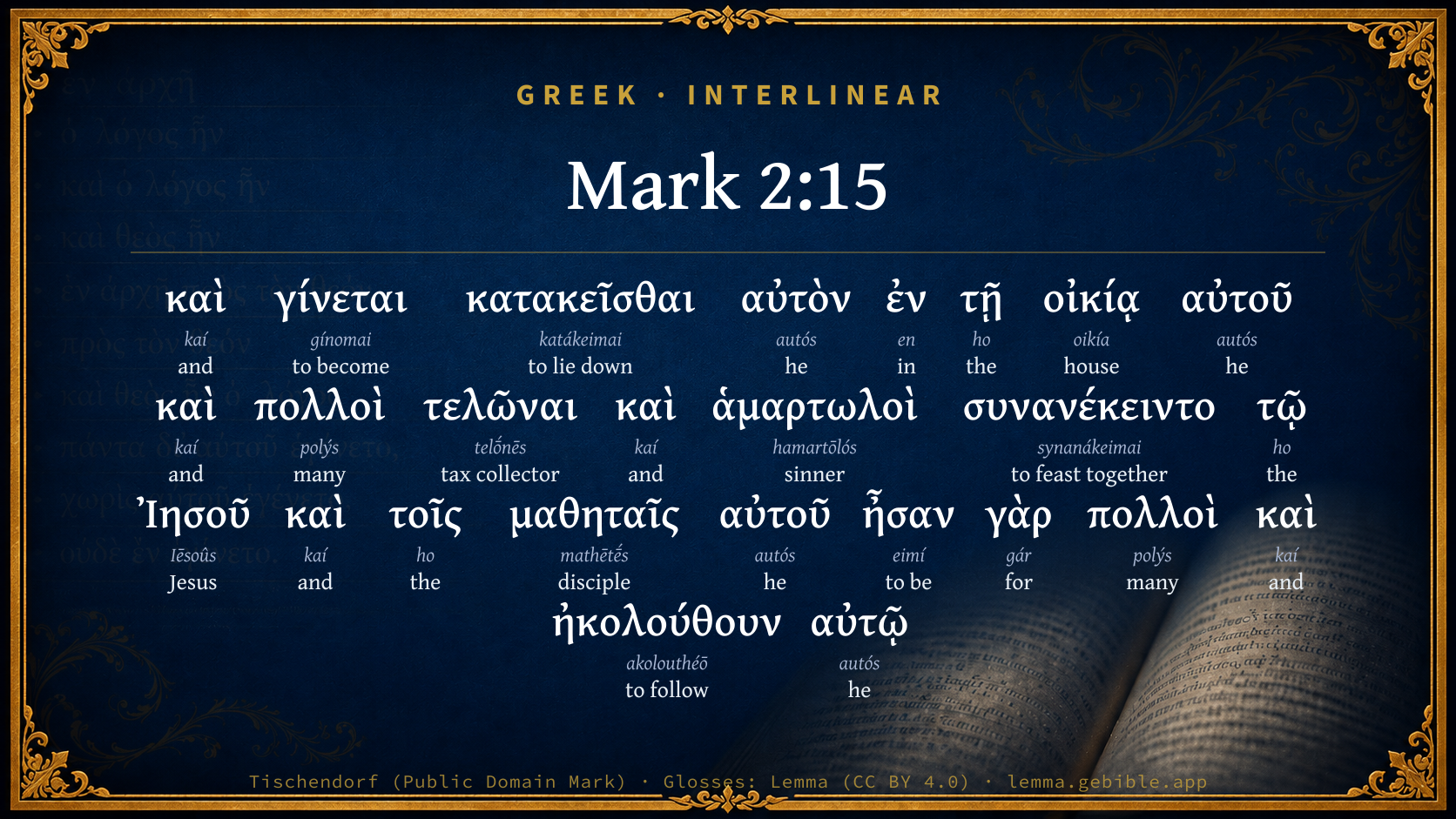
  1. καὶ kaí G2532 “and” Conjunction
  2. γίνεται gínomai G1096 “to become” Verb, Present, Middle or Passive deponent, Indicative, 3rd person, Singular
  3. κατακεῖσθαι katákeimai G2621 “to lie down” Verb, Present, Middle or Passive deponent, Infinitive
  4. αὐτὸν autós G846 “he” Personal pronoun, Accusative, Singular, Masculine
  5. ἐν en G1722 “in” Preposition
  6. τῇ ho G3588 “the” Article, Dative, Singular, Feminine
  7. οἰκίᾳ oikía G3614 “house” Noun, Dative, Singular, Feminine
  8. αὐτοῦ autós G846 “he” Personal pronoun, Genitive, Singular, Masculine
  9. καὶ kaí G2532 “and” Conjunction
  10. πολλοὶ polýs G4183 “many” Adjective, Nominative, Plural, Masculine
  11. τελῶναι telṓnēs G5057 “tax collector” Noun, Nominative, Plural, Masculine
  12. καὶ kaí G2532 “and” Conjunction
  13. ἁμαρτωλοὶ hamartōlós G268 “sinner” Adjective, Nominative, Plural, Masculine
  14. τῷ ho G3588 “the” Article, Dative, Singular, Masculine
  15. Ἰησοῦ Iēsoûs G2424 “Jesus” Noun, Dative, Singular, Masculine
  16. καὶ kaí G2532 “and” Conjunction
  17. τοῖς ho G3588 “the” Article, Dative, Plural, Masculine
  18. μαθηταῖς mathētḗs G3101 “disciple” Noun, Dative, Plural, Masculine
  19. αὐτοῦ autós G846 “he” Personal pronoun, Genitive, Singular, Masculine
  20. ἦσαν eimí G1510 “to be” Verb, Imperfect, Active, Indicative, 3rd person, Plural
  21. γὰρ gár G1063 “for” Conjunction
  22. πολλοὶ polýs G4183 “many” Adjective, Nominative, Plural, Masculine
  23. καὶ kaí G2532 “and” Conjunction
  24. ἠκολούθουν akolouthéō G190 “to follow” Verb, Imperfect, Active, Indicative, 3rd person, Plural
  25. αὐτῷ autós G846 “he” Personal pronoun, Dative, Singular, Masculine

About this verse

These counts appear in no published source. They are computed here, from the morphology-tagged text and Lemma’s own curated glosses. What Lemma adds →

26
words
16
distinct lemmas
Gospels
section

Notable vocabulary

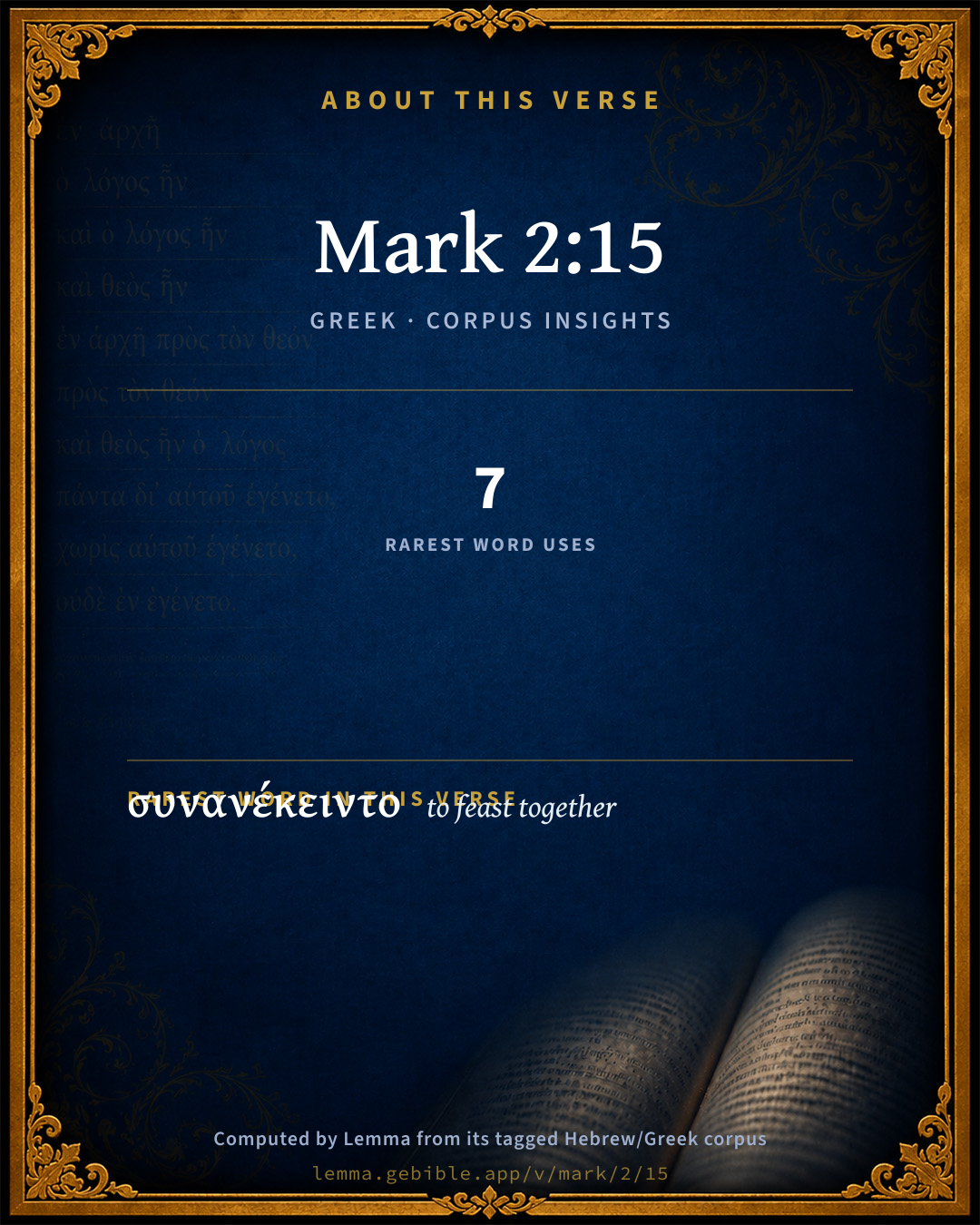
The rarest word here is συνανέκειντο to feast together G4873 — appearing just 7 times in the whole Greek New Testament.

Shared distinctive vocabulary

συνανέκειντο to feast together G4873 occurs in 7 verses of the Greek New Testament. Also found in:

Repetition

Words recur within this verse:

  • πολλοὶ many G4183 ×2
  • καὶ and G2532 ×5
  • αὐτὸν he G846 ×4
  • τῇ the G3588 ×3

Cross-references

5

Topical passages linked to Mark 2:15 in the Treasury of Scripture Knowledge — connected by theme and wording, ordered by reader-vote popularity; previews shown in the World English Bible.

  • Luke 15:1 Now all the tax collectors and sinners were coming close to him to hear him.
  • Matthew 9:10–11 It happened as he sat in the house, behold, many tax collectors and sinners came and sat down with Jesus and his disciples.
  • Luke 5:29–30 Levi made a great feast for him in his house. There was a great crowd of tax collectors and others who were reclining with them.
  • Matthew 21:31–32 Which of the two did the will of his father?" They said to him, "The first." Jesus said to them, "Most assuredly I tell you that the tax collectors and the prostitutes are entering into the Kingdom of God before you.
  • Luke 6:17 He came down with them, and stood on a level place, with a crowd of his disciples, and a great number of the people from all Judea and Jerusalem, and the sea coast of Tyre and Sidon, who came to hear him and to be healed of their diseases;

Cross-references courtesy of OpenBible.info (CC BY 4.0).

Commentary

Notes on Mark 2:15 from classic Christian and Jewish commentators (each source and its license shown beneath its notes). The classic Christian expositions comment on the surrounding passage and are grouped to its opening verse, so a note may address several verses; the Jewish commentaries on the Tanakh (Rashi and others) are per-verse, so they appear only where the commentator wrote on this verse.

Lemma curates 59 commentaries, every one of them public domain or Creative Commons licensed, each selected and text-cleaned for this edition rather than reprinted as found. About our sources →

Whedon's Commentary on the Bible

Daniel D. Whedon

§ 52. — LEVI’S FEAST; DISCOURSE OF JESUS, Mar_2:15-22.

This narrative of the feast given by Levi is furnished here, previous to its proper time, to connect it with his call. The account is different in points that show independence, yet the essential agreement is very complete.

15. His house — Matthew’s house. See our Life of Matthew, prefacing his Gospel.

Daniel D. Whedon (gen. ed.), Commentary on the Old and New Testaments (1874–1909) — public domain. Text from a community e-Sword module.

Godbey's Commentary on the New Testament

William B. Godbey

CHAPTER 29

MATTHEW’S BEAST

Mat 10:1-17; Mar 2:15-22; Luk 5:29-39. Luke “And Levi made a great feast for Him in his own house; and there was a great multitude of publicans and others who were sitting with them. And the scribes and Pharisees were murmuring to His disciples, saying, Why do you eat and drink with publicans and sinners? And Jesus, responding, said to them, They that are whole need not a physician, but they that are sick. I came not to call the righteous, but sinners to repentance.” Levi is a name of Matthew, the author of the first Gospel. He was a rich Jew, holding the office of publican — i.e., collector of the Roman revenue — living at Capernaum. Jesus passed by one day, spoke to him, and said, “Follow Me.” Unhesitatingly leaving all, he becomes a disciple of our Lord, and was afterward promoted to the apostleship. The publicans, as a rule, were proverbial for wickedness, dishonesty, and popular odium, as the Jews loathed the Roman Government, whose financial officers they were. We see how dearly Matthew loved his unsaved companions. Consequently he makes a great feast, and compliments them with an invitation, at the same time inviting Jesus and His disciples, hoping by this costly festival to bring them under the influence of the sinner’s Savior; thus giving us all an example we would do well to appreciate, also answering the hackneyed question, “How shall we reach the masses?” Give them a kind invitation, like Matthew, to come to a feast especially prepared for them in your own house, meanwhile you do your utmost, by prayer and timely conversation, to win them for God and heaven. We observe the same phenomenon this day which confronted Jesus and His disciples, thus intimately associated with the publicans and sinners at Matthew’s feast; i.e., the scribes (i.e., the pastors) and Pharisees (i.e., the influential and official members of the popular Churches) rejecting, contemptuously, drunkards, harlots, and other notorious reprobates, especially if they have no money. Matthew says: “Going, learn what this is, I wish mercy and not sacrifice. For I came, not to call the righteous, but sinners to repentance.” What does our Lord mean by mercy and not sacrifice? When you are utterly destitute, bankrupt, and broken-hearted, there is a wide, open door for Jesus to come in. With this He is delighted. So long as you realize your own possessions, you bank on them, and expect to win Divine favor by your contributions. In this way million’s plunge into hell. God is not poor. He does not need your money, nor anything else you have. He wants you, and not your possessions. Jesus wants immortal intelligence to glorify Him through all eternity.

THE DISCIPLES OF JOHN & JESUS

Mar 2:18. “And the disciples of John and Jesus were fasting. And they come and say to Him, Wherefore do the disciples of John and the Pharisees, and Thy disciples do not fast?” Fasting, in both dispensations, is not only a concomitant, but an auxiliary of prevailing prayer. Elijah, Moses, and Jesus all fasted forty days, Divinely kept in a spiritual rapture, the physical organism abiding in status quo. The disciples of Jesus, during His personal appearance, were an exception to this general rule, because of its disharmony with the power, the glory, and the infinite and extraordinary privilege peculiar to the immediate companions of the Omnipotent Savior; as fasting has a melancholy and lugubrious influence upon its votaries somewhat incompatible with that paradisiacal felicity characteristic of the Divine presence.

THE BRIDESMEN

“And Jesus said to them, Whether are the sons of the bride’s chamber able to fast as long as the bridegroom is with them? So long a time as they have the bridegroom with them they are not able to fast.” The sons of the bride’s chamber here mentioned as the men who have charge and are commissioned to the work of preparing the chamber in the house of the bridegroom for him to bring the bride into his own home; i.e., the great work of getting the bride ready and the bride chamber in order for the coming of the Bridegroom when He will take the bride to His heavenly home. We are betrothed to Christ in regeneration, and married to Him in sanctification. Jesus makes the application to His own disciples, and especially the twelve apostles, who were then laboring in the evangelistic field, destined soon to broaden out and encompass the whole world; thus calling out the bride from every nation under heaven, getting her sanctified, robed, and ready to meet the Bridegroom. Hence, God’s holy people, preaching the gospel of full salvation to the ends of the earth, “are the sons of the bride chamber,” faithfully laboring to get the bride ready for the Coming of the Bridegroom. Our Lord here fully settles the problem in reference to the expediency of fasting in our dispensation, when He states “And the days will come when the Bridegroom must be taken away from them, and then they will fast in that day.” Hence you see from this Scripture the pertinence of fasting ever since our Lord ascended into heaven. In His presence there was too much sunshine and glory for His disciples to fast. Since His departure, the widowed Church has not ceased to fast and pray for the return of our Lord.

THE NEW GARMENT, NEW BOTTLE, & NEW WINE

Luk 5:36. “And He spoke a parable to them, That no one putteth a piece of new garment on an old garment; as in that case the new tears it, and the piece which was from the new does not harmonize with the old. No one puts new wine into old bottles; as in that case the new wine will burst the bottles, and it will be poured out, and the bottles will perish; but the new wine is to be put into new bottles, and both will be preserved.” Every conceivable entity has both an exterior and an interior, which are equally indispensable to its existence. In the lucid and diversified symbolism of the gracious economy we have the most beautiful and perfect elucidation of both of these hemispheres, constituting the grand globe of full salvation. The new patch sewed on the old, thread-bare garment is too heavy and strong. It tears out all the fabric with which it is connected, making the hole several times its former size, and if repeated would actually tear the old garment all to pieces. What are we to do in this case? Let the old garment wear out, and never patch it. Oh! so our Lord has something better for us than the old tagged garment, and wants to take us out of the patching business altogether. He has for us the “best robe,” snowy white, washed in the blood of the Lamb, which will never get old and never wear out. Counterfeit religions are always patching up an old experience. Be sure you get this royal robe, which the King of glory furnishes His faithful bride without money and without price, which will never get old, nor wear out, nor need patching, but will shine with ever-brightening splendor through the flight of eternal ages. The garment represents the exterior of a Christian character, while the wine and the bottle typify the interior. You must keep your mind off the glass bottles of modern times, and contemplate the leather bottles, the only kind in use in the days of our Savior. It is wonderful how the Orientals never change, but perpetuate the customs and institutions of the Bible times. On the streets of Jerusalem, Hebron, Joppa, and all Palestinian cities, we constantly see the water- carriers bending under a whole goat-skin, full of water, thus carrying it from the fountain to supply the various demands. The fermentation of new wine, Increasing its bulk will break the old leather bottle, which is not strong enough thus to endure the pressure. While, of course, these strong metaphors illustrate the fact that Christianity is not simply a patch on Judaism, or some new wine poured into the old Mosaic bottles, but a de novo institution, such an interpretation merely reaches the surface, leaving the grand interior unexplored. The bottle is the heart. In a genuine conversion, God gives you a new heart. (Eze 36:26) God’s work, like Himself, never gets old. Hence the bottle He gives you is always new. Wine symbolizes the Holy Ghost, whom you receive as an indwelling Comforter in sanctification; of course, He can never get old. Therefore you see, with a true regeneration, you get the new bottle, which will never get old; while in the genuine. sanctification, you receive the new wine of the kingdom, which will never ferment nor get old. Hence, you should have nothing to do with the old bottles of a backslidden experience, nor the old wine of a counterfeit sanctification. The reason why the dead, worldly Churches are so timorous of sanctification preached in their pulpits, is because they are afraid the new wine will burst up their old bottles. But that is just what ought to be done. The bottle which the new wine will burst is of no account. The Lord’s genuine new bottles are elastic enough to hold a hundred-fold without detriment. The very thing we need in the fallen Churches is a glorious, Holy Ghost revival, whose first work is the bursting up of all those old bottles, and tearing up their old garments, thus showing them their need of the new. Then what a glorious time for all of us, when they all get new robes, bright and beautiful; new bottles, and all filled with the delicious, sweet, new wine, bright as ever sparkled from the grapes of Eshcol!

“And no one drinking the old immediately wishes the new; for He says, The old is better.” How is this? We find it universally illustrated. The heathens constantly meet our missionaries with the response, “Your religion suits you; but ours is ‘better’ for us.” Roman Catholic hears a Pentecostal sermon, but turning away, says his dead formality and priestcraft are “better.” As Luke says, he does not “immediately desire the new, but says the old is better.” Go into a dead, formal Church anywhere, and preach the living power of full salvation, and the people at first get angry, become sullen, and say their old religion “is better.” Go ahead, wait on the Lord, till these people get pungently convicted, and they will change their mind and want the “new.” Now remember, Jesus does not say “the old is better,” but that dead professor says it, and he is mistaken; for he soon changes his mind, when conviction strikes him like lightning, and takes it all back, turns round, seeks and finds the new bottle — i.e., the new heart — and never stops till he gets it filled with the new wine (i.e., the Holy Ghost), in the rich and glorious experience of entire sanctification.

William B. Godbey, Commentary on the New Testament (1896–1900) — public domain. Text from a community e-Sword module.

Bengel's Gnomon

Johann Albrecht Bengel

Mar 2:15.[18] Ἦσαν γὰρ, for they were) The Evangelist hereby explains why he had just written, with Jesus and His disciples; for they were many.

[18] Λευῒν Levi) called also Matthew.—V. g.

Bengel's Gnomon of the New Testament — English translation (T&T Clark, Edinburgh, 1860) — public domain. Text from a community e-Sword module.

Expositor's Greek Testament

ed. W. Robertson Nicoll

Mar 2:15 . ἐν τῇ οἰκίᾳ αὐτου : whose house? Not perfectly clear, but all things point to that of Levi. There is no mention of a return to Capernaum, where Jesus dwelt. The custom house may have been outside the town, nearer the shore. Then if the house of Jesus (Peter’s) had been meant, the name of Jesus should have stood after οἰκία instead of at the close of the verse. The main point to note is that whatever house is meant, it must have been large enough to have a hall or court capable of accommodating a large number of people. Furrer assumes as a matter of course that the gathering was in the court. “Here in the court of one of these ruined houses sat the Saviour of the lost in the midst of publicans and sinners” ( Wanderungen , p. 375). πολλοὶ , etc.: many to be taken in earnest, not slurred over, as we are apt to do when we think of this feast as a private entertainment given by Mt. to his quond m friends, Jesus being nothing more than a guest. ἦσαν γὰρ πολλοὶ καὶ ἠκολούθουν αὐτῷ : Mk. here takes pains to prevent us from overlooking the πολλοὶ of the previous clause = for they, the publicans, and generally the people who passed for sinners, were many , and they had begun to follow Him. Some (Schanz, Weiss, etc.) think the reference is to the disciples ( μαθηταῖς ), mentioned here for first time, therefore a statement that they were numerous (more, e.g. , than four ), quite apposite. But the stress of the story lies on the publicans, and Christ’s relations with them . (So Holtz., H. C.) It was an interesting fact to the evangelist that this class, of whom there was a large number in the neighbourhood, were beginning to show an interest in Jesus, and to follow Him about. To explain the number Elsner suggests that they may have gathered from various port towns along the shore. Jesus would not meet such people in the synagogue, as they seem to have been excluded from it ( vide Lightfoot and Wünsche, ad Mat 18:17 ). Hence the necessity for a special mission.

The Expositor's Greek Testament, edited by W. Robertson Nicoll (1897–1910) — public domain. Text from a community e-Sword module.

The Cambridge Bible for Schools and Colleges

gen. ed. J. J. S. Perowne

15. sat at meat] It is St Luke who tells us that St Matthew made, “great feast” in honour of his new Master (Luk_5:29), and to it, perhaps by way of farewell, he invited many of his old associates. This shews that he had made large sacrifices in order to follow Christ; see Neander’s Life of Christ, p. 230.

publicans and sinners] The “publicans” properly so called were persons who farmed the Roman taxes and in later times were usually Roman knights and men of wealth and position. Those here alluded to were the inferior officers, natives of the province where the taxes were collected, called properly portitores. So notorious were they for rapacity and dishonesty that Suetonius (Vit. Vesp. i.) tells us how several cities erected statues to Sabinus, “the honest publican;” and Theocritus in answer to the question, which were the worst kind of wild beasts, said, “On the mountains bears and lions; in cities, publicans and pettifoggers.” The Jews included them in the same category with harlots and sinners; see Mat_21:31-32; Mat_18:17. Observe that in his Gospel St Matthew alone styles himself in the list of the Apostles “the publican.”

The Cambridge Bible for Schools and Colleges (gen. ed. J. J. S. Perowne; Cambridge University Press, 1878–1918) — public domain. Text from a community e-Sword module.

John Gill's Exposition

And when the Scribes and Pharisees saw him eat,.... They were offended at his eating and drinking, though it was in moderation; because he did not fast as they, and their disciples did; and especially, that he eat

with publicans and sinners; men of very infamous characters, and bad lives, with whom the Pharisees disdained to keep company:

they said unto his disciples, how is it that he eateth and drinketh with publicans and sinners? The Vulgate Latin, Arabic, Persic, and Ethiopic versions read, "your master"; see Gill on Mat 9:11; so some Greek copies here.

John Gill's Exposition of the Whole Bible (1746–1763) — public domain (CC PDM 1.0). Text via the HelloAO Bible API.

Trapp's Complete Commentary

John Trapp

15 And it came to pass, that, as Jesus sat at meat in his house, many publicans and sinners sat also together with Jesus and his disciples: for there were many, and they followed him.

Ver. 15. Many publicans and sinners sat also] All at Matthew’s charge, and he thought it well bestowed, to bring them to Christ. So Paul, being himself assured of salvation, could do or suffer anything for the salvation of his poor countrymen. Rom 8:38-39; cf. Rom 9:1-2.

John Trapp, A Commentary or Exposition upon All the Books of the Old and New Testament (1647–1656) — public domain. Text from a community e-Sword module.

Albert Barnes' Notes on the Bible

Sat at meat in the house - The words “at meat” are not in the original. The phrase means “as he reclined at his meal,” or “as he was eating.” This feast was made by Matthew in honor of the Saviour. See Luk 5:29.

Publicans - See the notes at Mat 5:47.

Sinners - Sinners of abandoned character - of the same character that publicans commonly sustained - fit companions of publicans - great sinners.

There were many - That is, many “disciples.” Their following him, leaving their homes, and going with him from place to place, was proof of their attachment to him. There is no doubt that our Saviour, in the early part of his ministry, was extremely popular. Multitudes of the common people attended him, and gave conclusive evidence that they were his real disciples, and it was only after much opposition from the rich and the great that he ever became unpopular among the people. Perhaps no preacher has ever attracted so universal attention, and produced so decisive effects upon mankind, as did our Lord in his personal ministry.

Albert Barnes' Notes on the Bible (1834–1885) — public domain. Text from a community e-Sword/MySword module.

The Pulpit Commentary

And it came to pass egeneto seems the best readingas he was sitting at meat in his house. This was the house of Matthew. St. Matthew (Mat_9:10) modestly says, "in the house," keeping himself as much as possible in the background. St. Luke, with greater fullness, says (Luk_5:29) that "Levi made him a great feast in his house." From this it appears that Matthew at once marked the occasion of his call by inviting his associates, publicans and sinners, that they too, being won by the example and teaching of Christ, might be led in like manner to follow him. Good is ever diffusive of itself; and Christian love prompts those who have experienced the love of Christ to draw others to the same fountain of mercy. We find publicans and sinners constantly associated together; for, although there is nothing necessarily unlawful in the office of a tax-gatherer, yet, since men frequently followed that calling because it offered the opportunity for fraud and extortion, hence the "publicans" were, generally speaking, odious to the Jews, and regarded as nothing better than "sinners." More-over the Jews of old maintained that they were Abraham"s seed, and protested that as a people dedicated to God, they ought not to be subject to the Romans, who were Gentiles and idolaters. They considered that it was contrary to the liberty and dignity of the children of God that they should pay tribute to them, a view which increased their prejudice against the tax-gatherers. And indeed this was one main cause of the rebellion of the Jews, which led finally to their overthrow by Titus and Vespasian.

Vers. 15-22. Matthew"s house.

I THE SOCIALITY OF JESUS. He was found at ordinary dinner-parties and entertainments throughout his course, and to the last. He was a contrast in this to the ascetic Baptist. He was found in questionable" company. But the company of Pharisees would have been as questionable. " With a clear conscience a man may go into the miscellany of people called society. " A free and open manner is certain to bring remark and censure upon him. But better to mix with others and be thought no better" than they, than hold aloof and sour the heart with Pharisaic self-conceit. There is danger in general society, and danger in religious cliques.

II LOVE; JUSTIFYING ALL ECCENTRICITIES. It was eccentric to mix with those common and tabooed people. The whole conduct of Jesus was eccentric, and brought about fatal consequences. To aim at singularity is a foppery; to follow love"s impulse alone is graceful, generous, polite, refined. This is singular. Would there were more of such singularity!

III Naturalness. The spirit of man is like the face of earth and sky. Clouds pass over it; the sun is hidden. Anon all is bright again, and birds sing. To follow the lead of joy is in the best sense natural. Let the face and manner reflect the inner mind; to reverse this is to act a part. The pure and lovely hypocrisy is that which tries to affect the mien of mirth, though the heart be heavy. To put on the mask of gloom for the sake of warning others is Pharisaic, not Christian. Jesus is the example of the perfect gentleman.

IV THE PLACE AND TIME OF ASCETICISM. It is the reaction of the mind against certain sorrows. We must be true again to feeling and to fancy. It would be a violence to natural taste to put on wedding garments when a friend has passed away, however logical it might seem. There is a natural homeopathy of grief. Speaking of it and representing it outwardly tends to its relief; but to mimic a grief we feel not is to do a violence to ourselves. Be true to yourself: this is the only secret of moral beauty, from the lowest to the. highest moods, and is the lesson of Jesus. J.

The Pulpit Commentary (1880–1919), ed. H.D.M. Spence-Jones & Joseph S. Exell — public domain. Text from a community e-Sword module.

John Wesley's Explanatory Notes

Many publicans and notorious sinners sat with Jesus - Some of them doubtless invited by Matthew, moved with compassion for his old companions in sin. But the next words, For there were many, and they followed him, seem to imply, that the greater part, encouraged by his gracious words and the tenderness of his behaviour, and impatient to hear more, stayed for no invitation, but pressed in after him, and kept as close to him as they could.

John Wesley, Explanatory Notes Upon the Whole Bible (1754–1765) — public domain. Text via the GEBible commentary corpus.

Scofield Reference Notes

C. I. Scofield

sinners

Sin. (See Scofield "Rom 3:23")

The Scofield Reference Bible (1917 edition), notes by C. I. Scofield — public domain. Text from a community e-Sword module.

Kretzmann's Popular Commentary

Paul E. Kretzmann

The reception and dinner:

v. 15. And it came to pass that, as Jesus sat at meat in his house, many publicans and sinners sat also together with Jesus and His disciples; for there were many, and they followed Him

v. 16. And when the scribes and Pharisees saw Him eat with publicans and sinners, they said unto His disciples, How is it that He eateth and drinketh with publicans and sinners?

v. 17. When Jesus heard it, He saith unto them, They that are whole have no need of the ’physician, but they that are sick: I came not to call the righteous, but sinners to repentance.

Matthew was duly elated and thankful to the Lord, as a newly converted person is apt to be. In his joy he caused an elaborate dinner to be prepared for the Lord and the disciples. Jesus willingly accepted the invitation, because it would afford Him welcome opportunity to come into contact with needy souls. While He was reclining at one of the tables, in the fashion of the Orient, many publicans and sinners crowded in and joined in the meal. They were Levi Matthew’s former associates and friends, and he saw nothing strange or incongruous in their appearing at this time. But there were people that were highly indignant about this breach of Jewish custom and etiquette. For the tax collectors and the public sinners were for them in one class, they had been put out of the congregation, out of the synagogue, usually for some minor transgression against Jewish tradition. And, being properly shocked, the scribes voiced their disapproval to the disciples, either during the progress of the dinner or when they saw the disciples leave the house. They could not understand how Jesus could possibly eat at the same table with publicans and sinners. But Jesus heard their disapproving remark. He knew that His action would be an offense to these self-righteous hypocrites. And so He reminded them of a proverb which was then in general use: There is no need for the strong to have a doctor, but for the sick. That is true on the spiritual plane as well as on the physical. He that ’is truly well and strong, he that is perfectly righteous and without sin, truly needs no physician, no help for his sins, since he is not conscious of them and cannot be on account of their absence. Such perfect persons are indeed unknown on this earth; but all the greater is the number of them that imagine themselves to be perfect. And believing themselves to be righteous (miserable delusion!), they want nothing of the Savior of sinners, they will not believe that His mission concerns them. And so Christ confines His work to the sinners, to those that feel the weakness, the sickness of their soul, the terrible affliction of sin. By His call into communion with Him and by His dealing with them through the means of grace He gives them the assistance they need, He imputes to them, He gives them, His own righteousness, and thus makes them well in time and in eternity.

Paul E. Kretzmann, Popular Commentary of the Bible (1921–1924) — public domain. Text from a community e-Sword module.

McGarvey & Pendleton's Commentaries

J. W. McGarvey

J. W. McGarvey's The Fourfold Gospel [LVII. Matthew's Feast].

LVII. MATTHEW'S FEAST. DISCOURSE ON FASTING. (Capernaum.) aMATT. IX. 10-17; bMARK II. 15-22; cLUKE V. 29-39.

c29 And Levi [another name for the apostle Matthew] made him a great feast in his house: b15 And it came to pass, that he was sitting aas he sat at meat in the bhis ahouse, cand there was a great multitude of publicans [Matthew had invited his old friends] and of others band abehold, many publicans and sinners came and sat down with Jesus and his disciples. bfor there were many, cthat were sitting at meat with them. band they followed him. c30 And the Pharisees and their scribes bthe scribes of the Pharisees, [that is, the scribes which were of their party or sect] when they saw that he was eating with the sinners and publicans, c murmured against his disciples, saying, athey said unto his disciples, cWhy do ye eat and drink with the publicans and sinners? aWhy eateth your Teacher with the publicans and sinners? bHow is it that he eateth and drinketh with publicans and sinners? [From their standpoint, the question was natural enough. No strict Jew could eat with a Gentile ( Act_11:3, Gal_2:12), and Matthew's guests were classed with the heathen.] a12 But b17 And awhen he bJesus heard it, he canswering said bsaith unto them, They that are whole cin health have no need of a physician, but they that are sick. a13 But go ye and learn what this meaneth, I desire mercy, and not sacrifice [For an explanation of this passage, see Mat_22:4, Luk_14:8, Joh_2:8, Joh_2:9). Mourning and fasting would therefore ill befit such an occasion.] c35 But the days will come; and when the bridegroom shall [350] be taken from them, band then will they fast in that day. cthose days. [Jesus here foretells the removal of his visible presence from his disciples by his ascension. His words predict but do not command a fast. He prescribed no stated fasts, and the apostolic church kept none. History shows that prescribed fasts become formal and tend to Phariseeism.] 36 And he spake also a parable unto them: No man rendeth a piece from a new garment and putteth it upon an old garment, else he will rend the new, and also the piece from the new will not agree with the old. a16 And no man putteth bseweth a piece of undressed cloth on aupon an old garment; for belse that which should fill it up taketh from it, afrom the garment, bthe new from the old, and a worse rent is made. [Jesus justifies the conduct of his disciples by an appeal to the principles of the new dispensation, by which they were governed. The disciples of John looked upon Jesus as a reformer of Judaism, but he corrects their false impressions. To tear the new dispensation to pieces to renovate or embellish the old would be to injure the new and to destroy the old. By the process of fulling or dressing, new cloth was cleansed and shrunk so as to become more compact. The new cloth, therefore, had in it, so to speak, a life-element, and in its movement while shrinking it would tear the weaker fiber of the old cloth to which it was sewed, and thus enlarge the rent. The new dispensation could have rites and forms of its own, but could not conform to the rites of the Pharisees. If the conduct of his disciples had made a rent in the rabbinical traditions with regard to fasting, Jesus could not so modify the conduct of his disciples as to patch the rent without injuring the moral sense of his disciples, and without making Phariseeism a more meaningless hypocrisy than ever.] 22 And no man putteth { a17 Neither do men put new wine into old wine-skins: celse the the new wine will burst the skins, aand the wine citself will be ais spilled, band the wine perisheth, and the skins: aburst, cand the skins will perish. abut they put new wine cnew [351] wine must be put} binto fresh wine-skins. aand both are preserved. [This parable is also an illustration of the principles set forth above. Wine was then stored in casks of skin--usually hides of goats. Wine-skins, newly made, were elastic, and would expand to accommodate the fermentation of the new wine within. But the old wine-skins were stiff and of little strength, and would burst if fermenting liquid were confined within them.] c39 And no man having drunk old wine desireth new; for he saith, The old is good. [The thought here is that as wine should be put in skins suited for it, and as, at an entertainment, the different kinds of wine should be served in appropriate succession; so, fasting should be observed on suitable occasions--not, for instance, at a wedding.]

[FFG 349-352]

J. W. McGarvey (with Philip Y. Pendleton), Commentaries on the New Testament (The Fourfold Gospel, 1914; Acts; and the epistles) — public domain. Text from a community e-Sword/MySword module.

The People's New Testament

B. W. Johnson

15. Sat at meat. At a meal. In his house. Matthew's. Many publicans. Gatherers of the Roman tax. Sinners. Persons excommunicated from the synagogue.

B. W. Johnson's The People's New Testament with Notes (1889–1891) — public domain. Electronic text from the Christian Classics Ethereal Library (CCEL) ThML edition.

unfoldingWord translationNotes

Door43 World Missions Community

Connecting Statement:

It is now later in the day, and Jesus is at Levi's house for a meal.

Levi's house

"the home of Levi"

sinful people

The Pharisees used the phrase "sinful people" to refer to people who did not keep the law as well as the Pharisees thought they should.

for there were many and they followed him

Possible meanings are 1) "for there were many tax collectors and sinful people who followed Jesus" or 2) "for Jesus had many disciples and they followed him."

Why does he eat with tax collectors and sinful people?

The scribes and Pharisees asked this question to show they disapproved of Jesus' hospitality. This can be worded as a statement. AT: "He should not eat with sinners and tax collectors!" (See: Rhetorical Question)

translationWords

Jesus

Matthew

tax

sin

disciple

scribe

Pharisee

unfoldingWord translationNotes — © Distant Shores Media and the Door43 World Missions Community, licensed CC BY-SA 4.0. Source: git.door43.org/Door43/en_tn.

Cambridge Greek Testament for Schools and Colleges

15–17. THE FEAST IN LEVI’S HOUSE

Mat 9:10-13. Luk 5:29-32

15. γίνεται ([290][291][292] 33) rather than ἐγένετο ([293][294][295][296][297][298]).

[290] Codex Sinaiticus. 4th cent. Discovered by Tischendorf in 1859 at the Monastery of St Katharine on Mount Sinai. Now at St Petersburg. The whole Gospel, ending at Mar 16:8. Photographic facsimile, 1911.

[291] Codex Vaticanus. 4th cent., but perhaps a little later than א. In the Vatican Library almost since its foundation by Pope Nicolas V., and one of its greatest treasures. The whole Gospel, ending at Mar 16:8. Photographic facsimile, 1889.

[292] Codex Regius. 8th cent. An important witness. At Paris. Contains Mar 1:1 to Mar 10:15; Mar 10:30 to Mar 15:1; Mar 15:20 to Mar 16:20, but the shorter ending is inserted between Mar 16:8 and Mar 16:9, showing that the scribe preferred it to the longer one.

[293] Codex Alexandrinus. 5th cent. Brought by Cyril Lucar, Patriarch of Constantinople, from Alexandria, and afterwards presented by him to King Charles I. in 1628. In the British Museum. The whole Gospel. Photographic facsimile, 1879.

[294] Codex Ephraemi. 5th cent. A palimpsest: the original writing has been partially rubbed out, and the works of Ephraem the Syrian have been written over it; but a great deal of the original writing has been recovered; of Mark we have Mar 1:17 to Mar 6:31, Mar 8:5 to Mar 12:29, Mar 13:19 to Mar 16:20. In the National Library at Paris.

[295] Codex Bezae. 6th cent. Has a Latin translation (d) side by side with the Greek text, and the two do not quite always agree. Presented by Beza to the University Library of Cambridge in 1581. Remarkable for its frequent divergences from other texts. Contains Mark, except Mar 16:15-20, which has been added by a later hand. Photographic facsimile, 1899.

[296] Codex Oxoniensis. 9th cent. Contains Mark, except Mar 3:35 to Mar 6:20.

[297] Codex Sangallensis. 9th or 10th cent. Contains the Gospels nearly complete, with an interlinear Latin translation. The text of Mark is specially good, agreeing often with CL. At St Gall.

[298] Codex Petropolitanus. 9th cent. Gospels almost complete. Mar 16:18-20 is in a later hand.

15. γίνεται κατακεῖσθαι. See crit. note. Reclining at meals was usual. Of the six words used in the Gospels to denote this posture (ἀνακεῖσθαι, ἀνακλίνειν, ἀναπίπτειν, κατακεῖσθαι, κατακλίνειν, συνανακεῖσθαι), Mk uses all but κατακλίνειν, Mt. all but κατακεῖσθαι and κατακλίνειν, Lk. all six, while Jn uses only ἀνακεῖσθαι and ἀναπίπτειν. This is in accordance with the fulness of Lk.’s vocabulary and the sparseness of John’s. For these six words, Vulg. has only three, accumbere, discumbere, and recumbere, and it uses them almost promiscuously. All three are employed to translate both ἀνακεῖσθαι and ἀνακλίνειν.

ἐν τῇ οἰκίᾳ αὐτοῦ. In Levi’s house, as Lk. expressly states; Peter’s house would not hold a large reception. In Mt., αὐτοῦ is omitted. If Levi = Matthew, and Matthew is the authority for this part of the First Gospel, αὐτοῦ would be unnecessary.

πολλοὶ τελῶναι καὶ ἁμαρτωλοί. The combination is here in all three; cf. Mat 11:19; Mat 21:31; Luk 7:34; Luk 15:1; Luk 18:11. It is paralleled in Lucian (Necyom. 11); μοιχοὶ καὶ πορνοβόσκοι καὶ τελῶναι καὶ κόλακες καὶ συκοφάνται, καὶ τοιοῦτος ὅμιλος τῶν πάντα κυκώντων ἐν τῷ βίῳ. Cf. Aristoph. Equit. 248; Theoph. Charac. 6. Theocritus in answer to the question, which are the worst of wild beasts, says, “On the mountains bears and lions, in cities publicans and pettifoggers.” The word is derived from τέλη (Mat 17:25; Rom 13:7) and ὠνέομαι, and therefore in etymology τελῶναι = publicani, the wealthy persons, commonly equites, who bought or farmed the taxes or Government revenues. But in usage τελῶναι = portitores, who collected the taxes. This usage is invariable in N.T. and freq. elsewhere. Taxes were usually collected for the Emperor, and for a Jew to undertake such work for a heathen conqueror was the deepest disgrace; all such were excommunicated. But this was not Levi’s case; he would be disliked for being a tax-collector, but at Capernaum tolls were collected, not for Rome, but for the tetrarch. Rome allowed the Herods some powers of taxation.

τῷ Ἰησοῦ. So always in N.T. In LXX., Ἰησοῖ is sometimes found. Levi had invited his colleagues and acquaintances to meet the Master; it was his first missionary act. After the call of Simon and Andrew Christ is entertained at their humble house (Mar 1:29-31); and after the call of the well-to-do toll-collector He is entertained at his spacious house.

ἦσαν γὰρ πολλοί. Sc. οἱ μαθηταί. Like other teachers of repute, Jesus had hearers who followed Him in His movements. His “mighty works” attracted numbers, many of whom were retained by the “authority” of His teaching. It was the number of His adherents that roused the jealousy of the hierarchy, and the character of His teaching made them bitterly hostile. It is making the πολλοί tautological to refer it to τελῶναι κ. ἁμαρτωλοί.

καὶ ἠκολούθουν αὐτῷ. If the καί before ἰδόντες is genuine (see crit. note) these words are best taken with what follows. W.H., A.V., R.V. omit καί and connect κ. ἠκολ. αὐτῷ with ἦσαν γὰρ πολλοί. There is, however, more point in saying that Christ had hostile followers as well as friendly ones, than in saying that friendly people followed Him.

Cambridge Greek Testament for Schools and Colleges (Cambridge University Press, 1896; 21 vols, various authors incl. Carr, Maclear, Plummer, Farrar, Lumby, Moule, M. R. James, Simcox) — public domain. Text from a community e-Sword module.

Alford’s Greek Testament

Henry Alford

15.] The entertainment was certainly in Levi’s house, not as Meyer, ., in that of our Lord, which last is a pure fiction, and is not any where designated in the Gospel accounts. Certainly the καλέσαι, ver. 17, gives no countenance to the view. Our Lord, and those following Him as disciples, were ordinarily entertained where He was invited, which will account for ἠκολοὐθουν αὐτῷ:—and the change of subject in the two, αὐτόν and αὐτοῦ, is no uncommon thing: see a similar change in Luk 19:3, where to be consistent Meyer ought to understand ὅτι τῇ ἡλ. μικ. ἦν of our Lord. To help out his interpretation he strangely enough makes καλέσαι, ver. 17, mean ‘to invite.’

ἦσαν γὰρ … αὐτῷ, peculiar to Mark.

Henry Alford, The Greek Testament (1849–1861) — public domain. Text from a community e-Sword module.

International Critical Commentary

15. Καὶ γίνεται κατακεῖσθαι—And it comes to pass that he is reclining (at table).2

γίνεται instead of ἐγένετο, Tisch. Treg. WH. א BL 33. Omit ἐν τῷ before κατακεῖσθαι—Tisch. Treg. WH. RV. א BL 13, 33, 69, 102, 124, Memph.

Κατακεῖσθαι αὐτὸν ἐν τῇ οἰκίᾳ αὐτοῦ—he was reclining at table in his house. Meyer, Holtzmann, and others say that this was the house of Jesus. This is contrary to the statement of Lk., who says expressly that Levi made him a great feast at his house. But the recurrence of the pronoun αὐτὸν … αὐτοῦ makes it reasonably certain that they refer to the same person. Mt. does not insert any pronoun after τῇ οἰκίᾳ, and that makes his language point in the same direction. And the fact that Mt. and Mk. use different language, which nevertheless points to the same conclusion, makes that conclusion doubly certain. The connection between this event and the call of Levi is thus simply that both show Jesus’ revolutionary attitude towards the despised classes of his time.

τελῶναι—tax-gatherers. The name publicans, given them in our English Bible, comes from the Latin publicani, but in English it has become practically obsolete in that sense. Moreover, the Latin publicani does not apply to the whole class of tax-gatherers, but only to the Roman knights to whom the taxes were farmed out in the first instance.

ἁμαρτωλοὶ—sinners; i.e. here, those guilty of crimes against society and law, the degraded and vicious class.1

συνανέκειντο—were reclining at table with.2

μαθηταῖς—disciples. The common word used to describe the followers of Jesus, corresponding to the title διδάσκαλος applied to him. It is significant, that the names teacher and pupil are chosen by Jesus and the disciples to describe the relations between them. It is probable, according to the best text, that the last two clauses of this verse are to be separated, so that the verse ends with πολλοί.3 The statement is, that there were many of this class of open sinners. It does not denote the number present, which would be superfluous, but the number of the class. Holtzmann calls attention to the situation of Capernaum on the borders of the territory of Herod as the cause of the number of tax-gatherers, as this made it an important customs station. οἱ γραμ. τῶν Φαρις.—the Scribes of the Pharisees. The Pharisees were the sect that adhered not only to the Law, but to the rabbinical interpretation of the Law, which gradually formed a traditional code by the side of the written Law. Their scribes, therefore, would be the rabbis of the party that specially believed in the rabbis. Morison is right in calling them the arch-inquisitors, the genus inquisitor being the Pharisees.

In the N.T., the use of μαθηταί is confined to the Gospels and Acts. In the Gospels, it is applied to the twelve, who formed the inner circle of disciples, as well as the larger group outside. In the Acts, it is the general name for Christians, the official title apostles being given to the twelve.

ἠκολούθουν instead of ἠκολούθησαν, Tisch. Treg. WH. RV. א BL mss. of Lat. Vet. Vulg.

International Critical Commentary — older volumes (1896–1929), various authors — public domain. Text from a community e-Sword module.

Vincent's Word Studies in the New Testament

Marvin R. Vincent

His house. Levi 's. See Luk 5:29.

Marvin R. Vincent, Word Studies in the New Testament (1887–1900) — public domain. Text from a community e-Sword/MySword module.

Lesson kit

Teaching starters — assembled from the data on this page, not authored interpretation. Every prompt links to the verse data it draws on. Edit before teaching.

Mark, in the Gospels, opens this verse with 26 words (16 distinct Greek lemmas). Its most distinctive word is synanákeimai (“to feast together”). A historical commentator’s framing appears above. Read the whole chapter for the surrounding context.

Discussion questions

  1. The word synanákeimai carries the sense “to feast together.” How does it shape the verse?
  2. How does Matthew 9:10, which shares the word «to feast together», read alongside this verse?
  3. What does the repetition of “many” (2× in this one verse) do in this verse?
  4. The translations on this page render this verse differently — a whole-verse word diff, not a word-by-word alignment. What might account for the different wordings?
  5. Compare how Whedon's Commentary on the Bible and Godbey's Commentary on the New Testament read this verse. Where do they agree or differ?

Things to notice

Reading settings

Reading text

Shown beneath each verse's original-language words.

Old Testament
Old Testament edition

Read the OT as the Masoretic Hebrew (MT) or the Greek Septuagint (LXX).

English shown for the Greek Septuagint (in the Hebrew ↔ Greek comparison).

Comparing translations? Open the Compare panel on any verse page to stack up to four side by side.