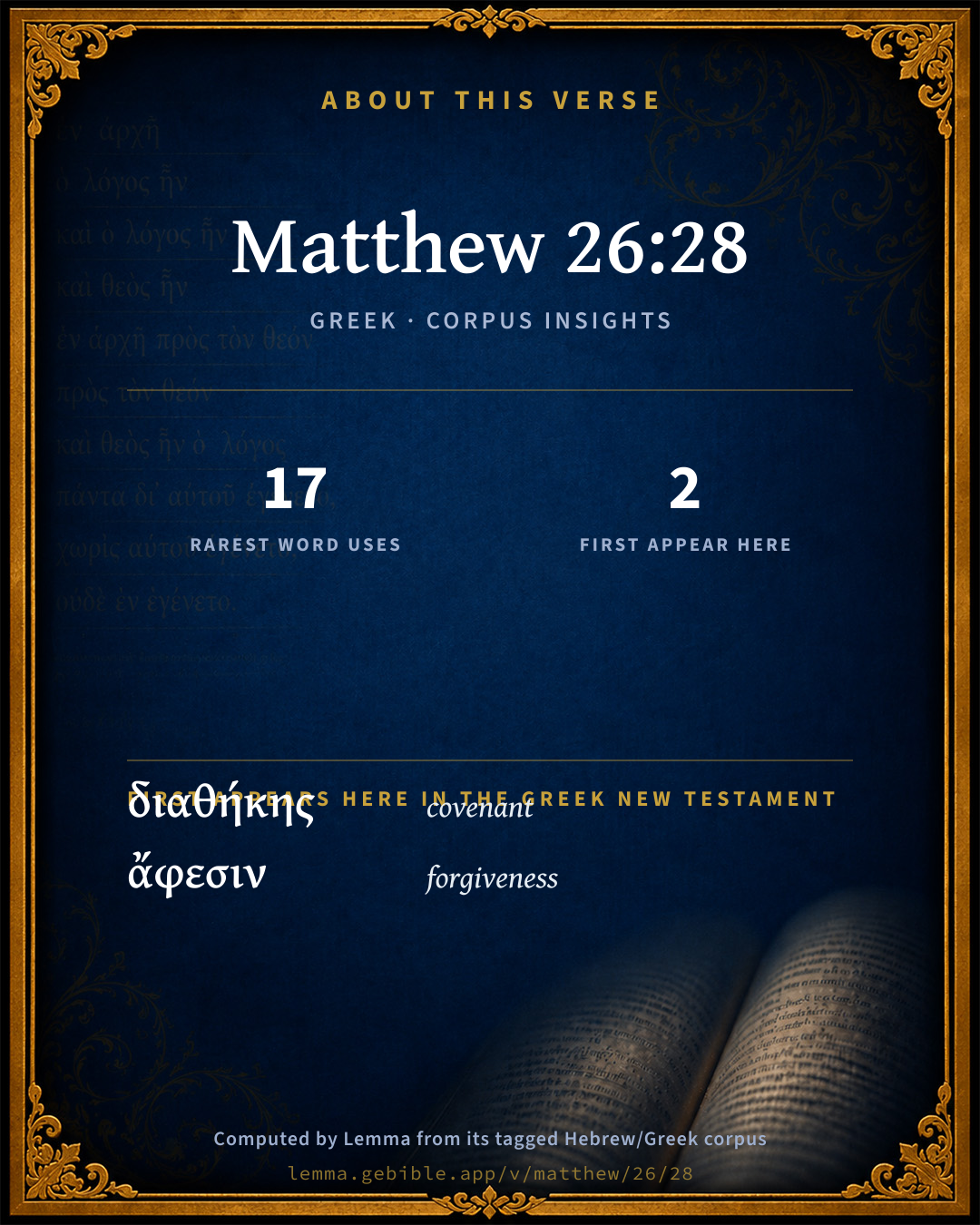
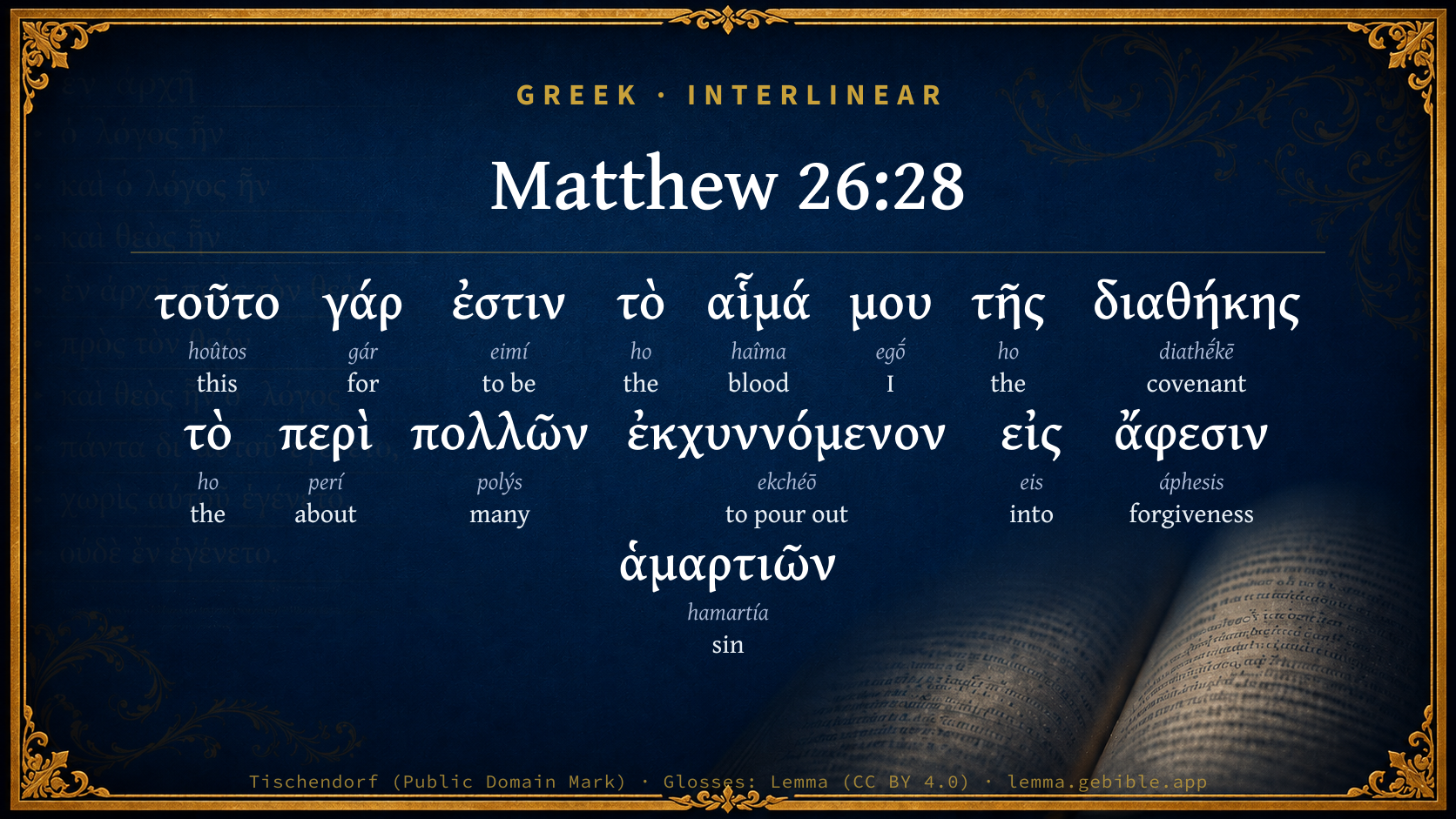
Matthew 26:28

Greek (Tischendorf 8th ed.) Matthew 26:28 appears in the Greek New Testament. The text above is from the Tischendorf 8th edition. Each word links to its Strong’s number and a concise gloss. Click any word for its full Thayer’s Greek Lexicon entry.
Download image
Cite this verse

Matthew 26:28 (World English Bible). Public Domain. Lemma interlinear Bible study tool, https://lemma.gebible.app/v/matthew/26/28.

Show BibTeX & RIS
BibTeX
RIS
English Translation
for this is my blood of the new covenant, which is poured out for many for the remission of sins.
World English Bible · Public Domain
Highlights
  • 2 first appearances in the Greek New Testament
Full analysis ↓
Download a study sheet

One document with this verse’s original text, its word-by-word gloss line, the meaning frame, cross-references with their text, attributed commentary, and full source and license credits — printable, and it pastes into notes with its structure intact.

This verse Autodidact and up

Study sheet (.html) Plain text (.txt)

A passage Seminary Student

Up to 50 verses in one chapter. A passage sheet keeps up to 6 commentary sources and 12 cross-references per verse, in the order this page ranks them, and says so on the sheet whenever that leaves anything out. Ask for a single verse and you get the Autodidact verse sheet above.

Everything on this page stays free to read, with no account — the sheet is a download of what is already on screen, not access to it.

Want to remove ads? Support Godless Engineer
Compare translations 3

The same verse in 3 English versions, stacked beneath the original-language interlinear above. Click any original word for its lexicon entry.

Each is an independent rendering of the whole verse — the interlinear is not word-aligned to these translations.

Highlighted words mark where these versions differ — a whole-verse word diff, not a word-by-word alignment.

  • World English Bible Public Domain
    for this is my blood of the new covenant, which is poured out for many for the remission of sins.
  • King James Version Public Domain
    For this is my blood of the new testament, which is shed for many for the remission of sins.
  • unfoldingWord Literal Text CC BY-SA 4.0
    For this is my blood of the covenant that is being poured out for many for the forgiveness of sins.

unfoldingWord Literal Text — © unfoldingWord, licensed CC BY-SA 4.0. Word-aligned USFM3 via Door43 (git.door43.org/unfoldingWord/en_ult).

Versions to compare (up to 4)

3 of 4 selected

Show all 19 translations

Every available English version of this verse, each an independent rendering of the whole verse.

  • World English Bible Public Domain
    for this is my blood of the new covenant, which is poured out for many for the remission of sins.
  • Berean Standard Bible Public Domain
    This is My blood of the covenant, which is poured out for many for the forgiveness of sins.
  • Majority Standard Bible Public Domain
    This is My blood of the new covenant, which is poured out for many for the forgiveness of sins.
  • King James Version Public Domain
    For this is my blood of the new testament, which is shed for many for the remission of sins.
  • American Standard Version (1901) Public Domain
    for this is my blood of the covenant, which is poured out for many unto remission of sins.
  • Revised Version (1885) Public Domain
    for this is my blood of the covenant, which is shed for many unto remission of sins.
  • Geneva Bible (1599) Public Domain
    For this is my blood of the Newe Testament, that is shedde for many, for the remission of sinnes.
  • Douay-Rheims (1899) Public Domain
    For this is my blood of the new testament, which shall be shed for many unto remission of sins.
  • Young's Literal Translation Public Domain
    for this is my blood of the new covenant, that for many is being poured out -- to remission of sins;
  • Literal Standard Version CC BY-SA 4.0
    for this is My blood of the New Covenant, that is being poured out for many, for forgiveness of sins;
  • Unlocked Literal Bible CC BY-SA 4.0
    For this is my blood of the covenant that is poured out for many for the forgiveness of sins.
  • unfoldingWord Literal Text CC BY-SA 4.0
    For this is my blood of the covenant that is being poured out for many for the forgiveness of sins.
  • Darby Bible Public Domain
    For this is my blood, that of the [new] covenant, that shed for many for remission of sins.
  • World Messianic Bible Public Domain
    for this is my blood of the new covenant, which is poured out for many for the remission of sins.
  • Webster's Bible Public Domain
    For this is my blood of the new testament, which is shed for many for the remission of sin.
  • Free Bible Version CC BY-SA 4.0
    “For this is my blood of the agreement, poured out for many for the forgiveness of sins.
  • Bible in Basic English Public Domain
    Take of it, all of you, for this is my blood of the testament, which is given for men for the forgiveness of sins.
  • Text-Critical English NT CC BY 4.0
    for this is my blood of the new covenant, which is poured out for many for the remission of sins.
  • Tyndale New Testament (1534) Public Domain
    For this is my bloude of the new testament that shalbe shedde for many for the remission of synnes.

Literal Standard Version (2020), Covenant Press — licensed CC BY-SA 4.0. Text via the HelloAO Bible API (eBible.org). Unlocked Literal Bible (unfoldingWord) — licensed CC BY-SA 4.0. Text via the HelloAO Bible API (eBible.org). unfoldingWord Literal Text — © unfoldingWord, licensed CC BY-SA 4.0. Word-aligned USFM3 via Door43 (git.door43.org/unfoldingWord/en_ult). Free Bible Version, Dr. Jonathan Gallagher — licensed CC BY-SA 4.0. Text via the HelloAO Bible API (eBible.org).

Word by word

More ways to search: Search by grammar → Find every occurrence → Compare this word →

Practice this passage: Drill this verse → Learn its vocabulary →

ἄφεσιν
áphesis
G859
“forgiveness”
Noun, Accusative, Singular, Feminine
Part of Speech
Noun
Case
Accusative
Number
Singular
Gender
Feminine
Full Thayer's Definition

Origin: from G863

TDNT: 09:29,9

1. release from bondage or imprisonment 2. forgiveness or pardon, of sins (letting them go as if they had never been committed), remission of the penalty
  1. τοῦτο hoûtos G3778 “this” Demonstrative pronoun, Nominative, Singular, Neuter
  2. γάρ gár G1063 “for” Conjunction
  3. ἐστιν eimí G1510 “to be” Verb, Present, Active, Indicative, 3rd person, Singular
  4. τὸ ho G3588 “the” Article, Nominative, Singular, Neuter
  5. αἷμά haîma G129 “blood” Noun, Nominative, Singular, Neuter
  6. μου egṓ G1473 “I” Personal pronoun, 1st person, Genitive, Singular
  7. τῆς ho G3588 “the” Article, Genitive, Singular, Feminine
  8. διαθήκης diathḗkē G1242 “covenant” Noun, Genitive, Singular, Feminine
  9. τὸ ho G3588 “the” Article, Nominative, Singular, Neuter
  10. περὶ perí G4012 “about” Preposition
  11. πολλῶν polýs G4183 “many” Adjective, Genitive, Plural, Masculine
  12. ἐκχυννόμενον ekchéō G1632 “to pour out” Verb, Present, Passive, Participle, Nominative, Singular, Neuter
  13. εἰς eis G1519 “into” Preposition
  14. ἁμαρτιῶν hamartía G266 “sin” Noun, Genitive, Plural, Feminine

About this verse

These counts appear in no published source. They are computed here, from the morphology-tagged text and Lemma’s own curated glosses. What Lemma adds →

15
words
13
distinct lemmas
Gospels
section

Notable vocabulary

The rarest word here is ἄφεσιν forgiveness G859 — appearing just 17 times in the whole Greek New Testament.

First appearance in Scripture

These words make their first canonical appearance in the Greek New Testament here:

  • διαθήκης covenant G1242
  • ἄφεσιν forgiveness G859

Shared distinctive vocabulary

ἄφεσιν forgiveness G859 occurs in 16 verses of the Greek New Testament. Also found in:

Repetition

A word recurs within this verse:

Cross-references

21

Topical passages linked to Matthew 26:28 in the Treasury of Scripture Knowledge — connected by theme and wording, ordered by reader-vote popularity; previews shown in the World English Bible.

  • Hebrews 10:4–14 For it is impossible that the blood of bulls and goats should take away sins.
  • Hebrews 9:14–22 how much more will the blood of Christ, who through the eternal Spirit offered himself without blemish to God, cleanse your conscience from dead works to serve the living God?
  • Leviticus 17:11 For the life of the flesh is in the blood; and I have given it to you on the altar to make atonement for your souls: for it is the blood that makes atonement by reason of the life.
  • Matthew 20:28 even as the Son of Man came not to be served, but to serve, and to give his life as a ransom for many."
  • Exodus 24:7–8 He took the book of the covenant and read it in the hearing of the people, and they said, "All that Yahweh has spoken will we do, and be obedient."
  • Revelation 7:14 I told him, "My lord, you know." He said to me, "These are those who came out of the great tribulation. They washed their robes, and made them white in the Lamb's blood.
  • 1 Corinthians 11:25 In the same way he also took the cup, after supper, saying, "This cup is the new covenant in my blood. Do this, as often as you drink, in memory of me."
  • 1 John 2:2 And he is the atoning sacrifice for our sins, and not for ours only, but also for the whole world.
  • Zechariah 9:11 As for you also, Because of the blood of your covenant, I have set free your prisoners from the pit in which is no water.
  • Ephesians 1:7 in whom we have our redemption through his blood, the forgiveness of our trespasses, according to the riches of his grace,
  • Hebrews 9:28 so Christ also, having been once offered to bear the sins of many, will appear a second time, without sin, to those who are eagerly waiting for him for salvation.
  • Hebrews 13:20 Now may the God of peace, who brought again from the dead the great shepherd of the sheep with the blood of an eternal covenant, our Lord Jesus,
  • Luke 22:19 He took bread, and when he had given thanks, he broke it, and gave to them, saying, "This is my body which is given for you. Do this in memory of me."
  • Colossians 1:14 in whom we have our redemption, the forgiveness of our sins;
  • Colossians 1:20 and through him to reconcile all things to himself, by him, whether things on the earth, or things in the heavens, having made peace through the blood of his cross.
  • Mark 14:24 He said to them, "This is my blood of the new covenant, which is poured out for many.
  • Romans 5:19 For as through the one man's disobedience many were made sinners, even so through the obedience of the one will many be made righteous.
  • Jeremiah 31:31 Behold, the days come, says Yahweh, that I will make a new covenant with the house of Israel, and with the house of Judah:
  • Romans 5:15 But the free gift isn't like the trespass. For if by the trespass of the one the many died, much more did the grace of God, and the gift by the grace of the one man, Jesus Christ, abound to the many.
  • Revelation 7:9 After these things I looked, and behold, a great multitude, which no man could number, out of every nation and of all tribes, peoples, and languages, standing before the throne and before the Lamb, dressed in white robes, with palm branches in their hands.
  • Mark 1:4 John came baptizing in the wilderness and preaching the baptism of repentance for forgiveness of sins.

Cross-references courtesy of OpenBible.info (CC BY 4.0).

Where the printed editions differ

1 variant

Places in this verse where the major printed Greek editions disagree on the wording in a way that affects the translation — a comparison of editions, not a manuscript-by-manuscript collation. The editions are the modern critical texts (Nestlé-Aland 28/27, SBL, Westcott-Hort, Tregelles, Tyndale House) and the traditional texts behind the KJV (the Textus Receptus and the Byzantine/Majority text). It is not a claim about which reading is original.

  1. Extra text
    καινῆς

    “of a new”

    In TregTRByz Not in NA28NA27TynSBLWH

    καινῆς (kainēs) 'of a new' is only in traditional manuscripts (Treg+TR+Byz)

Textual data: Translators Amalgamated Greek New Testament (STEPBible TAGNT) · CC BY 4.0.

Commentary

Notes on Matthew 26:28 from classic Christian and Jewish commentators (each source and its license shown beneath its notes). The classic Christian expositions comment on the surrounding passage and are grouped to its opening verse, so a note may address several verses; the Jewish commentaries on the Tanakh (Rashi and others) are per-verse, so they appear only where the commentator wrote on this verse.

Lemma curates 59 commentaries, every one of them public domain or Creative Commons licensed, each selected and text-cleaned for this edition rather than reprinted as found. About our sources →

Scofield Reference Notes

C. I. Scofield

remission

Forgiveness. Summary: The Greek word translated "remission" in Mat 26:28; Act 10:43; Heb 9:22 is elsewhere rendered "forgiveness." It means, to send off, or away. And this, throughout Scripture, is the one fundamental meaning of forgiveness--to separate the sin from the sinner. Distinction must be made between divine and human forgiveness:

(1) Human forgiveness means the remission of penalty. In the Old Testament and the New, in type and fulfilment, the divine forgiveness follows the execution of the penalty. "The priest shall make an atonement for his sin that he had committed, and it shall be forgiven him" Lev 4:35.

"This is my blood of the new covenant, which is shed for many for the remission sending away, forgiveness of sins" (Mat 25:28). "Without shedding of blood there is no remission" Heb 9:22.

See "Sacrifice" (See Scofield "Gen 4:4"); Gen 4:4 See Scofield "Heb 10:18". The sin of the justified believer interrupts his fellowship, and is forgiven upon confession, but always on the ground of Christ’s propitiating sacrifice; 1Jn 1:6-9; 1Jn 2:2.

(2) Human forgiveness rests upon and results from the divine forgiveness. In many passages this is assumed rather than stated, but the principle is declared in Eph 4:32; Mat 18:32; Mat 18:33.

sins Sin.

(See Scofield "Rom 3:23").

The Scofield Reference Bible (1917 edition), notes by C. I. Scofield — public domain. Text from a community e-Sword module.

Tyndale Open Study Notes

Tyndale Open Resources

26:28 the covenant: Under God’s covenant with Israel, the blood of sheep or goats (Exod 12:5, 13; 24:8) was shed and placed on the two doorposts and on the lintel at Passover (Exod 12:7). The blood of Jesus, the sinless Lamb of God, establishes a new covenant (see Jer 31:31). The idea of the covenant is God’s unilateral commitment to establish salvation for mankind, fulfilling the promise to Abraham (see Gen 12; Gal 3:15-29; 4:12-31). • to forgive the sins of many: Jesus shed his blood as a sacrifice for sin (see Jer 31:31-34; Mark 14:24). Some have understood many to refer only to God’s chosen people, while others have understood many to be an expression meaning “all” (cp. Matt 20:28).

Tyndale Open Study Notes — © Tyndale Open Resources, licensed CC BY-SA 4.0. Text via the HelloAO Bible API.

Bengel's Gnomon

Johann Albrecht Bengel

Mat 26:28. Τοῦτο, this) The true blood of Christ is shown to be actually present, just as the blood of the victims was in the Mosaic formula cited in Heb 9:20; for that formula is here referred to.—τῆς καινῆς, of the New) in contradistinction to the Old: see Exo 24:8, sc. “And Moses took the blood, and sprinkled it on the people, and said “Behold the blood of the covenant,” etc.—διαθήκης, testament, disposition, dispensation) Many theologians of the Reformed Church, and some even of the Evangelical communion,[1135] endeavoured in the last generation to reduce the whole scheme of Christian doctrine to the form of a covenant: a method pre-eminently suited to the Jewish theology; but Scripture expresses the New divine economy in this case, as it is wont in other cases, by a word belonging to the Old scheme, although employed in a sense not exactly coinciding with its original meaning: nor can we easily speak of the NEW, διαθήκη, or Dispensation (Dispositio), except in contrast to the Old, either expressed or implied. In short, the very words ברית and ΔΙΑΘΉΚΗ [by which the Old and New Dispensation are severally indicated] differ from each other, and their difference corresponds wonderfully with the actual state of the case. For the word ברית accords more with the Old economy, which had the form of a covenant, whereas διαθήκη accords more with the New economy, which has the form of a testament; on which account the Talmudists employ the Greek word דייתיקי [ΔΙΑΘΉΚΗ, written in Hebrew characters] as not having a Hebrew word whereby to express it. But the idea of a covenant does not so well agree with that entire son-ship which exists under the New Testament dispensation. Even the very notion of a testament, will at last, as it were, come to an end, on account of our intimate union with God: see Joh 17:21-22, and 1Co 15:28.—ΠΟΛΛῶΝ, many) even beyond the limits of Israel.—ἐκχυνόμενον, which is being shed) The present tense. There is the same potency in the Holy Supper, as if in that self-same moment the body of Christ was always being given, and His blood being shed.—ἌΦΕΣΙΝ ἉΜΑΡΤΙῶΝ, remission of sins) the especial blessing of the New Testament dispensation. [Eph 1:7, E. B.]

[1135] In Bengel, Reformed = Calvinistic: Evangelical = Lutheran.—(I. B.)

Bengel's Gnomon of the New Testament — English translation (T&T Clark, Edinburgh, 1860) — public domain. Text from a community e-Sword module.

Meyer's Critical & Exegetical Commentary

Heinrich August Wilhelm Meyer

Mat_26:28. The death-symbolism is now applied to that which contains the life (Gen_9:4 ff., and comp. on Acts 15), viz. the blood, which is described as sacrificial blood that is to be shed in order to make atonement. Neither here nor anywhere else in the New Testament (Heb_12:24 not excepted) can there be any question of the glorified blood of Christ. Comp. on Mat_26:26, and on 1Co_10:16. According to New Testament ideas, glorified blood is as much a contradictio in adjecto as glorified flesh. This also in opposition to Hofmann, p. 220.

τοῦτο] this, which ye are about to drink, the wine which is in this cup. Although this wine was red, it must not be supposed that the point of the symbolism lay in the colour (Wetstein, Paulus), but in the circumstance of its being poured out (see below: τὸ π. πολλ. ἐκχυνόμ.) into the cup; the outpouring is the symbolical correlative to the breaking in the case of the bread.

γάρ] justifies the πίετε … πάντες, on the ground of the interpretation given to that which is about to be drunk.

ἐστί] as in Mat_26:26.

τὸ αἷμά μου τῆς διαθήκης] This is the preferable reading; see the critical remarks. This is my blood of the covenant, my covenant blood (דַּם הַבְּרִית, Exo_24:8), my blood which serves to ratify the covenant with God. This is conceived of as sacrificial blood (in opposition to Hofmann). See Delitzsch on Heb_9:20. In a similar way Moses ratified the covenant with God by means of the sacrificial blood of an animal, Exo_24:6 ff. On the double genitive with only one noun, see Fritzsche, Quaest. Luc. p. 111 f.; Lobeck, ad Aj. 309; Winer, p. 180 [E. T. 239]. For the arrangement of the words, comp. Thuc. iv. 85. 2 : τῇ τε ἀποκλήσει μου τῶν πυλῶν. The connecting of the μου with αἷμα corresponds to the τὸ σῶμά μου of Mat_26:26, as well as to the amplified form of our Lords words as given by Luke and Paul; consequently we must not, with Rückert, connect the pronoun with τ. διαθήκης (the blood of my covenant). The covenant which Jesus has in view is that of grace, in accordance with Jer_31:31 ff., hence called the new one (by Paul and Luke) in contradistinction to the old one under the law. See on 1Co_11:26.

τὸ περὶ πολλῶν ἐκχυν. εἰς ἄφεσιν ἁμαρτιῶν] Epexegesis of τὸ αἷμά μου τῆς διαθήκης, by way of indicating who are to participate in the covenant (περὶ πολλῶν), the divine benefit conferred upon them (εἰς ἄφες. ἁμαρτ.), and the means by which the covenant is ratified (ἐκχυνόμ.): which is shed (expressing as present what, though future, is near and certain) for the benefit of many, inasmuch as it becomes instrumental in procuring the forgiveness of sins. The last part of this statement, and consequently what is implied in it, viz. the atoning purpose contemplated by the shedding of blood (comp. Lev_17:11), is to be understood as setting forth more precisely the idea expressed by περί. It must not be supposed, however, that ὑπέρ, which is used by Luke instead of περί, is essentially different from the latter; but is to be distinguished from it only in respect of the different moral basis on which the idea contained in it rests (like the German um and über), so that both the prepositions are often interchanged in cases where they have exactly one and the same reference, as in Demosthenes especially. See generally, on Gal_1:4; 1Co_1:13; 1Co_15:3.

The shedding of the blood is the objective medium of the forgiveness of sins; the subjective medium, viz. faith, is contained by implication in the use made in this instance, as in Mat_20:28 (see on the passage), of πολλῶν, as well as in the symbolic reference of the πίετε.

It is to be observed, further, that the genuineness of the words εἰς ἄφες. ἁμαρτ. is put beyond all suspicion by the unexceptionable evidence in their favour (in opposition to David Schulz), although, from their being omitted in every other record of the institution of the supper (also in Justin, Ap. i. 66, c. Tr. 70), they should not be regarded as having been originally spoken by Christ, but as an explanatory addition introduced into the tradition, and put into the mouth of Jesus.

REMARK 1.

That Jesus meant to institute a regular ordinance to be similarly observed by His church in all time coming, is not apparent certainly from the narrative in Matthew and Mark; but it is doubtless to be inferred from 1Co_11:24-26, no less than from the practice of the apostolic church, that the apostles were convinced that such was the intention of our Lord, so much so, that to the words of the institution themselves was added that express injunction to repeat the observance εἰς τ. ἐμὴν ἀνάμνησιν which Paul and Luke have recorded. As bearing upon this matter, Pauls declaration: παρέλαβον ἀπὸ τοῦ κυρίου, Mat_26:23, is of such decisive importance that there can no longer be any doubt (Rückert, p. 124 ff.) as to whether Jesus intended to institute an ordinance for future observance. We cannot, therefore, endorse the view that the repetition of the observance was due to the impression made upon the minds of the grateful disciples by the first celebration of the supper (Paulus, comp. also Weisse, Evangelienfr. p. 195).

REMARK 2.

The two most recent and exhaustive Protestant monographs treating of the Lords supper on the lines of the Confessions, but also discussing the subject exegetically, are: Ebrard, das Dogma vom heil. Abendm., Frankf. 1845 f., as representing the Reformed view, and Kahnis, d. Lehre vom Abendm., Lpz. 1851, as representing the Lutheran. Rückert, on the other hand, d. Abendm., s. Wesen u. s. Gesch. (Lpz. 1856), ignores the Confessions altogether, and proceeds on purely exegetical principles. The result at which Ebrard arrives, p. 110 (comp. what he says, Olshausens Leidensgesch. 1862, p. 103), is as follows: The breaking of the bread is a memorial of the death of Jesus; the eating of the bread thus broken is a symbolical act denoting that this death is appropriated by the believer through his fellowship with the life of Christ. But inasmuch as Jesus gives the bread to be eaten and the wine to be drunk, and inasmuch as He declares those substances to be pledges of the new covenant in His blood, the bread and the wine are, therefore, not mere symbols, but they assume that he who partakes of them is an actual sharer in the atonement brought about by the death of Christ. And since such a fellowship with Christs death cannot exist apart from fellowship with His life; since, in other words, the new covenant consists in an actual connection and union,it follows that partaking of the Lords supper involves as its result a true, personal central union and fellowship of life with Christ. The result at which Kahnis arrives in his above-cited work published in 1851[30] is the orthodox Lutheran view, and is as follows: The body which Christ gives us to feed upon in the supper is the same that was broken for us on the cross,just as its substratum, the bread, was broken,with a view to its being eaten. The blood which Christ gives us to drink in the supper is the same that was shed for us on the cross,just as its substratum, the wine, was poured out,with a view to its being drunk (p. 104). He comes back to Luthers synecdoche in regard to τοῦτο, which latter he takes as representing the concrete union of two substances, the one of which, viz. the bread, constitutes the embodiment and medium of the other (the body); the former he understands to be, logically speaking, only accidental in its nature, the essential substance being brought out in the predicate. As for the second element, he considers that it expresses the identity of the communion blood with the blood of the atoning sacrifice, and that not in respect of the function, but of the thing itself (for he regards it as an arbitrary distinction to say that the former blood ratifies, and that the latter propitiates); and that, accordingly, the reality in point of efficacy which, in the words of the institution, is ascribed to the latter necessarily implies a corresponding efficacy in regard to the former.

By adopting the kind of exegesis that has been employed in establishing the strictly Lutheran view, it would not be difficult to make out a case in favour of that doctrine of transubstantiation and the mass which is still keenly but awkwardly maintained by Schegg, and which finds an abler but no less arbitrary and mistaken advocate in Döllinger (Christenth. u. Kirche, pp. 37 ff., 248 ff., ed. 2), because in both cases the results are based upon the application of the exegetical method to dogmatic premises.

Then, in the last place, Rückert arrives at the conclusion that, as far as Matthew and Mark are concerned, the whole stress is intended to be laid upon the actions, that these are to be understood symbolically, and that the words spoken serve only as hints to enable us to interpret the actions aright. He thinks that the idea of an actual eating of the body or drinking of the blood never crossed the mind either of Jesus or of the disciples; that it was Paul who, in speculating as to the meaning of the material substances, began to attach to them a higher importance, and to entertain the view that in the supper worthy and unworthy alike were partakers of the body and blood of Christ in the supersensual and heavenly form in which he conceived them to exist subsequent to the Lords ascension. In this way, according to Rückert, Paul entered upon a line of interpretation for which sufficient justification cannot be found either in what was done or in what was spoken by our Lord, so that his view has furnished the germs of a version of the matter which, so far at least as its beneficial results are concerned, does not tell in his favour (p. 242). In answer to Rückert in reference to Paul, see on 1Co_10:16.

[30] In his Dogmatik, however (1861), I. pp. 516, 616 ff., II. p. 657 ff., Kahnis candidly acknowledges the shortcomings of the Lutheran view, and the necessity of correcting them, and manifests, at the same time, a decided leaning in the direction of the Reformed doctrine. The supper, he says, is the medium, of imparting to the believing communicant, in bread and wine, the atoning efficacy of the body and blood of Christ that have been sacrificed for us, which atoning efficacy places him to whom it is imparted in mysterious fellowship with the body of Christ. Kahnis now rejects, in particular, the Lutheran synecdoche and approves of the symbolical interpretation in so far as bread and wine, being symbols of Christs body and blood, constitute, in virtue of the act of institution, that sacramental word concerning our Lords body and blood which when emitted by Christ has the effect of conveying the benefits of His death. He expresses himself more clearly in II. p. 557, where he says: The Lords supper is the sacrament of the altar which, in the form of bread and wine, the symbols of the body and blood of Christ, which have been sacrificed for us, imparts to the believing communicant the sin-forgiving efficacy of Christs death. Those divinely-appointed symbols he regards as the visible word concerning Christs body and blood, which word, as the terms of the institution indicate, is the medium through which the atoning power of His death, i.e. the forgiveness of sins, is communicated. From the bread and wine Christ is supposed to create a eucharistic corporeality, which He employs as the medium for the communication of Himself.

REMARK 3.

As for the different versions of the words of the institution that are to be met with in the four evangelists, that of Mark is the most concise (Matthews coming next), and, considering the situation (for when the mind is full and deeply moved the words are few) and the connection of this evangelist with Peter, it is to be regarded as the most original. Yet the supplementary statements furnished by the others are serviceable in the way of exposition, for they let us see what view was taken of the nature of the Lords supper in the apostolic age, as is pre-eminently the case with regard to the τοῦτο ποιεῖτε εἰς τ. ἐμὴν ἀνάμνησιν of Paul and Luke. Comp. on Luk_22:19. According to Gess, I. p. 147, the variations in question are to be accounted for by supposing that, while the elements were circulating, Jesus Himself made use of a variety of expressions. But there can be no doubt that on an occasion of such painful emotion He would utter the few thoughtful words He made use of only once for all. This is the only view that can be said to be in keeping with the sad and sacred nature of the situation, especially as the texts do not lead us to suppose that there was any further speaking; comp., in particular, Mar_14:23-24.

Meyer — Critical and Exegetical Commentary on the New Testament — English translation by Peter Christie, edited by Frederick Crombie (T&T Clark, 1880) — public domain. Text from a community e-Sword module.

Expositor's Greek Testament

ed. W. Robertson Nicoll

Mat 26:28 . τὸ αἷμά μου : the very colour of the wine suggestive; hence called αἷμα σταφυλῆς in Deu 32:14 ; my blood, pointing to the passion, like the breaking of the bread. τῆς διαθήκης (for the two gen. μου τ . δ . dependent on αἷμα , vide Winer, 30, 3, 3), the blood of me, of the covenant . The introduction of the idea appropriate to the circumstances: dying men make wills ( διατίθενται οἱ ἀποθνήσκοντες , Euthy.). The epithet καινῆς in T. R. is superfluous, because involved in the idea. The covenant of course is new. It is Jeremiah’s new covenant come at last. The blood of the covenant suggests an analogy between it and the covenant with Israel ratified by sacrifice (Exo 24:8 ). τὸ περὶ πολλῶν ἐκχυνόμενον : the shedding for many suggests sacrificial analogies; the present participle vividly conceives that which is about to happen as now happening; περὶ πολλῶν is an echo of ἀντὶ πολλῶν in Mat 20:28 . εἰς ἄφεσιν ἁμαρτιῶν : not in Mk., and may be a comment on Christ’s words, supplied by Mt.; but it is a true comment. For what else could the blood be shed according to Levitical analogies and even Jeremiah’s new covenant, which includes among its blessings the complete forgiveness of sin?

The Expositor's Greek Testament, edited by W. Robertson Nicoll (1897–1910) — public domain. Text from a community e-Sword module.

Geneva Bible (1599)

Geneva Bible translators

To wit, this cup or wine, is my blood Sacramentally, as Luke 22:20.

Or covenant, that is to say, whereby the new league and covenant is made, for in making of leagues, they used pouring of wine, and shedding of blood.

Geneva Bible (1599) marginal notes — public domain. Text via Bolls.life.

Adam Clarke's Commentary

Verse 28. For this is my blood of the New Testament] This is the reading both here and in St. Mark; but St. Luke and St. Paul say, This cup is the New Testament in my blood. This passage has been strangely mistaken: by New Testament, many understand nothing more than the book commonly known by this name, containing the four Gospels, Acts of the Apostles, apostolical Epistles, and book of the Revelation; and they think that the cup of the New Testament means no more than merely that cup which the book called the New Testament enjoins in the sacrament of the Lord's Supper. As this is the case, it is highly necessary that this term should be explained. The original, ηκαινηδιαθηκη, which we translate, The New Testament, and which is the general title of all the contents of the book already described, simply means, the new COVENANT. Covenant, from con, together, and venio, I come, signifies an agreement, contract, or compact, between two parties, by which both are mutually bound to do certain things, on certain conditions and penalties. It answers to the Hebrew berith, which often signifies, not only the covenant or agreement, but also the sacrifice which was slain on the occasion, by the blood of which the covenant was ratified; and the contracting parties professed to subject themselves to such a death as that of the victim, in case of violating their engagements. An oath of this kind, on slaying the covenant sacrifice, was usual in ancient times: so in Homer, when a covenant was made between the Greeks and the Trojans, and the throats of lambs were cut, and their blood poured out, the following form of adjuration was used by the contracting parties: -

Ζευ κυδιϚε, μεγιϚε, και αθανατοι θεοι αλλοι,

Οπποτεροι προτεροι υπερ ορκια πημηνειαν,

Ωδε σφ' εγκεφαλος χαμαδις ρεοι, ως οδε οινος,

Αυτων, και τεκεων· αλοχοι δ' αλλοισι μιγειεν.

All glorious Jove, and ye, the powers of heaven!

Whoso shall violate this contract first,

So be their blood, their children's and their own,

Poured out, as this libation, on the ground

And let their wives bring forth to other men!

ILIAD l. iii. v. 298-301.

Our blessed Saviour is evidently called the διαθηκη, ברית berith, or covenant sacrifice, Isa 42:6; Isa 49:8; Zec 9:11. And to those Scriptures he appears to allude, as in them the Lord promises to give him for a covenant (sacrifice) to the Gentiles, and to send forth, by the blood of this covenant (victim) the prisoners out of the pit. The passages in the sacred writings which allude to this grand sacrificial and atoning act are almost innumerable. See the Preface to Matthew.

In this place, our Lord terms his blood the blood of the NEW covenant; by which he means that grand plan of agreement, or reconciliation, which God was now establishing between himself and mankind, by the passion and death of his Son, through whom alone men could draw nigh to God; and this NEW covenant is mentioned in contradistinction from the OLD covenant, η παλαια διαθηκη, 2Co 3:14, by which appellative all the books of the Old Testament were distinguished, because they pointed out the way of reconciliation to God by the blood of the various victims slain under the law; but now, as the Lamb of God, which taketh away the sin of the world, was about to be offered up, a NEW and LIVING way was thereby constituted, so that no one henceforth could come unto the Father but by HIM. Hence all the books of the New Testament, which bear unanimous testimony to the doctrine of salvation by faith through the blood of Jesus, are termed, Η Καινη Διαθηκη, The NEW covenant. See the Preface.

Dr. Lightfoot's Observations on this are worthy of serious notice. "This is my blood of the New Testament. Not only the seal of the covenant, but the sanction of the new covenant. The end of the Mosaic economy, and the confirming of a new one. The confirmation of the old covenant was by the blood of bulls and goats, Ex 24, Heb 9, because blood was still to be shed: the confirmation of the new was by a cup of wine, because under the new covenant there is no farther shedding of blood. As it is here said of the cup, This cup is the New Testament in my blood; so it might be said of the cup of blood, Ex 24, That cup was the Old Testament in the blood of Christ: there, all the articles of that covenant being read over, Moses sprinkled all the people with blood, and said, This is the blood of the covenant which God hath made with you; and thus the old covenant or testimony was confirmed. ln like manner, Christ, having published all the articles of the new covenant, he takes the cup of wine, and gives them to drink, and saith. This is the New Testament in my blood; and thus the new covenant was established." - Works, vol. ii. p. 260.

Which is shed (εκχυνομενον, poured out) for many] εκχεω and εκχυω, to pour out, are often used in a sacrificial sense in the Septuagint, and signify to pour out or sprinkle the blood of the sacrifices before the altar of the Lord, by way of atonement. See 2Kg 16:15; Le 8:15; Le 9:9; Ex 29:12; Le 4:7; Le 4:14; Le 4:17; Le 4:30; Le 4:34; and in various other places. Our Lord, by this very remarkable mode of expression, teaches us that, as his body was to be broken or crucified, υπερ ημων, in our stead, so here the blood was to be poured out to make an atonement, as the words, remission of sins, sufficiently prove for without shedding of blood there was no remission, Heb 9:22, nor any remission by shedding of blood, but in a sacrificial way. See the passages above, and on Mt 26:26.

The whole of this passage will receive additional light when collated with Isa 53:11-12. By his knowledge shall my righteous servant justify MANY, for he shall bear their iniquities - because he hath POURED OUT his soul unto death, and he bare the sin of MANY. The pouring out of the soul unto death, in the prophet, answers to, this is the blood of the new covenant which is poured out for you, in the evangelists; and the רבים, rabbim, multitudes, in Isaiah, corresponds to the MANY, πολλων, of Matthew and Mark. The passage will soon appear plain, when we consider that two distinct classes of persons are mentioned by the prophet.

1. The Jews. Isa 53:4. Surely he hath borne OUR griefs, and carried OUR sorrows. Isa 53:5. But he was wounded for OUR transgressions, he was bruised for OUR iniquities, the chastisement of OUR peace was upon him. Isa 53:6. All WE like sheep have gone astray, and the Lord hath laid upon him the iniquity of US all.

2. The GENTILES. Isa 53:11. By his knowledge, בדעתו bedaato, i.e. by his being made known, published as Christ crucified among the Gentiles, he shall justify רבים rabbim, the multitudes, (the GENTILES,) for he shall (also) bear THEIR offences, as well as OURS, the Jews, Isa 53:4, c.

It is well known that the Jewish dispensation, termed by the apostle as above, η παλαια διαθηκη, the OLD covenant, was partial and exclusive. None were particularly interested in it save the descendants of the twelve sons of Jacob: whereas the Christian dispensation, η καινη διαθηκη, the NEW covenant, referred to by our Lord in this place, was universal for as Jesus Christ by the grace of God tasted death for EVERY man, Heb 2:9, and is that Lamb of God that taketh away the sin of the WORLD, Joh 1:29, who would have ALL MEN to be saved, and come to the knowledge of the truth, Matt 26:1; Matt 2:4, even that knowledge of Christ crucified, by which they are to be justified, Isa 53:11, therefore he has commanded his disciples to go into all the world, and preach the Gospel to EVERY CREATURE, Mr 16:15. The reprobate race, those who were no people, and not beloved, were to be called in; for the Gospel was to be preached to all the world, though it was to begin at Jerusalem, Lu 24:47. For this purpose was the blood of the new covenant sacrifice poured out for the multitudes, that there might be but one fold, as there is but one Shepherd; and that God might be ALL and in ALL.

For the remission of sins.] εις αφεσις αμαρτιων, for (or, in reference to) the taking away of sins. For, although the blood is shed, and the atonement made, no man's sins are taken away until, as a true penitent, he returns to God, and, feeling his utter incapacity to save himself, believes in Christ Jesus, who is the justifier of the ungodly.

The phrase, αφεσις των αμαρτιων, remission of sins, (frequently used by the Septuagint), being thus explained by our Lord, is often used by the evangelists and the apostles; and does not mean merely the pardon of sins, as it is generally understood, but the removal or taking away of sins; not only the guilt, but also the very nature of sin, and the pollution of the soul through it; and comprehends all that is generally understood by the terms justification and sanctification. For the use and meaning of the phrase αφεσιςαμαρτοων, see Mr 1:4; Lu 1:77; Lu 3:3; Lu 24:47; Ac 2:38; Ac 5:31; Ac 10:43; Ac 13:38; Ac 26:18; Col 1:14; Heb 10:18.

Both St. Luke and St. Paul add, that, after giving the bread, our Lord said, Do this in remembrance of me. And after giving the cup, St. Paul alone adds, This do ye, as oft as ye drink it, in remembrance of me. The account, as given by St. Paul, should be carefully followed, being fuller, and received, according to his own declaration, by especial revelation from God. See 1Co 11:23, For I have received of the Lord that which also I delivered unto you, &c. See the harmonized view above.

Adam Clarke's Commentary on the Bible (1810–1826) — public domain. Text from a community e-Sword/MySword module.

Ellicott's Commentary for English Readers

(28) For this is my blood of the new testament.—Better, this is My blood of the Covenant; the best MSS. omitting the word “new” both here and in St. Mark. It was probably introduced into the later MSS. to bring the text into harmony with St. Luke’s report. Assuming the word “new” to have been actually spoken by our Lord, we can understand its being passed over by some reporters or transcribers whose attention had not been specially called to the great prophecy of Jer_31:31-34. That prophecy was, however, certain to have a prominent place in the minds of those who had come into contact, as St. Luke must have done, with the line of thought indicated in the Epistle to the Hebrews (Matthew 8, 9), and therefore we cannot wonder that we find it in the report of the words given by him (Mat_22:20) and by St. Paul (1Co_11:25). If we were to accept the other alternative, it would still be true that the covenant of which our Lord spoke was ipso facto new, and was therefore that of which Jeremiah had spoken, and that the insertion of the word (looking to the general freedom of the Gospels in reporting our Lord’s discourses) was a legitimate way of emphasising that fact.

Dealing with the words, we note (1) that the word “covenant” is everywhere (with, possibly, the one exception of Heb_9:16, but see Note there) the best equivalent for the Greek word. The popular use of the “New Testament” for the collected writings of the apostolic age, makes its employment here and in the parallel passages singularly infelicitous. (2) That the “blood of the covenant” is obviously a reference to the history of Exo_24:4-8. The blood which the Son of Man was about to shed was to be to the true Israel of God what the blood which Moses had sprinkled on the people had been to the outward Israel. It was the true “blood of sprinkling” (Heb_12:24), and Jesus was thus the “Mediator” of the New Covenant as Moses had been of the Old (Gal_3:19). (3) That so far as this was, in fact or words, the sign of a new covenant, it turned the thoughts of the disciples to that of which Jeremiah had spoken. The essence of that covenant was to be the inward working of the divine law, which had before been brought before the conscience as an external standard of duty—(“I will put My law in their inward parts,” Jer_31:33)—a truer knowledge of God, and through that knowledge the forgiveness of iniquity; and all this, they were told, was to be brought about through the sacrifice of the death of Christ.

Which is shed for many.—The participle is, as before, in the present tense—which is being shed—the immediate future being presented to them as if it were actually passing before their eyes. As in Mat_20:28, our Lord uses the indefinite “for many,” as equivalent to the universal “for all.” St, Paul’s language in 1Ti_2:6 shows, beyond the shadow of a doubt, how the words “for many” had been interpreted.

For the remission of sins.—This had been from the outset the substance of the gospel which our Lord had preached, both to the people collectively (Luk_4:16-19) and to individual souls (Mat_9:2; Luk_7:48). What was new in the words now was this connection with the shedding of His blood as that which was instrumental in obtaining the forgiveness. Returning, with the thoughts thus brought together, to the command of Mat_26:27, “Drink ye all of it,” we may see, as before in the case of the bread, an allusive reference to the mysterious words of Joh_6:53-54. In the contrast between the “sprinkling” of Exo_24:6 and the “drinking” here enjoined, we may legitimately see a symbol, not only of the participation of believers in the life of Christ, as represented by the blood, but also of the difference between the outward character of the Old Covenant and the inward nature of the New. It is, perhaps, not altogether outside the range of associations thus suggested to note that to drink together of a cup filled with human blood had come to be regarded as a kind of sacrament of closest and perpetual union, and as such was chosen by evildoers—as in the case of Catiline (Sallust, Catil. c. 22)—to bind their partners in guilt more closely to themselves. The cup which our Lord gave His disciples, though filled with wine, was to be to them the pledge of a union in holiness as deep and true as that which bound others in a league of evil.

We cannot pass, however, from these words without dwelling for a moment on their evidential aspect. For eighteen centuries—without, so far as we can trace, any interruption, even for a single week—the Christian Church, in all its manifold divisions, under every conceivable variety of form and ritual, has had its meetings to break bread and to drink wine, not as a social feast (from a very early date, if not from the beginning, the limited quantity of bread and wine must have excluded that idea), but as a commemorative act. It has referred its observance to the command thus recorded, and no other explanation has ever been suggested. But this being granted, we have in our Lord’s words, at the very time when He had spoken of the guilt of the Traitor and His own approaching death, the proof of a divine prescience. He knew that His true work was beginning and not ending; that He was giving a commandment that would last to the end of time; that He had obtained a greater honour than Moses, and was the Mediator of a better covenant (Heb_3:3; Heb_8:6).

A Bible Commentary for English Readers, edited by Charles John Ellicott (1878–1897) — public domain. Text from a community e-Sword module.

The Cambridge Bible for Schools and Colleges

gen. ed. J. J. S. Perowne

28. this is my blood] The blood of the sacrifice was the seal and assurance of the old covenant, so wine is the seal of the new covenant, under which there is no shedding of blood.

new testament] The word “new” is omitted in the most ancient MSS. here and in Mark.

testament] The Greek word means either (1) a “covenant,” “contract,” or (2) “a will.” The first is the preferable sense here, as in most passages where the word occurs in N.T. the new covenant is contrasted with “the covenant which God made with our fathers,” Act_3:25. It need hardly be remarked that the title of the New Testament is derived from this passage.

for many] i. e. to save many; “for” is used in the sense of dying for one’s country.

many] See note ch. Mat_20:28.

for the remission of sins] “For” here marks the intention, “in order that there may be remission of sins.” These words are in Matthew only.

The Cambridge Bible for Schools and Colleges (gen. ed. J. J. S. Perowne; Cambridge University Press, 1878–1918) — public domain. Text from a community e-Sword module.

John Gill's Exposition

But I say unto you, I will not drink henceforth,.... From whence it seems natural to conclude, that Christ had drank of the cup in the supper, as well as at the passover; and it is reasonable to believe, that he also ate of the bread; since it appears from what has been observed before; see Gill on Mat 26:26, that none might eat, till he that blessed and brake the bread had tasted of it (f): the reason why wine is here called

the fruit of the vine, and not wine; see Gill on Mat 26:27. The design of this expression is to show, that his stay would be very short: the cup he had just drank of, was the last he should drink with them: he should drink no more wine at the passover; he had kept the last, and which now of right was to cease; nor in the Lord's supper, for though that was to continue to his second coming, he should be no more present at it corporeally, only spiritually; nor in common conversation, which is not contradicted by Act 10:41. Since, though the apostles drank with him in his presence, it does not necessarily follow, that he drank with them; and if he did, it was not in a mortal state, nor in the ordinary manner and use of it, but to confirm his resurrection from the dead, nor can it be proved that he drank of the fruit of the vine: the design of the phrase, as before observed, is to signify his speedy departure from his disciples. The allusion is to an usage at the passover, when after the fourth cup, they tasted of nothing else all that night, except water; and so Christ declares, that he would drink no more, not only that night, but never after,

Until the day I drink it new with you, in my Father's kingdom: Mark says, "in the kingdom of God", Mar 14:25; and Luke, "until the kingdom of God come", Luk 22:18; and both the Syriac and Persic versions read it here, "in the kingdom of God"; by which is meant, something distinct from the kingdom of the Son, or of the Messiah, which was already come; and appeared more manifestly after the resurrection of Christ, upon his ascension to heaven, and the effusion of the holy Spirit, and the success of the Gospel, both among Jews and Gentiles; and which will be more glorious in the latter day: and when all the elect of God are gathered in, and have been presented to Christ by himself, he will then deliver up the kingdom to the Father, and God shall be all in all; and then the kingdom of the Father will take place here mentioned, and which is no other than the ultimate glory; so called, because it is of the Father's preparing and giving, and in which he will reign and dwell, and the saints with him, to all eternity; which must not be understood to the exclusion of Christ, for it is called his kingdom also, Luk 22:30, in this state, Christ will drink new wine, not literally, but spiritually understood; and which designs the joys and glories of heaven, the best wine which is reserved to the last: which is sometimes signified by a feast, of which wine is a principal part; by sitting down as at a table, in the kingdom of heaven, with Abraham, Isaac, and Jacob, Mat 8:11, and expressed by "wine", because of its refreshing and exhilarating nature, in God's presence is "fulness of joy"; and by "new wine", because these joys are the most excellent, because they are always new, and never change; they are "pleasures for evermore": to "drink" hereof, denotes the full enjoyment of them, which Christ, as man and mediator, and his people with him, shall be possessed of; and is different from the superficial "taste of the powers of the world to come", Heb 6:5, which hypocrites have, and those real prelibations of glory which saints have in this life; there being a difference between drinking and tasting, Mat 27:34, and this will be social; Christ and his true disciples shall be together; and drink this new wine together; or enjoy the same glory and felicity in the highest measure and degree, they are capable of; and which society therein will yield a mutual pleasure to each other, as the words here suggest. The Jews often express the joys of the world to come, by such like figurative phrases: they make mention of, , "the wine of the world to come" (g); and of , "a spiritual drink", in the last days, which is called the world to come (h): and so they explain (i) after this manner, Isa 64:4. "Neither hath the eye seen, O God", &c., , "this is the wine", which is kept in the grapes from the six days of the creation; of which they often speak in their writings (k).

(f) Maimon. Chametz Umetzah, c. 8. sect. 10. Piske Toseph. Pesach. art. 328. (g) Zohar in Lev. fol. 17. 2. (h) Tzeror Hammor, fol. 3. 4. En Israel, fol. 30. 1. (i) T. Bab. Berncot, fol. 34. 2, & Sanhed. fol. 99. 1. (k) Targum in Cant. viii. 2. Zohar in Gen. fol. 81. 4. Tzeror Hammor, fol. 30. 3.

John Gill's Exposition of the Whole Bible (1746–1763) — public domain (CC PDM 1.0). Text via the HelloAO Bible API.

Trapp's Complete Commentary

John Trapp

28 For this is my blood of the new testament, which is shed for many for the remission of sins.

Ver. 28. For this is my blood] This cup is my blood, viz. in a sacramental sense; as before the bread is said to be Christ’s body. If the words of Christ when he said, "this is my body," did change the substance, then, belike, when Christ said, "this cup is my blood," the substance of the cup was likewise changed into his blood, said Shetterden the martyr to Archdeacon Harpfield. And you can no more enforce of necessity (said another martyr) from the words of Christ the changing of the bread and wine into his body and blood, than the wife’s flesh to be the natural and real flesh of her husband, because it is written, "they are not two but one flesh." Besides, whereas it is forbidden that any should eat or drink blood, the apostles notwithstanding took and drank of the cup, &c. And when the sacrament was administered, none of them all crouched down, and took it for his god. Quandoquidem Christiani manducant Deum quem adorant, said Averroes the Arabian, sit anima mea cum Philosophis. Since Christians eat their God, I’ll have none.

Which is shed] That is, shall shortly be shed. But all is delivered and set down in the present tense, here and elsewhere in this business: because to faith (which at this sacrament we should chiefly actuate and exercise) all things are made present, whether they he things to come (as to these disciples) or things past, as now to us. A communicant must call up his faith, and bespeak it as Deborah did herself, Jdg 5:12. Awake, awake, Deborah, utter a song. Ascend up to heaven in the act of receiving, and fetch down Christ: lean by faith upon his blessed bosom, cleave to his cross, suck honey out of this rock, and oil out of the flinty rock, Deu 32:13, et intra ipsa redemptoris vulnera figite linguam, as Cyprian expresseth it. Let faith have her perfect work, since she is both the hand, mouth, and stomach of the soul.

For remission of sins] This includes all the benefits of the New Covenant, all the purchase of Christ’s passion, sweetly sealed up to every faithful receiver. Christ instituted his holy supper, tanquam καθαρτηριον αλεξικακον, a sovereign preservative or purgative, saith Ignatius. And by this sacrament we are fenced and strengthened against the devil and all his assaults, saith Chrysostom, Ita ut nos fugiat tanquam si leones ignem exspuentes essemus, so that he shunneth us, as if we were so many lions spitting fire at him.

John Trapp, A Commentary or Exposition upon All the Books of the Old and New Testament (1647–1656) — public domain. Text from a community e-Sword module.

Haydock's Catholic Bible Commentary

This is my blood of the New Testament, which shall be shed for many for the remission of sins. The Greek text in St. Luke shews that the words shall be shed, or is shed, cannot, in construction, be referred to the blood of Christ shed on the cross, but to the cup, at the institution of the holy sacrament. This cup (says Luke xxii. 20,) is the New Testament in my blood; which cup[6] shall be shed, or is shed for you. St. Paul also saith: this cup is the New Testament in my blood. And if any one will needs insist upon the words, as related by St. Matthew and St. Mark, the sense is still the same; viz. that this cup was not wine, but the blood of Christ, by which the New Testament was confirmed, or alliance betwixt God and man. --- For many. St. Luke and St. Paul, instead of many, say for you. Both are joined in the canon of the mass. Euthymius says, for many, is the same as for all mankind. This new alliance was made with all, and the former with the Jews only. (Witham) --- As the Old Testament was dedicated with blood in these words: This is the blood of the Testament, (Hebrews ix. 20,) so here is the institution of the New Testament, which God contracts with you, to communicate to you his grace and justice, by the merits of this blood, which shall be shed for you on the cross; and which is here mystically shed for many, for the remission of sins: for the Greek is in the present tense in all the three evangelists, and in St. Paul, 1 Corinthians xi, and the Latin Vulgate of St. Luke, xxii. 19. Hoc est corpus meum quod pro vobis datur: Greek: didomenon, klomenon ekchuvomenon.

===============================

[BIBLIOGRAPHY]

Greek: Touto to poterion, e kaine diatheke en to aimati mou to uper umon ekchunomenon, and not Greek: ekchunomeno; so that it agrees with Greek: poterion, &c.

George Leo Haydock (1774–1849), Haydock's Catholic Family Bible and Commentary, 1859 edition — public domain. Excludes Psalms (Douay-Rheims chapter numbering differs from Protestant) and Deuterocanonical books (Catholic canon only).

Whedon's Commentary on the Bible

Daniel D. Whedon

28. This is my blood — As the grain is the body, so the juice is the blood of the life of universal nature. And as the vine is the most beautiful pipe through which the juice of nature’s life flows forth to exhilarate man, so its ruddy colour reminds us that it is as it were the very blood which creation gives forth from her own body to cheer and nourish man. Thereby how striking an image does it become of the true blood which is shed forth from the body of nature’s incarnate God! It reminds us at once of his death and our life. Hence, when he poured the wine forth, how strong an image does he ever present to us of that streaming blood which assures us of the death of Him who died for all. Sense thus aids faith.

Of the new testament — As the blood of the paschal lamb was of the Old Testament. The word testament properly signifies covenant, or agreement by God with men; in the which he prescribes a system of duties and conditions, and promises his blessings. Under Moses, he had the old covenant or testament; under Christ, the new. And so the two volumes of the Bible are called the Old Testament and the New. Note here that the blood of the Old Testament, that is, of the passover, was just as truly and really the blood of the Saviour as the blood of the New, that is, the wine of the communion. The one was symbolical, so was the other.

Shed for many — As the bread should be broken, so wine should be poured, both acts representing the action of death. For many — For so many as are born of Adam. “No stress is to be laid on this word πολλων, many, as not being παντων, all, here; it is placed in opposition to the one life which is given — the one for many — and not with any distinction from παντων.” — Alford.

For the remission of sins — As without the retaining of the blood in the living system death ensues, so the blood is said in the ceremonial law to be the life. And so the flowing of the blood is the true ceremonial exhibition to the sight of vicarious or sacrificial death. Hence the apostle tells us that in the whole sacrificial system “without the shedding of blood there is no remission.” So the flowing blood of the Redeemer, both from his extremities and from his side, is the visible manifestation of his death, as the reality of death is necessary both to the performance of the entire work of redemption and to represent the death of the soul from which he would save men.

Daniel D. Whedon (gen. ed.), Commentary on the Old and New Testaments (1874–1909) — public domain. Text from a community e-Sword module.

The Pulpit Commentary

For. Yes, drink ye all hereof, for it is unspeakably precious. This (touto , as before, ver. 26) is my blood. This which I here give you. The blood separated from the body represents Christ"s death by violence; it was also the sign of the ratification of a covenant. Of the new testament; diayhkhv : covenant. The adjective "new" is omitted by some good manuscripts and modern editors, but it gives the sense intended. The Vulgate has, novi testamenti. The old covenant between God and his people had been ratified at Sinai by the blood of many victims; (Exo_24:5-8 Heb_8:8-13 Heb_9:15, etc.) the blood of Christ shed upon the cross ratifies "the new or Christian covenant to the world and the Church, and the same blood sacramentally applied ratifies the covenant individually to each Christian" (Sadler). The evangelical covenant supersedes the Judaic, even as the sacrifice of Christ fulfils and supersedes the Levitical sacrifices. Which is shed (is being shed) for many. The Vulgate has effundetur, in reference to the crucifixion of the morrow; but this is tampering with the text. Rather, by using the present tense, the Lord signifies that his death is certain that the sacrifice has already begun, that the "Lamb slain from the foundation of the world" (Rev_13:8) was now offering the eternal sacrifice. The whole ordinance is significant of the completion of the atonement. "Many" here is equivalent to "all." Redemption is universal, though all men do not accept the offer (see on Mat_20:28). Even Calvin says, "Non partem mundi tantum designat, sed totum humanum genus." For the remission of sins. "For without shedding of blood is no remission"; (Heb_9:22) "The blood of Jesus Christ, his Son, cleanseth us from all sin. (1Jn_1:7) The sacrifices of the Law, the blood of bulls and goats, could not take away sin; at most they gave a ritual and ceremonial purification. But what the Mosaic Law could not effect was accomplished by the precious blood of Christ, who offered himself a spotless and perfect Victim unto God. This is our Lord"s most complete announcement of the propitiatory nature of his sacrifice, which is appropriated by faith in the reception of his precious blood. St. Paul adds, "This do ye (touto poieite), as oft as ye drink it, in remembrance of me eiv thmnhsin , "for my commemoration." These were, of course, Christ"s words spoken at the time, and are of most important bearing on what is called the sacrificial aspect of the Holy Eucharist.

"The blood of the new covenant.

This verse is intensely interesting, because it contains one of our Lord"s rare sayings about the purpose of his death. For the most part the New Testament teachings on that great theme come from the apostles, who reflected on the event after it had passed into history, and with the light of the Resurrection upon it. Still, it is not just to say that the apostles originated the doctrine of the atonement. Not only is that doctrine foreshadowed in Isaiah 53; in the institution of his Supper our Lord distinctly sets it forth. Before this he spoke of his life being given as a ransom for many, (Mat_20:28) and he called himself the good Shepherd who lays down his life for the sheep. (Joh_10:15)

I JESUS SPEAKS WITH STRANGE EMPHASIS OF HIS BLOOD. In the present day some people shrink from all reference to the blood of Christ. They are disgusted with the coarse and unmeaning language of a certain class of preachers to whom the mere physical image seems to be more than the truth typified. But our Lord himself directs us to the subject in the wine of the Communion. We must interpret his meaning in the light of Jewish ideas. The Jew taught that the blood was the life. (Lev_17:11) Then Christ gives us his essential life. The blood was shed in the sacrifice of the victim at the altar. Christ is the great Sacrifice for our sins, and as such he sheds his blood; i.e. the blood signifies Christ dying for us; and then, beyond the mere act of dying, it signifies the preciousness of his life given to us.

II THE BLOOD OF CHRIST SEALS HIS NEW COVENANT. He was instituting a new order, a fresh relationship between man and God. The old covenant of the Jewish Law was obsolete. Men had outgrown it, and were ready to receive something larger and more spiritual. Jesus himself teaches that he institutes the fresh relation. As a covenant signifies certain terms and arrangements, this new covenant of Christ"s has its new conditions. His whole teaching about the kingdom of heaven is expository of his covenant. Preparations in prophecy (e.g. Jer_31:31) and explanations in apostolic writings help us further to understand it.

1. It is for all nations, not only for Jews.

2. It is of grace, not of law.

3. It is spiritual, not of "carnal ordinances.

III THIS NEW COVENANT BRINGS REMISSION OF SINS.

1. Christ forgives sins. By exercising his right to do so our Lord roused early antagonism among the defenders of the old religion. But the world has since seen that here lay the very root and core of his work. Here is the essence of the gospel for us today it promises forgiveness of sins.

2. This forgiveness springs from the death of Christ. We may find it difficult to trace the connection; but it is not an invention of human speculation, for we find our Lord himself speaking of it. It is Christ"s own teaching that our sins are forgiven through the shedding of his blood.

IV THE REMISSION OF SINS IS OF WIDE APPLICATION. Jesus says it is "for many." He did not die merely to save an elect few. He had large aims, and he will not "see of the travail of his soul and be satisfied" until he has brought many souls out of darkness into light. Therefore the very institution of the Lord"s Supper is an encouragement for the penitent to seek the pardon which Christ is so bountiful in bestowing. W.F.A.

Blood for remission.

"This is my blood of the new testament, which is shed for many for the remission of sins." The word "covenant," not "testament," is almost everywhere the best equivalent for the Greek word. It is manifest that our Lord was using a figure of speech. The liquid in the cup was wine, not blood; our Lord made it represent his blood the outpouring of his life which was to be the seal of the new covenant. This is a subject whose treatment must depend on the theological school to which the preacher belongs. The suggestion now made is not intended to fit to any theories, nor is it antagonistic to any other views. It is but one of the sides of a many-sided subject; but it is possible that it may prove suggestive and helpful to some minds. The incident recalled by our Lord"s figure is evidently that recorded in Exo_24:4-8. Moses sealed the covenant between God and the people by sprinkling the representative pillars and altar with blood, which involved the life of a victim. So Jesus undertook to negotiate between God and the people, in order to secure the remission of sins. He conducted that negotiation; he brought it to a satisfactory conclusion; he secured the acceptance of the covenant; he sealed it, signed it, in the name of God and in the name of man, with his own blood. Jesus was the Mediator of the new covenant, as Moses had been mediator of the old. Moses could not seal his covenant with his own blood. He sealed it with the representative blood of living creatures. Jesus could, and did, seal his covenant with his own blood. He could, for God and for man, pledge life upon faithfulness.

I COVENANTS BETWEEN GOD AND MAN ARE MADE THROUGH MEDIATORS. See cases Noah, Abraham, Moses. So Christ mediated a covenant.

II COVENANTS INVOLVE THE TAKING OF MUTUAL PLEDGES. In the new covenant, the pledge on God"s side is forgiveness and life; on man"s side, the obedience of faith. Christ took the pledges, both in the name of God and in the name of man.

III BLOOD WAS THE PROPER SEAL OF THE COVENANT. It meant the dedication of the life to faithful keeping of the covenant. Christ stamps the seal in his bloodshedding; his yielding life in keeping covenant.

IV DRINKING THE WINE IS SYMBOLICAL RENEWAL OF COVENANT. This is needed only on man"s side. We take, ever afresh, the solemn pledge that we will stand to the covenant Christ has made in our name. R.T.

The Pulpit Commentary (1880–1919), ed. H.D.M. Spence-Jones & Joseph S. Exell — public domain. Text from a community e-Sword module.

John Wesley's Explanatory Notes

This is the sign of my blood, whereby the new testament or covenant is confirmed. Which is shed for many - As many as spring from Adam.

John Wesley, Explanatory Notes Upon the Whole Bible (1754–1765) — public domain. Text via the GEBible commentary corpus.

The People's New Testament

B. W. Johnson

28. This is my blood. A sign or emblem of my blood. New testament. Or, covenant. Covenant is the preferable sense here, as in most passages where the word occurs in the New Testament; the new covenant is contrasted with “the covenant which God made with our fathers” (Acts 3:25). Shed for many. Shed, in one sense, for all, for the benefits of the blood are offered to all; but “many” accept it and are saved.

B. W. Johnson's The People's New Testament with Notes (1889–1891) — public domain. Electronic text from the Christian Classics Ethereal Library (CCEL) ThML edition.

Cambridge Greek Testament for Schools and Colleges

28. Tischendorf omits καινῆς with אBLZ, but it has the testimony of ACD and other uncials.

28. τοῦτο γάρ κ.τ.λ. The blood of the sacrifice was the seal and assurance of the old covenant, so wine, which is the blood of Christ once shed, is the seal of the new covenant.

The thought of shedding of blood would certainly connect itself with the ratification of a covenant in the minds of the apostles. From a covenant ratified by the victim’s blood (Gen 15:18) began the divine and glorious history of the Jewish race. By sprinkling of blood the covenant was confirmed in the wilderness: see Exo 24:8, where the very expression occurs τὸ αἷμα τῆς διαθήκης (cp. 1Pe 1:2, ῥαντισμὸν αἵματος Ἰησοῦ Χριστοῦ), and now a new B’rith or covenant (cp. Jer 31:33) confirmed by the victim’s blood is destined to be the starting point of a still more divine and glorious history. The Mediator of the New Covenant is ratifying it with the Princes of the New Israel.

καινῆς. See critical notes and ch. Mat 9:17.

διαθήκη means either (1) a ‘covenant,’ ‘contract,’ or (2) ‘a will.’ The first is the preferable sense here, as in most passages where the word occurs in N.T. the new covenant is contrasted with ‘the covenant which God made with our fathers,’ Act 3:25. For this reason it is to be regretted that the title ‘new testament’ rather than ‘new covenant’ has been adopted. The effect has been partly to obscure the continuity of the earlier and later dispensations.

περὶ πολλῶν, i.e. ‘to save many:’ this force of περὶ comes from the thought of encircling a thing or person, or fighting round him for the sake of protecting him: cp. ἀμύνεσθαι περὶ πάτρης, Il. XII. 243. ἀμυνέμεναι περὶ Πατρόκλοιο θανόντος, Il. XVII. 182.

πολλῶν. See note ch. Mat 20:23.

ἐκχυννόμενον. Now being shed. The sacrifice has already begun.

εἰς ἄφεσιν ἁμαρτιῶν. St Matthew alone records these words in this connection. Cp. Heb 9:22, χωρὶς αἱματεκχυσίας οὐ γίνεται ἄφεσις—a passage which bears closely upon this. For the expression cp. βάπτισμα μετανοίας εἰς ἄφεσιν ἁμαρτιῶν, ‘having for its end forgiveness.’ The figure in ἄφεσις is either (1) that of forgiving a debt, the word being frequently used of the year of release: ἔσται ἡ πρᾶσις ἕως τοῦ ἕκτου ἔτους τῆς ἀφέσεως καὶ ἐξελεύσεται ἐν τῇ ἀφέσει, Lev 25:28, or (2) from ‘letting go’ the sacrificial dove or scape-goat to symbolise the putting away of sins.

Cambridge Greek Testament for Schools and Colleges (Cambridge University Press, 1896; 21 vols, various authors incl. Carr, Maclear, Plummer, Farrar, Lumby, Moule, M. R. James, Simcox) — public domain. Text from a community e-Sword module.

Alford’s Greek Testament

Henry Alford

28. τοῦτο γάρ ἐστιν τὸ αἷμά μου τῆς [καινῆς] διαθ.] So Mark also, omitting γάρ and καινῆς. In Luke and 1 Cor. there is an important verbal difference. τοῦτο τὸ ποτήριον ἡ καινὴ διαθ. [ἐστὶν] ἐν τῷ ἐμῷ αἵματι. But if we consider the matter closely, the real difference is but trifling, if any. Let us recur to the Paschal rite. The lamb (χριστὸς τὸ πάσχα ἡμῶν) being killed, the blood (τὸ αἷμα τῆς διαθήκης, Exo 24:8) is sprinkled on the doorposts, and is a sign to the destroying angel to spare the house. The blood of the covenant is the blood of the lamb. So also in the new covenant. The blood of the Lamb of God, slain for us, being not only, as in the former case, sprinkled on, but actually partaken spiritually and assimilated by, the faithful soul, is the blood of the new covenant; and the sacramental cup, is, signifies, sets forth (καταγγέλλει, 1Co 11:26), this covenant in His blood, i.e. consisting in a participation in His blood. With this explanation let us recur to the words in our text. First it will be observed that there is not here that absolute assertion which τοῦτό ἐστιν τὸ σῶμά μου conveyed. It is not τοῦτό ἐστιν τὸ αἷμά μου absolutely. Wine, in general, does not represent by itself the effects (on the creation) of the blood of Christ; it, like every other nourishment of the body, is nourishment to us by and in Him, forasmuch as in Him all things consist: but there is no peculiar propriety whereby it is to us his Blood alone. But it is made so by a covenant office which it holds in his own declaration. Without shedding of blood was no remission of sins under the old covenant: and blood was, throughout, the covenant sign of forgiveness and acceptance. (See ref. Heb., where the Author, substituting τοῦτο for ἰδού in the LXX of Exo 24:8, seems to be alluding to this very formula.) Now all this blood of sacrifice finds its true reality and fulfilment in the blood of Christ, shed for the remission of sins. This is the very promise of the new covenant, see Heb 8:8-13, as distinguished from the old: the ἄφεσις ἁμαρτιῶν, once for all,—whereas the old had continual offerings, which could not do this, Heb 10:3, Heb 10:4. And of this ἄφεσις, the result of the outpouring of the blood of Christ,—first and most generally in bringing all creation into reconciliation with the Father (see Col 1:20),—secondly and individually, in the application by faith of that blood to the believing soul,—do the faithful in the Lord’s Supper partake.

τὸ περὶ πολλῶν (Luke, ὑμῶν) ἐκχ.] On the present participle, see above. The situation of the words in Luke is remarkable; for τὸ ποτήριον is the subject of the sentence, and ἡ κ. διαθήκη the predicate. See note there.

πολλῶν] see note, ch. 20:28. Cf. also Heb 9:28.

εἰς ἄφεσιν ἁμαρτιῶν] Peculiar to Matthew: see above. The connexion is not πίετε.… εἰς ἄφεσιν ἁμ. In the Sacrament, not the forgiveness of sins itself, but the refreshing and confirming assurance of that state of forgiveness is conveyed. The disciples (with one exception) were clean before the institution: Joh 13:10, Joh 13:11. St. Paul, in 1Co 11:25, repeats the τοῦτο ποιεῖτε ὁσάκις ἂν πίνητε εἰς τὴν ἐμὴν ἀνάμνησιν. On the words ὁσάκις ἂν πίνητε, see note there.

In concluding this note I will observe that it is not the office of a Commentator to enter the arena of controversy respecting transubstantiation, further than by his exegesis his opinions are made apparent. It will be seen how entirely opposed to such a dogma is the view above given of the Sacrament. Once introduce it, and it utterly destroys both the verity of Christ’s Body, and the sacramental nature of the ordinance. That it has done so, is proved (if further need be) by the mutilation of the Sacrament, and disobedience to the divine command, in the Church of Rome. See further notices of this in notes on 1Co 10:16, and on Joh_6.

Henry Alford, The Greek Testament (1849–1861) — public domain. Text from a community e-Sword module.

International Critical Commentary

(M) 28. For this is My blood of the covenant, which is being shed for many unto remission of sins.] Mk. has: “And He said to them, This is My blood of the covenant, which is being shed on behalf of many.”—τοῦτο] = this wine.—τὸ αἶμά μου τῆς διαθήκης] This wine represents My blood, i.e. My covenant blood, i.e. My blood shed to ratify a covenant. Nothing is said in Mk. to define the nature of the covenant, except that the blood was being shed on behalf of many, i.e. to give them a right to the privileges of the covenant. The covenant might be regarded as a covenant between Christ and the many, or, more naturally, between God and the many. Mt., by adding εἰς ἅφεσιν ἀμαρτιῶν, shows that he understood the covenant to be a covenant between God and the many by which remission of sins was secured to them, the sign of this covenanted forgiveness being the shed blood. For blood as signifying the ratification of a covenant, cf. Exo 24:8.—τῆς διαθήκης]So א B L Z; τῆς καινῆς διαθήκης, A C D al; τὸ τῆς καινῆς διαθήκης, A C al S1 has: “My blood, the new covenant.”

International Critical Commentary — older volumes (1896–1929), various authors — public domain. Text from a community e-Sword module.

Vincent's Word Studies in the New Testament

Marvin R. Vincent

Testament [διαθηκης] . From diatiqhmi, to distribute; dispose of. Hence of the disposition of one's property. On the idea of disposing or arranging is based that of settlement or agreement, and thence of a covenant. The Hebrew word of which this is a translation is primarily covenant, from a verb meaning to cut. Hence the phrase, to make a covenant, in connection with dividing the victims slain in ratification of covenants (Gen 14:9 - 18). Covenant is the general Old Testament sense of the word (1Ki 20:34; Isa 28:15; 1Sa 18:3); and so in the New Testament. Compare Mr 14:24; Luk 1:72; Luk 22:20; Act 3:25; Act 7:8. Bishop Lightfoot, on Gal 3:15, observes that the word is never found in the New Testament in any other sense that that of covenant, with the exception of Heb 9:15 - 17, where it is testament. We cannot admit this exception, since we regard that passage as one of the best illustrations of the sense of covenant. See on Heb 9:15 - 17. Render here as Rev., covenant.

Is shed [εκχυννομενον] . The present participle, is being shed. Christ 's thought goes forward to the consummation.

Marvin R. Vincent, Word Studies in the New Testament (1887–1900) — public domain. Text from a community e-Sword/MySword module.

Lesson kit

Teaching starters — assembled from the data on this page, not authored interpretation. Every prompt links to the verse data it draws on. Edit before teaching.

Matthew, in the Gospels, opens this verse with 15 words (13 distinct Greek lemmas). Its most distinctive word is áphesis (“forgiveness”). A historical commentator’s framing appears above. Read the whole chapter for the surrounding context.

Discussion questions

  1. How does “forgiveness” (áphesis) shape what this verse is saying?
  2. 2 words here appear for the first time in Scripture. What is being introduced at this debut?
  3. Mark 1:4 shares the word «forgiveness» with this verse. How do the two illuminate each other?
  4. “the” occurs 3× in this one verse. What is the effect of the repetition?
  5. These translations render this verse differently; the difference is in the English rendering, not the original. What questions does that raise?
  6. Reading how Scofield Reference Notes and Tyndale Open Study Notes read this verse, where do the two commentators agree and where do they part?

Things to notice

  • 2 words make their first canonical appearance in Scripture here.
  • These translations choose different wording for 10 words in this verse.
  • “the” occurs 3× in this single verse.
  • 13 distinct Greek lemmas span 15 words in this verse.

Reading settings

Reading text

Shown beneath each verse's original-language words.

Old Testament
Old Testament edition

Read the OT as the Masoretic Hebrew (MT) or the Greek Septuagint (LXX).

English shown for the Greek Septuagint (in the Hebrew ↔ Greek comparison).

Comparing translations? Open the Compare panel on any verse page to stack up to four side by side.