

Acts 17:4
Greek (Tischendorf 8th ed.) Acts 17:4 appears in the Greek New Testament. The text above is from the Tischendorf 8th edition. Each word links to its Strong’s number and a concise gloss. Click any word for its full Thayer’s Greek Lexicon entry.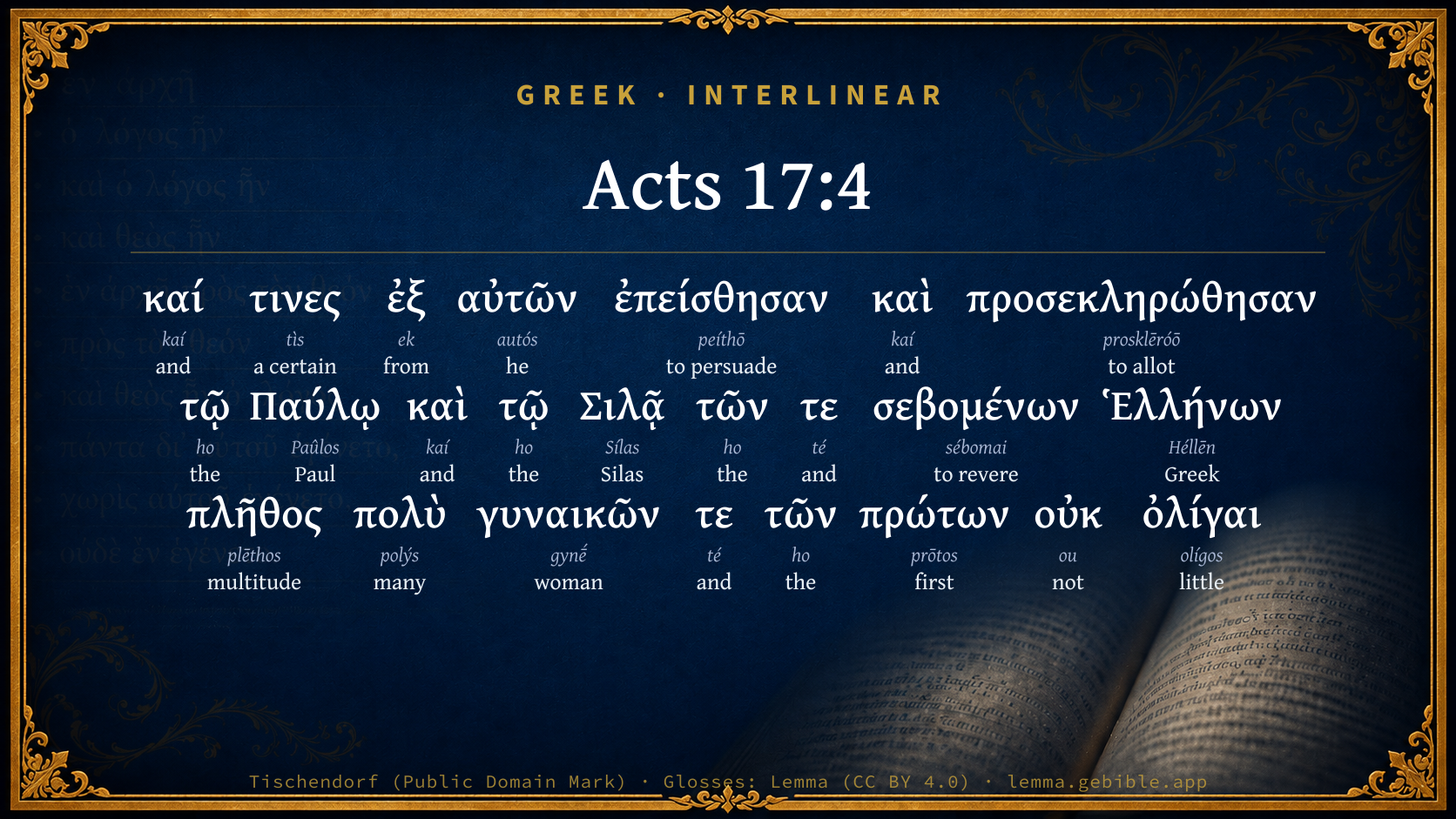
Some of them were persuaded, and joined Paul and Silas, of the devout Greeks a great multitude, and not a few of the chief women.
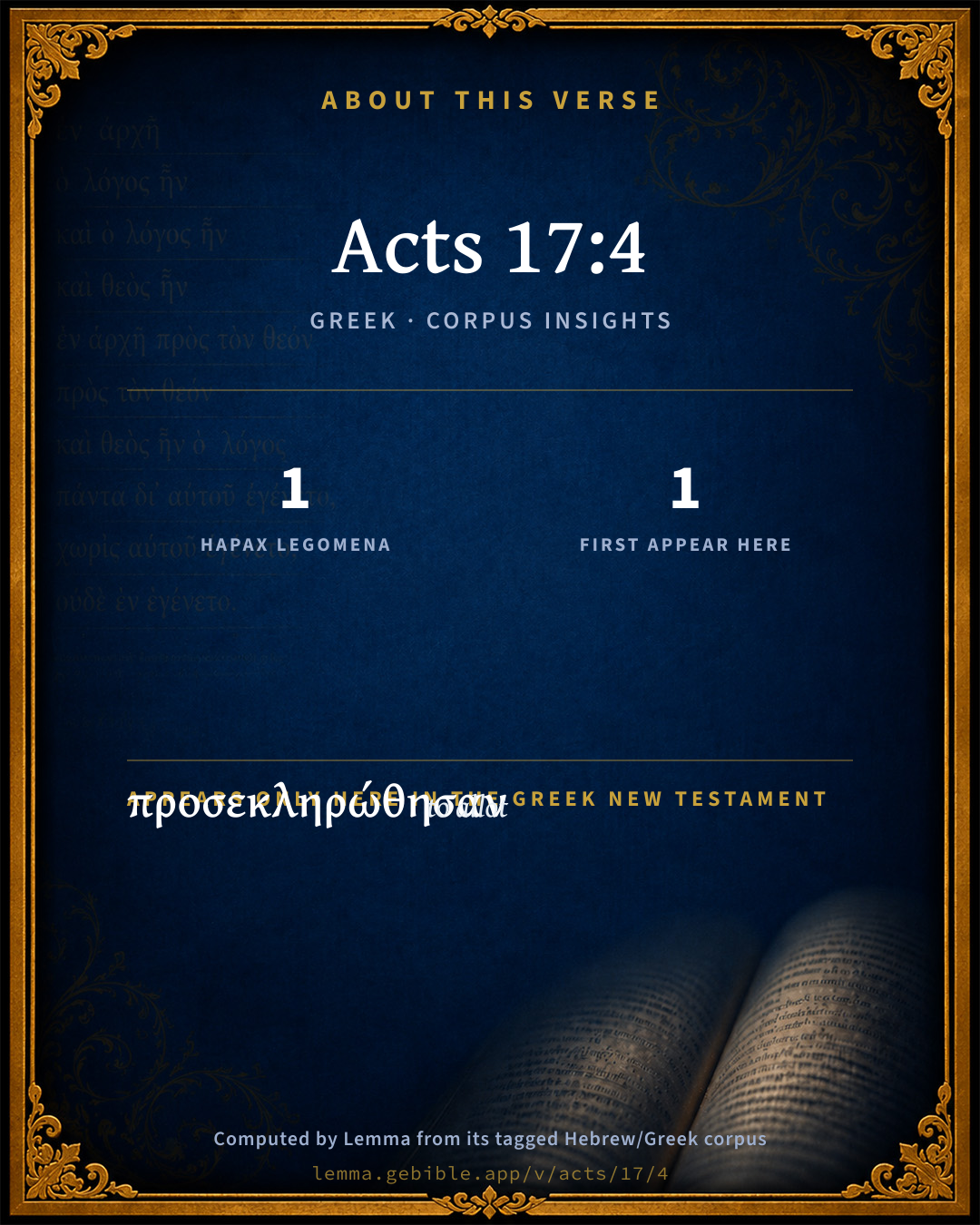
- 1 hapax legomenon — only here in the Greek New Testament
- 1 first appearance in the Greek New Testament
Download a study sheet
One document with this verse’s original text, its word-by-word gloss line, the meaning frame, cross-references with their text, attributed commentary, and full source and license credits — printable, and it pastes into notes with its structure intact.
This verse Autodidact and up
A passage Seminary Student
Up to 50 verses in one chapter. A passage sheet keeps up to 6 commentary sources and 12 cross-references per verse, in the order this page ranks them, and says so on the sheet whenever that leaves anything out. Ask for a single verse and you get the Autodidact verse sheet above.
Everything on this page stays free to read, with no account — the sheet is a download of what is already on screen, not access to it.
Compare translations 3
The same verse in 3 English versions, stacked beneath the original-language interlinear above. Click any original word for its lexicon entry.
Each is an independent rendering of the whole verse — the interlinear is not word-aligned to these translations.
Highlighted words mark where these versions differ — a whole-verse word diff, not a word-by-word alignment.
-
World English Bible Public Domain
Some of them were persuaded, and joined Paul and Silas, of the devout Greeks a great multitude, and not a few of the chief women.
-
King James Version Public Domain
And some of them believed, and consorted with Paul and Silas; and of the devout Greeks a great multitude, and of the chief women not a few.
-
unfoldingWord Literal Text CC BY-SA 4.0
And some from them were persuaded and were associated with Paul and Silas, both a large number of worshiping Greeks and not a few of the leading women.
unfoldingWord Literal Text — © unfoldingWord, licensed CC BY-SA 4.0. Word-aligned USFM3 via Door43 (git.door43.org/unfoldingWord/en_ult).
Show all 19 translations
Every available English version of this verse, each an independent rendering of the whole verse.
-
World English Bible Public Domain
Some of them were persuaded, and joined Paul and Silas, of the devout Greeks a great multitude, and not a few of the chief women.
-
Berean Standard Bible Public Domain
Some of the Jews were persuaded and joined Paul and Silas, along with a large number of God-fearing Greeks and quite a few leading women.
-
Majority Standard Bible Public Domain
Some of the Jews were persuaded and joined Paul and Silas, along with a large number of God-fearing Greeks and quite a few leading women.
-
King James Version Public Domain
And some of them believed, and consorted with Paul and Silas; and of the devout Greeks a great multitude, and of the chief women not a few.
-
American Standard Version (1901) Public Domain
And some of them were persuaded, and consorted with Paul and Silas, and of the devout Greeks a great multitude, and of the chief women not a few.
-
Revised Version (1885) Public Domain
And some of them were persuaded, and consorted with Paul and Silas; and of the devout Greeks a great multitude, and of the chief women not a few.
-
Geneva Bible (1599) Public Domain
And some of them beleeued, and ioyned in companie with Paul and Silas: also of the Grecians that feared God a great multitude, and of the chiefe women not a fewe.
-
Douay-Rheims (1899) Public Domain
And some of them believed, and were associated to Paul and Silas; and of those that served God, and of the Gentiles a great multitude, and of noble women not a few.
-
Young's Literal Translation Public Domain
And certain of them did believe, and attached themselves to Paul and to Silas, also of the worshipping Greeks a great multitude, of the principal women also not a few.
-
Literal Standard Version CC BY-SA 4.0
And certain of them believed, and attached themselves to Paul and to Silas, also a great multitude of the worshiping Greeks, also not a few of the principal women.
-
Unlocked Literal Bible CC BY-SA 4.0
Some of the Jews were persuaded and joined Paul and Silas, including a large number of devout Greeks, and not a few of the leading women.
-
unfoldingWord Literal Text CC BY-SA 4.0
And some from them were persuaded and were associated with Paul and Silas, both a large number of worshiping Greeks and not a few of the leading women.
-
Darby Bible Public Domain
And some of them believed, and joined themselves to Paul and Silas, and of the Greeks who worshipped, a great multitude, and of the chief women not a few.
-
World Messianic Bible Public Domain
Some of them were persuaded and joined Paul and Silas: of the devout Greeks a great multitude, and not a few of the chief women.
-
Webster's Bible Public Domain
And some of them believed, and consorted with Paul and Silas: and of the devout Greeks a great multitude, and of the chief women not a few.
-
Free Bible Version CC BY-SA 4.0
Some of them were convinced and joined Paul and Silas, along with many Greek-speaking worshipers and some leading women of the town.
-
Bible in Basic English Public Domain
And some of them had faith, and were joined to Paul and Silas; and a number of the God-fearing Greeks, and some of the chief women.
-
Text-Critical English NT CC BY 4.0
Some of the Jews were persuaded and joined Paul and Silas, as did a large number of the devout Greeks and quite a few prominent women.
-
Tyndale New Testament (1534) Public Domain
And some of them beleved and came and companyed with Paul and Sylas: also of the honourable Grekes a greate multitude and of the chefe wemen not a feawe.
Literal Standard Version (2020), Covenant Press — licensed CC BY-SA 4.0. Text via the HelloAO Bible API (eBible.org). Unlocked Literal Bible (unfoldingWord) — licensed CC BY-SA 4.0. Text via the HelloAO Bible API (eBible.org). unfoldingWord Literal Text — © unfoldingWord, licensed CC BY-SA 4.0. Word-aligned USFM3 via Door43 (git.door43.org/unfoldingWord/en_ult). Free Bible Version, Dr. Jonathan Gallagher — licensed CC BY-SA 4.0. Text via the HelloAO Bible API (eBible.org).
Word by word
More ways to search: Search by grammar → Find every occurrence → Compare this word →
Practice this passage: Drill this verse → Learn its vocabulary →
- Appears 1× in the Greek New Testament
- First appears here
- Part of Speech
- Verb
- Tense
- Aorist
- Voice
- Passive
- Mood
- Indicative
- Person
- 3rd person
- Number
- Plural
Full Thayer's Definition
- καί kaí G2532 “and” Conjunction
- τινες tìs G5100 “a certain” Indefinite pronoun, Nominative, Plural, Masculine
- ἐξ ek G1537 “from” Preposition
- αὐτῶν autós G846 “he” Personal pronoun, Genitive, Plural, Masculine
- ἐπείσθησαν peíthō G3982 “to persuade” Verb, Aorist, Passive, Indicative, 3rd person, Plural
- καὶ kaí G2532 “and” Conjunction
- προσεκληρώθησαν prosklēróō G4345 “to allot” Verb, Aorist, Passive, Indicative, 3rd person, Plural
- τῷ ho G3588 “the” Article, Dative, Singular, Masculine
- Παύλῳ Paûlos G3972 “Paul” Noun, Dative, Singular, Masculine
- καὶ kaí G2532 “and” Conjunction
- τῷ ho G3588 “the” Article, Dative, Singular, Masculine
- Σιλᾷ Sílas G4609 “Silas” Noun, Dative, Singular, Masculine
- τῶν ho G3588 “the” Article, Genitive, Plural, Masculine
- τε té G5037 “and” Particle
- σεβομένων sébomai G4576 “to revere” Verb, Present, Middle or Passive deponent, Participle, Genitive, Plural, Masculine
- Ἑλλήνων Héllēn G1672 “Greek” Noun, Genitive, Plural, Masculine
- πλῆθος plēthos G4128 “multitude” Noun, Nominative, Singular, Neuter
- πολὺ polýs G4183 “many” Adjective, Nominative, Singular, Neuter
- γυναικῶν gynḗ G1135 “woman” Noun, Genitive, Plural, Feminine
- τε té G5037 “and” Particle
- τῶν ho G3588 “the” Article, Genitive, Plural, Feminine
- πρώτων prōtos G4413 “first” Adjective, Genitive, Plural, Feminine, Superlative
- οὐκ ou G3756 “not” Particle, Negative
- ὀλίγαι olígos G3641 “little” Adjective, Nominative, Plural, Feminine
About this verse
These counts appear in no published source. They are computed here, from the morphology-tagged text and Lemma’s own curated glosses. What Lemma adds →
- 24
- words
- 18
- distinct lemmas
- Acts
- section
Notable vocabulary
1 hapax legomenon — a word that appears only here in the entire Greek New Testament:
- προσεκληρώθησαν to allot G4345
First appearance in Scripture
This word makes its first canonical appearance in the Greek New Testament here:
- προσεκληρώθησαν to allot G4345
Shared distinctive vocabulary
σεβομένων to revere G4576 occurs in 10 verses of the Greek New Testament. Also found in:
Cross-references
29Topical passages linked to Acts 17:4 in the Treasury of Scripture Knowledge — connected by theme and wording, ordered by reader-vote popularity; previews shown in the World English Bible.
- Acts 17:12 Many of them therefore believed; also of the prominent Greek women, and not a few men.
- Acts 13:43 Now when the synagogue broke up, many of the Jews and of the devout proselytes followed Paul and Barnabas; who, speaking to them, urged them to continue in the grace of God.
- Acts 14:4 But the multitude of the city was divided. Part sided with the Jews, and part with the apostles.
- Acts 13:50 But the Jews stirred up the devout and prominent women and the chief men of the city, and stirred up a persecution against Paul and Barnabas, and threw them out of their borders.
- Acts 15:22 Then it seemed good to the apostles and the elders, with the whole assembly, to choose men out of their company, and send them to Antioch with Paul and Barnabas: Judas called Barsabbas, and Silas, chief men among the brothers.
- Acts 28:24 Some believed the things which were spoken, and some disbelieved.
- 2 Corinthians 8:5 This was not as we had hoped, but first they gave their own selves to the Lord, and to us through the will of God.
- Proverbs 9:6 Leave your simple ways, and live. Walk in the way of understanding."
- Proverbs 13:20 One who walks with wise men grows wise, But a companion of fools suffers harm.
- Song of Solomon 1:7–8 Tell me, you whom my soul loves, Where you graze your flock, Where you rest them at noon; For why should I be as one who is veiled Beside the flocks of your companions? Lover
- Song of Solomon 6:1 Where has your beloved gone, you fairest among women? Where has your beloved turned, that we may seek him with you? Beloved
- Zechariah 8:20–23 Thus says Yahweh of Hosts: "Many peoples, and the inhabitants of many cities will yet come;
- John 7:35 The Jews therefore said among themselves, "Where will this man go that we won't find him? Will he go to the Dispersion among the Greeks, and teach the Greeks?
- Acts 2:41–42 Then those who gladly received his word were baptized. There were added that day about three thousand souls.
- Acts 2:44 All who believed were together, and had all things in common.
- Acts 4:23 Being let go, they came to their own company, and reported all that the chief priests and the elders had said to them.
- Acts 5:12–14 By the hands of the apostles many signs and wonders were done among the people. They were all with one accord in Solomon's porch.
- Acts 14:1 It happened in Iconium that they entered together into the synagogue of the Jews, and so spoke that a great multitude both of Jews and of Greeks believed.
- Acts 15:27 We have sent therefore Judas and Silas, who themselves will also tell you the same things by word of mouth.
- Acts 15:32 Judas and Silas, also being prophets themselves, encouraged the brothers with many words, and strengthened them.
- Acts 15:40 but Paul chose Silas, and went out, being commended by the brothers to the grace of God.
- Acts 16:3 Paul wanted to have him go out with him, and he took and circumcised him because of the Jews who were in those parts; for they all knew that his father was a Greek.
- Acts 17:17 So he reasoned in the synagogue with the Jews and the devout persons, and in the marketplace every day with those who met him.
- Acts 17:34 But certain men joined with him, and believed, among whom also was Dionysius the Areopagite, and a woman named Damaris, and others with them.
- Acts 18:4 He reasoned in the synagogue every Sabbath, and persuaded Jews and Greeks.
- Acts 19:10 This continued for two years, so that all those who lived in Asia heard the word of the Lord Jesus, both Jews and Greeks.
- Acts 21:28 crying out, "Men of Israel, help! This is the man who teaches all men everywhere against the people, and the law, and this place. Moreover, he also brought Greeks into the temple, and has defiled this holy place!"
- 2 Corinthians 6:17–18 Therefore, "'Come out from among them, And be separate,' says the Lord, 'Touch no unclean thing. I will receive you.
- Zechariah 2:11 Many nations shall join themselves to Yahweh in that day, and shall be my people; and I will dwell in the midst of you, and you shall know that Yahweh of Hosts has sent me to you.
Cross-references courtesy of OpenBible.info (CC BY 4.0).
Lesson kit
Teaching starters — assembled from the data on this page, not authored interpretation. Every prompt links to the verse data it draws on. Edit before teaching.
Acts, in the Acts, opens this verse with 24 words (18 distinct Greek lemmas). Its most distinctive word is prosklēróō (“to allot”). A historical commentator’s framing appears above. Read the whole chapter for the surrounding context.
Discussion questions
- How does “to allot” (prosklēróō) shape what this verse is saying?
- 1 word here appears nowhere else in the Greek New Testament. Why might the author reach for such rare wording?
- This is the first place “to allot” appears in Scripture (first appears here). What does its debut here establish?
- How does Matthew 15:9, which shares the word «to revere», read alongside this verse?
- What does the repetition of “the” (4× in this one verse) do in this verse?
- These translations render this verse differently. What is at stake in choosing one wording over another?
- Compare how Joseph Benson's Commentary and Tyndale Open Study Notes read this verse. Where do they agree or differ?
Things to notice
- 1 word in this verse appears nowhere else in the Greek New Testament.
- 1 word makes its first canonical appearance in Scripture here.
- These translations choose different wording for 14 words in this verse.
- “the” occurs 4× in this single verse.
- 18 distinct Greek lemmas span 24 words in this verse.
Commentary
Notes on Acts 17:4 from classic Christian and Jewish commentators (each source and its license shown beneath its notes). The classic Christian expositions comment on the surrounding passage and are grouped to its opening verse, so a note may address several verses; the Jewish commentaries on the Tanakh (Rashi and others) are per-verse, so they appear only where the commentator wrote on this verse.
Lemma curates 59 commentaries, every one of them public domain or Creative Commons licensed, each selected and text-cleaned for this edition rather than reprinted as found. About our sources →
Joseph Benson's Commentary
Joseph Benson's Commentary on the Old and New Testaments (1811–1818) — public domain. Text from a community e-Sword module.
Tyndale Open Study Notes
Tyndale Open Resources
Tyndale Open Study Notes — © Tyndale Open Resources, licensed CC BY-SA 4.0. Text via the HelloAO Bible API.
Bengel's Gnomon
Johann Albrecht Bengel
Bengel's Gnomon of the New Testament — English translation (T&T Clark, Edinburgh, 1860) — public domain. Text from a community e-Sword module.
Expositor's Greek Testament
ed. W. Robertson Nicoll
The Expositor's Greek Testament, edited by W. Robertson Nicoll (1897–1910) — public domain. Text from a community e-Sword module.
Jamieson, Fausset & Brown
Robert Jamieson, A. R. Fausset & David Brown
Jamieson, Fausset & Brown — Commentary Critical and Explanatory on the Whole Bible (1871) — public domain (CC PDM 1.0). Text via the HelloAO Bible API.
Adam Clarke's Commentary
Adam Clarke's Commentary on the Bible (1810–1826) — public domain. Text from a community e-Sword/MySword module.
John Calvin's Commentaries
John Calvin's Commentaries (1540-1563) — public domain. Text from the Calvin Translation Society English edition (1840s-50s) via the Christian Classics Ethereal Library (ccel.org). Calvin's coverage is partial (roughly two-thirds of the Bible); uncommented books and verses are honest gaps, never fabricated. The 19th-century editor's footnotes and remarks are omitted so the notes are faithfully Calvin's own voice.
Ellicott's Commentary for English Readers
A Bible Commentary for English Readers, edited by Charles John Ellicott (1878–1897) — public domain. Text from a community e-Sword module.
The Cambridge Bible for Schools and Colleges
gen. ed. J. J. S. Perowne
The Cambridge Bible for Schools and Colleges (gen. ed. J. J. S. Perowne; Cambridge University Press, 1878–1918) — public domain. Text from a community e-Sword module.
John Gill's Exposition
John Gill's Exposition of the Whole Bible (1746–1763) — public domain (CC PDM 1.0). Text via the HelloAO Bible API.
Trapp's Complete Commentary
John Trapp
John Trapp, A Commentary or Exposition upon All the Books of the Old and New Testament (1647–1656) — public domain. Text from a community e-Sword module.
Albert Barnes' Notes on the Bible
Albert Barnes' Notes on the Bible (1834–1885) — public domain. Text from a community e-Sword/MySword module.
Haydock's Catholic Bible Commentary
George Leo Haydock (1774–1849), Haydock's Catholic Family Bible and Commentary, 1859 edition — public domain. Excludes Psalms (Douay-Rheims chapter numbering differs from Protestant) and Deuterocanonical books (Catholic canon only).
Matthew Poole's English Annotations
Matthew Poole's English Annotations on the Holy Bible (1683–1685) — public domain. Text from a community e-Sword/MySword module.
Whedon's Commentary on the Bible
Daniel D. Whedon
Daniel D. Whedon (gen. ed.), Commentary on the Old and New Testaments (1874–1909) — public domain. Text from a community e-Sword module.
The Pulpit Commentary
The Pulpit Commentary (1880–1919), ed. H.D.M. Spence-Jones & Joseph S. Exell — public domain. Text from a community e-Sword module.
John Wesley's Explanatory Notes
John Wesley, Explanatory Notes Upon the Whole Bible (1754–1765) — public domain. Text via the GEBible commentary corpus.
Burkitt's Expository Notes on the New Testament
William Burkitt
William Burkitt's Expository Notes on the New Testament (1700–1703) — public domain. Text from a community e-Sword module.
McGarvey & Pendleton's Commentaries
J. W. McGarvey
J. W. McGarvey (with Philip Y. Pendleton), Commentaries on the New Testament (The Fourfold Gospel, 1914; Acts; and the epistles) — public domain. Text from a community e-Sword/MySword module.
Cambridge Greek Testament for Schools and Colleges
Cambridge Greek Testament for Schools and Colleges (Cambridge University Press, 1896; 21 vols, various authors incl. Carr, Maclear, Plummer, Farrar, Lumby, Moule, M. R. James, Simcox) — public domain. Text from a community e-Sword module.
Alford’s Greek Testament
Henry Alford
Henry Alford, The Greek Testament (1849–1861) — public domain. Text from a community e-Sword module.
Vincent's Word Studies in the New Testament
Marvin R. Vincent
Marvin R. Vincent, Word Studies in the New Testament (1887–1900) — public domain. Text from a community e-Sword/MySword module.