
Acts 18:8

Greek (Tischendorf 8th ed.) Acts 18:8 appears in the Greek New Testament. The text above is from the Tischendorf 8th edition. Each word links to its Strong’s number and a concise gloss. Click any word for its full Thayer’s Greek Lexicon entry.
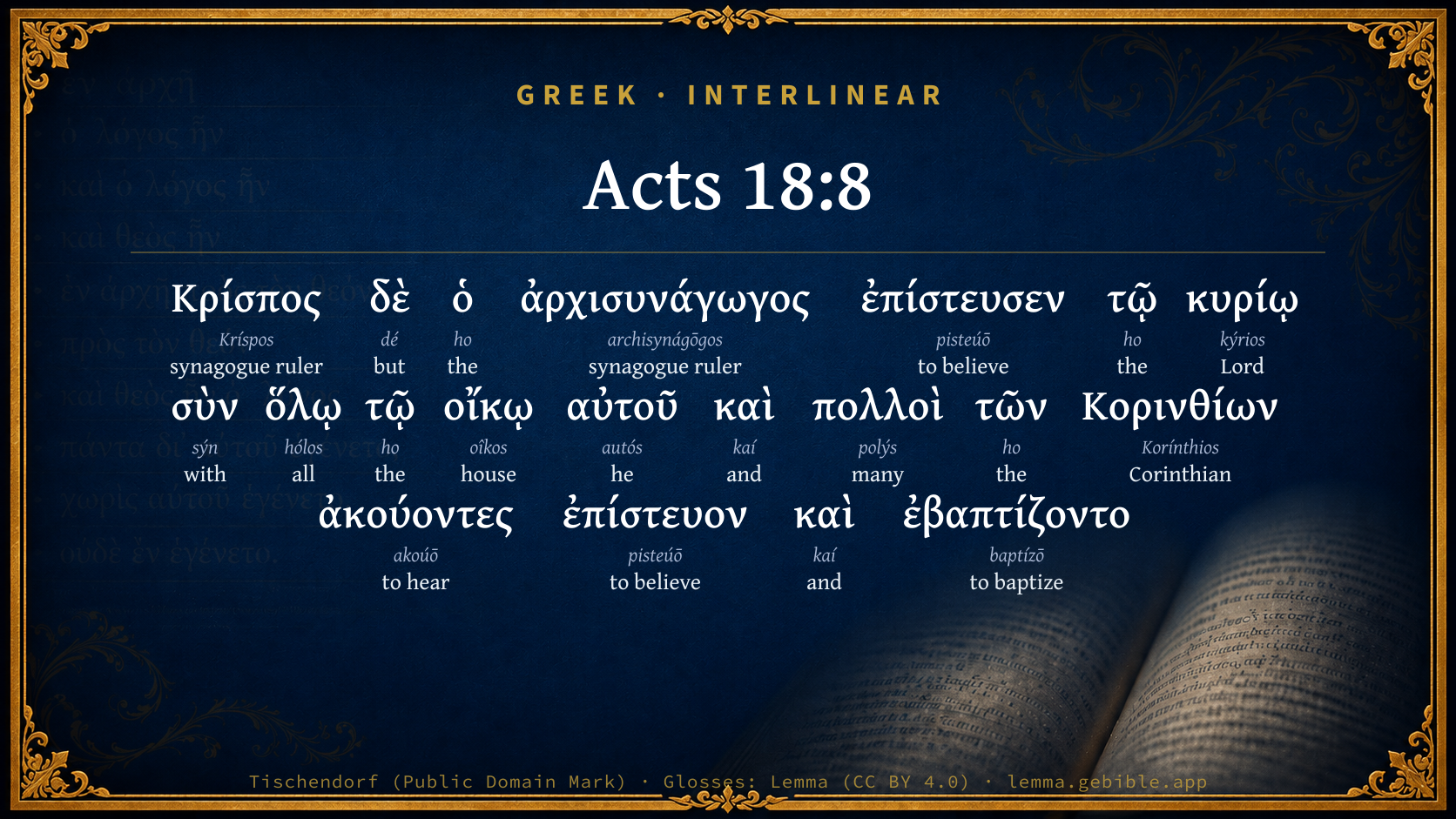
Download image
Cite this verse

Acts 18:8 (World English Bible). Public Domain. Lemma interlinear Bible study tool, https://lemma.gebible.app/v/acts/18/8.

Show BibTeX & RIS
BibTeX
RIS
English Translation
Crispus, the ruler of the synagogue, believed in the Lord with all his house. Many of the Corinthians, when they heard, believed and were baptized.
World English Bible · Public Domain
Highlights
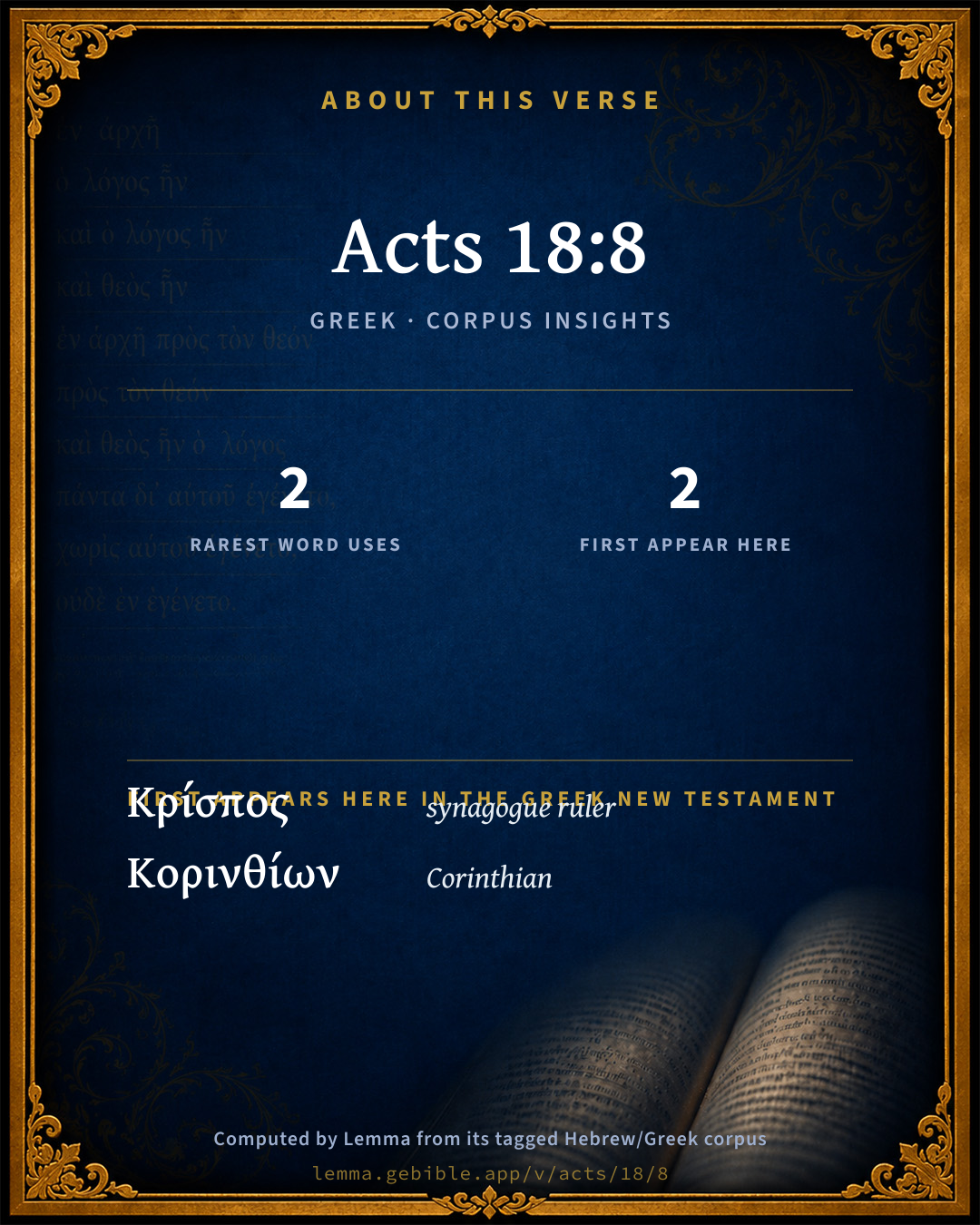
  • 2 first appearances in the Greek New Testament
Full analysis ↓
Download a study sheet

One document with this verse’s original text, its word-by-word gloss line, the meaning frame, cross-references with their text, attributed commentary, and full source and license credits — printable, and it pastes into notes with its structure intact.

This verse Autodidact and up

Study sheet (.html) Plain text (.txt)

A passage Seminary Student

Up to 50 verses in one chapter. A passage sheet keeps up to 6 commentary sources and 12 cross-references per verse, in the order this page ranks them, and says so on the sheet whenever that leaves anything out. Ask for a single verse and you get the Autodidact verse sheet above.

Everything on this page stays free to read, with no account — the sheet is a download of what is already on screen, not access to it.

Want to remove ads? Support Godless Engineer
Compare translations 3

The same verse in 3 English versions, stacked beneath the original-language interlinear above. Click any original word for its lexicon entry.

Each is an independent rendering of the whole verse — the interlinear is not word-aligned to these translations.

Highlighted words mark where these versions differ — a whole-verse word diff, not a word-by-word alignment.

  • World English Bible Public Domain
    Crispus, the ruler of the synagogue, believed in the Lord with all his house. Many of the Corinthians, when they heard, believed and were baptized.
  • King James Version Public Domain
    And Crispus, the chief ruler of the synagogue, believed on the Lord with all his house; and many of the Corinthians hearing believed, and were baptized.
  • unfoldingWord Literal Text CC BY-SA 4.0
    But Crispus, the synagogue leader, believed in the Lord with his whole house, and many of the Corinthians, hearing, were believing and were being baptized.

unfoldingWord Literal Text — © unfoldingWord, licensed CC BY-SA 4.0. Word-aligned USFM3 via Door43 (git.door43.org/unfoldingWord/en_ult).

Versions to compare (up to 4)

3 of 4 selected

Show all 19 translations

Every available English version of this verse, each an independent rendering of the whole verse.

  • World English Bible Public Domain
    Crispus, the ruler of the synagogue, believed in the Lord with all his house. Many of the Corinthians, when they heard, believed and were baptized.
  • Berean Standard Bible Public Domain
    Crispus, the synagogue leader, and his whole household believed in the Lord. And many of the Corinthians who heard the message believed and were baptized.
  • Majority Standard Bible Public Domain
    Crispus, the synagogue leader, and his whole household believed in the Lord. And many of the Corinthians who heard the message believed and were baptized.
  • King James Version Public Domain
    And Crispus, the chief ruler of the synagogue, believed on the Lord with all his house; and many of the Corinthians hearing believed, and were baptized.
  • American Standard Version (1901) Public Domain
    And Crispus, the ruler of the synagogue, believed in the Lord with all his house; and many of the Corinthians hearing believed, and were baptized.
  • Revised Version (1885) Public Domain
    And Crispus, the ruler of the synagogue, believed in the Lord with all his house; and many of the Corinthians hearing believed, and were baptized.
  • Geneva Bible (1599) Public Domain
    And Crispus the chiefe ruler of the Synagogue, beleeued in the Lord with all his housholde: and many of the Corinthians hearing it, beleeued and were baptized.
  • Douay-Rheims (1899) Public Domain
    And Crispus, the ruler of the synagogue, believed in the Lord, with all his house; and many of the Corinthians hearing, believed, and were baptized.
  • Young's Literal Translation Public Domain
    and Crispus, the ruler of the synagogue did believe in the Lord with all his house, and many of the Corinthians hearing were believing, and they were being baptized.
  • Literal Standard Version CC BY-SA 4.0
    and Crispus, the ruler of the synagogue believed in the LORD with all his house, and many of the Corinthians hearing were believing, and they were being immersed.
  • Unlocked Literal Bible CC BY-SA 4.0
    Crispus, the leader of the synagogue, believed in the Lord, together with all those who lived in his house; and many of the Corinthians who heard about it believed and were baptized.
  • unfoldingWord Literal Text CC BY-SA 4.0
    But Crispus, the synagogue leader, believed in the Lord with his whole house, and many of the Corinthians, hearing, were believing and were being baptized.
  • Darby Bible Public Domain
    But Crispus the ruler of the synagogue believed in the Lord with all his house; and many of the Corinthians hearing, believed, and were baptised.
  • World Messianic Bible Public Domain
    Crispus, the ruler of the synagogue, believed in the Lord with all his house. Many of the Corinthians, when they heard, believed and were immersed.
  • Webster's Bible Public Domain
    And Crispus the chief ruler of the synagogue believed on the Lord with all his house: and many of the Corinthians hearing, believed, and were baptized.
  • Free Bible Version CC BY-SA 4.0
    Crispus, leader of the synagogue, believed in the Lord together with his whole household. Many of the people of Corinth who heard the message became believers and were baptized.
  • Bible in Basic English Public Domain
    And Crispus, the ruler of the Synagogue, with all his family, had faith in the Lord; and a great number of the people of Corinth, hearing the word, had faith and were given baptism.
  • Text-Critical English NT CC BY 4.0
    Crispus, the ruler of the synagogue, believed in the Lord together with his whole household. And many of the Corinthians, when they heard, believed and were baptized.
  • Tyndale New Testament (1534) Public Domain
    How be it one Crispus the chefe rular of the synagoge beleved on the lorde with all his housholde and many of the Corinthias gave audience and beleved and were baptised.

Literal Standard Version (2020), Covenant Press — licensed CC BY-SA 4.0. Text via the HelloAO Bible API (eBible.org). Unlocked Literal Bible (unfoldingWord) — licensed CC BY-SA 4.0. Text via the HelloAO Bible API (eBible.org). unfoldingWord Literal Text — © unfoldingWord, licensed CC BY-SA 4.0. Word-aligned USFM3 via Door43 (git.door43.org/unfoldingWord/en_ult). Free Bible Version, Dr. Jonathan Gallagher — licensed CC BY-SA 4.0. Text via the HelloAO Bible API (eBible.org).

Word by word

More ways to search: Search by grammar → Find every occurrence → Compare this word →

Practice this passage: Drill this verse → Learn its vocabulary →

Κρίσπος
Kríspos
G2921
“synagogue ruler”
Noun, Nominative, Singular, Masculine
Part of Speech
Noun
Case
Nominative
Number
Singular
Gender
Masculine
Full Thayer's Definition

Origin: of Latin origin

TDNT: None

Crispus = "curled" 1. the ruler of the Jewish synagogue in Corinth, baptised by Paul
  1. δὲ dé G1161 “but” Conjunction
  2. ὁ ho G3588 “the” Article, Nominative, Singular, Masculine
  3. ἀρχισυνάγωγος archisynágōgos G752 “synagogue ruler” Noun, Nominative, Singular, Masculine
  4. ἐπίστευσεν pisteúō G4100 “to believe” Verb, Aorist, Active, Indicative, 3rd person, Singular
  5. τῷ ho G3588 “the” Article, Dative, Singular, Masculine
  6. κυρίῳ kýrios G2962 “Lord” Noun, Dative, Singular, Masculine
  7. σὺν sýn G4862 “with” Preposition
  8. ὅλῳ hólos G3650 “all” Adjective, Dative, Singular, Masculine
  9. τῷ ho G3588 “the” Article, Dative, Singular, Masculine
  10. οἴκῳ oîkos G3624 “house” Noun, Dative, Singular, Masculine
  11. αὐτοῦ autós G846 “he” Personal pronoun, Genitive, Singular, Masculine
  12. καὶ kaí G2532 “and” Conjunction
  13. πολλοὶ polýs G4183 “many” Adjective, Nominative, Plural, Masculine
  14. τῶν ho G3588 “the” Article, Genitive, Plural, Masculine
  15. Κορινθίων Korínthios G2881 “Corinthian” Adjective, Genitive, Plural, Masculine
  16. ἀκούοντες akoúō G191 “to hear” Verb, Present, Active, Participle, Nominative, Plural, Masculine
  17. ἐπίστευον pisteúō G4100 “to believe” Verb, Imperfect, Active, Indicative, 3rd person, Plural
  18. καὶ kaí G2532 “and” Conjunction
  19. ἐβαπτίζοντο baptízō G907 “to baptize” Verb, Imperfect, Passive, Indicative, 3rd person, Plural

About this verse

These counts appear in no published source. They are computed here, from the morphology-tagged text and Lemma’s own curated glosses. What Lemma adds →

20
words
15
distinct lemmas
Acts
section

Notable vocabulary

The rarest word here is Κρίσπος synagogue ruler G2921 — appearing just 2 times in the whole Greek New Testament.

First appearance in Scripture

These words make their first canonical appearance in the Greek New Testament here:

  • Κρίσπος synagogue ruler G2921
  • Κορινθίων Corinthian G2881

Shared distinctive vocabulary

Κρίσπος synagogue ruler G2921 occurs in 2 verses of the Greek New Testament. Also found in:
Repetition

Words recur within this verse:

  • ἐπίστευσεν to believe G4100 ×2
  • ὁ the G3588 ×4
  • καὶ and G2532 ×2

Cross-references

18

Topical passages linked to Acts 18:8 in the Treasury of Scripture Knowledge — connected by theme and wording, ordered by reader-vote popularity; previews shown in the World English Bible.

  • 1 Corinthians 1:13–17 Is Christ divided? Was Paul crucified for you? Or were you baptized into the name of Paul?
  • Mark 16:15–16 He said to them, "Go into all the world, and preach the Gospel to the whole creation.
  • Romans 10:14–17 How then will they call on him in whom they have not believed? How will they believe in him whom they have not heard? How will they hear without a preacher?
  • Acts 11:14 who will speak to you words by which you will be saved, you and all your house.'
  • Acts 8:12 But when they believed Philip preaching good news concerning the Kingdom of God and the name of Jesus Christ, they were baptized, both men and women.
  • Genesis 17:27 All the men of his house, those born in the house, and those bought with money of a foreigner, were circumcised with him.
  • Genesis 18:19 For I have known him, to the end that he may command his children and his household after him, that they may keep the way of Yahweh, to do righteousness and justice; to the end that Yahweh may bring on Abraham that which he has spoken of him."
  • Joshua 24:15 If it seem evil to you to serve Yahweh, choose you this day whom you will serve; whether the gods which your fathers served that were beyond the River, or the gods of the Amorites, in whose land you dwell: but as for me and my house, we will serve Yahweh.
  • Matthew 28:19 Therefore go, and make disciples of all nations, baptizing them in the name of the Father and of the Son and of the Holy Spirit,
  • Mark 5:22 Behold, one of the rulers of the synagogue, Jairus by name, came; and seeing him, he fell at his feet,
  • Mark 5:35 While he was still speaking, they came from the synagogue ruler's house saying, "Your daughter is dead. Why bother the Teacher any more?"
  • Acts 2:37–41 Now when they heard this, they were cut to the heart, and said to Peter and the rest of the apostles, "Brothers, what shall we do?"
  • Acts 8:35–38 Philip opened his mouth, and beginning from this Scripture, preached to him Jesus.
  • Acts 10:2 a devout man, and one who feared God with all his house, who gave gifts for the needy generously to the people, and always prayed to God.
  • Acts 13:15 After the reading of the law and the prophets, the rulers of the synagogue sent to them, saying, "Brothers, if you have any word of exhortation for the people, speak."
  • Acts 16:14–15 A certain woman named Lydia, a seller of purple, of the city of Thyatira, one who worshiped God, heard us; whose heart the Lord opened to listen to the things which were spoken by Paul.
  • Acts 16:34 He brought them up into his house, and set food before them, and rejoiced greatly, with all his household, having believed in God.
  • Acts 18:17 Then all the Greeks laid hold on Sosthenes, the ruler of the synagogue, and beat him before the judgment seat. Gallio didn't care about any of these things.

Cross-references courtesy of OpenBible.info (CC BY 4.0).

Commentary

Notes on Acts 18:8 from classic Christian and Jewish commentators (each source and its license shown beneath its notes). The classic Christian expositions comment on the surrounding passage and are grouped to its opening verse, so a note may address several verses; the Jewish commentaries on the Tanakh (Rashi and others) are per-verse, so they appear only where the commentator wrote on this verse.

Lemma curates 59 commentaries, every one of them public domain or Creative Commons licensed, each selected and text-cleaned for this edition rather than reprinted as found. About our sources →

Bengel's Gnomon

Johann Albrecht Bengel

Act 18:8. Ἐπίστευσε τῷ Κυρίῳ, believed on the Lord) The Lord Jesus Himself testified through Paul: ch. Act 14:3, “They speaking boldly in the Lord, who gave testimony unto the word of His grace.”—ἀκούοντες, hearing) of the conversion of Crispus, and hearing the word spoken by Paul.

Bengel's Gnomon of the New Testament — English translation (T&T Clark, Edinburgh, 1860) — public domain. Text from a community e-Sword module.

Meyer's Critical & Exegetical Commentary

Heinrich August Wilhelm Meyer

Act_18:8. This decided proceeding made a remarkable impression, so that even Crispus, the president of the synagogue, whom the apostle himself baptized (1Co_1:14), with all his family, believed on the Lord (Act_16:15; Act_16:34), and that generally many Corinthians (Jews and Gentiles; for the house of the proselyte was accessible to both) heard him and received faith and baptism.

Meyer — Critical and Exegetical Commentary on the New Testament — English translation by Peter Christie, edited by Frederick Crombie (T&T Clark, 1880) — public domain. Text from a community e-Sword module.

Expositor's Greek Testament

ed. W. Robertson Nicoll

Act 18:8 . Κρίσπος , cf. 1Co 1:14 , coincidence with, admitted by McGiffert, p. 269 (so too by Holtzmann), “no reason to doubt that he is the man whose conversion Luke reports,” according to tradition he became Bishop of Ægina, Const. Apost. , vii., 46. Though a Jew he bore a Latin name, cf. for a parallel case J. Lightfoot, Hor. Heb., in loco . ὁ ἀρχισ ., if we cf. Act 18:17 it looks as if in the Corinthian synagogue there was only one person bearing this title, and that Sosthenes succeeded Crispus when the latter became a Christian, see “Corinth” (Ramsay), Hastings’ B.D., i., p. 482, and see also Ramsay, Expositor , April, 1895, and above on Act 13:15 : on the reason of St. Paul’s baptism of Crispus, Gaius, Stephanas, see B.D. 2 , and Hastings’ B.D., u. s. There is certainly no ground for supposing that St. Paul depreciated baptism although he baptised so few in Corinth with his own hands, Speaker’s Commentary on 1Co 1:17 . It is evident from this notice that St. Paul’s preaching had not been without its effect on the Jewish residents, and probably one reason why the feeling against the Apostle was so strong, Act 20:3 , was because this influence extended to persons of importance in Corinth; the next words show good results among the Gentile population of the city. σὺν ὅλῳ τῷ οἴκῳ , cf. Act 16:15 , 1Co 1:16 . τῶν Κ ., not Ἰουδαῖοι , who are always so called, but Ελληνες , Act 18:4 , including for the most part “proselytes of the gate”. ἀκού . ἐπίστευον καὶ ἐβαπτ .: “used to hear, and believe, and receive baptism,” imperfects; the spread of the new faith was gradual but continuous, ἀκού . is taken by some to refer to the hearing of the fact that Paul had separated himself from the synagogue (so Wendt, Weiss); see critical note.

The Expositor's Greek Testament, edited by W. Robertson Nicoll (1897–1910) — public domain. Text from a community e-Sword module.

Jamieson, Fausset & Brown

Robert Jamieson, A. R. Fausset & David Brown

Crispus, the chief ruler of the synagogue, believed on the Lord with all his house--an event felt to be so important that the apostle deviated from his usual practice (Co1 1:14-16) and baptized him, as well as Caius (Gaius) and the household of Stephanas, with his own hand [HOWSON].

many of the Corinthians . . . believed and were baptized--The beginning of the church gathered there.

Jamieson, Fausset & Brown — Commentary Critical and Explanatory on the Whole Bible (1871) — public domain (CC PDM 1.0). Text via the HelloAO Bible API.

Adam Clarke's Commentary

Verse 8. Crispus the chief ruler of the synagogue] This person held an office of considerable consequence; and therefore his conversion to Christianity must have been very galling to the Jews. It belonged to the chief or ruler of the synagogue to preside in all the assemblies, interpret the law, decide concerning things lawful and unlawful, punish the refractory, excommunicate the rebellious, solemnize marriages, and issue divorces. It is likely that, on the conversion of Crispus, Sosthenes was chosen to succeed him.

Many of the Corinthians] Those to whom the sacred historian refers were probably Gentiles, and were the fruits of the apostle's labours after he had ceased to preach among the Jews.

Adam Clarke's Commentary on the Bible (1810–1826) — public domain. Text from a community e-Sword/MySword module.

Ellicott's Commentary for English Readers

(8) And Crispus, the chief ruler of the synagogue, believed on the Lord.—The article does not necessarily show that there was only one ruler—commonly, as at the Pisidian Antioch (Act_13:15), there were more—but that this Crispus was thus distinguished from others of the same name. The office was one which gave its holder an honourable position, and, as in inscriptions from the Jewish catacombs now in the Lateran Museum, was recorded on tombstones (Alfius Archisynagos) as a personal distinction of which the family of the deceased were proud. In favour of so conspicuous a convert, St. Paul deviated from his usual practice, and baptised Crispus with his own hands (1Co_1:14).

Many of the Corinthians hearing believed, and were baptized.—The tense of the two verbs implies a process going on daily for an undefined period. Among the converts we may note Gaius, or Caius, probably a man of higher social position than others, who made his house the meeting-place of the Church, and at St. Paul’s second visit received him as a guest (Rom_16:23), and the household of Stephanas, who, as “the first-fruits of Achaia,” must have been among the earliest converts (1Co_16:15). These also St. Paul baptised himself (1Co_1:14-15). Fortunatus and Achaicus, and Chloe, a prominent female convert (1Co_1:11), with Quartus, and Erastus the chamberlain of the city (Rom_16:23), and Epænetus, also among the “first-fruits of Achaia” (Rom_16:5), may also be counted among the disciples made now or soon afterwards.

A Bible Commentary for English Readers, edited by Charles John Ellicott (1878–1897) — public domain. Text from a community e-Sword module.

The Cambridge Bible for Schools and Colleges

gen. ed. J. J. S. Perowne

8. And Crispus, the chief ruler of the synagogue] It is better to omit “chief” otherwise this part of the word is twice translated. (So R. V.) This Crispus is alluded to, 1Co_1:14, as one of the few whom St Paul himself baptized. His previous distinguished position among the Jews, and the conversion of his whole family, would make him noticeable among the Christian converts. There may have been more than one synagogue in Corinth. In Act_18:17 we read of Sosthenes, the ruler of the synagogue. But it is quite possible that this man may have been appointed immediately after the conversion of Crispus, and may have been desirous to shew his zeal against the Christian teachers by laying an immediate information against Paul before the proconsul.

and many of the Corinthians … were baptized] St Paul mentions that he himself only baptized (in addition to Crispus) Gaius and the household of Stephanas. But Silas and Timothy were now by his side and would care for the admission of the new converts to baptism.

The Cambridge Bible for Schools and Colleges (gen. ed. J. J. S. Perowne; Cambridge University Press, 1878–1918) — public domain. Text from a community e-Sword module.

John Gill's Exposition

And Crispus, the chief ruler of the synagogue,.... This was a Jewish name; frequent mention is made of R. Crispa in the Jewish writings (k) this person, either through hearing Paul before he departed from the synagogue, or when in Justus's house, which was hard by the synagogue, believed on the Lord with all his house: he believed the doctrine the apostle preached, concerning Jesus, and that he was the Messiah; and he believed in him for life and salvation, and made a profession of his faith in him, and so did all his family, upon which he was baptized by the apostle; see Co1 1:14

and many of the Corinthians hearing not "his faith", as the Arabic version adds; as if hearing of the faith of Crispus induced them to believe also; for the ruler of the Jewish synagogue had no such influence on the Gentile Corinthians, as these were: but these hearing the Gospel preached by the apostle, very likely in the house of Justus, to which they came,

believed; faith came by hearing; they believed the Gospel, and they believed in Christ, the sum and substance of it; and not with a bare historical faith, but with a spiritual and saving one, or such as is unto salvation, with their heart, and with their mouth made confession of it:

and were baptized; not by the apostle, for he baptized at Corinth none but Crispus and Gaius, and the household of Stephanas, but by some of his companions, as Silas, or Timothy, or both: this is a plain instance of believers' baptism; first they heard the word of God; then they believed, this word coming with power to them; and upon their believing, they are baptized. These laid the foundation of a famous church in this place, which continued for many ages after; Silas, who is reckoned among the seventy disciples, is said to be the first bishop or pastor of it; See Gill on Luk 10:1; in the "second" century Primus was bishop of this church, with whom Egesippus as he went to Rome stayed some days, and was much refreshed with the orthodox faith of him, and the Corinthians; in the same century Dionysius presided over this church, who was not only very useful to the church under his care, but to many others (l); in the same age, under Severus lived Bacchylus bishop of Corinth, who wrote a book concerning Easter in the name of all the bishops in Achaia (m); in the third century Tertullian (n) makes mention of a church at Corinth; in the fourth century Epictetus was bishop of the said church, and was contemporary and familiar with Athanasius, to whom a letter is extant in the works of Athanasius (o); in the "fifth" century there was a church at Corinth, and a bishop of it was in the synod at Chalcedon, and it was then a metropolitan church; in this age Peregrinus bishop of Corinth was in the first synod at Ephesus, held against Nestorius, and Erisistratus, a bishop also of the same church, was in another synod at the same place, and Peter bishop of Corinth was in the Chalcedon council; in the "sixth" century mention is made of a bishop of the Corinthians, in the fifth synod at Constantinople, and in the same century Gregory instructed John bishop of the Corinthians rightly to govern the Lord's flock, and exhorted all the Corinthian bishops to concord. In this age Adrianus also was bishop of Corinth, he flourished under Mauritius the emperor; as likewise did Anastasius archbishop of the Corinthians; and he being removed from his office, John succeeded him in it; in the "seventh" century there was a Corinthian bishop in the sixth council at Constantinople (p); thus far this ancient church is to be traced in history.

(k) T. Hieros. Yebamot, fol. 2. 3. & 12. 2. & 18. 1. & passim. (l) Euseb. Eccl. Hist. l. 5. c. 22. & 23. (m) Hicronymi Catalog. Script. Ecclcs. sect. 54. fol. 96. D. (n) De Praescript. Heret. c. 36. (o) Tom. 1. p. 453. Ed. Commelin. (p) Magdeburg. Hist. Eccles. cent. 5. c. 2. p. 6. & c. 7. p. 418. & c. 10. p. 665. cent. 6. c. 2. p. 6. & c. 10. p. 349. cent. 7. c. 2. p. 5.

John Gill's Exposition of the Whole Bible (1746–1763) — public domain (CC PDM 1.0). Text via the HelloAO Bible API.

Trapp's Complete Commentary

John Trapp

8 And Crispus, the chief ruler of the synagogue, believed on the Lord with all his house; and many of the Corinthians hearing believed, and were baptized.

Ver. 8. And many of the Corinthians] When Crispus the chief ruler of the synagogue believed, many of the Corinthians believed also. Great men are the lookingglasses of the country, according to which most men dress themselves. Alexander the Great naturally held his head aside, his courtiers did the like. When Francis the French king was polled for the better healing of a wound in his head, all about him, and many others, cut off their long hair, &c.

John Trapp, A Commentary or Exposition upon All the Books of the Old and New Testament (1647–1656) — public domain. Text from a community e-Sword module.

Albert Barnes' Notes on the Bible

And Crispus - He is mentioned in 1Co 1:14 as having been one of the few whom Paul baptized with his own hands. The conversion of such a man must have tended greatly to exasperate the other Jews, and to further the progress of the Christian faith among the Corinthians.

With all his house - With all his family, Act 10:2.

And many of the Corinthians - Many even in this voluptuous and wicked city. Perhaps the power of the gospel was never more signal than in converting sinners in Corinth, and rearing a Christian church in a place so dissolute and abandoned. If it was adapted to such a place as Corinth; if a church, under the power of Christian truth, could be organized there, it is adapted to any city, and there is none so corrupt that the gospel cannot change and purify it.

Albert Barnes' Notes on the Bible (1834–1885) — public domain. Text from a community e-Sword/MySword module.

Matthew Poole's English Annotations

The chief ruler: there were several rulers in a synagogue, which we find frequent mention of, as Mat 9:18; Mar 5:22. Their office and place was, to advise and give order about the affairs of the synagogue, that all things might be performed according to their prescribed rules.

Many of the Corinthians believed; amongst whom are reckoned Gaius, Sosthenes, 1Co 1:1, and Epenetus, Rom 16:5.

Matthew Poole's English Annotations on the Holy Bible (1683–1685) — public domain. Text from a community e-Sword/MySword module.

Whedon's Commentary on the Bible

Daniel D. Whedon

8. Crispus—Their most eminent man, became a Christian with all his house. (See note on 1Co_1:14.)

Of course his secession from Judaism was a vacation of his office; and it seems probable that Sosthenes, (Act_18:17,) who was a leader of the party opposed to Paul, forthwith stepped into his place. He suffered the penalty of a flogging for his ambition, and perhaps became a Christian, the “Sosthenes the brother” of 1Co_1:1.

Many of the Corinthians—Probably Jews and Gentiles, with a majority of the latter.

Daniel D. Whedon (gen. ed.), Commentary on the Old and New Testaments (1874–1909) — public domain. Text from a community e-Sword module.

The Pulpit Commentary

Ruler for chief ruler, A.V.; (ajrcisunagwgov, as in Act_13:15) in for on, A.V. Crispus (a common Roman name) was one of the very few whom St. Paul himself baptized, probably on account of his important position as ruler of the synagogue, as we learn from 1Co_1:14. With all his house. (comp. Act_16:33, Act_16:34) Many of the Corinthians; i.e. of the Greeks and Romans, who composed the population of the city. It is seldom that we have the names of so many converts preserved as we have of this Achaian mission. Besides Crispus and Gaius, we know of Epaenetus and Stephanas, who would seem to have been converted together (Rom_16:5; 1Co_16:15) and probably also Fortunatus and Achaicus. (1Co_16:17) Gains, from his name (Caius) and his salutation to the Church at Rome, was probably a Roman. Fortunatus and Achaicus also be-belonged, perhaps, to the Roman colony. Here too were many heathen converts, (1Co_12:2) though mostly of the lower rank. (1Co_1:26-29)

The Pulpit Commentary (1880–1919), ed. H.D.M. Spence-Jones & Joseph S. Exell — public domain. Text from a community e-Sword module.

John Wesley's Explanatory Notes

And many hearing - The conversation of Crispus, and the preaching of Paul.

John Wesley, Explanatory Notes Upon the Whole Bible (1754–1765) — public domain. Text via the GEBible commentary corpus.

Godbey's Commentary on the New Testament

William B. Godbey

8. Even Crispus, the chief ruler of the synagogue, with all his family and quite a crowd, go with him.

William B. Godbey, Commentary on the New Testament (1896–1900) — public domain. Text from a community e-Sword module.

McGarvey & Pendleton's Commentaries

J. W. McGarvey

8. Although he left the synagogue in apparent discomfiture, he was not without fruits of his labors there. (8) " But Crispus, the chief ruler of the synagogue, believed on the Lord, with all his house; and many of the Corinthians, hearing, believed and were immersed. " It was very seldom that men of high position in the Jewish synagogues were induced to obey the gospel. It is greatly to the credit of Crispus, therefore, that he was among the first in Corinth to take this position, and this, too, at the moment when the opposition and blasphemy of the other Jews were most intense. He must have been a man of great independence of spirit and goodness of heart-the right kind of a man to form the nucleus for a congregation of disciples.

The conversion of these Corinthians is not detailed so fully as that of the eunuch, of Saul, or of Cornelius, yet enough is said to show that it was essentially the same process. "Many of the Corinthians, hearing, believed, and were immersed." They heard what Paul preached, "that Jesus is the Christ." This, then, is what they believed. That they repented of their sins is implied in the fact that they turned to the Lord by being immersed. To hear the gospel preached, to believe that Jesus is the Christ, and to be immersed, was the entire process of their conversion, briefly expressed.

J. W. McGarvey (with Philip Y. Pendleton), Commentaries on the New Testament (The Fourfold Gospel, 1914; Acts; and the epistles) — public domain. Text from a community e-Sword/MySword module.

Cambridge Greek Testament for Schools and Colleges

8. Κρίσπος δὲ ὁ ἀρχισυνάγωγος, and Crispus the ruler of the synagogue. This Crispus is alluded to, 1Co 1:14, as one of the few whom St Paul himself baptized. His previous distinguished position among the Jews, and the conversion of his whole family, would make him noticeable among the Christian converts. There may have been more than one synagogue in Corinth. In Act 18:17 we read of Sosthenes, the ruler of the synagogue. But it is quite possible that this man may have been appointed immediately after the conversion of Crispus, and may have been desirous to shew his zeal against the Christian teachers by laying an immediate information against Paul before the proconsul.

καὶ πολλοὶ τῶν Κορινθίων … ἐβαπτίζοντο, and many of the Corinthians … were baptized. St Paul mentions that he himself only baptized (in addition to Crispus) Gaius and the household of Stephanas. But Silas and Timothy were now by his side and would care for the admission of the new converts to baptism.

Cambridge Greek Testament for Schools and Colleges (Cambridge University Press, 1896; 21 vols, various authors incl. Carr, Maclear, Plummer, Farrar, Lumby, Moule, M. R. James, Simcox) — public domain. Text from a community e-Sword module.

Alford’s Greek Testament

Henry Alford

8.] On this, a schism took place among the Jews. The ruler of the synagogue attached himself to Paul, and was, together with Gaius, baptized by the Apostle himself (1Co 1:14): and with him many of the Corinthians (Jews and Gentiles, it being the house of a proselyte), probably Aquila and Priscilla also, believed and were baptized.

Henry Alford, The Greek Testament (1849–1861) — public domain. Text from a community e-Sword module.

Lesson kit

Teaching starters — assembled from the data on this page, not authored interpretation. Every prompt links to the verse data it draws on. Edit before teaching.

Acts, in the Acts, opens this verse with 20 words (15 distinct Greek lemmas). Its most distinctive word is Kríspos (“synagogue ruler”). A historical commentator’s framing appears above. Read the whole chapter for the surrounding context.

Discussion questions

  1. What does “synagogue ruler” (Kríspos) contribute to the verse as a whole?
  2. 2 words here appear for the first time in Scripture. What is being introduced at this debut?
  3. 1 Corinthians 1:14 shares the word «synagogue ruler» with this verse. How do the two illuminate each other?
  4. “to believe” occurs 2× in this one verse. What is the effect of the repetition?
  5. These translations render this verse differently; the difference is in the English rendering, not the original. What questions does that raise?
  6. Reading how Bengel's Gnomon and Meyer's Critical & Exegetical Commentary read this verse, where do the two commentators agree and where do they part?

Things to notice

  • 2 words make their first canonical appearance in Scripture here.
  • These translations choose different wording for 10 words in this verse.
  • “to believe” occurs 2× in this single verse.
  • 15 distinct Greek lemmas span 20 words in this verse.

Reading settings

Reading text

Shown beneath each verse's original-language words.

Old Testament
Old Testament edition

Read the OT as the Masoretic Hebrew (MT) or the Greek Septuagint (LXX).

English shown for the Greek Septuagint (in the Hebrew ↔ Greek comparison).

Comparing translations? Open the Compare panel on any verse page to stack up to four side by side.