Exodus 1:12

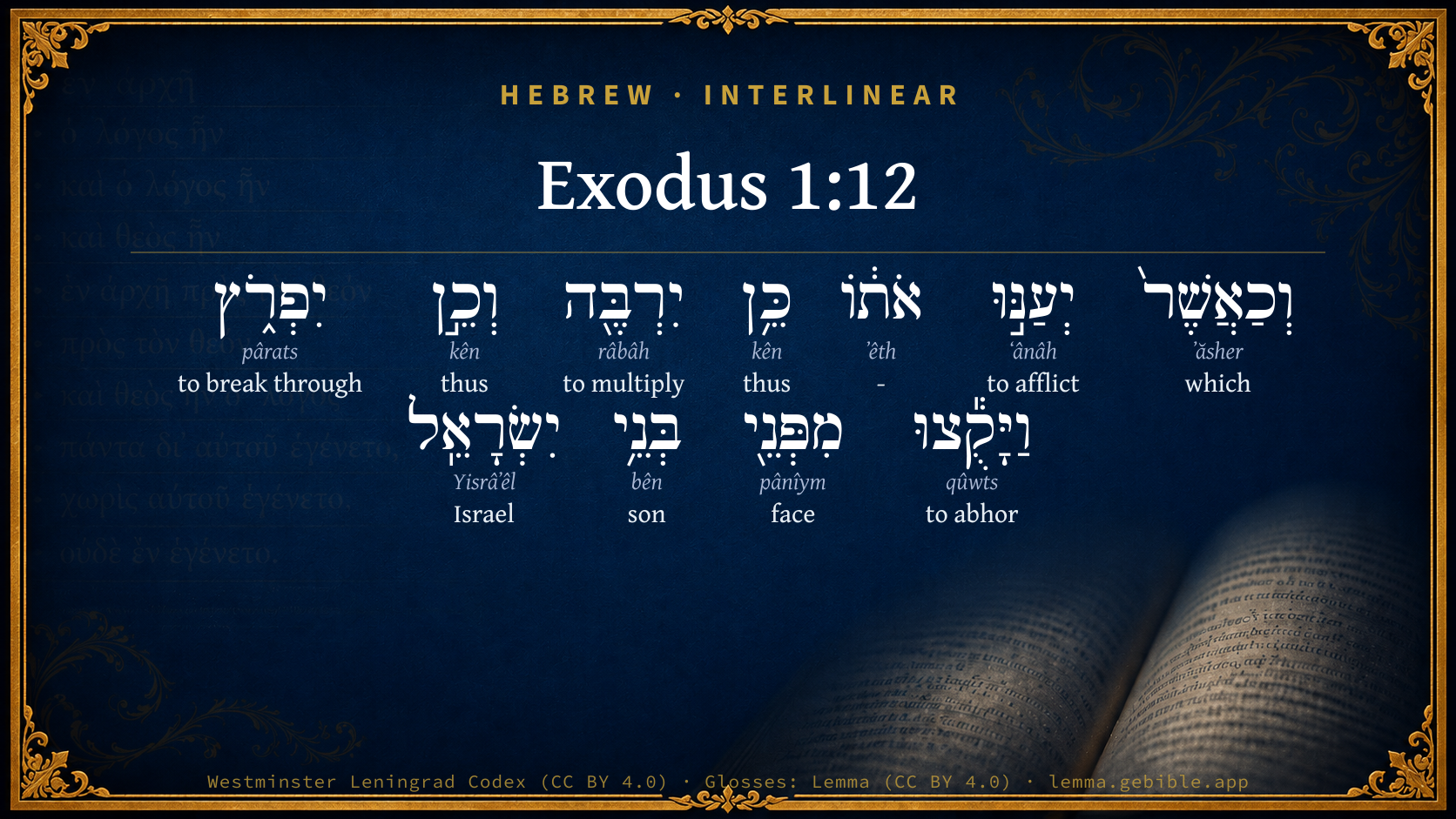
Hebrew (Westminster Leningrad Codex) Exodus 1:12 appears in the Hebrew Old Testament. The text above is from the Westminster Leningrad Codex. Each word links to its Strong’s number, a concise gloss, and parsing drawn from the Open Scriptures Hebrew Bible morphology. Click any word for its full Brown-Driver-Briggs (BDB) entry.
Download image
Cite this verse

Exodus 1:12 (World English Bible). Public Domain. Lemma interlinear Bible study tool, https://lemma.gebible.app/v/exodus/1/12.

Show BibTeX & RIS
BibTeX
RIS
English Translation
But the more they afflicted them, the more they multiplied and the more they spread out. They were grieved because of the children of Israel.
World English Bible · Public Domain
Download a study sheet

One document with this verse’s original text, its word-by-word gloss line, the meaning frame, cross-references with their text, attributed commentary, and full source and license credits — printable, and it pastes into notes with its structure intact.

This verse Autodidact and up

Study sheet (.html) Plain text (.txt)

A passage Seminary Student

Up to 50 verses in one chapter. A passage sheet keeps up to 6 commentary sources and 12 cross-references per verse, in the order this page ranks them, and says so on the sheet whenever that leaves anything out. Ask for a single verse and you get the Autodidact verse sheet above.

Everything on this page stays free to read, with no account — the sheet is a download of what is already on screen, not access to it.

Want to remove ads? Support Godless Engineer
Compare translations 3

The same verse in 3 English versions, stacked beneath the original-language interlinear above. Click any original word for its lexicon entry.

Each is an independent rendering of the whole verse — the interlinear is not word-aligned to these translations.

Highlighted words mark where these versions differ — a whole-verse word diff, not a word-by-word alignment.

  • World English Bible Public Domain
    But the more they afflicted them, the more they multiplied and the more they spread out. They were grieved because of the children of Israel.
  • King James Version Public Domain
    But the more they afflicted them, the more they multiplied and grew. And they were grieved because of the children of Israel.
  • unfoldingWord Literal Text CC BY-SA 4.0
    And insofar as they afflicted him, thus he multiplied and thus he spread out. And they felt a sickening dread from the face of the sons of Israel.

unfoldingWord Literal Text — © unfoldingWord, licensed CC BY-SA 4.0. Word-aligned USFM3 via Door43 (git.door43.org/unfoldingWord/en_ult).

Versions to compare (up to 4)

3 of 4 selected

Show all 18 translations

Every available English version of this verse, each an independent rendering of the whole verse.

  • World English Bible Public Domain
    But the more they afflicted them, the more they multiplied and the more they spread out. They were grieved because of the children of Israel.
  • Berean Standard Bible Public Domain
    But the more they were oppressed, the more they multiplied and flourished; so the Egyptians came to dread the Israelites.
  • Majority Standard Bible Public Domain
    But the more they were oppressed, the more they multiplied and flourished; so the Egyptians came to dread the Israelites.
  • King James Version Public Domain
    But the more they afflicted them, the more they multiplied and grew. And they were grieved because of the children of Israel.
  • American Standard Version (1901) Public Domain
    But the more they afflicted them, the more they multiplied and the more they spread abroad. And they were grieved because of the children of Israel.
  • Revised Version (1885) Public Domain
    But the more they afflicted them, the more they multiplied and the more they spread abroad. And they were grieved because of the children of Israel.
  • Geneva Bible (1599) Public Domain
    But the more they vexed them, the more they multiplied and grewe: therefore they were more grieued against the children of Israel.
  • Douay-Rheims (1899) Public Domain
    But the more they oppressed them, the more they were multiplied, and increased:
  • Young's Literal Translation Public Domain
    and as they afflict it, so it multiplieth, and so it breaketh forth, and they are vexed because of the sons of Israel;
  • Literal Standard Version CC BY-SA 4.0
    and as they afflict it, so it multiplies, and so it breaks forth, and they are distressed because of the sons of Israel;
  • Unlocked Literal Bible CC BY-SA 4.0
    But the more the Egyptians oppressed them, the more the Israelites increased in numbers and spread. So the Egyptians began to dread the Israelites.
  • unfoldingWord Literal Text CC BY-SA 4.0
    And insofar as they afflicted him, thus he multiplied and thus he spread out. And they felt a sickening dread from the face of the sons of Israel.
  • Darby Bible Public Domain
    But the more they afflicted them, the more they multiplied and spread; and they were distressed because of the children of Israel.
  • World Messianic Bible Public Domain
    But the more they afflicted them, the more they multiplied and the more they spread out. They started to dread the children of Israel.
  • Webster's Bible Public Domain
    But the more they afflicted them, the more they multiplied and grew. And they were grieved because of the children of Israel.
  • Free Bible Version CC BY-SA 4.0
    But the more the Israelites were mistreated, the more they grew in numbers and spread out—and the more the Egyptians detested them.
  • Bible in Basic English Public Domain
    But the more cruel they were to them, the more their number increased, till all the land was full of them. And the children of Israel were hated by the Egyptians.
  • JPS Tanakh (1917) Public Domain
    But the more they afflicted them, the more they multiplied and the more they spread abroad. And they were adread because of the children of Israel.

Literal Standard Version (2020), Covenant Press — licensed CC BY-SA 4.0. Text via the HelloAO Bible API (eBible.org). Unlocked Literal Bible (unfoldingWord) — licensed CC BY-SA 4.0. Text via the HelloAO Bible API (eBible.org). unfoldingWord Literal Text — © unfoldingWord, licensed CC BY-SA 4.0. Word-aligned USFM3 via Door43 (git.door43.org/unfoldingWord/en_ult). Free Bible Version, Dr. Jonathan Gallagher — licensed CC BY-SA 4.0. Text via the HelloAO Bible API (eBible.org).

Word by word

More ways to search: Search by grammar → Find every occurrence → Compare this word →

Practice this passage: Drill this verse → Learn its vocabulary →

וַיָּקֻ֕צוּ
qûwts
H6973
“and · to abhor”
Conjunction + Verb, Qal, Sequential Imperfect, 3rd Person, Masculine, Plural
Part of Speech
Conjunction + Verb
Stem
Qal
Form
Sequential Imperfect
Person
3rd Person
Gender
Masculine
Number
Plural
Full BDB Definition

Origin: a primitive root [identical with H6972 through the idea of severing oneself from (compare H6962 )]

TWOT: 2002

to be grieved, loathe, abhor, feel a loathing or abhorrence or sickening dread - (Qal) - to feel a loathing at, abhor - to feel a sickening dread - (Hiphil) - to cause sickening dread - to cause loathing
  1. וְכַאֲשֶׁר֙ ʼăsher H834 “and · like/as · which” Conjunction + Preposition + Particle, Relative
  2. יְעַנּ֣וּ ʻânâh H6031 “to afflict” Verb, Piel, Imperfect, 3rd Person, Masculine, Plural
  3. אֹת֔וֹ ʼêth H853 “- · him” Particle, Direct Object + Suffix, Personal, 3rd Person, Masculine, Singular
  4. כֵּ֥ן kên H3651 “thus” Particle, Demonstrative
  5. יִרְבֶּ֖ה râbâh H7235 “to multiply” Verb, Qal, Imperfect, 3rd Person, Masculine, Singular
  6. וְכֵ֣ן kên H3651 “and · thus” Conjunction + Particle, Demonstrative
  7. יִפְרֹ֑ץ pârats H6555 “to break through” Verb, Qal, Imperfect, 3rd Person, Masculine, Singular
  8. מִפְּנֵ֖י pânîym H6440 “from · face(s) of” Preposition + Noun, Common, Both, Plural, Construct
  9. בְּנֵ֥י bên H1121 “sons of” Noun, Common, Masculine, Plural, Construct
  10. יִשְׂרָאֵֽל Yisrâʼêl H3478 “Israel” Noun, Proper

About this verse

These counts appear in no published source. They are computed here, from the morphology-tagged text and Lemma’s own curated glosses. What Lemma adds →

11
words
10
distinct lemmas
Pentateuch
section

Notable vocabulary

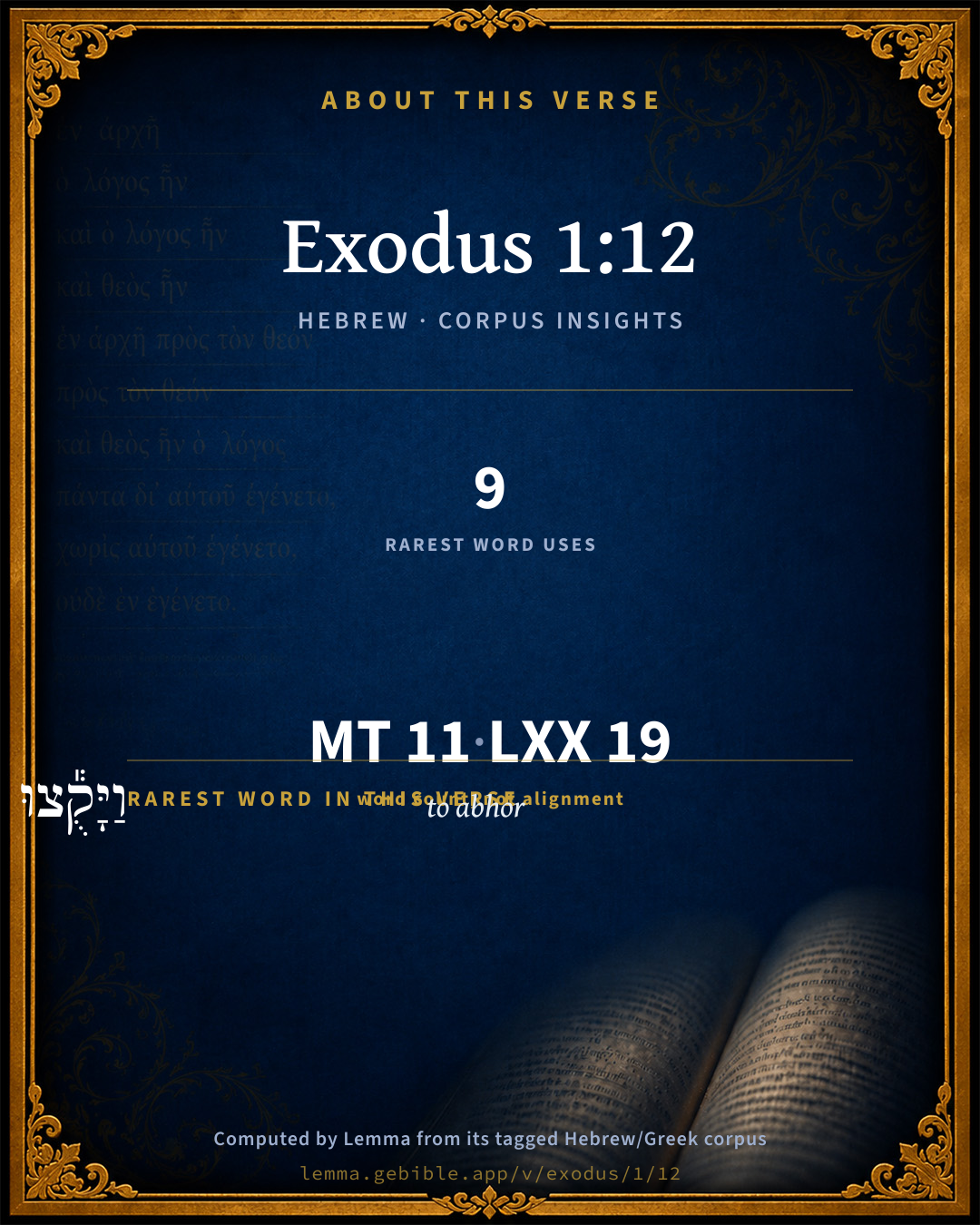
The rarest word here is וַיָּקֻ֕צוּ to abhor H6973 — appearing just 9 times in the whole Hebrew Bible.

Shared distinctive vocabulary

וַיָּקֻ֕צוּ to abhor H6973 occurs in 9 verses of the Hebrew Bible. Also found in:

Grammatical profile

  • 4 verbs
  • 3 nouns
  • 4 particles

Verb forms

  • יְעַנּ֣וּ Piel · Imperfect
  • יִרְבֶּ֖ה Qal · Imperfect
  • יִפְרֹ֑ץ Qal · Imperfect
  • וַיָּקֻ֕צוּ Qal · Sequential Imperfect

Repetition

A word recurs within this verse — often emphatic in Hebrew:

  • כֵּ֥ן thus H3651 ×2

Hebrew & Septuagint length

In English translation the verse runs 25 words from the Hebrew and 23 from the Septuagint (LXX English) — closely comparable.

A rough comparison of the two English renderings, which tokenize alike — not a word-level alignment.

Word counts can differ between the Hebrew and the Greek without any difference in meaning — e.g. the Hebrew direct-object marker אֵת has no separate Greek word, and Greek often adds the article ὁ.

In the original languages it is 11 Hebrew tokens and 19 Greek tokens — but the two are counted differently (Hebrew bundles its prefixes and suffixes into one token; the Greek is in lemma form), so that isn’t a like-for-like length.

Cross-references

6

Topical passages linked to Exodus 1:12 in the Treasury of Scripture Knowledge — connected by theme and wording, ordered by reader-vote popularity; previews shown in the World English Bible.

  • Psalms 105:24 He increased his people greatly, And made them stronger than their adversaries.
  • Exodus 1:9 He said to his people, "Behold, the people of the children of Israel are more and mightier than we.
  • Romans 8:28 We know that all things work together for good for those who love God, to those who are called according to his purpose.
  • Acts 5:28–33 saying, "Didn't we strictly charge you not to teach in this name? Behold, you have filled Jerusalem with your teaching, and intend to bring this man's blood on us."
  • John 12:19 The Pharisees therefore said among themselves, "See how you accomplish nothing. Behold, the world has gone after him."
  • Acts 4:2–4 being upset because they taught the people and proclaimed in Jesus the resurrection from the dead.

Cross-references courtesy of OpenBible.info (CC BY 4.0).

Hebrew and Greek witnesses Masoretic Hebrew ↔ Greek Septuagint

The same verse in the two great witnesses to the Old Testament, shown verse-for-verse.

These are two independent witnesses, not word-aligned to each other, and the Septuagint is shown in lemma (dictionary) form.

Hebrew Exodus 1:12 Masoretic · Westminster Leningrad Codex

וְכַאֲשֶׁר֙ יְעַנּ֣וּ אֹת֔וֹ כֵּ֥ן יִרְבֶּ֖ה וְכֵ֣ן יִפְרֹ֑ץ וַיָּקֻ֕צוּ מִפְּנֵ֖י בְּנֵ֥י יִשְׂרָאֵֽל

But the more they afflicted them, the more they multiplied and the more they spread out. They were grieved because of the children of Israel.

World English Bible · Public Domain

Greek LXX Exodus 1:12 Septuagint · lemma form

καθότι δέ αὐτός ταπεινόω τοσοῦτος πολύς γίγνομαι καί ἰσχύω σφόδρα σφόδρα καί βδελύσσω ὁ αἰγύπτιος ἀπό ὁ υἱός ἰσραήλ

But as they humbled them, by so much they multiplied, and grew exceedingly strong; and the Egyptians greatly abhorred the children of Israel.

LXX2012 (modern English Septuagint) · Public Domain

Hebrew: Westminster Leningrad Codex (CC BY 4.0). Greek: Septuagint (public domain); English from LXX2012 (modern English Septuagint) (Public Domain). How the Septuagint differs from the Hebrew →

Targum (Aramaic paraphrase)

2

The Targum is the ancient Jewish Aramaic paraphrase of the Hebrew Scriptures — an interpretive translation, not the Hebrew text itself. Onkelos (literal) and Pseudo-Jonathan (expansive) render the Torah, and Jonathan the Prophets. Coverage is partial: where no permissively-licensed English translation exists for a verse, only the Aramaic is shown. This is verse-level text, not a word-by-word alignment to the Hebrew.

  1. Targum Onkelos Torah (Genesis–Deuteronomy)
    וּכְמָא דִמְעַנַן לְהוֹן כֵּן סָגָן וְכֵן תַּקְפִין וַעֲקַת לְמִצְרָאֵי מִן קֳדָם בְּנֵי יִשְׂרָאֵל:

    (no public-domain English translation for this verse)

    Targum Onkelos — Aramaic: “Onkelos Genesis” (public domain); “Onkelos Exodus” (public domain); “Onkelos Leviticus” (public domain); “Onkelos Numbers” (public domain); “Onkelos Deuteronomy” (public domain). English: “Sefaria Community Translation” (CC0 1.0 (public-domain dedication)); “J.W. Etheridge. The Targums of Onkelos and Jonathan Ben Uzziel on the Pentateuch. London: Longmans, Green, 1862” (public domain). Text via Sefaria.

  2. Targum Pseudo-Jonathan Torah (Genesis–Deuteronomy)
    וְהֵיכְמָא דִמְעַנְיַין לְהוֹן הֵיכְדֵין הֲווֹן סָגַן וְהֵיכְדַין הֲווֹן תַּקְפִין וְאִתְיַעֲקוּ מִצְרָאֵי בְּחַיֵיהוֹן מִן קֳדָם בְּנֵי יִשְרָאֵל

    But as much as they depressed them, so much they multiplied, and so much they prevailed, and the Mizraee were troubled in their lives before the sons of Israel.

    Targum Pseudo-Jonathan — Aramaic: “Targum Jonathan on Genesis” (public domain); “Targum Jonathan on Exodus” (public domain); “Targum Jonathan on Leviticus” (public domain); “Targum Jonathan on Numbers” (public domain); “Targum Jonathan on Deuteronomy” (public domain). English: “The Targum of Jonathan ben Uzziel, trans. J. W. Etheridge, London, 1862” (public domain). Text via Sefaria.

Commentary

Notes on Exodus 1:12 from classic Christian and Jewish commentators (each source and its license shown beneath its notes). The classic Christian expositions comment on the surrounding passage and are grouped to its opening verse, so a note may address several verses; the Jewish commentaries on the Tanakh (Rashi and others) are per-verse, so they appear only where the commentator wrote on this verse.

Lemma curates 59 commentaries, every one of them public domain or Creative Commons licensed, each selected and text-cleaned for this edition rather than reprinted as found. About our sources →

Trapp's Complete Commentary

John Trapp

Exo 1:12 But the more they afflicted them, the more they multiplied and grew. And they were grieved because of the children of Israel.

Ver. 12. The more they multiplied.] As the ground is most fruitful that is most harrowed; and as the walnut tree bears best when most beaten. Fish thrive better in cold and salt waters, than in warm and fresh.

And they were grieved.] Or, irked, as Moab likewise was because of Israel: they did fret and vex at them. {Num 22:3-4} Yet they wero allied, and passed by them in peace: no other reason but the old enmity, Gen 3:15, and that utter antipathy, Pro 29:27.

John Trapp, A Commentary or Exposition upon All the Books of the Old and New Testament (1647–1656) — public domain. Text from a community e-Sword module.

Joseph Benson's Commentary

Exo 1:12. The more they multiplied — To the grief and vexation of the Egyptians. The original expression, rendered grew, is very emphatical, יפרצjiphrots.

They broke forth and expanded themselves with impetuosity, like a river swollen with the rains, whose waters increase and gain strength by being confined, Here we see how vain and fruitless the devices of men are against the designs of God: and how easily he, in his providence, can turn their counsels against themselves, and cause the very means which they employ to oppress his people, to become the greatest helps and advantages to them. Times of persecution and affliction have often been the church’s growing times: Christianity spread most when it was most persecuted.

Joseph Benson's Commentary on the Old and New Testaments (1811–1818) — public domain. Text from a community e-Sword module.

Tyndale Open Study Notes

Tyndale Open Resources

1:12 In spite of the concerted Egyptian oppression, the Israelites multiplied and spread; God was keeping his promise about giving Abraham many descendants (Gen 15:5).

Tyndale Open Study Notes — © Tyndale Open Resources, licensed CC BY-SA 4.0. Text via the HelloAO Bible API.

Geneva Bible (1599)

Geneva Bible translators

The more that God blesseth his, the more doth the wicked envy them.

Geneva Bible (1599) marginal notes — public domain. Text via Bolls.life.

Adam Clarke's Commentary

Verse 12. But the more they afflicted them] The margin has pretty nearly preserved the import of the original: And as they afflicted them, so they multiplied and so they grew That is, in proportion to their afflictions was their prosperity; and had their sufferings been greater, their increase would have been still more abundant.

Adam Clarke's Commentary on the Bible (1810–1826) — public domain. Text from a community e-Sword/MySword module.

Ellicott's Commentary for English Readers

(12) The more they afflicted them, the more they multiplied and grew.—This result was not natural. It can only be ascribed to God’s superintending Providence, whereby “the fierceness of man” was made to “turn to his praise.” Naturally, severe and constant labour exhausts a nation, and causes its numbers to diminish.

They were grieved.—This is scarcely strong enough. Translate, “They were sore distressed.”

A Bible Commentary for English Readers, edited by Charles John Ellicott (1878–1897) — public domain. Text from a community e-Sword module.

The Cambridge Bible for Schools and Colleges

gen. ed. J. J. S. Perowne

12. But the measure proved ineffectual: the more the Israelites were oppressed, the more they increased, so that the Egyptians felt an uneasy dread of them.

spread abroad] Lit. brake through (limits): fig. for expanded, spread abroad. So Gen_28:14; Gen_30:30; Gen_30:43 (all J), Isa_54:3 al.

were grieved because of] Render felt a loathing for. Both ‘grief’ and ‘grieve’ were used formerly (see DB. s.vv.; and cf. on Exo_8:24) in various acceptations which have now passed out of use,—Tindale for instance uses it in Exo_7:18 ‘shall grieve to drink of the water of the river,’ where AV. has ‘loathe.’ Here, at least to a modern reader, it conveys an entirely false idea of the meaning intended: RVm. abhorred (so Num_22:3 RVm.; Isa_7:16) is better; felt a loathing for (lit. because of) would be better still, as it would be also in Num_22:3, Isa_7:16 : cf. the same verb in Num_21:5 (EVV. ‘loatheth this worthless bread’).

The Cambridge Bible for Schools and Colleges (gen. ed. J. J. S. Perowne; Cambridge University Press, 1878–1918) — public domain. Text from a community e-Sword module.

John Gill's Exposition

But the more they afflicted them, the more they multiplied and grew,.... Became more numerous, "and broke out" (b), as it may be rendered, like water which breaks out and spreads itself; so the Israelites, increasing in number, spread themselves still more in the land; the Egyptians thought, by putting them to hard labour in building cities, to have weakened their strength, and made them unfit for the procreation of children; but instead of that, the more hard labour they were put unto, the more healthful and the stronger they were, and begot more children, and multiplied exceedingly: and so it is that oftentimes afflictive dispensations are multiplying and growing times to the people of God, in a spiritual sense; who grow like the palm tree, which the more weight it has upon it the more it grows; when the church of God has been most violently persecuted, the number of converts have been greater, and saints under affliction grow in grace, in faith and love, in holiness, humility, patience, peace, and joy; see Act 12:1.

and they were grieved because of the children of Israel; because of their multiplication and increase, and because their schemes for lessening them did not succeed; they were as thorns in their eyes, as some interpret the word, as Jarchi (c) observes.

(b) "erumpebat", Junius & Tremellius, Drusius, Tigurine version. (c) "in fractione", Cajetan. apud Rivet.

John Gill's Exposition of the Whole Bible (1746–1763) — public domain (CC PDM 1.0). Text via the HelloAO Bible API.

Matthew Poole's English Annotations

They multiplied, through God’s overruling providence and singular blessing, which God gave them purposely to hasten first their sorer affliction, and next, and by that means, their glorious deliverance.

They were grieved, through envy and fear.

Matthew Poole's English Annotations on the Holy Bible (1683–1685) — public domain. Text from a community e-Sword/MySword module.

Whedon's Commentary on the Bible

Daniel D. Whedon

12. More they afflicted… more they multiplied — But God was with the oppressed, and the immense national vitality which has made Israel the wonder of history began to be developed in proportion to the oppression, so that the Egyptians became distressed (with fear) before the children of Israel. Compare Num_22:3.

Daniel D. Whedon (gen. ed.), Commentary on the Old and New Testaments (1874–1909) — public domain. Text from a community e-Sword module.

The Pulpit Commentary

They were grieved because of the children of Israel. The word grieved very insufficiently renders the Hebrew verb, which "expresses a mixture of loathing and alarm" ("Speaker"s Commentary," vol. 1. pt. 1, p. 251). Kalisch translates forcibly, if inelegantly had a horror of the children of Israel."

The Pulpit Commentary (1880–1919), ed. H.D.M. Spence-Jones & Joseph S. Exell — public domain. Text from a community e-Sword module.

John Wesley's Explanatory Notes

But the more they afflicted them, the more they multiplied - To the grief and vexation of the Egyptians. Times of affliction, have oft been the church's growing times: Christianity spread most when it was persecuted.

John Wesley, Explanatory Notes Upon the Whole Bible (1754–1765) — public domain. Text via the GEBible commentary corpus.

Rashi

Rabbi Shlomo Yitzchaki (Rashi)

וכאשר יענו אתו AND AS THEY AFFLICTED THEM — In whatsoever matter it was that they set their hearts upon afflicting them so was the heart of the Holy One, blessed be He, set upon multiplying them and making them grow apace.

כן ירבה signifies: so they multiplied and so they grew apace (i. e. God’s determination was carried out, the imperfect tenses of the verbs denoting the continuance of the increase and growth). This is the real meaning; but there is a Midrashic explanation of these imperfect tenses: The Holy spirit (God) said this: You say פן ירבה, “lest they increase”, but “I” say כן ירבה, “thus will they assuredly increase” (Sotah 11a).

ויקצו the word means, THEY WERE WEARY OF THEIR LIVES. Our Rabbis explained that it means that they were as thorns (קוצים) in their eyes (cf. Sotah 11a).

Rashi on the Tanakh — English translations: “The Judaica Press complete Tanach with Rashi, translated by A. J. Rosenberg” (CC BY 4.0); “Pentateuch with Rashi's commentary by M. Rosenbaum and A.M. Silbermann, 1929-1934” (public domain); “The Metsudah Tanach series, Lakewood, N.J” (CC BY 4.0); and “The Book of Joshua, Metsudah Publications, 1997” (CC BY 4.0). Text via Sefaria.

Lesson kit

Teaching starters — assembled from the data on this page, not authored interpretation. Every prompt links to the verse data it draws on. Edit before teaching.

Exodus, in the Pentateuch, opens this verse with 11 words (10 distinct Hebrew lemmas). Its most distinctive word is qûwts (“to abhor”). A historical commentator’s framing appears above. Read the whole chapter for the surrounding context.

Discussion questions

  1. What does “to abhor” (qûwts) contribute to the verse as a whole?
  2. Genesis 27:46 shares the word «to abhor» with this verse. How do the two illuminate each other?
  3. “thus” occurs 2× in this one verse. What is the effect of the repetition?
  4. The translations on this page render this verse differently — a whole-verse word diff, not a word-by-word alignment. What might account for the different wordings?
  5. The verb «יְעַנּ֣וּ» is Piel Imperfect. How does its form color the action?
  6. Reading how Trapp's Complete Commentary and Joseph Benson's Commentary read this verse, where do the two commentators agree and where do they part?

Things to notice

Reading settings

Reading text

Shown beneath each verse's original-language words.

Old Testament
Old Testament edition

Read the OT as the Masoretic Hebrew (MT) or the Greek Septuagint (LXX).

English shown for the Greek Septuagint (in the Hebrew ↔ Greek comparison).

Comparing translations? Open the Compare panel on any verse page to stack up to four side by side.