
Matthew 27:55

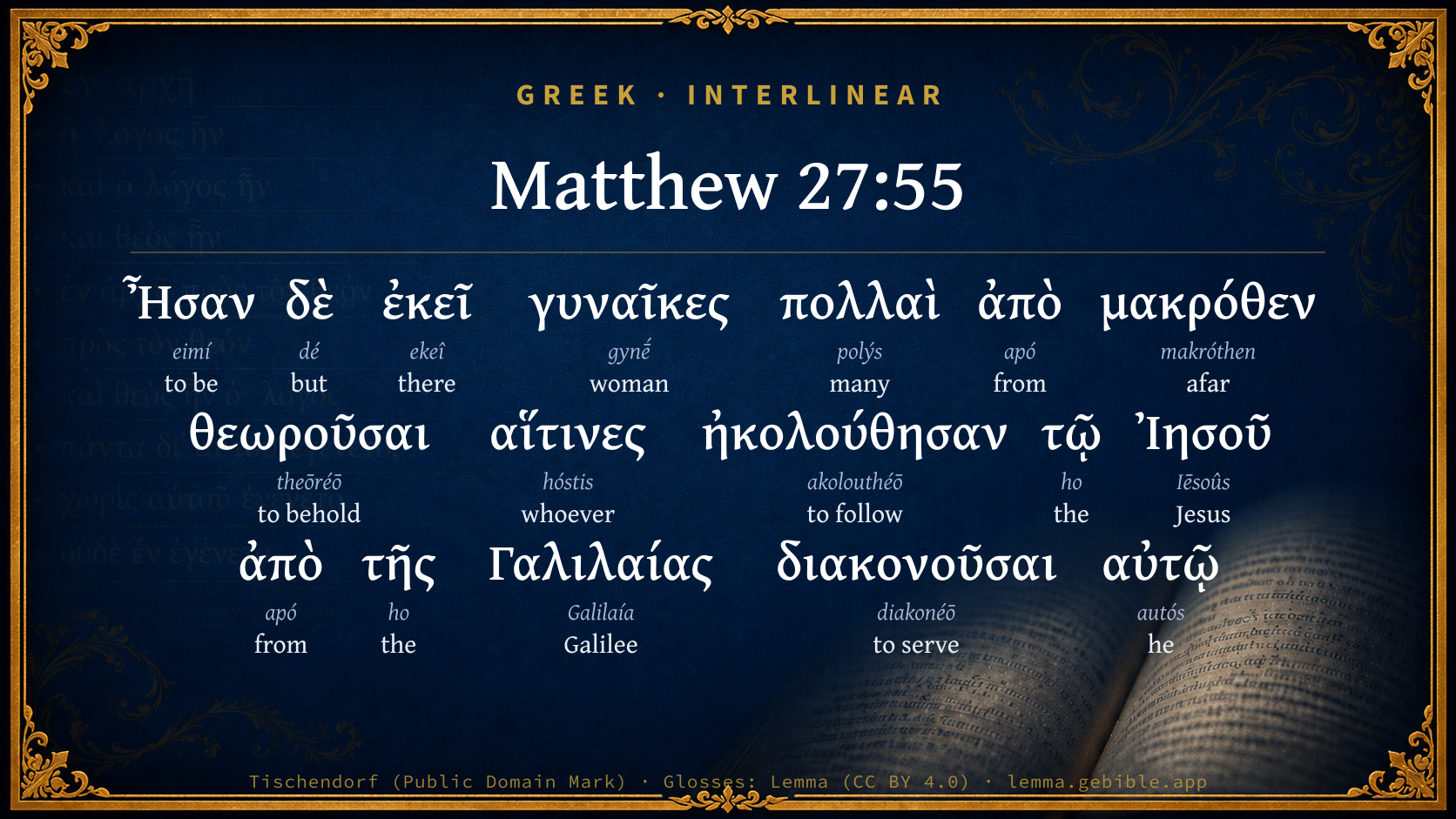
Greek (Tischendorf 8th ed.) Matthew 27:55 appears in the Greek New Testament. The text above is from the Tischendorf 8th edition. Each word links to its Strong’s number and a concise gloss. Click any word for its full Thayer’s Greek Lexicon entry.
Download image
Cite this verse

Matthew 27:55 (World English Bible). Public Domain. Lemma interlinear Bible study tool, https://lemma.gebible.app/v/matthew/27/55.

Show BibTeX & RIS
BibTeX
RIS
English Translation
Many women were there watching from afar, who had followed Jesus from Galilee, serving him.
World English Bible · Public Domain
Highlights
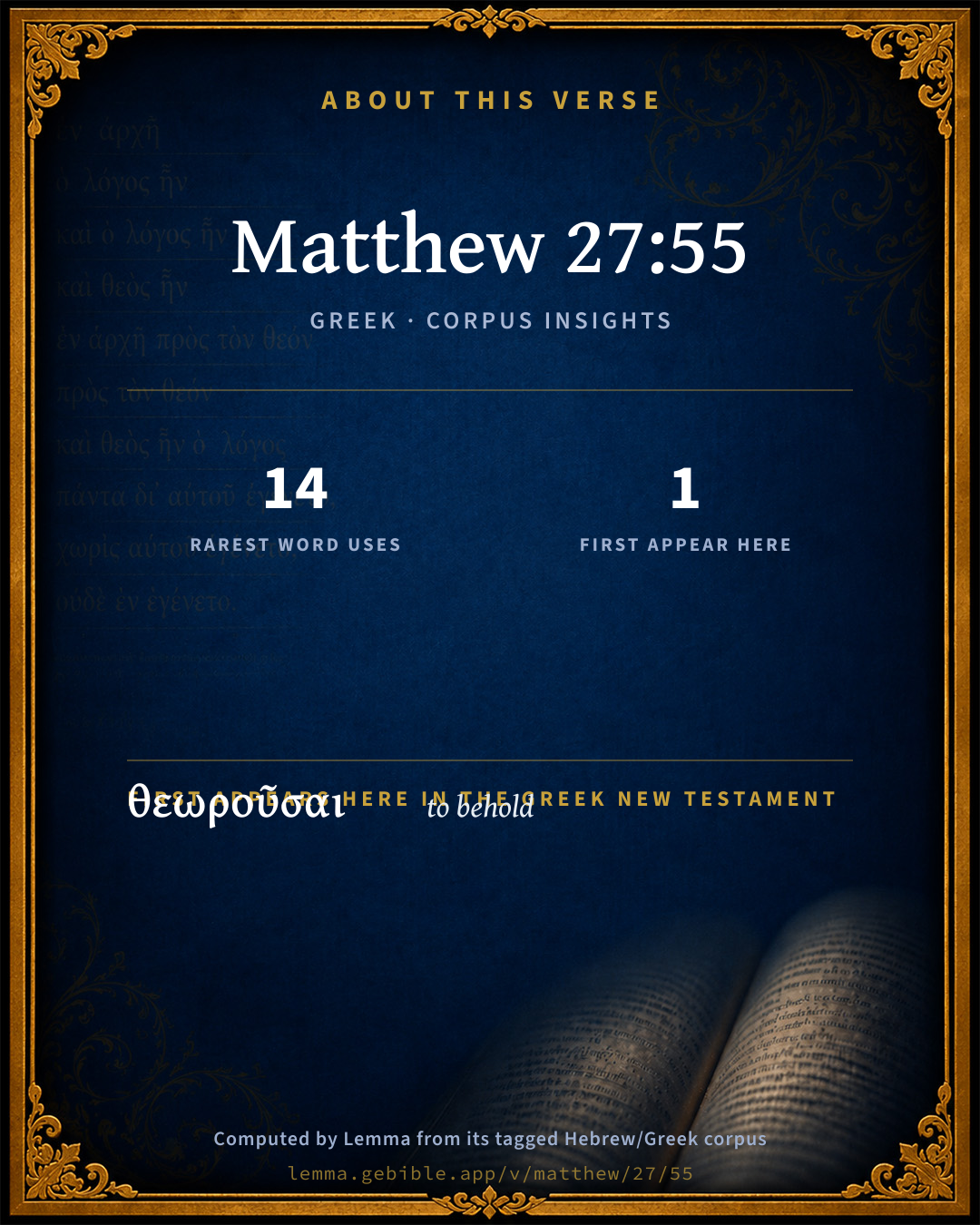
  • 1 first appearance in the Greek New Testament
Full analysis ↓
Download a study sheet

One document with this verse’s original text, its word-by-word gloss line, the meaning frame, cross-references with their text, attributed commentary, and full source and license credits — printable, and it pastes into notes with its structure intact.

This verse Autodidact and up

Study sheet (.html) Plain text (.txt)

A passage Seminary Student

Up to 50 verses in one chapter. A passage sheet keeps up to 6 commentary sources and 12 cross-references per verse, in the order this page ranks them, and says so on the sheet whenever that leaves anything out. Ask for a single verse and you get the Autodidact verse sheet above.

Everything on this page stays free to read, with no account — the sheet is a download of what is already on screen, not access to it.

Want to remove ads? Support Godless Engineer
Compare translations 3

The same verse in 3 English versions, stacked beneath the original-language interlinear above. Click any original word for its lexicon entry.

Each is an independent rendering of the whole verse — the interlinear is not word-aligned to these translations.

Highlighted words mark where these versions differ — a whole-verse word diff, not a word-by-word alignment.

  • World English Bible Public Domain
    Many women were there watching from afar, who had followed Jesus from Galilee, serving him.
  • King James Version Public Domain
    And many women were there beholding afar off, which followed Jesus from Galilee, ministering unto him:
  • unfoldingWord Literal Text CC BY-SA 4.0
    Now there were many women there, watching from a distance, who followed Jesus from Galilee, serving him.

unfoldingWord Literal Text — © unfoldingWord, licensed CC BY-SA 4.0. Word-aligned USFM3 via Door43 (git.door43.org/unfoldingWord/en_ult).

Versions to compare (up to 4)

3 of 4 selected

Show all 19 translations

Every available English version of this verse, each an independent rendering of the whole verse.

  • World English Bible Public Domain
    Many women were there watching from afar, who had followed Jesus from Galilee, serving him.
  • Berean Standard Bible Public Domain
    And many women were there, watching from a distance. They had followed Jesus from Galilee to minister to Him.
  • Majority Standard Bible Public Domain
    And many women were there, watching from a distance. They had followed Jesus from Galilee to minister to Him.
  • King James Version Public Domain
    And many women were there beholding afar off, which followed Jesus from Galilee, ministering unto him:
  • American Standard Version (1901) Public Domain
    And many women were there beholding from afar, who had followed Jesus from Galilee, ministering unto him:
  • Revised Version (1885) Public Domain
    And many women were there beholding from afar, which had followed Jesus from Galilee, ministering unto him:
  • Geneva Bible (1599) Public Domain
    And many women were there, beholding him a farre off, which had folowed Iesus from Galile, ministring vnto him.
  • Douay-Rheims (1899) Public Domain
    And there were there many women afar off, who had followed Jesus from Galilee, ministering unto him:
  • Young's Literal Translation Public Domain
    And there were there many women beholding from afar, who did follow Jesus from Galilee, ministering to him,
  • Literal Standard Version CC BY-SA 4.0
    And there were there many women beholding from afar, who followed Jesus from Galilee, ministering to Him,
  • Unlocked Literal Bible CC BY-SA 4.0
    Many women who had followed Jesus from Galilee to care for him were there looking on from a distance.
  • unfoldingWord Literal Text CC BY-SA 4.0
    Now there were many women there, watching from a distance, who followed Jesus from Galilee, serving him.
  • Darby Bible Public Domain
    And there were there many women beholding from afar off, who had followed Jesus from Galilee ministering to him,
  • World Messianic Bible Public Domain
    Many women were there watching from afar, who had followed Yeshua from Galilee, serving him.
  • Webster's Bible Public Domain
    And many women were there (beholding at a distance) who followed Jesus from Galilee, ministering to him:
  • Free Bible Version CC BY-SA 4.0
    Many women were also watching from a distance, those who had followed Jesus from Galilee and had supported him.
  • Bible in Basic English Public Domain
    And a number of women were there, watching from a distance, who had come with Jesus from Galilee, waiting on his needs.
  • Text-Critical English NT CC BY 4.0
    Many women who had followed Jesus from Galilee and provided for him were there looking on from a distance,
  • Tyndale New Testament (1534) Public Domain
    And many wemen were there beholdinge him a farre of which folowed Iesus from Galile ministringe vnto him.

Literal Standard Version (2020), Covenant Press — licensed CC BY-SA 4.0. Text via the HelloAO Bible API (eBible.org). Unlocked Literal Bible (unfoldingWord) — licensed CC BY-SA 4.0. Text via the HelloAO Bible API (eBible.org). unfoldingWord Literal Text — © unfoldingWord, licensed CC BY-SA 4.0. Word-aligned USFM3 via Door43 (git.door43.org/unfoldingWord/en_ult). Free Bible Version, Dr. Jonathan Gallagher — licensed CC BY-SA 4.0. Text via the HelloAO Bible API (eBible.org).

Word by word

More ways to search: Search by grammar → Find every occurrence → Compare this word →

Practice this passage: Drill this verse → Learn its vocabulary →

μακρόθεν
makróthen
G3113
“afar”
Adverb
Part of Speech
Adverb
Full Thayer's Definition

Origin: from G3117

TDNT: 10:12,5

1. from afar, afar
  1. Ἦσαν eimí G1510 “to be” Verb, Imperfect, Active, Indicative, 3rd person, Plural
  2. δὲ dé G1161 “but” Conjunction
  3. ἐκεῖ ekeî G1563 “there” Adverb
  4. γυναῖκες gynḗ G1135 “woman” Noun, Nominative, Plural, Feminine
  5. πολλαὶ polýs G4183 “many” Adjective, Nominative, Plural, Feminine
  6. ἀπὸ apó G575 “from” Preposition
  7. θεωροῦσαι theōréō G2334 “to behold” Verb, Present, Active, Participle, Nominative, Plural, Feminine
  8. αἵτινες hóstis G3748 “whoever” Relative pronoun, Nominative, Plural, Feminine
  9. ἠκολούθησαν akolouthéō G190 “to follow” Verb, Aorist, Active, Indicative, 3rd person, Plural
  10. τῷ ho G3588 “the” Article, Dative, Singular, Masculine
  11. Ἰησοῦ Iēsoûs G2424 “Jesus” Noun, Dative, Singular, Masculine
  12. ἀπὸ apó G575 “from” Preposition
  13. τῆς ho G3588 “the” Article, Genitive, Singular, Feminine
  14. Γαλιλαίας Galilaía G1056 “Galilee” Noun, Genitive, Singular, Feminine
  15. διακονοῦσαι diakonéō G1247 “to serve” Verb, Present, Active, Participle, Nominative, Plural, Feminine
  16. αὐτῷ autós G846 “he” Personal pronoun, Dative, Singular, Masculine

About this verse

These counts appear in no published source. They are computed here, from the morphology-tagged text and Lemma’s own curated glosses. What Lemma adds →

17
words
15
distinct lemmas
Gospels
section

Notable vocabulary

The rarest word here is μακρόθεν afar G3113 — appearing just 14 times in the whole Greek New Testament.

First appearance in Scripture

This word makes its first canonical appearance in the Greek New Testament here:

  • θεωροῦσαι to behold G2334

Shared distinctive vocabulary

μακρόθεν afar G3113 occurs in 14 verses of the Greek New Testament. Also found in:
Repetition

Words recur within this verse:

Cross-references

4

Topical passages linked to Matthew 27:55 in the Treasury of Scripture Knowledge — connected by theme and wording, ordered by reader-vote popularity; previews shown in the World English Bible.

  • Luke 8:2–3 and certain women who had been healed of evil spirits and infirmities: Mary who was called Magdalene, from whom seven demons had gone out;
  • Luke 23:48–49 All the multitudes that came together to see this, when they saw the things that were done, returned home beating their breasts.
  • John 19:25–27 But there were standing by the cross of Jesus his mother, and his mother's sister, Mary the wife of Clopas, and Mary Magdalene.
  • Luke 23:27–28 A great multitude of the people followed him, including women who also mourned and lamented him.

Cross-references courtesy of OpenBible.info (CC BY 4.0).

Commentary

Notes on Matthew 27:55 from classic Christian and Jewish commentators (each source and its license shown beneath its notes). The classic Christian expositions comment on the surrounding passage and are grouped to its opening verse, so a note may address several verses; the Jewish commentaries on the Tanakh (Rashi and others) are per-verse, so they appear only where the commentator wrote on this verse.

Lemma curates 59 commentaries, every one of them public domain or Creative Commons licensed, each selected and text-cleaned for this edition rather than reprinted as found. About our sources →

Joseph Benson's Commentary

Mat 27:55-56. And many women were there, beholding afar off — Viewing these things with weeping eyes and sympathizing hearts: which followed Jesus from Galilee — To Jerusalem, eighty or a hundred miles, out of the great love they had to him, and to his heavenly doctrine; ministering unto him — Liberally assisting him and his disciples with their property. Among which were Mary Magdalene — Or rather, Mary the Magdalene, or Mary of Magdala, as Μαρια η Μαγδαληνη, would be more properly rendered; even as Ιησους ο Ναξαρερηνος, is Jesus the Nazarene, or Jesus of Nazareth. “There can be no doubt that this addition, employed for distinguishing her from others of the same name, is formed from Magdala, the name of a city, mentioned Mat 15:39, probably the place of her birth, or at least of her residence.” — Campbell. And Mary the mother of James, (namely, James the Less, 15:49,) and Joses — Probably our Lord’s mother’s sister, (called, Joh 19:25, Mary the wife of Cleophas,) and the mother of Zebedee’s children — Namely, Salome. The three evangelists agree in affirming that these women stood afar off, looking on. Yet this is not inconsistent with Joh 19:25, where two of them, with our Lord’s mother, are said to have stood by the cross. It seems they were kept at a distance a while, perhaps by the guards, or they were afraid to approach. But when the greatest part of the soldiers were drawn off, and the darkness began, they gathered courage, and came so near that Jesus had an opportunity to speak to them a little before he expired. It is greatly to the honour of these excellent women, that they thus manifested more courage and attachment to their Lord and Master, than even the apostles themselves, who, notwithstanding that they had promised to die with him rather than desert him, had forsaken him and fled. But O! who can describe the feelings of these pious females, while they attended Jesus in these last scenes of his sufferings! What words can express, or heart conceive the depth of sorrow, compassion, anxiety, and despondency which must have been excited in their breasts, by what their eyes saw, and their ears heard during these mournful and awful hours! Of some other circumstances which occurred while our Lord hung on the cross, see the notes on Luk 23:39-43; Joh 19:26-27; Joh 19:31-37.

Mat 27:57-61. When the even was come — That is, when it was past three o’clock; for the time from three to six they termed the first evening: this being Friday, or the day before the sabbath, which began at six o’clock, after which no work could lawfully be done, our Lord’s body must have been applied for and obtained as soon as four, or a little after, otherwise there would not have been time to bury it before the sabbath began. There came a rich man of Arimathea — A city of the Jews, anciently called Ramoth: (Luke says, he was a counsellor; Mark, an honourable counsellor, and a good man and just;) who also himself was Jesus’s disciple — (But secretly, Joh 19:38,) not having courage openly to profess his faith in him, for fear of the Jews and their rulers. And he also waited for the kingdom of God, Luk 23:51; that is, for the manifestation of the Messiah’s kingdom; and, of consequence, had not consented to the deed of them who condemned Jesus: though a member of the sanhedrim, he had not joined them in their unjust sentence. He had either kept away from the court when they sat on the trial of Jesus, or, if he was present when the sentence was passed, he remonstrated against it. This honourable, just, and pious person went (Mark says, boldly) to Pilate, and begged the body of Jesus — Joseph had nothing to fear from the governor, who in the course of the trial had showed the greatest inclination to release Jesus; but he had reason to fear that this action would draw upon him abundance of ill-will from the rulers, who had been at such pains to get Jesus crucified. Nevertheless, the regard he had for his Master overcame all other considerations, and he asked leave to take his body down; because, if no friend had obtained it, it would have been ignominiously cast out among the executed malefactors. Then Pilate commanded the body to be delivered — Namely, after he had called the centurion to him, and had been assured by him that Jesus was certainly dead, which Pilate had at first doubted. Pilate was probably the more willing to grant the body to Joseph, both because he was thoroughly convinced that Jesus was innocent, and because it was generally thought by the heathen that the spirits of the departed received some advantage from the honours of a funeral paid to their bodies. “In discharging this last duty to his Master, Joseph was assisted (as we learn from Joh 19:39) by another disciple named Nicodemus, the ruler who formerly came to Jesus by night, for fear of the Jews. But he was not afraid of them now, for he showed a courage superior to that of the apostles, bringing such a quantity of spices along with him as was necessary to the funeral of his Master. These two, therefore, taking down the naked body, wrapped it with the spices in the linen furnished by Joseph. And laid it in his own new tomb, hewn out in the rock — Here we learn that Joseph, though a man of great wealth, and in a high situation of life, lived mindful of his mortality. For he had erected for himself a sepulchre in his garden, Joh 19:41, the place of his pleasure and retirement, that it might be often in his view, and suggest to him the thoughts of death and eternity. In the description of the sepulchre given by the evangelists, it is particularly remarked, that it was nigh to the place where he was crucified, consequently nigh to Jerusalem. By this circumstance all the cavils are prevented which might otherwise have been occasioned, in case the body had been removed farther off. Moreover, it is observed that the sepulchre was a new one, wherein never any man had been laid. This plainly proves that it could be no other than Jesus who rose out of it, and cuts off all suspicion of his being raised by touching the bones of some prophet buried there, as happened to the corpse which touched the bones of Elisha, 2Ki 13:21. Further, the evangelists take notice that it was a sepulchre hewn out of a rock, to show that there was no passage by which the disciples could get into it but the one at which the guards were placed, Mat 27:62, &c., and consequently that it was not in their power to steal away the body while the guards remained there performing their duty. And he rolled a great stone to the door of the sepulchre — To block up the entrance. The sepulchre, it seems, differed from that of Lazarus, being partly above ground; whereas Lazarus’s being wholly under ground, had a stone laid on the mouth of it, covering the entry of the stair by which they went down to it. The rolling of the stone to the grave’s mouth was with them as filling up the grave is with us; it completed the funeral. Having thus in silence and sorrow deposited the precious body of our Lord Jesus in the house appointed for all living, they departed without any further ceremony. It is the most melancholy circumstance in the funerals of our Christian friends, when we have laid their bodies in the dark and silent grave, to go home and leave them behind; but, it is not we that go home and reave them behind; no, it is they that are gone to the better home, and have left us behind! There was Mary Magdalene and the other Mary — Namely, the mother of James and Joses, Mat 27:56. The mother of Jesus, it appears, was not there, being hindered, probably, by the excess of her sorrow, or, perhaps, she might have been taken to the house of John as to her home, Joh 19:26-27. Thus we see the company which attended the funeral was very small and mean. There were none of the relations in mourning to follow the corpse; no formalities to grace the solemnity, but only these two good women, that were true mourners, who, as they had attended him to the cross, so they followed him to the grave, as if they gave themselves up to sorrow; and they sat over against the sepulchre, “not so much,” says Henry, “to fill their eyes with the sight of what was done, as to empty them in rivers of tears:” for true love to Christ will carry us to the utmost in following him: death itself will not, cannot, quench that divine fire.

Joseph Benson's Commentary on the Old and New Testaments (1811–1818) — public domain. Text from a community e-Sword module.

Whedon's Commentary on the Bible

Daniel D. Whedon

§ 142. — THE FRIENDS OF JESUS, vv. AND HIS BURIAL, Mat_27:55-61.

Pilate had early disappeared; the chief priests had been driven off by the darkness and earthquake: the revilers had been put to silence; and even the soldiers having confessed, the cross seems now to have been surrounded by the friends of Jesus, and his faithful followers heave in view. His death seems to have conquered all, and to have won the field to his own side. The voice of hostile triumph is changed to consternation, and words of revilings give place to confessions of his divinity. Amid the display of divine power and displeasure, the alarmed supplicators begin to fear that Elias may appear to the rescue; or that Jesus will come down from the cross, and the wrath of Jehovah be executed upon themselves for his murder. Alas! the fulfilment of that fear, predicted indeed in these convulsions of nature, is postponed, not abolished. The same multitudes must undergo the woes of Roman cruelty; and the same men must meet him when he has exchanged the cross for the throne, and “look on him whom they have pierced and mourn.”

55. And many women were there — Relatives, and followers of his doctrines. They stood the ground more firmly than his disciples. Indeed, their weakness was the source of their strength; for, from their sex, they were in less danger than the male followers of the Lord. At a modest distance, now that the worst of the Lord’s enemies are gone, they dare appear conspicuous in sight. These women (as we are informed, Mar_15:41, Luk_8:2-3) ministered unto Jesus of their substance while he was in Galilee. They had come now to Jerusalem for the same purpose. Mary the mother of Jesus, who previously stood at the cross, and whom Jesus on the cross committed to the guardianship of John, (Joh_19:25-27,) seems now to have departed.

Daniel D. Whedon (gen. ed.), Commentary on the Old and New Testaments (1874–1909) — public domain. Text from a community e-Sword module.

F. W. Grant's Numerical Bible

Subdivision 3. (Mat 27:55-66; Mat 28:1-20.)

The Resurrection.

The atoning work, then, is done: we are now to have before us the answer on God’s part to it, an answer which certainly cannot be long delayed. Indeed, as we have seen, there has been already answer; but not yet the answer. That will be no less than in raising Christ from the dead, and setting Him at His own right hand in heavenly places, with all authority given to Him in heaven and earth. We do not see Him in Matthew at the right hand of God: that is reserved for Mark. Nor do we even, as in Luke, see His ascent into heaven. But in accordance with the character of Matthew, we do find all authority put into His hand, - the Kingdom of heaven begun; with its administration committed to men, but with the assurance that He is with them to the end of the age.

1. The Lord having gone down to the depths of His humiliation, from this point all is changed. God permits no more indignity, and, marked out still, as every thing here is, by the voice of prophecy, the rich man comes forward to bear testimony to Him, and give His body its temporary resting place. "They assigned Him a grave with wicked men," says the prophet, "but with the rich man when He had died" (Isa 53:9, Heb.). He is numbered with transgressors no more, but in the hands of disciples, tender, if feeble hands, which though it be the shadow of death upon hopes lately so bright, will anoint Him for His burial. These women that have followed Him from Galilee, ministering to Him, wait on Him still with their eyes through all the terror of the Cross, too intent for fear or sorrow to divert their riveted gaze until the stone closes the sepulchre. This Joseph, too, just at the hour when all seems lost, comes forward openly to join himself to the disciples of a crucified Master. He goes to Pilate to beg the body of Jesus, and having obtained it, lays it in his own new tomb. For this death cannot mingle with the common deaths of men, but is that which dispels death. Nor can the Holy One enter into the abode of corruption - He who is to know none. The instinct of the heart goes, as it would seem, beyond knowledge; and God is over all, guarding and guiding.

2. The enemy, too, is at work to make more secure His coming triumph. His disciples shall not come and steal the body away, and make men think that He is risen. Upon the supposition that they were dealing with imposture merely, that would be well enough: but did they think so? Could they, fresh from the spectacle of such a death as He had died, imagine it?

They remember the words which His own disciples had forgotten; words which had contemplated what they had done to him, and asserted His own final triumph. On the third day He would rise again. If that were indeed true, how vain any effort of theirs to avert the consequences! Yet fear has its fascination; which compels its subjects to follow to the end they dread, - to know and face the worst that can come. Perhaps there were mingled motives, the result of contradictory thoughts which urged them on. At any rate they do all they can with their company of soldiers and their seal upon the sepulchre to make fraud and illusion both impossible, and to certify the only hope available for man.

3. Matthew gives us very briefly the resurrection of the Lord; and of all His manifestations of Himself to His disciples at Jerusalem only that to the women visiting the sepulchre. In His message given through these also He speaks of meeting them, not at Jerusalem, but in Galilee, the scene of His former labors. There the .commission with regard to the Kingdom is given them, and it is the Kingdom with which Matthew, as we know, is occupied.

The connection of our Lord with Galilee was from the first the token of His rejection by Israel. In His infancy Jerusalem under the sway of Herod had refused Him, and the rule of Archelaus there had turned Him aside from Judea to Nazareth. Galilee of the Gentiles was the witness of the ruin of Israel, as largely given up to these, the land of the former kingdom of the ten tribes, who had not returned from their captivity in Assyria. Out of Galilee, said the scribes, no prophet could arise. Yet it was there, among a people sitting in darkness and the shadow of death, that the Light was to arise.

The passing by of Jerusalem in the close of Matthew is easily seen, therefore, to be significant of the world-wide aspect of the Kingdom now to be proclaimed, a remnant of Israel sharing in it, in the time of their national rejection; the blessings of Christ’s rule. But not even into these does Matthew enter deeply: the air of reserve which we have noticed in Matthew clings in measure to him, to the end. There is one expression only which seems to break through it, and carry us on towards the complete revelation, - "Go and tell My brethren." But it is not developed further, and by itself might only apply the language of the Lord’s prophecy (Mat 25:40) to His present followers.

The separation which some would make between an evening visit of the women to the sepulchre, and a morning one, when the angel addresses them, seems neither necessitated by the words themselves,* nor consistent when the account is taken as a whole.** The stone had been rolled away when they got near enough to see; and thus the resurrection had already taken place. They may have felt the trembling of the ground and seen something of the lightning-like flash that had scattered the watch. But He was risen; and the opening of the tomb was to publish to all that it was empty. The victory is gained; and, as of old, the women celebrate it. Mary of Magdala here comes into prominence, out of whom seven demons had been cast by the word of Christ. And now that He has spoiled principalities and powers and led captivity captive, she in whom the complete power of Satan has been met and conquered is fittingly the leader of this company. Her heart is not empty since the unclean spirits left, but Another has filled it. The dead Christ still lives in her and controls her; and now she is a true "Mary of the watch-tower," even while yet she has no knowledge nor expectation of what has taken place.

{* opse ton sabbaton may mean "after the sabbath" as well as "in the end of" it: see Lange on the text.

**Yet it is evident that Matthew’s account is of the briefest, and that the Lord’s appearing to Mary Magdalene alone is omitted by him. Mark states that He appeared "first" to her, which does not seem to allow the presence of the other women at that time, as thought by some, while yet Matthew and Luke (Luk 24:10) plainly seem to include her with them in what is narrated here.}

It is John who details to us the way in which the risen Lord reveals Himself to her, during an interval of time passed over by Matthew, in which she has left the company with which she had come to the sepulchre to bring Peter and John to see that it was empty. The other women, less bold than she, must have waited for her to rejoin them before they went on to the tomb. If so Mary Magdalene must have already been gladdened with the knowledge that He was risen before she went back with them there. Matthew certainly intimates that Mary was with them at this time, as he only mentions "the other Mary" as her companion; and to these the angel addresses himself.* Now they are told that not only is He risen, but that He is going before them into Galilee, and there they should see Him.

{*In fact there were others, as Luke assures us (Luk 24:10).}

Galilee is in fact the gathering place of the disciples, characterizing the circumstances under which the new faith begins to be published, as we have seen. Presently an unexpected joy is theirs; for Jesus Himself meets them on the way, and while they worship at His feet, repeats to them the message given to them by the angel.

4. Meanwhile some of the guard bring word to the chief priests of all that has taken place. The impotence of all their efforts is revealed; and they have even to publish it, along with the manifestly false account of what had happened while the witnesses were asleep. Spite of all they will continue the vain struggle with omnipotence itself; and such are Israel’s chosen leaders.

5. The Gospel closes with the appearing of the Lord in Galilee, where by appointment the eleven meet Him; with others also, as is plain, for it could hardly be of the eleven, after all that we know to have taken place in Jerusalem, that it is written; that "some doubted." From His words to the women also Galilee seems to have been appointed, as already said, for a general gathering of the disciples, and it was probably here that He was seen, as the apostle tells us, "of more than five hundred brethren at once" (1Co 15:6). The institution of His Kingdom would naturally call for such a gathering; and here it is that He declares all authority to have been given to Him in heaven and upon earth, and sends them out to disciple all nations to it.

It is not a Kingdom set up as yet in power, but established as a Kingdom of the truth by the sowing of the "word of the Kingdom" in the hearts of men. This the parables of it (Mat 13:1-58) have already shown us. "Discipling" is therefore the mode of introduction into it; but this has two parts, which the Lord joins together here. The great essential for a disciple is, of course, reception of the Word; but since it is a Kingdom into which men are discipled, there is added to this an outward recognition to be made of the authority under which they come: and these are assuredly the "keys of the Kingdom," of which the Lord spoke to Simon Peter (16: 19). The "key of knowledge" He had spoken of elsewhere (Luk 11:52); here we have the external authoritative admission on the part of those to whom the Kingdom is committed: "disciple all the nations, baptizing them" the name to which they are baptized being that of the Triune God, now fully revealed.

"All nations" shows the whole world to be the sphere in which the Kingdom is to be proclaimed, and cannot be the Gentiles only: Israel cannot be left out of such a commission. Certainly, they have not received the Kingdom, nor the King: they cannot be looked upon as an inner circle from which His messengers are to be sent out; and in Luke "repentance and remission of sins" are to be "preached among all nations, beginning at Jerusalem" (24: 47). This is in fact the course that was pursued. By and by Paul is raised up of God to lead in the special Gentile work, and the other apostles, owning what God has done, give it up as apostles to Paul and Barnabas; but this is no failure on their part, nor change in the original plan. Paul still preaches "to the Jew first"; and if of the other apostles we have little scriptural notice, tradition scatters them variously among the Gentiles. Moreover, the commission given here in Matthew to baptize and teach is not one that we can limit in any way to the apostles, but must have wide enough application to embrace all who, in fact and according to Scripture, baptize and teach.

Thus the Kingdom takes its place outside all nations, while having its door wide open towards all, its blessed gospel call for all that have an ear to hear.

The King is, as we know, to be away; and just on this account He gives to those who represent Him here the assurance of His being ever present with them. Faith may reckon upon Him as securely all the way as if He were still bodily and visibly in company with His disciples; "all the days" - every single day - cloudy or bright - until the consummation of the age is reached, and the opened heavens yield Him once more to earth.

F. W. Grant, The Numerical Bible (4th ed., 1903) — public domain. Text from a community e-Sword module.

Meyer's Critical & Exegetical Commentary

Heinrich August Wilhelm Meyer

Mat_27:55 f. Ἠκολούθησαν] Here, as in Mat_27:60 and often elsewhere, we have the aorist in the relative clause instead of the usual pluperfect.

ἡ Μαγδαληνή] from Magdala (see on Mat_15:39), comp. Luk_8:2; she is not identical with the Mary of Joh_12:1 ff., who again has been confounded with the sinner of Luk_7:36. Comp. on Mat_26:6 ff. The מגדלינא is likewise mentioned in Rabbinical literature (Eisenmenger, entdeckt. Judenth. I. p. 277), though this must not be confounded with מגדלא, a plaiter of hair, which the Talmud alleges the mother of Jesus to have been (Lightfoot, p. 498).

ἡ τοῦ Ἰακώβου, κ.τ.λ.] the wife of Alphaeus. See on Mat_13:55; Joh_19:25. The mother of Joses is not a different Mary from the mother of James (Ewald, Gesch. Chr. p. 401), otherwise we should have had καὶ ἡ τοῦ Ἰωσῆ μήτηρ. See also Mar_15:47, Remark.

ἡ μήτηρ τῶν υἱῶν Ζεβεδ.] Salome. Comp. on Mat_20:20. In Joh_19:25 she is designated: ἡ ἀδελφὴ τῆς μητρὸς αὐτοῦ. The mother of Jesus, whose presence on this occasion is attested by John, is not mentioned by the Synoptists, though at the same time they do not exclude her (in opposition to Schenkel, Keim), especially as Matthew and Mark make no express reference to any but the women who ministered to the Lord. For this reason alone we feel bound to reject the hypothesis of Chrysostom and Theophylact, revived by Fritzsche, but refuted so long ago by Euthymius Zigabenus,the hypothesis, namely, that it is the mother of Jesus who is meant by Μαρία ἡ τοῦ Ἰακώβου καὶ Ἰωσῆ μήτηρ (Mat_13:55). So also Hesychius of Jerusalem in Cramers Catena, p. 256.

Meyer — Critical and Exegetical Commentary on the New Testament — English translation by Peter Christie, edited by Frederick Crombie (T&T Clark, 1880) — public domain. Text from a community e-Sword module.

Expositor's Greek Testament

ed. W. Robertson Nicoll

Mat 27:55 . γυναῖκες , women , bolder than men, love casting out fear. Lk. associates with them others called οἱ γνωστοὶ αὐτῷ , His acquaintance, which might include the disciples. Though they fled panic-stricken they may have rallied and returned to see the end, either along with the women or mixed in the crowd, and so have become qualified afterwards for witnessing to what happened. It is no argument against this that no mention is made of them in the narratives. It is no part of the plan of the evangelists to indicate the sources of their information. The women are not mentioned for this purpose, but because they have a part to play in the sequel. If they had been introduced as witnesses it would not have been made so clear that they stood “afar off” ( ἀπὸ μακρόθεν ). In like manner that Peter followed his Master to the judgment hall is told, not that he may be available as a witness, but because there is a story of denial to relate about him. πολλαὶ , many , a tribute to the impression made on feminine hearts by the Galilean ministry; for it was from Galilee they came, as the following clause states ( αἵτινες , etc., defining them as women who knew Him well, loved Him warmly, and served Him devotedly).

The Expositor's Greek Testament, edited by W. Robertson Nicoll (1897–1910) — public domain. Text from a community e-Sword module.

Jamieson, Fausset & Brown

Robert Jamieson, A. R. Fausset & David Brown

And many women were there beholding afar off, which followed Jesus--The sense here would be better brought out by the use of the pluperfect, "which had followed Jesus."

from Galilee, ministering unto him--As these dear women had ministered to Him during His glorious missionary tours in Galilee (see on Luk 8:1-3), so from this statement it should seem that they accompanied him and ministered to His wants from Galilee on His final journey to Jerusalem.

Jamieson, Fausset & Brown — Commentary Critical and Explanatory on the Whole Bible (1871) — public domain (CC PDM 1.0). Text via the HelloAO Bible API.

Adam Clarke's Commentary

Verse 55. Many women] To their everlasting honour, these women evidenced more courage, and affectionate attachment to their Lord and Master, than the disciples did, who had promised to die with him rather than forsake him.

Beholding afar off] At a distance - απο μακροθεν. Though this expression may be understood to refer, rather to the distance from which they came, (viz. from Galilee,) than the distance they stood from the cross; yet, as all malefactors were crucified naked, perhaps this may account for the distance at which these modest women stood.

Adam Clarke's Commentary on the Bible (1810–1826) — public domain. Text from a community e-Sword/MySword module.

Ellicott's Commentary for English Readers

(55) Many women were there beholding.—The group was obviously distinct from that of “the daughters of Jerusalem,” of Luk_23:28, but was probably identical with that mentioned in Luk_8:2-3, as accompanying our Lord in many of His journeyings.

A Bible Commentary for English Readers, edited by Charles John Ellicott (1878–1897) — public domain. Text from a community e-Sword module.

John Gill's Exposition

Among which was Mary Magdalene,.... Out of whom Christ had cast out seven devils; and who having received much from him, loved much, which she showed by her zealous and constant attachment to him. She was called Magdalene, either because she was an inhabitant of Magdala, Mat 15:39, so we read (e) of R. Isaac, of "Magdala", or "Magdalene"; and the rather, because that Magdala was famous, or rather infamous, for whoredom; for which reason the Jews (f) say, it was destroyed: or else she was so called, because she was a "tonstrix", or plaiter of women's hair, as the word signifies (g); and so we often read of Mary, , "the plaiter of women's hair" (h); by whom the Jews seem to design Mary, the mother of Jesus, whom they confound with this Mary Magdalene. Jerom says (i), her name signifies "towered", or "fortified", because of her care and diligence, and the ardour of her faith; and "Migdal", in Hebrew, does signify a tower:

and Mary the mother of James and Joses: the same with the wife of Cleophas, and sister to Mary, the mother of Jesus: instead of Joses, the Vulgate Latin and Ethiopic versions read Joseph: "Jose", in Hebrew, is the same with "Joseph", the last letter being cut off; the Arabic version reads Mary, the mother of James, and the mother of Joses, Joh 19:25.

And the mother of Zebedee's children: that is, of James and John; her name was Salome, Mar 15:40.

(e) Juchasin, fol. 96. 2. (f) T. Hieros. Taaniot, fol. 69. 1. Echa Rabbati, fol. 52. 4. (g) Maimon. & Bartenora in Misn. Kiddushin, c. 2. sect. 3. (h) T. Bab. Sabbat, fol. 104. 2. Chagiga, fol. 4. 2. & Sanhedrin, fol. 67. 1. (i) Ad Principiam, Tom. l. fol. 41.

John Gill's Exposition of the Whole Bible (1746–1763) — public domain (CC PDM 1.0). Text via the HelloAO Bible API.

Trapp's Complete Commentary

John Trapp

55 And many women were there beholding afar off, which followed Jesus from Galilee, ministering unto him:

Ver. 55. And many women were there] More hardy than the disciples, who all, save John, were fled and hidden. Oh stand (saith Dr Sutton), and behold a little, with those devout women, the body of thy Saviour, hanging upon the cross. See him afflicted from top to toe. See him wounded in the head, to heal our vain imaginations. See him wounded in the hands, to heal our evil actions. See him wounded in the heart, to cure our vain thoughts. See his eyes shut up, that did enlighten the world; see them shut, that thine might be turned from seeing of vanity. See that countenance so goodly to behold, spirted upon and buffeted, that thy face might shine glorious as the angels in heaven, &c. {See Trapp on "Joh 19:25"}

Beholding afar off] Either out of womanly modesty, or weakness of faith; which, when it is in heart, is able by its native puissance to pull the very heart as it were out of hell, and with confidence and conquest to look even death and the devil in the face; as we see in Anne Askew, Alice Driver, and other brave women, that suffered stoutly for Christ.

John Trapp, A Commentary or Exposition upon All the Books of the Old and New Testament (1647–1656) — public domain. Text from a community e-Sword module.

Albert Barnes' Notes on the Bible

Beholding afar off - These women were probably not suffered to come near the cross because it was surrounded by soldiers. They witnessed with intense feelings his sufferings from some convenient place as near as they could approach.

Ministering unto him - Attending him and providing for his wants. While multitudes of people joined in the cry, “Crucify him!” and forsook him in his trying moments, it does not appear that any of his female followers were thus unfaithful. In the midst of all his trials, and all the Contempt poured upon him, they adhered to their Redeemer. Never did female constancy shine more brightly, and never was a happier example set for all who should afterward believe on him!

Albert Barnes' Notes on the Bible (1834–1885) — public domain. Text from a community e-Sword/MySword module.

Haydock's Catholic Bible Commentary

Ministering unto him. It was customary with the Jews, for the women of that country to minister unto their teachers both food and raiment; but because this was liable to abuse, and to cause scandal to the Gentiles, St. Paul dispensed with their assistance. These women ministered to our Lord, hoping that he would bestow heavenly food to them, who offered earthly food to him: not that the Creator of all things stood in need of assistance: but he wished to shew his disciples an example of poverty in himself, and charity in these women. But let us see what sort of women these were that followed our Lord, among whom were Mary Magdalene, sister of Martha and Lazarus; Mary, the mother of James the less and Joseph, sister of the blessed Virgin Mary, and the mother of the sons of Zebedee, otherwise called Salome, who were disciples of Jesus. (St. Jerome, and Menochius)

George Leo Haydock (1774–1849), Haydock's Catholic Family Bible and Commentary, 1859 edition — public domain. Excludes Psalms (Douay-Rheims chapter numbering differs from Protestant) and Deuterocanonical books (Catholic canon only).

The Pulpit Commentary

Many women. These are mentioned as witnesses of all these events which the apostles are not recorded to have seen. Courageous and loving, they had followed the procession to Calvary, and at a distance watched the woeful proceedings there. Some, we know, had ventured to come closer to their dying Lord. (see Joh_19:25) Which followed (equivalent to had followed) Jesus from Galilee, ministering unto him. They had accompanied Jesus on his last journey to the Passover at Jerusalem, tending him during all the time, and of their substance ministering to his wants. (Luk_8:3)

The Pulpit Commentary (1880–1919), ed. H.D.M. Spence-Jones & Joseph S. Exell — public domain. Text from a community e-Sword module.

The People's New Testament

B. W. Johnson

55, 56. Many women. The devoted women were still faithful, when the disciples had fled. Of the apostles we only know that John was near.

Mary Magdalene. Mentioned first here, also in Luke 8:2, before the resurrection. She had been healed by the Lord. Mary the mother of James and Joses. She was the wife of Clopas or Alphæus (John 19:25). The mother of the sons of Zebedee. Salome. John (John 19:25) mentions “his (Jesus') mother's sister,” but does not name Salome, his own mother. Hence it is inferred that Salome was the sister of Mary, the mother of Jesus. Mary, the mother of Jesus, was also at the cross (John 19:25).

B. W. Johnson's The People's New Testament with Notes (1889–1891) — public domain. Electronic text from the Christian Classics Ethereal Library (CCEL) ThML edition.

International Critical Commentary

(M) 55. And there were there many women beholding from far off, who followed Jesus from Galilee, ministering to Him.] Mk. has: “And there were also women beholding from far off,—who when He was in Galilee were following Him and ministering to Him,—and many others who came up with Him to Jerusalem.” Mt. condenses Mk.’s prolix account, apparently omitting the last clause, but really incorporating it by inserting πολλαί after γυναῖκες, and substituting ἀπό for ἐν, and αἵτινες for αἴ.—ἠκολούθησαν] Aor., as often, for Mk.’s imperfect.—ἀπὸ τῆς Γαλιλαίας] So Lk.

International Critical Commentary — older volumes (1896–1929), various authors — public domain. Text from a community e-Sword module.

Vincent's Word Studies in the New Testament

Marvin R. Vincent

Which had followed [αιτινες] . Denoting a class : who were of the body of women that had followed him.

Marvin R. Vincent, Word Studies in the New Testament (1887–1900) — public domain. Text from a community e-Sword/MySword module.

Lesson kit

Teaching starters — assembled from the data on this page, not authored interpretation. Every prompt links to the verse data it draws on. Edit before teaching.

Matthew, in the Gospels, opens this verse with 17 words (15 distinct Greek lemmas). Its most distinctive word is makróthen (“afar”). A historical commentator’s framing appears above. Read the whole chapter for the surrounding context.

Discussion questions

  1. What does “afar” (makróthen) contribute to the verse as a whole?
  2. This is the first place “to behold” appears in Scripture (first appears here). What does its debut here establish?
  3. How does Matthew 26:58, which shares the word «afar», read alongside this verse?
  4. What does the repetition of “from” (2× in this one verse) do in this verse?
  5. The translations on this page render this verse differently — a whole-verse word diff, not a word-by-word alignment. What might account for the different wordings?
  6. Compare how Joseph Benson's Commentary and Whedon's Commentary on the Bible read this verse. Where do they agree or differ?

Things to notice

  • 1 word makes its first canonical appearance in Scripture here.
  • These translations choose different wording for 11 words in this verse.
  • “from” occurs 2× in this single verse.
  • 15 distinct Greek lemmas span 17 words in this verse.

Reading settings

Reading text

Shown beneath each verse's original-language words.

Old Testament
Old Testament edition

Read the OT as the Masoretic Hebrew (MT) or the Greek Septuagint (LXX).

English shown for the Greek Septuagint (in the Hebrew ↔ Greek comparison).

Comparing translations? Open the Compare panel on any verse page to stack up to four side by side.