Luke 5:15

Greek (Tischendorf 8th ed.) Luke 5:15 appears in the Greek New Testament. The text above is from the Tischendorf 8th edition. Each word links to its Strong’s number and a concise gloss. Click any word for its full Thayer’s Greek Lexicon entry.
Download image
Cite this verse

Luke 5:15 (World English Bible). Public Domain. Lemma interlinear Bible study tool, https://lemma.gebible.app/v/luke/5/15.

Show BibTeX & RIS
BibTeX
RIS
English Translation
But the report concerning him spread much more, and great multitudes came together to hear, and to be healed by him of their infirmities.
World English Bible · Public Domain
Download a study sheet

One document with this verse’s original text, its word-by-word gloss line, the meaning frame, cross-references with their text, attributed commentary, and full source and license credits — printable, and it pastes into notes with its structure intact.

This verse Autodidact and up

Study sheet (.html) Plain text (.txt)

A passage Seminary Student

Up to 50 verses in one chapter. A passage sheet keeps up to 6 commentary sources and 12 cross-references per verse, in the order this page ranks them, and says so on the sheet whenever that leaves anything out. Ask for a single verse and you get the Autodidact verse sheet above.

Everything on this page stays free to read, with no account — the sheet is a download of what is already on screen, not access to it.

Want to remove ads? Support Godless Engineer
Compare translations 3

The same verse in 3 English versions, stacked beneath the original-language interlinear above. Click any original word for its lexicon entry.

Each is an independent rendering of the whole verse — the interlinear is not word-aligned to these translations.

Highlighted words mark where these versions differ — a whole-verse word diff, not a word-by-word alignment.

  • World English Bible Public Domain
    But the report concerning him spread much more, and great multitudes came together to hear, and to be healed by him of their infirmities.
  • King James Version Public Domain
    But so much the more went there a fame abroad of him: and great multitudes came together to hear, and to be healed by him of their infirmities.
  • unfoldingWord Literal Text CC BY-SA 4.0
    But the word about him spread even more, and large crowds came together to hear him and to be healed from their sicknesses.

unfoldingWord Literal Text — © unfoldingWord, licensed CC BY-SA 4.0. Word-aligned USFM3 via Door43 (git.door43.org/unfoldingWord/en_ult).

Versions to compare (up to 4)

3 of 4 selected

Show all 19 translations

Every available English version of this verse, each an independent rendering of the whole verse.

  • World English Bible Public Domain
    But the report concerning him spread much more, and great multitudes came together to hear, and to be healed by him of their infirmities.
  • Berean Standard Bible Public Domain
    But the news about Jesus spread all the more, and great crowds came to hear Him and to be healed of their sicknesses.
  • Majority Standard Bible Public Domain
    But the news about Jesus spread all the more, and great crowds came to hear Him and to be healed by Him of their sicknesses.
  • King James Version Public Domain
    But so much the more went there a fame abroad of him: and great multitudes came together to hear, and to be healed by him of their infirmities.
  • American Standard Version (1901) Public Domain
    But so much the more went abroad the report concerning him: and great multitudes came together to hear, and to be healed of their infirmities.
  • Revised Version (1885) Public Domain
    But so much the more went abroad the report concerning him: and great multitudes came together to hear, and to be healed of their infirmities.
  • Geneva Bible (1599) Public Domain
    But so much more went there a fame abroad of him, and great multitudes came together to heare, and to be healed of him of their infirmities.
  • Douay-Rheims (1899) Public Domain
    But the fame of him went abroad the more, and great multitudes came together to hear, and to be healed by him of their infirmities.
  • Young's Literal Translation Public Domain
    but the more was the report going abroad concerning him, and great multitudes were coming together to hear, and to be healed by him of their infirmities,
  • Literal Standard Version CC BY-SA 4.0
    but the more was the report going abroad concerning Him, and great multitudes were coming together to hear, and to be healed by Him of their sicknesses,
  • Unlocked Literal Bible CC BY-SA 4.0
    But the report about him spread even farther, and large crowds of people came together to hear him teach and to be healed of their sicknesses.
  • unfoldingWord Literal Text CC BY-SA 4.0
    But the word about him spread even more, and large crowds came together to hear him and to be healed from their sicknesses.
  • Darby Bible Public Domain
    But the report concerning him was spread abroad still more, and great crowds came together to hear, and to be healed from their infirmities.
  • World Messianic Bible Public Domain
    But the report concerning him spread much more, and great multitudes came together to hear and to be healed by him of their infirmities.
  • Webster's Bible Public Domain
    But so much the more a fame of him went abroad: and great multitudes came together to hear and to be healed by him of their infirmities.
  • Free Bible Version CC BY-SA 4.0
    Yet the news about Jesus spread more and more. Large crowds came to hear Jesus and to be healed from their diseases.
  • Bible in Basic English Public Domain
    But news of him went out all the more, in every direction, and great numbers of people came together to give hearing to his words and to be made well from their diseases.
  • Text-Critical English NT CC BY 4.0
    But the news about Jesus spread even more, and large crowds would gather together to hear him and to be healed by him of their infirmities.
  • Tyndale New Testament (1534) Public Domain
    But so moche the moare went ther a fame abroade of him and moche people cam to geder to heare and to be healed of him of their infirmities.

Literal Standard Version (2020), Covenant Press — licensed CC BY-SA 4.0. Text via the HelloAO Bible API (eBible.org). Unlocked Literal Bible (unfoldingWord) — licensed CC BY-SA 4.0. Text via the HelloAO Bible API (eBible.org). unfoldingWord Literal Text — © unfoldingWord, licensed CC BY-SA 4.0. Word-aligned USFM3 via Door43 (git.door43.org/unfoldingWord/en_ult). Free Bible Version, Dr. Jonathan Gallagher — licensed CC BY-SA 4.0. Text via the HelloAO Bible API (eBible.org).

Word by word

More ways to search: Search by grammar → Find every occurrence → Compare this word →

Practice this passage: Drill this verse → Learn its vocabulary →

ἀσθενειῶν
asthéneia
G769
“weakness”
Noun, Genitive, Plural, Feminine
Part of Speech
Noun
Case
Genitive
Number
Plural
Gender
Feminine
Full Thayer's Definition

Origin: from G772

TDNT: 09:10,8

1. want of strength, weakness, infirmity a. of the body 1. its native weakness and frailty 2. feebleness of health or sickness b. of the soul 1. want of strength and capacity requisite 1b c. to understand a thing 1b d. to do things great and glorious 1b e. to restrain corrupt desires 1b f. to bear trials and troubles
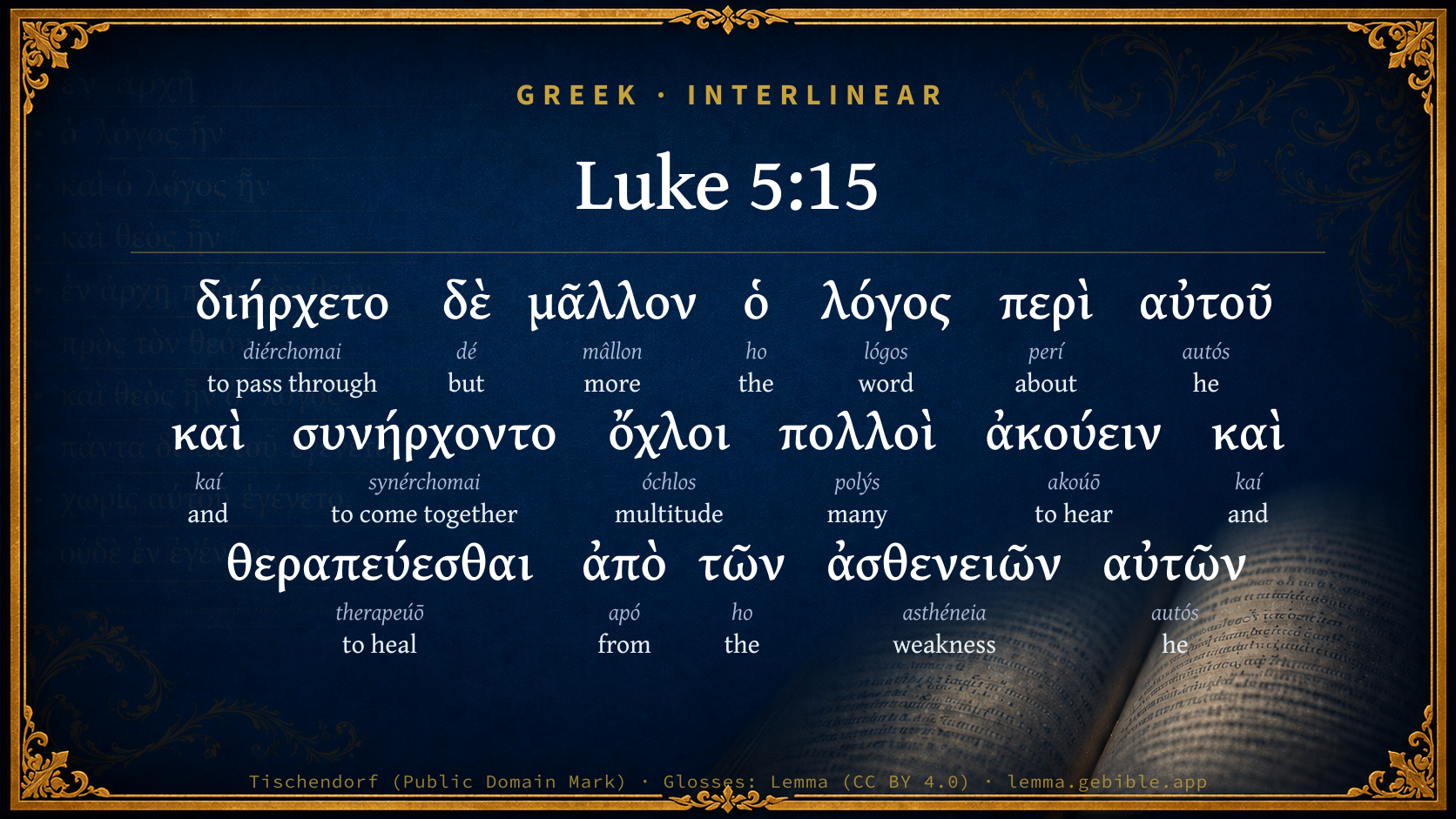
  1. διήρχετο diérchomai G1330 “to pass through” Verb, Imperfect, Middle or Passive deponent, Indicative, 3rd person, Singular
  2. δὲ dé G1161 “but” Conjunction
  3. μᾶλλον mâllon G3123 “more” Adverb
  4. ὁ ho G3588 “the” Article, Nominative, Singular, Masculine
  5. λόγος lógos G3056 “word” Noun, Nominative, Singular, Masculine
  6. περὶ perí G4012 “about” Preposition
  7. αὐτοῦ autós G846 “he” Personal pronoun, Genitive, Singular, Masculine
  8. καὶ kaí G2532 “and” Conjunction
  9. συνήρχοντο synérchomai G4905 “to come together” Verb, Imperfect, Middle or Passive deponent, Indicative, 3rd person, Plural
  10. ὄχλοι óchlos G3793 “multitude” Noun, Nominative, Plural, Masculine
  11. πολλοὶ polýs G4183 “many” Adjective, Nominative, Plural, Masculine
  12. ἀκούειν akoúō G191 “to hear” Verb, Present, Active, Infinitive
  13. καὶ kaí G2532 “and” Conjunction
  14. θεραπεύεσθαι therapeúō G2323 “to heal” Verb, Present, Passive, Infinitive
  15. ἀπὸ apó G575 “from” Preposition
  16. τῶν ho G3588 “the” Article, Genitive, Plural, Feminine
  17. αὐτῶν autós G846 “he” Personal pronoun, Genitive, Plural, Masculine

About this verse

These counts appear in no published source. They are computed here, from the morphology-tagged text and Lemma’s own curated glosses. What Lemma adds →

18
words
15
distinct lemmas
Gospels
section

Notable vocabulary

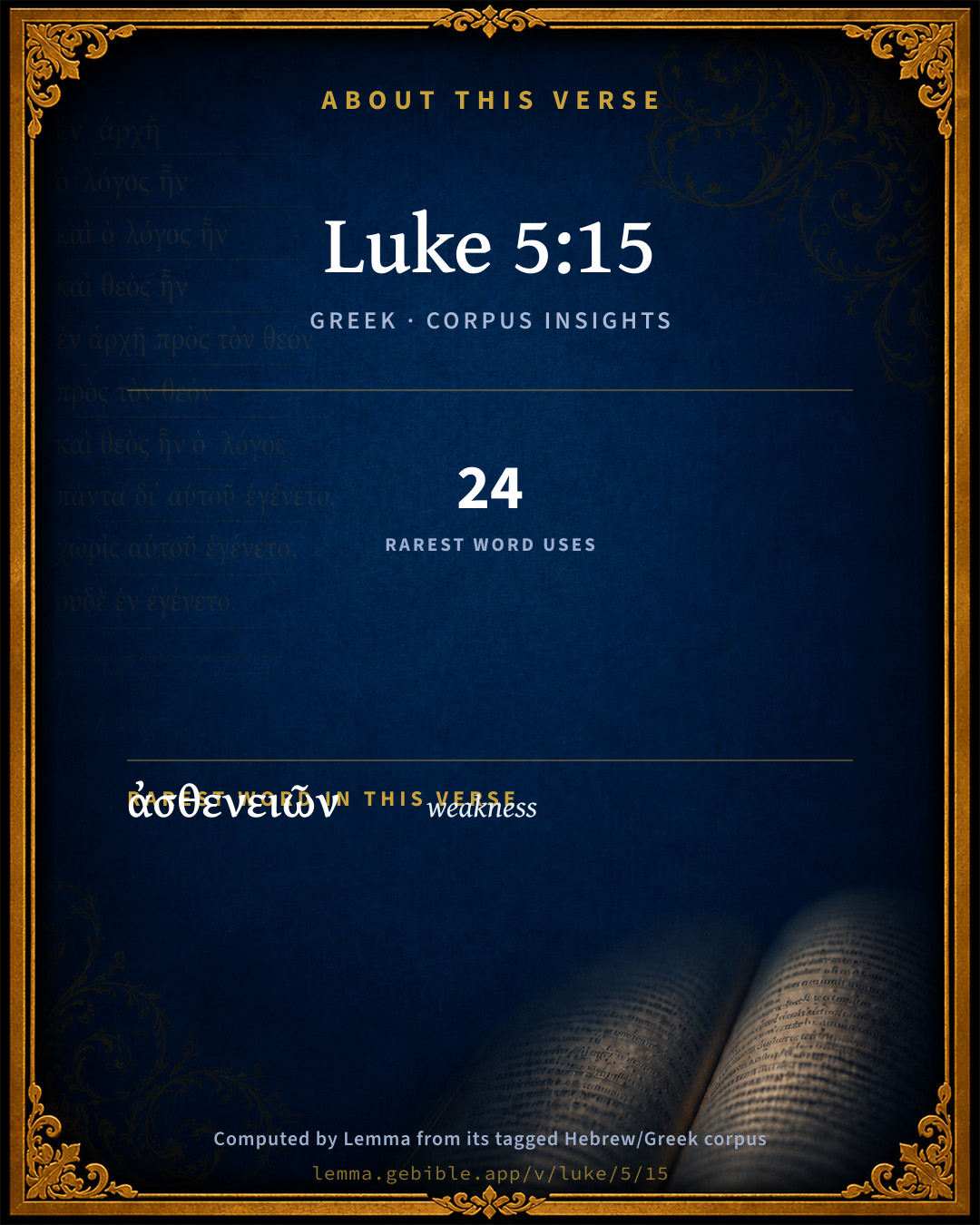
The rarest word here is ἀσθενειῶν weakness G769 — appearing just 24 times in the whole Greek New Testament.

Shared distinctive vocabulary

ἀσθενειῶν weakness G769 occurs in 23 verses of the Greek New Testament. Also found in:

Repetition

Words recur within this verse:

Cross-references

9

Topical passages linked to Luke 5:15 in the Treasury of Scripture Knowledge — connected by theme and wording, ordered by reader-vote popularity; previews shown in the World English Bible.

  • Matthew 15:30–31 Great multitudes came to him, having with them the lame, blind, mute, maimed, and many others, and they put them down at his feet. He healed them,
  • Luke 12:1 Meanwhile, when a multitude of many thousands had gathered together, so much so that they trampled on each other, he began to tell his disciples first of all, "Beware of the yeast of the Pharisees, which is hypocrisy.
  • Matthew 4:23–25 Jesus went about in all Galilee, teaching in their synagogues, preaching the Gospel of the Kingdom, and healing every disease and every sickness among the people.
  • Matthew 9:26 The report of this went out into all that land.
  • Mark 1:45–2:2 But he went out, and began to proclaim it much, and to spread about the matter, so that Jesus could no more openly enter into a city, but was outside in desert places: and they came to him from everywhere.
  • Mark 1:28 The report of him went out immediately everywhere into all the region of Galilee and its surrounding area.
  • Proverbs 15:33 The fear of Yahweh teaches wisdom. Before honor is humility.
  • Mark 3:7 Jesus withdrew to the sea with his disciples, and a great multitude followed him from Galilee, from Judea,
  • Luke 14:25 Now great multitudes were going with him. He turned and said to them,

Cross-references courtesy of OpenBible.info (CC BY 4.0).

Where the printed editions differ

1 variant

Places in this verse where the major printed Greek editions disagree on the wording in a way that affects the translation — a comparison of editions, not a manuscript-by-manuscript collation. The editions are the modern critical texts (Nestlé-Aland 28/27, SBL, Westcott-Hort, Tregelles, Tyndale House) and the traditional texts behind the KJV (the Textus Receptus and the Byzantine/Majority text). It is not a claim about which reading is original.

  1. Extra text
    ὑπ᾽ αὐτοῦ

    “by him”

    In TRByz Not in NA28NA27TynSBLWHTreg

    ὑπ᾽ αὐτοῦ (hup᾽ autou) 'by him' is only in traditional manuscripts (TR+Byz)

Textual data: Translators Amalgamated Greek New Testament (STEPBible TAGNT) · CC BY 4.0.

Commentary

Notes on Luke 5:15 from classic Christian and Jewish commentators (each source and its license shown beneath its notes). The classic Christian expositions comment on the surrounding passage and are grouped to its opening verse, so a note may address several verses; the Jewish commentaries on the Tanakh (Rashi and others) are per-verse, so they appear only where the commentator wrote on this verse.

Lemma curates 59 commentaries, every one of them public domain or Creative Commons licensed, each selected and text-cleaned for this edition rather than reprinted as found. About our sources →

The Biblical Illustrator

Joseph S. Exell

Luk_5:12; Luk_5:15

Behold a man full of leprosy

The leper cleansed

I.

LEPROSY AFFORDS A STRIKING REPRESENTATION OF THE CHARACTER AND CONSEQUENCE OF SIN.

1. This spiritual leprosy has rendered all our race unclean in the sight of God and in the judgment of His holy law.

(1) It shuts us out from His presence,

(2) and from a place among His people.

2. No skill or power of man can cure this disease.

3. This malady, if not healed, will issue in death. And remember, death is not cessation of being, but a state of awful terror, pain, and wretchedness. This is the issue to which sin is bringing its victims.

4. Yet, thank God, our case is not altogether hopeless; there is a cure.

II. OBSERVE THE STEPS TAKEN BY THIS LEPER TO OBTAIN A CURE. Thus we may learn what the disposition is, in which we should endeavour to approach the Saviour, who alone can heal our spiritual leprosy.

1. The first thing I would notice in this lepers conduct is the eagerness and haste with which he ran to Jesus immediately he met Him.

2. His reverential selfabasement. His eagerness in seeking relief did not cause him to forget what was due to the character of Him from whom that relief was sought.

3. The confidence he entertained of Christs power. Have not we far stronger grounds for this than he had? (J. Harding, M. A.)

Two pulpits

I. Observe HOW MANY ANONYMOUS BELIEVERS THERE ARE IN THE BIBLE RECORD WHO GIVE HELP ALL ALONG THE AGES. Here are mentioned multitudes, and among them two persons in particular--a leper and a paralytic. And that is all we know about any individual to whom that eventful day was the beginning of renewed life. No name, no history, no after career; but we suppose that these cripples are in heaven now, and we know that their story has helped thousands to be patient and cheerful on the way thither. It is of little consequence who we are; it matters more what we are.

II. EVEN IN EXTREME HOPELESSNESS OF DISEASE ONE MAY EXHIBIT A SUPREME AND ILLUSTRIOUS FAITH. The cases of these two men were as bad as they could well be; yet did our Lord find in them faith enough to be healed. In the rooms of the American Tract Society, in New York, are still standing two objects which I studied for some meditative years, once a month, at a committee meeting. One is a slight framework of tough wood, a few feet high, so bound together with hasps and hinges as to be taken down and folded in the hand. This was Whitefields travelling-pulpit--the one he used when, denied access to the churches, he harangued the thousands in the open air, on the moors of England. You will think of this modern apostle, lifted up upon the small platform, with the throngs of eager people around him, or hurrying from one field to another, bearing his Bible in his arms; ever on the move, toiling with Herculean energy, and a force like that of a giant. There, in that rude pulpit, is the symbol of all which is active and fiery in dauntless Christian zeal. But now, look again: in the centre of this framework, resting upon the slender platform, where the living preacher used to stand, you will see a chair--a plain, straight-backed, armed, cottage-chair--rough, simple, meagrely cushioned, unvarnished, and stiff. It was the seat in which Elizabeth Wallbridge, the dairymans daughter, sat and coughed and whispered, and from which she went only at her last hour to the couch on which she died. Here again is a pulpit; and it is the symbol of a life quiet and unromantic and hard in all Christian endurance. Every word that invalid woman uttered--every patient night she suffered--was a gospel sermon. In a hundred languages, the life of that servant of God has preached to millions of souls the riches of Christs glory and grace. And of these two pulpits, which is the most honourable is known only to God, who undoubtedly accepted and consecrated them both. The one is suggestive of the ministry of speech, the other of the ministry of submission.

III. AN EXPLANATION OF THE MYSTERY AND THE PURPOSE OF SUFFERING. Pain is a sort of ordination to the Christian ministry. Pure submission is as good as going on a foreign mission. Souls may be won to the Cross by a life on a sick-bed just as well as by a life in a cathedral desk.

IV. Hence, we may easily learn WHAT SHOULD BE THE CHIEF OCCUPATION OF AN INVALID. NO one can preach from any pulpit without the proper measure of study. He must thoughtfully ascertain what will make his efforts most pertinent.

1. He will study doctrine.

2. He will study experience, too.

A month ago I saw a brave soldier of the Cross who had been passing through a fiery history of years with broken health, which had taken him from the pulpit of his usefulness and bidden him look into the grave season after season. He was now only able to stand, and sought a new field. Only yesterday he visited me again; in his feebleness he lay on my couch while he talked. He had just come from putting the wife of his manhood, his patient helper and the stay of his home, in the bedlam of a madhouse. Poor in spirit and poor in purse, broken-hearted and alone, he feared he should break again. Yet there he lay, and spoke hopefully and gently. Oh, that valiant brother, quivering in every muscle, but bold and firm in his trustful courage, preached to me in my study as I know I never preached in my church!

V. Some people recover from long illness; Christ heals them, as He did these men in the story. So there is one more lesson for convalescents: WHAT ARE THEY GOING TO DO WITH THEIR LIVES HEREAFTER? It is a solemn thing to die, said Schiller, but it is a more solemn thing to live. We know the story of the Scotch mother, whose child an eagle stole away; half maddened she saw the bird reach its eyrie far up the cliff. No one could scale the rock. In distraction she prayed all the day. An old sailor climbed after it, and crept down dizzily from the height. There, on her outstretched arms, as she plod with closed eyes, he laid her babe. She rose in majesty of self-denial and took it (as she had been taught in that land) to her minister. She would not kiss it till it had been solemnly dedicated unto God I What shall a man do with a life given back to him? (C. S.Robinson, D. D.)

What has God done to save me?

The divinely-offered key to a right appreciation of Christs spiritual work, even to that which theologians call the Atonement, should be sought by observing how our Lord cleansed the lepers, made the blind to see, and the lame to walk. Let us endeavour to realize how He, whose name is the only name given under heaven among men whereby we may be saved, healed mens diseases, in order that we may understand, so far as it has been revealed, how He saves us from our sins.

I. CONSIDER, FIRST, WHY JESUS HEALED. Not to show that He could, but because He pitied the sufferer. When asked to work miracles to prove His ability to do so, He habitually declined. Every act of healing wrought by Christ was an act of pure compassion. He never healed to attract attention to Himself. He often commanded those He healed to say nothing of their cure.

II. CONSIDER, NEXT, HOW JESUS HEALED.

1. The fact that He had compassion upon them was itself the first step in the cure of many who came to Him. There are diseases in which recovery must begin by regaining lost self-respect. In Christ the most dissolute and disgraced found not only pity, but delicate considerateness. Think, e.g., of His treatment of this leper. We can scarcely conceive what the effect must have been upon a man who had for years been closeted with his loathsome self, or with still more loathsome fellow-sufferers--a man who might not eat with human beings unless the same deadly taint was upon them, nor appear in the street except jangling a bell to give warning of the peril his presence brought; who, if he patted upon the head a carrion dog, it must be instantly killed, lest it should brush against others and defile them, because he had touched it; who, if he saw his mother, his child, his wife approach, must fly or shout, Unclean, unclean! Keep afar! We can scarcely conceive what the effect must have been upon such a man, when he saw Jesus draw nigh. The multitude attending the Saviour falls back as men shrink from the plague; for crowds are always cowards. But the Master approaches, and, paying no heed to the jangling bell, the warning cry, lays His hand upon him. For the first time for years the leper feels the touch of a hand that is not hardened by the awful malady. That touch must have made the leper a new man in heart before the quickened pulse could shoot new life into the decaying limbs.

2. In healing, Christ made effort. One must be blind to read the New Testament, and fancy Christs cures cost Him nothing because He was Divine. It was because He was Divine that they cost Him so much. If you would seek beings incapable of suffering, you must not go up toward the angels and the great white throne, for there you will find the Lamb as it had been slain, but down among the oysters. Do you ask, How did Christ bear mens diseases? Thus: He sighed, He prayed, He lifted them in His arms, He put His hands upon them, He drew them to His bosom, He groaned, He felt His strength go from Him, to heal their bodies. If He had done less, He would not have made manifest the longsuttering God; and His saving mens bodies, His bearing their infirmities and healing their diseases, would have been no illustration of the agony with which He wrestled in Gethsemane for the salvation of their souls.

3. In many instances Jesus employed known remedies in physical healing. He manipulated the palsied tongue and the stopped ears--put His fingers in the ears, touched the tongue. He covered the blind eyes with moist clay, a well-known Egyptian remedy for ophthalmia. He inquired minutely the symptoms of the demoniac boy. He bent over those He healed, He touched them, as careful physicians do. Thus He encouraged, not the breach, but the observance of Gods order. He put honour, by His example, upon the use of scientific remedies. At times He healed by a word, without approaching the sick one. But He seems to have dispensed with remedies only when to employ them was impossible, or when they would have been obviously useless, or when there was a special reason for neglecting them. His example said to those apostles to whom miraculous powers were given, Use the best means; pray God to bless their use; and when you can do nothing more, pray. And that is what every wise and instructed Christian tries to do.

4. In all Christs healings there was conspicuously revealed the authority of absolute power. When He spoke, devils obeyed, the dead heard, the despairing hoped, the lost knew that they were found. (William B. Wright.)

The touch of Christ; or, the power of sympathy

A lady visiting an asylum for friendless orphan children lately watched the little ones go through their daily drill superintended by the matron, a firm, honest woman, to whom her duty had evidently become a mechanical task. One little toddler hurt her foot, and the visitor, who had children of her own, took her on her knee, petted her, made her laugh, and kissed her before she put her down. The other children stared in wonder. What is the matter? Does nobody ever kiss you? asked the astonished visitor. No; that isnt in the rules, maam, was the answer. A gentleman in the same city, who one morning stopped to buy a newspaper from a wizened, shrieking newsboy at the station, found the boy following him every day thereafter, with a wistful face, brushing the spots from his clothes, calling a car for him, &c. Do you know me? he asked at last. The wretched little Arab laughed. No; but you called me my child one day. Id like to do something for you, sir. I thought before that I was nobodys child. Christian men and women are too apt to feel when they subscribe to organized charities that they have done their duty to the great army of homeless, friendless waifs around them. A touch, a kiss, a kind word, may do much towards saving the neglected little one who feels he is nobodys child, teaching it, as no money can do, that we are all children of one Father. When Christ would heal or help the poor outcast, He did not send him money, but He came close and touched him.

A lepers logic

This man apparently had no doubt of our Lords ability to heal him. It was about Christs willingness that he was in doubt. As a rule, men do not naturally associate love and power; they believe in the existence of power far more readily than in that of love. Power seems to create distrust in love.

1. Perhaps because the world is so used to seeing power used arbitrarily and selfishly.

2. Because of the consciousness of sin. It was when Peter saw the Divine power of Christ displayed in the draught of fishes that he said, Depart from me, &c. And in the light of this fact, the incident of our text has a peculiar force; for--

I. THE DISEASE FROM WHICH THIS MAN WAS SUFFERING WAS REPRESENTATIVE OF SIN. It was a decomposition of the vital juices, putrefaction in a living body; hence an image of death. The leper was treated throughout as a sinner. He was a dreadful parable of death. The case of this leper, therefore--

II. GAVE OUR LORD AN OPPORTUNITY, NOT ONLY TO DO A WORK OF MERCY AND LOVE UPON A DISEASED MAN, BUT ALSO TO GIVE A SYMBOLIC TESTIMONY OF HIS WILLINGNESS TO DEAL LOVINGLY AND FORGIVINGLY WITH A SINFUL MAN. Let US see how Christs willingness comes out in this incident.

1. It is not repelled by an imperfect faith.

2. It was shown in Christs express declaration. How striking is the way in which He meets that timid If Thou wilt with I will. (M. R. Vincent, D. D.)

If Thou wilt

When the leper said, If Thou wilt, he narrowed his appeal, and directed it to the will of Jesus. His faith in Christs power was very much stronger that his faith in Christs goodness. It contained much that was true, but did not contain much more that was equally true. Christ answered, not according to the imperfection of the appeal, but according to its possibility of being perfected. If Thou wilt is fitting language for us, not because we doubt His goodness, but because we believe in His wisdom. If we learn that it is Gods will that we should suffer and have disappointment, we hope amidst our pain, and know that our disappointment is after all the appointment of the wiser still, and that, whatever may be in the meantime withheld, the answer will be given at last, Be thou clean. (J. Ogmore Davies)

Leprosy

I. PHYSICAL ASPECT.

1. White pustules--eat away flesh--attacking one member after another--at last the bones.

2. Attended with sleeplessness, nightmare, and hopelessness of cure.

3. A living death.

II. SOCIAL ASPECT.

1. Contagion.

2. Lived in a several house, or in bands at a distance from ordinary dwelling.

3. Went with head uncovered, crying, Room for the leper.

III. RELIGIOUS ASPECT.

1. Excommunication--no communion with the commonwealth of Israel.

2. In every way a type of the impenitent sinner. For--

3. Sin is a living death; contagious, and separates from God. (F. Godet, D. D.)

Socially restored, as well as morally

And He charged him to tell no man. Assume that the true state of the case was that Jesus wrought a cure, and left it to the priest to declare the patient cured, and all becomes clear, natural, and Christlike. Two things had to be done to make the benefit complete--the disease had to be healed, whereby the sufferer would be delivered from the physical evil; and it had to be authoritatively declared healed, whereby the sufferer would be delivered from the social disabilities imposed by the law upon lepers. Jesus conferred one-half of the blessing, and He sent the leper to the priest to receive from him the other half. He did this, not in ostentation, or by way of precaution, but chiefly, if not exclusively, out of regard to the mans good, that he might be restored, not only to health, but to society. Hence, also, the injunction of silence. The prevention of unhealthy excitement among the people was only a secondary aim. The primary end concerned the man healed. Jesus wished to prevent him from contenting himself with half the benefit, rejoicing in restored health, and telling everybody he met about it, and neglecting the steps necessary to get himself universally recognized as healed. (A. B. Bruce, D. D.)

Show thyself to the priest, &c.

A certificate of the recovery of a leper could only be given at Jerusalem, by a priest, after a lengthened examination, and tedious rites. It will illustrate the bondage of the ceremonial law, as then in force, to describe them. With his heart full of the first joy of a cure so amazing, the leper had to set off to the Temple for the requisite papers to authorize his return, once more, to the roll of Israel. A tent had to be pitched outside the city, and in this the priest examined the leper, cutting off all his hair with the utmost care; for, if only two hairs were left, the ceremony was invalid. Two sparrows had to be brought at this first stage of the cleansing--the one, Go be killed over a small earthen pan of water, into which its blood must drop; the other, after being sprinkled with the blood of its mate--a cedar twig, to which scarlet wool and a piece of hyssop (Psa_51:1) were bound, being used to do so--was let free in such a direction that it should fly to the open country. After the scrutiny by the priest, the leper put on clean clothes, and carried away those he had worn to a running stream to wash them thoroughly, and to cleanse himself by a bath. He could now enter the city, but for seven days more could not enter his own house. On the eighth day he once more submitted to the scissors of the priest, who cut off whatever hair might have grown in the interval. Then followed a second bath; and now he had only carefully to avoid any defilement, so as to be fit to attend in the Temple next morning, and complete his cleansing. The first step in this final purification was to offer three lambs, two males and a female, none of which must be under a year old. Standing at the outer edge of the court of the men, which he was not yet worthy to enter, the leper awaited the longed-for rites. These began by the priest taking one of the male lambs destined to be slain as an atonement for the leper, and handing it to each point of the compass in turn, and by his swinging a vessel of oil on all sides in the same way, as if to present both to the universally-present God. He then led the lamb to the leper, who laid his hands on its head, and gave it over as a sacrifice for his guilt, which he now confessed. It was forthwith killed at the north side of the altar, two priests catching its blood, the one in a vessel, the other in his hand. The first now sprinkled the altar with the blood, while the other went to the leper and anointed his ears, his right thumb, and his right toe with it. The one priest then poured some oil of the lepers offering into the left hand of the other, who, in his turn, dipped his finger seven times into the oil thus held, and sprinkled it as often towards the Holy of Holies. Each part of the leper which before had been touched with the blood was then further anointed with the oil, what remained being stroked on his head. The leper could now enter the mens court, and did so, passing through it to that of the priests. The female lamb was next killed, as a sin-offering, after he had put his hands on its head, part of its blood being smeared on the horns of the altar, while the rest was poured out at the altar-base. The other male lamb was then slain for a burnt-sacrifice; the leper once more laying him hands on its head, and the priests sprinkling its blood on the altar. The fat, and all that was fit for an offering, was now laid on the altar, and burned as a sweet-smelling savour to God. A meal-offering of fine wheat meal and oil ended the whole; a portion being laid on the altar, while the rest, with the two lambs, of which only a small part had been burned, formed the dues of the priest. It was not till all this had been done that the full ceremony of cleansing, or showing himself to the priests, had been carried out, and that the cheering words, Thou art pure, restored the sufferer once more to the rights of citizenship and of intercourse with men. No wonder that even a man like St. Peter, so tenderly minded to his ancestral religion, should speak (Act_15:10) of its requirements as a yoke which neither our fathers nor we are able to bear. (Dr. Geikie.)

The moral of Luk_5:14

Unless we show ourselves to whomsoever is our priest after our healings and cleansings, and after the gift which is commanded us, we are less pure for having been so cleansed, and more diseased for having been so healed. There can be no greater evil than to be prosperous without being prayerful, and strong without being Godlike. You should never finish your successful commercial enterprise with the balancing of your account at the bank. The only duty of your restored vigour is not merely to pay your doctors bill. Your healing and your prospering are from Israels God; you had better tell Him of them, and tell Him without much ado with man by the way. Tell no man until you know how to speak devoutly, and see no man until you have seen God. You must obey with the new strength before you are free in the use of it. (J. Ogmore Davies.)

Luk_5:15

A fame abroad of Him

True popularity

That distinguished and excellent judge, Lord Mansfield, once observed: True popularity is not that popularity which is followed after, but the popularity which follows after.

A fruitless expedient to prevent overcrowding

Dr. Chalmers, when large audiences attended his services, sometimes announced in the morning that he would repeat the same sermon in the afternoon. On one occasion when he had made that announcement Dr. Wardlaw was present, and gives us an account of the scene. It was on one Sabbath evening. The seats were occupied an hour before the time, and the doors were closed and bolted. An immense crowd was without, and as soon as Chalmers opened the vestry door, in spite of the keepers, the front door was forced open and the crowd rushed in, completely filling all the vacant space. Chalmers was grieved, and administered a sharp rebuke to the audience. Walking home with him, Chalmers said to Wardlaw, I preached the same sermon in the morning, and, for the very purpose of preventing the annoyance of such a densely-crowded place, I intimated that I should preach it again in the evening. Have you ever tried that plan? Wardlaw says: I did not smile. I laughed outright. No, no, I replied. My good friend, there are but very few of us that are under the necessity of having recourse to the use of means for getting thin audiences. (Bishop Simpson.)

The Biblical Illustrator, edited by Joseph S. Exell (c. 1880s–1900s) — public domain. Text from a community e-Sword module.

Bengel's Gnomon

Johann Albrecht Bengel

Luk 5:15. Θεραπεύεσθαι, to be healed) The verb is middle [and therefore means more strictly, to have themselves healed].

Bengel's Gnomon of the New Testament — English translation (T&T Clark, Edinburgh, 1860) — public domain. Text from a community e-Sword module.

Meyer's Critical & Exegetical Commentary

Heinrich August Wilhelm Meyer

Luk_5:15-16. Comp. Mar_1:45.

διήρχετο] The report ran throughout, was spread abroad. So absolutely, Thuc. vi. 46: ἐπειδὴ διῆλθεν ὁ λόγος, ὅτι κ.τ.λ.; Soph. Aj. 978; Xen. Anab. i. 4. 7; Plat. Ep. vii. p. 348 B.

μᾶλλ.] in a still higher degree than before; only all the more. Comp. Luk_18:39. See Stallbaum, ad Plat. Ap. p. 30 A; Nägelsbach on the Iliad, ed. 3, p. 227.

αὐτός] He, however, He on his part, in contrast with the multitudes who were longing for Him.

ἦν ὑποχωρῶν ἐν τοῖς ἐρημ.] i.e. He was engaged in withdrawing Himself into the desert regions (that were there), and in praying, so that He was therefore for the present inaccessible.

καὶ προσευχόμενος] This detail is given on several occasions by Luke alone. See Luk_3:21, Luk_6:12 f., Luk_9:18; Luk_9:29, and elsewhere.

Meyer — Critical and Exegetical Commentary on the New Testament — English translation by Peter Christie, edited by Frederick Crombie (T&T Clark, 1880) — public domain. Text from a community e-Sword module.

Expositor's Greek Testament

ed. W. Robertson Nicoll

Luk 5:15 . ἀκούειν , to hear, but not the word as in Luk 5:1 , rather to hear about the wonderful Healer and to get healing for themselves ( θεραπεύεσθαι ).

The Expositor's Greek Testament, edited by W. Robertson Nicoll (1897–1910) — public domain. Text from a community e-Sword module.

Godet's Commentaries

Frédéric Louis Godet

3. The Paralytic: Luk 5:15-26.—1 st. A general description of the state of the work, Luk 5:15-16; Luke 2 d. The cure of the paralytic, Luk 5:17-26.

1 st. Luk 5:15-16.

While seeking to calm the excitement produced by His miracles, Jesus endeavoured also to preserve His energies from any spiritual deterioration by devoting part of His time to meditation and prayer. As Son of man, He had, in common with us all, to draw from God the strength He needed for His hours of activity. Such touches as these in the narrative certainly do not look like an apotheosis of Jesus, and they constitute a striking difference between the evangelical portrait and the legendary caricature.

This thoroughly original detail suffices also to prove the independence of Luke’s sources of information.

After this general description (the seventh), the narrative is resumed with a detached and special incident, given as an example of the state of things described.

Frédéric Louis Godet — Commentaries on Luke, John, Romans, and 1 Corinthians — English translation (T&T Clark, Edinburgh, 1870s–1890s) — public domain. Text from a community e-Sword module.

Geneva Bible (1599)

Geneva Bible translators

Christ had rather be famous by his doctrine, than by miracles, and therefore he departeth from them that seek him, as a physician of the body, and not as the author of salvation.

Geneva Bible (1599) marginal notes — public domain. Text via Bolls.life.

Jamieson, Fausset & Brown

Robert Jamieson, A. R. Fausset & David Brown

LEPER HEALED. (Luk 5:12-16)

But so, &c.--(See Mar 1:45).

Jamieson, Fausset & Brown — Commentary Critical and Explanatory on the Whole Bible (1871) — public domain (CC PDM 1.0). Text via the HelloAO Bible API.

Ellicott's Commentary for English Readers

(15) So much the more.—The statement agrees with St. Mark, St. Matthew closing his account with the command given to the leper. Both the verbs, “went” and “came together,” are in the tense that implies continuous action.

A Bible Commentary for English Readers, edited by Charles John Ellicott (1878–1897) — public domain. Text from a community e-Sword module.

The Cambridge Bible for Schools and Colleges

gen. ed. J. J. S. Perowne

15. so much the more went there a fame abroad] It is clear therefore that the leper disobeyed his strict injunction. Such disobedience was natural, and perhaps venial; but certainly not commendable.

great multitudes came together … to be healed] Thus in part defeating our Lord’s purpose.

The Cambridge Bible for Schools and Colleges (gen. ed. J. J. S. Perowne; Cambridge University Press, 1878–1918) — public domain. Text from a community e-Sword module.

John Gill's Exposition

But so much the more went there a fame abroad of him,.... For the more he charged the man to keep silence, the more he blazed it abroad, being elated with the cure he received, and filled with gratitude to his benefactor; Mar 1:45.

And great multitudes came together to hear: him, or from him, as the Syriac, Arabic, Persic, and Ethiopic versions add; to hear the doctrines of the Gospel preached by him: "and to be healed by him of their infirmities"; their bodily weaknesses and disorders.

John Gill's Exposition of the Whole Bible (1746–1763) — public domain (CC PDM 1.0). Text via the HelloAO Bible API.

Trapp's Complete Commentary

John Trapp

15 But so much the more went there a fame abroad of him: and great multitudes came together to hear, and to be healed by him of their infirmities.

Ver. 15. But so much the more] Fame follows them that comes from it, and the contrary: as the crocodile doth.

John Trapp, A Commentary or Exposition upon All the Books of the Old and New Testament (1647–1656) — public domain. Text from a community e-Sword module.

The Pulpit Commentary

But so much the more went there a fame abroad of him: and great multitudes came together to hear, and to be healed by him of their infirmities. It is evident that his wishes and commands were neglected, possibly out of a mistaken feeling of gratitude. The result was that his work of teaching was hindered by the crowds who resorted to him at once as a Physician of extraordinary power. But he had graver and much more important work before him than even the blessed task of relieving suffering. So he withdrew himself, says our evangelist, and again spent a short season in solitude and prayer.

The Pulpit Commentary (1880–1919), ed. H.D.M. Spence-Jones & Joseph S. Exell — public domain. Text from a community e-Sword module.

unfoldingWord translationNotes

Door43 World Missions Community

the report about him

"the news about Jesus." This could mean either "the report about Jesus' healing the man with leprosy" or "the report about Jesus' healing people."

the report about him spread even farther

"the report about him went out even farther." This can be stated in active form. AT: "people kept telling the news about him in other places" (See: Active or Passive)

the deserted places

"lonely places" or "places where there were no other people"

translationWords

report

teach

cure

pray

unfoldingWord translationNotes — © Distant Shores Media and the Door43 World Missions Community, licensed CC BY-SA 4.0. Source: git.door43.org/Door43/en_tn.

Cambridge Greek Testament for Schools and Colleges

15. διήρχετο δὲ μᾶλλον ὁ λόγος περὶ αὐτοῦ. ‘But the talk about Him spread the more.’ This is a classical use of διέρχομαι, Soph. Aj. 978; Thuc. VI. 46. It is only used once again by St Luke (Act 5:34) and once by St Paul (1Ti 1:7). It is clear that the leper disobeyed the strict injunction of Jesus, as St Mar 1:45 emphatically records. Such disobedience was natural, and perhaps venial; but certainly not commendable.

συνήρχοντο ὄχλοι πολλοὶ … θεραπεύεσθαι. Thus in part defeating our Lord’s purpose.

Cambridge Greek Testament for Schools and Colleges (Cambridge University Press, 1896; 21 vols, various authors incl. Carr, Maclear, Plummer, Farrar, Lumby, Moule, M. R. James, Simcox) — public domain. Text from a community e-Sword module.

Alford’s Greek Testament

Henry Alford

15.] The reason of this is stated in Mark, ver. 45, to be the disobedience of the leper to the Lord’s command.

Henry Alford, The Greek Testament (1849–1861) — public domain. Text from a community e-Sword module.

International Critical Commentary

15. διήρχετο δὲ μᾶλλον ὁ λόγος περὶ αὐτοῦ. Lk. does not state, as Mk. does, that this was owing to the man’s disobedience. Mt. omits both points. This use of διέρχομαι of the spreading of a report is quite classical (Thuc. vi. 46, 5; Xen. Anab. i. 4, 7). The word is a favourite one with Lk.; see on 2:15. The μᾶλλον means “more than before, more than ever” (Joh 5:18, Joh 19:8), or “all the more,” because of the command not to tell (18:39; Act 5:14, Act 9:22, Act 22:2).

συνήρχοντο ὄχλοι πολλοὶ ἀκούειν καὶ θεραπεύεσθαι ἀπὸ τῶν ἀσθενειῶν. For miracles mentioned as being numerous, but without details, comp. 4:40, 6:18, 7:21. The constr. θεραπεύεσθαι ἀπό is peculiar to Lk. (7:21, 8:2). The usual constr. with θερ. is the acc. (4:23, 40, 9:1, etc.). For ἀσθενειῶν comp. 8:2, 13:11, 12; Act 28:9; Heb 11:34, where we have a similar constr., ἐδυναώθησαν ἀπὸ ἀσθενείας

International Critical Commentary — older volumes (1896–1929), various authors — public domain. Text from a community e-Sword module.

Vincent's Word Studies in the New Testament

Marvin R. Vincent

Went abroad [διηρχετο] . Dia, throughout the region. Wyc., the word walked about.

Came together [συνηρχοντο] Imperfect. Kept coming together, or were coming.

To be healed [θεραπευεσθαι] . Originally, to be an attendant, to do service; and therefore of a physician, to attend upon, or treat medically. In classical writers it has also the meaning to heal, as undoubtedly in the New Testament, and in Luke (xiii. 14; Act 4:14, etc.). See on Mt 8:7, and compare ijaomai, to heal, in verse 17.

Infirmities [ασθενειων] . A strictly literal rendering; aj, not, and sqenov, strength, exactly answering to the Latin in, not, and firmus, strong.

Marvin R. Vincent, Word Studies in the New Testament (1887–1900) — public domain. Text from a community e-Sword/MySword module.

Lesson kit

Teaching starters — assembled from the data on this page, not authored interpretation. Every prompt links to the verse data it draws on. Edit before teaching.

Luke, in the Gospels, opens this verse with 18 words (15 distinct Greek lemmas). Its most distinctive word is asthéneia (“weakness”). A historical commentator’s framing appears above. Read the whole chapter for the surrounding context.

Discussion questions

  1. What does “weakness” (asthéneia) contribute to the verse as a whole?
  2. Matthew 8:17 shares the word «weakness» with this verse. How do the two illuminate each other?
  3. “the” occurs 2× in this one verse. What is the effect of the repetition?
  4. These translations render this verse differently; the difference is in the English rendering, not the original. What questions does that raise?
  5. Reading how The Biblical Illustrator and Bengel's Gnomon read this verse, where do the two commentators agree and where do they part?

Things to notice

Reading settings

Reading text

Shown beneath each verse's original-language words.

Old Testament
Old Testament edition

Read the OT as the Masoretic Hebrew (MT) or the Greek Septuagint (LXX).

English shown for the Greek Septuagint (in the Hebrew ↔ Greek comparison).

Comparing translations? Open the Compare panel on any verse page to stack up to four side by side.