

Mark 10:22
Greek (Tischendorf 8th ed.) Mark 10:22 appears in the Greek New Testament. The text above is from the Tischendorf 8th edition. Each word links to its Strong’s number and a concise gloss. Click any word for its full Thayer’s Greek Lexicon entry.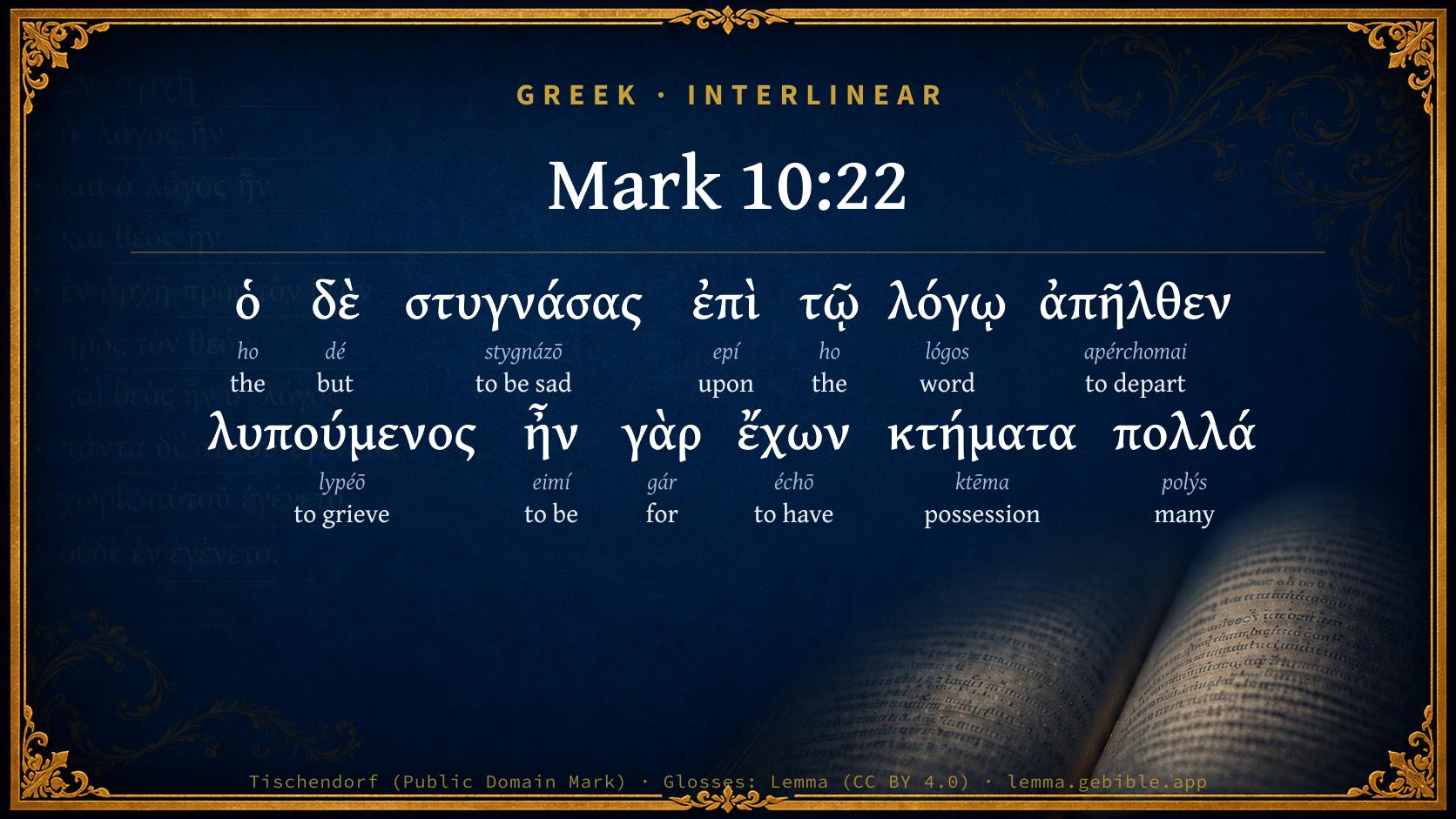
But his face fell at that saying, and he went away sorrowful, for he was one who had great possessions.
Download a study sheet
One document with this verse’s original text, its word-by-word gloss line, the meaning frame, cross-references with their text, attributed commentary, and full source and license credits — printable, and it pastes into notes with its structure intact.
This verse Autodidact and up
A passage Seminary Student
Up to 50 verses in one chapter. A passage sheet keeps up to 6 commentary sources and 12 cross-references per verse, in the order this page ranks them, and says so on the sheet whenever that leaves anything out. Ask for a single verse and you get the Autodidact verse sheet above.
Everything on this page stays free to read, with no account — the sheet is a download of what is already on screen, not access to it.
Compare translations 3
The same verse in 3 English versions, stacked beneath the original-language interlinear above. Click any original word for its lexicon entry.
Each is an independent rendering of the whole verse — the interlinear is not word-aligned to these translations.
Highlighted words mark where these versions differ — a whole-verse word diff, not a word-by-word alignment.
-
World English Bible Public Domain
But his face fell at that saying, and he went away sorrowful, for he was one who had great possessions.
-
King James Version Public Domain
And he was sad at that saying, and went away grieved: for he had great possessions.
-
unfoldingWord Literal Text CC BY-SA 4.0
But he, having become downcast at this word, went away being grieved, for he was having many possessions.
unfoldingWord Literal Text — © unfoldingWord, licensed CC BY-SA 4.0. Word-aligned USFM3 via Door43 (git.door43.org/unfoldingWord/en_ult).
Show all 19 translations
Every available English version of this verse, each an independent rendering of the whole verse.
-
World English Bible Public Domain
But his face fell at that saying, and he went away sorrowful, for he was one who had great possessions.
-
Berean Standard Bible Public Domain
But the man was saddened by these words and went away in sorrow, because he had great wealth.
-
Majority Standard Bible Public Domain
But the man was saddened by these words and went away in sorrow, because he had great wealth.
-
King James Version Public Domain
And he was sad at that saying, and went away grieved: for he had great possessions.
-
American Standard Version (1901) Public Domain
But his countenance fell at the saying, and he went away sorrowful: for he was one that had great possessions.
-
Revised Version (1885) Public Domain
But his countenance fell at the saying, and he went away sorrowful: for he was one that had great possessions.
-
Geneva Bible (1599) Public Domain
But hee was sad at that saying, and went away sorowfull: for he had great possessions.
-
Douay-Rheims (1899) Public Domain
Who being struck sad at that saying, went away sorrowful: for he had great possessions.
-
Young's Literal Translation Public Domain
And he -- gloomy at the word -- went away sorrowing, for he was having many possessions.
-
Literal Standard Version CC BY-SA 4.0
And he—gloomy at the word—went away sorrowing, for he was having many possessions.
-
Unlocked Literal Bible CC BY-SA 4.0
But because of this statement he looked very sad and he went away distressed, because he had many possessions.
-
unfoldingWord Literal Text CC BY-SA 4.0
But he, having become downcast at this word, went away being grieved, for he was having many possessions.
-
Darby Bible Public Domain
But he, sad at the word, went away grieved, for he had large possessions.
-
World Messianic Bible Public Domain
But his face fell at that saying, and he went away sorrowful, for he was one who had great possessions.
-
Webster's Bible Public Domain
And he was sad at that saying, and went away grieved: for he had great possessions.
-
Free Bible Version CC BY-SA 4.0
At this, the man's face fell, and he left feeling very sad, for he was very wealthy.
-
Bible in Basic English Public Domain
But his face became sad at the saying, and he went away sorrowing: for he was one who had much property.
-
Text-Critical English NT CC BY 4.0
But the man was dejected by what Jesus said and went away sorrowful, for he had many possessions.
-
Tyndale New Testament (1534) Public Domain
But he was discuforted with that sayinge and wet awaye morninge for he had greate possessions.
Literal Standard Version (2020), Covenant Press — licensed CC BY-SA 4.0. Text via the HelloAO Bible API (eBible.org). Unlocked Literal Bible (unfoldingWord) — licensed CC BY-SA 4.0. Text via the HelloAO Bible API (eBible.org). unfoldingWord Literal Text — © unfoldingWord, licensed CC BY-SA 4.0. Word-aligned USFM3 via Door43 (git.door43.org/unfoldingWord/en_ult). Free Bible Version, Dr. Jonathan Gallagher — licensed CC BY-SA 4.0. Text via the HelloAO Bible API (eBible.org).
Word by word
More ways to search: Search by grammar → Find every occurrence → Compare this word →
Practice this passage: Drill this verse → Learn its vocabulary →
- Appears 2× in the Greek New Testament
- First appears at Matthew 16:3
- Part of Speech
- Verb
- Tense
- Aorist
- Voice
- Active
- Mood
- Participle
- Case
- Nominative
- Number
- Singular
- Gender
- Masculine
Full Thayer's Definition
- ὁ ho G3588 “the” Article, Nominative, Singular, Masculine
- δὲ dé G1161 “but” Conjunction
- στυγνάσας stygnázō G4768 “to be sad” Verb, Aorist, Active, Participle, Nominative, Singular, Masculine
- ἐπὶ epí G1909 “upon” Preposition
- τῷ ho G3588 “the” Article, Dative, Singular, Masculine
- λόγῳ lógos G3056 “word” Noun, Dative, Singular, Masculine
- ἀπῆλθεν apérchomai G565 “to depart” Verb, Aorist, Active, Indicative, 3rd person, Singular
- λυπούμενος lypéō G3076 “to grieve” Verb, Present, Passive, Participle, Nominative, Singular, Masculine
- ἦν eimí G1510 “to be” Verb, Imperfect, Active, Indicative, 3rd person, Singular
- γὰρ gár G1063 “for” Conjunction
- ἔχων échō G2192 “to have” Verb, Present, Active, Participle, Nominative, Singular, Masculine
- κτήματα ktēma G2933 “possession” Noun, Accusative, Plural, Neuter
- πολλά polýs G4183 “many” Adjective, Accusative, Plural, Neuter
About this verse
These counts appear in no published source. They are computed here, from the morphology-tagged text and Lemma’s own curated glosses. What Lemma adds →
- 13
- words
- 12
- distinct lemmas
- Gospels
- section
Notable vocabulary
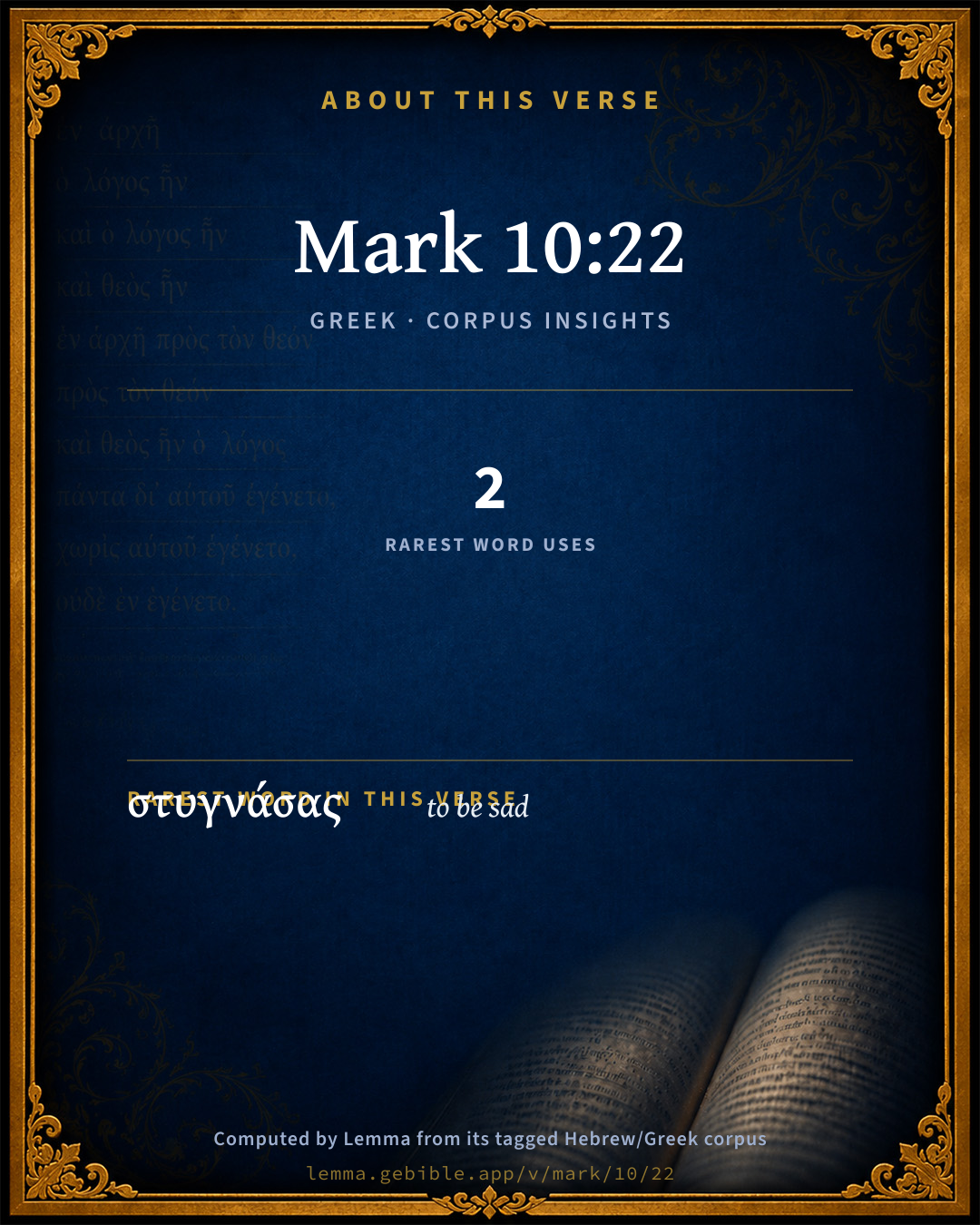
The rarest word here is στυγνάσας to be sad G4768 — appearing just 2 times in the whole Greek New Testament.
Shared distinctive vocabulary
στυγνάσας to be sad G4768 occurs in 2 verses of the Greek New Testament. Also found in:
Repetition
A word recurs within this verse:
- ὁ the G3588 ×2
Cross-references
18Topical passages linked to Mark 10:22 in the Treasury of Scripture Knowledge — connected by theme and wording, ordered by reader-vote popularity; previews shown in the World English Bible.
- 1 John 2:15–16 Don't love the world, neither the things that are in the world. If anyone loves the world, the Father's love isn't in him.
- 1 Timothy 6:9–10 But those who are determined to be rich fall into a temptation and a snare and many foolish and harmful lusts, such as drown men in ruin and destruction.
- Luke 12:15 He said to them, "Beware! Keep yourselves from covetousness, for a man's life doesn't consist of the abundance of the things which he possesses."
- Ephesians 5:5 Know this for sure, that no sexually immoral person, nor unclean person, nor covetous man, who is an idolater, has any inheritance in the Kingdom of Christ and God.
- 2 Timothy 4:10 for Demas left me, having loved this present world, and went to Thessalonica; Crescens to Galatia, and Titus to Dalmatia.
- Ezekiel 33:31 They come to you as the people comes, and they sit before you as my people, and they hear your words, but don't do them; for with their mouth they show much love, but their heart goes after their gain.
- Job 21:7–15 "Why do the wicked live, Become old, yes, and grow mighty in power?
- Matthew 13:22 What was sown among the thorns, this is he who hears the word, but the cares of this age and the deceitfulness of riches choke the word, and he becomes unfruitful.
- Matthew 19:22 But when the young man heard the saying, he went away sad, for he was one who had great possessions.
- Luke 18:23 But when he heard these things, he became very sad, for he was very rich.
- 2 Corinthians 7:10 For godly sorrow works repentance to salvation, which brings no regret. But the sorrow of the world works death.
- Genesis 13:5–11 Lot also, who went with Abram, had flocks, and herds, and tents.
- Deuteronomy 6:10–12 It shall be, when Yahweh your God shall bring you into the land which he swore to your fathers, to Abraham, to Isaac, and to Jacob, to give you, great and goodly cities, which you didn't build,
- Deuteronomy 8:11–14 Beware lest you forget Yahweh your God, in not keeping his commandments, and his ordinances, and his statutes, which I command you this day:
- Matthew 27:3 Then Judas, who betrayed him, when he saw that Jesus was condemned, felt remorse, and brought back the thirty pieces of silver to the chief priests and elders,
- Mark 6:26 The king was exceedingly sorry, but for the sake of his oaths, and of his dinner guests, he didn't wish to refuse her.
- Matthew 27:24–26 So when Pilate saw that nothing was being gained, but rather that a disturbance was starting, he took water, and washed his hands before the multitude, saying, "I am innocent of the blood of this righteous person. You see to it."
- Mark 6:20 for Herod feared John, knowing that he was a righteous and holy man, and kept him safe. When he heard him, he did many things, and he heard him gladly.
Cross-references courtesy of OpenBible.info (CC BY 4.0).
Lesson kit
Teaching starters — assembled from the data on this page, not authored interpretation. Every prompt links to the verse data it draws on. Edit before teaching.
Mark, in the Gospels, opens this verse with 13 words (12 distinct Greek lemmas). Its most distinctive word is stygnázō (“to be sad”). A historical commentator’s framing appears above. Read the whole chapter for the surrounding context.
Discussion questions
- What does “to be sad” (stygnázō) contribute to the verse as a whole?
- Matthew 16:3 shares the word «to be sad» with this verse. How do the two illuminate each other?
- “the” occurs 2× in this one verse. What is the effect of the repetition?
- These translations render this verse differently. What is at stake in choosing one wording over another?
- Reading how Tyndale Open Study Notes and Expositor's Greek Testament read this verse, where do the two commentators agree and where do they part?
Things to notice
- These translations choose different wording for 16 words in this verse.
- “the” occurs 2× in this single verse.
- 12 distinct Greek lemmas span 13 words in this verse.
Commentary
Notes on Mark 10:22 from classic Christian and Jewish commentators (each source and its license shown beneath its notes). The classic Christian expositions comment on the surrounding passage and are grouped to its opening verse, so a note may address several verses; the Jewish commentaries on the Tanakh (Rashi and others) are per-verse, so they appear only where the commentator wrote on this verse.
Lemma curates 59 commentaries, every one of them public domain or Creative Commons licensed, each selected and text-cleaned for this edition rather than reprinted as found. About our sources →
Tyndale Open Study Notes
Tyndale Open Resources
Tyndale Open Study Notes — © Tyndale Open Resources, licensed CC BY-SA 4.0. Text via the HelloAO Bible API.
Expositor's Greek Testament
ed. W. Robertson Nicoll
The Expositor's Greek Testament, edited by W. Robertson Nicoll (1897–1910) — public domain. Text from a community e-Sword module.
Adam Clarke's Commentary
Adam Clarke's Commentary on the Bible (1810–1826) — public domain. Text from a community e-Sword/MySword module.
Ellicott's Commentary for English Readers
A Bible Commentary for English Readers, edited by Charles John Ellicott (1878–1897) — public domain. Text from a community e-Sword module.
The Cambridge Bible for Schools and Colleges
gen. ed. J. J. S. Perowne
The Cambridge Bible for Schools and Colleges (gen. ed. J. J. S. Perowne; Cambridge University Press, 1878–1918) — public domain. Text from a community e-Sword module.
John Gill's Exposition
John Gill's Exposition of the Whole Bible (1746–1763) — public domain (CC PDM 1.0). Text via the HelloAO Bible API.
Trapp's Complete Commentary
John Trapp
John Trapp, A Commentary or Exposition upon All the Books of the Old and New Testament (1647–1656) — public domain. Text from a community e-Sword module.
The Pulpit Commentary
The Pulpit Commentary (1880–1919), ed. H.D.M. Spence-Jones & Joseph S. Exell — public domain. Text from a community e-Sword module.
Bengel's Gnomon
Johann Albrecht Bengel
Bengel's Gnomon of the New Testament — English translation (T&T Clark, Edinburgh, 1860) — public domain. Text from a community e-Sword module.
Cambridge Greek Testament for Schools and Colleges
Cambridge Greek Testament for Schools and Colleges (Cambridge University Press, 1896; 21 vols, various authors incl. Carr, Maclear, Plummer, Farrar, Lumby, Moule, M. R. James, Simcox) — public domain. Text from a community e-Sword module.
Alford’s Greek Testament
Henry Alford
Henry Alford, The Greek Testament (1849–1861) — public domain. Text from a community e-Sword module.
International Critical Commentary
International Critical Commentary — older volumes (1896–1929), various authors — public domain. Text from a community e-Sword module.
Vincent's Word Studies in the New Testament
Marvin R. Vincent
Marvin R. Vincent, Word Studies in the New Testament (1887–1900) — public domain. Text from a community e-Sword/MySword module.