
Luke 3:18

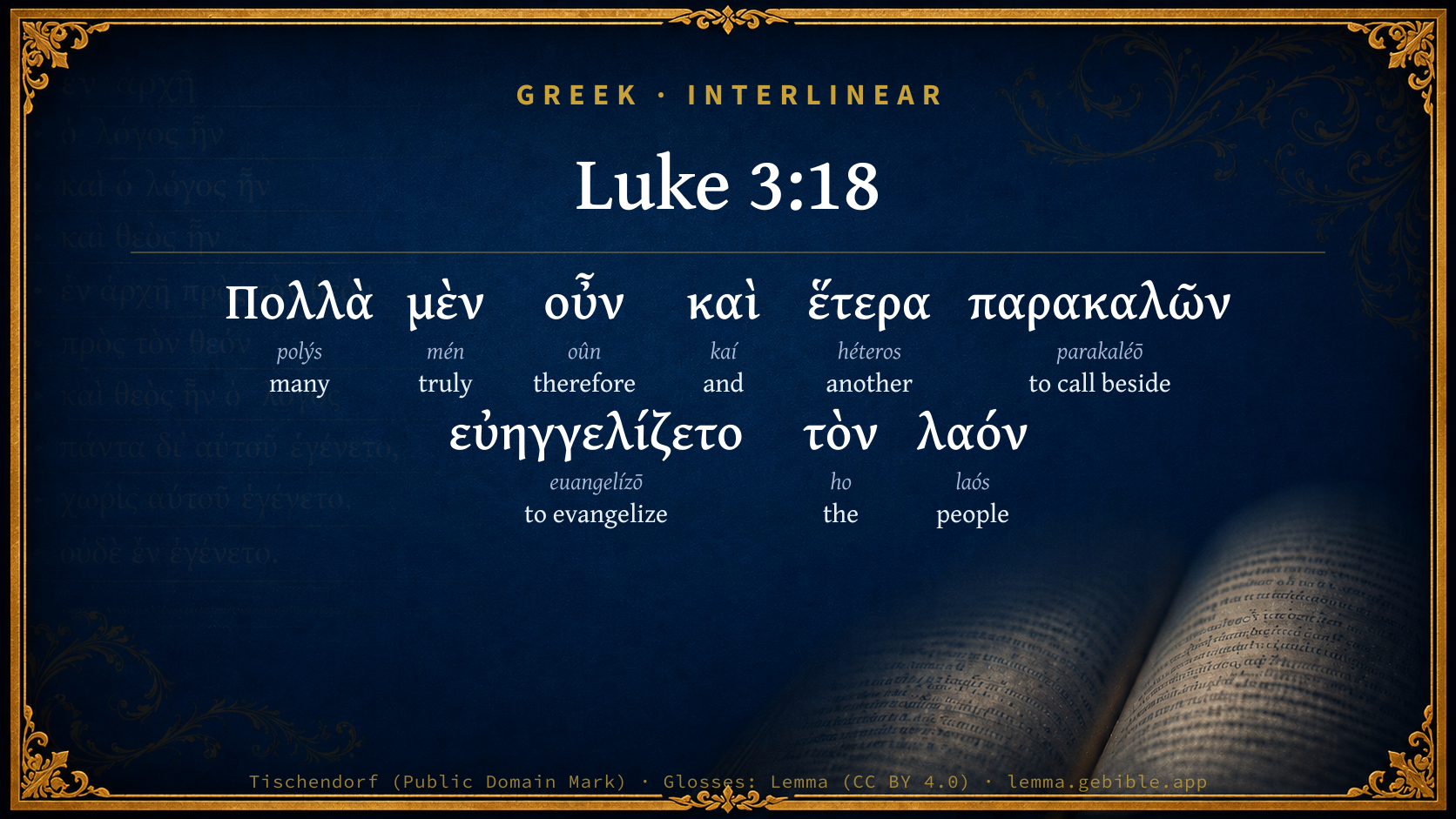
Greek (Tischendorf 8th ed.) Luke 3:18 appears in the Greek New Testament. The text above is from the Tischendorf 8th edition. Each word links to its Strong’s number and a concise gloss. Click any word for its full Thayer’s Greek Lexicon entry.
Download image
Cite this verse

Luke 3:18 (World English Bible). Public Domain. Lemma interlinear Bible study tool, https://lemma.gebible.app/v/luke/3/18.

Show BibTeX & RIS
BibTeX
RIS
English Translation
Then with many other exhortations he preached good news to the people,
World English Bible · Public Domain
Download a study sheet

One document with this verse’s original text, its word-by-word gloss line, the meaning frame, cross-references with their text, attributed commentary, and full source and license credits — printable, and it pastes into notes with its structure intact.

This verse Autodidact and up

Study sheet (.html) Plain text (.txt)

A passage Seminary Student

Up to 50 verses in one chapter. A passage sheet keeps up to 6 commentary sources and 12 cross-references per verse, in the order this page ranks them, and says so on the sheet whenever that leaves anything out. Ask for a single verse and you get the Autodidact verse sheet above.

Everything on this page stays free to read, with no account — the sheet is a download of what is already on screen, not access to it.

Want to remove ads? Support Godless Engineer
Compare translations 3

The same verse in 3 English versions, stacked beneath the original-language interlinear above. Click any original word for its lexicon entry.

Each is an independent rendering of the whole verse — the interlinear is not word-aligned to these translations.

Highlighted words mark where these versions differ — a whole-verse word diff, not a word-by-word alignment.

  • World English Bible Public Domain
    Then with many other exhortations he preached good news to the people,
  • King James Version Public Domain
    And many other things in his exhortation preached he unto the people.
  • unfoldingWord Literal Text CC BY-SA 4.0
    Therefore, also exhorting many other things, he preached good news to the people.

unfoldingWord Literal Text — © unfoldingWord, licensed CC BY-SA 4.0. Word-aligned USFM3 via Door43 (git.door43.org/unfoldingWord/en_ult).

Versions to compare (up to 4)

3 of 4 selected

Show all 19 translations

Every available English version of this verse, each an independent rendering of the whole verse.

  • World English Bible Public Domain
    Then with many other exhortations he preached good news to the people,
  • Berean Standard Bible Public Domain
    With these and many other exhortations, John proclaimed the good news to the people.
  • Majority Standard Bible Public Domain
    With these and many other exhortations, John proclaimed the good news to the people.
  • King James Version Public Domain
    And many other things in his exhortation preached he unto the people.
  • American Standard Version (1901) Public Domain
    With many other exhortations therefore preached he good tidings unto the people;
  • Revised Version (1885) Public Domain
    With many other exhortations therefore preached he good tidings unto the people;
  • Geneva Bible (1599) Public Domain
    Thus then exhorting with many other things, he preached vnto the people.
  • Douay-Rheims (1899) Public Domain
    And many other things exhorting, did he preach to the people.
  • Young's Literal Translation Public Domain
    And, therefore, indeed with many other things, exhorting, he was proclaiming good news to the people,
  • Literal Standard Version CC BY-SA 4.0
    And therefore, indeed, with many other things, exhorting, he was proclaiming good news to the people,
  • Unlocked Literal Bible CC BY-SA 4.0
    With many other exhortations also, John preached good news to the people.
  • unfoldingWord Literal Text CC BY-SA 4.0
    Therefore, also exhorting many other things, he preached good news to the people.
  • Darby Bible Public Domain
    Exhorting then many other things also he announced [his] glad tidings to the people.
  • World Messianic Bible Public Domain
    Then with many other exhortations he preached good news to the people,
  • Webster's Bible Public Domain
    And many other things in his exhortation he preached to the people.
  • Free Bible Version CC BY-SA 4.0
    John gave many warnings like this as he announced the good news to the people.
  • Bible in Basic English Public Domain
    And so comforting them with these and other words, he gave the good news to the people;
  • Text-Critical English NT CC BY 4.0
    With these and many other exhortations John preached good news to the people.
  • Tyndale New Testament (1534) Public Domain
    And many other thinges in his exhortacion preached he vnto the people.

Literal Standard Version (2020), Covenant Press — licensed CC BY-SA 4.0. Text via the HelloAO Bible API (eBible.org). Unlocked Literal Bible (unfoldingWord) — licensed CC BY-SA 4.0. Text via the HelloAO Bible API (eBible.org). unfoldingWord Literal Text — © unfoldingWord, licensed CC BY-SA 4.0. Word-aligned USFM3 via Door43 (git.door43.org/unfoldingWord/en_ult). Free Bible Version, Dr. Jonathan Gallagher — licensed CC BY-SA 4.0. Text via the HelloAO Bible API (eBible.org).

Word by word

More ways to search: Search by grammar → Find every occurrence → Compare this word →

Practice this passage: Drill this verse → Learn its vocabulary →

εὐηγγελίζετο
euangelízō
G2097
“to evangelize”
Verb, Imperfect, Middle, Indicative, 3rd person, Singular
Part of Speech
Verb
Tense
Imperfect
Voice
Middle
Mood
Indicative
Person
3rd person
Number
Singular
Full Thayer's Definition

Origin: from G2095 and G32

TDNT: 2:707,*

1. to bring good news, to announce glad tidings a. used in the OT of any kind of good news 1. of the joyful tidings of God's kindness, in particular, of the Messianic blessings b. in the NT used especially of the glad tidings of the coming kingdom of God, and of the salvation to be obtained in it through Christ, and of what relates to this salvation c. glad tidings are brought to one, one has glad tidings proclaimed to him d. to proclaim glad tidings 1. instruct (men) concerning the things that pertain to Christian salvation
  1. Πολλὰ polýs G4183 “many” Adjective, Accusative, Plural, Neuter
  2. μὲν mén G3303 “truly” Particle
  3. οὖν oûn G3767 “therefore” Conjunction
  4. καὶ kaí G2532 “and” Conjunction
  5. ἕτερα héteros G2087 “another” Adjective, Accusative, Plural, Neuter
  6. παρακαλῶν parakaléō G3870 “to call beside” Verb, Present, Active, Participle, Nominative, Singular, Masculine
  7. τὸν ho G3588 “the” Article, Accusative, Singular, Masculine
  8. λαόν laós G2992 “people” Noun, Accusative, Singular, Masculine

About this verse

These counts appear in no published source. They are computed here, from the morphology-tagged text and Lemma’s own curated glosses. What Lemma adds →

9
words
9
distinct lemmas
Gospels
section

Shared distinctive vocabulary

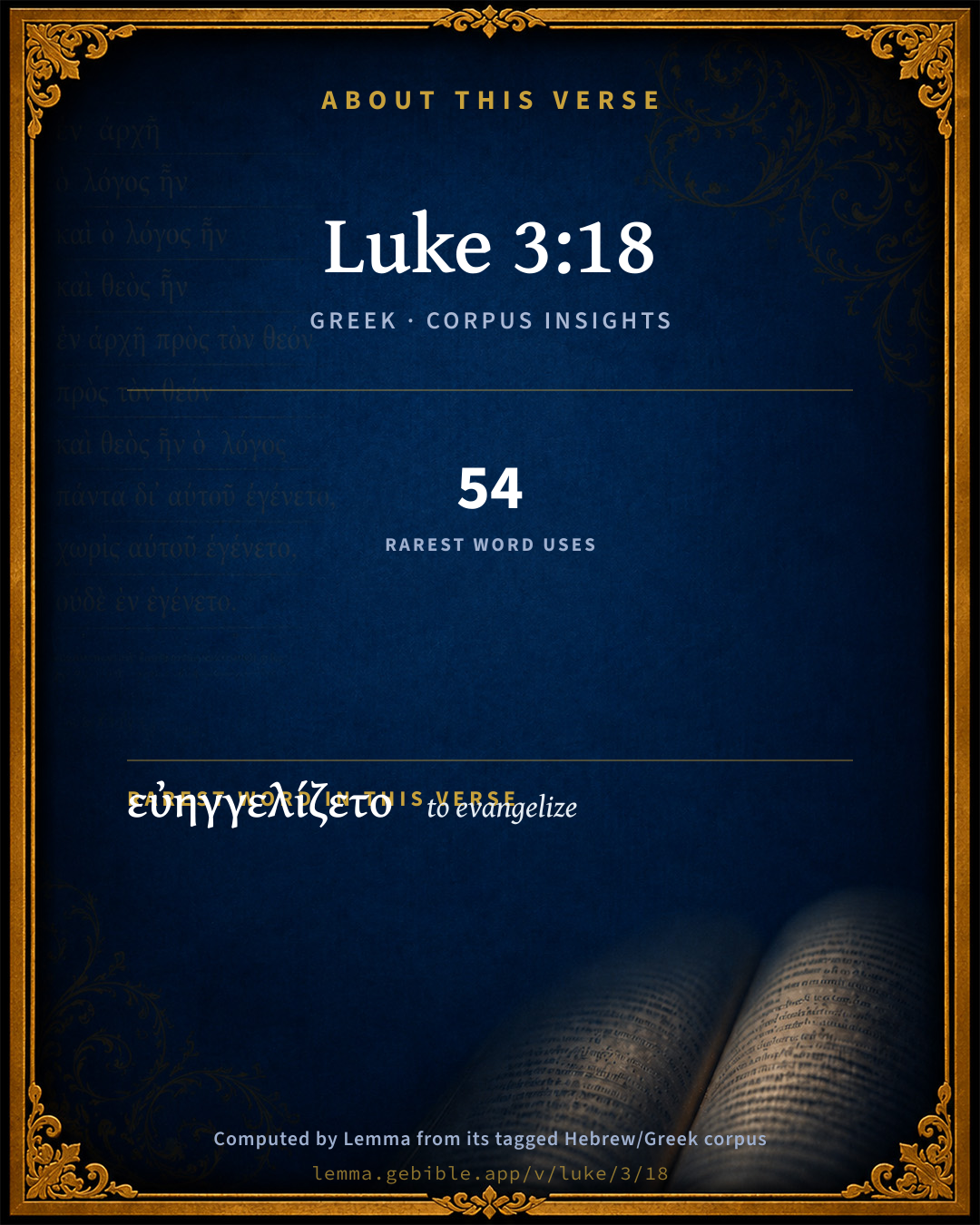
εὐηγγελίζετο to evangelize G2097 occurs in 52 verses of the Greek New Testament. Also found in:
Cross-references

5

Topical passages linked to Luke 3:18 in the Treasury of Scripture Knowledge — connected by theme and wording, ordered by reader-vote popularity; previews shown in the World English Bible.

  • John 1:29 The next day, he saw Jesus coming to him, and said, "Behold, the Lamb of God, who takes away the sin of the world!
  • John 1:34 I have seen, and have testified that this is the Son of God."
  • John 3:29–36 He who has the bride is the bridegroom; but the friend of the bridegroom, who stands and hears him, rejoices greatly because of the bridegroom's voice. This, my joy, therefore is made full.
  • Acts 2:40 With many other words he testified, and exhorted them, saying, "Save yourselves from this crooked generation!"
  • John 1:15 John testified about him. He cried out, saying, "This was he of whom I said, 'He who comes after me has surpassed me, for he was before me.'"

Cross-references courtesy of OpenBible.info (CC BY 4.0).

Commentary

Notes on Luke 3:18 from classic Christian and Jewish commentators (each source and its license shown beneath its notes). The classic Christian expositions comment on the surrounding passage and are grouped to its opening verse, so a note may address several verses; the Jewish commentaries on the Tanakh (Rashi and others) are per-verse, so they appear only where the commentator wrote on this verse.

Lemma curates 59 commentaries, every one of them public domain or Creative Commons licensed, each selected and text-cleaned for this edition rather than reprinted as found. About our sources →

The Biblical Illustrator

Joseph S. Exell

Luk_3:18; Luk_3:20

He shut up John in prison

Herod Antipas

The view here given of the character, conduct, and history of Herod Antipas is full of matter for awful reflection and serious admonition.

1. The mysteriousness of the ways of Providence. That a man so worthless should be permitted to cut short the labours and the life of so holy and useful a character, and that, too, in order to gratify the revenge of an abandoned adulteress, and to reward the vain exhibition of a giddy damsel, must, no doubt, at first appear strange. Yet the anger of God overtook: he persecutors before they left this world; and as for the holy sufferer, his work was done; and it was easy for his Lord to recompense to him his temporal sorrows a hundredfold in the world of glory.

2. The danger of power without grace. It is common to wish for power, and to envy those in whose hands it is; but when it is held without principle, it is fraught with peril, not only to those over whom it is exercised, but to those by whom it is possessed. They are generally borne away by the temptations which it presents to the gratification of caprice, luxury, covetousness, oppression, revenge, and every evil passion; and however prosperous their career may seem for a season, their end is generally destruction, and their memory is abhorred.

3. What is sin in the meanest is also sin in the highest. The judgment of God is impartial, and in every case He will render to each according to his deeds.

4. An awful commentary on human depravity.

5. The dreadful consequences which often result from the violation of the seventh commandment, and from intemperance.

6. We should learn to take reproof in good part. Well had it been for Herod if he had submitted to Johns rebuke and acted on it.

7. Sin, when pointed out, must be renounced. This man reverenced John, and yet lived and died in sin. Let us not do as he did. (James Foote, M. A.)

Johns rebuke of Herod

The life of John the Baptist divides itself into three distinct periods. Of the first, we are told that he was in the deserts until his showing unto Israel. This period lasted thirty years. The second is a shorter one. It comprises the few months of his public ministry. In the third we are to consider him as the tenant of a compelled solitude, in the dungeon of a capricious tyrant. A rare man, one of Gods heroic ones, a true conqueror; one whose life and motives it is hard to understand without feeling warmly and enthusiastically about them. One of the very highest characters, rightly understood, of all the Bible. In the verse which is to serve us for our guidance on this subject there are two branches which will afford us fruit of contemplation.

I. THE TRUTHFULNESS OF CHRISTIAN CHARACTER. Herod being reproved by John for Herodias. There are three things we remark in this truthfulness of John.

1. Its straightforwardness.

2. Its unconsciousness.

3. Its unselfishness.

II. THE APPARENT FAILURE OF CHRISTIAN LIFE. Shut up John in prison. The first thought which suggests itself is that a magnificent career is cut short too soon. At the very outset of ripe and experienced manhood the whole thing ends in failure. Johns day of active usefulness is over. The crowds that listened to his voice, we hear of them no more. Herod heard John gladly, did much good by reason of his influence. What was all that worth? The prophet comes to himself in a dungeon, and wakes to the conviction, that his influence had told much in the way of commanding attention, and even winning reverence, but very little in the way of gaining souls-the bitterest, the most crushing discovery in the whole circle of ministerial experience. All this was seeming failure. And this, brethren, is the picture of almost all human life. In the isolation of Johns dying hour there appears failure again. The martyr of truth dies privately in Herods dungeon. We have no record of his last words. There were no crowds to look on. We cannot describe how he received his sentence. Was he calm? Was he agitated? Did he bless his murderer? Did he give utterance to any deep reflections on human life? All that is shrouded in silence. He bowed his head, and the sharp stroke fell flashing down. We know that, we know no more--apparently a noble life abortive. And now--

III. Let us ask the question--WAS ALL THIS INDEED FAILURE? NO, it was sublimest victory. Johns work was no failure. He left behind him no sect to which he had given his name, but his disciples passed into the service of Christ, and were absorbed in the Christian Church. Words from John had made impressions, and men forgot in after years where the impressions first came from, but the day of judgment will not forget. John laid the foundations of a temple, and others built upon it. He laid it in struggle, in martyrdom. It was covered up like the rough masonry below ground, but when we look round on the vast Christian Church, we are looking at the superstructure of Johns toil. There is a lesson for us all in that, if we will learn it. Work, true work, done honestly and manfully for Christ, never can be a failure. We are treading upon a bridge of martyrs. The suffering was theirs--the victory is ours.

IV. In conclusion, we make three remarks.

1. Let young and ardent minds, under the first impressions of religion, beware how they pledge themselves by any open profession to more than they can perform.

2. We get from this subject the doctrine of a resurrection. Johns life was hardness, his end was agony. Be content to feel that this world is not your home. Homeless upon earth; try more and more to make your home in heaven, above with Christ.

3. Devotedness to Christ is our only blessedness. (F. W. Robertson, M. A.)

John Baptists imprisonment

Josephus gives some interesting particulars respecting the imprisonment and murder of the Baptist, which are not supplied in the gospel history. Herod Antipas, son of Herod the Great, was at that time tetrarch of Galilee and Peraea, and had married the daughter of Aretas, an Arabian king, whose territories abutted on his own. When he was at Rome, however, he stayed at the house of his half-brother Philip, whose wife Herodias he conceived a passion for. Antipas made known his passion, and Herodias readily enough consented to leave Philip and go with him. The daughter of Aretas was divorced, and Herodias duly installed in her place. John the Baptist had the courage to denounce this infamous marriage; and by and by Herod Antipas, under pretence that he feared Johns popularity with the multitude might lead to disturbances, apprehended and imprisoned him. John was sent to Machaerus, or MKhaur, on the eastern side of the Dead Sea, where Herod had both a city and fortress. The site and ruins of Machaerus were identified by Canon Tristram in his visit to the Land of Moab in 1872. It was from this spot, then, that John sent two of his disciples to Christ to ask, Art Thou He that should come? And it was here that Salome, the daughter of Herodias, danced before Antipas, and won for her infamous mother the head of John the Baptist. (Biblical Things Not Generally Known.)

John like Elijah

As the first Elijah reproved King Ahab for the murder of Naboth and the seizure of his vineyard, so the second Elijah rebuked King Herod for his lust. (W. Bull.)

Reproving a king

Dr. Hickington, chaplain to Charles II., used to preach at the kings vices. This the king took to himself; and so, one day, he said, Doctor, you and I ought to be better friends; give up being so sharp on me, and see if I dont mend on your hand. Well, well, quoth the doctor, Ill make it up with your Majesty on these terms: as you mend, Ill mend.

The king reproved

It is said that Henry the Great of France took much pleasure in conversing with an honest and religious man of low situation in life, who used great freedom with his Majesty. One day he said to the king, Sire, I always take your part when I hear any man speaking evil of you; I know that you excel in justice and generosity, and that many worthy things have been done by you. But you have one vice for which God will condemn you, if you do not repent--I mean the unlawful love of women. The king, it is said, was too magnanimous to resent this reproof, but he long felt it like an arrow in his bosom; and sometimes said that the most eloquent discourses of the doctors of the Sorbonne had never made such an impression on his soul as this honest reproof from his humble friend.

Excommunicating a prince

William IX., Duke of Aquitaine and Earl of Polctiers, was a violent and dissolute prince, and often indulged himself in improper behaviour at the expense of religion. Though he had contracted a very suitable marriage, and one with which he was satisfied for some time, he parted from his wife without reason, to marry another who pleased him better. The Bishop of Polctiers, by name Peter, could not brook so great a scandal; and having employed all other means in vain, he thought it his duty to excommunicate the duke. As he began to pronounce the anathema, William furiously advanced, sword in hand, saying, Thou art dead if thou proceedest. The bishop, as if afraid, required a few moments to consider what was most expedient. The duke granted it, and the bishop courageously finished the rest of the formula of excommunication. After which, extending his neck, Now, strike, said he, I am quite ready. The astonishment which this intrepid conduct produced in the duke disarmed his fury, and saying, ironically, I dont like you well enough to send you to heaven, he contented himself with banishing him.

Moral courage

Dr. Harris, the minister of Hanwell, during the Civil Wars, frequently had military officers quartered at his house. A party of them, being unmindful of the reverence due to the holy name of God, indulged themselves in swearing. The doctor noticed this, and on the following Sunday preached from these words--Above all things, my brethren, swear not. This so enraged the soldiers, who judged the sermon was intended for them, that they swore they would shoot him if he preached on the subject again. He was not, however, to be intimidated; and, on the following Sunday, he not only preached from the same text, but inveighed in still stronger terms against the vice of swearing. As he was preaching a soldier levelled his carabine at him; but he went on to the conclusion of his sermon, without the slightest fear or hesitation.

The Biblical Illustrator, edited by Joseph S. Exell (c. 1880s–1900s) — public domain. Text from a community e-Sword module.

Joseph Benson's Commentary

Luk 3:18-20. And many other things preached he unto the people — In this manner did John inculcate the doctrine of repentance, and declare his Master’s greatness. But his sermons were not confined to these matters. He discoursed also on many other important subjects, according as he knew they would be profitable to his hearers. But Herod the tetrarch, being reproved by him, &c. — In the whole course of John’s ministry he showed great integrity and courage, but especially in his intercourse with Herod the tetrarch, who, it seems, had heard him, and admitted him into conversation; for he was so bold as to address the tetrarch on the subject of his favourite sins, particularly his adultery with Herodias. This he represented to him in its true colours, and reproved him for it. But the effect of his exhortation was not what it ought to have been. It did not bring Herod to repentance. On the contrary, it so provoked him, that he cast the Baptist into prison, and thereby put an end to his ministry, after it had lasted a considerable time. This circumstance, though it happened after, is here mentioned before our Lord’s baptism, that his history (that of John being concluded) might then follow without any interruption.

Joseph Benson's Commentary on the Old and New Testaments (1811–1818) — public domain. Text from a community e-Sword module.

Bengel's Gnomon

Johann Albrecht Bengel

Luk 3:18-19. Παρακαλῶν, exhorting) The function of John was to exhort, and to announce the coming Gospel; to rebuke and to preach, Comp. Luk 3:3; Luk 3:19.—εὐηγγελίζετο, he preached the coming Gospel) as he did in Luk 3:16.

Bengel's Gnomon of the New Testament — English translation (T&T Clark, Edinburgh, 1860) — public domain. Text from a community e-Sword module.

Meyer's Critical & Exegetical Commentary

Heinrich August Wilhelm Meyer

Luk_3:18-20. See on Mat_14:3 ff.; Mar_6:17 ff. On μὲν οὖν, quidem igitur, so that μέν, rem praesentem confirmet, and οὖν, conclusionem ex rebus ita comparatis conficiat, see Klotz, ad Devar. p. 662 f.

καὶ ἕτερα] and other matters besides, different in kind from those already adduced. As to καί with πολλά, see Blomfield, ad Aesch. Pers. 249; Kühner, ad Xen. Mem. i. 2. 24; and as to ἕτερα, see on Gal_1:7.

εὐηγγελίζετο τ. λαόν] he supplied the people with the glad announcement of the coming Messiah. On the construction, comp. Act_8:25; Act_8:40; Act_14:21; Act_16:10; Lobeck, ad Phryn. p. 268.

ὁ δὲ Ἡρώδης κ.τ.λ.] an historical digression in which several details are brought together in brief compass for the purpose of at once completing the delineation of John in its chief features. To that description also belonged the contrast between his work (εὐηγγελίζ. τ. λαόν) and his destiny. The brief intimation of Luk_3:19-20 was sufficient for this.

ἐλεγχόμενος κ.τ.λ.] See Mat_14:3 f.

καὶ περὶ πάντων κ.τ.λ.] peculiar to Luke, but, as we gather from Mar_6:20, essentially historical. The πονηρῶν, attracted with it, stands thus according to classical usage. See Matthiae, § 473, quoted by Dissen, ad Dem. de Cor. p. 177, 349.

ἐπὶ πᾶσι] to all his wicked deeds.

καὶ κατέκλεισε] simplicity in the style is maintained at the expense of the syntax (Kühner, § 720).

ἐν τῇ φυλακῇ] in the prison, whither he had brought him. Comp. Act_26:10; Herodian, v. 8. 12, and elsewhere; Xen. Cyrop. vi. 4. 10.

Meyer — Critical and Exegetical Commentary on the New Testament — English translation by Peter Christie, edited by Frederick Crombie (T&T Clark, 1880) — public domain. Text from a community e-Sword module.

Expositor's Greek Testament

ed. W. Robertson Nicoll

Luk 3:18-20 . Close of the Baptist’s ministry and life . Lk. gives here all he means to say about John, condensing into a single sentence the full narratives of Mt. and Mk. as to his end.

Luk 3:18 . πολλὰ μὲν οὖν καὶ ἕτερα , “many things, too, different from these” (Farrar, who refers to Joh 1:29 ; Joh 1:34 ; Joh 3:27-36 , as illustrating the kind of utterances meant). The εὐηγγελίζετο following seems to justify emphasising ἕτερα , as pointing to a more evangelic type of utterance than those about the axe and the fan, and the wrath to come. But it may be questioned whether by such a representation the real John of history is not to a certain extent unconsciously idealised and Christianised. μὲν οὖν : the οὖν may be taken as summarising and concluding the narrative about John and μὲν as answering to δὲ in Luk 3:19 = John was carrying on a useful evangelic ministry, out it was cut short; or μενοῦν may be taken as one word, emphasising πολλὰ καὶ ἕτερα , and preparing for transition to what follows (Hahn).

The Expositor's Greek Testament, edited by W. Robertson Nicoll (1897–1910) — public domain. Text from a community e-Sword module.

Godet's Commentaries

Frédéric Louis Godet

4. vers. 18-20. — We find here one of those general surveys such as we have in Luk 1:66; Luk 1:80, Luk 2:40; Luk 2:52. For the third time the lot of the forerunner becomes the prelude to that of the Saviour. The expression many other things (Luk 3:18) confirms what was already indicated by the imperf. he used to say (Luk 3:7), that Luke only intends to give a summary of John’s preaching. The term he evangelized (a literal translation) refers to the Messianic promises which his discourses contained (Luk 3:16-17), and the true translation of this verse appears to me to be this: “while addressing these and many other exhortations to the people, he announced to them the glad tidings.”

Ver. 19. Herod Antipas, the sovereign of Galilee, is the person already mentioned in Luk 3:1. The word Φιλίππου, rejected by important authorities, is probably a gloss derived from Matthew. The first husband of Herodias was called Herod. He has no other name in Josephus. He lived as a private individual at Jerusalem. But perhaps he also bore the surname of Philip, to distinguish him from Herod Antipas. The brother of Antipas, who was properly called Philip, is the tetrarch of Ituraea (Luk 3:1). The ambitious Herodias had abandoned her husband to marry Antipas, who for love of her sent away his first wife, a daughter of Aretas king of Arabia; this act drew him into a disastrous war.

Luke’s expression indicates concentrated indignation. In order to express the energy of the ἐπὶ πᾶσιν, we must say: to crown all...The form of the phrase προσέθηκε καὶ κατέκλεισε is based on a well-known Hebraism, and proves that this narrative of Luke’s is derived from an Aramaean document. This passage furnishes another proof that Luke draws upon an independent source; he separates himself, in fact, from the two other synoptics, by mentioning the imprisonment of John the Baptist here instead of referring it to a later period, as Matthew and Mark do, synchronizing it with the return of Jesus into Galilee after His baptism (Mat 4:12; Mar 1:14). He thereby avoids the chronological error committed by the two other Syn., and rectified by John (Luk 3:24). This notice is brought in here by anticipation, as the similar notices, Luk 1:66 b and 80b. It is intended to explain the sudden end of John’s ministry, and serves as a steppingstone to the narrative Luk 7:18, where John sends from his prison two of his disciples to Jesus.

The fact of John the Baptist’s ministry is authenticated by the narrative of Josephus. This historian speaks of it at some length when describing the marriage of Herod Antipas with Herodias. After relating the defeat of Herod’s army by Aretas, the father of his first wife, Josephus (Antiq. 18.5. 1, 2) continues thus: “This disaster was attributed by many of the Jews to the displeasure of God, who smote Herod for the murder of John, surnamed the Baptist; for Herod had put to death this good man, who exhorted the Jews to the practice of virtue, inviting them to come to his baptism, and bidding them act with justice towards each other, and with piety towards God; for their baptism would please God if they did not use it to justify themselves from any sin they had committed, but to obtain purity of body after their souls had been previously purified by righteousness. And when a great multitude of people came to him, and were deeply moved by his discourses, Herod, fearing lest he might use his influence to urge them to revolt,—for he well knew that they would do whatever he advised them,—thought that the best course for him to take was to put him to death before he attempted anything of the kind. So he put him in chains, and sent him to the castle of Machaerus, and there put him to death. The Jews, therefore, were convinced that his army was destroyed as a punishment for this murder, God being incensed against Herod.” This account, while altogether independent of the evangelist’s, confirms it in all the essential points: the extraordinary appearance of this person of such remarkable sanctity; the rite of baptism introduced by him; his surname, the Baptist; John’s protest against the use of baptism as a mere opus operatum; his energetic exhortations; the general excitement; the imprisonment and murder of John; and further, the criminal marriage of Herod, related in what precedes. By the side of these essential points, common to the two narratives, there are some secondary differences:—1 st. Josephus makes no mention of the Messianic element in the preaching of John. But in this there is nothing surprising. This silence proceeds from the same cause as that which he observes respecting the person of Jesus. He who could allow himself to apply the Messianic prophecies to Vespasian, would necessarily try to avoid everything in contemporaneous history that had reference either to the forerunner, as such, or to Jesus. Weizsäcker rightly observes that the narrative of Josephus, so far from invalidating that of Luke on this point, confirms it. For it is evident that, apart from its connection with the expectation of the Messiah, the baptism of John would not have produced that general excitement which excited the fears of Herod, and which is proved by the account of Josephus.—2 d. According to Luke, the determining cause of John’s imprisonment was the resentment of Herod at the rebukes of the Baptist; while, according to Josephus, the motive for this crime was the fear of a political outbreak. But it is easy to conceive that the cause indicated by Luke would not be openly avowed, and that it was unknown in the political circles where Josephus gathered his information. Herod and his counsellors put forward, as is usual in such cases, the reason of State. The previous revolts—those which immediately followed the death of Herod, and that which Judas the Gaulonite provoked—only justified too well the fears which they affected to feel.

In any case, if, on account of this general agreement, we were willing to admit that one of the two historians made use of the other, it is not Luke that we should regard as the copyist; for the Aramaean forms of his narrative indicate a source independent of that of Josephus.

The higher origin of this ministry of John is proved by the two following characteristics, which are inexplicable from a purely natural point of view:—1 st. His connection, so emphatically announced, with the immediate appearance of the Messiah; 2 d. The abdication of John, when at the height of his popularity, in favour of the poor Galilean, who was as yet unknown to all. As to the originality of John’s baptism, the lustrations used in the oriental religions, in Judaism itself, and particularly among the Essenes, have been alleged against it. But this originality consisted less in the outward form of the rite, than—1. In its application to the whole people, thus pronounced defiled, and placed on a level with the heathen; and 2. In the preparatory relation established by the forerunner between this imperfect baptism and that final baptism which the Messiah was about to confer.

We think it useful to give an example here of the way in which Holtzmann tries to explain the composition of our Gospel:—

1. Luk 3:1-6 are borrowed from source A. (the original Mark); only Luke leaves out the details respecting the ascetic life of John the Baptist, because he intends to give his discourses at greater length; he compensates for this omission by adding the chronological data (Luk 3:1-2), and by extending the quotation from the LXX. (Luk 3:5-6)!

2. Luk 3:7-9 are also taken from A., just as are the parallel verses in Matthew; they were left out by the author of our canonical Mark, whose intention was to give only an abridgment of the discourses.

3. Luk 3:10-14 are taken from a private source, peculiar to Luke.

Are we then to suppose that this source contained only these four verses, since Luke has depended on other sources for all the rest of his matter?

4. Luk 3:15-17 are composed (a) of a sketch of Luke’s invention (Luk 3:15); (b) of an extract from A., Luk 3:16-17.—5. Luk 3:18-20 have been compiled on the basis of a fragment of A., which is found in Mar 6:17-29, a summary of which Luke thought should be introduced here.

Do we not thus fall into that process of manufacture which Schleiermacher ridiculed so happily in his work on the composition of Luke, à propos of Eichhorn’s hypothesis, a method which we thought had disappeared from criticism for ever?

Frédéric Louis Godet — Commentaries on Luke, John, Romans, and 1 Corinthians — English translation (T&T Clark, Edinburgh, 1870s–1890s) — public domain. Text from a community e-Sword module.

Jamieson, Fausset & Brown

Robert Jamieson, A. R. Fausset & David Brown

many other things, &c.--such as we read in Joh 1:29, Joh 1:33-34; Joh 3:27-36. (Also see on Mat 3:12.)

Jamieson, Fausset & Brown — Commentary Critical and Explanatory on the Whole Bible (1871) — public domain (CC PDM 1.0). Text via the HelloAO Bible API.

Ellicott's Commentary for English Readers

(18) Many other things . . .—This lay, more or less, in the nature of the case; but St. Luke’s is the only record which lays stress on the wider range of the Baptist’s teaching. The sources of information which supplied him with Luk_3:10-14, probably brought to his knowledge much of the same character; but what he records, in common with the other two Evangelists, was, as it were, the text and burden of it all.

A Bible Commentary for English Readers, edited by Charles John Ellicott (1878–1897) — public domain. Text from a community e-Sword module.

The Cambridge Bible for Schools and Colleges

gen. ed. J. J. S. Perowne

18. many other things] Of which some are recorded by St John alone (Luk_1:29; Luk_1:34, Luk_3:27-36).

preached he] εὐηγγελίζετο, literally, “he was preaching the Good Tidings.”

The Cambridge Bible for Schools and Colleges (gen. ed. J. J. S. Perowne; Cambridge University Press, 1878–1918) — public domain. Text from a community e-Sword module.

John Gill's Exposition

But Herod the tetrarch being reproved by him,.... By John, as the Syriac, Arabic, and Persic versions add:

for Herodias his brother Philip's wife; for taking her to wife, whilst his brother Philip was living. The account, which the Jewish chronologer (x) gives, of this Herod, and of this fact of his, and John's reproving him for it, and the consequence of it, perfectly agrees with this of the evangelist.

"Herod Antipater, and there are some that call him, "the tetrarch", was a son of Herod the first, and brother of Archelaus'; and he was the third king of the family of Herod; and he was very wicked, and a destroying man: many of the wise men of Israel he slew with the sword; and he took the wife of his brother Philip, whilst he was alive, to himself for wife; and John, the high priest, because "he reproved him" for this, he slew him with the sword, with many of the wise men of Israel.''

And John reproved him not only for this sin, but others:

and for all the evils which Herod had done; his revellings, debaucheries, murders, &c. all which John, in great faithfulness, and with much freedom, told him and rebuked him for: for Herod had had a particular respect for him, and often had him with him, and heard him gladly, when John had an opportunity of speaking personally to him.

(x) Ganz. Tzemach David, par, 1. fol. 25. 2.

John Gill's Exposition of the Whole Bible (1746–1763) — public domain (CC PDM 1.0). Text via the HelloAO Bible API.

Trapp's Complete Commentary

John Trapp

18 And many other things in his exhortation preached he unto the people.

Ver. 18. And many other things preached he] Being concionator admirabilis (as Keckerman saith of Jeremiah), an admirable preacher, full of pregnant instructions and admonitions, he did no miracle indeed, but he uttered many sweet oracles, which St Luke here passeth over, that he may hasten to speak of Christ, his main design.

John Trapp, A Commentary or Exposition upon All the Books of the Old and New Testament (1647–1656) — public domain. Text from a community e-Sword module.

The Pulpit Commentary

And many other things in his exhortation preached he unto the people. These words tell us that the above was merely a "specimen" of John the Baptist"s preaching, trenchant, fearless, practical, piercing the hearts of all classes and orders of the people who thronged to hear the earnest, fiery appeals of the great desert preacher. In this and in the next two verses St. Luke once more gives us a little picture of the events which were spread over a considerable area or" time. It is here introduced out of its proper place to explain the abrupt termination of the popular career of John the Baptist.

The Pulpit Commentary (1880–1919), ed. H.D.M. Spence-Jones & Joseph S. Exell — public domain. Text from a community e-Sword module.

Burkitt's Expository Notes on the New Testament

William Burkitt

Observe here, 1. In John the Baptist the character of a zealous and faithful minister of the gospel: he is one that deals plainly, and durst tell the greatest persons of their faults. Herod, though a king, is reproved by him for his adultery and incest. The crown and sceptre of Herod could not daunt the faithful messenger of God. There ought to meet in the ministers of Christ both courage, and impartiality; courage in fearing no faces, and impartiality in sparing no sins.

Observe, 2. Who it was that imprisoned and beheaded the holy Baptist: Herod a king. How sad is it when kings, who should be nursing-fathers to the church, do prove the bloody butchers of the prophets of God. Many of the severest persecutions which the ministers of God have fallen under, have been occasioned by their telling great men of their crimes. Men in power are impatient of reproof, and imagine that their authority gives them a license to transgress.

Observe, 3. The heinous aggravations of this sin in Herod: He added this to all his other sins, that he shut up John in prison. This evidenced him incorrigible and irreclaimable. John had preached before Herod, and Herod had heard John with some delight; but he had a darling lust, which occasioned his destruction.

Learn hence, that hypocrites may hear the word with some pleasure, and do many things with some delight, but they have always some beloved lust that must be spared; they will neither part with it, nor bear reproof for it. Herod sticks not to cut off that head, whose tongue was so bold as to reprove him for his lusts.

William Burkitt's Expository Notes on the New Testament (1700–1703) — public domain. Text from a community e-Sword module.

unfoldingWord translationNotes

Door43 World Missions Community

General Information:

The story tells what is going to happen to John but has not happened at this time. (See: Background Information)

With many other exhortations

"With many other strong urgings"

Herod the tetrarch

Herod was a tetrarch, not a king. He had only limited rule over the region of Galilee.

for marrying his brother's wife Herodias

"because Herod married Herodias, his own brother's wife." This was evil because Herod's brother was still alive. This can be stated clearly. AT: "because he married his brother's wife, Herodias, while his brother was still alive" (See: Assumed Knowledge and Implicit Information)

he locked John up in prison

Because Herod was tetrarch, he probably locked John up by ordering his soldiers to lock John up. AT: "he had his soldiers lock John up in prison" or "he told his soldiers to put John in prison" (See: Assumed Knowledge and Implicit Information)

translationWords

exhort

John (the Baptist)

preach

good news

Herod Antipas

tetrarch

Herodias

evil

prison

unfoldingWord translationNotes — © Distant Shores Media and the Door43 World Missions Community, licensed CC BY-SA 4.0. Source: git.door43.org/Door43/en_tn.

Cambridge Greek Testament for Schools and Colleges

18. πολλὰ μὲν οὖν καὶ ἕτερα. Literally, ‘Many things too, different from these;’ of which some are recorded by St John alone (Luk 1:29; Luk 1:34, Luk 3:27-36).

εὐηγγελίζετο. Literally, ‘he was preaching the Good Tidings.’ With the phrase εὐηγγελίζετο τὸν λαόν compare Act 8:25; Act 8:40; Act 16:10. The verb has two accusatives (one being the cognate accusative) in Act 13:22. It is found with the dative in Luk 4:18; Rom 1:15, &c. The accusative indicates the direction of the verbal action, and is involved in the notion of teaching.

Cambridge Greek Testament for Schools and Colleges (Cambridge University Press, 1896; 21 vols, various authors incl. Carr, Maclear, Plummer, Farrar, Lumby, Moule, M. R. James, Simcox) — public domain. Text from a community e-Sword module.

Alford’s Greek Testament

Henry Alford

18-20.] Luke only: containing the corroboration of the account in Mar 6:20 of John’s boldness in rebuking Herod, with this slight variation, that whereas in Mark Herod heard him gladly, and did many things in consequence, here the rebuke for general profligacy seems to have contributed to his imprisonment. These accounts however, though perfectly distinct, are by no means inconsistent. The same rebukes which stung Herod’s conscience and aided the desire to imprison John, might work on that conscience, and cause the wish to hear more from the man of God. Vv. 19, 20 are in anticipation of what follows; which is in Luke’s manner: see ch. 1:80.

21,

Henry Alford, The Greek Testament (1849–1861) — public domain. Text from a community e-Sword module.

International Critical Commentary

18-20. § Explanation of the Abrupt Termination of the Baptist’s Ministry. This is given here by anticipation in order to complete the narrative. Comp. the conclusions to previous narratives: 1:66, 80, 2:40, 52.

18. Λολλὰ μὲν οὖν καὶ ἕτερα. The comprehensive πολλὰ καὶ ἕτερα confirms the view taken above (ver. 7) that this narrative (7-18) gives a summary of John’s teaching rather than a report of what was said on any one occasion. The ἕτερα means “of a different kind” (Gal 1:6, Gal 1:7), and intimates that the preaching of the Baptist was not always of the character just indicated.

The cases in which μὲν οὗν occurs must be distinguished. 1. Where, as here, μέν is followed by a corresponding δέ, and we have nothing more than the distributive μὲν … δὲ … combined with οὖν (Act 8:4, Act 8:25, Act 8:11:19, Act 8:12:5, Act 8:14:3, Act 8:15:3, Act 8:30, etc.). 2. Where no δέ follows, and μέν confirms what is said, while οὖν marks an inference or transition, quidem igitur (Act 1:6, Act 1:2:41, Act 1:5:41, Act 1:13:4, Act 1:17:30; Heb 7:11, Heb 8:4, etc.). Win. liii. 8. a, p. 556.

παρακαλῶν εὐηγγελίζετο … ἐλεγχόμενος. These words give the three chief functions of the Baptist: to exhort all, to preach good tidings to the penitent, to reprove the impenitent. It is quite unnecessary to take τὸν λαόν with παρακαλῶν, and the order of the words is against such a combination.

In late Greek the acc. of the person to whom the announcement is made is freq. after εὐαγγελίζεσθαι (Act 14:15, Act 14:16:10; Gal 1:9; 1Pe 1:12; comp. Act 8:25, Act 8:40, Act 8:14:21): and hence in the pass. we have πτωχοὶ εὐαγγελίζονται. The acc. of the message announced is also common (8:1; Act 5:42, Act 5:8:4, Act 5:12?, 10:36, 11:20). Where both person and message are combined, the person addressed is in the dat. (1:19, 2:10, 4:43; Act 8:35; comp. Luk 4:18; Act 17:18; Rom 1:15, etc.): but in Act 13:32 we have double acc. Here the Lat. texts vary between evangelizabat populum (Cod. Am.) and evang. populo (Cod. Brix.).

International Critical Commentary — older volumes (1896–1929), various authors — public domain. Text from a community e-Sword module.

Vincent's Word Studies in the New Testament

Marvin R. Vincent

Other [ετερα] . Rather, various, different.

Preached [ευηγγελιζετο] . Rev., preserves the fuller meaning of the word according to its etymology : preached good tidings. See on Gospel, Superscription of Matthew.

19, 20. Compare Mt 14:3 - 5; Mr 6:17 - 20.

Marvin R. Vincent, Word Studies in the New Testament (1887–1900) — public domain. Text from a community e-Sword/MySword module.

Lesson kit

Teaching starters — assembled from the data on this page, not authored interpretation. Every prompt links to the verse data it draws on. Edit before teaching.

Luke, in the Gospels, opens this verse with 9 words (9 distinct Greek lemmas). Its most distinctive word is euangelízō (“to evangelize”). A historical commentator’s framing appears above. Read the whole chapter for the surrounding context.

Discussion questions

  1. What does “to evangelize” (euangelízō) contribute to the verse as a whole?
  2. How does Matthew 11:5, which shares the word «to evangelize», read alongside this verse?
  3. The translations on this page render this verse differently — a whole-verse word diff, not a word-by-word alignment. What might account for the different wordings?
  4. Compare how The Biblical Illustrator and Joseph Benson's Commentary read this verse. Where do they agree or differ?

Things to notice

Reading settings

Reading text

Shown beneath each verse's original-language words.

Old Testament
Old Testament edition

Read the OT as the Masoretic Hebrew (MT) or the Greek Septuagint (LXX).

English shown for the Greek Septuagint (in the Hebrew ↔ Greek comparison).

Comparing translations? Open the Compare panel on any verse page to stack up to four side by side.