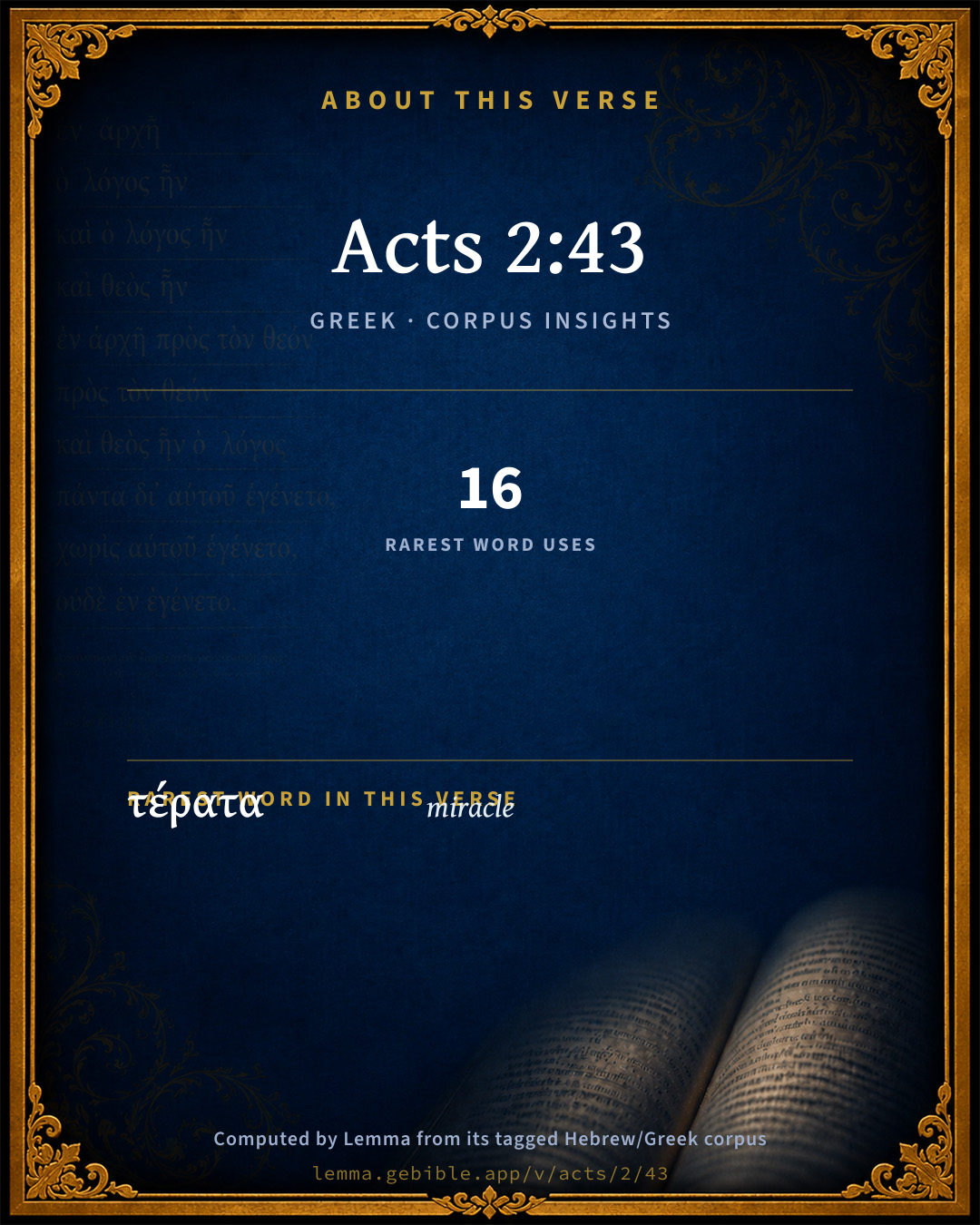
Acts 2:43

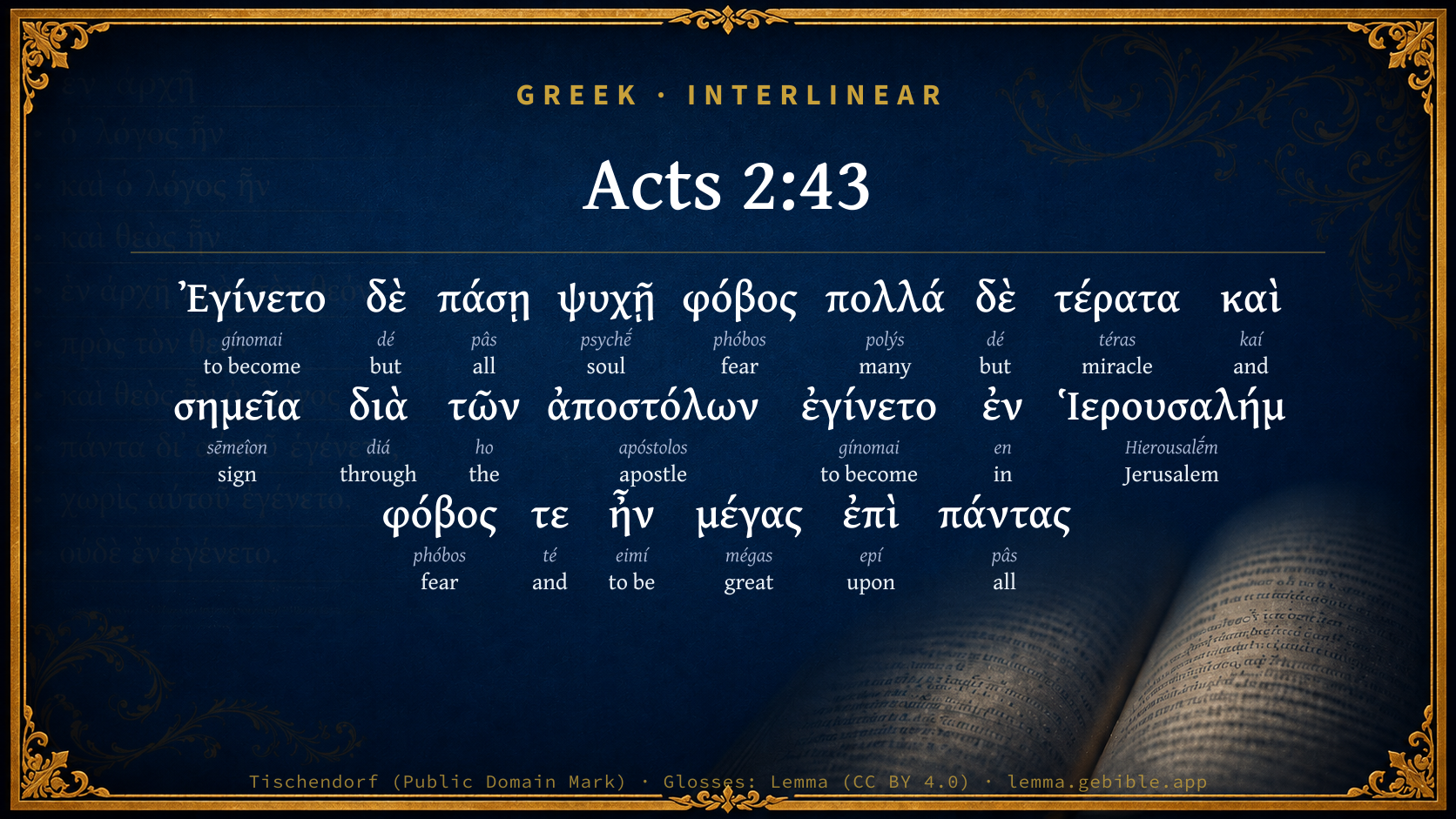
Greek (Tischendorf 8th ed.) Acts 2:43 appears in the Greek New Testament. The text above is from the Tischendorf 8th edition. Each word links to its Strong’s number and a concise gloss. Click any word for its full Thayer’s Greek Lexicon entry.
Download image
Cite this verse

Acts 2:43 (World English Bible). Public Domain. Lemma interlinear Bible study tool, https://lemma.gebible.app/v/acts/2/43.

Show BibTeX & RIS
BibTeX
RIS
English Translation
Fear came on every soul, and many wonders and signs were done through the apostles.
World English Bible · Public Domain
Download a study sheet

One document with this verse’s original text, its word-by-word gloss line, the meaning frame, cross-references with their text, attributed commentary, and full source and license credits — printable, and it pastes into notes with its structure intact.

This verse Autodidact and up

Study sheet (.html) Plain text (.txt)

A passage Seminary Student

Up to 50 verses in one chapter. A passage sheet keeps up to 6 commentary sources and 12 cross-references per verse, in the order this page ranks them, and says so on the sheet whenever that leaves anything out. Ask for a single verse and you get the Autodidact verse sheet above.

Everything on this page stays free to read, with no account — the sheet is a download of what is already on screen, not access to it.

Want to remove ads? Support Godless Engineer
Compare translations 3

The same verse in 3 English versions, stacked beneath the original-language interlinear above. Click any original word for its lexicon entry.

Each is an independent rendering of the whole verse — the interlinear is not word-aligned to these translations.

Highlighted words mark where these versions differ — a whole-verse word diff, not a word-by-word alignment.

  • World English Bible Public Domain
    Fear came on every soul, and many wonders and signs were done through the apostles.
  • King James Version Public Domain
    And fear came upon every soul: and many wonders and signs were done by the apostles.
  • unfoldingWord Literal Text CC BY-SA 4.0
    And fear was coming on every soul, and many wonders and signs were happening through the apostles.

unfoldingWord Literal Text — © unfoldingWord, licensed CC BY-SA 4.0. Word-aligned USFM3 via Door43 (git.door43.org/unfoldingWord/en_ult).

Versions to compare (up to 4)

3 of 4 selected

Show all 19 translations

Every available English version of this verse, each an independent rendering of the whole verse.

  • World English Bible Public Domain
    Fear came on every soul, and many wonders and signs were done through the apostles.
  • Berean Standard Bible Public Domain
    A sense of awe came over everyone, and the apostles performed many wonders and signs.
  • Majority Standard Bible Public Domain
    A sense of awe came over everyone, and the apostles performed many wonders and signs.
  • King James Version Public Domain
    And fear came upon every soul: and many wonders and signs were done by the apostles.
  • American Standard Version (1901) Public Domain
    And fear came upon every soul: and many wonders and signs were done through the apostles.
  • Revised Version (1885) Public Domain
    And fear came upon every soul: and many wonders and signs were done by the apostles.
  • Geneva Bible (1599) Public Domain
    And feare came vpon euery soule: and many wonders and signes were done by ye Apostles.
  • Douay-Rheims (1899) Public Domain
    And fear came upon every soul: many wonders also and signs were done by the apostles in Jerusalem, and there was great fear in all.
  • Young's Literal Translation Public Domain
    And fear came on every soul, many wonders also and signs were being done through the apostles,
  • Literal Standard Version CC BY-SA 4.0
    And fear came on every soul, also many wonders and signs were being done through the apostles,
  • Unlocked Literal Bible CC BY-SA 4.0
    Fear came upon every soul, and many wonders and signs were done through the apostles.
  • unfoldingWord Literal Text CC BY-SA 4.0
    And fear was coming on every soul, and many wonders and signs were happening through the apostles.
  • Darby Bible Public Domain
    And fear was upon every soul, and many wonders and signs took place through the apostles' means.
  • World Messianic Bible Public Domain
    Fear came on every soul, and many wonders and signs were done through the emissaries.
  • Webster's Bible Public Domain
    And fear came upon every soul: and many wonders and signs were done by the apostles.
  • Free Bible Version CC BY-SA 4.0
    Everyone was in awe, and many miracles and signs were done through the apostles.
  • Bible in Basic English Public Domain
    But fear came on every soul: and all sorts of wonders and signs were done by the Apostles.
  • Text-Critical English NT CC BY 4.0
    A sense of awe came upon every soul, and many wonders and signs were being done by the apostles.
  • Tyndale New Testament (1534) Public Domain
    And feare came over every soule. And many wondres and signes were shewed by the Apostles.

Literal Standard Version (2020), Covenant Press — licensed CC BY-SA 4.0. Text via the HelloAO Bible API (eBible.org). Unlocked Literal Bible (unfoldingWord) — licensed CC BY-SA 4.0. Text via the HelloAO Bible API (eBible.org). unfoldingWord Literal Text — © unfoldingWord, licensed CC BY-SA 4.0. Word-aligned USFM3 via Door43 (git.door43.org/unfoldingWord/en_ult). Free Bible Version, Dr. Jonathan Gallagher — licensed CC BY-SA 4.0. Text via the HelloAO Bible API (eBible.org).

Word by word

More ways to search: Search by grammar → Find every occurrence → Compare this word →

Practice this passage: Drill this verse → Learn its vocabulary →

τέρατα
téras
G5059
“miracle”
Noun, Nominative, Plural, Neuter
Part of Speech
Noun
Case
Nominative
Number
Plural
Gender
Neuter
Full Thayer's Definition

Origin: of uncertain affinity

TDNT: 09:53,1

1. a prodigy, portent 2. miracle: performed by any one
  1. Ἐγίνετο gínomai G1096 “to become” Verb, Imperfect, Middle or Passive deponent, Indicative, 3rd person, Singular
  2. δὲ dé G1161 “but” Conjunction
  3. πάσῃ pâs G3956 “all” Adjective, Dative, Singular, Feminine
  4. ψυχῇ psychḗ G5590 “soul” Noun, Dative, Singular, Feminine
  5. φόβος phóbos G5401 “fear” Noun, Nominative, Singular, Masculine
  6. πολλά polýs G4183 “many” Adjective, Nominative, Plural, Neuter
  7. δὲ dé G1161 “but” Conjunction
  8. καὶ kaí G2532 “and” Conjunction
  9. σημεῖα sēmeîon G4592 “sign” Noun, Nominative, Plural, Neuter
  10. διὰ diá G1223 “through” Preposition
  11. τῶν ho G3588 “the” Article, Genitive, Plural, Masculine
  12. ἀποστόλων apóstolos G652 “apostle” Noun, Genitive, Plural, Masculine
  13. ἐγίνετο gínomai G1096 “to become” Verb, Imperfect, Middle or Passive deponent, Indicative, 3rd person, Singular
  14. ἐν en G1722 “in” Preposition
  15. Ἱερουσαλήμ Hierousalḗm G2419 “Jerusalem” Noun, Proper, indeclinable
  16. φόβος phóbos G5401 “fear” Noun, Nominative, Singular, Masculine
  17. τε té G5037 “and” Particle
  18. ἦν eimí G1510 “to be” Verb, Imperfect, Active, Indicative, 3rd person, Singular
  19. μέγας mégas G3173 “great” Adjective, Nominative, Singular, Masculine
  20. ἐπὶ epí G1909 “upon” Preposition
  21. πάντας pâs G3956 “all” Adjective, Accusative, Plural, Masculine

About this verse

These counts appear in no published source. They are computed here, from the morphology-tagged text and Lemma’s own curated glosses. What Lemma adds →

22
words
18
distinct lemmas
Acts
section

Notable vocabulary

The rarest word here is τέρατα miracle G5059 — appearing just 16 times in the whole Greek New Testament.

Shared distinctive vocabulary

τέρατα miracle G5059 occurs in 16 verses of the Greek New Testament. Also found in:

Repetition

Words recur within this verse:

  • Ἐγίνετο to become G1096 ×2
  • πάσῃ all G3956 ×2
  • φόβος fear G5401 ×2
  • δὲ but G1161 ×2

Cross-references

13

Topical passages linked to Acts 2:43 in the Treasury of Scripture Knowledge — connected by theme and wording, ordered by reader-vote popularity; previews shown in the World English Bible.

  • Luke 7:16 Fear took hold of all, and they glorified God, saying, "A great prophet has arisen among us!" and, "God has visited his people!"
  • Luke 8:37 All the people of the surrounding country of the Gadarenes asked him to depart from them, for they were very much afraid. He entered into the boat, and returned.
  • John 14:12 Most assuredly I tell you, he who believes in me, the works that I do, he will do also; and greater works than these will he do; because I am going to my Father.
  • Mark 16:17 These signs will accompany those who believe: in my name they will cast out demons; they will speak with new languages;
  • Jeremiah 33:9 [This city] shall be to me for a name of joy, for a praise and for a glory, before all the nations of the earth, which shall hear all the good that I do to them, and shall fear and tremble for all the good and for all the peace that I procure to it.
  • Esther 8:17 In every province, and in every city, wherever the king's commandment and his decree came, the Jews had gladness and joy, a feast and a good day. Many from among the peoples of the land became Jews; for the fear of the Jews was fallen on them.
  • Hosea 3:5 Afterward the children of Israel shall return, and seek Yahweh their God, and David their king, and shall come with trembling to Yahweh and to his blessings in the last days.
  • Acts 3:6–9 But Peter said, "Silver and gold have I none, but what I have, that I give you. In the name of Jesus Christ of Nazareth, get up and walk!"
  • Acts 4:33 With great power, the apostles gave their testimony of the resurrection of the Lord Jesus. Great grace was on them all.
  • Acts 5:15–16 They even carried out the sick into the streets, and laid them on cots and mattresses, so that as Peter came by, at the least his shadow might overshadow some of them.
  • Acts 9:40 Peter put them all out, and kneeled down and prayed. Turning to the body, he said, "Tabitha, get up!" She opened her eyes, and when she saw Peter, she sat up.
  • Acts 5:11–13 Great fear came on the whole assembly, and on all who heard these things.
  • Acts 9:34 Peter said to him, "Aeneas, Jesus Christ heals you. Get up and make your bed!" Immediately he arose.

Cross-references courtesy of OpenBible.info (CC BY 4.0).

Commentary

Notes on Acts 2:43 from classic Christian and Jewish commentators (each source and its license shown beneath its notes). The classic Christian expositions comment on the surrounding passage and are grouped to its opening verse, so a note may address several verses; the Jewish commentaries on the Tanakh (Rashi and others) are per-verse, so they appear only where the commentator wrote on this verse.

Lemma curates 59 commentaries, every one of them public domain or Creative Commons licensed, each selected and text-cleaned for this edition rather than reprinted as found. About our sources →

Bengel's Gnomon

Johann Albrecht Bengel

Act 2:43. Φόβος, fear) For they had GOD present with them. This fear prevented the persecutors from breaking out in acts of violence against the novice Christians, before that the fitting time was come.—διὰ τῶν ἀποστόλων, by the apostles) therefore not by all the other disciples.

Bengel's Gnomon of the New Testament — English translation (T&T Clark, Edinburgh, 1860) — public domain. Text from a community e-Sword module.

Meyer's Critical & Exegetical Commentary

Heinrich August Wilhelm Meyer

Act_2:43. But fear came upon every soul, and many miracles, etc. Luke in these words describes: (1) what sort of impression the extraordinary result of the event of Pentecost made generally upon the minds (πάσῃ ψυχῇ, Winer, p. 147 [E. T. 194]) of those who did not belong to the youthful church; and (2) the work of the apostles after the effusion of the Spirit. Therefore τέ is the simple copula, and not, as is often assumed, equivalent to γάρ.

ἐγίνετο] (see the critical note) is in both cases the descriptive imperfect. Comp., moreover, on the expression, Hom. Il. i. 188: Πηλείωνι δʼ ἄχος γένετο, xii. 392, al. Elsewhere, instead of the dative, Luke has ἐπί with the accusative, or ἔμφοβος γίνεται.

φόβος, as in Mar_4:41, Luk_1:63; Luk_7:16, etc., fear, dread, which are wont to seize the mind on a great and wonderful, entirely unexpected, occurrence. This φόβος, occasioned by the marvellous result which the event of Pentecost together with the address of Peter had produced, operated quasi freno (Calvin), in preventing the first internal development of the churchs life from being disturbed by premature attacks from without.

διὰ τῶν ἀποστ.] for the worker, the causa efficiens, was God. Comp. Act_2:22; Act_4:30; Act_15:12.

Meyer — Critical and Exegetical Commentary on the New Testament — English translation by Peter Christie, edited by Frederick Crombie (T&T Clark, 1880) — public domain. Text from a community e-Sword module.

Expositor's Greek Testament

ed. W. Robertson Nicoll

Act 2:43 . πάση ψυχῇ , i.e. , every person, and so Act 3:23 , Hebraistic, cf. כָּל־נֶפֶשׁ , Lev 7:17 ; Lev 17:12 , etc., and cf. 1Ma 2:38 . In Act 2:41 the plural is used rather like the Latin capita in enumerations, cf. Act 7:14 ; Act 27:37 , and LXX, Gen 46:15 , Exo 1:5 , Num 19:18 , etc. But Winer-Moulton (p. 194, Act 22:7 ) would press the meaning of ψυχή here, and contends that the fear was produced in the heart , the seat of the feelings and desires, so that its use is no mere Hebraism, although he admits that in Rom 13:1 (1Pe 3:20 ) the single πᾶσα ψυχή = every person, but see l.c. φόβος , cf. Act 3:10 , i.e. , upon the non-believers, for “perfect love casteth out fear”. Friedrich notes amongst the characteristics of St. Luke that in his two books one of the results of miraculous powers is fear. Here the φόβος means rather the fear of reverential awe or the fear which acted quasi freno (Calvin), so that the early growth of the Church was not destroyed prematurely by assaults from without. There is surely nothing inconsistent here with Act 2:47 , but Hilgenfeld ascribes the whole of Act 2:43 to his “author to Theophilus,” partly on the ground of this supposed inconsistency, partly because the mention of miracles is out of place. But it is nowhere stated, as Hilgenfeld and Weiss presuppose, that the healing of the lame man in Act 3:1 ff. was the first miracle performed (see note there, and Wendt and Blass).

The Expositor's Greek Testament, edited by W. Robertson Nicoll (1897–1910) — public domain. Text from a community e-Sword module.

Geneva Bible (1599)

Geneva Bible translators

So oft as the Lord thinketh it expedient, he bridleth the rage of strangers that the Church may be planted, and have some refreshing.

Geneva Bible (1599) marginal notes — public domain. Text via Bolls.life.

Jamieson, Fausset & Brown

Robert Jamieson, A. R. Fausset & David Brown

fear came upon every soul--A deep awe rested upon the whole community.

Jamieson, Fausset & Brown — Commentary Critical and Explanatory on the Whole Bible (1871) — public domain (CC PDM 1.0). Text via the HelloAO Bible API.

Adam Clarke's Commentary

Verse 43. And fear came upon every soul] Different MSS. and versions read this clause thus, And GREAT fear and TREMBLING came upon every soul in JERUSALEM. For several weeks past they had a series of the most astonishing miracles wrought before their eyes; they were puzzled and confounded at the manner in which the apostles preached, who charged them home with the deliberate murder of Jesus Christ, and who attested, in the most positive manner, that he was risen from the dead, and that God had sent down that mighty effusion of the Spirit which they now witnessed as a proof of his resurrection and ascension, and that this very person whom they had crucified was appointed by God to be the Judge of quick and dead. They were in consequences stung with remorse, and were apprehensive of the judgments of God; and the wonders and signs continually wrought by the apostles were at once proofs of the celestial origin of their doctrine and mission, and of their own baseness, perfidy, and wickedness.

Adam Clarke's Commentary on the Bible (1810–1826) — public domain. Text from a community e-Sword/MySword module.

John Calvin's Commentaries

43. And there came. He signifieth unto us that the show and sight of the Church was such, that it made others afraid which did not consent unto [its] doctrine; and that was done for the preserving and furthering of the Church. When there ariseth any seen all men set themselves stoutly against the same; and as novelty is odious, the Jews would never have suffered the Church of Christ to stand one minute of an hour, unless the Lord had restrained them with fear as with a bridle. Furthermore, Luke noteth the manner of fear, that it was no such fear as bringeth men unto the obedience of Christ, but such as causeth men to stand in a doubt, and so, consequently, doth, as it were, so bind them hand and foot, that they dare not hinder the Lord’s work. Like as there be some at this day who will willingly be ignorant of the gospel; or, at least, are so holden with the cares of this world, that they cannot thoroughly join themselves unto Christ; and yet they are not so hard-hearted but that they confess that the truth is on our side; and, therefore, they rest, as it were, in the middle way, neither do they favor the cruelty of the wicked, because they are afraid to strive against God. And whereas he saith, Every soul, he speaketh thus by synecdoche. For it is certain that many did contemn the hand of God, and that other some were stricken with no great fear, but that they did furiously rage together against the Church. But Luke’s meaning was this, that there appeared such power of God in the Church, that the people for the most part had not one word to say.

And many wonders. This member serveth also to the showing of the cause. For the miracles served to make them afraid, together with other works of God, although this was not the only reason, but one of many, why they were afraid to set themselves against God, who was on that side, as they did gather by the miracles; whence we gather that they are not only profitable for this to bring men to God, but also to make the wicked somewhat more gentle, and that they may tame their furiousness. Pharaoh was a man of desperate stubbornness, (Exodus 8:8, etc. 19,) and yet we see how miracles do sometimes pierce his obstinate heart. He forgetteth them by and by; but when the hand of God is heavy upon him, he is compelled through fear to yield. To be brief, Luke teacheth that the Jews were by this means kept back, that the Church, which might easily have been destroyed, might have got up her head. Which thing we have oftentimes tried even in our time. And he doth not only declare that they were bridled with fear, lest they should be so bold as to attempt so much as they lusted to do hurt to the Church, but that they were also humbled with reverence to the glory of the gospel.

John Calvin's Commentaries (1540-1563) — public domain. Text from the Calvin Translation Society English edition (1840s-50s) via the Christian Classics Ethereal Library (ccel.org). Calvin's coverage is partial (roughly two-thirds of the Bible); uncommented books and verses are honest gaps, never fabricated. The 19th-century editor's footnotes and remarks are omitted so the notes are faithfully Calvin's own voice.

Ellicott's Commentary for English Readers

(43) Fear came upon every soul.—The Greek text shows a careful distinction of tenses. Fear—i.e., reverential awe—came specially at that season; the “signs and wonders” were wrought continually. (See Note on Act_2:19.)

A Bible Commentary for English Readers, edited by Charles John Ellicott (1878–1897) — public domain. Text from a community e-Sword module.

The Cambridge Bible for Schools and Colleges

gen. ed. J. J. S. Perowne

43. And fear came upon every soul] The mockers were silenced by what they saw and heard, and were deterred from further opposition even though they did not listen to the call to repentance.

wonders and signs] See Act_2:22.

The Cambridge Bible for Schools and Colleges (gen. ed. J. J. S. Perowne; Cambridge University Press, 1878–1918) — public domain. Text from a community e-Sword module.

John Gill's Exposition

And all that believed were together,.... Not in one place, for no one house could hold them all, their number was now so large; but they "agreed together", as the Arabic version renders it: all these believers were of one mind and judgment, as to doctrines, they agreed in their sentiments and principles of religion; and they were of one heart and soul, were cordially affected to each other, and mutually were assisting to one another in temporals, as well as in spirituals:

and had all things common: that is, their worldly goods, their possessions and estates; no man called anything peculiarly his own; and whatever he had, his brother was welcome to, and might as freely take, and use it, as if it was his own.

John Gill's Exposition of the Whole Bible (1746–1763) — public domain (CC PDM 1.0). Text via the HelloAO Bible API.

Trapp's Complete Commentary

John Trapp

43 And fear came upon every soul: and many wonders and signs were done by the apostles.

Ver. 43. Fear came upon] The enemies were overawed, and dared not moot or attempt against the Church.

John Trapp, A Commentary or Exposition upon All the Books of the Old and New Testament (1647–1656) — public domain. Text from a community e-Sword module.

Albert Barnes' Notes on the Bible

And fear came - That is, there was great reverence or awe. The multitude had just before derided them Act 2:13; but so striking and manifest was the power of God on this occasion, that it silenced all clamors, and produced a general veneration and awe. The effect of a great work of God’s grace is commonly to produce an unusual seriousness and solemnity in a community, even among those who are not converted. It restrains, subdues, and silences opposition.

Every soul - Every person or individual; that is, upon the people generally; not only on those who became Christians, but upon the multitudes who witnessed these things. All things were suited to produce this fear: the recent crucifixion of Jesus of Nazareth; the wonders that attended that event; the events of the day of Pentecost; and the miracles performed by the apostles, were all suited to diffuse solemnity, thought, anxiety through the community.

Many wonders and signs - See the notes on Act 2:22. This was promised by the Saviour, Mar 16:17. Some of the miracles which they performed are specified in the following chapters.

Albert Barnes' Notes on the Bible (1834–1885) — public domain. Text from a community e-Sword/MySword module.

Matthew Poole's English Annotations

Upon every soul; that is, upon every man; not only on them that were present, and persuaded to believe on Christ, whom the apostles preached; but on such also as were informed of those miraculous things which now happened; so that by this means the apostles were had in great esteem and respect by the people.

Matthew Poole's English Annotations on the Holy Bible (1683–1685) — public domain. Text from a community e-Sword/MySword module.

Whedon's Commentary on the Bible

Daniel D. Whedon

43. Fear came upon every soul—This refers to the nearest margin of population outside the Church. There appeared something so supernatural upon these “Nazarenes,” their doctrines of judgment upon unbelievers, and the wonders and signs done by the apostles combined, as to hush the mockers and stay the hand of persecutors. The Church had power and peace.

Daniel D. Whedon (gen. ed.), Commentary on the Old and New Testaments (1874–1909) — public domain. Text from a community e-Sword module.

The Pulpit Commentary

Fear came, etc. This seems to be spoken of the awe which fell upon the whole people, and restrained them from interfering with the disciples. Just as at the first settlement of Israel in the land of Canaan God laid the fear of them and the dread of them upon all the hind, (Deu_11:25) so now the fear engendered by the events on the day of Pentecost, by the signs and wonders which followed and by the wonderful unity and holiness of the newborn Church, so wrought upon every soul at Jerusalem that all enmity was paralyzed, and the disciples had time to multiply and to consolidate and establish themselves before the storm of persecution fell upon them.

Vers. 43-47. The spiritual commonwealth.

The Bible not intended to be a statute-book for nations, but a Book of Divine principles, which, while they should underlie all legislation, are not intended to supersede the natural development of human law. The glimpse into the earliest Church life specially helpful to God"s people, indirectly so to the world. Confirmation of the Acts in heathen authors, as Lucian, in his "Peregrinus Proteus," who refers to the community of goods and other features of the early Church.

I THE EDIFICE OF THE CHRISTIAN CHURCH RESTS UPON THE SUPERNATURAL. Fear on every soul; signs and wonders. Divine work both in the outward world and in the hearts and consciences of men.

II THE STRENGTH OF THE UNITING BOND in the new society is spiritual; not mere companionship, or social instinct, or common necessity, or political aim, but brotherly love springing out of faith a faith showing itself in self-sacrifice and steadfastness.

III THE SPECIALITY AND DISTINCTNESS of the Christian life in the midst of such a world. Unselfishness, mutual consideration, compassion for the needy, gladness and singleness of heart, devoutness, purity of home life, steadfast continuing in well-doing.

IV THE MIGHTY EFFECT of a pure Church upon an impure world. The true method of spreading religion is not by breaking down the distinctions between Church life and worldly life, but by revealing the spiritual power of Christ"s kingdom. "They had favor with all the people." The people know how to distinguish between reality and pretence. They will be always moved by sincerity. The Lord will add to his own work. The method which we see in nature is a type of that Which is ordained in grace. The vigorous life is selected to carry on the increase. Half-hearted Christianity cannot convert the world. Multitudinism is a great mistake, as well as mockery of Christ. Let the Lord add to the Church; let not our desires, or even our observances of Christian institutions, multiply numbers without increasing strength. R.

Vers. 43-47. The Church"s immediate assertion of her own moral forces.

fear came upon every soul daily such as should be saved." For many an institution of human society it is most easy to fix the date for the commencement of its operation, and to assign its term. It is one among many of the marks of Christianity that, once embodied, it begins its work there and then, and begins it never to pause, never to cease, till it is all finished. The peculiar and, at the same time, rightful influences of Christianity embodied in human society showed themselves promptly and decisively, Nothing artificial could help, nothing arbitrary could hinder, these. And if to the last possible moment they stole their march on the world silently, and to that same world insensibly, they no sooner come into sight than they are felt also, and unmistakably felt. The kingdom of God, that in some sense "cometh not with observation," when once come, is ever making a mark, that calls to it all manner of observation. It is full to overflowing of influence on the individual heart, on the individual life, and on human society. The intrinsic character of Christian principle and the possibilities that are in it, are simply and beautifully witnessed to in the very first of the fruits which it bore.

I IT WROUGHT AN UNUSUAL FEAR. It was an unusual fear, for more reasons than one.

1. The fear fell on all. If the "all" here mean the disciples and new converts only, yet the gain was great and the phenomenon noteworthy. But the great probability is that the "every soul" does not mean to point to those who were nosy enrolled in the new community alone, but to the vast number outside, who saw and heard of the apostles" "signs and wonders. " The city was still oftentimes because of this new portent in the very midst of it. The men of the city "talked often one with another." There was a temporary, general weaning from indifference, from frivolity, and from the zeal of mere earthly business.

2. The source of the fear was unusual. It was not that of Sinai. It was not that of wind and storm, earthquake or fire. The elements of nature were what they long had been. Just now, at all events, the sun was not turned into darkness, nor the moon into blood." It was a fear that came on men, not because of any overwhelmed impression made on the senses, but upon the mind.

3. The character of the fear was unusual. For it was that of awe and reverence one that awoke inquiry, and provoked irresistibly deeper thinking than those hearts had been generally familiar with. It more resembled the fear that ought to possess men in the presence of the facts, responsibilities, and heaven-born opportunities of human life. There is no evidence nor even room to suppose that it savored of anguished fear, or slavish fear, or tumultuous apprehension. This is one of the grand legitimate effects of Christian impression and conviction on the heart of either converted or unconverted, that they reduce to soberness and to some due sense of the things that are, whether in heaven or on earth, of which we may have thought previously far too little.

II CHRISTIANITY BORE THE FRUIT OF A MOST UNUSUAL UNITY. The brotherhood of humanity now is exampled. And though for many a reason and from many a cause, better or worse, its duration was very brief, yet we may say," It is enough." We shall know it again, "in like manner" as we now know it. These two things may be most permissibly said to the grief that mourns devoutly its short duration:

(1) that in very truth it was not really so short as it seemed; and

(2) that but a glimpse of it was of use, but a glimpse of it good to behold, but a flash of it such as to leave when it had gone, and such as has left, a glory on the Christian soul and on its gaze.

III IT BORE THE FRUIT OF A MOST UNUSUAL CHARITY. "To do good and to communicate" was not an absolute novelty; to give, and to give kindly and ungrudgingly, was not an unheard of thing; to feed the poor and give him garments, and to visit him, sick and in prison, was exalted moral philosophy, and godly practice too, in and from the days of Job. But the charity, and the sacrifice of the just rights of property, and the equality of this large family, was, for the thoroughness and the scale of them and for the occasion not one of shipwrecked distress on a desolate shore something very new under the sun. This, again, in outside show and bulk, was of short duration, but perhaps not of so short stay as it seems sometimes. And this; too, we shall recognize again.

IV CHRISTIAN PRINCIPLE NOW BORE A VERY UNUSUAL MANIFOLD FRUIT. Yes, not only manifold for quantity, but in kind. These, all these together, are found by the disciples; namely, great happiness of heart, great happiness in association with one another (as though no "root of bitterness" sprang up), great handiness in worshipping God, and great popularity with all the people. They were halcyon days indeed! Their peculiarity, as representing the infancy of the Church, irresistibly reminds us of the peculiarity of those early years in the humanity of the now risen, ascended, glorified Master himself. There was a time when it was said that "Jesus increased... in favor with God and man. " It is even so now with the family of his followers. The analogy is striking. And it is striking as one novel indication of the condescension of the great Lord, who so closely shared, who still so closely shares, his Church"s fortunes. For the resemblance must be quoted, not as one that shows the Church sharing its Founder"s fortunes, but the Founder anticipating his Church"s fortunes. In both examples how gratefully are we reminded of the legitimate influence, even in this world, of goodness. And how gratefully are we, by a mere foretaste, as it were, assured of that "favor" that Jesus and his truth and his faithful disciples must eventually command from the judgment of the world, whenever the time shall come! Nor was the Divine contentment that spread over and that evidently interpenetrated this newly fashioned society one which looked to mere selfishness then or to mere picturesqueness now. The favorable impression that it made on them that were without was useful as well as beautiful. It was attractive. And the very same qualities that made it attractive made it a safe refuge, home, school, nursery, to those that might own to the Divine attraction. To such a society the Lord added daily. And, let it with reverence be said, it could not be otherwise; but if it could, it would not. This is what the Church of Christ must be. It must be these all in one. The refuge for the sinner "saved;" his home on earth; his school; for many, because of their tender years, also the nursery of piety and devotion; but for all, young or old, a nursery, from which heaven is looked to as the introduction to the presence and abiding society of the Father himself. Thus, now, not the abstraction of a perfection of Christianity unlikely to be yet reached, but the oft-erring, oft-deficient embodiment of it in the lives of frail sinful, men, gave clear and beautiful proofs of what is the genius of it, of what it has in itself to do, and no obscure foreshadowing of the reign of love and peace and joy that Jesus is hastening on. B.

The Pulpit Commentary (1880–1919), ed. H.D.M. Spence-Jones & Joseph S. Exell — public domain. Text from a community e-Sword module.

John Wesley's Explanatory Notes

And fear came upon every soul - Of those who did not join with them: whereby persecution was prevented, till it was needful for them.

John Wesley, Explanatory Notes Upon the Whole Bible (1754–1765) — public domain. Text via the GEBible commentary corpus.

MacLaren's Expositions of Holy Scripture

Alexander MacLaren

Acts

PETER’S FIRST SERMON

Act 2:32 - Act 2:47.

This passage may best be dealt with as divided into three parts: the sharp spear-thrust of Peter’s closing words {Act 2:32 - Act 2:36}, the wounded and healed hearers {Act 2:37 - Act 2:41}, and the fair morning dawn of the Church {Act 2:42 - Act 2:47}.

I. Peter’s address begins with pointing out the fulfilment of prophecy in the gift of the Spirit {Act 2:14 - Act 2:21}.

It then declares the Resurrection of Jesus as foretold by prophecy, and witnessed to by the whole body of believers {Act 2:22 - Act 2:32}, and it ends by bringing together these two facts, the gift of the Spirit and the Resurrection and Ascension, as effect and cause, and as establishing beyond all doubt that Jesus is the Christ of prophecy, and the Lord on whom Joel had declared that whoever called should be saved. We now begin with the last verse of the second part of the address.

Observe the significant alternation of the names of ‘Christ’ and ‘Jesus’ in Act 2:31 - Act 2:32. The former verse establishes that prophecy had foretold the Resurrection of the Messiah, whoever he might be; the latter asserts that ‘this Jesus’ has fulfilled the prophetic conditions. That is not a thing to be argued about, but to be attested by competent witnesses. It was presented to the multitude on Pentecost, as it is to us, as a plain matter of fact, on which the whole fabric of Christianity is built, and which itself securely rests on the concordant testimony of those who knew Him alive, saw Him dead, and were familiar with Him risen.

There is a noble ring of certitude in Peter’s affirmation, and of confidence that the testimony producible was overwhelming. Unless Jesus had risen, there would neither have been a Pentecost nor a Church to receive the gift. The simple fact which Peter alleged in that first sermon, ‘whereof we all are witnesses,’ is still too strong for the deniers of the Resurrection, as their many devices to get over it prove.

But, a listener might ask, what has this witness of yours to do with Joel’s prophecy, or with this speaking with tongues? The answer follows in the last part of the sermon. The risen Jesus has ascended up; that is inseparable from the fact of resurrection, and is part of our testimony. He is ‘exalted by,’ or, perhaps, at, ‘the right hand of God.’ And that exaltation is to us the token that there He has received from the Father the Spirit, whom He promised to send when He left us. Therefore it is He-’this Jesus’-who has ‘poured forth this,’-this new strange gift, the tokens of which you see flaming on each head, and hear bursting in praise from every tongue.

What triumphant emphasis is in that ‘He’! Peter quotes Joel’s word ‘pour forth.’ The prophet had said, as the mouthpiece of God, ‘I will pour forth’; Peter unhesitatingly transfers the word to Jesus. We must not assume in him at this stage a fully-developed consciousness of our Lord’s divine nature, but neither must we blink the tremendous assumption which he feels warranted in making, that the exaltation of Jesus to the right hand of God meant His exercising the power which belonged to God Himself.

In Act 2:34, he stays for a moment to establish by prophecy that the Ascension, of which he had for the first time spoken in Act 2:33, is part of the prophetic characteristics of the Messiah. His demonstration runs parallel with his preceding one as to the Resurrection. He quotes Psa 110:1 - Psa 110:7, which he had learned to do from his Master, and just as he had argued about the prediction of Resurrection, that the dead Psalmist’s words could not apply to himself, and must therefore apply to the Messiah; so he concludes that it was not ‘David’ who was called by Jehovah to sit as ‘Lord’ on His right hand. If not David, it could only be the Messiah who was thus invested with Lordship, and exalted as participator of the throne of the Most High.

Then comes the final thrust of the spear, for which all the discourse has been preparing. The Apostle rises to the full height of his great commission, and sets the trumpet to his mouth, summoning ‘all the house of Israel,’ priests, rulers, and all the people, to acknowledge his Master. He proclaims his supreme dignity and Messiahship. He is the ‘Lord’ of whom the Psalmist sang, and the prophet declared that whoever called on His name should be saved; and He is the Christ for whom Israel looked.

Last of all, he sets in sharp contrast what God had done with Jesus, and what Israel had done, and the barb of his arrow lies in the last words, ‘whom ye crucified.’ And this bold champion of Jesus, this undaunted arraigner of a nation’s crimes, was the man who, a few weeks before, had quailed before a maid-servant’s saucy tongue! What made the change? Will anything but the Resurrection and Pentecost account for the psychological transformation effected in him and the other Apostles?

II. No wonder that ‘they were pricked in their heart’!

Such a thrust must have gone deep, even where the armour of prejudice was thick. The scene they had witnessed, and the fiery words of explanation, taken together, produced incipient conviction, and the conviction produced alarm. How surely does the first glimpse of Jesus as Christ and Lord set conscience to work! The question, ‘What shall we do?’ is the beginning of conversion. The acknowledgment of Jesus which does not lead to it is shallow and worthless. The most orthodox accepter, so far as intellect goes, of the gospel, who has not been driven by it to ask his own duty in regard to it, and what he is to do to receive its benefits, and to escape from his sins, has not accepted it at all.

Peter’s answer lays down two conditions: repentance and baptism. The former is often taken in too narrow a sense as meaning sorrow for sin, whereas it means a change of disposition or mind, which will be accompanied, no doubt, with ‘godly sorrow,’ but is in itself deeper than sorrow, and is the turning away of heart and will from past love and practice of evil. The second, baptism, is ‘in the name of Jesus Christ,’ or more accurately, ‘upon the name,’-that is, on the ground of the revealed character of Jesus. That necessarily implies faith in that Name; for, without such faith, the baptism would not be on the ground of the Name. The two things are regarded as inseparable, being the inside and the outside of the Christian discipleship. Repentance, faith, baptism, these three, are called for by Peter.

But ‘remission of sins’ is not attached to the immediately preceding clause, so as that baptism is said to secure remission, but to the whole of what goes before in the sentence. Obedience to the requirements would bring the same gift to the obedient as the disciples had received; for it would make them disciples also. But, while repentance and baptism which presupposed faith were the normal, precedent conditions of the Spirit’s bestowal, the case of Cornelius, where the Spirit was given before baptism, forbids the attempt to link the rite and the divine gift more closely together.

The Apostle was eager to share the gift. The more we have of the Spirit, the more shall we desire that others may have Him, and the more sure shall we be that He is meant for all. So Peter went on to base his assurance, that his hearers might all possess the Spirit, on the universal destination of the promise. Joel had said, ‘on all flesh’; Peter declares that word to point downwards through all generations, and outwards to all nations. How swiftly had he grown in grasp of the sweep of Christ’s work! How far beneath that moment of illumination some of his subsequent actions fell!

We have only a summary of his exhortations, the gist of which was earnest warning to separate from the fate of the nation by separating in will and mind from its sins. Swift conviction followed the Spiri-given words, as it ever will do when the speaker is filled with the Holy Spirit, and has therefore a tongue of fire. Three thousand new disciples were made that day, and though there must have been many superficial adherents, and none with much knowledge, it is perhaps not fanciful to see in Luke’s speaking of them as ‘souls’ a hint that, in general, the acceptance of Jesus as Messiah was deep and real. Not only were three thousand ‘names’ added to the hundred and twenty, but three thousand souls.

III. The fair picture of the morning brightness, so soon overclouded, so long lost, follows.

First, the narrative tells how the raw converts were incorporated in the community, and assimilated to its character. They, too, ‘continued steadfastly’ {Act 1:14}. Note the four points enumerated: ‘teaching,’ which would be principally instruction in the life of Jesus and His Messianic dignity, as proved by prophecy; ‘fellowship,’ which implies community of disposition and oneness of heart manifested in outward association; ‘breaking of bread,’-that is, the observance of the Lord’s Supper; and ‘the prayers,’ which were the very life-breath of the infant Church {Act 1:14}. Thus oneness in faith and in love, participation in the memorial feast and in devotional acts bound the new converts to the original believers, and trained them towards maturity. These are still the methods by which a sudden influx of converts is best dealt with, and babes in Christ nurtured to full growth. Alas! that so often churches do not know what to do with novices when they come in numbers.

A wider view of the state of the community as a whole closes the chapter. It is the first of several landing-places, as it were, on which Luke pauses to sum up an epoch. A reverent awe laid hold of the popular mind, which was increased by the miraculous powers of the Apostles. The Church will produce that impression on the world in proportion as it is manifestly filled with the Spirit. Do we? The s-called community of goods was not imposed by commandment, as is plain from Peter’s recognition of Ananias’ right to do as he chose with his property. The facts that Mark’s mother, Mary, had a house of her own, and that Barnabas, her relative, is specially signalised as having sold his property, prove that it was not universal. It was an irrepressible outcrop of the brotherly feeling that filled all hearts. Christ has not come to lay down laws, but to give impulses. Compelled communism is not the repetition of that oneness of sympathy which effloresced in the bright flower of this common possession of individual goods. But neither is the closed purse, closed because the heart is shut, which puts to shame so much profession of brotherhood, justified because the liberality of the primitive disciples was not by constraint nor of obligation, but willing and spontaneous.

Act 2:46 - Act 2:47 add an outline of the beautiful daily life of the community, which was, like their liberality, the outcome of the feeling of brotherhood, intensified by the sense of the gulf between them and the crooked generation from which they had separated themselves. Luke shows it on two sides. Though they had separated from the nation, they clung to the Temple services, as they continued to do till the end. They had not come to clear consciousness of all that was involved in their discipleship, It was not God’s will that the new spirit should violently break with the old letter. Convulsions are not His way, except as second-best. The disciples had to stay within the fold of Israel, if they were to influence Israel. The time of outward parting between the Temple and the Church was far ahead yet.

But the truest life of the infant Church was not nourished in the Temple, but in the privacy of their homes. They were one family, and lived as such. Their ‘breaking bread at home’ includes both their ordinary meals and the Lord’s Supper; for in these first days every meal, at least the evening meal of every day, was hallowed by having the Supper as a part of it. Each meal was thus a religious act, a token of brotherhood, and accompanied with praise. Surely then ‘men did eat angels’ food,’ and on platter and cup was written ‘Holiness to the Lord.’ The ideal of human fellowship was realised, though but for a moment, and on a small scale. It was inevitable that divergences should arise, but it was not inevitable that the Church should depart so far from the brief brightness of its dawn. Still the sweet concordant brotherhood of these morning hours witnesses what Christian love can do, and prophesies what shall yet be and shall not pass.

No wonder that such a Church won favour with all the people! We hear nothing of its evangelising activity, but its life was such that, without recorded speech, multitudes were drawn into so sweet a fellowship. If we were like the Pentecostal Christians, we should attract wearied souls out of the world’s Babel into the calm home where love and brotherhood reigned, and God would ‘add’ to us ‘day by day those that were being saved.’

Alexander MacLaren, Expositions of Holy Scripture (1904–1910) — public domain. Text from a community e-Sword module.

Burkitt's Expository Notes on the New Testament

William Burkitt

Observe here, 1. What awful respect God obliged the people of Jerusalem to pay unto the apostles: Fear came upon every soul, at the sight of those wonders and signs which were wrought by the apostles. ’Tis God that keeps up the authority and reverence of his ministers in the minds of their people: Did not he hold these stars in his own right hand, how soon would men trample them under their feet?

Observe, 2. An extraordinary instance of a noble charity among these primitive Christians; They had all things common; that is, they chose rather to part with their estates, than that any of their brethren should want; the rich very readily sold their possessions and goods to help and relieve the poor.

Yet note, 1. That this community was not of all their goods, but of that part only which everyone did voluntarily consecrate and devote to the relief of the church’s goods that was here practiced; but, by all things, we are to understand, such things as every one freely laid aside for the service of the poor.

Note, 2. That this practice was only used in Jerusalem, in the beginning of Christianity, without being a precedent for after times and places. Res quce erat temporaria necessitatis et liberi arbitrii, non debet in exemplum trahi, multo minus ut necessaria obtrudi.

Christ’s gospel doth not destroy the moral law; the eighth commandment is still in force, which it could not be, if there were no property. The lesson for your instruction, to be gathered from this instance, is this, That they who have ability ought to abound always in ordinary, and sometimes in extraordinary works of charity: We must always relieve the saints’ wants as we are able, and sometimes, upon an extraordinary occasion, above what we are well able.

William Burkitt's Expository Notes on the New Testament (1700–1703) — public domain. Text from a community e-Sword module.

Godbey's Commentary on the New Testament

William B. Godbey

MANY MIRACLES

43. The occasion is rife with the miraculous manifestations of the Divine presence. The supernatural audience of every man in his own language and equally supernatural utterance of the one hundred and twenty in all the diversified languages spoken by the nations of the globe as the Jews in their dispersions then and now speak the language of the nation whither they sojourn, “and there was a great consternation on all,” regardless of age, sex, rank or nationality, a mighty consternation from God out of heaven overawed the multitudes, all electrified through and through with the realization that God Almighty has Jerusalem in His hand.

William B. Godbey, Commentary on the New Testament (1896–1900) — public domain. Text from a community e-Sword module.

McGarvey & Pendleton's Commentaries

J. W. McGarvey

43. Next to this brief notice of the exercises of the Church, we have a glance at the effect of the scenes just described, upon the surrounding community. (43) " And fear came upon every soul, and many wonders and signs were done by the apostles. " This fear was not that which partakes of aversion, for we learn below, (47) that many were daily added to the Church; but it was that silent awe which miracles naturally inspired, mingled with respectful deference to a people of such holiness.

J. W. McGarvey (with Philip Y. Pendleton), Commentaries on the New Testament (The Fourfold Gospel, 1914; Acts; and the epistles) — public domain. Text from a community e-Sword/MySword module.

The People's New Testament

B. W. Johnson

43. Fear came upon every soul. Of the unbelievers.

B. W. Johnson's The People's New Testament with Notes (1889–1891) — public domain. Electronic text from the Christian Classics Ethereal Library (CCEL) ThML edition.

unfoldingWord translationNotes

Door43 World Missions Community

Fear came upon every soul

Here the word "Fear" refers to deep respect and awe for God. The word "soul" refers to the entire person. AT: "Each person felt a deep respect and awe for God" (See: Synecdoche)

many wonders and signs were done through the apostles

Possible meanings are 1) "the apostles performed many wonders and signs" or 2) "God performed many wonders and signs through the apostles" (See: Active or Passive)

wonders and signs

"miraculous deeds and supernatural events." See how you translated this in Acts 2:22.

All who believed were together

Possible meanings are 1) "All of them believed the same thing" or 2) "All who believed were together in the same place."

had all things in common

"shared their belongings with one another"

property and possessions

"land and things they owned"

distributed them to all

Here the word "them" refers to the profit that they made from selling their property and possessions. AT: "distributed the proceeds to all" (See: Metonymy)

according to the needs anyone had

They distributed the proceeds that they earned from selling their property and possessions to any believer who had a need.

translationWords

fear

miracle

apostle

believe

possess

unfoldingWord translationNotes — © Distant Shores Media and the Door43 World Missions Community, licensed CC BY-SA 4.0. Source: git.door43.org/Door43/en_tn.

Cambridge Greek Testament for Schools and Colleges

43. πάσῃ ψυχῇ. Even the mockers were afraid to continue their jeers in the face of such preaching and such lives.

τέρατα καὶ σημεῖα. See note on Act 2:22. The purposes now chiefly aimed at by the miracles were to arrest attention and bear evidence to the new teaching. So they are not here spoken of as δυνάμεις.

Cambridge Greek Testament for Schools and Colleges (Cambridge University Press, 1896; 21 vols, various authors incl. Carr, Maclear, Plummer, Farrar, Lumby, Moule, M. R. James, Simcox) — public domain. Text from a community e-Sword module.

Alford’s Greek Testament

Henry Alford

43.] πάσῃ ψυχῇ, designating generally the multitude,—those who were not joined to the infant church. This is evident by the πάντες δὲ οἱ πιστεύοντες when the church is again the subject, ver. 44.

φόβος, dread, reverential astonishment, at the effect produced by the outpouring of the Spirit. On the [anticipatory character or the] latter part of the verse see general remarks at the beginning of this section.

Henry Alford, The Greek Testament (1849–1861) — public domain. Text from a community e-Sword module.

Vincent's Word Studies in the New Testament

Marvin R. Vincent

Fear [φοβος] . Not terror, but reverential awe : as Mr 4:41; Luk 7:16; 1Pe 1:17, etc.

Marvin R. Vincent, Word Studies in the New Testament (1887–1900) — public domain. Text from a community e-Sword/MySword module.

Lesson kit

Teaching starters — assembled from the data on this page, not authored interpretation. Every prompt links to the verse data it draws on. Edit before teaching.

Acts, in the Acts, opens this verse with 22 words (18 distinct Greek lemmas). Its most distinctive word is téras (“miracle”). A historical commentator’s framing appears above. Read the whole chapter for the surrounding context.

Discussion questions

  1. What does “miracle” (téras) contribute to the verse as a whole?
  2. Matthew 24:24 shares the word «miracle» with this verse. How do the two illuminate each other?
  3. “to become” occurs 2× in this one verse. What is the effect of the repetition?
  4. These translations render this verse differently. What is at stake in choosing one wording over another?
  5. Reading how Bengel's Gnomon and Meyer's Critical & Exegetical Commentary read this verse, where do the two commentators agree and where do they part?

Things to notice

  • These translations choose different wording for 6 words in this verse.
  • “to become” occurs 2× in this single verse.
  • 18 distinct Greek lemmas span 22 words in this verse.

Reading settings

Reading text

Shown beneath each verse's original-language words.

Old Testament
Old Testament edition

Read the OT as the Masoretic Hebrew (MT) or the Greek Septuagint (LXX).

English shown for the Greek Septuagint (in the Hebrew ↔ Greek comparison).

Comparing translations? Open the Compare panel on any verse page to stack up to four side by side.