Acts 15:35

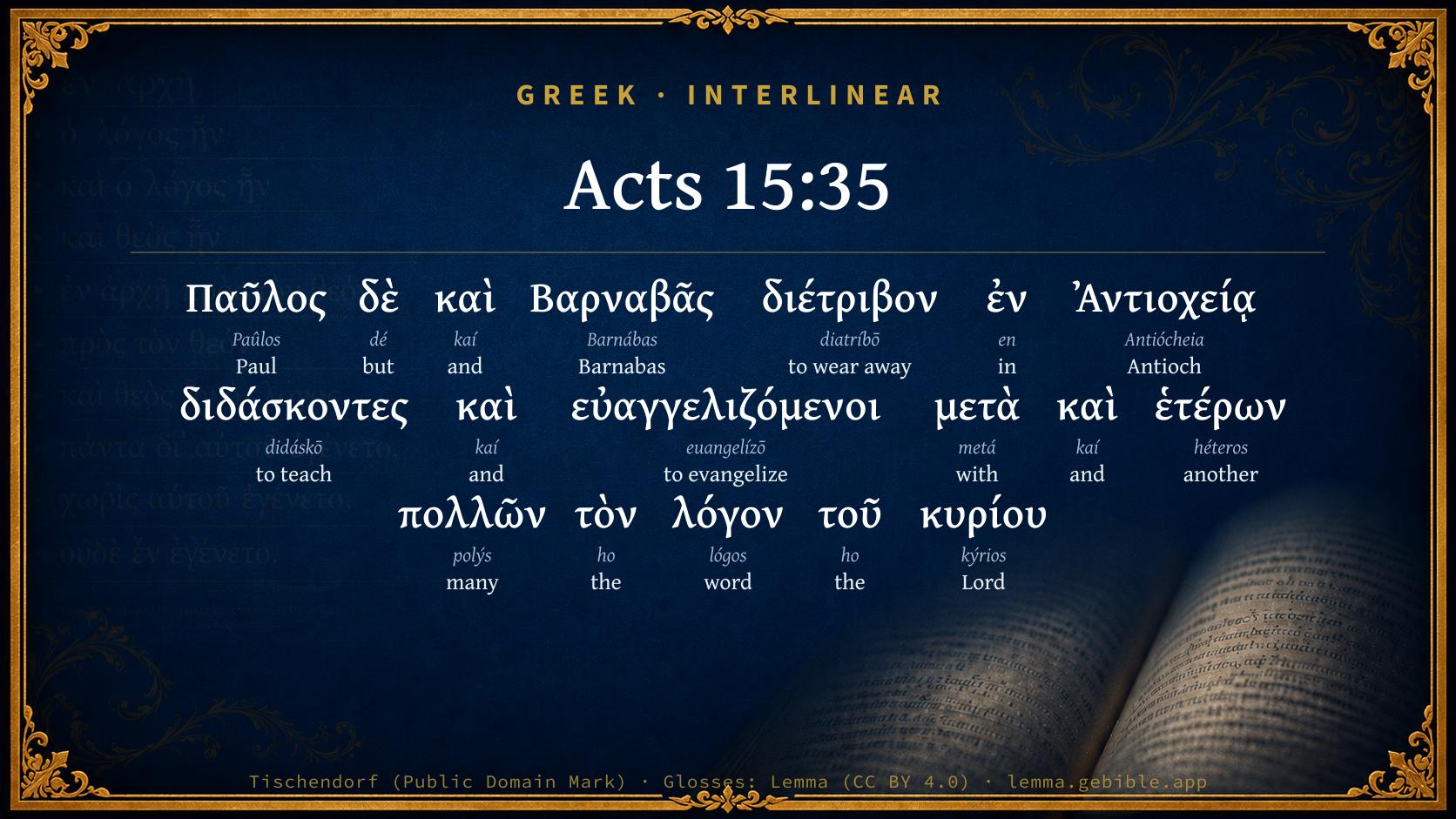
Greek (Tischendorf 8th ed.) Acts 15:35 appears in the Greek New Testament. The text above is from the Tischendorf 8th edition. Each word links to its Strong’s number and a concise gloss. Click any word for its full Thayer’s Greek Lexicon entry.
Download image
Cite this verse

Acts 15:35 (World English Bible). Public Domain. Lemma interlinear Bible study tool, https://lemma.gebible.app/v/acts/15/35.

Show BibTeX & RIS
BibTeX
RIS
English Translation
But Paul and Barnabas stayed in Antioch, teaching and preaching the word of the Lord, with many others also.
World English Bible · Public Domain
Download a study sheet

One document with this verse’s original text, its word-by-word gloss line, the meaning frame, cross-references with their text, attributed commentary, and full source and license credits — printable, and it pastes into notes with its structure intact.

This verse Autodidact and up

Study sheet (.html) Plain text (.txt)

A passage Seminary Student

Up to 50 verses in one chapter. A passage sheet keeps up to 6 commentary sources and 12 cross-references per verse, in the order this page ranks them, and says so on the sheet whenever that leaves anything out. Ask for a single verse and you get the Autodidact verse sheet above.

Everything on this page stays free to read, with no account — the sheet is a download of what is already on screen, not access to it.

Want to remove ads? Support Godless Engineer
Compare translations 3

The same verse in 3 English versions, stacked beneath the original-language interlinear above. Click any original word for its lexicon entry.

Each is an independent rendering of the whole verse — the interlinear is not word-aligned to these translations.

Highlighted words mark where these versions differ — a whole-verse word diff, not a word-by-word alignment.

  • World English Bible Public Domain
    But Paul and Barnabas stayed in Antioch, teaching and preaching the word of the Lord, with many others also.
  • King James Version Public Domain
    Paul also and Barnabas continued in Antioch, teaching and preaching the word of the Lord, with many others also.
  • unfoldingWord Literal Text CC BY-SA 4.0
    But Paul and Barnabas were staying in Antioch, teaching and proclaiming the word of the Lord, with many others also.

unfoldingWord Literal Text — © unfoldingWord, licensed CC BY-SA 4.0. Word-aligned USFM3 via Door43 (git.door43.org/unfoldingWord/en_ult).

Versions to compare (up to 4)

3 of 4 selected

Show all 19 translations

Every available English version of this verse, each an independent rendering of the whole verse.

  • World English Bible Public Domain
    But Paul and Barnabas stayed in Antioch, teaching and preaching the word of the Lord, with many others also.
  • Berean Standard Bible Public Domain
    But Paul and Barnabas remained at Antioch, along with many others, teaching and preaching the word of the Lord.
  • Majority Standard Bible Public Domain
    But Paul and Barnabas remained at Antioch, along with many others, teaching and preaching the word of the Lord.
  • King James Version Public Domain
    Paul also and Barnabas continued in Antioch, teaching and preaching the word of the Lord, with many others also.
  • American Standard Version (1901) Public Domain
    But Paul and Barnabas tarried in Antioch, teaching and preaching the word of the Lord, with many others also.
  • Revised Version (1885) Public Domain
    But Paul and Barnabas tarried in Antioch, teaching and preaching the word of the Lord, with many others also.
  • Geneva Bible (1599) Public Domain
    Paul also and Barnabas continued in Antiochia, teaching and preaching with many other, the worde of the Lord.
  • Douay-Rheims (1899) Public Domain
    And Paul and Barnabas continued at Antioch, teaching and preaching, with many others, the word of the Lord.
  • Young's Literal Translation Public Domain
    And Paul and Barnabas continued in Antioch, teaching and proclaiming good news -- with many others also -- the word of the Lord;
  • Literal Standard Version CC BY-SA 4.0
    And Paul and Barnabas continued in Antioch, teaching and proclaiming good news—with many others also—the word of the LORD;
  • Unlocked Literal Bible CC BY-SA 4.0
    But Paul and Barnabas stayed in Antioch along with many others, where they taught and proclaimed the word of the Lord.
  • unfoldingWord Literal Text CC BY-SA 4.0
    But Paul and Barnabas were staying in Antioch, teaching and proclaiming the word of the Lord, with many others also.
  • Darby Bible Public Domain
    And Paul and Barnabas stayed in Antioch, teaching and announcing the glad tidings, with many others also, of the word of the Lord.
  • World Messianic Bible Public Domain
    But Paul and Barnabas stayed in Antioch, teaching and proclaiming the word of the Lord, with many others also.
  • Webster's Bible Public Domain
    Paul also and Barnabas continued in Antioch, teaching and preaching the word of the Lord, with many others also.
  • Free Bible Version CC BY-SA 4.0
    But Paul and Barnabas stayed in Antioch, teaching and proclaiming the word of God along with many others.
  • Bible in Basic English Public Domain
    But Paul and Barnabas kept on in Antioch, teaching and preaching the word of God, with a number of others.
  • Text-Critical English NT CC BY 4.0
    But Paul and Barnabas stayed in Antioch, teaching and preaching, along with many others, the good news of the word of the Lord.
  • Tyndale New Testament (1534) Public Domain
    Paul and Barnabas continued in Antioche teachynge and preachynge the worde of the Lorde with other many.

Literal Standard Version (2020), Covenant Press — licensed CC BY-SA 4.0. Text via the HelloAO Bible API (eBible.org). Unlocked Literal Bible (unfoldingWord) — licensed CC BY-SA 4.0. Text via the HelloAO Bible API (eBible.org). unfoldingWord Literal Text — © unfoldingWord, licensed CC BY-SA 4.0. Word-aligned USFM3 via Door43 (git.door43.org/unfoldingWord/en_ult). Free Bible Version, Dr. Jonathan Gallagher — licensed CC BY-SA 4.0. Text via the HelloAO Bible API (eBible.org).

Word by word

More ways to search: Search by grammar → Find every occurrence → Compare this word →

Practice this passage: Drill this verse → Learn its vocabulary →

διέτριβον
diatríbō
G1304
“to wear away”
Verb, Imperfect, Active, Indicative, 3rd person, Plural
Part of Speech
Verb
Tense
Imperfect
Voice
Active
Mood
Indicative
Person
3rd person
Number
Plural
Full Thayer's Definition

Origin: from G1223 and the base of G5147

TDNT: None

1. to rub between, rub hard 2. to wear away, consume 3. to spend, pass time
  1. Παῦλος Paûlos G3972 “Paul” Noun, Nominative, Singular, Masculine
  2. δὲ dé G1161 “but” Conjunction
  3. καὶ kaí G2532 “and” Conjunction
  4. Βαρναβᾶς Barnábas G921 “Barnabas” Noun, Nominative, Singular, Masculine
  5. ἐν en G1722 “in” Preposition
  6. Ἀντιοχείᾳ Antiócheia G490 “Antioch” Noun, Dative, Singular, Feminine
  7. διδάσκοντες didáskō G1321 “to teach” Verb, Present, Active, Participle, Nominative, Plural, Masculine
  8. καὶ kaí G2532 “and” Conjunction
  9. εὐαγγελιζόμενοι euangelízō G2097 “to evangelize” Verb, Present, Middle, Participle, Nominative, Plural, Masculine
  10. μετὰ metá G3326 “with” Preposition
  11. καὶ kaí G2532 “and” Conjunction
  12. ἑτέρων héteros G2087 “another” Adjective, Genitive, Plural, Masculine
  13. πολλῶν polýs G4183 “many” Adjective, Genitive, Plural, Masculine
  14. τὸν ho G3588 “the” Article, Accusative, Singular, Masculine
  15. λόγον lógos G3056 “word” Noun, Accusative, Singular, Masculine
  16. τοῦ ho G3588 “the” Article, Genitive, Singular, Masculine
  17. κυρίου kýrios G2962 “Lord” Noun, Genitive, Singular, Masculine

About this verse

These counts appear in no published source. They are computed here, from the morphology-tagged text and Lemma’s own curated glosses. What Lemma adds →

18
words
15
distinct lemmas
Acts
section

Notable vocabulary

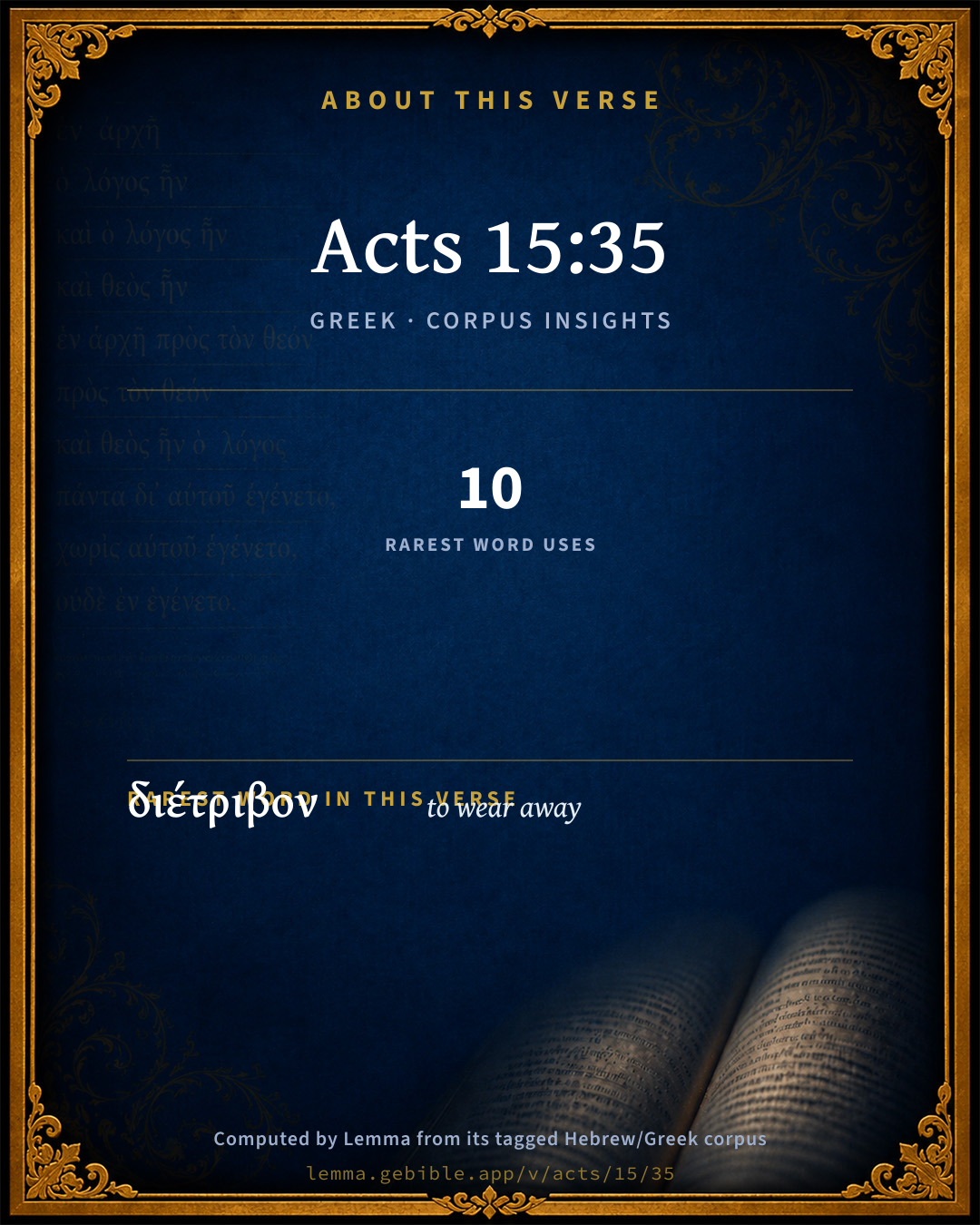
The rarest word here is διέτριβον to wear away G1304 — appearing just 10 times in the whole Greek New Testament.

Shared distinctive vocabulary

διέτριβον to wear away G1304 occurs in 10 verses of the Greek New Testament. Also found in:

Repetition

Words recur within this verse:

Cross-references

8

Topical passages linked to Acts 15:35 in the Treasury of Scripture Knowledge — connected by theme and wording, ordered by reader-vote popularity; previews shown in the World English Bible.

  • Colossians 1:28 whom we proclaim, admonishing every man and teaching every man in all wisdom, that we may present every man perfect in Christ Jesus;
  • 2 Timothy 4:2 preach the word; be urgent in season and out of season; reprove, rebuke, and exhort, with all patience and teaching.
  • Matthew 28:19–20 Therefore go, and make disciples of all nations, baptizing them in the name of the Father and of the Son and of the Holy Spirit,
  • Acts 13:1 Now in the assembly that was at Antioch there were some prophets and teachers: Barnabas, Simeon who was called Niger, Lucius of Cyrene, Manaen the foster-brother of Herod the tetrarch, and Saul.
  • Acts 8:4 Therefore those who were scattered abroad went around preaching the word.
  • Acts 14:28 They stayed there with the disciples for a long time.
  • Acts 28:31 preaching the Kingdom of God, and teaching the things concerning the Lord Jesus Christ with all boldness, without hinderance.
  • 1 Timothy 2:7 to which I was appointed a preacher and an apostle (I am telling the truth in Christ, not lying), a teacher of the Gentiles in faith and truth.

Cross-references courtesy of OpenBible.info (CC BY 4.0).

Commentary

Notes on Acts 15:35 from classic Christian and Jewish commentators (each source and its license shown beneath its notes). The classic Christian expositions comment on the surrounding passage and are grouped to its opening verse, so a note may address several verses; the Jewish commentaries on the Tanakh (Rashi and others) are per-verse, so they appear only where the commentator wrote on this verse.

Lemma curates 59 commentaries, every one of them public domain or Creative Commons licensed, each selected and text-cleaned for this edition rather than reprinted as found. About our sources →

Expositor's Greek Testament

ed. W. Robertson Nicoll

Act 15:35 . διέτριβον , cf. Act 12:19 , and see also on Act 16:12 . In LXX cf. Lev 14:8 , Jer 42 (35):7, Jdt 10:2 , 2Ma 14:23 . So also in classics with or without χρόνον . διδάσ . καὶ εὐαγγ .: possibly the first may refer to work inside the Church, and the second to work outside, but the distinction can scarcely be pressed. Within this time, according to Wendt, falls the incident between Paul and Peter, Gal 2:11 . On the other hand, see Weiss, Apostelgeschichte , p. 194, who thinks that the τινας ἡμέρας excludes, Gal 2 , etc., but the phrase is very indefinite, and may have included months as well as days, cf. Act 16:12 , and Act 9:23 . On the incident referred to see additional note at end of chapter.

The Expositor's Greek Testament, edited by W. Robertson Nicoll (1897–1910) — public domain. Text from a community e-Sword module.

Jamieson, Fausset & Brown

Robert Jamieson, A. R. Fausset & David Brown

Paul . . . and Barnabas continued in Antioch, teaching--to the disciples.

and preaching--to those without.

the word of the Lord, with many others--other laborers.

also--How rich must Antioch at this time have been in the ministrations of the Gospel! (For a painful scene on this occasion between Paul and Peter, see Gal 2:11-14).

Jamieson, Fausset & Brown — Commentary Critical and Explanatory on the Whole Bible (1871) — public domain (CC PDM 1.0). Text via the HelloAO Bible API.

Ellicott's Commentary for English Readers

(35) Preaching the word of the Lord.—Here, as often elsewhere, preaching the glad tidings of the word.

With many others.—Among these we may fairly reckon the prophets of Act_13:1. Looking to the later history of the Church of Antioch, it is not improbable that we may think also of the martyr Ignatius, and Euodius, afterwards Bishop of Antioch, as among those who were thus active, though they were not prominent enough, when St. Luke wrote, to be specially named. Ignatius was said to have been, together with Polycarp, a disciple of St. John (Mart. Ignat. c. 3), while another tradition represents him as a follower of Peter. It is possible that the dispute between St. Peter and St. Paul, referred to in Gal_2:11-13, occurred during this period, but the evidence on the whole tends to connect it with St. Paul’s visit to Antioch in Act_18:22, where see Note.

A Bible Commentary for English Readers, edited by Charles John Ellicott (1878–1897) — public domain. Text from a community e-Sword module.

The Cambridge Bible for Schools and Colleges

gen. ed. J. J. S. Perowne

35. teaching and preaching the word of the Lord] In such a community there was need not only of setting forth Jesus as the Saviour, but of much instruction concerning the ways in which God had shewn that the Gentiles were now to be made partakers of the new covenant. So that the two verbs should not be taken one as an explanation of the other.

The Cambridge Bible for Schools and Colleges (gen. ed. J. J. S. Perowne; Cambridge University Press, 1878–1918) — public domain. Text from a community e-Sword module.

John Gill's Exposition

And some days after,.... That Judas was gone to Jerusalem, and which they had spent in teaching and preaching the word of the Lord at Antioch:

Paul said to Barnabas, let us go again and visit our brethren in every city, where we have preached the word of the Lord, and see how they do; by the "brethren in every city", the apostle means the believers in Syria, Pamphylia, Pisidia, and Lycaonia; where he and Barnabas had preached the Gospel with success; where churches were planted and elders were ordained; of which an account is given in the two preceding chapters: and it may be observed, what an affection the apostle had for the young converts, and members of these churches; he calls them "brethren", they being partakers of the same grace, and of the same faith and family with himself, though they were not in the same office, nor had the same gifts; as also what care he took of them, and of those new planted churches: and which shows, that such are to be visited and looked after, and their cases inspected into; and inquiries should be made of them, how they do, how they go on; whether they continue in the faith, and grow in grace and in the knowledge of Christ; and whether they are lively in the exercise of the graces of faith, hope, love, humility, &c. and diligent and fervent in the discharge of duty; and this is a work becoming the ministers of the Gospel; and the example of the apostle is worthy of imitation.

John Gill's Exposition of the Whole Bible (1746–1763) — public domain (CC PDM 1.0). Text via the HelloAO Bible API.

Trapp's Complete Commentary

John Trapp

35 Paul also and Barnabas continued in Antioch, teaching and preaching the word of the Lord, with many others also.

Ver. 35. Teaching and preaching] i.e. Being instant and earnest, non frigidi docent, sed instant et urgent, saith Calvin here; they lay their bones to the Lord’s work, they set their sides and their shoulders to it, as those that would do the deed.

With many others also] In the primitive times, saith Mr Baxter (Pref. to Saint’s Everlasting Rest), every church had many ministers, wherefore the ablest speakers did preach most in public; and the rest did the more of the less public work. But now sacrilege and covetousness will scarcely leave maintenance for one in a church, &c.

John Trapp, A Commentary or Exposition upon All the Books of the Old and New Testament (1647–1656) — public domain. Text from a community e-Sword module.

Albert Barnes' Notes on the Bible

Paul also, and Barnabas, continued in Antioch - How long a time is unknown. It is probable that at this time the unhappy incident occurred between Paul and Peter which is recorded in Gal 2:11-14.

Albert Barnes' Notes on the Bible (1834–1885) — public domain. Text from a community e-Sword/MySword module.

Matthew Poole's English Annotations

Judas only returned to Jerusalem, to acquaint the apostles with the reception their letter had met with, and what obedience was readily given to their decrees; so that when these went away the church at Antioch was not left destitute of faithful pastors. When God gives the word, great is the multitude of preachers, Psa 68:11.

Matthew Poole's English Annotations on the Holy Bible (1683–1685) — public domain. Text from a community e-Sword/MySword module.

Whedon's Commentary on the Bible

Daniel D. Whedon

35. Teaching—Unfolding the system of Christian truths.

Preaching— Awakening the Christian emotions by impressive appeals.

Many others— Successful preaching and revivals generally make new preachers.

PAUL’S SECOND MISSION from Antioch, through Syria and Asia Minor, into Europe; namely, in Northern Greece, Philippi, Thessalonica, and Berea; in Southern Greece, Athens, and Corinth; thence back by sea, touching Ephesus, Cesarea, and Jerusalem, to Antioch, Act_15:36 to Act_18:23.

Daniel D. Whedon (gen. ed.), Commentary on the Old and New Testaments (1874–1909) — public domain. Text from a community e-Sword module.

The Pulpit Commentary

But Paul for Paul also, A.V.; tarried for continued, A.V. It is at this time that Meyer and other commentators (see ver. 1, note) place Peter"s visit to Antioch mentioned in Gal_2:11. But it is quite inconceivable that Peter, with all the influence of the Jerusalem Cornell fresh upon him, and after the part he himself took in it, and when his own emissaries, Silas and Judas, had just left Antioch, should act the part there ascribed to him. Nor is it within the region of probability that, so soon after the council, any should have come "from James" to unsay what James had said and written at the council. We may with much confidence place Peter"s visit to Antioch before the council, as suggested in note to ver. 1.

The Pulpit Commentary (1880–1919), ed. H.D.M. Spence-Jones & Joseph S. Exell — public domain. Text from a community e-Sword module.

John Wesley's Explanatory Notes

Paul and Barnabas abode in Antioch - And it was during this time that Peter came down from Jerusalem, and that St. Paul withstood him to the face, for separating himself from the Gentiles, Gal. ii, 11, &c.

John Wesley, Explanatory Notes Upon the Whole Bible (1754–1765) — public domain. Text via the GEBible commentary corpus.

Godbey's Commentary on the New Testament

William B. Godbey

DISRUPTION AND FINAL SEPARATION OF BARNABAS AND PAUL

35-39. The Greek word for “contention” is paroxysm, which now means an earthquake shock, which, you see, has a superlative signification. Paul and Barnabas were both sanctified wholly, and filled with the Holy Ghost. Perfect love is the bravest thing in the world; full salvation makes you positive enough to die in your tracks, when you know you are right. Paul and Barnabas were both right in this matter, and yet diametrically opposite. Consequently, there was no chance but to separate. Mark was merely incidental to the paroxysm. Paul was right in refusing to take him, because he had retreated from the field during the former campaign. Barnabas was right in sympathizing with his young, cowardly nephew (Col 4:10), and giving him another chance, which proved a success, so that Mark made an efficient preacher, and actually wrote the gospel of our Lord, and finally sealed his faith with his blood in Alexandria, Egypt. Paul appreciated him, and afterward called him to his work. The simple solution of the matter is, God was in the transaction. Paul had started out the junior preacher, with Barnabas, and actually revolutionized the ticket, and come to the front. Barnabas was an able leader, and Paul now more so. Hence it was a waste of ammunition for them longer to go together. It is now high time for each one to lead an evangelistic party the balance of his life. Here the curtain falls over Barnabas, that great and good man, and we never hear of him afterward. Doubtless, like his apostolical comrades, he lived a hero and died a martyr. The simple reason why we hear no more of him is because Luke, the historian, no longer accompanied him to write up his history, but went with Paul, though he is too modest even to tell us so, simply specifying that Mark went with Barnabas, and Silas with Paul.

41,42. Henceforth this inspired history all focalizes around Paul, who now, with Silas and Luke, travels through Syria and Cilicia (his native land) “establishing the churches.” In former years they had organized many churches, i. e., little holiness bands, in those great heathen countries. On this tour there is no mention of a single convert, the time, everywhere, being devoted to the establishment of the saints, i. e., getting them sanctified and teaching them the Word of the Lord. We find in this inspired history that Paul took great tours, traveling through vast regions, devoting all of his time to the work of sanctifying and edifying the churches.

William B. Godbey, Commentary on the New Testament (1896–1900) — public domain. Text from a community e-Sword module.

McGarvey & Pendleton's Commentaries

J. W. McGarvey

35. The city of Antioch still continued to be a profitable field for apostolic labor, and the scene of interesting events. (35) " Paul and Barnabas also continued in Antioch, with many others, teaching and preaching the word of the Lord. " It is during this period that the most judicious commentators locate the visit of Peter to Antioch, and the rebuke administered to him by Paul, as recorded in the second chapter of Galatians; "When Peter came to Antioch, I withstood him to the face, because he was to be blamed. For before the coming of certain persons from James, he did eat with the Gentiles; but when they came, he withdrew and separated himself, fearing them of the circumcision. And the other Jews dissembled likewise with him, so that even Barnabas was carried away with their dissimulation."

It has been erroneously supposed that Peter, in this affair, acted in direct conflict with the epistle which he had just united in addressing to the Gentile brethren. The harshness of this supposition has led some writers to hastily conclude that his improper conduct must have occurred at a period antecedent to the issuing of that epistle. It is also urged in favor of an earlier date of the incident, that, if it had occurred subsequent to the publication of that epistle, Paul would naturally have appealed to it in the controversy with Peter, which he seems not to have done. Both of these suppositions spring from a mistake as to the exact fault of which Peter was guilty. He did not insist that the Gentiles should be circumcised, or that they should keep the law; which were the points discussed in the apostolic epistle. But, still admitting the right of the uncircumcised to membership and its privileges, his fault was in refusing to eat with them in their private circles, although he had himself been the first to do so in the family of Cornelius, and had done so, for a time, even since he came to Antioch. In opposing such conduct, it would not have answered Paul's purpose to appeal to the epistle from Jerusalem; for it merely asserted the freedom of the Gentiles from the yoke of the law, without prescribing the intercourse that should exist between the circumcised and uncircumcised brethren. The course of argument which he did pursue was the only one available. He convicted Peter of inconsistency, saying, "If you, being a Jew, live like a Gentile, and not like a Jew, why do you require the Gentiles to live like Jews?" He had lived like a Gentile while eating with them; but now, by withdrawing from them, he was virtually saying to them, You must live like the Jews. This was inconsistent, and made it appear that either he was now a transgressor, while building up the Jewish prejudices, or had formerly been, while seeking to break them down. "For if I build again the things which I destroyed, I make myself a transgressor."

But the proof of inconsistency in an opponent never settles a question of truth or duty. After you have proved your opponent inconsistent, you have still to prove that his present course differs from what truth requires, as well as from his former course. Moral inconsistency convicts a man as a transgressor, but whether a transgressor now, or formerly, is still an open question. Paul, therefore, proceeded to prove Peter's present conduct improper, by stating as an undisputed fact, "I, through the law, am dead to the law, that I might live to God;" that is, by the limitation which the law prescribes to itself, it has ceased to bind me, and I have ceased to live under it. This fact was decisive, because all the distinction assumed to exist between the circumcised and uncircumcised was based upon the supposition that the former, at least, were still under the law.

This is the last passage in Acts connected with the Apostle Peter. Before leaving it, we must notice one fact in connection with this unhappy incident in his life which far outweighs the dissimulation rebuked by Paul. It is the manner in which he received this rebuke. There is not the least evidence of any resentment on his part, either for the rebuke itself, or for the subsequent publication of it to the Churches in Galatia. Most men become offended when thus rebuked by their equals, and would regard it as an unpardonable offense to give unnecessary publicity to a fault of this kind. But Paul knew so well the goodness of Peter's heart, that he did not hesitate to speak of it to the world and to future generations. That he did not overestimate the meekness of Peter, is evident from the fact that the latter subsequently spoke most affectionately of Paul, with direct allusion to his epistles, and with a publicity equal to that which his own sin had received. This excellence of Peter's character was known to other brethren besides Paul, as is evident from the freedom with which all the four evangelists speak of his denial of the Lord. They might have omitted this incident from their narratives, if they had been influenced by that pride and sensitiveness which prompt men to hide the faults of their leaders, or if they had thought that the publication of it would give serious offense to Peter. But they knew Peter, and, we must presume, they knew that he was willing for any fault of his, however discreditable, to be published to the world, if it would do any good. This is the spirit of self-sacrifice with which every servant of God should offer himself to the cause of Christ.

J. W. McGarvey (with Philip Y. Pendleton), Commentaries on the New Testament (The Fourfold Gospel, 1914; Acts; and the epistles) — public domain. Text from a community e-Sword/MySword module.

Cambridge Greek Testament for Schools and Colleges

35. διδάσκοντες καὶ εὐαγγελιζόμενοι, teaching and preaching. In such a community there was need not only of setting forth Jesus as the Saviour, but of much instruction concerning the ways in which God had shewn that the Gentiles were now to be made partakers of the new covenant. So that the two verbs should not be taken one as an explanation of the other. They represent different parts of the ministerial work.

Cambridge Greek Testament for Schools and Colleges (Cambridge University Press, 1896; 21 vols, various authors incl. Carr, Maclear, Plummer, Farrar, Lumby, Moule, M. R. James, Simcox) — public domain. Text from a community e-Sword module.

Alford’s Greek Testament

Henry Alford

35.] διδάσκοντες, to those who had received it,—εὐαγγελιζόμενοι, to those who had not.

36—Ch.

Henry Alford, The Greek Testament (1849–1861) — public domain. Text from a community e-Sword module.

Lesson kit

Teaching starters — assembled from the data on this page, not authored interpretation. Every prompt links to the verse data it draws on. Edit before teaching.

Acts, in the Acts, opens this verse with 18 words (15 distinct Greek lemmas). Its most distinctive word is diatríbō (“to wear away”). A historical commentator’s framing appears above. Read the whole chapter for the surrounding context.

Discussion questions

  1. How does “to wear away” (diatríbō) shape what this verse is saying?
  2. How does John 3:22, which shares the word «to wear away», read alongside this verse?
  3. What does the repetition of “and” (3× in this one verse) do in this verse?
  4. The translations on this page render this verse differently — a whole-verse word diff, not a word-by-word alignment. What might account for the different wordings?
  5. Compare how Expositor's Greek Testament and Jamieson, Fausset & Brown read this verse. Where do they agree or differ?

Things to notice

Reading settings

Reading text

Shown beneath each verse's original-language words.

Old Testament
Old Testament edition

Read the OT as the Masoretic Hebrew (MT) or the Greek Septuagint (LXX).

English shown for the Greek Septuagint (in the Hebrew ↔ Greek comparison).

Comparing translations? Open the Compare panel on any verse page to stack up to four side by side.