
John 10:41

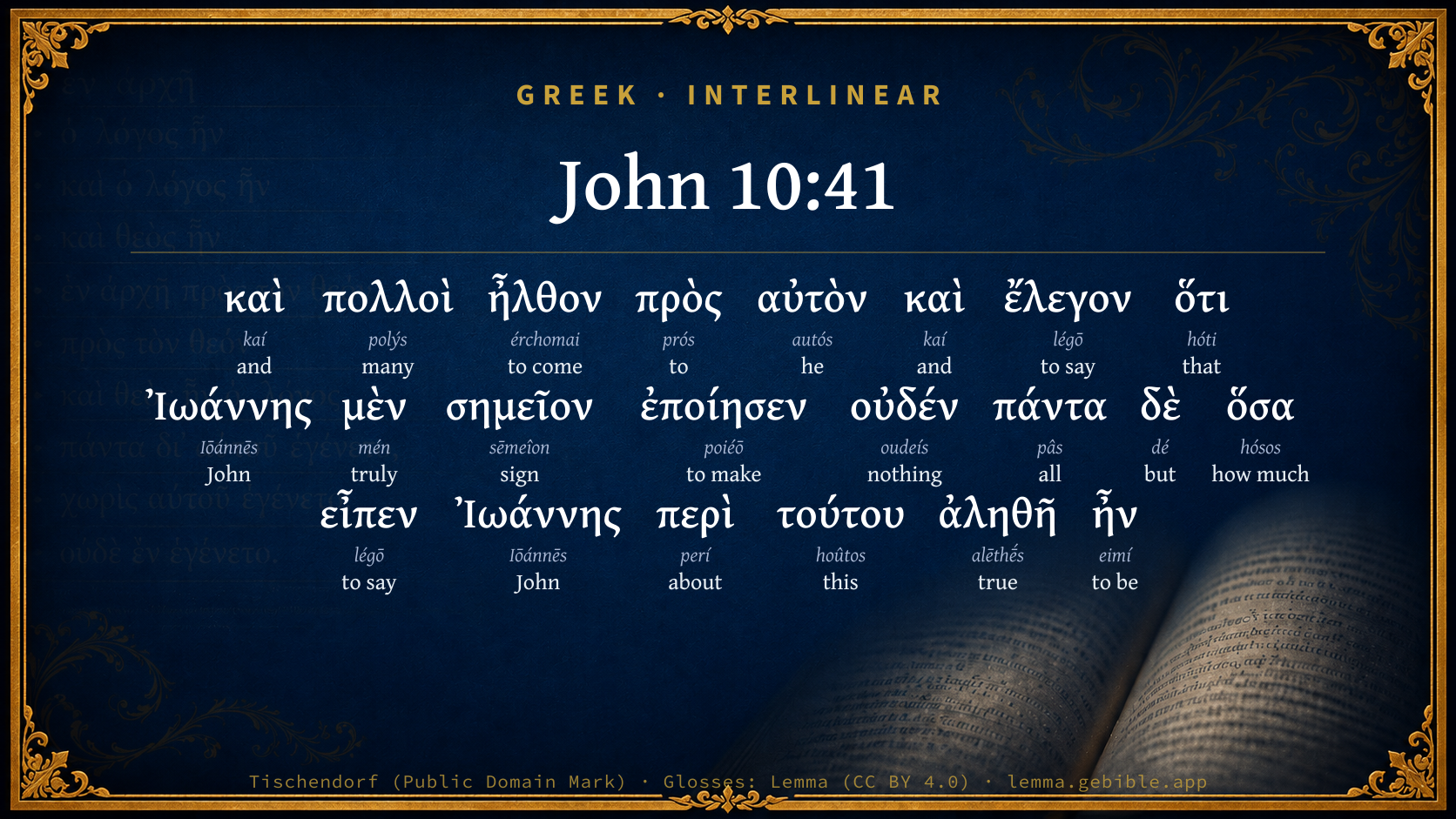
Greek (Tischendorf 8th ed.) John 10:41 appears in the Greek New Testament. The text above is from the Tischendorf 8th edition. Each word links to its Strong’s number and a concise gloss. Click any word for its full Thayer’s Greek Lexicon entry.
Download image
Cite this verse

John 10:41 (World English Bible). Public Domain. Lemma interlinear Bible study tool, https://lemma.gebible.app/v/john/10/41.

Show BibTeX & RIS
BibTeX
RIS
English Translation
Many came to him. They said, "John indeed did no sign, but everything that John said about this man is true."
World English Bible · Public Domain
Download a study sheet

One document with this verse’s original text, its word-by-word gloss line, the meaning frame, cross-references with their text, attributed commentary, and full source and license credits — printable, and it pastes into notes with its structure intact.

This verse Autodidact and up

Study sheet (.html) Plain text (.txt)

A passage Seminary Student

Up to 50 verses in one chapter. A passage sheet keeps up to 6 commentary sources and 12 cross-references per verse, in the order this page ranks them, and says so on the sheet whenever that leaves anything out. Ask for a single verse and you get the Autodidact verse sheet above.

Everything on this page stays free to read, with no account — the sheet is a download of what is already on screen, not access to it.

Want to remove ads? Support Godless Engineer
Compare translations 3

The same verse in 3 English versions, stacked beneath the original-language interlinear above. Click any original word for its lexicon entry.

Each is an independent rendering of the whole verse — the interlinear is not word-aligned to these translations.

Highlighted words mark where these versions differ — a whole-verse word diff, not a word-by-word alignment.

  • World English Bible Public Domain
    Many came to him. They said, "John indeed did no sign, but everything that John said about this man is true."
  • King James Version Public Domain
    And many resorted unto him, and said, John did no miracle: but all things that John spake of this man were true.
  • unfoldingWord Literal Text CC BY-SA 4.0
    And many came to him and were saying, “John indeed did no sign, but all that John said about this one was true.”

unfoldingWord Literal Text — © unfoldingWord, licensed CC BY-SA 4.0. Word-aligned USFM3 via Door43 (git.door43.org/unfoldingWord/en_ult).

Versions to compare (up to 4)

3 of 4 selected

Show all 19 translations

Every available English version of this verse, each an independent rendering of the whole verse.

  • World English Bible Public Domain
    Many came to him. They said, "John indeed did no sign, but everything that John said about this man is true."
  • Berean Standard Bible Public Domain
    Many came to Him and said, “Although John never performed a sign, everything he said about this man was true.”
  • Majority Standard Bible Public Domain
    Many came to Him and said, “Although John never performed a sign, everything he said about this man was true.”
  • King James Version Public Domain
    And many resorted unto him, and said, John did no miracle: but all things that John spake of this man were true.
  • American Standard Version (1901) Public Domain
    And many came unto him; and they said, John indeed did no sign: but all things whatsoever John spake of this man were true.
  • Revised Version (1885) Public Domain
    And many came unto him; and they said, John indeed did no sign: but all things whatsoever John spake of this man were true.
  • Geneva Bible (1599) Public Domain
    And many resorted vnto him, and saide, Iohn did no miracle: but all thinges that Iohn spake of this man, were true.
  • Douay-Rheims (1899) Public Domain
    And many resorted to him, and they said: John indeed did no sign.
  • Young's Literal Translation Public Domain
    and many came unto him, and said -- `John, indeed, did no sign, and all things, as many as John said about this one were true;'
  • Literal Standard Version CC BY-SA 4.0
    and many came to Him and said, “John, indeed, did no sign, and all things, as many as John said about this One were true”;
  • Unlocked Literal Bible CC BY-SA 4.0
    Many people came to him and they said, “John indeed did no signs, but all the things that John has said about this man are true.”
  • unfoldingWord Literal Text CC BY-SA 4.0
    And many came to him and were saying, “John indeed did no sign, but all that John said about this one was true.”
  • Darby Bible Public Domain
    And many came to him, and said, John did no sign; but all things which John said of this [man] were true.
  • World Messianic Bible Public Domain
    Many came to him. They said, “Yochanan indeed did no sign, but everything that Yochanan said about this man is true.”
  • Webster's Bible Public Domain
    And many resorted to him, and said, John performed no miracle; but all things that John spoke of this man were true.
  • Free Bible Version CC BY-SA 4.0
    Many people came to him, and they said, “John didn't perform miracles, but everything he said about this man has come true.”
  • Bible in Basic English Public Domain
    And a great number of people came to him, saying, John did no sign: but everything John said of this man was true.
  • Text-Critical English NT CC BY 4.0
    Many came to him and were saying, “John did no sign, but everything that John said about this man was true.”
  • Tyndale New Testament (1534) Public Domain
    And many resorted vnto him and sayd. Iohn dyd no miracle: but all thinges that Iohn spake of this man are true.

Literal Standard Version (2020), Covenant Press — licensed CC BY-SA 4.0. Text via the HelloAO Bible API (eBible.org). Unlocked Literal Bible (unfoldingWord) — licensed CC BY-SA 4.0. Text via the HelloAO Bible API (eBible.org). unfoldingWord Literal Text — © unfoldingWord, licensed CC BY-SA 4.0. Word-aligned USFM3 via Door43 (git.door43.org/unfoldingWord/en_ult). Free Bible Version, Dr. Jonathan Gallagher — licensed CC BY-SA 4.0. Text via the HelloAO Bible API (eBible.org).

Word by word

More ways to search: Search by grammar → Find every occurrence → Compare this word →

Practice this passage: Drill this verse → Learn its vocabulary →

ἀληθῆ
alēthḗs
G227
“true”
Adjective, Nominative, Plural, Neuter
Part of Speech
Adjective
Case
Nominative
Number
Plural
Gender
Neuter
Full Thayer's Definition

Origin: from G1 (as a negative particle) and G2990

TDNT: 05:07,4

1. true 2. loving the truth, speaking the truth, truthful
  1. καὶ kaí G2532 “and” Conjunction
  2. πολλοὶ polýs G4183 “many” Adjective, Nominative, Plural, Masculine
  3. ἦλθον érchomai G2064 “to come” Verb, Aorist, Active, Indicative, 3rd person, Plural
  4. πρὸς prós G4314 “to” Preposition
  5. αὐτὸν autós G846 “he” Personal pronoun, Accusative, Singular, Masculine
  6. καὶ kaí G2532 “and” Conjunction
  7. ἔλεγον légō G3004 “to say” Verb, Imperfect, Active, Indicative, 3rd person, Plural
  8. ὅτι hóti G3754 “that” Conjunction
  9. Ἰωάννης Iōánnēs G2491 “John” Noun, Nominative, Singular, Masculine
  10. μὲν mén G3303 “truly” Particle
  11. σημεῖον sēmeîon G4592 “sign” Noun, Accusative, Singular, Neuter
  12. ἐποίησεν poiéō G4160 “to make” Verb, Aorist, Active, Indicative, 3rd person, Singular
  13. οὐδέν oudeís G3762 “nothing” Adjective, Accusative, Singular, Neuter, Negative
  14. πάντα pâs G3956 “all” Adjective, Nominative, Plural, Neuter
  15. δὲ dé G1161 “but” Conjunction
  16. ὅσα hósos G3745 “how much” Correlative pronoun, Accusative, Plural, Neuter
  17. εἶπεν légō G3004 “to say” Verb, Aorist, Active, Indicative, 3rd person, Singular
  18. Ἰωάννης Iōánnēs G2491 “John” Noun, Nominative, Singular, Masculine
  19. περὶ perí G4012 “about” Preposition
  20. τούτου hoûtos G3778 “this” Demonstrative pronoun, Genitive, Singular, Masculine
  21. ἦν eimí G1510 “to be” Verb, Imperfect, Active, Indicative, 3rd person, Singular

About this verse

These counts appear in no published source. They are computed here, from the morphology-tagged text and Lemma’s own curated glosses. What Lemma adds →

22
words
19
distinct lemmas
Gospels
section

Shared distinctive vocabulary

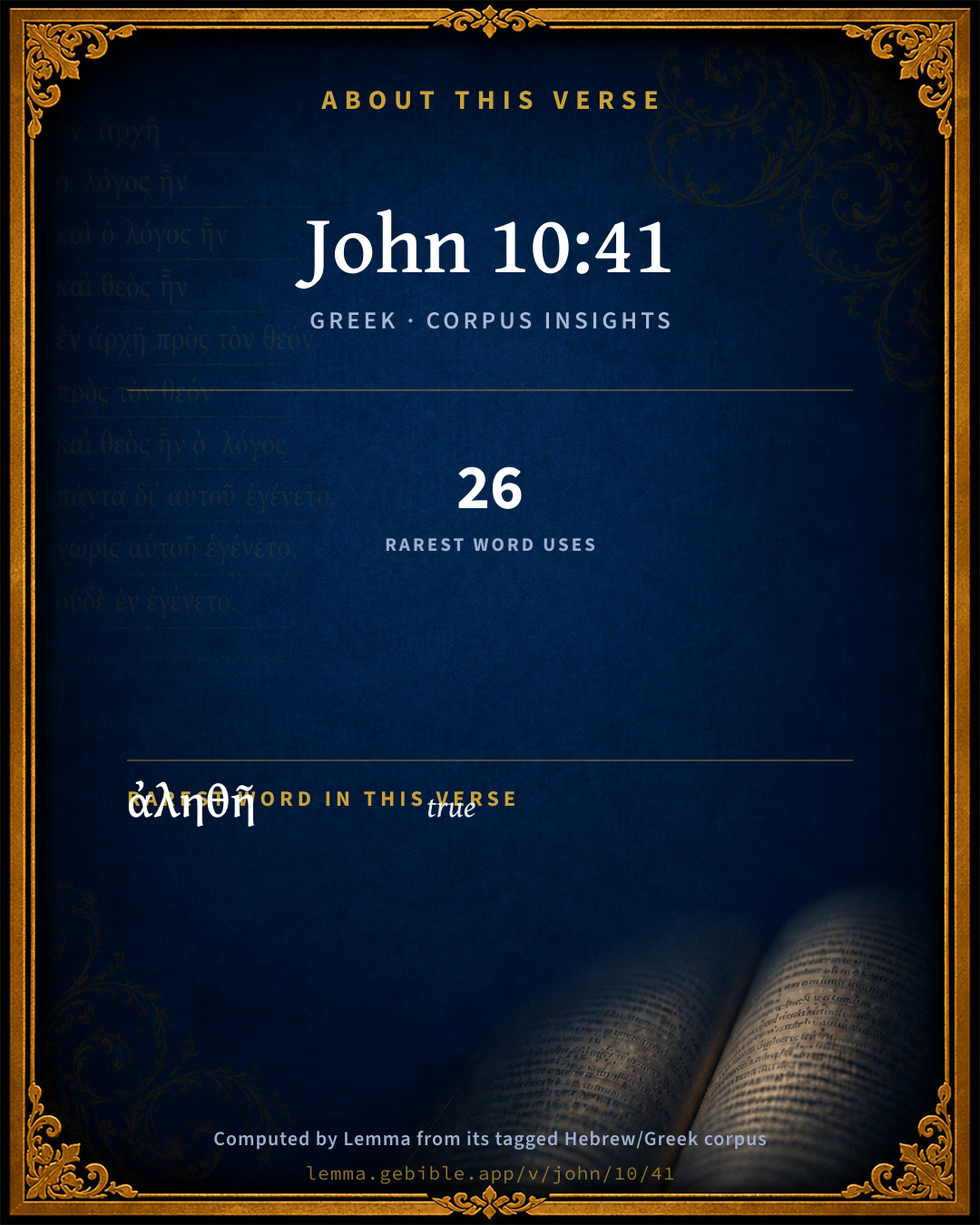
ἀληθῆ true G227 occurs in 25 verses of the Greek New Testament. Also found in:
Repetition

Words recur within this verse:

  • ἔλεγον to say G3004 ×2
  • Ἰωάννης John G2491 ×2
  • καὶ and G2532 ×2

Cross-references

12

Topical passages linked to John 10:41 in the Treasury of Scripture Knowledge — connected by theme and wording, ordered by reader-vote popularity; previews shown in the World English Bible.

  • John 1:33–34 I didn't recognize him, but he who sent me to baptize in water, he said to me, 'On whomever you will see the Spirit descending, and remaining on him, the same is he who baptizes in the Holy Spirit.'
  • John 1:29–30 The next day, he saw Jesus coming to him, and said, "Behold, the Lamb of God, who takes away the sin of the world!
  • Matthew 3:11–12 I indeed baptize you in water for repentance, but he who comes after me is mightier than I, whose shoes I am not worthy to carry. He will baptize you in the Holy Spirit.
  • Matthew 4:23–25 Jesus went about in all Galilee, teaching in their synagogues, preaching the Gospel of the Kingdom, and healing every disease and every sickness among the people.
  • Matthew 14:2 and said to his servants, "This is John the Baptizer. He is risen from the dead. That is why these powers work in him."
  • Mark 1:37 and they found him, and told him, "Everyone is looking for you."
  • Luke 5:1 Now it happened, while the multitude pressed on him and heard the word of God, that he was standing by the lake of Gennesaret.
  • Luke 7:26–30 But what did you go out to see? A prophet? Yes, I tell you, and much more than a prophet.
  • Luke 12:1 Meanwhile, when a multitude of many thousands had gathered together, so much so that they trampled on each other, he began to tell his disciples first of all, "Beware of the yeast of the Pharisees, which is hypocrisy.
  • John 1:27 He is the one who comes after me, who is preferred before me, whose sandal strap I'm not worthy to loosen."
  • John 2:11 This beginning of his signs Jesus did in Cana of Galilee, and revealed his glory; and his disciples believed in him.
  • John 3:26–36 They came to John, and said to him, "Rabbi, he who was with you beyond the Jordan, to whom you have testified, behold, the same baptizes, and everyone is coming to him."

Cross-references courtesy of OpenBible.info (CC BY 4.0).

Commentary

Notes on John 10:41 from classic Christian and Jewish commentators (each source and its license shown beneath its notes). The classic Christian expositions comment on the surrounding passage and are grouped to its opening verse, so a note may address several verses; the Jewish commentaries on the Tanakh (Rashi and others) are per-verse, so they appear only where the commentator wrote on this verse.

Lemma curates 59 commentaries, every one of them public domain or Creative Commons licensed, each selected and text-cleaned for this edition rather than reprinted as found. About our sources →

Tyndale Open Study Notes

Tyndale Open Resources

10:41 everything he said about this man has come true: See 1:19-51; 3:22-36. The fulfillment of John the Baptist’s predictions confirms both that he was a prophet and that what he said about Jesus was true.

Tyndale Open Study Notes — © Tyndale Open Resources, licensed CC BY-SA 4.0. Text via the HelloAO Bible API.

Bengel's Gnomon

Johann Albrecht Bengel

Joh 10:41. Μέν, indeed) The antithesis is between John and this Man, Jesus: not between the works and sayings of John.—περὶ τούτου, concerning this Man) concerning this Man, who doeth so many miracles.—ἀληθῆ ἦν) were true. The truth is true, even before it is acknowledged as such.[293]

[293] Bengel, J. A. (1860). Vol. 2: Gnomon of the New Testament (M. E. Bengel & J. C. F. Steudel, Ed.) (A. R. Fausset, Trans.) (226–388). Edinburgh: T&T Clark.

Bengel's Gnomon of the New Testament — English translation (T&T Clark, Edinburgh, 1860) — public domain. Text from a community e-Sword module.

Expositor's Greek Testament

ed. W. Robertson Nicoll

Joh 10:41 . There He was still busy; for πολλοὶ ἦλθον πρὸς αὐτόν , “many came to Him and said,” that is, giving this as their reason for coming, that “although John himself had done no miracle, all he had said of Jesus was found to be true”. The reference to John is evidently suggested by the locality, and probably means that the “many” alluded to as coming to Jesus belonged to the district and had been impressed by John. The correspondence between what they had heard from the Baptist and what they saw in Jesus, as well as the intrinsic evidence of the works He did, engendered belief in Him (Joh 10:42 ) Καὶ ἐπίστευσαν πολλοὶ ἐκεῖ εἰς αὐτόν .

The Expositor's Greek Testament, edited by W. Robertson Nicoll (1897–1910) — public domain. Text from a community e-Sword module.

Jamieson, Fausset & Brown

Robert Jamieson, A. R. Fausset & David Brown

many resorted to him--on whom the ministry of the Baptist had left permanent impressions.

John did no miracle, but all things John spake of this man were true--what they now heard and saw in Jesus only confirming in their minds the divinity of His forerunner's mission, though unaccompanied by any of His Master's miracles. And thus, "many believed on Him there."

Next: John Chapter 11

Jamieson, Fausset & Brown — Commentary Critical and Explanatory on the Whole Bible (1871) — public domain (CC PDM 1.0). Text via the HelloAO Bible API.

John Calvin's Commentaries

41. And many came to him. This large assembly shows that Christ did not seek solitude, in order to cease from the discharge of his duty, but to erect a sanctuary of God in the wilderness, when Jerusalem, which was his own abode and dwelling-place, had obstinately driven him out. And indeed this was a dreadful vengeance of God, that, while the temple chosen by God was a den of robbers, (Jeremiah 7:11; Matthew 21:13,) the Church of God was collected in a despised place.

John indeed did no miracle. They infer that Christ is more excellent than John, because he has distinguished himself by so many miracles, while John did not perform a single miracle Not that we ought always to judge from miracles, but that miracles, when united with doctrine, have no small weight, as has already been repeatedly mentioned. Their argument is defective; for they compare Christ with John, but they express only one part of the comparison. Besides, they take for granted, that John was an eminent prophet of God, and that he was endued with extraordinary grace of the Holy Spirit. They justly argue, therefore, that Christ ought to be preferred to John, because it was only by the fixed Providence of God that it was brought about that John, though in other respects a very great prophet, yet was not honored by performing any miracle. Hence they conclude, that this was done on Christ’s account, that he might be more highly esteemed.

But all that John said. It appears that this was not spoken by themselves, but was added by the Evangelist, in order to show that there were two reasons which induced them to believe in Christ. On the one hand, they saw that the testimony which John had given to him was true; and, on the other hand, the miracles of Christ procured for him greater authority.

John Calvin's Commentaries (1540-1563) — public domain. Text from the Calvin Translation Society English edition (1840s-50s) via the Christian Classics Ethereal Library (ccel.org). Calvin's coverage is partial (roughly two-thirds of the Bible); uncommented books and verses are honest gaps, never fabricated. The 19th-century editor's footnotes and remarks are omitted so the notes are faithfully Calvin's own voice.

Ellicott's Commentary for English Readers

(41) And many resorted unto him.—It is one of the key-notes of this Gospel, struck in its opening words (see Note on Joh_1:5), and recurring at frequent intervals, that in the midst of even the deepest darkness the light is never absent. In contrast with the rejection at Jerusalem there is the reception on the old ground, which brings memories of early days and bright hopes, which are not without their fulfilment now. The mission of the Seventy, and Christ’s own work in Galilee before the Feast of the Dedication (comp. Note on Joh_10:22), accounts for the number who now come to Him.

And said, John did no miracle: but all things . . .—Better, as before, John did no sign . . . This was not said to Him, but was a general remark suggested by the associations of the spot. The remark assigns to John the position as a witness which he claimed for himself, and which the Evangelist has made prominent in the narrative of His work. He did no sign, and therefore came short of the glory of Him whose signs they had seen and heard of; but more than any other he had recognised that glory, and directed men to it. His spiritual intuition, in advance of the generation in which he lived, was itself a sign, and all things which he had said about the Messiah had, in the events which had taken place since they had seen Him in that place before, been proved to be true. The witness of the past is linked to that of the present. The enthusiasm which John had kindled still burns.

A Bible Commentary for English Readers, edited by Charles John Ellicott (1878–1897) — public domain. Text from a community e-Sword module.

The Cambridge Bible for Schools and Colleges

gen. ed. J. J. S. Perowne

41. many resorted unto him] There is no reason why the usual translation ‘came’ should be changed to ‘resorted.’ The testimony of the Baptist, and perhaps the miraculous voice at Christ’s Baptism, were still remembered there. Since then there had been the mission of the Seventy and Christ’s own work in Galilee.

and said] Or, kept saying or used to say: it was a common remark.

John did no miracle] Or sign. This is indirect evidence of the genuineness of the miracles recorded of Christ. It is urged that if Jesus had wrought no miracles, they would very possibly have been attributed to Him after His death. Let us grant this; and at the same time it must be granted that the same holds good to a very great extent of the Baptist. The enthusiasm which he awakened, as a Prophet appearing after a weary interval of four centuries, was immense. Miracles would have been eagerly believed of him, the second Elijah, and would be likely enough to be attributed to him. But more than half a century after his death we have one of his own disciples quite incidentally telling us that ‘John did no miracle’; and there is no rival tradition to the contrary. All traditions concur in attributing miracles to Jesus.

The Cambridge Bible for Schools and Colleges (gen. ed. J. J. S. Perowne; Cambridge University Press, 1878–1918) — public domain. Text from a community e-Sword module.

John Gill's Exposition

And many believed on him there., Through the doctrine he preached, the miracles he wrought, and through comparing these things with what John had said of him: this shows the reason of Christ's leaving Jerusalem, and coming into these parts; there were others that were to believe in his name: the word "there", is left out in the Vulgate Latin, Syriac, and Persic versions.

Next: John Chapter 11

John Gill's Exposition of the Whole Bible (1746–1763) — public domain (CC PDM 1.0). Text via the HelloAO Bible API.

Trapp's Complete Commentary

John Trapp

41 And many resorted unto him, and said, John did no miracle: but all things that John spake of this man were true.

Ver. 41. John did no miracle] Lest he should be mistaken for the Messiah. But how got he then so much credit? By his mortified conversation especially. "Holy and reverend is God’s name," saith the Psalmist; therefore reverend, because holy. Holiness hath honour in the consciences of the very worst.

But all things that John spake] The word works not sometimes, till many years after it hath been preached, as here; and as they say of the elephant, that she goes with young thirteen years after she hath conceived.

John Trapp, A Commentary or Exposition upon All the Books of the Old and New Testament (1647–1656) — public domain. Text from a community e-Sword module.

Albert Barnes' Notes on the Bible

No miracle - He did not confirm his mission by working miracles, but he showed that he was a prophet by foretelling the character and success of Jesus. Either miracle or prophecy is conclusive proof of a divine mission, for no man can foretell a future event, or work a miracle, except by the special aid of God. It may be remarked that the people of that place were properly prepared by the ministry of John for the preaching of Jesus. The persecution of the Jews was the occasion of his going there, and thus the wrath of man was made to praise him. It has commonly happened that the opposition of the wicked has resulted in the increased success of the cause which they have persecuted. God takes the wise in their own craftiness, and brings glory to himself and salvation to sinners out of the pride, and passions, and rage of wicked men.

Albert Barnes' Notes on the Bible (1834–1885) — public domain. Text from a community e-Sword/MySword module.

Matthew Poole's English Annotations

God so ordered it in the wisdom of his providence, that though Elijah and Elisha under the law wrought miracles, by which they confirmed their Divine mission; yet John, coming immediately before Christ, as his messenger and forerunner, wrought none; that so the glory of Christ in working miracles when he came might be more clear and evident. This made the people, that came to Christ while he was in Galilee, say thus amongst themselves, We paid a great veneration to John the Baptist, yet he never did those things which Christ hath done: and whatsoever John told us of this person hath proved true; he hath done, and doth, greater things than ever John did, and is in the judgment of sense to be preferred before him, should we not now believe in him? John told us he was the Lamb of God, who takes away the sins of the world; and told us much more concerning him, which our eyes see is true.

Matthew Poole's English Annotations on the Holy Bible (1683–1685) — public domain. Text from a community e-Sword/MySword module.

Whedon's Commentary on the Bible

Daniel D. Whedon

41. John did no miracle—By a silent harmony with this statement, the other Evangelists relate no miracles of John’s. The people, in the very scene where Jesus and John first met, thus testify to the inferior position and powers of John; but, in the fulfilment of his words concerning Jesus, they find conclusive proof of the divine mission of the announcer and his Principal.

If Wieseler is correct, Luk_13:22 to Luk_17:10, comes in here. It would then follow that Jesus may have made excursions into Perea, making Bethabara his rallying point. Some of his most striking parables were uttered there.

Daniel D. Whedon (gen. ed.), Commentary on the Old and New Testaments (1874–1909) — public domain. Text from a community e-Sword module.

The Pulpit Commentary

Vers. 41, 42. posthumous fruit of John"s labors" (Bengel). Many came to him, and they said, one to another, rather than to the Lord, John indeed did no sign. It was not John"s function to work miracles or startle the world with visible proofs of his Divine commission. John stood on the natural sphere, found a place in contemporaneous history, and exerted all his influence by the force of his prophetic word. But as a remarkable confirmation of the whole revelation enacted by the life and deeds of Christ, we read, But all things that John spake of this Man were true. The testimonies of John were to the effect that Jesus was "mightier" than he that he was the Son of God, the "Baptizer with the Holy Ghost and with fire," and the Lamb of God, that taketh away the sin of the world." The absence of the miraculous nimbus from the record of John"s ministry is one of the subsidiary evidences we possess of the supernatural power wielded by our Lord Jesus Christ. John was a historic contemporary of Jesus, whose following survived for some centuries, but not until comparatively recent times did credulity or the mythopceic tendency clothe him in a supernatural glory. He was believed to be the Elijah of the new covenant, but he was not supposed to have gone to heaven, like his prototype. A rumor grew up that Jesus was John raised from the dead, but nothing came of it. There was all the material for a splendid myth, but no evolution of one. The reasoning, therefore, is fair since Jesus is reported by John"s disciples to have wrought great signs; these reports are not to be put down to credulity or fiction. The evangelist distinctly asserts that all these testimonies which he had himself recorded in John 1, when followed up by the visible and wonderful presence of the Son of God himself, were held to be true. We need not wonder, then, that many believed on him there.

The Pulpit Commentary (1880–1919), ed. H.D.M. Spence-Jones & Joseph S. Exell — public domain. Text from a community e-Sword module.

John Wesley's Explanatory Notes

John did no miracle - An honour reserved for him, whose forerunner he was.

John Wesley, Explanatory Notes Upon the Whole Bible (1754–1765) — public domain. Text via the GEBible commentary corpus.

Cambridge Greek Testament for Schools and Colleges

41. πολλοὶ ἦλθον. The harvest (Joh 4:35-38). The testimony of the Baptist, and perhaps the miraculous voice at Christ’s Baptism, were still remembered there. Since then there had been the mission of the Seventy and Christ’s own work in Galilee.

ἕλεγον. Kept saying or used to say: it was a common remark.

σ. ἐποίησεν οὐδέν. This is indirect evidence of the genuineness of the miracles recorded of Christ. It is urged that if Jesus had wrought no miracles, they would very possibly have been attributed to Him after His death. Let us grant this; and at the same time it must be granted that the same holds good to a very great extent of the Baptist. The enthusiasm which he awakened, as a Prophet appearing after a weary interval of four centuries, was immense. Miracles would have been eagerly believed of him, the second Elijah, and would be likely enough to be attributed to him. But more than half a century after his death we have one of his own disciples quite incidentally telling us that ‘John did no sign;’ and there is no rival tradition to the contrary. All traditions attribute miracles to Jesus.

ἐκεῖ. Last for emphasis. There, in contrast to Jerusalem which had rejected Him, many believed on Him (Joh 1:12), not merely believed His words (Joh 10:37-38).

Cambridge Greek Testament for Schools and Colleges (Cambridge University Press, 1896; 21 vols, various authors incl. Carr, Maclear, Plummer, Farrar, Lumby, Moule, M. R. James, Simcox) — public domain. Text from a community e-Sword module.

Alford’s Greek Testament

Henry Alford

41.] The locality reminds them of John and his testimony. The remark seems to have a double tendency;—to relate their now confirmed persuasion, that though John did not fulfil their expectations by shewing a sign or working miracles, yet he was a true prophet, and really, as he professed, the forerunner of this Person, who in consequence must be, what John had declared Him to he, the Messiah. And (ver. 42) the result followed:—many believed on Him. “The Ἰωάννης repeated, ver. 42, belongs to the simplicity of the speech, which is reproduced literatim, and expresses the honour paid by the people to the holy man whose memory still lived among them.” Meyer.

Henry Alford, The Greek Testament (1849–1861) — public domain. Text from a community e-Sword module.

International Critical Commentary

41. That the people flocked to hear His teaching in Peræa is confirmed by the Marcan tradition (Mar 10:1, Mat 19:1). They remembered what John the Baptist had said about Him, and remembered too that his witness had been found trustworthy. This was the reason why they came now in such numbers to see and hear Jesus.

Of John the Baptist, too, they remembered that he did no “sign,” such as might be expected of a prophet; but nevertheless, although it was not confirmed by signs (see on 2:11), his witness was true. For the witness of the Baptist, cf. 1:7, 29-34, 3:27-30, 5:33. It made a profound impression.

אD omit ὅτι after ἔλεγον, apparently not realising that ὅτι here is recitantis. The words which follow are set down as the actual words which the people used.

International Critical Commentary — older volumes (1896–1929), various authors — public domain. Text from a community e-Sword module.

Lesson kit

Teaching starters — assembled from the data on this page, not authored interpretation. Every prompt links to the verse data it draws on. Edit before teaching.

John, in the Gospels, opens this verse with 22 words (19 distinct Greek lemmas). Its most distinctive word is alēthḗs (“true”). A historical commentator’s framing appears above. Read the whole chapter for the surrounding context.

Discussion questions

  1. The word alēthḗs carries the sense “true.” How does it shape the verse?
  2. How does Matthew 22:16, which shares the word «true», read alongside this verse?
  3. What does the repetition of “to say” (2× in this one verse) do in this verse?
  4. The translations on this page render this verse differently — a whole-verse word diff, not a word-by-word alignment. What might account for the different wordings?
  5. Compare how Tyndale Open Study Notes and Bengel's Gnomon read this verse. Where do they agree or differ?

Things to notice

Reading settings

Reading text

Shown beneath each verse's original-language words.

Old Testament
Old Testament edition

Read the OT as the Masoretic Hebrew (MT) or the Greek Septuagint (LXX).

English shown for the Greek Septuagint (in the Hebrew ↔ Greek comparison).

Comparing translations? Open the Compare panel on any verse page to stack up to four side by side.