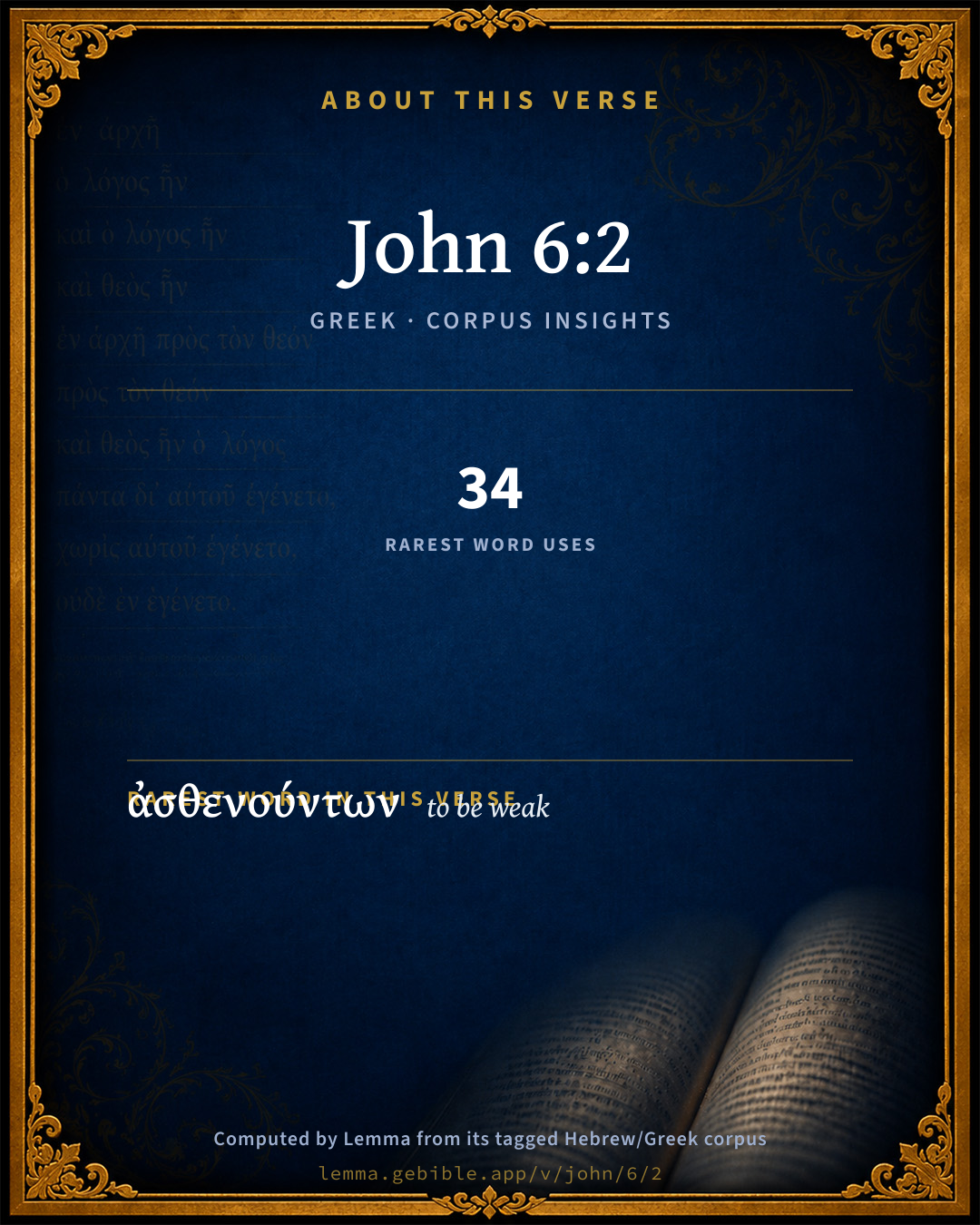
John 6:2

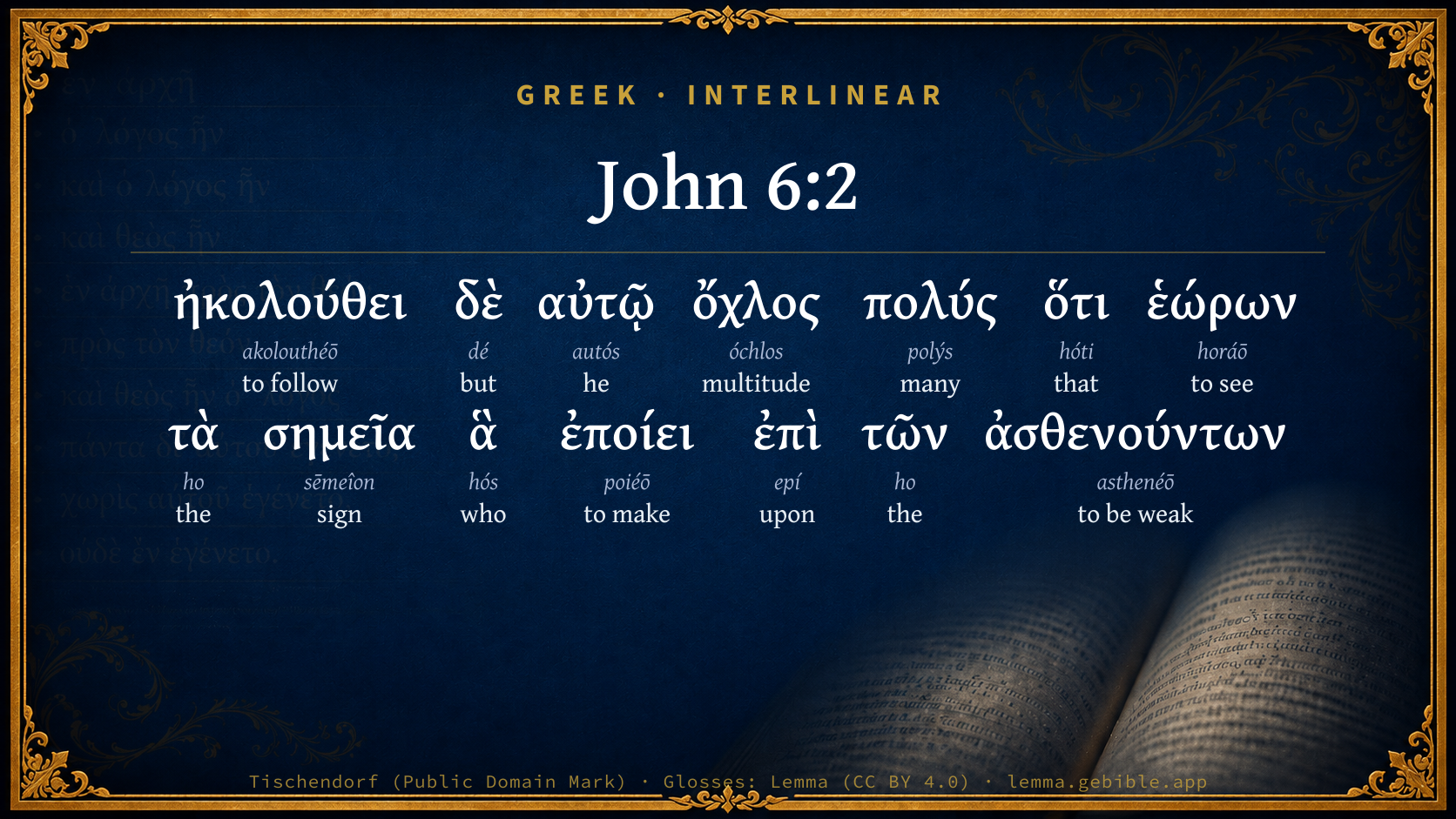
Greek (Tischendorf 8th ed.) John 6:2 appears in the Greek New Testament. The text above is from the Tischendorf 8th edition. Each word links to its Strong’s number and a concise gloss. Click any word for its full Thayer’s Greek Lexicon entry.
Download image
Cite this verse

John 6:2 (World English Bible). Public Domain. Lemma interlinear Bible study tool, https://lemma.gebible.app/v/john/6/2.

Show BibTeX & RIS
BibTeX
RIS
English Translation
A great multitude followed him, because they saw his signs which he did on those who were sick.
World English Bible · Public Domain
Download a study sheet

One document with this verse’s original text, its word-by-word gloss line, the meaning frame, cross-references with their text, attributed commentary, and full source and license credits — printable, and it pastes into notes with its structure intact.

This verse Autodidact and up

Study sheet (.html) Plain text (.txt)

A passage Seminary Student

Up to 50 verses in one chapter. A passage sheet keeps up to 6 commentary sources and 12 cross-references per verse, in the order this page ranks them, and says so on the sheet whenever that leaves anything out. Ask for a single verse and you get the Autodidact verse sheet above.

Everything on this page stays free to read, with no account — the sheet is a download of what is already on screen, not access to it.

Want to remove ads? Support Godless Engineer
Compare translations 3

The same verse in 3 English versions, stacked beneath the original-language interlinear above. Click any original word for its lexicon entry.

Each is an independent rendering of the whole verse — the interlinear is not word-aligned to these translations.

Highlighted words mark where these versions differ — a whole-verse word diff, not a word-by-word alignment.

  • World English Bible Public Domain
    A great multitude followed him, because they saw his signs which he did on those who were sick.
  • King James Version Public Domain
    And a great multitude followed him, because they saw his miracles which he did on them that were diseased.
  • unfoldingWord Literal Text CC BY-SA 4.0
    Now a great crowd was following him because they were seeing the signs that he was doing on the ones being sick.

unfoldingWord Literal Text — © unfoldingWord, licensed CC BY-SA 4.0. Word-aligned USFM3 via Door43 (git.door43.org/unfoldingWord/en_ult).

Versions to compare (up to 4)

3 of 4 selected

Show all 19 translations

Every available English version of this verse, each an independent rendering of the whole verse.

  • World English Bible Public Domain
    A great multitude followed him, because they saw his signs which he did on those who were sick.
  • Berean Standard Bible Public Domain
    A large crowd followed Him because they saw the signs He was performing on the sick.
  • Majority Standard Bible Public Domain
    A large crowd followed Him because they saw His signs He was performing on the sick.
  • King James Version Public Domain
    And a great multitude followed him, because they saw his miracles which he did on them that were diseased.
  • American Standard Version (1901) Public Domain
    And a great multitude followed him, because they beheld the signs which he did on them that were sick.
  • Revised Version (1885) Public Domain
    And a great multitude followed him, because they beheld the signs which he did on them that were sick.
  • Geneva Bible (1599) Public Domain
    And a great multitude followed him, because they sawe his miracles, which hee did on them that were diseased.
  • Douay-Rheims (1899) Public Domain
    And a great multitude followed him, because they saw the miracles which he did on them that were diseased.
  • Young's Literal Translation Public Domain
    and there was following him a great multitude, because they were seeing his signs that he was doing on the ailing;
  • Literal Standard Version CC BY-SA 4.0
    and there was following Him a great multitude, because they were seeing His signs that He was doing on the ailing;
  • Unlocked Literal Bible CC BY-SA 4.0
    A great crowd was following him because they saw the signs that he was doing on those who were sick.
  • unfoldingWord Literal Text CC BY-SA 4.0
    Now a great crowd was following him because they were seeing the signs that he was doing on the ones being sick.
  • Darby Bible Public Domain
    and a great crowd followed him, because they saw the signs which he wrought upon the sick.
  • World Messianic Bible Public Domain
    A great multitude followed him, because they saw his signs which he did on those who were sick.
  • Webster's Bible Public Domain
    And a great multitude followed him, because they saw his miracles which he performed on them that were diseased.
  • Free Bible Version CC BY-SA 4.0
    A large crowd was following him, for they'd seen his miracles of healing.
  • Bible in Basic English Public Domain
    And a great number of people went after him because they saw the signs which he did on those who were ill.
  • Text-Critical English NT CC BY 4.0
    A large crowd was following him because they saw the miraculous signs he was performing on the sick.
  • Tyndale New Testament (1534) Public Domain
    And a greate multitude folowed him because they had sene his myracles which he dyd on them that were diseased.

Literal Standard Version (2020), Covenant Press — licensed CC BY-SA 4.0. Text via the HelloAO Bible API (eBible.org). Unlocked Literal Bible (unfoldingWord) — licensed CC BY-SA 4.0. Text via the HelloAO Bible API (eBible.org). unfoldingWord Literal Text — © unfoldingWord, licensed CC BY-SA 4.0. Word-aligned USFM3 via Door43 (git.door43.org/unfoldingWord/en_ult). Free Bible Version, Dr. Jonathan Gallagher — licensed CC BY-SA 4.0. Text via the HelloAO Bible API (eBible.org).

Word by word

More ways to search: Search by grammar → Find every occurrence → Compare this word →

Practice this passage: Drill this verse → Learn its vocabulary →

ἀσθενούντων
asthenéō
G770
“to be weak”
Verb, Present, Active, Participle, Genitive, Plural, Masculine
Part of Speech
Verb
Tense
Present
Voice
Active
Mood
Participle
Case
Genitive
Number
Plural
Gender
Masculine
Full Thayer's Definition

Origin: from G772

TDNT: 09:10,8

1. to be weak, feeble, to be without strength, powerless 2. to be weak in means, needy, poor 3. to be feeble, sick
  1. ἠκολούθει akolouthéō G190 “to follow” Verb, Imperfect, Active, Indicative, 3rd person, Singular
  2. δὲ dé G1161 “but” Conjunction
  3. αὐτῷ autós G846 “he” Personal pronoun, Dative, Singular, Masculine
  4. ὄχλος óchlos G3793 “multitude” Noun, Nominative, Singular, Masculine
  5. πολύς polýs G4183 “many” Adjective, Nominative, Singular, Masculine
  6. ὅτι hóti G3754 “that” Conjunction
  7. ἑώρων horáō G3708 “to see” Verb, Imperfect, Active, Indicative, 3rd person, Plural
  8. τὰ ho G3588 “the” Article, Accusative, Plural, Neuter
  9. σημεῖα sēmeîon G4592 “sign” Noun, Accusative, Plural, Neuter
  10. ἃ hós G3739 “who” Relative pronoun, Accusative, Plural, Neuter
  11. ἐποίει poiéō G4160 “to make” Verb, Imperfect, Active, Indicative, 3rd person, Singular
  12. ἐπὶ epí G1909 “upon” Preposition
  13. τῶν ho G3588 “the” Article, Genitive, Plural, Masculine

About this verse

These counts appear in no published source. They are computed here, from the morphology-tagged text and Lemma’s own curated glosses. What Lemma adds →

14
words
13
distinct lemmas
Gospels
section

Shared distinctive vocabulary

ἀσθενούντων to be weak G770 occurs in 33 verses of the Greek New Testament. Also found in:

Repetition

A word recurs within this verse:

Cross-references

6

Topical passages linked to John 6:2 in the Treasury of Scripture Knowledge — connected by theme and wording, ordered by reader-vote popularity; previews shown in the World English Bible.

  • Matthew 4:24–25 The report about him went out into all Syria. They brought to him all who were sick, afflicted with various diseases and torments, possessed with demons, epileptics, and paralytics; and he healed them.
  • Matthew 12:15 Jesus, perceiving that, withdrew from there. Great multitudes followed him; and he healed them all,
  • Matthew 15:30–31 Great multitudes came to him, having with them the lame, blind, mute, maimed, and many others, and they put them down at his feet. He healed them,
  • Matthew 14:14 Jesus went out, and he saw a great multitude. He had compassion on them, and healed their sick.
  • Mark 6:33 They saw them going, and many recognized him and ran there on foot from all the cities. They arrived before them and came together to him.
  • John 2:11 This beginning of his signs Jesus did in Cana of Galilee, and revealed his glory; and his disciples believed in him.

Cross-references courtesy of OpenBible.info (CC BY 4.0).

Commentary

Notes on John 6:2 from classic Christian and Jewish commentators (each source and its license shown beneath its notes). The classic Christian expositions comment on the surrounding passage and are grouped to its opening verse, so a note may address several verses; the Jewish commentaries on the Tanakh (Rashi and others) are per-verse, so they appear only where the commentator wrote on this verse.

Lemma curates 59 commentaries, every one of them public domain or Creative Commons licensed, each selected and text-cleaned for this edition rather than reprinted as found. About our sources →

Meyer's Critical & Exegetical Commentary

Heinrich August Wilhelm Meyer

Joh_6:2-3. Ἠκολούθει] on this journey, continuously.

ἑώρων] not had seen (against Schweizer, B. Crusius), but saw. He performed them (ἐποίει) upon the way.

ἐπὶ τ. ἀσθ.] among the sick. Dem. 574. 3; Plat. Pol. iii. p. 399 A; Bernhardy, p. 246.

εἰς τὸ ὄρος] upon the mountain which was there. See on Mat_5:1. The mountain was certainly on the other side of the lake, but we cannot determine the locality more nearly. The loneliness of the mountain does not contradict Mat_14:13, nor does the eastern side of the lake contradict Luk_9:10 ff. (see in loc.).

Meyer — Critical and Exegetical Commentary on the New Testament — English translation by Peter Christie, edited by Frederick Crombie (T&T Clark, 1880) — public domain. Text from a community e-Sword module.

Adam Clarke's Commentary

Verse 2. They saw his miracles which he did] John does not mention these miracles; but Matthew details them, Mt 12:2-14:13. John seems more intent on supplying the deficiencies of the other evangelists than in writing a connected history himself.

Adam Clarke's Commentary on the Bible (1810–1826) — public domain. Text from a community e-Sword/MySword module.

John Calvin's Commentaries

2. And a great multitude followed him. So great ardor in following Christ arose from this, that, having beheld his power in miracles, they were convinced that he was some great prophet, and that he had been sent by God. But the Evangelist here omits what the other three relate, that Christ employed a part of the day in teaching and in healing the sick, and that, when the sun was setting, his disciples requested him to send away the multitudes, (Matthew 14:13, 14; Mark 6:34, 35; Luke 9:11, 12;) for he reckoned it enough to give the substance of it in a few words, that he might take this opportunity of leading us on to the remaining statements which immediately follow.

Here we see, in the first place, how eager was the desire of the people to hear Christ, since all of them, forgetting themselves, take no concern about spending the night in a desert place. So much the less excusable is our indifference, or rather our sloth, when we are so far from preferring the heavenly doctrine to the gnawings of hunger, that the slightest interruptions immediately lead us away from meditation on the heavenly life. Very rarely does it happen that Christ finds us free and disengaged from the entanglements of the world. So far is every one of us from being ready to follow him to a desert mountain, that scarcely one in ten can endure to receive him, when he presents himself at home in the midst of comforts. And though this disease prevails nearly throughout the whole world, yet it is certain that no man will be fit for the kingdom of God until, laying aside such delicacy, he learn to desire the food of the soul so earnestly that his belly shall not hinder him.

But as the flesh solicits us to attend to its conveniences, we ought likewise to observe that Christ, of his own accord, takes care of those who neglect themselves in order to follow him. For he does not wait till they are famished, and cry out that they are perishing of hunger, and have nothing to eat, but he provides food for them before they have asked it. We shall perhaps be told that this does not always happen, for we often see that godly persons, though they have been entirely devoted to the kingdom of God, are exhausted and almost fainting with hunger. I reply, though Christ is pleased to try our faith and patience in this manner, yet from heaven he beholds our wants, and is careful to relieve them, as far as is necessary for our welfare; and when assistance is not immediately granted, it is done for the best reason, though that reason is concealed from us.

John Calvin's Commentaries (1540-1563) — public domain. Text from the Calvin Translation Society English edition (1840s-50s) via the Christian Classics Ethereal Library (ccel.org). Calvin's coverage is partial (roughly two-thirds of the Bible); uncommented books and verses are honest gaps, never fabricated. The 19th-century editor's footnotes and remarks are omitted so the notes are faithfully Calvin's own voice.

Ellicott's Commentary for English Readers

(2) A great multitude . . .—This is explained by the facts (1) that the Baptist had been put to death, and that those who had followed him would now follow Christ; (2) that the Twelve had now returned from their ministry in the towns and villages of Galilee; (3) that the Passover was at hand, and that numbers would be flocking from Northern Palestine to Jerusalem.

Followed . . . saw . . . did.—Better, were following . . . were beholding . . . was doing. The verbs express a continuance of the actions. It does not mean simply that they saw these miracles on the west of the lake, and followed Him across it; but that He kept on healing the sick, and that the crowds kept on following Him. The usual caravan-road for the northern pilgrims was on the east side of the lake, and the throng would increase as He went.

A Bible Commentary for English Readers, edited by Charles John Ellicott (1878–1897) — public domain. Text from a community e-Sword module.

The Cambridge Bible for Schools and Colleges

gen. ed. J. J. S. Perowne

2. a great multitude] All the greater seeing that the Baptist was no longer a counter-attraction, and that the Twelve had returned from their mission, in which they had no doubt excited attention. This multitude went round by land while Christ crossed the water. All the verbs which follow are imperfects and express continued and habitual action; were following Him, because they were beholding the signs which he was doing, &c., i.e. after He landed He kept on working miracles of healing, and these continually attracted fresh crowds.

The Cambridge Bible for Schools and Colleges (gen. ed. J. J. S. Perowne; Cambridge University Press, 1878–1918) — public domain. Text from a community e-Sword module.

John Gill's Exposition

And a great multitude followed him,.... From several cities and towns in Galilee, where he had been preaching and working miracles:

because they saw his miracles which he did on them that were diseased; so that it was not for the sake of his doctrine, or for the good of their souls, they followed him; but either to gratify their curiosity in seeing his miracles, or to be healed in their bodies, as others had been.

John Gill's Exposition of the Whole Bible (1746–1763) — public domain (CC PDM 1.0). Text via the HelloAO Bible API.

Trapp's Complete Commentary

John Trapp

2 And a great multitude followed him, because they saw his miracles which he did on them that were diseased.

Ver. 2. And a great multitude followed him] Though he went privately into a desert place belonging to Bethsaida, Luk 9:10. The Sun of righteousness could not be hidden, for he had "healing in his wings," Mal 4:2.

John Trapp, A Commentary or Exposition upon All the Books of the Old and New Testament (1647–1656) — public domain. Text from a community e-Sword module.

Albert Barnes' Notes on the Bible

Because they saw his miracles ... - They saw that he had the power to supply their wants, and they therefore followed him. See Joh 6:26. Compare also Mat 14:14.

Albert Barnes' Notes on the Bible (1834–1885) — public domain. Text from a community e-Sword/MySword module.

Matthew Poole's English Annotations

Our Saviour (as appeareth by Mar 6:31) only spake to his apostles to withdraw into a desert place, and to rest a while; but, Mar 6:33, though our Saviour went by ship, yet the people ran afoot thither out of all cities, and outwent them, and came together unto him. That which induced them was their knowledge of the miracles which he had wrought.

Matthew Poole's English Annotations on the Holy Bible (1683–1685) — public domain. Text from a community e-Sword/MySword module.

Whedon's Commentary on the Bible

Daniel D. Whedon

2. Great multitude—Partly of Capernaites, and partly of passengers to the approaching Passover at Jerusalem.

Saw his miracles—Mere love of wonder-working was the low motive of the great number. To perform upon their whole mass a compassionate miracle, a miracle emblematic of his mission to the world, was the bridge upon which Jesus sought to bring them up to higher views.

Daniel D. Whedon (gen. ed.), Commentary on the Old and New Testaments (1874–1909) — public domain. Text from a community e-Sword module.

The Pulpit Commentary

There was following him a vast crowd, because they were spectators of the signs he was working on those that were sick. The imperfect tenses here reveal a period of time that had elapsed; a group and series of healings which had touched the heart of the people. Their "following" had not been by ship, but round the head of the lake, and across the ford of the Jordan, which is still situated about two miles from the point where the river flows into the Sea of Galilee. The multitudes would easily learn the direction of the well known boat with its solitary sail, and would be, some of them, ready at the landing place, to greet the Lord on his arrival. Many hours might elapse before the crowd had reached such vast proportions as we subsequently find. It may easily have been swollen by curious and inquisitive pilgrims, or by the inhabitants of the neighbouring villages, intent on a sight of the Prophet who had preached the sermon, who had spoken in wondrous parables, who had given such striking proof that "God was with him."

The Pulpit Commentary (1880–1919), ed. H.D.M. Spence-Jones & Joseph S. Exell — public domain. Text from a community e-Sword module.

Burkitt's Expository Notes on the New Testament

William Burkitt

Observe here, What an exact knowledge Christ had, not only of all his followers, but of the motives and principles which did induce them to follow him; it was not the excellency of his person, nor the heavenliness of his doctrine, that drew the mutitude at this time after him, but the novelty of his miracles, They saw the miracles which he did: it is better to feel one miracle wrought upon the heart, in changing and renewing that, than to see a thousand outward miracles wrought before our eyes.

William Burkitt's Expository Notes on the New Testament (1700–1703) — public domain. Text from a community e-Sword module.

McGarvey & Pendleton's Commentaries

J. W. McGarvey

J. W. McGarvey's The Fourfold Gospel [LXIII. B. Feeding the Five Thousand].

LXIII. FIRST WITHDRAWAL FROM HEROD'S TERRITORY AND RETURN. (Spring, A. D. 29.) Subdivision B. FEEDING THE FIVE THOUSAND. aMATT. XIV. 13-21; bMARK VI. 33-44; cLUKE IX. 11-17; dJOHN VI. 2-14.

c11 But aand the multitudes heard thereof [heard of Jesus and his disciples crossing the lake], b33 And they saw them going, and cperceiving it, bmany knew them, d2 And a great multitude followed him, because they beheld the signs which he did on them that were sick. band they ran together there on foot from all the cities, and outwent them. a14 And he came forth, and saw a great multitude, and had compassion on them, bbecause they were as sheep not having a shepherd cand he welcomed them, band he began to teach them many things. cand spake unto them of the kingdom of God, aand healed their sick. cand them that had need of healing he cured. [Jesus probably set sail from near Capernaum, and from thence across the lake to the narrow, secluded plain of El Batihah, where he landed is less than five miles. Seeing him start, the people followed him by running along the northern shore, and, though having a little farther to go, they traveled faster than the sailboat, and were waiting for him on the shore when he arrived.] d3 And Jesus went up into the mountain, and there he sat with his disciples. [The level plain did not afford a good platform from which to address the people.] 4 Now the passover, the feast of the Jews, was at hand. [This passover is computed to have been held on April 16, A. D. 29. This statement as to the time of year prepares us for his further statement that there was much grass in the plain. It also explains in part the gathering of a multitude in this secluded region. Pilgrims on their way to the passover would gladly go several miles out of their way to see the great Prophet perform a miracle. The excitement, due to the mission of the twelve and the death of the Baptist, also tended to swell the [375] crowd.] c12 And the day began to wear away; b35 And when the day was now far spent, a15 And when even was come, bhis disciples cthe twelve bcame unto him cand said unto him, asaying, bThe place is desert, and the day is now far spent; aand the time is already past [the time to seek lodging and provisions had gone by, and therefore the multitude must act quickly]; b36 send them athe multitudes cmultitude away, that they may go into the villages and country around, and lodge, and get provisions: aand buy themselves food. bsomething to eat. cfor we are here in a desert place. [The apostles were the first to think of eating, and naturally enough, for they had started on empty stomachs, and their own discomfort made them anticipate the sad plight in which the multitude would soon find itself.] a16 But Jesus said unto them, They have no need to go away; d5 Jesus therefore lifting up his eyes, and seeing that a great multitude cometh to him, saith unto Philip, Whence are we to buy bread, that these may eat? 6 And this he said to prove him: for he himself knew what he would do. 7 Philip answered him, Two hundred shillings' worth of bread is not sufficient for them, that every one may take a little. [Jesus tested Philip to see which way he would turn in his weakness. Jesus asked where the bread might be bought, knowing that power to feed the multitude resided in himself ( Isa_55:1), but Philip wondered where the money was to be had to buy it.] b37 But he answered and said unto them, Give ye them to eat. And they say unto him, Shall we go and buy two hundred shillings' worth of bread, and give them to eat? [The word translated shilling is the Roman denarius, worth about seventeen cents. The sum was not large, as we reckon money, but, considering the purchasing power of money in those days, it was an imposing sum, and it is to be doubted if the treasury-bag of Judas ever contained the fourth part of it. For a denarius was the regular price for a day's labor.] 38 And he saith unto them, How many [376] loaves have ye? go i and see. d8 One of his disciples, Andrew, Simon Peter's brother, saith unto him, 9 There is a lad here, who hath five barley loaves, and two fishes: but what are they among so many? bAnd when they knew, they say, Five, and two fishes. a17 And they say unto him, csaid, aWe have here but cno more than five loaves and two fishes; except we should go and buy meat for all this people. 14 For they were about five thousand men. [When sent to see what was in their larder, it appears that they had nothing at all. Andrew reports the finding of the boy's lunch while it was as yet the boy's property. Some of the others, having secured it from the boy, report it now at the disposal of Jesus, but comment on its insufficiency. Eastern loaves were thin and small, like good-sized crackers, and around the Sea of Galilee, the salting and preserving of small fish was an especial industry. These fish, therefore, were about the size of sardines. The whole supply, therefore, was no more than enough for one hungry boy. But each loaf had to be divided between a thousand, and each fish between twenty-five hundred men.] a18 And he said, Bring them hither to me. 19 And he commanded the multitude to sit down cAnd d10 Jesus said, cunto his disciples, Make them dthe people sit down. cin companies, about fifty each. 15 And they did so, and made them all sit down. b40 And they sat down in ranks, by hundreds, and by fifties. dNow there was much grass in the place. So the men sat down, in number about five thousand. [By thus arranging them in orderly companies, Jesus accomplished several things. He saved his apostles much time and labor in distributing the food. He insured that each one should be fed, and that the reality of the miracle could not be questioned, and he ascertained definitely how many men were fed.] c16 And d11 Jesus therefore took athe five loaves, and the two fishes, and looking up to heaven, che blessed and brake them, band brake the loaves; dand having [377] given thanks, he distributed to them that were set down; aand gave the loaves to the disciples, and the disciples to the multitudes. cand gave to the disciples to set before the multitude. dlikewise also of the fishes as much as they would. band the two fishes divided he among them all. 42 And they all ate, cand were all filled. [He blessed the loaves and fishes by returning thanks for them. This and similar acts of Jesus are our precedents for giving thanks, or, "asking the blessing," at our tables]: d12 And when they were filled, he saith unto his disciples, Gather up the broken pieces which remain over, that nothing be lost. [Christ is the economist of the universe. This command was in keeping with his laws which permit nothing to suffer annihilation. Ruin and destruction have no other effect than merely to change the form of things. Every atom of the material world which was here at the beginning of creation is here to-day, though it may have changed its form a million times in the progress of events.] So they gathered them up, cand there was taken athey took cup that which remained over to them of athe broken pieces, dand filled atwelve baskets full. bbasketfuls, dwith broken pieces from the five barley loaves, which remained over unto them that had eaten. band also of the fishes. a21 And they that did eat bate the loaves were aabout five thousand men, besides women and children. [Considering the distance from any town, the women and children would not likely be numerous. They form no part of the count, for Eastern usage did not permit the women to sit with the men. They, with the little ones, would stand apart.] d14 When therefore the people saw the sign which he did, they said, This is of a truth the prophet that cometh into the world. [That is to say, this is the Messiah, the prophet promised at Deu_18:15. Their desire to avenge the death of John made them feverishly anxious for the appearance of the Messiah, but this faith was inconstant.] [378]

[FFG 375-378]

J. W. McGarvey (with Philip Y. Pendleton), Commentaries on the New Testament (The Fourfold Gospel, 1914; Acts; and the epistles) — public domain. Text from a community e-Sword/MySword module.

The People's New Testament

B. W. Johnson

2–13. And a great multitude followed him. The miracle of the Feeding of the Five Thousand, which follows, is the only miracle of the Savior recorded by all the four Gospels. It is found in Matt. 14:13–21; Mark 6:30–44; Luke 9:10–17. From a comparison of the accounts we learn that it took place after the death of John the Baptist, and hence as late as the third year of our Lord's ministry. For notes see Matt. 14:13–21. We gain from John the information that it occurred near the passover, that is, in the early spring, about one year before the death of the Savior.

Gather up the fragments that remain. God does not allow wastefulness. Nature wastes nothing, not an ounce of matter. It is the waste of man that causes want. There is food enough for all. The waste of our nation is appalling;—$800,000,000 per year in liquor; $200,000,000 on tobacco, besides all the extravagance of life. Christ bids us save; save the fragments. It is by wasting the fragments that the great wastes occurs.

B. W. Johnson's The People's New Testament with Notes (1889–1891) — public domain. Electronic text from the Christian Classics Ethereal Library (CCEL) ThML edition.

Cambridge Greek Testament for Schools and Colleges

2. ἐθεώρουν for ἐώρων, a tense of ὁράω never used by S. John.

2. ἠκολούθει. Imperfects of continued action throughout the verse in contrast to ἀπῆλθεν and ἀνῆλθεν in Joh 6:1; Joh 6:3. Ἐθεώρουν implies reflecting attention; Joh 6:19, Joh 2:23, Joh 7:3, Joh 12:45, Joh 14:19, Joh 16:16. The multitude went round by land, while Jesus crossed the lake: it would be all the greater because the Baptist was no longer a counter-attraction, and the Twelve had returned from a mission which must have excited attention. Jesus kept on working miracles (ἐποίει), and these continually attracted fresh crowds.

Cambridge Greek Testament for Schools and Colleges (Cambridge University Press, 1896; 21 vols, various authors incl. Carr, Maclear, Plummer, Farrar, Lumby, Moule, M. R. James, Simcox) — public domain. Text from a community e-Sword module.

Alford’s Greek Testament

Henry Alford

2.] It is evident from this that a circuit in Galilee and works of healing are presupposed (see Matt. ver. 13: Mark, ver. 33: Luke, ver. 11).

Henry Alford, The Greek Testament (1849–1861) — public domain. Text from a community e-Sword module.

International Critical Commentary

2. ἠκολούθει δέ. So אBDLNW. But the rec. καὶ ἠκολούθει (AΓΔΘ) is quite in Jn.’s manner, who often uses καὶ for δέ (see below, v. 21).

“A great crowd was following Him” (cf. Mat 14:13, Luk 9:11; and see Mar 6:33), i.e. not only did they follow Him now, when He wished to be in retirement, but they had been following Him about before He crossed the lake; ἠκολούθει is the impft. of continued action. Their reason was “because they were noticing the signs that He was doing on the sick.” ἐθεώρουν (BDLNΘ) is the better reading, as preserving the idea that they had been continually observing His powers of healing (for θεωρεῖν in a like context, Cf. 2:23), but אΓΔ have ἑώρων. W has θεωροῦντες.

As Jn. represents the matter, it was previous works of healing that had attracted the attention of the crowds; e.g., presumably, the cure of the nobleman’s son, which has just been narrated (4:46ff.). Cf. also the works of healing narrated in Mar 1:29, Mar 1:32, Mar 1:40, Mar 1:2:1, Mar 1:3:1, Mar 1:6:5, but not described by Jn. Mat 14:14 and Luk 9:11, however, record that Jesus began the day on this occasion by healing the sick. This is not mentioned by Mk. On the other hand, Mar 6:34 (followed by Luk 9:11, but not by Mt.) says that the earlier part of the day was spent in teaching the people; but neither for this nor for works of healing is there room in the Johannine narrative (see below on v. 5). Jn. seems to know the Marcan story (see on v. 7), but he corrects it as he proceeds. See Introd., p. xcvii.

International Critical Commentary — older volumes (1896–1929), various authors — public domain. Text from a community e-Sword module.

Vincent's Word Studies in the New Testament

Marvin R. Vincent

Multitude [οχλος] . See on 1 19.

Followed [ηκολουθει] . Imperfect tense, denoting not merely the following on this occasion, but generally.

Saw [εωρων] . Rev., beheld. See on 1 18.

His miracles. Omit his. Render, as Rev., the signs.

He did [εποιει] . Imperfect, was doing, from time to time.

Marvin R. Vincent, Word Studies in the New Testament (1887–1900) — public domain. Text from a community e-Sword/MySword module.

Lesson kit

Teaching starters — assembled from the data on this page, not authored interpretation. Every prompt links to the verse data it draws on. Edit before teaching.

John, in the Gospels, opens this verse with 14 words (13 distinct Greek lemmas). Its most distinctive word is asthenéō (“to be weak”). A historical commentator’s framing appears above. Read the whole chapter for the surrounding context.

Discussion questions

  1. The word asthenéō carries the sense “to be weak.” How does it shape the verse?
  2. How does Matthew 10:8, which shares the word «to be weak», read alongside this verse?
  3. What does the repetition of “the” (2× in this one verse) do in this verse?
  4. The translations on this page render this verse differently — a whole-verse word diff, not a word-by-word alignment. What might account for the different wordings?
  5. Compare how Meyer's Critical & Exegetical Commentary and Adam Clarke's Commentary read this verse. Where do they agree or differ?

Things to notice

Reading settings

Reading text

Shown beneath each verse's original-language words.

Old Testament
Old Testament edition

Read the OT as the Masoretic Hebrew (MT) or the Greek Septuagint (LXX).

English shown for the Greek Septuagint (in the Hebrew ↔ Greek comparison).

Comparing translations? Open the Compare panel on any verse page to stack up to four side by side.