
Mark 3:7

Greek (Tischendorf 8th ed.) Mark 3:7 appears in the Greek New Testament. The text above is from the Tischendorf 8th edition. Each word links to its Strong’s number and a concise gloss. Click any word for its full Thayer’s Greek Lexicon entry.
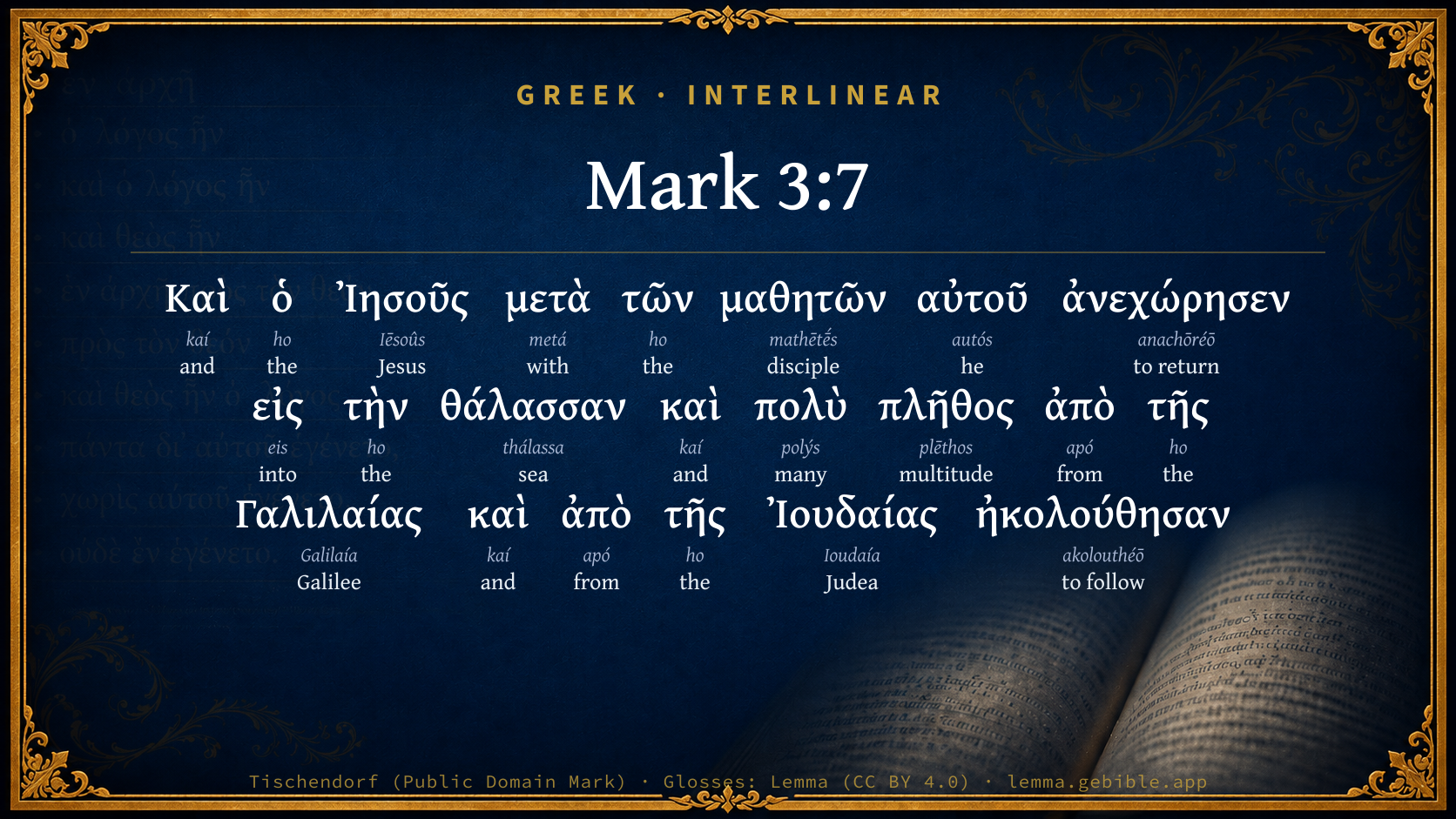
Download image
Cite this verse

Mark 3:7 (World English Bible). Public Domain. Lemma interlinear Bible study tool, https://lemma.gebible.app/v/mark/3/7.

Show BibTeX & RIS
BibTeX
RIS
English Translation
Jesus withdrew to the sea with his disciples, and a great multitude followed him from Galilee, from Judea,
World English Bible · Public Domain
Highlights
  • 1 first appearance in the Greek New Testament
Full analysis ↓
Download a study sheet

One document with this verse’s original text, its word-by-word gloss line, the meaning frame, cross-references with their text, attributed commentary, and full source and license credits — printable, and it pastes into notes with its structure intact.

This verse Autodidact and up

Study sheet (.html) Plain text (.txt)

A passage Seminary Student

Up to 50 verses in one chapter. A passage sheet keeps up to 6 commentary sources and 12 cross-references per verse, in the order this page ranks them, and says so on the sheet whenever that leaves anything out. Ask for a single verse and you get the Autodidact verse sheet above.

Everything on this page stays free to read, with no account — the sheet is a download of what is already on screen, not access to it.

Want to remove ads? Support Godless Engineer
Compare translations 3

The same verse in 3 English versions, stacked beneath the original-language interlinear above. Click any original word for its lexicon entry.

Each is an independent rendering of the whole verse — the interlinear is not word-aligned to these translations.

Highlighted words mark where these versions differ — a whole-verse word diff, not a word-by-word alignment.

  • World English Bible Public Domain
    Jesus withdrew to the sea with his disciples, and a great multitude followed him from Galilee, from Judea,
  • King James Version Public Domain
    But Jesus withdrew himself with his disciples to the sea: and a great multitude from Galilee followed him, and from Judaea,
  • unfoldingWord Literal Text CC BY-SA 4.0
    And Jesus, with his disciples, withdrew to the sea, and a great multitude followed from Galilee. And from Judea

unfoldingWord Literal Text — © unfoldingWord, licensed CC BY-SA 4.0. Word-aligned USFM3 via Door43 (git.door43.org/unfoldingWord/en_ult).

Versions to compare (up to 4)

3 of 4 selected

Show all 19 translations

Every available English version of this verse, each an independent rendering of the whole verse.

  • World English Bible Public Domain
    Jesus withdrew to the sea with his disciples, and a great multitude followed him from Galilee, from Judea,
  • Berean Standard Bible Public Domain
    So Jesus withdrew with His disciples to the sea, accompanied by a large crowd from Galilee, Judea,
  • Majority Standard Bible Public Domain
    So Jesus withdrew with His disciples to the sea, accompanied by a large crowd from Galilee, Judea,
  • King James Version Public Domain
    But Jesus withdrew himself with his disciples to the sea: and a great multitude from Galilee followed him, and from Judaea,
  • American Standard Version (1901) Public Domain
    And Jesus with his disciples withdrew to the sea: and a great multitude from Galilee followed; and from Judaea,
  • Revised Version (1885) Public Domain
    And Jesus with his disciples withdrew to the sea: and a great multitude from Galilee followed: and from Judaea,
  • Geneva Bible (1599) Public Domain
    But Iesus auoided with his disciples to the sea: and a great multitude followed him from Galile, and from Iudea,
  • Douay-Rheims (1899) Public Domain
    But Jesus retired with his disciples to the sea; and a great multitude followed him from Galilee and Judea,
  • Young's Literal Translation Public Domain
    And Jesus withdrew with his disciples unto the sea, and a great multitude from Galilee followed him, and from Judea,
  • Literal Standard Version CC BY-SA 4.0
    And Jesus withdrew with His disciples to the sea, and a great multitude from Galilee followed Him, and from Judea,
  • Unlocked Literal Bible CC BY-SA 4.0
    Then Jesus, with his disciples, went to the sea, and a great crowd of people followed from Galilee and from Judea
  • unfoldingWord Literal Text CC BY-SA 4.0
    And Jesus, with his disciples, withdrew to the sea, and a great multitude followed from Galilee. And from Judea
  • Darby Bible Public Domain
    And Jesus withdrew with his disciples to the sea; and a great multitude from Galilee followed him, and from Judaea,
  • World Messianic Bible Public Domain
    Yeshua withdrew to the sea with his disciples; and a great multitude followed him from Galilee, from Judea,
  • Webster's Bible Public Domain
    But Jesus withdrew himself with his disciples to the sea: and a great multitude from Galilee followed him, and from Judea.
  • Free Bible Version CC BY-SA 4.0
    Meanwhile Jesus returned to the Sea, and a large crowd followed him. They were from Galilee, Judea,
  • Bible in Basic English Public Domain
    And Jesus went away with his disciples to the sea, and a great number from Galilee came after him: and from Judaea,
  • Text-Critical English NT CC BY 4.0
    But Jesus withdrew with his disciples to the sea, and a great multitude from Galilee followed him, and also from Judea,
  • Tyndale New Testament (1534) Public Domain
    And Iesus auoyded with his disciples to the sea. And a greate multitude folowed him from Galile and from Iurie

Literal Standard Version (2020), Covenant Press — licensed CC BY-SA 4.0. Text via the HelloAO Bible API (eBible.org). Unlocked Literal Bible (unfoldingWord) — licensed CC BY-SA 4.0. Text via the HelloAO Bible API (eBible.org). unfoldingWord Literal Text — © unfoldingWord, licensed CC BY-SA 4.0. Word-aligned USFM3 via Door43 (git.door43.org/unfoldingWord/en_ult). Free Bible Version, Dr. Jonathan Gallagher — licensed CC BY-SA 4.0. Text via the HelloAO Bible API (eBible.org).

Word by word

More ways to search: Search by grammar → Find every occurrence → Compare this word →

Practice this passage: Drill this verse → Learn its vocabulary →

ἀνεχώρησεν
anachōréō
G402
“to return”
Verb, Aorist, Active, Indicative, 3rd person, Singular
Part of Speech
Verb
Tense
Aorist
Voice
Active
Mood
Indicative
Person
3rd person
Number
Singular
Full Thayer's Definition

Origin: from G303 and G5562

TDNT: None

1. to go back, return 2. to withdraw a. so as to leave a room b. of those who through fear seek some other place, or shun sight
  1. Καὶ kaí G2532 “and” Conjunction
  2. ὁ ho G3588 “the” Article, Nominative, Singular, Masculine
  3. Ἰησοῦς Iēsoûs G2424 “Jesus” Noun, Nominative, Singular, Masculine
  4. μετὰ metá G3326 “with” Preposition
  5. τῶν ho G3588 “the” Article, Genitive, Plural, Masculine
  6. μαθητῶν mathētḗs G3101 “disciple” Noun, Genitive, Plural, Masculine
  7. αὐτοῦ autós G846 “he” Personal pronoun, Genitive, Singular, Masculine
  8. εἰς eis G1519 “into” Preposition
  9. τὴν ho G3588 “the” Article, Accusative, Singular, Feminine
  10. θάλασσαν thálassa G2281 “sea” Noun, Accusative, Singular, Feminine
  11. καὶ kaí G2532 “and” Conjunction
  12. πολὺ polýs G4183 “many” Adjective, Nominative, Singular, Neuter
  13. πλῆθος plēthos G4128 “multitude” Noun, Nominative, Singular, Neuter
  14. ἀπὸ apó G575 “from” Preposition
  15. τῆς ho G3588 “the” Article, Genitive, Singular, Feminine
  16. Γαλιλαίας Galilaía G1056 “Galilee” Noun, Genitive, Singular, Feminine
  17. καὶ kaí G2532 “and” Conjunction
  18. ἀπὸ apó G575 “from” Preposition
  19. τῆς ho G3588 “the” Article, Genitive, Singular, Feminine
  20. Ἰουδαίας Ioudaía G2449 “Judea” Noun, Genitive, Singular, Feminine
  21. ἠκολούθησαν akolouthéō G190 “to follow” Verb, Aorist, Active, Indicative, 3rd person, Plural

About this verse

These counts appear in no published source. They are computed here, from the morphology-tagged text and Lemma’s own curated glosses. What Lemma adds →

22
words
15
distinct lemmas
Gospels
section

Notable vocabulary

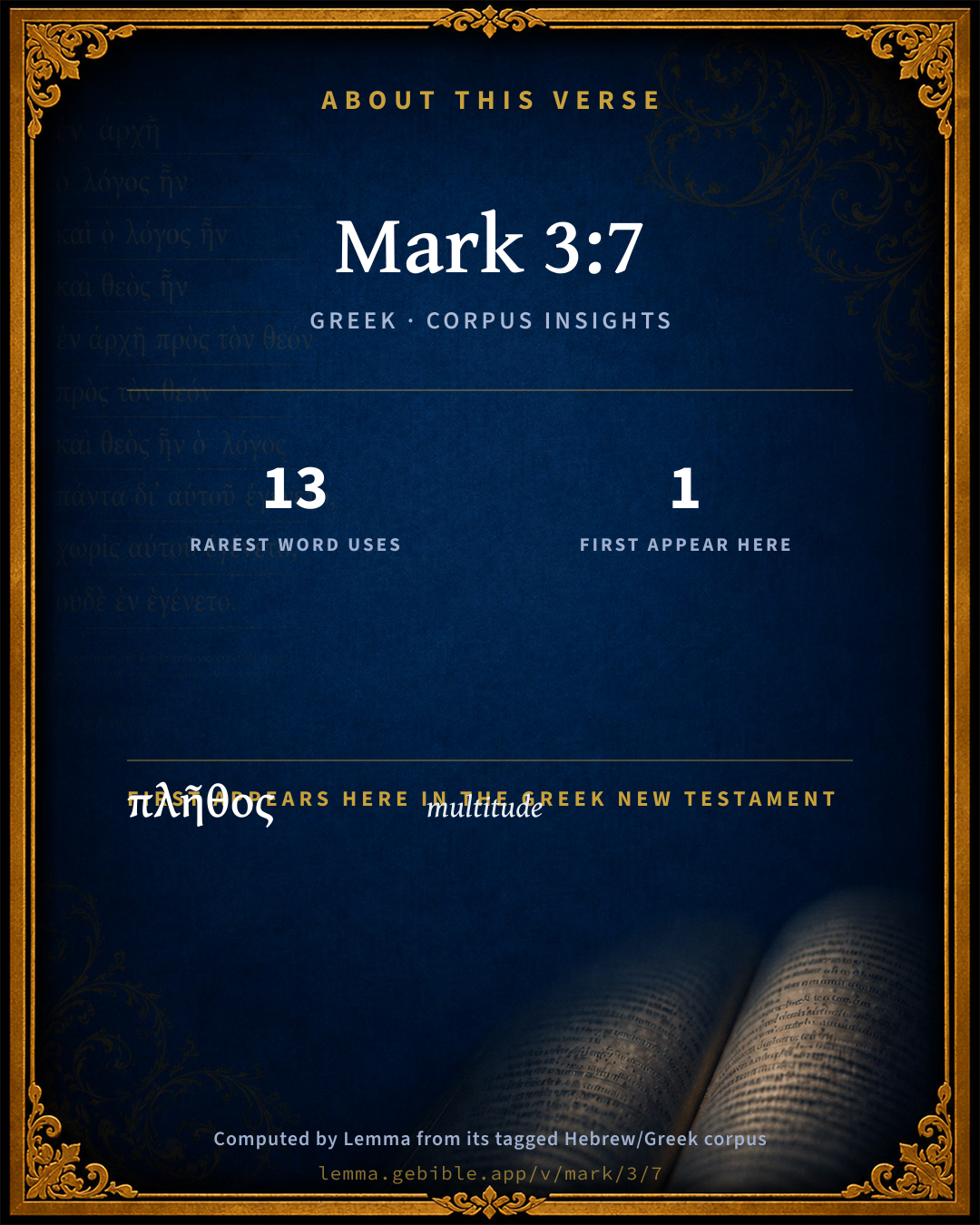
The rarest word here is ἀνεχώρησεν to return G402 — appearing just 13 times in the whole Greek New Testament.

First appearance in Scripture

This word makes its first canonical appearance in the Greek New Testament here:

  • πλῆθος multitude G4128

Shared distinctive vocabulary

ἀνεχώρησεν to return G402 occurs in 13 verses of the Greek New Testament. Also found in:
Repetition

Words recur within this verse:

Cross-references

16

Topical passages linked to Mark 3:7 in the Treasury of Scripture Knowledge — connected by theme and wording, ordered by reader-vote popularity; previews shown in the World English Bible.

  • Matthew 4:25 Great multitudes from Galilee, Decapolis, Jerusalem, Judea and from beyond the Jordan followed him.
  • Luke 6:17 He came down with them, and stood on a level place, with a crowd of his disciples, and a great number of the people from all Judea and Jerusalem, and the sea coast of Tyre and Sidon, who came to hear him and to be healed of their diseases;
  • Matthew 12:15 Jesus, perceiving that, withdrew from there. Great multitudes followed him; and he healed them all,
  • Joshua 20:7 They set apart Kedesh in Galilee in the hill-country of Naphtali, and Shechem in the hill-country of Ephraim, and Kiriath Arba (the same is Hebron) in the hill-country of Judah.
  • Matthew 10:23 But when they persecute you in this city, flee into the next, for most assuredly I tell you, you will not have gone through the cities of Israel, until the Son of Man has come.
  • Mark 1:39 He went into their synagogues throughout all Galilee, preaching and casting out demons.
  • Luke 6:12 It happened in these days, that he went out to the mountain to pray, and he continued all night in prayer to God.
  • Luke 23:5 But they insisted, saying, "He stirs up the people, teaching throughout all Judea, beginning from Galilee even to this place."
  • John 11:53–54 So from that day forward they took counsel that they might put him to death.
  • Joshua 21:32 Out of the tribe of Naphtali, Kedesh in Galilee with its suburbs, the city of refuge for the manslayer, and Hammothdor with its suburbs, and Kartan with its suburbs; three cities.
  • John 7:41 Others said, "This is the Christ." But some said, "What, does the Christ come out of Galilee?
  • John 7:52 They answered him, "Are you also from Galilee? Search, and see that no prophet has arisen out of Galilee."
  • John 10:39–41 They sought again to seize him, and he went out of their hand.
  • Acts 14:5–6 When some of both the Gentiles and the Jews, with their rulers, made a violent attempt to mistreat and stone them,
  • Acts 17:10 The brothers immediately sent Paul and Silas away by night to Beroea. When they arrived, they went into the Jewish synagogue.
  • Acts 17:14 Then the brothers immediately sent out Paul to go as far as to the sea, and Silas and Timothy still stayed there.

Cross-references courtesy of OpenBible.info (CC BY 4.0).

Commentary

Notes on Mark 3:7 from classic Christian and Jewish commentators (each source and its license shown beneath its notes). The classic Christian expositions comment on the surrounding passage and are grouped to its opening verse, so a note may address several verses; the Jewish commentaries on the Tanakh (Rashi and others) are per-verse, so they appear only where the commentator wrote on this verse.

Lemma curates 59 commentaries, every one of them public domain or Creative Commons licensed, each selected and text-cleaned for this edition rather than reprinted as found. About our sources →

The Biblical Illustrator

Joseph S. Exell

Mar_3:7-8

Came unto Him.

A powerful reason for coming to Christ

I. The attraction. They had heard with somewhat of a believing ear. They drew from what they heard an argument of hope. No doubt they were partly urged to come to Him by their own sad condition. They also perceived that Jesus was able to meet their case.

II. The gathering. Hearing did not content them. They did not wait until Jesus came to them. These people did not stop at His disciples. These people who came to Jesus in such crowds must have left their business. Many of them came from a great distance. They came with all their ailments about them.

III. The result. Not one was ever repulsed. All were cured. The attraction, therefore, grew. Therefore, sinners should come because-

(a) Jesus name invites them;

(b) His power encourages them;

(c) His character should allure them;

(d) His preparations should compel them. (C. H. Spurgeon.)

Christ accepted by some if hated by others: Christian effort not all in vain

All the world is not bound up in a Pharisees phylactery, nor held in chains by a philosophers new fancy. If some will not have the Saviour, others will; Gods eternal purpose will stand, and the kingdom of His anointed will come. (C. H. Spurgeon.)

Flowers after showers

I would have you count upon opposition, and regard it as a token of coming blessing. Dread not the black cloud, it does but prognosticate a shower. March may howl and bluster; April may damp all things with its rains, but the May flowers and the autumns harvest of varied fruits will come, and come by this very means. (C. H. Spurgeon.)

The Biblical Illustrator, edited by Joseph S. Exell (c. 1880s–1900s) — public domain. Text from a community e-Sword module.

Whedon's Commentary on the Bible

Daniel D. Whedon

§ 34. — JESUS AND THE MULTITUDES AT THE SEA OF TIBERIAS, Mar_3:7-12.

(See notes on Mat_12:15-21.

Daniel D. Whedon (gen. ed.), Commentary on the Old and New Testaments (1874–1909) — public domain. Text from a community e-Sword module.

The Preacher's Complete Homiletical Commentary

Joseph S. Exell (gen. ed.)

CRITICAL AND EXEGETICAL NOTES

Mar_3:7. Mark several times notes the Saviour’s seasons of retirement from public notice, either (as in this instance) to escape the pursuit of enemies, or for rest, or to pray, or for conference with His disciples. See Mar_6:31; Mar_6:46, Mar_7:24, Mar_9:2, Mar_14:32-35.

MAIN HOMILETICS OF THE PARAGRAPH.—Mar_3:7-12

(PARALLEL: Mat_12:15-21.)

Christ and His disciples.—While Pharisees and Herodians are hatching their plots against Him in Capernaum or the neighbouring Sepphoris, Jesus withdraws with His disciples to the purer atmosphere on the borders of the Galilean Lake. “It is His first retreat before opposition; and careful readers of the Gospels must observe that whenever the pressure of His enemies became extreme, He turned for safety to the simple fishermen, among whom they had no party, since they had preached no gospel to the poor, and that He was frequently conveyed by water from point to point, easily reached by followers, who sometimes indeed outran Him upon foot, but where treason had to begin its wiles afresh.”

I. The popularity of Jesus.—

1. Though rejected by the leaders both in Church and State, people flock to Him from all quarters: from North (“Tyre and Sidon”), South (“Judea,” “Jerusalem,” “Idumea”), East (“beyond Jordan”), and West (“Galilee”). “Even the Gentiles were beginning to rejoice in Him. In this following multitude we see a prophecy of the great truth that He should draw all men unto Him. There is that about Jesus which compels attention, and causes men to seek after Him. He is the real magnet of men.”

2. The motives of those who followed Him were doubtless very mixed. Many came out of sheer curiosity to witness His miracles; others were attracted by self-interest, hoping that they or their friends would participate in the blessings flowing from Him; but some few, we may hope, were drawn by higher considerations—because His teaching had found an echo in their hearts, and they thirsted for deeper draughts of the water of life.

II. The adaptability of Jesus.—He is equally at home everywhere, and never at a loss for expedients to meet exceptional circumstances. It is all one to Him whether He preaches from a ship or in the synagogue, so long as the great work of His ministry is not retarded. It would have been better for the Church in days not long gone by if she had shown more elasticity and adaptability to the needs of the times, if she had striven rather for unity of faith than for uniformity of practice.

III. Demoniac testimony refused by Jesus.—

1. He would not have men believe on Him on the testimony of evil spirits, but on that of God in Scripture, by His own words and works, and by the Spirit revealing this knowledge from the Father (Mat_16:17; Joh_14:11).

2. The time had not yet come for a full revelation of Himself, even to His most intimate friends. Nothing is more noticeable in our Lord’s teaching than that Divine reserve by which the truth is kept in abeyance until men are ready to receive it. “This action of His may teach His followers to be discreet. Falsehood indeed is always evil, but at times reticence is a duty, because certain truths are a medicine too powerful for some stages of spiritual disease. The strong sun which ripens the grain in autumn would burn up the tender germs of spring.”

Lessons.—

1. Christian effort, if rejected by some, will find acceptance from others.

2. No service, however trivial, is disdained by Christ, if the heart be pure.

3. How sad that, while unclean spirits acknowledge the supremacy of Christ, men deny and blaspheme His name.

OUTLINES AND COMMENTS ON THE VERSES

Mar_3:7. Jesus did not court martyrdom.—He had one great purpose in view, and He faced His enemies or withdrew from them, according as He could best accomplish His work. He was not afraid to go away, nor afraid to remain if need be. In many cases it is better quietly to withdraw from a hostile crowd, and do one’s work elsewhere.—F. N. Peloubet, D. D.

Mar_3:8. Crowds are not proofs but means of success.—The fame of the teaching and the miracles of Jesus brought great multitudes within reach of His influence. He could not go to them all, but they could come to Him. There is a legitimate popularity from earnest words and noble deeds.—Ibid.

How did Christ exercise His influence over great throngs?—

1. He never lowered the moral tone of His teaching.

2. He was never unequal to the increasing demands made upon His power.

3. He never requested the multitude to help Him in any selfish endeavours.—J. Parker, D. D.

Power of the gospel.—

1. No subject can draw such great multitudes as the gospel.

2. No subject can so deeply affect great multitudes as the gospel.

3. No subject can so profoundly and lastingly bless great multitudes as the gospel.—Ibid.

Mar_3:9. Christ nearer by removal.—This putting off from the shore and separating Himself from the crowd suggests to us a larger fact in the life of Jesus. He has gone away from the earth now to heaven, but He did so that He might the better save us. We know that in a vast throng only a few could even see Him, much less get at Him to touch Him. So we cannot help thinking how disadvantageous it would be for us had Jesus remained on the earth. How many of the poor, plague-stricken men of earth could have gone to Him, or rather how few could have gone to Him! But now that He is removed from the earth to heaven, He is where we may all see Him by faith, even from the ends of the earth, and “His word is nigh thee, even in thy mouth and in thy heart,” and all who hear His words and believe on Him are saved. In fact, just as Jesus was practically nearer to the multitude, both for sight and hearing, in that little boat than on land, so He is nearer to us now than if He had remained on earth—as near to the man in China, in India, or Africa as to us; and “all who call upon Him” are heard and saved.—G. F. Pentecost, D. D.

Mar_3:10. These miracles—

1. Illustrate and express in visible, tangible forms the lovingkindness of God, His goodwill toward men, His desire for their happiness, and His care to make them free from every evil.

2. The blessed effects of Christ’s mission proved it to be Divine. And to-day, as in those days, the convincing proof of Christianity is found in its beneficent effects. It makes everybody better who accepts it. The drunkard becomes sober, the selfish becomes generous, the vile becomes pure. Schools, colleges, education, hospitals, missions, all forms of benevolence, spring up wherever Christ is believed. Wherever there is the most Christianity, there is the most of all the things that raise and bless men. The map of the world is the proof of the Christian religion.

3. They manifest the power and presence of God in nature, and in His daily providence. Wherever any one act shews God’s presence, He is wholly present with all His power and all His love.—F. N. Peloubet, D. D.

Mar_3:11-12. The testimony of the demons.—The publication of Jesus’ real character and office by demons’ lips was only an act of spite. Their intention was to force on the antagonism between truth and error, between holiness and sin, and prematurely to bring this Divine history to a tragic close. Therefore Jesus declined this testimony. By the force of His mighty will He silenced these evil spirits; and hereby He demonstrates that it is possible to crush all hostility—human or Satanic—by the exercise of superior power. But His wisdom has discovered a more excellent way. The will which Divine power has created, Divine power can destroy. Better that Christ should not be made known than that He should be made known by unclean spirits. To be a true servant or preacher of Christ I must be clean.—J. D. Davies.

ILLUSTRATIONS TO CHAPTER 3

Mar_3:9. Waiting is a harder duty than doing.—In a certain battle a detachment of cavalry was kept inactive. It was hard for the men to do nothing but wait, while the fight was going on before them. At last, in the crisis of the battle, the command was given them to charge, and that body of fresh men, sweeping down like a torrent, turned the tide of battle. So, in the battle of life, waiting is often the surest means to victory. And it is comforting to know that where we see only the unsightly bud, God sees the perfect flower; where we see the rough pebble He sees the flashing diamond. Patient waiting and patient doing have at last their reward. The traveller who has patiently toiled up the weary passes of the Alps looks down at last with triumph on glorious Italy. Those who have sat by the bedside of a sick friend by night will know how gladly they welcomed the morning. The laurel crown which the victor at Olympia received was in itself of little value; it was prized as a sign of the victory that had come through hard strife. There is a great battle going on in the world—the strife between good and evil. In that strife we are engaged; and the harder the battle is, the sweeter will be the victory. During the battle of Waterloo, Wellington, it is said, took out his watch, and said, “I can hold out for so long. Blucher will be here within an hour, so victory is sure.” The Christian can in like manner dismiss all fear as to the result of the conflict in which he is engaged. Though the conflict be sore, though the sword pierce the soul, he knows that the Captain of salvation will not fail him.

The Preacher's Complete Homiletical Commentary (gen. ed. Joseph S. Exell; Funk & Wagnalls, c. 1892) — public domain (pre-1929). A full-Bible homiletical/sermon-outline anthology covering 65 of 66 books (2 John is absent from the source module). Text from a community e-Sword module.

Godbey's Commentary on the New Testament

William B. Godbey

WONDERFUL FAME OF JESUS

He has again reached the sea of Galilee, so exceedingly conspicuous in His ministry. I spent two bright autumnal days sailing over this sea, so delighted to traverse, drink, and bathe in those waters where my Lord moved hither and thither, drinking and washing in the same. We sail completely around that sea, stopping at many of the noted historic places.

Mar 3:7-12 : “And Jesus departed, with His disciples, to the sea, and a great multitude followed Him from Galilee, from Judea, from Jerusalem, from Idumea, and from beyond Jordan; and those about Tyre and Sidon, a great multitude, hearing how many things He was doing, came unto Him.” We see here that not only Galilee, Judea, and Jerusalem, all the Jewish countries, are pell-mell on His track, but the tawny sons of Esau are here from Idumea, away out toward sunrise; the Ammonites, the Moabites, and the tribes of Arabia are also on His track; while from the west, reaching out to the great sea, the multitudes of old Tyre and Sidon are thronging around Him. He made no appointments, they had no mail facilities, locomotives, or telegraphs; yet his fame has gone to the ends of the earth.

“And He said to His disciples that a small ship may wait on Him, on account of the crowd, in order that they may not throng Him. For He healed many, so that they are falling on Him, that He may touch them, so many as had diseases.” He avails Himself of this opportunity to preach the gospel to this vast multitude. The sea of Galilee is seven hundred feet below the level of the Mediterranean, and, as a natural consequence, surrounded by highlands. You see how a man in a boat near the shore, with the people on elevated ground in front, would enjoy a good opportunity to address them.

“And unclean spirits, when they saw Him, fell down before Him, and cried out, saying, Thou art the Son of God. He rebuked them much, that they may not make Him known.” These lecherous, impure, and brutal demons, rendering their poor victims debauchees and harlots, had once been spotless and bright, shining among the unfallen angels; as God never created an unclean spirit, they were victims of their own apostasy (Isa 14:12, and Jud 1:6); having in bygone ages gazed upon the ineffable glory of Jesus, now recognizing Him, they spontaneously confess Him before the multitude. Why did He forbid them? You must remember He did not openly avow His Christhood among the Jews until about one year subsequently to this date, as such an avowal would have precipitated His regal coronation, plunged the country into a bloody war, and expedited His own death prematurely. During the first two years of His ministry, He turns on the people a floodtide of truth appertaining to His Messiahship, gloriously corroborated by His incontestable miracles, preferring that the truth He preached and the mighty works He wrought should proclaim His Christhood; at the same time, in Gentile countries, such as Samaria and Gadara, He unequivocally proclaimed His Christhood, as there was no liability of their Crowning Him King.

William B. Godbey, Commentary on the New Testament (1896–1900) — public domain. Text from a community e-Sword module.

F. W. Grant's Numerical Bible

Section 1. (Mar 3:7-35; Mar 4:1-34.)

God only sufficient.

The whole subdivision is divided into seven parts; but the 4+3 into which the seven so often resolves itself, is so strongly marked that these become two sections. The first, as characterized by its 4, shows that external view of results which seems so much stamped with failure, but in which (man being fully proved) the sufficiency of God is seen as alone to be relied on. The second, stamped with its 3 of spiritual energy and resurrection, shows us the work of God itself in its salvation character, unhindered by the power of evil.

1. At the commencement we see once more divine power flowing forth in grace to meet all the effects of sin, in a world disorganized and ruined by it. A witness this which has a certain, present effect in attracting multitudes from all the country round.

(1) First, we have this as seen in the Lord Himself; where, notice, as to its significance in connection with what has been already said, that Jesus "withdraws with His disciples to the sea:" a hint, as we have seen reason to believe, of that going out to the nations which, however implied in the very character of the grace which is coming in; actually takes its form from Israel’s rejection of Him. At present it is Israel that is crowding after Him, but (notice again) in such a manner that He must take to the little ship because of the crowd.

The power of Satan, too, is everywhere manifest, though as manifestly subject of necessity to Him. After the manner we have seen, still they declare Him, - only to be rebuked and silenced by Him, as unfit to be His witnesses. Indeed we may see in it already an indication of how by and by the unclean birds would get lodgment in the branches of the overgrown "tree" of a parable which we find shortly given us in this very section.

(2) Next we are shown this ministry of the Lord extended by means of those called and empowered of Him to represent Him. For this they are ordained, first of all to be "with Him;" then that He might send them out to preach; the power to heal sicknesses and cast out demons being the accompaniment of this. The list of the twelve which follows is not in the same order as that in Matthew, except that Simon Peter’s is the first name, while that of the unhappy Judas is the last.

2. What follows here is still for the most part in Matthew, who however gives a much fuller account. Mark omits much that came after the choice of the twelve. Of the so-called "sermon on the mount" he has nothing, and little detail of the breach which is now becoming apparent between the nation led by its Pharisaic teachers and the Lord. All this has more its place in Matthew as the dispensational Gospel, while Mark comes almost at once to the conclusion when the scribes impute His miracles to demon power. This exhibits so clearly the heart hardened against all conviction that Christ warns them that blasphemy against the Holy Spirit, by whose power His mighty works were done, is the unpardonable sin. The expression in Mark, if the best accredited text is in fact the true one, is that it is "an eternal sin" - a sin which in its mark of a soul stiffened in determinate resistance to God speaks of an ultimate, eternal condition. Alas, it was demonic power in Israel that was asserting itself, and only One stronger than Satan could bind and deprive him of his prey. Satan would not cast out Satan; and the fact of his being cast out, that very slander admitted. They had thus, in fact, condemned themselves.

3. But all this was but the demonstration of man’s condition, which only the power of God is competent to meet. Even his kindred according to the flesh thought of the glorious Worker as "beside Himself;" and now they press upon Him in the midst of His labor with their supposed (at least) prior claim. With Him they could not plead it: the Son of God, this relationship to God governed all. It was on account of the state of man. Godward He had come, and His very presence among them argued, not their being right in this, but the reverse. For Him the spiritual condition was that upon which all else depended, and the spiritual link was all that He could acknowledge. In the most decisive way, therefore, He rejects the mere fleshly claim: "Who," He asks, "is My mother, and My brethren? And looking round on those sitting round about Him, He saith, Behold My mother and My brethren: for whosoever shall do the will of God, the same is My brother and sister and mother."*

{*One need hardly point out the rebuke of Romish Mariolatry in all this. It is, in fact, constant throughout the Gospels (comp. Luk 2:48-49; Luk 11:27-28; Joh 2:3-4).}

4. There follows, as in Matthew, the parable of the Sower and the seed, but only one other of what there is a series picturing the Kingdom of heaven as it would take shape in the absence of the King. The Lord’s last announcement of necessity brings in the Gentiles; if at least the work of the Spirit of God should be found among them: it contains, as is evident, a fundamental principle of Christianity; and Matthew traces the history of this till the coming of the Son of man in the clouds of heaven. Mark has one parable, indeed, which Matthew has not, and showing explicitly the absence of the King until the time of the harvest; but Matthew does not need this, as what he does give sufficiently declares it. Mark gives only so much of the history as to develop the principles; pressing all into a moral dealing with the individual conscience.

Here we are still upon the same track as before: the lesson is of the vanity of man; of the sufficiency of God alone. The parables here show this under the test of the word of God. The ground of the human heart yields nothing for God save as the Word is sown in it. Even then there are many causes of unfruitfulness, and foes of the new life that has sprung up. Nay, the general result as to the earth at large is mingled and dubious. What, in fact, has the history of the Church shown, if it be not this? How great the comfort of knowing, however, that this is no unforeseen, unaccountable happening. Before the Church began, the history of professing Christianity had already been outlined, and the causes of failure pointed out; and in the New Testament, parable, literal prophecy and vision have all been used to give us warning - a warning which is encouragement as well.

(1) The causes of barrenness are depicted for us in the parable of the Sower and the seed; and we have already gone through it in Matthew. From the word of God all fruit in man is to be found, yet from man himself opposition comes. The devil, the flesh, and the world are confederates against Christ; and the same hindrances, even where the word is received, prevail to hinder in different degrees the proper fruit of it.

Notice in the Lord’s rebuke to His disciples, how little the parabolic form should hinder intelligence for one of His own. "How then will ye know all parables?" shows what on the Lord’s part He designs for us. And everywhere, it need not be doubted, in Nature as well as in Scripture, such parables are to be found awaiting the interpretation of faith. Alas, we may, on the other hand, be ignorant of their very existence, and reason may deny what without such guidance it can never find; but agnosticism of whatever quality has no power of conviction for the man that sees; were the prayer oftener with us, "Open Thou mine eyes," we might at least realize more the immeasurableness of our inheritance.

(2) After the causes of barrenness the Lord goes on to warn of hindrances to testimony. If the word of God is that from which all fruit is to come, how great the responsibility to minister it. If a lamp is brought, what do you do with it? It is for illumination doubtless. Do you put it, then, under a bushel measure, or under a bed? Clearly not, but upon its stand. Activity and slothfulness as typified in these two ways may both hinder testimony: the heart bent upon gain; and occupied with what is emphatically called "business," like the thorny ground of the parable, may have little room for the Word, either to get hold of it or to scatter it. While Og’s great bed of ease and pleasure may keep men as securely from occupation with or ministry of the things unseen. Christ bids His disciples have before them the day of manifestation; in which all secret things shall be at last revealed.

Again, in order to minister one must receive; and if the fruit take its character from the seed, must receive only the truth. How important, then; to heed what one hears! and what one measures out to others will be more than recompensed again: a thing as true of ministry of the Word, as of practical conduct; for heaven’s law is scattering for increase, - you do not alienate from yourself what you give to others, but gain the more; and still this opens the way to fresh gain: to him that hath shall more be given. Every bit of truth acquired leads on to fresh truth; every sphere of usefulness found prepares for more.

(3) In a parable peculiar to Mark the Lord now goes on to speak of the day of manifestation at the reaping of earth’s harvest, and of what is implied in it for the present time. The seed put into the ground is left there by the sower as if he had no further thought about it. It springs up and grows, as it were, without his knowledge. So the Lord after sowing the seed of His word at the beginning, is gone up to heaven. How much, in fact, seems to be taking place without His knowledge. The crop goes on developing and ripening. When He sees that it is ripe, the sickle will be put in.

Of this harvest time of earth Matthew gives us the fuller detail. The parable here simply emphasizes the time of responsibility and uncertainty - the earth bringing forth of herself; then the intervention; when the crop is ready. Of the general result nothing is said at present. All that has been already before us would imply one not unmixed. Matthew shows us correspondingly tares among the wheat; not even the failure merely of much of the right seed (a lesson which Mark has repeated), but the effect of the enemy’s sowing. Mark passes over this to the third parable in Matthew; and here we find what has more sorrowful interest for us.

(4) We have already taken up in some detail the meaning of this third parable. It is that of the mustard-seed, and we have seen in it the picture, indeed, of success of a certain kind, a growth beyond expectation. The smallest of seeds develops into a tree; the Kingdom of heaven becomes (according to the constant use of the figure in Scripture) a world-power, - a thing of self-evident application; so long before our eyes that we have lost the sense of what it means. Christianity, we say, has a right of dominion over the earth: a claim which Rome has been most successful in making. Alas, if Christianity has ever ruled a nation upon earth, Christ Himself has never done so; and therefore nothing else than a debased Christianity. The success in this way has been dreadful failure: the well-rooted tree has given lodgment to the unclean birds of the air who in the first parable devour the good seed. Here in the degradation of the Kingdom of heaven to a world-power with the prince of this world undethroned, we find what even comes of the word of God among those professedly accepting, not rejecting. And here the view of man as tested by the Word comes naturally to an end.

F. W. Grant, The Numerical Bible (4th ed., 1903) — public domain. Text from a community e-Sword module.

The Expositor's Bible

CHAPTER 3:7-19 (Mar_3:7-19)

THE CHOICE OF THE TWELVE

"And Jesus with His disciples withdrew to the sea: and a great multitude from Galilee followed: and from Judea, and from Jerusalem, and from Idumea, and beyond Jordan, and about Tyre and Sidon, a great multitude, hearing what great things He did, came unto Him. And He spake to His disciples, that a little boat should wait on Him because of the crowd, lest they should throng Him: for He had healed many; insomuch that as many as had plagues pressed upon Him the they might touch Him. And the unclean spirits, whensoever they beheld Him, fell down before Him, and cried, saying, Thou art the Son of God. And He charged them much that they should not make Him known. And He goeth up into the mountain, and calleth unto Him whom He himself would: and they went unto Him. And He appointed twelve, that they might be with Him, and that He might send them forth to preach, and to have authority to cast out devils: and Simon He surnamed Peter; and James the sons of Zebedee, and John the brother of James; and them He surnamed Boanerges, which is, Sons of thunder: and Andrew, and Philip, and Bartholomew, and Matthew, and Thomas, and James the son of Alphaeus, and Thaddeus, and Simon the Cananaen, and Judas Iscariot, which also betrayed Him." Mar_3:7-19 (R.V.)

WE have reached a crisis in the labors of the Lord when hatred which has become deadly is preparing a blow. The Pharisees are aware, by a series of experiences, that His method is destructive to their system, that He is too fearless to make terms with them, that He will strip the mask off their faces. Their rage was presently intensified by an immense extension of His fame. And therefore He withdrew from the plots which ripen most easily in cities, the hotbeds of intrigue, to the open coast. It is His first retreat before opposition, and careful readers of the Gospels must observe that whenever the pressure of His enemies became extreme, He turned for safety to the simple fishermen, among whom they had no party, since they had preached no gospel to the poor, and that He was frequently conveyed by water from point to point, easily reached by followers, who sometimes indeed outran Him upon foot, but where treason had to begin its wiles afresh. Hither, perhaps camping along the beach, came a great multitude not only from Galilee but also from Judea, and even from the capital, of the headquarters of the priesthood, and by a journey of several days from Idumea, and from Tyre and Sidon, so that afterwards, even there, He could not be hid. Many came to see what great things He did, but others bore with them some afflicted friend, or were themselves sore stricken by disease. And Jesus gave like a God, opening His hand and satisfying their desires, "for power went out of Him, and healed them all." Not yet had the unbelief of man restrained the compassion of His heart, and forced Him to exhibit another phase of the mind of God, by refusing to give that which is holy to the dogs. As yet, therefore, He healeth all their diseases. Then arose an unbecoming and irreverent rush of as many as had plagues to touch Him. A more subtle danger mingled itself with this peril from undue eagerness. For unclean spirits, who knew His mysterious personality, observed that this was still a secret, and was no part of His teaching, since His disciples could not bear it yet. Many months afterwards, flesh and blood had not revealed it even to Peter. And therefore the demons made malicious haste to proclaim Him the Son of God, and Jesus was obliged to charge them much that they should not make Him known. This action of His may teach His followers to be discreet. Falsehood indeed is always evil, but at times reticence is a duty, because certain truths are a medicine too powerful for some stages of spiritual disease. The strong sun which ripens the grain in autumn, would burn up the tender germs of spring.

But it was necessary to teach as well as to heal. And Jesus showed His ready practical ingenuity, by arranging that a little boat should wait on Him, and furnish at once a pulpit and a retreat.

And now Jesus took action distinctly Messianic. The harvest of souls was plenteous, but the appointed laborers were unfaithful, and a new organization was to take their place. The sacraments and the apostolate are indeed the only two institutions bestowed upon His Church by Christ Himself; but the latter is enough to show that, so early in His course, He saw His way to a revolution. He appointed twelve apostles, in clear allusion to the tribes of a new Israel, a spiritual circumcision, another peculiar people. A new Jerusalem should arise, with their name engraven upon its twelve foundation stones. But since all great changes arrive, not by manufacture but by growth, and in cooperation with existing circumstances, since nations and constitutions are not made but evolved, so was it also with the Church of Christ. The first distinct and formal announcement of a new sheepfold, entered by a new and living Way, only came when evoked by the action of His enemies in casting out the man who was born blind. By that time, the apostles were almost ready to take their place in it. They had learned much. They had watched the marvelous career to which their testimony should be rendered. By exercise they had learned the reality, and by failure the condition of the miraculous powers which they should transmit. But long before, at the period we have now reached, the apostles had been chosen under pressure of the necessity to meet the hostility of the Pharisees with a counter-agency, and to spread the knowledge of His power and doctrine farther than One Teacher, however endowed, could reach. They were to be workers together with Him.

St. Mark tells us that He went up into the mountain, the well known hill of the neighborhood, as St. Luke also implies, and there called unto Him whom He Himself would. The emphasis refutes a curious conjecture, that Judas may have been urged upon Him with such importunity by the rest that to reject became a worse evil than to receive him. (Lange, Life of Christ, ii. p. 179,) The choice was all His own, and in their early enthusiasm not one whom He summoned refused the call. Out of these He chose the Twelve, elect of the election.

We learn from St. Luke (Luk_6:12) that His choice, fraught with such momentous issues, was made after a whole night of prayer, and from St. Matthew that He also commanded the whole body of His disciples to pray the Lord of the Harvest, not that they themselves should be chosen, but that He would send forth laborers into His harvest.

Now who were these by whose agency the downward course of humanity was reversed, and the traditions of a Divine faith were poured into a new mold?

It must not be forgotten that their ranks were afterwards recruited from the purest Hebrew blood and ripest culture of the time. The addition of Saul of Tarsus proved that knowledge and position were no more proscribed than indispensable. Yet is it in the last degree suggestive, that Jesus drew His personal followers from classes, not indeed oppressed by want, but lowly, unwarped by the prejudices of the time, living in close contact with nature and with unsophisticated men, speaking and thinking the words and thoughts of the race and not of its coteries, and face to face with the great primitive wants and sorrows over which artificial refinement spreads a thin, but often a baffling veil.

With one exception the Nazarene called Galileans to His ministry; and the Carpenter was followed by a group of fishermen, by a despised publican, by a zealot whose love of Israel had betrayed him into wild and lawless theories at least, perhaps into evil deeds, and by several whose previous life and subsequent labors are unknown to earthly fame. Such are the Judges enthroned over the twelve tribes of Israel.

A mere comparison of the lists refutes the notion that any one Evangelist has worked up the materials of another, so diverse are they, and yet so easily reconciled. Matthew in one is Levi in another. Thaddaeus, Jude, and Lebbaeus, are interchangeable. The order of the Twelve differs in all the four lists, and yet there are such agreement, even in this respect, as to prove that all the Evangelists were writing about what they understood. Divide the Twelve into three ranks of four, and in none of the four catalogues will any name, or its equivalent, be found to have wandered out of its subdivision, out of the first, second, or third rank, in which doubtless that apostle habitually followed Jesus. Within each rank there is the utmost diversity of place, except that the foremost name in each is never varied; Peter, Philip, and the Lesser James, hold the first, fifth, and ninth place in every catalogue. And the traitor is always last. These are coincidences too slight for design and too striking for accident, they are the natural signs of truth. For they indicate, without obtruding or explaining, some arrangement of the ranks, and some leadership of an individual in each.

Moreover, the group of the apostles presents a wonderfully lifelike aspect. Fear, ambition, rivalry, perplexity, silence when speech is called for, and speech when silence is befitting, vows, failures, and yet real loyalty, alas! we know them all. The incidents which are recorded of the chosen of Christ no inventor of the second century would have dared to devise; and as we study them, we feel the touch of genuine life; not of colossal statues such as repose beneath the dome of St. Peter's but of men, genuine, simple and even somewhat childlike, yet full of strong, fresh, unsophisticated feeling, fit therefore to become a great power, and especially so in the capacity of witnesses for an ennobling yet controverted fact.

William Robertson Nicoll, ed., The Expositor's Bible (London: Hodder & Stoughton, 1887–1910) — public domain. 65 of 66 books (1 Corinthians is not separately keyed, as that volume carries no machine-parseable verse references); section-level commentary keyed to the opening verse. Introductory and overview sections not keyed to a specific passage are excluded.

Tyndale Open Study Notes

Tyndale Open Resources

3:7-12 Jesus’ departure to the lake (the Sea of Galilee) sets the scene for 4:1–5:43. The multitude that came to see John the Baptist (1:7) was surpassed by the multitude that came to see Jesus. • Idumea was a region in southern Judea that had been occupied by the Edomites after the Exile. • Tyre and Sidon were Phoenician cities on the Mediterranean coast that Jesus later visited (7:24, 31).

Tyndale Open Study Notes — © Tyndale Open Resources, licensed CC BY-SA 4.0. Text via the HelloAO Bible API.

Bengel's Gnomon

Johann Albrecht Bengel

Mar 3:7. Ἀνεχώρησε, He withdrew) He avoided plots against Him, and yet He did not flee to a distance, nor in a fearful spirit, for He went to the sea [The particulars which Mark in this passage, Mar 3:7-19, records, he sets forth in the regular order of the narrative, and they are to be combined with Mat 4:24, etc. But the events which go before and follow in Mark, are parallel to the 12th. ch. of Matthew. Mark takes occasion [a handle] from the plots laid by His enemies, to record the withdrawal of the Saviour, Mar 3:7; and by that very fact, he returns in the meantime into the regular path from his digression, etc.—Harm., p. 238. The sea is mentioned in this verse; the house in Mar 3:19; and again the sea in ch. Mar 4:1. In this fashion Mark combines the histories of different times.—V. g.].

Mar 3:7-8. Πλῆθος, the multitude) There were two multitudes; the one was following Him out of Galilee, the other, from most diverse quarters, was then, for the first time, coming to Jesus. The former is called a great multitude, the latter, a multitude that was great, the epitasis (increase of force, in repeating the words, see Append.) being indicated by the transposition of the noun [before the adjective, instead of as in the first instance after it: πολὺ πλῆθος—πλῆθος πολύ.]

Bengel's Gnomon of the New Testament — English translation (T&T Clark, Edinburgh, 1860) — public domain. Text from a community e-Sword module.

Meyer's Critical & Exegetical Commentary

Heinrich August Wilhelm Meyer

Mar_3:7-12. Comp. Mat_12:15 f., Luk_6:17-19, who with their difference of historical arrangement make but brief use of the description in Mark, which is more accurate and more fresh and does not blend heterogeneous elements (Hilgenfeld).

εἱς] direction whither.

Mar_3:8. Ἰδουμαία] on the southeastern border of Palestine.

A point is not to be placed, as by Beza, Er. Schmid, and Fritzsche, after Ἰορδάνου, butas is required by the two distinct predicates based on the local relations, ἠκολούθησεν and ἦλθον πρὸς αὐτόνbefore καὶ ἀπὸ τ. Ἰουδαίας. It is first of all stated, who followed Jesus from Galilee, where He Himself was, to the sea, and then, from καὶ ἀπὸ τ. Ἰουδ. onward, who came to Him from other regions. Namely: and from Judaea, and from Jerusalem, and from Idumaea and Peraea (καὶ πέραν τοῦ Ἰορδ.; observe that here ἀπό is not repeated), and those (the Jews) about Tyre and Sidon, in great multitudes (πλῆθος πολύ belongs to the whole as a more precise definition of the subject), they came to Him,

Observe, moreover, the different position of πλῆθος in Mar_3:7-8; in the one case the greatness of the mass of people preponderates in the conception, in the other it is the idea of the mass of people itself.

ἐποίει] imperfect, used of the continuous doing.

Mar_3:9. ἵνα] What He said to them is conceived of as the design of the speaking (comp. on Mat_4:3): in order that a vessel should be continually at His service.

διὰ τὸν ὄχλον κ.τ.λ.] therefore not for the purpose of crossing over; ἔμελλε γὰρ ἐμβὰς εἰς αὐτὸ μὴ ἐνοχλεῖσθαι, Euthymius Zigabenus. Comp. Mar_4:1; Mat_13:2. It is not said, however, that He wished to teach out of the vessel (Kuinoel and others).

Mar_3:10 f. Information regarding this pressing towards Him.

ἐθεράπευσεν] not sanaverat (Castalio, Kuinoel, Fritzsche), but He healed just at that time. The ὥστε ἐπιπίπτειν αὐτῷ, so that they fell upon Him, depicts the impetuous thronging unto Him of those seeking aid. Admirabilis patientia et benignitas Domini, Bengel. προσέπιπτ. αὐτῷ in Mar_3:11 is different: they fell down before Him (Mar_5:33, Mar_7:25).

μάστιγας] plagues, Mar_5:29; Mar_5:34; Luk_7:21; Psa_35:15; Sir_40:9; 2Ma_7:37. In accordance with the context: plagues of sickness.

τὰ πνεύματα κ.τ.λ.] a statement in conformity with the appearance; the sick people identified themselves with the demons.

ὅταν] with the praeterite indicative: whenever they saw Him, i.e. as soon as ever they got sight of Him. See Winer, p. 276 [E. T. 388]. This rare and late linguistic phenomenon is to be explained to the effect, that the conception of the uncertain (ἄν) has become completely blended with ὅτε, and the whole emphasis rests upon this whenever. See Klotz, ad Devar. p. 690. It does not mean: if they ever saw Him.

Mar_3:12. ἵνα] design of the πολλὰ ἐπετίμα αὐτοῖς (the demons). How colourless is Mat_7:16! According to Hilgenfeld, Mark has exaggerated. As to the prohibition itself of their making Him known as Messiah, comp. Mar_1:43, and on Mat_8:4; Mar_5:43.

Meyer — Critical and Exegetical Commentary on the New Testament — English translation by Peter Christie, edited by Frederick Crombie (T&T Clark, 1880) — public domain. Text from a community e-Sword module.

Expositor's Greek Testament

ed. W. Robertson Nicoll

Mar 3:7-12 . The fame of Jesus spreads notwithstanding ( vide Mat 4:25 ; Mat 12:15 f.; Luk 6:17-19 ).

Mar 3:7 . μετὰ τῶν μαθητῶν , with the disciples : note they now come to the front. We are to hear something about them to which the notice of the great crowd is but the prelude. Hence the emphatic position before the verb. πρὸς τὴν θάλασσαν : as if to a place of retreat ( vide Mar 3:9 ). πολὺ πλῆθος : πολὺ , emphatic, a vast, exceptionally great crowd, in spite, possibly in consequence, of Pharisaic antagonism. Of course this crowd did not gather in an hour. The history is very fragmentary, and blanks must be filled up by the imagination. Two crowds meet (1) πολὺ πλῆθος from Galilee; (2) from more remote parts: Judaea, Jerusalem, Idumaea, Peraea, and the district of Tyre and Sidon πλῆθος πολύ (Mar 3:8 ): a considerable crowd, but not so great. ἀπὸ τ . Ἰδουμαίας : Idumaea, mentioned here only, “then practically the southern Shephelah, with the Negeb.” G. A. Smith, Historical Geography of the Holy Land , p. 239. Mentioned by Josephus (B. J., iii. 3 5) as a division of Judaea.

The Expositor's Greek Testament, edited by W. Robertson Nicoll (1897–1910) — public domain. Text from a community e-Sword module.

Vincent's Word Studies in the New Testament

Marvin R. Vincent

Withdrew. Mark alone notes no less than eleven occasions on which Jesus retired from his work, in order to escape his enemies or to pray in solitude, for rest, or for private conference with his disciples. See Mr 1:12; Mr 3:7; Mr 6:31, 46; Mr 7:24, 31; Mr 9:2; Mr 10:1; Mr 14:34.

A great multitude [πολυ πληθος] . Compare verse 8, where the order of the Greek words is reversed. In the former case the greatness of the mass of people is emphasized; in the latter, the mass of people itself.

Marvin R. Vincent, Word Studies in the New Testament (1887–1900) — public domain. Text from a community e-Sword/MySword module.

Adam Clarke's Commentary

Verse 7. Galilee] See Mt 4:13; Mt 4:15.

Adam Clarke's Commentary on the Bible (1810–1826) — public domain. Text from a community e-Sword/MySword module.

Ellicott's Commentary for English Readers

(7, 8) And from Judæa. . . . and from Jerusalem.—The fact thus recorded is interesting as in some degree implying the ministry in Jerusalem and its neighbourhood, which the first three Gospels, for some reason or other, pass over.

A Bible Commentary for English Readers, edited by Charles John Ellicott (1878–1897) — public domain. Text from a community e-Sword module.

The Cambridge Bible for Schools and Colleges

gen. ed. J. J. S. Perowne

7–12. Withdrawal of Jesus to the Lake of Gennesaret

7. a great multitude] Observe the wide area from which the multitude were now gathered together; the region (1) of Tyre and Sidon and Galilee in the North of Palestine; (2) of Judæa and Jerusalem in the centre, (3) of Peræa “beyond the Jordan” on the East, (4) of Idumæa in the extreme South. This is the only place where Idumæa, the country occupied by the descendants of Esau, is mentioned in the N. T. In the O. T. the name is found in Isa_34:5-6; Eze_35:15; Eze_36:5.

The Cambridge Bible for Schools and Colleges (gen. ed. J. J. S. Perowne; Cambridge University Press, 1878–1918) — public domain. Text from a community e-Sword module.

John Gill's Exposition

But Jesus withdrew himself with his disciples to the sea,.... Knowing their evil designs against him, he departed out of the synagogue, and city of Capernaum; and taking his disciples with him, he went to the shore of the sea of Galilee; not out of fear, but because his time was not yet come, and he had more work to do:

and a great multitude from Galilee: from the several parts of it, in which country he now was:

and from Judea: that part of the land of Israel, which was particularly so called, and belonged to the tribe of Judah.

John Gill's Exposition of the Whole Bible (1746–1763) — public domain (CC PDM 1.0). Text via the HelloAO Bible API.

Trapp's Complete Commentary

John Trapp

7 But Jesus withdrew himself with his disciples to the sea: and a great multitude from Galilee followed him, and from Judaea,

Ver. 7. But Jesus withdrew himself] Tertullian condemneth flight in any case: {a} but Patres legendi cum venia. His scholar Cyprian was of another and better judgment. Magister non tenetur in omnibus.

{a} Lib. de fuga persecut.

John Trapp, A Commentary or Exposition upon All the Books of the Old and New Testament (1647–1656) — public domain. Text from a community e-Sword module.

Albert Barnes' Notes on the Bible

To the sea - The Sea of Galilee, or to the lonely regions which surrounded the sea, where he might be in obscurity, and avoid their designs against his life. His time had not yet come, and he prudently took care of his life, thus showing that we are not needlessly to throw ourselves into danger.

Galilee - See the notes at Mat 2:22.

Judea - The southern division of the land of Palestine.

Jerusalem - Jerusalem was “in” Judea. It is mentioned particularly to show that not only the people of the surrounding country came, but also many from the capital, the place of wealth, and honor, and power.

Idumea - The country formerly inhabited by the “Edomites.” In the time of the Saviour it was embraced in the country belonging to the Jews. It was south of Judea proper. The word “Idumea” is a Greek word made from the Hebrew “Edom.” It signifies the land of Edom, a name given to Esau, one of the sons of Isaac, Gen 25:30. The word signifies “red,” and the name was given to him because he sought of Jacob red pottage as the price of his birthright. He settled in Mount Seir Deu 2:5, on the south of the land of Canaan, and the country of Idumea was bounded by Palestine on the north. During the Babylonian captivity the Edomites spread themselves into the country of Judea, and occupied a considerable part of the south of Palestine. They had, however, submitted to the rite of circumcision, and were incorporated with the Jews. From them sprang Herod the Great.

From beyond Jordan - From the region lying east of the river Jordan. The sacred writers lived on the west side of Jordan, and by the country “beyond Jordan” they meant that on the east side.

Tyre and Sidon - See the notes at Mat 11:21.

Albert Barnes' Notes on the Bible (1834–1885) — public domain. Text from a community e-Sword/MySword module.

The Pulpit Commentary

Vers. 7, 8. Jesus with his disciples withdrew to the sea. This shows that the miracle just recorded took place in the interior of Galilee, and not at Capernaum, which was close by the sea. The chief city in Galilee at that time was Sepphoris, which Herod Antipas had made his capital. There the Herodiaus would of course be numerous, and so too would the Pharisees; since that city was one of the five places where the five Sanhedrims met (see Reland, "Palestine," p. 100, referred to in the "Speaker"s Commentary," in lee. ). The remainder of these two verses should be read and pointed thus: And a great multitude from Galilee followed: and from Judaea, and from Jerusalem, and from Idumaea, and beyond Jordan, and about Tyre and Sidon, a great multitude, hearing what great things he did, come unto him. The meaning of the evangelist is this, that, in addition to the great multitude that followed him from the parts of Galilee which he had just been visiting, there were vast numbers from other parts who had now heard of his fame, and flocked to him from every quarter. This description sets before us in a strikingly graphic manner the mixed character of the multitude who gathered around our Lord to listen to his teaching, and to be healed by him as many, at least, as had need of healing.

HOMILIES BY R. GREEN Vers. 7-35. Retirement.

In the calm and successful prosecution of his work, Jesus has excited various feelings in the minds of the different classes around him. He has wrought many miracles all of them miracles of mercy; almost all, so far as recorded, miracles of healing. Of necessity his presence is hailed by the throngs of needy and suffering ones, and "his name is as ointment poured forth" to the multitudes who have proved his rower to heal. These cannot be restrained from publishing his fame abroad, though he has begged them to be silent, for he sees but too plainly the hindrance to his usefulness which a blaze of popularity would cause. In the course of his teaching he has made the Pharisees to blush more than once; and the popular movement which he seems likely to excite has stirred up the fears or the jealousies of the court party Herodians," who join their own political antagonists in their opposition to him, and they together plot his destruction. His relatives, "friends," including the highly honored one, "his mother, and his brethren," are excited with fear that "he is beside himself," for he allows not himself time to "so much as eat bread." "Scribes from Jerusalem," learned in the Law, the trained expounders of its sacred truths, and the authoritative adjudicators in matters of dispute, pass their judgment and verdict in explanation of the astounding facts which they cannot or dare not deny. "He is possessed," they say, "by the very "prince of the devils." He is the tool, the agent of Beelzebub himself, and "by the prince of the devils casteth he out the devils. This is truly a most ingenious though the most wicked of all explanations; a very blasphemy, ascribing the work of "the Holy Spirit" to "an unclean spirit," and placing Jesus in the lowest category of all lower than the lowest. It affirms him to be the agent of the arch-demon, working his behests, the servant of the devil of devils. And if possession by an evil spirit is the consequence and punishment of evil work, as was the current opinion, he is surely the worst of the bad. All this needs adjustment. The anger of some, the timidity, the fears, the indiscreet zeal, the error, the false views, and the wickedness of others, must all be corrected. For this purpose he, with his disciples," withdraws "to the sea," where, "because of the crowd, lest they should throng him," he orders that in future "a little boat should wait on him;" by which means he can escape the press, and either teach from the boat or sail away for rest and quiet. At eventide "he goeth up into the mountain," where he continues "all night in prayer to God;" needful in the midst of so much pressure and excitement, and most fitting in anticipation of the great work of the morrow. Then, when the morning breaks, he calls his disciples to him, from whom he chooses twelve, that they might be with him," for his own comfort and for purposes of training for future service in his kingdom, and that he might send them forth to preach, and to have authority to cast out devils, and to heal all manner of disease, and all manner of sickness." These "he named apostles," and "appointed," and "sent forth," and "charged them." Then, with awful withering words, he silences the scribes, first by argument, showing that on their own ground the divided kingdom "hath an end;" then by pointing to the "eternal sin" which he committeth who thus "shall blaspheme against the Holy Spirit," and who "hath never forgiveness." And now, turning to his anxious relatives, he asks and answers the question, "Who is my mother and my brethren?" Breaking loose from the bonds of mere natural relationship, he declares that he holds the closest alliance with "whosoever shall do the will of God." From all which every true disciple treading in his Master"s steps, and hearkening to his Master"s teaching, may learn:

1. The wisdom of frequent withdrawal from the excitements of life into calm, quieting intercourse with God in prayer, to the cooling contemplation of the Divine works, and the humbling communion with his own soul.

2. The sacredness of holy companionship; and, if he is called to teach great truths, the wisdom of gathering around him a few sympathetic spirits, and sharing with them his work and honor for the general good.

3. The necessity for keeping his mind sensitively alive to the teachings of the Holy Spirit, lest, resisting, he grieve him, and quench the only light by which the path of life may be found.

4. To learn the terrible peril to which he exposes himself who "puts darkness for light.

5. And joyfully to see the high calling which is of God, the close alliance with the Lord Christ which is secured to him who keeps the commandments of God, concerning whom the Lord says, "The same is my brother, and sister, and mother. G.

Vers. 7-12. Testimony of evil to goodness.

I ITS SINCERITY. We see many coming to Christ who thought they could get an immediate good from him. Others kept aloof who doubted what good could come, what evil might come, from the intercourse. The devils, whether for good or evil, "rush to Jesus." Whenever there is such a rush," something significant is stirring.

II ITS IRRESISTIBLE CHARACTER. There are men, there are movements, which are advertised by the evil they elicit from the latent depths of the heart. Observe the man who is hated, and by whom; observe the man who is loved, and by whom. Note the center of attraction, and for what sort of people; the center of repulsion, and what sort of people; and you have a clue to important truths. Christ is illustrated by all these rules. Who were they who approached him in love then? who now? What were the instincts arrayed against him then and now? J.

Vers. 7-12. Parallel passage: Mat_12:15-21. Popularity of Christ on the increase.

I THE POPULARITY OF JESUS. It was ever increasing, as is proved by this passage. A great multitude followed him from Galilee in the north; from Judaea and its capital in a central position; and from Idumaea in the far south, situated as it was between Judaea, Arabia, and Egypt; then from Peraea, east of the Jordan; the people of Tyre and Sidon also in the northwest; all these, attracted by the fame of what Jesus was doing, flocked unto him. So great were the multitude and pressure that he directed his disciples to procure a little boat to keep close to him in order to escape the crowding (dia to) and consequent confusion.

II His power to heal. This appears to be as yet the main attraction. The miracles of healing were abundant, so much so that the afflicted sufferers actually fell against him (epipiptein), that by the contact their plagues might be removed. Unclean spirits also, wherever they saw him, kept falling down before him, crying out, "Thou art the of God.

III PECULIARITY OF THE SYRIAC VERSION IN THIS PLACE. It strangely combines the two last classes in its rendering, namely, "Those that had plagues of unclean spirits, as often as they saw him, kept falling down before him." Our Lord, however, invariably reprobated and rejected their testimony, as if there were something insidious in it or injurious to his cause.

IV THE PHYSICAL HEALTH RESTORED TO SO MANY AFFLICTED BODIES WAS A GUARANTEE OF SPIRITUAL HEALTH FOR THE SOUL. In all the ages, and in all the annals of medical science, and in all the countries of the world, we have account of one Physician, and only one, who was able to lay his hand on the aching head and diseased heart of suffering humanity, bringing immediate cure and effectual relief. No malady could resist his healing power, no sickness withstand his touch, and no illness remain incurable once he but spoke the word. No disease, however deep-seated in the system, or deadly in its nature, or inveterate from long duration, could baffle his skill or defy his power. Whether it was palsy, or dropsy, or asthma, or convulsions, or ulceration, or bloody issue, or fever, or even consumption, or, what was still worse, leprosy itself, whatever the form of disease might be, he cured it. Persons labouring under organic defects the deaf, the dumb, the blind, the lame were brought to him, and he removed all those defects. Mental ailments also, as lunacy and demoniacal possession, all were relieved by him. Sometimes it was a word, sometimes a touch, again some external appliance, not as a remedy but to act as a conductor, or to show a connection instituted between the operator and the patient, but, whatever was the plan adopted, the power never failed to produce the desired effect. Now, whatever he did in this way to the body is proof positive of his ability and willingness to do the same and more for the soul. We may be diseased with sin so as to be loathsome in our own eyes and morally infectious to our neighbors and acquaintances; we may be leprous with sin so as to be cut off from the fellowship of the saints and the communion of the holy; we may be under the ban of man and the curse of heaven; yet if we approach this great Physician of soul as well as body, confiding in his power and trusting in his mercy, we shall obtain, and that without fail, healing and health for our diseased spirits and sin-sick souls. Thousands alive this day can testify from actual happy experience to the healing power of Jesus" word, the cleansing efficacy of his blood, and the renewing, purifying, and sanctifying influences of his Spirit. Millions this day in the realms of bliss above are enjoying the health and the happiness, the brightness and the beauty, the purity and perfection of that upper sanctuary, though on earth the diseases of their souls had been of the most desperate character utterly incurable had it not been for the mercy and grace of this great Physician. And he is still the same same, yesterday, to-day, and for ever," and able as ever to "save to the uttermost all that come unto God by him.

V A RECONCILIATION. It is thought by some that a discrepancy exists between the fourth verse of the fifty-third chapter of Isaiah and the seventeenth verse of the eighth chapter of St. Matthew. But if we take the first clause of each verse as referring to bodily diseases, and the second clause to the diseases of the mind or soul, we shall have an instructive harmony in place of an insuperable difficulty or seeming discrepancy. The verbs will then be most suitable and appropriate: the nasa of the Hebrew, being general in its meaning, to take up in any way, or to take up in order to take away, will correspond in its generality of signification to elabe , to take in any way; while saval , for which ebastase of St. Matthew is an exact equivalent, is to bear as a burden. "Thus," says Archbishop Magee, in his invaluable work on the Atonement, "are Isaiah and Matthew perfectly reconciled; the first clause in each relating to diseases removed, and the second to sufferings endured. " Thus too there is a close correlation between the removal of the diseases of the body and the expiation of the sins of our souls. J.J.G.

The Pulpit Commentary (1880–1919), ed. H.D.M. Spence-Jones & Joseph S. Exell — public domain. Text from a community e-Sword module.

Kretzmann's Popular Commentary

Paul E. Kretzmann

Miracles by the Seaside.

The withdrawal of Jesus:

v. 7. But Jesus withdrew Himself with His disciples to the sea; and a great multitude from Galilee followed" Him, and from Judea,

v. 8. and from Jerusalem, and from Idumea, and from beyond Jordan; and they about Tyre and Sidon, a great multitude, when they heard what great things He did, came unto Him.

Jesus made use of discretion and prudence. He knew the plans of the Pharisees, and therefore He withdrew from their wiles and persecutions and attacks. With His disciples He went down to the sea; these men are now mentioned as important adherents of Christ, which they were destined to become more and more as time passed. The shore of the lake was Christ’s place of retreat; from there He could any time easily remove still farther. And the opposition of the Pharisees had resulted in increasing the prestige of Christ in a manner which they had not anticipated, for now a great multitude, an immense crowd, as the evangelist notes twice, gathered from all sides. There were people from Galilee, the northern part of Palestine, where Jesus was then carrying on the work of His ministry. There were people from exclusive Judea that followed Him. Even haughty Jerusalem was represented, as well as Idumea, the country of the Edomites south and west of the Dead Sea, and Perea, the country on the east side of the Jordan, and the country about Tyre and Sidon, in Phoenicia. It was a revival movement which affected the entire country. There was hardly a person of average intelligence in all Palestine and in the surrounding countries that had not heard about the great Prophet and His preaching and healing in Galilee. The fame of His great deeds was still spreading, and the people, in consequence, were flocking to Him.

Paul E. Kretzmann, Popular Commentary of the Bible (1921–1924) — public domain. Text from a community e-Sword module.

The People's New Testament

B. W. Johnson

7. Jesus withdrew himself. See fuller notes on the popularity described in verses 7–12 under Matt. 12:15–21. The sea. Of Galilee. Also consult map for the localities named.

B. W. Johnson's The People's New Testament with Notes (1889–1891) — public domain. Electronic text from the Christian Classics Ethereal Library (CCEL) ThML edition.

unfoldingWord translationNotes

Door43 World Missions Community

Connecting Statement:

A great crowd of people follows Jesus, and he heals many people.

the sea

This refers to the Sea of Galilee.

Idumea

This is the region, previously known as Edom, which covered the southern half of the province of Judea.

the things he was doing

This refers to the miracles Jesus was performing. AT: "the great miracles that Jesus was performing"

came to him

"came to where Jesus was"

translationWords

Jesus

disciple

Sea of Galilee

Galilee

Judea

Jerusalem

Edom

Jordan River

Tyre

Sidon

unfoldingWord translationNotes — © Distant Shores Media and the Door43 World Missions Community, licensed CC BY-SA 4.0. Source: git.door43.org/Door43/en_tn.

Cambridge Greek Testament for Schools and Colleges

7–12. WITHDRAWAL TO THE SEA OF GALILEE

Mat 12:5-21. Luk 6:17-19

The three accounts are here very independent and there is not much similarity of wording. It is clear from the context that Mat 12:15-21, and not Mar 4:24-25, is the true parallel to this section. Mt. states, what we might infer from Mk, that Jesus retired to the Lake because He knew of the plots to destroy Him. Some friendly Herodian may have told the disciples.

7, 8. ἀνεχώρησεν πρὸς τὴν θάλασσαν. The verb does not imply retreat from danger (Joh 6:15; Act 23:19; Act 26:31), but it is often used in this sense (Mat 2:14; Mat 4:12; Mat 14:13). Arrest or assassination would be more easy in a town; by the Lake there were boats in which He could escape. Euthymius remarks that it was right to take these precautions, for He had still much teaching and healing to do.

καὶ πολὺ πλῆθος. “And a great multitude”; contrast πλῆθος πολύ in Mar 3:8. This is the nom. to ἠκολούθησεν, and this constr. may be continued down to Σιδῶνα, by which time both nom. and verb are almost forgotten, and therefore πλῆθος is repeated and a new verb (ἦλθον) is supplied (A.V.). But it is better to put a colon at ἠκολούθησεν and take all the items that follow with ἦλθον (R.V.). Only the Galileans followed Him to the Lake, and there were a great many of them, for they had seen His mighty works. The others could hardly be said to follow Him, but they came to Him afterwards, for they had heard of the many things which He did. Almost the whole of Palestine is represented; but there is no contingent from Samaria. Here, as in Mar 10:1 and Mat 4:25, the art. is omitted before πέραν τοῦ Ἰορδάνου. For Ἰεροσόλυμα see on Mar 10:32.

As the persecution which followed the martyrdom of Stephen caused a great extension of the Gospel, so also this conspiracy against Christ; it drove Him to become a roving Teacher and Healer.

ἀκούοντες ὅσα ποιεῖ. One expects ἀκούαντες ὅσα ἐποίει, which many texts have (see crit. note); but the pres. part. and verb are more vivid. The whole is a process which continues. “As they hear (almost, ‘as fast as they hear’) how many things He is doing, they came to Him.” The ἦλθον, rather than ἤρχοντο, is determined by ἠκολούθησεν: the Galileans followed, the rest came. Both A.V. and R.V. have “what great things He did”; but ὅσα refers to number rather than to importance (Mar 3:10, Mar 6:30; Mar 6:56, Mar 10:21, Mar 11:24, Mar 12:44, etc.). These multitudes are not disciples; it is not His teaching which attracts them, but His cures. They want to be healed, or to see Him heal. The disciples are the four fishermen (Mar 1:16-20), and possibly Levi.

Cambridge Greek Testament for Schools and Colleges (Cambridge University Press, 1896; 21 vols, various authors incl. Carr, Maclear, Plummer, Farrar, Lumby, Moule, M. R. James, Simcox) — public domain. Text from a community e-Sword module.

Alford’s Greek Testament

Henry Alford

7-12.] A general summary of our Lord’s healing and casting out devils by the sea of Galilee. Peculiar in this shape to Mark; but probably answering to Mat 12:15-21.Luk 6:17-19Luk 6:17-19. The description of the multitudes, and places whence they came, sets before us, more graphically than any where else in the Gospels, the composition of the audiences to which the Lord spoke, and whom He healed. The repetition of πλῆθος πολύ (ver. 8) is the report of one who saw the numbers from Tyre and Sidon coming and going.

Henry Alford, The Greek Testament (1849–1861) — public domain. Text from a community e-Sword module.

International Critical Commentary

7-12. Jesus departs to the sea of Galilee, followed by a great multitude.

The narrative of opposition is interrupted here, and we are introduced to a scene of another kind. The multitude about Jesus heretofore has been from Galilee, with a sprinkling of hostile Scribes and Pharisees (from Jerusalem?). But now we see it swelled by people from Judæa, and from the Gentile districts both north and south. It is an eager crowd, moreover, who fall upon him and threaten to crush him in their attempt to obtain his healing touch, so that Jesus has to procure a boat to be in attendance on him. The meaning of it all is, that the period of conflict does not signify a loss of popularity, but rather that the great access of favor with the people swells the tide of opposition.

7. ἀνεχώρησεν—withdrew. The verb is used of such retirement from public view as would be natural in such a position of danger as Jesus found himself in. Mt. uses the same verb, 12:15. It does not seem probable, in these circumstances, that he would choose the part of the lake near to Capernaum which was the scene of his usual work, because it was a place of resort. This time, he was seeking retirement, and he would find it in some more secluded part of the lake.

International Critical Commentary — older volumes (1896–1929), various authors — public domain. Text from a community e-Sword module.

Lesson kit

Teaching starters — assembled from the data on this page, not authored interpretation. Every prompt links to the verse data it draws on. Edit before teaching.

Mark, in the Gospels, opens this verse with 22 words (15 distinct Greek lemmas). Its most distinctive word is anachōréō (“to return”). A historical commentator’s framing appears above. Read the whole chapter for the surrounding context.

Discussion questions

  1. How does “to return” (anachōréō) shape what this verse is saying?
  2. This is the first place “multitude” appears in Scripture (first appears here). What does its debut here establish?
  3. How does Matthew 2:12, which shares the word «to return», read alongside this verse?
  4. What does the repetition of “the” (5× in this one verse) do in this verse?
  5. These translations render this verse differently. What is at stake in choosing one wording over another?
  6. Compare how The Biblical Illustrator and Whedon's Commentary on the Bible read this verse. Where do they agree or differ?

Things to notice

  • 1 word makes its first canonical appearance in Scripture here.
  • These translations choose different wording for 4 words in this verse.
  • “the” occurs 5× in this single verse.
  • 15 distinct Greek lemmas span 22 words in this verse.

Reading settings

Reading text

Shown beneath each verse's original-language words.

Old Testament
Old Testament edition

Read the OT as the Masoretic Hebrew (MT) or the Greek Septuagint (LXX).

English shown for the Greek Septuagint (in the Hebrew ↔ Greek comparison).

Comparing translations? Open the Compare panel on any verse page to stack up to four side by side.