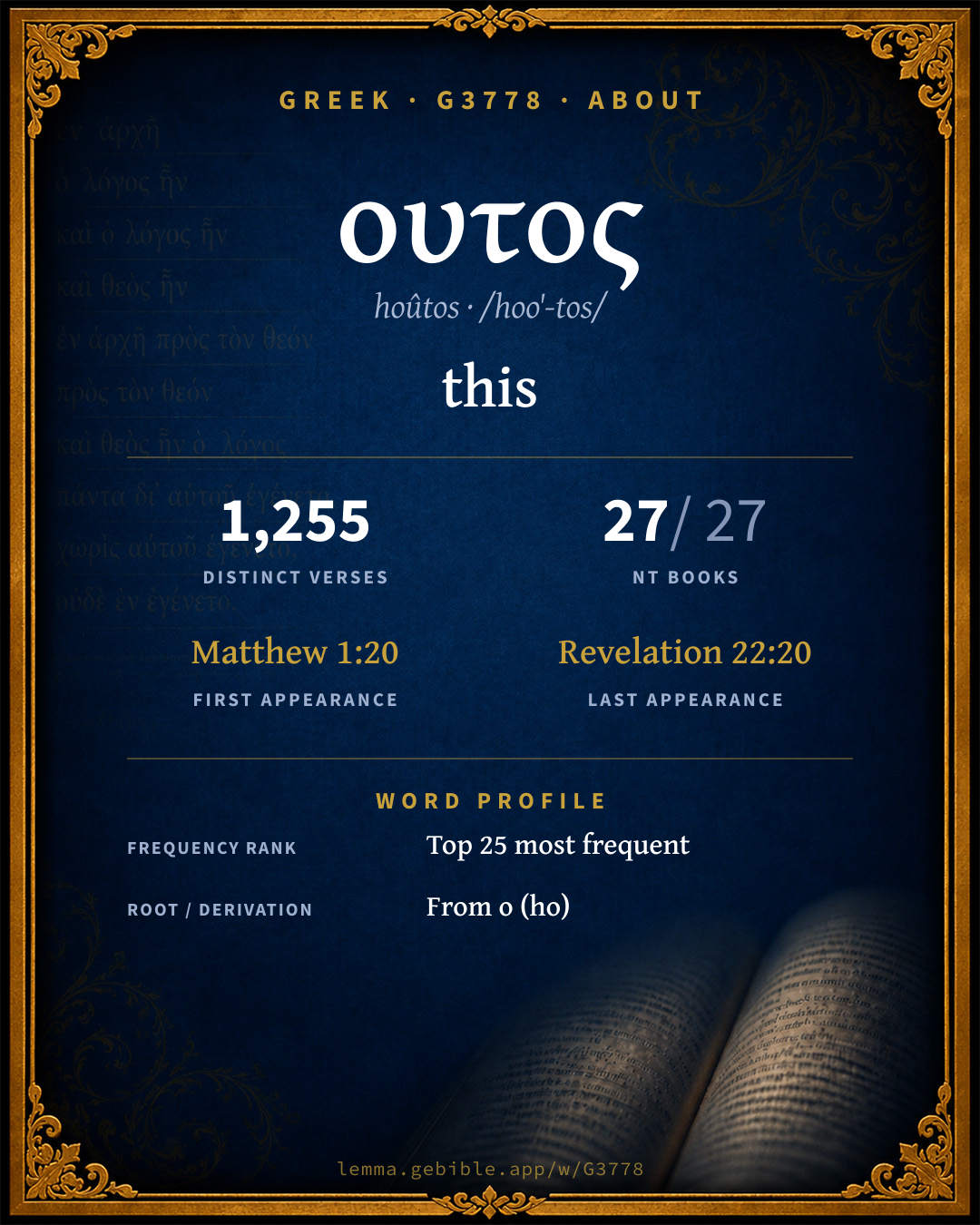
ουτος
this
Full lexicon entry — Thayer's Greek Lexicon
From Thayer's Greek Lexicon
Where this word appears
See every Accusative-case word in the Greek New Testament →
Grammar key — what these labels mean
Part of speech
- Demonstrative pronoun
- Points something out (“this,” “that”).
Case
- Accusative
- The case of the direct object and of extent.
- Nominative
- The case of the subject (and the predicate nominative).
- Dative
- The case of the indirect object, means, or location — “to / for / with / in.”
- Genitive
- The case of source, possession, or “of” — answers “whose / from what.”
Gender
- Neuter
- Grammatically neuter.
- Masculine
- Grammatically masculine.
- Feminine
- Grammatically feminine.
Number
- Singular
- One.
- Plural
- More than one.
Grammatical forms 24 distinct
- Demonstrative pronoun, Accusative, Singular, Neuter 228 times (17%)
- Demonstrative pronoun, Accusative, Plural, Neuter 191 times (14%)
- Demonstrative pronoun, Nominative, Singular, Masculine 187 times (14%)
- Demonstrative pronoun, Nominative, Singular, Neuter 105 times (8%)
- Demonstrative pronoun, Nominative, Plural, Masculine 74 times (5%)
- Demonstrative pronoun, Nominative, Singular, Feminine 73 times (5%)
- Demonstrative pronoun, Accusative, Singular, Masculine 59 times (4%)
- Demonstrative pronoun, Accusative, Singular, Feminine 52 times (4%)
+16 more forms (410 occurrences)
Parsed forms decoded from the imported morphology (Robinson–Tischendorf, public domain), counted across 1,379 parsed occurrences — not distinct verses.
Page 3 of 7 — showing verses 401–600 of 1,255 distinct verses where G3778 appears, across 27 books. Click any verse to open its interlinear word-by-word view. Verse text shown in the World English Bible for context — . Each verse’s Greek form is shown with its reference; the English is not keyword-highlighted, since the data carries no word-level English alignment. Use “Compare translations” on any verse to read it across multiple English versions. This concordance covers the Greek New Testament; Septuagint (Greek Old Testament) occurrences of this word are not indexed here.
Luke 210 verses
- Luke 24:9 ταῦτα dem.pron acc pl neut returned from the tomb, and told all these things to the eleven, and to all the rest.
- Luke 24:10 ταῦτα dem.pron acc pl neut Now they were Mary Magdalene, Joanna, and Mary the mother of James. The other women with them told these things to the apostles.
- Luke 24:11 ταῦτα dem.pron nom pl neut These words seemed to them to be nonsense, and they didn't believe them.
- Luke 24:14 τούτων dem.pron gen pl neut They talked with each other about all of these things which had happened.
- Luke 24:17 οὗτοι dem.pron nom pl masc He said to them, "What are you talking about as you walk, and are sad?"
- Luke 24:18 ταύταις dem.pron dat pl fem One of them, named Cleopas, answered him, "Are you the only stranger in Jerusalem who doesn't know the things which have happened there in these days?"
- Luke 24:21 τούτοις ταύτην ταῦτα dem.pron dat pl neut dem.pron acc sg fem dem.pron nom pl neut But we were hoping that it was he who would redeem Israel. Yes, and besides all this, it is now the third day since these things happened.
- Luke 24:26 ταῦτα dem.pron acc pl neut Didn't the Christ have to suffer these things and to enter into his glory?"
- Luke 24:36 Ταῦτα dem.pron acc pl neut As they said these things, Jesus himself stood among them, and said to them, "Peace be to you."
- Luke 24:44 οὗτοι dem.pron nom pl masc He said to them, "This is what I told you, while I was still with you, that all things which are written in the law of Moses, the prophets, and the psalms, concerning me must be fulfilled."
- Luke 24:48 τούτων dem.pron gen pl neut You are witnesses of these things.
John 214 verses
- John 1:2 οὗτος dem.pron nom sg masc The same was in the beginning with God.
- John 1:7 οὗτος dem.pron nom sg masc The same came as a witness, that he might testify about the light, that all might believe through him.
- John 1:15 οὗτος dem.pron nom sg masc John testified about him. He cried out, saying, "This was he of whom I said, 'He who comes after me has surpassed me, for he was before me.'"
- John 1:19 αὕτη dem.pron nom sg fem This is John's testimony, when the Jews sent priests and Levites from Jerusalem to ask him, "Who are you?"
- John 1:28 ταῦτα dem.pron nom pl neut These things were done in Bethany beyond the Jordan, where John was baptizing.
- John 1:30 οὗτός dem.pron nom sg masc This is he of whom I said, 'After me comes a man who is preferred before me, for he was before me.'
- John 1:31 τοῦτο dem.pron acc sg neut I didn't know him, but for this reason I came baptizing in water: that he would be revealed to Israel."
- John 1:33 οὗτός dem.pron nom sg masc I didn't recognize him, but he who sent me to baptize in water, he said to me, 'On whomever you will see the Spirit descending, and remaining on him, the same is he who baptizes in the Holy Spirit.'
- John 1:34 οὗτός dem.pron nom sg masc I have seen, and have testified that this is the Son of God."
- John 1:42 οὗτος dem.pron nom sg masc He brought him to Jesus. Jesus looked at him, and said, "You are Simon the son of Jonah. You shall be called Cephas" (which is by interpretation, Peter).
- John 1:51 τούτων dem.pron gen pl neut He said to him, "Most assuredly, I tell you, hereafter you will see heaven opened, and the angels of God ascending and descending on the Son of Man."
- John 2:11 ταύτην dem.pron acc sg fem This beginning of his signs Jesus did in Cana of Galilee, and revealed his glory; and his disciples believed in him.
- John 2:12 τοῦτο dem.pron acc sg neut After this, he went down to Capernaum, he, and his mother, his brothers, and his disciples; and they stayed there a few days.
- John 2:16 ταῦτα dem.pron acc pl neut To those who sold the doves, he said, "Take these things out of here! Don't make my Father's house a marketplace!"
- John 2:18 ταῦτα dem.pron acc pl neut The Jews therefore answered him, "What sign do you show us, seeing that you do these things?"
- John 2:19 τοῦτον dem.pron acc sg masc Jesus answered them, "Destroy this temple, and in three days I will raise it up."
- John 2:20 οὗτος dem.pron nom sg masc The Jews therefore said, "Forty-six years was this temple in building, and will you raise it up in three days?"
- John 2:22 τοῦτο dem.pron acc sg neut When therefore he was raised from the dead, his disciples remembered that he said this, and they believed the Scripture, and the word which Jesus had said.
- John 3:2 οὗτος ταῦτα dem.pron nom sg masc dem.pron acc pl neut The same came to him by night, and said to him, "Rabbi, we know that you are a teacher come from God, for no one can do these signs that you do, unless God is with him."
- John 3:9 ταῦτα dem.pron nom pl neut Nicodemus answered him, "How can these things be?"
- John 3:10 ταῦτα dem.pron acc pl neut Jesus answered him, "Are you the teacher of Israel, and don't understand these things?
- John 3:19 αὕτη dem.pron nom sg fem This is the judgment, that the light has come into the world, and men loved the darkness rather than the light; for their works were evil.
- John 3:22 ταῦτα dem.pron acc pl neut After these things, Jesus came with his disciples into the land of Judea. He stayed there with them, and baptized.
- John 3:26 οὗτος dem.pron nom sg masc They came to John, and said to him, "Rabbi, he who was with you beyond the Jordan, to whom you have testified, behold, the same baptizes, and everyone is coming to him."
- John 3:29 αὕτη dem.pron nom sg fem He who has the bride is the bridegroom; but the friend of the bridegroom, who stands and hears him, rejoices greatly because of the bridegroom's voice. This, my joy, therefore is made full.
- John 4:13 τούτου dem.pron gen sg neut Jesus answered her, "Everyone who drinks of this water will thirst again,
- John 4:15 τοῦτο dem.pron acc sg neut The woman said to him, "Sir, give me this water, so that I don't get thirsty, neither come all the way here to draw."
- John 4:18 τοῦτο dem.pron acc sg neut for you have had five husbands; and he whom you now have is not your husband. This you have said truly."
- John 4:20 τούτῳ dem.pron dat sg neut Our fathers worshiped in this mountain, and you Jews say that in Jerusalem is the place where people ought to worship."
- John 4:21 τούτῳ dem.pron dat sg neut Jesus said to her, "Woman, believe me, the hour comes, when neither in this mountain, nor in Jerusalem, will you worship the Father.
- John 4:27 τούτῳ dem.pron dat sg masc At this, his disciples came. They marveled that he was speaking with a woman; yet no one said, "What are you looking for?" or, "Why do you speak with her?"
- John 4:29 οὗτός dem.pron nom sg masc "Come, see a man who told me everything that I did. Can this be the Christ?"
- John 4:37 τούτῳ dem.pron dat sg masc For in this the saying is true, 'One sows, and another reaps.'
- John 4:42 οὗτός dem.pron nom sg masc They said to the woman, "Now we believe, not because of your speaking; for we have heard for ourselves, and know that this is indeed the Christ, the Savior of the world."
- John 4:47 οὗτος dem.pron nom sg masc When he heard that Jesus had come out of Judea into Galilee, he went to him, and begged him that he would come down and heal his son, for he was at the point of death.
- John 4:54 Τοῦτο dem.pron acc sg neut This is again the second sign that Jesus did, having come out of Judea into Galilee.
- John 5:1 ταῦτα dem.pron acc pl neut After these things, there was a feast of the Jews, and Jesus went up to Jerusalem.
- John 5:3 ταύταις dem.pron dat pl fem In these lay a great multitude of those who were sick, blind, lame, or paralyzed, waiting for the moving of the water;
- John 5:6 τοῦτον dem.pron acc sg masc When Jesus saw him lying there, and knew that he had been sick for a long time, he asked him, "Do you want to be made well?"
- John 5:14 ταῦτα dem.pron acc pl neut Afterward Jesus found him in the temple, and said to him, "Behold, you are made well. Sin no more, so that nothing worse happens to you."
- John 5:16 τοῦτο ταῦτα dem.pron acc sg neut dem.pron acc pl neut For this cause the Jews persecuted Jesus, and sought to kill him, because he did these things on the Sabbath.
- John 5:18 τοῦτο dem.pron acc sg neut For this cause therefore the Jews sought all the more to kill him, because he not only broke the Sabbath, but also called God his own Father, making himself equal with God.
- John 5:19 ταῦτα dem.pron acc pl neut Jesus therefore answered them, "Most assuredly, I tell you, the Son can do nothing of himself, but what he sees the Father doing. For whatever things he does, these the Son also does likewise.
- John 5:20 τούτων dem.pron gen pl neut For the Father has affection for the Son, and shows him all things that he himself does. He will show him greater works than these, that you may marvel.
- John 5:28 τοῦτο dem.pron acc sg neut Don't marvel at this, for the hour comes, in which all that are in the tombs will hear his voice,
- John 5:34 ταῦτα dem.pron acc pl neut But the testimony which I receive is not from man. However, I say these things that you may be saved.
- John 5:38 τούτῳ dem.pron dat sg masc You don't have his word living in you; because you don't believe him whom he sent.
- John 6:1 ταῦτα dem.pron acc pl neut After these things, Jesus went away to the other side of the sea of Galilee, which is also called the Sea of Tiberias.
- John 6:5 οὗτοι dem.pron nom pl masc Jesus therefore lifting up his eyes, and seeing that a great multitude was coming to him, said to Philip, "Where are we to buy bread, that these may eat?"
- John 6:6 τοῦτο dem.pron acc sg neut This he said to test him, for he himself knew what he would do.
- John 6:9 ταῦτα dem.pron nom pl neut "There is a boy here who has five barley loaves and two fish, but what are these among so many?"
- John 6:14 οὗτός dem.pron nom sg masc When therefore the people saw the sign which Jesus did, they said, "This is truly the prophet who comes into the world."
- John 6:27 τοῦτον dem.pron acc sg masc Don't work for the food which perishes, but for the food which remains to eternal life, which the Son of Man will give to you. For God the Father has sealed him."
- John 6:29 τοῦτό dem.pron nom sg neut Jesus answered them, "This is the work of God, that you believe in him whom he has sent."
- John 6:34 τοῦτον dem.pron acc sg masc They said therefore to him, "Lord, always give us this bread."
- John 6:39 τοῦτο dem.pron nom sg neut This is the will of my Father who sent me, that of all he has given to me I should lose nothing, but should raise him up at the last day.
- John 6:40 τοῦτο dem.pron nom sg neut This is the will of the one who sent me, that everyone who sees the Son, and believes in him, should have eternal life; and I will raise him up at the last day."
- John 6:42 οὗτός οὗτος dem.pron nom sg masc dem.pron nom sg masc They said, "Isn't this Jesus, the son of Joseph, whose father and mother we know? How then does he say, 'I have come down out of heaven?'"
- John 6:46 οὗτος dem.pron nom sg masc Not that anyone has seen the Father, except he who is from God. He has seen the Father.
- John 6:50 οὗτός dem.pron nom sg masc This is the bread which comes down out of heaven, that anyone may eat of it and not die.
- John 6:52 οὗτος dem.pron nom sg masc The Jews therefore contended with one another, saying, "How can this man give us his flesh to eat?"
- John 6:58 οὗτός τοῦτον dem.pron nom sg masc dem.pron acc sg masc This is the bread which came down out of heaven-- not as our fathers ate the manna, and died. He who eats this bread will live forever."
- John 6:59 ταῦτα dem.pron acc pl neut These things he said in the synagogue, as he taught in Capernaum.
- John 6:60 οὗτος dem.pron nom sg masc Therefore many of his disciples, when they heard this, said, "This is a hard saying! Who can listen to it?"
- John 6:61 τούτου τοῦτο dem.pron gen sg masc dem.pron nom sg neut But Jesus knowing in himself that his disciples murmured at this, said to them, "Does this cause you to stumble?
- John 6:65 τοῦτο dem.pron acc sg neut He said, "For this cause have I said to you that no one can come to me, unless it is given to him by my Father."
- John 6:66 τούτου dem.pron gen sg masc At this, many of his disciples went back, and walked no more with him.
- John 6:71 οὗτος dem.pron nom sg masc Now he spoke of Judas, the son of Simon Iscariot, for it was he who would betray him, being one of the twelve.
- John 7:1 ταῦτα dem.pron acc pl neut After these things, Jesus was walking in Galilee, for he wouldn't walk in Judea, because the Jews sought to kill him.
- John 7:4 ταῦτα dem.pron acc pl neut For no one does anything in secret, and himself seeks to be known openly. If you do these things, reveal yourself to the world."
- John 7:8 ταύτην dem.pron acc sg fem You go up to the feast. I am not yet going up to this feast, because my time is not yet fulfilled."
- John 7:9 ταῦτα dem.pron acc pl neut Having said these things to them, he stayed in Galilee.
- John 7:15 οὗτος dem.pron nom sg masc The Jews therefore marveled, saying, "How does this man know letters, having never been educated?"
- John 7:18 οὗτος dem.pron nom sg masc He who speaks from himself seeks his own glory, but he who seeks the glory of him who sent him, the same is true, and no unrighteousness is in him.
- John 7:25 οὗτός dem.pron nom sg masc Therefore some of them of Jerusalem said, "Isn't this he whom they seek to kill?
- John 7:26 οὗτός dem.pron nom sg masc Behold, he speaks openly, and they say nothing to him. Can it be that the rulers indeed know that this is truly the Christ?
- John 7:27 τοῦτον dem.pron acc sg masc However we know where this man comes from, but when the Christ comes, no one will know where he comes from."
- John 7:31 οὗτος dem.pron nom sg masc But of the multitude, many believed in him. They said, "When the Christ comes, he won't do more signs than those which this man has done, will he?"
- John 7:32 ταῦτα dem.pron acc pl neut The Pharisees heard the multitude murmuring these things concerning him, and the chief priests and the Pharisees sent officers to arrest him.
- John 7:35 οὗτος dem.pron nom sg masc The Jews therefore said among themselves, "Where will this man go that we won't find him? Will he go to the Dispersion among the Greeks, and teach the Greeks?
- John 7:36 οὗτος dem.pron nom sg masc What is this word that he said, 'You will seek me, and won't find me; and where I am, you can't come?'"
- John 7:39 τοῦτο dem.pron acc sg neut But he said this about the Spirit, which those believing in him were to receive. For the Holy Spirit was not yet given, because Jesus wasn't yet glorified.
- John 7:40 τούτων οὗτός dem.pron gen pl masc dem.pron nom sg masc Many of the multitude therefore, when they heard these words, said, "This is truly the prophet."
- John 7:41 οὗτός dem.pron nom sg masc Others said, "This is the Christ." But some said, "What, does the Christ come out of Galilee?
- John 7:46 οὗτος dem.pron nom sg masc The officers answered, "No man ever spoke like this man!"
- John 7:49 οὗτος dem.pron nom sg masc But this multitude that doesn't know the law is accursed."
- John 8:4 αὕτη dem.pron nom sg fem they told him, "Teacher, we found this woman in adultery, in the very act.
- John 8:6 τοῦτο dem.pron acc sg neut They said this testing him, that they might have something to accuse him of. But Jesus stooped down, and wrote on the ground with his finger.
- John 8:20 ταῦτα dem.pron acc pl neut Jesus spoke these words in the treasury, as he taught in the temple. Yet no one arrested him, because his hour had not yet come.
- John 8:23 τούτου τούτου dem.pron gen sg masc dem.pron gen sg masc He said to them, "You are from beneath. I am from above. You are of this world. I am not of this world.
- John 8:26 ταῦτα dem.pron acc pl neut I have many things to speak and to judge concerning you. However he who sent me is true; and the things which I heard from him, these I say to the world."
- John 8:28 ταῦτα dem.pron acc pl neut Jesus therefore said to them, "When you have lifted up the Son of Man, then you will know that I am he, and I do nothing of myself, but as my Father taught me, I say these things.
- John 8:30 Ταῦτα dem.pron acc pl neut As he spoke these things, many believed in him.
- John 8:40 τοῦτο dem.pron acc sg neut But now you seek to kill me, a man who has told you the truth, which I heard from God. Abraham didn't do this.
- John 8:47 τοῦτο dem.pron acc sg neut He who is of God hears the words of God. For this cause you don't hear, because you are not of God."
- John 9:2 οὗτος dem.pron nom sg masc His disciples asked him, "Rabbi, who sinned, this man or his parents, that he was born blind?"
- John 9:3 οὗτος dem.pron nom sg masc Jesus answered, "Neither did this man sin, nor his parents; but, that the works of God might be revealed in him.
- John 9:6 ταῦτα dem.pron acc pl neut When he had said this, he spat on the ground, made mud with the saliva, anointed the blind man's eyes with the mud,
- John 9:8 οὗτός dem.pron nom sg masc The neighbors therefore, and those who saw that he was blind before, said, "Isn't this he who sat and begged?"
- John 9:9 οὗτός dem.pron nom sg masc Others were saying, "It is he." Still others were saying, "He looks like him." He said, "I am he."
- John 9:16 οὗτος dem.pron nom sg masc Some therefore of the Pharisees said, "This man is not from God, because he doesn't keep the Sabbath." Others said, "How can a man who is a sinner do such signs?" There was division among them.
- John 9:19 οὗτός dem.pron nom sg masc and asked them, "Is this your son, who you say was born blind? How then does he now see?"
- John 9:20 οὗτός dem.pron nom sg masc His parents answered them, "We know that this is our son, and that he was born blind;
- John 9:22 ταῦτα dem.pron acc pl neut His parents said these things because they feared the Jews; for the Jews had already agreed that if any man would confess him as Christ, he would be put out of the synagogue.
- John 9:23 τοῦτο dem.pron acc sg neut Therefore his parents said, "He is of age. Ask him."
- John 9:24 οὗτος dem.pron nom sg masc So they called the man who was blind a second time, and said to him, "Give glory to God. We know that this man is a sinner."
- John 9:29 τοῦτον dem.pron acc sg masc We know that God has spoken to Moses. But as for this man, we don't know where he comes from."
- John 9:30 τούτῳ dem.pron dat sg neut The man answered them, "How amazing! You don't know where he comes from, yet he opened my eyes.
- John 9:31 τούτου dem.pron gen sg masc We know that God doesn't listen to sinners, but if anyone is a worshipper of God, and does his will, he listens to him.
- John 9:33 οὗτος dem.pron nom sg masc If this man were not from God, he could do nothing."
- John 9:39 τοῦτον dem.pron acc sg masc Jesus said, "I came into this world for judgment, that those who don't see may see; and that those who see may become blind."
- John 10:3 τούτῳ dem.pron dat sg masc The gatekeeper opens the gate for him, and the sheep listen to his voice. He calls his own sheep by name, and leads them out.
- John 10:6 Ταύτην dem.pron acc sg fem Jesus spoke this parable to them, but they didn't understand what he was telling them.
- John 10:16 ταύτης dem.pron gen sg fem I have other sheep, which are not of this fold. I must bring them also, and they will hear my voice. They will become one flock with one shepherd.
- John 10:17 τοῦτό dem.pron acc sg neut Therefore the Father loves me, because I lay down my life, that I may take it again.
- John 10:18 ταύτην dem.pron acc sg fem No one takes it away from me, but I lay it down by myself. I have power to lay it down, and I have power to take it again. I received this commandment from my Father."
- John 10:19 τούτους dem.pron acc pl masc Therefore a division arose again among the Jews because of these words.
- John 10:21 ταῦτα dem.pron nom pl neut Others said, "These are not the sayings of one possessed by a demon. It isn't possible for a demon to open the eyes of the blind, is it?"
- John 10:25 ταῦτα dem.pron nom pl neut Jesus answered them, "I told you, and you don't believe. The works that I do in my Father's name, these testify about me.
- John 10:41 τούτου dem.pron gen sg masc Many came to him. They said, "John indeed did no sign, but everything that John said about this man is true."
- John 11:4 αὕτη dem.pron nom sg fem But when Jesus heard it, he said, "This sickness is not to death, but for the glory of God, that God's Son may be glorified by it."
- John 11:7 τοῦτο dem.pron acc sg neut Then after this he said to the disciples, "Let's go into Judea again."
- John 11:9 τούτου dem.pron gen sg masc Jesus answered, "Aren't there twelve hours of daylight? If a man walks in the day, he doesn't stumble, because he sees the light of this world.
- John 11:11 ταῦτα τοῦτο dem.pron acc pl neut dem.pron acc sg neut He said these things, and after that, he said to them, "Our friend, Lazarus, has fallen asleep, but I am going so that I may awake him out of sleep."
- John 11:26 τοῦτο dem.pron acc sg neut Whoever lives and believes in me will never die. Do you believe this?"
- John 11:28 τοῦτο dem.pron acc sg neut When she had said this, she went away, and called Mary, her sister, secretly, saying, "The Teacher is here, and is calling you."
- John 11:37 οὗτος οὗτος dem.pron nom sg masc dem.pron nom sg masc Some of them said, "Couldn't this man, who opened the eyes of him who was blind, have also kept this man from dying?"
- John 11:43 ταῦτα dem.pron acc pl neut When he had said this, he cried with a loud voice, "Lazarus, come out!"
- John 11:47 οὗτος dem.pron nom sg masc The chief priests therefore and the Pharisees gathered a council, and said, "What are we doing? For this man does many signs.
- John 11:51 τοῦτο dem.pron acc sg neut Now he didn't say this of himself, but being high priest that year, he prophesied that Jesus would die for the nation,
- John 12:5 τοῦτο dem.pron nom sg neut "Why wasn't this ointment sold for three hundred denarii, and given to the poor?"
- John 12:6 τοῦτο dem.pron acc sg neut Now he said this, not because he cared for the poor, but because he was a thief, and having the money box, used to steal what was put into it.
- John 12:16 ταῦτα ταῦτα ταῦτα dem.pron acc pl neut dem.pron nom pl neut dem.pron acc pl neut His disciples didn't understand these things at first, but when Jesus was glorified, then they remembered that these things were written about him, and that they had done these things to him.
- John 12:18 τοῦτο τοῦτο dem.pron acc sg neut dem.pron acc sg neut For this cause also the multitude went and met him, because they heard that he had done this sign.
- John 12:21 οὗτοι dem.pron nom pl masc These, therefore, came to Philip, who was from Bethsaida of Galilee, and asked him, saying, "Sir, we want to see Jesus."
- John 12:25 τούτῳ dem.pron dat sg masc He who loves his life will lose it. He who hates his life in this world will keep it to eternal life.
- John 12:27 ταύτης τοῦτο ταύτην dem.pron gen sg fem dem.pron acc sg neut dem.pron acc sg fem "Now my soul is troubled. What shall I say? 'Father, save me from this time?' But for this cause I came to this time.
- John 12:30 αὕτη dem.pron nom sg fem Jesus answered, "This voice hasn't come for my sake, but for your sakes.
- John 12:31 τούτου τούτου dem.pron gen sg masc dem.pron gen sg masc Now is the judgment of this world. Now the prince of this world will be cast out.
- John 12:33 τοῦτο dem.pron acc sg neut But he said this, signifying by what kind of death he should die.
- John 12:34 οὗτος dem.pron nom sg masc The multitude answered him, "We have heard out of the law that the Christ remains forever. How do you say, 'The Son of Man must be lifted up?' Who is this Son of Man?"
- John 12:36 Ταῦτα dem.pron acc pl neut While you have the light, believe in the light, that you may become children of light." Jesus said these things, and he departed and hid himself from them.
- John 12:39 τοῦτο dem.pron acc sg neut For this cause they couldn't believe, for Isaiah said again,
- John 12:41 ταῦτα dem.pron acc pl neut Isaiah said these things when he saw his glory, and spoke of him.
- John 13:1 τούτου dem.pron gen sg masc Now before the feast of the Passover, Jesus knowing that his time had come that he would depart from this world to the Father, having loved his own who were in the world, he loved them to the end.
- John 13:7 ταῦτα dem.pron acc pl neut Jesus answered him, "You don't know what I am doing now, but you will understand later."
- John 13:11 τοῦτο dem.pron acc sg neut For he knew him who would betray him, therefore he said, "You are not all clean."
- John 13:17 ταῦτα dem.pron acc pl neut If you know these things, blessed are you if you do them.
- John 13:21 Ταῦτα dem.pron acc pl neut When Jesus had said this, he was troubled in spirit, and testified, "Most assuredly I tell you that one of you will betray me."
- John 13:24 τούτῳ dem.pron dat sg masc Simon Peter therefore beckoned to him, and said to him, "Tell us who it is of whom he speaks."
- John 13:28 τοῦτο dem.pron acc sg neut Now no man at the table knew why he said this to him.
- John 13:35 τούτῳ dem.pron dat sg neut By this everyone will know that you are my disciples, if you have love for one another."
- John 14:12 τούτων dem.pron gen pl neut Most assuredly I tell you, he who believes in me, the works that I do, he will do also; and greater works than these will he do; because I am going to my Father.
- John 14:13 τοῦτο dem.pron acc sg neut Whatever you will ask in my name, that will I do, that the Father may be glorified in the Son.
- John 14:25 Ταῦτα dem.pron acc pl neut I have said these things to you, while still living with you.
- John 15:5 οὗτος dem.pron nom sg masc I am the vine. You are the branches. He who remains in me, and I in him, the same bears much fruit, for apart from me you can do nothing.
- John 15:8 τούτῳ dem.pron dat sg neut "In this is my Father glorified, that you bear much fruit; and so you will be my disciples.
- John 15:11 ταῦτα dem.pron acc pl neut I have spoken these things to you, that my joy may remain in you, and that your joy may be made full.
- John 15:12 αὕτη dem.pron nom sg fem "This is my commandment, that you love one another, even as I have loved you.
- John 15:13 ταύτης dem.pron gen sg fem Greater love has no one than this, that someone lay down his life for his friends.
- John 15:17 ταῦτα dem.pron acc pl neut "I command these things to you, that you may love one another.
- John 15:19 τοῦτο dem.pron acc sg neut If you were of the world, the world would love its own. But because you are not of the world, since I chose you out of the world, therefore the world hates you.
- John 15:21 ταῦτα dem.pron acc pl neut But all these things will they do to you for my name's sake, because they don't know him who sent me.
- John 16:1 Ταῦτα dem.pron acc pl neut "These things have I spoken to you, so that you wouldn't be caused to stumble.
- John 16:3 ταῦτα dem.pron acc pl neut They will do these things because they have not known the Father, nor me.
- John 16:4 ταῦτα ταῦτα dem.pron acc pl neut dem.pron acc pl neut But I have told you these things, so that when the time comes, you may remember that I told you about them. I didn't tell you these things from the beginning, because I was with you.
- John 16:6 ταῦτα dem.pron acc pl neut But because I have told you these things, sorrow has filled your heart.
- John 16:11 τούτου dem.pron gen sg masc about judgment, because the prince of this world has been judged.
- John 16:15 τοῦτο dem.pron acc sg neut All things whatever the Father has are mine; therefore I said that he takes of mine, and will declare it to you.
- John 16:17 τοῦτο dem.pron nom sg neut Some of his disciples therefore said to one another, "What is this that he says to us, 'A little while, and you won't see me, and again a little while, and you will see me;' and, 'Because I go to the Father?'"
- John 16:18 τοῦτο dem.pron acc sg neut They said therefore, "What is this that he says, 'A little while?' We don't know what he is saying."
- John 16:19 τούτου dem.pron gen sg masc Therefore Jesus perceived that they wanted to ask him, and he said to them, "Do you inquire among yourselves concerning this, that I said, 'A little while, and you won't see me, and again a little while, and you will see me?'
- John 16:25 Ταῦτα dem.pron acc pl neut I have spoken these things to you in figures of speech. But the time is coming when I will no more speak to you in figures of speech, but will tell you plainly about the Father.
- John 16:30 τούτῳ dem.pron dat sg neut Now we know that you know all things, and don't need for anyone to question you. By this we believe that you came forth from God."
- John 16:33 ταῦτα dem.pron acc pl neut I have told you these things, that in me you may have peace. In the world you have oppression; but cheer up! I have overcome the world."
- John 17:1 Ταῦτα dem.pron acc pl neut Jesus said these things, and lifting up his eyes to heaven, he said, "Father, the time has come. Glorify your Son, that your Son may also glorify you;
- John 17:3 αὕτη dem.pron nom sg fem This is eternal life, that they should know you, the only true God, and him whom you sent, Jesus Christ.
- John 17:13 ταῦτα dem.pron acc pl neut But now I come to you, and I say these things in the world, that they may have my joy made full in themselves.
- John 17:20 τούτων dem.pron gen pl masc Not for these only do I pray, but for those also who believe in me through their word,
- John 17:25 οὗτοι dem.pron nom pl masc Righteous Father, the world hasn't known you, but I knew you; and these knew that you sent me.
- John 18:1 Ταῦτα dem.pron acc pl neut When Jesus had spoken these words, he went out with his disciples over the brook Kidron, where was a garden, into which he and his disciples entered.
- John 18:8 τούτους dem.pron acc pl masc Jesus answered, "I told you that I AM. If therefore you seek me, let these go their way,"
- John 18:17 τούτου dem.pron gen sg masc Then the maid who kept the door said to Peter, "Are you also one of this man's disciples?" He said, "I am not."
- John 18:21 οὗτοι dem.pron nom pl masc Why do you ask me? Ask those who have heard me what I said to them. Behold, these know the things which I said."
- John 18:22 ταῦτα dem.pron acc pl neut When he had said this, one of the officers standing by slapped Jesus with his hand, saying, "Do you answer the high priest like that?"
- John 18:29 τούτου dem.pron gen sg masc Pilate therefore went out to them, and said, "What accusation do you bring against this man?"
- John 18:30 οὗτος dem.pron nom sg masc They answered him, "If this man weren't an evildoer, we wouldn't have delivered him up to you."
- John 18:34 τοῦτο dem.pron acc sg neut Jesus answered him, "Do you say this by yourself, or did others tell you about me?"
- John 18:36 τούτου τούτου dem.pron gen sg masc dem.pron gen sg masc Jesus answered, "My Kingdom is not of this world. If my Kingdom were of this world, then my servants would fight, that I wouldn't be delivered to the Jews. But now my Kingdom is not from here."
About this entry
At a glance — auto-summarized from this page’s data, not written by a person. Every figure links to its source below. This summary describes the numbers; it doesn’t interpret them.
At its core, ουτος (hoûtos) means “this.” “same” is the historic King James Version rendering; modern versions use “this.” See the renderings breakdown. It turns up in 1,255 verses across 27 books, one of the most common footprint. It first appears in Matthew 1:20. It clusters with ο, τανυν and οδε under a shared root. Each statement above links to its evidence; the full detail follows below.
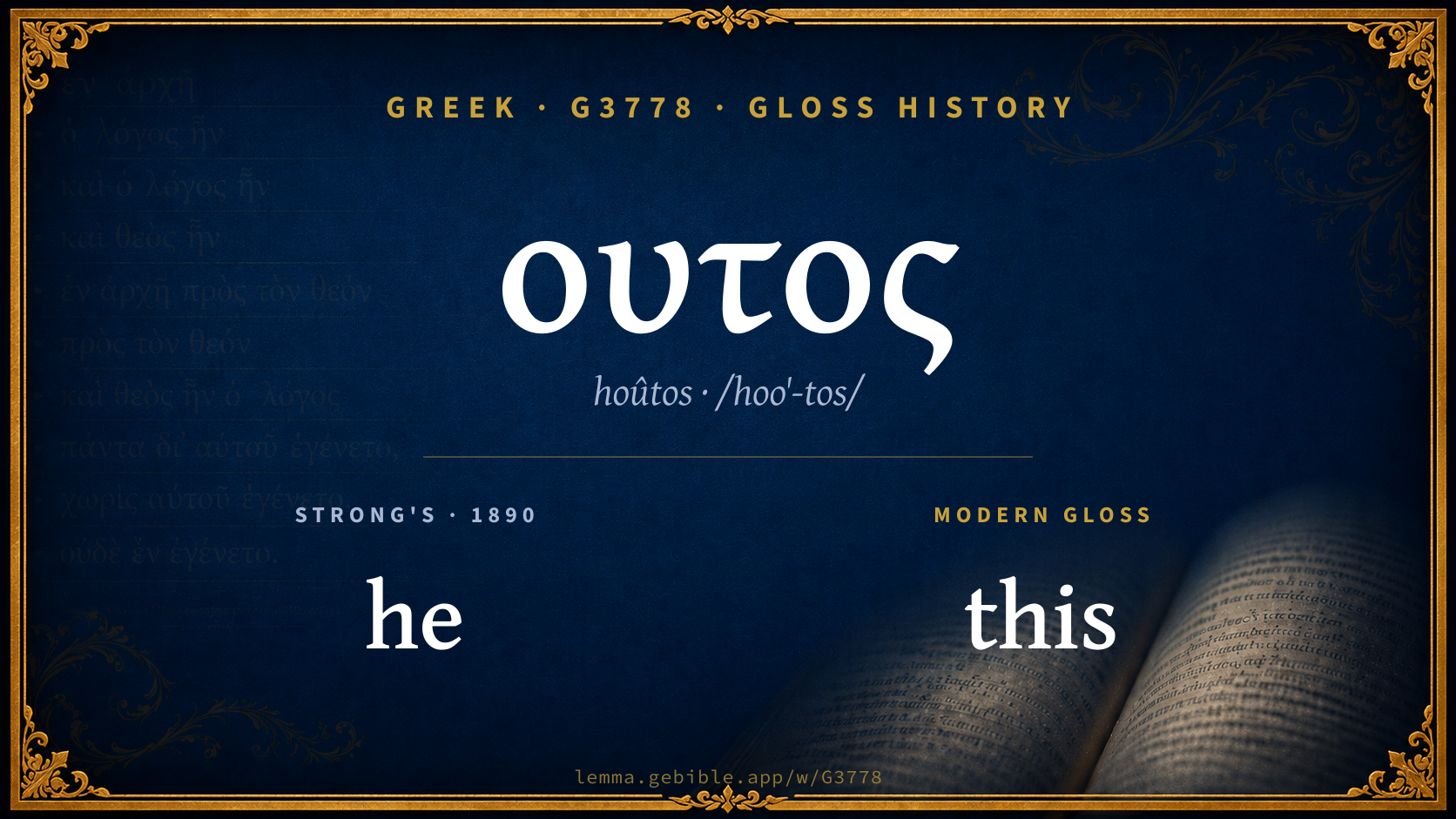
Gloss history
Strong's 1890 vs modern scholarship
About this word
Strong's G3778 catalogs a Greek word from the Greek New Testament.
These counts are not copied from any lexicon or concordance. They are computed here, from the morphology-tagged Greek New Testament. What Lemma adds →
- 1,255
- distinct verses
- The word appears in 1,255 distinct verses.
- 27 / 27
- NT books
- The word appears in 27 of 27 New Testament books.
- #13
- by frequency
- Top 25 most frequent Greek words (rank 13 of 5,347 Greek words by occurrence).
View all 1,255 occurrences in the concordance →
By section of the New Testament
By traditional corpus
Conventional, traditional groupings — biblical authorship is debated, so this is a traditional corpus grouping, not an authorship claim. Some books belong to more than one corpus (Luke is in both the Gospels and the Lukan corpus, and so on), so these shares overlap and need not total 100%. Each figure is a share of the word’s 1,255 distinct verses.
- Gospels 625 verses · 50%
- Lukan (Luke–Acts) 423 verses · 34%
- Johannine 300 verses · 24%
- Pauline corpus 242 verses · 19%
- General (Catholic) Epistles 92 verses · 7%
- Revelation 43 verses · 3%
- Hebrews 40 verses · 3%
How translations render this word
Counts come from each version’s own published word-to-Strong’s tagging or interlinear alignment — an approximate guide to how each version renders this word, not a word-level alignment the data otherwise carries. Because each total is that version’s own tagged count, the per-version totals vary from one another and need not match the appearance or distinct-verse counts above. These counts may also differ from a printed concordance because Lemma counts each distinctly tagged rendering and does not collapse phrase taggings into a single head-word total. This is a fixed set of word-tagged versions (KJV, ASV, BSB, ULT) and does not change with the reading translation you choose elsewhere. Each version’s license is shown beside its name below (and on Sources).
- King James Version: This 157×, These 62×, Same 34×
- American Standard Version: This 245×, These 81×, Same 28×
- Berean Standard Bible: This 572×, These 138×, Things 103×
- unfoldingWord Literal Text: This 745×, Things 237×, These 194×
King James Version Public Domain
Renders G3778 across 347 tagged occurrences — most commonly:
Plus 15 renderings that appear only once — usually multi-word phrases or single function words the recovered tagging swept in, not distinct renderings. Not rendered by a distinct English word in 9 further occurrences.
American Standard Version Public Domain
Renders G3778 across 470 tagged occurrences — most commonly:
Plus other, less common renderings. Plus 42 renderings that appear only once — usually multi-word phrases or single function words the recovered tagging swept in, not distinct renderings.
Berean Standard Bible Public Domain
Renders G3778 across 1,042 tagged occurrences — most commonly:
Plus other, less common renderings. Plus 49 renderings that appear only once — usually multi-word phrases or single function words the recovered tagging swept in, not distinct renderings. Not rendered by a distinct English word in 327 further occurrences.
unfoldingWord Literal Text CC BY-SA 4.0
Renders G3778 across 1,466 tagged occurrences — most commonly:
Plus other, less common renderings. Plus 16 renderings that appear only once — usually multi-word phrases or single function words the recovered tagging swept in, not distinct renderings.
Senses in Thayer's
The 1 sense Thayer's distinguishes for this word, in lexicon order (not ranked by frequency or importance). The full entry — with sub-senses — is in the Lexicon Entry tab.
- this, these, etc.
Word origin
Derived from ο (ho) (G3588).
Including the nominative masculine plural (second form) nominative feminine signular (third form) and the nominate feminine plural (fourth form). From the article G3588 and G846 ; the he ( she or it) that is this or that (often with the article repeated): - he (it was that) hereof it she such as the same these they this (man same woman) which who.
— Strong’s Exhaustive Concordance (1890), public domain.
Forms in the corpus
The 35 distinct written forms G3778 takes in the Greek New Testament, most frequent first — each parse links to that case’s occurrences in the concordance.
Same root — word family
Other Thayer's entries built from the same root as G3778, grouped by Strong’s listed origin. These share a root / origin per the lexicon — not necessarily a shared meaning. Each links to that word’s own entry.
Derives from
Shares the same root
- τανυν tanŷn G3569 present
- οδε hóde G3592 this
- οιος hoîos G3634 what sort of
- ος hós G3739 who
- σημερον sḗmeron G4594 this day
- ταυτα tautá G5024 thus
- τηλικουτος tēlikoûtos G5082 of such size
- τοι toí G5104 truly
- τοσουτος tosoûtos G5118 so great
- τοτε tóte G5119 then
- του toû G5120 his
- τουναντιον tounantíon G5121 on the contrary
- τουνομα toúnoma G5122 by name
Derived from this word
- ουτω hoútō G3779 thus
- ταυτα taûta G5023 these
- ταυταις taútais G5025 these
- ταυτη taútēi G5026 this
- τουτο toûto G5124 that thing
- τουτοις toútois G5125 these
- τουτον toûton G5126 this
- τουτου toútou G5127 of this
- τουτους toútous G5128 these
- τουτω toútōi G5129 to this
- τουτων toútōn G5130 of these
Proper names from this root
People and places named from this root — a name, not an additional meaning of the word.
- θεος theós G2316 God
- ο ων και ο ην και ο ερχομενος ho ṑn kaí ho ēn kaí ho erchómenos G3801 He who is
- Χαλδαιος Chaldaîos G5466 Chaldean
Compare all same-root words → Showing 4 of 29 — not the complete family. 3 of the same-root words are proper names (people or places). They share a root, not necessarily a meaning.
Septuagint usage
The same Greek word ουτος appears 3,488 times in the Greek Old Testament (Septuagint), across 3,014 verses in 38 books.
- 3,488
- LXX occurrences
- Tagged occurrences of this Greek word in the Septuagint.
- 3,014
- verses
- Distinct Septuagint verses containing this word.
- 38 / 39
- OT books
- The word appears in 38 of the 39 Old Testament books.
Sample Septuagint occurrences
- Genesis 2:4 οὗτος
- Exodus 1:1 οὗτος
- Leviticus 2:8 οὗτος
- Numbers 1:5 οὗτος
- Deuteronomy 1:1 οὗτος
- Joshua 1:2 οὗτος
- Judges 1:9 οὗτος
- Ruth 1:19 οὗτος
- 1 Samuel 1:2 οὗτος
- 2 Samuel 1:4 οὗτος
- 1 Kings 1:27 οὗτος
- 2 Kings 1:2 οὗτος
Septuagint occurrences (same lexeme)
Every verse where the same Strong’s number (G3778) appears in the Greek Septuagint — showing the first 50 of 3,014. Verse text shown in the World English Bible for context; the Greek form is the matched word — the English is not keyword-highlighted.
- Genesis 2:4 οὗτος This is the history of the generations of the heavens and of the earth when they were created, in the day that Yahweh God made earth and the heavens.
- Genesis 2:11 οὗτος The name of the first is Pishon: this is the one which flows through the whole land of Havilah, where there is gold;
- Genesis 2:13 οὗτος The name of the second river is Gihon: the same river that flows through the whole land of Cush.
- Genesis 2:14 οὗτος The name of the third river is Hiddekel: this is the one which flows in front of Assyria. The fourth river is the Euphrates.
- Genesis 2:19 οὗτος Out of the ground Yahweh God formed every animal of the field, and every bird of the sky, and brought them to the man to see what he would call them. Whatever the man called every living creature, that was its name.
- Genesis 2:23 οὗτος The man said, "This is now bone of my bones, and flesh of my flesh. She will be called Woman, because she was taken out of Man."
- Genesis 2:24 οὗτος Therefore a man will leave his father and his mother, and will join with his wife, and they will be one flesh.
- Genesis 3:11 οὗτος God said, "Who told you that you were naked? Have you eaten from the tree that I commanded you not to eat from?"
- Genesis 3:12 οὗτος The man said, "The woman whom you gave to be with me, she gave me of the tree, and I ate."
- Genesis 3:13 οὗτος Yahweh God said to the woman, "What is this you have done?" The woman said, "The serpent deceived me, and I ate."
- Genesis 3:14 οὗτος Yahweh God said to the serpent, "Because you have done this, cursed are you above all cattle, and above every animal of the field. On your belly shall you go, and you shall eat dust all the days of your life.
- Genesis 3:17 οὗτος To Adam he said, "Because you have listened to your wife's voice, and have eaten of the tree, of which I commanded you, saying, 'You shall not eat of it,' cursed is the ground for your sake. In toil you will eat of it all the days of your life.
- Genesis 3:20 οὗτος The man called his wife Eve, because she was the mother of all living.
- Genesis 4:20 οὗτος Adah gave birth to Jabal, who was the father of those who dwell in tents and have cattle.
- Genesis 4:21 οὗτος His brother's name was Jubal, who was the father of all who handle the harp and pipe.
- Genesis 4:26 οὗτος There was also born a son to Seth, and he named him Enosh. Then men began to call on Yahweh's name.
- Genesis 5:1 οὗτος This is the book of the generations of Adam. In the day that God created man, he made him in God's likeness.
- Genesis 5:29 οὗτος and he named him Noah, saying, "This same will comfort us in our work and in the toil of our hands, because of the ground which Yahweh has cursed."
- Genesis 6:3 οὗτος Yahweh said, "My Spirit will not strive with man forever, because he also is flesh; yet will his days be one hundred twenty years."
- Genesis 6:9 οὗτος This is the history of the generations of Noah. Noah was a righteous man, blameless among the people of his time. Noah walked with God.
- Genesis 7:1 οὗτος Yahweh said to Noah, "Come with all of your household into the ark, for I have seen your righteousness before me in this generation.
- Genesis 7:11 οὗτος In the six hundredth year of Noah's life, in the second month, on the seventeenth day of the month, on the same day all the fountains of the great deep were burst open, and the sky's windows were opened.
- Genesis 7:13 οὗτος In the same day Noah, and Shem, Ham, and Japheth, the sons of Noah, and Noah's wife, and the three wives of his sons with them, entered into the ark;
- Genesis 9:12 οὗτος God said, "This is the token of the covenant which I make between me and you and every living creature that is with you, for perpetual generations:
- Genesis 9:17 οὗτος God said to Noah, "This is the token of the covenant which I have established between me and all flesh that is on the earth."
- Genesis 9:19 οὗτος These three were the sons of Noah, and from these, the whole earth was populated.
- Genesis 10:1 οὗτος Now this is the history of the generations of the sons of Noah and of Shem, Ham, and Japheth. Sons were born to them after the flood.
- Genesis 10:5 οὗτος Of these were the isles of the nations divided in their lands, everyone after his language, after their families, in their nations.
- Genesis 10:8 οὗτος Cush became the father of Nimrod: he began to be a mighty one in the earth.
- Genesis 10:9 οὗτος He was a mighty hunter before Yahweh. Therefore it is said, "Like Nimrod, a mighty hunter before Yahweh."
- Genesis 10:12 οὗτος and Resen between Nineveh and Calah (the same is the great city).
- Genesis 10:18 οὗτος the Arvadite, the Zemarite, and the Hamathite. Afterward the families of the Canaanites were spread abroad.
- Genesis 10:20 οὗτος These are the sons of Ham, after their families, after their languages, in their lands, in their nations.
- Genesis 10:29 οὗτος Ophir, Havilah, and Jobab. All these were the sons of Joktan.
- Genesis 10:31 οὗτος These are the sons of Shem, after their families, after their languages, in their lands, after their nations.
- Genesis 10:32 οὗτος These are the families of the sons of Noah, after their generations, in their nations. Of these were the nations divided in the earth after the flood.
- Genesis 11:6 οὗτος Yahweh said, "Behold, they are one people, and they have all one language; and this is what they begin to do. Now nothing will be withheld from them, which they intend to do.
- Genesis 11:9 οὗτος Therefore the name of it was called Babel, because Yahweh confused the language of all the earth, there. From there, Yahweh scattered them abroad on the surface of all the earth.
- Genesis 11:10 οὗτος This is the history of the generations of Shem. Shem was one hundred years old, and became the father of Arpachshad two years after the flood.
- Genesis 11:27 οὗτος Now this is the history of the generations of Terah. Terah became the father of Abram, Nahor, and Haran. Haran became the father of Lot.
- Genesis 12:7 οὗτος Yahweh appeared to Abram, and said, "I will give this land to your seed." He built an altar there to Yahweh, who appeared to him.
- Genesis 12:12 οὗτος It will happen, when the Egyptians will see you, that they will say, 'This is his wife.' They will kill me, but they will save you alive.
- Genesis 12:18 οὗτος Pharaoh called Abram, and said, "What is this that you have done to me? Why didn't you tell me that she was your wife?
- Genesis 14:2 οὗτος that they made war with Bera, king of Sodom, and with Birsha, king of Gomorrah, Shinab, king of Admah, and Shemeber, king of Zeboiim, and the king of Bela (the same is Zoar).
- Genesis 14:3 οὗτος All these joined together in the valley of Siddim (the same is the Salt Sea).
- Genesis 14:7 οὗτος They returned, and came to En-mishpat (the same is Kadesh), and struck all the country of the Amalekites, and also the Amorites, that lived in Hazazon Tamar.
- Genesis 14:8 οὗτος There went out the king of Sodom, and the king of Gomorrah, and the king of Admah, and the king of Zeboiim, and the king of Bela (the same is Zoar); and they set the battle in array against them in the valley of Siddim;
- Genesis 14:17 οὗτος The king of Sodom went out to meet him, after his return from the slaughter of Chedorlaomer and the kings who were with him, at the valley of Shaveh (the same is the King's Valley).
- Genesis 14:24 οὗτος Except only that which the young men have eaten, and the portion of the men who went with me, Aner, Eshcol, and Mamre: let them take their portion."
- Genesis 15:1 οὗτος After these things the word of Yahweh came to Abram in a vision, saying, "Don't be afraid, Abram. I am your shield, your exceedingly great reward."
These are occurrences of the same Greek lexeme (G3778) in the Septuagint — not a translation of any one Hebrew word. The store carries no word-level Hebrew↔Greek alignment, so no Hebrew original is asserted here. Counts come from the recovered LXX Strong's tagging — high-frequency vocabulary is well covered, while rare or late forms may be untagged — so they reflect tagged occurrences and may slightly undercount.