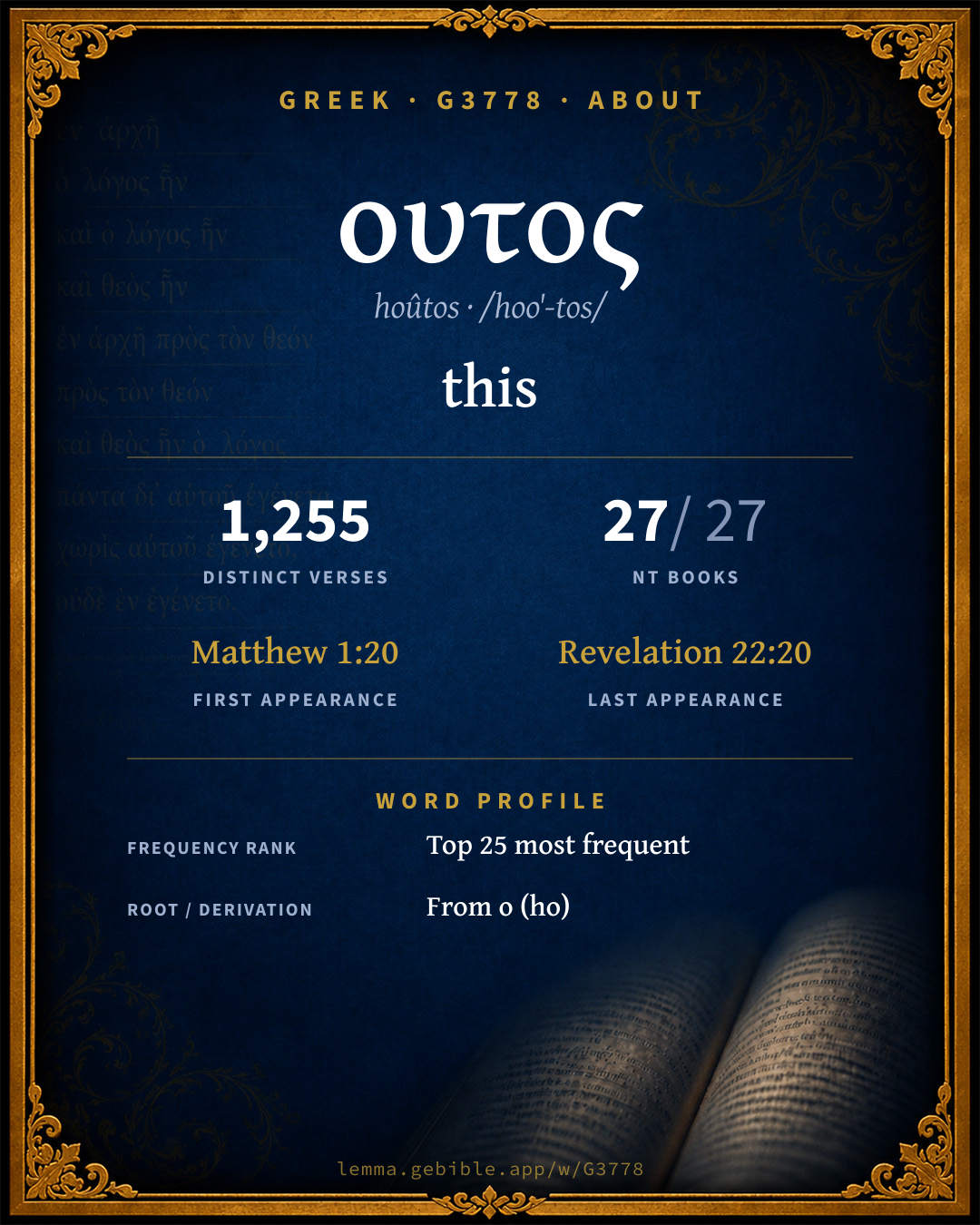
ουτος
this
Full lexicon entry — Thayer's Greek Lexicon
From Thayer's Greek Lexicon
Where this word appears
See every Accusative-case word in the Greek New Testament →
Grammar key — what these labels mean
Part of speech
- Demonstrative pronoun
- Points something out (“this,” “that”).
Case
- Accusative
- The case of the direct object and of extent.
- Nominative
- The case of the subject (and the predicate nominative).
- Dative
- The case of the indirect object, means, or location — “to / for / with / in.”
- Genitive
- The case of source, possession, or “of” — answers “whose / from what.”
Gender
- Neuter
- Grammatically neuter.
- Masculine
- Grammatically masculine.
- Feminine
- Grammatically feminine.
Number
- Singular
- One.
- Plural
- More than one.
Grammatical forms 24 distinct
- Demonstrative pronoun, Accusative, Singular, Neuter 228 times (17%)
- Demonstrative pronoun, Accusative, Plural, Neuter 191 times (14%)
- Demonstrative pronoun, Nominative, Singular, Masculine 187 times (14%)
- Demonstrative pronoun, Nominative, Singular, Neuter 105 times (8%)
- Demonstrative pronoun, Nominative, Plural, Masculine 74 times (5%)
- Demonstrative pronoun, Nominative, Singular, Feminine 73 times (5%)
- Demonstrative pronoun, Accusative, Singular, Masculine 59 times (4%)
- Demonstrative pronoun, Accusative, Singular, Feminine 52 times (4%)
+16 more forms (410 occurrences)
Parsed forms decoded from the imported morphology (Robinson–Tischendorf, public domain), counted across 1,379 parsed occurrences — not distinct verses.
Page 2 of 7 — showing verses 201–400 of 1,255 distinct verses where G3778 appears, across 27 books. Click any verse to open its interlinear word-by-word view. Verse text shown in the World English Bible for context — . Each verse’s Greek form is shown with its reference; the English is not keyword-highlighted, since the data carries no word-level English alignment. Use “Compare translations” on any verse to read it across multiple English versions. This concordance covers the Greek New Testament; Septuagint (Greek Old Testament) occurrences of this word are not indexed here.
Mark 69 verses
Luke 210 verses
- Luke 1:18 τοῦτο dem.pron acc sg neut Zacharias said to the angel, "How can I be sure of this? For I am an old man, and my wife is well advanced in years."
- Luke 1:19 ταῦτα dem.pron acc pl neut The angel answered him, "I am Gabriel, who stands in the presence of God. I was sent to speak to you, and to bring you this good news.
- Luke 1:20 ταῦτα dem.pron nom pl neut Behold, you will be silent and not able to speak, until the day that these things will happen, because you didn't believe my words, which will be fulfilled in their proper time."
- Luke 1:24 ταύτας dem.pron acc pl fem After these days Elizabeth, his wife, conceived, and she hid herself five months, saying,
- Luke 1:29 οὗτος dem.pron nom sg masc But when she saw him, she was greatly troubled at the saying, and considered what kind of salutation this might be.
- Luke 1:32 οὗτος dem.pron nom sg masc He will be great, and will be called the Son of the Most High. The Lord God will give him the throne of his father, David,
- Luke 1:34 τοῦτο dem.pron nom sg neut Mary said to the angel, "How can this be, seeing I am a virgin?"
- Luke 1:36 οὗτος dem.pron nom sg masc Behold, Elizabeth, your relative, also has conceived a son in her old age; and this is the sixth month with her who was called barren.
- Luke 1:39 ταύταις dem.pron dat pl fem Mary arose in those days and went into the hill country with haste, into a city of Judah,
- Luke 1:43 τοῦτο dem.pron nom sg neut Why am I so favored, that the mother of my Lord should come to me?
- Luke 1:61 τούτῳ dem.pron dat sg neut They said to her, "There is no one among your relatives who is called by this name."
- Luke 1:65 ταῦτα dem.pron nom pl neut Fear came on all who lived around them, and all these sayings were talked about throughout all the hill country of Judea.
- Luke 1:66 τοῦτο dem.pron nom sg neut All who heard them laid them up in their heart, saying, "What then will this child be?" The hand of the Lord was with him.
- Luke 2:2 αὕτη dem.pron nom sg fem This was the first enrollment made when Quirinius was governor of Syria.
- Luke 2:12 τοῦτο dem.pron nom sg neut This is the sign to you: you will find a baby wrapped in strips of cloth, lying in a feeding trough."
- Luke 2:15 τοῦτο dem.pron acc sg neut It happened, when the angels went away from them into the sky, that the shepherds said one to another, "Let's go to Bethlehem, now, and see this thing that has happened, which the Lord has made known to us."
- Luke 2:17 τούτου dem.pron gen sg neut When they saw it, they publicized widely the saying which was spoken to them about this child.
- Luke 2:19 ταῦτα dem.pron acc pl neut But Mary kept all these sayings, pondering them in her heart.
- Luke 2:25 οὗτος dem.pron nom sg masc Behold, there was a man in Jerusalem whose name was Simeon. This man was righteous and devout, looking for the consolation of Israel, and the Holy Spirit was on him.
- Luke 2:34 οὗτος dem.pron nom sg masc and Simeon blessed them, and said to Mary, his mother, "Behold, this child is set for the falling and the rising of many in Israel, and for a sign which is spoken against.
- Luke 2:36 αὕτη dem.pron nom sg fem There was one Anna, a prophetess, the daughter of Phanuel, of the tribe of Asher (she was of a great age, having lived with a husband seven years from her virginity,
- Luke 3:8 τούτων dem.pron gen pl masc Bring forth therefore fruits worthy of repentance, and don't begin to say among yourselves, 'We have Abraham for our father;' for I tell you that God is able to raise up children to Abraham from these stones!
- Luke 3:20 τοῦτο dem.pron acc sg neut added this also to them all, that he shut up John in prison.
- Luke 4:3 τούτῳ dem.pron dat sg masc The devil said to him, "If you are the Son of God, command this stone to become bread."
- Luke 4:6 ταύτην dem.pron acc sg fem The devil said to him, "I will give you all this authority, and their glory, for it has been delivered to me; and I give it to whomever I want.
- Luke 4:21 αὕτη dem.pron nom sg fem He began to tell them, "Today, this Scripture has been fulfilled in your hearing."
- Luke 4:22 οὗτος dem.pron nom sg masc All testified about him, and wondered at the gracious words which proceeded out of his mouth, and they said, "Isn't this Joseph's son?"
- Luke 4:23 ταύτην dem.pron acc sg fem He said to them, "Doubtless you will tell me this parable, 'Physician, heal yourself! Whatever we have heard done at Capernaum, do also here in your hometown.'"
- Luke 4:28 ταῦτα dem.pron acc pl neut They were all filled with wrath in the synagogue, as they heard these things.
- Luke 4:36 οὗτος dem.pron nom sg masc Amazement came on all, and they spoke together, one with another, saying, "What is this word? For with authority and power he commands the unclean spirits, and they come out!"
- Luke 4:43 τοῦτο dem.pron acc sg neut But he said to them, "I must preach the good news of the Kingdom of God to the other cities also. For this reason I have been sent."
- Luke 5:6 τοῦτο dem.pron acc sg neut When they had done this, they caught a great multitude of fish, and their net was breaking.
- Luke 5:21 οὗτος dem.pron nom sg masc The scribes and the Pharisees began to reason, saying, "Who is this that speaks blasphemies? Who can forgive sins, but God alone?"
- Luke 5:27 ταῦτα dem.pron acc pl neut After these things he went out, and saw a tax collector named Levi sitting at the tax office, and said to him, "Follow me!"
- Luke 6:3 τοῦτο dem.pron acc sg neut Jesus, answering them, said, "Haven't you read what David did when he was hungry, he, and those who were with him;
- Luke 6:12 ταύταις dem.pron dat pl fem It happened in these days, that he went out to the mountain to pray, and he continued all night in prayer to God.
- Luke 7:4 τοῦτο dem.pron acc sg neut When they came to Jesus, they begged him earnestly, saying, "He is worthy for you to do this for him,
- Luke 7:8 τούτῳ τοῦτο dem.pron dat sg masc dem.pron acc sg neut For I also am a man placed under authority, having under myself soldiers. I tell this one, 'Go!' and he goes; and to another, 'Come!' and he comes; and to my servant, 'Do this,' and he does it."
- Luke 7:9 ταῦτα dem.pron acc pl neut When Jesus heard these things, he marveled at him, and turned and said to the multitude who followed him, "I tell you, I have not found such great faith, no, not in Israel."
- Luke 7:17 οὗτος dem.pron nom sg masc This report went out concerning him in the whole of Judea, and in all the surrounding region.
- Luke 7:18 τούτων dem.pron gen pl neut The disciples of John told him about all these things.
- Luke 7:27 οὗτός dem.pron nom sg masc This is he of whom it is written, 'Behold, I send my messenger before your face, Who will prepare your way before you.'
- Luke 7:31 ταύτης dem.pron gen sg fem But the Lord said, "To what then will I liken the people of this generation? What are they like?
- Luke 7:39 οὗτος dem.pron nom sg masc Now when the Pharisee who had invited him saw it, he said to himself, "This man, if he were a prophet, would have perceived who and what kind of woman this is who touches him, that she is a sinner."
- Luke 7:44 ταύτην αὕτη dem.pron acc sg fem dem.pron nom sg fem Turning to the woman, he said to Simon, "Do you see this woman? I entered into your house, and you gave me no water for my feet, but she has wet my feet with her tears, and wiped them with the hair of her head.
- Luke 7:45 αὕτη dem.pron nom sg fem You gave me no kiss, but she, since the time I came in, has not ceased to kiss my feet.
- Luke 7:46 αὕτη dem.pron nom sg fem You didn't anoint my head with oil, but she has anointed my feet with ointment.
- Luke 7:49 οὗτός dem.pron nom sg masc Those who sat at the table with him began to say to themselves, "Who is this who even forgives sins?"
- Luke 8:8 ταῦτα dem.pron acc pl neut Other fell into the good ground, and grew, and brought forth fruit one hundred times." As he said these things, he called out, "He who has ears to hear, let him hear!"
- Luke 8:9 αὕτη dem.pron nom sg fem Then his disciples asked him, "What does this parable mean?"
- Luke 8:11 αὕτη dem.pron nom sg fem Now the parable is this: The seed is the word of God.
- Luke 8:13 οὗτοι dem.pron nom pl masc Those on the rock are they who, when they hear, receive the word with joy; but these have no root, who believe for a while, then fall away in time of temptation.
- Luke 8:14 οὗτοί dem.pron nom pl masc That which fell among the thorns, these are those who have heard, and as they go on their way they are choked with cares, riches, and pleasures of life, and bring no fruit to maturity.
- Luke 8:15 οὗτοί dem.pron nom pl masc That in the good ground, these are such as in an honest and good heart, having heard the word, hold it tightly, and bring forth fruit with patience.
- Luke 8:21 οὗτοί dem.pron nom pl masc But he answered them, "My mother and my brothers are these who hear the word of God, and do it."
- Luke 8:25 οὗτός dem.pron nom sg masc He said to them, "Where is your faith?" Being afraid they marveled, saying one to another, "Who is this, then, that he commands even the winds and the water, and they obey him?"
- Luke 9:9 οὗτος dem.pron nom sg masc Herod said, "John I beheaded, but who is this, about whom I hear such things?" He sought to see him.
- Luke 9:13 τοῦτον dem.pron acc sg masc But he said to them, "You give them something to eat." They said, "We have no more than five loaves and two fish, unless we should go and buy food for all these people."
- Luke 9:21 τοῦτο dem.pron acc sg neut But he warned them, and commanded them to tell this to no one,
- Luke 9:24 οὗτος dem.pron nom sg masc For whoever desires to save his life will lose it, but whoever will lose his life for my sake, the same will save it.
- Luke 9:26 τοῦτον dem.pron acc sg masc For whoever will be ashamed of me and of my words, of him will the Son of Man be ashamed, when he comes in his glory, and the glory of the Father, and of the holy angels.
- Luke 9:28 τούτους dem.pron acc pl masc It happened about eight days after these sayings, that he took with him Peter, John, and James, and went up onto the mountain to pray.
- Luke 9:34 ταῦτα dem.pron acc pl neut While he said these things, a cloud came and overshadowed them, and they were afraid as they entered into the cloud.
- Luke 9:35 οὗτός dem.pron nom sg masc A voice came out of the cloud, saying, "This is my beloved Son. Listen to him!"
- Luke 9:44 τούτους dem.pron acc pl masc "Let these words sink into your ears, for the Son of Man will be delivered up into the hands of men."
- Luke 9:45 τοῦτο τούτου dem.pron acc sg neut dem.pron gen sg neut But they didn't understand this saying. It was concealed from them, that they should not perceive it, and they were afraid to ask him about this saying.
- Luke 9:48 τοῦτο οὗτός dem.pron acc sg neut dem.pron nom sg masc and said to them, "Whoever receives this little child in my name receives me. Whoever receives me receives him who sent me. For whoever is least among you all, this one will be great."
- Luke 10:1 ταῦτα dem.pron acc pl neut Now after these things, the Lord also appointed seventy others, and sent them two by two ahead of him into every city and place, where he was about to come.
- Luke 10:5 τούτῳ dem.pron dat sg masc Into whatever house you enter, first say, 'Peace be to this house.'
- Luke 10:11 τοῦτο dem.pron acc sg neut 'Even the dust from your city that clings to us, we wipe off against you. Nevertheless know this, that the Kingdom of God has come near to you.'
- Luke 10:20 τούτῳ dem.pron dat sg neut Nevertheless, don't rejoice in this, that the spirits are subject to you, but rejoice that your names are written in heaven."
- Luke 10:21 ταῦτα dem.pron acc pl neut In that same hour Jesus rejoiced in the Holy Spirit, and said, "I thank you, O Father, Lord of heaven and earth, that you have hidden these things from the wise and understanding, and revealed them to little children. Yes, Father, for so it was well-pleasing in your sight."
- Luke 10:28 τοῦτο dem.pron acc sg neut He said to him, "You have answered correctly. Do this, and you will live."
- Luke 10:36 τούτων dem.pron gen pl masc Now which of these three do you think seemed to be a neighbor to him who fell among the robbers?"
- Luke 11:19 τοῦτο dem.pron acc sg neut But if I cast out demons by Beelzebul, by whom do your children cast them out? Therefore will they be your judges.
- Luke 11:27 ταῦτα dem.pron acc pl neut It came to pass, as he said these things, a certain woman out of the multitude lifted up her voice, and said to him, "Blessed is the womb that bore you, and the breasts which nursed you!"
- Luke 11:29 αὕτη dem.pron nom sg fem When the multitudes were gathering together to him, he began to say, "This is an evil generation. It seeks after a sign. No sign will be given to it but the sign of Jonah, the prophet.
- Luke 11:30 ταύτῃ dem.pron dat sg fem For even as Jonah became a sign to the Ninevites, so will also the Son of Man be to this generation.
- Luke 11:31 ταύτης dem.pron gen sg fem The Queen of the South will rise up in the judgment with the men of this generation, and will condemn them: for she came from the ends of the earth to hear the wisdom of Solomon; and behold, one greater than Solomon is here.
- Luke 11:32 ταύτης dem.pron gen sg fem The men of Nineveh will stand up in the judgment with this generation, and will condemn it: for they repented at the preaching of Jonah, and behold, one greater than Jonah is here.
- Luke 11:42 ταῦτα dem.pron acc pl neut But woe to you Pharisees! For you tithe mint and rue and every herb, but you bypass justice and the love of God. You ought to have done these, and not to have left the other undone.
- Luke 11:45 ταῦτα dem.pron acc pl neut One of the lawyers answered him, "Teacher, in saying this you insult us also."
- Luke 11:49 τοῦτο dem.pron acc sg neut Therefore also the wisdom of God said, 'I will send to them prophets and apostles; and some of them they will kill and persecute,
- Luke 11:50 ταύτης dem.pron gen sg fem that the blood of all the prophets, which was shed from the foundation of the world, may be required of this generation;
- Luke 11:51 ταύτης dem.pron gen sg fem from the blood of Abel to the blood of Zachariah, who perished between the altar and the sanctuary.' Yes, I tell you, it will be required of this generation.
- Luke 12:4 ταῦτα dem.pron acc pl neut "I tell you, my friends, don't be afraid of those who kill the body, and after that have no more that they can do.
- Luke 12:5 τοῦτον dem.pron acc sg masc But I will warn you whom you should fear. Fear him, who after he has killed, has power to cast into Gehenna. Yes, I tell you, fear him.
- Luke 12:18 τοῦτο dem.pron acc sg neut He said, 'This is what I will do. I will pull down my barns, and build bigger ones, and there I will store all my grain and my goods.
- Luke 12:20 ταύτῃ dem.pron dat sg fem "But God said to him, 'You foolish one, tonight your soul is required of you. The things which you have prepared--whose will they be?'
- Luke 12:22 τοῦτο dem.pron acc sg neut He said to his disciples, "Therefore I tell you, don't be anxious for your life, what you will eat, nor yet for your body, what you will wear.
- Luke 12:27 τούτων dem.pron gen pl neut Consider the lilies, how they grow. They don't toil, neither do they spin; yet I tell you, even Solomon in all his glory was not arrayed like one of these.
- Luke 12:30 ταῦτα τούτων dem.pron acc pl neut dem.pron gen pl neut For the nations of the world seek after all of these things, but your Father knows that you need these things.
- Luke 12:31 ταῦτα dem.pron nom pl neut But seek God's Kingdom, and all these things will be added to you.
- Luke 12:39 τοῦτο dem.pron acc sg neut But know this, that if the master of the house had known in what hour the thief was coming, he would have watched, and not allowed his house to be broken into.
- Luke 12:41 ταύτην dem.pron acc sg fem Peter said to him, "Lord, are you telling this parable to us, or to everybody?"
- Luke 12:56 τοῦτον dem.pron acc sg masc You hypocrites! You know how to interpret the appearance of the earth and the sky, but how is it that you don't interpret this time?
- Luke 13:2 οὗτοι ταῦτα dem.pron nom pl masc dem.pron acc pl neut Jesus answered them, "Do you think that these Galileans were worse sinners than all the other Galileans, because they suffered such things?
- Luke 13:6 ταύτην dem.pron acc sg fem He spoke this parable. "A certain man had a fig tree planted in his vineyard, and he came seeking fruit on it, and found none.
- Luke 13:7 ταύτῃ dem.pron dat sg fem He said to the vine dresser, 'Behold, these three years I have come looking for fruit on this fig tree, and found none. Cut it down. Why does it waste the soil?'
- Luke 13:8 τοῦτο dem.pron acc sg neut He answered, 'Lord, leave it alone this year also, until I dig around it, and fertilize it.
- Luke 13:16 ταύτην τούτου dem.pron acc sg fem dem.pron gen sg masc Ought not this woman, being a daughter of Abraham, whom Satan had bound eighteen long years, be freed from this bondage on the Sabbath day?"
- Luke 13:17 ταῦτα dem.pron acc pl neut As he said these things, all his adversaries were disappointed, and all the multitude rejoiced for all the glorious things that were done by him.
- Luke 13:32 ταύτῃ dem.pron dat sg fem He said to them, "Go and tell that fox, 'Behold, I cast out demons and perform cures today and tomorrow, and the third day I complete my mission.
- Luke 14:6 ταῦτα dem.pron acc pl neut They couldn't answer him regarding these things.
- Luke 14:9 τούτῳ dem.pron dat sg masc and he who invited both of you would come and tell you, 'Make room for this person.' Then you would begin, with shame, to take the lowest place.
- Luke 14:15 ταῦτα dem.pron acc pl neut When one of those who sat at the table with him heard these things, he said to him, "Blessed is he who will feast in the Kingdom of God!"
- Luke 14:20 τοῦτο dem.pron acc sg neut "Another said, 'I have married a wife, and therefore I can't come.'
- Luke 14:21 ταῦτα dem.pron acc pl neut "That servant came, and told his lord these things. Then the master of the house, being angry, said to his servant, 'Go out quickly into the streets and lanes of the city, and bring in the poor, maimed, blind, and lame.'
- Luke 14:30 οὗτος dem.pron nom sg masc saying, 'This man began to build, and wasn't able to finish.'
- Luke 15:2 οὗτος dem.pron nom sg masc The Pharisees and the scribes murmured, saying, "This man welcomes sinners, and eats with them."
- Luke 15:3 ταύτην dem.pron acc sg fem He told them this parable.
- Luke 15:24 οὗτος dem.pron nom sg masc for this, my son, was dead, and is alive again. He was lost, and is found.' They began to celebrate.
- Luke 15:26 ταῦτα dem.pron nom pl neut He called one of the servants to him, and asked what was going on.
- Luke 15:30 οὗτος dem.pron nom sg masc But when this, your son, came, who has devoured your living with prostitutes, you killed the fattened calf for him.'
- Luke 15:32 οὗτος dem.pron nom sg masc But it was appropriate to celebrate and be glad, for this, your brother, was dead, and is alive again. He was lost, and is found.'"
- Luke 16:1 οὗτος dem.pron nom sg masc He also said to his disciples, "There was a certain rich man who had a manager. An accusation was made to him that this man was wasting his possessions.
- Luke 16:2 τοῦτο dem.pron acc sg neut He called him, and said to him, 'What is this that I hear about you? Give an accounting of your management, for you can no longer be manager.'
- Luke 16:8 τούτου dem.pron gen sg masc "His lord commended the dishonest manager because he had done wisely, for the children of this world are, in their own generation, wiser than the children of the light.
- Luke 16:14 ταῦτα dem.pron acc pl neut The Pharisees, who were lovers of money, also heard all these things, and they scoffed at him.
- Luke 16:24 ταύτῃ dem.pron dat sg fem He cried and said, 'Father Abraham, have mercy on me, and send Lazarus, that he may dip the tip of his finger in water, and cool my tongue! For I am in anguish in this flame.'
- Luke 16:26 τούτοις dem.pron dat pl neut Besides all this, between us and you there is a great gulf fixed, that those who want to pass from here to you are not able, and that none may cross over from there to us.'
- Luke 16:28 τοῦτον dem.pron acc sg masc for I have five brothers, that he may testify to them, so they won't also come into this place of torment.'
- Luke 17:2 τούτων dem.pron gen pl masc It would be better for him if a millstone were hung around his neck, and he were thrown into the sea, rather than that he should cause one of these little ones to stumble.
- Luke 17:6 ταύτῃ dem.pron dat sg fem The Lord said, "If you had faith like a grain of mustard seed, you would tell this sycamore tree, 'Be uprooted, and be planted in the sea,' and it would obey you.
- Luke 17:8 ταῦτα dem.pron acc pl neut and will not rather tell him, 'Prepare my supper, clothe yourself properly, and serve me, while I eat and drink. Afterward you shall eat and drink'?
- Luke 17:18 οὗτος dem.pron nom sg masc Were there none found who returned to give glory to God, except this stranger?"
- Luke 17:25 ταύτης dem.pron gen sg fem But first, he must suffer many things and be rejected by this generation.
- Luke 17:34 ταύτῃ dem.pron dat sg fem I tell you, in that night there will be two people in one bed. The one will be taken, and the other will be left.
- Luke 18:4 ταῦτα dem.pron acc pl neut He wouldn't for a while, but afterward he said to himself, 'Though I neither fear God, nor respect man,
- Luke 18:5 ταύτην dem.pron acc sg fem yet because this widow bothers me, I will defend her, or else she will wear me out by her continual coming.'"
- Luke 18:9 ταύτην dem.pron acc sg fem He spoke also this parable to certain people who were convinced of their own righteousness, and who despised all others.
- Luke 18:11 ταῦτα οὗτος dem.pron acc pl neut dem.pron nom sg masc The Pharisee stood and prayed to himself like this: 'God, I thank you, that I am not like the rest of men, extortioners, unrighteous, adulterers, or even like this tax collector.
- Luke 18:14 οὗτος dem.pron nom sg masc I tell you, this man went down to his house justified rather than the other; for everyone who exalts himself will be humbled, but he who humbles himself will be exalted."
- Luke 18:21 ταῦτα dem.pron acc pl neut He said, "I have observed all these things from my youth up."
- Luke 18:23 ταῦτα dem.pron acc pl neut But when he heard these things, he became very sad, for he was very rich.
- Luke 18:30 τούτῳ dem.pron dat sg masc who will not receive many times more in this time, and in the world to come, eternal life."
- Luke 18:34 τούτων τοῦτο dem.pron gen pl neut dem.pron nom sg neut They understood none of these things. This saying was hidden from them, and they didn't understand the things that were said.
- Luke 18:36 τοῦτο dem.pron nom sg neut Hearing a multitude going by, he asked what this meant.
- Luke 19:9 τούτῳ dem.pron dat sg masc Jesus said to him, "Today, salvation has come to this house, because he also is a son of Abraham.
- Luke 19:11 ταῦτα dem.pron acc pl neut As they heard these things, he went on and told a parable, because he was near Jerusalem, and they supposed that the Kingdom of God would be revealed immediately.
- Luke 19:14 τοῦτον dem.pron acc sg masc But his citizens hated him, and sent an envoy after him, saying, 'We don't want this man to reign over us.'
- Luke 19:15 τούτους dem.pron acc pl masc "It happened when he had come back again, having received the kingdom, that he commanded these servants, to whom he had given the money, to be called to him, that he might know what they had gained by conducting business.
- Luke 19:19 τούτῳ dem.pron dat sg masc "So he said to him, 'And you are to be over five cities.'
- Luke 19:27 τούτους dem.pron acc pl masc But bring those enemies of mine who didn't want me to reign over them here, and kill them before me.'"
- Luke 19:28 ταῦτα dem.pron acc pl neut Having said these things, he went on ahead, going up to Jerusalem.
- Luke 19:40 οὗτοι dem.pron nom pl masc He answered them, "I tell you that if these were silent, the stones would cry out."
- Luke 19:42 ταύτῃ dem.pron dat sg fem saying, "If you, even you, had known today the things which belong to your peace! But now, they are hidden from your eyes.
- Luke 20:2 ταῦτα ταύτην dem.pron acc pl neut dem.pron acc sg fem They asked him, "Tell us: by what authority do you do these things? Or who is giving you this authority?"
- Luke 20:8 ταῦτα dem.pron acc pl neut Jesus said to them, "Neither will I tell you by what authority I do these things."
- Luke 20:9 ταύτην dem.pron acc sg fem He began to tell the people this parable. "A man planted a vineyard, and rented it out to some farmers, and went into another country for a long time.
- Luke 20:12 τοῦτον dem.pron acc sg masc He sent yet a third, and they also wounded him, and threw him out.
- Luke 20:13 τοῦτον dem.pron acc sg masc The lord of the vineyard said, 'What shall I do? I will send my beloved son. It may be that seeing him, they will respect him.'
- Luke 20:14 οὗτός dem.pron nom sg masc "But when the farmers saw him, they reasoned among themselves, saying, 'This is the heir. Come, let's kill him, that the inheritance may be ours.'
- Luke 20:16 τούτους dem.pron acc pl masc He will come and destroy these farmers, and will give the vineyard to others." When they heard it, they said, "May it never be!"
- Luke 20:17 τοῦτο οὗτος dem.pron nom sg neut dem.pron nom sg masc But he looked at them, and said, "Then what is this that is written, 'The stone which the builders rejected, The same was made the chief cornerstone?'
- Luke 20:19 ταύτην dem.pron acc sg fem The chief priests and the scribes sought to lay hands on Him that very hour, but they feared the people--for they knew He had spoken this parable against them.
- Luke 20:28 οὗτος dem.pron nom sg masc They asked him, "Teacher, Moses wrote to us that if a man's brother dies having a wife, and he is childless, his brother should take the wife, and raise up children for his brother.
- Luke 20:34 τούτου dem.pron gen sg masc Jesus said to them, "The children of this age marry, and are given in marriage.
- Luke 20:47 οὗτοι dem.pron nom pl masc who devour widows' houses, and for a pretense make long prayers: these will receive greater condemnation."
- Luke 21:3 αὕτη dem.pron nom sg fem He said, "Truly I tell you, this poor widow put in more than all of them,
- Luke 21:4 οὗτοι αὕτη dem.pron nom pl masc dem.pron nom sg fem for all these put in gifts for God from their abundance, but she, out of her poverty, put in all that she had to live on."
- Luke 21:6 ταῦτα dem.pron acc pl neut "As for these things which you see, the days will come, in which there will not be left here one stone on another that will not be thrown down."
- Luke 21:7 ταῦτα ταῦτα dem.pron nom pl neut dem.pron nom pl neut They asked him, "Teacher, so when will these things be? What is the sign that these things are about to happen?"
- Luke 21:9 ταῦτα dem.pron acc pl neut When you hear of wars and disturbances, don't be terrified, for these things must happen first, but the end won't come immediately."
- Luke 21:12 τούτων dem.pron gen pl neut But before all these things, they will lay their hands on you and will persecute you, delivering you up to synagogues and prisons, bringing you before kings and governors for my name's sake.
- Luke 21:22 αὗταί dem.pron nom pl fem For these are days of vengeance, that all things which are written may be fulfilled.
- Luke 21:23 τούτῳ dem.pron dat sg masc Woe to those who are pregnant and to those who nurse infants in those days! For there will be great distress in the land, and wrath to this people.
- Luke 21:28 τούτων dem.pron gen pl masc But when these things begin to happen, look up, and lift up your heads, because your redemption is near."
- Luke 21:31 ταῦτα dem.pron acc pl neut Even so you also, when you see these things happening, know that the Kingdom of God is near.
- Luke 21:32 αὕτη dem.pron nom sg fem Most assuredly I tell you, this generation will not pass away until all things are accomplished.
- Luke 21:36 ταῦτα dem.pron acc pl neut Therefore be watchful all the time, asking that you may be counted worthy to escape all these things that will happen, and to stand before the Son of Man."
- Luke 22:15 τοῦτο dem.pron acc sg neut He said to them, "I have earnestly desired to eat this Passover with you before I suffer,
- Luke 22:17 τοῦτο dem.pron acc sg neut He received a cup, and when he had given thanks, he said, "Take this, and share it among yourselves,
- Luke 22:19 τοῦτό τοῦτο dem.pron nom sg neut dem.pron acc sg neut He took bread, and when he had given thanks, he broke it, and gave to them, saying, "This is my body which is given for you. Do this in memory of me."
- Luke 22:20 τοῦτο dem.pron nom sg neut Likewise, he took the cup after supper, saying, "This cup is the new covenant in my blood, which is poured out for you.
- Luke 22:23 τοῦτο dem.pron acc sg neut They began to question among themselves, which of them it was who would do this thing.
- Luke 22:37 τοῦτο dem.pron acc sg neut For I tell you that this which is written must still be fulfilled in me: 'He was counted with the lawless.' For that which concerns me has an end."
- Luke 22:42 τοῦτο dem.pron acc sg neut saying, "Father, if you are willing, remove this cup from me. Nevertheless, not my will, but yours, be done."
- Luke 22:51 τούτου dem.pron gen sg neut But Jesus answered, "Let me at least do this"--and he touched his ear, and healed him.
- Luke 22:53 αὕτη dem.pron nom sg fem When I was with you in the temple daily, you didn't stretch out your hands against me. But this is your hour, and the power of darkness."
- Luke 22:56 οὗτος dem.pron nom sg masc A certain servant girl saw him as he sat in the light, and looking intently at him, said, "This man also was with him."
- Luke 22:59 οὗτος dem.pron nom sg masc After about one hour passed, another confidently affirmed, saying, "Truly this man also was with him, for he is a Galilean!"
- Luke 23:2 τοῦτον dem.pron acc sg masc They began to accuse him, saying, "We found this man perverting the nation, forbidding paying taxes to Caesar, and saying that he himself is Christ, a king."
- Luke 23:4 τούτῳ dem.pron dat sg masc Pilate said to the chief priests and the multitudes, "I find no basis for a charge against this man."
- Luke 23:7 ταύταις dem.pron dat pl fem When he found out that he was in Herod's jurisdiction, he sent him to Herod, who was also in Jerusalem during those days.
- Luke 23:14 τοῦτον τούτῳ dem.pron acc sg masc dem.pron dat sg masc and said to them, "You brought this man to me as one that perverts the people, and see, I have examined him before you, and found no basis for a charge against this man concerning those things of which you accuse him.
- Luke 23:18 τοῦτον dem.pron acc sg masc But they all cried out together, saying, "Away with this man! Release to us Barabbas!" --
- Luke 23:22 οὗτος dem.pron nom sg masc He said to them the third time, "Why? What evil has this man done? I have found no capital crime in him. I will therefore chastise him and release him."
- Luke 23:31 ταῦτα dem.pron acc pl neut For if they do these things in the green tree, what will be done in the dry?"
- Luke 23:35 οὗτός dem.pron nom sg masc The people stood watching. The rulers with them also scoffed at him, saying, "He saved others. Let him save himself, if this is the Christ of God, his chosen one!"
- Luke 23:38 οὗτος dem.pron nom sg masc An inscription was also written over him in letters of Greek, Latin, and Hebrew: "THIS IS THE KING OF THE JEWS."
- Luke 23:41 οὗτος dem.pron nom sg masc And we indeed justly, for we receive the due reward for our deeds, but this man has done nothing wrong."
- Luke 23:46 τοῦτο dem.pron acc sg neut Jesus, crying with a loud voice, said, "Father, into your hands I commit my spirit!" Having said this, he breathed his last.
- Luke 23:47 οὗτος dem.pron nom sg masc When the centurion saw what was done, he glorified God, saying, "Certainly this was a righteous man."
- Luke 23:48 ταύτην dem.pron acc sg fem All the multitudes that came together to see this, when they saw the things that were done, returned home beating their breasts.
- Luke 23:49 ταῦτα dem.pron acc pl neut All his acquaintances, and the women who followed with him from Galilee, stood at a distance, watching these things.
- Luke 23:51 οὗτος dem.pron nom sg masc (he had not consented to their counsel and deed), from Arimathaea, a city of the Jews, who was also waiting for the Kingdom of God:
- Luke 23:52 οὗτος dem.pron nom sg masc this man went to Pilate, and asked for Jesus' body.
- Luke 24:4 τούτου dem.pron gen sg neut It happened, while they were greatly perplexed about this, behold, two men stood by them in dazzling clothing.
About this entry
At a glance — auto-summarized from this page’s data, not written by a person. Every figure links to its source below. This summary describes the numbers; it doesn’t interpret them.
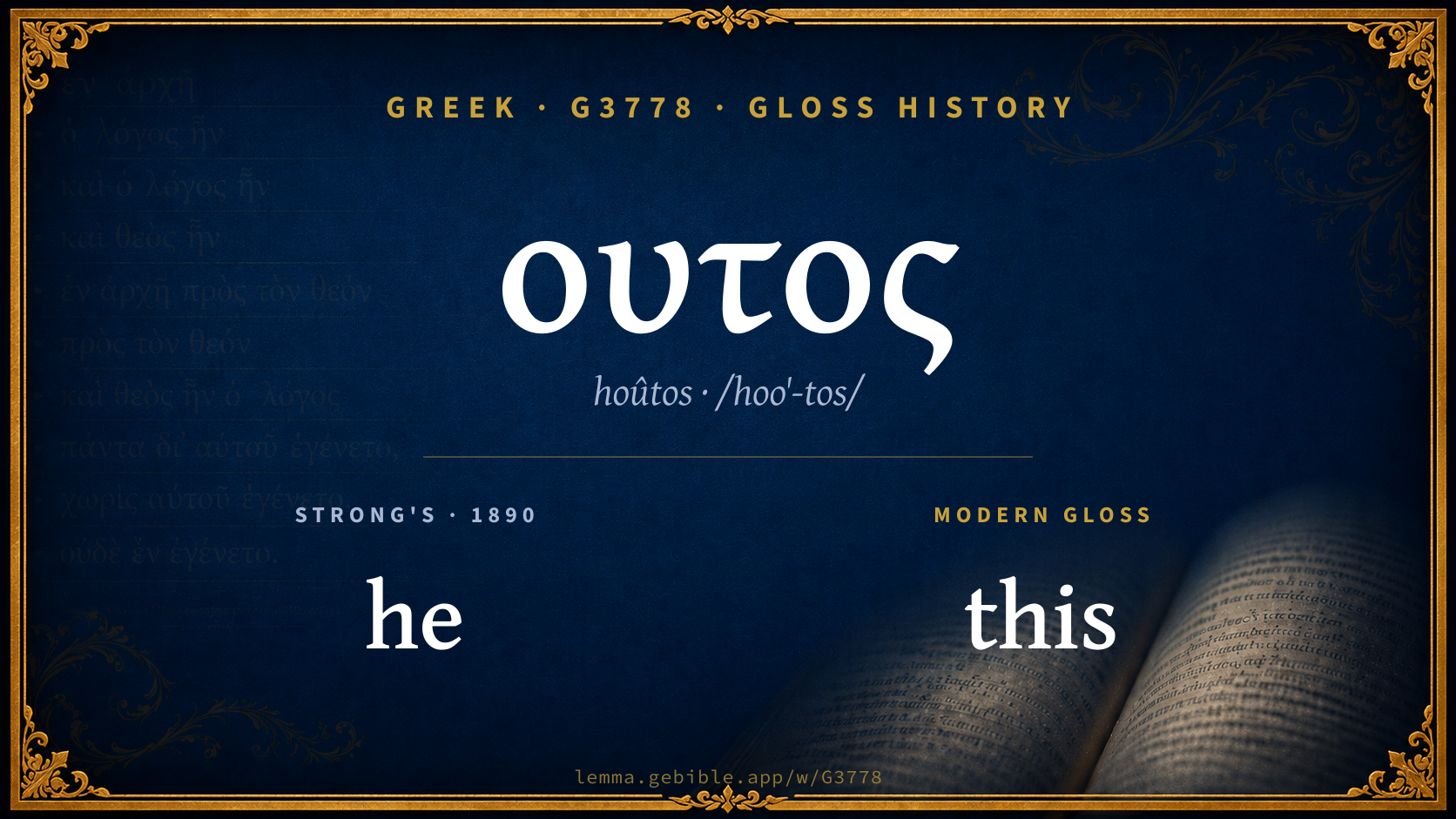
At its core, ουτος (hoûtos) means “this.” “same” is the historic King James Version rendering; modern versions use “this.” See the renderings breakdown. It turns up in 1,255 verses across 27 books, one of the most common footprint. It first appears in Matthew 1:20. It clusters with ο, τανυν and οδε under a shared root. Each statement above links to its evidence; the full detail follows below.
Gloss history
Strong's 1890 vs modern scholarship
About this word
Strong's G3778 catalogs a Greek word from the Greek New Testament.
These counts are not copied from any lexicon or concordance. They are computed here, from the morphology-tagged Greek New Testament. What Lemma adds →
- 1,255
- distinct verses
- The word appears in 1,255 distinct verses.
- 27 / 27
- NT books
- The word appears in 27 of 27 New Testament books.
- #13
- by frequency
- Top 25 most frequent Greek words (rank 13 of 5,347 Greek words by occurrence).
View all 1,255 occurrences in the concordance →
By section of the New Testament
By traditional corpus
Conventional, traditional groupings — biblical authorship is debated, so this is a traditional corpus grouping, not an authorship claim. Some books belong to more than one corpus (Luke is in both the Gospels and the Lukan corpus, and so on), so these shares overlap and need not total 100%. Each figure is a share of the word’s 1,255 distinct verses.
- Gospels 625 verses · 50%
- Lukan (Luke–Acts) 423 verses · 34%
- Johannine 300 verses · 24%
- Pauline corpus 242 verses · 19%
- General (Catholic) Epistles 92 verses · 7%
- Revelation 43 verses · 3%
- Hebrews 40 verses · 3%
How translations render this word
Counts come from each version’s own published word-to-Strong’s tagging or interlinear alignment — an approximate guide to how each version renders this word, not a word-level alignment the data otherwise carries. Because each total is that version’s own tagged count, the per-version totals vary from one another and need not match the appearance or distinct-verse counts above. These counts may also differ from a printed concordance because Lemma counts each distinctly tagged rendering and does not collapse phrase taggings into a single head-word total. This is a fixed set of word-tagged versions (KJV, ASV, BSB, ULT) and does not change with the reading translation you choose elsewhere. Each version’s license is shown beside its name below (and on Sources).
- King James Version: This 157×, These 62×, Same 34×
- American Standard Version: This 245×, These 81×, Same 28×
- Berean Standard Bible: This 572×, These 138×, Things 103×
- unfoldingWord Literal Text: This 745×, Things 237×, These 194×
King James Version Public Domain
Renders G3778 across 347 tagged occurrences — most commonly:
Plus 15 renderings that appear only once — usually multi-word phrases or single function words the recovered tagging swept in, not distinct renderings. Not rendered by a distinct English word in 9 further occurrences.
American Standard Version Public Domain
Renders G3778 across 470 tagged occurrences — most commonly:
Plus other, less common renderings. Plus 42 renderings that appear only once — usually multi-word phrases or single function words the recovered tagging swept in, not distinct renderings.
Berean Standard Bible Public Domain
Renders G3778 across 1,042 tagged occurrences — most commonly:
Plus other, less common renderings. Plus 49 renderings that appear only once — usually multi-word phrases or single function words the recovered tagging swept in, not distinct renderings. Not rendered by a distinct English word in 327 further occurrences.
unfoldingWord Literal Text CC BY-SA 4.0
Renders G3778 across 1,466 tagged occurrences — most commonly:
Plus other, less common renderings. Plus 16 renderings that appear only once — usually multi-word phrases or single function words the recovered tagging swept in, not distinct renderings.
Senses in Thayer's
The 1 sense Thayer's distinguishes for this word, in lexicon order (not ranked by frequency or importance). The full entry — with sub-senses — is in the Lexicon Entry tab.
- this, these, etc.
Word origin
Derived from ο (ho) (G3588).
Including the nominative masculine plural (second form) nominative feminine signular (third form) and the nominate feminine plural (fourth form). From the article G3588 and G846 ; the he ( she or it) that is this or that (often with the article repeated): - he (it was that) hereof it she such as the same these they this (man same woman) which who.
— Strong’s Exhaustive Concordance (1890), public domain.
Forms in the corpus
The 35 distinct written forms G3778 takes in the Greek New Testament, most frequent first — each parse links to that case’s occurrences in the concordance.
Same root — word family
Other Thayer's entries built from the same root as G3778, grouped by Strong’s listed origin. These share a root / origin per the lexicon — not necessarily a shared meaning. Each links to that word’s own entry.
Derives from
Shares the same root
- τανυν tanŷn G3569 present
- οδε hóde G3592 this
- οιος hoîos G3634 what sort of
- ος hós G3739 who
- σημερον sḗmeron G4594 this day
- ταυτα tautá G5024 thus
- τηλικουτος tēlikoûtos G5082 of such size
- τοι toí G5104 truly
- τοσουτος tosoûtos G5118 so great
- τοτε tóte G5119 then
- του toû G5120 his
- τουναντιον tounantíon G5121 on the contrary
- τουνομα toúnoma G5122 by name
Derived from this word
- ουτω hoútō G3779 thus
- ταυτα taûta G5023 these
- ταυταις taútais G5025 these
- ταυτη taútēi G5026 this
- τουτο toûto G5124 that thing
- τουτοις toútois G5125 these
- τουτον toûton G5126 this
- τουτου toútou G5127 of this
- τουτους toútous G5128 these
- τουτω toútōi G5129 to this
- τουτων toútōn G5130 of these
Proper names from this root
People and places named from this root — a name, not an additional meaning of the word.
- θεος theós G2316 God
- ο ων και ο ην και ο ερχομενος ho ṑn kaí ho ēn kaí ho erchómenos G3801 He who is
- Χαλδαιος Chaldaîos G5466 Chaldean
Compare all same-root words → Showing 4 of 29 — not the complete family. 3 of the same-root words are proper names (people or places). They share a root, not necessarily a meaning.
Septuagint usage
The same Greek word ουτος appears 3,488 times in the Greek Old Testament (Septuagint), across 3,014 verses in 38 books.
- 3,488
- LXX occurrences
- Tagged occurrences of this Greek word in the Septuagint.
- 3,014
- verses
- Distinct Septuagint verses containing this word.
- 38 / 39
- OT books
- The word appears in 38 of the 39 Old Testament books.
Sample Septuagint occurrences
- Genesis 2:4 οὗτος
- Exodus 1:1 οὗτος
- Leviticus 2:8 οὗτος
- Numbers 1:5 οὗτος
- Deuteronomy 1:1 οὗτος
- Joshua 1:2 οὗτος
- Judges 1:9 οὗτος
- Ruth 1:19 οὗτος
- 1 Samuel 1:2 οὗτος
- 2 Samuel 1:4 οὗτος
- 1 Kings 1:27 οὗτος
- 2 Kings 1:2 οὗτος
Septuagint occurrences (same lexeme)
Every verse where the same Strong’s number (G3778) appears in the Greek Septuagint — showing the first 50 of 3,014. Verse text shown in the World English Bible for context; the Greek form is the matched word — the English is not keyword-highlighted.
- Genesis 2:4 οὗτος This is the history of the generations of the heavens and of the earth when they were created, in the day that Yahweh God made earth and the heavens.
- Genesis 2:11 οὗτος The name of the first is Pishon: this is the one which flows through the whole land of Havilah, where there is gold;
- Genesis 2:13 οὗτος The name of the second river is Gihon: the same river that flows through the whole land of Cush.
- Genesis 2:14 οὗτος The name of the third river is Hiddekel: this is the one which flows in front of Assyria. The fourth river is the Euphrates.
- Genesis 2:19 οὗτος Out of the ground Yahweh God formed every animal of the field, and every bird of the sky, and brought them to the man to see what he would call them. Whatever the man called every living creature, that was its name.
- Genesis 2:23 οὗτος The man said, "This is now bone of my bones, and flesh of my flesh. She will be called Woman, because she was taken out of Man."
- Genesis 2:24 οὗτος Therefore a man will leave his father and his mother, and will join with his wife, and they will be one flesh.
- Genesis 3:11 οὗτος God said, "Who told you that you were naked? Have you eaten from the tree that I commanded you not to eat from?"
- Genesis 3:12 οὗτος The man said, "The woman whom you gave to be with me, she gave me of the tree, and I ate."
- Genesis 3:13 οὗτος Yahweh God said to the woman, "What is this you have done?" The woman said, "The serpent deceived me, and I ate."
- Genesis 3:14 οὗτος Yahweh God said to the serpent, "Because you have done this, cursed are you above all cattle, and above every animal of the field. On your belly shall you go, and you shall eat dust all the days of your life.
- Genesis 3:17 οὗτος To Adam he said, "Because you have listened to your wife's voice, and have eaten of the tree, of which I commanded you, saying, 'You shall not eat of it,' cursed is the ground for your sake. In toil you will eat of it all the days of your life.
- Genesis 3:20 οὗτος The man called his wife Eve, because she was the mother of all living.
- Genesis 4:20 οὗτος Adah gave birth to Jabal, who was the father of those who dwell in tents and have cattle.
- Genesis 4:21 οὗτος His brother's name was Jubal, who was the father of all who handle the harp and pipe.
- Genesis 4:26 οὗτος There was also born a son to Seth, and he named him Enosh. Then men began to call on Yahweh's name.
- Genesis 5:1 οὗτος This is the book of the generations of Adam. In the day that God created man, he made him in God's likeness.
- Genesis 5:29 οὗτος and he named him Noah, saying, "This same will comfort us in our work and in the toil of our hands, because of the ground which Yahweh has cursed."
- Genesis 6:3 οὗτος Yahweh said, "My Spirit will not strive with man forever, because he also is flesh; yet will his days be one hundred twenty years."
- Genesis 6:9 οὗτος This is the history of the generations of Noah. Noah was a righteous man, blameless among the people of his time. Noah walked with God.
- Genesis 7:1 οὗτος Yahweh said to Noah, "Come with all of your household into the ark, for I have seen your righteousness before me in this generation.
- Genesis 7:11 οὗτος In the six hundredth year of Noah's life, in the second month, on the seventeenth day of the month, on the same day all the fountains of the great deep were burst open, and the sky's windows were opened.
- Genesis 7:13 οὗτος In the same day Noah, and Shem, Ham, and Japheth, the sons of Noah, and Noah's wife, and the three wives of his sons with them, entered into the ark;
- Genesis 9:12 οὗτος God said, "This is the token of the covenant which I make between me and you and every living creature that is with you, for perpetual generations:
- Genesis 9:17 οὗτος God said to Noah, "This is the token of the covenant which I have established between me and all flesh that is on the earth."
- Genesis 9:19 οὗτος These three were the sons of Noah, and from these, the whole earth was populated.
- Genesis 10:1 οὗτος Now this is the history of the generations of the sons of Noah and of Shem, Ham, and Japheth. Sons were born to them after the flood.
- Genesis 10:5 οὗτος Of these were the isles of the nations divided in their lands, everyone after his language, after their families, in their nations.
- Genesis 10:8 οὗτος Cush became the father of Nimrod: he began to be a mighty one in the earth.
- Genesis 10:9 οὗτος He was a mighty hunter before Yahweh. Therefore it is said, "Like Nimrod, a mighty hunter before Yahweh."
- Genesis 10:12 οὗτος and Resen between Nineveh and Calah (the same is the great city).
- Genesis 10:18 οὗτος the Arvadite, the Zemarite, and the Hamathite. Afterward the families of the Canaanites were spread abroad.
- Genesis 10:20 οὗτος These are the sons of Ham, after their families, after their languages, in their lands, in their nations.
- Genesis 10:29 οὗτος Ophir, Havilah, and Jobab. All these were the sons of Joktan.
- Genesis 10:31 οὗτος These are the sons of Shem, after their families, after their languages, in their lands, after their nations.
- Genesis 10:32 οὗτος These are the families of the sons of Noah, after their generations, in their nations. Of these were the nations divided in the earth after the flood.
- Genesis 11:6 οὗτος Yahweh said, "Behold, they are one people, and they have all one language; and this is what they begin to do. Now nothing will be withheld from them, which they intend to do.
- Genesis 11:9 οὗτος Therefore the name of it was called Babel, because Yahweh confused the language of all the earth, there. From there, Yahweh scattered them abroad on the surface of all the earth.
- Genesis 11:10 οὗτος This is the history of the generations of Shem. Shem was one hundred years old, and became the father of Arpachshad two years after the flood.
- Genesis 11:27 οὗτος Now this is the history of the generations of Terah. Terah became the father of Abram, Nahor, and Haran. Haran became the father of Lot.
- Genesis 12:7 οὗτος Yahweh appeared to Abram, and said, "I will give this land to your seed." He built an altar there to Yahweh, who appeared to him.
- Genesis 12:12 οὗτος It will happen, when the Egyptians will see you, that they will say, 'This is his wife.' They will kill me, but they will save you alive.
- Genesis 12:18 οὗτος Pharaoh called Abram, and said, "What is this that you have done to me? Why didn't you tell me that she was your wife?
- Genesis 14:2 οὗτος that they made war with Bera, king of Sodom, and with Birsha, king of Gomorrah, Shinab, king of Admah, and Shemeber, king of Zeboiim, and the king of Bela (the same is Zoar).
- Genesis 14:3 οὗτος All these joined together in the valley of Siddim (the same is the Salt Sea).
- Genesis 14:7 οὗτος They returned, and came to En-mishpat (the same is Kadesh), and struck all the country of the Amalekites, and also the Amorites, that lived in Hazazon Tamar.
- Genesis 14:8 οὗτος There went out the king of Sodom, and the king of Gomorrah, and the king of Admah, and the king of Zeboiim, and the king of Bela (the same is Zoar); and they set the battle in array against them in the valley of Siddim;
- Genesis 14:17 οὗτος The king of Sodom went out to meet him, after his return from the slaughter of Chedorlaomer and the kings who were with him, at the valley of Shaveh (the same is the King's Valley).
- Genesis 14:24 οὗτος Except only that which the young men have eaten, and the portion of the men who went with me, Aner, Eshcol, and Mamre: let them take their portion."
- Genesis 15:1 οὗτος After these things the word of Yahweh came to Abram in a vision, saying, "Don't be afraid, Abram. I am your shield, your exceedingly great reward."
These are occurrences of the same Greek lexeme (G3778) in the Septuagint — not a translation of any one Hebrew word. The store carries no word-level Hebrew↔Greek alignment, so no Hebrew original is asserted here. Counts come from the recovered LXX Strong's tagging — high-frequency vocabulary is well covered, while rare or late forms may be untagged — so they reflect tagged occurrences and may slightly undercount.