Genesis 10:18

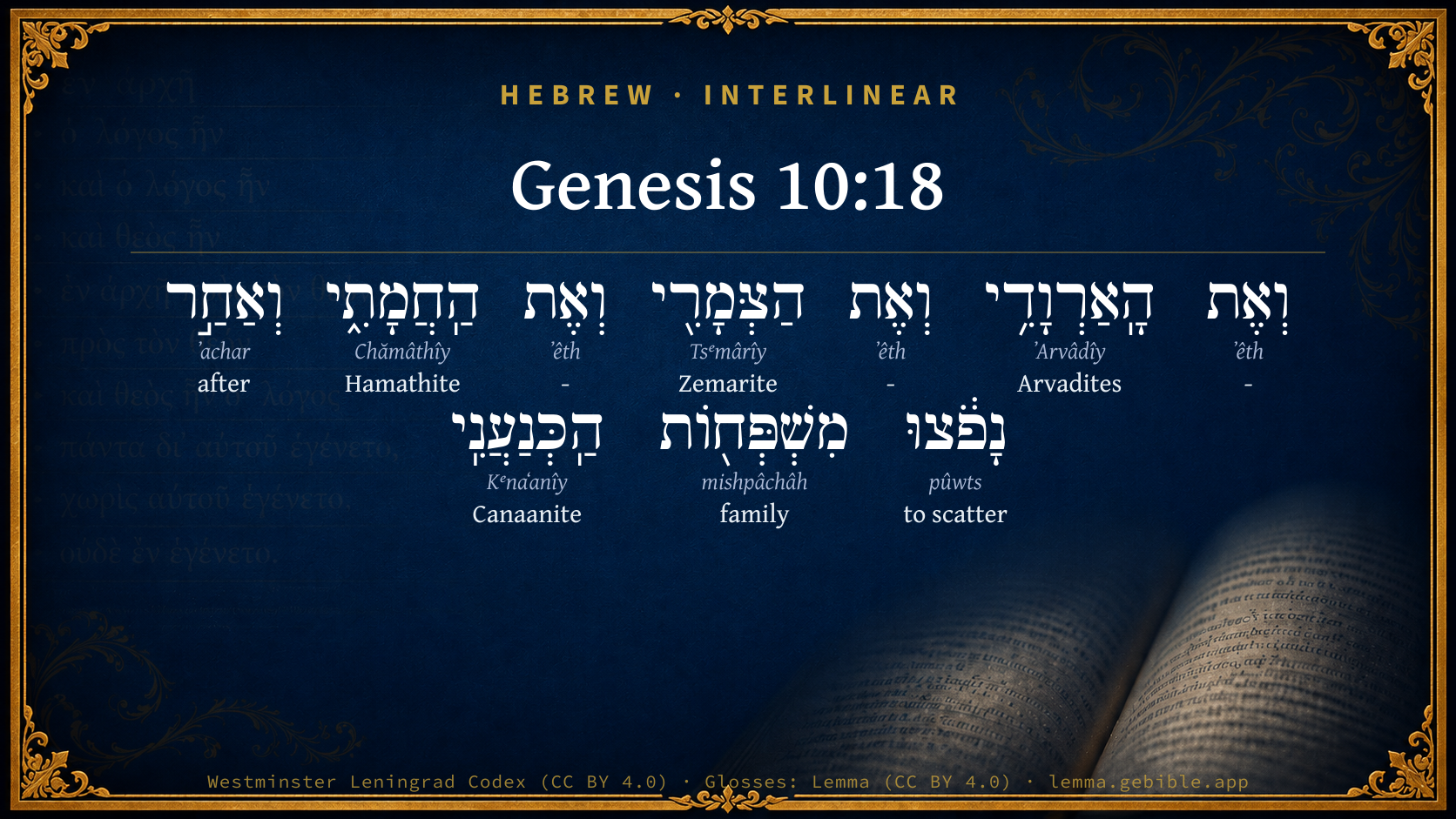
Hebrew (Westminster Leningrad Codex) Genesis 10:18 appears in the Hebrew Old Testament. The text above is from the Westminster Leningrad Codex. Each word links to its Strong’s number, a concise gloss, and parsing drawn from the Open Scriptures Hebrew Bible morphology. Click any word for its full Brown-Driver-Briggs (BDB) entry.
Download image
Cite this verse

Genesis 10:18 (World English Bible). Public Domain. Lemma interlinear Bible study tool, https://lemma.gebible.app/v/genesis/10/18.

Show BibTeX & RIS
BibTeX
RIS
English Translation
the Arvadite, the Zemarite, and the Hamathite. Afterward the families of the Canaanites were spread abroad.
World English Bible · Public Domain
Highlights
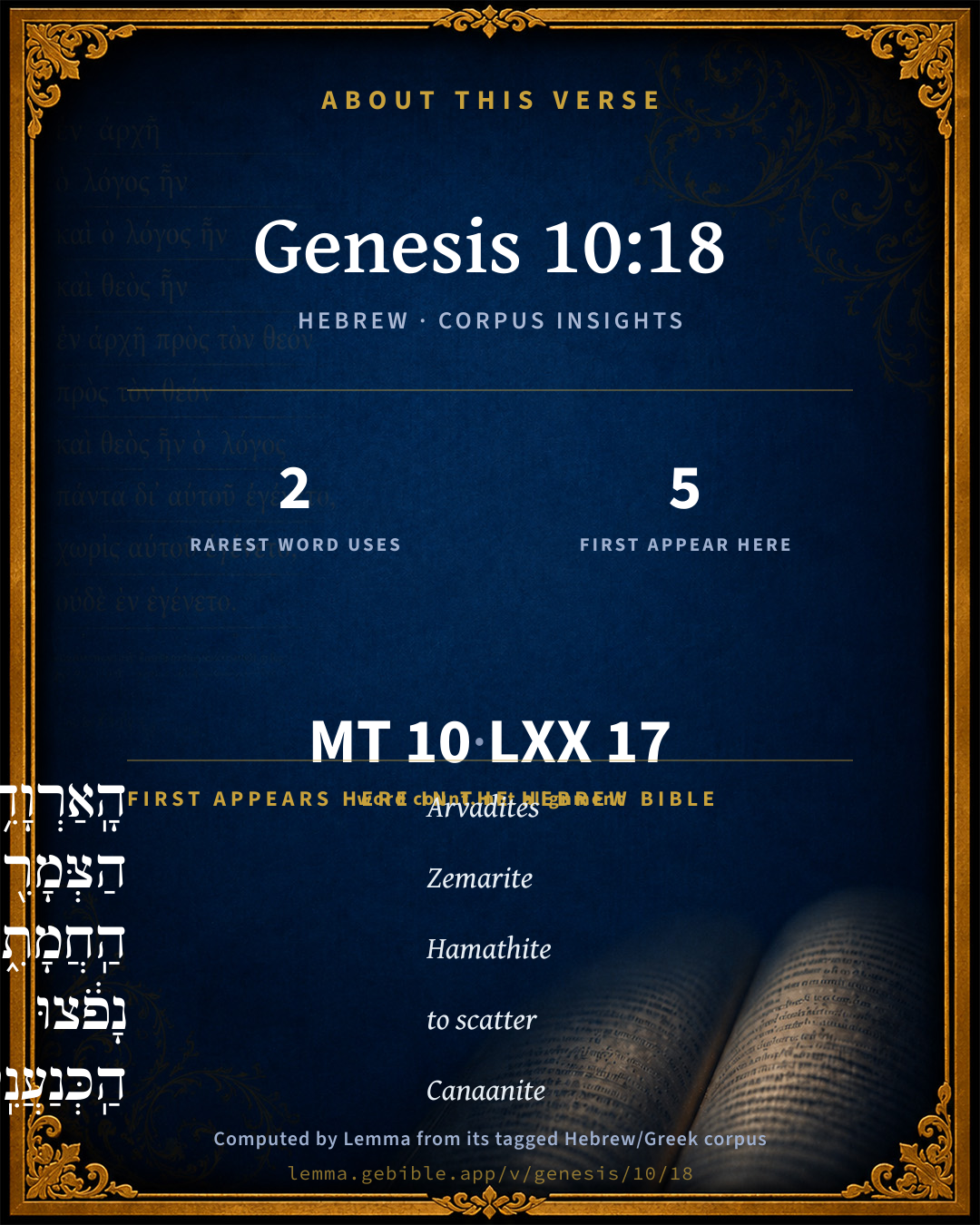
  • 5 first appearances in the Hebrew Bible
Full analysis ↓
Download a study sheet

One document with this verse’s original text, its word-by-word gloss line, the meaning frame, cross-references with their text, attributed commentary, and full source and license credits — printable, and it pastes into notes with its structure intact.

This verse Autodidact and up

Study sheet (.html) Plain text (.txt)

A passage Seminary Student

Up to 50 verses in one chapter. A passage sheet keeps up to 6 commentary sources and 12 cross-references per verse, in the order this page ranks them, and says so on the sheet whenever that leaves anything out. Ask for a single verse and you get the Autodidact verse sheet above.

Everything on this page stays free to read, with no account — the sheet is a download of what is already on screen, not access to it.

Want to remove ads? Support Godless Engineer
Compare translations 3

The same verse in 3 English versions, stacked beneath the original-language interlinear above. Click any original word for its lexicon entry.

Each is an independent rendering of the whole verse — the interlinear is not word-aligned to these translations.

Highlighted words mark where these versions differ — a whole-verse word diff, not a word-by-word alignment.

  • World English Bible Public Domain
    the Arvadite, the Zemarite, and the Hamathite. Afterward the families of the Canaanites were spread abroad.
  • King James Version Public Domain
    And the Arvadite, and the Zemarite, and the Hamathite: and afterward were the families of the Canaanites spread abroad.
  • unfoldingWord Literal Text CC BY-SA 4.0
    and the Arvadites and the Zemarites and the Hamathites. And afterward the clans of the Canaanites scattered,

unfoldingWord Literal Text — © unfoldingWord, licensed CC BY-SA 4.0. Word-aligned USFM3 via Door43 (git.door43.org/unfoldingWord/en_ult).

Versions to compare (up to 4)

3 of 4 selected

Show all 18 translations

Every available English version of this verse, each an independent rendering of the whole verse.

  • World English Bible Public Domain
    the Arvadite, the Zemarite, and the Hamathite. Afterward the families of the Canaanites were spread abroad.
  • Berean Standard Bible Public Domain
    the Arvadites, the Zemarites, and the Hamathites. Later the Canaanite clans were scattered,
  • Majority Standard Bible Public Domain
    the Arvadites, the Zemarites, and the Hamathites. Later the Canaanite clans were scattered,
  • King James Version Public Domain
    And the Arvadite, and the Zemarite, and the Hamathite: and afterward were the families of the Canaanites spread abroad.
  • American Standard Version (1901) Public Domain
    and the Arvadite, and the Zemarite, and the Hamathite: and afterward were the families of the Canaanite spread abroad.
  • Revised Version (1885) Public Domain
    and the Arvadite, and the Zemarite, and the Hamathite: and afterward were the families of the Canaanite spread abroad.
  • Geneva Bible (1599) Public Domain
    And Aruadi, and Zemari, and Hamathi: and afterwarde were the families of the Canaanites spred abroade.
  • Douay-Rheims (1899) Public Domain
    And the Aradian, the Samarite, and the Hamathite: and afterwards the families of the Chanaanites were spread abroad.
  • Young's Literal Translation Public Domain
    and the Arvadite, and the Zemarite, and the Hamathite; and afterwards have the families of the Canaanite been scattered.
  • Literal Standard Version CC BY-SA 4.0
    and the Arvadite, and the Zemarite, and the Hamathite; and afterward the families of the Canaanite have been scattered.
  • Unlocked Literal Bible CC BY-SA 4.0
    the Arvadites, the Zemarites, and the Hamathites. Afterward the clans of the Canaanites spread out.
  • unfoldingWord Literal Text CC BY-SA 4.0
    and the Arvadites and the Zemarites and the Hamathites. And afterward the clans of the Canaanites scattered,
  • Darby Bible Public Domain
    and the Arvadite, and the Zemarite, and the Hamathite. And afterwards the families of the Canaanites spread themselves abroad.
  • World Messianic Bible Public Domain
    the Arvadites, the Zemarites, and the Hamathites. Afterward the families of the Canaanites were spread abroad.
  • Webster's Bible Public Domain
    And the Arvadite, and the Zemarite, and the Hamathite: and afterward were the families of the Canaanites dispersed.
  • Free Bible Version CC BY-SA 4.0
    the Arvadites, the Zemarites, and the Hamathites. Later the Canaanite tribes spread out
  • Bible in Basic English Public Domain
    And the Arvadite and the Zemarite and the Hamathite; after that the families of the Canaanites went far and wide in all directions;
  • JPS Tanakh (1917) Public Domain
    and the Arvadite, and the Zemarite, and the Hamathite; and afterward were the families of the Canaanite spread abroad.

Literal Standard Version (2020), Covenant Press — licensed CC BY-SA 4.0. Text via the HelloAO Bible API (eBible.org). Unlocked Literal Bible (unfoldingWord) — licensed CC BY-SA 4.0. Text via the HelloAO Bible API (eBible.org). unfoldingWord Literal Text — © unfoldingWord, licensed CC BY-SA 4.0. Word-aligned USFM3 via Door43 (git.door43.org/unfoldingWord/en_ult). Free Bible Version, Dr. Jonathan Gallagher — licensed CC BY-SA 4.0. Text via the HelloAO Bible API (eBible.org).

Word by word

More ways to search: Search by grammar → Find every occurrence → Compare this word →

Practice this passage: Drill this verse → Learn its vocabulary →

הָֽאַרְוָדִ֥י
ʼArvâdîy
H721
“the · Arvadites”
Particle, Definite Article + Noun, Gentilic, Masculine, Singular, Absolute
Part of Speech
Particle + Noun
Type
Gentilic
Gender
Masculine
Number
Singular
State
Absolute
Full BDB Definition

Origin: patrial from H719

TWOT: None

Arvadites = "I shall break loose" - the descendants of Arvad, a son of Canaan
  1. וְאֶת ʼêth H853 “and · -” Conjunction + Particle, Direct Object
  2. וְאֶת ʼêth H853 “and · -” Conjunction + Particle, Direct Object
  3. הַצְּמָרִ֖י Tsᵉmârîy H6786 “the · Zemarite” Particle, Definite Article + Noun, Gentilic, Masculine, Singular, Absolute
  4. וְאֶת ʼêth H853 “and · -” Conjunction + Particle, Direct Object
  5. הַֽחֲמָתִ֑י Chămâthîy H2577 “the · Hamathite” Particle, Definite Article + Noun, Gentilic, Masculine, Singular, Absolute
  6. וְאַחַ֣ר ʼachar H310 “and · after” Conjunction + Adverb
  7. נָפֹ֔צוּ pûwts H6327 “to scatter” Verb, Niphal, Perfect, 3rd Person, Common, Plural
  8. מִשְׁפְּח֖וֹת mishpâchâh H4940 “families of” Noun, Common, Feminine, Plural, Construct
  9. הַֽכְּנַעֲנִֽי Kᵉnaʻanîy H3669 “the · Canaanite” Particle, Definite Article + Noun, Gentilic, Masculine, Singular, Absolute

About this verse

These counts appear in no published source. They are computed here, from the morphology-tagged text and Lemma’s own curated glosses. What Lemma adds →

10
words
8
distinct lemmas
Pentateuch
section

Notable vocabulary

The rarest word here is הָֽאַרְוָדִ֥י Arvadites H721 — appearing just 2 times in the whole Hebrew Bible.

First appearance in Scripture

These words make their first canonical appearance in the Hebrew Bible here:

  • הָֽאַרְוָדִ֥י Arvadites H721
  • הַצְּמָרִ֖י Zemarite H6786
  • הַֽחֲמָתִ֑י Hamathite H2577
  • נָפֹ֔צוּ to scatter H6327
  • הַֽכְּנַעֲנִֽי Canaanite H3669

Shared distinctive vocabulary

הָֽאַרְוָדִ֥י Arvadites H721 occurs in 2 verses of the Hebrew Bible. Also found in:

Grammatical profile

  • 1 verb
  • 5 nouns
  • 1 adverb
  • 3 particles

Verb forms

  • נָפֹ֔צוּ Niphal · Perfect

Hebrew & Septuagint length

In English translation the verse runs 16 words from the Hebrew and 19 from the Septuagint (LXX English) — closely comparable.

A rough comparison of the two English renderings, which tokenize alike — not a word-level alignment.

Word counts can differ between the Hebrew and the Greek without any difference in meaning — e.g. the Hebrew direct-object marker אֵת has no separate Greek word, and Greek often adds the article ὁ.

In the original languages it is 10 Hebrew tokens and 17 Greek tokens — but the two are counted differently (Hebrew bundles its prefixes and suffixes into one token; the Greek is in lemma form), so that isn’t a like-for-like length.

Cross-references

10

Topical passages linked to Genesis 10:18 in the Treasury of Scripture Knowledge — connected by theme and wording, ordered by reader-vote popularity; previews shown in the World English Bible.

  • Numbers 34:8 from Mount Hor you shall mark out to the entrance of Hamath; and the goings out of the border shall be at Zedad;
  • Joshua 18:22 and Beth Arabah, and Zemaraim, and Bethel,
  • 2 Samuel 8:9 When Toi king of Hamath heard that David had struck all the host of Hadadezer,
  • 2 Kings 17:24 The king of Assyria brought men from Babylon, and from Cuthah, and from Avva, and from Hamath and Sepharvaim, and placed them in the cities of Samaria instead of the children of Israel; and they possessed Samaria, and lived in the cities of it.
  • 2 Kings 17:30 The men of Babylon made Succoth-benoth, and the men of Cuth made Nergal, and the men of Hamath made Ashima,
  • 2 Chronicles 13:4 Abijah stood up on Mount Zemaraim, which is in the hill-country of Ephraim, and said, Hear me, Jeroboam and all Israel:
  • Isaiah 10:9 Isn't Calno as Carchemish? Isn't Hamath as Arpad? Isn't Samaria as Damascus?
  • Ezekiel 27:8 The inhabitants of Sidon and Arvad were your rowers: your wise men, Tyre, were in you, they were your pilots.
  • Ezekiel 47:16–17 Hamath, Berothah, Sibraim, which is between the border of Damascus and the border of Hamath; Hazer Hatticon, which is by the border of Hauran.
  • Zechariah 9:2 And Hamath, also, which borders on it; Tyre and Sidon, because they are very wise.

Cross-references courtesy of OpenBible.info (CC BY 4.0).

Hebrew and Greek witnesses Masoretic Hebrew ↔ Greek Septuagint

The same verse in the two great witnesses to the Old Testament, shown verse-for-verse.

These are two independent witnesses, not word-aligned to each other, and the Septuagint is shown in lemma (dictionary) form.

Hebrew Genesis 10:18 Masoretic · Westminster Leningrad Codex

וְאֶת הָֽאַרְוָדִ֥י וְאֶת הַצְּמָרִ֖י וְאֶת הַֽחֲמָתִ֑י וְאַחַ֣ר נָפֹ֔צוּ מִשְׁפְּח֖וֹת הַֽכְּנַעֲנִֽי

the Arvadite, the Zemarite, and the Hamathite. Afterward the families of the Canaanites were spread abroad.

World English Bible · Public Domain

Greek LXX Genesis 10:18 Septuagint · lemma form

καί ὁ ἀράδιος καί ὁ σαμαραῖος καί ὁ αμαθι καί μετά οὗτος διασπείρω ὁ φυλή ὁ χαναναῖος

and the Aradian, and the Samarean, and the Amathite; and after this the tribes of the Chananites were dispersed.

LXX2012 (modern English Septuagint) · Public Domain

Hebrew: Westminster Leningrad Codex (CC BY 4.0). Greek: Septuagint (public domain); English from LXX2012 (modern English Septuagint) (Public Domain). How the Septuagint differs from the Hebrew →

Targum (Aramaic paraphrase)

2

The Targum is the ancient Jewish Aramaic paraphrase of the Hebrew Scriptures — an interpretive translation, not the Hebrew text itself. Onkelos (literal) and Pseudo-Jonathan (expansive) render the Torah, and Jonathan the Prophets. Coverage is partial: where no permissively-licensed English translation exists for a verse, only the Aramaic is shown. This is verse-level text, not a word-by-word alignment to the Hebrew.

  1. Targum Onkelos Torah (Genesis–Deuteronomy)
    וְיָת אַרְוָדָאֵי וְיָת צְמָרָאֵי וְיָת חֲמָתָאֵי וּבָתַר כֵּן אִתְבַּדָּרוּ זַרְעֲיַת כְּנַעֲנָאֵי

    and Arvadaee, and Zemaraee, and Chamathaee: and afterwards the seed of the Kenaanaee were scattered abroad.

    Targum Onkelos — Aramaic: “Onkelos Genesis” (public domain); “Onkelos Exodus” (public domain); “Onkelos Leviticus” (public domain); “Onkelos Numbers” (public domain); “Onkelos Deuteronomy” (public domain). English: “Sefaria Community Translation” (CC0 1.0 (public-domain dedication)); “J.W. Etheridge. The Targums of Onkelos and Jonathan Ben Uzziel on the Pentateuch. London: Longmans, Green, 1862” (public domain). Text via Sefaria.

  2. Targum Pseudo-Jonathan Torah (Genesis–Deuteronomy)
    וְיַת לוֹטְסָאֵי וְיַת חוֹמְצָאֵי וְיַת אַנְטְכוֹאֵי וּבָתַר כְּדֵין אִתְבַּדְרוּ זַרְעֲיַתְהוֹן דִכְנַעֲנָאֵי

    and the Lutasaee, and the Chomtsaee, and the Antekoee; and after then the seed of the Kenaanaee were scattered.

    Targum Pseudo-Jonathan — Aramaic: “Targum Jonathan on Genesis” (public domain); “Targum Jonathan on Exodus” (public domain); “Targum Jonathan on Leviticus” (public domain); “Targum Jonathan on Numbers” (public domain); “Targum Jonathan on Deuteronomy” (public domain). English: “The Targum of Jonathan ben Uzziel, trans. J. W. Etheridge, London, 1862” (public domain). Text via Sefaria.

Commentary

Notes on Genesis 10:18 from classic Christian and Jewish commentators (each source and its license shown beneath its notes). The classic Christian expositions comment on the surrounding passage and are grouped to its opening verse, so a note may address several verses; the Jewish commentaries on the Tanakh (Rashi and others) are per-verse, so they appear only where the commentator wrote on this verse.

Lemma curates 59 commentaries, every one of them public domain or Creative Commons licensed, each selected and text-cleaned for this edition rather than reprinted as found. About our sources →

Trapp's Complete Commentary

John Trapp

Gen 10:18 And the Arvadite, and the Zemarite, and the Hamathite: and afterward were the families of the Canaanites spread abroad.

Ver. 18. {See Trapp on "Gen 10:16"}

John Trapp, A Commentary or Exposition upon All the Books of the Old and New Testament (1647–1656) — public domain. Text from a community e-Sword module.

The Cambridge Bible for Schools and Colleges

gen. ed. J. J. S. Perowne

18. the Arvadite] Arvad, a famous maritime town, the modern Ruwâd on an island 100 miles north of Zidon; cf. Eze_27:8; Eze_27:11.

the Zemarite] The dwellers in Simyra, modern Sumra, a few miles south of Ruwâd. It appears in the Tel-el-Amarna Letters as Zumur.

the Hamathite] The dwellers in Hamath, modern Ḥama, the famous ancient town to the extreme north of Canaan, on the Orontes, and the capital of a small kingdom overthrown by Sargon. Cf. Num_34:8; 2Ki_18:34; Amo_6:14.

and afterward] It has been conjectured that this clause followed originally upon the mention of “Zidon his firstborn and Heth,” Gen_10:15, and that the intervening passage (Gen_10:16-18 a) is a later addition. The clause leads up to the description, in Gen_10:19, of the subsequent boundaries of Canaan. The writer implies that the “families of the Canaanite,” who were driven out by the Israelites, were themselves not the original inhabitants.

In favour of 16–18a being a gloss, note (1) the change from the proper names, “Zidon” and “Heth,” to the appellatives, “the Jebusite,” “the Amorite,” &c.: (2) the delimitation of “the Canaanite” in Gen_10:19 excluding the Arkite, Sinite, Arvadite, Zemarite, and Hamathite, who in Gen_10:16-17 are included in the “sons of Canaan.”

The Cambridge Bible for Schools and Colleges (gen. ed. J. J. S. Perowne; Cambridge University Press, 1878–1918) — public domain. Text from a community e-Sword module.

John Gill's Exposition

And the Arvadite,.... The inhabitants of Arvad, or Aradus, an island in the Phoenician sea; it is mentioned with Sidon, Eze 27:8 so Josephus says (q), the Arudaeans possessed the island Aradus: it is about a league distant from the shore; Strabo (r) says it is twenty furlongs from land, and about seven in circumference, and is said to be built by the Sidonians; it is now, as Mr. Maundrel (s) says, by the Turks called Ru-ad, or, as Dr. Shaw says (t), Rou-wadde; See Gill on Eze 27:8.

And the Zemarite; who perhaps built and inhabited Simyra, a place mentioned by Pliny (u), not far from Lebanon, and along with Marathos, and Antarados, which lay on the continent, right against the island Aradus, or Arvad, and near the country of the Aradians. Strabo (w) makes mention of a place called Taxymira, which Casaubon observes should be Ximyra, or Simyra; and Mela (x) speaks of the castle of Simyra as in Phoenicia. There was a city called Zemaraim in the tribe of Benjamin, Jos 18:22 which Bishop Patrick suggests, and Ainsworth before him, that Zemarus, the son of Canaan, might be the founder of; and there is also a mountain of the same name in Mount Ephraim, Ch2 13:4.

And the Hamathite: who dwelt in Amathine, as Josephus (y), and was in his time called by the inhabitants Amathe; but the Macedonians called it, from one of their race, Epiphania, which seems to have been the country called Amathite,He removed from Jerusalem, and met them in the land of Amathis: for he gave them no respite to enter his country. (1 Maccabees 12:25)there was another Hamath, called Antiochia, but cannot be meant, since Hamath was the northern border of the land of Israel, then called the entrance of Hamath, which border was pretty near to Epiphania, but not so far as Antioch; this is the Amathus of Syria, twice mentioned by Herodotus, as Hillerus (z) observes: but both Reland (a) and Vitringa (b) are of opinion, that the Hamath so often mentioned in Scripture, which doubtless had its name from the Hamathite, is neither Antiochia nor Epiphania, but the city Emesa, or Emissa, which lay below Epiphania, upon the Orontes, nearer Damascus and the land of Canaan; and Hamath is mentioned with Damascus and Arpad, or Arvad, Isa 10:9 and, according to Eze 47:16. Hamath must lie between Damascus and the Mediterranean sea.

And afterwards were the families of the Canaanites spread abroad; not only these eleven, but two more which are not mentioned, the Canaanites properly so called, and the Perizzites; these families at first dwelt in one place, or within narrow limits; but, as they increased, they spread themselves further every way, and in process of time possessed all the country from Idumea and Palestine to the mouth of the Orontes, and which they held about seven hundred years, when five of these families, with the two other above mentioned, were cast out of the land for their sins, and to make way for the people of Israel.

(q) Antiqu. l. 1. c. 6. sect. 2. (r) Geograph. l. 16. p. 518. (s) Journey from Aleppo, &c. p. 19. Ed. 7. (t) Travels, p. 267. Ed. 2. (u) Nat. Hist. l. 5. c. 20. (w) Geograph. l. 16. p. 518. (x) De situ orbis, l. 1. c. 12. (y) Ut supra. (Antiqu. l. 1. c. 6. sect. 2.) (z) Onomastic. Sacr. p. 780. (a) Palestina Illustrata, tom. 1. l. 1. p. 121, 123, 317. (b) Comment. in Jesaiam, c. 10, 9.

John Gill's Exposition of the Whole Bible (1746–1763) — public domain (CC PDM 1.0). Text via the HelloAO Bible API.

Matthew Poole's English Annotations

Dispersed in the several quarters of the land, who, before they grew so numerous, dwelt together in the same place.

Matthew Poole's English Annotations on the Holy Bible (1683–1685) — public domain. Text from a community e-Sword/MySword module.

The Pulpit Commentary

And the Arvadite, dwelt in Arvad, Aradus, now Ruad (Josephus)and the Zemarite, Simyra, a city of Phoenicia (Bochart, Michaelis, Gesenius, Kalisch) whose ruins are still called Sumrahand the Hamathite. The inhabitants of Hamath, called Hammath Rabbah; (Amo_6:2) Epiphaneia by the Greeks; now Hamah. And afterwards i.e. subsequent to the formation of these distinct tribes by the confusion of tongueswere the families of the Canaanites spread abroad.

The Pulpit Commentary (1880–1919), ed. H.D.M. Spence-Jones & Joseph S. Exell — public domain. Text from a community e-Sword module.

Rashi

Rabbi Shlomo Yitzchaki (Rashi)

ואחר נפוצו AND AFTERWARDS WERE SPREAD ABROAD — From these many families were spread abroad (besides those already mentioned. 5:15—18).

Rashi on the Tanakh — English translations: “The Judaica Press complete Tanach with Rashi, translated by A. J. Rosenberg” (CC BY 4.0); “Pentateuch with Rashi's commentary by M. Rosenbaum and A.M. Silbermann, 1929-1934” (public domain); “The Metsudah Tanach series, Lakewood, N.J” (CC BY 4.0); and “The Book of Joshua, Metsudah Publications, 1997” (CC BY 4.0). Text via Sefaria.

Radak

Rabbi David Kimhi (Radak)

ואחר נפוצו, after the languages were confused.

משפחות הכנעני, the ones who had been mentioned previously, i.e. the Canaanites, were scattered to a different region, to the land called afterwards ”the land of Canaan.”

Radak on the Tanakh — English translations: “Sefaria Community Translation” (CC0 1.0 (public-domain dedication)); “Eliyahu Munk, HaChut Hameshulash” (CC BY 4.0); “Rabbi Mike Feuer, Jerusalem Anthology” (CC BY 4.0); and “R. David Kimhi on the first book of Psalms, Translated by R.G. Finch, London, 1919” (public domain). Text via Sefaria.

Lesson kit

Teaching starters — assembled from the data on this page, not authored interpretation. Every prompt links to the verse data it draws on. Edit before teaching.

Genesis, in the Pentateuch, opens this verse with 10 words (8 distinct Hebrew lemmas). Its most distinctive word is ʼArvâdîy (“Arvadites”). A historical commentator’s framing appears above. Read the whole chapter for the surrounding context.

Discussion questions

  1. How does “Arvadites” (ʼArvâdîy) shape what this verse is saying?
  2. 5 words here appear for the first time in Scripture. What is being introduced at this debut?
  3. 1 Chronicles 1:16 shares the word «Arvadites» with this verse. How do the two illuminate each other?
  4. The translations on this page render this verse differently — a whole-verse word diff, not a word-by-word alignment. What might account for the different wordings?
  5. The verb «נָפֹ֔צוּ» is Niphal Perfect. How does its form color the action?
  6. Reading how Trapp's Complete Commentary and The Cambridge Bible for Schools and Colleges read this verse, where do the two commentators agree and where do they part?

Things to notice

Reading settings

Reading text

Shown beneath each verse's original-language words.

Old Testament
Old Testament edition

Read the OT as the Masoretic Hebrew (MT) or the Greek Septuagint (LXX).

English shown for the Greek Septuagint (in the Hebrew ↔ Greek comparison).

Comparing translations? Open the Compare panel on any verse page to stack up to four side by side.