John 6:59

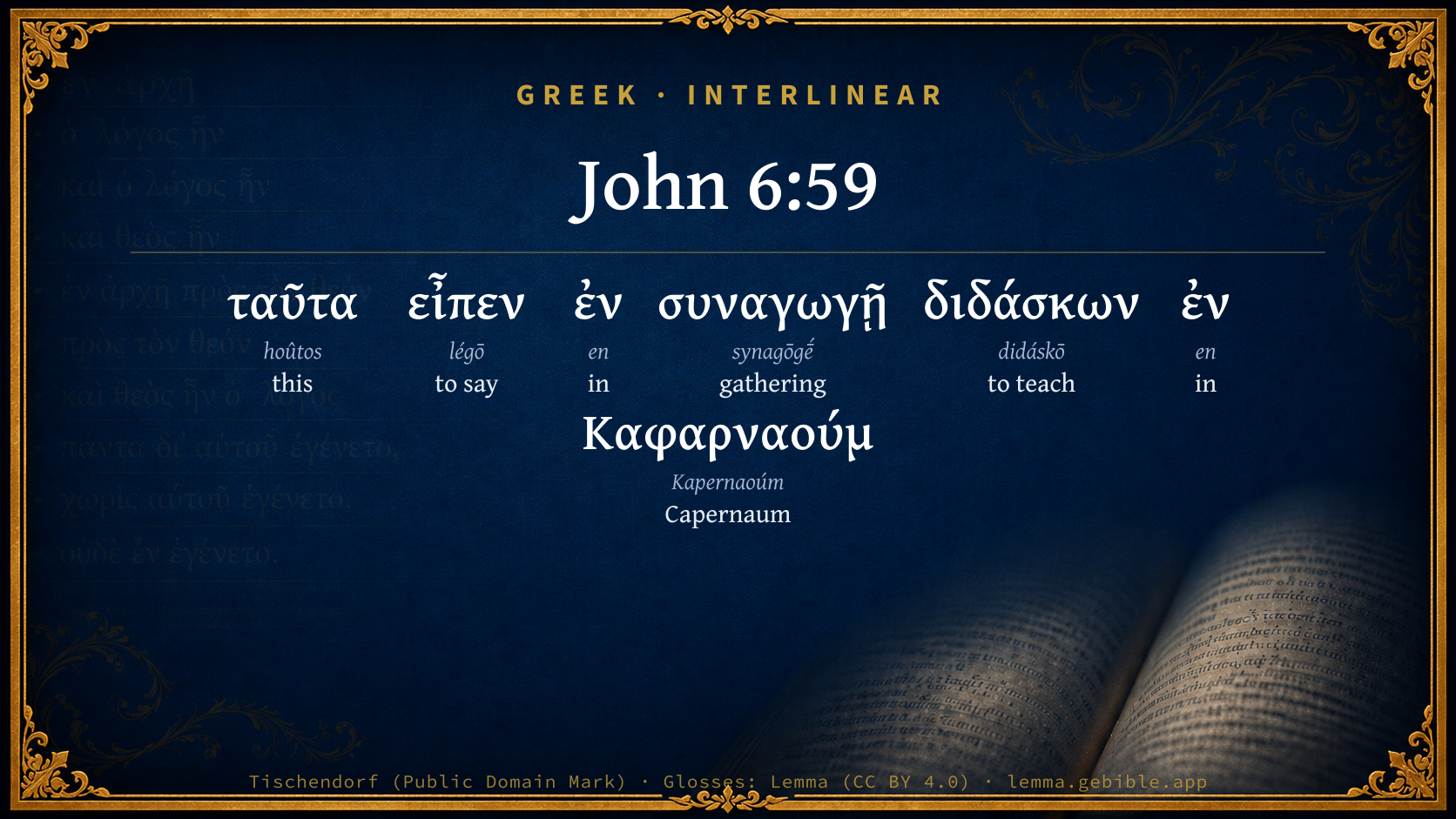
Greek (Tischendorf 8th ed.) John 6:59 appears in the Greek New Testament. The text above is from the Tischendorf 8th edition. Each word links to its Strong’s number and a concise gloss. Click any word for its full Thayer’s Greek Lexicon entry.
Download image
Cite this verse

John 6:59 (World English Bible). Public Domain. Lemma interlinear Bible study tool, https://lemma.gebible.app/v/john/6/59.

Show BibTeX & RIS
BibTeX
RIS
English Translation
These things he said in the synagogue, as he taught in Capernaum.
World English Bible · Public Domain
Download a study sheet

One document with this verse’s original text, its word-by-word gloss line, the meaning frame, cross-references with their text, attributed commentary, and full source and license credits — printable, and it pastes into notes with its structure intact.

This verse Autodidact and up

Study sheet (.html) Plain text (.txt)

A passage Seminary Student

Up to 50 verses in one chapter. A passage sheet keeps up to 6 commentary sources and 12 cross-references per verse, in the order this page ranks them, and says so on the sheet whenever that leaves anything out. Ask for a single verse and you get the Autodidact verse sheet above.

Everything on this page stays free to read, with no account — the sheet is a download of what is already on screen, not access to it.

Want to remove ads? Support Godless Engineer
Compare translations 3

The same verse in 3 English versions, stacked beneath the original-language interlinear above. Click any original word for its lexicon entry.

Each is an independent rendering of the whole verse — the interlinear is not word-aligned to these translations.

Highlighted words mark where these versions differ — a whole-verse word diff, not a word-by-word alignment.

  • World English Bible Public Domain
    These things he said in the synagogue, as he taught in Capernaum.
  • King James Version Public Domain
    These things said he in the synagogue, as he taught in Capernaum.
  • unfoldingWord Literal Text CC BY-SA 4.0
    He said these things in a synagogue, teaching in Capernaum.

unfoldingWord Literal Text — © unfoldingWord, licensed CC BY-SA 4.0. Word-aligned USFM3 via Door43 (git.door43.org/unfoldingWord/en_ult).

Versions to compare (up to 4)

3 of 4 selected

Show all 19 translations

Every available English version of this verse, each an independent rendering of the whole verse.

  • World English Bible Public Domain
    These things he said in the synagogue, as he taught in Capernaum.
  • Berean Standard Bible Public Domain
    Jesus said this while teaching in the synagogue in Capernaum.
  • Majority Standard Bible Public Domain
    Jesus said this while teaching in the synagogue in Capernaum.
  • King James Version Public Domain
    These things said he in the synagogue, as he taught in Capernaum.
  • American Standard Version (1901) Public Domain
    These things said he in the synagogue, as he taught in Capernaum.
  • Revised Version (1885) Public Domain
    These things said he in the synagogue, as he taught in Capernaum.
  • Geneva Bible (1599) Public Domain
    These things spake he in the Synagogue, as he taught in Capernaum.
  • Douay-Rheims (1899) Public Domain
    This is the bread that came down from heaven. Not as your fathers did eat manna, and are dead. He that eateth this bread, shall live for ever.
  • Young's Literal Translation Public Domain
    These things he said in a synagogue, teaching in Capernaum;
  • Literal Standard Version CC BY-SA 4.0
    He said these things in a synagogue, teaching in Capernaum;
  • Unlocked Literal Bible CC BY-SA 4.0
    But Jesus said these things in the synagogue while he was teaching in Capernaum.
  • unfoldingWord Literal Text CC BY-SA 4.0
    He said these things in a synagogue, teaching in Capernaum.
  • Darby Bible Public Domain
    These things he said in [the] synagogue, teaching in Capernaum.
  • World Messianic Bible Public Domain
    He said these things in the synagogue, as he taught in Capernaum.
  • Webster's Bible Public Domain
    These things he said in the synagogue, as he taught in Capernaum.
  • Free Bible Version CC BY-SA 4.0
    Jesus explained this while he was teaching in a synagogue at Capernaum.
  • Bible in Basic English Public Domain
    Jesus said these things in the Synagogue while he was teaching at Capernaum.
  • Text-Critical English NT CC BY 4.0
    He said these things in a synagogue while teaching in Capernaum.
  • Tyndale New Testament (1534) Public Domain
    These thinges sayd he in the synagoge as he taught in Capernaum.

Literal Standard Version (2020), Covenant Press — licensed CC BY-SA 4.0. Text via the HelloAO Bible API (eBible.org). Unlocked Literal Bible (unfoldingWord) — licensed CC BY-SA 4.0. Text via the HelloAO Bible API (eBible.org). unfoldingWord Literal Text — © unfoldingWord, licensed CC BY-SA 4.0. Word-aligned USFM3 via Door43 (git.door43.org/unfoldingWord/en_ult). Free Bible Version, Dr. Jonathan Gallagher — licensed CC BY-SA 4.0. Text via the HelloAO Bible API (eBible.org).

Word by word

More ways to search: Search by grammar → Find every occurrence → Compare this word →

Practice this passage: Drill this verse → Learn its vocabulary →

About this verse

These counts appear in no published source. They are computed here, from the morphology-tagged text and Lemma’s own curated glosses. What Lemma adds →

7
words
6
distinct lemmas
Gospels
section

Notable vocabulary

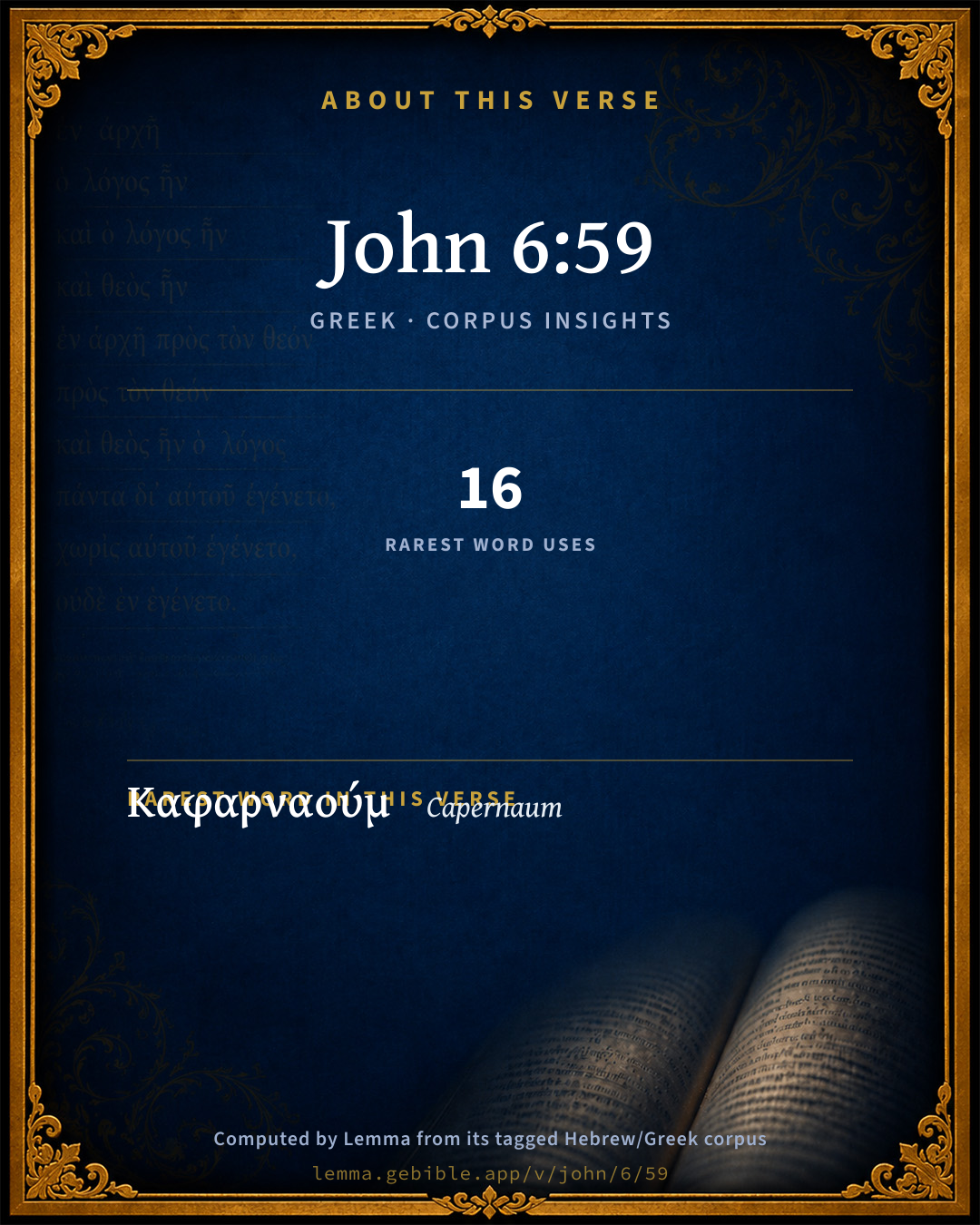
The rarest word here is Καφαρναούμ Capernaum G2584 — appearing just 16 times in the whole Greek New Testament.

Shared distinctive vocabulary

Καφαρναούμ Capernaum G2584 occurs in 16 verses of the Greek New Testament. Also found in:

Repetition

A word recurs within this verse:

Cross-references

6

Topical passages linked to John 6:59 in the Treasury of Scripture Knowledge — connected by theme and wording, ordered by reader-vote popularity; previews shown in the World English Bible.

  • John 6:24 When the multitude therefore saw that Jesus wasn't there, nor his disciples, they themselves got into the boats, and came to Capernaum, seeking Jesus.
  • Psalms 40:9–10 I have proclaimed glad news of righteousness in the great assembly. Behold, I will not seal my lips, Yahweh, you know.
  • Proverbs 1:20–23 Wisdom calls aloud in the street. She utters her voice in the public squares.
  • Proverbs 8:1–3 Doesn't wisdom cry out? Doesn't understanding raise her voice?
  • Luke 4:31 He came down to Capernaum, a city of Galilee. He was teaching them on the Sabbath day,
  • John 18:20 Jesus answered him, "I spoke openly to the world. I always taught in synagogues, and in the temple, where the Jews always meet. I said nothing in secret.

Cross-references courtesy of OpenBible.info (CC BY 4.0).

Commentary

Notes on John 6:59 from classic Christian and Jewish commentators (each source and its license shown beneath its notes). The classic Christian expositions comment on the surrounding passage and are grouped to its opening verse, so a note may address several verses; the Jewish commentaries on the Tanakh (Rashi and others) are per-verse, so they appear only where the commentator wrote on this verse.

Lemma curates 59 commentaries, every one of them public domain or Creative Commons licensed, each selected and text-cleaned for this edition rather than reprinted as found. About our sources →

The Biblical Illustrator

Joseph S. Exell

Joh_6:59

These things said He in the synagogues

I.

The OCCASION of this wonderful revelation to the Church. The desire of the Jews to have the miracle of the manna repeated. Those of larger views may have had the supply of an army in thought.

II. The DESIGN was to quench for ever any such ambition. If you desire a warrior leader I am not of that kind.

III. The SUBSTANCE showed that mans true peace lay not in things of sense. Christs errand was to bestow spiritual blessings on all mankind. To this end He must die as a vicarious sacrifice. To participate in the blessings of this sacrifice there must be faith. The discourse is a complete resume of the gospel plan of salvation. (W. H. Van Doren, D. D.)

Capernaum

was a busy bright little town; a station on the great road; a garrison for Roman troops; a port for collecting dues by land and lake; a place of tanners, dyers, soap-boilers; a market for oilmen, shepherds, cheesemongers, fruit grocers; a halting ground for the buyers and sellers of every kind, the corn-chandlers, the fishermen, the woolstaplers, the vinters, and the gardeners. Being the first town on the Lake of Tiberias as you ride in from Damascus, as Arena is the first town on Lago Maggiore as you come from Turin, it was the port at which any one coming that way would embark for cities lying south and east on the shore. Standing on a hill of limestone, rough and rich with the flow of the basaltic rocks from higher volcanic hills; having the rich plain and cool lake of Gennesareth at its feet, with the palm, the orange, and the pomegranate blooming everywhere about, Capernaum became, like Come or Palanza nearer home, a retreat for the rich as well as a field of labour for the poor. Most of the Jewish inhabitants, net-makers, fishermen, farmers, were believers in a physical Messiah; followers of Herod, of Judas, of Simon, of John; Jews of an earnest and yet of a most worldly type. The strangers who dwelt among those Jews, like every one trained in the Hellenic schools, were liberal and tolerant in affairs of faith. Had not the Roman governor built a synagogue for the Jews at his own expense? Capernaum, properly spelt Capharna Hum, was one of the towns most favoured by the Lord. It was the first place to which He came after His baptism by John. There He dwelt for a little while with His early disciples, Peter and Andrew, James and John. Here lived the good nobleman whose son He cured. There too He healed the demoniac in the synagogue, relieved the mother-in-law of Peter, healed the man sick of the palsy, and restored the withered hand. There He made whole the centurions servant, and raised the daughter of Jairus from the dead. From the blue waters of the lake He obtained the tribute money, and on its slimy shores, among the brambles and vines, He spoke the parables of the Tares, of the Sower, of the Treasure, of the Merchant, of the Net. In the White Synagogue, built by the Roman soldier, He pronounced His discourses on Faith, on Fasting, on Humility of Spirit, on Brotherly Love. Near to Capernaum He fed the five thousand, walked on the sea, and preached His Sermon on the Mount. He loved the busy, Basaltic town, and after His expulsion from Nazareth He made it the scene of His ministry. In the words of St. Matthew, a native of the place, it became His own city. Where, then, was this favoured spot? Strange to say, the great Churches of East and West, while bent on fixing the sites of events in the sacred story … kept no clear record of the scene of so many miracles and sermons as Capernaum. (Hepworth Dixon.)

The Biblical Illustrator, edited by Joseph S. Exell (c. 1880s–1900s) — public domain. Text from a community e-Sword module.

Joseph Benson's Commentary

Joh 6:59. These things — The things recorded in the preceding verses; said he in the synagogue — He spoke them openly in the hearing of all the people who attended at public worship in the synagogue; and that probably after prayer, and the reading of the law, in consequence of the question said to be asked him, Joh 6:25. Nor are we to wonder at the dialogue which passed here; for conversations between different persons, and even debates, were not unusual in the Jewish synagogues: there are many other instances of disputes, which either Christ or his apostles had with the Jews in these places of worship. See Mat 12:9-13; Luk 13:10-17; Act 13:44-47; and Act 17:17. It was evidently for wise reasons that our Lord involved a part of his discourse in figurative and mysterious language; as, in particular, that which related to eating his flesh and drinking his blood; or to his sufferings and death, and the life and salvation to be obtained thereby.

Joseph Benson's Commentary on the Old and New Testaments (1811–1818) — public domain. Text from a community e-Sword module.

Bengel's Gnomon

Johann Albrecht Bengel

Joh 6:59. Εἶπεν—διδάσκων, He spake—teaching) Comp. ch. Joh 8:20, “These words spake Jesus, as He taught in the temple” [as here in the synagogue]; Joh 7:28.

Bengel's Gnomon of the New Testament — English translation (T&T Clark, Edinburgh, 1860) — public domain. Text from a community e-Sword module.

Expositor's Greek Testament

ed. W. Robertson Nicoll

Joh 6:59 . With his usual exact specification of time and place John adds ταῦτα … ἐν Καφαρναούμ . Lampe says: “Colligi etiam inde potest, quod haec acciderint in Sabbato”; but the synagogue was available for teaching on other days, and it is not likely that on a Sabbath so many persons would have followed Him across the lake.

The Expositor's Greek Testament, edited by W. Robertson Nicoll (1897–1910) — public domain. Text from a community e-Sword module.

Jamieson, Fausset & Brown

Robert Jamieson, A. R. Fausset & David Brown

These things said he in the synagogue--which seems to imply that what follows took place after the congregation had broken up.

Jamieson, Fausset & Brown — Commentary Critical and Explanatory on the Whole Bible (1871) — public domain (CC PDM 1.0). Text via the HelloAO Bible API.

Adam Clarke's Commentary

Verse 59. In the synagogue - in Capernaum.] From Joh 6:26, to this verse, the evangelist gives us the discourse which our Lord preached in the synagogue, in which he was repeatedly interrupted by the Jews; but this gave him the fuller opportunity to proclaim the whole truth relative to his passion and death, to edify the disciples, and confute these gainsayers.

Adam Clarke's Commentary on the Bible (1810–1826) — public domain. Text from a community e-Sword/MySword module.

John Calvin's Commentaries

59. He spoke these things in the synagogue. John points out the place, that we may know that there were many present, and likewise, that a sermon was delivered as on a weighty and important subject. But it immediately follows that out of so great a multitude there were scarcely to be found a very few who profited by it; and — what is worse — it proved to be the occasion of desertion to many who professed to be disciples of Christ. If the Evangelist had said that only some of them were offended, that ought to have been accounted monstrous; but when they rise up in crowds and conspire together against him, what name shall we give to such an action? Let this narrative then be deeply impressed on our minds, that we may never murmur against Christ when he speaks; and if in the present day we perceive any thing of this kind in others, let not their pride disturb our faith.

John Calvin's Commentaries (1540-1563) — public domain. Text from the Calvin Translation Society English edition (1840s-50s) via the Christian Classics Ethereal Library (ccel.org). Calvin's coverage is partial (roughly two-thirds of the Bible); uncommented books and verses are honest gaps, never fabricated. The 19th-century editor's footnotes and remarks are omitted so the notes are faithfully Calvin's own voice.

Ellicott's Commentary for English Readers

(59) As he taught in Capernaum.—If we accept the identification of Capernaum with Tell-Hûm, which is in every way probable (comp. Note on Mat_4:13), we have good reason for believing that modern discovery has traced out the foundations of the synagogue in which this discourse was spoken. It was a gift to the Jews by a devout Gentile (Luk_7:5), and as such, of greater architectural beauty than was common among Galilean synagogues. Corinthian capitals and a heavy cornice and frieze are among the ruins, and the traveller’s eye may rest to-day on the very ornaments which our Lord’s eyes saw there eighteen centuries ago. On one of the lintels of the door he may trace a sculptured pot of manna, and connect with it the thoughts of the manna which the fathers did eat, and died: just as in a Christian church he may trace the emblems of the bread of life, which a man may eat of and not die. A plan and details of the synagogue, with an account by Captain Wilson, R.E., will be found in the Second Quarterly Statement of the Palestine Exploration Fund (June, 1869). The same society has published a photograph of the ruins.

A Bible Commentary for English Readers, edited by Charles John Ellicott (1878–1897) — public domain. Text from a community e-Sword module.

The Cambridge Bible for Schools and Colleges

gen. ed. J. J. S. Perowne

59. in the synagogue] Or, in synagogue, as we say ‘in church:’ there is no article in the Greek. Comp. Joh_18:20. The verse is a mere historical note, stating definitely what was stated vaguely in Joh_6:22 as ‘the other side of the sea.’ ‘These things’ naturally refers to the whole discourse from Joh_6:26; we have no sufficient evidence of a break between Joh_6:40 and Joh_6:41. On the other hand there is strong evidence that from Joh_6:26 to Joh_6:58 forms one connected discourse spoken at one time in the synagogue at Capernaum. The site of Capernaum is not undisputed (see on Mat_4:13); but assuming Tell Hûm to be correct, the ruins of the synagogue there are probably those of the very building in which these words were uttered. On one of the stones a pot of manna is sculptured.

The Cambridge Bible for Schools and Colleges (gen. ed. J. J. S. Perowne; Cambridge University Press, 1878–1918) — public domain. Text from a community e-Sword module.

John Gill's Exposition

When Jesus knew in himself,.... And of himself, without any intelligence from others, or hearing what was said, being the omniscient God:

that his disciples murmured at it; at the doctrine he had delivered, looking upon it as absurd, incredible, and contrary to sense and reason:

he said unto them, does this offend you? or trouble you? cannot you get over this? cannot you understand it? or account for it? if not, how will you be able to digest some other things, or reconcile them to your minds, which are less known, and more unexpected, and will appear at first sight more surprising?

John Gill's Exposition of the Whole Bible (1746–1763) — public domain (CC PDM 1.0). Text via the HelloAO Bible API.

Trapp's Complete Commentary

John Trapp

59 These things said he in the synagogue, as he taught in Capernaum.

Ver. 59. These things said he in the synagogue] In a set sermon, and yet to little purpose; for many made defection. Vultures unguento fugantur, et scarabei rosa, Vultures are put to flight by perfumes and the rose bettle, say Pliny and Aelian. {Aelian, On Animals, l. 3. c. 7. 1:165} When we have spent all our wind on our people, their hearts will be still apt to be carried away with every wind of cantrary doctrine or satanical suggestion.

John Trapp, A Commentary or Exposition upon All the Books of the Old and New Testament (1647–1656) — public domain. Text from a community e-Sword module.

Matthew Poole's English Annotations

Though the state of the Jewish church at this time was corrupt enough, both as to matters of doctrine, worship, and discipline; yet it being constituted by his Father, he did not decline their assemblies either in the temple at Jerusalem, or in the places of the public worship, which were called synagogues, and were both in their cities and villages; for he had a liberty to teach in them, as appeareth both from this and many other texts; which he accordingly used, and usually spent the sabbath, or a great part of it, in those places and assemblies: yet by his presence he no way owned or declared his approbation of their corruptions, but frequently and freely reproved them; only because of those superstitious impertinencies (there being at this time no idolatry practised amongst them) he would not disown what was of God his Father among them. The same practice we shall observe amongst the apostles, till the Jews declared themselves hardened, drove them out from their synagogues, and spake evil of the way of the gospel before the multitude, Act 19:9. Then indeed, and not before, Paul separated the disciples, disputing daily in the school of one Tyrannus. This also is further to be observed in the practice of our Saviour, that although he went to the temple and the synagogues, and there joined with the Jewish worship instituted by his Father, and reproved (as he had occasion) the corruptions they had introduced and superadded; yet he did not forbear himself teaching the gospel in other places besides the temple and the synagogues. The evangelist also notes, that the synagogue where he taught these things was in Capernaum, a city of Galilee, which in this was exalted to heaven, that it had not only the gospel preached in it, but by Christ himself; but for the contempt of the gospel is since brought down to hell, as much debased as it was before exalted, being long since reduced to a poor inconsiderable place, and at this day under the tyranny of the Mahometan prince.

Matthew Poole's English Annotations on the Holy Bible (1683–1685) — public domain. Text from a community e-Sword/MySword module.

Whedon's Commentary on the Bible

Daniel D. Whedon

59. Said he in the synagogue… in Capernaum—Our Evangelist thinks, wisely, that he has here made a great record, and he carefully notes the place: he well remembers it.

Daniel D. Whedon (gen. ed.), Commentary on the Old and New Testaments (1874–1909) — public domain. Text from a community e-Sword module.

The Pulpit Commentary

These things probably referring to the discourse which followed upon the contest and discussion of the Jews among themselves (vers. 52-58), or it may include the entire discussion from ver. 40 onwardshe said in synagogue (or, in a synagogue), as he was teaching in Capernaum. Capernaum is thus distinctly verified as the place whither the multitudes had followed him. It was, as we learn from the synoptists, his second and habitual home in Galilee. In Warren"s "Recovery of Jerusalem," p. 344, a description of Tell-Hum and of its ruins occurs, and amongst them the remains of an ancient synagogue. "On turning over a large block of stone," says Wilson, "we found the pot of manna engraved on its face." "This very symbol may have been before the eyes of those who heard the Lord"s words" (Westcott). This note of time and place is important, as showing that thus early in his ministry our Lord proclaimed in Galilee, as well as in Jerusalem, the deepest things of his own consciousness and intentions; that the teaching in Galilee was not, as Renan would have us apprehend, nothing more than an idyllic progress of personal popularity and rapturous hosanna. The Lord knew that he must offend those who would by force constrain him to be their Messianic King, and made it by this discourse clear that spiritual communion with his inner life, as a Divine, Heaven-sent Representative, as One suffering and dying for the world, was the only and supreme condition of deriving and sharing in his own supernatural and eternal life.

The effect of this discourse and the crisis that followed in his public ministry is now described. The words of Jesus led to deeper faith and to a more determined antagonism. "The light shone into the darkness, and the darkness comprehended it not." "He came to his own, and his own received him not; but to as many as received, he gave power to become sons of God."

The Pulpit Commentary (1880–1919), ed. H.D.M. Spence-Jones & Joseph S. Exell — public domain. Text from a community e-Sword module.

The People's New Testament

B. W. Johnson

59. These things said he in the synagogue. In the ruins, called Tel Hum, supposed to be those of Capernaum, are found those of a synagogue known to have been erected in the Herodian period by its style of architecture. There is ground for believing that this is the one erected by the centurion that “loveth our nation” (Luke 7:5), and in which Christ spoke.

B. W. Johnson's The People's New Testament with Notes (1889–1891) — public domain. Electronic text from the Christian Classics Ethereal Library (CCEL) ThML edition.

Cambridge Greek Testament for Schools and Colleges

59. ἐν συναγωγῇ. In synagogue (no article), as we say ‘in church;’ comp. Joh 18:20. The verse is a historical note, stating definitely what was stated vaguely in Joh 6:22 as ‘on the other side of the sea.’ S. John cannot forget the circumstances of this solemn discourse, and he records them one by one; ‘these things He said—in full synagogue—while teaching—in Capernaum;’ a very early gloss (D) adds ‘on a sabbath.’ The verse shews that the Evangelist is aware of the Synoptic ministry in Galilee. ‘These things’ naturally refers to the whole discourse from Joh 6:26; we have no sufficient evidence of a break between Joh 6:40 and Joh 6:41. On the other hand there is strong evidence that from Joh 6:26 to Joh 6:58 forms one connected discourse spoken at one time in the synagogue at Capernaum. The site of Capernaum is not undisputed (see on Mat 4:13); but assuming Tell Hûm to be correct, the ruins of the synagogue there are probably those of the very building in which these words were uttered. On one of the stones a pot of manna is sculptured.

Cambridge Greek Testament for Schools and Colleges (Cambridge University Press, 1896; 21 vols, various authors incl. Carr, Maclear, Plummer, Farrar, Lumby, Moule, M. R. James, Simcox) — public domain. Text from a community e-Sword module.

International Critical Commentary

59. For the site of Capernaum, see on 2:12. The synagogue at Capernaum (built by the centurion, Luk 7:5) was the place where Jesus gave His first public instruction (Mar 1:21; cf. Luk 4:31f.).1 That it was His habit to teach in country synagogues is clear; cf. Mar 1:39, Mar 3:1, Mat 4:23, Mat 4:9:35, Mat 4:12:9, Mat 4:13:54; and see Joh 18:20, the only other place where the word συναγώγη occurs in Jn.

ἐν συναγωγῇ, “in synagogue,” as we say “in church.” D prefixes the article τῇ before συν., but incorrectly; cf. 18:20. D also adds σαββάτῳ, and this may possibly be a gloss which has tradition behind it. Sabbath synagogue services were those at which instruction was usually given, although there were services on Mondays and Thursdays as well. On the other hand, the narrative represents a crowd as following Jesus across the lake, which would involve more travelling than was regarded as right on the Sabbath day.

The Disciples are Perplexed by the Words of Jesus (Vv. 60-65)

International Critical Commentary — older volumes (1896–1929), various authors — public domain. Text from a community e-Sword module.

Vincent's Word Studies in the New Testament

Marvin R. Vincent

In the synagogue [εν συναγωγη] . But the definite article is wanting; so that we must either understand in a synagogue, or in an assembly. See on Jas 2:2. Among the ruins at Tell Hum, the probable site of Capernaum, have been found among the remains of a synagogue a block of stone, perhaps the lintel, carved with the pot of manna, and with a pattern of vine leaves and clusters of grapes. See a full account of these ruins in Thomson's "Land and Book, Central Palestine and Phoenicia," pp. 417 - 419.

Marvin R. Vincent, Word Studies in the New Testament (1887–1900) — public domain. Text from a community e-Sword/MySword module.

Godet's Commentaries

Frédéric Louis Godet

Ver. 59. “These things said Jesus, as he taught in the synagogue, at Capernaum.”

There was a regular meeting in the synagogue on the second, fifth and seventh days of the week (Monday, Thursday and Saturday). The day of the Passover must have fallen in the year 29, on Monday, April 18th (see Chavannes, Revue de theol ., third series, Vol. I., p. 209ff.). If the multiplying of the loaves occurred on the evening before the Passover (Joh 6:4), the following day, the day on which Jesus pronounced this discourse, must consequently have been Monday, which was a day of meeting. But with what purpose does the evangelist insert this notice here? Does he mean merely to give an historical detail? It is difficult to believe this. Tholuck thinks that his design is to account for the numerous audience which the following narrative (therefore, Joh 6:60), implies. Is not this somewhat far-fetched? It seems to us, rather, that after having given the account of so solemn a discourse, the evangelist felt the need of fixing forever the locality of this memorable scene (comp. Joh 8:20).

In order to be sensible of this intention we must, first, observe the absence of an article before συναγωγῇ, not: in the synagogue, but: in full synagogal assembly; then, we must connect the objective words in an assembly with teaching, and in Capernaum with He said, and paraphrase as follows: “He spoke thus, teaching in full synagogue, at Capernaum.” The term διδάσκων, teaching, which denotes a teaching properly so called, recalls the manner in which Jesus had explained and discussed the Scriptural texts, Joh 6:31; Joh 6:35; it is in accord with the solemnity of this scene.

The hearers had questioned, murmured, debated; now it is the betterdisposed among them, and even some of the permanent disciples of Jesus, who make themselves the organs of the general discontent.

Frédéric Louis Godet — Commentaries on Luke, John, Romans, and 1 Corinthians — English translation (T&T Clark, Edinburgh, 1870s–1890s) — public domain. Text from a community e-Sword module.

Lesson kit

Teaching starters — assembled from the data on this page, not authored interpretation. Every prompt links to the verse data it draws on. Edit before teaching.

John, in the Gospels, opens this verse with 7 words (6 distinct Greek lemmas). Its most distinctive word is Kapernaoúm (“Capernaum”). A historical commentator’s framing appears above. Read the whole chapter for the surrounding context.

Discussion questions

  1. The word Kapernaoúm carries the sense “Capernaum.” How does it shape the verse?
  2. How does Matthew 4:13, which shares the word «Capernaum», read alongside this verse?
  3. What does the repetition of “in” (2× in this one verse) do in this verse?
  4. These translations render this verse differently; the difference is in the English rendering, not the original. What questions does that raise?
  5. Compare how The Biblical Illustrator and Joseph Benson's Commentary read this verse. Where do they agree or differ?

Things to notice

  • These translations choose different wording for 2 words in this verse.
  • “in” occurs 2× in this single verse.
  • 6 distinct Greek lemmas span 7 words in this verse.

Reading settings

Reading text

Shown beneath each verse's original-language words.

Old Testament
Old Testament edition

Read the OT as the Masoretic Hebrew (MT) or the Greek Septuagint (LXX).

English shown for the Greek Septuagint (in the Hebrew ↔ Greek comparison).

Comparing translations? Open the Compare panel on any verse page to stack up to four side by side.